
Losing My Hero-in-Law

It all started in October 2022. Our peaceful lives were disrupted by a devastating diagnosis, like a riptide at the beach. 

My sister-in-law took Alberto, my father-in-law, to a cardiologist. Multiple tests revealed that he suffered from heart problems, and they recommended open heart surgery as soon as possible. 

Scary for Dad, and for all of us too. 

More tests brought more bad news: aggressive stage 3 lung cancer. 

From that day onward, everything changed;  not just for him, but for all of us. And so began all the countless appointments with countless doctors. There were so many of them that my partner and his sister rearranged their lives to ensure he made them all. They used lunch breaks or left work early.

Heart surgery, a stent and a port, chemotherapy, radiation treatments. Physical, mental. He went through it, we went through it. 

Seven months to the all-clear. He still had to see a doctor every three months, but everyone was so relieved to hear the good news.

Dad, our salt of the earth icon

Alberto Dela Cruz Jr. was a humble, loving,  and hardworking man. 

He would wear aloha shirts no matter the weather, loved sweatpants because he always complained of being cold, and wore Crocs because he said they were comfy to just slip on. Though he had turned 75 just before his diagnosis, he looked younger because he always colored his hair brown whenever gray hairs started to show. 

Alberto raised five of his children by himself after losing his wife to cancer when she was just 43. 

He missed her every day.

He brought three of his kids to Hawaii, including my other half, for a better life. His two eldest stayed in the Philippines. They were already married and too old to petition to come to America.

An agriculturalist back in the Philippines, he put his head down in Hawaii and labored as a security guard to provide for his grown kids back home, and those that he brought over to his adopted homeland.

With Dad, everything was better

(Unsplash/Nikola Duza)

Two things I loved doing with Dad were traveling with him and cooking up family barbecues. 

He adored heading back to the Philippines to visit family. Going with him was the best. We stayed for three weeks the first time I went there with him. The experience was ten times better because we were with family and, in particular, Dad. We laughed together, told stories, and ate rich and mouthwatering food. 

Dad sure did love singing karaoke both there and in Las Vegas. His favorite song was Sinatra’s My Way. Every lyric of that song matched him so perfectly. He owned it. Whenever I hear that song, I think of him.

Keeping close through the wipeout

Sadly, Dad’s health crises were not behind us.

My partner got a call from his aunty saying that Dad felt like he couldn’t breathe.  In the hospital,  they couldn’t keep his oxygen levels up, and they admitted him. It wasn’t cancer, but Alberto would never return home. 

I actually worked at the hospital he was staying in, so I visited him daily before work, on my lunch break, and after work. I made sure to make the most out of every day because I knew that it wasn’t looking good. 

He would always greet me with, “Hello, Shannel! Oh, you work today? Thanks for coming to see me.”  We would trade stories, and he would always tell me about his day, and how he struggled with his treatments.

 He even shared that he knew he was not going to make it. He urged me to  tell my partner and his siblings to forgive each other and be there for each other when he no longer could be. I tried to stay strong and hold back my tears in front of him. I prayed day and night that he would recover to see my daughter grow.

He would always hold my hand so tight, and introduce me to  the medics caring for him: “This is my daughter-in-law. She works here. I really appreciate her coming to see me all the time,” he would tell them with a big smile on his face.

Towards the end, a diagnosis of fibrosis, when the lungs cannot produce enough oxygen on their own, saw doctors summon  the family to break the news to us together.  Dad had two choices. One was  to have a tube inserted into his throat to boost his oxygen levels, but which would likely prove fatal due to his underlying health conditions. The other option was comfort care, delivering  morphine via IV, that would allow him to pass away comfortably. 

Dad chose comfort care, so he could end his life peacefully with our crew by his side. We all surrounded him in his final hours and held his hand until the end. It hurt even though, or maybe because, he had the chance to say goodbye before he took his last breath on May 12, 2023, when he left us. 

We couldn’t believe he was gone. And so we cried, and cried, and cried… 

I vividly remember my other half yelling and trying to wake his dad up. 

I have never experienced a death that hurt so much. The fear in Dad’s eyes made me so sad. They were the eyes of a man who didn’t want to go yet; who wanted to fight to live and to be here for his grandchildren. It was heartbreaking. At least we know that he is no longer suffering, and feel that he is now in a better place, watching over us all.

We’re mourning, but buoyed by his strength 

I will forever hold onto the memory of his strength. He was steadfast in everything he endured, from losing his wife and having to take care of his five kids by himself, to losing his son to suicide and having to bury him. Then, after all that, facing his serious health problems, he was still a fighter, and he never ever gave up.

Seeing my other half grieve also pains me. He talks about his father and reminds me how long it’s been since he left us. He still can’t believe that he’s gone, and he wishes he could see him or hear his voice again. I remind both of us that it’s okay to mourn Alberto.

Now, when we miss him, we clean his grave and bring him beautiful flowers, but it will never be the same. When a person passes, it is their spirit that you will forever be longing for. I can no longer hear his voice, his laughter, or see his smile. 

We will always miss Dad. All the memories we shared with him will live on through pictures, the retelling of stories,  and the little things in life that remind us of our departed hero.

We Built La Familia

Maybe it was the traveling we always used to do. 

A family of six that would pile into a fire-engine red 1985 Chevy van, a vehicle that could easily hold a family of six. However, we would always load the van with all kinds of toys and goodies, so I imagined it looked like Santa’s sleigh, filled with as much joy and happiness as he delivered on Christmas Eve. 

This is something that my family would do every December for as long as I can remember. A strong family, with beliefs our parents would instill in us and to one day show our future family.

Meet the crew

Our crew of four kids was made up of serious, silly, and sometimes not-so-well-behaved kids. There was my youngest brother, who could not have been older than eight years at the time. He was a chubby child with curly hair that had more waves than the ocean. I remember all my aunts would comment how it was the look their hairdresser should mimic. 

Next was me, a doe-eyed kid with thin, long wavy hair and glasses to finish off my innocent look. Then there was my older brother, a lanky child who would constantly be outgrowing his clothes because of how tall he was getting at that time. The oldest among us was my sister, who stood at 5 foot nothing, with the longest black, spiral shaped hair of anyone we knew except for my mother. While she looked like a little girl that wouldn’t hurt a fly, to us, she was the guardian of the bunch. She was like a second mother to us boys. 

My mother was no taller than my sister, but the respect she demanded from us kids was that of French wrestler Andre the Giant . My father was the tallest man I had ever seen back then, towering over us like Dwayne Johson does to Kevin Hart (compare heights of 6’5”/196cm with 5’2”/157cm). He looked like a Mexican version of Mufi Hannemann, former Mayor of Honolulu, if Mufi had a thick black mustache. 

This is the family that would show me what it means to be la familia

Memories of our journeys

Family trips were some of the fondest memories I could remember. While it felt like we  would travel for what seemed like days, it was only about 12 hours. The long hours were not the reason for the fond memories, but how we came together as a family to make the trip the most memorable. 

We would laugh at each other telling jokes, play card games, and make lonches de aguacate. These avocado sandwiches were not some mediocre meal that anyone could prepare. No, this was left to mi madre, who could make a simple aguacate y jamon con queso lonche (adding ham with sliced cheese) look like the best meal you would have ever had in your entire life. 

My mother would tell us how much of her heart was in making meals for us on the road. It was so important to us that our mother would make the lonches, that when my father wanted to stop at a restaurant to eat, we all would object, “No. Just buy what mom needs.” 

Some of the best jokes told on this trip were, in the opinion of my older brother, “So funny you could laugh so hard that you may laugh your head off.” He would say knock, knock and everyone in the van would have to respond, because if we did not, all anyone would hear for the next century was him nonstop saying, “Knock! Knock! Knock, knock!” Do you see how annoying this was? Nails on a chalkboard. The joke would finally end with, “Well, you made me so mad that I forgot what it was.” 

My older sister was the one who, in her mind, had shuffled the deck of the cards in a manner that would put a Vegas dealer to shame. She would grasp half the cards in the right hand and the other half in the left, then she would bring the cards together to shuffle them and mix the two decks into one. She would finish off her shuffle with a tap of the deck on the cooler that we were all treating as a luxurious green table from the MGM. I never thought it was weird that, as a child, I knew how to play poker. The stakes were high back then, where we all had our one sock that was filled with marbles to place a bet with. 

The scenery would change so much as we traveled south. As we traveled, we would see mighty chunks of rock rise all over the land. To be able to witness mountains that stood with such firm, vertical, gravity-defying peaks was always something to admire.

So many times we would have to travel on a road that hugged the mountain and our van would hug the road just as tight as a child hugs their mom after the first day of school. Just as the mountains came, so did the landscape of the desert. The desert was full of sand, flat, crumbing rock, sandstone, and cacti that looked like it was leaning over searching for water. 

The family reunion

(Image courtesy of Andrik Langfield via Unsplash)

Many of these trips would take us to our family in a little village on the outskirts of Durango, Mexico.

Our arrival at the village my parents grew up in was always something that brought a smile to me and my siblings. The entrance to the village was not very noticeable, but we knew that we had arrived when we had passed the only building that everyone got their hielo (ice) from. This building from the outside looked like it was built with adobe clay. It was as long as my little eyes could see. There was always a line of gente (people) to get their hielo

Next would be the road to my grandparents’ house. Believe it or not, there was a La Palma landmark very well known to us. That palm tree was as tall as the Eiffel Tower and would tower over all the houses on that block. My grandparents’ house was in sight from there and we could see the metal french-style door, which changed colors according to which color my abuelita  (granny) felt like at the time. It was a fun guessing game to see what it would be every time we visited. 

The nights in the village were actually brisk and always made the senses feel so much better, as it was the season of Christmas. Coming from a desert-like environment to a colder environment made us embrace the jackets our parents would make us wear, running around with our Parka jackets with our breath visible in the air and our noses as red as a reindeer. All this did not matter to anyone, as we would spend all day and all night in the courtyard of my abuelo’s house. 

My abuelita’s is a 5-bedroom home that at max capacity could hold maybe four families, but we squeezed in and made room where we could lay down. Being able to enjoy this time with our extended family was the greatest time in our life. Our family was as large as could be, with 20 primos y primas (cousins), not including my family and 10 tíos y tías (uncles and aunts). 

Family festivities

Every year was a family reunion with a party that would top the last, with the slaughtering of a goat so that we could enjoy a feast. The party was an epic scene, as it would start in the morning with Abuelita making breakfast for everyone. The adults would be having their cafecito con pan dulce (espresso with sweet buns) and us kids would be eating pan dulce with abuelita’s hot chocolate. 

(Image courtesy of David Guerrero via Unsplash)

Mariachi con la familia

With festivities comes music, of course. Since my father’s family is extremely musical, there would always be music playing in the background so everyone could sing along. My father’s brothers and sister would start singing like a Mariachi concert. It did not matter that the adults were singing ‘til the roosters crowed. It was always a delight to hear so much music coming from the courtyard. 

The laughter would continue with the younger siblings. My cousins and I had spent all day buying up all the fireworks we could gather from the corner stores. Each firework had a distinct shape and size. There was one we called La Palomita, it was the size of a pigeon. Not only was the size something to marvel at but, when La Palomita would go off, the paper that was holding what we believed to be gunpowder would fly everywhere like if a bird had just been struck. 

These times ensured great bonds were created and treasured. There was so much to enjoy, so much time — and so little time. These memories are the building blocks for what my belief in family is. La Familia is something that you have to work on. Not only with your immediate family, but with all your distant relatives. This will always be the strongest value that anyone can instill in their children.

(Image courtesy of Nubia Navarro via Pexels)

Almost Lost Forever: True Love and Survival

When the extraordinary Swedish documentary “Nelly & Nadine,” directed by Magnus Gertten, was released in 2022, it was featured in over 100 festivals and received more than 20 international awards, mainly in Europe. Thankfully in the US, it is now widely available on streaming services like Amazon Prime. For me, it was one of those films that stays with you, makes you think, makes you remember, makes you well up with tears. 

“Nelly & Nadine” is a true story about two women who became lovers at the most harrowing place and time — a concentration camp during WWII. Somehow, they survived. If it weren’t for a benevolent granddaughter named Sylvie, their story would have been lost. 

This documentary spoke to the heart of my own struggles and experiences as a lesbian of Jewish heritage. As a child, I knew my family’s immigrant story, how they crammed onto ships headed to America from Eastern Europe in the early 20th century. Those who stayed behind never visited us, and their lives passed from view. 

I was over sixty when I first visited Prague and went to the historic Jewish cemetery. Written on a memorial wall were the family names of Jews who were transported and killed at the Terezin concentration camp. My eyes scrolled down the lengthy list and stopped short at one name: Rappaport, the family name of my mother’s father. I gasped as a chill went down my spine. If I hadn’t gone to that old graveyard, their fate would have been lost to me. 

Delving into their story

The story of “Nelly & Nadine” begins at a remote farmhouse in Northern France. 

The elderly Sylvie Bianchi goes to the attic and opens dusty boxes, which contain her dead grandmother’s diary, letters, photographs, and home movies. She and her husband became the custodian of the boxes after her mother’s death. They faithfully kept them for many decades, as Sylvie had fond memories of her grandmother, Nelly Mousset-Vos (1906-1987), who had been an opera mezzo soprano of considerable talent. 

Nelly

All Sylvie knew of Nelly was the kind, gray-haired woman with the wonderful voice who came to spend Christmas holidays with her French family, traveling all the way from her home in Caracas, Venezuela. After the end of WWII, Nelly moved there with a woman named Nadine. Sylvie knew only that Nadine was just her grandmother’s friend and housemate. Their relationship was still a secret.

Sylvie was curious and at some point in her search, she found Nelly’s diary. She read only a few lines before it was too painful to continue. Her grandmother never spoke to any family member about her two years in various Nazi concentration camps, but there it was all laid out in words. Finally, she dared to go further, and what she found was astounding.

Sylvie decided to share Nelly’s archive, so this documentary could be made. Researchers, historical recordkeepers, and friends of Nelly and Nadine helped to flesh out their true story. As the story was unearthed bit by bit, Sylvie participated in the key interviews and was shown the documents. She came to appreciate her grandmother not only as a remarkable person, but also as a hero of France. 

Sylvie knew that Nelly performed in cities all over EuropeIn the 1930s, and that she had two children (her marriage ended in divorce.) She learned that after the Nazi occupation of France in 1940, her grandmother joined the Resistance as part of a spy ring. In 1943, Nelly was swept up and arrested by the Gestapo in Paris and sent to the Ravensbrück concentration camp. The prisoners were forced to do hard labor under terrible conditions; if they couldn’t work, they were killed. 

Nadine

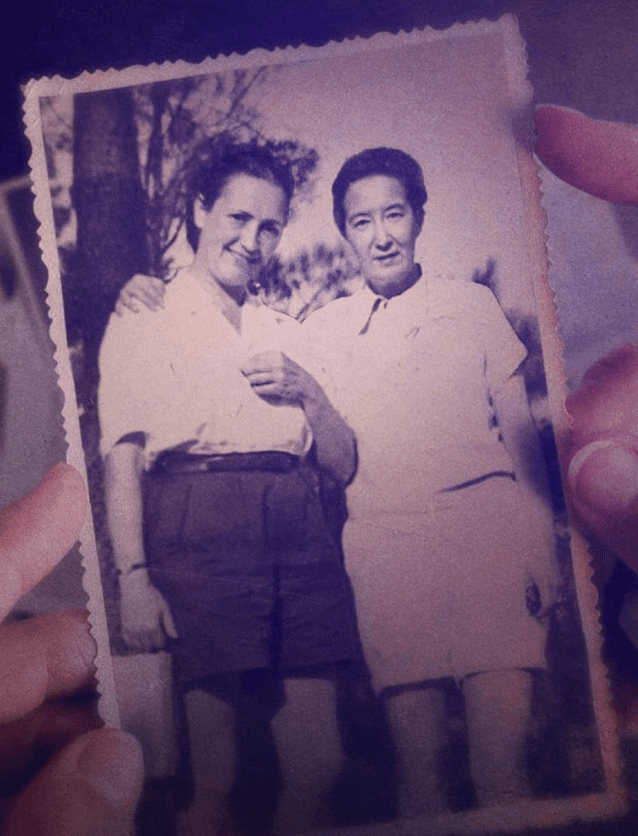
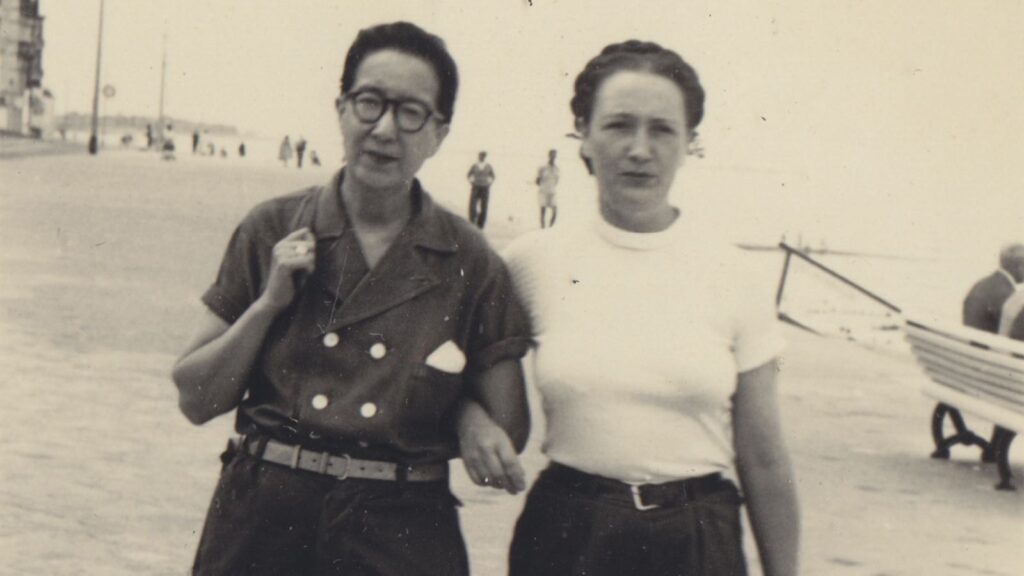
Old photographs and home movies revealed what the mysterious Nadine looked like. She had a tall, elegant figure with short dark hair and often dressed in trousers, a shirt, and tie. Born in Madrid, Nadine Hwang (1902-1972) was the daughter of a high-ranking Chinese diplomat and a Belgian mother. She was educated in multiple languages.

Nadine moved to Paris in 1933 and became part of the feminist/lesbian circle around Natalie Barney (1876-1972). A playwright, poet and novelist, Barney hosted a salon of notable artists and writers at her Left Bank home. Nadine became Barney’s chauffeur and one of her casual lovers. Nelly’s memoir stated that Nadine helped at-risk people escape from occupied France to Spain, which led to her arrest and transportation to Ravensbrück in May 1944. 

Nelly and Nadine

By Christmas Eve 1944, Nelly was forced to perform  carols. Nadine called out a request. 

With Nelly and Nadine meeting in the camp, their relationship became intimate and passionate. Against all odds, their love for each other kept them alive. They were separated when Nelly was later transported to the notorious Mauthausen concentration camp in Austria. Forced labor in the stone quarry usually meant death, and Nelly was close to the edge at this camp. Her intense memories of Nadine kept her going. As it happened, this was late in the war. 

The film shows a poignant clip of a movie taken in 1945 when a group of liberated prisoners from Ravensbrück arrived in Sweden. You see the faces of the survivors deliriously happy to be alive and start their recovery. Nadine was in that crowd. Hers was the only sad, tense face. At the time, no one understood the reason. Nadine was thinking of Nelly. Was she alive or dead?

By some miracle, Nelly had survived, and they found each other again. 

The real reel — my own story

What followed after the war was the story of so many gay men and women before the gay liberation movement of the 1970s. 

I know because I was around then. 

In 1965, I was a sophomore at UC Berkeley when I phoned my father from the dorm. I told him that I wasn’t returning home for the summer. I’d met someone I wanted to be with, someone I loved. Her name was Caitlin. My father exploded, calling me a child, an infatuated fool. He told me to come home or all financial support would end. 

I went with Caitlin, and my life became one of desperate struggle to stay in school and graduate. But I did. 

The price of being honest and true to oneself was so high that gay people had to make heartrending decisions. Some had secret lovers under the beard of a straight spouse. To keep a career and paycheck, one’s real private life was never spoken about at work. Coming out meant stiff societal consequences (even criminal in the case of men). On the streets, fluid gender or flamboyant clothes raised the risk of being beaten or killed. 

Not to compare to the camps, but no gay abandon for society’s rejects, either. Despite the passage of marriage equality and wider acceptance, it’s still tough out there for so many.

Buenos Dios, Caracas

Nelly and Nadine were likewise determined to live free and honest lives. Staying in Europe was too painful after what they experienced in the camps and too close to Nelly’s family. 

(Photo courtesy of  Egildes Rivero via Unsplash)

They picked Caracas, Venezuela — sunny and inexpensive with available jobs for educated, multilingual Europeans. The home movies showed them relaxing and entertaining their queer friends. They lived as partners until Nadine died in 1972.

Especially moving was the way Nadine filmed Nelly at their Caracas apartment. She caught Nelly deep in her own thoughts. Her face reflected a profound inner sadness, as her time in the camps could never be forgotten. One can only imagine that those memories were crushing and tragic. 

(Photo courtesy of Frameline48)

But she had Nadine, and they endured those memories together, always together. Love is love, that’s all, and that’s enough.

Sunset on the Mountain, Sunrise in My Head

At times when I am faced with life’s inevitable challenges, my initial and persistent thought is “I’ll never get through it this time.” But I’ve come to realize each time that I have made it through, and I will continue to, because that’s just life. I like to think of myself as an optimistic, go-getter type of person, but I can’t deny that I also have a very defeatist mindset. 

Defeat — I can’t think of any better way to describe the feeling of wanting to give up when you can’t seem to find it in you to take just one more step. We’ve all heard it before that “Nothing good ever comes easy,” and these honest, encouraging words prevent me from giving up.

No matter how big or small your struggles are, it requires a great deal of courage to persevere and overcome them, invariably an extraordinary achievement to be proud of.

Walk your dogs!

It may be nothing much to some, but one of my favorite things is taking my sister’s dog, Mahina, out for an evening walk. Such a small yet fulfilling task gives me a sense of accomplishment for being an average person.

Most people in their day-to-day lives don’t see waking up or getting ready in the morning as a burdensome chore, but unless you’ve hit rock bottom, you may not realize how great it is to have the ability to complete such simple tasks with ease. Lately, this pressure has been lifted off my shoulders, but like dust collecting on a high shelf, it always returns no matter how many times I thought I got rid of it.

With the slightest ambition after a long weekend, I grab the dog leash as Mahina pops her head out from her napping spot behind the couch and comes running to the door. I am content to see how excited she is to go for a walk, and that it is enough to get me through what little of the day is left. 

As always, there are a handful of families at the park with all their children running around, playing soccer together, and a few familiar faces of those who also take their dogs out at this time in the evening. This hour seems the most serene with the sun starting to set, a cool breeze blowing, the lines of cars coming home from work, the overgrown weeds tickling the side of my ankles, and the wafting scent of someone grilling dinner in their backyard.

Amongst everyone around me experiencing their individual lives, I find myself as just another regular person taking a walk in the neighborhood park. In moments of bliss like these, I stop wherever I am and just think, ‘I am so happy right now. It was worth it after all,” because it always surprises me that I survived through all the struggles when  I thought I wouldn’t make it past that day. 

(Photo courtesy of Seth Cottle via Unsplash, of Kualoa Ranch, Kaneohe, Hawaii, USA)

With the faint sound of people talking and laughing in the background, I held my phone up closer to my face listening to the soft ringtone and waiting for my friend, Kaden, to answer my call. I asked to see what he was planning for all of us to do the following day, and was shocked to hear him reply with “The boys wanted to go Koko Head.” 

On my way back home, I tried to distract my mind from how intimidating just the thought of it was, and enjoyed the calm last scenes of my walk with Mahina.

Sunset with a view of life

But I wake up the next morning with the same lack of energy and wearied mindset of just enduring the day as much as I can. I am sitting in the passenger seat of Kaden’s car pulling into the parking lot of Koko Head, wondering why I even agreed to do something like this when I barely have the motivation to get out of bed. 

I drag my feet along just to meet up with some of the boys at the bottom, and realize that the hike hasn’t even started yet. Everyone else starts stretching, but instead, I sit on the curb of the sidewalk and stare down at the asphalt road in front of me. We haven’t even started, and I am looking weary and feeling defeated. It is late in the afternoon, even for summer, and the sun is already beginning to go down. As soon as the last few of our friends arrive, we begin to make our way up the steps.

Step after step. 

After step. 

After step. 

After a while, the exhaustion consumes my mind and body. I pause in my tracks and look back at the thousands of steps I have already taken. But when I face again towards the top, I realize, why come this far, to only come this far? 

From this point, I can see the top, but only if I look up high enough beyond the incline. The last couple of steps are just within my reach, yet miles away. I start to feel the burn in my quads and tiredness in my body from only drinking water the entire day, realizing that I forgot to eat anything. Anything. It isn’t even the hunger in my stomach or the pain in my legs, but the mental exhaustion that makes me want to give up. It takes every ounce of energy in me to make another step, after step, after step. 

Finally, I reach the top and immediately sit down on the graffitied concrete wall next to my friends who are waiting for the rest of us. The sudden transition from intense workout to immediate rest rushes a wave of weakness over my faint body, but the feeling of achievement is surely fulfilling. 

I find solace and hope in being able to proudly hold my head high while staring out at the view from the top of a mountain. In a brief moment, I catch a glimpse of the beautifully painted orange sky seconds before it vanishes. I could not feel any more relieved than from letting the cold, thin air blow through my hair, listening to the sounds of crickets chirping, and watching the faded remnants of color leave the sky as night begins to fall. 

You won it, you own it

This experience seemed oddly similar to my walk with Mahina from the day prior. At the end of the day, between celebrating the act of taking a walk outside and hiking to the top of a steep mountain, I was able to conquer something I thought I wouldn’t be able to. 

It didn’t matter on a scale of how large or demanding the activity was, I was proud to have pushed myself to overcome it. Truthfully, nothing good ever comes easy, and perseverance is all a part of the process. 

The sun sets every day regardless of who you are and what you’ve experienced. It is a reminder to us all that it is worth it in the end, to persevere through challenges and to be proud of what you have accomplished.

(Photo courtesy of Taisia Karaseva via Unsplash, of Koko Head Park Road, Honolulu, Hawaii, USA)

‘This Is Us’ — The Drama of Body Shaming, Diversity, and Conflict on My TV

Being a voracious reader since forever, I have always been a sucker for a good story. Unwittingly, I tend to submerge myself in characters  so completely that for those few moments I belong entirely to them — crying with them, laughing with them — oblivious of the tear rolling down my cheek or the smile plastered on my face, participating in their glee as well as their grief.

So when I came across “This Is Us” on NBC.com and Amazon Prime, my curiosity was piqued for many reasons. It all started with a news article that caught my attention. Highlighting the acting chops of the mellifluous Mandy Moore, this piece even flirted with a possible Emmy run, witnessing a meteoric rise in popularity. It was a running dual role of a young mother of triplets in a storyline oscillating between the past and present day where she plays an older woman eventually confronting an impending age-related disease.

Eager to see Moore on screen after a long time, I dove right in. 

Image of a person pointing a remote control at a tv.
(Photo courtesy of Erik Mclean via Unsplash)

Family and mental health

I was hooked from the first episode. The pairing of Milo Ventimiglia and Mandy Moore as husband and wife is nothing short of a masterstroke. The passionately in-love, all-in superhero father and husband played by Ventimiglia, masterfully exuding the perfect cocktail of gravitas, charm, compassion, bravado, humility and problem-solver dad had my full attention from the get-go.

Inarguably, if Ventimiglia is the ship that keeps the story afloat, Moore and her immaculate craft are the sails that propel it all forward. With a few charming smiles that age gracefully much like the rest of her, Moore lures you in and makes you believe that Rebecca Pearson is who she is now and forever; that we can never go back to someone called Mandy Moore. Hailing from different worlds, these two characters fit like two broken pieces of the same whole, glued together by their own impervious love.

Unlike other gripping shows that I tend to binge-watch at optimal speed, I took my time with this one. Like a fine wine that is savored and relished with every sip, I took my time to unearth the treasure trove of familial bonds. In particular, between the Pearson triplets  —  the imperfections, the fractious relationships that conversely also formed the cornerstones supporting the reformed relationships of their later years.

Well-embroidered

What I loved the most was the brilliantly and most intricately sewn layer upon layer of not just the broader base story, but the amount of light shone on the unraveling of each character’s backstories and underlying complexities. 

Three siblings who could not be more different, battling their own unique demons since their childhood, deliver a poignant and relatable lesson on the importance of staying united as a family, even in periods of estrangement and coming together to lift up loved ones. I also noted how their father’s influence pulsates through these characters in all they do as their lives progress.

Pick a social issue

In its ingenuity, the show has incorporated important global issues like racism, body shaming, eating disorders, LGBTQIA+ living (seniors and teens), child disabilities, anxiety and mental health into each of its character stories.

How this family comes together for each of its members going through one of these issues, and how the show successfully manages to normalize these conversations is what struck me. Especially those plots under the category of mental health like Randall Pearson’s unrelenting anxiety issues, Kate Pearson’s damaged self-esteem with her weight, and Kevin Pearson’s enormous pressure on himself to live up to the man his father was. Kevin finds himself failing miserably at every step; he’s kind, but not the deepest. 

Affection in our homes

Even an aging Rebecca in the throes of an impending disorder still battles with profound grief after many years, and brings forth the importance of mental health patients. Conversations that need to start within the four walls of our own homes. 

Especially today, on the heels of a gradually quieting global pandemic that upended lives and fractured relationships, the need for families to double down on regular public displays of affection — especially in front of and with their children — is important in my life.

This is something I circle back to often. When I grew up, there was a clear lack of public displays of affection. We just weren’t “huggers”. It didn’t help that the society that surrounded us when we were growing up, and continues to dictate the acceptability of such acts of physical affection in public like hugging and kissing, also ostensibly made such desires within many families within their realm stay away from it. Or perhaps be more conscious of it. This was something the series hit home for me too and I find myself consciously making an effort to encourage physical gestures of love towards my siblings by modeling it for them too.

Diversity and body shaming

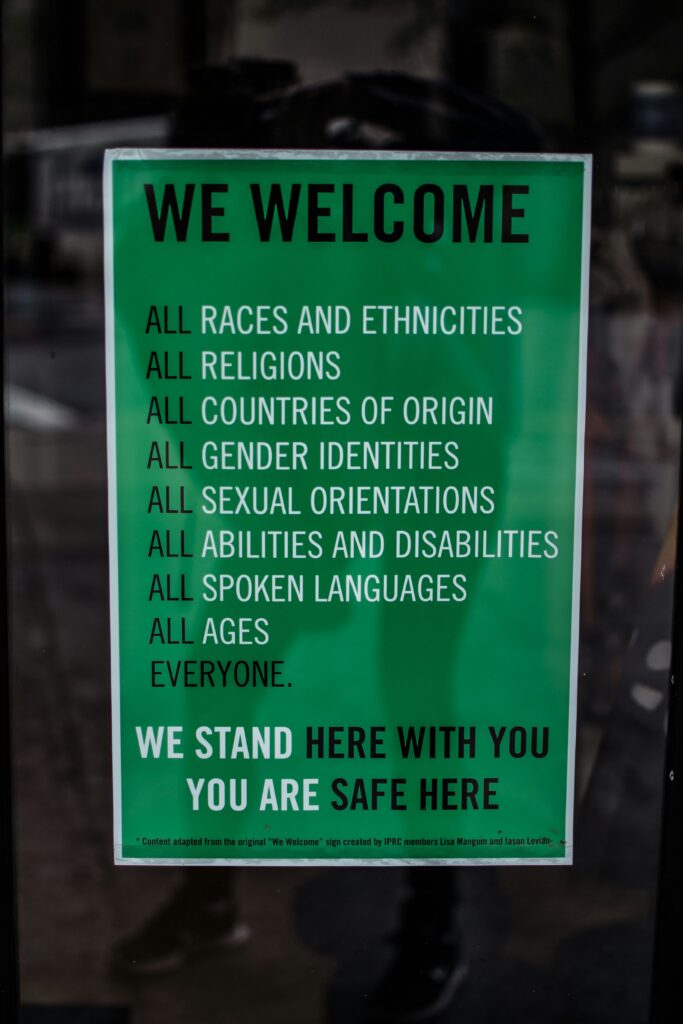
Image of a sign that says, “We welcome all races and ethnicities, all religions, all countries of origin, all gender identities, all sexual orientations, all abilities and disabilities, all spoken languages, all ages, everyone. We stand here with you. You are safe here.
(Photo courtesy of Brittani Burns via Unsplash)

In the early 1980s, a white American couple with twin babies adopts a third, an African American newborn abandoned by his father at a fire station. Steeped with the versatility that very few others possess, the inimitable Sterling K. Brown plays this grown-up Black boy, Randall Pearson, who was born to a black family but raised by a white one and was still trying to unearth the full story of his biological family’s checkered past. The show acts as the conduit that brings forth the harsh racism that people of color have been subjected to since time immemorial and still in the period in which the show is based.

It’s a wake-up call to recognize that the difference in color cannot and should not overshadow the sameness of all humanity. We often tend to begin this very important and urgent education too late. Just the other day, when my three-year-old son said that he did not want to play with our house help anymore because she was “dark” in color and not “white” like us, I knew that this education hadn’t started soon enough. A three-year-old doesn’t fully understand the weight of his words, but unwittingly he brought forth the urgency of handholding and guidance on this issue at the toddler stage itself.

Mental health too, remains a core and underlying commonality permeating the essence of the entire show and through all the time periods. Randall Pearson grew up with a white family that was so busy trying to give him a “normal” childhood that they never once addressed his “blackness” and the baggage that comes with it. Or how it could be affecting him and his curiosity to know more about his community and where he really came from. It is one of the main reasons his relationship with his siblings is consistently complicated.

When I think of how my four-year-old is learning to embrace his classmates who come from all cultures, races, countries, sizes and colors of skin, and how all of this is their “normal” right from the get-go, it fills me with hope for a more inclusive, loving, and broad-minded future.

There’s more 

A very overweight Kate Pearson struggles with weight loss, the inability to have a child, multiple failed IVF attempts, and ultimately the success of surrogacy while her best friend is struggling with the eating disorder bulimia. So many issues in this one sentence that go tabooed, unspoken, ill-approved, hushed-and-brushed under the carpet in so many countries and cultures even today. So many issues that for the most part only garner sneering spite instead of support. 

The effortless execution of the portrayal of all these important issues in the show is noteworthy. They don’t all resolve.  And then, there is illness [please ensure that the text in peach isn’t visible to the reader until they click after Spoiler Tag Alert to reveal it!] Spoiler Tag Alert Alzheimer’s disease is addressed across an arc of episodes.  This one hits close to home as it was what took my grandfather from us almost two decades ago. Moore’s portrayal of a woman who has just been diagnosed early with this neurologic disorder is Emmy-worthy in my book.

Aging in the four walls of our own houses

I was still in school and too young to fully comprehend that this evil disease was slowly but surely consuming my grandfather — shutting down his organs bit by bit inside the four walls of our own house. In many ways, this show that I watched decades after losing him is a sort of closure that I needed and didn’t fully understand that I needed back then.

I can write a whole book on why this show is a must-watch, but that would be tough to do without more spoiler alerts! It’s a riveting, heartwarming and stirring watch for everyone in every capacity — as a parent, a mother, a father, a wife, a caregiver, a child, a friend, a partner.

These are our stories too. 

There’s a reason they call it “This Is Us.”  

Two images of ducks in water. The photo on the left has a mother duck with her ducklings, while the photo on the right has just one adult duck.
(Photo courtesy of Siegfried Poepperl via Unsplash)


Toxic Words

Every language has thousands of words, and the ones we choose, I believe, almost always reflect who we are, what we feel, and what we want to communicate. I say “almost always” because I have never been fond of certainties, and I consider doubt an essential element of life, as to not judge people based solely on what they say. 

Sometimes, I too have said something rude in a moment of anger, but soon after came regret and most of all, the realization that I had made a mistake. No one is perfect, but when the words that are now called “toxic” are repeated and become a deliberate and ongoing way to hurt, then it becomes a conscious intent to denigrate and offend.

Who has not heard the old saying “actions speak louder than words?” 

It is a concept that seems extremely valid to me, but sometimes we forget that words have weight. With thousands of words at our disposal, it is reasonable to assume that most of our linguistic expressions in life and social communication are the result of a choice. Unless fate (or whatever else governs human life) intervenes in our lives, when we speak to another person, we should be careful not to offend the sensitivity of our interlocutor.

Recently, while reading a website of aphorisms, I was struck by a quote by author Rhonda Byrne. In 2006, she wrote the essay “The Secret,” which I plan to read soon, discussing topics related to personal growth and inner development:

            “It only takes a minute to cause hurt but sometimes a lifetime to repair.”

The author puts “words” first and then “actions”. This does not seem to me a coincidence. Words are a way to convey positive feelings, but also to express violence and aggression toward, for example, fragile people.  

Human beings cannot live in isolation. We all often need affirmation, support and help from those around us. I believe that the freedom to express one’s opinion does not preclude the ability to do so with kindness and tact.

My best friend had been the victim of a truly toxic relationship. When she introduced me to her new boyfriend, he seemed to me like a serious and polite young man. He was elegant, handsome, and behaved like a gentleman from another era.

But from the very first night, I could tell that something was wrong in their relationship. There were four of us at the restaurant table where we had made reservations: myself, my then-boyfriend, and the two of them. As the waiter served the first course, my friend’s boyfriend began to share anecdotes about their fledgling relationship.

“You know your best friend can’t cook? And if you saw the mess she makes in the washing machine! She ruined two of my shirts. She can’t even read the washing instructions.”

Throughout the evening, he criticized every one of her actions. As he spoke, I wondered: “How can a man in love only point out the faults of the person he is with?”

Maybe my friend was not perfect. Maybe it was true that she could not cook or use the washing machine. But where is the line between truth and contempt? The point was not to be hypocritical or to hide my friend’s flaws, but to choose words that wouldn’t make her interpret it wrongly and feel inferior because of her minor shortcomings. 

I tried to resist the temptation to confront him in front of everyone in the restaurant, and at the end of the evening I took my friend aside.

“Do you realize that all he did was criticize you? How can you live with someone who doesn’t appreciate you?”

“He has never laid a hand on me, if that is what you mean. He is not violent.”

But I knew that violence does not always manifest itself in actions. There is also a subtle and invisible form that is transmitted through words.

When I told her to leave him, she shrugged. She had always had a difficult home life and a troubled relationship with her father. But she had chosen a man who was even worse.

Every word he spoke was meant to show contempt, to belittle and manipulate her. He wanted to make her feel bad about the smallest things, as if he wanted to prove his superiority.

There was nothing I could do at that moment. The choice was not mine. I could only offer her my support and tell her that I would help her at any time. A few months later, I got a call from my friend. She had left their home. She had reached a point where tolerating it was no longer an option.

This is why I believe we must choose our words carefully when interacting with those close to us. Sensitivity is a value that should not be sacrificed to selfishness.

This is why Rhonda Byrne emphasized the importance of words. How we use them surely reveals the kind of person we want to be.

Finding Community in Identity: Discovering My Autism in Adulthood

I’ve spent my whole life feeling like I didn’t truly fit in with anyone around me. I’ve always felt there was something “off” about me. It was as though everyone except me received a user manual for how to be human.

It took me 25 years to realize that the reason I felt different from most people is that I’m autistic. But due to my lack of education on the subject, I went that long without even knowing.

Unraveling the signs

Most of my behaviors and a large part of my personality are a result of my autism. But only late in my life did I realize there were names for how I navigated and experienced the world. 

Sensory issues

Growing up, many of the clothes I had bothered me so intensely to the point where the seams or even the type of fabric were all I could focus on all day. Sounds that were too loud to me but not to others led me to cover my ears and want to leave the room. These are only two examples of the many sensory processing issues that I’ve experienced my whole life.

(Unsplash/Majestic Lukas)

Special interests

Whenever I find something I enjoy, whether a hobby, show, book, or topic, I go all in. I want to know everything about that thing, so I spend many of my waking moments thinking about it. For months or years now, much of my life has revolved around my current special interest or hyperfixation. The intensity of my interest in a particular topic goes beyond what most people enjoy.

Shutdowns and meltdowns

I can also get overwhelmed by emotions or sensory input. As a kid, this presented as wanting to withdraw from the world, and usually speaking became difficult and energy-consuming. I still get periods like this, and they can last as long as a few hours to some days. Now I know these are called autistic shutdowns. I also experience autistic meltdowns, where I get so overstimulated or upset that I sob uncontrollably and find it difficult to calm myself down.

Social communication problems

I’ve always found it difficult to express and read people’s emotions, facial expressions, and intentions. For a long time, I called myself “socially awkward.” I often take others’ words out of context and struggle with social cues. While I’ve gotten considerably better at socializing with others, it’s still like speaking a foreign language, and the native speakers can tell it’s not my first language. 

My hardships with social skills have led to many misunderstandings and miscommunications. Since I was a toddler, keeping up with conversations and coping with social situations has been difficult.

Structure and routine needs

I thought I’d eventually grow out of my “weirdness” as I called it. But that didn’t happen. As I grew into adulthood, my problems only seemed to exacerbate. At 18 years old, I got my first job in retail. After that, I held positions in journalism and teaching. These jobs required a lot of spontaneity and lacked routine. Because of this, I struggled. I found myself hopping from one job to another to avoid what I now know are shutdowns, meltdowns, and burnout.

(Unsplash/Christ Montgomery)

A sense of belonging

In my mid-twenties, I came across autistic people’s stories and videos on my social media feeds. I related to most of what they said about their experiences with autism. After months of listening to this community and doing my research, I began to identify as autistic. It felt like I had finally found other people like me and I wasn’t alone in the world.

In late 2022, I pursued an official diagnosis. I found a local psychologist who offered autism diagnostic services. For several hours, he interviewed my mom and me about my entire life—from birth till now. Afterward, I received a six-page report that confirmed that I was, indeed, autistic.

Knowing I’m autistic has helped me realize I’m not the only one who feels this way. I now know I’m not “weird” or alone. I’m just autistic.

Since my diagnosis, I have found a community of people who understand me. I feel like I’ve discovered “my people.” I have made friends with other autistic individuals online who share similar special interests, communication styles, and ways of existing in the world. My allistic, or non-autistic, friends and family are lovely. Nonetheless, it’s been a breath of fresh air to forge relationships with people who process the world like me.

Finding community

This newfound sense of belonging has inspired me to share some tips for anyone who might be feeling different–autistic or otherwise.

  1. Don’t do it alone

Find online groups, forums, hashtags, or even in-person meetings related to a particular interest, feeling, or experience. Hearing about other peoples’ experiences and, even better, interacting in these communities can help build connections with like-minded people. This can foster relationships with dozens, hundreds, and even thousands of others with similar experiences.

  1. Keep an open mind

Be open, honest, and vulnerable. This can be challenging, especially when feeling like an outcast for certain traits, behaviors, or hobbies. But by sharing stories, you will find others with similar experiences. Speaking from experience, authenticity leads to a more profound sense of belonging.

  1. Embrace support

Get support from people who have had those experiences. Getting advice from those who have already walked that path is helpful in getting a headstart in understanding. Other people can offer valuable insight and new perspectives to help with growth and adaptation.

  1. Give yourself time

Don’t rush the journey. It can take a while to find the kinds of people with similar traits and interests. But even if it takes time, those people are still out there. Building relationships with new people can be difficult and time-consuming, but it’s worth it.

Embracing my difference

Since finding a community of like-minded people, I’ve grown a lot. I’ve forgiven myself for many of my social shortcomings and emotional outbursts that have stemmed from my autism.

I didn’t need to hold myself to such high standards anyway, but knowing that I have a disability that hinders me from navigating this world in the same ways as others has helped to understand why I feel the way I’ve felt my whole life. I no longer feel the need to meet the expectations of a society that is not optimized for autistic people.

(Pexels/Min An)

I’ve also been accommodating myself more. I bought noise-canceling headphones to help with sensory overload. I set boundaries with others when I’m not feeling like socializing. I avoid situations where I know I’ll get overstimulated. I’ve started “unmasking” my autistic traits, which means I’m not hiding them as much as I used to.

I have also found beauty in what I have realized are autistic traits. A few of these include my strong sense of social justice, intense passion for my special interests, and great attention to detail. I cherish these aspects (and more) of who I am now more than ever.

There’s nothing wrong with being different. But it’s great to know that my difference has a name and a community. I hope everyone can find their community filled with people that understand them because it’s a beautiful discovery. For me, it has brought me a sense of belonging and self-acceptance that I didn’t know was possible.

From Academia to a Gompa and Back: How Retreats Brought Me Full Circle

Enmeshed in a busy year working at my academic office at my university, I thought about attending a retreat. I wanted some relief from the tiresome routine.  As a postgraduate student, I was embroiled in a substantial project of completing a research dissertation. The subject I was working on was philosophy/theology and ecology, and I enjoyed it. This was the year before the arrival of Covid-19, and there was still a bustle around the corridors and offices of the School of Humanities. 

Added to my research paper,  my academic duties included reading and grading assignments, attending lectures, and giving an occasional lecture to students enrolled in the Genre Studies unit. These were fairly light duties for any casual academic. For me, the burden of resolving the complicated subject matter of my research was most challenging. Sitting long hours working on it, I sometimes found it hard to concentrate, and I would try to find a way to clear my mind, mostly by strolling in the university gardens. 

In the garden, there were trees, lawns, and walking tracks. Refreshment corners with coffee and snacks were also available in various locations on the campus — a campus good enough to refresh and recharge oneself. But I realized these moments were not refreshing enough. I needed more than these small havens on the campus, and a fuller break from the responsibilities of my work. Perhaps it was time for a course in contemplation.

I could usually recover by retreating into my quiet office space, writing, researching, and listening to classical music. This still works well for me, but the internet remains a constant distraction. When I was offered the opportunity to go on a retreat, I decided to go for it, so I booked a spot for the mid-term break.

Most retreat centers are located in bushland — remote woods away from town and the internet — areas of complete solitude. They are close to nature and use solar power and tank water. It could be rough to keep the tablets, pads, laptops, and phones always charged.

The silence here was so exciting
My first retreat was a combination of daily meditation “sits” in the gompa  (silent sessions in the meditation hall), sleeping in a caravan, and engaging in the crack-of-dawn writing bouts lit by battery-operated lamplight.

(Photo Courtesy of Maria Orlova via Pexels)

On my first flush of morning in the retreat, the bush was quiet. I knew that soon, the birds would begin to stir in the sky.  I was writing a paper to present at a conference on theology, while also working on completing my thesis. My computer, with its e-book library, was my essential equipment, and that early morning quiet time alone was inspiring. 

Well before daylight each morning, I would walk up to the kitchen to fill a thermos with coffee. On the way, I might encounter kangaroos pausing watchfully in their paths, waiting to discover my intentions. I would practice a kind of gentle meditative walking, hoping they would not be disturbed by my presence. Soon, they would bound off, either down the valley towards the dam or into the bush, and I would continue walking, but now, I had a deepened connection with my surroundings. In the retreat center in a mountain range in northern New South Wales north of Sydney, the early spring air was crisp and clear.

The air

What a joy to have access to such clean air in the tranquil bushland!

Each morning during the break, I would sit near a small pond at the edge of a stand of gum trees, where spring wildflowers were blooming. Sometimes, the teacher would come and sit with me, and we would discuss a Zen verse or the Heart Sutra.

(Photo Courtesy of Pat Whelen via Unsplash)

Then, we would return to meditate in the gompa. Here, a statue of Buddha sat before the window on an altar with smaller statues and photos around him and lovely flowers and incense offered to him. It was a serene space at the top of a hill, surrounded by native bushland and flat sandstone rocks from which a view extended across the valley to the south. Inside the gompa, it was silent, apart from the occasional rustle when other meditators adjusted their posture. A stillness descended over the space as participants focused on their breath, beginning to release thoughts of the outside world and various day-to-day activities. 

(Photo Courtesy of Jared Rice via Unsplash)

At night, after the last meditation, the constellations of the Southern Cross and the Pointers were brilliant among the bright star fields beyond Earth. 

One thing I learned was that no matter what might appear to be going on within my fellow attendees and myself or in the memories that arose during meditation, it would always be our own personal “stuff” that would come up, simply so we could become aware of it. It was only after several uncomfortable sessions with a busy mind that I found the best way to do that. It was to alternate a sitting meditation session with one in which I walked outside or stood among the wildflowers, attending to the birds while, as earlier in the day, emptying my mind of thoughts. 

(Photo Courtesy of Adana Durso via Pexels)

Silence would sometimes pervade my awareness of those airy heights, at least for a while.

When the last day arrived, we cleaned the gompa, the kitchen, and the caravans and left the Retreat Centre around lunchtime. The next day, I returned to the university, and my mind calmed as I settled back into my office. The world seemed brighter, and my random thoughts only came occasionally and more quietly. I knew I would be able to return to academic work, but now with a peaceful mind. 

Soon, the paper was finished and ready to be presented. It was time I made some real progress in writing my dissertation. 

A Change

My mother always told me that I was her sunshine. Not only is this because my name is Summer, but also because I was the only daughter in the family and was thus treated like a princess. I was told I would do great things in life and to always follow my dreams, so I grew up having many ambitions. I wanted to be a princess like many of the other girls in preschool. In elementary school, I wanted to be a teacher and an FBI agent. When I got to middle school, I wanted to be a therapist. Finally, in my high school years, I decided I wanted to be a profiler. This decision wasn’t just influenced by the many, many TV series of cop shows like Forensic Files, Law and Order, or NCIS, but also because of my brother.

To explain what I mean, I must start from the very beginning. As a single mother, my mom was always working. She started her day at 3 am and ended it by 6 pm, taking a total of three different buses in order to take her kids to and from school at the same time. To me and my second oldest brother (Zach), our oldest brother (Josh) was like our father. My mom was too poor to afford babysitters, so that’s what Josh became.

In a way, Josh had given up his childhood for us. 

I think that’s why he changed; because of the responsibilities bestowed upon him from such an early age. Not only was he essentially a father to kids who weren’t his, it meant having to solely raise us right while Mom worked.

With all that responsibility and pressure, he constantly struggled with his mental health. Some days, I would catch him looking out of our nine-story building – which we were lucky enough to have – to a backyard beach. In those moments, time seemed to stand still. Moments like that were ever fleeting though when you are surrounded by kids who constantly bicker.

(Unsplash/Sasha Freemind)

Introductions

One day, Josh brought home a girl. Now, my brother wasn’t one to date very often, nor did he usually bring girls over. With a mom who constantly had an opinion about every little thing we did, it’s not a surprise that none of us ever brought anyone home. Although we ultimately knew it was because she was just looking out for us, it was the way she did it that bugged us. She always started with this smug look, a look that always threw everyone off.

This first girl Josh brought over was very soft-spoken, nice, and had much in common with him. I would even go so far as to say they were practically the same person. She was the type of person who just clicks perfectly at the first meeting when you’re young, and you idolize them as the coolest person ever. 

She stayed in our lives until I was about 11 years old.

There were times in their relationship when she and my brother would “take breaks,” but they would always end up back together. In hindsight, this possibly could have played a part in my own future commitment issues. Seeing those breaks made me realize the hardships of being in a serious relationship, a relationship – platonic or otherwise – that I thought I would never find myself in. 

The different faces we hide

As time went on, things began to change. 

Do you remember being younger and having everything hidden from you, whether out of necessity or compassion? More of those lies began to appear in our family from this point on, ones kept specifically from me so as not to dim my sunshine.

Looking back, I can see what a good liar my brother was; how easy it was for him to hide his millions of emotions behind the biggest smile in the world.

Don’t get me wrong, he still absolutely refused to smile in pictures. When he did, though, it would light up the entire room. When I did eventually recognize the mask he wore, it was a real eye-opener. This man, the one who raised me and who had become a saint in my eyes, had been facing his demons the whole time. 

My brother has had his fair share of this cruel world since he was just a kid, including going through my mom’s many mistakes for lovers, and his dad, who could barely get himself together for his son. 

No one is perfect, including my family and I, and living in Waianae certainly didn’t make things any better. We grew up having little money and only one income to support the four of us; That’s barely enough to live on in Hawaii.It made it easier to be drawn to things you never thought you would have the means to do. 

You’ve probably heard a lot of times that smoking cigarettes or vapes are “gateway drugs.” Well, it was that previously-mentioned sweet girl who introduced my brother to these drugs. Addiction ran in my family and in Josh’s too, and this made the difference between this girl and my brother ever more apparent; she was able to stop when she wanted to.  When she finally left for good, he refused to get clean. After all, when you have addiction problems, there is a lot you’ll do before you stop. 

The spiral of addiction 

Years went by as his addiction grew more intense until he finally couldn’t hide it from us any longer. By that point, we had moved in next door to the soon-to-be “chronics” – a fancy way of saying drug addicts in Hawaii – who only worsened it.

I couldn’t believe just how different my brother was becoming. I never imagined I would ever feel the need to leave a room or hide when he entered. Soon, I was even terrified to be home or around anyone at all. It was like watching a perfect flower blossom only to wither, just to see him deteriorate and lose his mind. 

People say home is where the heart is, a saying that was becoming less and less true for me, because home was a place I was starting to despise. For one thing, it was the place where I had to be constantly on guard because of my brother’s new and questionable friends. One time I was even woken up by one of them sneaking in through my window!

One incident that stands out

It was late one night. I had just finished showering in the girls’ bathroom in my mom’s room and was heading down the hallway towards my room. Right in the middle of that hall was the boys’ bathroom. 

Trying to be as quiet as I could – because Josh was in the boys’ bathroom – I sneaked to my room and made it safely through the hallway when I heard him finally exit the bathroom.

It was rare for my brother to ever yell at me.I was so scared of my brother’s anger that I did my best to avoid his bad side, and as a result, he completely spoiled me. I never got yelled at because I was smart enough not to push his buttons. 

But my brother was different now. He no longer had sympathy for anyone, swearing they all hated him and were constantly talking behind his back. He would sometimes even tell me he could hear voices in the walls speaking to him, voices that revealed what we would say when he was gone. 

This time was no different. Accusing me of speaking about him behind his back, he started screaming so loud that it woke my mother. She immediately rushed out of her room half-awake to see me cornered near the closet. My eyes were full of tears as I looked at her, pleading for help. She quickly swooped in to defend me.

That was my mom’s last straw. Soon after, she finally kicked Josh out, which was probably the hardest thing my mother ever had to do. She is a strong lady with her own share of trauma that made her empathy never-ending. In her eyes, no one deserved to be pushed away like that until absolutely necessary. 

My struggle to understand

For the longest time, I never really understood why my mom put up with Josh for so long or even why my brother had switched so drastically. It made me question their actions. Why only then were they unable to control themselves? 

I decided to look for an escape and turned to the shows I loved best: True Crime TV. I came upon this one show called N.C.I.S., a show that constantly relied on a profiler. A lot of shows I watched had profilers on them, but it wasn’t until I realized that I wanted to understand people better that I really started to notice them. In N.C.I.S., the profiler could read people like the back of her hand. 

You’re probably thinking that shows like that aren’t completely accurate and, trust me, I know. But it was the fact that she understood everything that really caught my attention. It was a way for me to finally understand my brother’s reasons as to why he turned to drugs, and the reason my mom had so much empathy for people who deserved so much less. If it had not been for my brother and mother showing me such a change and putting me through those experiences, I probably would have been an entirely different person. A teacher, perhaps, or maybe even a princess.

(Unsplash/Marija Zaric)

In Experience: Reflections of a Settler

It’s all in the reflections. This account is one of my fondly revisited ones, a space for self-discovery and conscience.

Aah, I’m exhausted! It was half past two on a Delhi late August summer afternoon in 2021 when I was attending one of my tutorial classes at my college. These sessions were calming ones where we would think about life and sort of relax through such reflections. In the hustle and bustle of assignments and deadlines, I sometimes lost the excitement of these sessions as a result.

So, this circle of informal questions quickly shifted to me, and I, at that moment, was completely baffled by the line of questioning. Seeing this, the teacher asked, “What’s the most striking difference between your place and here?” 

Without even thinking, I quickly answered, “Infrastructure and maybe nothing else.” It might have been the most absurd answer she’d ever heard, but it was thankfully enough as the class dispersed, and I was left with a question. 

It was probably regret that crawled up on me, so much that I could hardly think of anything else beyond that question whenever I would travel through my place and Delhi. Like a sense of being lost in observation. Being someone who always loved to observe the uncanniness in their surroundings, it made me more aware of the circumstances, the nuances of communication, gestures and the degree of proximity. 

Okay, so let me quickly peel away the layers of silence and say it out loud that there indeed is an array of differences in the regions. To begin with, Assam, the eastern state, is a rainbow of warm-hearted people belonging to distinctive ethnicities; some of them have inhabited these lands and some have flocked in during the past two centuries. Now, they are coming to Delhi, the land that kindled hopes in millions of aspirants to finally hit a milestone in their career. It’s also ethnically diverse and inhabited by the majority of these aspiring populations. 

How can I not express the most striking reason for my discontent, which is that the food of the Eastern States, this palace of rice, undoubtedly has my heart? Well, Delhi has its own variance in serving comfort foods, but what made me kinda sick within the two months of my initial stay in Delhi was the resilient roti culture. Still, I countered it over time and developed a fondness for some traditional North Indian dishes like “kadhi chawal” and the very tender thin “rumali roti.”

On the streets, I see an abundance of greenery and, hiding in it, stories of penance and sometimes grief. This landscape sustains tales of livelihoods where every day is a struggle to make ends meet. Still, the lands do not align with the competition to tread upon the lives of one another. It is implicitly integrated into the idea of being that, in every way, there is a placid display of diversity. 

The settlers of my eastern homeland preserve a simple but magnificent culture where one can find fresh vegetable markets and brightly blue skies. One that caters for its people in “kaah” (the bell metal used to make utensils), “muga” (muga silk), and that greets one with the “gamusa,” (a woven scarf with distinct embroidery patterns.). Enchanting wall carvings and fantastically lit elaborate markets make Delhi in itself the most vibrant capital of the world to experience life and people in. The street corners are animated with students and doorways to the metro are full of hawkers and a brigade of auto drivers who are ready to even take one “to the moon.”

It is only in the humanities and liberal arts that we capitalise on the idea of learning and thinking, cultivating skills for empathetic understanding. It is in exploring these phases of my journey that I started considering things that are seldom asked. But as I should say, they do hold relevance as they become significant throughout the experiences, and give more context to someone’s story.

All in all, it was a contrasting vision that was important to help me touch the nodes of reality, somewhere where there was not only a beginning but also closure. Feeling at home, reclining to all the familiar essence of it, needs imagination. And this is one that has now become very intricately intertwined with the idea of both places. Maybe the shared idea of belongingness rents this “liking” space in my heart. Now, even though I have no permanent residence to establish here, I trust that the familiarity of the region keeps home in a close embrace.

Now that my experiences have handed me a platter full of unique exposures, I regard this as an invaluable archive of memories. These memories will stay and colour new horizons of thought and provide me with a deeper contrasting tapestry of insights. In retrospect, to my response, our professor, I would say, “Ah how embarrassing!”