Offboarding

Jasmine’s heart was working a rhythm. It wasn’t quite pounding, but she could feel the flush in her face, the warmth flooding her body. It was all so cool in her mind’s eye. The delivery of the information, the breakdown of the facts, her clinical assessment of matters, all coming off like a Swiss watch. Her rucksack sat up against the table leg to her left. She found herself adjusting its position three times before the HR manager arrived. What exactly she was adjusting she couldn’t say.

Jasmine was keenly aware of her presence and perception in the workplace: quiet, in the corner, coder, unnoticeable. She wasn’t even a coder but a junior developer. As a techie in a department of a big bank, she accepted and understood her furniture-level importance to the grand operation she found herself in. She liked the job. It didn’t set her heart on fire, but the scale of it, the money and the prestige of working for an internationally recognized bank wasn’t something she took lightly. Looking round the glossy, clean off-white interview room, a bubble of anxiety rose within her.

Her mum’s face came to mind. Mum, prouder than proud the day she told her she got this job. Rarely one to openly express a beaming warmth and celebration on Jasmine’s success, she was clearly quite chuffed with this one. It was the name, it was the status of the bank. It was being able to tell her friends at the hairdresser “My daughter works for…” Yet this was her exit interview. Just some 8 months in. She didn’t really have a story to tell her Mum. She doubted she’d understand. Neither did she have a cogent plan of what would come next. Jasmine sucked in her cheeks and pursed her lips. What was just moments away scared her.

The doubt was porous. Forget being hot and uncomfortable, she felt foolish. Had she watched too many movies? This was the right thing to do… but was it the right decision for her? Jasmine looked up at the analogue clock on the wall ahead, just a minute till the appointment, when she heard a middle-aged brogue on the other side of the door. A dull clink signaled the lowering of the door handle. Malcolm Graves entered.

***

It was a breezy work day for Malcolm, sans kerfuffle or boondoggles. The weekend was just round the corner, and he had his weekly squash game planned for 7 p.m. Margaret had booked a trip to the Lake District for the weekend, and he’d merrily scheduled annual leave for the second half of Friday and the whole of Monday. Coffee in hand and paperwork under his arm, Malcolm was enjoying the pleasant frequency of not feeling too high or too low; he remained somewhere in the middle, trouble free.

The HR department had been gifted a lighter load in recent months. There were the usual unpleasant incidents involving abusive customers from the ground floors but nothing out of the ordinary. The email inbox was not inundated, and the implementation (and creation) of new policy had slowed compared to the heady days of some 5-6 years ago. Malcolm, in truth, had never met Jasmine. He had the name on file but didn’t recall it upon being assigned the exit interview. When he looked at the job description, he couldn’t tell you exactly what Jasmine did and well, with her being a techie, he entered the room with no qualms.

“Jasmine,” Malcolm briskly stated on entrance.

“Hel—“

In a flurry of nerves, Jasmine nearly tipped the interview table upon standing to greet him.

“Oh, careful there. That desperate to leave us, are you?” Malcolm gently ribbed, reaching a hand out to shake Jasmine’s.

Jasmine let out a nervous chuckle before gripping Malcolm’s hand, only making the briefest of eye contact. Malcolm could feel the anxiety radiating off of Jasmine, and he had to resist the impulse to wipe his own hand down; Jasmine’s was wet with sweat.

“Dear God,” he heard his inner monologue proclaim.

“These IT guys really do struggle with human interaction.”

He maintained his warm, off-handed, yet smiley demeanor. He guessed Jasmine was, at most, in her early 30s. Large glassy eyes were exaggerated in rimless glasses, and she was soft-voiced and quite clearly nervous. Malcolm was endeared at the thought of this young woman being deeply engrossed by a small, flickering laptop on a desk in front of her somewhere. Once they were both seated, Malcolm leapt into the standard procedural rhythm.

“Name?”

“Jasmine Thompson.”

“Position?”

“Junior Developer.”

“Department?”

“IT & Digital.”

“Manager?”

“Sharon Coates.”

“Start date?”

“It was err… I think, yeah, um, February 17th.”

“And leave date… is… today.” Malcolm reeled off mechanically, as he filled in the form. He looked up at Jasmine. Her face was beginning to glisten and seemed stuck in uneasy blankness.

“So Jasmine, would you like to tell me what your reasons for leaving are?” Malcolm asked, attempting the friendliest tone he could muster.

Jasmine looked down to her left and didn’t answer. Malcolm sat in silence for all of 10 seconds before it became untenable. He implored as delicately as possible.

“Look. Jasmine. If there’s something you feel HR ought to know, then now is the time to say something.”

Jasmine heaved in a large breath and gave Malcolm a brief pocket of eye contact before returning to looking at the floor. Malcolm hadn’t encountered this kind of shutdown before; he was beginning to feel an uneasy sense of gravity. He probed further, conducting his voice in a near whisper,

“… if this has anything to do with why you’re leaving, it is important that we know.”

Jasmine gave an uneasy look. She then reluctantly reached into her rucksack and pulled out a beige folder of printouts. She put them on the table silently. Malcolm glanced at the folder, then at Jasmine before picking it up to examine. Inside, he saw a log of some sort, a spreadsheet.

“Can you help me out here Jasmine? What am I looking at? Outside of what looks like some sizable transactions…”

“It’s um, it’s, from a system I’ve been working on in my pipeline.”

“… go on.”

“This is a log of the cache for AML.”

“In plain English, please, Jasmine.”

“On the left are the client numbers from the identification portal. The middle is the transaction names, and then the dates, then the transaction type, sums.”

“Right.”

“Then the column on the far right is whether transactions have been flagged.”

“Flagged? In regards to anti-money laundering?”

Jasmine nodded and leaned forward.

“Turn to page 12 and after.”

Malcolm did so. He scanned it up and down, then the next page, then the next and the one after. Jasmine cleared her throat and stated,

“It’s the same clients, same transactions, same types, but they’re no longer getting flagged.”

Malcolm sat back and studied the papers, line by line, taking his time. He glanced up at Jasmine. In return, Jasmine looked everywhere but at Malcolm. She took a deep gulp of air and told Malcolm the truth,

“That warning system is mine, under my access, exclusively; I’m the only person in tech who could remove or alter a transaction’s flagged status.”

“And you didn’t do this?” Malcolm asked unblinking.

Jasmine shook her head. The burst of silence between them was heavy. Malcolm continued to look down at the paper.

“… then… who could?”

Jasmine’s eyes held Malcolm’s. She raised her right hand from the table and from chest height made a gesture pointing up.

Malcolm looked at the paper again. He found himself in the very well of discomfort Jasmine was stewing in. Malcolm paused. He skimmed through the last pages once more. He looked at the sums and how many. These were huge amounts of money.

“Jasmine, how much of this have you—“

A dull thud hit the table, rupturing the stilted atmosphere. A huge pile of folders lay between them, spilling across the table, covering its entire surface. Jasmine zipped up her rucksack. Her voice shaking, eyes wide, she pleaded,

“You can’t tell anyone this came from me. Please– I just wanna get out of here.”

Recidivist Phantoms

It was some 18 months into the AI overhaul, and a pattern began to emerge.

It started with just instances, here or there. There was no great wave. There were just punctuated happenings, miles apart, entirely without relation. Though, over enough time, droplets made up an ocean.

Prison releases in any iteration of society had always been a complicated matter. The statistics were seldom positive on the side of rehabilitation. Worldwide, recidivism was a reality – between 18% and 55% of released prisoners could return within two years. Even in a day and age where western penal systems found themselves creaking with overpopulation, there was no immediate remedy for the complications of life after release.

Irrespective of their sentences, fundamental issues of housing and having any kind of reliable support or income stood in the way for a significant proportion of released individuals. That’s not to say many couldn’t go on to form a stable life, but this was, of course, entirely conditional. Public support was high for businesses hiring ex-offenders, but promising outcomes remained low. Those who could rejoin the workforce knew the barriers they were heading towards.

Barely 15% found themselves back at work within six weeks of release, while a little over 20% received employment after six months. These were the fortunate few, typically with support systems in place for them, and low-wage, low-security work their means of money. Ultimately, the broadest of barriers to life after prison were stigma, mental health complexities and homelessness. Yet, something began to change, to show up, bit by bit, across international probation reports.

***

Jobs were being vacuumed up at light speed as juries became a thing of the past. AI became the replacement for judges and every last piece of visual media’s origins and intentions were entirely unknowable. The most affluent of areas segued into universal basic utopia, while the most deprived areas became enclaves of isolated desperation. The world had become a fully automated riddle. Few roles remained for human beings, yet low-wage, low-security work, deemed befitting of released prisoners, was still available.

Probation officers were also among the remaining jobs, relying on some last human faces to reintegrate other human faces into society upon their release. Curiously, the ex-offenders who managed to gain interviews and employment started to display peculiar trends across their probation reports. Ad-hoc, instantaneous compiling of information meant AI noticed these patterns first. This notice was soon passed on to their human counterparts. Abby Nelson received hers via email the night before her 9:45 am appointment with a Mr. Derek Rogers.

Some months ago, Abby weathered the initial shock of being reposted to the role of a Probation Officer. She did though, with enough experience, acclimate and soon counted herself lucky. Firstly, she had a job. Secondly, she had a job that was solely based around people with acute needs; her role was necessary and desired, and it most certainly should have been carried out by a human being. Abby found herself as much an agony aunt as a useful resource to many of her clients. They were simply trying to get through, consistently trying and applying in hope that a stable job would materialize soon.

She often ruminated on the fact that poor literacy is one the most profound themes of prison populations, and, while it stands as an obstacle to employment prospects, this can also result in remarkably expressive, poetic, and connected speakers. Without the rigidity and constriction of schooled literacy, individuals often found themselves adept as perceptive talkers and listeners. They might not be able to recall the pedantic insides of a peer-reviewed academic textbook, but they could distinguish a lie from the tone of a voice. They knew the threat of manipulation from a pressed syllable. They also recognized a good soul from a bad one, all from the choice of words and their delivery. Abby relied on this fact, and respected it, as she approached any client conversation.

Derek was a success story. Abby had always found him polite and straightforward. His sentence had been four years for, in his own words, “getting up in business that was none of my business.” He didn’t reek of self-loathing or wanton mental health crises as so many releases did. Abby saw his story straight; Derek had fallen for an offer to make quick money in a moment of weakness, and he’d been caught in the act. He accepted his sentence and made no bones about his crime, following a quiet, drama-free sentence: he was released.

Derek’s life story was one of a self-made man, and his life after release continued that motif. Within two months he’d secured a single room flat and began to make a modicum of regular income as a plasterer and plumber. He also kept himself well clear of anything nefarious. With an ex-wife “somewhere out there” and “few friends worth talking to,” Derek was a fifty-something in the process of reintegration and, ultimately, doing incredibly well.

***

Abby and he had been seated for some ten or so minutes before she realized something was off. Derek always sat to face her and was somewhat chatty. He had the slightly grating, chauvinistic habit of calling her “Abby girl.” However, Abby weighed this endearment against every other name prison releases had called her in the past months and decided to recognize its warmth. Today, though, Derek wasn’t chatty. He gazed out and away from Abby and… he looked tired.

“Is everything okay, Derek?” Abby implored, genuinely hoping bad news was not afoot.

Derek shuffled a bit in his chair. He half-muttered under his breath, interrupting himself from responding more than once. He briefly glanced back at Abby and let out a little chuckle before setting himself. His eyes shifted to another corner of the room while he said,

“What is it? This… AI? This, this new world. Photographs, now videos. Vehicles with nobody driving. None of it real. You know, even when you walk down a street full of people – it feels empty. Nobody… talks anymore. Don’t even acknowledge your walking on the same street. It’s quiet but the cars. My last three jobs; I get sent the job on my email, I go to the door, I’m answered by the door bell… I didn’t even see the last three people whose homes I was in. There were no photos on the walls, either. It doesn’t matter where I take a job, it’s the same everywhere I go.”

Derek looked up and out, ruefully, mournfully.

“Is… is… this it? Dead streets. Nobody behind the counter. Talking to a computer. Everything’s a computer program. It feels cold. The whole thing, it’s… it’s… not like people live here anymore. It’s like everybody is scared. Too scared for a greeting. Too scared for even a ‘hello’.”

Derek looked pained. His voice softened. Abby’s throat felt dry.

“A child spat at me.”

His gaze set upon Abby once more. His face stopped moving; his eyes felt hollow. 

“Just a little thing. 5, maybe 7 years old… he – it, didn’t hit me. But… the mother… she moved her kid away from me. Didn’t confront or discipline him. Didn’t make an apology. She grabbed him and moved away… like I was the problem.”

Derek paused.

“That’s not about me. I have no sign on my head. People don’t know I’ve been to prison. They can’t read minds… this is people. People are just scared.”

Derek briefly brought himself back from his thoughts, back to Abby, back to the present. He began with an exhale,

“Abby girl, I may be talking crazy, but… and don’t misunderstand me when I say this… I don’t ever want to… do something stupid again. That’s not what I’m talking about. Don’t misunderstand me. But can you believe me when I say this; I had a dream the other night of being back inside. Do you hear that? This… out here… there’s no society. I can’t believe I’m saying this, but I think something in me wants to go back.”

Abby sat in silence, looking at the glassy wetness filling Derek’s eyes. This was as honest and intimate an exchange as she’d ever had with a released prisoner. Abby didn’t know where to begin.

The email memo she’d received the night before was as if prophecy:

En masse, successfully reintegrating prison releases were longing to be back in prison.

Maggie Mascot

It wasn’t that she was the best; there were smarter workers. There were more articulate speakers, those with more connections, and those more “in.” There were certainly those who’d been at the company longer — but nobody gave more.

She could feel it, she knew it; people wanted her around. They desired her energy and forthrightness. She was wanted on the team and on their side in a proverbial playground scrap. They were always grateful for her input. She was forever cheerily met and greeted. Maggie (“Maggs”) was essential.

She was also the mascot, well, that’s how it could feel. That was the other side of it. She tried to keep her mind clear of such formulations of thought. She didn’t really like thinking about it. How petty it seemed, and, when she really stared at it, ugly.

The thankless tasks of spreadsheets, reports, social and messaging platform accounts; all organized when unasked for. Yet approaching her mid-thirties, Maggie was beginning to feel a discomfort at automatically going the extra mile.

“Still look 24 babes,” was a continual refrain coming her way. Maggie didn’t need telling this — she was quite aware. Like many a woman, superficial evaluation had lost a degree of thrill at the turn of 30. Hearing it from desired parties was always welcome, but the more important matters of status and being paid one’s worth held greater appeal.

She liked her little motor, resigned to the scruffy handbag on wheels it was. Loved a drive, her playlist blaring, charging down the road ahead, feeling unfiltered, unlimited, and… behind?  It was old. It didn’t reflect her. The age, the miles, and condition — this car spoke of settling. Maggie wasn’t ready, had no plans, and didn’t deserve to settle.

Maggie parked up some 20 minutes early. A timekeeping extraordinaire, well, certainly compared to many of the men in her office. She opened the tin of Cavendish & Harvey fruit drops found in her side glove compartment. There was a cherry flavored one left and a little celebratory “Yes” left her in a whisper. She didn’t fancy facing the panel with a Halloween purple or sickly yellow tongue for distraction.

Opening up her printed, bullet-pointed, and line-itemed interview documents, Maggie could hardly focus. It wasn’t so much butterflies, but… disinterest. Muttering the sentences in double time under her breath, she didn’t need this prep: she knew it. She’d known it for the better part of a fortnight. As an actor would say, she was “off-book.”

Her eyes gazed across the car park filled with cars and devoid of people. A brief pocket of dissociation. Her body numb, her mind temporarily blank. When she came to, she could feel a dull edge of disquiet and angst. Maggie had been here before.

The Deputy Regional Manager position opened up four years ago and she’d applied. All the colleagues who knew were rooting for her. She tried to remember if she’d parked in the same spot; it felt like the same spot. At the time, it came down to Maggie and one other, Bill Rutherford; a longtime stalwart of Kenson Logistics.

A near waddling turret of self-appreciation guided by a gift of the gab, Bill was a known voice and face able to make the panel laugh with easy familiarity. Maggie was the good girl, checking every box with a hard dose of earnestness and a light sprinkling of concern for others’ sensibilities. Bill Rutherford got the job. Maggie went back to Gillingham to tell expectant parties she’d fallen short.

Four years ago was rough. Retelling the same story to different people over and over, receiving the same messages of sympathy was… frankly aggravating. She reflected that her approach hadn’t necessarily belied the truth; that communicating her capacity wasn’t the best way to advertise it. Perhaps checking boxes wasn’t the way.

Maggie felt she’d lost a great opportunity to someone with less to offer than her, on merits that had little to do with the job description. She was privately downcast for the next month. The extra mile didn’t go far up against cronyism. The mascot remained firmly in her place.

***

Entering the conference room where the panel sat was fine, flat even. There was a surreal, familiar numbness to this. The panel hadn’t aged a day and even appeared to be dressed exactly the  same as they were four years ago, a disquieting exercise in time warp.

The same conference room fronted the same table in the same position and layout. All was déjà vu in every last inconsequential detail; the laminated printouts, the order of the glasses, and their unopened complimentary bottles of water. Maggie sat in what very much appeared the same style of chair. It had been four years of standstill; nothing had changed at all.

Her hearing left her within seconds of the interview starting. Was this the interview? Was it an alternative timeline? It felt like a dress rehearsal for the interview. Another “not quite” experience as she found here not all that long ago. Maggie Mascot went through the motions; she couldn’t hear herself talking or her responses to any of the questions.

It was as if she had some third-person perspective of the interview over her own right shoulder. The expressions, timely nods, and notetaking of the panel felt like reruns. Observer and participant, her mind drifted. There was just one out, one potential that sat in the farthest corner of her consciousness.

Laura had never caused Maggie trouble. There was never any unspoken friction. It was more like they operated on different frequencies and vibrations despite working in the same office. They were always friendly and warm, but they weren’t close.

Laura had girls in the office she would share with and chat to; Maggie wasn’t one of them. It was the same the other way round. Though curiously, they did manage to share some confidants vicariously. Ultimately, they were different people who garnered different responses and reactions to those around them.

Maggie was indispensable, reliable, trustworthy… Mascot. Laura was… prestigious, for want of better words. An Oxbridge graduate, Laura came from money. Not generational wealth, per se, but “dad did well” kind of money. Her holidays and social media accounting of them were like visual brochures. Laura seemed a closeted influencer.  

Elf-like, porcelain and glossy, Laura had eyes like planets. The men around the office always found a particularly playful or attentive energy when interacting with her, irrespective of how bad a day they were having. She also managed to maintain one of those waists that suggest no internal organs live there. Laura was a cut above, and not just of Maggie.

Through her confidants, Maggie gleaned only a little on Laura, as she wasn’t really one to ask. One of the few slivers she gathered was of a budding workplace romance. Legitimate, mature, adult, not bedhopping or drunken and lusty. Laura was around 10 or so weeks into seeing the junior accounts manager Jack.

They looked pretty picture perfect when lined up together in one’s mind’s eye. Maggie didn’t feel one way or another about it. Jack was nice enough and cute but she had no particular interest in him. The nascent couple hadn’t, however, run their relationship past HR.

When the interview was near conclusion, just as four years ago, Maggie was asked to say a few words about the other internal candidate. The questioning began. Would she have a problem working for this person as her superior should they get the role? Then, the customary and standard kind words.

Maggie came alive all of sudden. She went from dipping in and out of dissociation to being beamingly, near painfully, present. A few words… on Laura Talbot… and what she brought to the Gillingham office.

In a semi ad-lib, Maggie spoke warmly of Laura and her presence. She also, right at the last moment, managed to express how pleasant and refreshing it was to see a workplace romance flourishing in this HR-heavy day and age.

The panel somewhat froze, all four members rather stiffened. The air changed and the faces lost a softness to them. The only woman on the panel asked Maggie to continue with a simple, “Oh?”

And the rest is history. Sure, a “good girl” wouldn’t have done it. Absolutely, her face felt flush as she said the words. Was it out of character? Maybe a little. Was it what she wanted to do? Not so much. Was her drive back to Gillingham conducted in eerie quiet? You bet ya.

Yet, at the end of the following week, Kenson Logistics had a new Deputy Regional Manager, and Maggie was “Mascot” no more.

Open Books

“Because it feels awkward.”

Oh? Has she still not gone yet?

“It’s not like I even know him anyway.”

It’s been weeks.

“No, I don’t want to. I don’t need to have a reason.”

If she doesn’t want to go, then forcing a meeting isn’t going to change her mind.

“I’m hanging up.”

I watched as the young customer made her way to my front desk, carrying a few volumes from that new series currently popular on social media. The promotional artwork around the display table sure was eye-catching.

“Find everything okay?” I asked cheerfully.

“Yeah, do you know when the next volume will be out?” she asked as she rummaged through her shoulder bag.

“The company said I should expect it in a few months. There’s been a delay in printing, it seems.”

“I heard the same thing. That gives me time to catch up, then.”

“I’ll let you know if I hear otherwise next time. Anything else?”

“No, no, that’s it.”

“That’ll be $64.92. Need a receipt today?”

“No, thank you.”

I bagged her books with trained speed as I watched another customer amble through the door, setting off the bell hanging in the corner. I bade her goodbye as she scrambled out into the breezy fall afternoon, and wondered if the series was worth reading. The premise of a romantic comedy about a zombie didn’t really appeal to me, but manga is a lot easier to read, so maybe it wouldn’t be too bad.

Will she go see him? Telling a young girl like her to do something out of adult obligation never works out.

A brass table lamp with a warm glow over books and other odds and ends at a small shop.
(Image courtesy of Nathalie Stimpfl via Unsplash)

My thoughts were soon filled with far-fetched imaginings as I pushed my cart of books to re-shelve. Awkward childhood, familial spat, the parents wanting something in return?

“Excuse me,” an elderly man perusing the autobiography section flagged me down. “Where do I find ‘The Tell’ by Amy Griffin?”

“Right here, sir,” I answered, showing him the shelf further down the aisle. I watched him pick up the book and start reading the jacket.

Huh, I wonder if it’s any good? I wonder how he got to know about it?

I spied Oprah’s Book Club symbol as I continued to re-shelve and made a mental note to look it up later.

“No, your family is condescending, doesn’t have any basic civil manners, and they all chew with their mouths open. I am not going to go just to have them make snide remarks about me and my ‘middle management’ job.”

I paused as I heard a whispered, and very heated, conversation from the end of the row.

“Listen here, Lisa, if I have to go, then I will tell them about our divorce myself the minute I walk through that door.”

If my eyes could have opened any wider, they would have. I looked around me to see if any other customers were in earshot, and then realized what section he was in.

Heh, Self-Help.

I spun on my heels to go the long way around, sneakily catching a glimpse at Lisa’s ex-husband, and started humming to myself. My phone chimed, alerting me to a calendar reminder to start ordering the spring reading list for the local high school. My store doesn’t get many students coming through for mandatory reading materials, but classics and Shakespearean titles will occasionally sell if the covers are visually appealing enough. The Used Books section also gains traction if I update the prices online early enough.

The profit margins aren’t too big, but my cozy shop has seen steady business and moderate success since I opened a few years ago. I can’t compete with warehouse prices, but I’ve tried to make my corner of the book world appealing.

Oh, Jeremy stopped by. Wonder if he’ll like any of these.

I gave a cheery greeting to one of my regulars as I dropped off my haul, made small talk, and started pushing my book cart back to the other side of the store. I glanced slowly back and watched as Jeremy made his way to the pile of tomes like a dragon eyeing a new treasure. He sure didn’t hide his love of used books.

I’m sure half his library is from here. Oh, wait, does he shop at other bookstores? What a cheater!

A golden dragon pendant with a silver chain lying on a book.
(Image courtesy of COPPERTIST WU via Pexels)

I chuckled inwardly before spotting Marge shuffling toward my desk. Pushing my half-emptied cart to the side, I briskly walked to the front and called out to her. I asked how her new grandchild was doing and learned he just got let out of the NICU and would be able to go home with Cathy and Erik soon. When I asked about all the cookbooks she had picked up, she said her best friend was flying in to visit for the weekend, and they were going to try out some recipes.

“If I don’t get through them all, I’m sure Erik would take them from me. Cathy sure does love his cooking.”

“Oh, I bet. A new mom doesn’t have the energy to be standing in the kitchen, right?”

“Quite so! Oh, that reminds me, maybe Betty and I should make some dishes to bring over to the hospital. It’s been a while since everyone has seen each other, probably not since the wedding. Oh, I should tell Betty. We’ll go shopping for some additional goodies when she lands.”

“Maybe for diapers? Can never have enough, I hear.”

“Oh, that’s too practical. No, it needs to be more fun.”

“A framed picture of diapers, then.”

“Now that’s the ticket, dear!”

I wave Marge off and internally hope Cathy is up for company this weekend. 

Well, if Betty can cook, I’m sure she’ll be welcomed with open arms.

Two women standing with their backs turned in the kitchen, cooking over the stove top.
(Image courtesy of Ivan Samkov via Pexels)

My attention snaps to the next customer, another regular who works across the street at the coffee shop. We chit-chat about how slow things have been this weekend, theorize how the weather must be making everybody stay in, and gossip about the new flower shop closing down in the next plaza because they were caught working as a front.

I watched him hold the door open as two teen girls giggled their way in and made a beeline to the romantic zombie table. Their squeals and hushed conversation were just barely audible from my post. I positioned my stool under me as I went through my purchase orders, inquiries, and updates on the computer. The bell brought my eyes up to another teen girl. She saw me first, but instantly looked away as her friends called her attention. I watched as she half-jogged her way over to them, turning the squeals from a duo to a trio, when Lisa’s ex-husband suddenly came into view, plopping a basket half-filled with self-help books and various manga in front of me.

What did Lisa do? What did you do?

More wild imaginings ran through my mind as I rang him up, my customer service routine on autopilot. “Find everything okay?” “Fine.” “Are any of these gifts?” “No.” “Would you like your receipt?” “No, thanks.” “Here’re your bags. Thanks for coming in.” “Bye.”

Hmm, what did you see in him, Lisa?

Out of the corner of my eyes, I watched the girls perform a rousing game of “Rock, Paper, Scissors” as I turned back to my computer.

It’s almost closing time.

I pushed the intercom button, alerted my customers that the shop would close in thirty minutes, and resumed my work.

Let’s finish this quickly.

I quickly clicked through my orders, jotted down the titles I would need to find later, and closed out my windows as a line started to form. The end-of-the-day rush doesn’t last long, but the quicker I can shoo people out, the sooner I can resume my librarian duties and pick up food on the way home.

The elderly man left holding a few books that Oprah had recommended.

Jeremy took about a third of the books that I returned.

A few customers walked out empty-handed.

The girls chittered excitedly about who got to read volume one first, how unfair it was, and that they called dibs on the next volume release. I interjected that it would only be a few more months, which prompted loud exclamations that the first girl needs to read “super-duper fast, or else!”

I walked Lenny, another regular, out, gossiping about the latest celebrity news until they turned a corner, and closed and locked the door. I groaned out loud at my checklist before placing my to-go order.

Twenty minutes to close up.

I zoomed through the now-empty aisles to grab any books that looked out of place, wrote down tasks to take care of in the morning, and shoved the list into my bag. Finishing the closing procedure quickly, I grabbed a book on my way out the door, and locked up the shop.

I need to finish this before Jenny comes in tomorrow. I can’t have her spoiling the ending for me, not again.

Making my way to my car, I gave one last look at my darkened windows before waving goodbye to the coffee shop worker across the street. He stopped bussing the table to smile and wave back.

See you tomorrow.

An open book on a table, next to a cup of coffee with a leaf latte art on top of a red saucer with a small creamer pitcher and spoon.
(Image courtesy of Khalis Rafif via Unsplash)


Bombs Go “TikTok”

Frank was a 24-year-old graphic designer hailing from Nairobi’s Eastlands, juggling freelance gigs and dreams of launching his own studio. His life was a combination of late-night Photoshop sessions, matatu commutes, and weekend football with friends in one of the Eastlands playing grounds. TikTok was his escape—a place to share skits and animations under the username of @hei.sfrankie. With 700 followers, mostly friends and a few fans he had gathered over time, he posted for fun, not fame. It all blew up one Saturday evening.

Burnt out from a client’s endless revisions on a recent project, Frank filmed a quick video in his cramped bedsitter. Wearing a faded Arsenal jersey, he parodied Nairobi’s hustle: “POV: You’re pitching a design to a client who wants to ‘make it pop’ but only pays in exposure.” He acted out a dramatic client call, complete with exaggerated eye-rolls and a mock faint, set to a trending TikTok beat. Frank captioned the short video, “#HustlerLifeKE #NairobiStruggles,” uploaded it, and crashed.

By morning, his phone was a mess. Likes surged past 3,000, then 30,000. Comments sped across the screen as viewers commiserated. “This is EVERY freelancer!” “Tag my boss!” Friends blasted it across WhatsApp; strangers dueted the clip with their own hustle stories. Views hit 250,000 by noon. A local blog ran a headline: “Nairobi Designer’s TikTok Nails Freelance Woes.” Influencers started reposting it, pushing views past three million. Frank’s followers soared from 15,000 to 150,000 in just a few days.

The rush was electric. Frank dove in, posting skits about matatu Wi-Fi scams, the mugging business within the dark corridors of the city, and animating Nairobi’s skyline with quirky effects. Each video exploded, with some reaching 20 million views. Brands flooded his DMs; a tech startup offered 60,000 Kenyan Shillings for a gadget ad, a streetwear brand sent free hoodies for corresponding promo videos. He quit freelancing and bought a ring light, a used MacBook, and a better phone. His bio changed from a mere content creator to a professional digital creator. Invites poured in—art events, influencer meetups at Two Rivers Mall. Strangers at Java House whispered, “That’s hei.sfrankie.” Fame felt like a rocket, but that high crashed hard. 

TikTok’s algorithm was a beast — post daily or fade into the crowded world of reels that were anything but real. Frank’s days became a grind; the professional world wasn’t going easy on him: brainstorm at dawn, film in borrowed spaces, sometimes on the streets, and edit till 3 AM. Sleep was a memory — he lived on cold coffee and buns. But Frank also wasn’t going to give up that easily. This was a far better profession than being in an environment where he was always watching out for his supervisor. Here, he could do his work without any other third-party pressuring him. It was only his clients and him.

However, when things seemed to be moving well, and the algorithm had really realized his craft, a very unfortunate event happened. One time, he had posted a video advertising a scammer company. Well, at least he did not know it was a fraudulent company until his clients, some of whom were his followers, raised an alarm of being conned by the very company he had posted a sponsored AD for in his latest TikTok video. Negative comments oozed, most of which blamed him for leading people into a con. Frank tried to laugh it off, but the hate clung like damp air. Privacy vanished. A fan spotted him while shopping at his estate’s shop and leaked his address. Brands stopped endorsing him. A phone company withdrew an endorsement worth a hundred grand for a promo of the newly launched model of an Android phone.

Then, engagement dipped. Frank hid his stress, publicly lying about his bank balance. Burnout consumed him. His appetite also seemed to be in jeopardy. His weight dropped; his dreads dulled. Endless insomnia kicked in hard as Frank was haunted by internet trolls and the rapid loss of followers. Clearly, things were getting out of hand, and he had to do something quickly before everything spiraled further. Like many influencers before him who had undergone the same ordeal, going live in a bid to try to explain the current situation to his loyal remaining fans was the only option.

Unlike the usual live broadcasts where a creator talks with their audience directly, Frank decided to do it differently. He wanted to resolve everything with a skit of how people were being taken advantage of on social media, especially upcoming artists and creators. Suddenly, in the middle of the skit, panic struck. Heart racing, hands trembling, he choked, “I’m drowning.” He cracked while filming. Tears fell. The chat was split in their support and venom: “Clout crying,” “Overrated,” alongside “We got you, Frankie.” Frank ended the live video, collapsing on set while his crew rescued him.

The moment of truth and realization had finally struck. Viral fame wasn’t a throne; it was a cage. The money, however vast and consistent, unlike an employer’s salary, bought only glaring ring lights and flashing cameras, not joy of any kind. Frank missed creating for passion, not likes. This is when he decided to start creating with his hands what he felt was burning inside him. He decided to start expressing for both his art and himself, not for unknown, insatiable consumers who would not appreciate his flaws whenever they occurred. Frank began focusing on his vision of having his own studio where he would create whatever he wanted and display it proudly.

He logged off for about two months, but of course, the spirit of digital creating hadn’t really left him. He planned a comeback, but this time he would do things differently — he shifted gears — posting three times weekly, blocking haters, and ignoring statistics. He started showcasing his talent for design on his platforms, which attracted new positive and passion-aligned followers. He even got a partnership with the city’s gallery center to help him showcase his art. Support started coming his way, and eventually, his vision of having his own art exhibition center materialized.

Sudden fame had thrust Frank into a storm of hype and pressure — doubt, isolation, and the grueling chase to remain relevant to strangers on the internet. But stepping back, reminding himself of who he was and what his art stood for, he found his spark once more. Fame wasn’t the goal; purpose was. In Nairobi’s pulsing streets, Frank created again—not for the algorithm, but for his art and the studio he had started, honestly and earnestly.

Window Sweets

Coletta Feek was the sole proprietor of the small chocolate shop, Magnifeek Sweets. Her shop remained her entire life and the only thing she had ever actively worked towards. The relationships, and broken days, that she had experienced were, in her eyes, treasures directly resulting from her shop’s success. She had had a honeyed childhood, soul-searching adolescence, and desired nothing. Although her own life experiences were often dressed in ganaches and gossamer doilies, the young woman truly believed that she had felt the kaleidoscope of human emotions already, all due to the wide display window of her shop.

The pane was worn and thin, fogging around the edges where the glass had warped as Magnifeek Chocolates had been everything from a florist to a pharmacy before Coletta had purchased the property. Since the window itself looked rather tired, she did everything she could to make what it housed vibrant. She set false evergreen boughs, dressed in holiday lights, around the edges of the glass and a rich burgundy velvet pooled on the tiered platforms that contained confections of nearly every color and shape. 

Chocolate seashells, a seaswept reminder of her grandmother, sat on pewter plates she polished regularly. Stained glass window cookies glistened next to succulent roulades and mousse cakes dressed in candied rind and mint leaves. Bouquets of chocolate lollipops stunned in vases she had never used for flowers, while her shop’s signature chocolate mice with ribbon tails scurried among the treats, adding the whimsy she hoped her customers would appreciate as much as she always had. 

Coletta’s most precious part of owning her shop was watching passersby linger, if only briefly, at her shop window, because, for a moment, she could see them as they truly were. She had witnessed families, with children who pressed their small faces against the pane, begging their loved ones to enter the chocolate shop. Lovers of every age had sought out the sweets to enjoy together under streetlights as the rumble of traffic hid their whispers from the rest of the world. And, every once in a while, a widower would come to the shop for a sweet bit of respite, remembering who he had held close as a younger man when kisses were still sugar.

The chocolatier had been privy to the lives of her customers for as long as she could remember, which meant that she had also observed the darker shades of hope outside her shop’s window.

In particular, she recalled a middle-aged man who lingered a few steps behind the same attractive couple. His hair was red, with a bit of starlight at its edges, and she recollected the patch of silver in his beard, shaped like a roof shingle. The man never spoke to the couple, but he followed them as wearily as if tethered to them. The couple rarely seemed to notice his presence, and, no matter how many times they crossed the shop’s window, they were never speaking to the man whose shadow was interwoven with their own. Coletta once dropped a chocolate mouse when the redheaded man reluctantly pulled his gaze away from the couple and fixed his cool eyes upon her. She stared down at the ruined sweet, crumbled on the ground in front of her,  picked up the pieces and combed the ribbon tail gently between her fingers.

The couple continued to walk by Magnifeek Sweets, stopping in for a small box of truffles to share with one another, and, eventually, their affection enveloped even Coletta. She heard the bell ring at the shop’s door. 

“Coletta! Kalev and I are here for some of your divine truffles!” 

“Hello, you two,” Coletta cooed. She always admired the warmth with which Madigan spoke to everyone, especially her Kalev. He was usually quiet, but always cordial with Coletta, while Mads asked her about new confections and the changes in the display window. 

“Coletta, you wouldn’t perchance take custom orders, would you?” 

“I haven’t previously, but I am open to the idea,” she responded while carefully packaging an assortment of truffles, adding two complimentary chocolate mice—one with a teal tail, the other with chartreuse—to the box. Mads had picked up the endearing habit of opening the ribbon-wrapped box as soon as Kalev and she were outside, looking incredulously through the display window at Coletta, then running back inside the shop to grab her hand and thank her for such a kindness.

“There are more than just window sweets here!” she would say, squeezing Coletta’s hand while Kalev tipped his hat to her through the window, still holding the open box of truffles. 

“You’re very welcome, Mads. Please take care of yourself, and see you soon…” Coletta’s voice trailed off as she recognized the red haired man, sitting on a bench across from the shop, staring with those languishing eyes, at Kalev and Mads. As the duo cheerfully wandered off, the man rose and began trailing them once more.

Coletta had come to relish in those moments of quiet friendship between Kalev, Mads, and herself, but she hadn’t the courage to bring up the bearded man and his concerning surveillance of the couple. Instead, she placed her energy into the curious custom order she had received from the lovers. They had asked for some small chocolates, all embossed with the figure of an imposing hound. The couple had never spoken of owning any animals. Coletta had even spied Mads retreating from a stray mutt that had startled her by accident some time ago. But, the order was an easy one. She crafted the chocolates and filled them with peach preserves and pistachio praline, as Kalev had mentioned the order was a gift. As always, she boxed the chocolates up, including a few extra chocolate mice for good measure. While she placed the finishing touches on her display’s delights, sampling a few to gauge their quality (an indulgent ritual of hers), the red haired man was suddenly standing in her shop. The door’s bell had not rung. “Miss Feek, is it?” His voice was high, akin to a young man’s. “Ye-yes?” Coletta corrected herself immediately, years of customer service conditioning her tongue to mouth certain saccharine salutations. “Please excuse my verbal lapse. Welcome, and how may I assist you, sir?” The man did not stir, and he continued looking, almost through, Coletta. The two stood there in silence for a few moments, until the chocolate in Coletta’s hand began to melt.

“Please pardon my intrusion. I have noticed your stares when I am near, especially when Kalev and Madigan are present?” Coletta caught her breath– he knows their names. She steeled herself, wiping her fingers clean with a damp cloth. “They are friends of mine, and I cannot help but notice you have a rather… keen interest in them.” The man’s eyes appeared less exhausted now. “Well, I see you understand more than chocolate,” he muttered quietly. “You see,” his voice rose slightly, “I have a genuine fondness for both of your friends. We knew each other well, some time ago, but those two probably do not remember me.” “Is that so? Why don’t you speak to them then, instead of following them around like a lost puppy?” Customer service be damned, Coletta thought to herself. The man smirked. “That’s a fair point, Miss. In any case, I simply stopped by to thank you for your kindness to them. I shan’t be much more trouble to Kalev and Madigan, and I assure you that I shall not darken your shop’s doorway again–” “Sir, I apologize for my slip of the tongue. You think it would be sweeter with all the sugar surrounding me. Please, take this, and you are welcome here at any time.” She held out two of the extra chocolates with the hound emblazoned on them, nestled on a square of wax paper. The man grabbed the token gingerly, folding the paper gently around the chocolates. “Another kindness, I see.” He looked at Coletta directly once more, and she darted her eyes towards his gloved hand, holding the small parcel. “Tell me,” he said more gently now, “What made you want to be a confectioner?” Coletta, who began looking out her display window fondly, answered with a certainty that years of pride had instilled. “I want to make this world something we want to cling onto, even on desperate days.” She looked up, hoping to gauge the redheaded man’s reaction to her answer. However, he was already walking by her store’s wide window, never looking back.

Madigan and Kalev adored the chocolates Coletta had crafted, and Mads embraced Coletta gratefully. “They’re perfect! Thank you so much, Coletta!” she said serenely. “Yes, they are your best ones yet,” Kalev chimed in calmly. “You two are exceptionally kind. May I ask what these chocolates are for? Kalev, you informed me that they are a gift if I recall?” “Precisely. It is the anniversary of my family’s dog trainer’s passing, and we wished to bring a special gift to his resting place this year. It was my sweet’s idea–” Mads interrupted her heart, “Kalev, I just knew Coletta would work her magic! I still remember how kind Mr. Tihar was when we were children– we should celebrate his memory always.” “I agree, my love. Mr. Tihar was like a father to me years ago, and he always had a fondness for sweets. I am certain he would have loved your shop, if he were still alive.” 

After Mads had embraced her a few more times, the couple departed, and Coletta was left in the stillness of her beloved shop, with chocolate mice staring back at her knowingly. She smiled, ever-so-slightly, and whispered, “It was lovely to meet you, Mr. Tihar. I hope you enjoy the chocolates.”

Rougarou

The cypress boughs reached out above her, curlin’ tightly, like his fingers had around that damned bottle. The woods were darker than Nadine had ever seen them. She knew the forest had a way of sucking all the light of the world into it, like ether through a straw, and, yet, she still felt safer there, among the thickets, than with Pa when he had been drinkin’ and yellin’. Before Mama had died, they would walk through those woods together, catchin’ fireflies at the creek. For Nadine’s thirteenth birthday, she had received a small silver brooch from her mama, a gris-gris, inscribed with the glowing insects she loved so much, and she was told to never take it off, especially in them woods. Nadine recalled how her mama would laugh loud enough to drown out the distant shouts of Pa when he was in one of his huffs, and she remembered watching the sides of Mama’s eyes wrinkle like the peach trees in August when she howled.

For a long while after she had left them, Nadine had wondered how Mama could laugh so hard, even when Pa was so angry all the time. “Yer Pa is tryin’, but dere are some tings we just keep tryin’ widout tinkin’ if de tryin’s doin’ any good,” she would say before laughing again like the foxes did hunting rabbits. Nadine remembered that Mama had told her that laughing real hard brought the fireflies out, and “nuttin’ bad could happ’n” while they danced in the air. But somethin’ bad had happened; she lost Mama.

Nadine learned to avoid her father’s wrath simply by watching how his eyes looked when he’d come round from the docks. If they were puffy, like the great gray goujon he’d hook for market, bloated, staring in different directions but not seein’ anything, then it was time to skip out the back and take the path she knew soundly, even after the sun had set behind the tupelo trees.

Nadine knew every bog, bank, and branch of the bayou, and she had learned how to stay safe there, too. Boiling some black willow bark would ease Pa’s sore back and Mama’s headaches. With a good fire and some patience, she could stew nettles to make soup that would keep her going for days. If she was careless and got stung by the nettles or a bald-faced hornet, a little jewelweed sap could soothe the stings. Nadine’s mama had taught her everything she had ever known about them woods, and they protected her even now. 

“Chil’, WHERE Y’AT!?” Pa yelled from near the house. Nadine instinctively held her breath– he was awfully bad tonight. He had never been this bad when Mama was alive.

Nadine remembered how Mama’s headaches had progressively worsened, to the point where her own remedies from the woods worked about as well as a screen door would in Pa’s pirogue. Then, Mama’s nose started bleeding, and she fell on the front porch. She slumped next to the cardinal flowers poking through the railing, the same crimson color that ran down her face and onto Nadine’s hands as she tried rousing her. She shook her mama violently, desperately, as tears burned her face like the July sun. There was so much blood, then Mama lay still. 

Pa had found Nadine holding Mama, wrapping her arms around her like honeysuckle as she had every day of her life. Nadine stopped crying, but she still shuddered and squeezed her mama’s arms, hoping they would warm up again. Pa had not looked his daughter in her eyes again since that day, and they never did have a proper funeral for Mama.

***

“WHEN I FIND YUH!” her Pa roared. The panicked prick of reality buried those painful memories among the ferns surrounding her. Pa sounded real close, and she knew that that meant trouble. Nadine was careful to step only on the dry or mossy patches of the trail so as not to give her Pa any undue lagniappe. She traveled away from the furious voice, although she knew that, like lost light, sound also became garbled in those woods. A human voice could wander for what seemed like miles after its owner had stopped talkin’, with the tree hollows and tides echoing and taunting any listeners within earshot. 

Nadine grew quieter still, and sought cover in the dampened groove under a toppled cypress near Firefly Creek, briefly making sure there were no hornets’ nests in the exposed roots. She heard something moving, quick as a cocodrie, through the woods. It was large and heavy, but still moved swiftly– much faster than her pa could in his stupor. He was angry about somethin’, but, even pie-eyed drunk, the couyon wouldn’t rush into the bayou unprepared. No, whoever was closing distance on Nadine could not be Pa. Then she heard it, like the sharp crack when her mama had collapsed on the warped wooden steps of their porch. 

There were two gunshots, and wiry red flashes to her right, much closer than she had expected, where the gunpowder had ignited. Birds scattered from their roosts, and a boar squealed in surprise. Then, Pa screamed, a wet, dark scream that matched the inky blackness of the woods. Silence settled across the bayou, as brief as the fire flashes, before Nadine heard something else entirely.

A rasping breath followed, and she swore she could hear something inhaling deeply through its nose. Nadine thought she almost felt the searching stare of someone she could not see, and she gravely hoped they could not spy her ‘neath the clammy roots where she hid. Her own breath caught as a figure emerged from the grove. She grasped her brooch with one hand and covered her mouth with the other.

The figure was hulking and matted in dry muck. They stood tall on two sinewy legs that seemed nearly as thick as the tree trunk that concealed Nadine, and their face was far too long. Their aquiline snout and teeth shone sharp, even in the dark, and, yet, the figure’s yellow eyes reminded the girl of the fireflies she so deeply admired. She dug her palm into her mama’s brooch and lost herself to terror. Nadine’s other hand fell away as she gasped, and the creature turned, hearing her, and staring with open maw. Nadine noticed somethin’ slick painting the figure’s mouth, red as the blackbird’s wings, when they approached her hollow with ferocious speed. 

Without thinking, she laughed desperately, wildly as her mama had in life. She squeezed the brooch as hard as she could, until the silver was warm like her. As she laughed, the figure bounded towards her, filling her vision as they grew nearer still. All she saw were their two swollen, yellow eyes, staring unblinking into her own. This was the end, her end. She felt it, had felt it for a while, ever since Mama had died.

***

The rumble was soft, even, and gradual. It sounded as if the ground were shakin’, but her hands and stomach rested upon the damp, still earth. The echo filled her ears and the space behind her eyes, and she suddenly heard her mama’s laughter. The trees creaked, while the sky seemed to be brightening, awash with a luminous luster. With a glow as full and warm as her mama’s embrace, a cloud of fireflies flickered, turning the bayou into a crystalline scene. Wisps of yellow, green, and gold transformed the cypress trees into inverted chandeliers, while the water was wet peridot. 

The sky gleamed with swarms of fireflies, multitudes like she had never seen. Swaths of insects landed anywhere they could, including all over Nadine’s chilled body. The figure inhaled deeply again, but the laughter continued, stronger still, and the fireflies swarmed them, unrelenting. The figure reached out to bat at their luminescent assailants. The insects overwhelmed them, pulsing with their living light, until, yet again, all Nadine saw was the figure’s gaze, full as the moon would be in a fortnight. 

As the figure swayed, gilded in wings and the thunderous thrum they made, the laughter now came from Nadine’s own throat. And, as she stared back, the figure’s eyes were, all at once, a much more familiar color. “Mama?”

Covered Mirrors and the Souls of the Dead (November 2)

It may be strange, but my grandfather died between the 1st and 2nd of November 2000. He, who had always been full of life and joy, had been confined to his bed for two months, weakened by a very aggressive cancer. Not even two intensive surgeries had been able to remove it completely. The doctors had always told us not to lose hope, and I had deluded myself into thinking that his recovery was truly possible.

I was sixteen years old and I didn’t know the true meaning of death. Death had seemed like a distant or fantastical concept, something to be read about in a mystery novel or seen in a movie, but reality is different from fantasy. Especially when it comes to the people we love.

That night, death took my grandfather in his sleep and, although we had been expecting it for a while, knowing never stops the pain. When he stopped breathing, the only people in the room were my grandmother and her sister, Caterina, who had volunteered to take shifts with my parents and my maternal uncle and to relieve my grandmother of some of her daily responsibilities. It was she who noticed that my grandfather was finally free from pain.

When I heard the landline phone at home ring, I immediately understood from my mother’s voice that the inevitable had happened. We quickly got dressed and went to my grandparents’ house, which was in a seven-story condominium not far from ours.

I didn’t cry on the way. There was still something unreal about the event. But when my grandmother greeted us in tears and led us into the bedroom, where I saw my grandfather’s waxen and motionless face with my own eyes, I was undeniably confronted with the reality of death.

As my mother sobbed, I felt almost paralyzed. Suddenly, Aunt Caterina put her arm around my shoulders and whispered softly, “You’ll see, your grandfather will be at peace now. But you have to help me do something.”

I looked at her, perplexed. What was there to be done?

“We have to cover all the mirrors in the house.”

I thought she had gone mad as she took me by the arm and slowly led me into the hallway. Dazed and with my heart pounding, I followed her into a small storage room. She grabbed some large dark blue dish towels and a sheet.

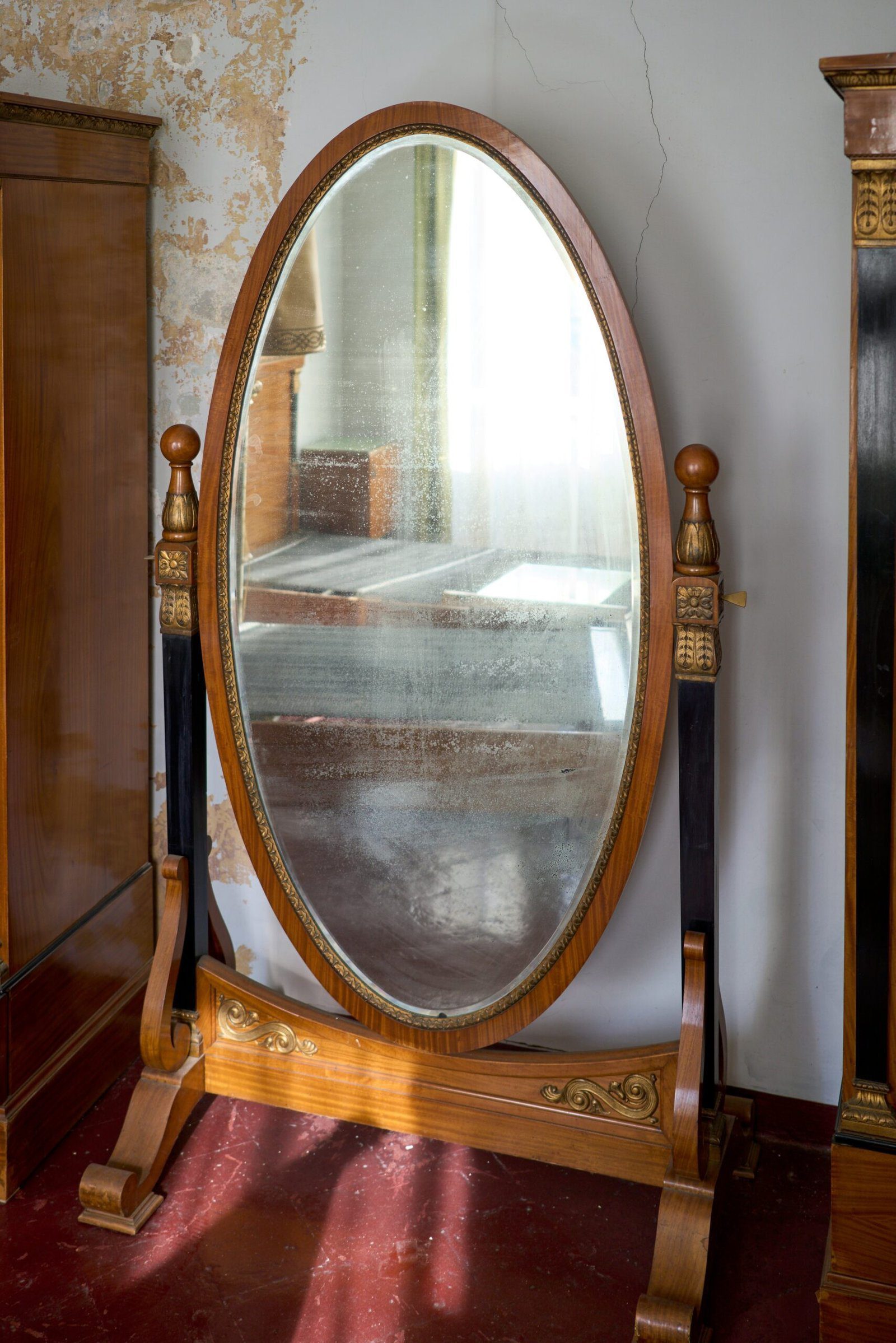
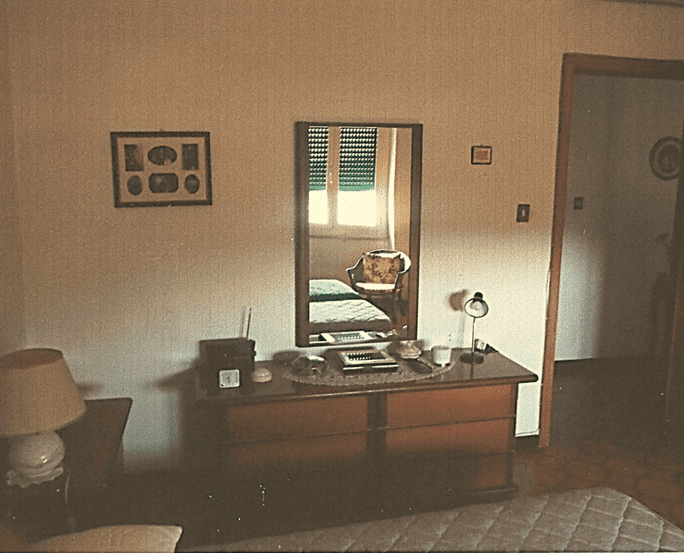
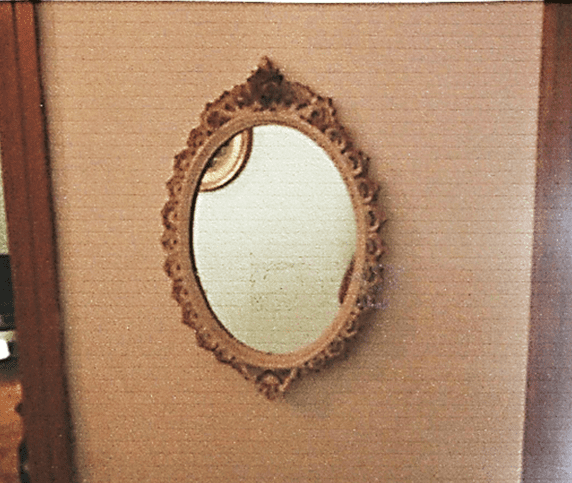
There were three mirrors in my house. One mirror in my grandparents’ bedroom, one in the corridor, and a rather large and antique one in the dining room that had been passed down through three generations.

(Image courtesy of Viviana De Cecco – November 2000)

When we entered the bedroom, Aunt Caterina asked me to help her tuck the edges of the cloth into the upper corners of the frame so that it was completely covered. 

It was this way that I discovered one of the funeral customs that are still deeply rooted in Sardinia, in all of southern Italy and in various cultures around the world. There are traditions so old that no one knows exactly when and where they originated. Covering the mirrors when a person dies is a custom that has its roots in the mists of time. 

Aunt Caterina explained to me that covering the mirror with a cloth prevents the soul of a deceased person from being frightened by seeing its own reflection. In addition, to prevent the departing soul from getting lost, it is appropriate to close all the windows, draw the curtains, leave some lights on and leave the door open to facilitate its journey to the afterlife.

The mirror is often seen as a portal between our earthly world and another dimension, and the wandering soul of the deceased, drawn by the glow of its reflective surface, may become trapped there forever. Instead of leaving its mortal remains, it could potentially drag the souls of all the living people reflected in the same mirror and haunt the house of the deceased for all eternity.

I remembered all the times when, as a child, my grandfather would sit me on his lap before a family celebration and make funny faces in the dining room mirror to make me laugh. He was always ready with a joke, and the thought of not seeing his smile again tore at my heart. Seeing those mirrors covered with those big dark cloths, the typical color of mourning, felt like a sign of the end. They reminded me of those abandoned houses where life had faded and happiness has been lost forever.

These dark beliefs are much more prevalent in the inland rural areas than in the cities. That’s why my aunt’s words, coming from a rural village where certain superstitions about the dead are never underestimated, touched me deeply. Even though those ideas may seem quite incredible and ludicrous, there was something both frightening and reassuring about that belief. It was comforting to think that my grandfather’s death wouldn’t be the end, and that we had helped usher in the beginning of his journey to perhaps a better place.

(Image courtesy of Viviana De Cecco – November 2000)

Even today, I feel torn between rational skepticism and doubt that there may be some truth in these ancient beliefs. Perhaps our ancestors were much wiser than us modern people. 

The Greeks and Romans were among the first to seek glimpses of the future in reflective surfaces. Who hasn’t broken a mirror and heard: “Now you’ll have seven years of bad luck”? The Romans believed that a person’s life was divided into seven-year cycles. Breaking a mirror would bring bad luck simply because it represented the souls of the living. Likewise, for the Egyptians, mirrors weren’t just for cosmetic purposes among the wealthier classes, but they also had funerary significance. It was believed that their radiance was linked to the sun god Ra and was a symbol of vital regeneration, which is why they were often depicted in the reliefs of the tombs of high dignitaries.

While doing some research on the internet, I discovered that this belief is also widespread in the Jewish religion. In the sacred text called the Talmud, there’s a phrase that several writers have quoted in their novels that refers to the human relationship with mirrors: “We do not see things as they are, we see them as we are.” This phrase makes me think that a mirror shows us our physical reflection on one side, but also reveals the nuances of our gaze, where all the feelings that lie beneath our exterior are hidden.

When we look at ourselves, we often say that we have a lively gaze. Where does this vitality come from? What can we call it? Is it the soul that we see? What is hidden within us that the mirror cannot really show us?

When a mirror reflects a dead person, there is no gaze to interpret and no movements to reproduce. Think of the vampire, who has no reflection in the mirror precisely because he is dead. Or consider exorcism practices, which sometimes use mirrors to chase demons out of the possessed.

So how do we know what is beyond the reflection of a lifeless body? I believe that superstitions are created to find the answer people have been seeking for centuries in their search for the meaning of life and, above all, its end.

Now it seems to me that this ritual is a demonstration of the living’s love for their loved ones, a testament to their desire to protect them. No one can know for sure what really happens the moment they depart this world, just as no one can know if there is emptiness or light.

What is certain is that, on that night when I returned home with my parents, I looked in the mirror in my room and wondered if my beloved grandfather, who had always been a guiding presence in my childhood, had found peace.

When my Aunt Caterina died three years later, there was no need to cover the mirrors. She died of pneumonia in the hospital, in that sterile environment where death seems even sadder. Everything happened slower with her. I had time to say goodbye to her and to hear that she had no regrets. She had been happy and was going in peace.

At that moment, standing at her bedside with my relatives, I began to believe in the soul. I believed it could be found in the looks of those who are with us, in their words and in all those gestures through which every human being communicates with his fellow human beings.

Toxic Words

Every language has thousands of words, and the ones we choose, I believe, almost always reflect who we are, what we feel, and what we want to communicate. I say “almost always” because I have never been fond of certainties, and I consider doubt an essential element of life, as to not judge people based solely on what they say. 

Sometimes, I too have said something rude in a moment of anger, but soon after came regret and most of all, the realization that I had made a mistake. No one is perfect, but when the words that are now called “toxic” are repeated and become a deliberate and ongoing way to hurt, then it becomes a conscious intent to denigrate and offend.

Who has not heard the old saying “actions speak louder than words?” 

It is a concept that seems extremely valid to me, but sometimes we forget that words have weight. With thousands of words at our disposal, it is reasonable to assume that most of our linguistic expressions in life and social communication are the result of a choice. Unless fate (or whatever else governs human life) intervenes in our lives, when we speak to another person, we should be careful not to offend the sensitivity of our interlocutor.

Recently, while reading a website of aphorisms, I was struck by a quote by author Rhonda Byrne. In 2006, she wrote the essay “The Secret,” which I plan to read soon, discussing topics related to personal growth and inner development:

            “It only takes a minute to cause hurt but sometimes a lifetime to repair.”

The author puts “words” first and then “actions”. This does not seem to me a coincidence. Words are a way to convey positive feelings, but also to express violence and aggression toward, for example, fragile people.  

Human beings cannot live in isolation. We all often need affirmation, support and help from those around us. I believe that the freedom to express one’s opinion does not preclude the ability to do so with kindness and tact.

My best friend had been the victim of a truly toxic relationship. When she introduced me to her new boyfriend, he seemed to me like a serious and polite young man. He was elegant, handsome, and behaved like a gentleman from another era.

But from the very first night, I could tell that something was wrong in their relationship. There were four of us at the restaurant table where we had made reservations: myself, my then-boyfriend, and the two of them. As the waiter served the first course, my friend’s boyfriend began to share anecdotes about their fledgling relationship.

“You know your best friend can’t cook? And if you saw the mess she makes in the washing machine! She ruined two of my shirts. She can’t even read the washing instructions.”

Throughout the evening, he criticized every one of her actions. As he spoke, I wondered: “How can a man in love only point out the faults of the person he is with?”

Maybe my friend was not perfect. Maybe it was true that she could not cook or use the washing machine. But where is the line between truth and contempt? The point was not to be hypocritical or to hide my friend’s flaws, but to choose words that wouldn’t make her interpret it wrongly and feel inferior because of her minor shortcomings. 

I tried to resist the temptation to confront him in front of everyone in the restaurant, and at the end of the evening I took my friend aside.

“Do you realize that all he did was criticize you? How can you live with someone who doesn’t appreciate you?”

“He has never laid a hand on me, if that is what you mean. He is not violent.”

But I knew that violence does not always manifest itself in actions. There is also a subtle and invisible form that is transmitted through words.

When I told her to leave him, she shrugged. She had always had a difficult home life and a troubled relationship with her father. But she had chosen a man who was even worse.

Every word he spoke was meant to show contempt, to belittle and manipulate her. He wanted to make her feel bad about the smallest things, as if he wanted to prove his superiority.

There was nothing I could do at that moment. The choice was not mine. I could only offer her my support and tell her that I would help her at any time. A few months later, I got a call from my friend. She had left their home. She had reached a point where tolerating it was no longer an option.

This is why I believe we must choose our words carefully when interacting with those close to us. Sensitivity is a value that should not be sacrificed to selfishness.

This is why Rhonda Byrne emphasized the importance of words. How we use them surely reveals the kind of person we want to be.

No Room For Veal

I was only six months in, working as an apprentice chef at Rocco’s, a family-run catering outfit based in the suburbs of Greater London; Esher Common to be exact. The Esher site was a multi-story production and storage outpost and the place where most of the culinary magic happened.

Mid-July; daytime

The sun was high, and the winds were still over the stony shoreline of Brighton Beach. I smelled the air and listened to the crashing waves in front of me. Peaceful, I thought, took one last drag, and stubbed out my cigarette in the overflowing ashtray.

Our staff had gathered at the client’s site, The Lock, a boxy event space in the arches under the promenade, for a planning meeting ahead of a couple of events they had on the horizon. The first was a birthday celebration in a few days, and the other was the annual Bank Holiday Ball.

Claire was already there, perched on a stool, nursing an Americano. She looked after the business side of things and was perhaps one of the best things to ever happen to Rocco’s. She had beauty and brains and was quite a likable character.

The Head Chef, Pierre, had just stepped in, an hour after the briefing was scheduled to start. His long-sleeved, crisp white dress shirt opened mid-chest and was adorned with a loose paisley print neckerchief. The cuffs were turned up, and the shirt tucked into his trousers.

“Okay, Fabien. Paolo. You have already the menu for the birthday party, yes?” Chef Pierre asked. His accent was thick as a pumpkin.

Ugh. It’s Fabian and Pablo. Nincompoop.

He waved his stubby fingers in the air, beckoning us to speak.

“Yes, Chef,” I said. “We were thinking of spinach and prosciutto stuffed veal rolls, with some greens. And a light garnish—maybe lemon—for the main?”

I said “we,” but the veal was more Pablo’s idea.

Since that Hannibal Lecter guy likened the exquisite delicacy of veal to the taste of human flesh, I was no longer a fan; period. But the prosciutto stuffed veal rolls required an inherent degree of talent, with equal portions of patience. And in that case, Pablo was your guy. He was the one with the most talent. I was just his humble sidekick. Nearly half the kitchen wished they had his skills, Chef Pierre included. But shhh; he’d never admit it.

Pablo was only twenty-four and had swapped the Brazilian sun for the rain and the chills of Britain. To better his talent, he would say. He landed at Rocco’s a month before I arrived and was considered senior to me and Ella Wolfeschlegelsteinhausenbergerdorff, the entitled one. Together, Chef Pierre dubbed us, his three Apprentis de Chefs. Fancy title, right?

“Nuh! We will not be doing that!” Chef Pierre interjected.

His face was set like the rain that was about to be kicked from the sky.

“—but Chef; the couple is from Nice and often travel to Italy with the family, for the cuisine. They haven’t been able to travel much since the pandemic. I thought it would be good to surprise them with something special,’ said Pablo.

That’s it, Pablo, sock it to him. I gave him a reassuring glance. A nod of approval soon followed.

“And for dessert — we will make sweetcorn panna cotta with fresh blueberry compote. I’ve already spoken to Claire, and there’s enough Chianti Classico in the store,” Pablo continued.

“Exactly,” Chef Pierre said. “They’re French. And we will not be making butchered young cows stuffed with anything.”

Chef Pierre raised his eyebrows. His wonky left eye glared at us with such degeneracy. He could have easily sliced us into thin strips of prosciutto if he blinked.

“But Chef—” I pleaded.

“Shut it, Fabien. Paolo, I expected better.”

Hmm, better?

“Chef!”

“Nuh. Instead, we will be making chicken cordon bleu. The other stuff is okay.”

Chef Pierre then turned to Ella what’s-her-face and thanked her for the cordon bleu suggestion. He gave her a cheeky grin and waved the rest of us off.

Of all the dishes imaginable, Chef Pierre chose chicken fucking cordon bleu? I wasn’t okay with that. No matter how you dressed it up, it was just chicken and melty cheese. Not even French. But I guess if Chef was happy with stuffing skinned chicken with blocks of cheddar and ham, then I was happy.

Truth be told, Chef Pierre lost his mojo a couple of years before that. Rumor has it that his wife left his philandering ways for her nail technician — a Thai woman, tall and fair with skin made of silk, I was told. Since then, he’s been searching for happiness at the bottom of the next bottle of Glann Ar Mor. Okay, that is French. In the end, Chief Pierre became a slothful soul and lost his powers of invention. 

I walked over to Pablo and bumped shoulders.

“Hey, don’t worry, Mon,” I said. “I’m sure you’re gonna fix it up nice.”

“I have to. I can’t afford to mess this up, not now.”

Thursday, event day

My night was fitful. I managed to pry my eyes open when the alarm sounded but stayed in bed until I was late, another one of my unshakable toxic traits.

I quickly got dressed, grabbed my kit, and boarded the Thameslink service to Brighton. Thankfully, I caught the last train for the hour. I would have made it to work in time for the briefing had my travel not been limited by the complications of modern-day commuting and earthly physics.

Chef Pierre was already in, busy chatting away with Ella, ignoring everyone else who had gathered in the center of the kitchen, awaiting his edicts, that is, directions.

“Bon. So, this is the menu,” Chef Pierre said, tossing out the stack of menu cards.

I gave the menu a quick whiz. As suspected, nothing had changed.

Chef Pierre instructed the wait staff to take their lead from Claire. The sous chefs and our group of apprentices fell directly under his supreme thumb.

“Boys. I want the mains plated and ready for me before they go out, okay?”

Boys. That was Pablo and me, if ever you were wondering.

“Yes, Chef,” Pablo replied.

We chopped, skinned, peeled, prodded, and poked for the more significant part of the day. 

It was now an hour to service, and my anxiety was ballooning. I needed a quick break, a minute or two to reset my nerves. I gave Pablo a shoulder tap.

“Hey. I’m stepping out back for a bit. Cool?”

“I got this, Man, but be quick,” Pablo said, unwrapping the stack of plates needed for the main course.

I smiled, snuck out the back, and shared a quick spliff with the dish guy. My eyes rolled back on the first pull as I meditated on my misgivings. I said a little prayer, threw some thanks to the heavens, and begged the universe to bring a swift end to the day before I gave in to the sleep that was beckoning.

Bzzt.

A timely distraction sounded from my mobile and my most trusted timepiece and companion for those dire hours in the trenches with Chef Pierre.

“Great news from the bank!” the text said, and then in another line “Let’s catch up ASAP!” I made a mental note to reply later and was about to pop the phone back into my pocket when I heard him. 

Getting high on haute cuisine — vaulted plates

“C’est quoi ça?!” Chef Pierre demanded.

His voice filled the kitchen with a thunderous roar.

“You imbecile!” Chef continued.

I ditched my share of the contraband in the bushes and hurried back to the kitchen, tripping over the door jamb that almost took out both my bony knees as I came crashing on the floor. By God’s grace, I was able to stand, but my ego was still on the floor. As soon as I recovered, I watched in awe as Chef hurled a single-plated main dish across his station.

Splat!

The plate and the dressing hit the wall first. The piping hot cordon bleu followed suit.

A few inches more to the left and the chicken would have connected with Pablo’s forehead — dished and served with all its accompaniments.

Pablo stood motionless and pale-faced.

I could tell Pablo’s heart sank as he watched his hard work reduced to a hot mess on the floor beside him. He never had to say anything; I knew precisely what was coursing through his mind.

“Oie!” I shouted as my neck veins stiffened and my face twisted into a hot mess, too.

The bass in my voice ripped through the kitchen like an unsuspected undercurrent and carried with it months of cultivating rage.

“What the rass yuh do that for? Like, what the actual fuck Pierre?!”

At this point, something colder than ice surged through my veins.

“Vous,”’ he replied. “Vous.”

“Vous what, Pierre?!”

I polished my utter defiance with a bit of Franglais and now, I had his complete attention.

“Yuh so fucking ungrateful!” I continued my rant. “Imagine, we here working on your chicken cordon-fucking-BLUE, all day. And the best you can do is fling the fucking plate at the man’s head? Pierre. Yuh never here. Late all the time. Teach us shit, yet you expect pumpkin pie?”

My fury gave voice to Pablo’s will as I stood up to Chef. For us both.

Ella covered her mouth with both hands as she tried to stifle a scream. Chef Pierre’s behavior was shocking, even by her standards. I imagined, to her, mine must have been simply appalling. But if the truth was ever like a loaded gun, this was the trigger.

I reigned in my Jamaican sass, just in time to see Claire’s face pop from behind the swing door; her mouth open like a bass.

“Get out! Get out now!” Pierre shouted. “Leave my fucking kitchen….”

“Cheups.” I pulled air through my gritted teeth, making the longest hiss imaginable.

My apron and hat were already off, on the floor, somewhere. I didn’t care where.

I almost lost the entire surface of my pupils as I rolled my eyes returning his salty looks.

The rest of the kitchen staff froze. The only noticeable sounds were the splashes of water from the overflowing sink and the few pots next to Pablo that had now started grumbling.

“You’re done, Fabien. You’re done!” His breadfruit fingers pointed to the door.

“Idiot. And it’s FABIAN.”

I was two words short of telling him to stick his job up his arse, as they say in Britain. Instead, I maintained my indignant stare and marched to where Claire stood.

The next day

Chef turned up to work shitfaced and back into his dusty old corduroys. So much for the crisp whites and that tadpole printed neck thing.

I saw that his pot belly was about to burst, so I kicked him a waste bucket. His upper body folded at the waist as he struggled to stand. He puked until the balls of his eyes exploded into pure redness, intoxicating the kitchen with the most putrid scent imaginable, spilling drips of puke onto his oversized coat that hung loosely across his back.

If you ask anyone, they will tell you it’s not uncommon for chefs to go berserk on the odd occasion when the service time was missed or  the vegetables were  not still al dente as commissioned. But no one deserved the utter disdain that Pablo endured. 

Well, there you have it — altered plates

I later learned that Pablo had altered Pierre’s plating arrangements. Knowing Pablo, he probably felt the dish looked flat and unimaginative. And as I suspected, Pablo injected a little life into the dish; some colors, height and texture to the lone chicken and the sprig of green against a dollop of that god-awful mush Pierre swore was the best thing since sweet potato chips.

The truth was that Pierre’s incompetence had become taxing, and it was no longer a secret. Why he lasted there so long, no one knew. But “everything does not have to make sense,” I heard someone say. And often, when you get that feeling, it just might be time to move on.

Pierre hauled himself to the prep table, dead in the center of the kitchen, where we all gathered again for the end-of-day briefing that should have taken place yesterday.

I stood next to my boy Pablo; my head was down, eyes fixated on the shiny surface of the table in front of me. I listened as Pierre cleared his throat and cringed at the thought of the smack that was about to escape his unbathed tongue.

“So, yesterday was okay,” Pierre said. “The couple was happy with the meal and the service. And send their regards.”

Pierre’s eyes were everywhere except where they were meant to be.

“I’ll await suggestions on the ball from vous by later today. That is all.”

He turned and then left the kitchen.

Was it shame? Guilt? Total indifference? I was confused.

It was 8 PM, and the night sky had placed a cloak of darkness over Esher Common. While the rest of the town slept, Pablo and I were busy organizing the ingredients for the upcoming ball.

“Bro. This packing thing is too much,” Pablo whined.

“I know. Plus, it’s just us two,’ I replied. “But we can do it, Mon. Let’s hurry.”

“We should be at the Notting Hill Carnival this weekend… YESSS,” Pablo remarked.

I watched in utter shame as Pablo broke into something like a dance. His body moved like an awkward robot that had lost a couple of screws in the knees and waist.

“Pablo, ah, beg! Leave the gyrating to us Caribbean folks,’ I said. “Dancing is not your thing.” We exchanged a couple of laughs and then got on with the packing.

Throughout the evening, we worked as hard as possible to prep and package the food for the Bank Holiday Ball set for Monday back in Brighton.

It was now 11:15 pm; my phone reminded me with a familiar buzz.

“Your train will be here soon,’ I told Pablo. ‘Go ahead, Man, and I’ll finish up.”

It was a trek back into the city, and the last train for the night was fast approaching.

“You sure, bro?” Pablo asked. “I already fucked up once. I can’t afford to lose this job, Man.”

“Come on, Pablo. You either leave now or catch the night bus to North London.”

The journey back to London by bus would have been long and unsavory, especially on a holiday weekend like this.

Pablo tore off his apron and stuffed it and the other bits in his bag, and he was through the door in seconds.

Moments later, BANG!

A loud thud just outside the door stole my attention. I called for Pablo, but there was no answer, so I walked over and eased the door open.

“Pablo! Pablo! Just go, Mon!” I shouted.

But the cause of the racket wasn’t Pablo; it was Pierre.

Fuck! My thoughts mouthed to form a silent shout.

What was he doing here? “His shift ended eons ago,” I thought, closing the door behind me after squeezing myself through.

Looking at his unbalanced steps, I could tell Pierre was drunk.

Pierre was wearing a gray tracksuit and a dark pair of trainers. His ears were plugged, and the hood of his shirt was up.

I watched as Pierre slid through the unlatched door and downstairs into the staff break room.

I gave a stealthy pursuit, still clutching a roll of cling film; my confused brain neglected to instruct my hand to get rid of it.

My silly hands must have pressed too hard against the swing door, and it plopped open, flooding the room with light from the passageway.

“What are you doing here?!” Pierre barked.

He yanked the earphones from his ears and gave me a cold-eye stare.

“Your shift ended 8 hours ago,” I replied with an equal measure of contempt.

Bzzt. Bzzt. Bzzt.

The ramble from my phone interrupted our stare down.

“Yea, Mon,” I said. “We’re just wrapping up now.”

It was the frozen storage guys; they were running late. I now had plenty more time.

I ran back upstairs, quickly labeled the foodstuff for the ball, and the extra meat, cleaned the counters and meat saw, and gave the floor a quick mop with a bit of vinegar.

The remaining trash, I double bagged and dumped in the food waste skip out back.

“Mate. Can you give me a lift to the station? At this hour, Uber doesn’t come to this side,” I asked the frozen storage guy as he loaded the last crate onto the truck. I figured a minicab from the train station at Esher Common to Croydon wouldn’t be too expensive.

“Sure. No worries, Man,” he replied.

I swung my backpack across my shoulders and hopped into the cabin.

Saturday and the freezer is full

It was now Saturday, and way too early to be awake.

I found myself back at The Locke, with the gang putting things in place for the ball, our client’s last hurrah for the summer. I made a cup of coffee and drowned it with some sweetened condensed milk. I took a good whiff and allowed the scent of imported instant to permeate my nostril.

I sifted through a mountain of paper Pierre had neglected to file and shook my head. Maybe this would be my new normal — I could get used to this.

Bzzt. Bzzt.

“Hello?”

“Is this Fabien?”

“NO. Fabian,” I corrected her, distancing myself from whatever French connection I had left.

“Oh, apologies, my dear. This is Ronda, calling from Brixton Bank. About your recent application?”

Yikes.

“Yes, oh, hi Ronda”

I smirked.

“Fabian. We would like to make you an offer.”

“Fantastic.”

“Can you come in next Tuesday?”

“Absolutely.”

“Great. I’ll see you at nine?”

Now, if only I could get Pierre’s big head out of the way. 

‘Fabian.’

A soft voice called out to me. It was Ella. “Claire wants to know If you guys have decided on the main for the ball?”

Shit. Did I?

“Yes,” I replied. “Veal Piccata. The veal is in the frozen storage containers in Esher. They were shipped just before the fire.” 

Spoiler Alert
Now, if only I could get Pierre’s big head out of the way — of the Piccata. His carved remains were ziplocked and tucked away in the freezer right here, yet only 80 percent frozen. If I don’t relocate it in the freezer soon, it will be rock-hard by Tuesday, too late for reaching the veal.

The weekend

Pablo was right; it was the Bank Holiday weekend. I might go to the Notting Hill Carnival after all.