INK

In a coffee shop a woman sits, head bent, knotted and frizzy blonde hair cascading down her back. A claw clip clings to it with little purpose: impotent, listless, one tooth broken at the root.

Besides her sit a cup of coffee and a laptop. She hates the artificial light it generates: a swinging metronome, pulling her face toward the glare, frying her retinas.

Well, out of sight, out of mind, she thinks, and slips it into her backpack. But the burn behind her eyelids still sears.  

She pulls out a notepad; wrinkles her nose in distaste at the sight of her own messy handwriting. Why can’t she have beautiful, flowing script like other girls? Effortlessly curly and smooth (their hair always the same — no frizz in sight) half cursive: one letter making love to another, forming a sensuous breath, an uninterrupted thought inhaled and exhaled in harmony.

Poetry ought to hold hands with elegant script — not chicken scratch.

But what was the word she was looking for?

Her moonbeam shouldn’t just glisten or gleam; but perhaps illuminate? Luminate? Effervesce?

Too highfalutin, she thinks.

Use simple words you aren’t a Victorian novelist. No Brontes here. Hadn’t they written all their best works by the age you are now? You, on the other hand, have written nothing.

She decides on “shimmer” with distaste.

Across the shop, a middle-aged woman sits on a sofa. Her latte lays untouched on the low table before her. She is deeply uncomfortable and utterly ignorant of her own feelings — her whole awareness taken up with wishing her cell phone would ring, though she knows it will not.

 Her daughter, after all, is busy. Her daughter doesn’t need her. Her daughter is just fine.

Somewhere, on the other side of the country, she sits — like that girl to the right maybe — writing a beautiful paper that will get an “A.” And she will call home happy about it, someday. Just not today.

Though Ashley takes much better care of her appearance, she thinks, spotting the claw clip. That’s the way she was raised: “You have to put your best foot forward,” she always told her daughter.

She wishes Ashley would call more often. She wishes even more that she did not resent her for not calling — children must be left to live their own lives — but then, on the other hand, didn’t their parents deserve more than to be treated like an ATM?

Maybe I did something wrong when she was growing up, she wonders, thinking back into a blurry abyss where memories sometimes rose to the surface with painful clarity.

Though she is ashamed of it, she often snoops in their joint bank account. She had seen the bill the day before: mental health solutions, psychotherapy. She knows what people talk about in those sessions — about all the things their parents did wrong — every unintentional trauma they imparted, the spankings they had given. Well, hadn’t everyone told her it was good to spank her children then? Hadn’t her own parents done it to her, sometimes with a belt? It had never crossed her mind to resent them for it.

But children were different now because now was a different time. They believed in looking deeply into every feeling and rooting out every pain, rehashing every conflict. They had no idea what a great luxury it was to be able to do so.

She remains unconvinced, no matter what Ashley says, that it is always better to uncover than to bury. Her coffee grows cold, so she forces herself to drink it, mechanically.

A little boy runs back and forth across the shop, from his Mother, seated at a bistro table outside, through the heavy door (he must push hard, like Superman, to make it move) to the shelf of games. He runs his fingers over each game but chooses none because his legs are twitching to run and leap.

He dashes back again (fast, like a cheetah), catching a glimpse of a thin woman sitting beside the games. She has lines all over her face because she is old, and she looks sad. He forgets about her the moment he turns away and pushes at the door.

Mother sits reading, though he can feel her watching him, making sure he does not try to run across the street. He wishes they could play together, but knows she doesn’t want to.

He knows Mother more by smell and touch and sound than by sight — because she is always moving, and her legs are the body part he sees most. She is a skirt, a lullaby, a pantsuit, a warm hug, sometimes a stern voice, but always far above him, in a different sphere he cannot fully enter.

He kicks a pebble and sends it scuttling onto the street. He starts after it with abandon, but finds himself stopped, because Mother has grabbed his shoulder, though she has not looked up. She is omniscient, omnipresent.

She says, “Jeremy, stay.”

He looks longingly after the pebble, then at a bird in a tree, then at the pastries in the shop window. He runs back through the door, push, push, PUSH, and the shop bell jingles.
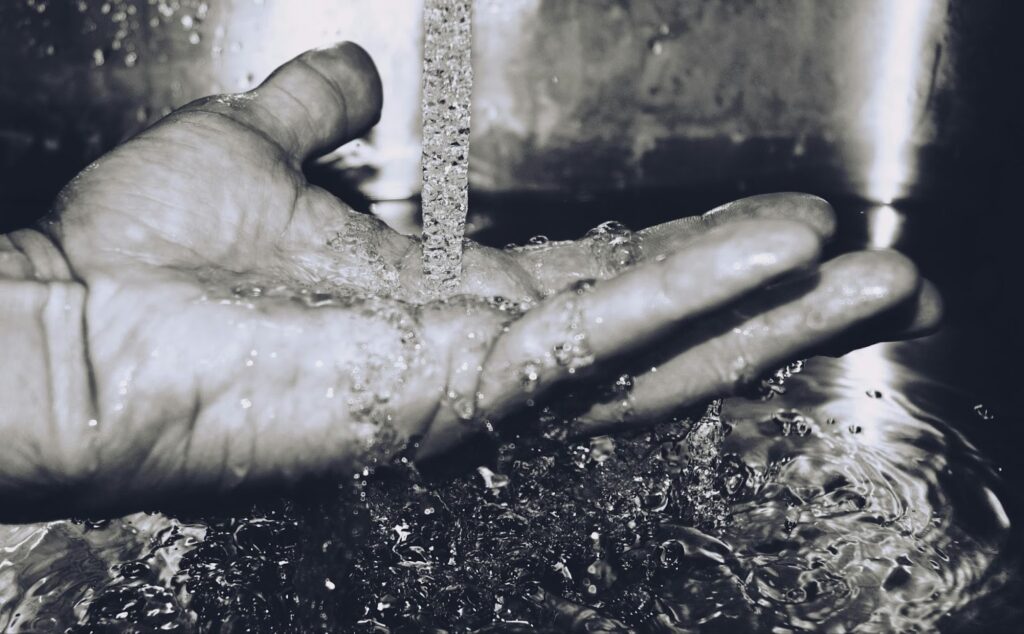
A grayscale image of a man washing his hand. It is large, strong, and he lets the water cleanse it thoroughly.
(Image Courtesy of George Becker via Pexels) 

In the bathroom, a man eyes his bald head in the mirror above the sink — a rounded and reflective plain, speckled by only a few sickly trees that escaped the strip mall’s razor. He remembers that an astounding percentage of men don’t wash their hands. This makes him feel a little bad for women, and a little bad for himself, too.

Well, he will scrub his hands proficiently, though considering he is about to touch the door handle (urine-bespeckled, undoubtedly) he is not sure it matters.

Everything in life comes out the same, no matter how hard you try, he thinks. What was the point of being good or right in a world where everything is contaminated already — the planet, more or less a castle of bacteria, growing far too fast to be cleansed by soap and water?

A losing battle, he decides, drying his hands.

All this time his eyes have rested on the fruity-flowery wallpaper covering the single-person bathroom: the peaches a warm, burning orange, the cherry blossom petals a delicate, breathy pink, the leaves and vines a cool, comforting green. He is acutely aware that because he is a man, he should not like this wallpaper, but that, unfortunately, he does like it, just like he likes white mochas and peach Bellini.

He walks out of the bathroom and sees a little kid bolt through the shop door, making the bell tinkle. Once upon a time, he was that child, a whirlwind of energy, a flame cruelly contained by kerosene-glass.

Always shattering, screeching and weeping — though the weeping had only continued ‘til seven or so, when he came to understand the cringy weakness of it. He still cried, of course, but only silently, alone, at night. If no one hears a tree fall, does it really make a sound?

He has a theory that “good” men continue to cry into adulthood, even if forced to do so in private. Those who dry up their ducts transform into gods of burning rage… the price of evaporating human tears.

Unless he is self-deluded, and the wallpaper and crying mean something else entirely. He has often wondered if he is gay. Hadn’t softness and sensitivity — however hard he fought against them — permeated his life? The problem with this theory is he doesn’t really want to have sex with men. But considering the repression and homophobia of most males, how can he know for sure? Everything he believes about himself could be a lie — the truth hidden deep beneath layers of societal guilt and shame.

Maybe, even now, his perceived attraction to the girl in the corner — he watches her as she rips through notebook pages, dotting “I’s” and crossing “T’s,” viciously dashing out whole sentences — is all a sham. Her knotted hair reminds him of brambles on the edge of a lawn, encroaching into the landscaping, squelching non-native plants, reclaiming the wild.

It must be this wildness that bewitches him, that enters his body like an evil spirit and drags him across the room to her. Hitting on women in coffee shops is too bold and deeply out of character for him.  Watching his body stroll over to her, he considers if his real intention is to reassert his heterosexuality.

Standing at her table, alarmingly close to her, he realizes he has nothing to say. Mercifully, not only does no sound come out when he opens his mouth, but the girl, absorbed in her art, seems unaware of his presence. Before she can look up, he turns and hustles toward the door.
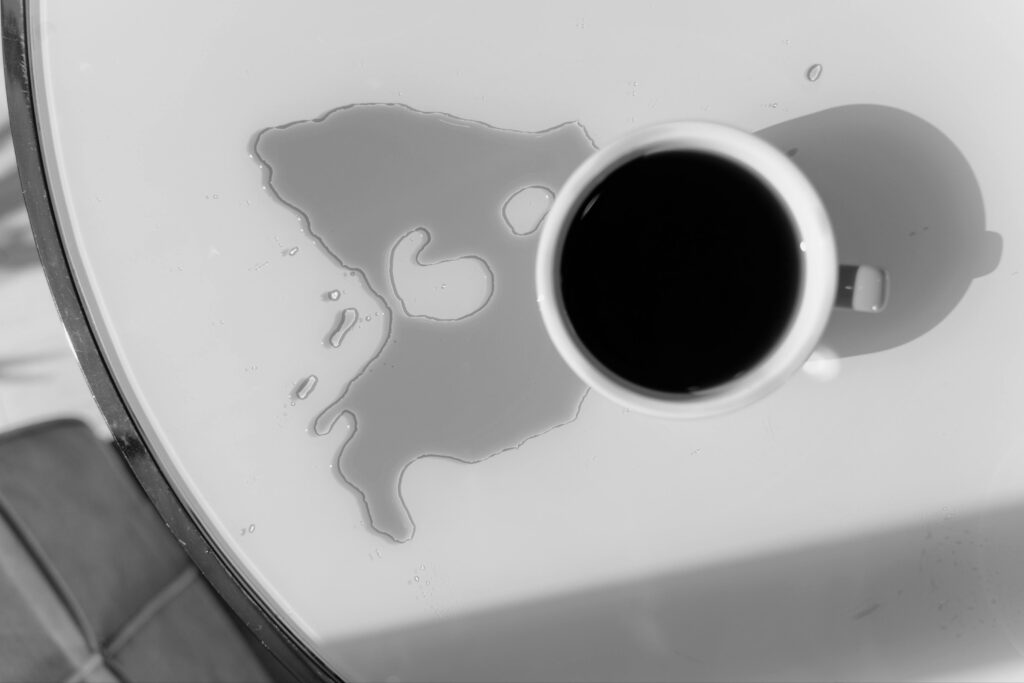
A grayscale image of a cup of coffee that has been partially spilled. The puddle of coffee on the table has gone cold.
(Original image courtesy of RDNE Stock project via Pexels)

On the way out, he nearly runs into the little boy, bolting outside again. He shifts his balance to prevent collision, nearly falling, and careens into a low table, upsetting the coffee cup of an older woman. She looks up at him with tight pursed lips and wide, startled eyes.  

“Oh shit, sorry about that,” he says, trying to help her clean up the mess. But she waves him away, saying nothing. He is left to drift toward the door, knowing himself a failure.

The commotion makes the writer come to herself again. She sees the older woman soak up her spilled coffee with napkins, the child outside pull at his mother’s pant leg, and the younger man disappear through the shop door with a clang.

Even from behind she can tell he is attractive — broad shoulders, a nice butt. Why can’t anyone like that ever notice me? she thinks.

 He’s probably gay, she decides. He’s dressed too nicely to be straight.

She turns back to her page, buzzing with discontentment. One more cold, hard letter written, and her hand stills. Her pen has run out of ink.
Biblical Gardens

The biblical gardens were a fairyland. In Jean’s imagination, no one had planted the flowers, engraved the stones, or bought the benches: they had all appeared out of thin air. An angel had flown down from heaven, touched the land with a long, shining finger, and Eden had sprouted, flourished.

Mother often took Jean there to paint. “I could live without the overt Christianity,” she always said, “But something about this place calms me down.”

Jean played along the paths, in the creek, puzzled over the Bible verses, scattered throughout the garden – etched on rocks, displayed on wooden signs – as natural and essential to this place as the colony of ants that lived beside Mother’s favorite bench. Mother spent most of her time sitting there, overlooking the waterfall, often painting it, but sometimes staring at the signs with a sad, sour look on her face.

From a young age, Jean knew the real reason they came here was Grandma.

“I would have scattered her ashes here if the old bitch hadn’t insisted on being buried,” Mother told Jean again and again. “It would have been cheaper and nicer, but nope, because it would be easier on me… fuck it.”

Then she would sketch a flower, butterfly, or sometimes children playing in the garden. But none of the pictures, no matter how beautiful they were, made anyone who saw them happy. Even the butterflies, still and scrawled, came away looking sad.

To this day, one of these sketches hangs in Jean’s hallway, and she stops to look at it sometimes, just to remember the burden her mother had to carry.

In the picture, three children run down the trail, past Maudlin’s empty bench. The face of the first, a tall girl with curly brown hair that streams behind her as she runs onto the bridge crossing the creek, cannot be seen. The second is a little boy, mid-trip, his hands falling down in front of him to catch himself, his profile also not visible.

Maudlin is the third – drawn to impart the liminal: a grown-woman’s countenance plastered on a little girl’s body – turning around to stare at the voyeur looking in. Her mouth hangs open like a trap door, her eyes wide and globular, like two green planets; her arms hang limply at her sides, flopping, as if they have no bones.

         The path through the garden is aided by several bridges, which allow the walker to zig-zag back and forth over the creek. The second, a dainty wooden arch that crosses the stream nearest the waterfall, sits deep in the garden, while the first, broader and well-worn, stands at the entrance. The thudding of Jean’s feet against the wood, drowning out the noise of Highway 49 behind her, seemed to herald her arrival, making her journey into another world complete.

         A big sign that hung over the first bridge said: “Taste and See the Goodness of the Lord.” Mother always made a face whenever they walked past it, but Jean liked the idea of a god-garden. And she understood what the sign meant, too: when you experienced art, you couldn’t help but learn about the Maker.

         Jean invited Jules to come with them, but only once, because not only did Mother find him annoying – “That kid talks so much about reptiles it makes me want to kill myself” – but also because Jean rightly recognized that he would be incapable of respecting the sanctity of the place.

         You didn’t run in these gardens, she tried to explain, you were meant to walk slowly. Nor did you shout – you spoke in low, dulcet tones.

         “It’s like church,” she warned him, “solemn.”

         “You don’t go to church.”

         “My grandma took me, when I was really little, like 3 or 4.”

         “You can’t remember that. That’s too little to remember.”

         A hazy world, blurred at the edges, like a dream:

         Thick lights, streaming through the stained glass, illuminated the face of the baby, whose mother held up for all to see. She looked sad. Were all mothers sad?

         Little boys, at the front of the church, dressed in white, singing like angels, or doves; the tone of each voice building on another, climbing higher and higher, further and further upward, till the whole church swam in music, till the sound, crystalizing at the tippy top of the high-ceiling, threatened to burst through the roof and obliterate the chapel in a violent, vibrating melody.

         The big wooden cross loomed at the front with a man dying, sweating beads of blood – ever after. When Jean thought of her grandmother, she thought also of the statue of that man, because a moment after spotting him she turned her eyes to the ground and was shocked and frightened to find her grandmother on her knees, opening and closing her mouth without words, crying. Jean had never seen her cry before and would never witness her doing so again.

         She almost reached out her little hand, like one might reach for a blooming cactus, before she remembered the touch would hurt. And her eyes again rested on the wooden cross. Jean wondered why on earth that poor man was up there, half-naked and sweating blood. And why all these people stared at him.

         She asked Grandma, after service, who he was.

“That’s God,” Grandma said solemnly.

And for some reason it made sense to Jean that God was mutilated, that he bled.

         “I hate church,” Jules said. “It’s boring.”

         “You’ll like it here though,” Jean reassured him. “There’s a creek. And lots of lizards.”

         “Well, alright,” Jules said, “I’ll come if I have nothing better to do.”

         Jean frowned at his lack of enthusiasm.

         Jules insisted on racing from the car to the garden, which confirmed that Jean’s decision to invite him had been a grave mistake. Still, it did feel wonderful to run, with her hair streaming out behind her and her feet thudding bombastically on the wooden bridge like the music of an off-beat drum. She didn’t race past the world; it bolted by her, elegantly topsy-turvy, with the speed and swiftness of light and wind.

         Then her feet landed on the soft, spongy grass with relief. She wanted to sink down into it and grow burrowing roots for the cool, dark earth to hold. 

         Jean collapsed on the bench closest to the entry way as Jules finally came sprinting across the bridge, huffing and puffing.

         “I beat you!” Jean gasped, triumphantly.

         “Only ‘cause I let you win,” Jules wheezed. He took out his inhaler and brought it to his mouth, inhaling long puffs.

         Jean saw Mother far away, still lingering in the parking lot, fading into the background like a tree or moss-covered rock. And the garden before her grew larger than itself—expanding into tangible imagination, a thought bubble solidified into a new, wild continent.

         “I know what to play,” Jules said, excitedly. “We’ll be explorers, making maps and stuff.”

         Jean considered this. “But why are there only two of us?”

         “I don’t know, maybe everyone else died… and now we are running out of food.” Jules, in thoughtful contemplation, bit his lip. “You can’t be a girl, though,” he continued. “They wouldn’t have brought girls.”

         “That’s not true. Lewis and Clark brought an Indian woman with them.”

         “I can’t even say her name,” Jules said, “so she doesn’t really count.”

         Jean frowned, wondering aloud: “It was an ‘S’ something…”

She suddenly felt it was important to remember, because this woman had existed – hadn’t she? – as much as Lewis or Clark, and she was actually more real than either of them, because she had been born from the land she traversed: sprouted up straight from the soil, rather than merely being someone who walked on top of it. Like the difference between herself and Jules – he stomped over and through places, but they never belonged to him or changed him in any way. But Jean became a part of the world she walked in, weaving a flower into her hair, scattering earth into the cuts on her fingers, welcoming water into her stinging eyes. Of course Jules wanted all the characters in the story to be stompers: unaware of the shrubbery they marred and the big boot tracks they left.

“Sacagawea!” she said triumphantly, remembering.

“Yeah, whatever. Don’t you want to play?”

“Why don’t you be the explorer, and I’ll be the Indian woman,” Jean said. “And I’ll help you learn to survive.”

In an uncharacteristic moment of self-assertion, she continued, ignoring Jules furrowed brow, and said, “We can pretend the creek’s the ocean, and you got shipwrecked here. And you don’t have any food. And if you want to survive you better become friends with me!”

Jean ran away then, ignoring Jules’ calling after her, because she didn’t want to argue, and maybe what she really wanted was to play alone – along the path, over the bridge, many waters gurgling underfoot, drowning out his voice. Up the winding trail (which ran parallel to the one Jules stood on but was separated by the creek), up the wooden steps and out of his sight – till she stood below the big wooden crucifix, with the image of the God-man, dying. She walked past him quickly because it made her sad to look at him, and continued to ascend the steps till she came to a stone table engraved with twelve men. The one in the center held out an ornate cup to the others, and the inscription sprawled beneath them, covering its length in fancy letters: 

“This is my blood of the covenant, poured out for you.”

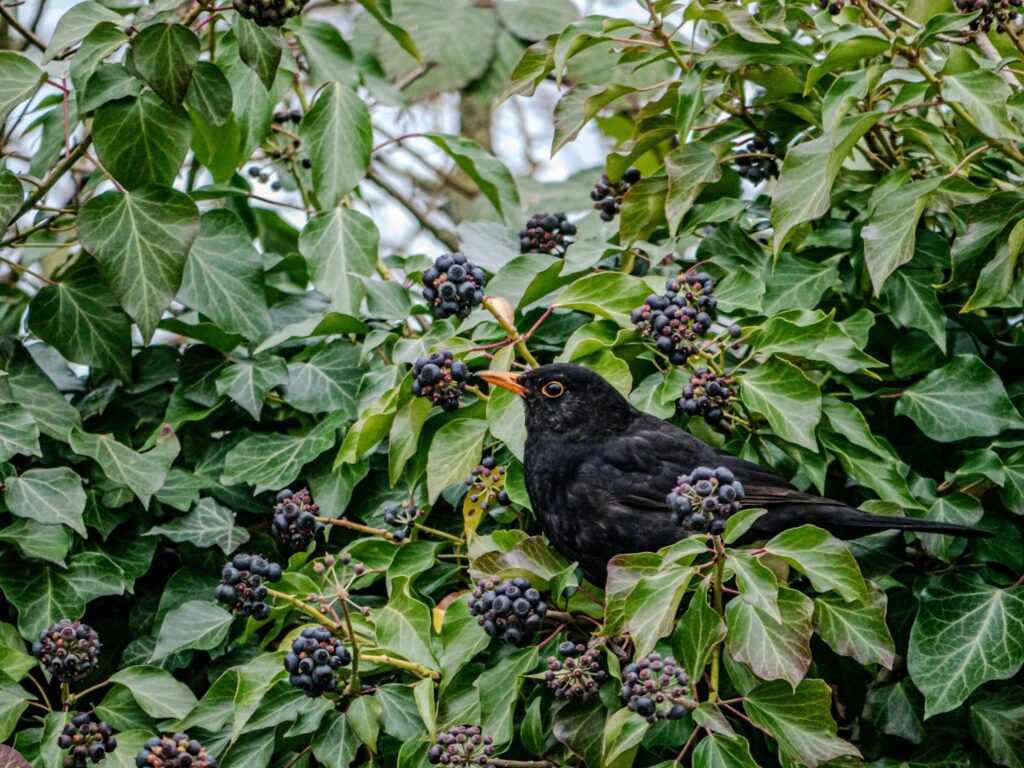
A black bird, with a bright orange beak and ring around its ebony eyes, sits nestled in a thorny bush of dark-colored berries.
(Image courtesy of SK Stannik via Pexels)

The table and engraved goblet suggested to her a deep, disturbing magic. Witch doctors drinking the blood of their victims, magic spells and voodoo dolls, vampires lurking in the shadows. She connected it in her mind with that horrible scene in Narnia, where Aslan lay strapped to the stone table, murdered by the ghouls and goblins. It didn’t seem, for some reason, like Jules would be able to find her here. And so, in the brush a few steps beyond the table, in the shade of a large oak tree, she made her wigwam.

A tributary of the creek wound through this area, no more than a trickle this time of year, almost hidden completely by blackberry bushes. The big, shining berries dotted the branches, weighing them down. Carefully, she ventured into the thicket of thorny tendrils that tore at her clothes. Jean grabbed at the stems between the thorns and unstuck the fabric best she could. She plucked the berries nearest to her, one by one, from the bush, careful not to crush those which were juicy and overripe. But her delicate grip still pulverized many – resulting in a drain of dark, sticky blood flowing down her fingers.

Jean ate some and transported the rest to the stone table where she mashed them up with a stick. But upon poking her finger cautiously in the resulting juices and realizing the concoction was too thin and watery for her purposes, she knelt down by the nearly dried up stream and gathered some mud from the edges. Then, she mixed the mud with the mushed-up berries, creating a black paste.

One mark on the forehead. One on each cheek. One mark on the chin. Because the berries and the mud, cool and granular, now covered her skin, seeping into her pores, clogging them, she felt she knew the earth more intimately, like Sacagawea must have known it.

Jean heard Jules splashing in the creek, pounding on the ground with his feet in big, heavy beats, whooping and screaming loudly as he pretended to sail a ship on the seven seas. Everything he did affronted this place; his life force a chaotic reverberation that echoed throughout quiet earth and sky, silencing nature—scattering lizards, forcing birds to take flight.

She marked her hands with paste, then her forearms, in swirls of stars and moons, till black-red galaxies covered her body. If she were here alone, she would make a gallon of the stuff and lather herself, head to toe in it. She wondered if doing so would camouflage her and allow her to disappear against the backdrop of the ground, granting her invisibility. Or would the earth, seeing her skin turned to mud, recognize her as its own and swallow her whole?

The real world (where Mother lived, drawing somewhere, and Jules tramped) intruded on Jean’s solitude, limiting the scope of what she could become. It hung in the corner of her mind, frowning, reminding her always that she could not cover her whole body in mud and that she was not really an Indian. But her desire for this not to be true became so intense that, when Jules began to call her, Jean did not answer.

         She was a Native American woman, cautious of this strange, noisy, pale man. She must not let herself be seen, but instead, observe the stranger, see if he was her friend or foe.

         “Jean, where’d you go?” Jules called. His footsteps – thud, thud, thud – resounding from below, came closer. She must hide. Furtively, Jean slipped behind the stone table, behind the large wooden cross that overshadowed it, which marked the boundary of the garden. All that lay before her was a hedge of thick blackberry bushes. For a moment she felt trapped, until she realized: why shouldn’t these be her home? Wouldn’t the thorns, with white tips like teeth, protect her?

Only, they would hurt her, too. She cautiously grabbed one of the branches between the thorns, and then, with less care, grabbed another, accepting the painful pricks. She could hear Jules coming up the trail toward the stone table, closer and closer, so she abandoned all caution, covered her face with her arms, and waded head first into the blackberries.

Thorns scratched and tore at her arms, legs, and hands, creating so many cuts that she didn’t know where to focus on the pain. But Jean kept going until she knew the shrub had become her shroud. She crouched there, in the middle of the bush, the thorns hovering all around her like hungry fangs, savoring her, so if she moved even a centimeter they gnawed. She watched as a big scratch on her bicep produced a thin trail of blood, quickly filling the fleshy, thorn-carved trench it originated from and overflowing, trickling down her forearm. Still, she remained motionless. 

And Jules’ feet – thud, thud, thud. “Jean?”

He stood before the stone table, only feet away, but he could not see her. The ability to watch him, undetected, filled Jean with an exhilarating sense of power. She knew more than him – could see more; he was at her mercy.

He looked this way and that, calling her, a slight panic crouching in the corner of his eye. “Jean, where’d ya go? You’re always disappearing,” he howled. Frustrated, he kicked the stone table. “Ow! Ow! Owww!”

Jean, counting on his preoccupying pain, snuck out of the bushes as silently as she could and routed him from behind. She felt like a snake in the garden, quiet, crafty, shrewd.

His eyes rose from his foot; seeing her there; a millisecond’s pause to take in her form – the berry juice paint, the scratches, the trickling blood; then, a delayed scream, high-pitched, and a hop backwards, so he almost fell onto the stone table.

His eyes opened wider still. Jean pantomimed an imaginary bow and arrow, strung taunt and ready to fly at his face. “Jeeeeez Jean, how’d you…?”

“Shhhh,” she whispered, like a narrator speaking to her reader in an aside, “we’re still playing.” 

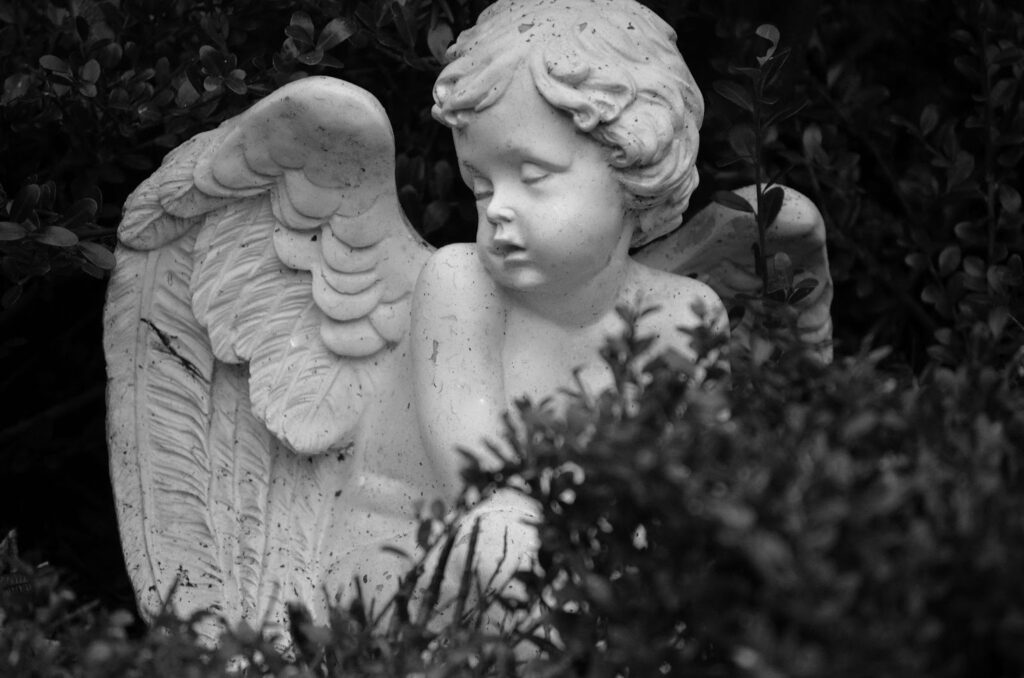
A grayscale photograph of a cherub angel statue hidden behind dark and dense shrubbery. His eyes are closed, and his mouth is open in a stone sigh.
(Image courtesy of Mario Wallner via Pexels)

This Fabric Does Not Suit Me

Editor’s Note: The Poetry Foundation defines an acrostic poem as, “A poem in which the first letter of each line spells out a word, name, or phrase when read vertically.” Usually, the central theme of the poem is revealed upon reading this hidden message.

This Fabric Does Not Suit Me

There’s a suit that I keep tucked away,
Hanging in my wardrobe, behind my newer clothes.
Every glance I take, I realise how much I have changed.

Fourteen years since I first laid eyes on it…
Allow me, now, to look in hindsight,
Back to a time when fashion weighed on chasing brainless trends.
Racks in retail shops were filled with fragile, gaudy tat,
Impressive shoes and shirts and hats,
Colorful and contemporary, yet lacking in their substance.

Once, I’ll admit, I sought these things that people viewed as “beautiful…”
Finding my thoughts swayed by spontaneous desire.

Originally, I spied this expensive suit displayed in River Island,
Underlined with crimson curves and shapes that ran red eddies.
Relishing the looks of envy, I swiftly made it mine.

Life felt sensuous when I wore this suit for a time, though…
Opinions of my character were shifting day-to-day.
Very strange choice, they’d say, for someone like me to wear something like that…
Everyone saw how much it was changing me.

Had I listened – understood that popularity was empty,
Allowed myself the chance to think if I actually liked that sumptuous skin…
Separation would have been made much easier.

For a child came from my marriage to this ill-fitting decision.
Red Timberland boots, bought on holiday one year.
And, however much I now look at that suit with scathing eyes,
Yearning to reverse that snap decision…
Everyone I know loves these Timberland boots, and so do I.
Destiny dresses in mysterious ways.

Ego

Ego

The profound stature of
This hill I would die on
Disarms me;
Enveloping me with insidious
Melanalcoholic acceptance.
Sleepless nights become
Displaced, impassive sedation.
Monotony shrieks, bellows.

I bear the years behind me.
Ignore the lies I tell–
I feel them all.
Success robs me of peace;
Failure bats at my brain.
Beat it smooth so that
I may bask in the ambience
Of blissful oblivion.

What’s In A Name? 

What’s in a name? 

If you could choose your own name, who would you be?
A name is important, it’s an identity. Or is it just an identity badge?


A signpost to wear for the people you meet, a label to shout when they see you in the street.
A medal of honor or of something to come: Colonel, Professor, Intern, or Bum.
A word that announces you into a room, a nom de guerre or nom de plume.
Or perhaps a nickname for behind closed doors: an “I’ll let you use mine, if you let me use yours.


An insult, a put-down, a dredging of the past: something you can’t escape which will always outlast
Any title bestowed by Queen or by King, or a surname change from an engagement ring.
“He’s a DICK!” “She’s a BITCH!” They’re the HEAD CHEF at the Ritz?”
A show of possession, origin or control, a transient position or your life’s greatest role: …


She’s his editor; he’s my dad; I’m his husband from Islamabad.
The honorary letters in your signature block, the title you use when you visit the doctor.
A caricature or a show of respect: ‘Mr. Never Was’ / ‘Mrs. Hasn’t Happened Yet’…
Or a stage-bound creation for fortune and fame. Go on, tell me: what’s in a name? 

======================================================================

Kebab Wrist

To my friends. I’ll always be Kebab Wrist, and it’s my own fault.  

They all had nicknames. I was desperate for one. Not least because the last day of school was looming and with it our deadline to design Leavers’ Shirts, displaying our nicknames for the ages. And so on a drunken night belonging to one of those halcyon days, when a piece of kebab flopped over a polystyrene tray and came to rest its greasy warmth on the undercarriage of my left wrist, I proclaimed: FROM THIS MOMENT, I SHALL BE KEBAB WRIST!

The shirt was printed, posted, and worn…and the rest is history.

Kebab Wrist hasn’t aged well: I’m 5 years vegetarian, and this reminder of one’s carnivorous past is triggering. But it’s not the name that interests me; it’s the character behind the name. Where Jordan Frazer is mercurial, ever-searching for answers he’ll probably never find, Kebab Wrist is consistently animated and authoritative. Where Jordan Frazer will pop a tummy Gaviscon before a heady Bloody Mary, Kebab Wrist drinks now, worries later. If Jordan Frazer is fast becoming all elbow-patches, Armagnac, and wingback recliners, Kebab Wrist is a leather-clad, tequila-soaked stage-dive. And any time we get the gang back together, I transform into Kebab Wrist, like a civilian into a superhero. 

At home, I’m someone else entirely. To my wife, I’m Jordie. Occasionally Muffin. Sometimes I’m Pancake, but only when she’s prepared to be Buttercup. Pet names are a relationship’s rite of passage. And when I’m at home, I’m cute. To be honest, I think that I’m Muffin or Pancake just so she’ll let me go out and be Kebab Wrist. And I think she allows me that privilege so Kebab Wrist doesn’t infiltrate the sanctity of our marriage. That’s fair enough; I wouldn’t want that bastard in my house either. 

Nicknames allow us to live our gang fantasies: harmless tokens of eras we’ve defined; insignias of exclusive clubs that turn away newcomers to protect our human connections of friendship and love. Nicknames are great until they’re not… 

‘Jordo’ 

At work, I was Jordo. This wasn’t a name I invented. It was allocated by colleagues. 

For a while, I thought a work persona proposed a healthy separatism: as long as I knew when I was being Jordo, it would prevent him from contaminating who I really was. I decided this Jordo character would allow me to preserve my ‘true self’: the Jordan at home, with his old-vinyl collection and recipe for rice pudding. 

But Jordo started to take over. It was frightening: that with a tiny change of name came an entire personality swing. Jordo threw his weight around. He signed off emails, ”Kind Regards, Jordo.” He used hefty-but-meaningless terminology like ‘let’s circle-back‘ for an ‘executive summary’ and ‘what’s the ask? I found myself excusing rude behavior because it was Jordo and ‘that’s just what he was like’ as the character in the suit I had to play as part of my role in the Great Game of Life. It wasn’t me, not the real me. 

But it got worse. I decided I was much too important to write the full Kind Regards and so my signoff was reduced to “KRs, Jordo.” I adopted passive-aggression as standard in any communication I sent zingers like “As you know if you read my previous email…” It all came to a head one Saturday morning when my wife asked me to look over a grocery list she’d written out so I could add anything. I asked her if she’d “Leave the draft on my desk with a sticky note labeled JORDO TO REVIEW.” 

IT WAS A SATURDAY AND I WAS AT HOME. What a dick…

I’d spent so long thinking Kebab Wrist was the disruptive element to keep on the perimeter that I’d handed Jordo the door keys and all the alarm codes, unaware of the danger he posed. I allowed the streams to cross. I allowed Jordan to become a ghost. And I was busted. 

Beware the fake ID 

Imagine if you started a job and were assigned an entirely different name. That alongside your ‘Desktop Postural Assessment’ you were given a name badge that said Nigel Coltrice or Jonquille Cornflowers. You wouldn’t wear it — it’s not your name! 

But each morning, as I Double-Windsored my tie, snapped shut my cufflinks, and transformed into Jordo, that’s exactly what I did. And the sad part is that I suspect it’s what everyone was doing. It wasn’t until I decided to quit to pursue my creative passions that I could have honest conversations with some of those colleagues. Masks fell that I didn’t know were being worn. I suppose it came from insecurity, surface knowledge that everyone was everyone else’s competitor in one way or another. If not directly, then eventually.  

My own name

Now, I value the autonomy of choosing my own name. It is my most immediate expression of identity. It projects how I see myself and allows me to evaluate whether that projection pleases me. Using different names in different arenas can be healthy: compartmentalizing personality traits to emphasize or suppress depending on the task at hand. It promotes the oft-quoted but rarely practiced mantra ‘Work/Life Balance’, reserving my authentic self for my loved ones at home. It lets me cut loose and recapture the abandon of youth with my oldest friends. And I think it protects artistic integrity of my work: I use a pseudonym when I’m writing my column as “The Millennial Anxiety Uncle,” and I adopt a larger-than-life Rockstar persona when I’m onstage. 

Most importantly, my wife’s got Jordan back. 

But I’m staying hypervigilant of my mental health so  that this doesn’t devolve into a dissociative disorder. I won’t be conforming to the traits of characters invented for me by others. And where my characters are my own inventions for these purposes, I’ll be watching them carefully. 

They have a habit of turning into monsters.  

Man stamping his foot at the camera
(Image courtesy of Lauro Rodríguez via Unsplash)

Getting to Eloquent

Was it my fault?

Did I deserve the treatment?

What did I do wrong?

I remember soaking my pillow in tears that night.

“Why me?” I asked no one in particular. It only added insult to the already open wound. 

It was not a genetically inherited trait. I knew this because I had researched my family, having read a book on genetics in grade 6, and no one in my family tree had the disorder. 

Drying my tears, I reviewed what happened that day. The day before, the Religious Education teacher had asked us to memorize John 3:16. I already knew it. I never missed church and the Sabbath School. 

“Kelvin! Stand up and recite John 3:16!” Mr. Jack’s authoritative voice commanded. Confidently, I rose from my desk, which I guess was trying to win an award for being too noisy.

“For Go…o…o…d so lo…ve…d…” I began. I had not finished the final section of my recitation before everyone burst into laughter except Mr. Jack and me. 

I realized that being a new student was not going to be as much fun as I had anticipated. I guess they thought I did not know the verse because of my hesitation. So thought Mr. Jack, who stared at me with cold unblinking eyes, flexing the water pipe on his hands.

All I remember about the following few minutes that seemed to last a decade is the pain that tormented my back as Mr. Jack applied his best technique to ensure I never forgot. 

“How will you pass your High School entry exam?” he challenged as he continued to make me count the number of strokes he expertly laid on my back. 

The school had no option. Whatever it took, we had to pass, not only because of our own good but also to put the school’s name among the ‘mighty’ primary schools in Nyandarua County.

He did not understand my speech impediment. My fear of being laughed at and being misunderstood drove me to withdraw from people and triggered the next problem – making new friends in my new school. My friends at home understood me, but this was not the case at Saint Peter’s Academy. 

Getting to eloquent

It was not long before it dawned on me that if I did not face the darkness growing inside me, I was never going to be embraced for who I was.

I started reading novels aloud at the deserted soccer field rather than the mind reading I had been accustomed to. Though I took more than thrice the time I would spend normally, it was a valiant effort. I could now do a few words without a stammer. No hesitation. 

The few words became a sentence before I joined High School. Classmates would complain about my slow reading pace when I volunteered to read articles in class. I remember two students mumbling that a certain person was to fall asleep if I read a Swahili article the teacher had asked me to recite.

Though discouraged by many of my classmates in grade 9, I still began to develop eloquence as I read aloud. By grade 10, I volunteered to deliver a trip report on the assembly ground, which I did at a rather moderate pace.

Bit by bit, I improved and struggled against myself.

I was not done yet. Trip reporting became my thing for more than a dozen trips I attended thereafter. No one dared to steal that activity from me.

Where Are You From?

I have been traveling since I was 14, constantly feeling like an outsider. Whenever I catch myself thinking, “Here I am; I belong here,” the inevitable question arises: “Where are you from?” This recurring question has left me feeling stuck, uncertain of where I truly belong.

It’s a strange sensation — feeling torn between places, unsure of where I truly fit in. One can easily drift through life, holding onto the hope that things will eventually improve, but time passes quickly, and I often wonder where my roots have gone.

I was born in the Republic of Moldova and moved to Romania for school, spending seven years there. Afterward, I transitioned to the United Kingdom for university, where I lived for about three years. During this time, I had the opportunity to travel to the United States through a university program. I later returned to Romania before coming back to the UK.

Last year, I spent time in Russia with my parents, and for the first time in a long while, I felt at home. I wasn’t an emigrant or an immigrant — I was right where I was meant to be. I discovered so many beautiful aspects of Russian culture, such as ballet, opera, and cuisine. The language, which I’ve spoken since I was five, resonated deeply within me. I embraced the traditions and the people, and my eyes sparkled with joy as I immersed myself in this world.

Yet, doubts linger. Is this place truly for me? Do I belong here? We often wrestle with the fear of trusting our own feelings and instincts. As my grandfather was Russian, I always felt there was a special connection for me in this country. However, the question remains: “Where are you from?” I often respond jokingly, saying, “I’m a person of the world,” yet inside, I feel like a stranger no matter where I go. 

Somewhere else 

So, how can one know where they truly belong in this vast world? It’s an interesting dynamic when we go abroad for studies or work — we become strangers in a world that doesn’t quite feel like home. I’ve observed how people often believe that life is better elsewhere. They encourage others to venture abroad, to build their own lives and careers. There’s also a natural curiosity about the food, behavior, and lifestyles of different cultures, leading many to conclude that somewhere else is better than their own homeland. 

However, there is no absolute “better” or “worse”; it’s all about how you perceive yourself and whether you’re open to embracing the world around you.

If you find yourself stuck answering the question, “Where are you from?” consider replying, “I’m still figuring it out, still searching for where I belong in this world.”

(Image courtesy of Shing via Unsplash) 

Covered Mirrors and the Souls of the Dead (November 2)

It may be strange, but my grandfather died between the 1st and 2nd of November 2000. He, who had always been full of life and joy, had been confined to his bed for two months, weakened by a very aggressive cancer. Not even two intensive surgeries had been able to remove it completely. The doctors had always told us not to lose hope, and I had deluded myself into thinking that his recovery was truly possible.

I was sixteen years old and I didn’t know the true meaning of death. Death had seemed like a distant or fantastical concept, something to be read about in a mystery novel or seen in a movie, but reality is different from fantasy. Especially when it comes to the people we love.

That night, death took my grandfather in his sleep and, although we had been expecting it for a while, knowing never stops the pain. When he stopped breathing, the only people in the room were my grandmother and her sister, Caterina, who had volunteered to take shifts with my parents and my maternal uncle and to relieve my grandmother of some of her daily responsibilities. It was she who noticed that my grandfather was finally free from pain.

When I heard the landline phone at home ring, I immediately understood from my mother’s voice that the inevitable had happened. We quickly got dressed and went to my grandparents’ house, which was in a seven-story condominium not far from ours.

I didn’t cry on the way. There was still something unreal about the event. But when my grandmother greeted us in tears and led us into the bedroom, where I saw my grandfather’s waxen and motionless face with my own eyes, I was undeniably confronted with the reality of death.

As my mother sobbed, I felt almost paralyzed. Suddenly, Aunt Caterina put her arm around my shoulders and whispered softly, “You’ll see, your grandfather will be at peace now. But you have to help me do something.”

I looked at her, perplexed. What was there to be done?

“We have to cover all the mirrors in the house.”

I thought she had gone mad as she took me by the arm and slowly led me into the hallway. Dazed and with my heart pounding, I followed her into a small storage room. She grabbed some large dark blue dish towels and a sheet.

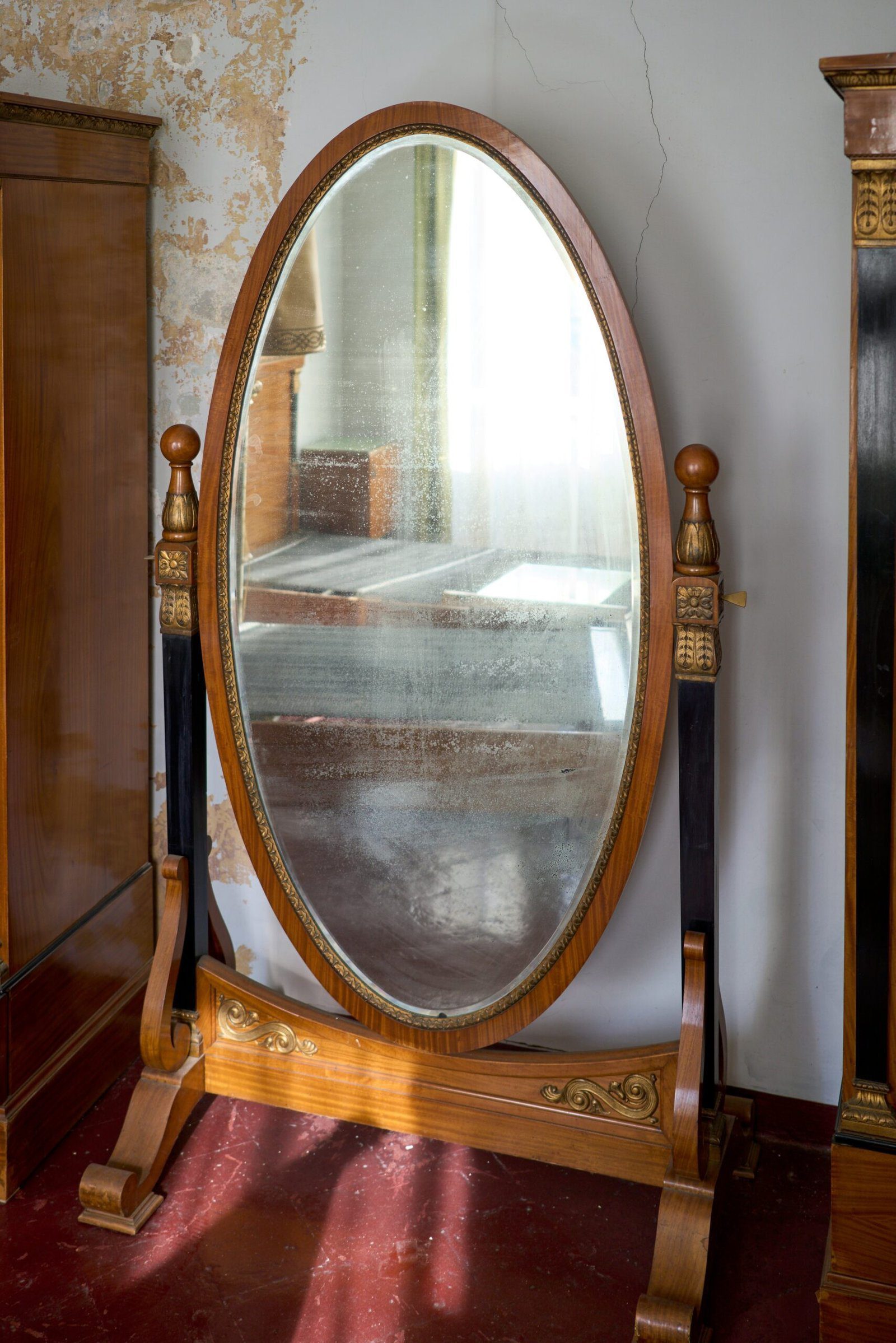
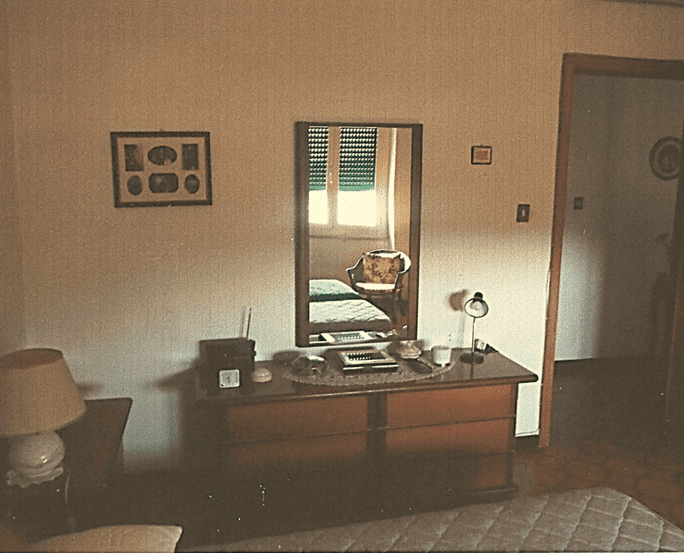
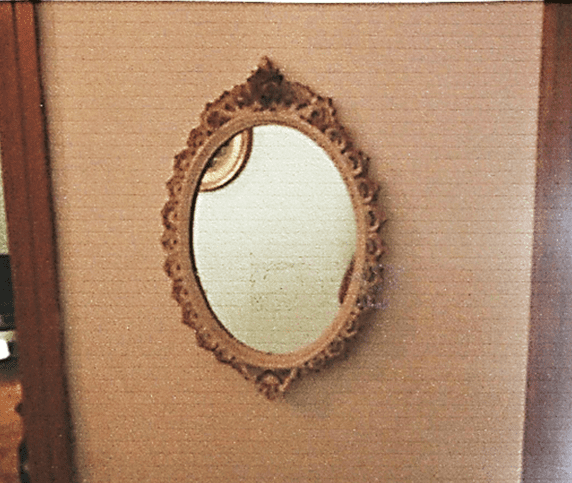
There were three mirrors in my house. One mirror in my grandparents’ bedroom, one in the corridor, and a rather large and antique one in the dining room that had been passed down through three generations.

(Image courtesy of Viviana De Cecco – November 2000)

When we entered the bedroom, Aunt Caterina asked me to help her tuck the edges of the cloth into the upper corners of the frame so that it was completely covered. 

It was this way that I discovered one of the funeral customs that are still deeply rooted in Sardinia, in all of southern Italy and in various cultures around the world. There are traditions so old that no one knows exactly when and where they originated. Covering the mirrors when a person dies is a custom that has its roots in the mists of time. 

Aunt Caterina explained to me that covering the mirror with a cloth prevents the soul of a deceased person from being frightened by seeing its own reflection. In addition, to prevent the departing soul from getting lost, it is appropriate to close all the windows, draw the curtains, leave some lights on and leave the door open to facilitate its journey to the afterlife.

The mirror is often seen as a portal between our earthly world and another dimension, and the wandering soul of the deceased, drawn by the glow of its reflective surface, may become trapped there forever. Instead of leaving its mortal remains, it could potentially drag the souls of all the living people reflected in the same mirror and haunt the house of the deceased for all eternity.

I remembered all the times when, as a child, my grandfather would sit me on his lap before a family celebration and make funny faces in the dining room mirror to make me laugh. He was always ready with a joke, and the thought of not seeing his smile again tore at my heart. Seeing those mirrors covered with those big dark cloths, the typical color of mourning, felt like a sign of the end. They reminded me of those abandoned houses where life had faded and happiness has been lost forever.

These dark beliefs are much more prevalent in the inland rural areas than in the cities. That’s why my aunt’s words, coming from a rural village where certain superstitions about the dead are never underestimated, touched me deeply. Even though those ideas may seem quite incredible and ludicrous, there was something both frightening and reassuring about that belief. It was comforting to think that my grandfather’s death wouldn’t be the end, and that we had helped usher in the beginning of his journey to perhaps a better place.

(Image courtesy of Viviana De Cecco – November 2000)

Even today, I feel torn between rational skepticism and doubt that there may be some truth in these ancient beliefs. Perhaps our ancestors were much wiser than us modern people. 

The Greeks and Romans were among the first to seek glimpses of the future in reflective surfaces. Who hasn’t broken a mirror and heard: “Now you’ll have seven years of bad luck”? The Romans believed that a person’s life was divided into seven-year cycles. Breaking a mirror would bring bad luck simply because it represented the souls of the living. Likewise, for the Egyptians, mirrors weren’t just for cosmetic purposes among the wealthier classes, but they also had funerary significance. It was believed that their radiance was linked to the sun god Ra and was a symbol of vital regeneration, which is why they were often depicted in the reliefs of the tombs of high dignitaries.

While doing some research on the internet, I discovered that this belief is also widespread in the Jewish religion. In the sacred text called the Talmud, there’s a phrase that several writers have quoted in their novels that refers to the human relationship with mirrors: “We do not see things as they are, we see them as we are.” This phrase makes me think that a mirror shows us our physical reflection on one side, but also reveals the nuances of our gaze, where all the feelings that lie beneath our exterior are hidden.

When we look at ourselves, we often say that we have a lively gaze. Where does this vitality come from? What can we call it? Is it the soul that we see? What is hidden within us that the mirror cannot really show us?

When a mirror reflects a dead person, there is no gaze to interpret and no movements to reproduce. Think of the vampire, who has no reflection in the mirror precisely because he is dead. Or consider exorcism practices, which sometimes use mirrors to chase demons out of the possessed.

So how do we know what is beyond the reflection of a lifeless body? I believe that superstitions are created to find the answer people have been seeking for centuries in their search for the meaning of life and, above all, its end.

Now it seems to me that this ritual is a demonstration of the living’s love for their loved ones, a testament to their desire to protect them. No one can know for sure what really happens the moment they depart this world, just as no one can know if there is emptiness or light.

What is certain is that, on that night when I returned home with my parents, I looked in the mirror in my room and wondered if my beloved grandfather, who had always been a guiding presence in my childhood, had found peace.

When my Aunt Caterina died three years later, there was no need to cover the mirrors. She died of pneumonia in the hospital, in that sterile environment where death seems even sadder. Everything happened slower with her. I had time to say goodbye to her and to hear that she had no regrets. She had been happy and was going in peace.

At that moment, standing at her bedside with my relatives, I began to believe in the soul. I believed it could be found in the looks of those who are with us, in their words and in all those gestures through which every human being communicates with his fellow human beings.

The 11th Commandment – Don’t Rush Childhood

What is that one thing you wanted as a child? 

I bet you eagerly wanted to be an adult. Being an adult meant doing whatever you wanted to do. Why can’t you do the things adults do? Why is the answer always “no” whenever you ask for a cool toy, snack, or game? This question I often asked myself, and finally when I was six years old, I was able to come up with an answer. 

It involved alcohol, peppermints, and command mints, as I heard them called. 

***

Give me that beer

During the Christmas season of 1999, my parents threw a big party at our place. Many adults and kids showed up. When it was time to eat and drink, I noticed something that would bother me. My parents would serve adults beer and kids sodas. As a child, this is what I observed at all our parties. Finally, I had enough and decided that I would also drink beer with the adults.

(Image courtesy of Daniel Kandie via Unsplash)

This commandment continued at all our parties we threw as the months and years passed. 

Finally, I had enough and decided that I would also drink beer with the adults. Of course, I knew my parents wouldn’t allow it, so I needed to do it without them noticing. I hatched a plan. 

Once another event gathered everyone and my parents went into the kitchen, I seized my chance. I approached a man drinking beer and asked him for a sip. I couldn’t believe it, he agreed. 

I regretted it almost immediately. The beer was so bitter that I ran out of the living room and locked myself in the room; I think I may have cried, too. 

Lessons from the beer

For kids:

Generally, adults are better equipped to handle tough issues. Maturity and life experience aside, adults have different preferences and tolerance from kids. 

I. Do honor the differences of age and respect them. 

Generally, adults are better equipped to handle tough issues. A good example is how they are able to willingly drink beer despite its bitterness. You would think they would stop at the first sip but yet they keep going. 

I took one sip myself and couldn’t handle the taste at all. 

II. Do not take the name adult in vain by rushing to be just like adults, even with something simple like alcohol. 

You can’t handle the tough things that adults do in the first place. Your brains just aren’t developed enough to shoulder the hardships of life any more than a foal is developed enough to carry a human rider. Did you notice you don’t usually work, pay taxes, or drive?

For adults:

Can you imagine what would have happened if I drank a bottle instead of taking only a sip? It wouldn’t have taken long for me at all to become inebriated, considering my small size and that I was underweight. My parents would have punished me either by scolding me or … the belt. 

III. Do not allow kids to consume beer, for reasons besides its bitter taste. 

It could have even affected my future as well if my parents weren’t strict, and ignored me instead.  

IV. Do not enable kids in bad habits. 

If I ignored the taste in my desperation to be like the adults, I could develop an addiction at that age and would constantly do whatever I could to get a beer.

***

Give me those sweets

Drinking wasn’t the only adult thing I wanted to do when I was a child. 

(Image courtesy of Eric Prouzet via Unsplash)

I wanted to be a shopkeeper for one reason only: the sweets. As a kid, I was always fascinated by how those workers could be surrounded by so many sweets and not eat them. At the time, I didn’t realize that the reason was that shopkeepers needed to make money by selling their sweets, not eating their profits.

Since I was excited about this career path, I told my mother that I wanted to be a shopkeeper when I grew up. Mind you, I previously told her I wanted to be a lecturer. Understandably, she was confused and irritated. Why would I want to be a shopkeeper anyway? She didn’t ask me in words. 

V. Do honor the shopkeeper and all career choices.

Of course, there is nothing wrong with being a shopkeeper, considering we need their services. However, my mother thought that this dream was not allowing me to realize my full potential. I met this reaction with frustration. Why couldn’t she accept that I wanted to be a shopkeeper? 

However, as an adult, I have since realized I don’t want to run a shop due to how challenging the role is. It was not as simple as it appeared to me in the past. Shopkeepers must have strong inventory management skills to strike a balance between overstocking or understocking their shelves, controlling expenses, and monitoring cash flow. A huge part of their job is customer service. Their stock is dependent on their customers and supply and demand, not just candy they can snack on themselves. I still wonder. 

Lessons from the sweets

For adults:

Sometimes kids can be shallow as they simply don’t know any better. When asking them what they want to be when they grow up, listen carefully. 

VI. Do not kill their imagination. Be sure to ask about their preferred career path in easy terms of things they enjoy doing and what could help make them a good living. Typically, kids don’t understand the challenges that are prevalent in that job and instead focus only on the advantages. 

Imposing a career on your child, it is a mistake to say, “You want to be a shopkeeper? Why can’t you be a doctor instead?” By framing it this way, you are already pressuring your child down a specific career path, a path they may have no interest in. Instead, find out why your child loves the career they want to pursue. 

VII. Do explain exactly what chores that job actually does. 

If their reasons seem shallow or ridiculous, work to redirect their dreams. 

For kids:

At the end of the day, growing up is inevitable. You might want to rush into adulthood because it appears fun, but adulthood comes also with many expenses and responsibilities. 

VIII. Do, as a kid, keep the privilege of not having to think about paying for anything. Overall, you may be desperate to grow up. 

Right now, I struggle to pay rent every month. 

***

This is now a single pic: 

(Image courtesy of Anna Shvets via Pexels)

Give me the car keys

IX. Do describe the challenges of adulthood along with all the advantages of childhood. 

However, also be careful to convey life in a way that doesn’t demonize adulthood to the extent that discourages them from wanting to grow older at all. 

X. Do let your child enjoy their youth without coveting adulthood. Teach them lessons big and small as they grow.  Let them learn to handle adult responsibilities with confidence.  

(Image courtesy of Jon Haley via Unsplash)

‘This Is Us’ — The Drama of Body Shaming, Diversity, and Conflict on My TV

Being a voracious reader since forever, I have always been a sucker for a good story. Unwittingly, I tend to submerge myself in characters  so completely that for those few moments I belong entirely to them — crying with them, laughing with them — oblivious of the tear rolling down my cheek or the smile plastered on my face, participating in their glee as well as their grief.

So when I came across “This Is Us” on NBC.com and Amazon Prime, my curiosity was piqued for many reasons. It all started with a news article that caught my attention. Highlighting the acting chops of the mellifluous Mandy Moore, this piece even flirted with a possible Emmy run, witnessing a meteoric rise in popularity. It was a running dual role of a young mother of triplets in a storyline oscillating between the past and present day where she plays an older woman eventually confronting an impending age-related disease.

Eager to see Moore on screen after a long time, I dove right in. 

Image of a person pointing a remote control at a tv.
(Photo courtesy of Erik Mclean via Unsplash)

Family and mental health

I was hooked from the first episode. The pairing of Milo Ventimiglia and Mandy Moore as husband and wife is nothing short of a masterstroke. The passionately in-love, all-in superhero father and husband played by Ventimiglia, masterfully exuding the perfect cocktail of gravitas, charm, compassion, bravado, humility and problem-solver dad had my full attention from the get-go.

Inarguably, if Ventimiglia is the ship that keeps the story afloat, Moore and her immaculate craft are the sails that propel it all forward. With a few charming smiles that age gracefully much like the rest of her, Moore lures you in and makes you believe that Rebecca Pearson is who she is now and forever; that we can never go back to someone called Mandy Moore. Hailing from different worlds, these two characters fit like two broken pieces of the same whole, glued together by their own impervious love.

Unlike other gripping shows that I tend to binge-watch at optimal speed, I took my time with this one. Like a fine wine that is savored and relished with every sip, I took my time to unearth the treasure trove of familial bonds. In particular, between the Pearson triplets  —  the imperfections, the fractious relationships that conversely also formed the cornerstones supporting the reformed relationships of their later years.

Well-embroidered

What I loved the most was the brilliantly and most intricately sewn layer upon layer of not just the broader base story, but the amount of light shone on the unraveling of each character’s backstories and underlying complexities. 

Three siblings who could not be more different, battling their own unique demons since their childhood, deliver a poignant and relatable lesson on the importance of staying united as a family, even in periods of estrangement and coming together to lift up loved ones. I also noted how their father’s influence pulsates through these characters in all they do as their lives progress.

Pick a social issue

In its ingenuity, the show has incorporated important global issues like racism, body shaming, eating disorders, LGBTQIA+ living (seniors and teens), child disabilities, anxiety and mental health into each of its character stories.

How this family comes together for each of its members going through one of these issues, and how the show successfully manages to normalize these conversations is what struck me. Especially those plots under the category of mental health like Randall Pearson’s unrelenting anxiety issues, Kate Pearson’s damaged self-esteem with her weight, and Kevin Pearson’s enormous pressure on himself to live up to the man his father was. Kevin finds himself failing miserably at every step; he’s kind, but not the deepest. 

Affection in our homes

Even an aging Rebecca in the throes of an impending disorder still battles with profound grief after many years, and brings forth the importance of mental health patients. Conversations that need to start within the four walls of our own homes. 

Especially today, on the heels of a gradually quieting global pandemic that upended lives and fractured relationships, the need for families to double down on regular public displays of affection — especially in front of and with their children — is important in my life.

This is something I circle back to often. When I grew up, there was a clear lack of public displays of affection. We just weren’t “huggers”. It didn’t help that the society that surrounded us when we were growing up, and continues to dictate the acceptability of such acts of physical affection in public like hugging and kissing, also ostensibly made such desires within many families within their realm stay away from it. Or perhaps be more conscious of it. This was something the series hit home for me too and I find myself consciously making an effort to encourage physical gestures of love towards my siblings by modeling it for them too.

Diversity and body shaming

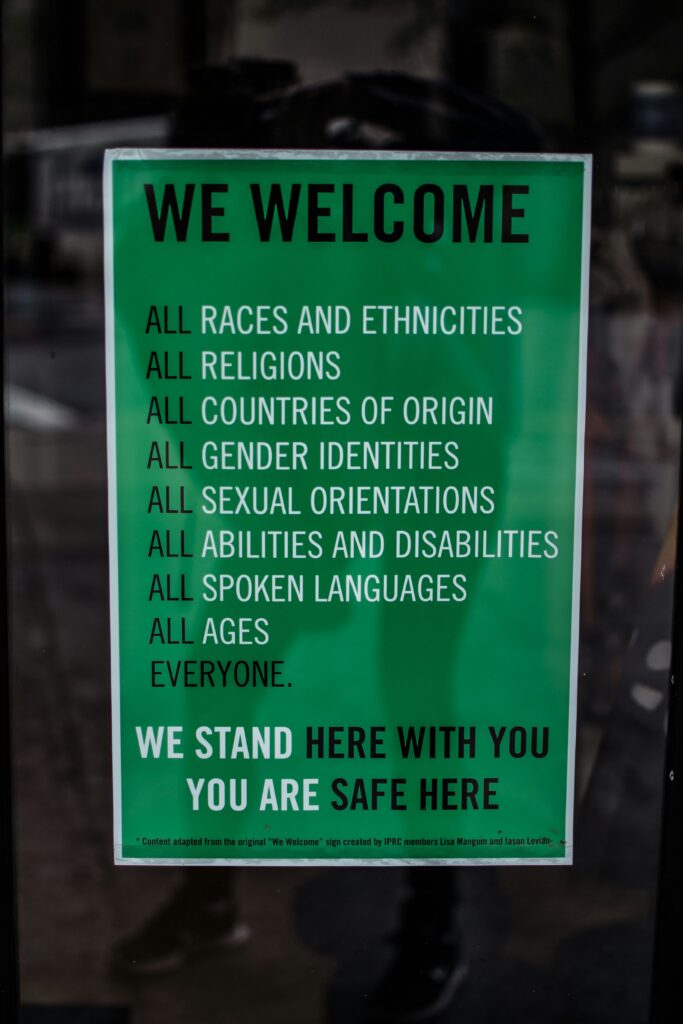
Image of a sign that says, “We welcome all races and ethnicities, all religions, all countries of origin, all gender identities, all sexual orientations, all abilities and disabilities, all spoken languages, all ages, everyone. We stand here with you. You are safe here.
(Photo courtesy of Brittani Burns via Unsplash)

In the early 1980s, a white American couple with twin babies adopts a third, an African American newborn abandoned by his father at a fire station. Steeped with the versatility that very few others possess, the inimitable Sterling K. Brown plays this grown-up Black boy, Randall Pearson, who was born to a black family but raised by a white one and was still trying to unearth the full story of his biological family’s checkered past. The show acts as the conduit that brings forth the harsh racism that people of color have been subjected to since time immemorial and still in the period in which the show is based.

It’s a wake-up call to recognize that the difference in color cannot and should not overshadow the sameness of all humanity. We often tend to begin this very important and urgent education too late. Just the other day, when my three-year-old son said that he did not want to play with our house help anymore because she was “dark” in color and not “white” like us, I knew that this education hadn’t started soon enough. A three-year-old doesn’t fully understand the weight of his words, but unwittingly he brought forth the urgency of handholding and guidance on this issue at the toddler stage itself.

Mental health too, remains a core and underlying commonality permeating the essence of the entire show and through all the time periods. Randall Pearson grew up with a white family that was so busy trying to give him a “normal” childhood that they never once addressed his “blackness” and the baggage that comes with it. Or how it could be affecting him and his curiosity to know more about his community and where he really came from. It is one of the main reasons his relationship with his siblings is consistently complicated.

When I think of how my four-year-old is learning to embrace his classmates who come from all cultures, races, countries, sizes and colors of skin, and how all of this is their “normal” right from the get-go, it fills me with hope for a more inclusive, loving, and broad-minded future.

There’s more 

A very overweight Kate Pearson struggles with weight loss, the inability to have a child, multiple failed IVF attempts, and ultimately the success of surrogacy while her best friend is struggling with the eating disorder bulimia. So many issues in this one sentence that go tabooed, unspoken, ill-approved, hushed-and-brushed under the carpet in so many countries and cultures even today. So many issues that for the most part only garner sneering spite instead of support. 

The effortless execution of the portrayal of all these important issues in the show is noteworthy. They don’t all resolve.  And then, there is illness [please ensure that the text in peach isn’t visible to the reader until they click after Spoiler Tag Alert to reveal it!] Spoiler Tag Alert Alzheimer’s disease is addressed across an arc of episodes.  This one hits close to home as it was what took my grandfather from us almost two decades ago. Moore’s portrayal of a woman who has just been diagnosed early with this neurologic disorder is Emmy-worthy in my book.

Aging in the four walls of our own houses

I was still in school and too young to fully comprehend that this evil disease was slowly but surely consuming my grandfather — shutting down his organs bit by bit inside the four walls of our own house. In many ways, this show that I watched decades after losing him is a sort of closure that I needed and didn’t fully understand that I needed back then.

I can write a whole book on why this show is a must-watch, but that would be tough to do without more spoiler alerts! It’s a riveting, heartwarming and stirring watch for everyone in every capacity — as a parent, a mother, a father, a wife, a caregiver, a child, a friend, a partner.

These are our stories too. 

There’s a reason they call it “This Is Us.”  

Two images of ducks in water. The photo on the left has a mother duck with her ducklings, while the photo on the right has just one adult duck.
(Photo courtesy of Siegfried Poepperl via Unsplash)