Screw the Standard-Issue Labeling Machine

Message: “Aunt nell, Nanti hettie. Dooey daiture and quinque, parker, Bona lavs, ducky. “
Polari translation: Listen, I am not straight. In 2025, I give you my best wishes, my dear.

In high school gym class, I often overheard conversations about sexual encounters, stories, ‘advice,’ and asking questions. I remember in ninth or tenth grade, a friend asked me questions about sexual experiences due to my being in a relationship. I felt uncomfortable, as this wasn’t something I wanted to discuss out in the open. I also didn’t want to discuss what started occurring in my life at 17 (that I hadn’t yet  fully processed). Sex was an uncomfortable topic. Romance was different.

Finding the right words or labels

I had always felt romantic attraction towards others. My first crush was on a boy in my kindergarten class, and I realized in sixth grade that I was attracted to girls. Throughout my life, I thought of romantic attraction, not sexual attraction, as a vital component of a relationship.

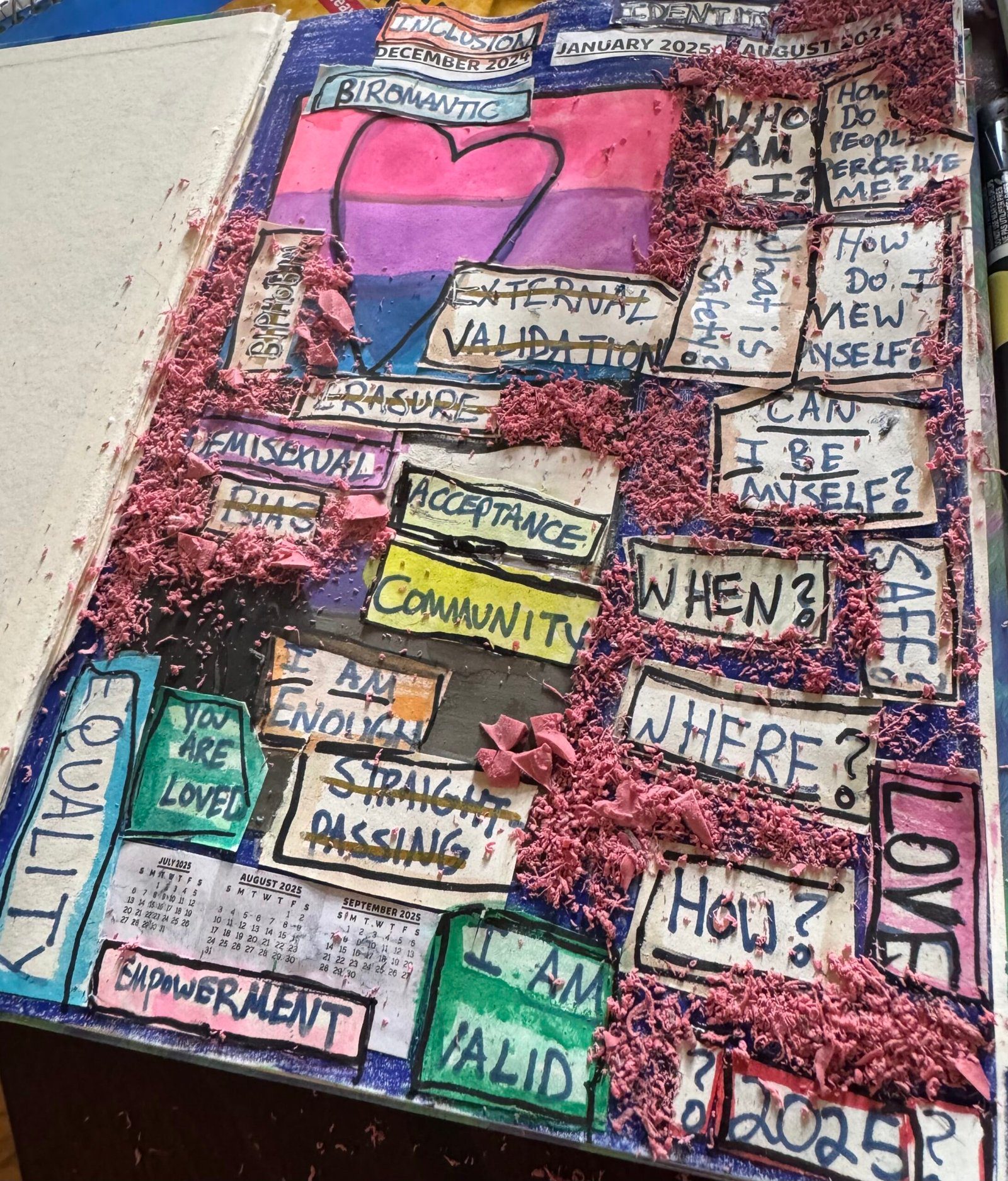
In seventh grade, I discovered the label bisexual. That identity lasted eight years, since I didn’t know there were other options to define myself. Earlier this year, I reconsidered if the label I had worn for so long was accurate to who I am. After thinking it over, I faced that the most accurate way to identify myself was biromantic and demisexual.

Biromantic is described as “being romantically attracted to more than one gender, not exactly in the same degree, same time, or in the same way.”

Biromantic to me means that I am romantically attracted to others, just not in the sexual sense.

Demisexual can be defined as “experiencing little to no sexual attraction without a strong emotional or romantic connection, falling under the ace umbrella (Asexual).”

To me, this means that I’m only sexually attracted to someone after thoroughly getting to know and trusting them on a deep, romantic level. I’ve never viewed myself as someone who could have a one-night stand or a friends-with-benefits situation.

For the past five years, I’ve reconsidered if it’s safe for me to be authentic in terms of my sexuality. With the rise of anti-LGBT laws and bills, I’m afraid to be open about it in public. If I’m with my close friends and in a safe environment, I’m able to speak about it in detail. Without my community, I’d feel lost. 

The feeling of community does not always take the form of a connection that exists in person, since there are online friendships I hold dear to me. For basically ten years now, I have been an active member of the fandom that surrounds two of my favorite YouTubers, Dan and Phil. 

Many within the fandom (phandom) are also LGBTQIA+. In addition, Dan and Phil themselves are queer individuals, and foster community within their fan base. This has been a positive space for me since I was thirteen, and first discovered my attraction to women/feminine-presenting people. 

A friend of mine who I first met in the phandom once exclaimed while hanging out, “I’m here, I’m queer, I’m gay, and I slay.” This is an example of inclusion within the phandom. 

Although I’m afraid to share my identity in some social situations, I have a safety net. The same net simultaneously protects and isolates me. Two years ago, my fiance and I became engaged. Due to bias and biphobia, I’m often viewed as straight because of my fiance’s gender. 

For example, a classmate in high school asked me if I was “still bi” after beginning my relationship with my now-fiance. I’m sometimes not considered part of  the LGBT community as a result of this relationship. That’s isolating.

Erasure is a concept that I internalize, and I have a difficult relationship with it. It makes me feel uneasy knowing that others dictate my identity. Being part of the community is part of my identity. The intersectionality of all my identities live within me: I am a woman, biromantic, demisexual, neurodivergent, and disabled — all at the same time.
Image of paints that make for a rough rainbow
(Image courtesy of Steve Johnson on Unsplash)

The world we live in now

However, in this current climate, I’m privileged to have that safety net of being straight-passing. I am outwardly protected against hatred in some ways, but still discriminated against. 

After a situation that happened to me a few years ago at a local restaurant,  I’m scared to wear pride clothing. A nearby city didn’t have their first pride celebration until 2019. I know that not everyone in the area supports people like myself. 

That protest during senior year

During my senior year of college last year, students found out about a restrictive policy that was passed by the board. This policy stated that transgender, trans, and nonbinary students were no longer eligible for admission; many of my former peers are trans and nonbinary.

At a campus event with a guest speaker, I felt unfairly silenced. We were told we couldn’t speak out, couldn’t interrupt the speaker, yet weren’t allowed to leave yet. Students who weren’t seniors protested the policy by wearing all black and accessorized with pride flag pins. But, I was a senior. 

Part of me knew that the college administration was restricting students, but part of me didn’t know to what extent. I knew I needed to use my voice for good, since the restrictions were even stricter for students who were not closer to graduating. People in my life warned me about protesting, told me to not get myself in trouble. I didn’t care, because it was my senior year and knew just one extra voice could make a difference. I crossed that line almost daily, every time the administration made changes. I constantly worried that I would be called into the dean’s office, but thankfully I wasn’t.

I was surprised to find out how restricted I was as a student, but not shocked at the same time. I believe I was surprised that the administration thought so low of students, as many of us would not have even attempted to interrupt the speaker — without being told not to. I felt a sense of disconnection between how we as students viewed ourselves and our peers vs. how the Admin viewed us. The local police showed up to the Annual Founder’s Day event after the meeting, without our knowledge. I felt as if Admin viewed anyone who spoke out as a threat, when most people were not. 

Some faculty were supportive of students, and I understand why some were not in the position to risk their jobs in order to support us. 

In response to feeling shut out before, that same month I attended a protest on campus where students joined together, raising our voices to “Rescind the policy.” The administration approved the protest ahead of time. It was student-led, with fixed guidelines allowing us to shout approved phrases, hold signs, and only protest during the approved time slot. The protest coincided with the week that a board of directors meeting was occurring on campus. Once the meeting was over, we could no longer protest.

Following the protest, I joined a few others who were planning on speaking to a local reporter.  I didn’t know if I would be punished for speaking out afterwards, but I took that risk. Loved ones warned me not to do it, saying I would get in trouble. However, after the way the campus climate had shifted quickly under the appointment of a new commander, getting in trouble was the least of my concern.

Despite graduating from college and leaving that environment, I face bias and discrimination still, but primarily due to other parts of my identity.

Anxiety comes upon me whenever I see red MAGA banners in nearby cities or when I come across articles online that mention politicians’ stances. Anxiety creeps in when I visit cities that are dominated by primarily anti-LGBT institutions.

I often don’t tell others about my sexuality upon meeting them since I cannot be sure of their intentions. I wonder if I can attend local pride events — if it’s worth the possibility of being targeted online by someone from my hometown who is passionate in their anti-LGBT sentiments. How accepting a particular state is a variable in determining where to relocate. 

As well as this, I never know what will happen to my loved ones who are part of the community in 2025. I wish there were protections in place for every LGBTQIA+ individual. I wish I could foster that progress.

How I define progress and resistance

I may be ridiculed in public when I wear a pride shirt, but I know my experience isn’t the same as LGBTQIA+ people in other states or around the world. I may have been outed in seventh grade — and called a slur when I publicly came out as bisexual on instagram in ninth grade — yet, I cannot compare my experience to those who were queer activists in the 60s, 70s, and  onward. I don’t know what it’s truly like to fear my life on the daily for who I am.

I can’t relate to the community members who spoke a code language for decades in order to share everyday encounters with their friends. There are no direct terms for biromantic and demisexual in this language. Thus, I most likely would have been referred to as bibi palone (bisexual woman). Polari represents the history of the community during one of many  dangerous time periods for those in the LGBTQIA+ community. 

Survive and thrive

The historical basis for pride was to stand up against injustice, fight for those who can’t do so themselves, and make a difference. Pride at its root is about being authentic, even when social barriers are in place.

I’m not suggesting that others outside of myself should necessarily tackle injustice, as individuals exist in different circumstances than myself. I myself am sometimes worried about wearing pride clothing or accessories. Further, fostering change is not a monolith. It can be carried out through different methods.

Prioritizing well-being and self-care may be the only form of autonomy for individuals. Sometimes, resistance consists of survival and, eventually, thriving. Being true to who I am makes a difference. 

I’m very glad to be able to live with my fiance now. Right now, for me, being myself is resistance enough. 
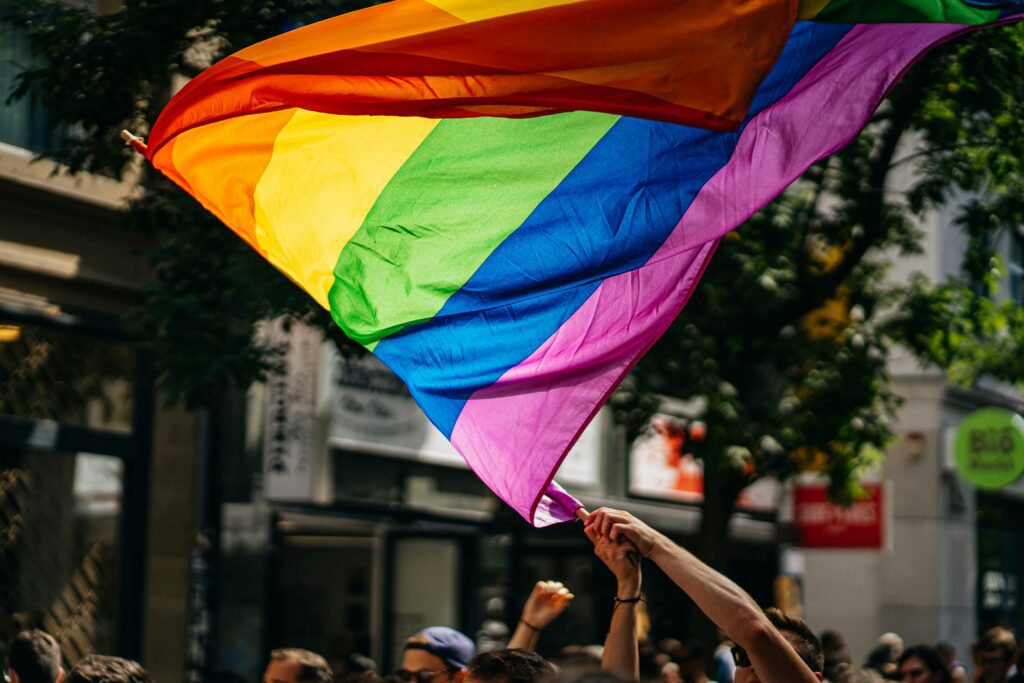
Arms waving a glowing pride flag in the wind
Image courtesy off Raphael Renter | @raphi_rawr on Unsplash

Almost Lost Forever: True Love and Survival

When the extraordinary Swedish documentary “Nelly & Nadine,” directed by Magnus Gertten, was released in 2022, it was featured in over 100 festivals and received more than 20 international awards, mainly in Europe. Thankfully in the US, it is now widely available on streaming services like Amazon Prime. For me, it was one of those films that stays with you, makes you think, makes you remember, makes you well up with tears. 

“Nelly & Nadine” is a true story about two women who became lovers at the most harrowing place and time — a concentration camp during WWII. Somehow, they survived. If it weren’t for a benevolent granddaughter named Sylvie, their story would have been lost. 

This documentary spoke to the heart of my own struggles and experiences as a lesbian of Jewish heritage. As a child, I knew my family’s immigrant story, how they crammed onto ships headed to America from Eastern Europe in the early 20th century. Those who stayed behind never visited us, and their lives passed from view. 

I was over sixty when I first visited Prague and went to the historic Jewish cemetery. Written on a memorial wall were the family names of Jews who were transported and killed at the Terezin concentration camp. My eyes scrolled down the lengthy list and stopped short at one name: Rappaport, the family name of my mother’s father. I gasped as a chill went down my spine. If I hadn’t gone to that old graveyard, their fate would have been lost to me. 

Delving into their story

The story of “Nelly & Nadine” begins at a remote farmhouse in Northern France. 

The elderly Sylvie Bianchi goes to the attic and opens dusty boxes, which contain her dead grandmother’s diary, letters, photographs, and home movies. She and her husband became the custodian of the boxes after her mother’s death. They faithfully kept them for many decades, as Sylvie had fond memories of her grandmother, Nelly Mousset-Vos (1906-1987), who had been an opera mezzo soprano of considerable talent. 

Nelly

All Sylvie knew of Nelly was the kind, gray-haired woman with the wonderful voice who came to spend Christmas holidays with her French family, traveling all the way from her home in Caracas, Venezuela. After the end of WWII, Nelly moved there with a woman named Nadine. Sylvie knew only that Nadine was just her grandmother’s friend and housemate. Their relationship was still a secret.

Sylvie was curious and at some point in her search, she found Nelly’s diary. She read only a few lines before it was too painful to continue. Her grandmother never spoke to any family member about her two years in various Nazi concentration camps, but there it was all laid out in words. Finally, she dared to go further, and what she found was astounding.

Sylvie decided to share Nelly’s archive, so this documentary could be made. Researchers, historical recordkeepers, and friends of Nelly and Nadine helped to flesh out their true story. As the story was unearthed bit by bit, Sylvie participated in the key interviews and was shown the documents. She came to appreciate her grandmother not only as a remarkable person, but also as a hero of France. 

Sylvie knew that Nelly performed in cities all over EuropeIn the 1930s, and that she had two children (her marriage ended in divorce.) She learned that after the Nazi occupation of France in 1940, her grandmother joined the Resistance as part of a spy ring. In 1943, Nelly was swept up and arrested by the Gestapo in Paris and sent to the Ravensbrück concentration camp. The prisoners were forced to do hard labor under terrible conditions; if they couldn’t work, they were killed. 

Nadine

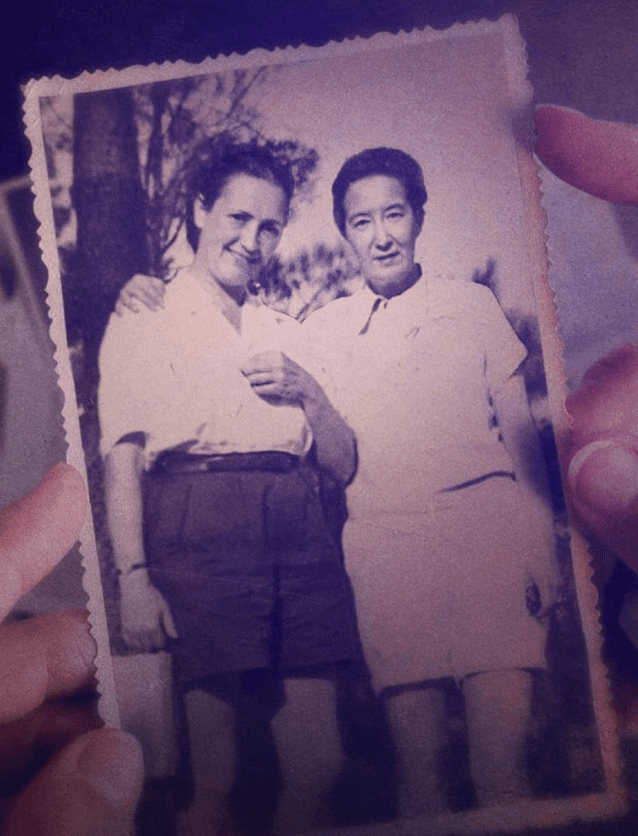
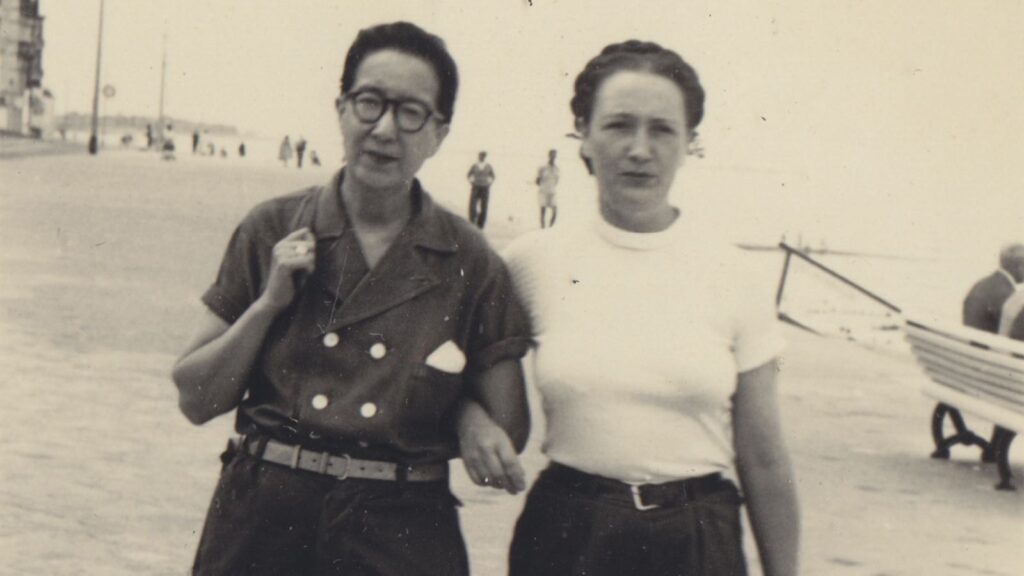
Old photographs and home movies revealed what the mysterious Nadine looked like. She had a tall, elegant figure with short dark hair and often dressed in trousers, a shirt, and tie. Born in Madrid, Nadine Hwang (1902-1972) was the daughter of a high-ranking Chinese diplomat and a Belgian mother. She was educated in multiple languages.

Nadine moved to Paris in 1933 and became part of the feminist/lesbian circle around Natalie Barney (1876-1972). A playwright, poet and novelist, Barney hosted a salon of notable artists and writers at her Left Bank home. Nadine became Barney’s chauffeur and one of her casual lovers. Nelly’s memoir stated that Nadine helped at-risk people escape from occupied France to Spain, which led to her arrest and transportation to Ravensbrück in May 1944. 

Nelly and Nadine

By Christmas Eve 1944, Nelly was forced to perform  carols. Nadine called out a request. 

With Nelly and Nadine meeting in the camp, their relationship became intimate and passionate. Against all odds, their love for each other kept them alive. They were separated when Nelly was later transported to the notorious Mauthausen concentration camp in Austria. Forced labor in the stone quarry usually meant death, and Nelly was close to the edge at this camp. Her intense memories of Nadine kept her going. As it happened, this was late in the war. 

The film shows a poignant clip of a movie taken in 1945 when a group of liberated prisoners from Ravensbrück arrived in Sweden. You see the faces of the survivors deliriously happy to be alive and start their recovery. Nadine was in that crowd. Hers was the only sad, tense face. At the time, no one understood the reason. Nadine was thinking of Nelly. Was she alive or dead?

By some miracle, Nelly had survived, and they found each other again. 

The real reel — my own story

What followed after the war was the story of so many gay men and women before the gay liberation movement of the 1970s. 

I know because I was around then. 

In 1965, I was a sophomore at UC Berkeley when I phoned my father from the dorm. I told him that I wasn’t returning home for the summer. I’d met someone I wanted to be with, someone I loved. Her name was Caitlin. My father exploded, calling me a child, an infatuated fool. He told me to come home or all financial support would end. 

I went with Caitlin, and my life became one of desperate struggle to stay in school and graduate. But I did. 

The price of being honest and true to oneself was so high that gay people had to make heartrending decisions. Some had secret lovers under the beard of a straight spouse. To keep a career and paycheck, one’s real private life was never spoken about at work. Coming out meant stiff societal consequences (even criminal in the case of men). On the streets, fluid gender or flamboyant clothes raised the risk of being beaten or killed. 

Not to compare to the camps, but no gay abandon for society’s rejects, either. Despite the passage of marriage equality and wider acceptance, it’s still tough out there for so many.

Buenos Dios, Caracas

Nelly and Nadine were likewise determined to live free and honest lives. Staying in Europe was too painful after what they experienced in the camps and too close to Nelly’s family. 

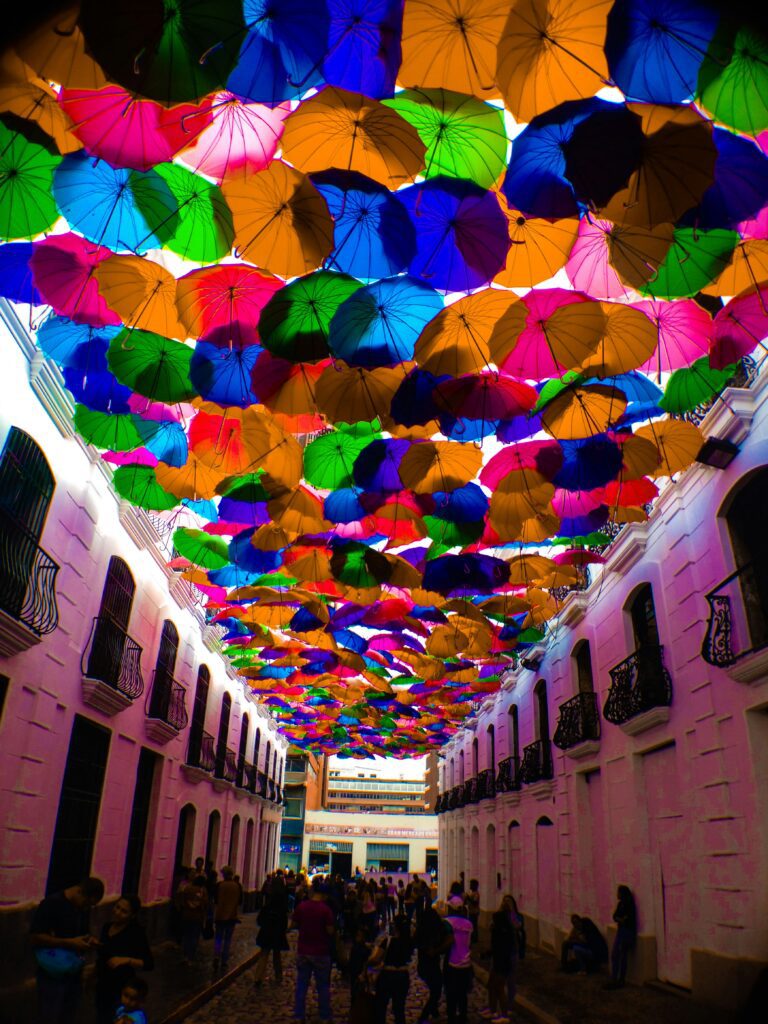
(Photo courtesy of  Egildes Rivero via Unsplash)

They picked Caracas, Venezuela — sunny and inexpensive with available jobs for educated, multilingual Europeans. The home movies showed them relaxing and entertaining their queer friends. They lived as partners until Nadine died in 1972.

Especially moving was the way Nadine filmed Nelly at their Caracas apartment. She caught Nelly deep in her own thoughts. Her face reflected a profound inner sadness, as her time in the camps could never be forgotten. One can only imagine that those memories were crushing and tragic. 

(Photo courtesy of Frameline48)

But she had Nadine, and they endured those memories together, always together. Love is love, that’s all, and that’s enough.

‘This Is Us’ — The Drama of Body Shaming, Diversity, and Conflict on My TV

Being a voracious reader since forever, I have always been a sucker for a good story. Unwittingly, I tend to submerge myself in characters  so completely that for those few moments I belong entirely to them — crying with them, laughing with them — oblivious of the tear rolling down my cheek or the smile plastered on my face, participating in their glee as well as their grief.

So when I came across “This Is Us” on NBC.com and Amazon Prime, my curiosity was piqued for many reasons. It all started with a news article that caught my attention. Highlighting the acting chops of the mellifluous Mandy Moore, this piece even flirted with a possible Emmy run, witnessing a meteoric rise in popularity. It was a running dual role of a young mother of triplets in a storyline oscillating between the past and present day where she plays an older woman eventually confronting an impending age-related disease.

Eager to see Moore on screen after a long time, I dove right in. 

Image of a person pointing a remote control at a tv.
(Photo courtesy of Erik Mclean via Unsplash)

Family and mental health

I was hooked from the first episode. The pairing of Milo Ventimiglia and Mandy Moore as husband and wife is nothing short of a masterstroke. The passionately in-love, all-in superhero father and husband played by Ventimiglia, masterfully exuding the perfect cocktail of gravitas, charm, compassion, bravado, humility and problem-solver dad had my full attention from the get-go.

Inarguably, if Ventimiglia is the ship that keeps the story afloat, Moore and her immaculate craft are the sails that propel it all forward. With a few charming smiles that age gracefully much like the rest of her, Moore lures you in and makes you believe that Rebecca Pearson is who she is now and forever; that we can never go back to someone called Mandy Moore. Hailing from different worlds, these two characters fit like two broken pieces of the same whole, glued together by their own impervious love.

Unlike other gripping shows that I tend to binge-watch at optimal speed, I took my time with this one. Like a fine wine that is savored and relished with every sip, I took my time to unearth the treasure trove of familial bonds. In particular, between the Pearson triplets  —  the imperfections, the fractious relationships that conversely also formed the cornerstones supporting the reformed relationships of their later years.

Well-embroidered

What I loved the most was the brilliantly and most intricately sewn layer upon layer of not just the broader base story, but the amount of light shone on the unraveling of each character’s backstories and underlying complexities. 

Three siblings who could not be more different, battling their own unique demons since their childhood, deliver a poignant and relatable lesson on the importance of staying united as a family, even in periods of estrangement and coming together to lift up loved ones. I also noted how their father’s influence pulsates through these characters in all they do as their lives progress.

Pick a social issue

In its ingenuity, the show has incorporated important global issues like racism, body shaming, eating disorders, LGBTQIA+ living (seniors and teens), child disabilities, anxiety and mental health into each of its character stories.

How this family comes together for each of its members going through one of these issues, and how the show successfully manages to normalize these conversations is what struck me. Especially those plots under the category of mental health like Randall Pearson’s unrelenting anxiety issues, Kate Pearson’s damaged self-esteem with her weight, and Kevin Pearson’s enormous pressure on himself to live up to the man his father was. Kevin finds himself failing miserably at every step; he’s kind, but not the deepest. 

Affection in our homes

Even an aging Rebecca in the throes of an impending disorder still battles with profound grief after many years, and brings forth the importance of mental health patients. Conversations that need to start within the four walls of our own homes. 

Especially today, on the heels of a gradually quieting global pandemic that upended lives and fractured relationships, the need for families to double down on regular public displays of affection — especially in front of and with their children — is important in my life.

This is something I circle back to often. When I grew up, there was a clear lack of public displays of affection. We just weren’t “huggers”. It didn’t help that the society that surrounded us when we were growing up, and continues to dictate the acceptability of such acts of physical affection in public like hugging and kissing, also ostensibly made such desires within many families within their realm stay away from it. Or perhaps be more conscious of it. This was something the series hit home for me too and I find myself consciously making an effort to encourage physical gestures of love towards my siblings by modeling it for them too.

Diversity and body shaming

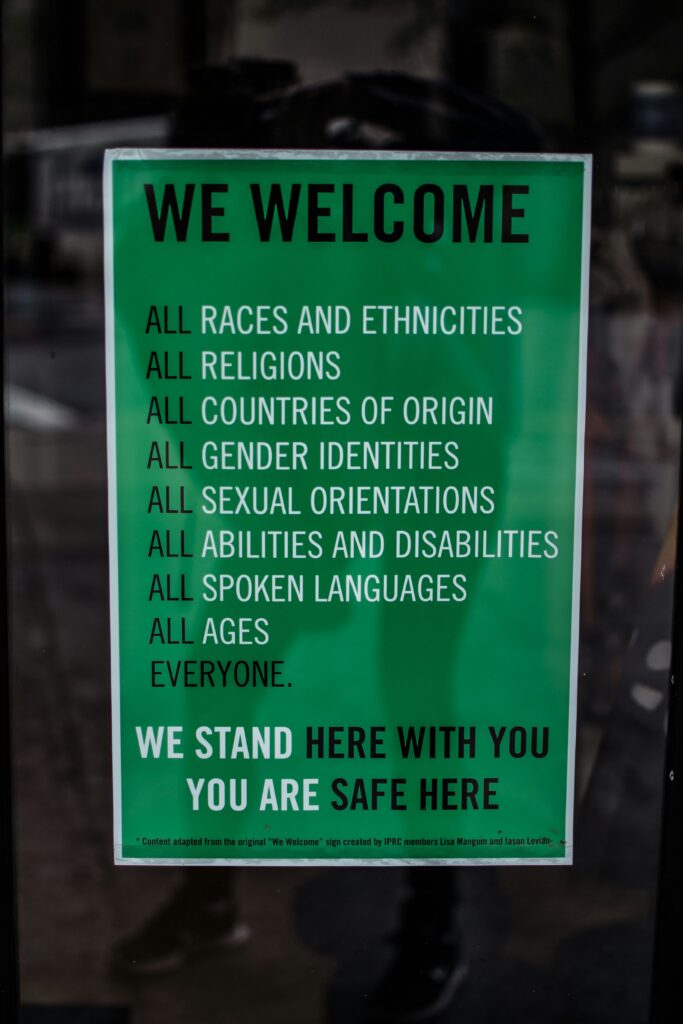
Image of a sign that says, “We welcome all races and ethnicities, all religions, all countries of origin, all gender identities, all sexual orientations, all abilities and disabilities, all spoken languages, all ages, everyone. We stand here with you. You are safe here.
(Photo courtesy of Brittani Burns via Unsplash)

In the early 1980s, a white American couple with twin babies adopts a third, an African American newborn abandoned by his father at a fire station. Steeped with the versatility that very few others possess, the inimitable Sterling K. Brown plays this grown-up Black boy, Randall Pearson, who was born to a black family but raised by a white one and was still trying to unearth the full story of his biological family’s checkered past. The show acts as the conduit that brings forth the harsh racism that people of color have been subjected to since time immemorial and still in the period in which the show is based.

It’s a wake-up call to recognize that the difference in color cannot and should not overshadow the sameness of all humanity. We often tend to begin this very important and urgent education too late. Just the other day, when my three-year-old son said that he did not want to play with our house help anymore because she was “dark” in color and not “white” like us, I knew that this education hadn’t started soon enough. A three-year-old doesn’t fully understand the weight of his words, but unwittingly he brought forth the urgency of handholding and guidance on this issue at the toddler stage itself.

Mental health too, remains a core and underlying commonality permeating the essence of the entire show and through all the time periods. Randall Pearson grew up with a white family that was so busy trying to give him a “normal” childhood that they never once addressed his “blackness” and the baggage that comes with it. Or how it could be affecting him and his curiosity to know more about his community and where he really came from. It is one of the main reasons his relationship with his siblings is consistently complicated.

When I think of how my four-year-old is learning to embrace his classmates who come from all cultures, races, countries, sizes and colors of skin, and how all of this is their “normal” right from the get-go, it fills me with hope for a more inclusive, loving, and broad-minded future.

There’s more 

A very overweight Kate Pearson struggles with weight loss, the inability to have a child, multiple failed IVF attempts, and ultimately the success of surrogacy while her best friend is struggling with the eating disorder bulimia. So many issues in this one sentence that go tabooed, unspoken, ill-approved, hushed-and-brushed under the carpet in so many countries and cultures even today. So many issues that for the most part only garner sneering spite instead of support. 

The effortless execution of the portrayal of all these important issues in the show is noteworthy. They don’t all resolve.  And then, there is illness [please ensure that the text in peach isn’t visible to the reader until they click after Spoiler Tag Alert to reveal it!] Spoiler Tag Alert Alzheimer’s disease is addressed across an arc of episodes.  This one hits close to home as it was what took my grandfather from us almost two decades ago. Moore’s portrayal of a woman who has just been diagnosed early with this neurologic disorder is Emmy-worthy in my book.

Aging in the four walls of our own houses

I was still in school and too young to fully comprehend that this evil disease was slowly but surely consuming my grandfather — shutting down his organs bit by bit inside the four walls of our own house. In many ways, this show that I watched decades after losing him is a sort of closure that I needed and didn’t fully understand that I needed back then.

I can write a whole book on why this show is a must-watch, but that would be tough to do without more spoiler alerts! It’s a riveting, heartwarming and stirring watch for everyone in every capacity — as a parent, a mother, a father, a wife, a caregiver, a child, a friend, a partner.

These are our stories too. 

There’s a reason they call it “This Is Us.”  

Two images of ducks in water. The photo on the left has a mother duck with her ducklings, while the photo on the right has just one adult duck.
(Photo courtesy of Siegfried Poepperl via Unsplash)