Lifestyle provides an inside peek into the varied ways we shape our own lives and experiences. How we choose to live, breathe, and navigate our everyday lives is exhilarating to explore.
On a very sunny and boring afternoon, I got a text from a strange number that simply said Hello. I replied out of bored curiosity, and the stranger introduced herself as Amaka. Amaka was my seatmate in primary school, who apparently has always had a crush on me since then. She told me she searched for me all through her high school years and found my contact information when we were entering university. This whole conversation was the beginning of a new world for me.
Amaka is a beautiful girl, naturally endowed with an amazing body that would make anyone’s jaws drop. Her melanin skin radiates as the sun touches it — oh, what a beautiful sight! A brown-skin woman with all the flair of an African Queen. Her smile could heal a broken heart, make everyone’s day, and even encourage me to keep going. She has the mind and soul of our ancestors, she speaks with confidence and stands tall in stormy times. How could I resist such a person? I tell you confidentially that this woman was my soulmate.
So our love story begins…
We got to talking. She remains in our hometown where she is awaiting a letter of admission from her chosen university. I, on the other hand, was working long hours day and night in a different town a ways away, making a whole lot of money while I was still young. Just like in the fairytales, we spoke at length every time we possibly could, day or night. Falling in love with her was the easiest thing I’ve ever experienced. Within that first week, I was entirely ensnared. I started sending out presents and buying her gifts.
She was my anchor after a very long day at work and encouraged me when I was feeling lost. We gossiped about everything.
As with any person, I had some cold days. Days where you feel off, days where you’re really out of your zone and need a hug, days where it feels like the world is heavy on your shoulders and all you need is a kiss and a long cuddle.
I trust you
This was an issue we worked on, and I was shocked about the response I was given. Amaka told me that I could have a side piece who would be there for the cold days. All she asked was that I always came back to her. I wasn’t comfortable with it because that’s not right, but I believe “I trust you” carries a greater commitment than “I love you.” Love cannot exist without trust, after all. Even if love doesn’t work that way, I understood she was willing to sacrifice part of herself by sharing me with other girls. In actuality, she has a part of me all to herself.
A meeting with fireworks
So after a few months went by, I traveled to meet the love of my life. It was one of the best memories I have ever had and I still wish that day could be repeated. I went to visit her at her apartment the next morning and she looked even more beautiful in person than in pictures or on Facetime. I walked calmly towards her smiling with my imaginary fireworks shooting in my chest with excitement. I hugged her with all the joy in my heart and, oh my goodness, she smelt like angels ought to smell -– a perfect woman. I was welcomed with a warm kiss and, honestly speaking, it blew my mind and made me blush.
Amaka invited me in to eat dinner with her, which was a perfectly prepared Jollof rice with Goat meat. Damn, she really knows how to cook! As that saying goes, “A way to a man’s heart is through his stomach,” she paved her way right in with concrete. We spent the whole day together and it was great. We had a lot of fun together and created everlasting memories.
Of course, the fairytale had to end and I traveled back to work after two weeks. After a while, I even had to move to a more distant town than where I used to live, increasing the ever-so-long distance between my soulmate and me. Despite my toxic trait creeping in where I avoid my issues until I must resolve them, she remained my ever-steady soulmate. Every time I had an episode, she would patiently wait for me to return. I haven’t had anyone love me that deeply before. Regardless of my faults, Amaka was determined to be mine and always waited for me no matter how many times I left.
As life moves on without labels
Fast forward two years down the line, during which we haven’t physically seen each other in person as life had other plans for us. We weren’t able to have conversations as often as usual, and the distance made everything seem to drag by slowly without each other. We decided to be lovers without a label. Yeah, you read that right – lovers without a label. She wasn’t my girlfriend by name, but was totally in love with me and the same went for me.
We couldn’t tie down each other’s wings as time passed on with life taking us in different directions.
We still speak and text like lovers.
I know she might be waiting on it like me.
“Babygirl, so you know, this isn’t the end yet.”
(Image courtesy of Antonio DiCaterina via Unsplash)
If you could choose your own name, who would you be? A name is important, it’s an identity. Or is it just an identity badge?
A signpost to wear for the people you meet, a label to shout when they see you in the street. A medal of honor or of something to come: Colonel, Professor, Intern, or Bum. A word that announces you into a room, a nom de guerre or nom de plume. Or perhaps a nickname for behind closed doors: an “I’ll let you use mine, if you let me use yours.
An insult, a put-down, a dredging of the past: something you can’t escape which will always outlast Any title bestowed by Queen or by King, or a surname change from an engagement ring. “He’s a DICK!” “She’s a BITCH!” They’re the HEAD CHEF at the Ritz?” A show of possession, origin or control, a transient position or your life’s greatest role: …
She’s his editor; he’s my dad; I’m his husband from Islamabad. The honorary letters in your signature block, the title you use when you visit the doctor. A caricature or a show of respect: ‘Mr. Never Was’ / ‘Mrs. Hasn’t Happened Yet’… Or a stage-bound creation for fortune and fame. Go on, tell me: what’s in a name?
To my friends. I’ll always be Kebab Wrist, and it’s my own fault.
They all had nicknames. I was desperate for one. Not least because the last day of school was looming and with it our deadline to design Leavers’ Shirts, displaying our nicknames for the ages. And so on a drunken night belonging to one of those halcyon days, when a piece of kebab flopped over a polystyrene tray and came to rest its greasy warmth on the undercarriage of my left wrist, I proclaimed: “FROM THIS MOMENT, I SHALL BE KEBAB WRIST!”
The shirt was printed, posted, and worn…and the rest is history.
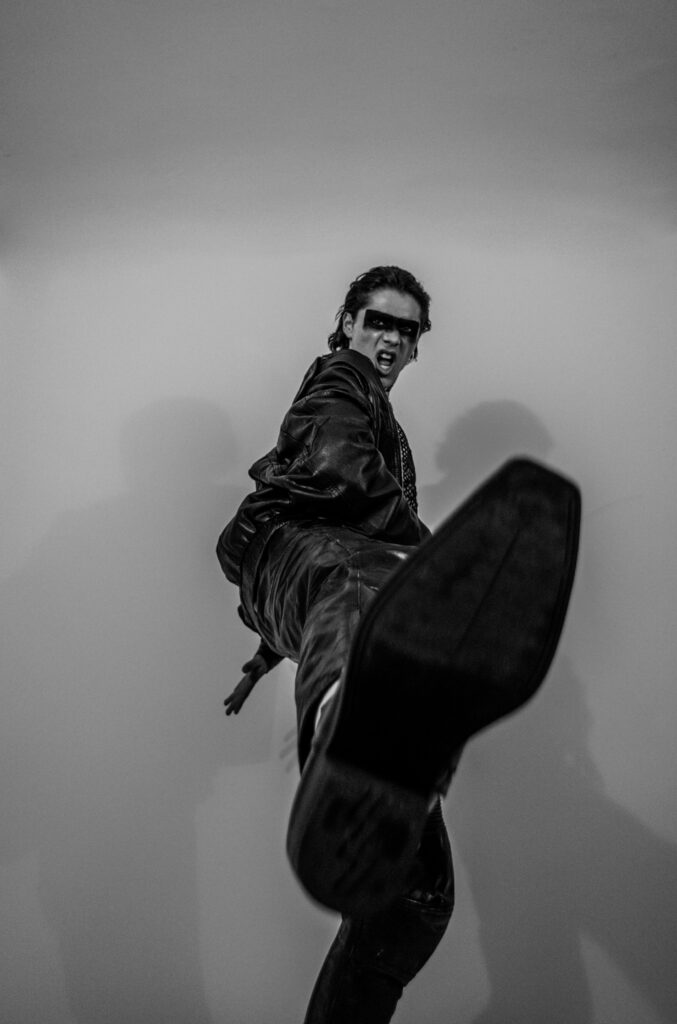
Kebab Wrist hasn’t aged well: I’m 5 years vegetarian, and this reminder of one’s carnivorous past is triggering. But it’s not the name that interests me; it’s the character behind the name. Where Jordan Frazer is mercurial, ever-searching for answers he’ll probably never find, Kebab Wrist is consistently animated and authoritative. Where Jordan Frazer will pop a tummy Gaviscon before a heady Bloody Mary, Kebab Wrist drinks now, worries later. If Jordan Frazer is fast becoming all elbow-patches, Armagnac, and wingback recliners, Kebab Wrist is a leather-clad, tequila-soaked stage-dive. And any time we get the gang back together, I transform into Kebab Wrist, like a civilian into a superhero.
At home, I’m someone else entirely. To my wife, I’m Jordie. Occasionally Muffin. Sometimes I’m Pancake, but only when she’s prepared to be Buttercup. Pet names are a relationship’s rite of passage. And when I’m at home, I’m cute. To be honest, I think that I’m Muffin or Pancake just so she’ll let me go out and be Kebab Wrist. And I think she allows me that privilege so Kebab Wrist doesn’t infiltrate the sanctity of our marriage. That’s fair enough; I wouldn’t want that bastard in my house either.
Nicknames allow us to live our gang fantasies: harmless tokens of eras we’ve defined; insignias of exclusive clubs that turn away newcomers to protect our human connections of friendship and love. Nicknames are great until they’re not…
‘Jordo’
At work, I was Jordo. This wasn’t a name I invented. It was allocated by colleagues.
For a while, I thought a work persona proposed a healthy separatism: as long as I knew when I was being Jordo, it would prevent him from contaminating who I really was. I decided this Jordo character would allow me to preserve my ‘true self’: the Jordan at home, with his old-vinyl collection and recipe for rice pudding.
But Jordo started to take over. It was frightening: that with a tiny change of name came an entire personality swing. Jordo threw his weight around. He signed off emails, ”KindRegards, Jordo.” He used hefty-but-meaningless terminology like ‘let’s circle-back‘ for an ‘executive summary’ and ‘what’s the ask?’ I found myself excusing rude behavior because it was Jordo and ‘that’s just what he was like’ as the character in the suit I had to play as part of my role in the Great Game of Life. It wasn’t me, not the real me.
But it got worse. I decided I was much too important to write the full Kind Regards and so my signoff was reduced to “KRs, Jordo.” I adopted passive-aggression as standard in any communication I sent zingers like “As you know if you read my previous email…” It all came to a head one Saturday morning when my wife asked me to look over a grocery list she’d written out so I could add anything. I asked her if she’d “Leave the draft on my desk with a sticky note labeled JORDO TO REVIEW.”
IT WAS A SATURDAY AND I WAS AT HOME. What a dick…
I’d spent so long thinking Kebab Wrist was the disruptive element to keep on the perimeter that I’d handed Jordo the door keys and all the alarm codes, unaware of the danger he posed. I allowed the streams to cross. I allowed Jordan to become a ghost. And I was busted.
Beware the fake ID
Imagine if you started a job and were assigned an entirely different name. That alongside your ‘Desktop Postural Assessment’ you were given a name badge that said Nigel Coltrice or Jonquille Cornflowers. You wouldn’t wear it — it’s not your name!
But each morning, as I Double-Windsored my tie, snapped shut my cufflinks, and transformed into Jordo, that’s exactly what I did. And the sad part is that I suspect it’s what everyone was doing. It wasn’t until I decided to quit to pursue my creative passions that I could have honest conversations with some of those colleagues. Masks fell that I didn’t know were being worn. I suppose it came from insecurity, surface knowledge that everyone was everyone else’s competitor in one way or another. If not directly, then eventually.
My own name
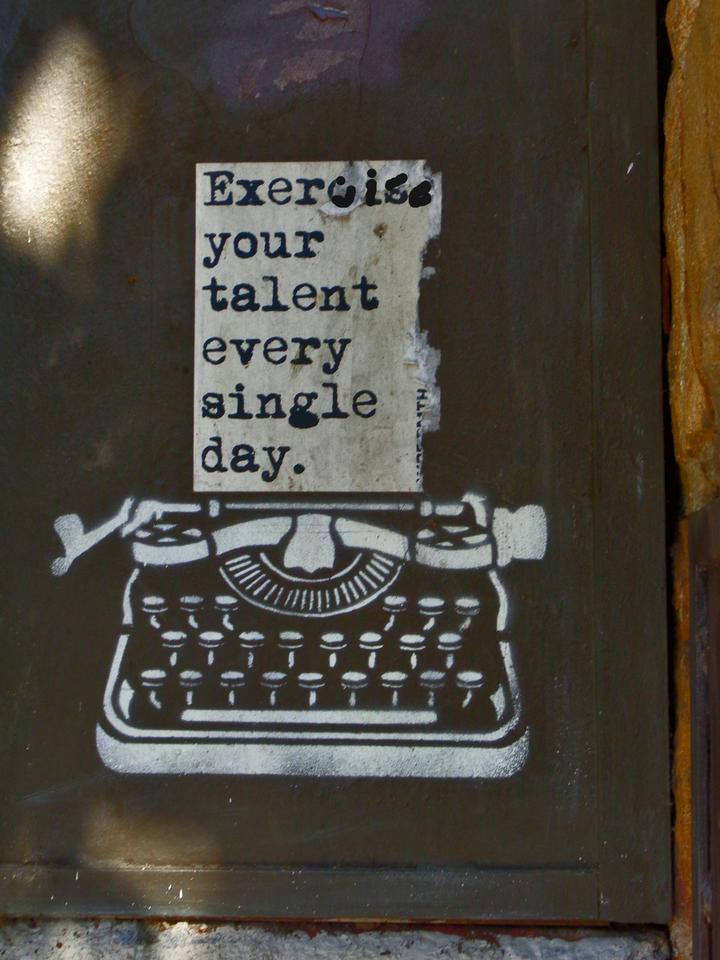
Now, I value the autonomy of choosing my own name. It is my most immediate expression of identity. It projects how I see myself and allows me to evaluate whether that projection pleases me. Using different names in different arenas can be healthy: compartmentalizing personality traits to emphasize or suppress depending on the task at hand. It promotes the oft-quoted but rarely practiced mantra ‘Work/Life Balance’, reserving my authentic self for my loved ones at home. It lets me cut loose and recapture the abandon of youth with my oldest friends. And I think it protects artistic integrity of my work: I use a pseudonym when I’m writing my column as “The Millennial Anxiety Uncle,” and I adopt a larger-than-life Rockstar persona when I’m onstage.
Most importantly, my wife’s got Jordan back.
But I’m staying hypervigilant of my mental health so that this doesn’t devolve into a dissociative disorder. I won’t be conforming to the traits of characters invented for me by others. And where my characters are my own inventions for these purposes, I’ll be watching them carefully.
Realism is focused on the awareness of immediate possibilities and acts based on certainty and what is probable.
Idealism is focused on hope and then considering the possibility is always there, even if unlikely.
Idealism is a motivating force necessary to cross the hard days. Realism keeps us grounded in the hard facts, and it creates the firm conviction that, with reasonable efforts, anything can become possible.
Finding that balance is the hard part. I hope that someone’s desire can be implemented or adjusted somewhere between the grounded reality and the perfect outcome.
Imagine
Imagination is the circle of thoughts we love to breathe in, no matter the philosophy. This thought circle can be the comfort zone where we find peace and tranquility, healthy doses for the mind’s stability. A stable mind is necessary to live life truly, rather than going through the motions and spending hours, days, weeks, months, and years till death. I should know.
Imagination holds a powerful place in my life, shaping how I work and plan. I often begin by germinating an obsession — a goal that may initially seem impractical, unattainable. I continually water this obsession, to thrive and drive me forward.
Don’t call me “unrealistic,” but the idealistic approach lets me chase what seems impossible, and it defines my mindset.
This approach often leads to what I call a rebellious mindset. It strengthens my determination to stick to my goals against all odds. While not all dreams achieved through this idealism come to fruition, I still find that this process builds resilience. This resistance to external pressures fosters a personality that is difficult to sway, making me less susceptible to compromising on fundamental rights, freedom of speech, or injustice.
In Pakistan, where societal and institutional pressures often push individuals to conform to the old narratives, my idealistic mindset allows me to challenge these norms. I resist the go-with-the-flow mentality that dominates our local culture. This resistance, born of my imagination-driven idealism, makes me a person who cannot easily be managed, whether by those in power or within social circles.
Don’t elbow me
From an early age, I had a dream of joining the armed forces. Normally after 12th grade, we can apply to join. I was declared medically unfit due to the carrying angle of my elbow, the angle between the forearm and arm when the arm is extended. The excessive angle may lead to a person’s inability to carry weight, so I was declared temporarily unfit as carrying heavy bulky weights is quite normal in the armed forces. I was shattered.
(Image courtesy of shraga kopstein via Unsplash)
I had waited for many years for the day I could apply to the armed forces. I went to the Combined Military Hospital Lahore to get advice about the treatment of this angle issue. The senior surgeon of their orthopedics department was a brigadier rank officer and only affirmed what I had already heard — I was medically unfit for service.
“It is impossible to force this elbow angle in position, as it is by birth and not changeable,” he said very clearly, “There is no option for you.”
I was coming down the stairs, and the word “impossible” was ringing in my ears on repeat. Before coming back, the doctor just wrote TRY CHIN-UPS on my prescription slip and also told me that there is almost a zero percent chance of effective results from chin-up exercise.
I just kept the words “impossible” and “0% chance” in my mind as I started doing chin-ups, and started to play hockey by keeping the stick near my elbow (another technique recommended by a physical instructor.) I continued to work on this routine for almost eight months without rest. I spent all day on the ground, almost entirely on running, chin-ups, and hockey.
During this time, even my mother and father advised me to stop as “it” is a natural condition and not curable. In their words, “You must focus on any other profession.” My friends used to mock me by calling my hard work a futile effort.
All of these opposing forces played a vital role in making me resistant to all opinions and steadfast in my wish to work at getting the carrying angle decreased to the normal range. My two main motivations were to prove all the people’s opinions wrong, and imagining the moment when I would be declared medically fit for the armed forces.
After eight or nine months, I reapplied, and was declared medically fit … by the senior orthopedic surgeon of CMH Lahore. This senior orthopedic surgeon was sitting on the same chair where I was advised by his fellow surgeon that I had no chance of getting this carrying angle cured. I believe this imaginative and rebellious approach gives me the courage to stand firmly for what I believe is right and just, no matter the challenges.
However, a question I mainly consider is why imagination is a person’s only source of peace.
Just turn the tables
Shift your intention towards the thinking philosophy of a person. A person creates a private boundary and wants to allow only those people in whom they love. Possibilities exist that things happen according to a person’s will. Or never happen at all.
The fact is that a person only wants to live with the people or things of their choice or with those whom they love. When life is working out and everything is flowing smoothly, they don’t need to live in their imagination when their reality is already according to their wish. Likewise, if the opposite is true and nothing in their life fits the narrative they want, a person will always prefer fantasy.
Preferring imagination when reality doesn’t meet their desires also resonates deeply with my life. There have been times when my circumstances didn’t align with my narrative of how things should be. During such times, I relied on imagination not as an escape, but as a tool to redefine my path and rekindle hope.
Take this scenario: a man wants to marry a woman, but she does not want to be his wife. It is very common for Pakistani youth to feel affection for someone without reciprocation. This reality will upset the man, just as it would anyone else in the world who experiences that kind of rejection. To avoid facing it, some men will develop a fantasy world around them, where everything is according to their wishes, and imagine that woman as his wife. Mental stability is so vital that a person can spend his whole life sitting on a beach if there’s peace there.
So, when this love-sick man feels comfortable in that specific zone where everything is according to his arrangement, he may never broaden his circle to accept reality, because reality is painful and upsets his mental stability.
Keep turning
Now comes the other side of the story. Suppose a woman whom he wants to marry becomes his wife. Here the reality is beautiful, so the man does not need to imagine it. He can be with a woman he wanted to marry.
This example highlights that choosing a path of imagination is not always necessary. We all want to choose a way that follows mental stability, happiness, and our desired direction, traveling only with those we want to travel with. This path can be imaginative if the day does not unfold following our desires. On the other hand, it can be realistic if the year serves our demand.
People who live in fantasy think that if life does not progress according to their thoughts, they should develop a forest of ideas and continue to roam, reconciling disparate elements, and accommodating setbacks, under the varying shades of thought.
Grief from losing loved ones or precious things is only natural; otherwise, how could you really consider it love? This might be true, but being consumed by grief can also cause severe damage to relationships around that person.
I often imagine the moment when I will leave this world, and the people I’ve helped will speak to themselves or others, saying, “This was the man who supported us when we needed it most.” That thought motivates me deeply, as I hope my legacy will live on; not through fame, but through gratitude in the hearts of those I’ve touched.
Can imagination harm you?
Imagination is so immersive, but too much of anything makes a person unaware of their surroundings as they get lost within themselves. If they go too deep or too often into the workings of their own mind, they risk losing interest in the present, in their responsibilities, and in dear ones; a disconnect.
A person’s happiness may rely on sadness; the sadder, the more content. The repetitive thoughts of the desired life give only temporary relief, but when this bubble of imagination pops, the pain becomes enjoyable as it closes the circle.
Imagination is deeply embedded in my life. I often imagine scenarios and ideals, not about myself per se but about the circumstances I want to create. Like joining the armed forces, when that path didn’t materialize, I redirected my imagination toward contributing to society in other meaningful ways.
I now aspire to be a “hidden treasure” — a person who works silently to help others without seeking recognition. I have been fortunate to help people in small ways, such as paying tuition fees for needy students, assisting patients with medical expenses, or supporting families in distress. Without publicizing them, true kindness lies in remaining behind the scenes.
I would say that my idealism has sometimes led to frustration when reality doesn’t align with my vision. However, I see these moments as opportunities for growth and adaptation. Instead of being overwhelmed, I channel my energy into finding alternative ways to move closer to my goals.
Our demands from fantasizer and associated consequences
We mostly think those suffering from an imaginative trauma must return to life and be normal like others. Easy for us to say, but much more difficult to actually do practically. Our continuous demand forces them to develop a facade.
When that person becomes fed up with acting, watch for extreme behavioral changes like powerful flashbacks, regret, and open exposure to whatever that person is covering.
Extreme realistic or extreme idealistic?
What creates a problem for most of us is that we are either highly realistic or highly idealistic.
For example, a hardworking and talented worker wants a certain job. She goes with a practical approach that the company’s standards are too high for her and decides against applying for that specific job. She is thinking only in black and white. This is a highly realistic approach if something is complex. Many others cannot meet the high standards, so she thinks she also could not.
On the other hand, a 45-year-old artisan applies for a job with selection criteria that anticipates a 20-year-old, but the artisan is so motivated and has a firm belief that they are the best candidate, the best worker. That is a highly idealistic approach that has something less to do with the reality that everyone else experiences.
Both of these approaches are extreme yet correctable, and that correction lies in creating a balance.
I consider myself more idealistic than realistic, and I tend to stay firmly focused on my goals despite external challenges. For example, recently in Pakistan, the weather has turned extremely cold — a rare occurrence in a country accustomed to heat. While many people find it difficult to engage in physical activities during such weather, I have maintained a daily routine of running for 10 kilometers early in the morning before sunrise, even when the sun is scarcely visible these days. Yet, I persist because I idealize the sense of accomplishment and discipline it brings me. This is how I strike a balance between realism and idealism: I acknowledge the challenges but push through by focusing on the rewards they offer.
In the balance
Idealism and realism are two poles of magnets that repel. Balance is impossible because the idealistic and realistic approaches are linked to the person’s desires. How can human beings suppose something against their will? This unacceptability of the possibilities that reality and idealism bring along leads to the challenge of creating a balance.
How can we force the balance? Who doesn’t lose the forest for the trees?
It is actually the struggle to create a balance between idealistic and realistic perspectives that makes us human; a work in progress, but not forced.
Finding that balance is the hard part. Can you imagine?
“Why me?” I asked no one in particular. It only added insult to the already open wound.
It was not a genetically inherited trait. I knew this because I had researched my family, having read a book on genetics in grade 6, and no one in my family tree had the disorder.
Drying my tears, I reviewed what happened that day. The day before, the Religious Education teacher had asked us to memorize John 3:16. I already knew it. I never missed church and the Sabbath School.
“Kelvin! Stand up and recite John 3:16!” Mr. Jack’s authoritative voice commanded. Confidently, I rose from my desk, which I guess was trying to win an award for being too noisy.
“For Go…o…o…d so lo…ve…d…” I began. I had not finished the final section of my recitation before everyone burst into laughter except Mr. Jack and me.
I realized that being a new student was not going to be as much fun as I had anticipated. I guess they thought I did not know the verse because of my hesitation. So thought Mr. Jack, who stared at me with cold unblinking eyes, flexing the water pipe on his hands.
All I remember about the following few minutes that seemed to last a decade is the pain that tormented my back as Mr. Jack applied his best technique to ensure I never forgot.
“How will you pass your High School entry exam?” he challenged as he continued to make me count the number of strokes he expertly laid on my back.
The school had no option. Whatever it took, we had to pass, not only because of our own good but also to put the school’s name among the ‘mighty’ primary schools in Nyandarua County.
He did not understand my speech impediment. My fear of being laughed at and being misunderstood drove me to withdraw from people and triggered the next problem – making new friends in my new school. My friends at home understood me, but this was not the case at Saint Peter’s Academy.
Getting to eloquent
It was not long before it dawned on me that if I did not face the darkness growing inside me, I was never going to be embraced for who I was.
I started reading novels aloud at the deserted soccer field rather than the mind reading I had been accustomed to. Though I took more than thrice the time I would spend normally, it was a valiant effort. I could now do a few words without a stammer. No hesitation.
The few words became a sentence before I joined High School. Classmates would complain about my slow reading pace when I volunteered to read articles in class. I remember two students mumbling that a certain person was to fall asleep if I read a Swahili article the teacher had asked me to recite.
Though discouraged by many of my classmates in grade 9, I still began to develop eloquence as I read aloud. By grade 10, I volunteered to deliver a trip report on the assembly ground, which I did at a rather moderate pace.
Bit by bit, I improved and struggled against myself.
I was not done yet. Trip reporting became my thing for more than a dozen trips I attended thereafter. No one dared to steal that activity from me.
A light comes on, and a close-up pair of eyes appear in the frame. My blinking is constant, almost excessive, in the harsh white light of the room. My eyes are not large; they seem narrow (or ‘slanted’, as my brother says), making it hard for me to keep them open. My eyebrows above my dark brown irises are not remarkable and in fact are unkempt, untidy, and without a defined shape. The unruly hairs help cover the scar from a small cut that was caused by the frame of a pair of glasses long ago. They broke while preventing the fall of a restless child who was trying to reach the top of a wooden post while my back was turned.
Those eyes, looking ahead, cannot see all they should, but are amazed by the little they have observed. A hand appears in frame, clutching a red crayon, firmly intending to complete the task at hand — to color in the blurry silhouette of whatever figure is printed on the white sheet.
At times, the red crayon rebels, resisting confinement by the thick black ink line, and the hand does not seem to care much. I believe I have successfully completed my task, but when I hand the sheet to my mum, she brings it close to her face and then looks at me, worried and wide-eyed. She asks, “Son, did you color this in?”
Astigmatism.
That was the explanation some doctor gave me a long time ago, and that’s what I have for life. Fortunately, I can still distinguish the shapes of things to avoid bumping into them, and the glasses reduce blindness, but I now feel dependent on them.
My eyelids feel heavy. A hand, my hand, intrudes into the frame to scratch my left eye, and as a result, some eyelashes fall out and the cornea wears down. Tears no longer lubricate properly, and my eyes show signs of fatigue. The dark circles under them are more than noticeable. I haven’t had a good night’s sleep in years.
My eyes have also seen unforgettable things: a victory goal in the 96th minute, the tragic end of Walter White, my grandfather singing “La Cucaracha”, the long-awaited arrival of the newborn at home and the heartbroken cry of its mother, the departure of its father from home, the loving eyes of a woman… There are moments and images in which significance lies not in clarity, but simply in sight.
A phoropter slowly approaches the face to which the dark brown eyes belong. The optometrist is observed from a general perspective. As she changes lenses, the doctor repeatedly asks, “Do you see better with this one, or with the previous one?”
I never notice the difference from one to the other.
Of course, before approaching that device, the doctor asked me to do the usual task: to pick up the chart and read the paragraphs full of tiny letters, or to tell her the letters I can see from a few meters away. I can’t remember the last time I successfully read letters on the wall chart.
I approach the optometrist’s desk at her request, while I wait for her to review whatever she has to analyze… I never worry about knowing exactly what it’s about, because the answer is always the same: “The prescription in your left eye has increased.”
Which is the same as saying that my vision has gotten a bit worse. Again.
Next, she gives me instructions to prevent corneal damage, things like not rubbing my eyes or not spending many hours in front of the computer. I hear her, but I don’t listen. I know that buying the contact lenses I need is not within my budget, and that I have to wear glasses for life. The optometrist says they are mandatory, and my driving license echoes it. I see her, but I am not really looking at her.
(Image courtesy of alameen studios via Pexels)
Over time, I also started to enjoy cinema and writing. Two forms of art that require a creative — and visual — exercise to create and enjoy. Over the years, the bridge of my nose between my eyes has been ‘tattooed’ by the noticeable marks of numerous glasses. It seems unfair for those eyes to have to strain just to enjoy the shape of letters and read smoothly.
I find this pleasure ironic. I always panic: What if my glasses break, get lost, or stop working? How will I read and distinguish the figures on the screen? The damage to my eyes is progressive. Resignation…
But as the doctor shakes my hand to say goodbye, I can only think of the consolation: that the camera, the pencil, and the imagination allow me to capture — and reflect — that which my eyes will not let me see.
It may be strange, but my grandfather died between the 1st and 2nd of November 2000. He, who had always been full of life and joy, had been confined to his bed for two months, weakened by a very aggressive cancer. Not even two intensive surgeries had been able to remove it completely. The doctors had always told us not to lose hope, and I had deluded myself into thinking that his recovery was truly possible.
I was sixteen years old and I didn’t know the true meaning of death. Death had seemed like a distant or fantastical concept, something to be read about in a mystery novel or seen in a movie, but reality is different from fantasy. Especially when it comes to the people we love.
That night, death took my grandfather in his sleep and, although we had been expecting it for a while, knowing never stops the pain. When he stopped breathing, the only people in the room were my grandmother and her sister, Caterina, who had volunteered to take shifts with my parents and my maternal uncle and to relieve my grandmother of some of her daily responsibilities. It was she who noticed that my grandfather was finally free from pain.
When I heard the landline phone at home ring, I immediately understood from my mother’s voice that the inevitable had happened. We quickly got dressed and went to my grandparents’ house, which was in a seven-story condominium not far from ours.
I didn’t cry on the way. There was still something unreal about the event. But when my grandmother greeted us in tears and led us into the bedroom, where I saw my grandfather’s waxen and motionless face with my own eyes, I was undeniably confronted with the reality of death.
As my mother sobbed, I felt almost paralyzed. Suddenly, Aunt Caterina put her arm around my shoulders and whispered softly, “You’ll see, your grandfather will be at peace now. But you have to help me do something.”
I looked at her, perplexed. What was there to be done?
“We have to cover all the mirrors in the house.”
I thought she had gone mad as she took me by the arm and slowly led me into the hallway. Dazed and with my heart pounding, I followed her into a small storage room. She grabbed some large dark blue dish towels and a sheet.
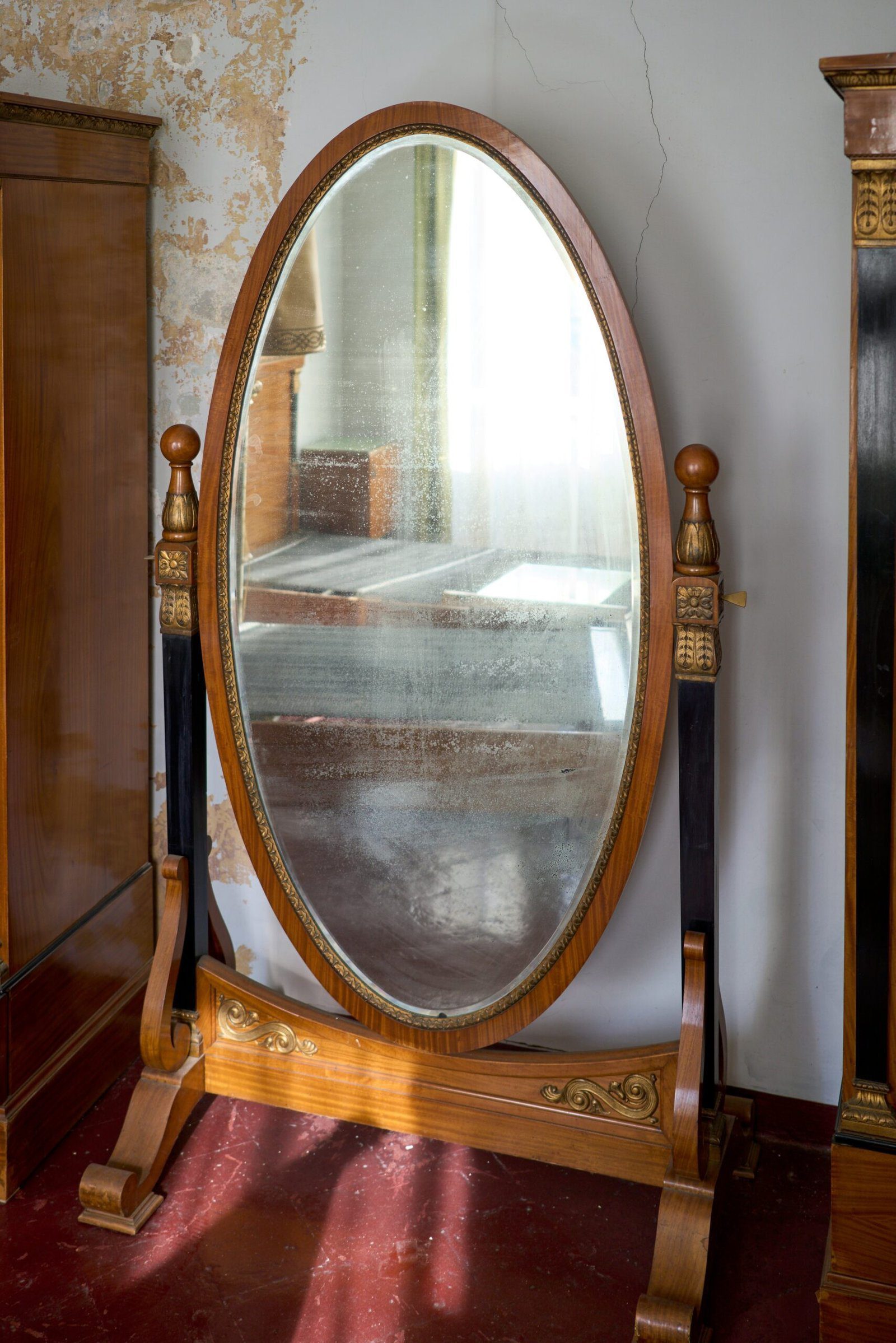
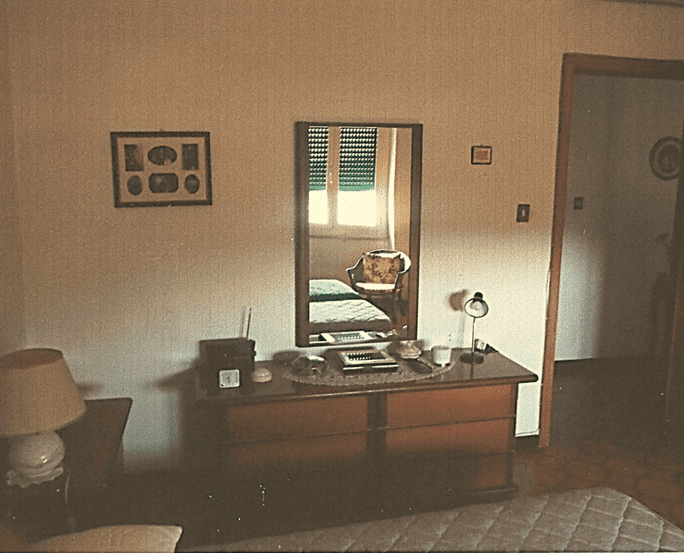
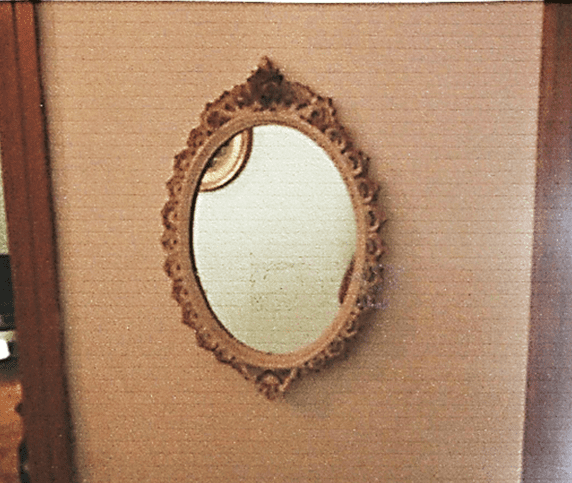
There were three mirrors in my house. One mirror in my grandparents’ bedroom, one in the corridor, and a rather large and antique one in the dining room that had been passed down through three generations.
(Image courtesy of Viviana De Cecco – November 2000)
When we entered the bedroom, Aunt Caterina asked me to help her tuck the edges of the cloth into the upper corners of the frame so that it was completely covered.
It was this way that I discovered one of the funeral customs that are still deeply rooted in Sardinia, in all of southern Italy and in various cultures around the world. There are traditions so old that no one knows exactly when and where they originated. Covering the mirrors when a person dies is a custom that has its roots in the mists of time.
Aunt Caterina explained to me that covering the mirror with a cloth prevents the soul of a deceased person from being frightened by seeing its own reflection. In addition, to prevent the departing soul from getting lost, it is appropriate to close all the windows, draw the curtains, leave some lights on and leave the door open to facilitate its journey to the afterlife.
The mirror is often seen as a portal between our earthly world and another dimension, and the wandering soul of the deceased, drawn by the glow of its reflective surface, may become trapped there forever. Instead of leaving its mortal remains, it could potentially drag the souls of all the living people reflected in the same mirror and haunt the house of the deceased for all eternity.
I remembered all the times when, as a child, my grandfather would sit me on his lap before a family celebration and make funny faces in the dining room mirror to make me laugh. He was always ready with a joke, and the thought of not seeing his smile again tore at my heart. Seeing those mirrors covered with those big dark cloths, the typical color of mourning, felt like a sign of the end. They reminded me of those abandoned houses where life had faded and happiness has been lost forever.
These dark beliefs are much more prevalent in the inland rural areas than in the cities. That’s why my aunt’s words, coming from a rural village where certain superstitions about the dead are never underestimated, touched me deeply. Even though those ideas may seem quite incredible and ludicrous, there was something both frightening and reassuring about that belief. It was comforting to think that my grandfather’s death wouldn’t be the end, and that we had helped usher in the beginning of his journey to perhaps a better place.
(Image courtesy of Viviana De Cecco – November 2000)
Even today, I feel torn between rational skepticism and doubt that there may be some truth in these ancient beliefs. Perhaps our ancestors were much wiser than us modern people.
The Greeks and Romans were among the first to seek glimpses of the future in reflective surfaces. Who hasn’t broken a mirror and heard: “Now you’ll have seven years of bad luck”? The Romans believed that a person’s life was divided into seven-year cycles. Breaking a mirror would bring bad luck simply because it represented the souls of the living. Likewise, for the Egyptians, mirrors weren’t just for cosmetic purposes among the wealthier classes, but they also had funerary significance. It was believed that their radiance was linked to the sun god Ra and was a symbol of vital regeneration, which is why they were often depicted in the reliefs of the tombs of high dignitaries.
While doing some research on the internet, I discovered that this belief is also widespread in the Jewish religion. In the sacred text called the Talmud, there’s a phrase that several writers have quoted in their novels that refers to the human relationship with mirrors: “We do not see things as they are, we see them as we are.” This phrase makes me think that a mirror shows us our physical reflection on one side, but also reveals the nuances of our gaze, where all the feelings that lie beneath our exterior are hidden.
When we look at ourselves, we often say that we have a lively gaze. Where does this vitality come from? What can we call it? Is it the soul that we see? What is hidden within us that the mirror cannot really show us?
When a mirror reflects a dead person, there is no gaze to interpret and no movements to reproduce. Think of the vampire, who has no reflection in the mirror precisely because he is dead. Or consider exorcism practices, which sometimes use mirrors to chase demons out of the possessed.
So how do we know what is beyond the reflection of a lifeless body? I believe that superstitions are created to find the answer people have been seeking for centuries in their search for the meaning of life and, above all, its end.
Now it seems to me that this ritual is a demonstration of the living’s love for their loved ones, a testament to their desire to protect them. No one can know for sure what really happens the moment they depart this world, just as no one can know if there is emptiness or light.
What is certain is that, on that night when I returned home with my parents, I looked in the mirror in my room and wondered if my beloved grandfather, who had always been a guiding presence in my childhood, had found peace.
When my Aunt Caterina died three years later, there was no need to cover the mirrors. She died of pneumonia in the hospital, in that sterile environment where death seems even sadder. Everything happened slower with her. I had time to say goodbye to her and to hear that she had no regrets. She had been happy and was going in peace.
At that moment, standing at her bedside with my relatives, I began to believe in the soul. I believed it could be found in the looks of those who are with us, in their words and in all those gestures through which every human being communicates with his fellow human beings.
Six letters, six minutes. C-L-O-S-E-D at 8:00pm. It’s now 8:06pm.
I stare at the bold black letters in front of the weathered “J. Hara’s General Store” with a bit of torturous disbelief. My stomach grumbles and I feel my husband’s thinly veiled displeasure radiating off his person like a heat wave. I turn to him and state, “Well now what?”
Grumble, grumble. “I don’t know, honey. I’m just as surprised as you are,” my husband says.
“I know right? It’s a Saturday evening. How can things close at 8 o’clock at night?!”
“Big Island really does things differently from O’ahu.”
I nod in agreement. “Well,” I suggest, “I guess we can try to drive back further into town. Do you want to grab Taco Bell?”
My husband, Jess, ponders my inquiry for a few moments while kicking a rock on the pavement below. I begin to shiver from the evening air while I likewise scan our surroundings.
Currently we’re standing in front of a locally owned market and general store boasting its historical status with old, wooden siding and some sepia tone photos on its outer cork advertisement board. To our left is a gravel parking lot, and to our right is a closed cafe and a small gas station. Other than a few lampposts dotted here or there, the cool, white moonlight shining down is the only illumination we have.
J. Hara’s General Store is the closest to our weekend getaway…a mere 40-minute drive away. Neither my husband nor I really want to keep driving, but we’re too hungry to go back to our campsite without something to eat. We have spent the whole day hiking the Volcanoes National Park and, in our excitement, we have neglected to eat anything beyond trail mix for the better half of the day. So, we hop back into our rental Jeep long past the sunset on Pele’s playground and decide to drive North until we find somewhere to eat.
And now here we are. But we’re six minutes too late.
Perhaps noticing my sudden goosebumps or feeling the cool breeze himself, Jess recommends we head back to our vehicle to try and look up something else on Yelp. Up until a few miles down the road, we have had no phone service, thus the time discrepancy with the restaurant. Agreeing, we begin to walk to the Jeep, chatting about our day all the while, when the young couple at a gas pump catches my eye.
Other than the not-so-amenable employee closing up, my husband and I, and the couple, the parking lot is empty. Typically, I mind my own business, yet I can’t help but notice that the man has been fiddling with the gas pump for the entire time Jess and I have been there. It clearly has an “OUT OF ORDER” bag over its handle, so I can’t understand why he would be trying to use it.
They look young, and seem stylish; the man sporting a boy band singer haircut and monochrome black ensemble and the woman, with her profile poking out of the top of the red Mustang convertible, is pretty enough to be an actress. He continues to call out to his female companion, with increasing frustration when suddenly it clicks.
He’s speaking Korean!
(Image courtesy of Kang So-eun via Pixabay)
Many years before I wound up at this gas station in Kurtistown, Hawai’i, I spent many nights in Monterey, California at a little place called the Defense Language Institute (DLI), the United States military’s premier language learning academy. For sixteen arduous months, I spent upwards of seven hours a day, five days a week learning my assigned language of Korean to become a linguist in the US Navy.
Frankly, the experience was very difficult for me. Although my aptitude was great, and I had not much trouble with the actual Korean learning process, many of the emotional, physical, and spiritual aspects and consequences of my Korean course were back-breaking. The rigorous military-school work balance, homesickness, youth, poor self-esteem, and even just the blunt, and seemingly callus treatment from our native Korean instructors often wore me down.
I can see now how these experiences shaped me and helped me become a much stronger version of myself today, but at the time, I was often melancholy and filled with angst.
I channeled my feelings into despising the Korean language for being required to learn it. I didn’t want it to come to me easily; I wanted to fail and start something new in the Navy, but my fear at what the military would do to me were I to quit at such an advanced stage forced me to continue to perform well academically.
Essentially, I had shown my potential in a difficult course with a low retention rate. Were I to fail, my superiors might know I was doing so purposefully and reassign me a terrible job in the Navy. Like painting ships for twelve hours a day. Needless to say, when I finally graduated from DLI, I was excited to move on and my first duty station was…well, you guessed it, Seoul, South Korea.
Many aspects of living in Korea were very enjoyable, like the cuisine, shopping for cheap skin care and beauty, all activities I enjoyed, though I was not a huge fan of the culture itself. Being a foreigner, even one who spoke Korean fluently, didn’t exactly help me feel at home. The homogeneity of the society only succeeded in making me feel like a fish out of water, no matter how hard I tried to swim.
My time there, luckily, was short, lasting only about four months before I was reassigned to Hawai’i. I’ve more or less been here ever since, though I left the military about a year ago. Nevertheless, my relationship with the Korean language and Korean culture has always been one of contention for me, with me rarely speaking Korean to this day.
Do I speak Korean or not?
So it is, on this June evening in the middle of seemingly nowhere on a verdant, tropical rock in the middle of the sea, that a young Korean gentleman and lady are in need of help, and, if you believe in it, divine intervention sends a Korean linguist their way.
As my husband and I approach the door of our rental car, I feel a mixture of anxiety and apprehension enter my gut. Should I help them? No, they’ll figure it out. But they’ve been stuck there for a while already. But what if I try to help and I mess up? Will they understand me? No, I should just let it go.
Then, I think, “What if they were me?”
I feel myself walking toward the pair as if my feet had a mind of their own. Even if I am shy and my past experiences make me wary, I am going to help these people if it is the last thing I ever do.
After all, especially having come up the way, I know there is nowhere else to get gas but another ten miles north or so into Hilo proper. What if they can’t make it back that far? No, we will Korean our way through this together.
“Hwaiting!” (Pronounced more like high ting, the marker is similar to “Let’s go” or “Do your best.”)
I approach the man meekly, but then energetically surge into Korean, like we’d known each other our entire lives, though much more politely, I hope. He is definitely surprised, but I can see the relief on his face. I explain, “Ee-go-noon an-twey-yo” (It doesn’t work), and that he has to use a different one, that these other pumps have 89 or 93 octane, depending on what the Mustang needs.
His girlfriend/wife even steps out of the car to say thank you, as they are clearly getting very flustered, having never been to the US and are not completely versed in English, signage, and the like. Before we part ways, we even bow to one another as is customary in Korean culture, though rare in Western ones. In spite of my initial fear, I am able to help people in need. This holds a special meaning for me.
As we walk back to our Jeep, Jess says, “Nicely done, babe! I’ve never actually heard you speak Korean before. You seem really good.”
I reflect for a moment on his words. At DLI, our teachers enforced humility. Even the top student was not good enough. In Korea, I never felt good enough either, being a boulder in a world of pebbles. In my heart, I often struggle with worthiness, too.
But tonight, I look at my husband proudly and smirk, “You’re right. I’m actually kind of a pro.” Lesson learned.
I bet you eagerly wanted to be an adult. Being an adult meant doing whatever you wanted to do. Why can’t you do the things adults do? Why is the answer always “no” whenever you ask for a cool toy, snack, or game? This question I often asked myself, and finally when I was six years old, I was able to come up with an answer.
It involved alcohol, peppermints, and command mints, as I heard them called.
***
Give me that beer
During the Christmas season of 1999, my parents threw a big party at our place. Many adults and kids showed up. When it was time to eat and drink, I noticed something that would bother me. My parents would serve adults beer and kids sodas. As a child, this is what I observed at all our parties. Finally, I had enough and decided that I would also drink beer with the adults.
(Image courtesy of Daniel Kandie via Unsplash)
This commandment continued at all our parties we threw as the months and years passed.
Finally, I had enough and decided that I would also drink beer with the adults. Of course, I knew my parents wouldn’t allow it, so I needed to do it without them noticing. I hatched a plan.
Once another event gathered everyone and my parents went into the kitchen, I seized my chance. I approached a man drinking beer and asked him for a sip. I couldn’t believe it, he agreed.
I regretted it almost immediately. The beer was so bitter that I ran out of the living room and locked myself in the room; I think I may have cried, too.
Lessons from the beer
For kids:
Generally, adults are better equipped to handle tough issues. Maturity and life experience aside, adults have different preferences and tolerance from kids.
I. Do honor the differences of age and respect them.
Generally, adults are better equipped to handle tough issues. A good example is how they are able to willingly drink beer despite its bitterness. You would think they would stop at the first sip but yet they keep going.
I took one sip myself and couldn’t handle the taste at all.
II. Do not take the name adult in vain by rushing to be just like adults, even with something simple like alcohol.
You can’t handle the tough things that adults do in the first place. Your brains just aren’t developed enough to shoulder the hardships of life any more than a foal is developed enough to carry a human rider. Did you notice you don’t usually work, pay taxes, or drive?
For adults:
Can you imagine what would have happened if I drank a bottle instead of taking only a sip? It wouldn’t have taken long for me at all to become inebriated, considering my small size and that I was underweight. My parents would have punished me either by scolding me or … the belt.
III. Do not allow kids to consume beer, for reasons besides its bitter taste.
It could have even affected my future as well if my parents weren’t strict, and ignored me instead.
IV. Do not enable kids in bad habits.
If I ignored the taste in my desperation to be like the adults, I could develop an addiction at that age and would constantly do whatever I could to get a beer.
***
Give me those sweets
Drinking wasn’t the only adult thing I wanted to do when I was a child.
(Image courtesy of Eric Prouzet via Unsplash)
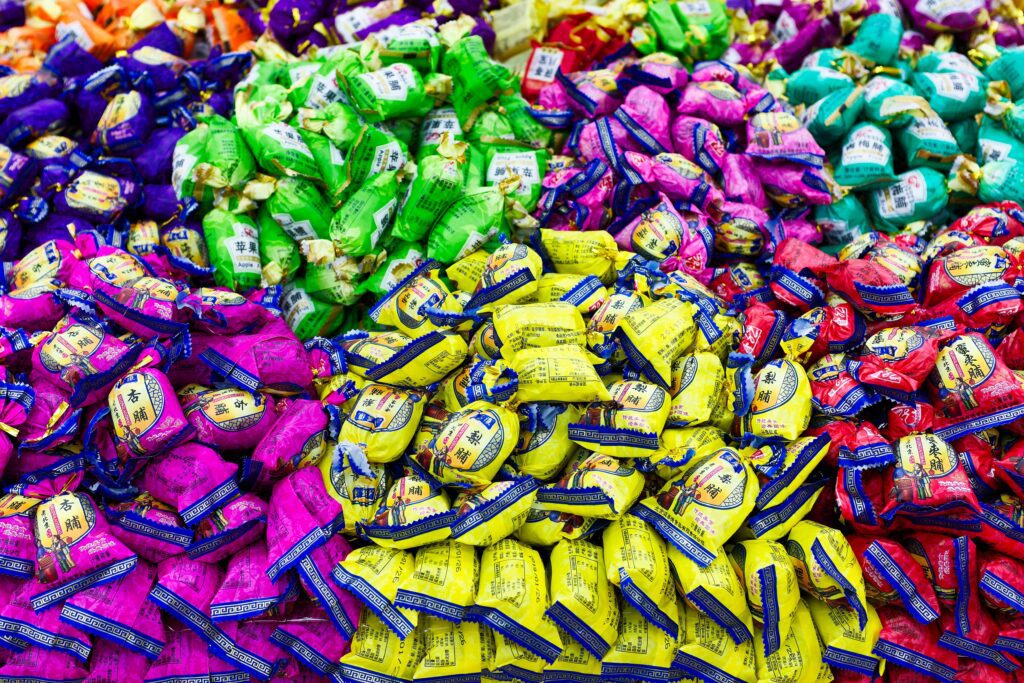
I wanted to be a shopkeeper for one reason only: the sweets. As a kid, I was always fascinated by how those workers could be surrounded by so many sweets and not eat them. At the time, I didn’t realize that the reason was that shopkeepers needed to make money by selling their sweets, not eating their profits.
Since I was excited about this career path, I told my mother that I wanted to be a shopkeeper when I grew up. Mind you, I previously told her I wanted to be a lecturer. Understandably, she was confused and irritated. Why would I want to be a shopkeeper anyway? She didn’t ask me in words.
V. Do honor the shopkeeper and all career choices.
Of course, there is nothing wrong with being a shopkeeper, considering we need their services. However, my mother thought that this dream was not allowing me to realize my full potential. I met this reaction with frustration. Why couldn’t she accept that I wanted to be a shopkeeper?
However, as an adult, I have since realized I don’t want to run a shop due to how challenging the role is. It was not as simple as it appeared to me in the past. Shopkeepers must have strong inventory management skills to strike a balance between overstocking or understocking their shelves, controlling expenses, and monitoring cash flow. A huge part of their job is customer service. Their stock is dependent on their customers and supply and demand, not just candy they can snack on themselves. I still wonder.
Lessons from the sweets
For adults:
Sometimes kids can be shallow as they simply don’t know any better. When asking them what they want to be when they grow up, listen carefully.
VI. Do not kill their imagination. Be sure to ask about their preferred career path in easy terms of things they enjoy doing and what could help make them a good living. Typically, kids don’t understand the challenges that are prevalent in that job and instead focus only on the advantages.
Imposing a career on your child, it is a mistake to say, “You want to be a shopkeeper? Why can’t you be a doctor instead?” By framing it this way, you are already pressuring your child down a specific career path, a path they may have no interest in. Instead, find out why your child loves the career they want to pursue.
VII. Do explain exactly what chores that job actually does.
If their reasons seem shallow or ridiculous, work to redirect their dreams.
For kids:
At the end of the day, growing up is inevitable. You might want to rush into adulthood because it appears fun, but adulthood comes also with many expenses and responsibilities.
VIII. Do, as a kid, keep the privilege of not having to think about paying for anything. Overall, you may be desperate to grow up.
Right now, I struggle to pay rent every month.
***
This is now a single pic:
(Image courtesy of Anna Shvets via Pexels)
Give me the car keys
IX. Do describe the challenges of adulthood along with all the advantages of childhood.
However, also be careful to convey life in a way that doesn’t demonize adulthood to the extent that discourages them from wanting to grow older at all.
X. Do let your child enjoy their youth without coveting adulthood. Teach them lessons big and small as they grow. Let them learn to handle adult responsibilities with confidence.
I have always dreamed of visiting Dubai, the city of skyscrapers, luxury, and opportunity. I heard stories of how people from different countries and backgrounds found success and happiness in this cosmopolitan hub, and I found myself wanting to be one of them. That’s why, in November of 2016, I decided to take a bold step and travel to Dubai from Kenya, where I was living, in search of a job.
I was both excited and nervous as I boarded the plane. I had saved enough money to cover my expenses for two months, but I hoped to find a job sooner than that. I had a certificate in computer science and some experience in sales, marketing, and office administration. With these credentials, I thought I had a good chance of landing a decent job in Dubai’s booming economy.
The hunt
I arrived in Dubai on a sunny morning. No surprise there. As I took a taxi to my hotel, I was amazed by the sight of the city’s skyline, glittering with tall buildings and modern architecture. I truly felt like I had entered a different world. My room was a modest space, but perfectly clean and comfortable. After I checked in and unpacked my bags, I decided to rest for a while and then explore the city.
The next day, I woke up early and got ready for my job hunt. With my resume ready and several copies printed, I began my search, starting with a list of potential employers that I had researched online. I planned to visit their offices first and drop off my resume, ultimately hoping to get an interview. I also registered on some online job portals and applied for various positions that matched my qualifications and interests.
I spent the next few weeks in a cycle of repetition: visiting offices, applying online, and waiting for responses. I also tried to network with some people I met at the hotel, the mall, and the mosque. I hoped to at least get some referrals or job leads from them. Throughout this process, I remained optimistic and confident that I would find a job soon.
However, as the days passed, I realized that finding a job in Dubai was not as easy as I had imagined. I faced many challenges and disappointments along the way, such as the competition, the cost of living, the culture shock, and issues with my visa.
Dirhams and dilemmas
Dubai is a popular destination for job seekers from all over the world, with thousands of people competing for the same jobs. The plethora of candidates allows employees to be extremely selective. Unsurprisingly, they often preferred candidates with more experience, higher education levels, and better connections than mine.
To put it bluntly, Dubai is an expensive city to live in. Everything from rent, food, transportation, and entertainment costs more than I had initially expected. I had to budget very carefully and limit my spending. Unfortunately, this meant that I simply could not afford to go out and enjoy the city’s attractions or nightlife. I had to save every dirham I had for my basic needs and in case of an emergency.
Being a hub for job seekers and people from all around the world, Dubai is naturally a diverse and multicultural city with its own culture and traditions. I had to quickly adapt to the local customs and etiquette, such as avoiding public displays of affection. I also had to learn some Arabic words and phrases to communicate with the locals — unrelated to my native Luganda. All of this combined to cause me to at times be acutely aware of a sensation of culture shock, out of place and lonely in this foreign land.
I had entered Dubai on a tourist visa, only valid for 30 days. I had to renew it at the end of this period, which cost me 500 dirhams. I also had to exit and re-enter the country every time I renewed my visa, which cost me an additional 300 dirhams for the air ticket to Kuwait. With all these issues, I ended up being very worried that I would run out of time and money before I found a job and got a work visa.
Despite all these challenges I faced, I did not give up on my dream. I kept looking for a job, hoping for a breakthrough. I made the best of my situation, choosing to focus on the pros of Dubai rather than the cons. I visited some of the famous landmarks, such as the Burj Khalifa, the Palm Jumeirah, and the Dubai Mall, all the while marveling at the city’s beauty and innovation. I also met some friendly and helpful people who gave me advice, support, and encouragement. I made some friends from different countries and cultures, who shared their stories and experiences with me. I learned a lot from them and appreciated their friendship.
However, at the end of December, the coolest month, it finally dawned on me that I had failed to make any meaningful progress. I had not received any job offers or interviews, only rejections or even no response at all. Eventually, I had to accept that I had exhausted all my options and resources. I had no more money to pay for my rent, visa, or food. I had no choice but to return to Kenya.
Beyond sour grapes
I felt sad and disappointed as I packed my bags and checked out of the hotel. I felt like I had failed and wasted my time and money. I wondered what I would do when I got back home. I had no job, no savings, and no idea what I was going to do next. I felt like I had nothing to look forward to.
I took a taxi to the airport and boarded the plane. I looked out of the window and saw the city fading away. I said goodbye to Dubai and thanked it for the experience. I also thanked God for keeping me safe and healthy. I prayed for a better future and hoped that one day I would return to Dubai, not as a job seeker, but as a successful and happier person.
I had never traveled internationally or spoken any language other than English. Yet somehow, something so seemingly impossible became real. I was about to step out of my comfort zone and personally experience a giant leap of a trip outside of just pictures or videos on the internet.
Last September, I left my five children for twenty days, crossing the 2,800 miles from North America into South America, but I found myself in Peru. My friend Ana, a native Spanish speaker from Mexico, grabbed my hand before we exited Lima airport, telling me, “Don’t talk to anybody, and stay right behind me.” Her take, not mine, but she was Latina, so I didn’t argue.
The doors slid open and a sea of faces — clustered close together and vying for attention — called out, voice upon voice, begging to take someone, anyone, any place they could possibly want to go. Ana already had a taxi driver waiting for us, her name written on a board he was holding, standing just outside the swarm. She held me close behind her until we were loading our bags in the trunk.
I sat silently in the back while Ana and our driver chatted. Apparently, the driver asked where I was from. Upon hearing the States, he responded with “Oh, so that’s why your friend doesn’t talk?”
Rules of the road
The road had no rules. Lanes meant nothing. Other vehicles meant nothing. Horns meant nothing unless you were the one honking, which meant you were serious.
Our ride and every Peruvian ride we took from then on was a series of “We’re not gonna make it” action movie scenes. The cars maneuvered the way motorbikes do, weaving through the small in-betweens. The bikes, and there were many, carried up to three people at times.
Doorways to other worlds
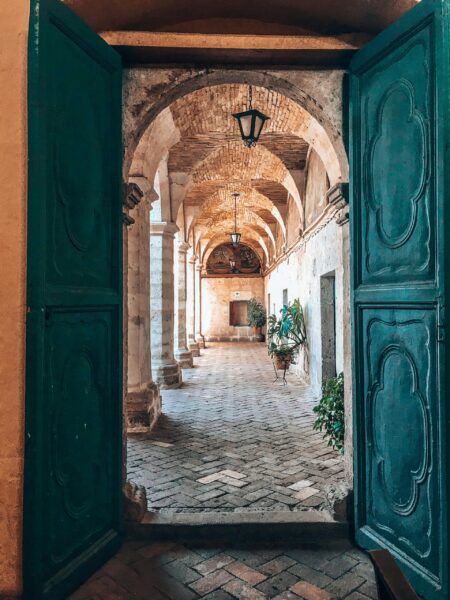
Our hotel entrance was a doorway stuck between all the other buildings and so simple that I glossed over it every time we returned to lay our heads down. That could have been because a doorway does not speak the same way that a door does.
(Image courtesy of the writer)
A doorway is but a hole, a near emptiness, a thing which may be crossed. But the Peruvian doors are entryways, mystical, unknown, and bursting with the knowledge that an entire life unlike your own exists just beyond.
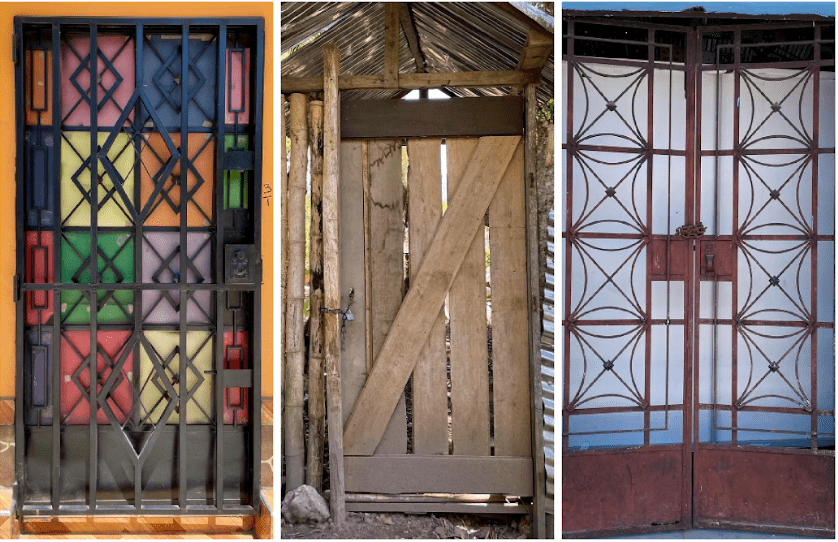
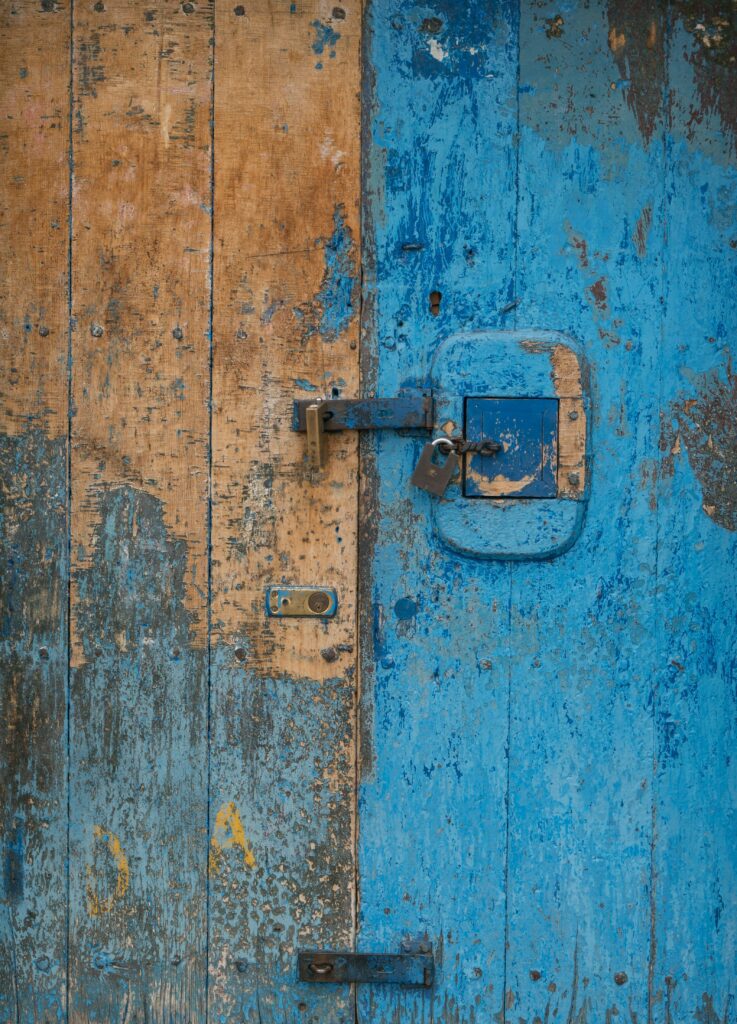
They are made of color, of gated iron, of broken down wood, of stories. Doors became my obsession. If the drivers of Peru were number one on our “ways to die” list, the act of getting a photograph of a specific door was a close second with how dangerous getting to some of them ending up becoming.
(Image courtesy of Rod Long via Unsplash)
Cathedrals, shanties, museums, and houses had elaborate doors kept safe behind bars whereas some others were left open and easily accessible. Bikes were left to lean around everywhere we looked. One open door, the one to church, required payment to enter. The closed ones — with their lion heads forever keeping their iron rings prisoner — were the most telling.
Closed doors and grated windows were sometimes guarded by the police, all of whom were more than welcoming when I asked to get a picture of them. They said I could join them, or sent me across the street to go beyond a gate there to get a picture with their other police officer friend. The doors told stories.
Transported to the beautiful unfamiliar
The people told stories, too. The architecture. The murals. The mist that forever kept the city of Lima the same gray as the inside of a cloud: light and dreamy.
Ana and I walked and walked our first three days, before we moved deeper into the city. Among the people, it was easy to feel like the distance from home wasn’t quite so great. It was a crowded city like any other, where people had little dogs wearing sweaters and booties. We were by the ocean, which felt foreign enough for gleeful excitement, but not enough to feel transported.
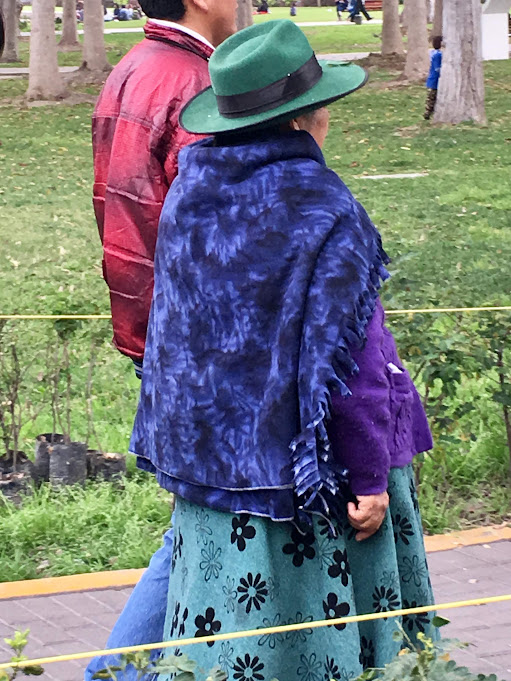
That enchantment happened when we came across the first woman dressed in traditional Peruvian layered Inca clothing. Rich jewel-toned colors and knit patterns wrapped her, and a baby was swaddled against her chest as she walked while selling homemade chocolates. She was petite and beautiful. Gentle like a doe.
(Image courtesy of Yosef Baskin)
Ana spoke with her while I looked on admiringly. Her woven basket of chocolates was just a bit too large for her to reach across its diameter. The chocolates were wrapped in paper with bright stripes of blue and orange. Their tops were cut into strips, erupting from them like a little carnival.
Ana, who is allergic to chocolate, gave her some small change. A blue bundle left the basket as she turned and asked if I wanted the peanut butter chocolate. I gave her my coins. An orange carnival tent came in exchange. I gestured and asked in English if I could see her baby. Shyly, she pulled part of her colorful wrap aside.
I was stunned by the baby’s beauty — its unknown power that all babies possess — but even more so by his sheer size: to think that he came from his mother’s small frame, and that he was still only seven months old!
That was the moment. The moment that felt like thousands of miles away. The moment when a stranger became a life and a place became a home. The moment that even my best imagination could not come close to comparing to. Peru was just a few thousands of miles away from home, different but similar, and knowing that made it feel surreal. The ground we walked upon, the air we walked through, and the mist-covered mountains that seemed to float in the sky, were always there, yet always out of reach.
So many wonders we will never forget
We ate plenty of food – mostly good, some not. We had a spontaneous paragliding adventure, but that wasn’t nearly as terrifying as the drive to the beach without a seat belt. We were overwhelmed by the marketplace on our “gift getting” day. We spent a day in the plaza and burned our tongues on the best churros ever. During all of these experiences, every single person was kind.
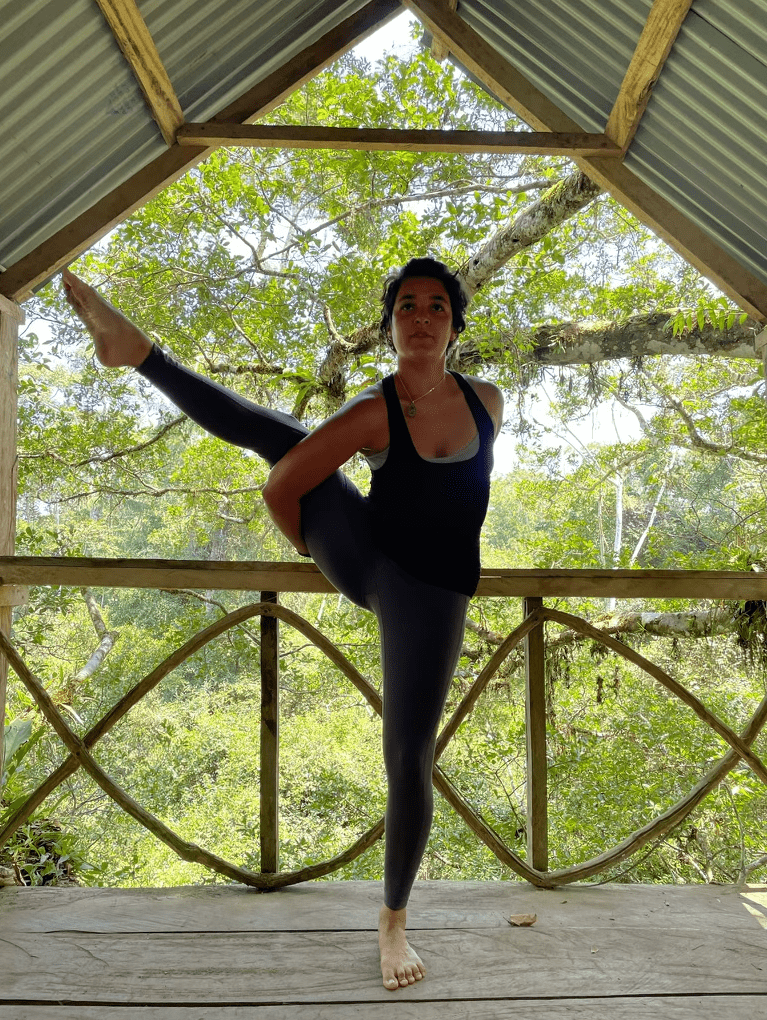
We spent three days in Lima, every second of them filled, and each one with a story of its own. After those three days, we next made our way across the Andes by plane and up the next mountain by car. We traveled deep into the jungle towards Moyobamba – a place where we would train to become certified yoga teachers.
(Image courtesy of the writer)
In Moyobamba, we spent fourteen days nestled alongside the river at the Kantu Lodge. Thirteen people – nine students and four teachers – got together every day from 5:45 am to 10:00 pm.
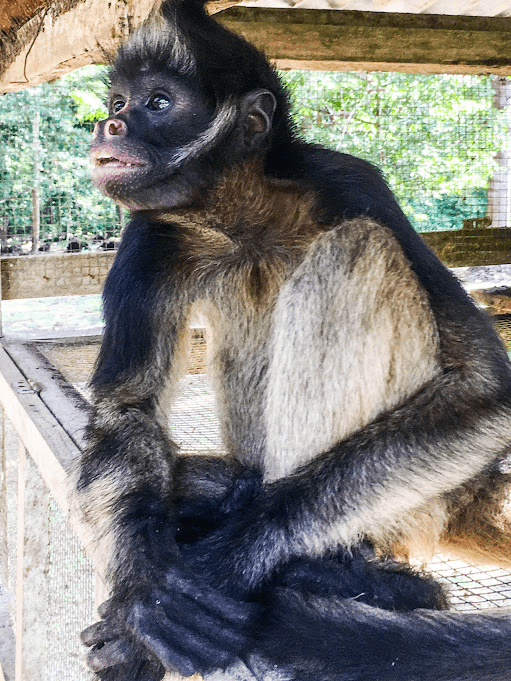
There were also the adorable black spider monkeys with tails as long as their bodies that swung from the trees just outside the shala (a shaded, open pavilion, from the Sanskrit term for adobe) where we practiced. The local butterflies were the size of both my hands together and flew lazily about, their sky-blue iridescence unreal in their authenticity.
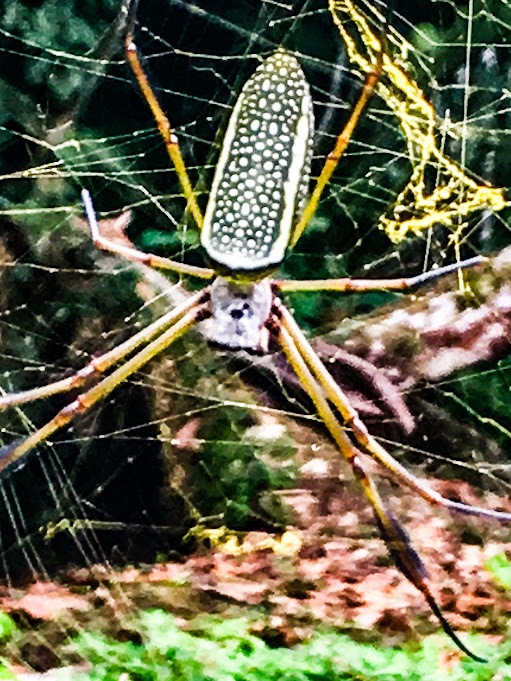
We hand-washed clothes in the bathroom sink and hung them out to dry with the hope it wouldn’t rain. Except for the single day of a continuous 12-hour downpour, our clothes stayed relatively clean. We shooed tarantulas, huntsman, and every other spider from our bedrooms, the shala, and the girls who screamed at every insect that came near them.
(Image of Amazonian Spider Monkey orphan courtesy of Yosef Baskin)
We did yoga with the children on the streets who happily ran around barefoot —
some no older than four, asking us “Yoga? Yoga!”
(Image of Peruvian Golden Spider courtesy of Yosef Baskin)
We traveled misty rivers, drank cacao, and visited a remote region filled with medicinal plants run by indigenous women, and to swim in the waters there. We saw hummingbirds and huge, ruddy brown birds with reddish eyes, looking in as they watched us from behind glass. We feasted on 42 total different vegetarian dishes served at every meal. We danced while thunderclouds rolled above us or while a fire crackled between us. We sang loudly from the balcony and along the paths.
But most importantly, we laughed. We laughed with hearts who knew what it was to really laugh. We left as certified yoga teachers, but that piece of paper holds within it stories of adventures I never thought possible and that were truer than ink can describe. It holds a piece of the world that really does exist, so far, far away from home.