The Timestamp That Changed the Way I Practice Journalism

On November 5th, 2021, Brazil was gripped by breaking news. 

A small aircraft had crashed in the countryside of Minas Gerais. On board was Marília Mendonça, one of the country’s most beloved singers — a young artist whose voice had become the soundtrack of heartbreak for millions. Within minutes, headlines multiplied, major outlets began reporting that she had survived, citing information from her press office. Relief spread quickly across social media and television broadcasts.

In the newsroom, I did what journalists are trained to do in moments of confusion: I went back to the primary source. The official note from the Fire Department included a precise timestamp for the crash. I read it once. I read it again. And something didn’t fit.

I compared it with the time the statement was released and considered the geography of the region. The reported time of the crash and the geography of the region made it nearly impossible for any official medical confirmation to have happened that quickly. There simply hadn’t been enough time.

The location was remote. Rescue operations would have required travel, on-site assessment, and official confirmation procedures.

It wasn’t a dramatic realization. It was quiet, mathematical. 

The timeline did not add up. There simply had not been enough time for anyone to responsibly confirm survival. There was no way the information circulating could already be confirmed. Based on logistics, distance, and the sequence of events, the optimistic reports circulating at that moment were, at best, premature.

I faced an uncomfortable dilemma. Like millions of Brazilians, I was not emotionally detached from the story. Marília’s music had been part of my daily life. I was also a fan. Her songs had played in my headphones, at parties, during long nights of writing. That day, I wasn’t just an editor. I was someone refreshing my phone like everyone else, hoping the earlier reports were true. I wanted the early reports to be true. But journalism is not guided by desire; it is guided by verification. Journalism has no space for hope.

And in that small gap between minutes, I understood something before anyone said it out loud. I didn’t feel triumphant. I felt cold. 

 If I was right, the country would move from relief to mourning.

Instead of repeating what other outlets were publishing, I chose to write a cautious article questioning the timeline and emphasizing the lack of confirmed information from emergency authorities. The piece did not speculate. It did not declare an outcome. It simply highlighted the inconsistencies between the official timestamps and the claims being disseminated. I knew I would be the only one swimming against the current, to push against this national hope. And still, uncomfortable as it was, I knew it was necessary.

Shortly afterward, the confirmation came: she had not survived.

The article became the most accessed in the history of our publication, surpassing 1.2 million unique views in less than three hours. It marked a significant growth moment for the site and consolidated our credibility in high-sensitivity coverage. In business terms, it was a turning point.

But my personal turning point had occurred earlier while examining that timestamp. That was the moment I understood, with unsettling clarity, what journalism really asks of you. It asks you to doubt relief. To slow down when the world accelerates. To risk being the cautious voice in a room eager for good news. And sometimes, it asks you to be right in ways you wish you weren’t.

Some believe professional maturity in journalism is about speed, sharp analysis, and competitive positioning. That afternoon clarified something more fundamental: responsibility often means resisting collective momentum. It also taught me that professional instinct and personal grief can coexist in the same body. I wrote through a lump in my throat. I updated headlines while processing my own sadness.

In breaking news environments, especially during emotionally charged events, the pressure to publish quickly can overshadow the discipline of verification. The easy choice would have been to replicate what larger outlets were reporting. The harder choice was to pause, analyze the data, and risk being temporarily out of sync with the national narrative.

Looking back, that was my Eureka moment. Not the confirmation itself, and not the record-breaking traffic, but the quiet realization that accuracy sometimes requires standing apart from the crowd — even when the crowd includes respected newsrooms.

That day permanently reshaped how I approach crisis coverage. Speed matters. Reach matters. But neither outweighs the ethical obligation to interrogate information, especially when hope is involved. Journalism is about being right for the right reasons — even when being right carries the weight of grief.

I have covered many stories since. None have carried that same quiet, irreversible click.

A timestamp. A calculation. A country holding its breath.

And the moment I knew.

Image of empty airplane seats in greyscale.
Image courtesy of Alejandro Anzola on Unsplash

Overloaded, Overwhelmed, and I Don’t Like It One Bit

Yes, how to cope with information overload?

I can remember complaining about the dire state of the news cycle all of 10 years ago now, and I have to state it hasn’t gotten any more appealing in the decade since. ‘Cope’ is an interesting word here, as it suggests ‘a lived-with condition’, a sickness, an illness of sorts is being tolerated. It gets me thinking perhaps that’s the best way to consider information overload, an illness in need of treatment that isn’t going anywhere. Now I’m no doctor, but I can talk about what I’ve done and without a copay.

Slow the roll

I’m of the opinion that the news is in need of slowing way down. I’ve found this opinion shared by voices including Ian Hislop and Trevor Noah, who have had to read news daily as part of their jobs. Both are of the opinion that you don’t need to read/consume news every day. Trevor Noah going as far as saying once a week is a lot more reflected and accurate summation of real-time world events. So, while the 24/7 of social media isn’t going anywhere, our consumption of news certainly can be lessened. In my experience, a weekly check-in on news hasn’t cost me anything and left me with a much clearer head.

While the onslaught of information we face isn’t going to change anytime soon, I’d argue our relationship with it can be altered on an individual basis. I’ve witnessed my habits around news and information consumption have required me to be mindful. My worst habit was perfectly innocuous, just a news site… yet I’d find myself, on autopilot, typing in the site on my phone, scanning, scrolling, zoning out. Nothing to do with the content in front of me — all to do with dissociation and escapism. I found myself blocking an innocent news site just to break an empty escapism habit. Vacant doom-scrolling sites are worth getting away from. That’s my take.

Curate your recursive algorithm

I’m something of a YouTube head currently. I don’t think it’s a great app. I have no particular love or affinity for it, but as someone not seeking much TV right now, I find it a great source to listen to music and podcasts in the background. YT is my go-to for that easy convenience. However, like the rest of us, I’ve found that just a single search on a given curiosity tends to fill the entire feed within a matter of minutes. It’s immediately overstimulating content pushed in my face that may have nothing to do with what I actually want.

My contention is: any form of social media or platform requires a consistent degree of pruning. Sad or not, mindful cultivation is a must. Just to avoid a feed full of asinine garbage there to grab my attention, irrespective of any value. I’ve found myself every so many weeks, or sometimes days, purposely doing this. Due to how tailored our individual algorithms are, I think the grim reality of their purpose is easily forgotten.

Their desire is to grab our attention, to keep us clicking, to trigger the advertisements and feed revenue streams. We are simply the users, using and to a degree being used all in the name of data. I’ve found the more carefully I use any social media platform, the less overwhelmed, drowned, or flattened I feel. Spending just a few minutes clicking -Not interested- or -See less of this- has significantly lessened the mindless, unwanted engagement here.

Is the medium the mess?

Last but not least, the format — online, the internet — is this not a considerable vein of the problem? Considering my own relationship with information overload, it’s struck me this is not only a contemporary problem, it’s an entirely digital one. If I look around my flat right now and look at the stacks of books… there was never a complaint of too much information in an entirely analogue world. There was never a declaration that one could read too many books. In fact, you can’t.

My hunch is… this could be key to combatting information overload; be judicious and pick your sources. If scrolling and screens are driving you loopy, swap them out for books and pages. I’m not stating this is the path for everyone, but hasn’t reading  been valued and performed for centuries? 

Try to find your information overload that way, and I bet you never will, and might just get smarter along the way.

A young reader silhouetted against the sunset.
(Image courtesy of Daniel Joshua via Unsplash)

Racial Equality Lags at Work

Only half of minority employees in Britain feel that companies are making progress on racial equality, according to a report last month by UK-based recruitment firm Green Park.

The report comes as firms battle a global backlash against DEI (diversity, equity and inclusion) policies triggered by the re-election of U.S. President Donald Trump. The views of non-white employees in the Green Park report contrast with those of company leaders and white employees, who are more positive about progress in addressing racial inequalities.

There has been change at the top. Ten years ago, the majority of FTSE-100 companies, Britain’s largest publicly listed firms, was led by all-white boards. This year, only five FTSE-100 companies have all-white boards, the report said. The Green Park survey of more than 700 people showed that 84.4 percent of corporate leaders believe business is making progress in addressing racial inequalities. Among white employees, however, that figure dropped to 69.3%, while for minority employees it fell further, to 51.2%.

“Corporate leaders are in sore need of a wake-up call – their own perception of progress is at odds with the perception of those who work for them,” Black British broadcaster and chair of Green Park Sir Trevor Phillips said in the report.

“The gap in sentiment between leaders and their ethnic minority employees can be seen from space. Not all employees see their bosses’ behaviours in the same way.”

Panellists at a Green Park virtual conference earlier this month warned about resistance to DEI policies. Green Park is a co-founder of Race Equality Matters, a British organisation of companies seeking to achieve racial equality in the workplace.

“The U.S. is the ground zero for the DEI backlash,” Tamara Box, chair of the women advisory committee at Britain’s Chartered Management Institute told the conference, attended by Yuvoice. Box pointed to an increasing wave of “pure self-interest and this sense of me-first”.

Box said Britain had always had a more positive approach to diversity policies than the United States, but added: “don’t kid ourselves that (this wave) isn’t coming here harder and faster”.

A majority of people in Britain view diversity policies positively, but that proportion has dropped to 52 percent, from 62 percent in 2023, according to a separate report released jointly last month by research group More in Common, Oxford University and University College London Policy Lab.

The right-wing Reform UK party, which is currently leading the ruling Labour party by 12 points in opinion polls, has said it will scrap diversity policies if it gains power.

Box told the conference that concerns about DEI policies needed to be taken seriously.

“In almost every organisation there will be a white straight ‘he’ who feels that all the things we talk about…leave him out. You can’t ignore a voice you don’t want to hear. There are people who feel left out of our efforts at inclusion, and by definition that means we are failing at inclusion.”

However, fellow panellist Mark Lomas, head of culture for the commercial insurance market Lloyd’s of London, said that businesses have a way to go, as they are not reflecting the ethnic make-up of the British population, nor of British universities.

“As managers, we have to be really clear that this idea of meritocracy doesn’t exist, anywhere.”

Is it Me, or Are We All “Stacking Grinds”?

All time must now be quality time

Ah, the grind. The 40-plus hours a week of earning my keep whilst trying to keep soul and sanity intact. There’s not much I can add to the endless commentary on this reality. What interests me most on this topic is that contemporary living seems to be centered around the grind on top of the grind. Or should I say, the grinds on top of the grind. The stacked grind, if you will. It’s as though our increased reliance on machinery and automated processes has changed our expectations of ourselves — that we, too, should have a certain level of productivity at all times. Ever productive, ever optimal. 

Sustainable, optimal, valuable. Execution, success, failure. This language is the perfect fit for operating businesses, quarterly board meetings, and machines. It’s far from a healthy or perfect fit for people, though. Machines were only ever brought to society to bring results. Unfortunately, not only are we not machines, the results of our productivity are rarely as important to us as the process of being busy itself is. Aren’t we all about the process, the journey? The results and the destination aren’t ever that relevant. Maybe that’s how this obsession with the grind came to be; we wanted to chase that high of being productive at all costs, at all times. Is this grind stacking a result of industrial brainwashing? Are we collectively turning ourselves into mass machinery, becoming something we were never meant to be? 

Optimally

I’m trying to work out what optimal means for myself, and I’m looking around at my peers. What I’m observing is curious. Those in the deepest of grinds, chasing work, gym, social, vocational, and status goals seem the furthest from happiness. The people closest in my life, who have the best slice of happiness, are doing quite the opposite. 

These people are far from gym rats: padded, not iron board flat, and far from worried about how photogenic they are. Selfies and social accounts aren’t really these people’s deal; they are more concerned about school catchment areas than their waistlines. They don’t ask for much, money is responsibly watched over, not idolized with a giddy dream of more. Despite the lack of striving, thriving, “optimal;” they appear to have what all those chasing optimal don’t have — a noticeable degree of contentment and peace with themselves and their lives, which I admire.

The stacked grind is insane, and yet, it’s normal for many. 

I’m writing this as I attempt it on my own. I’ve got the 40-hour a week job, the 3–4 workouts a week, the clean diet, the regular social hangouts, and as the author of this piece — wouldn’t you know — my vocation, my calling, my “side hustle” is writing.

Grinding to a… burnout?

I’d be lying if I told you I don’t wake up some Saturday mornings and feel… flattened. I’m still a young man (relatively… my twenties have been and gone; toll the bell, please) and yeah, I’m tired. It would also be dishonest of me to tell you I’m not after “optimal.” And, frankly, it would be dishonest of me to tell you I know what optimal means for myself. When I look around and see my peers after the same thing — this elusive idea of optimal — they appear equally bewildered at the input-to-reward ratio of grind stacking. 

Ha, there I go again, talking in ratios. Machine, much?

With all of this stacking and pushing for optimization in our lives, am I the only one who  foresees the inevitable outcome — burnout?

This contemporary burnout culture worries me, and maybe because I’ve experienced it myself. An utter internal flatlining was my burnout. Unable and uninterested in relating to much and full of fear. Thanks to the travelling I was soon to do, I did get months off work to recoup. What really shook me was my genuine anxiety over returning to work when the time inevitably came. 

People more disciplined, educated, and capable than me have burned out. Lawyers, doctors, nurses — all professions admirable but a likely disaster in these hands — sidelined and flattened through overexertion. Burnout is not specific to geography. I’ve seen burnouts in Australia, New Zealand, the UK, the U.S., and Norway. We’ve never had more provincial safety or material comfort. In some sense, we’ve never had it so good. 

Maybe it’s because we’re expecting and wanting more than ever before. Previous times had people working longer, harder hours with less to aid them, and yet burnout was not in their lexicon. 

Image of a person holding their head in their hands in a cluttered space.
(Image courtesy Christian Erfurt on Unsplash)

Will the grind measure up?

When our elders look back, they don’t regret what they have done — they regret what they didn’t do. In this respect, we might consider more stacking. However, the free spirit in me very much wants to savor the juice of life. While I can, when I can, go for all of it, the good stuff. A very best attempt to squeeze out every last drop.

I’m observing the struggle of the grind and not its raving success. There are surely people who can and do hit the robot groove: up at 5, supplements, exercise, work, date night, and a chartered flight the following morning. For the select few who do not find their mortal limits screaming at them in this process, I applaud them.

Yet it is the tenor of our grind-into-burnout culture that unsettles me. A Buddhist proverb says, “Each of you is perfect the way you are, and yet, you can use a little improvement.” 

I feel our current culture emphasizes the last part of that phrase — with scant regard for the first.

Will You Be My Long-term Career Match?

Really, where is this match-made-in-heaven?

With the ever-increasing population comes a decrease in resources. Or will the next baby be the genius who solves hunger, poverty, cancer, pollution, dry skin, and loneliness?

This confusion is but one area that gives people difficulty in choosing their careers, while others seem to fall into a pot of gold. 

There is always pressure when it comes to one’s future in terms of work and source of livelihood. Have you ever been in a position where the career you adored suddenly became an out-of-choice nothing? Maybe it is overcrowded or not looking as lucrative as it did. Many times, people find themselves in career paths they never had a passion for. Then the passion rises later or never at all. 

Having witnessed these questions, you might wonder how you will know what your career will be in the long run? Who doesn’t want the job/career that is the match made in heaven? 

Career choice is indeed different from the actual career itself. For many people, there is the bitterness with their job. For instance, you might think teaching is just tutoring and lecturing in front of students, but there is much more: the commitment and all the professional documents you need to become the ideal teacher.

Now, for someone falling into the dilemma of what his/her career will be, here are some points that I found will keep you at peace when you are ready. 

Look at yourself, look at your options

These bits worked for me, and I am sure they will help you too: Self-observation and considering many options. Recognize and evaluate your skills, interests, values, and career objectives, but don’t forget to find out about the job market, to project salaries and scrutinize educational requirements.

Who am I, and what skills do I have now or need soon?

Employers are all looking for skilled employees. Someone who they are sure will bring value to their place of work. You need to understand what set of skills you have that you can execute for top results — productive and unique. 

For instance, when I was about to apply for the post of Student Outsourcing Coordinator at Biomed Laboratory Limited, I was obliged to read and evaluate my experience and honestly scrutinize myself if I had what it took to take up this role. 

Although the job requirements stressed knowledge of microbiology, histopathology, and neuropathology I had trained on during my studies, I was still not certain if I had the skills right and went back to my notebooks. I even called my former facilitator to help me understand what the job demanded. Having done all this, I realized that indeed I had the right skills, and so I applied for the job with courage. Through my field experience, I developed skills with real applications, not just theory. 

How would I recognize my true interests?

Most people have fallen into the trap of getting into careers that they never wanted or had a love for. This is the point where the CVor resume is convincing, but is full of uncertainties. I was almost becoming a victim of this frustration when I was applying for the Outsourcing Coordinator position for Biomed Lab.  I saw it was important to follow what resonates well with me, working with students and assisting them in getting lab training. The fact that I was the bridge between what they learned in theory and actualizing that material in real world situations is what motivated me.

Surely, my interest was not in working in the lab only, but also in helping others get a chance to create an experience. So first understand what your passion and interests are — things that when you do them, you feel motivated, and not because you have no other option.

Do the company values match my own?

You need to make sure that the career you yearn for holds the matching set of values and principles that will set the ground for an easy time while at the job, and not those that will conflict with your standards. When I joined Biomed Lab as their employee, the work environment was in harmony with my values of cooperating instead of competing, with good communication and a genuine urge to help every student achieve their goals. 

Yet I was afraid that the experience I had during my internships would recur in this new work environment, where nobody cared about the feelings of an individual, only what they gave to the company. But I am happy to say that at Biomed, we share values, making my job enjoyable — fertile for growth —and therefore more meaningful than the internship. 

(Image courtesy of name_ gravity via Unsplash)

Which career objectives will make my career bloom?

Objectives are very important to sift through when it comes to knowing how your career will grow. Before you choose that career, plot out the goals you want that field to achieve clearly and understand how you will achieve them within that career. With this landscape in mind, you are sure your future career will bloom with the harvest you envision. 

Having clearly defined objectives made me courageous when new opportunities poked up. Before I applied to Biomed, I reviewed whether the position I applied for matched what I wanted to ultimately reap

I have always yearned for a working domain where science, education, and people meet. But how would it actually turn out when I finally accepted a job with my feet on the ground? Fortunately, I got a role that connected students to lab practices, which to me was the right path towards achieving my career goals. At least it was a start. I gained experience in communication, organization, and leadership, the experience I was expecting to achieve in the long run of promoting public health research and training.  

Don’t worry, setting goals does not mean you limit yourself to that scope alone, but rather helps you work purposefully. Focusing.

How is my job market operating right now?

Another way of determining what your future job will look like is through the job market. Conduct some research on easy websites to identify the trends of how the career you want is now absorbing employees. Review various careers and assess which ones best fit your expectations based on the market

For example, I never considered knowing how my own job market would relate to me getting real opportunities. I later faced how important it is to understand the market when I was looking for career options during my final year of school.

I was shocked to learn that my intended field of lab positions was overcrowded and at the same time offered limited job titles. This constraint compelled me to research other flexible but related roles where my skills would still count.  Luckily, I came across Biomed actively hiring at that time and even offering a position related to what I wanted — not exactly, but at least in the same area of interest. So, stay updated on the jobs that are actually in demand and highly competitive in terms of the salary offered.

Which salary should I expect?

Pay is another important factor to consider when thinking about taking on a given career. You need to predict the wages you are likely to be paid for some balance between the labor given and the salary you get in return. This range will save you from exploitation by your employer.  

(Image courtesy of micheile henderson via Unsplash)

Before I applied for the Coordinator role, I took some time to research salary expectations in similar roles. I did not just focus on the immediate salary, but also on the likely future salary, should I secure a higher rank. You don’t owe interviewers your idea of your salary expectations, but you need to know what the market will bear as you react to their offers.

This “digging” would help ensure that my salary grew relative to the work I put in,  with room for advancement.  As much as salary should not be the center of focus for an employee, having an idea of what to expect financially helps prepare a balance between input and output,  to avoid overextending yourself or being used.

Which education (or paper proof) do I need?

Once you have identified a career that you want to pursue, how will you get there? Figure out which educational and then professional goals you should aim for, 

Personally, I looked for whatever would enable me to work seamlessly in the lab training field, thus identifying shortfalls in my knowledge of biological science. When I first decided to apply for the position in student outsourcing, I understood that having overall knowledge about science would be of great help. Still, I needed to be sure what the employers were specifically searching for.  I conducted research mostly to know what qualifications and degrees were in demand in my line of work. With this knowledge I was driven to consider positions that could offer promotions — space for growth and continuous improvement. 

You must familiarize yourself with the various levels of programs-training-certificates you can take to enable you to rise in your career path and attain achievements easily. In other words, choose a career trajectory that will see you get promoted easily, and not a career that will stunt you. 

Taking it all in for me

Taking the above factors into consideration from evaluating skills to understanding salary expectations, I applied for the role at Biomed easily, since they helped me match my personal goals, values, and interests with the opportunities that were available there. 

The primary aspect is knowing that my career was not about predicting my future, but plowing in to learn more about my career without guessing wildly. Through self-evaluation of my skills, weighing my interests and personal values, having clear goals, knowing about the job market, and making sure that my salary balanced with my labor, I was able to come up with good strategies to navigate my way into and through my career.

As I continue to develop new skills in this position, the same factors guide me confidently in getting new opportunities, whether I will consider advancing in this field of work or looking for new career directions entirely. 

Who knows, maybe you are the baby who next solves the world’s challenges, starting with your own almost-perfect career that at least matches you. 

(Image courtesy of Clark Tibbs via Unsplash)

My Invitation to the Wellness Table

Well, isn’t that perfection?

My own experience with body dysmorphia began young. I was big as a child and, after a significant loss in my life, began quite the crash diet at 16, accompanied by near nightly hour-long runs. Yup. At 16, no dietician or for that matter remotely wise. I did very much lose the desired weight, but the cost on my body and self-image would last long after this driven attempt at taking control of it.

Disordered eating and its traits are prevalent. I’d go as far as to say in an increasingly visual, screen-drenched society, it may be more implicitly encouraged than ever. Johnathan Haidt’s The Anxious Generation gives a comprehensive overview of the unmitigated harm social media has dealt young people. The most pronounced strand is entirely wound around image, and inevitably, with society’s construct of beauty standards; body image. 

With young women definitely the most vulnerable on the front line of this danger, young men on a much smaller scale are incrementally falling to unhealthy self-image standards, too.

Yes, men, too

I’m using the term disordered eating because I contend its traits are easily found. One may or may not be ‘diagnosable’, but a rundown of the diagnoses may sound uncannily familiar. Orthorexia would be defined as ‘clean eating to an obsessional level’. Bigorexia would be defined as a ‘monomaniacal pursuit of desirable body definition with clean eating’, particularly prevalent among men. Contemporary gym culture seems to be a hotbed for both of these with an online environment fueling a culturally accepted fire.

Night Eating Syndrome is a consumption of 80% of a day’s calories at night. Well, I’ll openly admit after a night out with enough beers in me I must have done that more than once. Binge Eating Disorder can be characterized as always on and off diets, always going on a diet tomorrow, finding it extremely difficult to control eating outside of three meals per day. 

Let me be clear, a diagnosable condition is an urgent matter in need of professional intervention. Yet, I wholeheartedly believe the traits of many of these patterns are easily found among many millions.

I’ve always believed mental illness to a dangerous extent is projected in the greater public psyche to some ill-fitting cartoon. It’s the ‘outsider’: they’re male, they are muttering to themselves, their eyes are wild, they’re either wiry or huge so an explosion of violence is imminent. Yet statistical reality points in the opposite direction. The highest mortality rate of any psychiatric disorder belongs to anorexia nervosa. It’s not a guy who’s an overt danger to those around him, it’s a woman who’s a danger to herself. A young woman, barely noticeable, who wants to avoid confrontation, who doesn’t want to take up space, who wants to be small, who wants to get smaller and smaller till she disappears altogether. This young woman is desperate to take control and her means of doing so become her lethal enemy.

My contact with ‘The Underworld’

Working for an eating disorder program was a juxtaposed experience. Half was pure inspiration — witnessing vulnerable young women support one another as they hauled themselves out of hell one day at a time. The other half was a nigh-on Orwellian affair — abetting strict, unnatural conditions to bring acutely unwell individuals back to health in profoundly punishing ways. We would accompany them for three meals and two snacks across a day at the ‘Wellness Table’. People who desperately psychologically did not want food in their bodies. They say bringing an addict out of an addiction is like caging a tiger. The table was more like bringing a tiger out of a cage and taking it for a walk several times a day.

Returning home having worked with the eating-disorder patients was a singular experience. I have no problem admitting I usually came home either feeling somewhat shaken or stressed. In the same facility, I was regularly working with alcohol and drug misuse treatment, but that was rare to leave a mark the way this work did. There was a haunting quality to this work, to be engaged with people whose mortality was in question. Who at times would present as if they were just young girls ‘playing up’. Who could be genuine allies to each other’s progress, or need separating for being a danger to another’s wellness. It was truly difficult work to not take home and feel full of fear or frustration. 

Any resistance in their work could be a win for an illness on board that wanted them dead.

The most accessible psychology I found at the time was Carl Jung’s. In very broad terms, his psychoanalytic school of thought is half medical framework and half literature of mythology and folk tales. His psychological contention of archetypes and symbols in psychology has been greatly expanded and explored by many, most notably by Donald Kalsched. His work Trauma and the Soul holds incredible accounts of mythic symbology and archetypes found in depth psychology work. Angels, demons, gatekeepers, child gods continually recur in the dreams and imagination of people who dig such depths. What I never expected was to get a genuine sense of such hallmarks right in front of me, in reality.

The Wellness Table brought the most staggering encounter of transference I’ll ever have. Coming to the end of any of the three meals a day would leave me either exhausted, furious, or wired. This was not my energy, this was not my emotional state or thinking, it belonged to the brave young women on the program. But just 45 minutes of sharing that terrain with them left me in an entirely different and uncomfortable space. Some glimpses, sometimes, at their most resistant and unwell, when what was killing them was winning the fight, they would be archetypes walking the earth.

After having spent enough weeks witnessing these people take on their greatest challenge, the whole experience changed. How they appeared and felt to me was now different. The depths of just how unwell these young people were was staring me in the face. Bodies hardly sustaining their own running. 

On a slow track towards death and barely able to take that which would keep them alive. These people were liminal. Neither quite alive nor exactly on their deathbed. I was face to face with the Undead. 

Did the overwhelming majority of clients I worked with leave the facility in better health of body and mind than when they arrived? Yes. Many had made friendships during their stay that I’m confident lasted beyond. I would also be remiss to imply that every last patient was suffering from anorexia, as it wasn’t so. 

Yet in all cases, they had that flicker of something mythical, much of it stirring to witness. Embers of Promethean fire and a courage worthy of Athena herself. All warmed with hope. 

(Image courtesy of Aedrian Salazar via Unsplash)

Ctrl+Alt+Layoff

“So, you’re a pro at this. You know what you need to do.”

My therapist was trying her best to cheer me up amidst a shitstorm — our country falling apart and my being laid off. It will be my third time —I have to submit for unemployment again. 

“Imagine if this was your first time around,” she continued. “That’d be even worse — trying to figure out what to do with all of this happening. So, you at least know what you need to do.”

Where’s the safety net?

Thing is, I wish I didn’t. 

I actually don’t remember what I need to do at all as I write this. My brain has blanked out those parts of my memory, likely in an attempt to preserve a shred of my ego.

I hate this. I’m a proponent of welfare systems and safety nets — have been for as long as I can remember. I’ll tell you wholeheartedly that people who end up unemployed deserve help, regardless of what happened. I still stand by that.

I’m also the person who was always commended for my diligence and work ethic growing up. The overachiever. I never did the bare minimum. To do that would be to fail, to be lazy. And now, here I am, completely through no fault of my own — according to my former employer.

The one needing unemployment benefits for the third fucking time in my life.

I’m trying to apply now as I write this, and lo and behold, the NYS Department of Labor unemployment website is down. That feels… ironic? Fitting? Like some sort of sign from the universe stating a message in big, celestial letters? I don’t know anymore.

From the inside then to the outside now

(Image courtesy of Cottonbro Studio via pexels)

Here’s the thing: I interviewed people in my last three positions. And that’s how I know that all of these recruiters online saying you just need to tailor your every cover letter more or “use your network” are entirely out of touch with reality.

For one role,  literally over 700 people had applied. The founder of the company, because it was just the two of us at the time, asked me to do a first pass — and maybe a second and third. Out of those 700, maybe half fully met the qualifications. So, we had 350 individuals. 

We couldn’t interview them all, especially with just the two of us. We had to become pickier. So, who had more experience? Who had a more robust portfolio? Who had more education? On it went, until we could finally narrow it down to 15 or so individuals for an interview. 

We could hire only one person out of the 350, all of whom could definitely have done the job. We had to choose one

What do you do in that scenario?

Fast forward to another position, and my company was hiring for the person who would become my manager! It was very exciting, given that our marketing team was so small — just two of us — and we desperately needed the support. 

I can’t recall the exact number of individuals I helped interview. What I can say is that they had started interviewing for this position at least three months before I joined; it wasn’t until four or five months into my working there that they finally hired someone for the job. 

There were plenty of applicants, but some folks involved in the hiring process — who were much higher up the corporate ladder than my coworker and me — found something wrong with almost every single candidate. 

Some of the reasons: 

“He doesn’t seem to learn ‘actively’ enough.”

”She probably wouldn’t be able to push back against the SMEs (our experts) when needed.”

 And, of course, the classic, “Her attitude wasn’t great.” 

Eventually, they made a decision. It worked out that the person who was hired became one of the best managers I’ve ever had. Only for him to be laid off less than a year later.

At another job, we were hiring for an additional marketing team member — something we very much needed. I don’t know the total number of applicants. All I know is the three of us in the marketing team were provided about ten or so resumes and portfolios, give or take a few. The ones that had made it to this stage where we were interviewing them had already passed the initial interview process, so they clearly were qualified. 

So, how do you choose then? That answer depended on who you were talking to. 

Honestly

One applicant made a joke about Star Wars on their resume, and one of my coworkers thought that was too “cringe” to take him seriously and decided not to move forward with him.

Another applicant made the mistake of telling the truth. She confessed lacking knowledge in a specific area when another interviewer told her, “There are no wrong answers.” This coworker, after the meeting, explicitly stated that they had said the purpose was to “make the candidate feel more comfortable being honest,” so they could discern whether or not she had the right skills. Her honesty was her downfall. 

I know ethics can be subjective, but I was highly disturbed by this action.

So, no. It’s not about tailoring your resume or writing a perfect cover letter. And networking? It’ll help, but only to a degree. 

You need to have everything lined up — the experience, the tone, the timing.  And then you need a hiring team whose subjective views will accept you out of hundreds of equally qualified, if not more qualified, applicants.

I’ve seen both sides. Honestly, they’re both awful.  But at least on that side, I was getting paid.

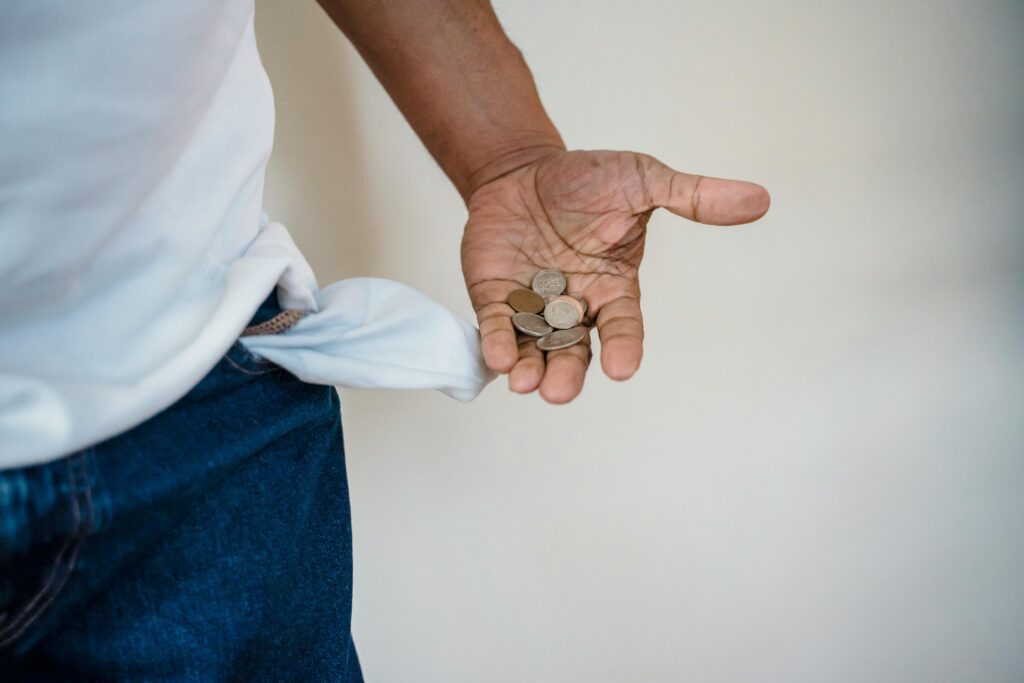
Money, please

(Image courtesy of Nicola Barts via pexels)

It’s not like I’m doing nothing at all. I still have my dog-walking and pet-sitting side gig, and I’m doing a little freelance work here and there. I also hold a volunteer position, much as the title I have there gnaws at my imposter syndrome — Director? Me? What could I possibly contribute that would make it right for me to be the director of anything? I can’t even keep a fucking job.

My job tracker stares back at me as I type this. Sterile-white spreadsheet cells. No hope offered. Over 300 applications now — full-time, part-time, freelance, contract. And only two calls back. 

Well, technically, three. I had a recruiter reach out to me for a position with a major social media giant whose CEO met a revelation of needing more “masculinity” in the company and had just laid off thousands of highly qualified individuals. I turned down that conversation and job, thinking ‘You want male energy and called a Jessica; you’re a pig and called this Jessica; and if I took the job out of need despite all that, I’d still get canned due to the wrong energy field.’ Maybe only to also be labeled as an underperformer, with no evidence to back up that title.

I may feel like a fraud half of the time in my work, like I don’t deserve my title or my salary, but I know I’m not an underperformer. I am Jessica Day. If nothing else, I am a hard worker.

And yet, I’m left here with so many questions. So many frustrations. So many concerns.

How long will it take me to find a job? 

Will I ever find a job again?

Am I bad at everything I do? 

Am I always going to be laid off or furloughed? 

Is this going to happen again? And again? 

Can I trust any employer? 

Is it me? Is it them? What is it? 

Why has this happened? 

Why is our economy here yet again? 

When will people stop using “unprecedented” to describe this shitty moment in time? 

Will my generation ever know any semblance of calm? 

Will we ever be able to buy houses and have families and just have normal fears like what milk to buy instead of whether or not we can afford groceries?

I don’t know. 

I don’t know I don’t know. I don’t know. I don’t. Fucking. Know. 

I wish I knew.

Where do we go from here?

(Image courtesy of Ron Lach via pexels)

In the meantime, I’ve been tracking the layoffs happening in our country. I’ve currently tallied tens of thousands of individuals laid off since the beginning of January. I’m one of the many. 

It’s horrific to think of everyone who’s lost their position, their livelihood. They lost their stability, their sense of direction.

And no, they can’t all be underperformers. That’s highly improbable, as anyone with any understanding of statistics could tell you.

Spiraling would be the word I’d use here. For myself. For the economy. 

There’s no easy way out of this situation, and everyone has their own idea of what the best way out is. The fact is, there is no best way out. 

I have a friend who just finally found another job, and I’m so proud of and happy for her. She’s worked with globally known companies and at an upper-management level. It still took her over six months to finally land a job offer — and as a vice president no less, which is very exciting and so deserved. 

But I look at her, with her impressive resume and years of experience, and then I look at mine….

It took her over six months. 

How long will it take me? 

What if my partner loses his job, too? 

Will we be able to survive? 

Will we ever find jobs again? 

Will we be able to retire? 

Will we have Social Security?

See how the spiraling is easy to fall into? 

Once you fall in, you can’t pull yourself out.

But I’m a pro at this, as my therapist said. Not just applying for unemployment, though still feeling shame, but also surviving scary events in history.

I’ve lived through the ice storm of ‘98, Y2K, the dot-com bubble, the 9/11 attacks, the 2008 financial crisis, the H1N1 scare, COVID, and now… whatever we want to call this chaos we’re living through that is our entire world right now — right alongside the rest of my generation.

I’m a pro at surviving. 

I can do this. 

I’ve got this.

Right? 

right?

(Image courtesy of Luca via pexels)

Gobsmacked By Environmental Consciousness: How COVID Recycled My Values & Priorities

We learn valuable life lessons the hard way. In 2018, as I proudly stepped out of my final year of high school, little did I know that the journey ahead would teach me valuable life lessons. My post-school life began with an unexpected jab that forever altered my perspective on managing personal finances and also a surprising consideration – environmental sustainability. Who knew?

Gobsmacked by freedom

(Image courtesy of Ady April via pexels)

After completing school, I was convinced that higher education was beyond my grasp. Underestimating my academic record, I decided to take up any job I got. 

Independence looked more appealing than education. 

I managed to find a job as an Administrative Clerk at a wholesale and supply store. I had no clue that this decision would become the root of my deeper sense of understanding of the economy and money management. As a teenager, my salary, which was more than my pocket money, seemed a luxury. I spent whichever way I wanted. No restrictions. I was so happy I worked there for three years, even during the challenging period of the COVID-19 pandemic. It became a necessity then. And why would I leave my newfound independence?

That period was dreadful for those who worked in stores, given the merciless looting that took place in our country. Our lives were at risk of being infected and also due to our workplaces being looted, we were in danger of being killed by store looters — the new breed of looters formed during the pandemic.

Gobsmacked by threats

(Image Courtesy of Eri Mclean via pexels)

As an administrative clerk, my interactions with an array of people — drivers, suppliers, and customers — every encounter was almost life-threatening.  Implementing stringent safety protocols seemed just mental solace. The threat of the store being looted and in the process of safeguarding it being killed was also scaring me. Striking a delicate balance between upholding professional obligations and safeguarding personal health and life became paramount. 

Despite the inherent risks, I approached each interaction with diligence, ensuring that essential business operations continued smoothly, focused on both profit and safety. This added layer of complexity was not for a teen like me. For me, it was a heavy dose of challenges . My goal was just to have a job and safeguard my independence. 

Balancing the demands of the job while managing personal anxieties about health and safety became a daily struggle. I grew up to be an adult, a real adult. Despite the hardships, I remained resilient, adapting to new protocols, mastering remote collaboration tools, and maintaining open lines of communication with my superiors.

Witnessing the destruction of businesses and the financial fallout reinforced the fragility of economic stability in me. Something too hard to take in as an independent teenager was the idea of financial insecurity. The very thought of losing my job sent a chill down my spine. 

Gobsmacked by finances

(Image courtesy of Joslyn Pickens via pexels)

It was during these days of instability that I realized the need for financial stability, and that only a college degree paved the route to a better job and hence stronger finances. Determined, I applied for a Bachelor of Commerce in Law degree. Much to my surprise, the institution acknowledged my academic results and cast away the doubts I had about myself. Despite the financial struggles that would accompany. me, I was determined. I joined the college.

But once independent, always independent. As I alone shouldered the burden of college fees and other monthly expenses,  I could not afford to quit my job as clerk. However, this challenge served as a stepping stone for my personal growth, growth towards adulthood, towards worldly maturity. I transitioned from a spendthrift teen and learned how to budget and save. I turned my financial burden into my financial awareness. 

Juggling work and studies, I found gratitude in the fact that my employment not only fueled my educational pursuits, but also provided a way to help my family financially. I understood the value of taking care of the needs of my family.

My job allowed me to review the ever-changing prices from suppliers for an extensive array of household products, from hardware to appliances to food. It was during this time that I witnessed the harsh reality of economic instability. The instability that affected me and everybody else around me. The price of essential food items such as corn, wheat, and rice increased significantly as the months passed.

Occasionally, the company’s suppliers used to send out letters notifying us of shortages of certain products or informing us of inflation due to the scarcity of raw materials.  My education continued, I started noticing the interconnectedness of our economic systems with environmental sustainability. Our actions, both as individuals and as a society, have far-reaching consequences. 

When many saw the scarcity of raw materials exploding the prices, I saw the importance of taking care of our natural resources. 

I felt the need to prioritize environmental responsibility.

I stopped running after wants. In a world where our choices are impacted by availability and price tags, the importance of the modest consumer takes on a broader perspective. It extends beyond financial stability to encompass the conservation of resources and the preservation of our environment. 

Experiencing the economic instability due to pandemic effects, with looting and its aftermath, stirred in me the need for a mindful and sustainable approach to life. These challenges forced my family and me to adapt to be more resourceful and wise with our spending. We cut our expenses wherever possible, and managed with whatever we already had.

Gobsmacked by environmental sustainability

(Image courtesy of MS Uppy via unsplash)

Saving, reusing, and recycling are not just environmentally friendly actions. In moments of uncertainty, I turned to those simple yet profound acts as a source of empowerment and resilience. Whether it was finding new ways to repurpose household items or diligently sorting recyclables, each action felt like a small but meaningful contribution to a larger cause. Beyond just environmental conservation, these practices turned into my values to become a source of personal fulfillment even during a difficult time. I embraced a commitment to sustainability by prioritizing the principles of reduce, reuse, and recycle. 

Actually, the pandemic recycled my values and priorities.

Recognizing the importance of minimizing waste and conserving resources, I did my bit for the environment and drew my own satisfaction. Reducing unnecessary consumption, carefully assessing my needs, and opting for eco-friendly alternatives whenever possible became my motto. 

Additionally, I actively sought out opportunities to extend the lifespan of things and reduce landfill. My small yet humble step towards embracing sustainability.

Embracing the recycling ethos, I diligently sorted waste materials and ensured proper disposal in recycling facilities, contributing to the circular economy and promoting a positive chain reaction that influences the availability of resources, the stability of economies, and the well-being of our planet. 

As we navigate through the uncertainties of life, a pandemic that hit the entire world, tragic and devastating for millions, left a never-fading print of horror in our lives.  Its effects changed how we view life, and I was no exception.  A commitment to responsible living can create a healthier and more sustainable future for all.

My journey taught me that being financially aware is important because anything similar could knock us out again, leaving us in limbo and facing inflated prices. The choices we make today in response to the environment will  have a big impact tomorrow. 

Me. Writer. I Don’t Exactly Have a Point I Want to Achieve

I have always wanted to be a writer.
To tell my story to the world.
This raw feeling to be understood
To be validated by others who are willing to read
And see the world through my brain 
Has been haunting me ever since I was young.

But I always chose to run away.
I didn’t want to write because I think I was unable to write.
The way I poured out my words did no justice
To what I actually feel or think.
I was not skillful enough to deliver my words.
They say perfectionism kills the potential
And I have seen it more than enough, yet learned nothing from it.

Yet here I am today.
I want to start to write.
It’s okay if your words are not aesthetic enough.
You don’t have to be fancy French.
I know you have insecurities about being born a country bumpkin.
I am crude, I am not refined enough-— I cannot be
The high-value girl that could attract everything to her palm.
I need to work for it.
I need to carve my way to even arrive at my destination point.
I was not born rich enough to just live a carefree life.
But given my lot, I am not satisfied with just consuming and living a meaningless life.

I feel lost.
Don’t exactly have a point that I want to achieve.
I am scared that greed will lead my life astray.
But become greedless enough and you can be a vacuum.
Delivered to the open front door of nihilism.

Finding the balance between being and becoming
To be satisfied or to be starved
To living by the moment
Or one day living the life.
I am but a 20-something girl, pulled by the world to be an adult
Driven by fear and anxiety
Just to feel enough.

Some people really enjoy being lost.
They say once you are lost
You are pushed to rediscover your path.
They claim that direction is more important than speed
And being lost is the best way to rediscover it.  

But what if you are not lost, just stuck?
You can’t escape.
The job you hate.
The messy room you currently live in.
The toxic relationship you won’t fix.
Which one is more miserable, the first one or the rest?

Or is it just the fault of your state of confusion where you can’t even decide your current state?
You feel like you are lost
But you also think you are stuck.
In this state of bewilderment, you might, really, just be a coward.
With a diary. 

(Photo courtesy of Ashlyn Ciara via Unsplash)

Who Knew I’d follow My Family of Teachers Into the Profession I Hated!

Some people would say teaching is in my blood and that I am destined for the job. I strongly disagree with this for many reasons. 

In my family, there are many teachers. My mom is a special education teacher, and so is my grandma. One of my aunts teaches 4th grade and another takes health classes for nursing students. However, when I graduated high school in 2012, I knew that teaching as a profession was not for me. I knew, once I left high school, that I would never want to step foot in any other public school classroom ever again. At the time I graduated high school, I didn’t even want to attend college. I felt forced into the decision by my family who all flew in from out of town to attend my graduation and started handing me cash for college expenses.

People don’t realize that they have such power in the words they say and in how they choose to communicate with their peers, whether that be through kind and thoughtful words or hateful and judgmental insults. The never-ending bullying that I endured throughout my childhood in the public education system turned me away from continuing my education in college, and it was the deciding factor for not wanting to be a teacher myself.  A real shame, because I later learned I have the potential to be a straight-A student and actually enjoy learning new things. 

I go back to school

Unfortunately in 2017, at the age of 23, I was forced back into school — this time, working as a special education paraprofessional. I was a lost soul who was severely lacking purpose and direction in life. It was simply a job that paid money, and that it was all anyone cared about. 

To be a teacher, you have to have the right personality to deal with all the bureaucracy in the schools and among the staff. But you also have to have a real passion for the job to deal with the many challenging behaviors from the children; I severely lacked both qualities. Added to that, there’s the lack of proper compensation for all the hard work and effort you put into doing the job. It became evident to everyone involved that I did not want to do it. 

(Image courtesy of Mick Haupt via Unsplash)

In July 2020, I decided to go back to school, because I did not want to spend the rest of my life working jobs I hated just for a paycheck. I didn’t want to be just another number at a job who was reminded every day that I was easily replaceable. I wanted to do something meaningful with my life and be properly compensated for it.  So, I enrolled in an online degree in an elementary teaching program. Yes, teaching! 

(Image courtesy of Cole Townsend via New Old Stock)

However, it was for a very short time. Later in December of 2021, I decided to change my major after being screwed over by yet another school district.

Working in the schools was a lot like being stuck back in school — a feeling of being forced into school, just like in my childhood. 

There are also cliques of employees at every single school and district, and for someone who never fitted in properly in school, even as a child, work easily became a monumental disaster. Not only were the students at these schools now name-calling me. Yes, hurling pet names at a fully-grown adult!  The staff, and my colleagues, started calling me into meetings and pointing out everything I was doing wrong to bully and harass me. 

Many of these districts got rid of me for stupid reasons that weren’t even justifiable. The nerve. They simply didn’t like me and so chose not to invest their time in helping me become a better employee. It was a no-win situation and I eventually felt like an epic failure. 

I saw admin staff send us educators running for the hills

People are saying that there is a teacher shortage, but from what I am seeing, the shortage is of teachers. The shortfall lies in the way these districts are run and run down by staff and administrations. That is, sending many teachers running for the hills and fleeing the profession in outrage. 

As teachers, we want to be appreciated for our work and to be properly compensated for the immense effort we put into the work, especially with the rising cost of living. We want to feel safe at our place of employment and not fear for our safety every day. We also want to be rewarded for our efforts with respect, and not to be belittled and bullied by supervisors on a rampage.

The public education system is severely broken. I say that instead of trying to force change within the students, educators should first look in the mirror and ask what they can do to help create a better working environment for their employees. 

Because when employees don’t care, students can’t. The teachers burn out, they don’t love the material, they don’t love the interaction with the students, and they don’t address or maybe punish — okay, guide — students who misbehave. Isn’t that enough for you to give up the art of being a teacher?