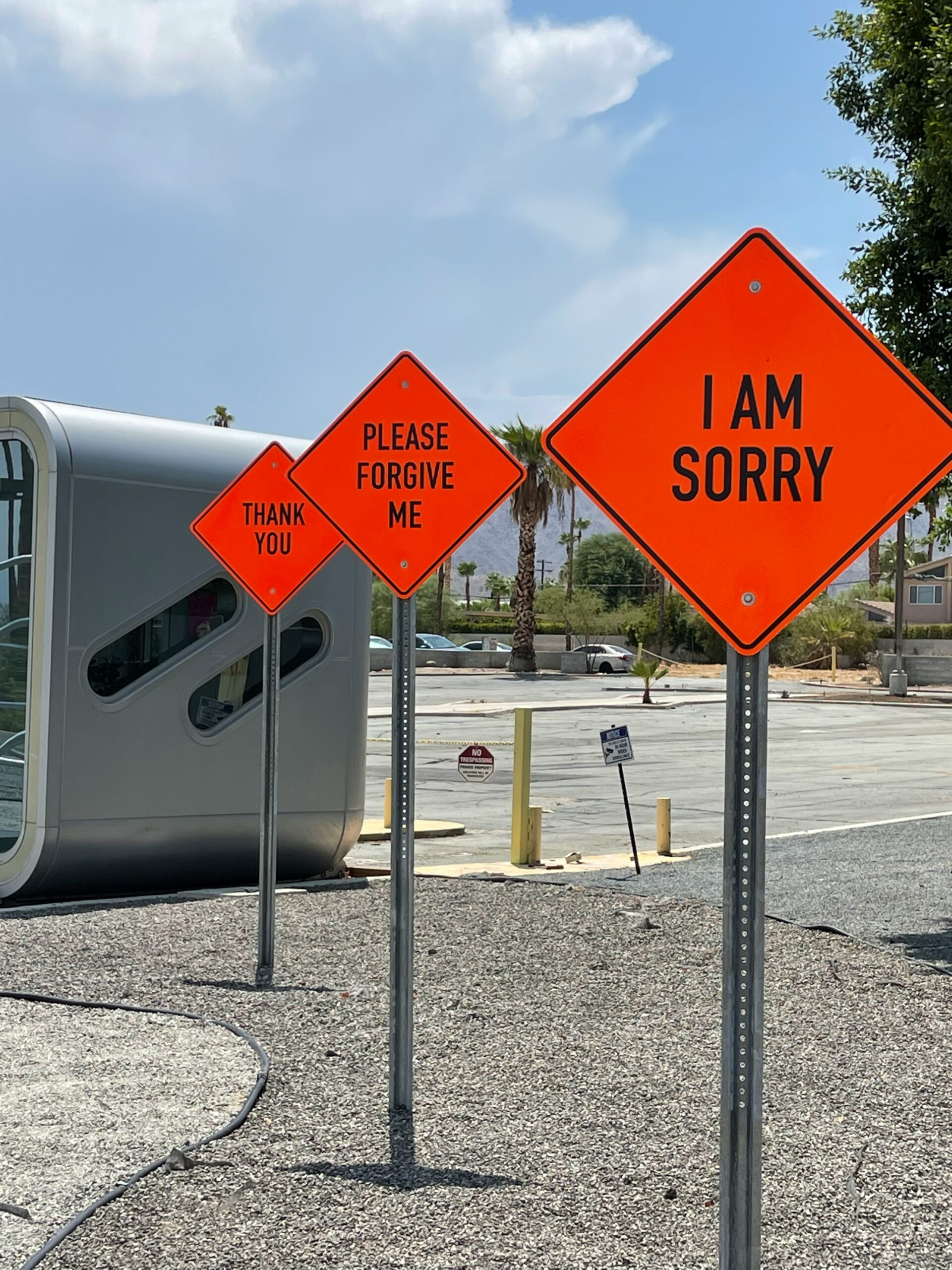
Is There a Library in Your Future?

I’ll be honest. My attention span has dwindled drastically since my voracious reading days of high school.

I can’t blame social media and short-form content completely for my lack of attention, however. College demanded me to read prose, sonnets, and anthologies for my English major. Then my various career paths had me read training manuals, handbooks, student writings, peer-written pieces, legal documents, press releases, reports, and interviews. Finally, life became broader and more open in terms of entertainment. New dramas and shows were released regularly — across all the streaming platforms — captivating games always popping up on my never-ending wishlist, and casual mobile apps take up my attention more so than a clunky physical book. I already have enough to carry in my ever-increasingly heavy bag, and the thought of carrying around another item I don’t heavily need makes any e-reader unappealing.

So, what do I do?

I may not be able to read literature like I used to back in my school years, but that doesn’t mean I don’t enjoy reading. From novels to manuscripts to how-tos, digital information allows anyone to discover anything. 

A big reason I don’t read physical books anymore is my phone — and not just because of the games. I’m an avid web comic reader. I’ve always been interested in manga growing up, and with many artists and creators releasing their content on Instagram and WEBTOONS, it’s easier for me to keep up with easy-to-digest updates such as slice-of-life, comedy, drama, and even epics. The artists aren’t the only ones working hard to bring their passion projects to life; writers and support staff work hard too to ensure a well-made experience is consistently being put out there for their dedicated readers.

Reading has always been a passion of mine. Growing up, I have attempted to remedy my lack of motivation to read novels. I got a library card to access their e-book library. It took some hoop jumping to finally get to the site I needed to re-read the series I used to enjoy as a high school student, but having a literal library of titles to choose from right on my phone has been a major help. I’m already on the third novel; I may not read through it as quickly as I used to, but when I get in the zone, I really get re-invested in reading again.

This one might be a cheat, but one major reason I don’t read physical books again is because of my work. I copyedit light novels, and I often read the chapters multiple times to ensure I’m consistent and thorough. After staring at words on my screen for multiple hours at a time, though, it’s nice to take a break and go back to my comics.

Are libraries dead? A little bit dead?

Absolutely not. Libraries are essential to any and every community. I respect libraries and what libraries do to help their patrons find what they need. Additionally, they’re adapting to the times. Broadening their services to e-books, video game rentals, and 3D printers is a bonus to the workshops, story times, crafternoons, and computer services they already provide.

One of the reasons I became an English major was that I used to read a lot. Growing up, I had a lot of downtime after school while my parents worked all day and night. One place they would always make time to take me to was the local library near their workplaces. There, I would grab heaps of books to occupy myself for two weeks before I had to return them — I think my record was twelve books. I was an avid reader; one teacher told me that I was reading above my level and questioned whether I did read as much as I reported on my read-a-thon sheets. I was immersed and rapt by the world found within a stack of books

My mom had to explain that I did indeed just read that much.

A woman lying on the couch reading, surrounded by books.
(Image courtesy of cottonbro studio on Pexels)

It was because of libraries that my world opened up to new ways of thinking, to how sad a book could really become, to far-off places with in-depth lore.

And it’s because of libraries that I believe writers still have a major audience. In this digital age, I’ve become more frugal in where I spend my money. Being able to rent a book and not having to pay $20-$40 is a major steal if I’m only going to read it once. If you still want a physical copy and the location you go to doesn’t have it in stock, the library’s borrowing system can get a copy from another location for pickup.

Of course, let’s not forget the e-library. Signing up for a library card is fast and easy, and it allows you to browse an immense catalog of titles that you can easily rent and re-checkout without having to deal with in-person interactions. And sometimes, you just don’t want to leave the house to grab a book.

But what if I don’t read books?
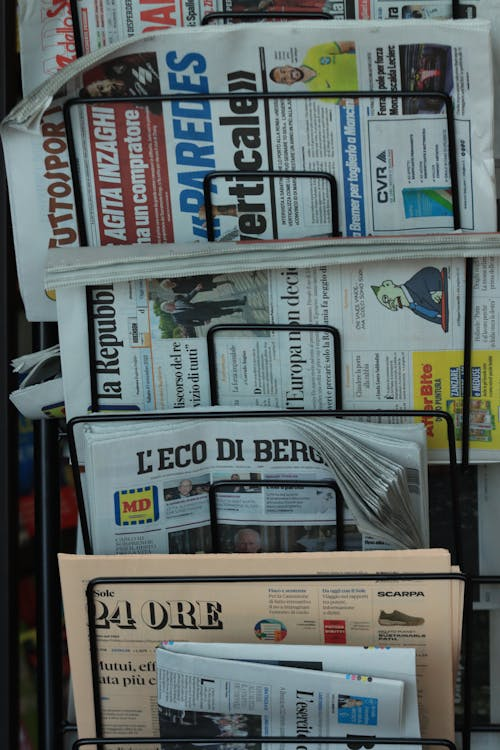
A rack filled with newspapers.
(Image courtesy of Efrem Efre on Pexels)

Printed text is a sure-fire way to spread information for people in a hurry and in need of a break from their phones. Articles, newspapers, and collections of works are fantastic ways of spreading and recording information. Consumers will always have a need to access the written word, whether it be fiction or nonfiction. 

Libraries can help with that too. Some places, such as universities or metropolitan locations, will house records to preserve history or help with research. Instantaneous consumerism and clickbait articles may be rampant, but in-depth journalism takes time, money, and resources. If you’re looking to wind down with something that’s more factual, I’m willing to bet you’ll find at least a few things to pique your interest if you talk with your local librarian.

Let me know what you end up checking out when you do go. I just may be interested in it myself.
Moonlighting as an Extrovert

When I was younger, I had difficulty making friends because I lacked many skills, such as communication and confidence when approaching new people. It got a little easier in high school when I started developing more hobbies and had classes with a more consistent group of individuals. By college, I had more confidence in myself, so I was able to engage in more small talk and exchange contact information much more quickly, whether it was for classes or extracurricular activities. However, as an adult, the only way I could meet new people was gradually limited mainly to the workplace, where each new company brought a fresh group of faces for me to bumble my way through into friendships.

As much as I seemed to be friendly and engaging, I was actually an introvert, and going out all the time turned out to be exhausting.

Starting a new career: extrovert

Whether online or in person, having some sort of confidence to initiate a conversation always seemed to be a necessity, no matter where I went. 

Do I have my Rolodex of formal niceties and social platitudes ready? How do I know when to talk to them? What should my energy level be? Are there any mutual topics or hobbies we can talk about? Where and when should we talk in case I need an escape route if the conversation starts to peter out? Why does it seem like my conversation partner is an interviewer? Or maybe even vice versa, that I’m vetting them to see if we are a good match?

That’s because it actually kind of was. We’re interviewing each other to see if we were a good match. Or, you know, sometimes if they had any malicious intent. Your girl was not in the mood to get into any trouble at any time or wherever I went.

So we’re a fit, now what?

It might not be an issue most people want to acknowledge, but there is that slight fear or anxiety when you start a new friendship and want to solidify it. What task should you take on? When should you voice your opinions? How do you continue to climb the ranks from acquaintance to friend? Maybe even a good or best friend? 

A natural progression of many friendships is going out together, or spending time in more intimate settings or group hangs. That’s when the next challenge comes through: what activity should you do? Do you play it safe or adventurous? Stay local or explore? Is it a food outing or a physical activity?

When I moved to Japan, I had to force myself to be social and interact in order to make friends. Luckily, my company had a great, engaging volunteer community that hosted many events and activities to help everyone get to know each other. Whether it was going to a restaurant as a big group, exploring nature, or experiencing culture, I signed up for as many things as I could financially to meet a variety of people to befriend. Luckily, the people I gravitated toward started standing out to me, and I began seeing them more often at activities I had signed up for. At least we had similar interests that we could riff off of.

A work in process, but in smaller spurts

My social battery was working overtime, and I had a dossier of friendship applicants I could sift through to find my new group. For about two years, my weekends and holidays were spent going on multiple trips, stayed out many nights exploring bars and restaurants, and attended a ton of gatherings and parties. However, during the work week, I stayed home and binged Netflix with either leftovers or store-bought dinners. I like to think these moments alone helped me be a better social butterfly.

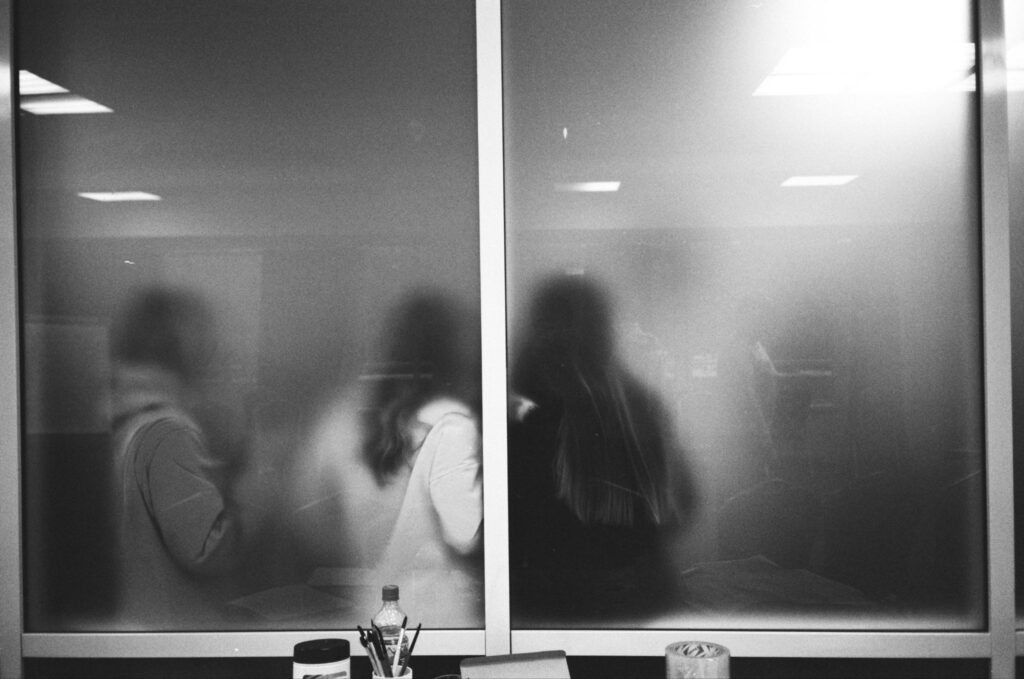
Multiple individuals, behind frosted glass, stand together chatting. They are on the other side of the pane from an office desk with pencils, paper, and other tools sitting on it.
(Image courtesy of Maria Varshavskaya via Pexels)

Eventually, I started aligning with people I would call good friends. Better yet, many of them were introverts like me. So, I would go to the bars less and to each other’s places more. We would go shopping together or plan our own trips outside the company-oriented ones. Sometimes we would meet up just to gripe about work or watch mindless media together — I feel like these moments were essential to keeping me, us all maybe, sane while living away from home. 

Before I knew it, I became a volunteer myself to help my community enjoy their time in a foreign country. I had to stretch my comfort zone here and there to make the most of my time in Japan, and I felt a sense of accomplishment helping others make connections, just like how my predecessors helped me when I first arrived.

Leaving the company, now not in each other’s company

I eventually left Japan and moved back home, and the distance really affected the relationships I made. I’ve kept in touch with some, touched base with others, but have largely grown distant from many of them. The distance and time differences really didn’t help the situation.

Looking back, we were in relationships of convenience; we were thrown together in a foreign country and had to make a few friends to mitigate the loneliness in a sea of unfamiliar faces. Not to mention the language barrier, that was another struggle. I was able to communicate with some of my Japanese coworkers and friends, but I had to switch between English and Japanese often because my proficiency wasn’t that high — and I had a better grasp of the language than many who moved to my area.

Luckily for me though, some of the friendships I made have survived until now. I may not be talking to as many people as I did when I lived in Japan, but it’s been a real blessing to still be in touch with those who wanted to stay connected, whether it’s a trip to see one another or an invitation to a wedding or occasion.

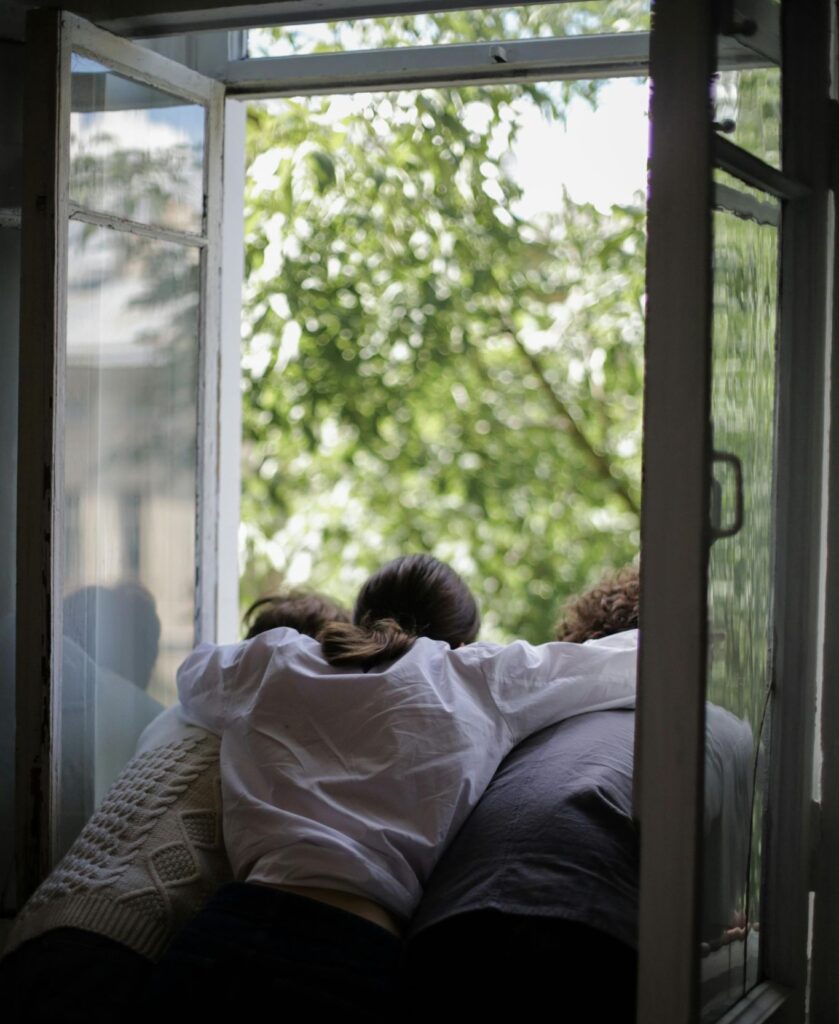
A group of friends, embracing one another, stare out a window together at green trees. They are thinking of other friends, who live far and wide, across the world.
(Image courtesy of cottonbro studio via Pexels)

The exit interview

For me, I wholeheartedly recommend that people move away to a new place. Not only to experience a shock to your system, but to force you out of your comfort zone and make lasting memories. I had a blast meeting new people, going on solo adventures, and making mistakes that I learned from along the way. Would I have preferred to stay holed up on my bed, binging House while eating a cold bento and a slice of melon I bought from a convenience store on my way home? Absolutely. But would I have regretted doing that every single weekend? One hundred percent.

A dear friend of mine is now in Australia, and I do my best to check in once in a while, but I know she’s living her best life right now. At first, I was concerned about her mental well-being while in a new country, but, after persistent encouragement and a nudge to explore here and there, I eased off and let her do her own thing. Now, I’m just waiting for her latest tales of adventure to get me itching for another one of my own.

Travel Slow

For the past month, my wife and I have been traveling through New Zealand. The reason being we plan to move here because America, where we’re from and live, is so great again. I won’t subject you to a political rant about why we’re leaving; our brains have been beaten enough as it is. Instead, I thought it would be a better use of time to share my traveling philosophies on how to get from place to place, how to eat and drink, and how I did it on a single-ply budget. 

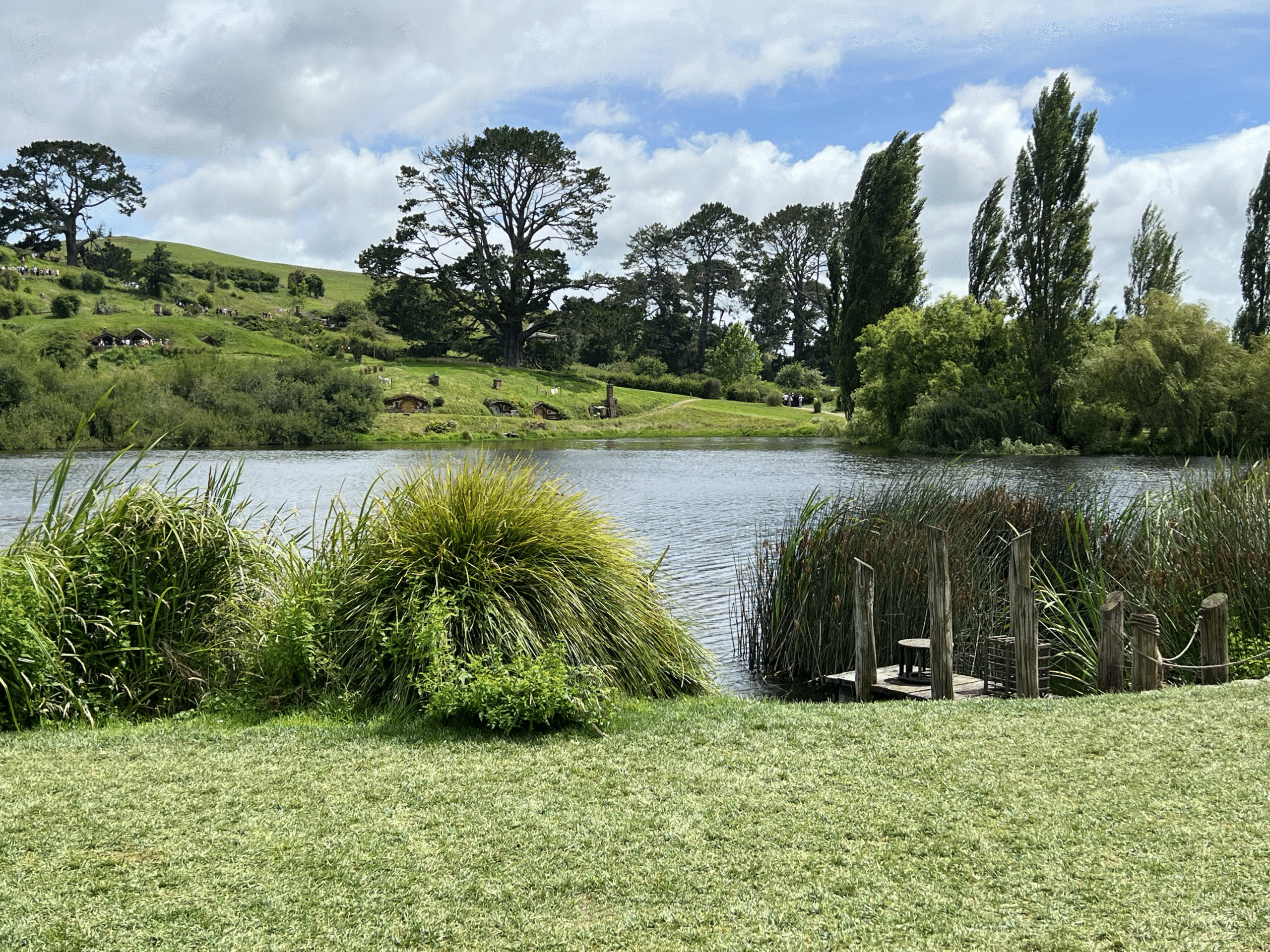
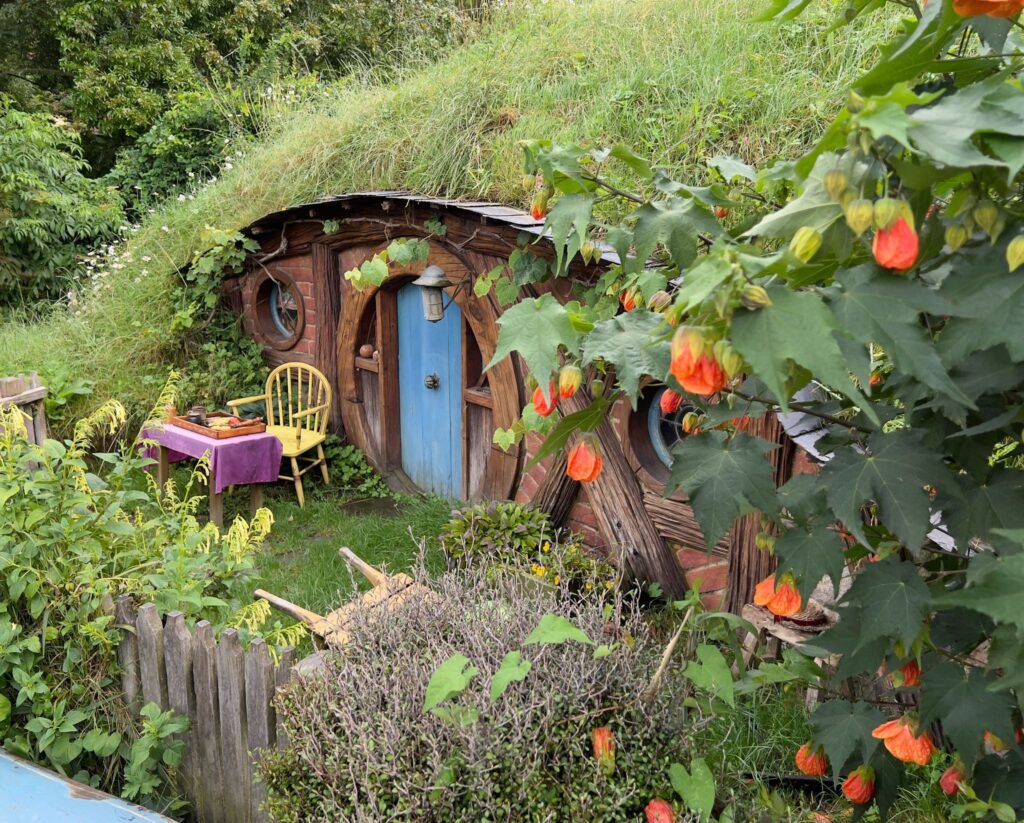
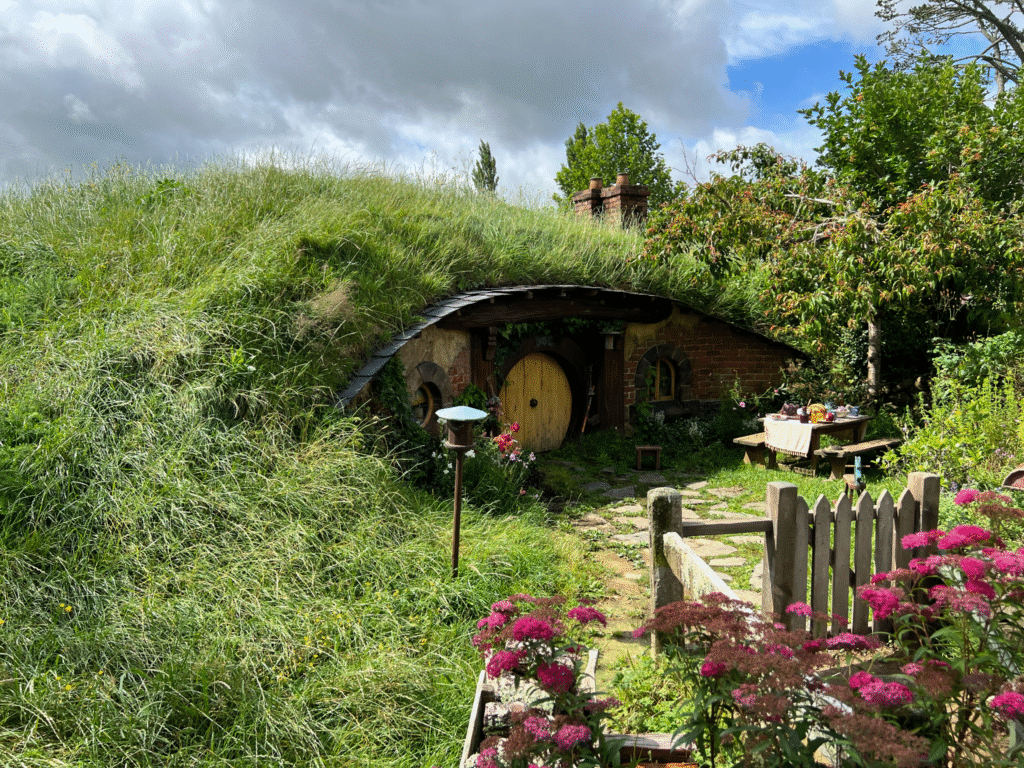
Every time I tried to put into words just how to explain and describe my unforgettable experiences in Hobbiton, I always found myself coming up short. Soon, I concluded that there just simply was no way for me to convey through words just what my experience was like. So instead of words, I decided to use the pictures I took throughout my trip. Here is another picture of what my dream home looks like.

A blue door Hobbit hole with a small chair in front and garden.

We started in Auckland, the northernmost city on the north island, then made our way south to Wellington, New Zealand’s capital, stopping at a few places in between. The long journey from north to south took around 10 hours in total by train, and although a plane would have cut this time in half, the extra time it took was well worth it. After all, flying might be a convenience, but taking a train allows you to see more of the country. It allows you to enjoy and appreciate not just the incredible landscapes – otherwise missed skipping to airports – but also the factories and farms that keep the country running behind the scenes. I believe in travelling slow when in foreign places and I do so in any way I can, even when I’m only staying in one city.

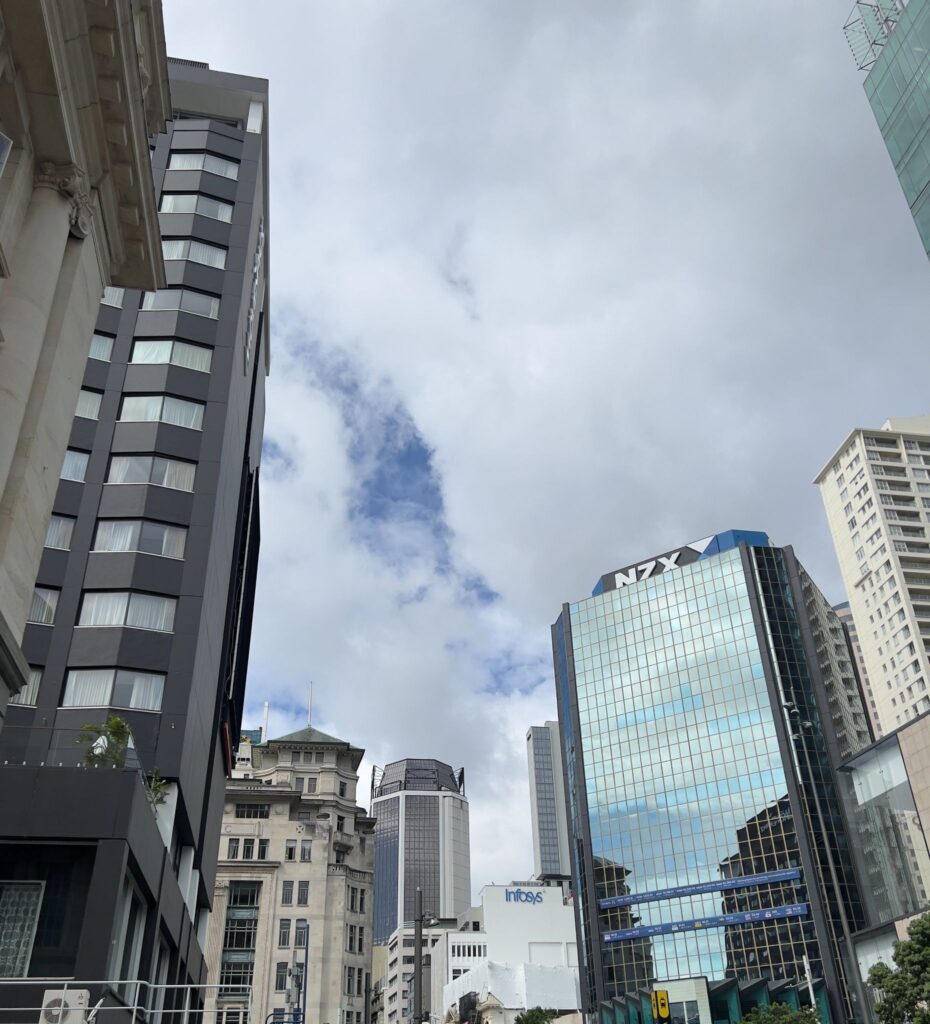
Downtown Auckland skyline

Although we had the option to rent a car while we were here – since our California driver’s licenses are accepted – I had no interest in doing so. Since I don’t plan on having a car once we make the move, I wanted to get a sense of what living life without a car would be like. Besides, walking through a downtown street in the city center is the best way to find what you aren’t looking for. The buses in Auckland were clean, ran on a frequent schedule, and paying the fare was as easy as tapping on and off. However, the bus system was still unfamiliar to us and we definitely got lost more than once. I prefer getting lost though, especially in a city where safety is a priority. Plus, you never know what you’ll stumble across after you miss your stop, misread the map, or take a wrong turn in the wrong direction. One time, when this happened to my wife and I, we even found an area called Newmarket just outside of Auckland’s city center, a place we ended up having a serious interest in living in. During our wander, we also came across an outdoor food market complete with its own bar – perfect for someone like me who’s a huge fan of outside beers. All of the experiences I had in Auckland have thus taught me that I shouldn’t just be focused on sightseeing, but should also get in where the people are.

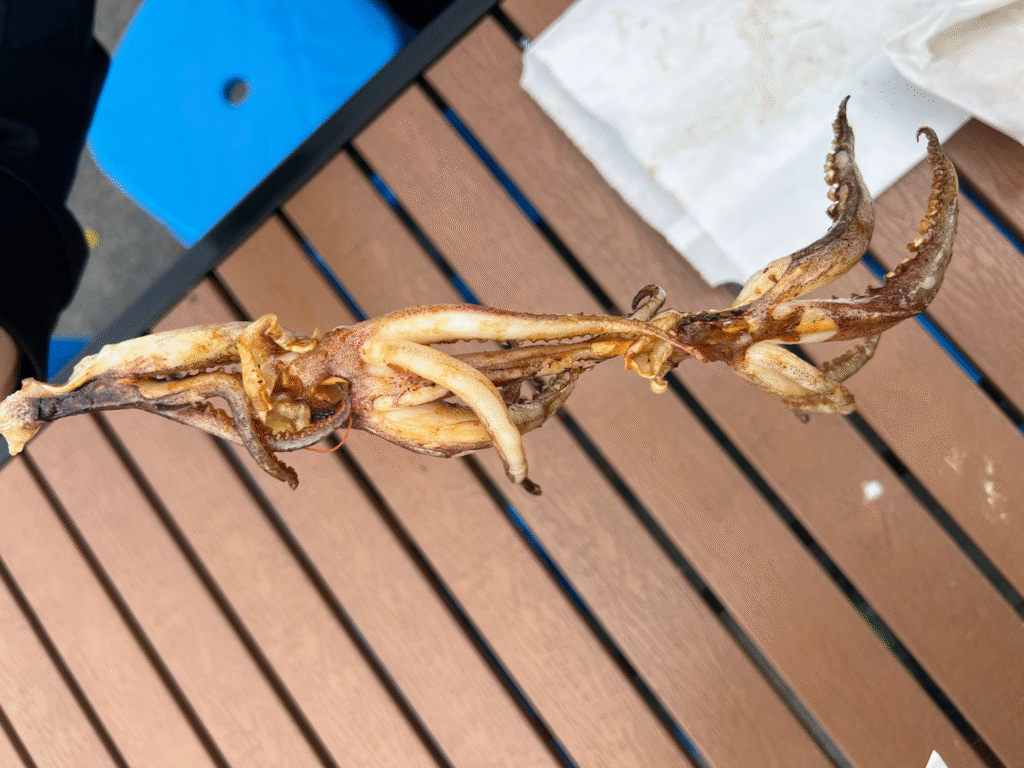
When it comes to eating, my process is simple: try a little bit of everything. Part of the fun is getting out there and learning the subtle differences in what things are called. Take lemonade for instance – back in the states, it’s a mix of lemon juice, sugar, and water. In New Zealand, however, lemonade is referring to lemon/lime soda instead, making it more akin to Sprite. My wife was shocked when that came to the table. Did we stay in and order Dominos one night because we were exhausted? Of course we did. I’m not saying you have to run yourself ragged, and in fact I completely stand against it. All I’m saying is that you should just step out of your comfort zone a little. Food is unlikely to be the thing that kills you, especially in New Zealand, so you really shouldn’t fear that thing on a stick that was cooked outside. Because when all was said and done, I can assure you that it was delicious.

Cooked squid on a skewer.

Drinking. I am a drinker. If beer was a religion I’d be a zealot. I do not believe in drinking moderately. In fact, I believe it would be irresponsible to my constitution to do so. For the record, though, I don’t drink beer exclusively either; I’ll try any fermented beverage at least once. That’s because, to me, alcohol – same as food – is culture. Every corner of the world has an alcoholic beverage associated with it. The United States is known for moonshiners and whiskey distilleries. Mexico has tequila, while South America and the Caribbean have rum. Western Europe is synonymous with pubs, Oktoberfest, and beer in general. Russia and vodka go hand in hand. Japan has sake, and Korea has soju. Mankind has a collective habit of figuring out how to ferment the plants that grow where we live into delicious beverages. It is another one of the many things we have in common. There are parts of the world where alcohol is absent, but in those places religion is the dominant aspect of their culture. I’m not encouraging you to try every beer on the menu twice, as I did on the train from Auckland to Wellington. But if you’re not sober, for the sake of living try living a little extra. If I hadn’t, I wouldn’t have learned there are unique hops that grow in New Zealand. I didn’t learn the science, nor do I even remember what they were called. But I remember the taste. Because of my proclivity to beer I have a wider appreciation for New Zealand’s agriculture. So my take is, if you do plan on having a drink, forget moderation, if for only this one time.

Traveling is hard financially. Especially these days where most of us are scrounging our spare change together just to make rent. This is how I’m currently living as well, but my wife and I still decided to make the trip. We didn’t concoct some grand plan on spending while we were here. We decided it would be something we never looked back on in regret. The fact of the matter is that we live in uncertain times, and the places you want to go may soon not be so easily accessible; the time is now. I’m coming home with pennies in my bank account and not one regret about taking this trip. I got to see how simple living can be, how truly nice people are, and how much I needed a change in scenery from the current state of my country.

A yellow door Hobbit hole with a picnic table out front.

To the Summit of Fuji

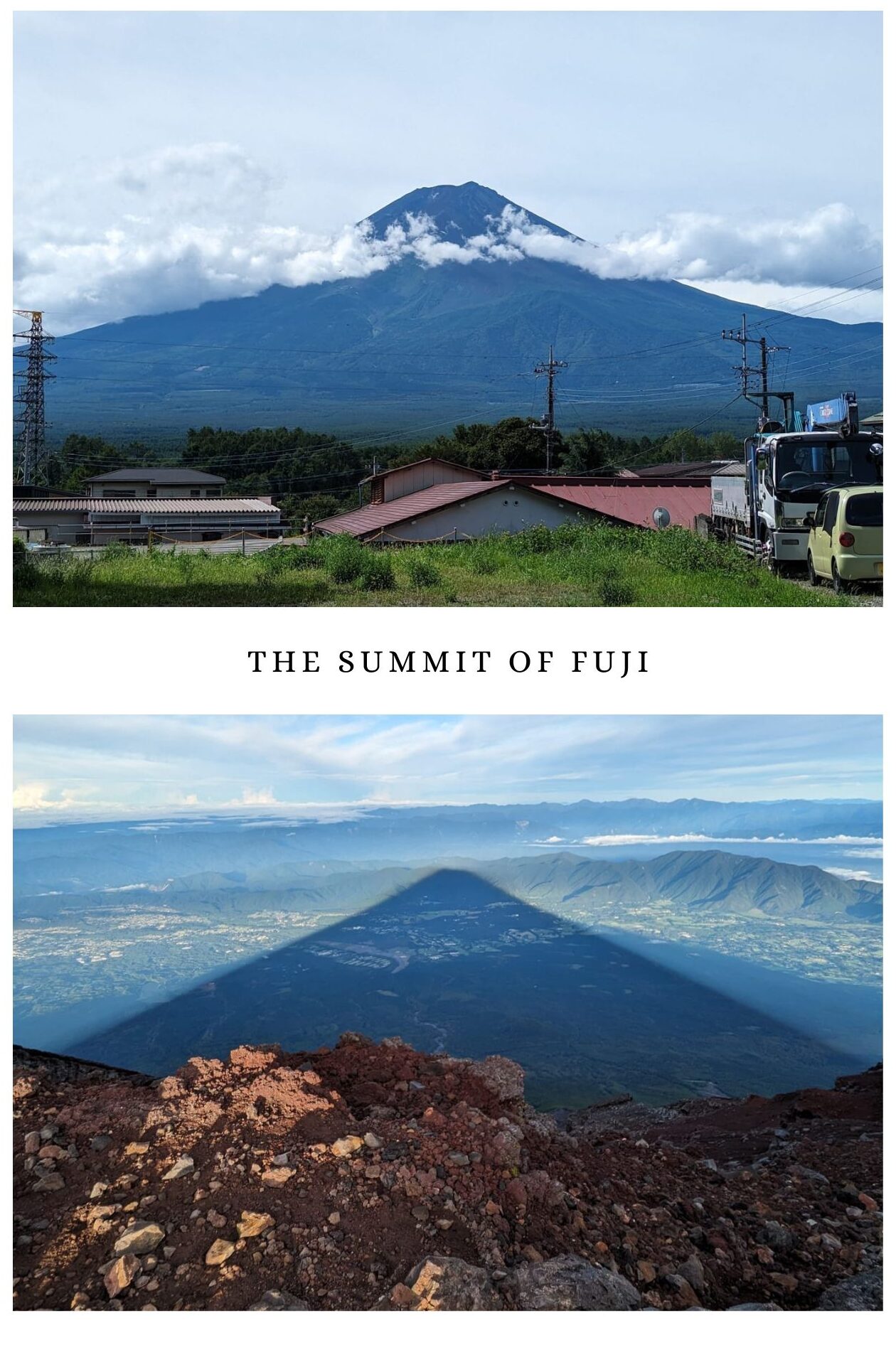
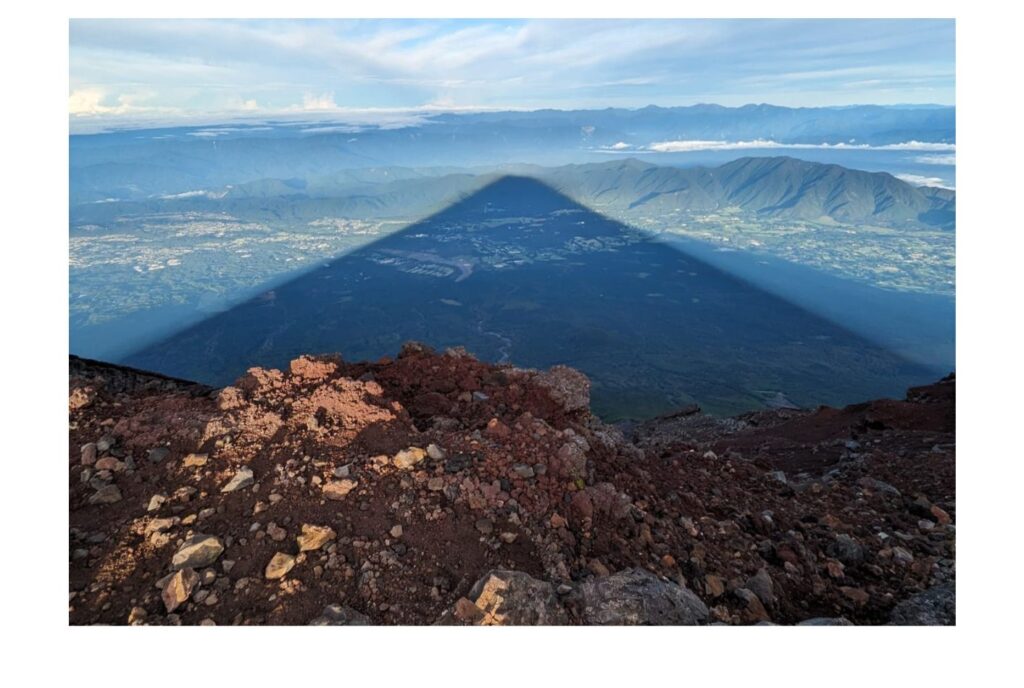
Image shows a combination of two photos: the first is a landscape shot of Mount Fuji during summer, the second shows the shadow of Fuji spread over the land.
(Images courtesy of the writer)

As of writing this, it’s been roughly two years since I reached the summit of Mount Fuji. I could wax endlessly about the idyll of Japan, having spent 26 days exploring Honshu and Kyushu with my ex-partner, but Fuji-san was an integral milestone over and above the rest – one I shall meditate on forevermore.

Many tourists will form stark interpretations of Mount Fuji. Bask in its immeasurable beauty. Dread its perilous dangers. Truthfully, my experience was more fragmented. Fuji-san is an entity, a landmass of divinity that murmurs its own language. I connected intensely with the journey during my climb. Out of wonder? Respect? Fear? I felt my body screaming, every checkpoint marred by the knowledge of steeper ascents lying ahead, and yet I emerged with a greater spirituality I hadn’t intended to find.

Fifth station: ground zero

The bus rattled in winding meanders, past volleys of trees as the views grew increasingly more ethereal. Customary for most ascents, we were charting half the mountain by road, crossing vast, impassable forests towards an accessible basecamp. I was entranced by the cultural significance of my oncoming quest, packed into this bus full of both locals and tourists from around the globe. Since my partner had steered clear of the task, I was also totally alone.

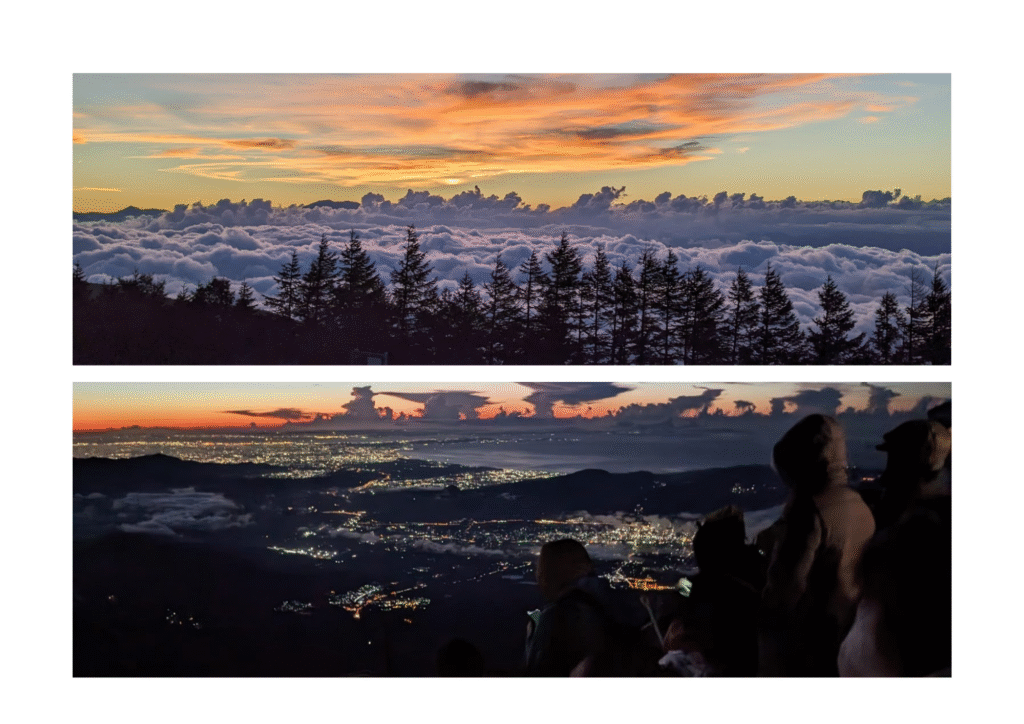
By the time we reached the fifth station at 2,300 meters, every person was struck by the same revelation:

Two images featuring the view from the ascent of Fuji. The first shows a sunset from the fifth station while the second shows a sunrise from the summit.

We were already surfing the clouds.

An asphalt lot spreading towards a bank of skeletal firs, and beyond that, nothing but rolling marshmallow waves tinged in gold. All I’d done was step onto a bus!

With over an hour before I was due to begin, I reviewed my inventory. Sugary food and drinks? Check. Climbing poles and torch? Check. Oxygen canisters? Check. Phone? Drastically low on battery. Not my photo ops! I was forced to commandeer a charging port on the outside rim of the visitor centre because they didn’t have them… inside for some reason…

It was during this dilemma that I met Louie, a fellow Brit. Like me, he was going alone for now and asked if I wanted some company for the ascent. Knowing I was gunning for a ‘bullet climb’ to reach the summit before sunrise, the fact that Louie told me he would be staying in one of the overnight huts further up made me wary. Eventually, we compromised, deciding to stick together until the sixth station where Louie would reunite with his tourist friend and I would press onwards.

As the sun wilted around 7 p.m., we set out on the popular Yoshida Trail, quietly confident. We’d researched the gentle and non-taxing section between fifth and sixth. Even while trekking the muddy terrain and fallen roots, we believed that darkness would be our greatest enemy and awareness our guiding light.

We lost the trail within fifteen minutes.

Somehow, we’d verged onto a tractor path, coated in loose stones and rutting indents. The angle of ascent was something like 45 degrees in comparison to the demarcated trail we’d keenly avoided some 200 meters back. Still, we pressed on. An effective shortcut, we thought.

An hour passed. Our bodies were failing. Our legs slipped every twenty paces. We had no evidence of travelling remotely in the right direction. All we knew was up.

Then a building reared into view.

Sixth station: a moment of suspension

The first milestone was wedged into an outcrop of gravel just above the tractor route. A hut offered facilities and shelter, but no functioning shops. The view was gorgeous. The distant lights of towns and villages texturing the landscape like beds of fireflies. The fading midnight colours, pockmarked by flurried drifts of cloud. 

I learned from Louie about his Canadian friend, Kyohei. He was so lost, he may well have been climbing a different mountain. Several phone calls were received and dropped in this time, leaving us exasperated on the fleeting motes of phone service at this altitude. Still, Kyohei flickered between how right he believed his directions were and how wrong Fuji-san was for deceiving them.

Dutifully, I stayed with Louie for a further hour, talking through the finest details of our lives – where we studied, our passions, our hobbies, our fears. When Kyohei finally found us and I bade the two of them farewell, the appreciation for life’s individual complexity and the beauty of human collision stayed on with me.

The route to seventh was smooth and repetitively serpentine. Shockingly, I found the temperature so mild that I stripped down to a t-shirt. Despite the purported frigid conditions at this altitude, I didn’t apply any more layers until the summit.

What was glaring during one of my breaks was the utter silence in my vicinity. No additional climbers were visible behind or ahead of me. No wildlife, no traffic, no environmental disturbances. This was a vacuum, devoid of sense. Time had been suspended. There was something spiritual about this immersion in the faraway, this stretch away from noise. Something healing.

Seventh station: sheer insignificance

I’m confident about my fitness. I run regularly and stay active through work. I’ve climbed hills with challenging conditions before.

Oh boy, this was beyond that.

Following seventh, the angle of elevation hiked steeply. Surfaces underfoot became ever more perilous – I’m talking avenues of boulders, sharp chicanes overlooking fatal drop-offs, steps that felt like ladders. The threat of danger was suddenly unrelenting.

With some near misses under my belt, I started to comprehend how insignificant my existence truly is. I’m eleven stone (give or take) of carbon, bones and messy opinions. With one misstep, I could have been reduced to a smear along the countryside.

For any intending to make this climb, please prepare for the worst (that includes renting all the necessary equipment, including poles, torches and gloves – survival is unlikely without these) and please don’t underestimate the difficulty from guides you may read online.

And, you know, don’t get lost on any unchartered tractor paths.

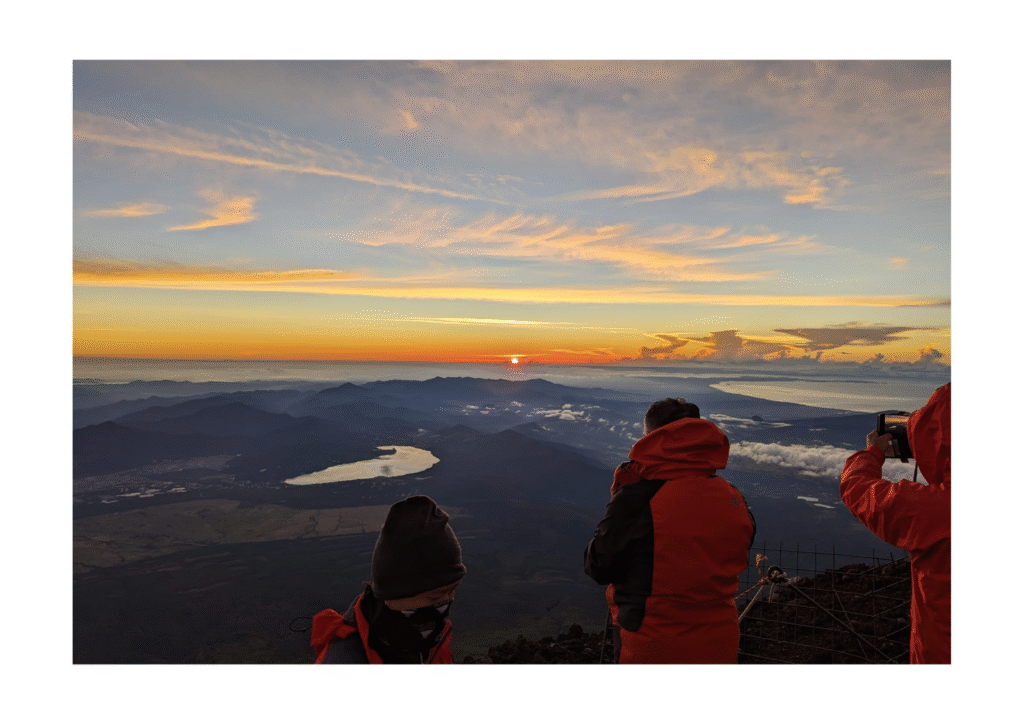
Sunrise from the summit of Fuji.

Eighth station: hunger and resilience

By eighth, there were signs of civilization. Most of the overnight huts were located nearby. Suddenly apparent was the hunger lurking in the pits of my stomach and a severe lack of snacks remaining in my backpacks. My breaks were growing longer, whilst my contemporaries seemed to be coping just fine. Damn these unbothered gurus of mountaineering…

I needed help, and having relied on my partner (who had been studying for a year in Japan) for the majority of our communication, I felt lost locating it. I considered throwing in the towel or renting a hut for the night, but in the end, I sucked it up. Somehow, I  managed to acquire some chocolate after a bungled back-and-forth with some retailers, which was a small moment of pride for me. I could do this on my own.

There was one universal language up here – resilience. Every soul was laser-focused on the same triumph and I knew this determination would translate into movement. I knew we would prevail.

Ninth station: the shove

Just before ninth, the Yoshida and Subashiri trails intersected. Suddenly, where before isolation left you exposed, you could barely move through queues of bodies shoving impatiently towards the peak. Somehow, it felt further away than ever.

In many ways, this was the easiest part, and the most encouraging. Forced to shuffle at a snail’s pace, you can catch your breath more easily. Plus, you finally appreciate the sheer volume of cultures surrounding you. Climbers young and old, timid and bold… every race, religion and creed, every unique background and occupation, all united, breathing down each other’s necks and longing for the rocks to level out underfoot.

My thoughts drifted to Louie and Kyohei. I wondered if they’d made it to their hut, or whether they’d made the final push. I only hoped they hadn’t turned back too soon.

The summit

There was something initially underwhelming about reaching the summit. There was no great final obstacle, no fanfare. The upward push simply ended, filtering into a condensed community of buildings where I was finally able to get a warm udon meal (transformative) and rest, dwelling in the majesty of what was to come.

Everyone gathered along a rocky hill encircled by barriers. This appeared to be a designated lookout point, facing the eastern sky. And at 5 a.m., far from our vantage at the top of the world, a beam broke free from its twilight.

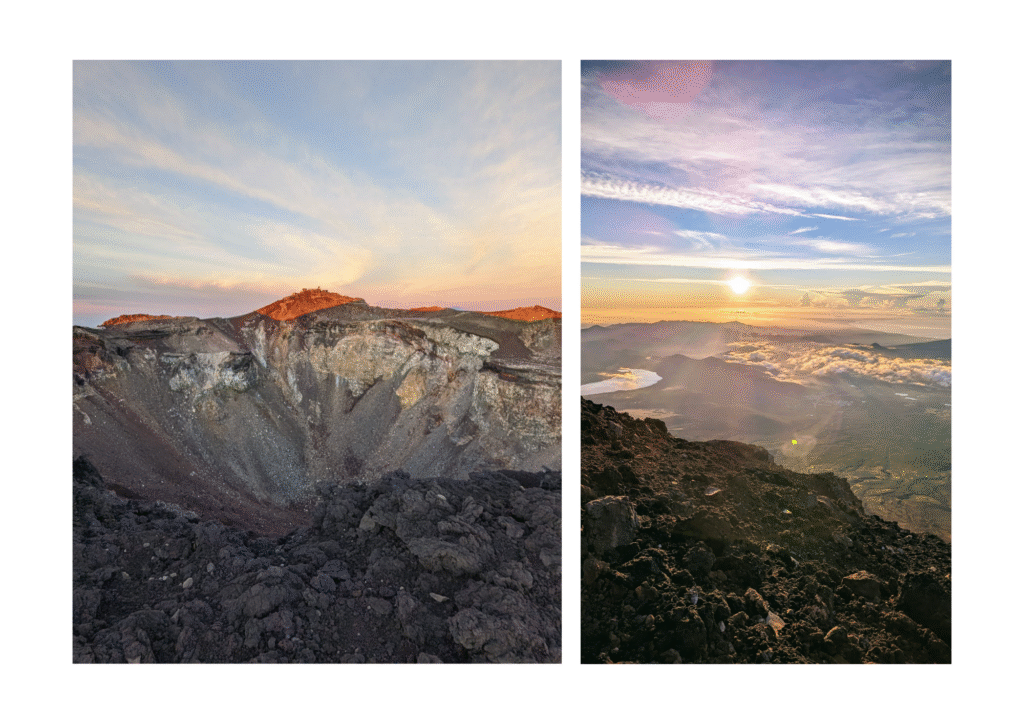
Two images of the view of and from Fuji, showing the contrast between rock and sky.

1,476 meters. Nine and a half hours. One of the most extraordinary feats I’d accomplished. With my newfound triumph and a warm meal in my belly, I felt more awake than ever. I took an extra hour or so (as many climbers do) to walk around Fuji’s caldera, one part of which descends into the crater. They just let you do that. You can climb into an active stratovolcano. It’s crazy.

The future of Fuji

Many elements have changed since I ascended the mountain in 2023. For one, it now costs 4,000 yen per person to climb, whereas before donations were voluntary. The trailheads are now closed off in the evenings between certain hours to any climbers not staying in huts. That aside, I found this experience to be utterly life-changing and would recommend it to anyone daring enough. I would do it again in a heartbeat.

The Long and Short Game

Crushes

What exactly is a crush? Can it be quantified? Measured? Narrowed to a single description? I used to think that  a crush was an attraction you felt strongly and quickly within the first months of knowing someone… Depending on the mutuality, this crush can either expand or fade (often with one-sided difficulty).

A crush feels magnetic, like everything lighting up at once… Otherwise, it doesn’t count, right?

Well, no. There’s more depth to attraction than that, as I’ve discovered recently. Hidden strands and universal shifts. I’d never accounted for friendships where attraction develops later, or where crushes are seasonal, almost, fading with the weather. I’d never accounted for my changing tastes.

As of late February, I’ve been in a relationship with my best friend of five years. I can’t get enough of her, yet the strangest thing is… not even three months ago, I never would have put this on my bingo card. Genuinely.

The subtlest shifts can usher in the most tectonic of changes.

The long game

I met my now-girlfriend (we’ll call her Emma) in our first year of university, when neither of us really knew what the hell we were doing. I’d previously been off with COVID or some other hacking spell from a drama workshop, so Emma approached me mid-session on the day I returned. She’d missed seeing me in class. Something had drawn her to me, though even then it was never anything romantic. In fact, it was somewhat chronic, seeing how it led to our crippling bubble tea addiction at the local Pearls, where we then spent the majority of our free time.

We developed a bond very quickly, having the same humour, quirks and coping mechanisms. This was exacerbated by our respective flatmate situations.

As a freshman, I lived in a hallway of eight, each having an individual and unique personality that quickly separated into cliques. We were amiable enough, holding parties, supporting one another — though towards the end of the year, the ‘incident’ happened. Without delving into too much detail, a growing wedge between two members of the hallway (a conflict I was utterly uninvolved in, I should add) forced me into choosing sides. I attempted to mediate, but because of my indecision, it was I who was treated like the villain.

I’ve rarely felt that isolated in my life. Never once did I receive an apology. Even worse, for some time, it seemed I would have to make reparations out of necessity if I wanted housemates to bunk with in our second year.

That’s when Emma started showing up. She’d been having trouble with her corridor too. Together we found a mutual escape with one another, hanging out in each other’s rooms, dancing to theatre songs, filming silly TikTok videos, drunken rants and reassurances.

She’s the reason I was able to finish my first year, if I’m being candid.

The roommate problem

With second year approaching, we mock-interviewed four combinations of housemates, only having each other as constants – this part was not up for debate. Once we’d found a third, we prowled for houses and lucked out with a sudden opening on the hill leading down from our university. Emma and I moved in for a week to test the waters, and celebrated the occasion with our respective families at a local restaurant.

What was hilarious was that my parents had actually met her parents several years before anything would happen.

As I learned recently, I had made a good impression.  Emma’s mum and dad had both been rooting for us, even as we pursued our own relationships. Many of our mutual friends suspected that we were an item too, though we never took any notice.

For one thing, now being roommates, there was forbidden territory. We were ever aware that if  we started dating and something had gone wrong — the awkwardness of still living together would probably have driven us apart forever. I hear horror stories of younger couples from our university moving in together and promptly breaking up, yet still having to share the same room (or even the same bed)! Our bond was a reliable constant, and this continued through our second year of living together when Emma and I took on substantial roles in student societies and needed a shared space to de-stress.

When you pair that with a genuine lack of physical attraction back then, It seemed impossible that we ever could have crossed a line.

Suddenly, distance

Three years flew past. Suddenly, we were back home, considering our options from different counties. I dove straight into my Master’s, while Emma took a year to pursue masterclasses and save money.

Ironically, my contact with Emma was fairly infrequent for a time. I’m still not sure why to be honest. Perhaps we were cautious of codependency? Perhaps I was just genuinely bad at texting? For whatever reason it happened, I have this distance to thank, inexplicably, for us growing even closer. Within that absence, I think something clicked into place.

The short game

The moment I started ‘crushing’, however you define it, is unclear. I wouldn’t even strictly call it a crush… just a gentle, lifting realisation. I tend to trace it back to Emma’s 2026 New Year’s post on Instagram, featuring her family during some merry late night celebrations. I made a joke, commenting how it looked like her dad was capsizing, falling drunkenly from a rather voluminous armchair and out of frame. We got to talking off the back of that. We were properly talking. I mean, four days straight, yapping every minute we could.

It was like a veil had been lifted, one that had previously only revealed half-truths. I stared at her photos for longer. I scrolled through threads upon threads of conversation, searching for notes of interest. I was soaked in curiosity, to know her better, to hear about every minute detail of her day.

Within a month, we met with some mutual friends in London for bowling and I invited Emma to come visit my home county. Within another month, she was laying on my parents’ couch beside me. That first night, we got to talking about prior relationships and encounters, especially some troubling ones where close friends had revealed their true feelings to her, causing their relationship to subsequently go cold. She mentioned how she’d never put herself in that position again.

PANIC! I thought I had zero chance. Consider also that, not even a week prior, Emma had posted a reel on Instagram talking about how soulmates can be platonic – that the universe doesn’t always deal in red strings, but blue ones and pink ones too. This, I thought, was a truly wonderful sentiment, if not a touch concerning on the whole burgeoning attraction front.

Still, I didn’t eliminate the possibility, the little clues I’d picked up. I took her out the next day to watch The Housemaid, followed by some hot chocolate in a bistro cafe. We ended up back on the couch in the evening, wrapped in each other’s arms with some animated films on the TV. The chemistry was abundant, our faces growing closer and closer, but I was terrified of making that first move! All our many years of history were riding on this one moment.

Strangely, it was Kung Fu Panda 2 that did it for us, when Emma started making random pss pss pss noises as if she was trying to beckon a cat from across the room. I kissed her then, teasingly, just to shut her up, this esoteric ritual having gone on for around a minute.

The kiss was very much returned.

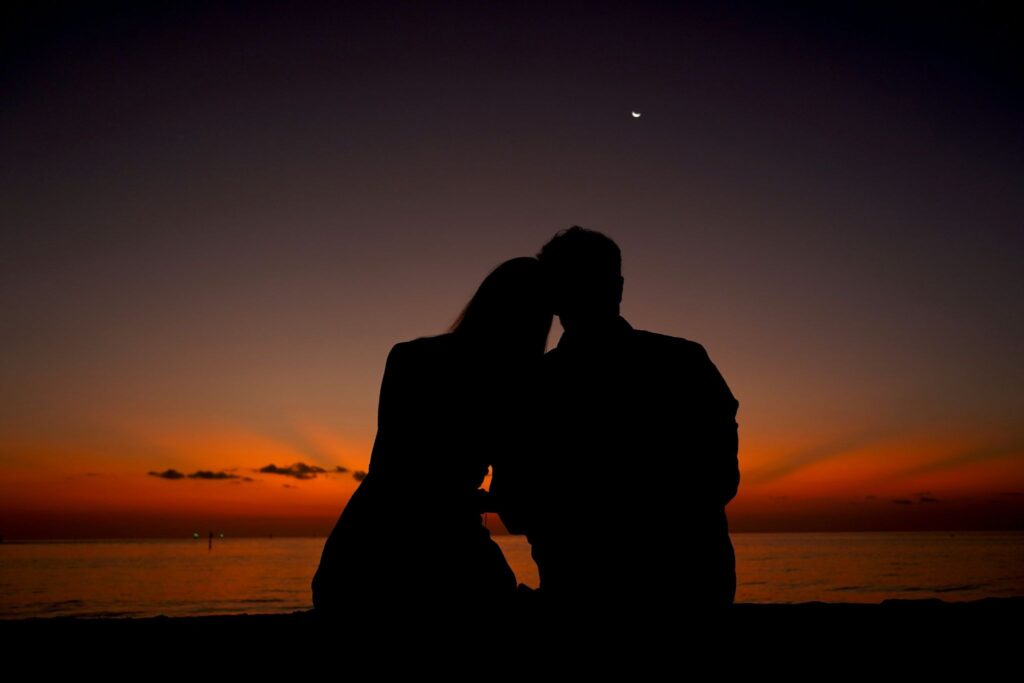
Image of a man and a woman sitting facing the sun setting over the ocean. They are sitting close and leaning against one another.
Image courtesy of Kemal Esensoy on Unsplash

New beginnings

Emma’s mentioned that her timing on the whole “I’m never dating my friends again” discussion was a bit wonky, but I’m glad she brought it up. I’m not willing to mess this up, hence my asking Emma to be my girlfriend the day she was due to travel back home. I’m done chasing loose ends. I’m done dithering.

I’ve never truly loved someone before. Not like this.

We’ve talked at length since about whether we should have gotten together earlier. Neither of us see it. The foundation we’ve built gave rise to new angles and perspectives – not so much a revelation as a new chapter. The start of a fresh page. Everything has fallen into place for us because of this timing, and I don’t think we’d have it any other way.

So have patience. Sometimes crushes can be mere infatuations. They can lead you into meaningless scenarios. Don’t get caught in the trap of feeling that love has to be explosive or dramatic as we see in films and TV and stories. Sometimes you play long games, sometimes you play shorter ones. Other times it can feel like both together. But trust me, when you’re slow-dancing to Labi Siffre with the truest extension of your soul, it feels like weaving a cocoon in the fabric of time.

When you find that special someone… you’ll know.

I Can’t Not Use It

How come it’s ”insufferable” but not “unsufferable”? Why is “irregardless” an accepted word? Is it “sneaked in or snuck”? Who actually says “tomato” instead of “tomato” (You know what I mean)?

The root of it all

I’m sure I’m not the only one who read a lot growing up. However, all that exposure to the written language, vocabulary, and different styles of writing didn’t exactly include a dictionary. Believe me, I’ve tried reading it before, and, surprisingly, it wasn’t exactly fruitful. You see, the written word is exactly that: written. If you come across a new word that seems difficult to pronounce, you don’t exactly get to hear what it sounds like unless you ask somebody to help you. And honestly, when you get in the flow of reading, do you really want to stop just to ask?

That all changed when I entered high school.

In my first year, I remember how fascinating it was to learn that much of the English language is borrowed from other countries and that many of the words we know now are based on a dead language — Latin. Latin roots, prefixes, and suffixes particularly drew my interest, and I’ve always chuckled to myself about how I was most interested in English because of Latin.

It was also then I realized that I wanted to pursue a career in English.

Not an English teacher

Now, mind you, I didn’t want to be a teacher; I just wanted to be surrounded by words and books, and I wanted the opportunity to learn more about language. That interest stayed with me all through high school, and I was determined to be an English major.. My favorite one-liner was, “I’m an English major, not a dictionary.” Throughout college, my interest in language continued to grow, and I studied Japanese while learning to teach English as a second oral language. There was also a hot moment when I learned the Korean alphabet (Hangul).

Ironically, I even became a teacher assistant in Japan.

With the help of  my students and the teachers outside the English department, I came to realize that the English language was just a mess.

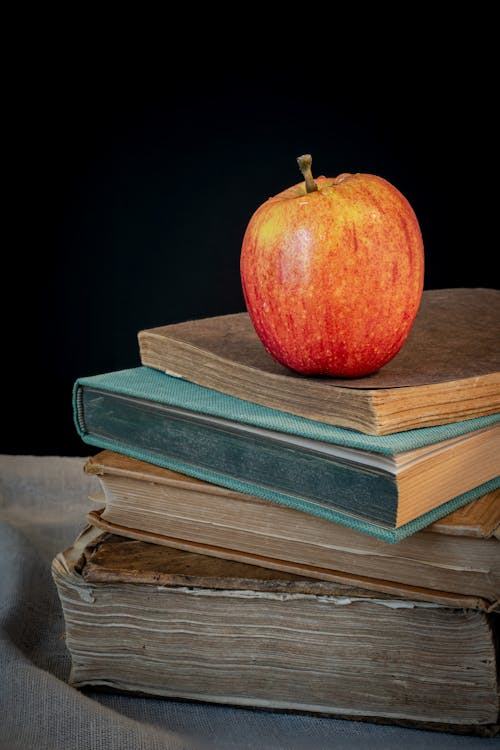
A stack of older-looking books with an apple perched on top.
(Image courtesy of Ylanite Koppens on Pexels)

Which homophone is the correct word to use? What do these idioms mean? How come there’s a specific order for adjectives? Why is it that when you affix a word (like compile), it’s pronounced differently from the original word (like compilation)? Homonyms? Now they’re just plain rude.

Yet, I pursued the language. I studied linguistics. I bought books to better understand grammar.I researched the same words over and over just so I could confidently explain their meaning to somebody who was trying to understand English themselves. To be honest, though, I still don’t quite know how to use adverbs correctly. But Hangul did come in handy when I was trying to show students how to pronounce English words correctly.

A lifetime within three years

Of the hundreds of students I’ve taught over three years, I’d say about 92% didn’t want to learn, whether from me or in general. Maybe about 6% were interested passively, and the last 2% were genuinely interested in a second language. Learning English helped them open up new opportunities, leave their hometown, and understand something outside their routine lives.

There’s one student, a bright young man, who I think about fondly. He took to the lessons – and my dumb games – with actual interest. I was fortunate to have taught him from his first year through his third year. Then, summer vacation rolled around after graduation, and the new semester started. It wasn’t until then that I learned he went to Hawai’i with his family for vacation and was involved in a tragic accident.

A small part of me thought that I helped cultivate his interest in the language, that I contributed just a small part to his confidence in English, and that it was just enough for him and his family to travel abroad. I may have forgotten his name (a terrible flaw I am truly ashamed of), but I can still picture his face perfectly. I know it’s not something I should hold myself accountable for, that it’s unreasonable to blame anyone for what had happened. Instead, I choose to be grateful that I had the chance to be a positive influence in his life.

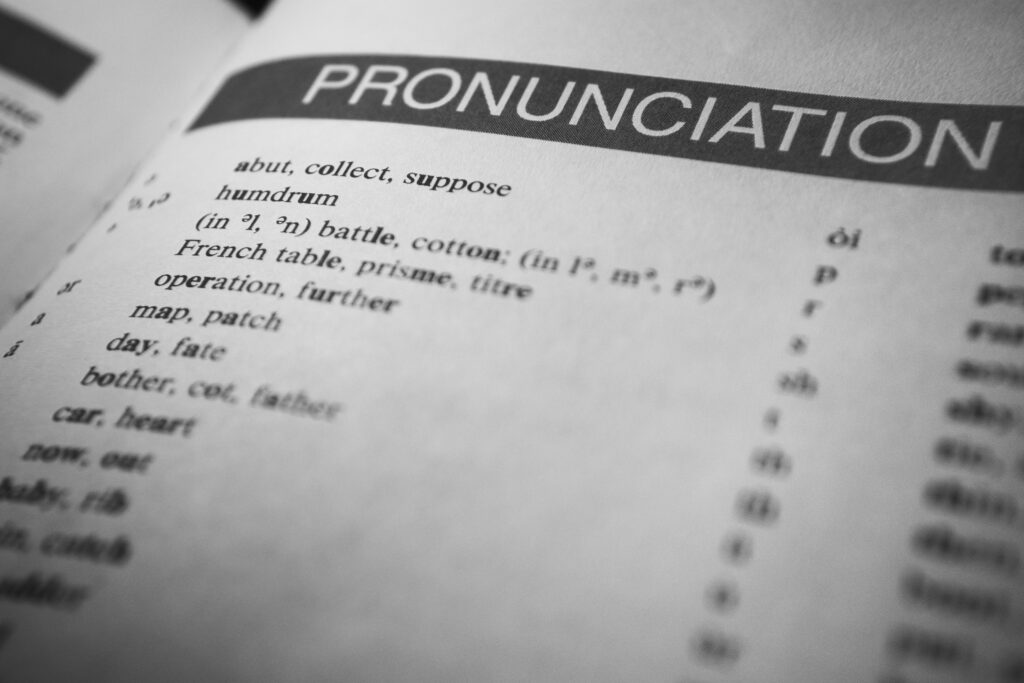
A page from a textbook showing the phonetic notations of a group of words.
(Image courtesy of Nothing Ahead on Pexels)

Me, my professor, and English

Truthfully, English is my second language, but it’s become my primary language. Studying it has broadened my horizons, deepened my appreciation and understanding of it, and allowed me to connect with people who also truly wanted to learn. I’d like to thank my grammar professor in college, who helped spark that motivation in me to better understand English. She fled North Korea, taught herself English, and is now teaching native English speakers how to better understand and dissect the innate understanding we have of the language – such as why we know to say “jump into the pool” and not “jump onto the pool.”

I still love to learn, and I’m best working behind the scenes rather than in front of students, teaching. That spark I felt nearly two decades ago still remains to this day.

And for the record, I personally say ‘toe-mae-toe.’

Love and Learning in Oslo

Sagene, maybe midnight. Maybe just before. It’s late. I had my usual spot at the local park, up on the rise where a couple of benches sit, with a view to the whole place. It’s January and it is cold — really cold — but I don’t mind it. 

In Norway, they know how to bundle up. Frankly, living two entirely separate existences — from the bright, warmer months to the dark, colder ones — is a necessity. Norwegian winter isn’t a joke, it’s real. You get endless false summits of the snow finally melting, only for it to fall again and again and again.

I was triple-layered all over, beanie on my head and a flask of piping hot coffee in hand as I sat out to smoke. I was escaping, in truth. There was always a part of me in that relationship that just needed…air. I just had to, wanted to. Then of course, I’d feel mildly guilty that I’d pulled such an escape hatch and left my girlfriend back in the flat.

I took my seat on the bench, my increasingly customary spot. I looked up to see the Big Dipper faintly flickering in the sky above. This was my little refuge. Yet that led to a significant question… why exactly did I even need a refuge?

***

I was in Norway, following the girl I loved. She and I had been together some six years when back home came calling for her and, on open invite, I followed.

We both left London feeling we’d found the person we would gladly spend the rest of our lives with. It was magical. Leaving the only country I’d ever known in the name of romance was exhilarating. (It’s also one of the coolest ways to sign off from a job).

We spent six months living at her folks’ place. Amazing people, brilliant hosts, with a pristine haven of a home. I sat, got fed, and mildly fat when, legally, I couldn’t do anything else. It was around the six month mark when my girlfriend got a job interview in Oslo. We moved to the capital and got a little apartment with a balcony in a beautiful, leafy corner.

It’s rare that reality lands like an anvil, giving that shuddering sweep of blood running cold. Those sideswipes happen, but they aren’t often. Usually, typically, reality unfolds, slowly, carefully, over time. As it has been said in writings more important than this one, “God gives us as much truth as we can handle”.

In retrospect, I was running on myths: Myths and half truths — all well meant, I should caveat. It would dawn on me in the weeks ahead that I’d be taking advice about living in Norway from someone who hadn’t actually done that since school age.

Myth Number 1 – Norway is not that expensive.

We were Londoners. We’d spent the best part of our formative 20’s in the Big Smoke. It’s a major capital, and, like most, it comes at a premium. Even so, my girlfriend was fairly confident that the cost of living would be about the same.

I believe we were about two food shops in when she’d turn to me and said,

 “Norway’s bloody expensive, isn’t it?”

Myth Number 2 – Everyone Speaks English There. You’ll Be Fine

Now this is a slippery one. Mostly because it is true. The vast majority of Osloaites (or, in Norwegian, Osloenser) I met or made friends with had a comfortable and easy grasp of English. Yet how this related to job markets was less than inspiring. The inference that speaking Norwegian wasn’t a necessity for employment turned out not to be true. My preceding months of Duolingo were far from enough to get by…

Myth Number 3 – Work Part Time, Do Your Writing

The only doubt I had in moving was that I’d be making major changes in my life I wasn’t ready for. I was confident in the relationship, in my partner, and in the move to a part of the world that gave her family a support network. We spoke before moving and she gracefully, beautifully, gave me the green light: do it, go for it, live your dream. Work some 25-30 hours a week and spend the rest of your time doing what you love.

However, with the above two items being so, this was simply impossible.

All this unfolded over the opening weeks and into months of living in Norway. Reality can never live up to fantasy; that’s why we’re generally dissuaded from it. My partner got a job that was really well paying, and she was good for it. Honestly, she had an incredible mind, a remarkably intelligent person.

She went on a coding course while we were living at her folks’. She got head-hunted by one of the biggest publishers in the country, for a well-paid and profoundly contemporary job. The flipside of the coin was: it swallowed her whole.

She was consumed by it. She stressed about it approaching work. She stressed about it during work, and she stressed about it after work. It became the only topic of conversation when she was back. Weekends were increasingly matters of recuperation, when she was regularly beleaguered with migraines.

I couldn’t help but feel gut-punched at the irony. She was so deserving of this job. This was an immensely capable and smart individual. London’s job market had been indifferent, when not cruel, to her. Finally, she got a chunk of employment that actually measured up to her value. Yet this was the first time a valuable and well paying role had come her way in our time together. I was so happy for her getting the post, but once again, reality clashed with fantasy and visions. I’d never considered that a job which actually made the most of that brilliant brain would leave her depleted and despondent.

I don’t know when exactly the turn happened —when I started to feel the pressure cooker — but I remember a firm sense that… I’d lost my place in the relationship. I began to feel invisible and powerless. My freelancing engagements were hardly enough to line pockets, and Norway is expensive. Her mind was elsewhere, with no conversation but work. I felt like a passenger. As for my love… that was the burn, I still loved her, but love is a raw and beautiful force with many different faces.

She felt like home. I cared for her deeply. I felt an overwhelming sense of responsibility and care for her happiness. I was a best friend, a father figure, a flatmate, and definitely a source of comfort. But… lover, romantic partner? Something got lost on the flight from Heathrow to Oslo. Something altered as the reality of living in Norway unfolded. She was deeply committed to me, and I’d drawn a line in the sand by moving over, but something was gone.

Seven years in, was this normal? How does one tell? Who does one ask? What makes you know?

***

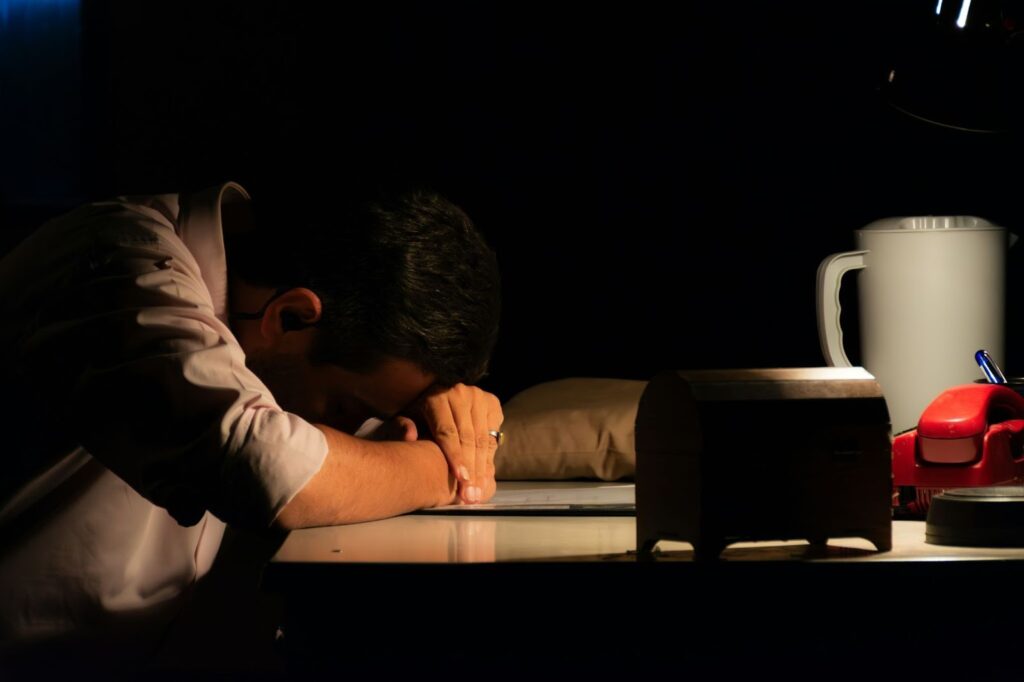
Image of a man at a table, his head down on his crossed arms in front of him. A single light illuminates his body and the objects on the table.
Image courtesy of Human Bahluli on Unsplash

Sagene, gone ten pm, maybe midnight. It’s cold out–or is it? It could be spring, summer. I spent so much time finding my little spot up at the park it’s something of a blur. I do remember kissing my girlfriend before heading to the park, clear as day. I remember her face; I remember coming away from the kiss with it… just not feeling right.

The spot was quiet, just the occasional dog walker passing through. Sitting on the bench, I felt full– something in me not sitting right. Maybe it was the kiss, the relationship.. It was this dark, uncomfortable presence in my psyche that refused to be ignored. My mind swam as memories plumed.

Cabin trips in the spring and summer. Seven beautiful Christmases worthy of oil paintings. A family taking me in as one of their own. Hard times in London. Good times in London. The uncomfortable ups and downs of being a twenty-something. The wonderful ups and downs of being twenty-something lovers. Friends back home. Embarrassments. Arguments. Uproarious laughter. Binge-watching series. Holidays and trips together. Tender holding of one another. Comforting each other through losses. The opening joy of starting up in Oslo together. Her cute face…

I stood up from the bench, my cup ready to spill. I stepped forward just a matter of steps, looking out to the horizon, just a few trees and high-rises filling a spread of skyline. To no one, to anyone, the words left my lips with a throat as tight as vice:

“This isn’t the one…”

And I cried and I cried and I cried. I bawled like an infant, alone in relative darkness. I’d moved everything I had and left everything behind for this. I was all in. I’d rolled the dice and I got snake eyes.

***

What followed was a year of trying. I tried the good-cop way and we kept the groove of the relationship. I tried the bad-cop way and disturbed the groove of the relationship, but not for the better. Sometime in June the following year, I broke the relationship off. Despite the well of tears that followed for us both in the weeks and months ahead, it would increasingly dawn on us that it was the right decision.

I don’t know if my eureka moment was realizing the relationship had to end, or the conviction that came about myself having made the leap. By the time I had to leave Norway, I’d entirely placed my happiness and self-worth in someone else.

I’d taken the archaic maxim ‘happy wife, happy life’ to an extremis that just abandoned me. There were parasitic elements that I couldn’t reconcile or take pride in: your country, you got the good job, you take the reins now.

I’d stopped treating love with love. Some ghastly dependency arrived with an utter sense of resentment; that the success of the move for her hadn’t instantly equated to a glowing happiness. Moving countries for your love is certainly a man’s choice, and I’d turned out a scared boy.

Returning to the UK brought a determination. I couldn’t look to or depend on externals; I needed to look at me. I wanted responsibility and change, with a full understanding that they are harbingers of stress and challenge. I wanted to be the architect and accountable party for my own happiness and never lose sight of that.

I desired reality, even if it meant the frightening prospect of staring it down the barrel. I wanted to be someone who could take that. I set out to do the work of becoming the guy I was meant to be, not someone I thought I was… running on myths out of someone else’s mouth and covert contracts about others.

***

Creative destruction is a term for economics but I feel it can be more broadly applied. Sometimes the antiseptic stings; we have to make decisions that are painful at the time for better results down the line. That’s certainly turned out to be true. I’m very much becoming who I was meant to be with a steeper degree of self-worth, insight and responsibility than I’d ever had in my life. I’m also pursuing what I love more diligently and consistently than I’ve ever done.

As for the villainous matter of being the breaker in the break-up…

When I left my partner, she had a beautiful, full furnished apartment and a well-paying job in the capital of her country. She was just a train ride away from family and had a blooming social life in the city. This hasn’t changed.

There’s a saying that “sometimes, in order to find love, we must hurt the ones we love”.

We’re both for the better for it, with a deeper understanding of love and ourselves that staying together could never have fulfilled. She’s free now and so am I, living the lives we want to.

That’s the reality– no myths required.

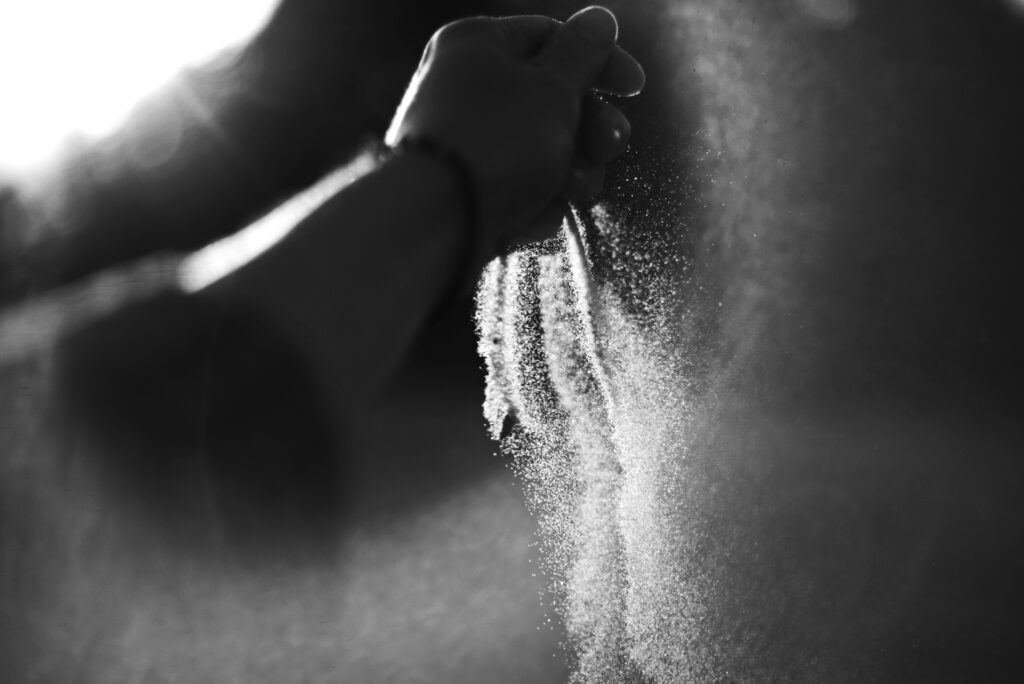
Image of a person’s clutched hand. Sand falls out of their hand as they loosen their grip.
Image courtesy of Liana S on Unsplash

So This Is You Apologizing?

“Human beings don’t like accepting that they are at fault; instead, they would rather blame others.” This statement just sounded to me like any other psychological way to prove theories until I found myself deep into this trap. I came to realize that “carrying your cross” is an actual thing and not just any other quote. Doubtless, there is a reason for this. But why is it so difficult to own a fault and  apologize instead of sugarcoating the mistake with endless deflections. 

If I did anything wrong — If

I get goosebumps when I recall the day I first encountered the phrase “anything wrong” used in place of a genuine apology. I was coming home from work after a long day in the office, just one of those days where you wished the time would move faster so at least you can go home and decompress. Of course, the evening setting sun was just the kind of therapy I needed as it hit me. Just as I was about to cross the street that led to my apartment, I got a phone call from a friend asking if we would meet up for a cup of coffee. I agreed quickly, as it had become a relaxing routine to go out for coffee together while discussing our lives and ways forward. Moreover, talking to someone would still help me relax.

That evening, though, was not like the usual. That casual comment hit me so hard that it left me both stunned and boiling with anger and disappointment. He had said, almost as an afterthought, “If I did anything wrong, then I’m sorry.” 

This was supposedly him giving an apology to me for a sin he had committed against me. Immediately, it dawned on me that under that conditional remark lay an avoidance of true responsibility. I felt very disrespected and demeaned. This hit me hard. For years I had boasted how I always owned up to my mistakes and flaws, and now I was falling victim to my insecurity. But was I right to get annoyed or displeased?

Yet when confronted with my flaws, I too sometimes found myself peppering my language with qualifiers. I began to examine my past and noticed patterns where I would say, “If I did something wrong” rather than a plain, “I’m sorry.” These words, though soothing to my ego, are deep down loaded with ambiguity, disguising accountability behind a curtain of uncertainty. They allowed me to retreat from taking full responsibility, leaving the hurt unaddressed and the issue unresolved. If they existed at all. 

However, the turning point came on one of the fine days when I was scrolling through Facebook, when a post came up that I felt was addressing me. Memories of past crises and unspoken apologies began flooding my mind as though they were fresh. I remembered an incident at work when I had unintentionally taken credit for a colleague’s idea. To make matters worse, instead of admitting my mistake totally, I offered a conditional apology during a meeting, saying, “If I did anything wrong, I apologize.” 

Do not crucify me! At the time, I thought this was a very diplomatic way to ease tension while maintaining my aura, but the resentment in my colleagues’ eyes was a clear indication that I just added more salt to the wound. It was clear that my half-hearted words were nowhere close to owning my mistake. I began to see that true accountability meant embracing the full weight of my actions without diminishing them with uncertainty. 

Who’s responsible?

Taking responsibility is not simply about saying a few words — it’s a commitment to self-reflection and growth. I soon realized that a genuine apology requires clarity. It demands that you acknowledge the specific harm you’ve caused and lay the blame squarely on your actions rather than sheltering behind “if” statements. There is no room for empty excuses if you truly care about the people you hurt. This realization came gradually, through multiple conversations, quiet evenings of self-sanitization, and the honesty of a few trusted friends who assisted me by pointing out where my apologies had fallen short.

I decided to set out on a journey—not just to mend broken relationships, but also to mend the parts of myself that had become accustomed to self-protection. I started by revisiting every incident where I had used phrases like “if I did anything wrong.” One memory was particularly touching. I had been in a heated argument with a sibling over a long-overlooked family issue. In the aftermath, I used that conditional apology, hoping that it would mend the rift. Instead, my sibling felt that I had not acknowledged the depth of the hurt I had caused. The realization hit me: the conditional “if” was a loophole, a word shield that allowed the severity of my actions to be insignificant in my own eyes. I learned that true remorse requires vulnerability and complete ownership of one’s mistake.

Taking responsibility also meant facing the consequences of my actions. In my relationships and in my professional life, I discovered that accountability was often the first step to rebuilding trust. For instance, I led a project in which certain decisions resulted in unexpected losses. Rather than clarifying my role and admitting my error, I tossed around a conditional apology that left my team questioning my commitment. The resulting project delays and bruised egos eventually forced me to confront a hard truth: a half-apology was like a bandage on a deep wound — it might cover the surface, but it did nothing to help the healing. I learned that effective communication and complete admission of missteps not only repair relationships but also foster an environment of trust and learning.

The journey to becoming someone who truly takes responsibility was far from simple. It required a daily commitment to honesty, even when that honesty is uncomfortable. I began to practice writing down my thoughts at the end of each day, reflecting on moments when I might have hurt others. Journaling became my silent confidant, a place where I could confront my mistakes without judgment. 

Through this process, I started replacing the conditional if I did anything wrong with clear and definitive statements. I would write, “I realize that I made you feel terrible, and why, so I am deeply sorry for the injustice I caused.” Over time, this not only helped mend relationships but also allowed me to grow as an individual. I found that those I hurt respected my willingness to admit my faults, even if it left me feeling exposed.

Reflecting on these experiences now, I see that the phrase “if I did anything wrong” is a poor substitute for a meaningful apology. It is a disclaimer that shields one from full responsibility rather than offering heartfelt remorse. True accountability demands that we shed our defensive language and embrace the reality of our actions. By doing so, we not only mend what was broken but also pave the way for a more honest, reflective, and compassionate way of living. 

Let’s be clear

Today, I strive to approach every relationship with clarity and integrity. I remind myself that owning up to mistakes is not a sign of weakness but rather a reaffirmation of my commitment to  improving as a person. Every genuine apology is a chance to build bridges, to show that I value the feelings of those around me over my own need to always be right. In embracing my missteps, I found that I was also embracing my connection to myself. To forgive myself. 

In a world where it’s all too easy to hide behind conditional statements, I’ve learned that the courage to say, “I am sorry that I did this thing” unburdens my soul and lays the foundation for a more empathetic future where accountability and sincerity are held sacred. 

Because if I am not sure what it was that I did wrong, how will I avoid it next time? This journey is ongoing, a path of continuous learning that I hope will inspire others to examine their words, to take full responsibility for their actions. 

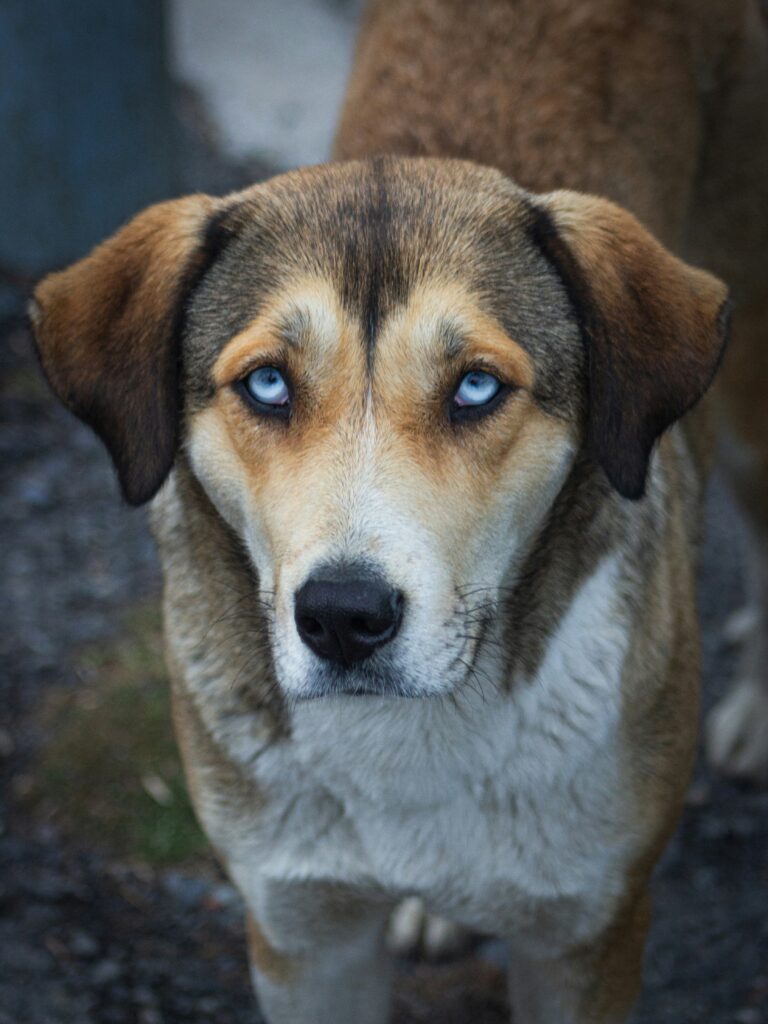
Dog with the saddest face saying “Oops, sorry!” with unturned eyes and downturned ears.
(Image courtesy of Ilya Melnichenko via Unsplash)

Mother Goose and Uncle Charles Perrault

Writer’s Note: Charles Perrault’s stories contain mature themes, specifically: violence against women and girls, sexual violence, xenophobia, cannibalism, and negative depictions of poverty. 

If you wish to read his fables, discretion is advised. Many of the themes were glorified during Perrault’s lifetime, but are outdated now and are controversial in a modern context.
I do not take inspiration from these controversial themes.

Hud and Grampy

From the time that I learned how to read, I gravitated towards literature and the arts. At first, it was pictures and touch-and-feel books. Later, I read chapters and The Rainbow Magic series. Post Transitional-1st when my fine motor skills began to improve, forming letters and writing sentences became easier. After school, my maternal grandparents’ house was the place where my creativity truly shined. I spent several hours there every afternoon during the week when my parents were working. Stacks of computer paper, pencils, and a stapler were tools that I regularly used. Before I learned the basics of navigating a computer, I assembled my short stories by hand.

My creative process started with the details, building the story arc without even realizing it. Next, I added the visual elements, imagery that featured characters from my own imagination. Not only did I recognize that language was important, but I knew that readability was fundamental. One side of my story was in English, and the other was in Spanish that I inaccurately gleaned from Google Translate. My grandparents fostered my interests, allowing me to have mock-storytime sessions in their living room. It didn’t matter how much it made sense, it only mattered that I tried. They resisted providing negative feedback, only giving me constructive criticism when necessary. Once I learned how to draft the pages on a computer, my grandfather simply reminded me to not use too much computer paper and printer ink — with my literary collection. 

Grandmother Hud loved to read, and I enjoyed asking her questions about the dusty books on the bookshelf (including outdated encyclopedias.)  I loved our frequent trips to the library during the summer when I had more time with my grandparents. My favorite genre to check out was fiction, especially the American Girls collection series by Valerie Tripp & Connie Rose Porter. 

Outside of the library, my grandparents’ shelf mesmerized me with all of the colors, artwork, genres, and variety of authors. However, some items on the shelves were untouchable, fragile; very personal to my grandfather. Sometimes, I tried to quickly glance at a blue book with a yellow typeface: Perrault’s Fairy Tales, with thirty-four full-page illustrations by Gustave Doré

For the longest period of my life, I believed that my storytelling came from my grandfather, Grampy. He was a storyteller in his own right, usually repeating tales that he had picked up during his lifetime. He adored sharing how people in the past used to tell tales by word-of-mouth before it was typical to write stories down. His words enticed me, and he knew exactly how to draw readers in.

I was a naturally curious child who wondered about our family history, about the origin of things. Where did the name Perrault come from? Who was the first person to have the namesake? Soon, this would be revealed to me. 

When I was seven or eight, Grampy noticed how I attempted to flip through his prized possession when I thought he wasn’t looking. He grabbed it off of the shelf, while telling me the significance of it. Grampy described as if it was a trivia show,  “See this book? Did you know that you’re related to Charles Perrault, the author of this? My dad was a Perrault.” I stared at him with amazement, thinking of how lucky I was to be related to someone like that.  

An adult creating a family tree from painted fingerprints and the outline of tree branches.
(Image courtesy of Joshua Manjgo via Unsplash.)

He continued, “This book has been passed down in our family for generations. It was given to me when I was your age, and it’s my turn to pass it down to you.” It felt like a magical fairytale, unfathomable to my undeveloped mind. Grampy embellished some of it and fabricated the history of the supposed family heirloom, which in reality was published in 1969. I think he wanted me to have an even greater purpose for writing, because he believed in me when I often stood out to others.

After this a-ha moment, I reflected on what it meant for my future. In my early childhood, I constantly switched my potential career goals, going from a veterinarian, a pop star, a ballerina, a nail technician, and an author. I believe that the creative industry is the best field, based on my skills, interests, and literal heritage. 

Charles Perrault was a well-known author who began his career (as an advisor and architect) through serving on the Acadèmie Française, and later, helping Louis XIV design part of the Palace of Versailles.  In the 1690s, he continued writing, and released his book, “Tales and Stories of the Past With Morals.” 

A version of Charles Perrault’s fairytales:

A 1760 French-to-English translation of a nursery rhyme, “Rock-a-by Baby” from Perrault’s written work, Contes de ma mère I’Oye: Mother Goose Tales. Above the lyrics is an image of a mother rocking her baby in a bassinet.
(Image courtesy of Francis Power & Charles Perrault via Wikipedia Commons)

Transcription of “Hush-a-by baby”

Hush-a-by baby On the tree top,
When the wind blows  the cradle will rock;
When the bough breaks the cradle will fall,
Down tumbles baby, Cradle and all.

This may serve as a warning to the proud and ambitious, who climb so high that they generally fall at last. 

He is best known for: “The Tales of Mother Goose,” the modern version of “Cinderella,” “Sleeping Beauty,” “Puss in Boots,” “Little Red Riding Hood,” “Bluebeard,” “Little Tom Thumb.” 

A version of Charles Perrault’s fairytales

An 1883 version of La Cenicienta ó La Chinela de Cristal, or Cinderella and the Glass Slipper. The illustration shows a young woman sitting on a bench with her arms on her lap.
(Image courtesy of Julian Bastinos and Charles Perrault via Google Books.)

How could I be related to Charles and not find out until now? I pondered on all of life’s possibilities. Everything suddenly made sense: how my brain was wired, how language, reading, and writing came easy to me; why I felt a deep desire to create literature. Writing is in my blood. In my veins, it’s in my DNA. My creativity originates from a man I never met. We are generations apart, yet we share the same passion and admiration.

DNA double helix strands on a black background.
(Image courtesy of Warren Umoh via Unsplash.)

I told myself that day that when I grew up, I wanted to become an author like Charles Perrault. I would work towards becoming famous, a household name. Whenever I feel like my chance of getting into the industry is dwindling away, I remind myself of what keeps me going. What makes me believe in myself. That answer is always the revelation that I had on what began as an ordinary afternoon. 

My life changed that day, and it was all I could think about for the rest of the week. Last year in 2025, I started the painstaking genealogical process of figuring out exactly how we are related. Charles is my tenth great-granduncle. Not only do I trace my love for writing back to him, but the commonalities and family history are connected through physical traits, such as how Grampy strongly resembled Charles Perrault.

A 1697 photo of Charles Perrault  in his late 60s, taken by Gérard Edelinck. His right hand is on top of a book.
(Image courtesy of Academie Francaise via Wikimedia Commons.)
A 56-year-old Grampy holding his infant granddaughter.
(Image courtesy of the author.)

When I look at myself in the mirror, I don’t notice any major similarities between Charles, and Grampy,  and me. The only physical trait that we share is that one side of my nose appears higher and slightly elongated from the right side profile, possibly resembling his nasal bridge. 

Genetics can be tricky, especially when my maternal and paternal genetics frequently clash. I do not resemble Charles, but we are relatives. 

Even though I was a child when I had my first eureka moment, it sits with me, and courses through my body. Time has passed and Hud and Grampy are no longer living, but we will always be intertwined. I will permanently be related to Charles Perrault and my grandparents, no matter what. It’s a constant bond that will never fade away.

The Timestamp That Changed the Way I Practice Journalism

On November 5th, 2021, Brazil was gripped by breaking news. 

A small aircraft had crashed in the countryside of Minas Gerais. On board was Marília Mendonça, one of the country’s most beloved singers — a young artist whose voice had become the soundtrack of heartbreak for millions. Within minutes, headlines multiplied, major outlets began reporting that she had survived, citing information from her press office. Relief spread quickly across social media and television broadcasts.

In the newsroom, I did what journalists are trained to do in moments of confusion: I went back to the primary source. The official note from the Fire Department included a precise timestamp for the crash. I read it once. I read it again. And something didn’t fit.

I compared it with the time the statement was released and considered the geography of the region. The reported time of the crash and the geography of the region made it nearly impossible for any official medical confirmation to have happened that quickly. There simply hadn’t been enough time.

The location was remote. Rescue operations would have required travel, on-site assessment, and official confirmation procedures.

It wasn’t a dramatic realization. It was quiet, mathematical. 

The timeline did not add up. There simply had not been enough time for anyone to responsibly confirm survival. There was no way the information circulating could already be confirmed. Based on logistics, distance, and the sequence of events, the optimistic reports circulating at that moment were, at best, premature.

I faced an uncomfortable dilemma. Like millions of Brazilians, I was not emotionally detached from the story. Marília’s music had been part of my daily life. I was also a fan. Her songs had played in my headphones, at parties, during long nights of writing. That day, I wasn’t just an editor. I was someone refreshing my phone like everyone else, hoping the earlier reports were true. I wanted the early reports to be true. But journalism is not guided by desire; it is guided by verification. Journalism has no space for hope.

And in that small gap between minutes, I understood something before anyone said it out loud. I didn’t feel triumphant. I felt cold. 

 If I was right, the country would move from relief to mourning.

Instead of repeating what other outlets were publishing, I chose to write a cautious article questioning the timeline and emphasizing the lack of confirmed information from emergency authorities. The piece did not speculate. It did not declare an outcome. It simply highlighted the inconsistencies between the official timestamps and the claims being disseminated. I knew I would be the only one swimming against the current, to push against this national hope. And still, uncomfortable as it was, I knew it was necessary.

Shortly afterward, the confirmation came: she had not survived.

The article became the most accessed in the history of our publication, surpassing 1.2 million unique views in less than three hours. It marked a significant growth moment for the site and consolidated our credibility in high-sensitivity coverage. In business terms, it was a turning point.

But my personal turning point had occurred earlier while examining that timestamp. That was the moment I understood, with unsettling clarity, what journalism really asks of you. It asks you to doubt relief. To slow down when the world accelerates. To risk being the cautious voice in a room eager for good news. And sometimes, it asks you to be right in ways you wish you weren’t.

Some believe professional maturity in journalism is about speed, sharp analysis, and competitive positioning. That afternoon clarified something more fundamental: responsibility often means resisting collective momentum. It also taught me that professional instinct and personal grief can coexist in the same body. I wrote through a lump in my throat. I updated headlines while processing my own sadness.

In breaking news environments, especially during emotionally charged events, the pressure to publish quickly can overshadow the discipline of verification. The easy choice would have been to replicate what larger outlets were reporting. The harder choice was to pause, analyze the data, and risk being temporarily out of sync with the national narrative.

Looking back, that was my Eureka moment. Not the confirmation itself, and not the record-breaking traffic, but the quiet realization that accuracy sometimes requires standing apart from the crowd — even when the crowd includes respected newsrooms.

That day permanently reshaped how I approach crisis coverage. Speed matters. Reach matters. But neither outweighs the ethical obligation to interrogate information, especially when hope is involved. Journalism is about being right for the right reasons — even when being right carries the weight of grief.

I have covered many stories since. None have carried that same quiet, irreversible click.

A timestamp. A calculation. A country holding its breath.

And the moment I knew.

Image of empty airplane seats in greyscale.
Image courtesy of Alejandro Anzola on Unsplash