Offboarding

Jasmine’s heart was working a rhythm. It wasn’t quite pounding, but she could feel the flush in her face, the warmth flooding her body. It was all so cool in her mind’s eye. The delivery of the information, the breakdown of the facts, her clinical assessment of matters, all coming off like a Swiss watch. Her rucksack sat up against the table leg to her left. She found herself adjusting its position three times before the HR manager arrived. What exactly she was adjusting she couldn’t say.

Jasmine was keenly aware of her presence and perception in the workplace: quiet, in the corner, coder, unnoticeable. She wasn’t even a coder but a junior developer. As a techie in a department of a big bank, she accepted and understood her furniture-level importance to the grand operation she found herself in. She liked the job. It didn’t set her heart on fire, but the scale of it, the money and the prestige of working for an internationally recognized bank wasn’t something she took lightly. Looking round the glossy, clean off-white interview room, a bubble of anxiety rose within her.

Her mum’s face came to mind. Mum, prouder than proud the day she told her she got this job. Rarely one to openly express a beaming warmth and celebration on Jasmine’s success, she was clearly quite chuffed with this one. It was the name, it was the status of the bank. It was being able to tell her friends at the hairdresser “My daughter works for…” Yet this was her exit interview. Just some 8 months in. She didn’t really have a story to tell her Mum. She doubted she’d understand. Neither did she have a cogent plan of what would come next. Jasmine sucked in her cheeks and pursed her lips. What was just moments away scared her.

The doubt was porous. Forget being hot and uncomfortable, she felt foolish. Had she watched too many movies? This was the right thing to do… but was it the right decision for her? Jasmine looked up at the analogue clock on the wall ahead, just a minute till the appointment, when she heard a middle-aged brogue on the other side of the door. A dull clink signaled the lowering of the door handle. Malcolm Graves entered.

***

It was a breezy work day for Malcolm, sans kerfuffle or boondoggles. The weekend was just round the corner, and he had his weekly squash game planned for 7 p.m. Margaret had booked a trip to the Lake District for the weekend, and he’d merrily scheduled annual leave for the second half of Friday and the whole of Monday. Coffee in hand and paperwork under his arm, Malcolm was enjoying the pleasant frequency of not feeling too high or too low; he remained somewhere in the middle, trouble free.

The HR department had been gifted a lighter load in recent months. There were the usual unpleasant incidents involving abusive customers from the ground floors but nothing out of the ordinary. The email inbox was not inundated, and the implementation (and creation) of new policy had slowed compared to the heady days of some 5-6 years ago. Malcolm, in truth, had never met Jasmine. He had the name on file but didn’t recall it upon being assigned the exit interview. When he looked at the job description, he couldn’t tell you exactly what Jasmine did and well, with her being a techie, he entered the room with no qualms.

“Jasmine,” Malcolm briskly stated on entrance.

“Hel—“

In a flurry of nerves, Jasmine nearly tipped the interview table upon standing to greet him.

“Oh, careful there. That desperate to leave us, are you?” Malcolm gently ribbed, reaching a hand out to shake Jasmine’s.

Jasmine let out a nervous chuckle before gripping Malcolm’s hand, only making the briefest of eye contact. Malcolm could feel the anxiety radiating off of Jasmine, and he had to resist the impulse to wipe his own hand down; Jasmine’s was wet with sweat.

“Dear God,” he heard his inner monologue proclaim.

“These IT guys really do struggle with human interaction.”

He maintained his warm, off-handed, yet smiley demeanor. He guessed Jasmine was, at most, in her early 30s. Large glassy eyes were exaggerated in rimless glasses, and she was soft-voiced and quite clearly nervous. Malcolm was endeared at the thought of this young woman being deeply engrossed by a small, flickering laptop on a desk in front of her somewhere. Once they were both seated, Malcolm leapt into the standard procedural rhythm.

“Name?”

“Jasmine Thompson.”

“Position?”

“Junior Developer.”

“Department?”

“IT & Digital.”

“Manager?”

“Sharon Coates.”

“Start date?”

“It was err… I think, yeah, um, February 17th.”

“And leave date… is… today.” Malcolm reeled off mechanically, as he filled in the form. He looked up at Jasmine. Her face was beginning to glisten and seemed stuck in uneasy blankness.

“So Jasmine, would you like to tell me what your reasons for leaving are?” Malcolm asked, attempting the friendliest tone he could muster.

Jasmine looked down to her left and didn’t answer. Malcolm sat in silence for all of 10 seconds before it became untenable. He implored as delicately as possible.

“Look. Jasmine. If there’s something you feel HR ought to know, then now is the time to say something.”

Jasmine heaved in a large breath and gave Malcolm a brief pocket of eye contact before returning to looking at the floor. Malcolm hadn’t encountered this kind of shutdown before; he was beginning to feel an uneasy sense of gravity. He probed further, conducting his voice in a near whisper,

“… if this has anything to do with why you’re leaving, it is important that we know.”

Jasmine gave an uneasy look. She then reluctantly reached into her rucksack and pulled out a beige folder of printouts. She put them on the table silently. Malcolm glanced at the folder, then at Jasmine before picking it up to examine. Inside, he saw a log of some sort, a spreadsheet.

“Can you help me out here Jasmine? What am I looking at? Outside of what looks like some sizable transactions…”

“It’s um, it’s, from a system I’ve been working on in my pipeline.”

“… go on.”

“This is a log of the cache for AML.”

“In plain English, please, Jasmine.”

“On the left are the client numbers from the identification portal. The middle is the transaction names, and then the dates, then the transaction type, sums.”

“Right.”

“Then the column on the far right is whether transactions have been flagged.”

“Flagged? In regards to anti-money laundering?”

Jasmine nodded and leaned forward.

“Turn to page 12 and after.”

Malcolm did so. He scanned it up and down, then the next page, then the next and the one after. Jasmine cleared her throat and stated,

“It’s the same clients, same transactions, same types, but they’re no longer getting flagged.”

Malcolm sat back and studied the papers, line by line, taking his time. He glanced up at Jasmine. In return, Jasmine looked everywhere but at Malcolm. She took a deep gulp of air and told Malcolm the truth,

“That warning system is mine, under my access, exclusively; I’m the only person in tech who could remove or alter a transaction’s flagged status.”

“And you didn’t do this?” Malcolm asked unblinking.

Jasmine shook her head. The burst of silence between them was heavy. Malcolm continued to look down at the paper.

“… then… who could?”

Jasmine’s eyes held Malcolm’s. She raised her right hand from the table and from chest height made a gesture pointing up.

Malcolm looked at the paper again. He found himself in the very well of discomfort Jasmine was stewing in. Malcolm paused. He skimmed through the last pages once more. He looked at the sums and how many. These were huge amounts of money.

“Jasmine, how much of this have you—“

A dull thud hit the table, rupturing the stilted atmosphere. A huge pile of folders lay between them, spilling across the table, covering its entire surface. Jasmine zipped up her rucksack. Her voice shaking, eyes wide, she pleaded,

“You can’t tell anyone this came from me. Please– I just wanna get out of here.”

Recidivist Phantoms

It was some 18 months into the AI overhaul, and a pattern began to emerge.

It started with just instances, here or there. There was no great wave. There were just punctuated happenings, miles apart, entirely without relation. Though, over enough time, droplets made up an ocean.

Prison releases in any iteration of society had always been a complicated matter. The statistics were seldom positive on the side of rehabilitation. Worldwide, recidivism was a reality – between 18% and 55% of released prisoners could return within two years. Even in a day and age where western penal systems found themselves creaking with overpopulation, there was no immediate remedy for the complications of life after release.

Irrespective of their sentences, fundamental issues of housing and having any kind of reliable support or income stood in the way for a significant proportion of released individuals. That’s not to say many couldn’t go on to form a stable life, but this was, of course, entirely conditional. Public support was high for businesses hiring ex-offenders, but promising outcomes remained low. Those who could rejoin the workforce knew the barriers they were heading towards.

Barely 15% found themselves back at work within six weeks of release, while a little over 20% received employment after six months. These were the fortunate few, typically with support systems in place for them, and low-wage, low-security work their means of money. Ultimately, the broadest of barriers to life after prison were stigma, mental health complexities and homelessness. Yet, something began to change, to show up, bit by bit, across international probation reports.

***

Jobs were being vacuumed up at light speed as juries became a thing of the past. AI became the replacement for judges and every last piece of visual media’s origins and intentions were entirely unknowable. The most affluent of areas segued into universal basic utopia, while the most deprived areas became enclaves of isolated desperation. The world had become a fully automated riddle. Few roles remained for human beings, yet low-wage, low-security work, deemed befitting of released prisoners, was still available.

Probation officers were also among the remaining jobs, relying on some last human faces to reintegrate other human faces into society upon their release. Curiously, the ex-offenders who managed to gain interviews and employment started to display peculiar trends across their probation reports. Ad-hoc, instantaneous compiling of information meant AI noticed these patterns first. This notice was soon passed on to their human counterparts. Abby Nelson received hers via email the night before her 9:45 am appointment with a Mr. Derek Rogers.

Some months ago, Abby weathered the initial shock of being reposted to the role of a Probation Officer. She did though, with enough experience, acclimate and soon counted herself lucky. Firstly, she had a job. Secondly, she had a job that was solely based around people with acute needs; her role was necessary and desired, and it most certainly should have been carried out by a human being. Abby found herself as much an agony aunt as a useful resource to many of her clients. They were simply trying to get through, consistently trying and applying in hope that a stable job would materialize soon.

She often ruminated on the fact that poor literacy is one the most profound themes of prison populations, and, while it stands as an obstacle to employment prospects, this can also result in remarkably expressive, poetic, and connected speakers. Without the rigidity and constriction of schooled literacy, individuals often found themselves adept as perceptive talkers and listeners. They might not be able to recall the pedantic insides of a peer-reviewed academic textbook, but they could distinguish a lie from the tone of a voice. They knew the threat of manipulation from a pressed syllable. They also recognized a good soul from a bad one, all from the choice of words and their delivery. Abby relied on this fact, and respected it, as she approached any client conversation.

Derek was a success story. Abby had always found him polite and straightforward. His sentence had been four years for, in his own words, “getting up in business that was none of my business.” He didn’t reek of self-loathing or wanton mental health crises as so many releases did. Abby saw his story straight; Derek had fallen for an offer to make quick money in a moment of weakness, and he’d been caught in the act. He accepted his sentence and made no bones about his crime, following a quiet, drama-free sentence: he was released.

Derek’s life story was one of a self-made man, and his life after release continued that motif. Within two months he’d secured a single room flat and began to make a modicum of regular income as a plasterer and plumber. He also kept himself well clear of anything nefarious. With an ex-wife “somewhere out there” and “few friends worth talking to,” Derek was a fifty-something in the process of reintegration and, ultimately, doing incredibly well.

***

Abby and he had been seated for some ten or so minutes before she realized something was off. Derek always sat to face her and was somewhat chatty. He had the slightly grating, chauvinistic habit of calling her “Abby girl.” However, Abby weighed this endearment against every other name prison releases had called her in the past months and decided to recognize its warmth. Today, though, Derek wasn’t chatty. He gazed out and away from Abby and… he looked tired.

“Is everything okay, Derek?” Abby implored, genuinely hoping bad news was not afoot.

Derek shuffled a bit in his chair. He half-muttered under his breath, interrupting himself from responding more than once. He briefly glanced back at Abby and let out a little chuckle before setting himself. His eyes shifted to another corner of the room while he said,

“What is it? This… AI? This, this new world. Photographs, now videos. Vehicles with nobody driving. None of it real. You know, even when you walk down a street full of people – it feels empty. Nobody… talks anymore. Don’t even acknowledge your walking on the same street. It’s quiet but the cars. My last three jobs; I get sent the job on my email, I go to the door, I’m answered by the door bell… I didn’t even see the last three people whose homes I was in. There were no photos on the walls, either. It doesn’t matter where I take a job, it’s the same everywhere I go.”

Derek looked up and out, ruefully, mournfully.

“Is… is… this it? Dead streets. Nobody behind the counter. Talking to a computer. Everything’s a computer program. It feels cold. The whole thing, it’s… it’s… not like people live here anymore. It’s like everybody is scared. Too scared for a greeting. Too scared for even a ‘hello’.”

Derek looked pained. His voice softened. Abby’s throat felt dry.

“A child spat at me.”

His gaze set upon Abby once more. His face stopped moving; his eyes felt hollow. 

“Just a little thing. 5, maybe 7 years old… he – it, didn’t hit me. But… the mother… she moved her kid away from me. Didn’t confront or discipline him. Didn’t make an apology. She grabbed him and moved away… like I was the problem.”

Derek paused.

“That’s not about me. I have no sign on my head. People don’t know I’ve been to prison. They can’t read minds… this is people. People are just scared.”

Derek briefly brought himself back from his thoughts, back to Abby, back to the present. He began with an exhale,

“Abby girl, I may be talking crazy, but… and don’t misunderstand me when I say this… I don’t ever want to… do something stupid again. That’s not what I’m talking about. Don’t misunderstand me. But can you believe me when I say this; I had a dream the other night of being back inside. Do you hear that? This… out here… there’s no society. I can’t believe I’m saying this, but I think something in me wants to go back.”

Abby sat in silence, looking at the glassy wetness filling Derek’s eyes. This was as honest and intimate an exchange as she’d ever had with a released prisoner. Abby didn’t know where to begin.

The email memo she’d received the night before was as if prophecy:

En masse, successfully reintegrating prison releases were longing to be back in prison.

Maggie Mascot

It wasn’t that she was the best; there were smarter workers. There were more articulate speakers, those with more connections, and those more “in.” There were certainly those who’d been at the company longer — but nobody gave more.

She could feel it, she knew it; people wanted her around. They desired her energy and forthrightness. She was wanted on the team and on their side in a proverbial playground scrap. They were always grateful for her input. She was forever cheerily met and greeted. Maggie (“Maggs”) was essential.

She was also the mascot, well, that’s how it could feel. That was the other side of it. She tried to keep her mind clear of such formulations of thought. She didn’t really like thinking about it. How petty it seemed, and, when she really stared at it, ugly.

The thankless tasks of spreadsheets, reports, social and messaging platform accounts; all organized when unasked for. Yet approaching her mid-thirties, Maggie was beginning to feel a discomfort at automatically going the extra mile.

“Still look 24 babes,” was a continual refrain coming her way. Maggie didn’t need telling this — she was quite aware. Like many a woman, superficial evaluation had lost a degree of thrill at the turn of 30. Hearing it from desired parties was always welcome, but the more important matters of status and being paid one’s worth held greater appeal.

She liked her little motor, resigned to the scruffy handbag on wheels it was. Loved a drive, her playlist blaring, charging down the road ahead, feeling unfiltered, unlimited, and… behind?  It was old. It didn’t reflect her. The age, the miles, and condition — this car spoke of settling. Maggie wasn’t ready, had no plans, and didn’t deserve to settle.

Maggie parked up some 20 minutes early. A timekeeping extraordinaire, well, certainly compared to many of the men in her office. She opened the tin of Cavendish & Harvey fruit drops found in her side glove compartment. There was a cherry flavored one left and a little celebratory “Yes” left her in a whisper. She didn’t fancy facing the panel with a Halloween purple or sickly yellow tongue for distraction.

Opening up her printed, bullet-pointed, and line-itemed interview documents, Maggie could hardly focus. It wasn’t so much butterflies, but… disinterest. Muttering the sentences in double time under her breath, she didn’t need this prep: she knew it. She’d known it for the better part of a fortnight. As an actor would say, she was “off-book.”

Her eyes gazed across the car park filled with cars and devoid of people. A brief pocket of dissociation. Her body numb, her mind temporarily blank. When she came to, she could feel a dull edge of disquiet and angst. Maggie had been here before.

The Deputy Regional Manager position opened up four years ago and she’d applied. All the colleagues who knew were rooting for her. She tried to remember if she’d parked in the same spot; it felt like the same spot. At the time, it came down to Maggie and one other, Bill Rutherford; a longtime stalwart of Kenson Logistics.

A near waddling turret of self-appreciation guided by a gift of the gab, Bill was a known voice and face able to make the panel laugh with easy familiarity. Maggie was the good girl, checking every box with a hard dose of earnestness and a light sprinkling of concern for others’ sensibilities. Bill Rutherford got the job. Maggie went back to Gillingham to tell expectant parties she’d fallen short.

Four years ago was rough. Retelling the same story to different people over and over, receiving the same messages of sympathy was… frankly aggravating. She reflected that her approach hadn’t necessarily belied the truth; that communicating her capacity wasn’t the best way to advertise it. Perhaps checking boxes wasn’t the way.

Maggie felt she’d lost a great opportunity to someone with less to offer than her, on merits that had little to do with the job description. She was privately downcast for the next month. The extra mile didn’t go far up against cronyism. The mascot remained firmly in her place.

***

Entering the conference room where the panel sat was fine, flat even. There was a surreal, familiar numbness to this. The panel hadn’t aged a day and even appeared to be dressed exactly the  same as they were four years ago, a disquieting exercise in time warp.

The same conference room fronted the same table in the same position and layout. All was déjà vu in every last inconsequential detail; the laminated printouts, the order of the glasses, and their unopened complimentary bottles of water. Maggie sat in what very much appeared the same style of chair. It had been four years of standstill; nothing had changed at all.

Her hearing left her within seconds of the interview starting. Was this the interview? Was it an alternative timeline? It felt like a dress rehearsal for the interview. Another “not quite” experience as she found here not all that long ago. Maggie Mascot went through the motions; she couldn’t hear herself talking or her responses to any of the questions.

It was as if she had some third-person perspective of the interview over her own right shoulder. The expressions, timely nods, and notetaking of the panel felt like reruns. Observer and participant, her mind drifted. There was just one out, one potential that sat in the farthest corner of her consciousness.

Laura had never caused Maggie trouble. There was never any unspoken friction. It was more like they operated on different frequencies and vibrations despite working in the same office. They were always friendly and warm, but they weren’t close.

Laura had girls in the office she would share with and chat to; Maggie wasn’t one of them. It was the same the other way round. Though curiously, they did manage to share some confidants vicariously. Ultimately, they were different people who garnered different responses and reactions to those around them.

Maggie was indispensable, reliable, trustworthy… Mascot. Laura was… prestigious, for want of better words. An Oxbridge graduate, Laura came from money. Not generational wealth, per se, but “dad did well” kind of money. Her holidays and social media accounting of them were like visual brochures. Laura seemed a closeted influencer.  

Elf-like, porcelain and glossy, Laura had eyes like planets. The men around the office always found a particularly playful or attentive energy when interacting with her, irrespective of how bad a day they were having. She also managed to maintain one of those waists that suggest no internal organs live there. Laura was a cut above, and not just of Maggie.

Through her confidants, Maggie gleaned only a little on Laura, as she wasn’t really one to ask. One of the few slivers she gathered was of a budding workplace romance. Legitimate, mature, adult, not bedhopping or drunken and lusty. Laura was around 10 or so weeks into seeing the junior accounts manager Jack.

They looked pretty picture perfect when lined up together in one’s mind’s eye. Maggie didn’t feel one way or another about it. Jack was nice enough and cute but she had no particular interest in him. The nascent couple hadn’t, however, run their relationship past HR.

When the interview was near conclusion, just as four years ago, Maggie was asked to say a few words about the other internal candidate. The questioning began. Would she have a problem working for this person as her superior should they get the role? Then, the customary and standard kind words.

Maggie came alive all of sudden. She went from dipping in and out of dissociation to being beamingly, near painfully, present. A few words… on Laura Talbot… and what she brought to the Gillingham office.

In a semi ad-lib, Maggie spoke warmly of Laura and her presence. She also, right at the last moment, managed to express how pleasant and refreshing it was to see a workplace romance flourishing in this HR-heavy day and age.

The panel somewhat froze, all four members rather stiffened. The air changed and the faces lost a softness to them. The only woman on the panel asked Maggie to continue with a simple, “Oh?”

And the rest is history. Sure, a “good girl” wouldn’t have done it. Absolutely, her face felt flush as she said the words. Was it out of character? Maybe a little. Was it what she wanted to do? Not so much. Was her drive back to Gillingham conducted in eerie quiet? You bet ya.

Yet, at the end of the following week, Kenson Logistics had a new Deputy Regional Manager, and Maggie was “Mascot” no more.

Ever Be Forgot

Ever Be Forgot

The foreboding he felt was palpable. Bad juju, bad mana – no good vibes here. It was the sheer number of them. The closer he got to the designated site, the more cars there were. Road sides had started to look congested about 4-5 miles back.

By the time Eddie Whelan parked his car, there was no further to travel; it was park up or turn back. The winding, thinning country lanes up to the forest were stocked with cars everywhere he looked. This felt enormous. People had travelled a long ways to be here, from all over the country, and so very many.

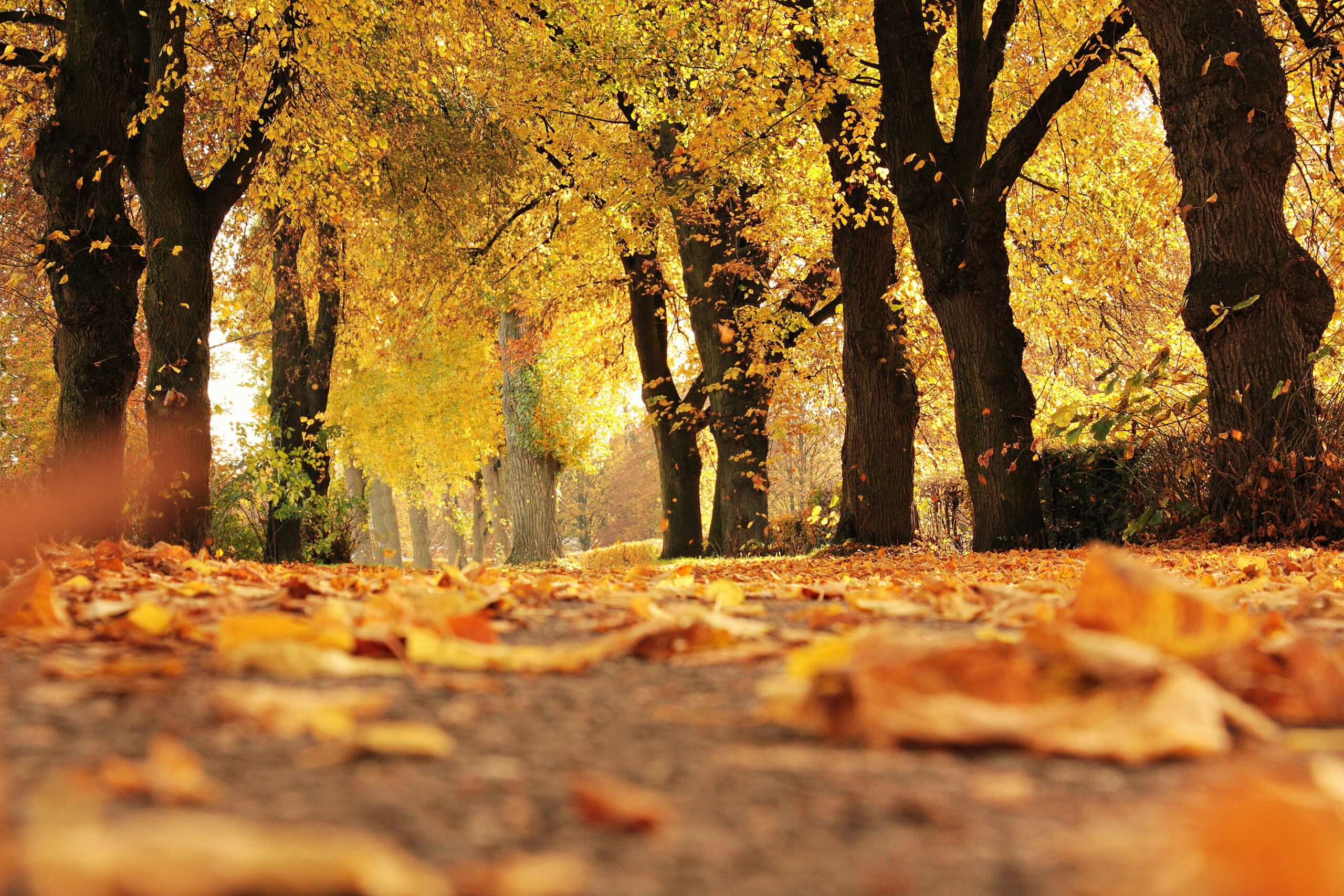
Deep autumn right on the cusp of winter, when “the fall” has lost its charm. The first flashes of crispy pastel yellows and oranges dissolved into the sludge of dark mud under foot.

“Shit,” Eddie somewhat gasped as nearly an entire shoe was swallowed by mud. The visibility was dismal. There was clearly some form of glow emanating from the depths of the forest. Mainly, he was guided by a mid-distant hollering and the banter of the revelers way ahead of him.

A brief glance back and Eddie’s car was no longer visible in the gloom of later year night. Nevertheless, he kept moving forward, identifying the pines and conifers ahead with his phone torch. It felt eerie; it felt like it couldn’t be trusted. Time, place, setting – everything was off.

His years in the field had taught him he couldn’t really trust any novel environment – that caution, and an unblinking vigilance, were a necessity. But this was a flavor of feral he hadn’t sensed in a good while, maybe since youth. This was Guy Fawkes Night after all:

“Remember, remember the 5th of November.”

A holiday 400 years in antiquity, a staple of national identity.

“Gunpowder, treason, and plot…”

Counter terrorism before it was named, as King and Parliament saved.

“I see no reason, why gunpowder treason…”

Bring fireworks along, lighting bonfires must be done.

“Should ever be forgot.”

An evening of national pride, community, and fun.

Eddie wiped a drip of snot from the tip of his nose. The assaulting British cold emanated from the forest with every step. The winter to come was making its presence known – wrap up as you will, it’s going for your bones.

Wading deeper into the foreground of ominous pines, Eddie felt his entire back stiffen. This was a hell of a time to be out late… anywhere. He’d watched helplessly in recent months as his waistline and appetite for casual cigarette smoking grew. He thought to himself that maybe his job had never been harder.

Current affairs reporting in the 21st century was seldom uplifting. Journos knew the score, just as the general public did. Negativity, cynicism, and the inflammatory were catnip to news consumers. Yet, this was a bad year.

Britain’s social fabric was hemorrhaging. National identity had gone from being something revised, expanded and growing, decade for decade, to something febrile and dangerous. Forging ahead was rejected while screaming for something long gone was the order of the day. Exactly what it meant to be British had become a nationwide obsession. In many corners, it became a green light for vigilantism and worse.

Eddie could hear voices getting louder up ahead. The silhouettes of tree trunks getting steadily clearer. He couldn’t tell if it was his eyes adjusting to darkness or if he was moving towards light. A sharp crunch echoed nearby. Eddie made a snap glance behind. Nothing. Was he being followed?

Arguably the originators of conservatism, Britain had only in the most recent decades used the word “diversity.” The term Britain had always favored was “tolerance.” Yet it was clear in some parts of the country, this had long since faded. The picture was ugly. Violent white crime remained on a steady upward trajectory. Youth crime circled its perennial numbers. Hate crimes were suspiciously falling out of reporting, circulation, or consideration. Streets had become hairy.

Some areas of the country started setting curfews – the most economically deprived areas; typically those neighboring acute densities of immigrant communities. This, commentators called the British Establishment’s greatest failure since the three-day week. The defeat of it reeked. If you can’t make a better society, then survey, control, and cage it. The headlines were clickbait gold. Their message was societal decay.

IS THE BRITISH POLICE A SPENT FORCE?

SERVE AND PROTECT WHO?

OLD BILL OUT TO PASTURE!

The fuse was lit 6 months prior.

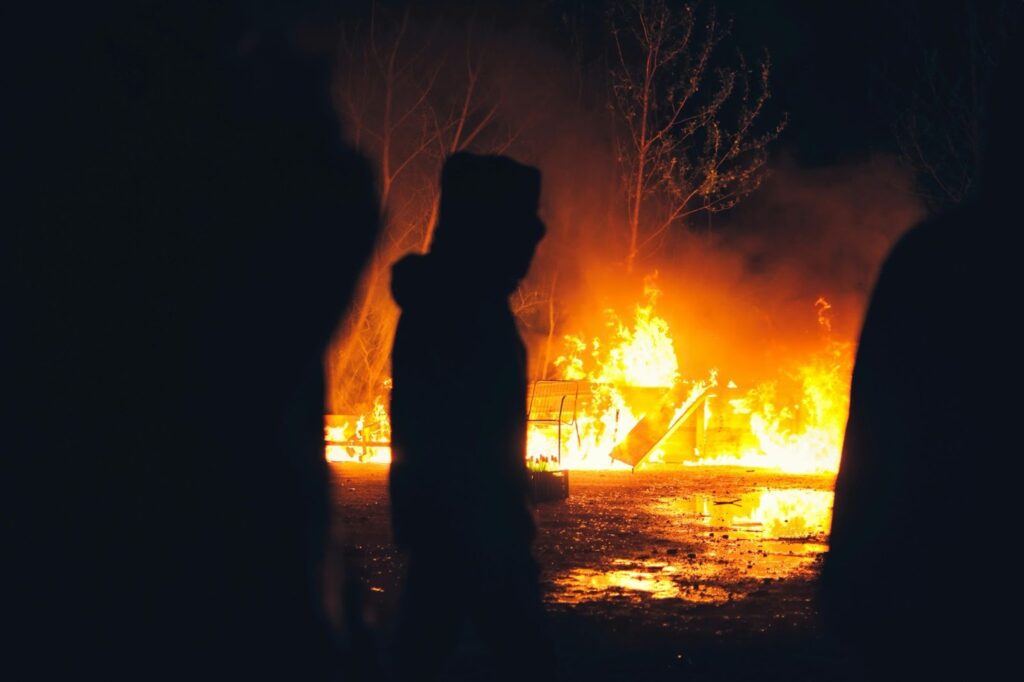
Three dark figures stand watching a public park ablaze as a bench and child’s slide go up in flames.
(Image courtesy of Marco Allasio via Pexels)

Shrill screaming filled the air. A firework ripped through the sky in a phosphorous tear. A pocket of silence followed before a loud pop of neon green splinters gilded the night sky. Eddie made a slow nervous turn to check behind him. Nothing again. As the airborne metal salts faded, the auburn glow of bonfire swelled ahead of him. At his furthest squint, Eddie could make out people marching towards the blaze. He followed.

The internet being a public space mirrors its real life counterpart: what is unacceptable in broad daylight may well find its private settings, corners, or… forums. Many who gather underground, away from the masses, are easily swayed and influenced by conspiracy and fear-mongering. The results can be disastrous.

Such a disaster imploded in an online forum exclusive to the British Isles. Some snarling, aggrieved, nefarious collection of men had taken it upon themselves to begin surveillance of places of worship and their attendees around their local communities. Blinded by bigotry and fear, they did not see the harassment or encroachment of civil liberties they were committing.

Eddie’s walking slowed when the bonfire was only partially blocked. He was no longer alone. The many, many cars parked up had indeed come to this site for what was an almighty bonfire. He couldn’t make out the entire scale of it because it was… it was as big as a house. And no small house.

Like a snowball rolling down a hill, the more this xenophobic tribe posted, the more the number of posts grew. The more the number of posts swelled, the more fictitious narratives and venomous storytelling were assigned to the innocent parties they preyed upon.

After an escalating 3-month campaign against one such individual, stalked and swatted by a forum frothing from the mouth, one of the very worst hate crimes in the country’s history was committed.

Women were left degraded and on life support. Children, grossly still, with skull fractures and broken bones lay in intensive care. A family and their home marred beyond recognition– all while the father was away and unable to protect. Horrifying, blind hate.

Eddie was no longer alone. A hard slap on the back announced the fact.

“Get in!” barked a scratchy voice leaving a full pudgy face, grinning wildly in giddy solidarity. The reveler marched ahead, unawares Eddie was far from one of his own. Eddie was struck by the heat emanating from the bonfire. This was as much a formidable force as a gathering point. The base of the behemoth bonfire was hardly visible from the dense crowd surrounding. Then, Eddie looked up and stopped walking closer.

The intelligence communities, in conjunction with the police, soon found the culprits. Those convicted individuals swore that they knew the truth. They claimed, feverishly, that they had attacked the family of an extremist, a terrorist in waiting, a threat to society. Yet, the intelligence communities found nothing of the sort.

Their “target,” upon interview and background checks of length and depth only intelligence teams could conduct, showed no prior or present links, trails, or anything nefarious to his name. The forum had created a monster that didn’t exist. Innocents lay in hospital beds thanks to imagined enemies – a disaster of both social and epistemic proportions.

Like the blast of a bomb, the harrowing damage rippled further than the site of impact. The perpetrators went in the dock, defiant and convinced of a system trying to suppress their “knowing the truth.” In fact, the sheer lack of evidence against the victim and his family only solidified the convicted individuals’ certainty that they were right to act as they had. Worse still, some corners of the internet and certain tribes of British society celebrated these criminals as martyrs.

When the government concluded its McAndrews Commission Report from the investigation – it was met with muted response. People believed what they believed – many felt that they were receiving the true overview of an evil attack of repugnant racism while others believed it was a government smoke screen avoiding uncomfortable realities.

The cacophonous chanting and pervasive roar surrounding Eddie was akin to a football cup final. A crowd in raucous anticipation of a great event. He had hoped his undercover following of the forums would turn out to be a damp squib. He tried not to let his own feelings cloud his expectations, but they must have done so. The enthusiasm of the posting was real, the projected attendance was not understated. The scale of this was intimidating, obscene.

This was a celebration, but one rotten and malignant in nature. Oh, the attendees were citizens, but this wasn’t citizenship. A calendar date to stand against nihilism had been hijacked to salute it. Eddie had craned his neck to look up at the towering effigy slowly catching flame. A giant “Guy Fawkes” wrapped in a huge banner. Printed across the banner: a published family photo of the victims.

Eddie slowly raised his phone, to take photos, to report, to do his job. The shriek of another firework and the heat of the fire felt miles away. His blood ran cold. He was numb – what had his country become.

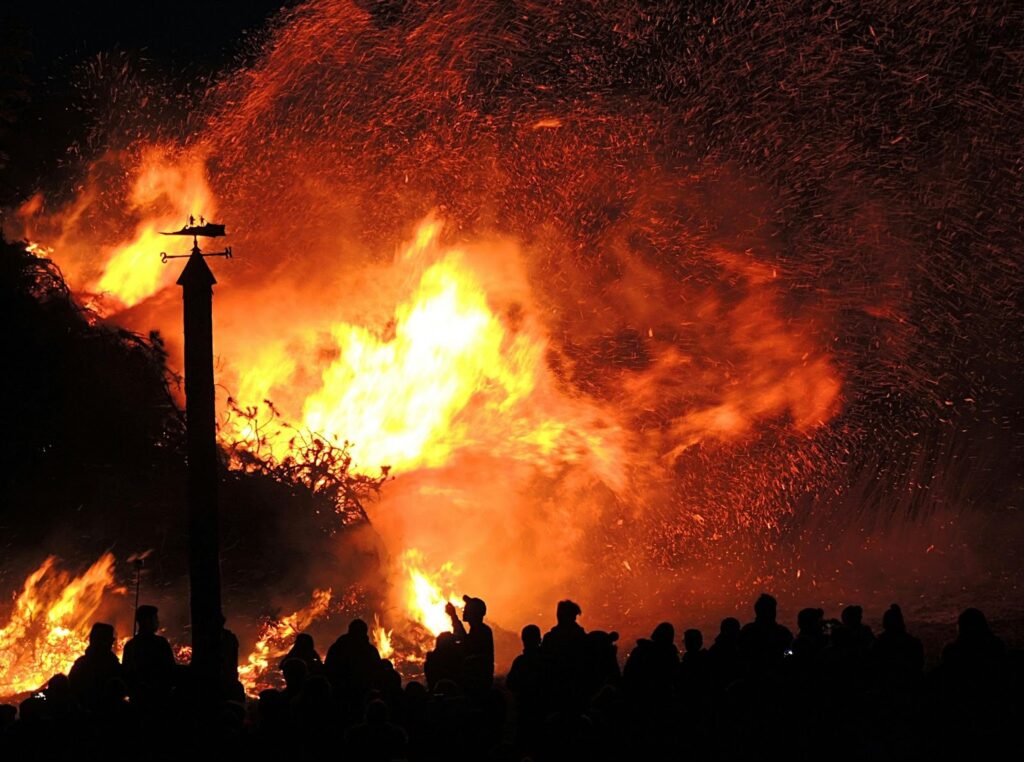
A huge crowd of people stand in the dark watching a gigantic blaze rage with sparks and flames everywhere. A small tower with a melting weathervane can be seen in contrast against the bright fire.
(Image courtesy of Pixabay via Pexels)

All Yours

Finding someone isn’t all fun. I’ve got a few miles on me now. Plenty have checked out the terrain. Plenty more have declined. I’m hoping to find that someone, my person.

I miss the regular walks in parks, you know. Never mind the season, I just liked being out with you. Whether you were bright and chirpy or distracted with work, or family, your phone, all three. Park walks were always sweet.

I remember the laughter, every one of yours; the cacklers, the gigglers, the chucklers, the wheezers or snorters. Hearing a laugh, no matter its form, is never a bad thing.

Cuddling up on the sofa with your place half a tip. Cozy and peaceful, the blare of the TV’s screen, its glow, the way you smelled. You, without a worry in the world, giving slow patient affection without a thought. Going out is great. Sometimes home is better.

I can always tell when someone loves me from their eyes. The scores of eyes I’ve had look at me and through me. Happy, loving, angry, or exasperated. Call it selfish, but having all your attention always lit me up.

No matter who I’ve been with, I’ll admit when you went away, you were all I’d think about. I remember each and every time, how happy you were to see me, whenever you returned. In truth, I doubt any of you were as happy to see me, as I was you.

Sure, I’m a dustbin on legs who’ll eat anything, but food with you was always best. Food from you, even better. Always served with a warm smile in your voice or on your face, a loving touch. Excuse the cringe, but the key to this guy’s heart is most definitely his stomach.

I’ll confess, I found meeting your mates overwhelming. They weren’t always fans of me. To be honest, I didn’t always like them, but I’d do it anytime for you. You know, I don’t forget how you wanted to show me off to everyone and how great that felt. 

I know I’m not bad. I know you can do better, too. Maybe someone more focused. Someone who can sit still more, someone better with kids, I don’t know. 

I’ll never forget the moments where you’d just speak to me. From the heart, subconscious, involuntary. It really didn’t matter what you said, it was how you were saying it. It didn’t matter if it was good or deep and meaningful, it could be bad or absolute nonsense. 

It didn’t matter. There was a special frequency, only for me. Like I became your secret confidant. Knowing things even your Mum or besties didn’t know.

I realize I could frustrate you and cause problems you never asked for. I’m a lifelong sufferer of heart-on-my-sleeve. The sleeve’s torn up now. I’m not bad, you know.

Another long afternoon, and it’s sad to think so many opportunities have passed with good and loving people. I’m not giving up yet though – I think you’ve always got to be willing.

Karen might be the sweetest woman I have ever met. She always gives me the same loving look every time she sees me.

She’s been running this kennel for over 10 years now, and, every time I’ve returned, she says, “We’ll find you a home one day, Rolo.”

I hope she’s right. I just wanna belong to someone.

Life Stock

When the announcement was made Robert went numb. As a high earner with status to boot, a total reset of employment and the job market wasn’t exactly in his favor. Robert had hit something of a private, personal, custom-made shellshock.

That was certainly how he felt in the days that followed. Sanitation workers and inner city school teachers were jubilant across social media channels #NewLifeHereICome. Delivery drivers and personal support workers were no less elated, birthing their own TikTok trend. “The Finale” involved displaying and dismissing their final paycheck to the camera (oftentimes with a colorfully worded limerick), before buying a round for the entire bar they were in and toasting the new life ahead. Robert, however, was not feeling so exultant about the seismic change.

He wasn’t alone. There were hundreds of thousands, who, having their 9-5 (or more) taken from them, felt wholly bereft. People openly admitted it in online forums. Even those who were understimulated, or verged on disdaining their jobs, were dreading the prospect of the unknown. There was the comfort of the familiar that so many shared irrespective of its quality. Many made comparisons to the lockdowns of the COVID-19 pandemic, that maybe the time off before the next chapter would bring a different perspective. And then there were the few… the few who really did love their jobs or felt it firmly anchored their identity, who couldn’t shake the dread of what was to come.

Robert came home that night to his wife of 12 years, Marie. She knew him in her gut, could feel him, often more able to identify his feelings than he himself could. Robert wasn’t a go-getter, a strident male. He was perfectly charming when out of his head and grasping his own quiet confidence, but… this was a man who wanted things simple and free of uncertainty. Marie chose Robert for this very clear bottom line of his character; Robert Jessop was relaxed and dependable. 

Marie knew this was a painfully uncomfortable time for him. He was borderline mute the evening of the announcement. Marie took it in stride like many others had. She’d had to adapt and claw for everything she’d earned in life. Robert not so much. He was a man who liked the path laid out clearly before him so he could diligently, carefully apply a lifelong perfectionist streak. The “Draft” demanded improvisation and malleability in dimensions yet to be defined. Their usual routine on a Thursday evening was a movie night at home. A warm and cozy nest comprised of blankets, pillows, and bowls of popcorn. That Thursday night, Robert was cold, unblinking, and sans appetite.

The announcement had been rumored. Workplaces, social spaces, and homes were all participating in the conversation– one they had seen on screen after screen, heard on podcast after podcast and witnessed woven into and dodged on podium after podium. AI had gone from replacing some jobs to just gobbling up so many it was dizzying. Job security may have been on the wane in the decades leading up to the Draft, but it had become untenable.

Entire fields were vanishing into computer programs. The knock-on effect on education and vocation was enormous and rapid. The world simply could not keep up. Robert wasn’t glib. He’d gone from doing long hours of case work to completing the repetitive tedium of entering prompts and proofreading AI. When it first arrived, AI helped Robert do his job, but it wasn’t lost on him that it had been the other way around for quite a while. As a legal professional, Robert was quietly hopeful he’d be safe. He was wrong.

Just an email. Cold. Blanketed. Faceless. Factual.

To Whom It May Concern:

This role is no longer statutory.

Make arrangements for departure by the day’s end.

You have been entered into the Draft- 1st Round.

May you succeed in your future endeavors.

The Government disseminated automated, prerecorded announcements to the public of the Draft. There was no human face or voice to the entire operation. The few bullet points afforded to the public on the Draft and its “1st Round” were cold comforts. It spoke vaguely of roles including “Adjudicators” and “Assignors.” After three days at home, which Robert mostly spent listlessly plodding about his flat like a toddler lost in a supermarket, the next email would arrive.

Robert was made an “Assignor.” His new job was to give new jobs to people. The pay wasn’t what he previously had, but it wasn’t shabby either. He was informed he was a practical fit for the position’s personnel specifications and that it was an in-person role along with “Adjudicators.” Robert couldn’t help but feel a wave of unease. This entire great transition had arrived ad-hoc through faceless digital means, yet somehow the most febrile part of it required human faces on the front line.

As an Assignor, Robert was in an eerily similar position to his previous. He was aiding an automated process in which present jobs had already been delineated and chosen, but he had to be there face-to-face to inform people of their fates. Marie tried to assure him that his position would be placating to people, that he was the human face of comfort at the end of a big change most didn’t feel prepared for. Robert felt more convinced that he would be performing some bizarre inverse of Zoom call firings from the early 21st century.

Reading over the job description, there were elements that left him with only questions. The brief outlined “Placebo” roles. These hires were not necessary, were not needed, and were already being performed by automation. Then… why were people also getting assigned these roles? What was the Placebo? Was it AI and machine learning’s way of squeezing more knowledge out of human error, or just a social experiment for only AI’s amusement? 

***

He would never forget the first day at a community center renovated for machine purposes rather than human ones. Community centers used to always be unkempt, charmingly messy– a worn book with folded corners. They revealed a space that had been lived in, appreciated, and occupied by many over the years, but, now, Robert entered a vacuum of a space. Off-white glossed every angle; a crisp echo from every sound made; a sight belonging to a space station instead of planet Earth. He made his way to the desk outlined in the brief, used the login information provided and waited until the line outside bubbled and slowly spilled over inside.

He’d never forget her face. He noticed her before she reached the desk. A haunted, wide-eyed expression standing out from the crowd with dark, deep, mahogany eyes that radiated a hurt sadness. The woman’s aura shone through in a line that breathed anxiety and discomfort, no loud sounds, just a continual collective fidget and darting eyes. The entire line screamed of people who were just bursting to ask questions but didn’t dare speak. There was one glaring issue – there was no Adjudicator. Looking at his brief for the umpteenth time, his eyes didn’t deceive him. Robert was supposed to have a fellow authority figure, they just weren’t present. He took a deep breath, readied himself to start proceeding when a voice boomed from outside.

“‘Scuse me, ‘Scuse me,” a rough male baritone trampled the fragile ambience.

Its source soon strode through, a large, hulking figure of a man. One would assume that a bouncer or cage fighter were his potential former posts. He was  dressed in black, with a loaded utility belt across his waist, and a confident swagger on approach. Upon reaching the desk, he outstretched his large hand towards Robert.

“Alrigh’ boss?,” a near giddy tone produced.

“Yeah… Your name?,” retorted a taken aback Robert.

“Maocum, I’m ‘judicatah. You the assina, right?”

“Uh, yes. Robert.”

A satisfied grin swept across Malcolm’s face. He tucked his thumbs into his belt, which on closer inspection held a stun baton, pepper spray, and a taser.

“Readuh when ya are,” Malcolm near purred in excitement, before turning away in smug satisfaction.

Robert looked out to the line. All eyes were on Malcolm. The air had gone from buzzing with anxiety to stiff and stilted with fear. Robert’s misgivings were true, the deep-seated ones he had held long before the Draft was upon them. It wasn’t that the machines were taking over the world. It was that they couldn’t see the humans living in it. His first day of the Draft was confirmation.

Robert was the bad news while Malcolm was crowd control.

Window Sweets

Coletta Feek was the sole proprietor of the small chocolate shop, Magnifeek Sweets. Her shop remained her entire life and the only thing she had ever actively worked towards. The relationships, and broken days, that she had experienced were, in her eyes, treasures directly resulting from her shop’s success. She had had a honeyed childhood, soul-searching adolescence, and desired nothing. Although her own life experiences were often dressed in ganaches and gossamer doilies, the young woman truly believed that she had felt the kaleidoscope of human emotions already, all due to the wide display window of her shop.

The pane was worn and thin, fogging around the edges where the glass had warped as Magnifeek Chocolates had been everything from a florist to a pharmacy before Coletta had purchased the property. Since the window itself looked rather tired, she did everything she could to make what it housed vibrant. She set false evergreen boughs, dressed in holiday lights, around the edges of the glass and a rich burgundy velvet pooled on the tiered platforms that contained confections of nearly every color and shape. 

Chocolate seashells, a seaswept reminder of her grandmother, sat on pewter plates she polished regularly. Stained glass window cookies glistened next to succulent roulades and mousse cakes dressed in candied rind and mint leaves. Bouquets of chocolate lollipops stunned in vases she had never used for flowers, while her shop’s signature chocolate mice with ribbon tails scurried among the treats, adding the whimsy she hoped her customers would appreciate as much as she always had. 

Coletta’s most precious part of owning her shop was watching passersby linger, if only briefly, at her shop window, because, for a moment, she could see them as they truly were. She had witnessed families, with children who pressed their small faces against the pane, begging their loved ones to enter the chocolate shop. Lovers of every age had sought out the sweets to enjoy together under streetlights as the rumble of traffic hid their whispers from the rest of the world. And, every once in a while, a widower would come to the shop for a sweet bit of respite, remembering who he had held close as a younger man when kisses were still sugar.

The chocolatier had been privy to the lives of her customers for as long as she could remember, which meant that she had also observed the darker shades of hope outside her shop’s window.

In particular, she recalled a middle-aged man who lingered a few steps behind the same attractive couple. His hair was red, with a bit of starlight at its edges, and she recollected the patch of silver in his beard, shaped like a roof shingle. The man never spoke to the couple, but he followed them as wearily as if tethered to them. The couple rarely seemed to notice his presence, and, no matter how many times they crossed the shop’s window, they were never speaking to the man whose shadow was interwoven with their own. Coletta once dropped a chocolate mouse when the redheaded man reluctantly pulled his gaze away from the couple and fixed his cool eyes upon her. She stared down at the ruined sweet, crumbled on the ground in front of her,  picked up the pieces and combed the ribbon tail gently between her fingers.

The couple continued to walk by Magnifeek Sweets, stopping in for a small box of truffles to share with one another, and, eventually, their affection enveloped even Coletta. She heard the bell ring at the shop’s door. 

“Coletta! Kalev and I are here for some of your divine truffles!” 

“Hello, you two,” Coletta cooed. She always admired the warmth with which Madigan spoke to everyone, especially her Kalev. He was usually quiet, but always cordial with Coletta, while Mads asked her about new confections and the changes in the display window. 

“Coletta, you wouldn’t perchance take custom orders, would you?” 

“I haven’t previously, but I am open to the idea,” she responded while carefully packaging an assortment of truffles, adding two complimentary chocolate mice—one with a teal tail, the other with chartreuse—to the box. Mads had picked up the endearing habit of opening the ribbon-wrapped box as soon as Kalev and she were outside, looking incredulously through the display window at Coletta, then running back inside the shop to grab her hand and thank her for such a kindness.

“There are more than just window sweets here!” she would say, squeezing Coletta’s hand while Kalev tipped his hat to her through the window, still holding the open box of truffles. 

“You’re very welcome, Mads. Please take care of yourself, and see you soon…” Coletta’s voice trailed off as she recognized the red haired man, sitting on a bench across from the shop, staring with those languishing eyes, at Kalev and Mads. As the duo cheerfully wandered off, the man rose and began trailing them once more.

Coletta had come to relish in those moments of quiet friendship between Kalev, Mads, and herself, but she hadn’t the courage to bring up the bearded man and his concerning surveillance of the couple. Instead, she placed her energy into the curious custom order she had received from the lovers. They had asked for some small chocolates, all embossed with the figure of an imposing hound. The couple had never spoken of owning any animals. Coletta had even spied Mads retreating from a stray mutt that had startled her by accident some time ago. But, the order was an easy one. She crafted the chocolates and filled them with peach preserves and pistachio praline, as Kalev had mentioned the order was a gift. As always, she boxed the chocolates up, including a few extra chocolate mice for good measure. While she placed the finishing touches on her display’s delights, sampling a few to gauge their quality (an indulgent ritual of hers), the red haired man was suddenly standing in her shop. The door’s bell had not rung. “Miss Feek, is it?” His voice was high, akin to a young man’s. “Ye-yes?” Coletta corrected herself immediately, years of customer service conditioning her tongue to mouth certain saccharine salutations. “Please excuse my verbal lapse. Welcome, and how may I assist you, sir?” The man did not stir, and he continued looking, almost through, Coletta. The two stood there in silence for a few moments, until the chocolate in Coletta’s hand began to melt.

“Please pardon my intrusion. I have noticed your stares when I am near, especially when Kalev and Madigan are present?” Coletta caught her breath– he knows their names. She steeled herself, wiping her fingers clean with a damp cloth. “They are friends of mine, and I cannot help but notice you have a rather… keen interest in them.” The man’s eyes appeared less exhausted now. “Well, I see you understand more than chocolate,” he muttered quietly. “You see,” his voice rose slightly, “I have a genuine fondness for both of your friends. We knew each other well, some time ago, but those two probably do not remember me.” “Is that so? Why don’t you speak to them then, instead of following them around like a lost puppy?” Customer service be damned, Coletta thought to herself. The man smirked. “That’s a fair point, Miss. In any case, I simply stopped by to thank you for your kindness to them. I shan’t be much more trouble to Kalev and Madigan, and I assure you that I shall not darken your shop’s doorway again–” “Sir, I apologize for my slip of the tongue. You think it would be sweeter with all the sugar surrounding me. Please, take this, and you are welcome here at any time.” She held out two of the extra chocolates with the hound emblazoned on them, nestled on a square of wax paper. The man grabbed the token gingerly, folding the paper gently around the chocolates. “Another kindness, I see.” He looked at Coletta directly once more, and she darted her eyes towards his gloved hand, holding the small parcel. “Tell me,” he said more gently now, “What made you want to be a confectioner?” Coletta, who began looking out her display window fondly, answered with a certainty that years of pride had instilled. “I want to make this world something we want to cling onto, even on desperate days.” She looked up, hoping to gauge the redheaded man’s reaction to her answer. However, he was already walking by her store’s wide window, never looking back.

Madigan and Kalev adored the chocolates Coletta had crafted, and Mads embraced Coletta gratefully. “They’re perfect! Thank you so much, Coletta!” she said serenely. “Yes, they are your best ones yet,” Kalev chimed in calmly. “You two are exceptionally kind. May I ask what these chocolates are for? Kalev, you informed me that they are a gift if I recall?” “Precisely. It is the anniversary of my family’s dog trainer’s passing, and we wished to bring a special gift to his resting place this year. It was my sweet’s idea–” Mads interrupted her heart, “Kalev, I just knew Coletta would work her magic! I still remember how kind Mr. Tihar was when we were children– we should celebrate his memory always.” “I agree, my love. Mr. Tihar was like a father to me years ago, and he always had a fondness for sweets. I am certain he would have loved your shop, if he were still alive.” 

After Mads had embraced her a few more times, the couple departed, and Coletta was left in the stillness of her beloved shop, with chocolate mice staring back at her knowingly. She smiled, ever-so-slightly, and whispered, “It was lovely to meet you, Mr. Tihar. I hope you enjoy the chocolates.”

Rougarou

The cypress boughs reached out above her, curlin’ tightly, like his fingers had around that damned bottle. The woods were darker than Nadine had ever seen them. She knew the forest had a way of sucking all the light of the world into it, like ether through a straw, and, yet, she still felt safer there, among the thickets, than with Pa when he had been drinkin’ and yellin’. Before Mama had died, they would walk through those woods together, catchin’ fireflies at the creek. For Nadine’s thirteenth birthday, she had received a small silver brooch from her mama, a gris-gris, inscribed with the glowing insects she loved so much, and she was told to never take it off, especially in them woods. Nadine recalled how her mama would laugh loud enough to drown out the distant shouts of Pa when he was in one of his huffs, and she remembered watching the sides of Mama’s eyes wrinkle like the peach trees in August when she howled.

For a long while after she had left them, Nadine had wondered how Mama could laugh so hard, even when Pa was so angry all the time. “Yer Pa is tryin’, but dere are some tings we just keep tryin’ widout tinkin’ if de tryin’s doin’ any good,” she would say before laughing again like the foxes did hunting rabbits. Nadine remembered that Mama had told her that laughing real hard brought the fireflies out, and “nuttin’ bad could happ’n” while they danced in the air. But somethin’ bad had happened; she lost Mama.

Nadine learned to avoid her father’s wrath simply by watching how his eyes looked when he’d come round from the docks. If they were puffy, like the great gray goujon he’d hook for market, bloated, staring in different directions but not seein’ anything, then it was time to skip out the back and take the path she knew soundly, even after the sun had set behind the tupelo trees.

Nadine knew every bog, bank, and branch of the bayou, and she had learned how to stay safe there, too. Boiling some black willow bark would ease Pa’s sore back and Mama’s headaches. With a good fire and some patience, she could stew nettles to make soup that would keep her going for days. If she was careless and got stung by the nettles or a bald-faced hornet, a little jewelweed sap could soothe the stings. Nadine’s mama had taught her everything she had ever known about them woods, and they protected her even now. 

“Chil’, WHERE Y’AT!?” Pa yelled from near the house. Nadine instinctively held her breath– he was awfully bad tonight. He had never been this bad when Mama was alive.

Nadine remembered how Mama’s headaches had progressively worsened, to the point where her own remedies from the woods worked about as well as a screen door would in Pa’s pirogue. Then, Mama’s nose started bleeding, and she fell on the front porch. She slumped next to the cardinal flowers poking through the railing, the same crimson color that ran down her face and onto Nadine’s hands as she tried rousing her. She shook her mama violently, desperately, as tears burned her face like the July sun. There was so much blood, then Mama lay still. 

Pa had found Nadine holding Mama, wrapping her arms around her like honeysuckle as she had every day of her life. Nadine stopped crying, but she still shuddered and squeezed her mama’s arms, hoping they would warm up again. Pa had not looked his daughter in her eyes again since that day, and they never did have a proper funeral for Mama.

***

“WHEN I FIND YUH!” her Pa roared. The panicked prick of reality buried those painful memories among the ferns surrounding her. Pa sounded real close, and she knew that that meant trouble. Nadine was careful to step only on the dry or mossy patches of the trail so as not to give her Pa any undue lagniappe. She traveled away from the furious voice, although she knew that, like lost light, sound also became garbled in those woods. A human voice could wander for what seemed like miles after its owner had stopped talkin’, with the tree hollows and tides echoing and taunting any listeners within earshot. 

Nadine grew quieter still, and sought cover in the dampened groove under a toppled cypress near Firefly Creek, briefly making sure there were no hornets’ nests in the exposed roots. She heard something moving, quick as a cocodrie, through the woods. It was large and heavy, but still moved swiftly– much faster than her pa could in his stupor. He was angry about somethin’, but, even pie-eyed drunk, the couyon wouldn’t rush into the bayou unprepared. No, whoever was closing distance on Nadine could not be Pa. Then she heard it, like the sharp crack when her mama had collapsed on the warped wooden steps of their porch. 

There were two gunshots, and wiry red flashes to her right, much closer than she had expected, where the gunpowder had ignited. Birds scattered from their roosts, and a boar squealed in surprise. Then, Pa screamed, a wet, dark scream that matched the inky blackness of the woods. Silence settled across the bayou, as brief as the fire flashes, before Nadine heard something else entirely.

A rasping breath followed, and she swore she could hear something inhaling deeply through its nose. Nadine thought she almost felt the searching stare of someone she could not see, and she gravely hoped they could not spy her ‘neath the clammy roots where she hid. Her own breath caught as a figure emerged from the grove. She grasped her brooch with one hand and covered her mouth with the other.

The figure was hulking and matted in dry muck. They stood tall on two sinewy legs that seemed nearly as thick as the tree trunk that concealed Nadine, and their face was far too long. Their aquiline snout and teeth shone sharp, even in the dark, and, yet, the figure’s yellow eyes reminded the girl of the fireflies she so deeply admired. She dug her palm into her mama’s brooch and lost herself to terror. Nadine’s other hand fell away as she gasped, and the creature turned, hearing her, and staring with open maw. Nadine noticed somethin’ slick painting the figure’s mouth, red as the blackbird’s wings, when they approached her hollow with ferocious speed. 

Without thinking, she laughed desperately, wildly as her mama had in life. She squeezed the brooch as hard as she could, until the silver was warm like her. As she laughed, the figure bounded towards her, filling her vision as they grew nearer still. All she saw were their two swollen, yellow eyes, staring unblinking into her own. This was the end, her end. She felt it, had felt it for a while, ever since Mama had died.

***

The rumble was soft, even, and gradual. It sounded as if the ground were shakin’, but her hands and stomach rested upon the damp, still earth. The echo filled her ears and the space behind her eyes, and she suddenly heard her mama’s laughter. The trees creaked, while the sky seemed to be brightening, awash with a luminous luster. With a glow as full and warm as her mama’s embrace, a cloud of fireflies flickered, turning the bayou into a crystalline scene. Wisps of yellow, green, and gold transformed the cypress trees into inverted chandeliers, while the water was wet peridot. 

The sky gleamed with swarms of fireflies, multitudes like she had never seen. Swaths of insects landed anywhere they could, including all over Nadine’s chilled body. The figure inhaled deeply again, but the laughter continued, stronger still, and the fireflies swarmed them, unrelenting. The figure reached out to bat at their luminescent assailants. The insects overwhelmed them, pulsing with their living light, until, yet again, all Nadine saw was the figure’s gaze, full as the moon would be in a fortnight. 

As the figure swayed, gilded in wings and the thunderous thrum they made, the laughter now came from Nadine’s own throat. And, as she stared back, the figure’s eyes were, all at once, a much more familiar color. “Mama?”

Counterfeit World 3.0

Roscoe has defiled Doyle’s living room, again. So, Doyle was siphoning resources—not much, about a tenth of one percent—from RAMPART’s projection of a post-Great Lakes Midwest to figure out what to do about the dog. Head down, avoiding the gaze of tenured professors and project managers, he played with parameters: what if I’d had Roscoe since he was a puppy? What if I was his first and only owner? What if I was still with May and wasn’t trying to take care of him all alone?

Again and again, RAMPART hitches, borrowed computing power tapped dry. Lake Erie is suddenly in stasis, simulated pipelines freezing over without bursting. In a fake California, avocado trees and almond nuts super-chill.

Doyle knows: stranger things will happen. He can’t bring himself to read the weekly reports out of the Minder team. But he sees them burdened more and more with the world’s climate news, with the world’s climate future. Administration has tried to ease burnout by rotating people through, but that just smears the misery around. 

In a little notebook at his workstation, he makes a game out of it, connecting calamities to breakdowns of personal maintenance, along with ways he’ll reward himself for getting them right. He’ll order a pizza and gorge himself on it, he’ll put his work aside and lose himself in a video game, whatever. He has to keep this going, somehow. More and more it’s a victory just to force his eyes open in the morning. 

May tried to talk him into finding another project to work on. “There must be a healthier way to get your hours in,” she told him, three or seven or twenty times. When he replays those memories, Roscoe is always laying its muzzle in her lap, and she is stroking its dumb floppy ear. The two of them were so close, but somehow she’s gone and the dog is still there. 

“Forget the university, forget my department.” In his memory, Doyle always fixes her with a very serious “you’re not thinking this through” look. And then he cringes at what an ass he was, and is. “There is nowhere in the world on the bleeding edge of complexity theory like RAMPART. Maybe an alphabet agency, but do you want to move to Washington?” 

To that she had no answer. That satisfied him just fine. Everything, everything in the world, has a reason for it. Everything is as it is because there can be no other way. The dog poops on the rug because it needs to defecate. The glaciers melt because the Earth’s atmosphere traps too much of the sun’s heat. Doyle stays on with RAMPART because there is nowhere else to understand the world. 

Not that working out why his ex’s dog is violating his living room has ever been one of the uses he’s imagined for his education.

From queries of ideal dog-caretaking scenarios lobbed at RAMPART, Doyle can learn very little. All of the results were perfectly useless. Much of the information the projections provide is, even for useful questions. But there, again, the low reasoning of high planners: if the machine provides answers to questions no one asks and works for those in need of work, run the machine! 

In his chair, he leans back and groans, a balloon deflating. To certain things he’s locked in: hours for teaching undergrads, doing research, writing up results—all of it is non-negotiable. He had not asked for the dog. He doesn’t want it. But when May announced that she was moving out and breaking off their engagement, she had given reason why it would not do otherwise than for the dog to stay with him. He felt helpless before it, before whatever goals she wanted him to move toward, and before the monumental task of taking care of its smelly, drooling, bottomlessly energetic majesty. Taking care of the dog was a bad idea. He let it happen anyway. And now here they are. 

What Doyle needs, ridiculously, is for the dog to understand. And maybe that is overestimating it, but Doyle knows there is plenty that it does understand in its dim doggy brain. Surely, Doyle reasoned, it can be made to understand absence? Absence of time to get it out? Of will to move, to see other human beings going about their lives pretending the world wasn’t going to end in their lifetimes? 

At least an absence of appropriate places to empty its bowels indoors? 

No, RAMPART said. Told him what he already knew. It can’t be other than what it is. Certain outputs are guaranteed by certain inputs. They’re locked in. 

When he goes home, wincing through the blast of feces-tainted air that pours over him as he unlocks his apartment door, he decides to be brave. He decides to try something new. 

After he’s scooped up the offending object and scrubbed the rug with half a bottle of spot-cleaner, he calls, gently: “Dog!” 

Roscoe pads on out, big paws quite delicate. There’s an undeniable cast of shame on his ferretish greyhound face, and Doyle finds himself wondering how that can be: shame is a recognition that an internal self has somehow failed an external other. Most days, Doyle figures the dog barely knows he exists. 

On the soiled carpet, it sits. Stares up at him with eyes liquid and dumb. 

“Bad dog,” Doyle says, but there’s no real anger behind it. His thoughts are elsewhere: he spent the afternoon updating drought projections to line up with a just-approved plan to drain all the Great Lakes, the largest combined freshwater reservoir in the world, to irrigate farms for a handful of billion-dollar agribusiness concerns. Visions of shores receding from piers, of cold and warm fronts sliding over the Great Plains like drunken roller-skaters, of lines of refugees begging for mouthfuls of water. He wants to escape. 

The dog whines up at him, a high piggish squeal. Its tail thumps the carpet. 

“I’m going to stream something,” Doyle says, mostly to release himself from the hope that he’ll do something productive tonight. And the fear, always there, that he’ll do it poorly. He pats his thighs. “Cuddle up?” 

The dog stares at him. 

He collapses onto the couch, remote in hand. Absently he pats the spot beside him, inviting the dog to carve its own groove into the cushion.

Instead, it retreats from him across the room, to where its leash hangs by the door. Eventually, its whines shift from plaintive to aggressive, growing deeper and rougher. 

Doyle sits, insistent. If only it could understand, he thinks. I have nothing in me for you right now. 

Eventually, Roscoe gives up and shuffles out. Doyle avoids eye contact. From the squeak of bedsprings, Doyle can tell it’s claimed the bed. That suits him fine: he curls up on the couch, volume down low, light and sound washing over him until he’s gone. 

***

There’s a simulation he likes to run. To torture himself with. Worst-case scenario: five degrees Celsius, world on fire, economic collapse, water wars, nuclear wars, wars to end all wars. 

He’s feeling crappy today, so he boots it up, finest detail, fifty years ahead. The tail end of his natural lifespan. 

RAMPART is too complicated, and watches too many factors, to give you the same result every time, even with the same parameters. So every sim is like watching a different horror movie from the same series: the same, but startling in its particular depravities. 

Shallow graves pockmark the American southwest. And bullet casings, ammo dumps, burst bridges, contaminated water supplies. Climate refugees from Central America spat. But the violence doesn’t end there. 

So-called American civilization has come to nest in enclaves of a few tens of thousands: in the Rockies, in Appalachia, the Upper Peninsula, and islands in the Pacific. He traces their lines of flight from centers of power in Washington, New York, Chicago, and California. It rhymes with some history he knows; elite flight in times of crisis. They take everything they can and when there is nothing left to take, they move on. 

He can picture all of society like this giant, holding so many on its shoulders. Crushing some underfoot. To outrun some crisis or other it shrugs, and casts off more and more, those with looser grips. Losing ballast. Until there is nothing left, no one. 

When his turn comes, he hopes he’s crushed quickly. Not left to watch it recede from him. Not left by himself.

***

One muggy oppressive April day the Minder team has an opening, and Doyle is asked to fill it. Doyle is almost grateful to have something to think about besides the ruins Roscoe is making of his apartment, until about lunch. 

Technically the job is to mind the RAMPART sims: to keep them up-to-date so that the other teams — Public Outreach, Policy Advising, Climate Diplomacy — have a solid baseline to work from. But to do that you have to look at the thing itself: the rapidly fouling world, the only planet anyone has. 

It’s kind of funny when Doyle thinks about it. To navigate a changing climate, you need models. Someone must make those models: someone must stare unblinking at that worsening climate in the increasingly unlikely hope that anything is done at all. Even a humanitarian project runs on human suffering. 

At least he’s not the only one feeling this way. Every chance he can get to try and connect with anyone else on the team, he takes. They’re all stuck in this together. And it’s pretty funny, the sentiments that fall out of them, this collection of twenty-somethings whose collective decades of study have amounted to, basically, a certainty that their lives are over before they even began. 

Even as everything else is dying, two things flourish: cockroaches and gallows humor. 

Project admins are loose about approving hours. So a run to check climate-monitoring equipment, a job that could be done by two people, can become an all-team road trip. Desks vacated, windows down, scraping something off the highway to share and calling it joy. 

They’re far out in farmland the university runs for its ag programs, not much more than blue skies and grains still greening in the stalk. 

“Bet we could buy this land real cheap,” Sripan says. “Set up some windmills, run some broadband, get some crypto farms running.” 

Everyone groans. Thaddea kicks the back of Sripan’s seat. “I hate the problems I spend all day studying,” she says, voice squeaky and mocking. “But the causes? I love the causes!” 

Sripan looks stung. Doyle knows where he’s coming from: his education hasn’t been cheap, either. There are always costs to defray. You kick the world and all you get is a broken foot, so why not see if the world can help you pay your new medical bills? 

“It sounds like Sripan wants to do crypto sustainably,” Doyle volunteers. “I didn’t hear anything about running a diesel motor to power anything.” 

“Doesn’t matter,” Thaddea says, negotiating with her seatbelt until her back is to the window so she can address the whole team. “So long as someone’s bought in, even doing it sustainably, and someone somewhere else can make money off it, corner-cutting miners will try to get in.” 

“You could say that about any societal evil at this point,” Doyle says before he can think it through. 

Thaddea nods. 

The rest of the trip up is really quiet. 

The equipment they’re there to look at is in a little rural airport the university maintains. It’s mostly rented out to hobbyist pilots and companies making short-notice flight plans, and neither group is making a showing today. They pretty much have the run of the place. 

On the roof of the air traffic control tower they have their instruments, though only Sripan makes a beeline for the ladder. Doyle lingers on the tarmac a moment, trying to picture Roscoe sprinting through fields until he collapses in a panting, drooling mess of doggy endorphins. It’s hard to imagine anything ever being that happy. Then he decides to try and speak to Sripan. To not let him feel alone. Hopefully. 

“How bad is it?” Doyle asks him up top. For a moment, he’s just a researcher following the data. Working out a problem. For a moment, he doesn’t have to live here. 

“Bad.” Sripan shows him the atmospheric data, the temperature readouts, and the heat waves. RAMPART estimates of knock-on deaths and how well they fit with the latest projections on global collapse. “But there is a bright spot.”

Doyle punches him in the shoulder. “Yeah, it’s called the Sun. It’s going to cook us in our own sweat.” 

Sripan doesn’t even seem to feel it. Instead, he pulls up an unfamiliar graph, a range of glorious heights and precipitous drops eventually flattened out to zero. “Recognize this?” 

“Life expectancy of the average human being since the start of the Industrial Age?” 

“I thought not.” Sripan brings up a JPEG of another harebrained crypto-coin that had made a few people obscenely wealthy and consigned most of its investors to their parents’ basements forever with its crash the past fall. 

“Crying over spilled milk?” 

“No. Look at these emissions numbers —”

Doyle snaps his fingers. “Which are tied to electricity production —”

“Which dropped when Babacoin crashed.” Sripan overlays the two figures, and there it is, a lag in new emissions right where they’d hoped it would sit. “The market recovered, and with it emissions, but…” 

Human actions are making this crisis: human actions can unmake it. 

“All we need to do is vaporize the world economy.” The words fall out of Doyle, leaden and lifeless. 

“What I’m hearing is, everyone is screwed.” Thaddea hangs on the last step of the ladder. 

“No,” Sripan retorts. “It’s just that everything is…” 

“Complicated,” Doyle finishes. Human civilization follows one set of rules, rewarding accumulation and positive feedback loops, and the global climate acted according to the laws of physics, which was not as kind to those as the Fortune 500 list was. RAMPART only confirmed an obvious fact: a collision between those two sets of rules would be very, very ugly. 

“So what do we do?” Sripan asks. 

“Can we even do anything in the first place?” Thaddea asks. 

Doyle allows himself a smile. The answer to that question: it’s complicated. 

A mono-rotor plane circles overhead, probably a trainee waiting to land. Toylike, fragile, small enough to reach out and grab, to bash against the rocks until it stops spewing poison. An increase in complexity often — though not always — meant a corresponding drop in robustness, in failure tolerance. A rubber airplane toy can bounce off the ground, be dusted off, and delight its pilot again. A real airplane does not have the same resilience. 

RAMPART itself might have transcended this limit: its distributed network, which gave it its prodigious computing power, might have also rendered it basically beyond dismantling. Certain ways of thinking might have a similar elegance, an indestructibility enviable to anything less than a water bear. 

It remains to be seen if human civilization is a comparable phenomenon. 

“I don’t know,” Doyle says. “Things can happen, but I don’t know how much anyone can do…”

“No one can do anything.” Thaddea takes the roof, and takes her dramatic stand: everyone should just roll over and die. 

Sripan looks like he’s thinking of a retort. But nothing comes of it. 

In a group setting, moods can also achieve that elegance, Doyle thinks. Every time we see the million ways the world is dying: we cannot forget. We cannot think otherwise. 

Depression is a robust complicated meme. Depression is an elegant group phenomenon. Depression is a shared swamp, a crab bucket, everyone dragging each other down. Maybe he could try and get a paper together, or at least a presentation at some conference. He’s supposed to have a career here, after all. Not just be married to misery. 

Doyle wants to say something: we just saw how manmade factors can push things in a positive direction. But the moments tick on, and the mosquito drone of the propeller plane overhead beats at him until he can’t believe it anymore. So they sit in silence, waiting. 

Above, the plane circles, landing not yet approved. Daylight going. Fuel burning. Not grounded and not really in the air. Suspended. 

***

He needs a more exotic apocalypse. RAMPART was built to model climate change, but a little tinkering with its parameters reveals a startling imagination for all things eschatological. So he asks it to surprise him, and it does.

He shouldn’t be doing this. But he doesn’t feel like anything tonight but a slab of sweating meat soaking the couch, squinting at his computer through eyes dry and gunky. Nothing RAMPART will show him can make him feel any worse.

The first thing he knows is the Sun is an angry red, and swollen in the sky. It has outlasted every other star or blocked them out. Or something has gathered them up like marbles on the playground and taken them home.

The Earth’s soil is poisoned with heavy metals, its atmosphere a haze of nerve agents too sophisticated to be there by accident. The Moon rains down on the blasted world every night, its pieces pulverizing the last of the biosphere. He is in awe of what a ruin has been made.

There is a stark beauty here, too. He finds cities ringed around monuments to dead glories, skeins of cracked boulevards, and canals connecting lifeless districts. There are walls etched with art and indecipherable cuneiform. There are garden beds smashed into splinters. There are metal statues, half-gone, lying helter-skelter in the streets and propped against door frames. Some are hollow. Some are packed with ash and charred bone. Some are open-mouthed, their jaws wrenched out-of-socket, mouths hanging open like plastic bags in the wind, empty eyes weeping mercury. 

He can imagine what might have happened here. It does not matter. He will not ask RAMPART to run the model in reverse, to wake these imagined people from their empty deaths back into empty lives. Their rest seems too gentle: their end came for them all, together. He takes a moment to imagine facing the end one among billions laying down for the night to never wake up. It’s not hope. But it is something to hold onto.

Roscoe pads up to him in the dark by his computer. He whines and whines and whines. Doyle could take him for a walk: May left a reflective vest for them. He certainly won’t be sleeping tonight. 

Instead, he shoos Roscoe away, afraid for its sake that it will die alone in mute animal panic with all the rest of them. 

***

May calls him. He can’t believe it. He just stares.  

She drops the call before he can pick it up. 

He can’t bring himself to call. But he can text. And he spends the next twenty minutes nauseous, checking his phone, certain she’s going to pounce on him. 

She wants some more of her stuff back, that is all. They arrange a meet-up, a place of her choosing. On the day in question, he vibrates in the driver’s seat trying to convince himself to not go home and ignore the dog. 

May picked a post-Starbucks coffee shop for their post-love meet-up, gently lit in earth tones. It smells like good coffee in there but Doyle still feels like he’s about to throw up as soon as the door jingles. Even before he spots her. Especially when he spots her. There is a small smile on her face when she waves him over. He almost spills his drink he’s shaking so badly. 

They talk drinks like they used to. Doyle starts to smile and then it’s gone, terrified that might be construed as flirty. If this was their second date, things might be going well. But it’s not. 

For a moment there is silence. Then the hiss and rattle from behind the bar, the shuffle of foot traffic, and the wordless thrashing of himself within himself by himself. He wants to be away. 

“I grabbed the books I know are yours,” he says. He’s been waiting to get them out for months, every memory of them cross-shaded with one of her. He felt nauseous to see them but could not bear to throw them away. Eventually, he heaped a blanket over them. 

“How’s Roscoe doing?” 

“Fine,” he says, too quickly. May can tell: she winces, stung. 

“Is he still with you?” 

“Yes.” Still slobbering, shedding, still shitting in the living room because Doyle can’t get him out. “We are… Having trouble, though.” 

May draws back. “Oh.” 

“I’m having a hard time.” He hasn’t told anyone this. But to May it bursts out like a weeping sore. 

She looks at him, tender, frustrated: you’ve gone and spilled your guts all over me. 

May opens her mouth and he cuts her off: “And it’s not your fault —” 

“I know it’s not,” she says. “It’s yours. You took that job, you plug yourself into your phone until you want to claw your eyes out, you refuse to look for help, you keep everyone away, and when that’s pointed out to you, you use that to torture yourself rather than do anything.” She looks away from him and stares out the coffee shop window. Wondering, Doyle imagines, what life would be like if she had spent these last few years of her life with anyone else.

He knows she’d be better off. Everyone would. He cannot think of a single good thing he’s ever done. It makes no sense to imagine ever having done so — he’s the kind of person who can’t even bring himself to walk a dog. 

“Please take the dog back,” Doyle says. It comes out like a whisper, like something is choking him. 

“No.” Her anger is more threatening than jagged steel. “You need that dog. You need something you can’t push or rationalize away. Something to drag you out of yourself. If he has to, with his teeth.” 

“I can’t make this work,” he says. He’s pleading. Pathetic. “I can’t make anything work.” 

“Why not?”

“There’s nothing else in me, May.” 

If she has anything to say, she doesn’t say it. Doyle can read it in her face: he is not worth the time, or the effort. Or the heartbreak. 

They drift out to his ratty little Subaru. Something about its weird elongated chassis, how low it is, makes it look like it’s cringing from them. 

From the trunk, he takes a box: the books, some spices and kitchen utensils, a miniature sculpture she bought for him he’s used as a paperweight. She doesn’t take it. 

“Doyle,” she says. “You need help. To see someone, or —”

“Okay,” he snaps. He’s tired of hearing this like he’s a child who needs to eat his vegetables. 

Relief seeps into her like a stain. “That’s good to hear.” 

“Come back to me,” he says. He couldn’t not say it. It’s got a pull, inescapable. It was only reasonable. And now that it’s out of him, he has arrived at the place he’s been going to since she left him. There is nowhere else to go.

She wheels away, looking for her car. “No.”

“You said it: I need help, I need someone.” He can feel the grit of the idea as he grasps it. He can make this work. For once, he can get the inescapable working of the world on his side. 

“I’m not doing that. We’re done.” She’s walking away. He follows. He recognizes her RAV-4 up ahead. She’s probably changed her windshield wipers twice in the six months since she left. 

“Because I’m not worth it?” That must be it. There’s no other reason. 

“Because you can’t ask me for that. Because I tried.” 

“How?” He’s demanding, snarling. Passers-by have stopped in their tracks, to watch. 

“I tried and tried. You took and took until I didn’t feel like I was helping.” She swings her door open between them. “I felt like I was drowning with you. I won’t do that again.” 

Her door crunches closed but the engine doesn’t start. Her head is in her hands. 

He did this. This is his fault, proof of his worthlessness. He is an anchor to drag people down and nothing else. 

He still has her stuff. She is still on the other side of the window. One last thing to hold on to, to hope for when all else has deserted him. He is left waiting a long time. 

***

RAMPART is not an arbitrary device. If you want a world that isn’t on fire, you can’t tell it that gas doesn’t burn. You need to ask it to imagine that no one wants to burn gas in the first place. Doyle wants to prove that this will never happen. 

It’s the cowardly impulse to put lit cigarettes out on your arms. It’s a way to spite May, and himself: to know that he is right to feel this way.  

So he goes for broke. Asks RAMPART to show him how to reel back from the brink. Muscular moves away from fossil fuel burning, which means a build-out of public green energy unconstrained by profit motive. And that demands a massive, unimaginable, shift in political economy: basically, everyone above the mayor or middle management in the West needs to go. 

And that’s just to put the brakes on the worst to come. To reverse the damage of these last two centuries requires a snapping of sclerotic and risk-averse societies into vigorous action: reflective aerosols dispersed to increase albedo and lower temperature, shrinking suburban sprawl to make room for habitat corridors. New ecologies need to be built from the ground up, new sciences of control imagined to steer them, and new ethics inscribed to command them. No part of the old and elegant and evil thinking that has so made the world Doyle lives in can remain untouched. 

He can see it all when he closes his eyes. It glimmers, precious and fragile. Its after-image follows him, a counterfeit world trying to superimpose itself. 

If he had a fine, subtle knife, perhaps he could pare away the ruin, disfigure this world until no one could tell the difference between it and the fake. Cut and cut and cut until he has made a newer, gentler place, where springs burst pure. Strange thought on a lonely night: of course there is no such place. This is all he was born to. 

He cannot get the thought of the knife out of his head. The border between this world and the next is so very thin. 

***

He opens his door one day, and before he can even step inside the dog is there, hairs on end, no whites to its eyes, teeth bared. Growling. Right up at him. 

Doyle gets it. He is a bad dog owner. This poor animal has barely left his 600-square-foot apartment in months. It has been reduced: he has seen this dog pleased, head laid gently in May’s lap after a good walk, paws squared up at street corners while they wait to cross. This is not that dog. 

Roscoe is the dog Doyle has made of it because Doyle can’t do — can’t be — anything other than what he is.

When Doyle sees Roscoe like this, his first thought is to dial animal control. Goodbye, dog. Let me get back to my wallowing.

But: there is no reason to think of this vicious mangled animal as any more real than the gentle pet he’s known. He has made it according to one mold, an ugly and selfish one, but he just as easily might remake it. Doyle is aware suddenly that the sky is bright and blue, that Roscoe has vigor in its — in his — limbs, and that he, Doyle, might be able to match him. There is still time. 

He kneels there on his doormat until he’s at the dog’s level. The dog’s expression softens into canine concern, a whine rather than a growl. It makes him laugh. 

“Easy, buddy,” he says. 

Doyle clips the leash onto the dog’s collar, and the dog practically spills out the door, eager to be everywhere, see everything, sniff the same tree, and hear the same squirrel it must have seen a million times before. Doyle guides it down the sidewalk, watching its eyes, how everything is new again to it.

It’s high spring. Doyle frets over the temperature until the sunlight dappling the new shoots catches his eyes. In the branches, birds cry, and squirrels chatter over food hidden through the winter. Doyle doesn’t think it’s beautiful. But he understands how the dog might, and that — knowing that he made that happen —  it feels good. 

He can’t remember the last time something felt good. 

He is not a new man. He cannot bleach away what he knows, even on this lovely day. He refuses to forget any of it. 

But Doyle will make an effort, too, to remember this. How easily he and the dog took this stroll he thought impossible. How this pleasant breeze and daylight gibbous moon could not be contained in his systems of the world. Every day he has ever lived might have held this moment: not ignorance, and certainly not perfection, but a rest from his incomplete understanding. It is not foolish to imagine doing away with the ruin. There is always the chance to see into a better day. Waiting, more true, hidden in this false moment. 

“And where would that leave us, Roscoe?” 

At the sound of his name, Roscoe pulled himself from the tree he had been sniffing, ear cocked crazily. And when his attention settles on Doyle, he seems — though perhaps Doyle was suffering from an overly sunny disposition — to smile.


Ye Olde Plastic Knight

I awoke at the crack of noon. My first order of business was to determine my whereabouts. I appeared to be home, although one can never be certain. I searched for my chalice to soothe my parched throat, but it was empty. 

I resolutely made the journey from reclining to standing. 

Shall I drink to that?

Sir Henry was asleep in his corner of the domicile, and I had not the heart to wake the man. While he may not have been the best companion to share living quarters with — he often complained about the bracing winds that blew through — a man must receive all the rest he can get. I peered into a nearby fount to see if my armour was in good nick. My shoulder-protecting pauldrons were a bit dented, but the rest appeared fine. Most importantly, my cape with the colours of the rainbow, the symbol of any true Plastic Knight, was pristine as always. I left my residence and went to meet my knight in training, Squire Robert. 

He arrived at the meadow on his old steed. It had belonged to his brother, who had no more need of it when he left to become a merchant on the other side of the Kingdom. Robert was a good lad. He spoke to everyone with a smile that could not be false. He had with him my morning’s sustenance. Bread with peanuts ground into a paste and a chalice filled with the dreaded orange sugar beverage.

“I told you not to bring me this vile liquid,” I said.

“Well you can’t just drink wine the whole day,” Robert replied. “Besides, we’re still a week away from the end of the month, and I’m not happy about it either.”

“I shall make do for now. I am simply voicing my displeasure at imbibing such ghastliness.”

“You’re being overly dramatic. Isn’t it the Way of the Plastic Knight to accept food and drink whenever offered?”

I grumbled and finished the drink. Though he was still green, the boy did have an understanding of the Code. 

Leaving the meadow, the two of us proceeded to the Lord’s Castle. We paid our respects and then prepared for monster slaying. The boy was not ready to face beasts, and saying something about his upcoming trials, he departed. 

Hunting monsters is a dangerous task. You must find a locale with a great number of intersections in order to intercept their path. Once there you must attack, with unwavering fortitude in the face of insurmountable odds. The beasts are truly terrifying — chimera of every possible fashion, wolves with horse heads and chicken legs, snake-headed apes sporting the wings of a bat, and more. Too many to count. Truly, only a Plastic Knight wielding a Great Sword can defeat them. 

Fair maiden

From time to time, a citizen of the Kingdom would come and bequeath me the largesse of a small donative for my efforts. At a point, with my cloak flashing brilliantly in the light, a young maiden stopped by me.

“This is amazing,” she said with a smile. “I wish I could give you something, but I don’t have any money on me.”

“Fear not maiden, a Plastic Knight does not strive for wealth, but for honour.”

“You are hilarious.”

I wished the lady farewell and continued my task of defeating the savage hordes. 

Go, Man, Go!

Once my long day of fighting was done, I visited the local merchant quarter. This bustling covered market of the Kingdom housed everything from food vendors to fine tailors. I patronized the wine merchant and, thanks to the generosity of the citizenry, procured two flagons made by the Cousins Four company. Before I left, I decided to head to the grocer and procure two fine Orange Fruit of the Man for me and Robert to have later. The boy has always loved them. I made my request to the merchant. 

“Look Umkhulu, I’m sorry I don’t know what you are asking for?”

“The Orange Fruit of the Man, dearest lady, an exotic sweet fruit from lands far off. It has a sweet taste and green skin. Most delicious and soft.”

“Oh, okay, I see. Don’t worry, you want two, yes?” 

From vintage to nectar to  bottle

As I began the journey home, I noticed Ol’ Salazar guarding Kahs. These vicious and noisy creatures with giant silver teeth, wide-set yellow eyes,  and stunted legs have power to travel much faster than a horse. Protecting Kaws is a very lucrative employment for a Plastic Knight. Unlike most, Salazar takes his task seriously. He is never too far from his mace if anyone molests one of his charges. I nodded to the man and offered him wine. He accepted.

“A fine vintage. One may be inclined to call it a nectar, do you not agree?” I said.

“I dunno, can hardly taste anything these days.”

I examined the man and noticed for the first time how heavy his eyes seemed, how deep the creases on his brow were, how taut the skin on his cheeks. The life of a Plastic Knight, rewarding as it may be, is a hard one. I left my struggling compatriot and headed back to my domicile. Sir Henry greeted me with joyous salutations. I believed my patron was glad I was home until I saw he spied the wine. I gave him a bottle and ignored his overplayed gratitude. I cursed the god that brought this vile wretch to my sanctum. We finished the bottle. I then realised that the sun had nearly set. It was time to meet with my squire again. 

At the arena

Squire was performing in the Arena when I arrived. He struck furiously, the crowd cried out in triumph. I shouted “Huzzah!” and his comrades lifted him up and cheered. I met him outside after the events. 

(Photo courtesy of Niko Pečnik via Pexels)

“Congratulations, young squire! A fine performance, I must say.” 

“Thanks. I saw you were here about halfway in. Did you see me sc…?” but before he could finish his query, he was whisked away by one of his compatriots. I left him to his glory for a while. Once everyone else left, he returned to me.

“Sorry. Josh just wanted to say ‘well done.’ Anyway, why were you so late?” Robert asked.

“Well, hunting and killing the fiercest beasts in the land is not something one can do in a single turn of an hourglass. I also paid a visit to the fine wine vendor. He has a wonderful establishment, I must say.”

My squire seemed despondent. I asked what the matter was. 

“You went to… actually, forget about it.”

“No, what is the matter, my young squire?”

“I just… I just can’t believe you went to the goddamn bottle store again. After what Mom… you know what? Fuck it! I’m done.”

The boy marched off before I could ask him what he was talking about. What is a mum? I decided to let him go. He obviously still burned with the fire of competition.

“Well into the night, towards adventure!”

***

Morning already?

I woke up but kept my eyes closed. I could feel my achy legs from the day before. My knees were stinging from the carpet burn I got off the grass. I rotated my ankles, and felt the dull throbbing pain of the late tackle from after I scored the game-winning goal last night. Everyone was so shocked that the ref didn’t even call a foul. My heart was pumping and I felt an electric energy all through my arms and legs. I could still hear the crowd chanting my name, their roar filling my body. I don’t know how Lebogang Manyana managed to play at Soccer City, with 50,000 chanting his name. I could still see Josh looking at me with a grin on his face, congratulating me. 

Then I saw Granddad stumble over. I made myself cross and now I was properly awake. I called for Mom but she didn’t answer. She had left for church already. I don’t know why she always went to church, probably to pray for Granddad. I left my room and turned right, walked past the bathroom and into the kitchen. I popped some bread in the toaster, hearing the faint click as it locked in my breakfast. It was still six days to the end of the month, so I mixed some No Name squash drink for myself. I had peanut butter on the toast without more. Six days until payday. 

Once I finished eating, I remembered I was supposed to meet up with the old man again today. Part of me felt like going back upstairs and sleeping the day away, but I got dressed, made some food and drink for him, grabbed my bag, got on my bike and was on my way. I rode through the neighbourhood, heading towards the park, our usual meeting place. There weren’t that many cars out, so I could build some speed, feeling the lactic acid in my charley horse legs finally burn away. 

Out to lunch in the park

By the time I arrived at the park, I had a decent sweat going. It was a sunny day with no clouds in the sky. Couples had come in to be in love and make goo-goo eyes at each other. I sat by a bench for a bit just taking in the people. 

(Photo  courtesy of Yiran Yang via Unsplash)

Everyone had a smile on their face and a few gave me a nod as they walked by. I started to look around the park, pushing my bike as I walked. 

I kept looking through the park until I saw a flash of colour through the bushes. I dropped my bike and dived in, the thorns raking through my legs and arms. I felt blood on my legs and I winced in pain. I got to the flash of colour, though I still couldn’t see it clearly through the bushes. I reached for it, more thorns tearing at me, and pulled out a condom wrapper. After washing my hands at a nearby fountain, I decided to move on to the statue.

By the time I got there my legs had started to feel rubbery and I was breathing hard. I looked around. I didn’t know who it was a statue of, just some old guy on a horse with a face too worn to see, but Granddad liked to kneel in front of it. I chilled there for a bit because I was kinda pissed at Granddad and didn’t really feel like finding him. Then I remembered seeing him stumbling, the smell of wine on his breath. I started worrying that he had got himself hurt. It had happened before. 

I stopped people walking past the statue and asked, “Hey, have you seen an old man with a scruffy beard wearing a plastic costume?” 

Some beer belly with a bald head told me to “Fuck off you bloody tsotsi!” He was probably thinking I was scamming him or something. A young white guy ignored me, saying “Sorry I don’t have anything on me, hey.” 

My heart started beating faster and faster, images filled my mind of Granddad lying at the bottom of a ditch, his head cracked open and his face bloody. 

I cycled down the road for quite a while, the sound of my own grinding chain distracting me. I kept going until I got to the courtyard next to the dam. Granddad would often “busk” there, pulling out a long piece of plastic pipe, yes,  and swinging it around like crazy. It doesn’t sound too exciting, but he really goes for it, jumping and diving with flourishes and everything. People would often stop and watch and some would give him money. 

I looked around, remembering that when I was eight years old, I felt so proud watching him. Afterwards he would buy us each a mango, or as he called them the orange fruit of the man. I could almost taste the sweetness of the fruit, sticky pulp clinging to my face. I always felt so safe around him. I believed he was the strongest man in the universe and would always protect me. I thought that until four years later when some drunk asshole punched him in the face during one of his performances. 

I started looking more desperately, calling out to him, feeling the panic building in my chest. 

Before giving in, I thought I’d better check the mini-mall. It was an okay place I guess, it had a little bit of everything, but the building stank and none of the stores ever had exactly what you wanted. I looked in the bushes and the dark corners of the parking lot. Still nothing. I asked Old Sal the car security guard if he had seen him. He rested his chin on his knobkierrie (African club) stick and said, “Not since yesterday. Tell him thanks for the wine.” He gave me a toothless grin. I said “No problem” and let him be. Old Sal had been there as long as I could remember, as unchanging as he was ancient, but still no slouch with his knobkierrie in hand. 

I asked the shopkeepers if he’d been in. The bottle store was already closed and the manager at the supermarket said he didn’t see anything. 

(Photo courtesy of Alexander Mils via Unsplash)

As I was leaving one of the ladies at the counter asked, “Are you looking for the orange man-fruit Umkhulu?” 

“Yeah. An old man who dresses strange?”

“I saw him yesterday. Hasn’t been in today. If I see him, I’ll tell him you are looking for him.”

I figured I’d visit the overpass where he stayed, in case he was holed up there, but that’d be unusual. The place was absolutely trashed, with old blankets and garbage everywhere. Near a dirty mattress was what looked like a puddle of pee. Henry was still asleep. I tried to wake him to ask him where Granddad was, but all I got was a fart in response. 

My Mom had always wanted Granddad to live with us, but he didn’t want to. He had always said, “The life of a Plastic Knight is one of absolute freedom. Why would I allow myself to be chained to the prison of domesticity?” Although he was homeless, Granddad didn’t stray too far away from his usual spots. So if I couldn’t find him anywhere it was something to worry about.

I started cycling through the streets aimlessly, looking out for any sign of Granddad and thinking about the time he helped me learn to ride a bike. 

He would say, “Robert my young lad, to ride a steed first you must earn its respect. You must have confidence, my young man.” 

“But what if I fall, Granddad?”

“Then you will rise again.”

I kept cycling and cycling

My legs ached, the muscles almost cramping. My throat was dry and I had finished Granddad’s orange squash hours ago. My heart was pounding in my ears and my head hurt. I began cycling downhill, pushing pace, going faster and faster. A passing car jumped to a stop. I swerved to avoid it. My bike hit the pavement. Pain shot through my body as the air left my lungs. Luckily I landed in a bush and didn’t seem to have hurt myself too badly. I had cuts all over my arms, hands and legs now. I turned my head and saw a massive rock right by my face. My heart dropped. I get why mom always nagged me about a helmet.  

It was getting dark so I gave up and started for home. I passed by the football field just in case anyone saw him after I left. The field was probably the nicest place in a five-kilometer radius. The grass was always green and mown, the floodlights the only consistent lights in the area, all due to an outreach program that looked for up-and-coming players for professional clubs. My dream was to get a scholarship through the program. I just had to make sure my team won the league. 

Josh came up to me. “Hey man, I just wanted to say again that the goal you scored last night was craaazy,” he said.

“Thanks, man. I was wondering if you saw that guy who was talking to me before I left?”

“Who you talking about?”

“You know, that old man I was with, kinda talks like our Shakespeare lessons in English.”

“Oh shit that guy, uh nah. Haven’t seen him since yesterday, dude.”

“Thanks. I’m out, see you around.”

(Photo courtesy of Skylar Kang via Pexels)

And he kept recycling

I was a few blocks from home, wondering how I was going to tell Mom that her dad was missing, when I actually saw him passed out on the pavement. He was still wearing the suit made of old plastic milk bottles, and his cloak stitched together out of chip packets. 

I woke him up and told him to come with me. I half carried him, with his arm around my shoulder, and most of his weight resting on me. He smelled like toilets and wine. I wondered if he had wet himself while he was sleeping.

“Where are we headed to, my squire?” His words were slurred.

“Back to Mom’s place. You need a meal and a bed. No arguments.”

“You cannot trap me in such confines, my good sir, I will resist with much fortitude.”

He tried to walk away from me and nearly fell back onto the pavement. Picking him back up, I said, “Listen, dear Knight, you have been invited by um … the Countess to come to a royal feast in order to celebrate your many accomplishments. It is, um, at her behest that I implore you to come join us. She has heard of your many exploits — from me.”

“If it is at her behest then I shall join you for said feasting. We shall sing and dance the night away. With many pitchers of wine.” He paused and looked me in the eyes for a second. “You have been injured, dear squire.”

“A few rapscallions are no match for the squire of a Plastic Knight, no?”

“While I have no doubts of your combative prowess, I beseech you leave the slaying of monsters and defeating of vagabonds to professionals. We cannot have the hero of the arena being harmed.”

“I guess you’re right. Come on then, Mom will be happy to see you.”

“Wait, squire, I have something for you.” He stopped and nearly stumbled. He reached into his jacket pocket and pulled out something green and golden. 

“I have an Orange Fruit of the Man.” He took a knife out from his other pocket, made one long slice along the edge, and expertly peeled the mango in one quick movement. He handed it to me with a flourish.  

I bit into it, tasting the sweetness, feeling the soft fruit on my cheeks.