As someone who loves horror films, they still find ways of haunting me. Even now, I occasionally wake up in the middle of the night from a nightmare that feels as real and chilling as Halloween night. In my eyes, these cyclical terrors reveal how expertly crafted the creatures and jump scares of fictional films are. Anytime a jump scare occurs, especially in the Conjuring films, which are personal favorite frights of mine, I have to turn my attention to a random corner of the screen or not look at all. That’s how much they get under my skin.
With its final film premiering this past September, The Conjuring film series has made its impact as a horror film staple for many horror buffs. The films are fictional retellings of notable, real life cases of paranormal investigators, Ed and Lorraine Warren. Whether or not you believe the events of these chilling ghost hunts are factual or fanciful, the films are a perfect example of what horror films should be: fun and entertaining to watch. Furthermore, the franchise contains jump scares that have lingered in the dark recesses of my mind for years, and they remain insidious reminders of the art of a great scare.
Prior to the franchise’s final film release, I have been rewatching the previous installments in anticipation of the new horrors that inevitably await me. However, of the four previous films, I cannot seem to get past The Conjuring 2 because of one specific performance that always manages to send shivers up my spine. The character of the “Crooked Man” is a standout ghoul of the second film, invading the household through a toy zoetrope (a spinning lantern) and his eponymous children’s song. I am so terrified of this menace that I have to hide my face behind my hands throughout the sequence – I still don’t entirely know what happens! What I do understand is that the talented actor who plays the “Crooked Man,” Javier Botet, is able to move his body in such a foreboding way that it makes the character unnerving and desperately uncomfortable to watch. Acting directly against Patrick Wilson (who plays one of the series’ protagonists, Ed Warren), Botet moves like a horrific animatronic, sending the audience spinning like the zoetrope he leaps out of in the dark.
Speaking of the dark, watching any horror film in the middle of the day seems like the best option for me despite the fact that any little noise after the credits roll will make me question everything that’s going on in my own home. And that is an extremely effective way to prove that these jump scares and other techniques awaken my fight-or-flight mode and rattle me when I’m home alone. A prime example of this manifests whenever my family and I make the mistake of watching a scary film at night. It is my job to take our beloved dog outside for the evening, so, every night without fail, I always glance into the dark garage just to double-check that nothing is lurking in the dark despite the tiny security light remaining on continuously. I still don’t understand why I do this; it has just become a habit at this point, probably as a result of the malignant shadows that my loved ones and I so enjoy watching on screen. Consequently, I have learned that family ties are often tethered to fear as well.
A while back, I decided to watch Hereditary, a petrifying film about how some family secrets continue plaguing future generations in truly horrific ways. I viewed it in the middle of the day, being home alone, and the sunshine brought me little comfort. The physical act of Toni Collete, who plays one of the film’s main characters, climbing the ceiling in her family’s home, her head banging continuously against the wall as her terrified son screams, “Mommy, I’m sorry,” will always haunt me because of her character’s unnerving silence and erratic, inhuman movements. The sight and sounds (or lack thereof) of that particular scene never fail to make my blood run cold. And other films continue to use visual and auditory storytelling to incite dread in their audiences masterfully.
I can’t even watch The Exorcist anymore because of Linda Blair’s incredibly nuanced performance as a child actress portraying a girl who is possessed. The words and actions that leave her mouth shook me to my core when I first watched the film. I was shocked beyond belief that not only was this level of brutalistic horror achieved in the early 1970s, but that my seemingly fearless mom and uncle had a hard time watching it as teenagers. While The Exorcist has produced some incredibly famous imagery, the mental image of Regan (the young girl possessed by a demon that Blair plays) profusely cursing and spitting at the priest and her family trying to save her/exorcise the demon is something I’ll never get over. The very sight of Regan’s appearance changing as she swiftly loses her humanity and the gruff sounds of the young girl’s voice as the demon possessing her fights for control are expertly done, and the film has rightfully achieved its goal of being one of the scariest films of all time.
More recently, horror continues to expand and include the terrors of the everyday. In Longlegs, a film about an FBI agent investigating the grisly murders of a supposed occultist serial killer, there is an emphasis on how the smallest acts can infuse horror that make one’s heart ache. Nicolas Cage plays the titular villain of the horror crime film and is an incredibly eerie character. His performance perfectly encompasses dread and an inhuman rage as he wails, “Mommy, Daddy, unmake me!” in his own car after being thrown out of a hardware store. Such a small act, as being asked to leave a store, sets Cage’s character into a spiral that utterly terrifies me and showcases how quickly someone can devolve to disastrous degrees. Understanding the additional context of the film, Longlegs’ personal yell is horrifying. Cage’s line delivery played on repeat in my mind for a few days afterwards, and it’s unlike anything I’ve ever seen and heard.
Horror films are such a delight to experience, whether at home or in the theater, because they often expose us to things, concepts, and characters we would not dare to dream up. And, if the jump scares give me goosebumps, then I know I’ll be in for a wild ride! Additionally, horror films are a great way for my family to connect with one another. Half of my family (including myself from time to time) will binge true crime podcasts, documentaries, and macabre tv shows across all of the streaming platforms, fueling our never-ending love of the genre. My family loves good scares, whether we get them from horror films or one of the countless documentaries we have watched with bated breath and many gasps. Effective jump scares and thrills from horror films make my skin crawl, get my heart pumping, and provide terrors that I believe most individuals can’t truly fathom in the modern world. Finally, the creativity sparked by horror films continues to stand alone as an irreplaceable form of gruesome (and sometimes gratifying) entertainment.
In 2025, Brazil will host Latin America’s largest sustainability event for the 15th time, called Virada Sustentável – which can be roughly translated as ‘Sustainable Week’. Since 2011, the initiative’s main goal has been to integrate art and culture with sustainability, drawing the society’s attention to socio-environmental issues.
The project travels through many states and cities, in order to attract a diversified public. This year ‘s first stop happened in May, at the city of Belo Horizonte, the capital of the state of Minas Gerais.
The most recent event took place in September, where São Paulo hosted the program. The project ran from the 17th to the 21st in various locations through São Paulo, the largest metropolis of South America, promoting sustainability through art and knowledge.
André Palhano, creator and co-founder of the event, highlights that the main goal is to handle the theme with a more of an optimistic approach.
“We have an important mission to ‘enchant’ people to sustainability, rather than ‘scaring’ them. Maybe, showing the amazing world that we still have can be more mobilizing than simply showing the terrifying world we’ll have if we do nothing.”
The 15th edition has many free, creative activities, which look out for the mix between art and sustainability to the discussion of themes like socio-environmental racism, conscious consumption and urban mobility.
Among the highlights of the program in São Paulo, there was:
Musical performances by artists like Mariana Ahdad and Thiago Ramil – whose debut album Leve Embora earned a 2016 Latin Grammy nomination.
Dance, theater and music performances;
Discussion groups, lectures and workshops;
Furthermore, Virada São Paulo included exclusive participation, like: Claudia Visoni, journalist and activist; Rodrigo Perpétuo, executive secretary of South America ICLEI; and Kamila Camilo, founder of Oyá institute.
The programming was prestigious to the most diversified number of artists. On September 19th, the visitors could enjoy a tribute made in honor of the Hip-Hop’s 50th year anniversary.
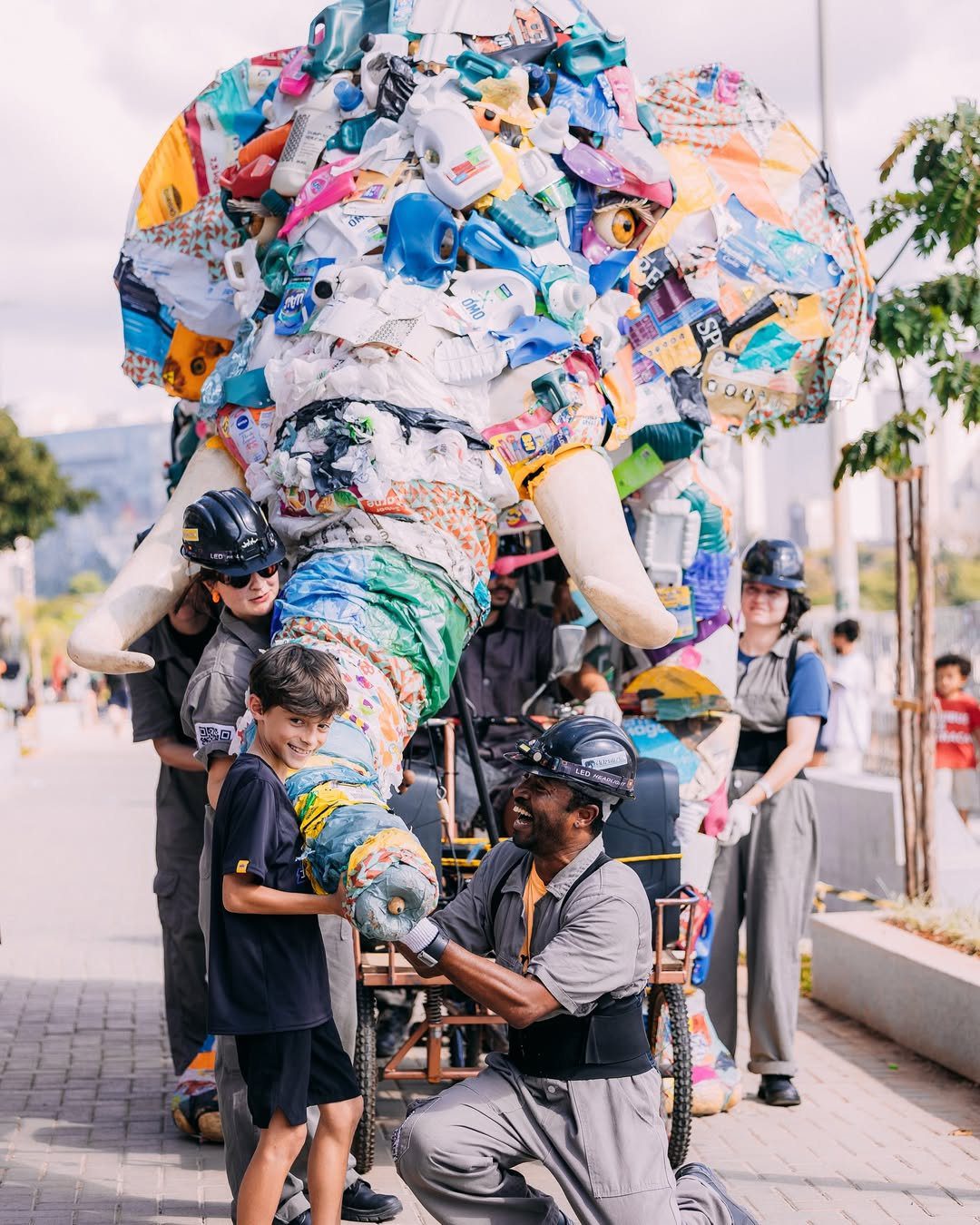
During the day, plastic expositions were shown, made with the goal of transforming trash with creative potential, raising questions about consumer habits. Through the night, a music event took place, connecting the public to the diversity of Black music.
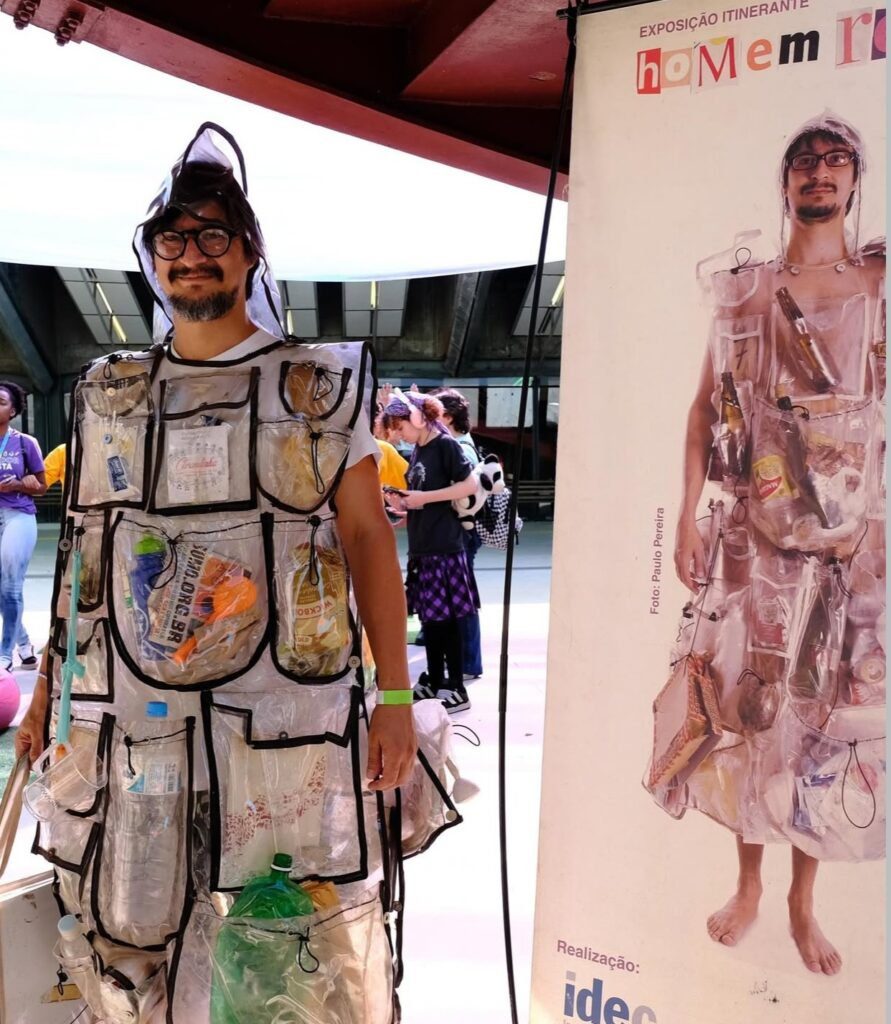
Many other artists were present. Between them, the artist Peri Pane, with the piece “Reflux Man”. Made in 2003, the project emerged from one of the artist’s ideas: during a week, he kept all his trash in a transparent plastic cape, made by the artist Mariana Reis.
It’s an artistic manifestation that seeks to provoke a reflection about the impact of individual consumption and the citizen’s responsibility with its own trash.
The artist Peri Pane (Photo by @peri_pane via Instagram)
The young Esther Dagápito told Yuvoice the most impactful moment of her experience at the Virada Sustentável.
“To me, the most impactful thing was the diversity of activities and the way that sustainability was thought beyond traditional molds, understanding that it is necessary to listen to plural voices to think about a better planet.”
Esther highlights an important aspect of the event: the activities focused on children. There, kids were able to have a dynamic contact with the climate agenda through games, dynamics, picnics with songs aimed to their ages, and much more.
“I was struck by the number of activities geared toward children, something that isn’t common given that children aren’t always included in this debate. As the producer of a collective focused on well-being, art, and regeneration that organizes activities for children, I consider the presence of children essential,” concludes Esther.
The program also stood out for its strong Indigenous focus. On September 21st, the city hosted an art fair dedicated to the native population of the country, featuring Indigenous people from Jaraguá Jardim. Additionally, Paulista Avenue hosted fairs, thrift stores, and discussion groups with Indigenous activists.
On the last day of the event in São Paulo, Txai Suruí, an Indigenous leader of the Paiter Suruí group, spoke about the need for debate on issues such as climate emergencies.
“This topic must be increasingly strengthened, whether by municipal, state, or federal governments, or anyone else,” she stated.
Txai Suruí advocates for a more observant approach to those suffering the consequences of environmental change and also for the need for government accountability regarding these factors.
“It’s necessary to discuss quality, pesticide-free food. It’s necessary to discuss vulnerable communities, where environmental impacts are first impacted by floods and landslides. […] All of this relates to what’s being discussed in these global forums and what’s being decided in the Chambers of Deputies and the Senate.”
In 2025, Brazil has the opportunity to become a benchmark in international cooperation for sustainable development through joint actions that seek a more just society and a balanced climate.
This initiative gains even more relevance this year, as the country hosts the 2025 United Nations Climate Change Conference (COP30), a global event that discusses solutions to the climate crisis.
The Virada Sustentável 2025 program is organized around the question “what is important to report on climate change and sustainability?”, reinforcing the connection with the UN Sustainable Development Goals (SDGs).
In an exclusive interview with Yuvoice, André Palhano emphasizes the importance of the event in 2025.
“This is the year in which we have seen, by far, the largest number of events related to this topic in several cities, certainly due to COP 30. But the curious thing is that many of these events and their promoters don’t communicate with each other, and don’t engage in dialogue. This led us to a challenge: to make this year’s edition of Virada a meeting place and an exchange of experiences among the different stakeholders in the cities, whether from the public sector, the private sector, or, above all, organized civil society.”
After the conclusion of the event in São Paulo, Virada Sustentável will travel to other cities in the coming months. Rio de Janeiro, Porto Alegre and Belém (COP30 host city) will receive the program until the end of the year.
Sometimes when we’re young, or even as adults, we want to play that childhood game of imagining “What superpowers would you like to have if you could have anything?” The first things that come to mind are usually invisibility, flying, reading minds, teleporting, the ability to see into the future. What about forgetting all the bad experiences we’ve had throughout our lives? That’s a superpower as well. Why not!
But what if that superpower grew out of control? What if that game slowly became your reality? What if no one noticed at first, but your forgetting superpower ceased to remain silent and crept like the shadow you and the people around you could no longer avoid.
If your superhero forgets, are you ready to be forgotten? Is anyone? Of course not!
Not only is being forgotten by someone whose life you are a part of not easy to accept, but it feels like the loss of their memory robs a little part of you as well. Because our existence depends on the memory of others. A little part of you is lost as someone’s memory of you fades. I don’t know if you agree with me, but look, it’s true. I have seen what happens to our lives if our loved ones don’t remember us.
The experience…
It all started with her losing her keys, leaving the stove on, forgetting to return home, forgetting how to cook her favorite dishes, consuming toxic products like kitchen products or ant poison, forgetting who she was and who we were, forgetting her own face in the mirror, being surprised to be told she was a mother and grandmother, and forgetting that she exists even while knowing she’s alive.
Little by little, she lost the ability to speak, although she makes herself understood. Her Catholicism remains intact, and every person she meets receives a blessing from her. Que mi Dios la guarde y la proteja. Amén (“May my God keep her and protect her. Amen.”)
The irony is that in the rush of losing her memories, she is returning to a past that is still present in her mind. She doesn’t know what time she’s in. She completely lost track of time more than 15 years ago. Since that cloud descended, it has hung constantly over her memory, her life, and withered the trunk of a tree that sustained the strength of the family… because yes, I write about Abuelita, an illiterate woman whose intelligence always allowed her to embrace life. Today she could be a master of time, of the eternal moment, and of all existence without needing to know tomorrow. Now she is a stranger to the immediate moment, a slave to time, and someone whose existence forgets yesterday.
Silently, she began to suffer without anyone noticing. As she tried to recall why she couldn’t remember things, her routine dwindled to one day at a time.
Today, the monster in her head has nothing left to eat. Even as she is forgetting how to walk, I am still following in her footsteps, and the Earth still feels the weight of her bones that refuse to surrender. She just enjoys one day at a time. I don’t know what kind of thoughts she has; she only talks to herself. Understanding her is like trying to understand a smile. I don’t know what time it is to her; we only enjoy her existence to keep her presence in our memory; and I often don’t know what time it is either; we simply forget time when we are by her side.
The Monster…
Alzheimer’s has distorted the challenge of understanding the eternal farewell, hidden the awareness of a time that has expired, faded the reflection in a mirror that will soon break, and stopped the hourglass at the instant when all meaning in life fades. Sand grains frozen in free fall.
The Monster affects neuronal tissue, which adults have on average close to 100 billion of. Even
a newborn has around 223 million. Neurons create, and recall memories, then protect them. However, when they begin to disappear, a person’s behavior changes. Some become similar to a three-year-old child. I’m not sure how many neurons my grandmother has today.
She began to suffer in silence, without anyone noticing. As she tried to process why she couldn’t remember, her routine gradually became a puzzle where she constantly had to find the pieces to put her mind back together, until one day she gave up. The pieces didn’t fit together, they were lost and disappeared, leaving a half-finished, meaningless game that was eventually swept off the table and onto the floor. Today I wonder what her last thought was before Monster took charge.
***
When today leads to goodbye…
Today she is 92 years old, and this all started when she was about 60. She used to tell me I was her favorite person—she’d told me that since I was a child—and now that I’m an adult, those words live on in my memory. Today she smiles with a lost gaze, trying to identify the person in front of her, but she can’t.
I struggle to understand her struggles, and to calm her anger.
She goes where her steps want to go, because memory doesn’t reach any corner or space.
Memory is a treasure we should all cherish. It’s a magic box where time should be itself and nothing changes. A lockbox where we can keep control and no one can steal any of it. A transparent box where we are the eternal instant that allows us to be alive and no one suspects it. And where experience is captured and refuge teaches us — a permanent storage box where we keep the life in a body and a body in time.
Yet, I don’t know how many secrets we keep, how many stories no one knows, and even… how much time we have to preserve our lives before an outsider tries to invite us on a journey into oblivion.
I haven’t said goodbye to her yet. Maybe I’m not ready, because when I am, she suddenly remembers my name, suddenly my time and hers stop for a microsecond, and suddenly the call of hope makes sense… but nothing happens. They are just shooting stars that cross our path to remind us that everything built in life also dies in life, and with it, a hundred stars I’ve seen.
I’d never questioned it, but Alzheimer’s is the answer to understanding that memory has its time, it has a limit, it has an expiration date, it has an end, and it has its own cycle, but all within our own reality.
That game of “What superpowers would you like to have if you could have anything?” is not, for many, an imaginary world, but a reality in which the life of Alzheimer’s itself is silenced behind those who live it.
Faced with the refusal to accept that death also lives within us once, time is no longer the obstacle many fear.
There’s this childhood film that, no matter how outdated the CGI clearly is, just seems to get me — even today. “The Adventures of Sharkboy and Lavagirl” made me feel seen in my perceived difference from others my age; I was naturally more of a loner, more of someone on the outside. As I’ve gotten older, however, I’ve come to relate to the movie’s plot through a different understanding —that of losing loved ones.
An unexpected loss times two
At seventeen, I lost my maternal grandfather, Grampy, to stage four brain cancer. A year later, I lost my maternal grandmother, Hud, due to an incident at her assisted living space during the pandemic. Both deaths were unexpected for our entire family.
I couldn’t process it all at the time. It was too much, too fast.
As Grampy and Hud’s only grandchild, we had a strong bond, and they were an integral part of my support system. I felt their encouragement no matter where I was in life. They celebrated me and consistently showed up for events like Girl Scouts, choir performances, birthdays, and more.
I don’t think I’d be the person I am today if it weren’t for both of them.
I often reminisce on the memories I have of my grandparents, looking through scrapbooks we made together and watching movies we loved — like “The Adventures of Sharkboy and Lavagirl.” Over the course of the last few years, I’ve begun to process my grief through these actions. I’ve also managed to retain a connection with my grandparents despite their deaths.
Reconnecting with the things I enjoyed when I was younger allows me to experience how life was when Hud and Grampy were alive — easier, more fun. It’s a temporary escape from the stress of daily life, from adulthood.
Grampy and Hud on one side, Sharkboy and Lavagirl on the other
In “The Adventures of Sharkboy and Lavagirl,” the protagonist, Max, uses a fantasy realm as a method of coping with bullying and family issues; the dream world is his safe place. Like Max in his dream world, my dreams allow me to continue my life with Grampy and Hud as it once was.
In my own dream world, my grandparents regularly appear. We carry out everyday tasks together, like shopping, going out to eat, and having Tuesday night dinners at their house. I wish that time was infinite in those dreams. In other dreams, they’re alive, and I’m trying to prevent their deaths to no avail. Those dreams can’t end fast enough.
I now have a constant fear of unexpectedly losing more loved ones. Emergency medical situations are anxiety-inducing, as are travel plans. My grief is also hard to contain — it overflows, causes me to do things out of the ordinary, and makes me want to punish myself. It’s agonizing, and intensifies my depression and suicidal thoughts. I blame myself for what happened to them, even though I know it wasn’t my fault.
When life doesn’t feel as heavy, I speak about who Grampy and Hud were in honor, much like Max proudly sharing the legacies of Sharkboy and Lavagirl to his peers.
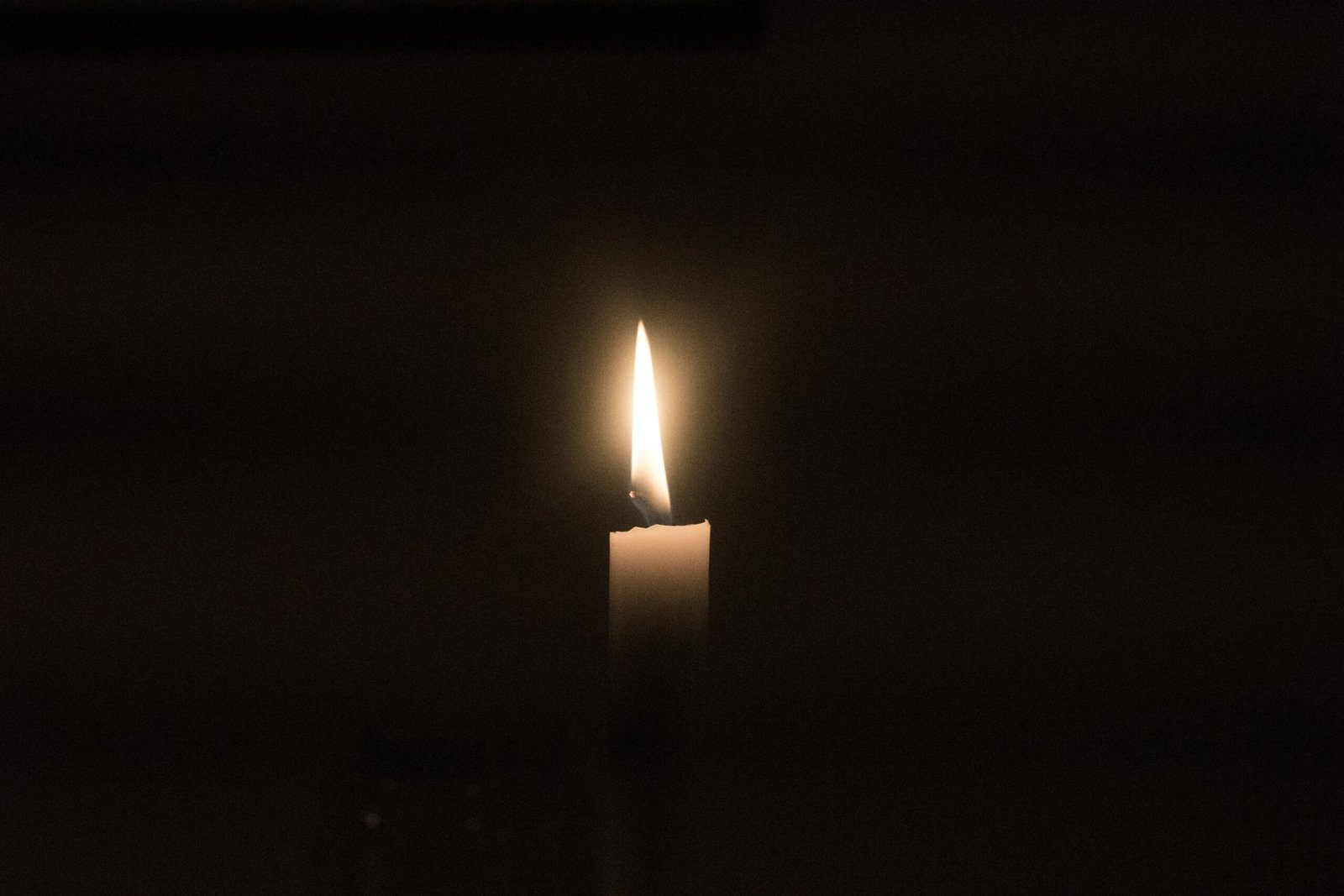
(Image courtesy of Johannes Plenio on Unsplash)
I don’t know where they went
Mentioning Hud and Grampy in the past tense reminds me of Max in the beginning of the film, when he’s unable to explain where Sharkboy and Lavagirl are. Another character asks him: “Why don’t you bring Sharkboy and Lavagirl to class tomorrow?” Max explains, “They went away. I don’t know where they went.”
Much like Max, I don’t know where Hud and Grampy are or where they went. I’m not religious, nor do I have any particular beliefs about what happens after. In all honesty, I don’t really want to think about in what state they might — or might not — exist.
Max knows that Sharkboy and Lavagirl are real, and he knows where they are when he’s asleep — they come alive when he’s dreaming. At the behest of his family and peers, Max tries to tell himself that Sharkboy and Lavagirl don’t exist, but he finds it difficult to believe. This reminds me of the first stage of grief: denial.
Immediately after Hud and Grampy’s deaths, I found it challenging to refer to them in the past tense. It was an internal denial of their passing; I just couldn’t accept it.
The aftermath holds so many questions
I daydream often about how differently my life would have turned out if my grandparents were still alive. Would I be happier? Would I still have admitted myself to a psychiatric facility last year? Maybe it’s unrealistic to think their presence would have changed much, but the questions remain for me.
There’s a moment in the film where Lavagirl asks Max to dream about her so her identity will become stronger. She tells him, “Dream about me next, Max, I need to know who I am. Not just destruction, or a simple flame. Dream of me as something good.”
I frequently wonder which pieces of my identity are a result of Grampy and Hud’s love and which pieces were lost when they died. More questions bound through my brain during these moments.
Would they think I’m a good person? Have I made them proud? What advice would they give me? I’ll never know the answers to these questions, and I never will.
I can’t change the past or bring them back to this earth. However, I can focus on how much love they had for me, and I for them. Those recollections are my safe place, especially when life feels heavy.
I can’t yet mend the parts of myself that were broken when they died back together, but I can hold onto their memory. And like Max, I can dream of them — where life goes on just as it used to.
Who doesn’t love babies? They’re cute and they will grow up to support us in our old age. But there’s a problem – people are having fewer of them. Global fertility rates have fallen by more than one child per woman since 1990, to 2.2 live births in 2024, according to United Nations data. The growing financial burden of people living longer has caused alarm throughout the globe. China dropped its one-child policy in 2016, relaxing it further to allow families to have three children in 2021, yet the UN still estimated China’s 2024 birth rate at only just over one child. Latest data from Britain shows fertility rates are at their lowest since records began in 1939, at 1.41 birth per woman. Other European countries have even lower rates, including countries usually regarded as family-orientated, such as Italy and Spain. But governments which have looked to replace their own populations with younger immigrants have faced pushback. The Brexit vote in Britain to separate the country from the European Union was linked to the EU’s open immigration policy towards its member countries, and anti-immigrant protests have continued in Britain this year.
However, there’s an upside to falling fertility rates. Emerging markets economist Charlie Robertson sees the lower number of births as a boon for developing countries with young populations such as Kenya.
“It’s incredibly dangerous, the Western media narrative about how awful ageing societies are, implying that high fertility rates are a good thing,” he told Yuvoice in an interview.
In Kenya, where the average birth rate has dropped to just over three, compared with nearly five 20 years ago, growth will be turbo-charged in the next few years because in smaller families, parents can afford to put aside savings. More savings mean more money in the banking system, and when the banks are flush with cash, they tend to lend to businesses at lower interest rates. This makes it easier for businesses to expand, driving economic growth. “It’s impossible to have a big banking system with high fertility,” says Robertson.
Fertility rates have played a major role in Western history. Robertson says Marx was wrong on demographics, as he assumed that the high fertility rates of mid-nineteenth century Britain would continue. This would increase competition for jobs, leaving many jobless and ultimately leading to revolution. Instead, “the fertility rate began to slow and continued to decline, we didn’t reach that tipping point”, Robertson says.
The key to lower birth rates is education. When women are educated, they often have fewer children. “You give them the possibility to have a career, to have a choice,” according to Robertson.
So which developing countries are set to benefit from lower fertility rates? In addition to Kenya, Robertson highlights Egypt as poised for take-off after its fertility rate fell in 2019 below three, the magic number for kickstarting growth. Nigeria, with a fertility rate of 4.4, will take longer to industrialise.
In Asia, a fertility rate of 2.1 in Bangladesh translates into faster growth than in Pakistan, for example, where the rate is 3.5. In Afghanistan, meanwhile, a lack of education for women will guarantee the country has “continuing decades of poverty” according to Robertson, because fertility rates will remain high.
His views are controversial with those who feel that a higher birth rate is helpful for families in countries with no social security net. A recent report from development economics platform VoxDev, for example, shows that when women in Africa have a higher income, they have more children to safeguard their long-term economic security.
On the whole, economists in developing countries are on board with the importance of lower fertility rates, according to Robertson, but “politicians don’t get it”. Maybe baby-hugging is just too attractive a photo opportunity for politicians to discard it.
To my great surprise, the year has turned its cogs once more through their cycle, delivering us to the dreary descent of winter and everyone’s favorite pumpkin-slaughtering holiday — Halloween. Now, the day itself doesn’t represent a great deal for me or my family. I know Mum will be tucked up in a blanket next to her expensive log burner, enjoying the autumnal chill that October heralds — the excuse for tucking away on lazy evenings. Dad will have forgotten (not for the first time) to stockpile any sweets before the inevitable stragglers in threadbare costumes come salivating at the door. There’s never been much ceremony for ghosts and goblins, or any of that materialistic nonsense, but this year will be special.
Not to blow smoke up my ass, but I am my parents favorite (and only) son, and I will be blessing them with my company.
Feels like an age since I saw them last. Life just escapes you, doesn’t it? One’s parade of self-importance and fractured completeness overwhelms everything; that’s to say, I’d be perfectly happy to kick my feet up with the wife in Hoxton… sneak in a signature mocktail. Perhaps bump uglies over the ominous tones of Michael Myers rampaging through Haddonfield (such a ridiculous franchise — I mean, it’s iconic and undoubtedly transformed the slasher genre, but Michael, my buddy and pal, walk a little faster). Something about this year though… We’ve grown tired of routine. “To hell with automation!” So Laura’s visiting her brother in Ireland (who’s a bit of a nut for the spooky season himself — she’ll never escape), and I’m visiting the hallowed streets of my glorious hometown… Dramworth.
You know when you’re a kid and everything feels more compact? Everything makes more sense when it’s handed to you on a silver platter — nothing adult to worry about, only your numerous group of friends, who’s snogging who and which local park you’ll be vandalizing next. A town like… Dramworth (God, I can’t even say it without dying inside) can feel like your whole world. Then you reach that second stage of young adulthood where you’d literally dig through hell and back to escape those cloying memories and never return? Yeah, the older I get… and the more this bus does a kickflip every time it hits a pothole, the more I understand where that impulse is borne from.
Something’s changed here… Even the generic bus smell is different, more clinical. Less likely to taper your nose hairs with curling wafts of ass dust… Well, no one’s mourning that loss.
Stepping off the drear-mobile, I realize it’s a remarkably on-brand day. Dull, gray skies; the distinct possibility of rain, foretold by hurried attempts to fold up the standing dryers lurking in front gardens; a biting wind that tears through any attempts to appear cool or nonplussed. There’s literally a tumbleweed in the gutter. The local witches will be most pleased.
I’ve packed only the bare essentials for staying a few nights — let’s just say I’ll be reusing underwear. I don’t know, it’s difficult to visit my parents regularly nowadays for more than short, controlled bursts at a time. I’m not attached to them by the hip anymore, so they’ve taken that strange path of evolution, upgrading from parents to just… people. People I don’t necessarily get along with all of the time. They’re like my in-laws now… Actually, no, that’s not fair. My in-laws are much better.
Still, it’s necessary, isn’t it, to repair those broken lines of communication before the portent of mental decay and the rapid search for nursing homes. That’s when they become children for the second time. When you suddenly look upon them with tinted eyes and wonder where the time escaped to. And you confront the things that were never said and now cannot be understood. Makes me shiver a little bit, so it’s not something I dwell on more than maybe… once a week.
I want to see them. Maybe I have to keep telling myself that, hoping the fact sinks in, but it’s absolutely true. There’s many a life update to share. It’s all been hush-hush till now, but… Laura’s expecting. We haven’t had the scans yet, but she’s secretly hoping that the gods of anomaly are on her side and we get twins. Two little girls. I must admit, the idea appeals to me greatly. Plus, work is blooming on my end. The company just recently processed a vacancy and they’re recommending me for…
The fountain’s gone.
Wait… Am I in the right — Yeah, I’m not that lost. This can’t be right. Ron’s Fountain, it was right here in the town center! It was, like, our one notable tourist destination. What happened? Did it get airlifted?
Come to think of it, everything’s half-falling apart around here. The shopping mall is a quarter-mile of tired linoleum and B-side shops that fall just outside the region of relevancy… Well, it always was like that (I enjoyed poking my head into Home Bargains every so often, trying to find the weirdest drink possible and sampling it with a group of my friends — that’s how I figured out I like the taste of dandelion and burdock). The market stalls in the plaza stand empty, now a labyrinth of obstacles for young lads on their Voi scooters. Exposed brickwork, fading plaster, repurposed windows… When did it get this depressing?
It’s just a shell now…
And suddenly, I get the distinct sense I’m being watched. Not maliciously, in the way of sizing up a target or judging someone’s appearance. Just a vague, apathetic awareness of one’s presence crossing into another, invading an alien space and loitering… And I realize how long I’ve been standing in this one spot, staring into an empty fountain basin and drooling onto my chin. Damn my nostalgia!
Can’t believe this. Back when I was young, that fountain was a sight to behold. One of the jets was said to reach twelve feet in the air! My friends and I never really spent much time around the fountain itself — I mean, it was swarming on all the good days, people making wishes, flicking coins into the bottom and all that schmuck.
But we knew Ron, this homeless dude who draped around the alley on Knox Road. Before the market got really busy in the mornings, around the time my friends and I would be heading to school, we sometimes caught Ron splashing about in the fountain, having a whale of a time (I mean, genuinely, I’ve never seen unfiltered joy quite like Ron’s when he got into that water). Usually we sniggered and moved on, making fun of him as young kids do, but sometimes we called out. Went and bantered with him. He was honestly such a down-to-earth guy (if, admittedly, a little unfurnished upstairs) and not at all the picture of the loony we’d generated in our heads. He always stank of petrol for some reason…
One time, the police caught him in his act. There was a standoff, apparently. Reports say he held his hands up as if they’d trained a gun on him and assured them he was only washing himself. Naturally, this didn’t go down well. Ron was chased out of there (with his pockets chock full of silvers and pennies, I imagine). From what I know, he was never apprehended, but… we never saw him again after that day, so I couldn’t confirm that.
Now that I’m three blocks away from my parents, I’m absolutely sure I’m being followed. It’s funny… I think I’ve seen maybe five people out in Dramworth today. That’s it. Maybe everyone’s fully embraced the Halloween spirit, becoming masters of disguise and fading into the creeping shadows, but I doubt this town’s coordination is that strong. Dusk is descending, so it’s possible people are just settling into their evenings. Still… It’s eerie out here, and every footstep is magnified. I’m not even sure which direction they’re coming from, but I can hear them. Around every bush, between every parked car.
I don’t fancy turning around to confront them. Back in Dramworth, having eyes on you is something you just become accustomed to while sticking to lit paths and fostering a monumental sense of awareness. I’m almost home now and, hey, I’m a grown-ass man who don’t need no…
The footsteps recede. I stop still as a crosswind picks up, scattering skeletal leaves across the dented pavement and into the road.
There’s a faint whiff of petrol on the tide of the breeze.
– – –
I ring the doorbell. Crusty old thing — one of those Victorian antiques, now green with oxidation. The front porch is inherently familiar, coaxing like a warm embrace. Mum opens the pine door. She smiles. I smile. She reaches down to help me with my case.
In 2025, the physical education teacher Thiago Feijão, 32, faces Brazilian justice for the second time, accused of robbery and murder. The worst part of this history? There’s a good chance that he’s innocent.
Convicted in 2015 through a photo lineup, he presents evidence and testimonies in support of his innocence. The case is marked by contradictions and racial bias, which generated national repercussions and reignited debates about discrimination in the judicial system and the narrative of racial democracy in Brazil.
A Black man, Thiago was accused based on a photograph identified by only one witness, who at another moment had described him as a white man. He was sentenced to 28 years in prison for robbery followed by homicide and armed criminal association.
According to the prosecution, Thiago allegedly took part in two robberies, including a felony murder, on May 29 and 30, 2015, along with three other men.
However, he presented witnesses and evidence proving it was impossible for him to have been at the crime scenes.
May 29, 2015: Thiago was working at a warehouse managed by his family. The ice supplier, Édson Santos, confirmed having spoken with him minutes before closing his shop, making it impossible for him to reach the crime scene in time.
May 30, 2015: Feijão said he was picking up his daughter and getting ready to watch a UFC championship at home. His wife, Sharon, presented phone records, cell tower location data, and a statement from his daughter’s school principal as proof.
Thiago’s identification was based solely on a photograph. Although the initial witness had described the suspects as three Black men and one white man, Thiago, being Black, was still charged as the “white suspect.”
He was imprisoned for two months until he obtained habeas corpus. With a new arrest warrant issued in 2024, Feijão decided to go into hiding, a situation he remains in to this day.
The case returned to national attention in 2025, when two new witnesses securely identified another man as responsible for the crimes for which Thiago had been convicted.
In an interview with Yuvoice, Thiago’s lawyer, Rodolfo Xavier, stated:
“For me, the moment that stood out was during the hearing in the early evidence-gathering procedure, when it became clear that the photo attributed to Thiago Feijão was in fact of another person.”
The physical resemblance between the two men had led the initial witness to make a mistake.
“It was Ruan, already deceased. The ones who recognized Ruan in the photograph were his widow and also his former sister-in-law. Both testified in court and confirmed the recognition,” he added.
The criminal appeal presented by the defense was rejected, leading the lawyers to file a habeas corpus with the Superior Court of Justice (STJ) in an attempt to overturn the decision.
The request was denied on the grounds that legal criteria had not been met and that the appeal overlapped with the trial of the main case, still pending.
The case proceeds slowly, and Thiago’s defense team now awaits approval of the request for annulment of the photo lineup and, secondarily, acquittal for lack of evidence.
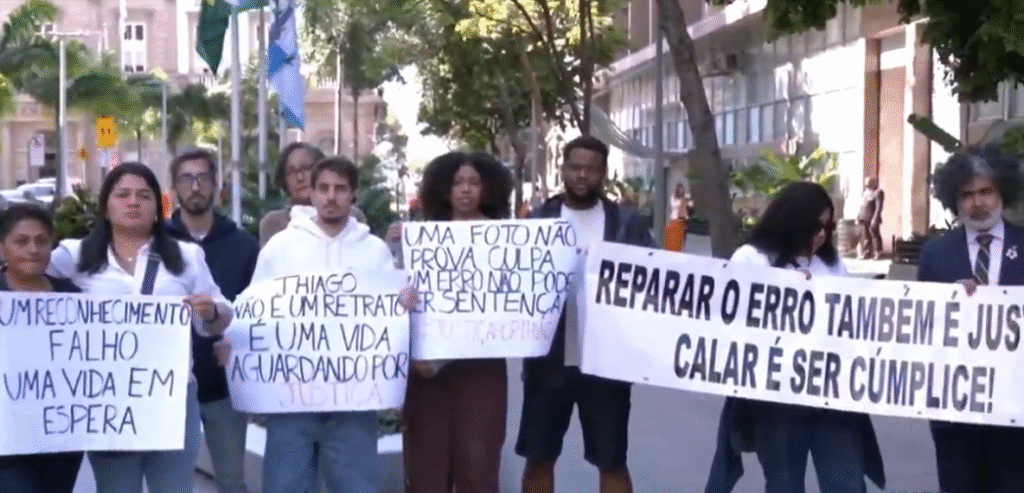
Family holds protest in Rio de Janeiro, Brazil, and calls for justice in the trial of Thiago Feijão – Photo credit: SBT
The myth of racial democracy
Thiago Feijão’s case sparks outrage and opens discussions on how structural racism operates intrinsically within Brazil’s judicial system.
A misidentification can cost years of freedom and inflict enormous suffering on families, highlighting the unequal weight of justice for Black and white people.
Since its early history, Brazil has often been portrayed as a naturally egalitarian country due to miscegenation. This discourse, cemented as common sense, denies the racism revealed in research and daily life for Black Brazilians, also affecting their self-identification.
Sociologist Gilberto Freyre, in ‘The Masters and the Slaves’ (‘Casa-Grande & Senzala’, 1933), reinforced the idea that miscegenation favored national development and would create a “cordial” nation, ignoring that relations between masters and the enslaved often involved coercion, abuse, and violence.
From this perspective emerged the narrative that Brazil was a country without racial division, where everyone was equal, even before the law. This belief became widely disseminated and deeply ingrained, serving as a way to deny data that demonstrate unequal treatment based on skin color.
João Miguel Goes, 18, shared with Yuvoice his experience as a young Black man in Rio de Janeiro:
“[…] Because if it really were about safety, safety for your own life, you’d have to stay at home, you’d have to deprive yourself of living. So, to keep on living, you live in fear, in tension. At any moment something could happen to you, they could accuse you of something you didn’t do, but since you’re the one with dark skin, curly hair… then the blame falls on you.”
According to a 2023 study by the ‘Rede de Observatórios da Segurança’, 90% of people killed by police that year were Black. This shows that police violence is not distributed equitably, but disproportionately targets the Black population.
Figures like this make clear the need to reject false ideas such as the myth of Brazilian racial democracy. In practice, stories like Thiago Feijão’s show that this idea is an illusion.
It is not about individual mistakes but about a structural pattern in which Black people are more readily positioned as suspects.
The scales of Justice are not balanced for all, and structural racism continues to shape experiences, opportunities, and identities in Brazil.
As the hot chocolate cooled down in our mugs, and the buttery popcorn was ready after the tape was rewound, he popped onto the TV screen. His animated purple skin, bright uncanny eyes, and devious smile materialized.
His dangerous, yet, spirited voice spoke the words, “Hi, there. Face, here!” I began to scream, thinking of many scenarios where he could attack me. Tears began to flood down my face, like rain on a car window. Not again. Not again.
I just wanted to watch Little Bear! Why was Face here?
His Role in My Life
Face haunted me on the daily; he haunted me whenever I watched a “Nick Jr.” VHS.
However, the most frightening thing was when I thought about Face before bed. I tossed and turned, while he took the form of objects in my dreams. One second, he was an airplane. The next, a flashlight, shining in the dark.
I never knew what he would shapeshift into. I was three — I didn’t understand that images cannot pop out of a TV screen and hurt you. I imagined him emerging from his pixelated prison, harming me with his non-existent body.
It would have been easy for Face.
A Continuation
Once VHS tapes fell out of fashion, I was relieved to know that Face would remain a relic of the past, a horrifying memory trapped in childhood.
By the time he was revived in 2022, I was 20 years old. Too old to watch “Nick Jr.,” too distracted with college to know about Face’s Music Party on Paramount+.
As I am writing this, I don’t know why his animated voice still makes my hands shake with fear.
My body attempts to regulate itself. He isn’t real, it’s just animation. I know he can’t cause me injury, but my inner child relives the emotions I experienced back then.
His prison holds him, and has done so since 2004. He was let out three years ago, and his release was short-lived. Face’s freedom was tainted by his selfishness — his destiny carried out, much like that of a parasite to a host.
Resurrecting Face
I stumbled across a Blue’s Clues VHS last month while searching for home videos. He was in a small shoebox that was labeled, “Kristen’s Things: Blue.” I didn’t see it at first, since the shoebox was trapped under a larger one that featured the motif of a VCR.
Curiosity struck me, and a false sense of security covered my body like a heated blanket. His orange plastic casing kept me safe.
I believed he had forgotten about my existence. Your mind tricks you, tells you that there is no harm. Occasionally, the fight-or-flight response fails to deploy.
You are stuck in midair. There is no safety net. This might be your new home.
Somehow, I found my way back down. I decided to open the Blue’s Clues tape. My laptop began to glitch, and the screen became a bilious shade of green.
There was no possibility of this occurring, yet, it happened right in front of me.
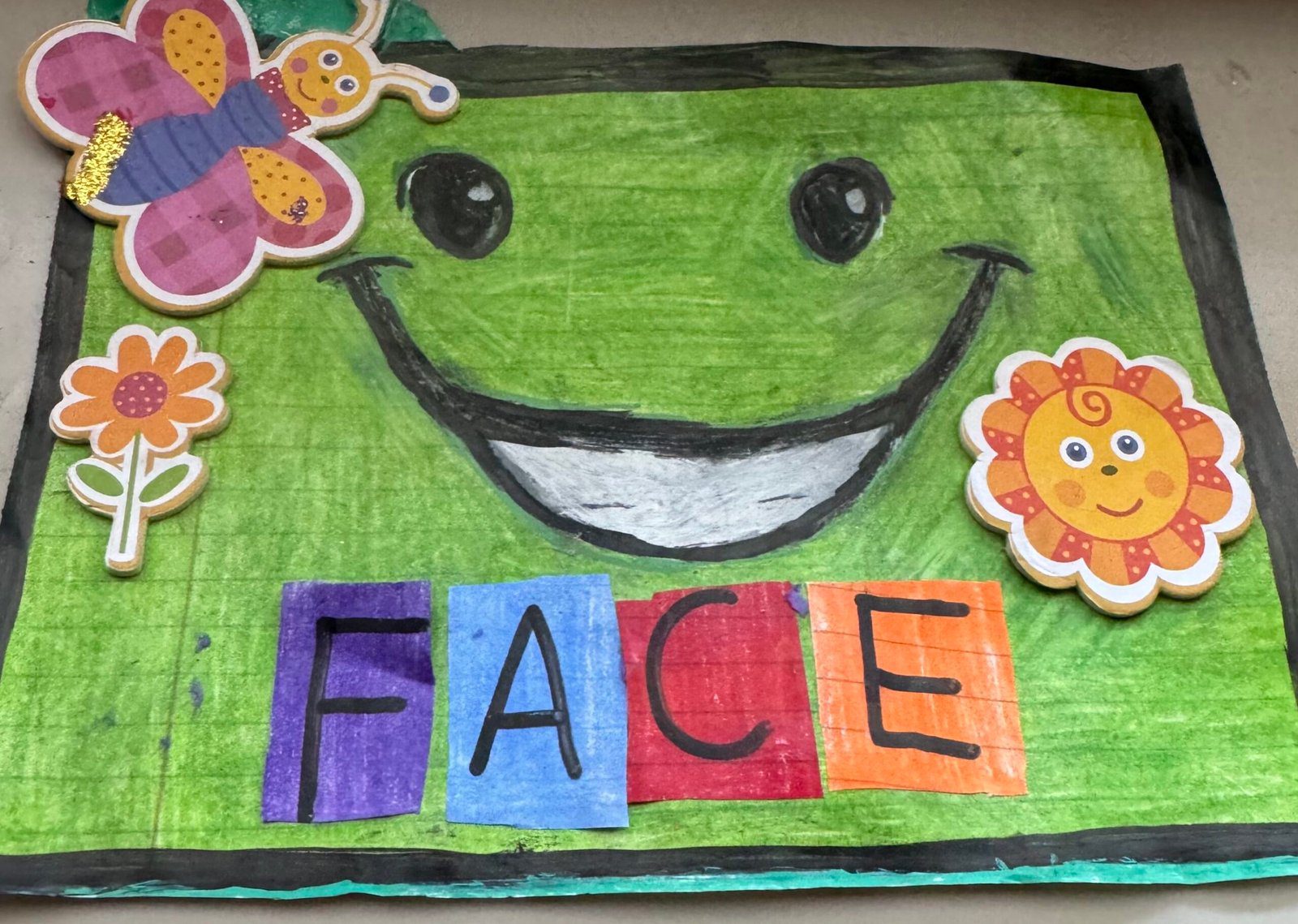
(Image courtesy of Omar Alnahi via Pexels)
Ctrl C, Ctrl V, Ctrl X
He spread his code and reproduced until his genealogy had been extended. He forced the commands: Ctrl C, Ctrl V to copy and paste his DNA.
Face spent his time doomscrolling through my files, and eventually, commanded my laptop to press Ctrl X. He lived on while my fragments of me were obliterated.
The trumpet sound he produces plays on repeat. His eyes are enlarged, and his smile wide and wolfish. He redirects his gaze, focuses on me.
He is worse than the ILOVEYOU virus. He is more than a bug — he is a trojan. Face seems innocent and cheerful, but he is insidious, a maddening malady.
I don’t believe that I am his only victim; he will attack whoever seeks him out.
He is your worst enemy; one’s least favorite nightmare. His presence haunts you until you want to beg him for mercy. But, you do not want to let him win.
The Winner?
You destroy the tape when you return home, and practice deep breathing to cope. The terror is over. You were the last person in your family to experience his wrath.
However, you forget to warn your neighbors who have children. The next day, you hear screaming from across the street, and that laughter that sounds like sick.
From a distance, the words: “Hi, there. Face, here,” are spoken. You know that odious sound too well. If you intervene, he will target you again.
It’s too risky. All you can do is hope your neighbor knows how to destroy him.
Two days later, you find her TV, remote, and Amazon Fire TV Stick on the sidewalk. There are two large buckets of concrete in the grass. While she is at work, you drown Face in the cement mixture, vindicating your neighbor and her children, now tethered to you in trauma.
He has finally been defeated. He cannot be resurrected again. His reign has ceased, and you do not ask to take credit for the end.
You were mine while it lasted
In body, in sheets, in endless glances.
You were mine in the frozen hours
Of two hearts determined to love
Timelessly,
In the yesterday of today and
The today of tomorrow,
Your silhouette in my mind where you live and relive,
The memory of my mornings.
We are no longer…
We are sand in tides
Playing with moon cycles
So as not to forget the seconds,
The love within watches.
Yes, that is what we are…
Love in life
Without knowing the end,
Because on our bodies
You left a mark
Which forgetting cannot erase.