Ever Be Forgot

Ever Be Forgot

The foreboding he felt was palpable. Bad juju, bad mana – no good vibes here. It was the sheer number of them. The closer he got to the designated site, the more cars there were. Road sides had started to look congested about 4-5 miles back.

By the time Eddie Whelan parked his car, there was no further to travel; it was park up or turn back. The winding, thinning country lanes up to the forest were stocked with cars everywhere he looked. This felt enormous. People had travelled a long ways to be here, from all over the country, and so very many.

Deep autumn right on the cusp of winter, when “the fall” has lost its charm. The first flashes of crispy pastel yellows and oranges dissolved into the sludge of dark mud under foot.

“Shit,” Eddie somewhat gasped as nearly an entire shoe was swallowed by mud. The visibility was dismal. There was clearly some form of glow emanating from the depths of the forest. Mainly, he was guided by a mid-distant hollering and the banter of the revelers way ahead of him.

A brief glance back and Eddie’s car was no longer visible in the gloom of later year night. Nevertheless, he kept moving forward, identifying the pines and conifers ahead with his phone torch. It felt eerie; it felt like it couldn’t be trusted. Time, place, setting – everything was off.

His years in the field had taught him he couldn’t really trust any novel environment – that caution, and an unblinking vigilance, were a necessity. But this was a flavor of feral he hadn’t sensed in a good while, maybe since youth. This was Guy Fawkes Night after all:

“Remember, remember the 5th of November.”

A holiday 400 years in antiquity, a staple of national identity.

“Gunpowder, treason, and plot…”

Counter terrorism before it was named, as King and Parliament saved.

“I see no reason, why gunpowder treason…”

Bring fireworks along, lighting bonfires must be done.

“Should ever be forgot.”

An evening of national pride, community, and fun.

Eddie wiped a drip of snot from the tip of his nose. The assaulting British cold emanated from the forest with every step. The winter to come was making its presence known – wrap up as you will, it’s going for your bones.

Wading deeper into the foreground of ominous pines, Eddie felt his entire back stiffen. This was a hell of a time to be out late… anywhere. He’d watched helplessly in recent months as his waistline and appetite for casual cigarette smoking grew. He thought to himself that maybe his job had never been harder.

Current affairs reporting in the 21st century was seldom uplifting. Journos knew the score, just as the general public did. Negativity, cynicism, and the inflammatory were catnip to news consumers. Yet, this was a bad year.

Britain’s social fabric was hemorrhaging. National identity had gone from being something revised, expanded and growing, decade for decade, to something febrile and dangerous. Forging ahead was rejected while screaming for something long gone was the order of the day. Exactly what it meant to be British had become a nationwide obsession. In many corners, it became a green light for vigilantism and worse.

Eddie could hear voices getting louder up ahead. The silhouettes of tree trunks getting steadily clearer. He couldn’t tell if it was his eyes adjusting to darkness or if he was moving towards light. A sharp crunch echoed nearby. Eddie made a snap glance behind. Nothing. Was he being followed?

Arguably the originators of conservatism, Britain had only in the most recent decades used the word “diversity.” The term Britain had always favored was “tolerance.” Yet it was clear in some parts of the country, this had long since faded. The picture was ugly. Violent white crime remained on a steady upward trajectory. Youth crime circled its perennial numbers. Hate crimes were suspiciously falling out of reporting, circulation, or consideration. Streets had become hairy.

Some areas of the country started setting curfews – the most economically deprived areas; typically those neighboring acute densities of immigrant communities. This, commentators called the British Establishment’s greatest failure since the three-day week. The defeat of it reeked. If you can’t make a better society, then survey, control, and cage it. The headlines were clickbait gold. Their message was societal decay.

IS THE BRITISH POLICE A SPENT FORCE?

SERVE AND PROTECT WHO?

OLD BILL OUT TO PASTURE!

The fuse was lit 6 months prior.
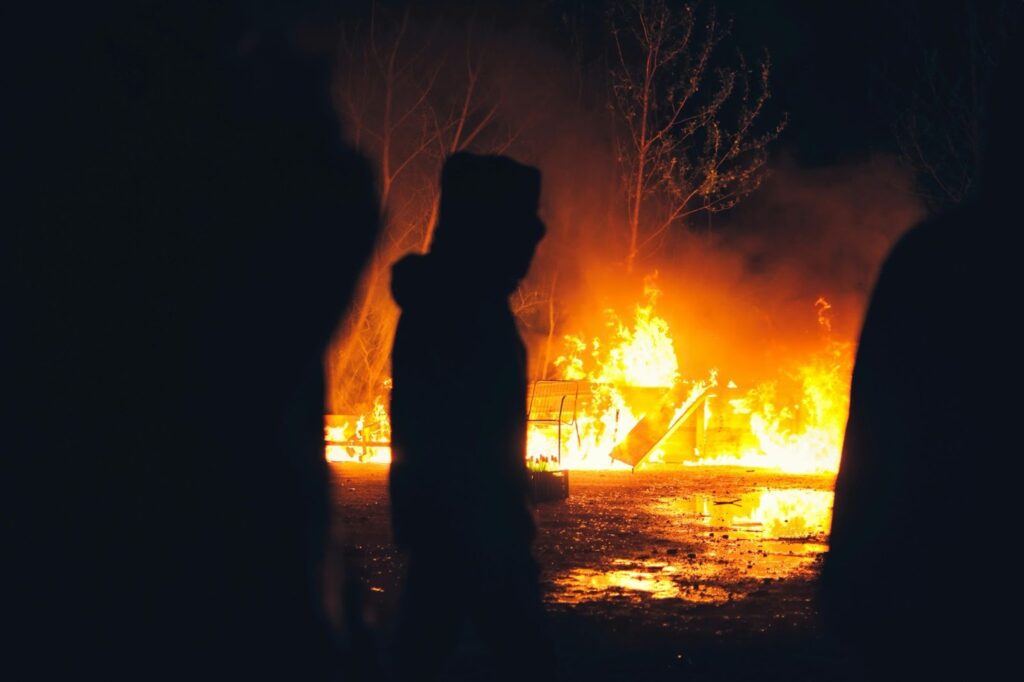
Three dark figures stand watching a public park ablaze as a bench and child’s slide go up in flames.
(Image courtesy of Marco Allasio via Pexels)

Shrill screaming filled the air. A firework ripped through the sky in a phosphorous tear. A pocket of silence followed before a loud pop of neon green splinters gilded the night sky. Eddie made a slow nervous turn to check behind him. Nothing again. As the airborne metal salts faded, the auburn glow of bonfire swelled ahead of him. At his furthest squint, Eddie could make out people marching towards the blaze. He followed.

The internet being a public space mirrors its real life counterpart: what is unacceptable in broad daylight may well find its private settings, corners, or… forums. Many who gather underground, away from the masses, are easily swayed and influenced by conspiracy and fear-mongering. The results can be disastrous.

Such a disaster imploded in an online forum exclusive to the British Isles. Some snarling, aggrieved, nefarious collection of men had taken it upon themselves to begin surveillance of places of worship and their attendees around their local communities. Blinded by bigotry and fear, they did not see the harassment or encroachment of civil liberties they were committing.

Eddie’s walking slowed when the bonfire was only partially blocked. He was no longer alone. The many, many cars parked up had indeed come to this site for what was an almighty bonfire. He couldn’t make out the entire scale of it because it was… it was as big as a house. And no small house.

Like a snowball rolling down a hill, the more this xenophobic tribe posted, the more the number of posts grew. The more the number of posts swelled, the more fictitious narratives and venomous storytelling were assigned to the innocent parties they preyed upon.

After an escalating 3-month campaign against one such individual, stalked and swatted by a forum frothing from the mouth, one of the very worst hate crimes in the country’s history was committed.

Women were left degraded and on life support. Children, grossly still, with skull fractures and broken bones lay in intensive care. A family and their home marred beyond recognition– all while the father was away and unable to protect. Horrifying, blind hate.

Eddie was no longer alone. A hard slap on the back announced the fact.

“Get in!” barked a scratchy voice leaving a full pudgy face, grinning wildly in giddy solidarity. The reveler marched ahead, unawares Eddie was far from one of his own. Eddie was struck by the heat emanating from the bonfire. This was as much a formidable force as a gathering point. The base of the behemoth bonfire was hardly visible from the dense crowd surrounding. Then, Eddie looked up and stopped walking closer.

The intelligence communities, in conjunction with the police, soon found the culprits. Those convicted individuals swore that they knew the truth. They claimed, feverishly, that they had attacked the family of an extremist, a terrorist in waiting, a threat to society. Yet, the intelligence communities found nothing of the sort.

Their “target,” upon interview and background checks of length and depth only intelligence teams could conduct, showed no prior or present links, trails, or anything nefarious to his name. The forum had created a monster that didn’t exist. Innocents lay in hospital beds thanks to imagined enemies – a disaster of both social and epistemic proportions.

Like the blast of a bomb, the harrowing damage rippled further than the site of impact. The perpetrators went in the dock, defiant and convinced of a system trying to suppress their “knowing the truth.” In fact, the sheer lack of evidence against the victim and his family only solidified the convicted individuals’ certainty that they were right to act as they had. Worse still, some corners of the internet and certain tribes of British society celebrated these criminals as martyrs.

When the government concluded its McAndrews Commission Report from the investigation – it was met with muted response. People believed what they believed – many felt that they were receiving the true overview of an evil attack of repugnant racism while others believed it was a government smoke screen avoiding uncomfortable realities.

The cacophonous chanting and pervasive roar surrounding Eddie was akin to a football cup final. A crowd in raucous anticipation of a great event. He had hoped his undercover following of the forums would turn out to be a damp squib. He tried not to let his own feelings cloud his expectations, but they must have done so. The enthusiasm of the posting was real, the projected attendance was not understated. The scale of this was intimidating, obscene.

This was a celebration, but one rotten and malignant in nature. Oh, the attendees were citizens, but this wasn’t citizenship. A calendar date to stand against nihilism had been hijacked to salute it. Eddie had craned his neck to look up at the towering effigy slowly catching flame. A giant “Guy Fawkes” wrapped in a huge banner. Printed across the banner: a published family photo of the victims.

Eddie slowly raised his phone, to take photos, to report, to do his job. The shriek of another firework and the heat of the fire felt miles away. His blood ran cold. He was numb – what had his country become.

A huge crowd of people stand in the dark watching a gigantic blaze rage with sparks and flames everywhere. A small tower with a melting weathervane can be seen in contrast against the bright fire.
(Image courtesy of Pixabay via Pexels)

Treats to Tricks

Come, all children, and take a seat
As I tell you a tale of tricks and treats.
For do you know the tale of Mr. Jack?
Well, better keep those socks on your feet.

’Twas an extraordinary night, on the eve
Where souls can cross with ease,
Between here and the spectral plane
To witness the goings-on of you and me.

Then, from yonder! Within the woods,
A ghoul, most peculiar, there stood.
Roaming around, without a care,
Looking as if he had barely reached adulthood.

“Ah, another year, another bore.
Whatever is there to come for?
These breathing passersby care not one bit
As they wander, listlessly, on the ground floor.”

“They cackle with glee, and sing with mirth,
While my body lies beneath this earth!
Well, no more! No more, I say!
Chaos and confusion, I… shall… give… thee… birth.”

And with that, our poltergeist flew from the trees,
Racing through his mind, many mysteries
Mr. Jack was gleeful to plague those humans,
All in order to disrupt their reveries.

From shrubberies, doors, and around high dormers,
Look at Mr. Jack! He was a born performer.
He’d howl, levitate, and steal any and all treats,
From all types: witches, robots, and even black cats on the corner.

A spider here, a fake door there, a crooked entranceway–
Clear the cul-de-sac, off the streets, the town was in disarray!
He tipped chairs and filched hats from anyone he saw,
While his mischievous acts put horror and havoc on display.

As the night waned and the innocents had all gone home,
Our ghostly menace found himself left all alone.
Sure, it was fun to tease humans on this one dark night,
But now, he was left feeling colder than his tombstone.

“Maybe, just maybe, I went a little too far with such measures…”
He mused sadly, recounting his misdeeds amidst ghoulish leisures.
The laughter, cheer, and excitement, once making the air so electric,
Had been sucked away, leaving the town devoid of any pleasures.

Quietly to himself, he made an invigorating promise.
His new plan, it wasn’t going to be as thoughtless.
He hurried back across the divide just as the sun rose, amber,
And the living roamed once more, feet firmly on the surface.

As days turned to weeks, to months, and finally to a year,
Our once-spooked town was traveling forth without fear.
Lingering thoughts of mishaps past and horrors forgotten
Weren’t going to spoil the night around these parts, no dear!

And from across the plane floats Mr. Jack, with new determination
To make things right, better—and a little cleverer. With renewed motivation,
He decided to tone things down—last year, it got out of hand!
But this year, this year! He’s ready to begin new machinations.

He spied treats and candy everywhere he went,
And there his attention was now being spent.
“What’s Halloween without a little trickery?
I won’t go overboard this year, but I’m not that innocent.”

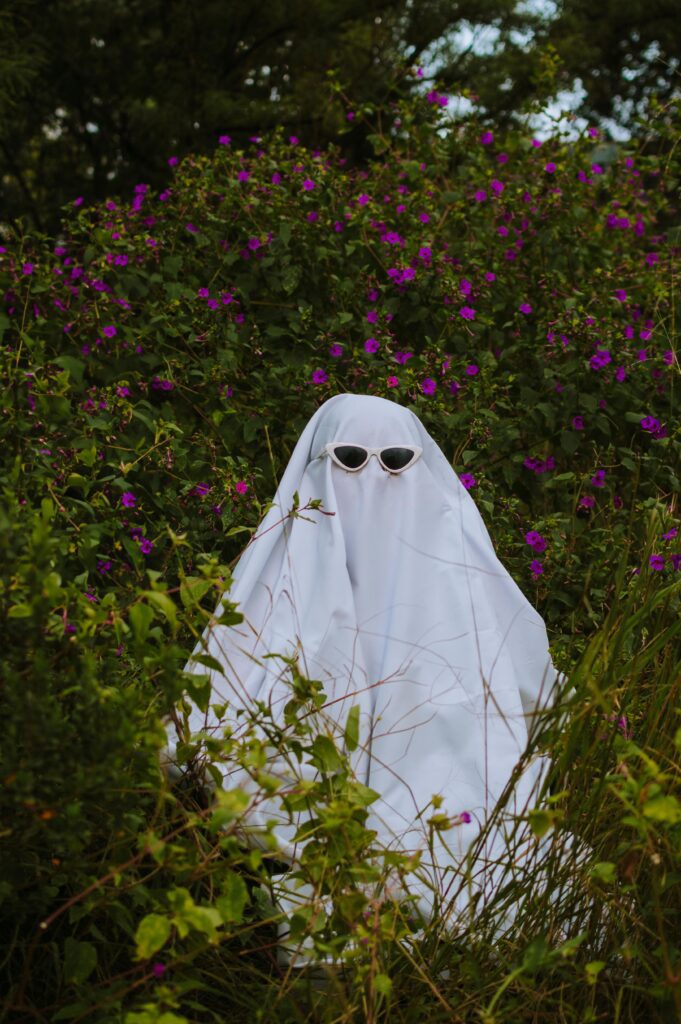
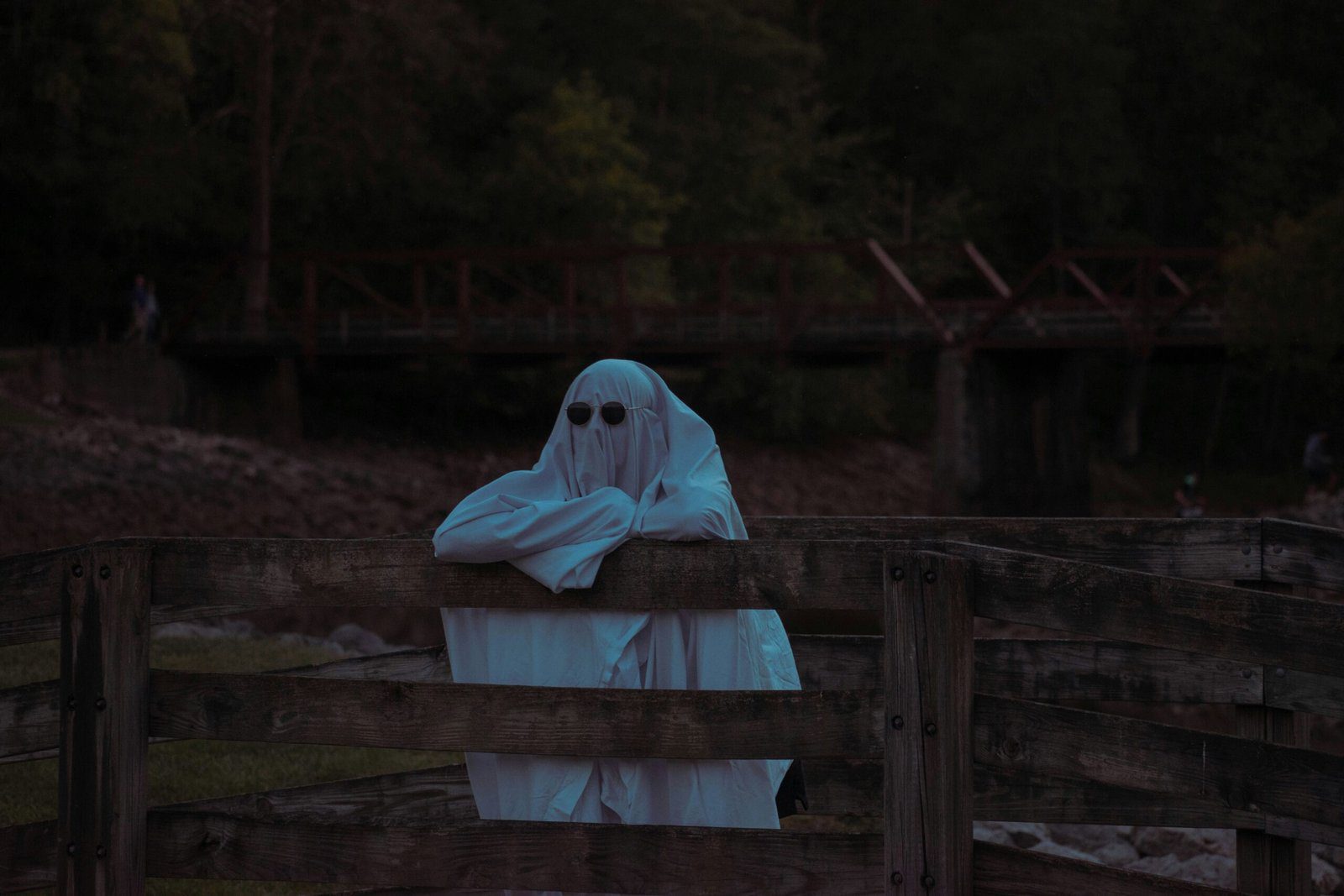
A ghost wearing sunglasses hiding in a field of shrubs and greenery with purple flowers.
(Image courtesy of Susan Flores via Pexels)

Mr. Jack smiled to himself as he played his part
Hiding, disguising, mystifying; now this was art!
Sure, there were no screams of fear or wails of anguish,
But he did feel some joy in his undead heart

When he noticed others surrounding his victims,
Laughing and cajoling at the unexpected outcome
Of a bewildered child, who was counting his delights,
Only to find the broccoli head his candy had become.

“Next year, I wonder if I should expand my operations?”
Mr. Jack debated, heavily immersed in his internal conversation.
“Why should I only keep to this one town three years in a row?
Next Halloween is going to need even more preparation!”

‘Batman: Arkham Asylum’ = Enduring Interactive Fear

Welcome to the madhouse, Batman!

As a kid, very little excited me more than getting to interact with my favorite DC hero, Batman. Whether it was a new animated show or a movie that changed the superhero film landscape, any opportunity to experience more Batman was a welcome one to me. So imagine my excitement when the brand new Batman game, Batman: Arkham Asylum, was announced. Needless to say, 11 year-old me was over the moon, thrilled to get to properly play as Batman for the first time ever. 

One thing I think no one was ready for was just how scary Batman: Arkham Asylum turned out to be. Most outsiders to the Arkham video game series likely hear “Batman” and immediately think it is just another superhero game. It certainly is a superhero game, with you running around as Batman beating up thugs while trying to stop the Joker’s latest scheme. What makes it so much more than that though, is how the game carried with it a fantastic element of horror throughout the entire story. Although future games in the franchise carried over this horror theme, none of them nailed it quite like Arkham Asylum did.

The game starts out as your standard Batman adventure, or technically the end of one: Batman has captured Joker and is taking him to be locked back up in Arkham Asylum, the incredibly outdated psychiatric hospital (= prison) that hosts the majority of Batman’s rogues gallery. Not long after bringing Joker in, the Clown Prince of Crime launches his real scheme – overtaking the asylum staff and taking control of the madhouse. 

From the very beginning, Batman: Arkham Asylum creates an atmosphere of unease. The titular asylum is dingy, grimy, and very reminiscent of an abandoned, haunted mental hospital you would find in an aging horror film. The only difference is that instead of being haunted by incorporeal spirits, Arkham Asylum is haunted by very real, very alive threats who all have one goal in mind: to kill you, as Batman. 

In fact, the asylum even has some monsters of its own: Killer Croc, a mutated crocodile man, tells Batman in the very beginning of the game he intends to eat the Caped Crusader. Cut to later in the game when you are slowly creeping around Croc’s lair, he will spontaneously burst out from the water, chasing you across flimsy platforms. With your only option being to walk slowly or risk Croc taking notice of your location, players have to painstakingly make their way through his lair with the constant fear of a crocodile man jumping out and hunting you down.

As you run around the asylum, Joker will periodically use the PA system to speak with Batman and taunt him. The PA system makes a noise that will haunt me for the rest of the time; a chime that sounds slightly off, almost as if it’s getting further and further under your skin every time it plays. Eventually, Joker also unleashes the absolutely rabid ‘Arkham Lunatics’, locked up in straight jackets and ready to attack anyone on sight. They hide throughout the asylum, forcing on the player the expectation that one of them could jump out from under the floorboards or pounce on you from the ceiling at any moment. Over the moon. 

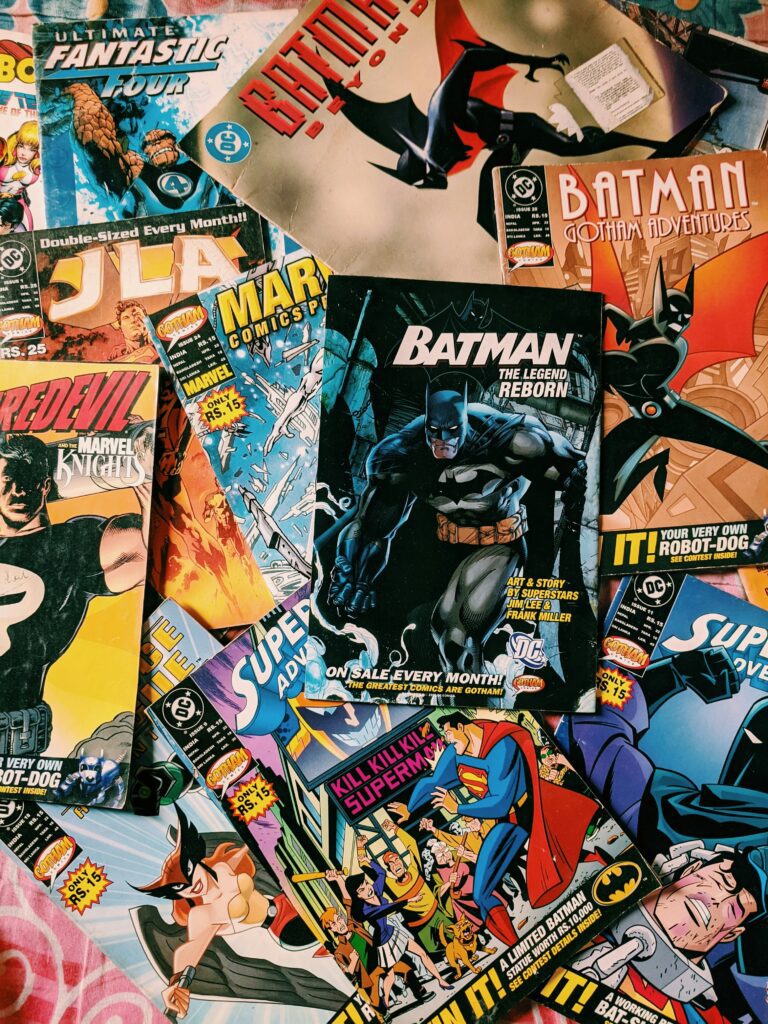
Brightly colored classic comic book covers including Batman
(Image courtesy of Dev via Unsplash)

Scarecrow: The Master of Fear

But of course, nothing embodies fear more in the Arkham series than the master of fear himself, Scarecrow. For the uninitiated, Scarecrow, a.k.a. Dr. Jonathan Crane, is a former doctor of Arkham Asylum who invented the aptly-named “Fear Toxin,” a chemical concoction that shows its user their worst fears come to life as horrific hallucinations. Three times throughout the game, players are forced to contend with Scarecrow while under the effects of his Fear Toxin – running a deadly nightmare gauntlet where they need to fight off skeletons and hide whenever the massive Scarecrow appears and looms over his realm of fear. Being seen by him results in immediate death, driving the stakes and the player’s blood pressure up even more. 

Right before the very last Scarecrow nightmare challenge, the player experiences what can be considered the best scare tactic in the entire franchise. As Batman is walking through the asylum, he is dosed with Fear Toxin. Suddenly, the game seems to crash, with the screen and audio glitching and the player left frustrated and dealing with a very real fear for any gamer: did my game just break and make me lose all my progress? From what I’ve read from others who have played the game, this “glitch” tricked many players into resetting their game console, convinced that their game had actually broken. Oh, heavens.

For those who stuck it out, they learned that the glitch was actually a scripted event. As one fear was conquered a new one emerged, and  the game seemingly starts over from the very beginning with its opening cutscene. This time, Joker is in the driver seat, taking Batman to Arkham Asylum where he is promptly brought in on a stretcher and shot by the Joker, leaving the player unable to do anything but watch helplessly. Of course, Batman is a beacon of willpower, so he overcomes the hallucinations and manages to take down Scarecrow and, inevitably, the Joker – though not before Joker mutates himself into a monstrosity that likely haunted the dreams of many young players.

Batman: Arkham Asylum manages to accomplish polar opposites at once: making players truly feel like Batman on an immersive level, who himself inspires fear in the many thugs he takes down, while also managing to surprise and terrorize the player on a meta level. 

Melting down, yet over the moon

Batman may not have been afraid, but I certainly was, nearly having a heart attack every time a lunatic launched at me from out of a grate I didn’t notice. I did notice my controller flying up in the air as I yelled out. In fear?

Horror games aren’t everybody’s cup of tea, myself typically included. But Batman: Arkham Asylum reaches this crucial sweet spot where it gives players all the power and then knocks them back down, forcing them to overcome the twisted thoughts and schemes of Gotham City’s most wanted. Even now, nearly 20 years later, I still find myself feeling that same unease as I step back into the asylum and contend with the likes of Scarecrow, the Joker, Killer Croc. Especially Killer Croc. 

Yet, traversing all that chaos and destruction to triumphantly take down the Joker at the end makes it all the more satisfying when I surpass the nightmares and finally save the day, standing tall as the Batman. 

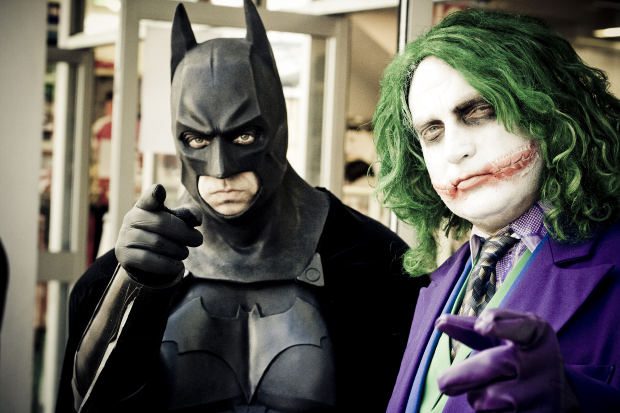
characters dressed as Batman and the Joker point at the camera
(Image courtesy of dmscs via Morguefile)

A Macchiato with Ennui

I order two coffees as the rain thrashes slick against the streets outside – a black ground for myself and a macchiato with ten… ten espresso shots for my friend. Now, I’ve never tried a macchiato, let alone one designed to make your brain implode like this one. I don’t think too hard about the different types, whether to steam or foam the milk, which volcanic rocks the coffee beans were barbecued on, et cetera. Coffee is coffee as far as I’m concerned, a necessity to make it through the day… but this, this is beyond necessity. 

The young ponytailed barista can’t help shooting me a bemused, cautionary glance as she hands over the second of the steaming mugs. “Wednesdays, am I right?” I attempt to chuckle amiably, feeling a cringe winding down my spine. God, suck it up, man.

Caffeine grenades in hand, I tiptoe back to the corner booth where my friend is slumped, quietly existing. Well, I say friend… We’ve barely spoken since I stumbled upon him in that dark alleyway, lying flat on his back behind a stinking skip bin. I remember feeling a certain… morbid curiosity. I mean, you’d know what I was talking about if you were able to see him. He’s a tough nut to crack, that’s for sure – he was unresponsive for the first three days I visited. So, on the fourth day that week (which now must have been at least a month ago), I invited him for coffee. To my pleasant surprise, he inclined his head – which may have been an affirmative gesture, or… actually, he might have been shielding his eyes from the sun. Still… here he is. Better late than never, I suppose.

My friend rolls his head at the bitter stench wafting across the table, stretching his pallid fingers around the scalding ceramic. Taking a sip, his eyes close momentarily as if drifting into a wistful slumber… then he whacks the table with his fist. “Wowza! Coffee’s a rarity where I’m from,” he remarks, setting the mug aside (I’ll realise later that this is the first and only time he touches it). “The buzz reminds me that I’m alive.”

His natural name, whatever that means, is Annuien Inodiare. Is that Latin? Late Middle Ages French or Anglo-Saxon, perhaps? Either way, his preferred name is Ennui.

At first glance, it would appear that some form of prehistoric wild animal had slunk into this Mean Bean on Fifth Street. Fortunately, I appear to be the only person capable of seeing Ennui… all ten feet of him. Unkempt, unwashed hair tousles down his pockmarked face, which is prone to yawning every ten seconds or so. Mousey fabric covers his prodigious shoulders, stitched into a makeshift cloak which billows as if constantly being swept up by some invisible draught. “That’s just the Tide,” he dismisses. “It’s like a cosmetic effect for immortal beings. Can’t get rid of it. A bit of a nuisance, really.”

His voice is grating in a way I can’t fathom and yet… comfortingly familiar. Listless? It’s like a dull drone, accented with tedium. A voice that clearly takes great effort to form, emerging on the wave of a sigh. At this point, I haven’t pried too deeply into his background. I mean, he’s clearly not of this world (and I’m handling that fact with remarkable composure). With the name and his characteristics… I fear I’ve bumped into a modern-day god or deity or… immortal being? I’ll choose my questions very wisely.

“So you clearly don’t look… I mean, with the height and all… this…” I gesture pathetically in his direction, deciding I might never open my mouth again. What the hell was that?

“Eh, I look more impressive than I actually am and that’s… not a high bar.” Ennui trills his lips, glimpsing around the coffee shop with the interest of a sulking preteen. “You probably think I’m a mess. Can hardly blame you. The others have told me I’m nothing but an ‘unfortunate byproduct’ anyway. None of ‘em want me around.”

“The others?” I query, taking a sip of my own coffee. Ennui yawns for the thirtieth time.

“The cardinal emotions,” he tuts. “You know, my extended family. From what I’ve heard, they’re making real change out there, Rage and Fear and… Joy. Ugh, Joy. Sometimes I think he’s trying way too hard. Don’t you find it exhausting to be that happy all the time? Come on, man… Why bother when it’s easier to feel nothing at all?”

“Yeah…” Damn, he’s got me there. I know I’ve been guilty of that mindset from time to time. “But what are you doing here? You know… on Earth, I guess. Do all the other emotions have… bodies?”

“Not typically.” Ennui grins slightly. “You know, I’d pay good money to see that. How you mortals do it, all these loose, fleshy parts… I’ve grown fond of them myself, but I know a few divas up there who’d have some choice opinions. No, I’ve been… let’s say I’ve been given a time out. The others don’t want me messing up their big, progressive plans, but… I don’t know. I get bored, man! I’m bored, and I’m tired all the time, and that starts impacting you mortals when I try to hang out with the guys up top, all ethereal and… wibbly-wobbly and whatever. I just get in the way. They sent me down here, saying it could cure me, which is cute.” 

It’s at this moment that I start to wonder whether I might be dreaming. I pinch the soft flesh of my thigh under the table. Ow… 

Well. Worth a shot. I turn back to my coffee. “So… why can I see you when no-one else can?” 

Ennui chuckles, then. That’s progress. “Don’t think you’re special. I’ve got, like, a million Samaritans quacking at me right now. There’s a form of me here for anyone feeling the same way that I do. People just like you!”

I can’t help feeling stung by this accusation. “I’m not some kind of defeatist. Ennui, that’s… a feeling of worthlessness, right? Like, everything is meaningless?”

“Ah, no, that’s Nihil,” Ennui reassures. “Bloody Nihil… Trust me, none of us go near that one. He’s always off somewhere dark and unpleasant, brooding, making everyone miserable. Luckily for us, his utter disbelief in humanity by definition affects a small percentage of it. Me, I just have lapses. I come and go, that’s why I’m a bit of a wanderer right now. I don’t feel defeated, I’m just… waiting for something that I find exciting to come along. And trust me, that can take forever.”

“But that’s such a lacking feeling,” I pipe up. “The best thing we can do is just… just get on with our lives as they are and stay on track.”

Ennui leans back against the faux-leather. “Do you really believe that?”

I hesitate, pursing my lips. Do I? Truthfully, with the consulting firm giving me grief on a daily basis, it’s been harder to stay motivated in the evenings. I’ve stopped writing, I can barely set aside any brain space for learning guitar… But that’s just life, isn’t it? “We can’t just wake up one day and decide that everything’s going to change. It’s impractical, and… and it takes an insane amount of willpower to follow through, you know?”

“Nah, I fully agree with you. Way too much effort, to be honest. I’m far too disorganised to be that kind of advocate – you should meet Muse, though. She’s an absolute hoot.” Ennui links his fingers, sloping his massive body over the puny square table. “I’ve never wanted to be a saint but I’m no villain either. I’m indifferent to any of that. See, the others think I’m some productivity-killer, but I disagree. The way I see it… I’m your reminder that life is transitory and beautiful, and that moments of true fulfilment should be cherished above anything else.” 

“That’s… one way of looking at it, I guess.”

“Did that sound good? I’ve been practicing.” Ennui stands then, his hulking body creaking like an old wooden ship tipping through icy waters. “Cheers for the macchiato. That’s a brain fog decimator right there. I’ll remember that feeling for a long time.”

“Will I see you again?” I ask, my voice rattling with unexpected hope. God, I’m pathetic.

“No, I somehow doubt you will, but listen… This has cheered me right up, so thanks. Genuinely.” He trudges through the coffee shop, stopping by the door with a barely perceptible tilt of his head. “Hah! Look at all these people – they think you’ve been talking to yourself for twenty minutes.” Then he’s gone, fading into the argentine mist of diminishing rainfall.

A Grave Scribe Tale: Fatal Fame

WRITER’S  NOTE: I am writing the introduction of this story as a homage to Tales from the Crypt with my Grave Scribe persona. Please enjoy!

A coffin creak is heard in the background.

“Ah… so you found me again, dear reader. ‘The Grave Scribe,’ keeper of secrets and chronicler of souls too restless to stay buried. Tonight, I open my tome to a tale from the humid heart of Malaysia. A tale of vanity, ambition, and blood.

A pop singer turned witch doctor.
A politician turned victim.
A ritual turned execution.

Oh yes… a modern-day witch trial!

Now, let her speak. Let Mona Fandey rise from her grave and tell you, in her own words, how the hunger for fame can devour far more than just your career.”

“I will not die.” Those were my last words. 

I knew from childhood, I was born to shine like Taylor Swift and the K-Pop idols who adorn your YouTube feed. They did not have YouTube in my time. All I ever wanted was to be adored. When I sang, people listened. When I smiled, the world tilted a little closer. Even though my husband gave up his savings to give me air time, the moguls of Malaysian media decided I was not good enough. 

Fame, it seemed, was a cruel lover. 

Unlike Affandi, my loyal husband. He was also my greatest believer. He told me I wasn’t meant to fade. “You have the gift,” he said, “If the world won’t give you power, take it.

After much discussion, we both decided to take up magic. We would make people’s dreams come true since many believed in unseen forces. Some might call it black magic, but it was hope and power for me, Affandi, and our assistant, Juraimi. His ingratitude would lead to our inevitable fall, and I still don’t know if I should curse him or thank him. I still remember smiling for the cameras while being escorted out of the courthouse and thinking I should strangle him, but maybe it was also another chance for fame, so I just took the chance and smiled. I knew I was born for fame; I did what came naturally. But, I digress. 

My clients came from every corner and dark hollow of society: businessmen, socialites, politicians—all desperate for something they couldn’t earn.

That’s when Datuk Mazlan Idris came to me.

A man of ambition, burning so brightly he couldn’t see the shadows closing in. He wanted power. Minister of State, he said. He wanted more. And he could have it, what I could never attain. The people’s praise and respect. I decided that men like him should never outshine me. 

That’s why I told Affandi to give him the axe. “Power to the people,” I say! “Death to tyrants!”

He came with money — lots of it. 2.5 million ringgit was my quote. He did not pay me the full amount upfront – the nerve of him. But a deal is a deal, and he gave enough for my plastic surgery and new car later on. 

I offered him two talismans: a cane and a songkok, once belonging — so I told him — to Sukarno, the first President of Indonesia. “With these,” I said, “you will be invincible.”

He believed me. They always do.

That night, the air was heavy with the cloying fragrance of incense, burnt at the site of our patron’s home. My husband, Affandi, and our helper, Juraimi, prepared the room and the means of disposing of our victim later on. I told Mazlan to lie face down, close his eyes, and trust in the magic of the ritual so money would come to him out of thin air in droves he couldn’t dream of — the fool! 

He smiled at the prospect.
Oh, how easily men trust when ambition blinds them.

I placed petals over his body and whispered blessings. He thought fortune was about to rain from the heavens. Instead, Juraimi’s axe fell thrice.

Three swings.
Three echoes.
Then silence.

We dismembered him, piece by piece, like a broken promise. I told myself it was art. A ritual of power. A step toward the immortality fame had denied me.

But you know what’s strange? The moment the blood touched my hands, I felt alive again. Not as a pop star. Not as a has-been. But as someone seen. I was finally unforgettable. I could have tasted his blood, but not with my husband watching of course. 

When the police caught us, I smiled for the cameras. They clicked and flashed, and I gave them what they wanted — a star reborn in scandal. My name was everywhere. Mona Fandey. The witch. The murderer. The legend.

And when the judge read my sentence — death by hanging — I didn’t tremble. I only smiled wider.

“Aku takkan mati,” I told them.
I will not die.

And, perhaps, I haven’t.

When they pulled the lever, I didn’t scream. I thought of lights, of applause,  of my name echoing in eternity. I got what I wanted; all it took was a sacrifice. All of the greats did so for their art, and I am their peer. 

And now… I’m here.

Whispering through time, through screens, through stories.

You think this is just a tale of horror, dear reader?
No. It’s a mirror.

You scroll, you post, you crave followers and fame.
You’d trade pieces of yourself just to be seen.

Be careful what you chase.
Because vanity never dies.

And neither did I.

The Grave Scribe closes the tome with a slow grin.

“Sleep well, my wicked friend. And if you hear a dark song in the shadows, don’t look back. It might just be Mona, craving another chance to perform.”

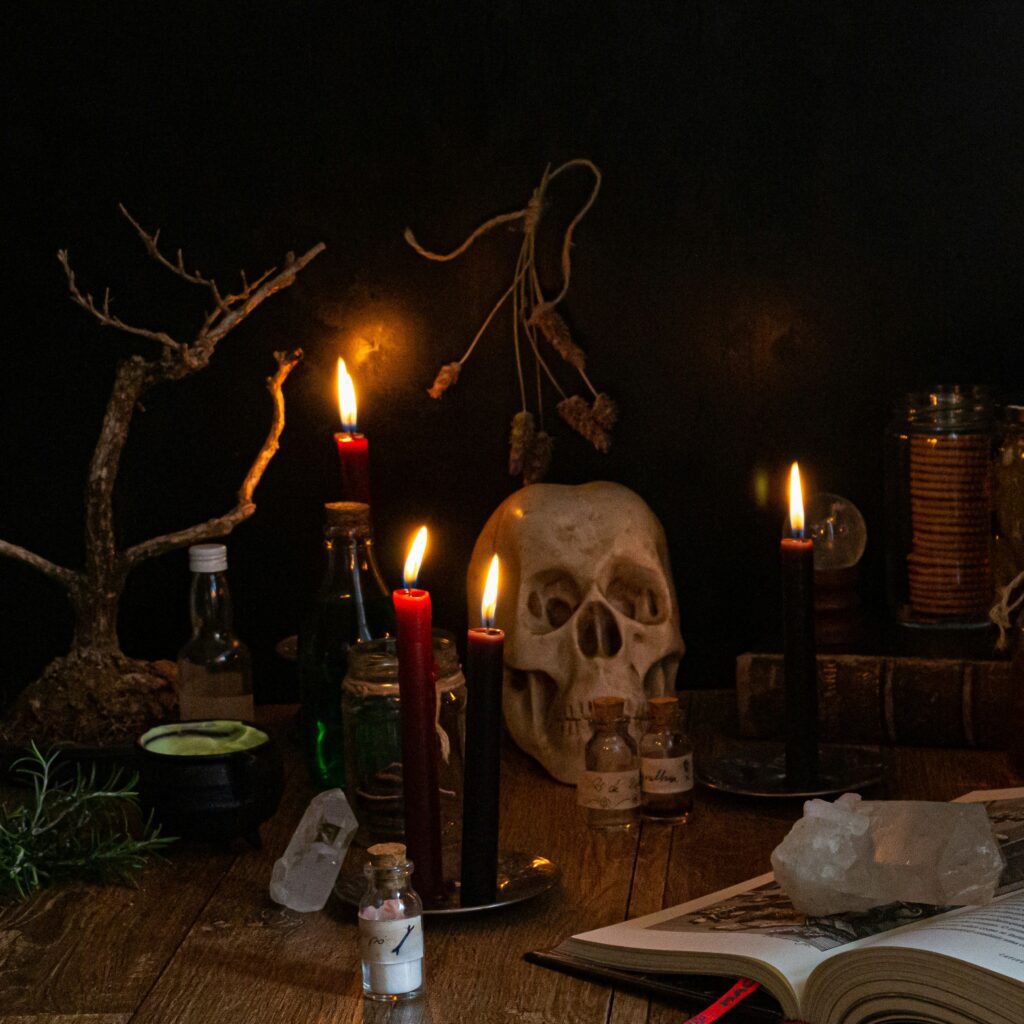
A skull, red candles, a spell book, and potions/vials sit on an old table – a scene fit for a witch and other figures of the night!
(Photo courtesy of Sabrina Roman via Unsplash)

Of Monsters and Motherhood

Amongst humanities graduate students, especially literature students, there is a joke that grad school will kill one’s passion for reading. I always thought that I would be impervious to such a curse – that no matter what my Hispanic Literature programs threw at me, my love of reading would remain unscathed. I chose to study literature because, like most people who do the same, I loved reading from an early age. Further, I loved dissecting passages and plots, analyzing character motivations, and connecting works of fiction to larger societal themes. To a certain degree, I was right about my passion being steadfast in the face of the stresses of advanced academic training. There are numerous books from many different countries and eras that piqued my interest beyond them being required reading.  

However, the greatest book in the world cannot fix the fatigue that a bloated reading schedule causes. I knew what I was getting into, of course, but knowing really doesn’t matter after having to read hundreds upon hundreds of pages of say, Garcilaso de la Vega or Gonzalo Fernández de Oviedo (real ones know!), as I had to do during my Colonial Latin American Literature survey course. For six years, I often felt as though I had one eye on a PDF and one eye on the clock, mentally calculating how long it took to read one page and estimating how quickly I could finish a book before moving on to the next one. However, In early 2021, I found myself free of the constraints of reading under pressure, as I had passed my preliminary exams for my doctoral degree the semester before. 

Turning the page

With my attention now solely focused on crafting my dissertation and teaching Spanish language classes, I had won back something that had been missing during my time taking courses: an eensy, teensy bit of free time. Unfortunately for me, I had also been recently diagnosed with allergic asthma, so some of this free time was spent, once or twice a week, in my allergist’s office, on the receiving end of histamine shots that would (hopefully) reduce the severity of my allergies, while also not inducing anaphylaxis.

In that sterile and uninspiring room, far from the creaky, imposing library shelves I had been dwarfed by for so long, the pressure to read for the purposes of writing papers and bolstering class discussions melted away. Accompanied only by my ancient iPad, loaded with the Libby app, I would spend hours waiting in that office, interrupted intermittently by my doctor checking my airways and the injection site on my arm. At my fingertips was what seemed like an unending catalogue of books whose publications I had missed for the last six years. What’s more, I soon discovered something about me that I never expected: I loved reading horror fiction.

All my life I have hated horror movies. I have only seen one, The Strangers (2008), and even that was against my will. The Halloween of my fourteenth year saw me crowding into my friend’s basement with the rest of our social group, which consisted of teens who were not scaredy-cats like me. Due to a combination of peer pressure and shaky confidence, I agreed to watch the aforementioned horror flick while thinking, “Maybe it won’t be so bad.”

Boy, was I wrong. 

Despite my rejection of slasher films, I wouldn’t consider myself an overly  sensitive person, but my anxious personality is not well-suited to the anticipation and gore of the horror genre. There are some days I refuse to watch even an episode of The X-Files as twilight approaches. So to have been, suddenly, breathlessly waiting for books to come off hold that featured content aimed to terrify was very surprising to me, though I embraced it all the same.

My reading reawakening that began beneath the stale, fluorescent lights in a random medical building in north-central Indiana led to a years-long obsession of reading (when I wasn’t writing my dissertation, of course) anything horror- or thriller-adjacent that I could get my hands on. I devoured litfic that centered around body and/or psychological horror, crimes being committed, anything that boasted showcasing the darker sides of humanity.

I didn’t exclusively read horror and thrillers, but I found myself gravitating back toward such works, desperate for the illusion of control while living in a political landscape that was (and still is) trending anti-woman. In these fictional worlds, women could act on their impulses– something we’re very rarely allowed to do in reality. They may be committing crimes, sure, but aren’t we, as women, allowed a little rage when we’re losing our rights to medical care? Can’t we cheer for women doing exactly as they wish when there are those who wish to take away our rights to vote, to divorce, to be employed? Sadly, to everything there is a season, and it seems as though my time voyeuristically consuming women’s rights and wrongs through fiction has come to a possible end. 

A lone light illuminates an old bookcase.
(Image courtesy of Engin Akyurt via Pexels)

Plot twist

After the birth of my daughter, my anxiety has gone into overdrive in an effort, evolutionarily and biologically, I suppose, to try to maintain my family unit within a small, protective bubble and keep the horrors of the world away. The terror that originally had no effect on me when reading horror is now wholly felt, as if I were back in the eighth grade, in my friend’s basement, watching Liv Tyler and Scott Speedman get stalked and terrorized by three weirdos in masks.

I noticed this change when I was finally able to read Monstrilio by Gerardo Sámano Córdova, a book about a woman mourning the loss of her child to such a degree that she turns a piece of his body into a sentient monster. I read, maybe, 10 percent of the book when panic began to overtake me. What if I lost my daughter? In our world, sadly devoid of magical realism, I wouldn’t be able to manifest such a creature. I would have nothing. Plenty of parents around the globe have obviously experienced loss, so I would not be special. But, such a fact does not eliminate the disquietude that this concept produces. I returned the book almost immediately. Then, very recently, a similar thing happened while I was reading the beginning pages of The Lamb by Lucy Rose. 

I had read books describing cannibalism before and, while the idea personally disgusts me, I was able to push past this revulsion to see how these gruesome tales proceeded. Now, my response was so visceral, so palpably felt, that not even a can of Vernors ginger ale could remedy my nausea.

Both books had been hyped up on Bookstagram (a community with which, like BookTok, I have many issues but ultimately can’t quit) for months, as certain accounts received advanced reading copies and therefore raved about how good they were before library-using plebs like me could gain access to them. I was so excited to read them, but, this enthusiasm, and the state of my emotional moods, were in direct opposition.  

The militant feminist in me (which, let’s be honest, is most of my personality) is begging me to push through. She, to be frank, doesn’t even think it’s appropriate to confess that motherhood has caused any change. I should be able to engage in the things I enjoy, instead of letting possible internalized patriarchal ideals – that dictate that mothers’ lives should revolve around their children; that they should spend every single second of every single hour of every single day thinking about their children and their needs; that they are not complete people now, but accessories to the new generation – win. Whatever individuality I can eke out, says this feminist, should be celebrated and pursued doggedly.

Cliffhanger?

Unfortunately, overriding my brain is easier said than done. I find that I miss the previous catharsis I relished while reading; I have no outlet for my frustrations. Also, a small part of me fears that, with this change in taste, I’m no longer cool. Is this how the process from eclectic individual to lame parent starts?

Maybe I’ll return to Monstrilio and The Lamb in the future, when I’m more practiced at divorcing reading and my anxieties. Maybe it’s finally time to give Marcel Proust’s In Search of Lost Time a try? Maybe I’ll exclusively read nonfiction until I’m 90. The specifics of my reading habits were different at 10, 17, 25, and will continue to vary at 32, 46, 54, and so on.

I find myself back at square one, in a place akin to where I was in 2021, wanting to read but not sure where that desire will take me. Still, I have progressed before and will again. And, I should emphasize, I’m ultimately grateful that my lifelong passion for reading remains in spite of the hiccups detailed here, and that I have passed that passion on to my daughter, who demands a reading of Frog and Toad Are Friends at least once a day.

For now, I suppose the horror books on my to-be-read list must wait patiently  in their dark corners. But, as the current total of this list, according to my profile on The Storygraph, is 3,308 books, there’s plenty to read in the meantime. 

Show Stage Fright the Stage Door 1-2-3

1 — Surviving stage fright

As a kid, I loved soloing in choirs. But I hated speaking in front of the class, overcome with stage fright — my own private hell. 

As a favor to a new friend, I will resist triggering you with a detailed list of unpleasant-to-debilitating symptoms. You’re welcome. 

2 — Surmounting stage fright

I was choreographing a solo modern piece years later for a dance concert in college. Four weeks before the show, my old friend stage fright barged in hard to block me, claiming squatter’s rights. On my property. Out of nowhere, I invented a new deed & title to show him the door. 

If I give in to him, that guarantees that I drain all the joy from rehearsing to performing to the warm afterglow I wish to bask in. 

I don’t think so. He moved on. 

I was psyched, but relaxed, and the performance excelled. 

3 — Surpassing stage fright 

Now as a singer-songwriter, I share this one freely with newcomers: 

Performing is scary. I can help 1-2-3, but you have to trust me. And I have to say the word ****. 

When you perform, you’re suddenly so magnetic that you become everyone’s world. They all want to **** you. The least you can do is to make them feel like they are yours, too. That is, return the favor by signaling you are quite ready to **** them silly. You have a special privilege like bartenders and waiters who everybody falls in love with because they serve and give, nourish and nurture. Performers, with their job to entice, are automatically attractive. 

Performing is not about you, but what you serve up to your audience. 

Stage fright is about being wrapped up in me while stage presence is about what I bestow upon the audience. Focus on your delivery and ‘bringing it’, so stage fright — what was that about? — might just fade with the lights.

Hey, if you are adored by virtue of the role you took, you should reciprocate symbolically by rewarding the audience with a wonderful performance. 

A duel of love perhaps, a dance, a courtship for sure, entertaining holds the power to cast a spell over an audience, and performers do so as they step onstage, maybe even before the crowd settles. Believe me, you somehow bewitch them. Let that magic linger. 

When we host, we focus without worry on pleasing our guests, not ourselves. As performers, recognize that your guests all arrive hungry for your show, ready to enjoy, ready to love you. Yo’ goodies are baked in, if yet unearned. So earn it. 

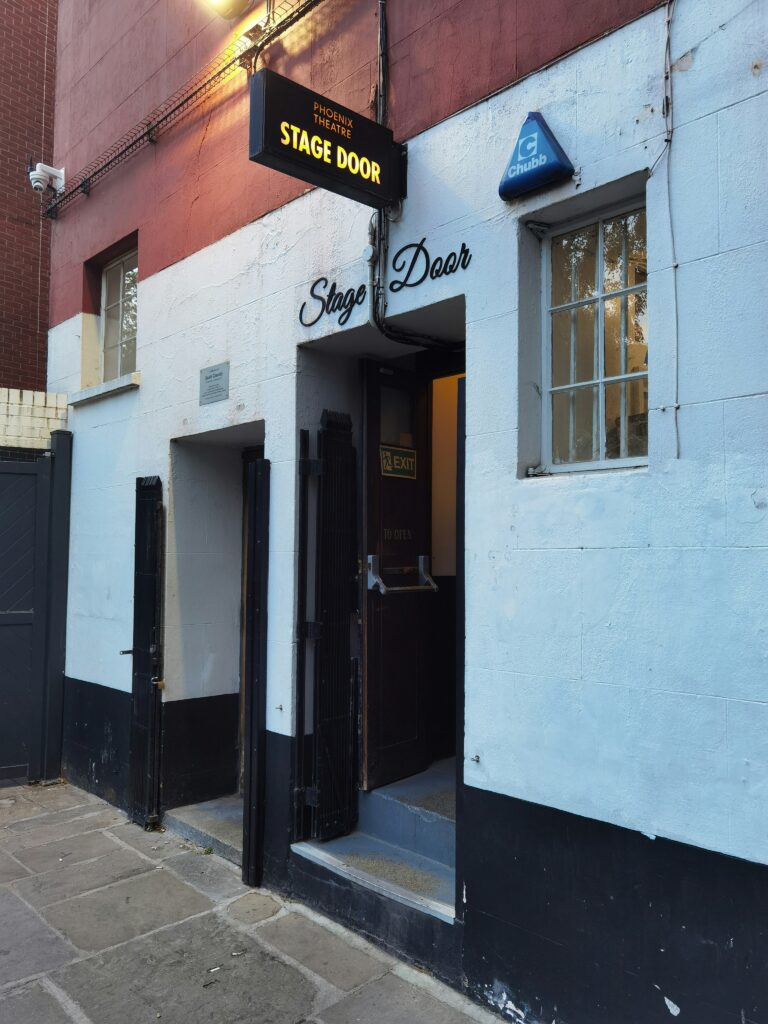
Open stage door, up two steps
(Image courtesy of Call Me Fred via Unsplash)

Window Sweets

Coletta Feek was the sole proprietor of the small chocolate shop, Magnifeek Sweets. Her shop remained her entire life and the only thing she had ever actively worked towards. The relationships, and broken days, that she had experienced were, in her eyes, treasures directly resulting from her shop’s success. She had had a honeyed childhood, soul-searching adolescence, and desired nothing. Although her own life experiences were often dressed in ganaches and gossamer doilies, the young woman truly believed that she had felt the kaleidoscope of human emotions already, all due to the wide display window of her shop.

The pane was worn and thin, fogging around the edges where the glass had warped as Magnifeek Chocolates had been everything from a florist to a pharmacy before Coletta had purchased the property. Since the window itself looked rather tired, she did everything she could to make what it housed vibrant. She set false evergreen boughs, dressed in holiday lights, around the edges of the glass and a rich burgundy velvet pooled on the tiered platforms that contained confections of nearly every color and shape. 

Chocolate seashells, a seaswept reminder of her grandmother, sat on pewter plates she polished regularly. Stained glass window cookies glistened next to succulent roulades and mousse cakes dressed in candied rind and mint leaves. Bouquets of chocolate lollipops stunned in vases she had never used for flowers, while her shop’s signature chocolate mice with ribbon tails scurried among the treats, adding the whimsy she hoped her customers would appreciate as much as she always had. 

Coletta’s most precious part of owning her shop was watching passersby linger, if only briefly, at her shop window, because, for a moment, she could see them as they truly were. She had witnessed families, with children who pressed their small faces against the pane, begging their loved ones to enter the chocolate shop. Lovers of every age had sought out the sweets to enjoy together under streetlights as the rumble of traffic hid their whispers from the rest of the world. And, every once in a while, a widower would come to the shop for a sweet bit of respite, remembering who he had held close as a younger man when kisses were still sugar.

The chocolatier had been privy to the lives of her customers for as long as she could remember, which meant that she had also observed the darker shades of hope outside her shop’s window.

In particular, she recalled a middle-aged man who lingered a few steps behind the same attractive couple. His hair was red, with a bit of starlight at its edges, and she recollected the patch of silver in his beard, shaped like a roof shingle. The man never spoke to the couple, but he followed them as wearily as if tethered to them. The couple rarely seemed to notice his presence, and, no matter how many times they crossed the shop’s window, they were never speaking to the man whose shadow was interwoven with their own. Coletta once dropped a chocolate mouse when the redheaded man reluctantly pulled his gaze away from the couple and fixed his cool eyes upon her. She stared down at the ruined sweet, crumbled on the ground in front of her,  picked up the pieces and combed the ribbon tail gently between her fingers.

The couple continued to walk by Magnifeek Sweets, stopping in for a small box of truffles to share with one another, and, eventually, their affection enveloped even Coletta. She heard the bell ring at the shop’s door. 

“Coletta! Kalev and I are here for some of your divine truffles!” 

“Hello, you two,” Coletta cooed. She always admired the warmth with which Madigan spoke to everyone, especially her Kalev. He was usually quiet, but always cordial with Coletta, while Mads asked her about new confections and the changes in the display window. 

“Coletta, you wouldn’t perchance take custom orders, would you?” 

“I haven’t previously, but I am open to the idea,” she responded while carefully packaging an assortment of truffles, adding two complimentary chocolate mice—one with a teal tail, the other with chartreuse—to the box. Mads had picked up the endearing habit of opening the ribbon-wrapped box as soon as Kalev and she were outside, looking incredulously through the display window at Coletta, then running back inside the shop to grab her hand and thank her for such a kindness.

“There are more than just window sweets here!” she would say, squeezing Coletta’s hand while Kalev tipped his hat to her through the window, still holding the open box of truffles. 

“You’re very welcome, Mads. Please take care of yourself, and see you soon…” Coletta’s voice trailed off as she recognized the red haired man, sitting on a bench across from the shop, staring with those languishing eyes, at Kalev and Mads. As the duo cheerfully wandered off, the man rose and began trailing them once more.

Coletta had come to relish in those moments of quiet friendship between Kalev, Mads, and herself, but she hadn’t the courage to bring up the bearded man and his concerning surveillance of the couple. Instead, she placed her energy into the curious custom order she had received from the lovers. They had asked for some small chocolates, all embossed with the figure of an imposing hound. The couple had never spoken of owning any animals. Coletta had even spied Mads retreating from a stray mutt that had startled her by accident some time ago. But, the order was an easy one. She crafted the chocolates and filled them with peach preserves and pistachio praline, as Kalev had mentioned the order was a gift. As always, she boxed the chocolates up, including a few extra chocolate mice for good measure. While she placed the finishing touches on her display’s delights, sampling a few to gauge their quality (an indulgent ritual of hers), the red haired man was suddenly standing in her shop. The door’s bell had not rung. “Miss Feek, is it?” His voice was high, akin to a young man’s. “Ye-yes?” Coletta corrected herself immediately, years of customer service conditioning her tongue to mouth certain saccharine salutations. “Please excuse my verbal lapse. Welcome, and how may I assist you, sir?” The man did not stir, and he continued looking, almost through, Coletta. The two stood there in silence for a few moments, until the chocolate in Coletta’s hand began to melt.

“Please pardon my intrusion. I have noticed your stares when I am near, especially when Kalev and Madigan are present?” Coletta caught her breath– he knows their names. She steeled herself, wiping her fingers clean with a damp cloth. “They are friends of mine, and I cannot help but notice you have a rather… keen interest in them.” The man’s eyes appeared less exhausted now. “Well, I see you understand more than chocolate,” he muttered quietly. “You see,” his voice rose slightly, “I have a genuine fondness for both of your friends. We knew each other well, some time ago, but those two probably do not remember me.” “Is that so? Why don’t you speak to them then, instead of following them around like a lost puppy?” Customer service be damned, Coletta thought to herself. The man smirked. “That’s a fair point, Miss. In any case, I simply stopped by to thank you for your kindness to them. I shan’t be much more trouble to Kalev and Madigan, and I assure you that I shall not darken your shop’s doorway again–” “Sir, I apologize for my slip of the tongue. You think it would be sweeter with all the sugar surrounding me. Please, take this, and you are welcome here at any time.” She held out two of the extra chocolates with the hound emblazoned on them, nestled on a square of wax paper. The man grabbed the token gingerly, folding the paper gently around the chocolates. “Another kindness, I see.” He looked at Coletta directly once more, and she darted her eyes towards his gloved hand, holding the small parcel. “Tell me,” he said more gently now, “What made you want to be a confectioner?” Coletta, who began looking out her display window fondly, answered with a certainty that years of pride had instilled. “I want to make this world something we want to cling onto, even on desperate days.” She looked up, hoping to gauge the redheaded man’s reaction to her answer. However, he was already walking by her store’s wide window, never looking back.

Madigan and Kalev adored the chocolates Coletta had crafted, and Mads embraced Coletta gratefully. “They’re perfect! Thank you so much, Coletta!” she said serenely. “Yes, they are your best ones yet,” Kalev chimed in calmly. “You two are exceptionally kind. May I ask what these chocolates are for? Kalev, you informed me that they are a gift if I recall?” “Precisely. It is the anniversary of my family’s dog trainer’s passing, and we wished to bring a special gift to his resting place this year. It was my sweet’s idea–” Mads interrupted her heart, “Kalev, I just knew Coletta would work her magic! I still remember how kind Mr. Tihar was when we were children– we should celebrate his memory always.” “I agree, my love. Mr. Tihar was like a father to me years ago, and he always had a fondness for sweets. I am certain he would have loved your shop, if he were still alive.” 

After Mads had embraced her a few more times, the couple departed, and Coletta was left in the stillness of her beloved shop, with chocolate mice staring back at her knowingly. She smiled, ever-so-slightly, and whispered, “It was lovely to meet you, Mr. Tihar. I hope you enjoy the chocolates.”

Halloween, A Thousand Feet High

Costumed kids,
Pumpkin pie,
Wind whips
And trees sigh:
My tears run
(Generator
Dies), and you
Don’t ask me
Not to cry,
But say, “Hold
Out your hand.”

I soar upwards, watching the world simultaneously minimize and enlarge before my eyes. Roads transform into unraveled threads,  mountain ranges into gentle ridges, great lakes into dots of blue. 

I know that the land below hasn’t really changed, only my perspective of it. But from several thousand feet high, that’s hard to believe. Lost in myself, I forget that the objective and subjective aren’t the same. In the landscape of my own consciousness, there are no true norths — no indisputable, solid landmarks that can guide me. And just as my perspective shifts, transformed by age, so have my memories.

To recall is not straightforward. We don’t pull a perfectly preserved file from the mind and replace it, unaltered. Instead, to remember is to erase, add shading, embellish. Sitting on this plane, I know my memory of Halloween night has been distorted beyond recognition — a road turned into a shoe string.

Every time I write about my life, I want to caution whoever reads it: what I’m about to tell you is both entirely true and a bold-faced lie. 

That fateful Halloween of the cat

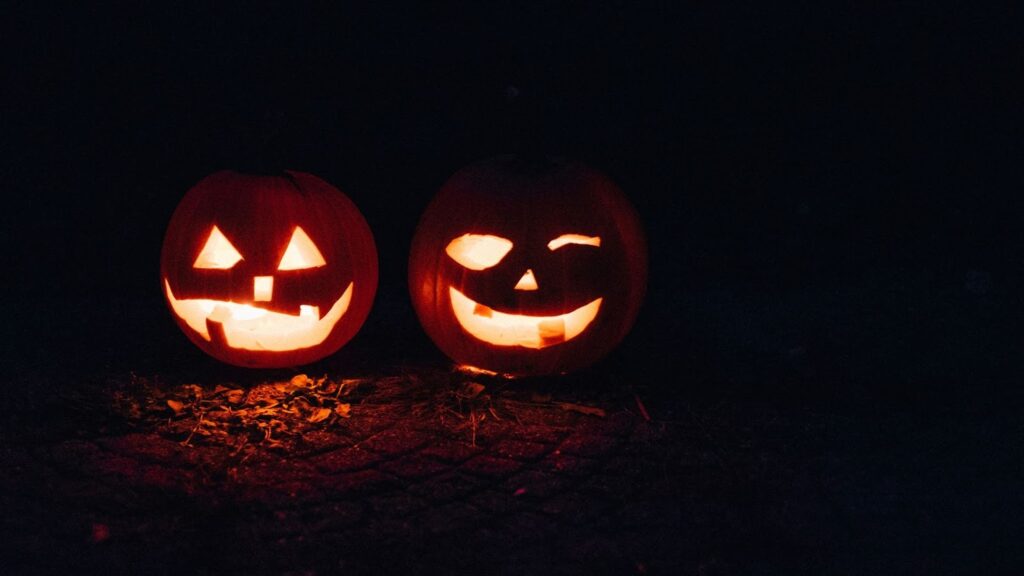
Two jack-o-lanterns glowing in the dark.
(Photo by Beth Teutschmann on Unsplash)

Last Saturday, I talked with my brother on the phone. We swapped memories, unsure of whose lay closer to the truth.

“Wasn’t it in the front yard?” I asked.

“No,” he said, “I’m pretty sure it was in the back. Mom wouldn’t have let you play in the front.”

“But, I thought I remembered Dad getting home,” I argued, “which is why we were out there. I was running out to greet him and show him my cat, and I fell.”

Halloween, 2000, in foggy Pacifica, which is situated on the northern California coast: we were a family of five. I wouldn’t use the adjective “normal” to describe us — because who is normal when you dig deep enough down? — but I will paint you a generic picture: white, suburban, middle-class.

My brother reminded me that he dressed up as Spiderman that year, complete with webshooters that catapulted Silly String. I can picture him at 8 years old, sprinting around the house, trying to climb the walls, spinning web after web. Dodging behind the couch to evade my mother, speeding past one of his little sisters, almost knocking her down. I have no idea what costume my two-or-so self wore, but I imagine it was nothing elaborate. The prior year, I had shrieked so determinedly when my mother attempted to dress me up in anything that, exasperated, she finally drew a circle on my t-shirt, wrote “I’m a pill,” and forced me into it.

Whether I understood Halloween as a concept at two and a half is debatable. However, the great pride I took in the cat I had “painted” at Clay Creation earlier in the week — red splotches blobbed over white ceramic — was not. We must have picked up our artistic triumphs that day. My mother stayed at home with us as our father worked, and she was always spoiling us with that kind of fun — painting, crafts, sewing.

“I know I shouldn’t have let you carry it,” she told me, “but you wanted to show Dad yourself.”

So, I had toddled out to him across the pavement, hands outstretched, clutching my seemingly blood-bespeckled cat (an omen of what was to come) as he got out of the car.

“Dadda, look,” I said proudly. And then I tripped, smashed the luckless cat into a million pieces, fell palm first, and gracefully landed on sharp ceramic.

My “memory” ends there — actually, it ends before the impalement, with the trip, the slow fall, and the shattering. I’m sure I screamed. Blood undoubtedly trickled across the pavement.

“I thought I remembered you saying later,” I told my brother, “that you were really worried you wouldn’t get to go trick-or-treating.”

“Probably. But Dad took us, and we had a really great time. I don’t remember thinking about you at all,” he laughed.

My poor mother, meanwhile, wrapped my hand in a towel and transported me, shrieking, to the emergency room.

Are parents real?

Parents aren’t really people for their children for a very long time; children usually don’t see their caregivers as individuals with wants and needs and vibrant inner lives of their own. I know I certainly didn’t for a long time. Someday, they may see the light, but only through a painful process of maturation that culminates in their own experience of parenthood.

It’s hard for me, even now  as a grown woman, to conceptualize what my mother felt then — as impossible as it would be for someone who has never flown to imagine what the world looks like from several thousand feet high. My perspective of her is shifting, but she still hasn’t quite become a person yet, maybe because, in my mind, she was always more of an icon or a household god than a woman with emotions, fears, and a life of her own.

She was always right. She could fix everything. One word, one hug, and she could drive all the sadness away.

That night, after we had arrived at the emergency room and were ushered in to see a doctor, the sky had darkened to pitch black. Fog billowed on the sidewalk, reflecting the streetlights.

My mother remembers the emergency room being busy. Amid the shuffle, bustle, and crying kids, something truly eerie happened — the lights went out, the backup generator failed, and we were left swathed in darkness.

“They got the lights back on again pretty quickly,” my mother told me, “but on Halloween night, it was pretty creepy.”

Bleeding in the dark, I must have been frightened — but not overly so. My mother, after all, was with me. However, a fresh wave of fear must have hit me when I sat before the doctor, sharp metal instruments shining on his left and right, and listened to him say I needed … stitches.

“You were really little,” she always recalls, when telling the story, “and for small children, they strap them down to something called a papoose board. But I knew how much that would scare you. I told them that if I asked you to, you would hold out your hand and be completely still.”

The doctor objected. My mother insisted. I was not strapped down.

“Sofie,” she said to me. “I want you to hold out your hand for the doctor. Keep looking at me and stay still — even though it hurts.”

I did.

To this day, I have a scar on my right palm, extending from wrist to lifeline, drawing a half-moon. And for a long time, the story of my extreme filial obedience was a source of pride. It is clear to me now that all glory should go to my mother, who inspired such a high level of faith and respect in her child, and in a doctor. That is no common thing.

And I do like to think it was trust, not a fear of punishment, that led me to obey. The belief she would never ask me to do something painful unless it were for my ultimate well-being. When you find a deity both all powerful and all good, you follow them.

The crash that follows

Can you sense the inevitable crash to come — anticipate how adult complexities must eventually clash with childlike faith? As I got older, my mother fell off her pedestal. Adolescence and adulthood have brought me great pain as I realized, little by little, that she’s no god after all. 

For the last ten years, my sister, the undescribed fifth member of my family, has been sick. She may never get better, nor will she die anytime soon — she’s stuck in a type of half-alive purgatory, a caterpillar cemented in its cocoon.

As we have readjusted to the reality of her illness, life has gone on over this painful backdrop, separate from and yet always intertwined with it. I have fiercely disagreed with my parents; reevaluated my childhood — broken the snow globe and poured the contents on the floor. I have dealt with my own mental illness, gone to therapy. Back to therapy again, as I try to accept that my sister is ill.

I’ve been so, so angry that my mother can’t fix it, can’t make my sister well, can’t wave a magic wand and fix the cracks in our family and the world.

If she were to read this, I’d say. “Any anger I have towards you, any feelings of disappointment … are because you were a damn good parent. You wrapped me in a beautiful illusion, and it’s a testament to the strength of that illusion that seeing you as you are, with limitations, has been so painful for me.”

The cycle of life continues

Image of a person holding a baby in their hands. The baby’s feet are poking out from a blanket.
(Photo by Omar Lopez on Unsplash)

Throughout our lives, point of view shifts. Objective truths blur, fade, and come into focus again. Even now, the plane has begun its descent: once again, I can make out rivers, roads, houses.

As my fiancé and I talk about having children, I can feel my perspective morphing into a new shape, one that will only be fully visible when my own children have been raised, and I finally have lived as much life as my mother has.

I know that when I hold my baby girl in my arms, I’m going to hope and pray that we also have the kind of relationship where, if I ask her, she’ll hold out her hand, not counting the cost. What a terrifying privilege and responsibility — beautiful when stewarded, disastrous when mishandled.

It makes me want to weep knowing that, just like my mother, I will champion that responsibility both well and poorly in turn. Because, after all, no one is all powerful or all good — we are all just people, trying, and often failing, to do the best for those we love.

My parents tried much harder than most.

Back together

When we got home that Halloween night, it was to find that my father had meticulously collected every piece of my cat and glued it back together.

I still have it — splattered blood red, lined with deep fissures that tell the story of its shattering and repair. And if I could wave a magic wand, wish away the scars, and make the ceramic smooth again, I wouldn’t.

And Mom: I wouldn’t want you to, either.

What Kind of Bat Are You?

When I was a kid and played little prince-turned-to-toad-type games, I always used to wonder: Hmmmm? What kind of peeper would I be?

Toadie

Would I be the Goliath frog of Cameroon? They say it’s the largest Conrauidae amphibian anywhere in the world. A beast of a frog. Giant. Massive. Monstrous. A right warty ruin. These so-called “slippery frogs” can grow to the size of a baby deer. And they’re born to run — just like Bruce Springsteen or a real deer. Drop, trot. Hop, hop. Takes four hands to hold type shit.

So if I had to be a bullfrog, then it better be that same, slick dreadnought. That’s the frog I’ve always wanted. Conraua goliath. Camarooni leviathanicus. Froggy monstrosititus. Amphibi juggernautti. Toadus maximus. All gross, no glory.

Batty

As an adult, I’ve played a similar game when wanting to fly: What kind of creature would I be in flight? No stupid bird for sure. All beak and big feathers. Weak! And far too pretty, to be sure. Soaring through the clouds. Bathed in light. Close to God and Daedalus too.

No way! I’d rather be a bat. A giant grotesque. A rodent with fleshy wings and nighttime flight. Eating insects and fruit. Sucking nectar from flowers. Drinking blood from a field full of cows.

But what sort of bat would I be?

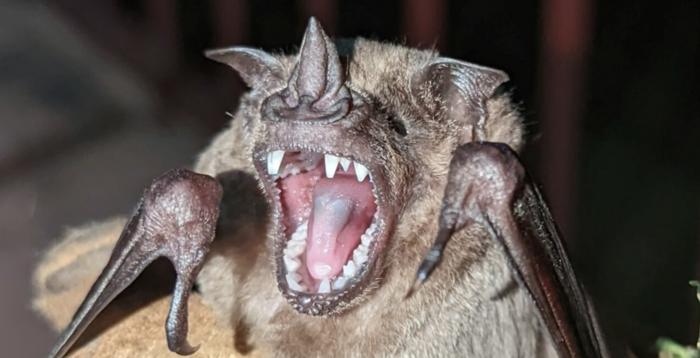
Closeup of a bat with its mouth wide open, exposing tongue,  molars, and incisors clearly
The Jamaican fruit bat Artibeus jamaicensis has a short jaw, like many fruit-eating bats. (Image courtesy of Alexa Sadier via Eurekalert)

A few bat muthafuckaz

Would I be that gorgeous beast known as the flying fox? He of golden-crowned, golden-capped locks? The giant fruit bat Acerodon jubatus is the biggest one of all. A bat out of hell — like a small cat with wings, only with a rat face and groovy two-tone hair. They eat only fruit and the occasional insect taco too. Plus what a cool name… Jubatus? Chew bet I am!

But forget about him. The coolest, most awesomely enviable of all bat names is Vampyrum spectrum, the so-called great spectral bat — also known as the American false vampire bat. These bats are remarkable. Loving. Social. Popular.

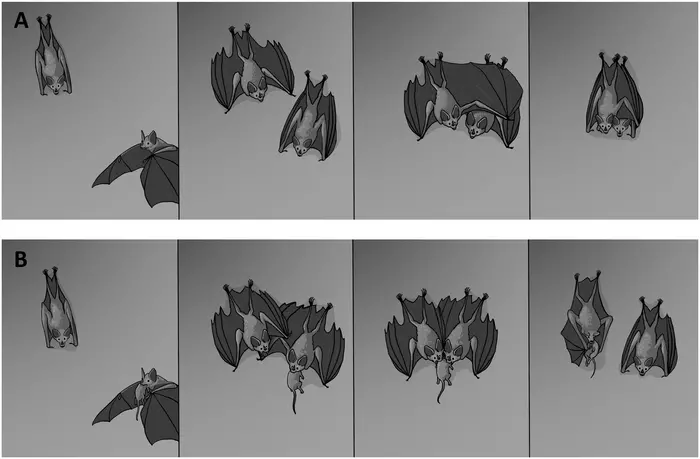
Last month, scientists at the Museum of Natural History in Berlin, Germany, reported hiding a camera in a tree and filming one group of this curious species. These bats sometimes sleep in balls for warmth on cold nights, with the outside bats wrapping their wings around the group. They also give each other bro-hugs, apparently. Most significantly, they participate in a takes-a-village form of “biparenting,” where hunting adults bring back food to share with random pups in the batty ball — often not even their own offspring. Gotta love ‘em.

The B&W illustration has two rows of four panels. The top panel shows two bats encountering each other and hugging in a side hug. In the bottom panel are the same two bats. One brings a rodent in its mouth and gives it to the other bat who greedily accepts.
Social behavior in Vampyrum spectrum bats. The top four panels show a classic bat “bro hug.” The bottom four panels depict an “Ooo… gimme, gimme” example of biparenting. (Image courtesy of Paulo C. Ditzel (2025). CC-BY 4.0 via PLOS One)

Could I be part of that bat ball too — a screeching, gnashing commensal hunter and communal hugger? Maybe.

Or would I be the greatest hunting bat of all… the amazing incomprehensible Nyctalus lasiopterus, otherwise known as the greater noctule bat.

In-flight mealtime

This month, researchers studying lasiopterus from Aarhus University in Denmark and Doñana Biological Station in Spain showed that the bats are rare predators indeed. One of the few hunters in the entire animal kingdom capable of taking down a migrating songbird from a high-altitude avian flock at night. Bon appe-tit.

The greater noctule bat flies to an altitude of more than 1,200 meters (~4,000 feet). There, using sonar, it blindly trolls the mid-troposphere in search of a bounty. Ultrasonic screeches echolocate its path and pinpoint its prey: an unfortunate warbler, robin, or other songbird booty. The noctule bat picks them off. One by one. It can catch birds almost as big as itself.

While it takes them down, the bat doesn’t take them, uh, down. Audio recordings the scientists made of bats catching birds in mid-flight reveal their screeching continues, echolocating around, after the capture. And there are other sounds as well. Chewing sounds. Spitting sounds. Drooling. Yum. In one recording, a noctule bat devours its songbird dinner for 23 minutes, all while soaring high above Earth.

Ah, sweet mystery of life

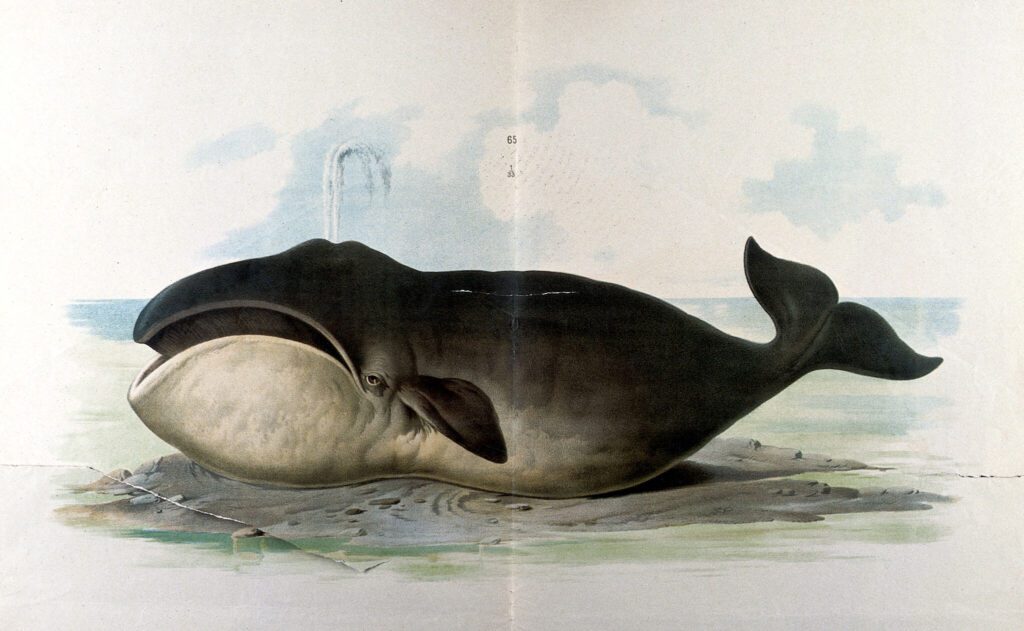
What mysteries these bats keep close. Some may even spill the secret to human longevity. They buck nature’s trend of live small, die young. Mice and rodents have lifespans measured in months — dogs and cats, years. Human life spans average out in decades, and larger mammals can live even longer still. The mighty 4-meter (13-foot) bowhead whale can easily live to be 200.

A color lithograph plate from a 19th century book depicting a bowhead whale done by a talented artist. A crease line down the middle of the print suggests a two-page spread in a book.
An 1860 chromolithograph by F. Gerasch of a bowhead whale resting on a sandbank. (Image courtesy of F. Gerasch via Wellcome Trust)

But bats buck this trend and then some. For their size, they are the longest lived of all mammals, according to zoologist Emma Teeling of University College Dublin. “There are 19 species of mammal that live longer than humans, given their body size,” Teeling told me in a 2022 interview. “And 18 of these are bats.”

For the last 13 years, Teeling has led a group of researchers in a mobile lab to the north of France. As I have reported, they drive through the pastoral hills and picturesque towns of Brittany to arrive at an old Gothic church whose belfry serves as both flophouse and nursery to a population of around 5,000 bats. Then they get together with local townsfolk to capture, weigh, measure, and release every bat in this population, repeating the same procedure with the same bats the next year.

Teeling likens the secrets of a bat’s biology to a Ferrari with good brakes — a car that’s fast as hell but can stop on a dime without setting the tires on fire. Their bodies resist cancer. They tolerate viruses (thank you for that whole COVID-19 thing, by the way). And learning those lessons may someday help humans live longer.

Dracula as Fat Bubba Bat

But if truth be told, I want to be the weirdest bat of all, which in my opinion is the most famous bat in nature: our dear, dear, dreaded creature-of-the-night friend, Desmodus rotundus.

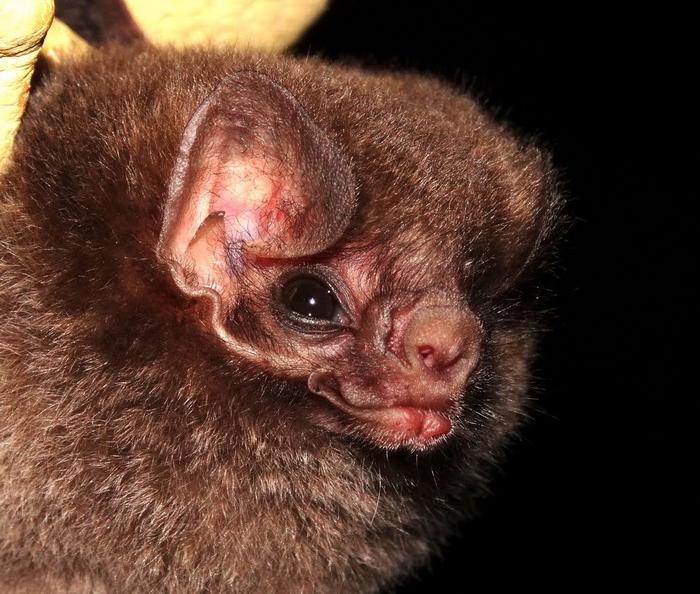
Vampire bats are biological wonders. They have spherically distensible bellies, shorter jaws, sharper teeth, and can drink twice their body weight in blood every night. Ever seen a fat, full vampire bat taking flight? Think about a bowling ball with wings. They’re not called rotundus for nothing!

Closeup of a bat with its mouth closed, but a brown hairy face and a fat, round body.
The hairy-legged vampire bat Diphylla ecaudata feeds primarily on the blood of birds. It is one of three living species of vampire bats. Fewer teeth and shorter jaws serve their specialized diet. (Image courtesy of Sharlene Santana/University of Washington via Eurekalert)

They have special pits in their nose lined with infrared detectors — heat vision goggles, essentially. That physiology allows them to spot the pulsing, blood-pounding vein of a large mammal in the dark. They have no sweet and bitter taste receptors on their tongues, which means they’ve lost the taste for anything other than gimme-more blood. And they get it. They have razor sharp teeth, another evolution. Self-sharpening teeth, in fact. With no tooth enamel, their teeth wither into a keenly honed edge, always. Not just sharp — razor sharp.

All that allows them to spot, bite, and spout open a main line cut through the rough fur and thick hide of their traditional dinner — mountain lion or other large mammal — or sometimes even crocodiles, turtles, and rattlesnakes. Such brave bats!Their modern diet is often an all-you-can-eat bonanza of bitten ankles of domestic cows and sheep.

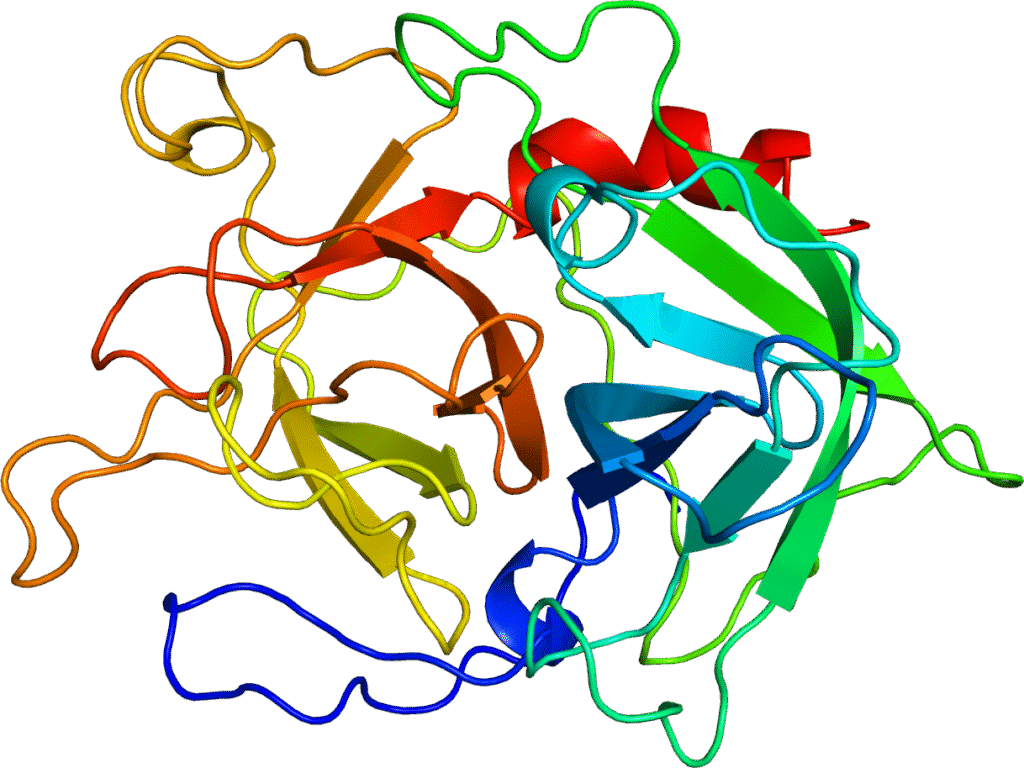
Vampire evolutionary adaptations do not stop at opening wounds, either. The bats have grooved tongues, like built in straws. Lick, lick. Gulp, gulp. They also produce chemicals that keep the flow of blood unstaunched via an anticoagulant present in their saliva — affectionately dubbed “Draculin.”

Colorful ribbon diagram of an enzyme molecule based on its atomic structure. The art shows large unstructured regions as well as some beta-sheets and one alpha-helix.
3D structure of desmoteplase, a compound derived from Draculin. (Image courtesy of Protein Data Bank coordinates (PDB #1A5I) via Wikimedia Commons)

Large animals will kick these annoying vampire bats away when they bite. Those fangs… Oh mommy it hurts! But the more the bat licks the wound, the better it feels. The more the searing pain subsides. The cows stop fighting back. Bat licks are soothing. Nice. They have painkilling analgesic compounds on their tongues as well that soothe the wounds. Licks de-staunch and double salve. Let them do it, bitter bitten cows moo. It doesn’t hurt. Feels good.

Vampire bats are also social, though disgustingly so. Rather than wallow in their own post-sanguine puffery, a vampire bat will not hesitate to regurgitate a share of its bloodmeal with its brood mates. They literally vomit-share directly into the mouths of their loved ones. (Candy corn anyone?)

And finally… There’s one feature of the vampire bat that I love the most. They have freakishly large thumbs, which they use in conjunction with their strong thighs to launch themselves into the air. It ain’t pretty, waddling down the runway into a freakish thumb Cabriole caper. But it works. They launch themselves time after time into the nighttime sky and escape — to bite and suck and drink (to later vomit) and live another day.

I’ll have what she’s having.

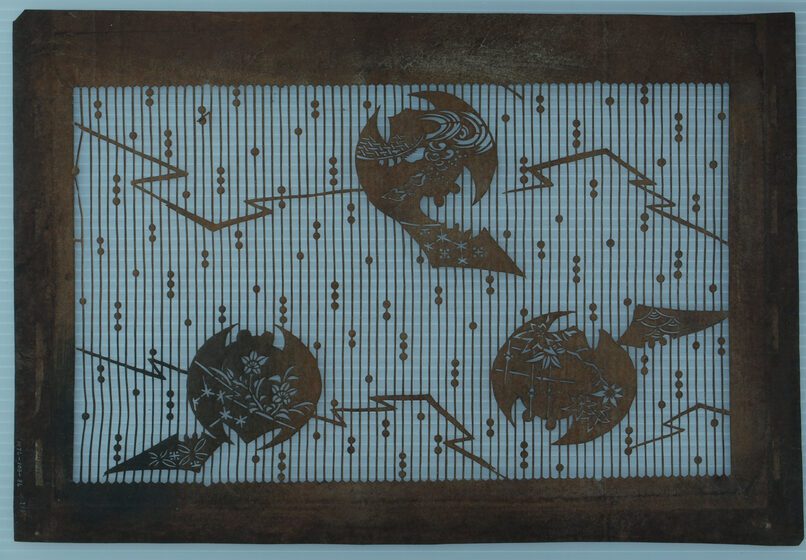
 A delicate Japanese cut paper Katagami art showing three bats decorated in various nature motifs amongst vertical bamboo stripes.
A Katagami of three bats dated mid 18th or early 19th century and now part of the Cooper Hewitt, Smithsonian Design Museum Collection. Waves, bamboo, maple leaves, and multiple blossoms give life to the lucky silhouettes on a medium of mulberry paper (kozo washi) treated with fermented persimmon juice (kakishibu), and utilizing silk threads (itoire). In Japan, bats symbolize good luck. (Image courtesy of Helen Snyder via Smithsonian)