
Offboarding

Jasmine’s heart was working a rhythm. It wasn’t quite pounding, but she could feel the flush in her face, the warmth flooding her body. It was all so cool in her mind’s eye. The delivery of the information, the breakdown of the facts, her clinical assessment of matters, all coming off like a Swiss watch. Her rucksack sat up against the table leg to her left. She found herself adjusting its position three times before the HR manager arrived. What exactly she was adjusting she couldn’t say.

Jasmine was keenly aware of her presence and perception in the workplace: quiet, in the corner, coder, unnoticeable. She wasn’t even a coder but a junior developer. As a techie in a department of a big bank, she accepted and understood her furniture-level importance to the grand operation she found herself in. She liked the job. It didn’t set her heart on fire, but the scale of it, the money and the prestige of working for an internationally recognized bank wasn’t something she took lightly. Looking round the glossy, clean off-white interview room, a bubble of anxiety rose within her.

Her mum’s face came to mind. Mum, prouder than proud the day she told her she got this job. Rarely one to openly express a beaming warmth and celebration on Jasmine’s success, she was clearly quite chuffed with this one. It was the name, it was the status of the bank. It was being able to tell her friends at the hairdresser “My daughter works for…” Yet this was her exit interview. Just some 8 months in. She didn’t really have a story to tell her Mum. She doubted she’d understand. Neither did she have a cogent plan of what would come next. Jasmine sucked in her cheeks and pursed her lips. What was just moments away scared her.

The doubt was porous. Forget being hot and uncomfortable, she felt foolish. Had she watched too many movies? This was the right thing to do… but was it the right decision for her? Jasmine looked up at the analogue clock on the wall ahead, just a minute till the appointment, when she heard a middle-aged brogue on the other side of the door. A dull clink signaled the lowering of the door handle. Malcolm Graves entered.

***

It was a breezy work day for Malcolm, sans kerfuffle or boondoggles. The weekend was just round the corner, and he had his weekly squash game planned for 7 p.m. Margaret had booked a trip to the Lake District for the weekend, and he’d merrily scheduled annual leave for the second half of Friday and the whole of Monday. Coffee in hand and paperwork under his arm, Malcolm was enjoying the pleasant frequency of not feeling too high or too low; he remained somewhere in the middle, trouble free.

The HR department had been gifted a lighter load in recent months. There were the usual unpleasant incidents involving abusive customers from the ground floors but nothing out of the ordinary. The email inbox was not inundated, and the implementation (and creation) of new policy had slowed compared to the heady days of some 5-6 years ago. Malcolm, in truth, had never met Jasmine. He had the name on file but didn’t recall it upon being assigned the exit interview. When he looked at the job description, he couldn’t tell you exactly what Jasmine did and well, with her being a techie, he entered the room with no qualms.

“Jasmine,” Malcolm briskly stated on entrance.

“Hel—“

In a flurry of nerves, Jasmine nearly tipped the interview table upon standing to greet him.

“Oh, careful there. That desperate to leave us, are you?” Malcolm gently ribbed, reaching a hand out to shake Jasmine’s.

Jasmine let out a nervous chuckle before gripping Malcolm’s hand, only making the briefest of eye contact. Malcolm could feel the anxiety radiating off of Jasmine, and he had to resist the impulse to wipe his own hand down; Jasmine’s was wet with sweat.

“Dear God,” he heard his inner monologue proclaim.

“These IT guys really do struggle with human interaction.”

He maintained his warm, off-handed, yet smiley demeanor. He guessed Jasmine was, at most, in her early 30s. Large glassy eyes were exaggerated in rimless glasses, and she was soft-voiced and quite clearly nervous. Malcolm was endeared at the thought of this young woman being deeply engrossed by a small, flickering laptop on a desk in front of her somewhere. Once they were both seated, Malcolm leapt into the standard procedural rhythm.

“Name?”

“Jasmine Thompson.”

“Position?”

“Junior Developer.”

“Department?”

“IT & Digital.”

“Manager?”

“Sharon Coates.”

“Start date?”

“It was err… I think, yeah, um, February 17th.”

“And leave date… is… today.” Malcolm reeled off mechanically, as he filled in the form. He looked up at Jasmine. Her face was beginning to glisten and seemed stuck in uneasy blankness.

“So Jasmine, would you like to tell me what your reasons for leaving are?” Malcolm asked, attempting the friendliest tone he could muster.

Jasmine looked down to her left and didn’t answer. Malcolm sat in silence for all of 10 seconds before it became untenable. He implored as delicately as possible.

“Look. Jasmine. If there’s something you feel HR ought to know, then now is the time to say something.”

Jasmine heaved in a large breath and gave Malcolm a brief pocket of eye contact before returning to looking at the floor. Malcolm hadn’t encountered this kind of shutdown before; he was beginning to feel an uneasy sense of gravity. He probed further, conducting his voice in a near whisper,

“… if this has anything to do with why you’re leaving, it is important that we know.”

Jasmine gave an uneasy look. She then reluctantly reached into her rucksack and pulled out a beige folder of printouts. She put them on the table silently. Malcolm glanced at the folder, then at Jasmine before picking it up to examine. Inside, he saw a log of some sort, a spreadsheet.

“Can you help me out here Jasmine? What am I looking at? Outside of what looks like some sizable transactions…”

“It’s um, it’s, from a system I’ve been working on in my pipeline.”

“… go on.”

“This is a log of the cache for AML.”

“In plain English, please, Jasmine.”

“On the left are the client numbers from the identification portal. The middle is the transaction names, and then the dates, then the transaction type, sums.”

“Right.”

“Then the column on the far right is whether transactions have been flagged.”

“Flagged? In regards to anti-money laundering?”

Jasmine nodded and leaned forward.

“Turn to page 12 and after.”

Malcolm did so. He scanned it up and down, then the next page, then the next and the one after. Jasmine cleared her throat and stated,

“It’s the same clients, same transactions, same types, but they’re no longer getting flagged.”

Malcolm sat back and studied the papers, line by line, taking his time. He glanced up at Jasmine. In return, Jasmine looked everywhere but at Malcolm. She took a deep gulp of air and told Malcolm the truth,

“That warning system is mine, under my access, exclusively; I’m the only person in tech who could remove or alter a transaction’s flagged status.”

“And you didn’t do this?” Malcolm asked unblinking.

Jasmine shook her head. The burst of silence between them was heavy. Malcolm continued to look down at the paper.

“… then… who could?”

Jasmine’s eyes held Malcolm’s. She raised her right hand from the table and from chest height made a gesture pointing up.

Malcolm looked at the paper again. He found himself in the very well of discomfort Jasmine was stewing in. Malcolm paused. He skimmed through the last pages once more. He looked at the sums and how many. These were huge amounts of money.

“Jasmine, how much of this have you—“

A dull thud hit the table, rupturing the stilted atmosphere. A huge pile of folders lay between them, spilling across the table, covering its entire surface. Jasmine zipped up her rucksack. Her voice shaking, eyes wide, she pleaded,

“You can’t tell anyone this came from me. Please– I just wanna get out of here.”
Recidivist Phantoms

It was some 18 months into the AI overhaul, and a pattern began to emerge.

It started with just instances, here or there. There was no great wave. There were just punctuated happenings, miles apart, entirely without relation. Though, over enough time, droplets made up an ocean.

Prison releases in any iteration of society had always been a complicated matter. The statistics were seldom positive on the side of rehabilitation. Worldwide, recidivism was a reality – between 18% and 55% of released prisoners could return within two years. Even in a day and age where western penal systems found themselves creaking with overpopulation, there was no immediate remedy for the complications of life after release.

Irrespective of their sentences, fundamental issues of housing and having any kind of reliable support or income stood in the way for a significant proportion of released individuals. That’s not to say many couldn’t go on to form a stable life, but this was, of course, entirely conditional. Public support was high for businesses hiring ex-offenders, but promising outcomes remained low. Those who could rejoin the workforce knew the barriers they were heading towards.

Barely 15% found themselves back at work within six weeks of release, while a little over 20% received employment after six months. These were the fortunate few, typically with support systems in place for them, and low-wage, low-security work their means of money. Ultimately, the broadest of barriers to life after prison were stigma, mental health complexities and homelessness. Yet, something began to change, to show up, bit by bit, across international probation reports.

***

Jobs were being vacuumed up at light speed as juries became a thing of the past. AI became the replacement for judges and every last piece of visual media’s origins and intentions were entirely unknowable. The most affluent of areas segued into universal basic utopia, while the most deprived areas became enclaves of isolated desperation. The world had become a fully automated riddle. Few roles remained for human beings, yet low-wage, low-security work, deemed befitting of released prisoners, was still available.

Probation officers were also among the remaining jobs, relying on some last human faces to reintegrate other human faces into society upon their release. Curiously, the ex-offenders who managed to gain interviews and employment started to display peculiar trends across their probation reports. Ad-hoc, instantaneous compiling of information meant AI noticed these patterns first. This notice was soon passed on to their human counterparts. Abby Nelson received hers via email the night before her 9:45 am appointment with a Mr. Derek Rogers.

Some months ago, Abby weathered the initial shock of being reposted to the role of a Probation Officer. She did though, with enough experience, acclimate and soon counted herself lucky. Firstly, she had a job. Secondly, she had a job that was solely based around people with acute needs; her role was necessary and desired, and it most certainly should have been carried out by a human being. Abby found herself as much an agony aunt as a useful resource to many of her clients. They were simply trying to get through, consistently trying and applying in hope that a stable job would materialize soon.

She often ruminated on the fact that poor literacy is one the most profound themes of prison populations, and, while it stands as an obstacle to employment prospects, this can also result in remarkably expressive, poetic, and connected speakers. Without the rigidity and constriction of schooled literacy, individuals often found themselves adept as perceptive talkers and listeners. They might not be able to recall the pedantic insides of a peer-reviewed academic textbook, but they could distinguish a lie from the tone of a voice. They knew the threat of manipulation from a pressed syllable. They also recognized a good soul from a bad one, all from the choice of words and their delivery. Abby relied on this fact, and respected it, as she approached any client conversation.

Derek was a success story. Abby had always found him polite and straightforward. His sentence had been four years for, in his own words, “getting up in business that was none of my business.” He didn’t reek of self-loathing or wanton mental health crises as so many releases did. Abby saw his story straight; Derek had fallen for an offer to make quick money in a moment of weakness, and he’d been caught in the act. He accepted his sentence and made no bones about his crime, following a quiet, drama-free sentence: he was released.

Derek’s life story was one of a self-made man, and his life after release continued that motif. Within two months he’d secured a single room flat and began to make a modicum of regular income as a plasterer and plumber. He also kept himself well clear of anything nefarious. With an ex-wife “somewhere out there” and “few friends worth talking to,” Derek was a fifty-something in the process of reintegration and, ultimately, doing incredibly well.

***

Abby and he had been seated for some ten or so minutes before she realized something was off. Derek always sat to face her and was somewhat chatty. He had the slightly grating, chauvinistic habit of calling her “Abby girl.” However, Abby weighed this endearment against every other name prison releases had called her in the past months and decided to recognize its warmth. Today, though, Derek wasn’t chatty. He gazed out and away from Abby and… he looked tired.

“Is everything okay, Derek?” Abby implored, genuinely hoping bad news was not afoot.

Derek shuffled a bit in his chair. He half-muttered under his breath, interrupting himself from responding more than once. He briefly glanced back at Abby and let out a little chuckle before setting himself. His eyes shifted to another corner of the room while he said,

“What is it? This… AI? This, this new world. Photographs, now videos. Vehicles with nobody driving. None of it real. You know, even when you walk down a street full of people – it feels empty. Nobody… talks anymore. Don’t even acknowledge your walking on the same street. It’s quiet but the cars. My last three jobs; I get sent the job on my email, I go to the door, I’m answered by the door bell… I didn’t even see the last three people whose homes I was in. There were no photos on the walls, either. It doesn’t matter where I take a job, it’s the same everywhere I go.”

Derek looked up and out, ruefully, mournfully.

“Is… is… this it? Dead streets. Nobody behind the counter. Talking to a computer. Everything’s a computer program. It feels cold. The whole thing, it’s… it’s… not like people live here anymore. It’s like everybody is scared. Too scared for a greeting. Too scared for even a ‘hello’.”

Derek looked pained. His voice softened. Abby’s throat felt dry.

“A child spat at me.”

His gaze set upon Abby once more. His face stopped moving; his eyes felt hollow. 

“Just a little thing. 5, maybe 7 years old… he – it, didn’t hit me. But… the mother… she moved her kid away from me. Didn’t confront or discipline him. Didn’t make an apology. She grabbed him and moved away… like I was the problem.”

Derek paused.

“That’s not about me. I have no sign on my head. People don’t know I’ve been to prison. They can’t read minds… this is people. People are just scared.”

Derek briefly brought himself back from his thoughts, back to Abby, back to the present. He began with an exhale,

“Abby girl, I may be talking crazy, but… and don’t misunderstand me when I say this… I don’t ever want to… do something stupid again. That’s not what I’m talking about. Don’t misunderstand me. But can you believe me when I say this; I had a dream the other night of being back inside. Do you hear that? This… out here… there’s no society. I can’t believe I’m saying this, but I think something in me wants to go back.”

Abby sat in silence, looking at the glassy wetness filling Derek’s eyes. This was as honest and intimate an exchange as she’d ever had with a released prisoner. Abby didn’t know where to begin.

The email memo she’d received the night before was as if prophecy:

En masse, successfully reintegrating prison releases were longing to be back in prison.

INK

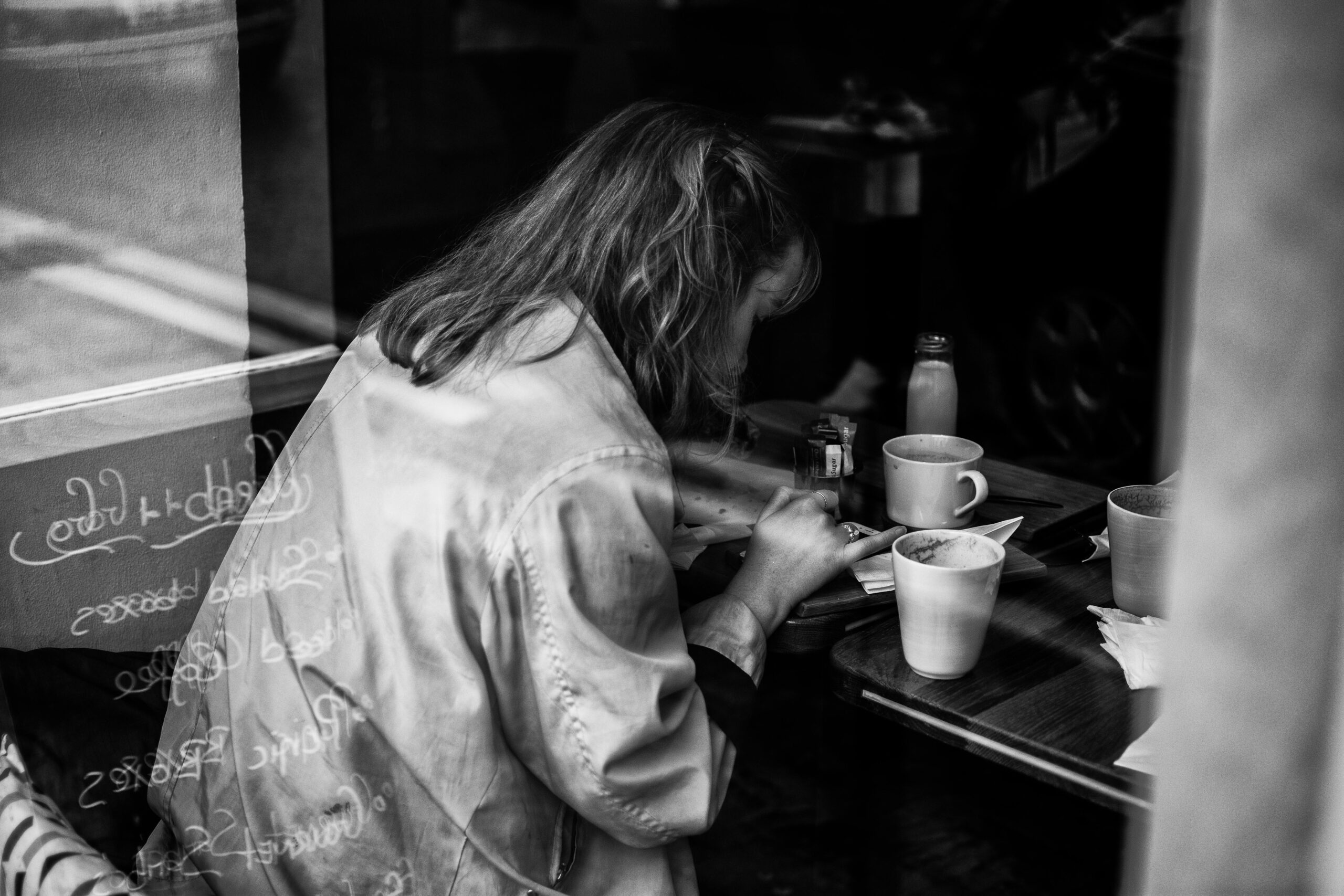
In a coffee shop a woman sits, head bent, knotted and frizzy blonde hair cascading down her back. A claw clip clings to it with little purpose: impotent, listless, one tooth broken at the root.

Besides her sit a cup of coffee and a laptop. She hates the artificial light it generates: a swinging metronome, pulling her face toward the glare, frying her retinas.

Well, out of sight, out of mind, she thinks, and slips it into her backpack. But the burn behind her eyelids still sears.  

She pulls out a notepad; wrinkles her nose in distaste at the sight of her own messy handwriting. Why can’t she have beautiful, flowing script like other girls? Effortlessly curly and smooth (their hair always the same — no frizz in sight) half cursive: one letter making love to another, forming a sensuous breath, an uninterrupted thought inhaled and exhaled in harmony.

Poetry ought to hold hands with elegant script — not chicken scratch.

But what was the word she was looking for?

Her moonbeam shouldn’t just glisten or gleam; but perhaps illuminate? Luminate? Effervesce?

Too highfalutin, she thinks.

Use simple words you aren’t a Victorian novelist. No Brontes here. Hadn’t they written all their best works by the age you are now? You, on the other hand, have written nothing.

She decides on “shimmer” with distaste.

Across the shop, a middle-aged woman sits on a sofa. Her latte lays untouched on the low table before her. She is deeply uncomfortable and utterly ignorant of her own feelings — her whole awareness taken up with wishing her cell phone would ring, though she knows it will not.

 Her daughter, after all, is busy. Her daughter doesn’t need her. Her daughter is just fine.

Somewhere, on the other side of the country, she sits — like that girl to the right maybe — writing a beautiful paper that will get an “A.” And she will call home happy about it, someday. Just not today.

Though Ashley takes much better care of her appearance, she thinks, spotting the claw clip. That’s the way she was raised: “You have to put your best foot forward,” she always told her daughter.

She wishes Ashley would call more often. She wishes even more that she did not resent her for not calling — children must be left to live their own lives — but then, on the other hand, didn’t their parents deserve more than to be treated like an ATM?

Maybe I did something wrong when she was growing up, she wonders, thinking back into a blurry abyss where memories sometimes rose to the surface with painful clarity.

Though she is ashamed of it, she often snoops in their joint bank account. She had seen the bill the day before: mental health solutions, psychotherapy. She knows what people talk about in those sessions — about all the things their parents did wrong — every unintentional trauma they imparted, the spankings they had given. Well, hadn’t everyone told her it was good to spank her children then? Hadn’t her own parents done it to her, sometimes with a belt? It had never crossed her mind to resent them for it.

But children were different now because now was a different time. They believed in looking deeply into every feeling and rooting out every pain, rehashing every conflict. They had no idea what a great luxury it was to be able to do so.

She remains unconvinced, no matter what Ashley says, that it is always better to uncover than to bury. Her coffee grows cold, so she forces herself to drink it, mechanically.

A little boy runs back and forth across the shop, from his Mother, seated at a bistro table outside, through the heavy door (he must push hard, like Superman, to make it move) to the shelf of games. He runs his fingers over each game but chooses none because his legs are twitching to run and leap.

He dashes back again (fast, like a cheetah), catching a glimpse of a thin woman sitting beside the games. She has lines all over her face because she is old, and she looks sad. He forgets about her the moment he turns away and pushes at the door.

Mother sits reading, though he can feel her watching him, making sure he does not try to run across the street. He wishes they could play together, but knows she doesn’t want to.

He knows Mother more by smell and touch and sound than by sight — because she is always moving, and her legs are the body part he sees most. She is a skirt, a lullaby, a pantsuit, a warm hug, sometimes a stern voice, but always far above him, in a different sphere he cannot fully enter.

He kicks a pebble and sends it scuttling onto the street. He starts after it with abandon, but finds himself stopped, because Mother has grabbed his shoulder, though she has not looked up. She is omniscient, omnipresent.

She says, “Jeremy, stay.”

He looks longingly after the pebble, then at a bird in a tree, then at the pastries in the shop window. He runs back through the door, push, push, PUSH, and the shop bell jingles.

A grayscale image of a man washing his hand. It is large, strong, and he lets the water cleanse it thoroughly.
(Image Courtesy of George Becker via Pexels) 

In the bathroom, a man eyes his bald head in the mirror above the sink — a rounded and reflective plain, speckled by only a few sickly trees that escaped the strip mall’s razor. He remembers that an astounding percentage of men don’t wash their hands. This makes him feel a little bad for women, and a little bad for himself, too.

Well, he will scrub his hands proficiently, though considering he is about to touch the door handle (urine-bespeckled, undoubtedly) he is not sure it matters.

Everything in life comes out the same, no matter how hard you try, he thinks. What was the point of being good or right in a world where everything is contaminated already — the planet, more or less a castle of bacteria, growing far too fast to be cleansed by soap and water?

A losing battle, he decides, drying his hands.

All this time his eyes have rested on the fruity-flowery wallpaper covering the single-person bathroom: the peaches a warm, burning orange, the cherry blossom petals a delicate, breathy pink, the leaves and vines a cool, comforting green. He is acutely aware that because he is a man, he should not like this wallpaper, but that, unfortunately, he does like it, just like he likes white mochas and peach Bellini.

He walks out of the bathroom and sees a little kid bolt through the shop door, making the bell tinkle. Once upon a time, he was that child, a whirlwind of energy, a flame cruelly contained by kerosene-glass.

Always shattering, screeching and weeping — though the weeping had only continued ‘til seven or so, when he came to understand the cringy weakness of it. He still cried, of course, but only silently, alone, at night. If no one hears a tree fall, does it really make a sound?

He has a theory that “good” men continue to cry into adulthood, even if forced to do so in private. Those who dry up their ducts transform into gods of burning rage… the price of evaporating human tears.

Unless he is self-deluded, and the wallpaper and crying mean something else entirely. He has often wondered if he is gay. Hadn’t softness and sensitivity — however hard he fought against them — permeated his life? The problem with this theory is he doesn’t really want to have sex with men. But considering the repression and homophobia of most males, how can he know for sure? Everything he believes about himself could be a lie — the truth hidden deep beneath layers of societal guilt and shame.

Maybe, even now, his perceived attraction to the girl in the corner — he watches her as she rips through notebook pages, dotting “I’s” and crossing “T’s,” viciously dashing out whole sentences — is all a sham. Her knotted hair reminds him of brambles on the edge of a lawn, encroaching into the landscaping, squelching non-native plants, reclaiming the wild.

It must be this wildness that bewitches him, that enters his body like an evil spirit and drags him across the room to her. Hitting on women in coffee shops is too bold and deeply out of character for him.  Watching his body stroll over to her, he considers if his real intention is to reassert his heterosexuality.

Standing at her table, alarmingly close to her, he realizes he has nothing to say. Mercifully, not only does no sound come out when he opens his mouth, but the girl, absorbed in her art, seems unaware of his presence. Before she can look up, he turns and hustles toward the door.

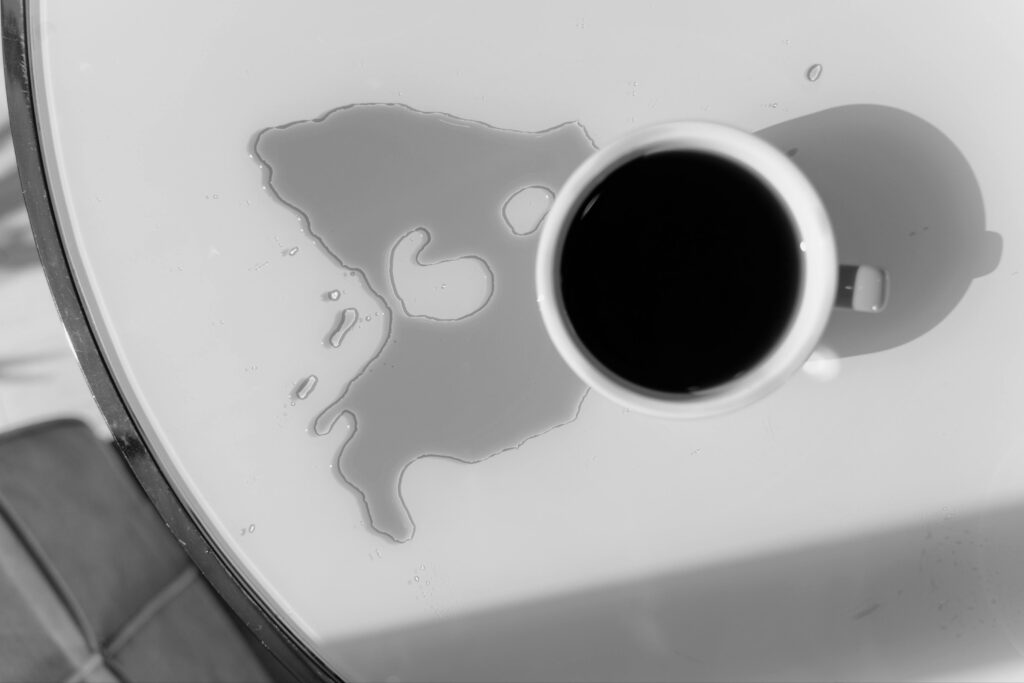
A grayscale image of a cup of coffee that has been partially spilled. The puddle of coffee on the table has gone cold.
(Original image courtesy of RDNE Stock project via Pexels)

On the way out, he nearly runs into the little boy, bolting outside again. He shifts his balance to prevent collision, nearly falling, and careens into a low table, upsetting the coffee cup of an older woman. She looks up at him with tight pursed lips and wide, startled eyes.  

“Oh shit, sorry about that,” he says, trying to help her clean up the mess. But she waves him away, saying nothing. He is left to drift toward the door, knowing himself a failure.

The commotion makes the writer come to herself again. She sees the older woman soak up her spilled coffee with napkins, the child outside pull at his mother’s pant leg, and the younger man disappear through the shop door with a clang.

Even from behind she can tell he is attractive — broad shoulders, a nice butt. Why can’t anyone like that ever notice me? she thinks.

 He’s probably gay, she decides. He’s dressed too nicely to be straight.

She turns back to her page, buzzing with discontentment. One more cold, hard letter written, and her hand stills. Her pen has run out of ink.

Velveteen Reality

It had been two years, and I’m utterly positive now: I can’t leave.

The last thing I remembered was drifting off after doing some late-night reading. And the next thing I knew, I woke up in a forest with wings attached to my back. I. Had. Wings.

Why did I have wings? I truly didn’t know. But after flying around, it seemed to be around the turn of the century. The modern world I grew up in was long gone, and I had no idea how to get back home. I spent three weeks spiraling in anxiety and fear, flying aimlessly around the woods looking for any sort of sign of where I was. The only clues I had were the lack of modern cars and the unpaved landscape—I was definitely not in any metropolitan city.

One twist of luck I discovered was my new magic affinity. My now shrunken size allowed me to fly anywhere really quickly, and the humans weren’t able to see me. I flitted around gardens and kitchens without being caught. I needed to eat somehow, and I hadn’t the faintest idea of what job I would’ve been able to get. Plus, it was still quite cold outside, so the warmth inside was hard to resist.

As I flew around the houses one night, I was peeking through the windows for any sort of entertainment on their old-school TVs when I noticed a horse and a rabbit in the middle of the room. Something deep inside told me to go in, so I slipped through and hid in a dark corner.

“What is real?” the little bunny asked the horse.

“Real isn’t how you are made. It’s a thing that happens to you,” the horse replied sagely.

Yup. I had landed myself somehow in The Velveteen Rabbit

I had somehow become the Fairy in my favorite childhood story. When I was younger, I used to own several stuffed bunnies in the hopes of creating a real one myself. I had memorized the story by heart—but I never once wanted to be part of the story! I couldn’t accept being sent back a whole century just to make stuffed animals real.

Once the reality started sinking in, I made a beeline for the forest hollow I had now called my home. Now that I was able to use magic, outdoor living was more manageable for me. It was a far cry from the comfort I grew up in, but it was a lot easier.

A wooden statue in a white dress with purple flowers, wings showing from behind as if in flight.
(Image courtesy of Alessandro Matonti via Unsplash)

“Okay, okay, okay. I am a fairy. I am to make toys turn into real things?? The horse explains to the rabbit at the beginning of the…” I trailed off, running my memory at high speed, not trusting my recollection, and trying to find other sources of truth. Alas, it was to no avail. “I’m at the beginning of the story. The rabbit doesn’t turn real…for another half a year…”

If I were to make the rabbit real…then would I be able to go home?

A new determination filled within me. I now had a shot.

For the next few months, I began pushing the boy and bunny together: hiding the china dog, whispering in the boy’s ear that he longed for the bunny, and nudging the nanny on where to find it every time it was left behind.

Then, my time to shine had come.

I distracted the gardener and untied the bag holding the old toys to burn. That night, the velveteen rabbit rolled out. I had practiced and rehearsed for this very moment.

“You were real to the boy because he loved you,” I delivered in my most cheery voice. “Now, you shall be real to everyone.”

I scooped the rabbit up in my arms, dropped it off in the forest, and gave one final kiss. Then, I fluttered back into the shadows and watched as the rabbit explored its new life.

A brown rabbit stands on its hind legs in a field.
(Image courtesy of Laura Lumimaa via Pexels)

But I didn’t return as I had hoped.

I still had wings on my back, I could still use magic, and I was still in the story. With a light heart, I flew back to my hollow. I surprised myself when I thought about how…meaningful it felt to transform a boy’s love into a tangible wish.

So, when I saw myself still in those now-familiar woods, watching the velveteen rabbit of my childhood hopping around, I wasn’t too disappointed.

After all, there were plenty of toys to watch over.

Biblical Gardens

The biblical gardens were a fairyland. In Jean’s imagination, no one had planted the flowers, engraved the stones, or bought the benches: they had all appeared out of thin air. An angel had flown down from heaven, touched the land with a long, shining finger, and Eden had sprouted, flourished.

Mother often took Jean there to paint. “I could live without the overt Christianity,” she always said, “But something about this place calms me down.”

Jean played along the paths, in the creek, puzzled over the Bible verses, scattered throughout the garden – etched on rocks, displayed on wooden signs – as natural and essential to this place as the colony of ants that lived beside Mother’s favorite bench. Mother spent most of her time sitting there, overlooking the waterfall, often painting it, but sometimes staring at the signs with a sad, sour look on her face.

From a young age, Jean knew the real reason they came here was Grandma.

“I would have scattered her ashes here if the old bitch hadn’t insisted on being buried,” Mother told Jean again and again. “It would have been cheaper and nicer, but nope, because it would be easier on me… fuck it.”

Then she would sketch a flower, butterfly, or sometimes children playing in the garden. But none of the pictures, no matter how beautiful they were, made anyone who saw them happy. Even the butterflies, still and scrawled, came away looking sad.

To this day, one of these sketches hangs in Jean’s hallway, and she stops to look at it sometimes, just to remember the burden her mother had to carry.

In the picture, three children run down the trail, past Maudlin’s empty bench. The face of the first, a tall girl with curly brown hair that streams behind her as she runs onto the bridge crossing the creek, cannot be seen. The second is a little boy, mid-trip, his hands falling down in front of him to catch himself, his profile also not visible.

Maudlin is the third – drawn to impart the liminal: a grown-woman’s countenance plastered on a little girl’s body – turning around to stare at the voyeur looking in. Her mouth hangs open like a trap door, her eyes wide and globular, like two green planets; her arms hang limply at her sides, flopping, as if they have no bones.

         The path through the garden is aided by several bridges, which allow the walker to zig-zag back and forth over the creek. The second, a dainty wooden arch that crosses the stream nearest the waterfall, sits deep in the garden, while the first, broader and well-worn, stands at the entrance. The thudding of Jean’s feet against the wood, drowning out the noise of Highway 49 behind her, seemed to herald her arrival, making her journey into another world complete.

         A big sign that hung over the first bridge said: “Taste and See the Goodness of the Lord.” Mother always made a face whenever they walked past it, but Jean liked the idea of a god-garden. And she understood what the sign meant, too: when you experienced art, you couldn’t help but learn about the Maker.

         Jean invited Jules to come with them, but only once, because not only did Mother find him annoying – “That kid talks so much about reptiles it makes me want to kill myself” – but also because Jean rightly recognized that he would be incapable of respecting the sanctity of the place.

         You didn’t run in these gardens, she tried to explain, you were meant to walk slowly. Nor did you shout – you spoke in low, dulcet tones.

         “It’s like church,” she warned him, “solemn.”

         “You don’t go to church.”

         “My grandma took me, when I was really little, like 3 or 4.”

         “You can’t remember that. That’s too little to remember.”

         A hazy world, blurred at the edges, like a dream:

         Thick lights, streaming through the stained glass, illuminated the face of the baby, whose mother held up for all to see. She looked sad. Were all mothers sad?

         Little boys, at the front of the church, dressed in white, singing like angels, or doves; the tone of each voice building on another, climbing higher and higher, further and further upward, till the whole church swam in music, till the sound, crystalizing at the tippy top of the high-ceiling, threatened to burst through the roof and obliterate the chapel in a violent, vibrating melody.

         The big wooden cross loomed at the front with a man dying, sweating beads of blood – ever after. When Jean thought of her grandmother, she thought also of the statue of that man, because a moment after spotting him she turned her eyes to the ground and was shocked and frightened to find her grandmother on her knees, opening and closing her mouth without words, crying. Jean had never seen her cry before and would never witness her doing so again.

         She almost reached out her little hand, like one might reach for a blooming cactus, before she remembered the touch would hurt. And her eyes again rested on the wooden cross. Jean wondered why on earth that poor man was up there, half-naked and sweating blood. And why all these people stared at him.

         She asked Grandma, after service, who he was.

“That’s God,” Grandma said solemnly.

And for some reason it made sense to Jean that God was mutilated, that he bled.

         “I hate church,” Jules said. “It’s boring.”

         “You’ll like it here though,” Jean reassured him. “There’s a creek. And lots of lizards.”

         “Well, alright,” Jules said, “I’ll come if I have nothing better to do.”

         Jean frowned at his lack of enthusiasm.

         Jules insisted on racing from the car to the garden, which confirmed that Jean’s decision to invite him had been a grave mistake. Still, it did feel wonderful to run, with her hair streaming out behind her and her feet thudding bombastically on the wooden bridge like the music of an off-beat drum. She didn’t race past the world; it bolted by her, elegantly topsy-turvy, with the speed and swiftness of light and wind.

         Then her feet landed on the soft, spongy grass with relief. She wanted to sink down into it and grow burrowing roots for the cool, dark earth to hold. 

         Jean collapsed on the bench closest to the entry way as Jules finally came sprinting across the bridge, huffing and puffing.

         “I beat you!” Jean gasped, triumphantly.

         “Only ‘cause I let you win,” Jules wheezed. He took out his inhaler and brought it to his mouth, inhaling long puffs.

         Jean saw Mother far away, still lingering in the parking lot, fading into the background like a tree or moss-covered rock. And the garden before her grew larger than itself—expanding into tangible imagination, a thought bubble solidified into a new, wild continent.

         “I know what to play,” Jules said, excitedly. “We’ll be explorers, making maps and stuff.”

         Jean considered this. “But why are there only two of us?”

         “I don’t know, maybe everyone else died… and now we are running out of food.” Jules, in thoughtful contemplation, bit his lip. “You can’t be a girl, though,” he continued. “They wouldn’t have brought girls.”

         “That’s not true. Lewis and Clark brought an Indian woman with them.”

         “I can’t even say her name,” Jules said, “so she doesn’t really count.”

         Jean frowned, wondering aloud: “It was an ‘S’ something…”

She suddenly felt it was important to remember, because this woman had existed – hadn’t she? – as much as Lewis or Clark, and she was actually more real than either of them, because she had been born from the land she traversed: sprouted up straight from the soil, rather than merely being someone who walked on top of it. Like the difference between herself and Jules – he stomped over and through places, but they never belonged to him or changed him in any way. But Jean became a part of the world she walked in, weaving a flower into her hair, scattering earth into the cuts on her fingers, welcoming water into her stinging eyes. Of course Jules wanted all the characters in the story to be stompers: unaware of the shrubbery they marred and the big boot tracks they left.

“Sacagawea!” she said triumphantly, remembering.

“Yeah, whatever. Don’t you want to play?”

“Why don’t you be the explorer, and I’ll be the Indian woman,” Jean said. “And I’ll help you learn to survive.”

In an uncharacteristic moment of self-assertion, she continued, ignoring Jules furrowed brow, and said, “We can pretend the creek’s the ocean, and you got shipwrecked here. And you don’t have any food. And if you want to survive you better become friends with me!”

Jean ran away then, ignoring Jules’ calling after her, because she didn’t want to argue, and maybe what she really wanted was to play alone – along the path, over the bridge, many waters gurgling underfoot, drowning out his voice. Up the winding trail (which ran parallel to the one Jules stood on but was separated by the creek), up the wooden steps and out of his sight – till she stood below the big wooden crucifix, with the image of the God-man, dying. She walked past him quickly because it made her sad to look at him, and continued to ascend the steps till she came to a stone table engraved with twelve men. The one in the center held out an ornate cup to the others, and the inscription sprawled beneath them, covering its length in fancy letters: 

“This is my blood of the covenant, poured out for you.”

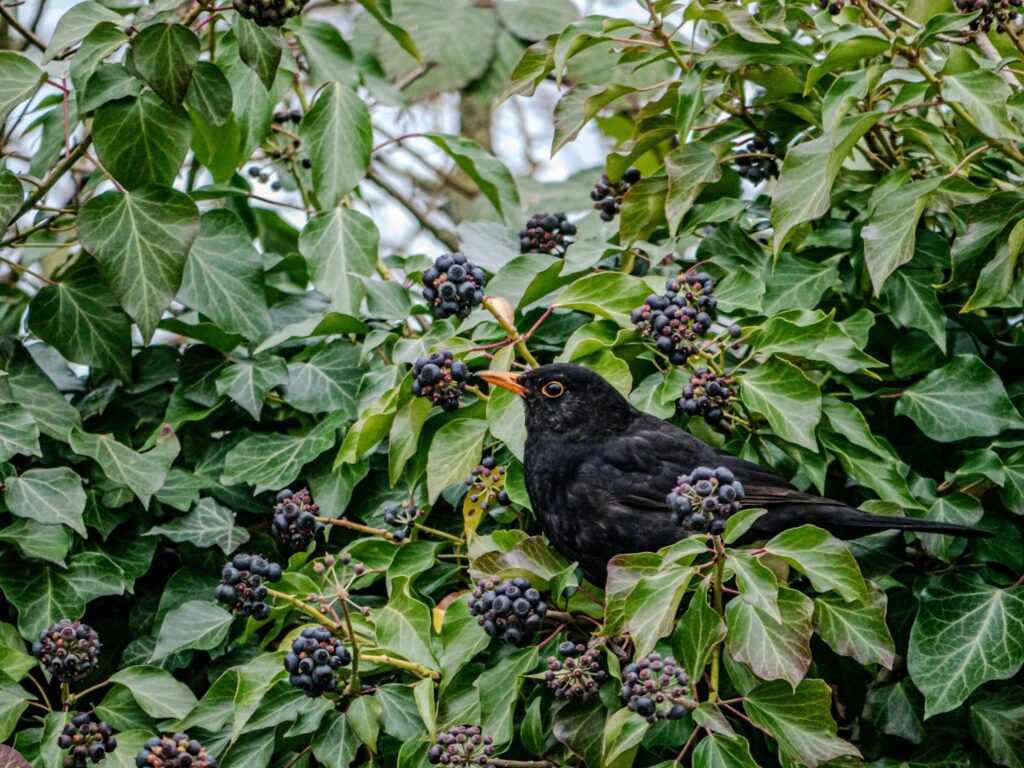
A black bird, with a bright orange beak and ring around its ebony eyes, sits nestled in a thorny bush of dark-colored berries.
(Image courtesy of SK Stannik via Pexels)

The table and engraved goblet suggested to her a deep, disturbing magic. Witch doctors drinking the blood of their victims, magic spells and voodoo dolls, vampires lurking in the shadows. She connected it in her mind with that horrible scene in Narnia, where Aslan lay strapped to the stone table, murdered by the ghouls and goblins. It didn’t seem, for some reason, like Jules would be able to find her here. And so, in the brush a few steps beyond the table, in the shade of a large oak tree, she made her wigwam.

A tributary of the creek wound through this area, no more than a trickle this time of year, almost hidden completely by blackberry bushes. The big, shining berries dotted the branches, weighing them down. Carefully, she ventured into the thicket of thorny tendrils that tore at her clothes. Jean grabbed at the stems between the thorns and unstuck the fabric best she could. She plucked the berries nearest to her, one by one, from the bush, careful not to crush those which were juicy and overripe. But her delicate grip still pulverized many – resulting in a drain of dark, sticky blood flowing down her fingers.

Jean ate some and transported the rest to the stone table where she mashed them up with a stick. But upon poking her finger cautiously in the resulting juices and realizing the concoction was too thin and watery for her purposes, she knelt down by the nearly dried up stream and gathered some mud from the edges. Then, she mixed the mud with the mushed-up berries, creating a black paste.

One mark on the forehead. One on each cheek. One mark on the chin. Because the berries and the mud, cool and granular, now covered her skin, seeping into her pores, clogging them, she felt she knew the earth more intimately, like Sacagawea must have known it.

Jean heard Jules splashing in the creek, pounding on the ground with his feet in big, heavy beats, whooping and screaming loudly as he pretended to sail a ship on the seven seas. Everything he did affronted this place; his life force a chaotic reverberation that echoed throughout quiet earth and sky, silencing nature—scattering lizards, forcing birds to take flight.

She marked her hands with paste, then her forearms, in swirls of stars and moons, till black-red galaxies covered her body. If she were here alone, she would make a gallon of the stuff and lather herself, head to toe in it. She wondered if doing so would camouflage her and allow her to disappear against the backdrop of the ground, granting her invisibility. Or would the earth, seeing her skin turned to mud, recognize her as its own and swallow her whole?

The real world (where Mother lived, drawing somewhere, and Jules tramped) intruded on Jean’s solitude, limiting the scope of what she could become. It hung in the corner of her mind, frowning, reminding her always that she could not cover her whole body in mud and that she was not really an Indian. But her desire for this not to be true became so intense that, when Jules began to call her, Jean did not answer.

         She was a Native American woman, cautious of this strange, noisy, pale man. She must not let herself be seen, but instead, observe the stranger, see if he was her friend or foe.

         “Jean, where’d you go?” Jules called. His footsteps – thud, thud, thud – resounding from below, came closer. She must hide. Furtively, Jean slipped behind the stone table, behind the large wooden cross that overshadowed it, which marked the boundary of the garden. All that lay before her was a hedge of thick blackberry bushes. For a moment she felt trapped, until she realized: why shouldn’t these be her home? Wouldn’t the thorns, with white tips like teeth, protect her?

Only, they would hurt her, too. She cautiously grabbed one of the branches between the thorns, and then, with less care, grabbed another, accepting the painful pricks. She could hear Jules coming up the trail toward the stone table, closer and closer, so she abandoned all caution, covered her face with her arms, and waded head first into the blackberries.

Thorns scratched and tore at her arms, legs, and hands, creating so many cuts that she didn’t know where to focus on the pain. But Jean kept going until she knew the shrub had become her shroud. She crouched there, in the middle of the bush, the thorns hovering all around her like hungry fangs, savoring her, so if she moved even a centimeter they gnawed. She watched as a big scratch on her bicep produced a thin trail of blood, quickly filling the fleshy, thorn-carved trench it originated from and overflowing, trickling down her forearm. Still, she remained motionless. 

And Jules’ feet – thud, thud, thud. “Jean?”

He stood before the stone table, only feet away, but he could not see her. The ability to watch him, undetected, filled Jean with an exhilarating sense of power. She knew more than him – could see more; he was at her mercy.

He looked this way and that, calling her, a slight panic crouching in the corner of his eye. “Jean, where’d ya go? You’re always disappearing,” he howled. Frustrated, he kicked the stone table. “Ow! Ow! Owww!”

Jean, counting on his preoccupying pain, snuck out of the bushes as silently as she could and routed him from behind. She felt like a snake in the garden, quiet, crafty, shrewd.

His eyes rose from his foot; seeing her there; a millisecond’s pause to take in her form – the berry juice paint, the scratches, the trickling blood; then, a delayed scream, high-pitched, and a hop backwards, so he almost fell onto the stone table.

His eyes opened wider still. Jean pantomimed an imaginary bow and arrow, strung taunt and ready to fly at his face. “Jeeeeez Jean, how’d you…?”

“Shhhh,” she whispered, like a narrator speaking to her reader in an aside, “we’re still playing.” 

A grayscale photograph of a cherub angel statue hidden behind dark and dense shrubbery. His eyes are closed, and his mouth is open in a stone sigh.
(Image courtesy of Mario Wallner via Pexels)

Maggie Mascot

It wasn’t that she was the best; there were smarter workers. There were more articulate speakers, those with more connections, and those more “in.” There were certainly those who’d been at the company longer — but nobody gave more.

She could feel it, she knew it; people wanted her around. They desired her energy and forthrightness. She was wanted on the team and on their side in a proverbial playground scrap. They were always grateful for her input. She was forever cheerily met and greeted. Maggie (“Maggs”) was essential.

She was also the mascot, well, that’s how it could feel. That was the other side of it. She tried to keep her mind clear of such formulations of thought. She didn’t really like thinking about it. How petty it seemed, and, when she really stared at it, ugly.

The thankless tasks of spreadsheets, reports, social and messaging platform accounts; all organized when unasked for. Yet approaching her mid-thirties, Maggie was beginning to feel a discomfort at automatically going the extra mile.

“Still look 24 babes,” was a continual refrain coming her way. Maggie didn’t need telling this — she was quite aware. Like many a woman, superficial evaluation had lost a degree of thrill at the turn of 30. Hearing it from desired parties was always welcome, but the more important matters of status and being paid one’s worth held greater appeal.

She liked her little motor, resigned to the scruffy handbag on wheels it was. Loved a drive, her playlist blaring, charging down the road ahead, feeling unfiltered, unlimited, and… behind?  It was old. It didn’t reflect her. The age, the miles, and condition — this car spoke of settling. Maggie wasn’t ready, had no plans, and didn’t deserve to settle.

Maggie parked up some 20 minutes early. A timekeeping extraordinaire, well, certainly compared to many of the men in her office. She opened the tin of Cavendish & Harvey fruit drops found in her side glove compartment. There was a cherry flavored one left and a little celebratory “Yes” left her in a whisper. She didn’t fancy facing the panel with a Halloween purple or sickly yellow tongue for distraction.

Opening up her printed, bullet-pointed, and line-itemed interview documents, Maggie could hardly focus. It wasn’t so much butterflies, but… disinterest. Muttering the sentences in double time under her breath, she didn’t need this prep: she knew it. She’d known it for the better part of a fortnight. As an actor would say, she was “off-book.”

Her eyes gazed across the car park filled with cars and devoid of people. A brief pocket of dissociation. Her body numb, her mind temporarily blank. When she came to, she could feel a dull edge of disquiet and angst. Maggie had been here before.

The Deputy Regional Manager position opened up four years ago and she’d applied. All the colleagues who knew were rooting for her. She tried to remember if she’d parked in the same spot; it felt like the same spot. At the time, it came down to Maggie and one other, Bill Rutherford; a longtime stalwart of Kenson Logistics.

A near waddling turret of self-appreciation guided by a gift of the gab, Bill was a known voice and face able to make the panel laugh with easy familiarity. Maggie was the good girl, checking every box with a hard dose of earnestness and a light sprinkling of concern for others’ sensibilities. Bill Rutherford got the job. Maggie went back to Gillingham to tell expectant parties she’d fallen short.

Four years ago was rough. Retelling the same story to different people over and over, receiving the same messages of sympathy was… frankly aggravating. She reflected that her approach hadn’t necessarily belied the truth; that communicating her capacity wasn’t the best way to advertise it. Perhaps checking boxes wasn’t the way.

Maggie felt she’d lost a great opportunity to someone with less to offer than her, on merits that had little to do with the job description. She was privately downcast for the next month. The extra mile didn’t go far up against cronyism. The mascot remained firmly in her place.

***

Entering the conference room where the panel sat was fine, flat even. There was a surreal, familiar numbness to this. The panel hadn’t aged a day and even appeared to be dressed exactly the  same as they were four years ago, a disquieting exercise in time warp.

The same conference room fronted the same table in the same position and layout. All was déjà vu in every last inconsequential detail; the laminated printouts, the order of the glasses, and their unopened complimentary bottles of water. Maggie sat in what very much appeared the same style of chair. It had been four years of standstill; nothing had changed at all.

Her hearing left her within seconds of the interview starting. Was this the interview? Was it an alternative timeline? It felt like a dress rehearsal for the interview. Another “not quite” experience as she found here not all that long ago. Maggie Mascot went through the motions; she couldn’t hear herself talking or her responses to any of the questions.

It was as if she had some third-person perspective of the interview over her own right shoulder. The expressions, timely nods, and notetaking of the panel felt like reruns. Observer and participant, her mind drifted. There was just one out, one potential that sat in the farthest corner of her consciousness.

Laura had never caused Maggie trouble. There was never any unspoken friction. It was more like they operated on different frequencies and vibrations despite working in the same office. They were always friendly and warm, but they weren’t close.

Laura had girls in the office she would share with and chat to; Maggie wasn’t one of them. It was the same the other way round. Though curiously, they did manage to share some confidants vicariously. Ultimately, they were different people who garnered different responses and reactions to those around them.

Maggie was indispensable, reliable, trustworthy… Mascot. Laura was… prestigious, for want of better words. An Oxbridge graduate, Laura came from money. Not generational wealth, per se, but “dad did well” kind of money. Her holidays and social media accounting of them were like visual brochures. Laura seemed a closeted influencer.  

Elf-like, porcelain and glossy, Laura had eyes like planets. The men around the office always found a particularly playful or attentive energy when interacting with her, irrespective of how bad a day they were having. She also managed to maintain one of those waists that suggest no internal organs live there. Laura was a cut above, and not just of Maggie.

Through her confidants, Maggie gleaned only a little on Laura, as she wasn’t really one to ask. One of the few slivers she gathered was of a budding workplace romance. Legitimate, mature, adult, not bedhopping or drunken and lusty. Laura was around 10 or so weeks into seeing the junior accounts manager Jack.

They looked pretty picture perfect when lined up together in one’s mind’s eye. Maggie didn’t feel one way or another about it. Jack was nice enough and cute but she had no particular interest in him. The nascent couple hadn’t, however, run their relationship past HR.

When the interview was near conclusion, just as four years ago, Maggie was asked to say a few words about the other internal candidate. The questioning began. Would she have a problem working for this person as her superior should they get the role? Then, the customary and standard kind words.

Maggie came alive all of sudden. She went from dipping in and out of dissociation to being beamingly, near painfully, present. A few words… on Laura Talbot… and what she brought to the Gillingham office.

In a semi ad-lib, Maggie spoke warmly of Laura and her presence. She also, right at the last moment, managed to express how pleasant and refreshing it was to see a workplace romance flourishing in this HR-heavy day and age.

The panel somewhat froze, all four members rather stiffened. The air changed and the faces lost a softness to them. The only woman on the panel asked Maggie to continue with a simple, “Oh?”

And the rest is history. Sure, a “good girl” wouldn’t have done it. Absolutely, her face felt flush as she said the words. Was it out of character? Maybe a little. Was it what she wanted to do? Not so much. Was her drive back to Gillingham conducted in eerie quiet? You bet ya.

Yet, at the end of the following week, Kenson Logistics had a new Deputy Regional Manager, and Maggie was “Mascot” no more.

Open Books

“Because it feels awkward.”

Oh? Has she still not gone yet?

“It’s not like I even know him anyway.”

It’s been weeks.

“No, I don’t want to. I don’t need to have a reason.”

If she doesn’t want to go, then forcing a meeting isn’t going to change her mind.

“I’m hanging up.”

I watched as the young customer made her way to my front desk, carrying a few volumes from that new series currently popular on social media. The promotional artwork around the display table sure was eye-catching.

“Find everything okay?” I asked cheerfully.

“Yeah, do you know when the next volume will be out?” she asked as she rummaged through her shoulder bag.

“The company said I should expect it in a few months. There’s been a delay in printing, it seems.”

“I heard the same thing. That gives me time to catch up, then.”

“I’ll let you know if I hear otherwise next time. Anything else?”

“No, no, that’s it.”

“That’ll be $64.92. Need a receipt today?”

“No, thank you.”

I bagged her books with trained speed as I watched another customer amble through the door, setting off the bell hanging in the corner. I bade her goodbye as she scrambled out into the breezy fall afternoon, and wondered if the series was worth reading. The premise of a romantic comedy about a zombie didn’t really appeal to me, but manga is a lot easier to read, so maybe it wouldn’t be too bad.

Will she go see him? Telling a young girl like her to do something out of adult obligation never works out.

A brass table lamp with a warm glow over books and other odds and ends at a small shop.
(Image courtesy of Nathalie Stimpfl via Unsplash)

My thoughts were soon filled with far-fetched imaginings as I pushed my cart of books to re-shelve. Awkward childhood, familial spat, the parents wanting something in return?

“Excuse me,” an elderly man perusing the autobiography section flagged me down. “Where do I find ‘The Tell’ by Amy Griffin?”

“Right here, sir,” I answered, showing him the shelf further down the aisle. I watched him pick up the book and start reading the jacket.

Huh, I wonder if it’s any good? I wonder how he got to know about it?

I spied Oprah’s Book Club symbol as I continued to re-shelve and made a mental note to look it up later.

“No, your family is condescending, doesn’t have any basic civil manners, and they all chew with their mouths open. I am not going to go just to have them make snide remarks about me and my ‘middle management’ job.”

I paused as I heard a whispered, and very heated, conversation from the end of the row.

“Listen here, Lisa, if I have to go, then I will tell them about our divorce myself the minute I walk through that door.”

If my eyes could have opened any wider, they would have. I looked around me to see if any other customers were in earshot, and then realized what section he was in.

Heh, Self-Help.

I spun on my heels to go the long way around, sneakily catching a glimpse at Lisa’s ex-husband, and started humming to myself. My phone chimed, alerting me to a calendar reminder to start ordering the spring reading list for the local high school. My store doesn’t get many students coming through for mandatory reading materials, but classics and Shakespearean titles will occasionally sell if the covers are visually appealing enough. The Used Books section also gains traction if I update the prices online early enough.

The profit margins aren’t too big, but my cozy shop has seen steady business and moderate success since I opened a few years ago. I can’t compete with warehouse prices, but I’ve tried to make my corner of the book world appealing.

Oh, Jeremy stopped by. Wonder if he’ll like any of these.

I gave a cheery greeting to one of my regulars as I dropped off my haul, made small talk, and started pushing my book cart back to the other side of the store. I glanced slowly back and watched as Jeremy made his way to the pile of tomes like a dragon eyeing a new treasure. He sure didn’t hide his love of used books.

I’m sure half his library is from here. Oh, wait, does he shop at other bookstores? What a cheater!

A golden dragon pendant with a silver chain lying on a book.
(Image courtesy of COPPERTIST WU via Pexels)

I chuckled inwardly before spotting Marge shuffling toward my desk. Pushing my half-emptied cart to the side, I briskly walked to the front and called out to her. I asked how her new grandchild was doing and learned he just got let out of the NICU and would be able to go home with Cathy and Erik soon. When I asked about all the cookbooks she had picked up, she said her best friend was flying in to visit for the weekend, and they were going to try out some recipes.

“If I don’t get through them all, I’m sure Erik would take them from me. Cathy sure does love his cooking.”

“Oh, I bet. A new mom doesn’t have the energy to be standing in the kitchen, right?”

“Quite so! Oh, that reminds me, maybe Betty and I should make some dishes to bring over to the hospital. It’s been a while since everyone has seen each other, probably not since the wedding. Oh, I should tell Betty. We’ll go shopping for some additional goodies when she lands.”

“Maybe for diapers? Can never have enough, I hear.”

“Oh, that’s too practical. No, it needs to be more fun.”

“A framed picture of diapers, then.”

“Now that’s the ticket, dear!”

I wave Marge off and internally hope Cathy is up for company this weekend. 

Well, if Betty can cook, I’m sure she’ll be welcomed with open arms.

Two women standing with their backs turned in the kitchen, cooking over the stove top.
(Image courtesy of Ivan Samkov via Pexels)

My attention snaps to the next customer, another regular who works across the street at the coffee shop. We chit-chat about how slow things have been this weekend, theorize how the weather must be making everybody stay in, and gossip about the new flower shop closing down in the next plaza because they were caught working as a front.

I watched him hold the door open as two teen girls giggled their way in and made a beeline to the romantic zombie table. Their squeals and hushed conversation were just barely audible from my post. I positioned my stool under me as I went through my purchase orders, inquiries, and updates on the computer. The bell brought my eyes up to another teen girl. She saw me first, but instantly looked away as her friends called her attention. I watched as she half-jogged her way over to them, turning the squeals from a duo to a trio, when Lisa’s ex-husband suddenly came into view, plopping a basket half-filled with self-help books and various manga in front of me.

What did Lisa do? What did you do?

More wild imaginings ran through my mind as I rang him up, my customer service routine on autopilot. “Find everything okay?” “Fine.” “Are any of these gifts?” “No.” “Would you like your receipt?” “No, thanks.” “Here’re your bags. Thanks for coming in.” “Bye.”

Hmm, what did you see in him, Lisa?

Out of the corner of my eyes, I watched the girls perform a rousing game of “Rock, Paper, Scissors” as I turned back to my computer.

It’s almost closing time.

I pushed the intercom button, alerted my customers that the shop would close in thirty minutes, and resumed my work.

Let’s finish this quickly.

I quickly clicked through my orders, jotted down the titles I would need to find later, and closed out my windows as a line started to form. The end-of-the-day rush doesn’t last long, but the quicker I can shoo people out, the sooner I can resume my librarian duties and pick up food on the way home.

The elderly man left holding a few books that Oprah had recommended.

Jeremy took about a third of the books that I returned.

A few customers walked out empty-handed.

The girls chittered excitedly about who got to read volume one first, how unfair it was, and that they called dibs on the next volume release. I interjected that it would only be a few more months, which prompted loud exclamations that the first girl needs to read “super-duper fast, or else!”

I walked Lenny, another regular, out, gossiping about the latest celebrity news until they turned a corner, and closed and locked the door. I groaned out loud at my checklist before placing my to-go order.

Twenty minutes to close up.

I zoomed through the now-empty aisles to grab any books that looked out of place, wrote down tasks to take care of in the morning, and shoved the list into my bag. Finishing the closing procedure quickly, I grabbed a book on my way out the door, and locked up the shop.

I need to finish this before Jenny comes in tomorrow. I can’t have her spoiling the ending for me, not again.

Making my way to my car, I gave one last look at my darkened windows before waving goodbye to the coffee shop worker across the street. He stopped bussing the table to smile and wave back.

See you tomorrow.

An open book on a table, next to a cup of coffee with a leaf latte art on top of a red saucer with a small creamer pitcher and spoon.
(Image courtesy of Khalis Rafif via Unsplash)


Ever Be Forgot

Ever Be Forgot

The foreboding he felt was palpable. Bad juju, bad mana – no good vibes here. It was the sheer number of them. The closer he got to the designated site, the more cars there were. Road sides had started to look congested about 4-5 miles back.

By the time Eddie Whelan parked his car, there was no further to travel; it was park up or turn back. The winding, thinning country lanes up to the forest were stocked with cars everywhere he looked. This felt enormous. People had travelled a long ways to be here, from all over the country, and so very many.

Deep autumn right on the cusp of winter, when “the fall” has lost its charm. The first flashes of crispy pastel yellows and oranges dissolved into the sludge of dark mud under foot.

“Shit,” Eddie somewhat gasped as nearly an entire shoe was swallowed by mud. The visibility was dismal. There was clearly some form of glow emanating from the depths of the forest. Mainly, he was guided by a mid-distant hollering and the banter of the revelers way ahead of him.

A brief glance back and Eddie’s car was no longer visible in the gloom of later year night. Nevertheless, he kept moving forward, identifying the pines and conifers ahead with his phone torch. It felt eerie; it felt like it couldn’t be trusted. Time, place, setting – everything was off.

His years in the field had taught him he couldn’t really trust any novel environment – that caution, and an unblinking vigilance, were a necessity. But this was a flavor of feral he hadn’t sensed in a good while, maybe since youth. This was Guy Fawkes Night after all:

“Remember, remember the 5th of November.”

A holiday 400 years in antiquity, a staple of national identity.

“Gunpowder, treason, and plot…”

Counter terrorism before it was named, as King and Parliament saved.

“I see no reason, why gunpowder treason…”

Bring fireworks along, lighting bonfires must be done.

“Should ever be forgot.”

An evening of national pride, community, and fun.

Eddie wiped a drip of snot from the tip of his nose. The assaulting British cold emanated from the forest with every step. The winter to come was making its presence known – wrap up as you will, it’s going for your bones.

Wading deeper into the foreground of ominous pines, Eddie felt his entire back stiffen. This was a hell of a time to be out late… anywhere. He’d watched helplessly in recent months as his waistline and appetite for casual cigarette smoking grew. He thought to himself that maybe his job had never been harder.

Current affairs reporting in the 21st century was seldom uplifting. Journos knew the score, just as the general public did. Negativity, cynicism, and the inflammatory were catnip to news consumers. Yet, this was a bad year.

Britain’s social fabric was hemorrhaging. National identity had gone from being something revised, expanded and growing, decade for decade, to something febrile and dangerous. Forging ahead was rejected while screaming for something long gone was the order of the day. Exactly what it meant to be British had become a nationwide obsession. In many corners, it became a green light for vigilantism and worse.

Eddie could hear voices getting louder up ahead. The silhouettes of tree trunks getting steadily clearer. He couldn’t tell if it was his eyes adjusting to darkness or if he was moving towards light. A sharp crunch echoed nearby. Eddie made a snap glance behind. Nothing. Was he being followed?

Arguably the originators of conservatism, Britain had only in the most recent decades used the word “diversity.” The term Britain had always favored was “tolerance.” Yet it was clear in some parts of the country, this had long since faded. The picture was ugly. Violent white crime remained on a steady upward trajectory. Youth crime circled its perennial numbers. Hate crimes were suspiciously falling out of reporting, circulation, or consideration. Streets had become hairy.

Some areas of the country started setting curfews – the most economically deprived areas; typically those neighboring acute densities of immigrant communities. This, commentators called the British Establishment’s greatest failure since the three-day week. The defeat of it reeked. If you can’t make a better society, then survey, control, and cage it. The headlines were clickbait gold. Their message was societal decay.

IS THE BRITISH POLICE A SPENT FORCE?

SERVE AND PROTECT WHO?

OLD BILL OUT TO PASTURE!

The fuse was lit 6 months prior.

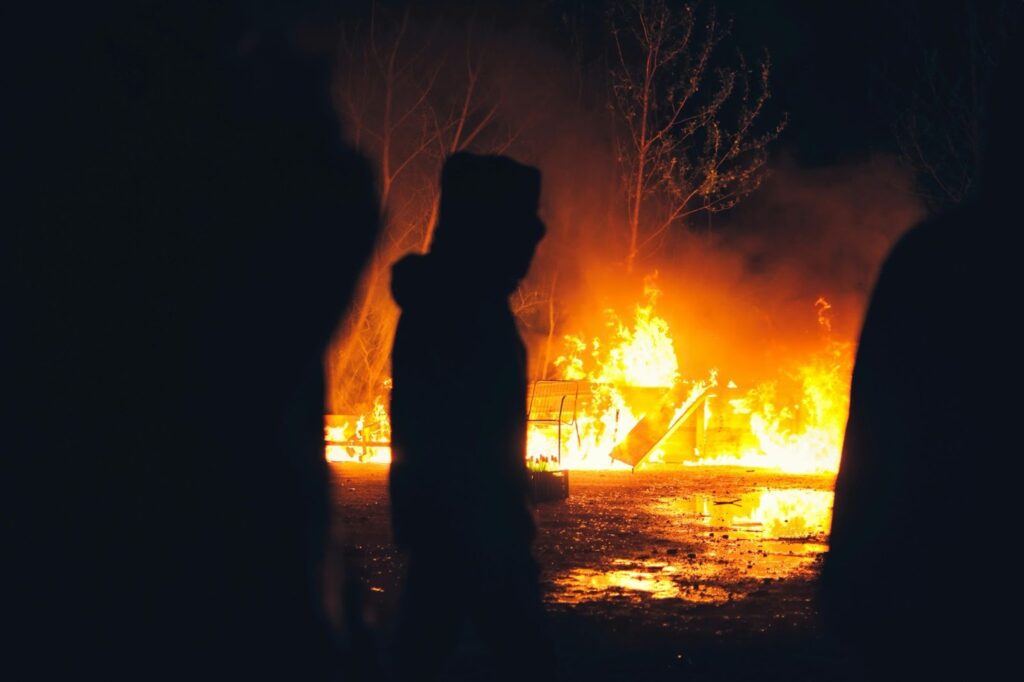
Three dark figures stand watching a public park ablaze as a bench and child’s slide go up in flames.
(Image courtesy of Marco Allasio via Pexels)

Shrill screaming filled the air. A firework ripped through the sky in a phosphorous tear. A pocket of silence followed before a loud pop of neon green splinters gilded the night sky. Eddie made a slow nervous turn to check behind him. Nothing again. As the airborne metal salts faded, the auburn glow of bonfire swelled ahead of him. At his furthest squint, Eddie could make out people marching towards the blaze. He followed.

The internet being a public space mirrors its real life counterpart: what is unacceptable in broad daylight may well find its private settings, corners, or… forums. Many who gather underground, away from the masses, are easily swayed and influenced by conspiracy and fear-mongering. The results can be disastrous.

Such a disaster imploded in an online forum exclusive to the British Isles. Some snarling, aggrieved, nefarious collection of men had taken it upon themselves to begin surveillance of places of worship and their attendees around their local communities. Blinded by bigotry and fear, they did not see the harassment or encroachment of civil liberties they were committing.

Eddie’s walking slowed when the bonfire was only partially blocked. He was no longer alone. The many, many cars parked up had indeed come to this site for what was an almighty bonfire. He couldn’t make out the entire scale of it because it was… it was as big as a house. And no small house.

Like a snowball rolling down a hill, the more this xenophobic tribe posted, the more the number of posts grew. The more the number of posts swelled, the more fictitious narratives and venomous storytelling were assigned to the innocent parties they preyed upon.

After an escalating 3-month campaign against one such individual, stalked and swatted by a forum frothing from the mouth, one of the very worst hate crimes in the country’s history was committed.

Women were left degraded and on life support. Children, grossly still, with skull fractures and broken bones lay in intensive care. A family and their home marred beyond recognition– all while the father was away and unable to protect. Horrifying, blind hate.

Eddie was no longer alone. A hard slap on the back announced the fact.

“Get in!” barked a scratchy voice leaving a full pudgy face, grinning wildly in giddy solidarity. The reveler marched ahead, unawares Eddie was far from one of his own. Eddie was struck by the heat emanating from the bonfire. This was as much a formidable force as a gathering point. The base of the behemoth bonfire was hardly visible from the dense crowd surrounding. Then, Eddie looked up and stopped walking closer.

The intelligence communities, in conjunction with the police, soon found the culprits. Those convicted individuals swore that they knew the truth. They claimed, feverishly, that they had attacked the family of an extremist, a terrorist in waiting, a threat to society. Yet, the intelligence communities found nothing of the sort.

Their “target,” upon interview and background checks of length and depth only intelligence teams could conduct, showed no prior or present links, trails, or anything nefarious to his name. The forum had created a monster that didn’t exist. Innocents lay in hospital beds thanks to imagined enemies – a disaster of both social and epistemic proportions.

Like the blast of a bomb, the harrowing damage rippled further than the site of impact. The perpetrators went in the dock, defiant and convinced of a system trying to suppress their “knowing the truth.” In fact, the sheer lack of evidence against the victim and his family only solidified the convicted individuals’ certainty that they were right to act as they had. Worse still, some corners of the internet and certain tribes of British society celebrated these criminals as martyrs.

When the government concluded its McAndrews Commission Report from the investigation – it was met with muted response. People believed what they believed – many felt that they were receiving the true overview of an evil attack of repugnant racism while others believed it was a government smoke screen avoiding uncomfortable realities.

The cacophonous chanting and pervasive roar surrounding Eddie was akin to a football cup final. A crowd in raucous anticipation of a great event. He had hoped his undercover following of the forums would turn out to be a damp squib. He tried not to let his own feelings cloud his expectations, but they must have done so. The enthusiasm of the posting was real, the projected attendance was not understated. The scale of this was intimidating, obscene.

This was a celebration, but one rotten and malignant in nature. Oh, the attendees were citizens, but this wasn’t citizenship. A calendar date to stand against nihilism had been hijacked to salute it. Eddie had craned his neck to look up at the towering effigy slowly catching flame. A giant “Guy Fawkes” wrapped in a huge banner. Printed across the banner: a published family photo of the victims.

Eddie slowly raised his phone, to take photos, to report, to do his job. The shriek of another firework and the heat of the fire felt miles away. His blood ran cold. He was numb – what had his country become.

A huge crowd of people stand in the dark watching a gigantic blaze rage with sparks and flames everywhere. A small tower with a melting weathervane can be seen in contrast against the bright fire.
(Image courtesy of Pixabay via Pexels)

Maggie’s Invitation

The village of Oakhaven was very inviting, like a panoramic postcard. The streets were swept to the point of polish, and the windows of tea shops were draped in lace as delicate as a spider’s web. But, if you listened closely, you would notice a preternatural silence. There was no birdsong or local chatter giving life to the streets, as a visitor would expect.

There were no children playing in the squares, no dogs to amble alongside nonexistent horses. Instead, the elderly sat on benches with their hands folded, watching the road. Anticipating something perhaps, anything that would bring back some cheerful bustle to the dreary cobblestone lanes of the country hamlet.

In the center of the square stood the Gilded Ledger. It was a massive, golden pedestal where the “tax” was recorded.

Margaret stood in front of it, holding a single copper coin. “Maggie” was the name she preferred, and her tithe to the Ledger was due. Her register entry was under Lidsfarne, and her family members’ names were all scratched away, leaving her the sole heir of their responsibility to the golden pillar.

It was a hard run for her this year, being a washerwoman. She imagined a better life as a girl, being married to a young trader from the city, where the merchants lived and sold their glittering wares. She could have lived a comfortable life, but the will of Heaven had other plans.

The ones who collected the tithes were known as “Sovereigns;” they kept the “sanctuaries” running and devotedly obeyed the will of Heaven. Every able-bodied man, woman, or child was meant to contribute to the Gilded Ledger to help the Sovereigns run the spires, which kept the sun from dying since the last Sundering.

But Maggie Lidsfarne, last of her kin, was the only healthy young woman left in the village.

She was twenty-two, and for the past six months, she had been the only tenant of her house. Her mother had died in the winter, and her brother had been taken to the sanctuaries a year before.

“Penny for your thoughts, child?”

The voice was soft, like the silken dressing robes she would often wash for some of the Sovereigns. Maggie turned to see a Deacon of the order. He wore a mantle of cream and gold, holding a basket of warm bread. The smell of baked goods, fresh from the oven, warmed Maggie with welcome nostalgia. She remembered how well her mother had baked, and the cakes she made for her brother and her every birthday.

The Deacon didn’t seem like a monster. He reminded her of the father she had lost.

“I’m just… I’m behind on the heating costs,” Maggie whispered. “And the Ledger says my ‘tithe’ is due.” The Deacon sighed with sympathy.

“The tax is a heavy burden for those who walk alone. The Sovereigns need the gold to keep the sun shining and the borders safe. But the Ledger doesn’t just take metal, Maggie. It takes weight.”

He stepped closer, offering her a piece of bread and glancing at the scrawled list of names in the register briefly. “You haven’t spoken to anyone in six months, have you?”

Maggie gazed down at her shoes. The isolation caused a physical ache in her chest. “There’s no one left to talk to.”

“That is the heaviest weight of all,” the Deacon said, his voice dropping to a comforting murmur. “Why keep it? If you come to the sanctuary, we can take that heaviness from you. We can turn the cold silence of your empty house into something beautiful… something that can pay the debt for the whole village.”

He reached out and touched her hand. His skin was unnaturally warm — the heat of a furnace, like when her mother was still around and baking loaves of bannock such as those the Deacon held close.

“Imagine,” he continued, “no more cold nights. No more wondering if anyone remembers your name. In the sanctuary, you shall become part of the very gold that saves us all.”

Maggie looked at the bread, then at the sanctuary shimmering, garishly, upon the hill.

It was an impressive building, with whitewashed walls of plaster and ivory glazed terracotta, crowned by gilded bell-shaped canopies pointing heavenwards. The long spires protruding from their peaks were said to direct the focus of thousands in prayer, preventing the sun from dying.

It was beautiful, glowing with a cold, amber light. Maggie didn’t see the laboratories beneath it. She couldn’t fathom the “unrefined” — those hulking, silent beastmen who moved the heavy machinery in the dark, their eyes filled with the fading memories of their mothers’ faces.

In those spires that pricked the sky, gleaming above her, she saw a way to stop feeling like a ghost.

“Will my brother be there? And my mother, too? Are they praying with everyone else?” she asked.

The Deacon smiled, an expression that didn’t quite reach his eyes. “He is part of the foundation now. He is very important to us. Your mother is, too.”

Maggie took his hand. As they walked toward the hill, the copper coin she had been holding fell to the cobblestones. Its thud was dull, and cold like the sanctuary’s light. The air around them began to thicken, turning slightly grey, as if the world was selling its color to pay for the glow of the Oakhaven Temple above.

Nearby, an old woman on a bench watched them go. She didn’t call out. She didn’t stop them. She simply adjusted her shawl and waited for her own turn to be “noticed” by the men in gold, to be granted a piece of the warm bread, which they baked in their resplendent furnaces. 

Bombs Go “TikTok”

Frank was a 24-year-old graphic designer hailing from Nairobi’s Eastlands, juggling freelance gigs and dreams of launching his own studio. His life was a combination of late-night Photoshop sessions, matatu commutes, and weekend football with friends in one of the Eastlands playing grounds. TikTok was his escape—a place to share skits and animations under the username of @hei.sfrankie. With 700 followers, mostly friends and a few fans he had gathered over time, he posted for fun, not fame. It all blew up one Saturday evening.

Burnt out from a client’s endless revisions on a recent project, Frank filmed a quick video in his cramped bedsitter. Wearing a faded Arsenal jersey, he parodied Nairobi’s hustle: “POV: You’re pitching a design to a client who wants to ‘make it pop’ but only pays in exposure.” He acted out a dramatic client call, complete with exaggerated eye-rolls and a mock faint, set to a trending TikTok beat. Frank captioned the short video, “#HustlerLifeKE #NairobiStruggles,” uploaded it, and crashed.

By morning, his phone was a mess. Likes surged past 3,000, then 30,000. Comments sped across the screen as viewers commiserated. “This is EVERY freelancer!” “Tag my boss!” Friends blasted it across WhatsApp; strangers dueted the clip with their own hustle stories. Views hit 250,000 by noon. A local blog ran a headline: “Nairobi Designer’s TikTok Nails Freelance Woes.” Influencers started reposting it, pushing views past three million. Frank’s followers soared from 15,000 to 150,000 in just a few days.

The rush was electric. Frank dove in, posting skits about matatu Wi-Fi scams, the mugging business within the dark corridors of the city, and animating Nairobi’s skyline with quirky effects. Each video exploded, with some reaching 20 million views. Brands flooded his DMs; a tech startup offered 60,000 Kenyan Shillings for a gadget ad, a streetwear brand sent free hoodies for corresponding promo videos. He quit freelancing and bought a ring light, a used MacBook, and a better phone. His bio changed from a mere content creator to a professional digital creator. Invites poured in—art events, influencer meetups at Two Rivers Mall. Strangers at Java House whispered, “That’s hei.sfrankie.” Fame felt like a rocket, but that high crashed hard. 

TikTok’s algorithm was a beast — post daily or fade into the crowded world of reels that were anything but real. Frank’s days became a grind; the professional world wasn’t going easy on him: brainstorm at dawn, film in borrowed spaces, sometimes on the streets, and edit till 3 AM. Sleep was a memory — he lived on cold coffee and buns. But Frank also wasn’t going to give up that easily. This was a far better profession than being in an environment where he was always watching out for his supervisor. Here, he could do his work without any other third-party pressuring him. It was only his clients and him.

However, when things seemed to be moving well, and the algorithm had really realized his craft, a very unfortunate event happened. One time, he had posted a video advertising a scammer company. Well, at least he did not know it was a fraudulent company until his clients, some of whom were his followers, raised an alarm of being conned by the very company he had posted a sponsored AD for in his latest TikTok video. Negative comments oozed, most of which blamed him for leading people into a con. Frank tried to laugh it off, but the hate clung like damp air. Privacy vanished. A fan spotted him while shopping at his estate’s shop and leaked his address. Brands stopped endorsing him. A phone company withdrew an endorsement worth a hundred grand for a promo of the newly launched model of an Android phone.

Then, engagement dipped. Frank hid his stress, publicly lying about his bank balance. Burnout consumed him. His appetite also seemed to be in jeopardy. His weight dropped; his dreads dulled. Endless insomnia kicked in hard as Frank was haunted by internet trolls and the rapid loss of followers. Clearly, things were getting out of hand, and he had to do something quickly before everything spiraled further. Like many influencers before him who had undergone the same ordeal, going live in a bid to try to explain the current situation to his loyal remaining fans was the only option.

Unlike the usual live broadcasts where a creator talks with their audience directly, Frank decided to do it differently. He wanted to resolve everything with a skit of how people were being taken advantage of on social media, especially upcoming artists and creators. Suddenly, in the middle of the skit, panic struck. Heart racing, hands trembling, he choked, “I’m drowning.” He cracked while filming. Tears fell. The chat was split in their support and venom: “Clout crying,” “Overrated,” alongside “We got you, Frankie.” Frank ended the live video, collapsing on set while his crew rescued him.

The moment of truth and realization had finally struck. Viral fame wasn’t a throne; it was a cage. The money, however vast and consistent, unlike an employer’s salary, bought only glaring ring lights and flashing cameras, not joy of any kind. Frank missed creating for passion, not likes. This is when he decided to start creating with his hands what he felt was burning inside him. He decided to start expressing for both his art and himself, not for unknown, insatiable consumers who would not appreciate his flaws whenever they occurred. Frank began focusing on his vision of having his own studio where he would create whatever he wanted and display it proudly.

He logged off for about two months, but of course, the spirit of digital creating hadn’t really left him. He planned a comeback, but this time he would do things differently — he shifted gears — posting three times weekly, blocking haters, and ignoring statistics. He started showcasing his talent for design on his platforms, which attracted new positive and passion-aligned followers. He even got a partnership with the city’s gallery center to help him showcase his art. Support started coming his way, and eventually, his vision of having his own art exhibition center materialized.

Sudden fame had thrust Frank into a storm of hype and pressure — doubt, isolation, and the grueling chase to remain relevant to strangers on the internet. But stepping back, reminding himself of who he was and what his art stood for, he found his spark once more. Fame wasn’t the goal; purpose was. In Nairobi’s pulsing streets, Frank created again—not for the algorithm, but for his art and the studio he had started, honestly and earnestly.