
Backing New Beginnings: Refugee Entrepreneurs Find Support Across Britain

“When the land is full of snow and you don’t know what is underneath — ­business is like that,” says Akbar Majidov, an immigrant to Britain who runs a catering business with his wife Sanobar. You have to take risks, Akbar told The Sentinel: “you just need to walk on the snow. Sometimes there’s a hole there, but sometimes it’s OK.”

Akbar and Sanobar from Uzbekistan in central Asia are operating in London street markets and at private events, selling home-made food originating from their Persian-speaking Tajik culture. 

Akbar has had to tread virgin territory to forge a life for himself since he came to Britain in 2003, a life which has included working in construction and for restaurant group The Breakfast Club. Sanobar joined him permanently in London in 2019.

The husband-and-wife team has received guidance from non-profit organisation TERN, The Entrepreneurial Refugee Network, which is helping refugees to launch their own businesses. TERN helped 725 refugee entrepreneurs in the 2024-2025 financial year. It is seeing such demand for its mentoring and training courses that it is running a waiting list.

Kateryna Reshetnyk, a Ukrainian refugee from the eastern city of Kharkiv, now works with her husband in the Scottish town of Girvan, running PIXSEL UK, which produces hybrid glass protectors for car and motorcycle screens. Kateryna hadn’t operated a business before she was forced to flee the war in Ukraine. She told The Sentinel how she has also benefited from training through TERN.

“I had an accountancy course, an accountant from TERN helped me to create a business plan and I had a course for eBay. TERN and eBay helped refugees like me who want to sell on eBay.”

Immigrants to Britain have been facing a hostile environment in the past few years, both from governments and from right-wing populist party Reform UK, which is leading in opinion polls. However, there is also a groundswell of support for Britain’s multiculturalism. At least 50,000 people joined a march against the far right in London at the end of March. Nowhere is this multiculturalism more apparent than in the variety of international foods available to diners in London, the best city in the world for food, according to Tripadvisor.

The signature dish of the Majidovs’ business, Samarkand Palav, is oshi palav, inscribed in 2016 on UNESCO’s Representative List of the Intangible Cultural Heritage of Humanity. Palav typically features rice, meat and carrots, as well as spices such as cumin. What makes the dish so tasty is that the ingredients are cooked together, with the rice absorbing the flavour of the meat and vegetables, says Akbar.

Another distinctive element of palav is that it is cooked and served in layers, with first rice, then meat, then vegetables, says Sanobar: “this very beautiful layer gives a touch of Bukhara and Samarkand.”

Sanobar says it is important for immigrants to integrate into Britain when they arrive. However, it is also important for them not to forget their own culture. For Sanobar, the contrast between central Asian and British culture can sometimes be great:

“In Uzbekistan, we keep a friendly, centuries-old culture. People live for today, and they don’t worry about money for the future. In the markets, in the bazaar, people share their food, they share everything. I think it’s good if they bring this nice culture with them and they share.”

Kateryna also stressed the importance for refugees of making the most of what they have.

“Thank you to people who trust us and who allow us to create a business here, and who provide advice for refugees. I understand now that everything changes very fast in our lives. You need to live for today and for this moment, not wait. I have been waiting for good things for four years, but we decided to create our business here, to live our full lives.”

Co-working app takes on café life with one-hour slots

Are you fed up with working from home? But also fed up with spotty wi-fi and glaring staff when you rock up to a café to work? Struggling to find an acceptable alternative workspace to the bedroom has been a headache for many laptop workers over the past few years. However, two start-up founders who met on Brighton’s storied beach in southeast England are hoping to change that.

Cameron Foskett and Connor Tagg are seeking angel, early-stage investors for their app, Werksy, which launched a year ago and is designed to make co-working far more flexible.

Co-working has become increasingly attractive to both big companies and small start-ups in the past few years, as The Sentinel reported earlier this year. The United Kingdom and Ireland are in the forefront of that co-working boom. In co-working, freelancers or employees of different firms share office space, and often lounge and leisure facilities.

Since the COVID-19 pandemic, it has become more popular for people to use booking platforms to book co-working spaces for as short a time as a day, or even half a day. However, Werksy is going one step further by offering co-working space for as little time as one hour.

This short-term space is in direct competition to café life, and as Foskett told The Sentinel, there are some basic barriers to cross.

“Some people don’t even know about co-working, the number of times I’ve had to explain what co-working is, as a concept.”

However, as Tagg points out: “The problem with working from a café is that after about an hour you’re sat there with a cold cup of coffee that you’re trying to nurse and you’re feeling a bit awkward and the barista is making eyes at you.”

Some London café owners are discouraging laptop workers from using their space, because of the downer that a silent laptop worker can have on the café atmosphere.

Café frequenters argue that their working space is free, but Foskett says that this does not take into account that co-working spaces offer free coffee. No more making your one flat white last 60 minutes. Wi-fi in co-working space is also more reliable, Foskett adds.

Foskett, with a background in sales, and Tagg, with a background in product design, had a Eureka moment in a chance meeting on Brighton beach in 2020, when Foskett heard about Tagg’s idea to make popping into a workspace as easy as tapping in and out of a Brighton bus ride. Werksy already has more than 3,000 users. The founders have been financing the venture themselves, helped by income from their existing careers. More investment could enable them eventually to expand beyond Britain, they told The Sentinel. 

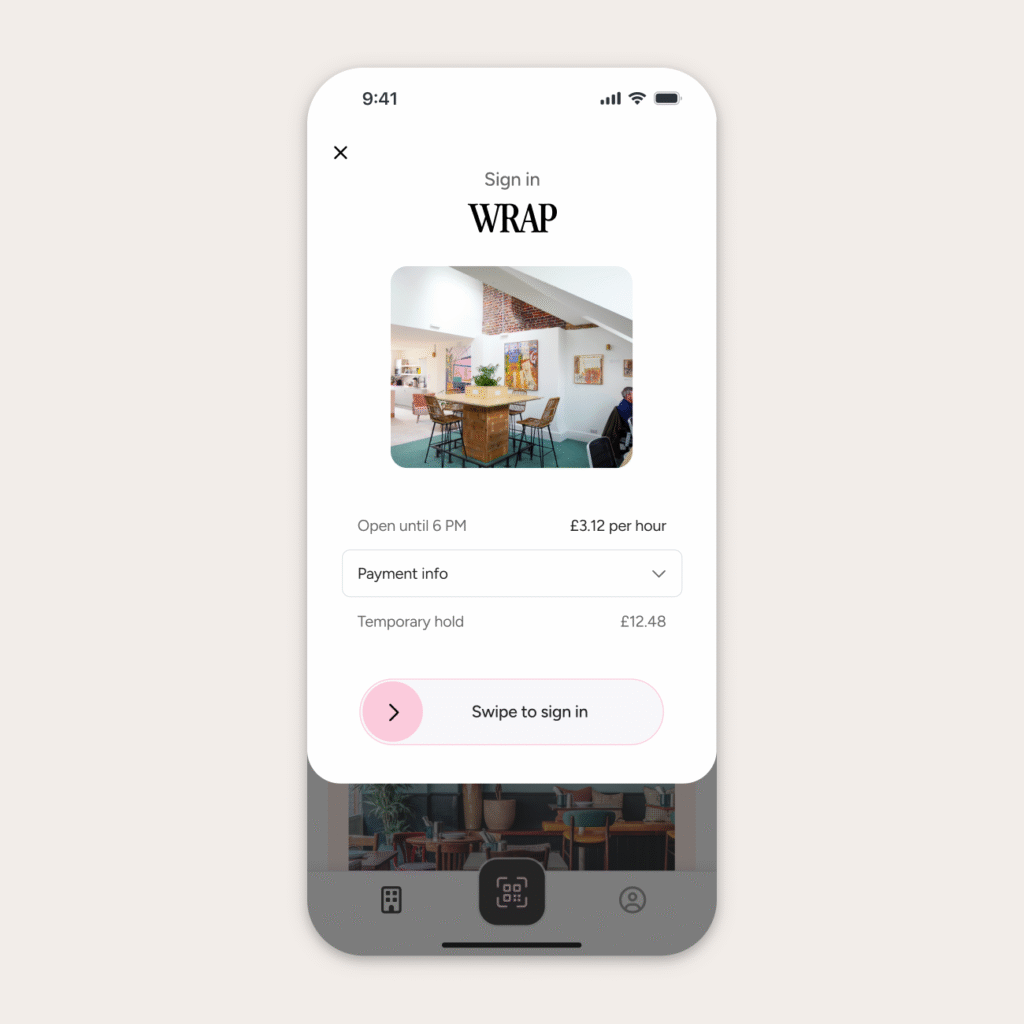
Screenshot from flexible workspace app showing image of co-working lounge, with payment and sign-in details.
Screenshot from the Werksy app, via https://werksy.notion.site/press

Once Werksy users are logged onto the app, entry to co-working space is via QR code.  Scanning in and out means there is no requirement for anyone to check whether app users have overstayed their time, unlike with conventional booking platforms, Foskett says.

Entry gives you access to co-working lounges, rather than to dedicated desk space.

However, lounge quality has improved in recent years, according to Nathan Carpenter, head of central sales at flexible workspace operator NewFlex, which offers Werksy users space in its co-working lounges.

“All of the lounges are fully kitted out with USB ports and plug sockets, you get coffee and you get refreshments and it’s a nice place to work. It makes a big difference for remote workers, who will have spent most of their time in a Costa or Starbucks trying to get signal, if you have a place which is really dedicated for you to work.”

Werksy user Aimen Chouchane, head of marketing for AI-powered video surveillance firm IntelexVision, says Werksy enables him to find reliable places to work in between meetings when he spends a day in London. He prefers this option to coffee shops, where “wifi can be unpredictable. Finding a perfect one can be hard, sometimes they’re too noisy.”

The nature of Chouchane’s work also means that security is important, that no one is looking over his shoulder.

Fashion designer Noemie Jouas, who also acts as an ambassador for Werksy, helping to promote the app, says the flexibility is ideal for workers with a varied schedule:

“The kind of work that I do is really, really different every single week. I might have photo shoots somewhere, or sometimes I have fabric shopping. My job takes me everywhere, Werksy saves a lot of time travelling in London.”

Prices can be a little more expensive than the cost of one coffee. The usual range for an hour in a Werksy space is between two and seven pounds, Foskett says, compared with £2.50 for a flat white in a London Starbucks. But users say the more appealing workspaces and the offer of free refreshments make up for that.

However, Fleura Bardhi, professor of marketing at City St George’s, University of London, told The Sentinel that short-term working risks removing the sense of community that co-working spaces have tried hard to foster:

“Booking for a day is a new development. Because it’s so flexible, it’s ‘why not?’ Then it comes with a damage to the community. A lot of people join so they are part of the community. If you have outsiders in and out for an hour and a day, it’s different.”

Foskett disputes that, pointing out that some Werksy users regularly use the same co-working space, and that a conventional co-working community that requires a monthly payment of several hundred pounds excludes many.

“We’ve got a lot of entrepreneurs, freelancers and people that just either don’t have the money, or don’t have the need to be restricted to one office.”

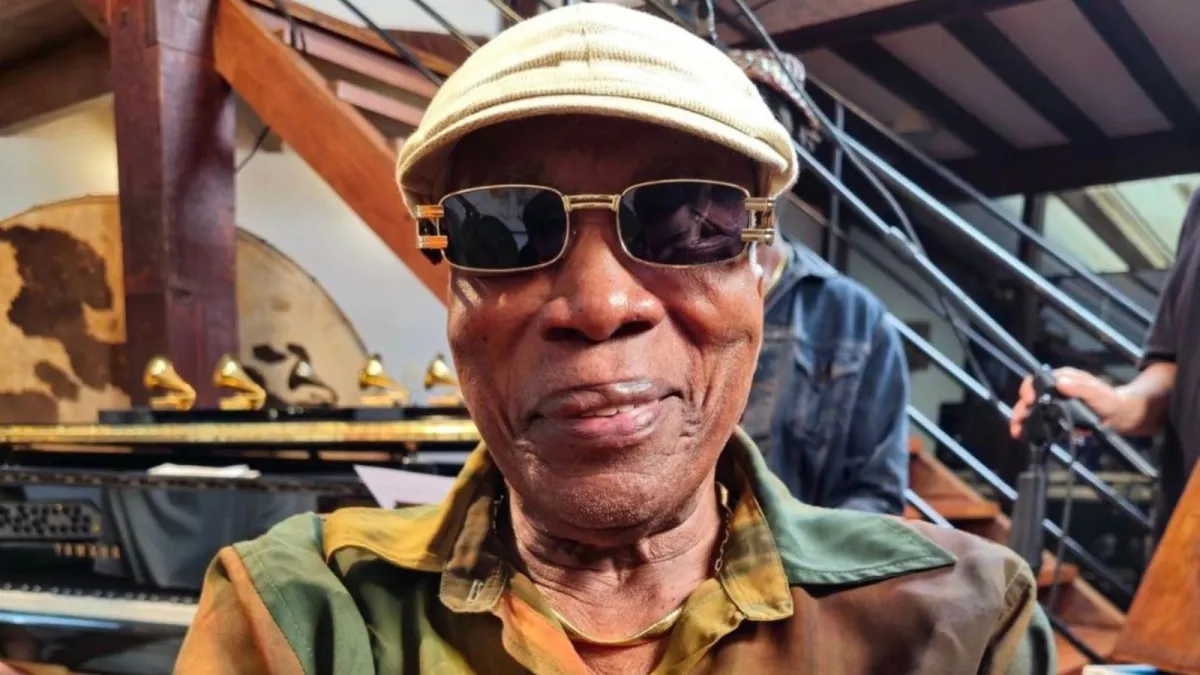
Brazilian Music Icon Milton Nascimento Awarded Honorary Doctorate

In December 2025, Brazilian singer and songwriter Milton Nascimento once again received the title of Doctor Honoris Causa. In April of the same year, he had already received the same distinction from the University of Campinas (Unicamp). As one of the greatest names in Brazilian popular music, the recognition highlights the impact of his artistic work on the country.

The title of Doctor Honoris Causa is one of the highest honors that can be granted by universities and seeks to recognize exceptional individuals who have contributed directly to society, without the requirement of having completed an academic degree.

In addition to Milton Nascimento, emblematic figures such as Meryl Streep and Pelé have also been honored with the title of Doctor Honoris Causa.

In December, the Oswaldo Cruz Foundation (Fiocruz), the largest biomedical research institution in Latin America, awarded the honorary title to the artist. One week later, the Federal University of Minas Gerais (UFMG) also granted him the same distinction. The events brought together academic authorities, researchers, and representatives from the cultural field.

With an approach focused on an expanded concept of health, Fiocruz emphasized during the ceremony the deep dialogue between art, culture, and health:

“One of the questions that always comes up is what a musician has to do with Fiocruz. The answer lies in our understanding of health, which includes social determinants and recognizes culture as a foundational element. Milton is not only an artistic icon; he is a reference for political engagement and the defense of social causes,” said Cristiana Brito, director of Fiocruz Minas, in her speech.

The award recognizes the artistic trajectory of Bituca, the nickname by which he is widely known, as an example of the use of art to confront social injustices. Throughout his musical career, the Minas Gerais-born musician has addressed diverse themes such as resistance, denunciation, and the affirmation of Black identity.

Speaking to The Sentinel, historian and professor at the State University of Minas Gerais, João Teófilo, highlighted the importance of the title:

“Milton Nascimento is one of the most important figures in Brazilian culture born in the 20th century. I dare say he is the greatest living artist in the country. His work presents a level of sophistication widely recognized by both musicians and scholars, in Brazil and abroad,” he stated.

“Brazilian music and culture would not be the same without the presence of an artist of Milton’s magnitude, whose influence crosses generations and borders. In this sense, the title of Doctor Honoris Causa is not only an individual tribute, but an institutional recognition of the centrality of his work to the understanding of Brazilian culture,” Teófilo concluded.

Having been recently diagnosed with Lewy body dementia (LBD), the artist was unable to attend the ceremony, and the award was received by his friend, musical partner and conductor, Wilson Lopes.

“Milton is an artist of immense greatness, not only musically, but humanly as well,” Lopes emphasized during the event.

Cultural Impact

During the period of the Brazilian military dictatorship, from 1964 to 1985, Milton Nascimento was one of the targets of censorship. His resistance to the system can be seen in several works, but especially in his album Milagre dos Peixes, released in 1973.

The album’s title criticizes the so-called “economic miracle” promoted by the dictatorship. At the time, the regime used television and radio to sell a narrative of a country in development, ignoring the aggressions and censorship imposed by the military.

Several tracks from the album had their lyrics banned or subjected to cuts that compromised their integrity. However, the singer decided not to exclude them, but rather to change the proposal. As a result, the censored songs were given vocalizations, screams, and other sound effects. According to accounts from the period, the idea was to express, through experimentation, everything that the dictatorship prevented him from singing.

The album liner notes made the censorship even more evident. In the credits, even the songs composed only of vocalizations still included the songwriter’s name. This way, his audience would know that, despite the experimental nature of the track, there had originally been a composition there.

In response to his resistance, not only the artist but also members of his family reportedly faced persecution during the dictatorship. As a result, he had to distance himself from his then-girlfriend and his adopted son for an indefinite period, losing contact for years.

Beyond the dictatorial period, Bituca explored throughout his discography themes related to racial inequality, the celebration of Black identity, and the valorization of women. Songs such as “Morro Velho,” “Maria, Maria,” and “Lágrimas do Sul (For Winnie Mandela)” are examples of this.

Also speaking to The Sentinel, João Teófilo, who researches themes related to the military dictatorship, culture, and memory, emphasized the musician’s importance beyond the Brazilian dictatorial period:

“Although Milton consolidated himself as an artist mainly in the 1970s, in the midst of the dictatorial regime, his work is not limited to the issues of that period. He is an artist who thinks about Brazil ‘from within,’ the deep Brazil, addressing structural themes such as Black identity, racism, Latin America, social inequalities, and Indigenous issues, among many others,” Teófilo noted.

Another major highlight of his career is his defense of Brazil’s Indigenous peoples. “Amor de Índio,” “Os Povos,” and “Yanomami e Nós (Pacto de Vida)” are some of his works that reflect on justice and the appreciation of nature and those who live in it.

“Milton is a political and engaged artist, even though, like any long trajectory, his career presents occasional contradictions. What stands out, however, is the fact that he has placed his work at the service of causes he believes in, combining aesthetics with social commitment. Thus, more than a virtuoso or a musical genius, Milton Nascimento is a sensitive interpreter of Brazil, someone who, in dialogue with various partners, has helped — and continues to help — think about and understand the country in its tensions, wounds, and possibilities,” Teófilo concluded.

Gal Costa’s Final Performance Released as Posthumous Album

It premiered last October, the posthumous album that captured the final performance of the Brazilian voice of Gal Costa.

Titled As Várias Pontas de uma Estrela, the record brings together live recordings of her performance at the 2022 Coala Festival. This was her last show before her passing on November 9 of that same year, at the age of 77.

In addition to the songs already available on all streaming platforms, the label Biscoito Fino, responsible for the project, released an audiovisual of the performance, restored with artificial intelligence, on its YouTube channel.

In the year Gal would have turned 80, the release is part of a tribute to the singer. On October 1, an official TikTok profile for the artist was launched, aimed at bringing her legacy closer to new generations and reinforcing her importance in global music.

In a conversation with Yuvoice, John, an enthusiast of Gal’s work and curator of a digital archive dedicated to the singer, recalls that she always moved naturally between eras and sounds.

“Just like Caetano, Gal always knew how to renew herself and fit in with the new generation: in her choice of songs, her style, her thoughts, her ideology, and her behavior. In other words, Gal was always very current.”

For him, this attitude explains the singer’s connection with young audiences.

“She always wanted to be contemporary and spark ruptures, and she did that throughout her entire career. This rebellion in the form of art makes new generations identify with her ideas.”

The minimalist cover of As Várias Pontas de uma Estrela was conceived and created by Omar Salomão.

The real star of the artwork are Gal’s striking red lips, part of the singer’s visual identity and present in other works such as Fa-Tal – Gal a Todo Vapor (1971), Água Viva (1978), Gal Tropical (1979), and Profana (1984), as well as the compilation Minha Voz, Minha Vida (2000).

Tim Bernardes, who shared the stage with Gal in the performance of “Vapor Barato,” recalls the magnitude of the show.

“That show was different. Something happened, everyone was really electrified. It was the first time I played live with Gal. In the footage, you can see that I can’t hold back my smile. There was a rock and roll vibe, which was how Gal won me over when I first discovered her albums from the turn of the 1960s to the 1970s. I’m happy to know all of this will be available. It’s a show I’m very honored and happy to have been part of.”

The album brings together 20 tracks in total, mixing the singer’s own hits with reinterpretations of other major names in Brazilian music, such as Milton Nascimento, Caetano Veloso, and Gilberto Gil.

Check the tracklist of As Várias Pontas de uma Estrela below:

  • Fé Cega, Faca Amolada
  • Hotel das Estrelas
  • Divino Maravilhoso
  • Dom de Iludir
  • Quando Você Olha pra Ela
  • Palavras no Corpo
  • Nada Mais (Lately)
  • Paula e Bebeto
  • Desafinado
  • A História de Lilly Braun
  • Açaí
  • Lua de Mel
  • Sorte
  • Como 2 e 2 (feat. Rubel)
  • Tigresa
  • Negro Amor
  • Vapor Barato (feat. Tim Bernardes)
  • Baby
  • Um Dia de Domingo
  • Brasil

Importance of Gal Costa for the global music industry

The muse of the Tropicália movement was one of the main forces responsible for spreading the avant-garde spirit that blended elements of Northeastern Brazilian culture with international rock influences.

Especially during her time as part of Tropicália, her musicality reflected diverse influences: first through the transition from the Northeast to the Southeast of Brazil, then through the international references absorbed by Caetano Veloso and Gilberto Gil during their exile in Europe under the military dictatorship.

Her musical trajectory had an impact that went beyond Brazilian borders, with tours in the United States and Europe, as well as performances at festivals such as Montreux in Switzerland.

After her passing in 2022, The New York Times described her as “one of the greatest singers in the history of Brazil and the world,” highlighting the power of her voice on a global scale.

Gal Costa was the only Brazilian female singer to appear in the ranking of the 200 greatest singers of all time, published by Rolling Stone in 2023, placing 90th.

She is also, to this day, the only Brazilian figure with a photograph displayed in the Carnegie Hall Hall of Fame.

In an exclusive interview with Yuvoice, cultural producer Sofia Gianfelice highlights the artist’s symbolic strength.

“Precisely because she was a sex symbol and possessed a unique personality and posture, my perception of her as an artist only grew stronger, because I believe an artistic personality shouldn’t be based solely on musicality, but also on the body and everything that makes up a human being in all their complexity.”

For John, this attitude expanded the singer’s artistic power and turned her into a symbol of courage.

“The freedom with which she explored her voice, her body, her style, and her stage presence always showed that art and attitude can walk together. Freedom in Brazilian culture is owed in large part to Gal’s artistic boldness and the movements she was part of.”

Gal Costa’s figure holds an extremely strong representational role in Brazil, being one of the most versatile and inspiring artists for new names in the music scene. This is especially due to the fact that she became a symbol of autonomy and sexuality during the years of the military dictatorship.

The artist always kept her romantic life private, but her aesthetic stance and her freedom from gender conventions made her, over the decades, an important reference for the LGBTQIAP+ movement, at a time when such figures were rare in Brazilian public life.

All the courage that marked her trajectory takes on new form with the release of As Várias Pontas de uma Estrela, which goes beyond a posthumous record and asserts itself as a historical document immortalizing the final performance of one of Brazil’s greatest voices.

Sweden’s Coffee Paradox: When Climate Leadership Meets Cultural Tradition

How do you like your coffee?

It’s one of the first questions I’m asked when I arrive at a job interview in Stockholm. Before anyone mentions my CV, someone reaches for the kettle. The interview hasn’t officially started, but in a way, it already has.

This is fika — Sweden’s daily ritual of coffee and conversation. But here’s the paradox: In 2022, Swedish coffee consumption drove the clearing of roughly 331 hectares of Amazon rainforest, exceeding the impact of Swedish beef consumption that same year, according to a 2025 analysis by Chalmers University of Technology, the Stockholm Environment Institute, and WWF.

For a country that topped the Global Sustainable Competitiveness Index in 2024 and aims for fossil-free energy by 2045, this creates an uncomfortable question: How does a climate leader reconcile a beloved cultural tradition with global environmental damage?

The Cost of Comfort

Swedes consume coffee at one of the highest per-capita rates globally. Fika isn’t just a coffee break — it happens at 10 a.m., after lunch, during meetings, on trains, at job interviews. To skip it feels antisocial. This is where colleagues become friends, where business gets done, where the long Nordic winter becomes bearable.

But coffee carries a steep environmental price. At least 312,803 hectares of Brazilian forest were directly cleared for coffee cultivation through 2023, according to Coffee Watch. Up to two-thirds of Brazil’s suitable Arabica growing area could be lost by 2050 under current climate trends. Coffee production depletes water resources, destroys biodiversity, and relies on carbon-intensive supply chains spanning thousands of kilometers.

Swedish University of Agricultural Sciences researchers report that 119 million cups of coffee brewed in Swedish restaurants are wasted annually — before accounting for the beans that never make it to market, the water used in cultivation, or the forests cleared to grow them.

“Coffee is one of the most environmentally damaging crops in global agriculture,” says Anne Charlotte Bunge, a sustainability researcher at Stockholm University. “If fika is to continue, Swedes need to rethink what they drink and how much.”

The Limits of “Klimatsmart”

The response has been what Swedes call “klimatsmart fika” — climate-smart coffee breaks. Cafés now prominently display certifications. Oat milk has become standard. Consumers increasingly choose specialty beans from traceable sources over cheap drip coffee.

Swedish roaster Löfbergs has invested in direct partnerships with producers, supporting agroforestry practices that improve soil health and biodiversity. CEO Anders Fredriksson frames this as both ethical imperative and business necessity: “A sustainable transition is critical for companies that want to remain competitive.”

Market data from late 2024 shows rising demand for sustainably sourced coffee, with artisanal cafés emphasizing ethical production. Plant-based alternatives now appear as expected defaults rather than sacrifices — oat milk in place of dairy, plant-based butter in cinnamon buns.

But does this add up to meaningful change?

The Amazon Footprint Report 2025 notes that while certification can reduce links between consumption and deforestation, no label guarantees a product is entirely deforestation-free. Sweden’s total coffee footprint remains substantial. Incremental improvements in sourcing don’t change the fundamental equation: coffee will never be a local, low-impact crop in Scandinavia.

What’s Not Being Addressed

This disconnect reveals the limits of consumer-focused climate solutions. Individual Swedes making better choices matters less than the aggregate demand signal. Sweden’s total coffee consumption continues at one of the world’s highest per-capita rates despite growing sustainability awareness.

There’s also no policy discussion. Unlike beef or palm oil, coffee faces no import restrictions, no deforestation-free sourcing requirements, no government initiatives to reduce consumption. The burden falls entirely on voluntary consumer action and corporate self-regulation.

A Tradition Under Pressure

Yet giving up fika entirely seems both unlikely and, to many Swedes, undesirable. Traditions rarely disappear because they’re criticized. They do, however, evolve under pressure.

This illustrates the emotional complexity of climate action when it intersects with identity. Fika isn’t fungible. It can’t be replaced with tea or hot chocolate without losing its cultural meaning. The ritual itself — the pause, the social connection, the shared moment — is what Swedes are trying to preserve.

What Would Real Change Look Like?

If Sweden were serious about aligning coffee consumption with climate leadership, several pathways exist:

Import regulations requiring deforestation-free certification for all coffee, similar to emerging EU standards for other commodities. Corporate transparency mandates forcing retailers to disclose supply chain environmental impacts. Public procurement policies prioritizing sustainable coffee in government offices, schools, and hospitals. Investment in alternative protein crops that could reduce agricultural pressure in tropical regions.

None of these are currently under consideration.

The Swedish government’s climate strategy extensively covers transportation, energy, and industrial emissions. Coffee doesn’t appear. This suggests that cultural traditions enjoy implicit protection from the kind of scrutiny applied to other sectors — even when environmental impacts are comparable.

“We have this idea that climate action is about big infrastructure and policy,” Bunge observes. “But it’s also about daily habits that feel too personal to regulate. That’s where it gets difficult.”

The Uncomfortable Middle Ground

The story of klimatsmart fika is ultimately about incremental adaptation in the face of systemic problems. It’s consumers making marginally better choices within a framework that remains fundamentally unsustainable. It’s corporations improving practices without reducing volumes. It’s a country maintaining its self-image as a climate leader while outsourcing environmental damage to distant ecosystems.

Is this progress? Compared to ignoring the issue entirely, yes. Compared to what the climate actually requires, probably not.

What fika reveals is how societies negotiate the gap between values and behavior, between what we believe and what we’re willing to change. The Swedish approach — acknowledging the problem, making adjustments, hoping it’s enough — may be the most honest response available when tradition collides with environmental necessity.

But honesty isn’t the same as adequacy. Sweden can’t forest its way to sustainability if consumption patterns remain unchanged. At some point, climate leadership requires confronting uncomfortable questions about which traditions can continue and which must transform.

For now, the coffee keeps brewing. The ritual continues. And the Amazon keeps shrinking — 331 hectares at a time.

Co-working forges ahead in post-pandemic world

At lunchtime on an ordinary autumn Tuesday, co-working space Shoreditch Exchange is buzzing with young office workers. In the heart of one of London’s trendiest quarters, people are playing table tennis, enjoying free coffee from the workplace’s own barista and taking part in the day’s special activity – soap-making.

The COVID pandemic upended the way that we work. Working from home, or cafés, was once the preserve of freelance writers and designers – now hybrid working has become the norm for many office staff.

Co-working, in which freelancers or employees of different firms share office space, and often leisure facilities, existed before the pandemic.  But as big firms increasingly demand their employees back in the office five days a week, where does co-working fit in?

“The world of co-working has completely changed,” David Kaiser, chief executive of Oneder, which operates Shoreditch Exchange, told The Sentinel in an interview.

It’s no longer just about freelancers sharing space, but also about big companies who want to scale the size of their office space up and down more easily, Kaiser said. Companies are renting whole floors in co-working spaces, where lease lengths tend to be shorter than for traditional offices, though this gap is narrowing.

Mandeep Soor, CEO and co-founder of AI start-up Bendi, is enthusiastic about Shoreditch Exchange. “In the year we’ve been here, we’ve grown as a start-up and then shrunk again — and the team has been super flexible,” she said. “We’ve also made a bunch of friends here with other founders at the same stage as us, sharing everything from tips around funding to testing the early versions of our product.”

However, the model remains of co-working spaces providing facilities such as free tea and coffee and social activities such as yoga or running clubs. 

At one point, co-working seemed like it might have been a bubble. Lockdowns and work from home mandates during the COVID-19 pandemic dented the appeal of these short-term office tenancies. Co-working giant WeWork, for example, filed for Chapter 11 bankruptcy protection for its U.S. and Canadian businesses in November 2023. However, it came out of bankruptcy last year.

The global flexible office market is projected to triple from $45.24 billion in 2025 to $136.46 billion by 2032, according to Fortune Business Insights. And Britain is in the forefront of this trend. Co-working was available in 4,315 locations in the UK and Ireland in the third quarter of 2025, making the region “one of the most extensively networked markets in the world”, according to a report from co-working listing service Coworking Cafe.

It’s unusual for people to come into a co-working space every day, Kaiser said, reflecting continued demand from staff for flexible working. Around 1.1 million employees say they left a job in the last year due to a lack of flexible working, according to a report from UK human resources professional body CIPD. This is particularly the case for younger employees, the report said.

However, half of organisations which offer hybrid working have put incentives in place to encourage employees to be at their workplace more often, the CIPD report said.

“Every company has a different approach to mandated office work but the majority of companies want people in the office, for productivity, for the culture, to avoid loneliness,” Kaiser said.

“To get people back to an office, you have to entice them. You need to create these environments that are vibrant and fun and offer experiences they can’t get anywhere else. You also need office wifi, good coffee, good connectivity – you have to get the basics right.”

Doron Meyassed, CEO of holiday home platform Plum Guide, said that his staff were excited to be at Shoreditch Exchange “because of the atmosphere, the welcoming team and the variety of events”.

Fleura Bardhi, professor of marketing at City St George’s, University of London, said demand for co-working reflected “how  much consumption is embedded in work”.

“Your lifestyle is blended with work. For young generations, it’s very important to be in workplaces that fit their consumer identity,” she told The Sentinel, adding that some co-working spaces allow pets and storage, “it’s an extension of their living spaces”.

However, Kaiser said it was not just young people who use co-working space: “We have a variety of ages in our buildings, a variety of sectors, from tech to law firms to financial services.”

Two-year-old Oneder already operates four co-working spaces in London, with two more to open in 2026.

Bardhi said traditional offices should take lessons from co-working on how to attract employees, “it made work meaningful, so that’s why people stayed.” But Bardhi also said there was a risk in making your office more fun: “If everything is work, your hobby is work, there are no boundaries.” 

Bardhi said that for some people, it gets to the point where they say “I’m burnt out of having fun. I don’t want to see anybody, I don’t want to play any more.”

But for Kaiser, fun is part of the appeal, as co-working offers a space “people want to come to, not have to go to”.

Grandma goes to uni

“You’re lovely. You remind me of my grandma.” It wasn’t quite the sort of welcome I was hoping for at my first social event as a mature student two years ago. Remind me of my mother – I’ll accept it. Grandma – seems a step too far. However, doing the maths, it does figure. As a (very) mature student of over 60, I could indeed at a pinch have been grandma to the mostly 22-year olds on my humanities master’s at a top British university.

Being a mature student at such an elevated age was a strange and daunting experience. Technology has zoomed at quite a pace since I did my undergraduate degree. I wrote my undergrad dissertation on a typewriter – I was proud that it was an electric one, oh so advanced. Goodness only knows how I did referencing – if I even did any. I’m too scared to look back at that dissertation, which is gathering dust in my attic. Did I put any quotations in my essays I wonder? I would have had to copy those quotes down in longhand from books or journals in the library which I often couldn’t even withdraw. My fave hangout in those days was a library section called “dead periodicals”, and I was usually the only person there. No wonder the younger generation look at me today like someone just out of the Ark. I lived it, but even I find it hard to believe it.

Of course we’ve all had to get to grips with technology in our jobs, and as a news agency journalist I was used to reading fast, thinking fast and typing fast, all helpful attributes for academic study. But I have to admit now, though didn’t want to admit then, that I wasn’t too familiar even with basic programmes like Word, as we used a proprietorial editing system at work. I didn’t even know how to highlight PDFs, for example. Those 22-year-olds were streets ahead of me.

On the master’s, we were reading theoretical papers by people who often hadn’t even published when I was first at uni. Or if they had published, my university was not avant-garde enough to have us reading them. And as for the language they were written in…it took me the two years of the course, which I did part-time, to understand that there is a whole jargon of literary and cultural theory being used on the assumption that you’ve already read a bunch of theorists and understand their language. Michel Foucault, RIP, was one of the main culprits – genealogy, discourse, anyone?

 It’s hard to say quite why I chose to do a master’s when I did. The costs are high to study in Britain these days, even for domestic students. I’m trying not to think about how many luxury holidays I could have had for the price of the fees. However, after years of French evening classes I felt I wanted to delve more into the study of literature and history, and more broadly than into French studies alone. I felt the need to write essays which would require me to read books I would never normally read. I wanted to get feedback – though after the return of nine assignments with criticism of anything from my (arguably?) incorrect use of the comma to complaints that my sentences were too short, I may have got less keen on that. I did find the course constantly demanding and stimulating, however, and it’s whetted my appetite for more – I’m starting evening classes at another uni soon.

However, I wonder whether universities are doing enough to attract mature and part-time students. In Britain, fees may not be as high as for private U.S. universities, but they are high compared with elsewhere in Europe, and of course they are even higher for international students, often a mainstay of British master’s programmes. Academics tell me that the high fees, particularly for students from the European Union post-Brexit, along with the geopolitical climate and an increase in visa restrictions in the UK are deterring international students. Meanwhile, young domestic student numbers are also expected to fall due to demographic changes.

So maybe mature students could be filling that gap. Richard Hebblethwaite, head last year of the award-winning mature, part-time and carer student network at University College London, told Yuvoice he found starting a master’s in his 50s intimidating. But he soon settled in, and says that particularly as the British population gets older, universities should be making a commitment to lifelong learning. Mature students have a lot to offer, Hebblethwaite says:

“They’re a little bit more experienced in terms of life and perspectives. Many of them are not backwards in coming forward with ideas and opinions, they work well with other students in terms of project teams, and often they can initiate conversations and discussions within lectures or seminars.”

Lots of my friends and former colleagues, many much younger than me, say they would like to take a master’s degree when they retire, or before. But they are shocked to hear the cost.

So for anyone out there who would like to attract more part-time and mature students to their universities, here are my ideas, mostly based on good practice I’ve discovered around the place:

–          Provide catch-up classes ahead of the start of the year for those who’ve been away from studying for a long time.

–          For a master’s which would be full-time over one year, offer a part-time programme over three years, rather than two. It’s particularly hard to do a master’s dissertation, which usually counts for at least one-third of the course, when you are working part-time. Studying part-time while working is hard work but makes it more affordable. More time to complete would be a bonus.

–          Put modules all on one day and make it clear which day that is, so people know when they need to take time off from work for the course.

–          Spread compulsory modules evenly over the course, so part-time students in particular aren’t faced with too many modules bunched up together.

–          Masters’ degrees are expensive, so consider offering stand-alone modules, rather than the whole degree. Some universities are doing this already.

–          Offer extra-curricular short courses, ideally with some essay-writing and feedback built in. Again, this is already on offer, but not very much.

I’m sure there are all sorts of logistical reasons why these ideas aren’t feasible for many universities, but if even some of them were put into practice more regularly, I think you would soon see more than one “grandma”, or even grandpa, in a student seminar near you.

Racial Equality Lags at Work

Only half of minority employees in Britain feel that companies are making progress on racial equality, according to a report last month by UK-based recruitment firm Green Park.

The report comes as firms battle a global backlash against DEI (diversity, equity and inclusion) policies triggered by the re-election of U.S. President Donald Trump. The views of non-white employees in the Green Park report contrast with those of company leaders and white employees, who are more positive about progress in addressing racial inequalities.

There has been change at the top. Ten years ago, the majority of FTSE-100 companies, Britain’s largest publicly listed firms, was led by all-white boards. This year, only five FTSE-100 companies have all-white boards, the report said. The Green Park survey of more than 700 people showed that 84.4 percent of corporate leaders believe business is making progress in addressing racial inequalities. Among white employees, however, that figure dropped to 69.3%, while for minority employees it fell further, to 51.2%.

“Corporate leaders are in sore need of a wake-up call – their own perception of progress is at odds with the perception of those who work for them,” Black British broadcaster and chair of Green Park Sir Trevor Phillips said in the report.

“The gap in sentiment between leaders and their ethnic minority employees can be seen from space. Not all employees see their bosses’ behaviours in the same way.”

Panellists at a Green Park virtual conference earlier this month warned about resistance to DEI policies. Green Park is a co-founder of Race Equality Matters, a British organisation of companies seeking to achieve racial equality in the workplace.

“The U.S. is the ground zero for the DEI backlash,” Tamara Box, chair of the women advisory committee at Britain’s Chartered Management Institute told the conference, attended by Yuvoice. Box pointed to an increasing wave of “pure self-interest and this sense of me-first”.

Box said Britain had always had a more positive approach to diversity policies than the United States, but added: “don’t kid ourselves that (this wave) isn’t coming here harder and faster”.

A majority of people in Britain view diversity policies positively, but that proportion has dropped to 52 percent, from 62 percent in 2023, according to a separate report released jointly last month by research group More in Common, Oxford University and University College London Policy Lab.

The right-wing Reform UK party, which is currently leading the ruling Labour party by 12 points in opinion polls, has said it will scrap diversity policies if it gains power.

Box told the conference that concerns about DEI policies needed to be taken seriously.

“In almost every organisation there will be a white straight ‘he’ who feels that all the things we talk about…leave him out. You can’t ignore a voice you don’t want to hear. There are people who feel left out of our efforts at inclusion, and by definition that means we are failing at inclusion.”

However, fellow panellist Mark Lomas, head of culture for the commercial insurance market Lloyd’s of London, said that businesses have a way to go, as they are not reflecting the ethnic make-up of the British population, nor of British universities.

“As managers, we have to be really clear that this idea of meritocracy doesn’t exist, anywhere.”

Why Brazil Turns Yellow Every September: A Nation’s Fight Against Suicide Stigma

Every day, 38 Brazilians take their own lives. Since 2013, every September, the country turns yellow to highlight the urgency of this number and expand the conversation around mental health. The “Yellow September” campaign has become one of the largest global initiatives against the stigma surrounding suicide.

Yet the topic remains globally neglected: according to the World Health Organization (WHO), suicide claims more lives than AIDS, malaria, and breast cancer, but only 38 out of approximately 194 countries promote national prevention campaigns. In Brazil, the most concrete response to these statistics has been listening. 

More than numbers, these are interrupted stories that call for compassion. It’s in the space between silence and a cry for help that initiatives like the Center for Valuing Life (CVV) emerge—a national reference in emotional support and suicide prevention.

CVV Hotline: A Safe Space to Be Heard

Loneliness. We are solitary beings. We’re even born alone. Sometimes we go through good or bad moments, but we don’t always have someone to talk to. This is just one of the situations experienced by CVV’s on-call volunteers, part of a global network of similar centers.

Early Saturday morning. Most people in Brazil are asleep, but Alan Lima, for the past eight years, remains available to answer calls to 188. On the other end of the line, a voice may belong to someone with insomnia, someone lonely, with no one to share life’s difficulties with—or someone experiencing suicidal thoughts. 

Alan explains that he’s received calls from people so lonely they simply wanted to share a joyful life experience but had no one to talk to. He also has a paid profession, but dedicates himself to giving lectures and serving as a spokesperson for the Center for Valuing Life.

Like Alan, CVV Brazil’s volunteers are ordinary people. You don’t need to be a healthcare professional or have specific training to volunteer—just the willingness to listen. After a few weeks of training, volunteers begin answering calls and hearing stories, initially supervised by a more experienced colleague. 

One weekly shift is the minimum requirement. During months when mental health is more widely discussed—like September, thanks to the national “Yellow September” campaign—there’s a need to reinforce the team handling calls.

Volunteers attend monthly support meetings to share experiences and continue their training. Most work remotely, answering calls via software on a computer. Some members even live outside Brazil and still provide services. 

Support is also available via chat, email, and in-person. Across the country, there are 90 physical service centers. Across all platforms, 3,360 volunteers rotate shifts 24 hours a day, 7 days a week. In the first half of 2025, CVV received over 1.2 million calls.

Search platforms like Google and even Instagram help guide people to the organization. For example, if we come across content showing signs of distress, we can anonymously report it (via the “three dots” on Instagram), prompting CVV to reach out and offer help. 

Volunteers have noticed that AI chat platforms, when detecting users trying to use them as “therapists” or expressing suicidal thoughts, have also started suggesting calling 188.

Despite all the benefits CVV provides to society, it receives no government or private funding, surviving solely on volunteer labor and donations to maintain its structure. Most of the financial donations come from… the volunteers themselves! (Yes, besides their time and dedication, they also donate money.) 

The institution, now 73 years old, handled 2.7 million calls in 2024. Beyond the hotline, it’s active on social media and offers over 100 free podcasts on mental health and suicide.

More recently, the organization joined TikTok to reach younger audiences and promote suicide prevention among them. 

With a calm and steady voice, Alan explains that suicide and mental health remain taboos in Brazilian and global society. Often, simply having someone to talk to is already a way to prevent worse outcomes.

It’s quiet work that may seem small, but it holds the immense power of meaningful social support. 

CVV Brazil is part of Befrienders, a global organization.

Fewer babies, more growth?

Who doesn’t love babies? They’re cute and they will grow up to support us in our old age. But there’s a problem – people are having fewer of them. Global fertility rates have fallen by more than one child per woman since 1990, to 2.2 live births in 2024, according to United Nations data. The growing financial burden of people living longer has caused alarm throughout the globe. China dropped its one-child policy in 2016, relaxing it further to allow families to have three children in 2021, yet the UN still estimated China’s 2024 birth rate at only just over one child. Latest data from Britain shows fertility rates are at their lowest since records began in 1939, at 1.41 birth per woman. Other European countries have even lower rates, including countries usually regarded as family-orientated, such as Italy and Spain.  But governments which have looked to replace their own populations with younger immigrants have faced pushback. The Brexit vote in Britain to separate the country from the European Union was linked to the EU’s open immigration policy towards its member countries, and anti-immigrant protests have continued in Britain this year.

However, there’s an upside to falling fertility rates. Emerging markets economist Charlie Robertson sees the lower number of births as a boon for developing countries with young populations such as Kenya.

“It’s incredibly dangerous, the Western media narrative about how awful ageing societies are, implying that high fertility rates are a good thing,” he told Yuvoice in an interview.

In Kenya, where the average birth rate has dropped to just over three, compared with nearly five 20 years ago, growth will be turbo-charged in the next few years because in smaller families, parents can afford to put aside savings. More savings mean more money in the banking system, and when the banks are flush with cash, they tend to lend to businesses at lower interest rates. This makes it easier for businesses to expand, driving economic growth. “It’s impossible to have a big banking system with high fertility,” says Robertson.

Fertility rates have played a major role in Western history. Robertson says Marx was wrong on demographics, as he assumed that the high fertility rates of mid-nineteenth century Britain would continue. This would increase competition for jobs, leaving many jobless and ultimately leading to revolution. Instead, “the fertility rate began to slow and continued to decline, we didn’t reach that tipping point”, Robertson says.

The key to lower birth rates is education. When women are educated, they often have fewer children. “You give them the possibility to have a career, to have a choice,” according to Robertson.

So which developing countries are set to benefit from lower fertility rates? In addition to Kenya, Robertson highlights Egypt as poised for take-off after its fertility rate fell in 2019 below three, the magic number for kickstarting growth. Nigeria, with a fertility rate of 4.4, will take longer to industrialise.

In Asia, a fertility rate of 2.1 in Bangladesh translates into faster growth than in Pakistan, for example, where the rate is 3.5. In Afghanistan, meanwhile, a lack of education for women will guarantee the country has “continuing decades of poverty” according to Robertson, because fertility rates will remain high.

His views are controversial with those who feel that a higher birth rate is helpful for families in countries with no social security net. A recent report from development economics platform VoxDev, for example, shows that when women in Africa have a higher income, they have more children to safeguard their long-term economic security.

On the whole, economists in developing countries are on board with the importance of lower fertility rates, according to Robertson, but “politicians don’t get it”. Maybe baby-hugging is just too attractive a photo opportunity for politicians to discard it.