Screw the Standard-Issue Labeling Machine

Message: “Aunt nell, Nanti hettie. Dooey daiture and quinque, parker, Bona lavs, ducky. “
Polari translation: Listen, I am not straight. In 2025, I give you my best wishes, my dear.

In high school gym class, I often overheard conversations about sexual encounters, stories, ‘advice,’ and asking questions. I remember in ninth or tenth grade, a friend asked me questions about sexual experiences due to my being in a relationship. I felt uncomfortable, as this wasn’t something I wanted to discuss out in the open. I also didn’t want to discuss what started occurring in my life at 17 (that I hadn’t yet  fully processed). Sex was an uncomfortable topic. Romance was different.

Finding the right words or labels

I had always felt romantic attraction towards others. My first crush was on a boy in my kindergarten class, and I realized in sixth grade that I was attracted to girls. Throughout my life, I thought of romantic attraction, not sexual attraction, as a vital component of a relationship.

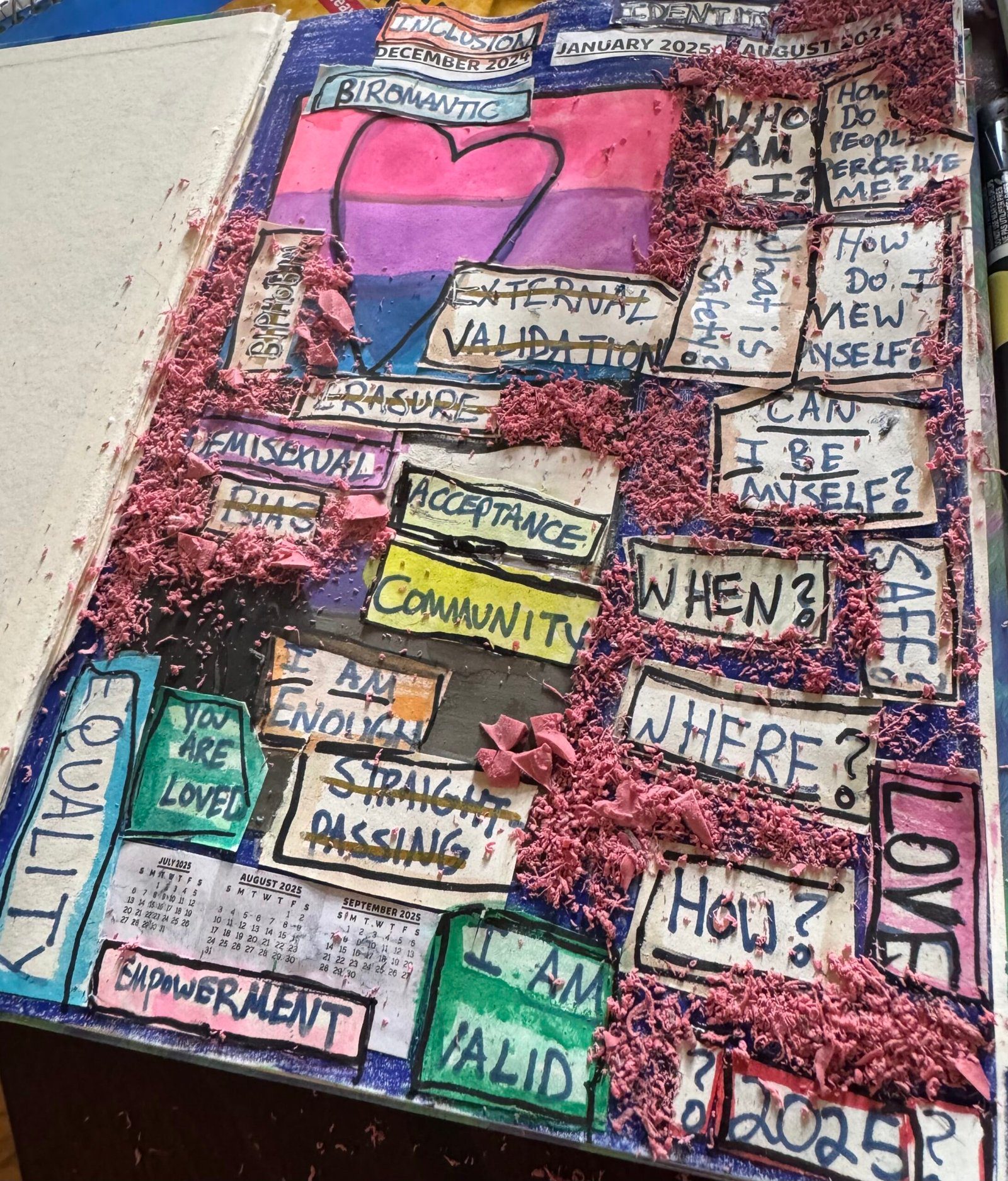
In seventh grade, I discovered the label bisexual. That identity lasted eight years, since I didn’t know there were other options to define myself. Earlier this year, I reconsidered if the label I had worn for so long was accurate to who I am. After thinking it over, I faced that the most accurate way to identify myself was biromantic and demisexual.

Biromantic is described as “being romantically attracted to more than one gender, not exactly in the same degree, same time, or in the same way.”

Biromantic to me means that I am romantically attracted to others, just not in the sexual sense.

Demisexual can be defined as “experiencing little to no sexual attraction without a strong emotional or romantic connection, falling under the ace umbrella (Asexual).”

To me, this means that I’m only sexually attracted to someone after thoroughly getting to know and trusting them on a deep, romantic level. I’ve never viewed myself as someone who could have a one-night stand or a friends-with-benefits situation.

For the past five years, I’ve reconsidered if it’s safe for me to be authentic in terms of my sexuality. With the rise of anti-LGBT laws and bills, I’m afraid to be open about it in public. If I’m with my close friends and in a safe environment, I’m able to speak about it in detail. Without my community, I’d feel lost. 

The feeling of community does not always take the form of a connection that exists in person, since there are online friendships I hold dear to me. For basically ten years now, I have been an active member of the fandom that surrounds two of my favorite YouTubers, Dan and Phil. 

Many within the fandom (phandom) are also LGBTQIA+. In addition, Dan and Phil themselves are queer individuals, and foster community within their fan base. This has been a positive space for me since I was thirteen, and first discovered my attraction to women/feminine-presenting people. 

A friend of mine who I first met in the phandom once exclaimed while hanging out, “I’m here, I’m queer, I’m gay, and I slay.” This is an example of inclusion within the phandom. 

Although I’m afraid to share my identity in some social situations, I have a safety net. The same net simultaneously protects and isolates me. Two years ago, my fiance and I became engaged. Due to bias and biphobia, I’m often viewed as straight because of my fiance’s gender. 

For example, a classmate in high school asked me if I was “still bi” after beginning my relationship with my now-fiance. I’m sometimes not considered part of  the LGBT community as a result of this relationship. That’s isolating.

Erasure is a concept that I internalize, and I have a difficult relationship with it. It makes me feel uneasy knowing that others dictate my identity. Being part of the community is part of my identity. The intersectionality of all my identities live within me: I am a woman, biromantic, demisexual, neurodivergent, and disabled — all at the same time.
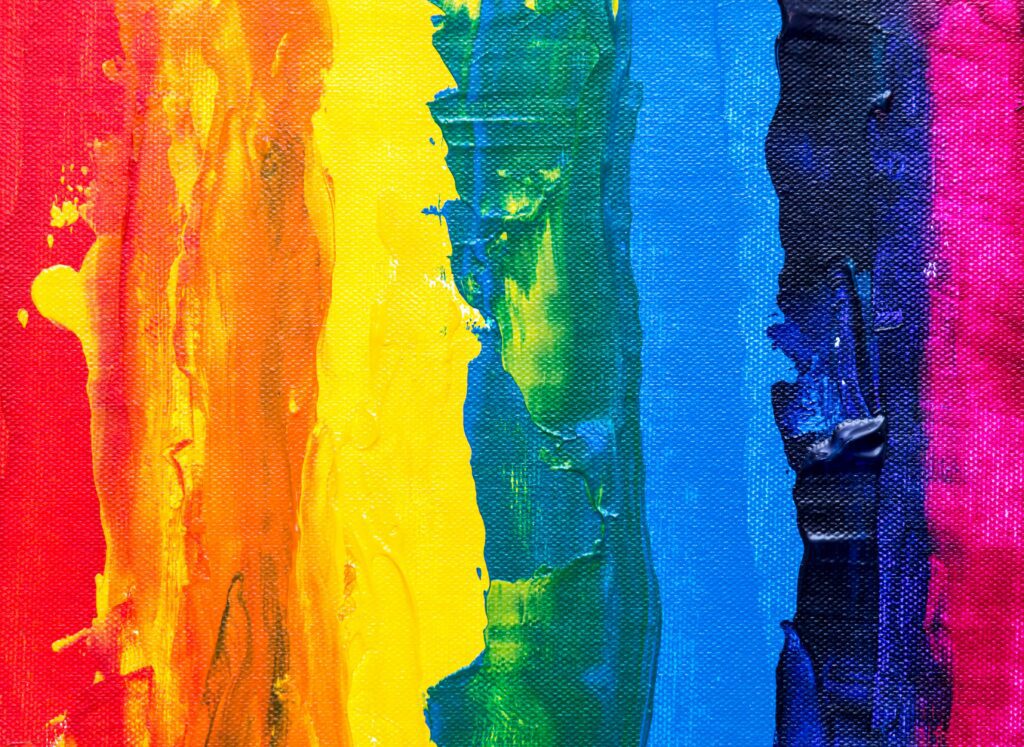
Image of paints that make for a rough rainbow
(Image courtesy of Steve Johnson on Unsplash)

The world we live in now

However, in this current climate, I’m privileged to have that safety net of being straight-passing. I am outwardly protected against hatred in some ways, but still discriminated against. 

After a situation that happened to me a few years ago at a local restaurant,  I’m scared to wear pride clothing. A nearby city didn’t have their first pride celebration until 2019. I know that not everyone in the area supports people like myself. 

That protest during senior year

During my senior year of college last year, students found out about a restrictive policy that was passed by the board. This policy stated that transgender, trans, and nonbinary students were no longer eligible for admission; many of my former peers are trans and nonbinary.

At a campus event with a guest speaker, I felt unfairly silenced. We were told we couldn’t speak out, couldn’t interrupt the speaker, yet weren’t allowed to leave yet. Students who weren’t seniors protested the policy by wearing all black and accessorized with pride flag pins. But, I was a senior. 

Part of me knew that the college administration was restricting students, but part of me didn’t know to what extent. I knew I needed to use my voice for good, since the restrictions were even stricter for students who were not closer to graduating. People in my life warned me about protesting, told me to not get myself in trouble. I didn’t care, because it was my senior year and knew just one extra voice could make a difference. I crossed that line almost daily, every time the administration made changes. I constantly worried that I would be called into the dean’s office, but thankfully I wasn’t.

I was surprised to find out how restricted I was as a student, but not shocked at the same time. I believe I was surprised that the administration thought so low of students, as many of us would not have even attempted to interrupt the speaker — without being told not to. I felt a sense of disconnection between how we as students viewed ourselves and our peers vs. how the Admin viewed us. The local police showed up to the Annual Founder’s Day event after the meeting, without our knowledge. I felt as if Admin viewed anyone who spoke out as a threat, when most people were not. 

Some faculty were supportive of students, and I understand why some were not in the position to risk their jobs in order to support us. 

In response to feeling shut out before, that same month I attended a protest on campus where students joined together, raising our voices to “Rescind the policy.” The administration approved the protest ahead of time. It was student-led, with fixed guidelines allowing us to shout approved phrases, hold signs, and only protest during the approved time slot. The protest coincided with the week that a board of directors meeting was occurring on campus. Once the meeting was over, we could no longer protest.

Following the protest, I joined a few others who were planning on speaking to a local reporter.  I didn’t know if I would be punished for speaking out afterwards, but I took that risk. Loved ones warned me not to do it, saying I would get in trouble. However, after the way the campus climate had shifted quickly under the appointment of a new commander, getting in trouble was the least of my concern.

Despite graduating from college and leaving that environment, I face bias and discrimination still, but primarily due to other parts of my identity.

Anxiety comes upon me whenever I see red MAGA banners in nearby cities or when I come across articles online that mention politicians’ stances. Anxiety creeps in when I visit cities that are dominated by primarily anti-LGBT institutions.

I often don’t tell others about my sexuality upon meeting them since I cannot be sure of their intentions. I wonder if I can attend local pride events — if it’s worth the possibility of being targeted online by someone from my hometown who is passionate in their anti-LGBT sentiments. How accepting a particular state is a variable in determining where to relocate. 

As well as this, I never know what will happen to my loved ones who are part of the community in 2025. I wish there were protections in place for every LGBTQIA+ individual. I wish I could foster that progress.

How I define progress and resistance

I may be ridiculed in public when I wear a pride shirt, but I know my experience isn’t the same as LGBTQIA+ people in other states or around the world. I may have been outed in seventh grade — and called a slur when I publicly came out as bisexual on instagram in ninth grade — yet, I cannot compare my experience to those who were queer activists in the 60s, 70s, and  onward. I don’t know what it’s truly like to fear my life on the daily for who I am.

I can’t relate to the community members who spoke a code language for decades in order to share everyday encounters with their friends. There are no direct terms for biromantic and demisexual in this language. Thus, I most likely would have been referred to as bibi palone (bisexual woman). Polari represents the history of the community during one of many  dangerous time periods for those in the LGBTQIA+ community. 

Survive and thrive

The historical basis for pride was to stand up against injustice, fight for those who can’t do so themselves, and make a difference. Pride at its root is about being authentic, even when social barriers are in place.

I’m not suggesting that others outside of myself should necessarily tackle injustice, as individuals exist in different circumstances than myself. I myself am sometimes worried about wearing pride clothing or accessories. Further, fostering change is not a monolith. It can be carried out through different methods.

Prioritizing well-being and self-care may be the only form of autonomy for individuals. Sometimes, resistance consists of survival and, eventually, thriving. Being true to who I am makes a difference. 

I’m very glad to be able to live with my fiance now. Right now, for me, being myself is resistance enough. 
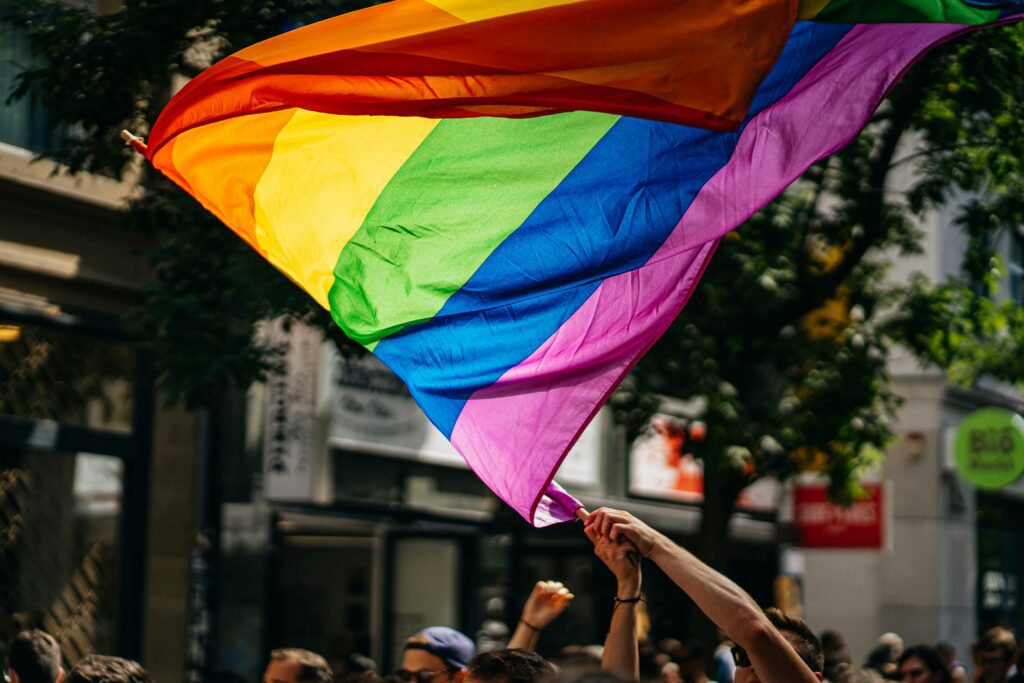
Arms waving a glowing pride flag in the wind
Image courtesy off Raphael Renter | @raphi_rawr on Unsplash

‘Batman: Arkham Asylum’ = Enduring Interactive Fear

Welcome to the madhouse, Batman!

As a kid, very little excited me more than getting to interact with my favorite DC hero, Batman. Whether it was a new animated show or a movie that changed the superhero film landscape, any opportunity to experience more Batman was a welcome one to me. So imagine my excitement when the brand new Batman game, Batman: Arkham Asylum, was announced. Needless to say, 11 year-old me was over the moon, thrilled to get to properly play as Batman for the first time ever. 

One thing I think no one was ready for was just how scary Batman: Arkham Asylum turned out to be. Most outsiders to the Arkham video game series likely hear “Batman” and immediately think it is just another superhero game. It certainly is a superhero game, with you running around as Batman beating up thugs while trying to stop the Joker’s latest scheme. What makes it so much more than that though, is how the game carried with it a fantastic element of horror throughout the entire story. Although future games in the franchise carried over this horror theme, none of them nailed it quite like Arkham Asylum did.

The game starts out as your standard Batman adventure, or technically the end of one: Batman has captured Joker and is taking him to be locked back up in Arkham Asylum, the incredibly outdated psychiatric hospital (= prison) that hosts the majority of Batman’s rogues gallery. Not long after bringing Joker in, the Clown Prince of Crime launches his real scheme – overtaking the asylum staff and taking control of the madhouse. 

From the very beginning, Batman: Arkham Asylum creates an atmosphere of unease. The titular asylum is dingy, grimy, and very reminiscent of an abandoned, haunted mental hospital you would find in an aging horror film. The only difference is that instead of being haunted by incorporeal spirits, Arkham Asylum is haunted by very real, very alive threats who all have one goal in mind: to kill you, as Batman. 

In fact, the asylum even has some monsters of its own: Killer Croc, a mutated crocodile man, tells Batman in the very beginning of the game he intends to eat the Caped Crusader. Cut to later in the game when you are slowly creeping around Croc’s lair, he will spontaneously burst out from the water, chasing you across flimsy platforms. With your only option being to walk slowly or risk Croc taking notice of your location, players have to painstakingly make their way through his lair with the constant fear of a crocodile man jumping out and hunting you down.

As you run around the asylum, Joker will periodically use the PA system to speak with Batman and taunt him. The PA system makes a noise that will haunt me for the rest of the time; a chime that sounds slightly off, almost as if it’s getting further and further under your skin every time it plays. Eventually, Joker also unleashes the absolutely rabid ‘Arkham Lunatics’, locked up in straight jackets and ready to attack anyone on sight. They hide throughout the asylum, forcing on the player the expectation that one of them could jump out from under the floorboards or pounce on you from the ceiling at any moment. Over the moon. 

Brightly colored classic comic book covers including Batman
(Image courtesy of Dev via Unsplash)

Scarecrow: The Master of Fear

But of course, nothing embodies fear more in the Arkham series than the master of fear himself, Scarecrow. For the uninitiated, Scarecrow, a.k.a. Dr. Jonathan Crane, is a former doctor of Arkham Asylum who invented the aptly-named “Fear Toxin,” a chemical concoction that shows its user their worst fears come to life as horrific hallucinations. Three times throughout the game, players are forced to contend with Scarecrow while under the effects of his Fear Toxin – running a deadly nightmare gauntlet where they need to fight off skeletons and hide whenever the massive Scarecrow appears and looms over his realm of fear. Being seen by him results in immediate death, driving the stakes and the player’s blood pressure up even more. 

Right before the very last Scarecrow nightmare challenge, the player experiences what can be considered the best scare tactic in the entire franchise. As Batman is walking through the asylum, he is dosed with Fear Toxin. Suddenly, the game seems to crash, with the screen and audio glitching and the player left frustrated and dealing with a very real fear for any gamer: did my game just break and make me lose all my progress? From what I’ve read from others who have played the game, this “glitch” tricked many players into resetting their game console, convinced that their game had actually broken. Oh, heavens.

For those who stuck it out, they learned that the glitch was actually a scripted event. As one fear was conquered a new one emerged, and  the game seemingly starts over from the very beginning with its opening cutscene. This time, Joker is in the driver seat, taking Batman to Arkham Asylum where he is promptly brought in on a stretcher and shot by the Joker, leaving the player unable to do anything but watch helplessly. Of course, Batman is a beacon of willpower, so he overcomes the hallucinations and manages to take down Scarecrow and, inevitably, the Joker – though not before Joker mutates himself into a monstrosity that likely haunted the dreams of many young players.

Batman: Arkham Asylum manages to accomplish polar opposites at once: making players truly feel like Batman on an immersive level, who himself inspires fear in the many thugs he takes down, while also managing to surprise and terrorize the player on a meta level. 

Melting down, yet over the moon

Batman may not have been afraid, but I certainly was, nearly having a heart attack every time a lunatic launched at me from out of a grate I didn’t notice. I did notice my controller flying up in the air as I yelled out. In fear?

Horror games aren’t everybody’s cup of tea, myself typically included. But Batman: Arkham Asylum reaches this crucial sweet spot where it gives players all the power and then knocks them back down, forcing them to overcome the twisted thoughts and schemes of Gotham City’s most wanted. Even now, nearly 20 years later, I still find myself feeling that same unease as I step back into the asylum and contend with the likes of Scarecrow, the Joker, Killer Croc. Especially Killer Croc. 

Yet, traversing all that chaos and destruction to triumphantly take down the Joker at the end makes it all the more satisfying when I surpass the nightmares and finally save the day, standing tall as the Batman. 

characters dressed as Batman and the Joker point at the camera
(Image courtesy of dmscs via Morguefile)

Let’s Conjure Up Some Jump Scares!

As someone who loves horror films, they still find ways of haunting me. Even now, I occasionally wake up in the middle of the night from a nightmare that feels as real and chilling as Halloween night. In my eyes, these cyclical terrors reveal how expertly crafted the creatures and jump scares of fictional films are. Anytime a jump scare occurs, especially in the Conjuring films, which are personal favorite frights of mine, I have to turn my attention to a random corner of the screen or not look at all. That’s how much they get under my skin. 

With its final film premiering this past September, The Conjuring film series has made its impact as a horror film staple for many horror buffs. The films are fictional retellings of notable, real life cases of paranormal investigators, Ed and Lorraine Warren. Whether or not you believe the events of these chilling ghost hunts are factual or fanciful, the films are a perfect example of what horror films should be: fun and entertaining to watch. Furthermore, the franchise contains jump scares that have lingered in the dark recesses of my mind for years, and they remain insidious reminders of the art of a great scare.  

Prior to the franchise’s final film release, I have been rewatching the previous installments in anticipation of the new horrors that inevitably await me. However, of the four previous films, I cannot seem to get past The Conjuring 2 because of one specific performance that always manages to send shivers up my spine. The character of the “Crooked Man” is a standout ghoul of the second film, invading the household through a toy zoetrope (a spinning lantern) and his eponymous children’s song. I am so terrified of this menace that I have to hide my face behind my hands throughout the sequence – I still don’t entirely know what happens!  What I do understand is that the talented actor who plays the “Crooked Man,” Javier Botet, is able to move his body in such a foreboding way that it makes the character unnerving and desperately uncomfortable to watch. Acting directly against Patrick Wilson (who plays one of the series’ protagonists, Ed Warren), Botet moves like a horrific animatronic, sending the audience spinning like the zoetrope he leaps out of in the dark. 

Speaking of the dark, watching any horror film in the middle of the day seems like the best option for me despite the fact that any little noise after the credits roll will make me question everything that’s going on in my own home. And that is an extremely effective way to prove that these jump scares and other techniques awaken my fight-or-flight mode and rattle me when I’m home alone. A prime example of this manifests whenever my family and I make the mistake of watching a scary film at night. It is my job to take our beloved dog outside for the evening, so, every night without fail, I always glance into the dark garage just to double-check that nothing is lurking in the dark despite the tiny security light remaining on continuously. I still don’t understand why I do this; it has just become a habit at this point, probably as a result of the malignant shadows that my loved ones and I so enjoy watching on screen. Consequently, I have learned that family ties are often tethered to fear as well.

A while back, I decided to watch Hereditary, a petrifying film about how some family secrets continue plaguing future generations in truly horrific ways. I viewed it in the middle of the day, being home alone, and the sunshine brought me little comfort. The physical act of Toni Collete, who plays one of the film’s main characters, climbing the ceiling in her family’s home, her head banging continuously against the wall as her terrified son screams, “Mommy, I’m sorry,” will always haunt me because of her character’s unnerving silence and erratic, inhuman movements. The sight and sounds (or lack thereof) of that particular scene never fail to make my blood run cold. And other films continue to use visual and auditory storytelling to incite dread in their audiences masterfully.

I can’t even watch The Exorcist anymore because of Linda Blair’s incredibly nuanced performance as a child actress portraying a girl who is possessed. The words and actions that leave her mouth shook me to my core when I first watched the film. I was shocked beyond belief that not only was this level of brutalistic horror achieved in the early 1970s, but that my seemingly fearless mom and uncle had a hard time watching it as teenagers. While The Exorcist has produced some incredibly famous imagery, the mental image of Regan (the young girl possessed by a demon that Blair plays) profusely cursing and spitting at the priest and her family trying to save her/exorcise the demon is something I’ll never get over. The very sight of Regan’s appearance changing as she swiftly loses her humanity and the gruff sounds of the young girl’s voice as the demon possessing her fights for control are expertly done, and the film has rightfully achieved its goal of being one of the scariest films of all time. 

More recently, horror continues to expand and include the terrors of the everyday. In Longlegs, a film about an FBI agent investigating the grisly murders of a supposed occultist serial killer, there is an emphasis on how the smallest acts can infuse horror that make one’s heart ache. Nicolas Cage plays the titular villain of the horror crime film and is an incredibly eerie character. His performance perfectly encompasses dread and an inhuman rage as he wails, “Mommy, Daddy, unmake me!” in his own car after being thrown out of a hardware store. Such a small act, as being asked to leave a store, sets Cage’s character into a spiral that utterly terrifies me and showcases how quickly someone can devolve to disastrous degrees. Understanding the additional context of the film, Longlegs’ personal yell is horrifying. Cage’s line delivery played on repeat in my mind for a few days afterwards, and it’s unlike anything I’ve ever seen and heard. 

Horror films are such a delight to experience, whether at home or in the theater, because they often expose us to things, concepts, and characters we would not dare to dream up. And, if the jump scares give me goosebumps, then I know I’ll be in for a wild ride! Additionally, horror films are a great way for my family to connect with one another. Half of my family (including myself from time to time) will binge true crime podcasts, documentaries, and macabre tv shows across all of the streaming platforms, fueling our never-ending love of the genre. My family loves good scares, whether we get them from horror films or one of the countless documentaries we have watched with bated breath and many gasps. Effective jump scares and thrills from horror films make my skin crawl, get my heart pumping, and provide terrors that I believe most individuals can’t truly fathom in the modern world. Finally, the creativity sparked by horror films continues to stand alone as an irreplaceable form of gruesome (and sometimes gratifying) entertainment. 

When the Climate Becomes Your Enemy

Amidst the sweltering lanes of a Delhi slum, where the sun feels merciless and the air itself seems scorched, life unfolds with harsh lessons. 

This is where I grew up — navigating the world with dyslexia, dyspraxia (a disorder that affects coordination and movement), and a stammer, while also serving as a lifeline for my chronically ill mother. We survived domestic violence, yes, but today we are facing an equal challenge: surviving a world that seems indifferent to its most vulnerable. 

Try and feel them

You hear about heat waves in headlines, but can you feel them? Have you felt that suffocating weight in the air, that oppressive sense of panic when you realize there is no water, no relief, and no escape? For us, enduring a Delhi heatwave in a makeshift home was like being slowly roasted alive. I remember one particular day when the temperature soared, making it unbearable to breathe. Our tiny room felt like an oven; the walls radiated heat, and the ceiling fans offered no respite. Each day was a battle against an invisible enemy, as my mother’s health crumbled and my own challenges flared up.

Finally, after my mother received care from the government hospital, I vividly remember that some of the medicine her doctor prescribed required cold storage, and at that time we had no refrigerator. I had to ask the local pharmacy for help.

In the unrelenting heat,  my dyspraxia intensified, turning even simple tasks into exhausting struggles. One prominent dimension of dyspraxia that becomes increasingly noticeable during this period is sensory overload. Typically, I struggle with processing sensory information, including touch, taste, and sound. However, the combination of intense heat and constant sensory stimulation during the summer significantly amplifies these difficulties.

As temperatures rise, I find it increasingly difficult to regulate my body temperature, which leads to feelings of restlessness, fatigue, and irritability. The discomfort of excessive sweating can also interfere with my ability to hold objects or maintain a firm grip, further intensifying the coordination challenges that are already a part of living with dyspraxia.

Image courtesy of Parker Hilton via Unsplash

Hot and bothered, you are a statistic

The time I rushed my mother to the emergency room during a particularly brutal heatwave, getting to the hospital was a nightmare. Public healthcare was our only option, and the system was stretched to its breaking point. The waiting room was packed, and as I stammered through my explanation, I felt the impatient stares of those around me. The doctors and nurses tried, but they were drowning in a sea of patients. The helplessness I felt when I stammered while trying to explain my mother’s deteriorating condition was overwhelming. In those sterile hallways, you’re not a person — you’re a number, a problem to be processed. It’s a kind of invisibility that’s hard to describe and even harder to live through.

Here’s the painful reality: if our healthcare infrastructure can’t account for the heightened vulnerabilities of disabled people, we’re not just failing, we’re actively contributing to needless suffering. Accessibility isn’t about “nice-to-haves” like ramps or braille signs — it’s about life and death. It’s about creating safe, resilient spaces where people can seek care without being pushed to the margins, or to their own limits. If healthcare can’t adapt to the reality of climate change, then the most vulnerable will continue to pay the price.

We were overheated. Statistics are cold. They can tell you about the number of people affected, but they don’t make you feel it. Stories like ours bring urgency and humanity to these issues. When you look past the numbers, you see people fighting battles that few even realize exist.

From struggle to action: the birth of Green Disability

Out of this experience, I realized that we needed to make our voices heard in the climate conversation. That’s when I decided to start Green Disability, a grassroots initiative for climate action that includes the needs of people with disabilities. Today, our community has grown to over 600 members, with our newsletter reaching over 7,000 people. We’re not just an organization, but a movement, and our message is simple: the climate crisis affects everyone, and you can’t talk about sustainability without talking about accessibility.

We’re working on documenting the lives of disabled people in climate-vulnerable areas, sharing their struggles and their resilience. We’re also simplifying complex research, turning data into stories that resonate with our community and inspire action. This isn’t just about raising awareness. It’s about creating real change.

Climate justice is empty without disability justice

We’re one of the world’s largest minorities, a major minority! Yet we’re often overlooked in climate solutions. But we won’t be ignored anymore. Disability justice and climate justice go hand in hand. 

If we’re serious about tackling the climate crisis, then people with disabilities must be part of the climate conversation.

What is Fear?

What is Fear?

Whenever I plan to write, the white empty paper scares me.

This year, I turn 31. What did I achieve in these years and days of my life? How do I define myself?

My passport says that I am Egyptian, even if I spent more than half my life outside the country. Should I start telling my story from 1993? I was born in Khor Fakkan in Shariah, United Arab Emirates, the youngest of seven children. My parents named me Khadija.

I graduated from high school and returned to Egypt. I participated in a revolution which didn’t achieve its goals. I got married after a great and epic love story…or that’s what I thought, until I got divorced.

I gave birth to two amazing kids. I graduated from Sharjah University with a degree in English literature and translation.

I spent my twenties with my son Qassem. Life was beautiful until I gave birth to my daughter Layla and fell into a hole of postpartum depression. Alice in Wonderland was running after the rabbit, but I was running after myself.

What lessons have I learned from my life? What is the moral of my own story?

I can bake apple Bundt cake, lemon cake and chocolate banana bread. I cannot work under pressure. I used to hide my problems. I love life and in the same way loathe it. I love to prepare my meals with passion  and eat them slowly. I love to spend time with my friends.

I know the sound of typing pleases me. I love writing and literature. I believe that there is a special connection between me and literature and I discover that day after day.

I am fond of language. I lose and I win. I am ambitious. I dream of becoming a great translator. I dream of winning the best mom ever prize (if there is such a thing)!

Why do I hate the Egyptian revolution? The revolution fell from paradise to the earth like Adam’s apple. I wonder, did Adam hate the apple? Did he swear at her?

I was living such a simple life in Dubai in 2011, when the flame of revolution ignited in the Middle East. I was a high school student. The revolution seemed like the greener grass on the other side. I dreamed of being part of what was happening. But since that time, I have been enduring a series of personal and public defeats. Can life lead to better outcomes? Can the course of life change?

(Image courtesy of Melanie Wasser via Unsplash)

Once you have been broken and tasted fear, fear becomes a habit. Do you know who I am?

I am the girl who at the age of 19 almost got caught by the central security forces at a protest. As I felt them pull my arms and grab me, I screamed “I want my mom!” Since then fear knows my address and acts like that friend who, no matter how many times you avoid her, keeps ringing your doorbell… 

Unwritten Dreams

I forgot to have a big dream
Now that I think about it
I never even found my passion
The easy solution would be to claim that I’m a writer 
But that doesn’t feel true most days
The words I write are not my own
Rather the physical manifestation of my pain
Of something within me that is beyond my control
And removing them is a process that exhausts me

I never planned for my future
I simply took it day by day
Leaving me to feel lost and unprepared
Unwilling to accept that this is it
I am missing the feeling that used to drive me
That gave me hope for what was to come
Because I am in a future now
Once again filled with words that hurt me
And worried that this is all I will ever amount to

2027

The invasion happened 40 years ago, in 2027. 

Big, oval-shaped metal ships appeared out of the sky. It’s hard for anyone to think that on that day, millions of lives disappeared. The aliens came in their large spacecrafts with protruding metal legs, and walked around our town in Aberdeen. 

I was ten years old at the time, with Jay, who was eleven, and our mom. We were at the festival park downtown. Our dad wasn’t there, which was how things usually were. I remember that the perimeter of the park had a shaded, circular path for people who took their afternoon walks. There were two playgrounds. At the north-western side of the park, there were numerous wooden picnic tables, shaded by large trees.

 After what felt like hours of Jay and I running around, our mom called us over to the picnic table to have lunch. As we ran over, I heard an eerie, high-pitched buzzing in my ear. I turned around to see where it was coming from. The sound became so loud and painful that I had to cover my ears, trying in vain to protect myself from it. I looked around the park and saw everyone doing the same. A homeless man who always frequented this park with his gang of dogs fell to his knees, his face scrunched up from the buzzing sound. I couldn’t understand what he was saying as I watched him curl into a ball, rolling from side to side with his mouth open. 

Jay grabbed my hand and we ran to our mother as the sky turned dark. The beautiful baby blue color disappeared as the clouds quickly moved in, painting it gray. The wind intensified as we raced to our mother. I was terrified that my brother and I were going to get blown away. But thank God, we reached our mother in time and she took us into her arms. I don’t remember what I said because now all I can see when I close my eyes are the clouds opening and the alien spacecraft crashing from the sky. 

We couldn’t run for cover. The impact of the spacecraft’s landing caused the ground to shake violently. Each time we tried to get up and walk, we ended up with itchy grass on our faces. The ground where the crafts landed on the cars, the public library, and the city hall were all shaking. 

My mom held my brother and me close, whispering, “We are going to be alright.”

She tried her best to shield our eyes from the scene and focused on her, but it was futile. It was impossible not to see the complete destruction of my hometown. I thought again of the homeless man and his dogs. I still remember how hard I screamed when I saw him killed. A part of me, now, is grateful that the buzzing was so loud that I wasn’t able to hear the crushing of his bones or his horror-stricken cry. When the spacecraft’s feet lifted into the air, the man’s body was flattened, and he and the dog’s internal organs fell out of their bodies, mixing together on the ground. 

My mom snatched my face and forced me to look her in the eye, “Mina, keep your eyes on mommy, okay? You too Jay! Kids, hold onto my hand tight and don’t  let go!” 

Jay and I nodded in silent horror.

My mom squeezed our hands, shaking them as she spoke. I didn’t have time to answer and neither did Jay. She got up and dragged us out of the park and towards the car before we could get a word out. I looked at my older brother to see his face turn white, as his eyes flooded with tears, snot running down his nose. I never saw Jay look horrified before then. He was the typical older brother, never afraid of anything. I was the one that would cry hysterically. But at that moment, the roles were reversed. I was the quiet one. I looked over at my mother again. She was clearly horrified, too, but somehow much calmer than either of us, because she wasn’t afraid for herself. Even in the middle of an alien invasion she couldn’t bring herself to be selfish. All she cared about was getting Jay and me out in one piece.

God why didn’t I listen to her then. 

Suddenly, my fingers cease to type. Memories of my mother come flooding back. Her strength, her resolve. How she could be so calm amidst total chaos. Writing about her makes the pang of her absence even more apparent. The sick feeling in my stomach twists as I tell you this story.

My mother started sprinting for the car, dragging us by our arms. As we ran, I turned my head around to look at the mayhem. People scrambled to take cover and dodge the craft’s feet. A man carried a woman on his back towards the parking lot. He leaped over the carcasses of the homeless man and his dog but then slipped on the blood-slicked concrete and fell. My mom yanked my arm to turn me away. We were almost by our car when red lights appeared above us. I looked up and saw that each craft had wand-like appendages with red lights on them. I turned to ask Jay what they were, but his eyes were on our mom, unaware of what was about to happen. 

“Mommy, I’m–“ 

Before I could finish what I was going to say. I heard what sounded like a crack of thunder. 

Rain? Is it going to rain now? 

Suddenly one of the wands shot out a blinding beam of light. The reflection lit up the whole park.  A deep thumping sound came from the wand before another beam came out and struck a woman. She let out a horrified cry as her body turned red, and then her arms, stomach, and legs exploded. Chunks of her body scattered around us, her torso fell to the ground while the remains of her leg landed all around us. Something large and red flew past my head, and a moment later, her blood rained down on us. I turned to my left and saw her disfigured leg on the ground.  

 It was when the three of us took a big leap over something, that I felt a strange substance on my shoulder. I turned my head and saw a red, rust-smelling mass. I tried desperately to get it off me, but Jay’s grip on my hand tightened. I decided to ignore it. We continued running, while our mom pushed and dodged people to get out of our way. She knocked over a woman who was on her knees, screaming for her child to get up. I looked away, unable to bear the sight of it. We were inches away from the car when the sound of multiple lasers rang in the air. 

My mom screamed as we finally reached the car and unlocked it. 

“Keep your eyes on me!”

She threw Jay and me inside before she hurried behind the wheel.  Outside the car window, more crafts swirled around the park, shooting lasers at anything alive and walking. My eyes turned back to the spot where the homeless man was. I saw the woman riding on the other man’s back. She was now on the ground, wailing and calling for him, but he kept running and left her behind. He nearly escaped when the laser beam hit him in the head, disintegrating it immediately.  His lifeless body fell along with the other mutilated corpses around him. In a trance, I watched the bodies explode and the earth shake, and heard the buzzing, which overpowered the sound of my mom calling me.

 She grabbed my face, “Mina! Mina!”  she screamed, her fingernails digging into my skin.

 “Mommy, my face hurts,” I whimpered. I tried to move my face away, but her grip was too strong. 

Our mom’s voice trembled and cracked, “Mina! Listen to me! Do not look outside! Please honey. Look at your brother.” I looked at Jay, and he looked back at me, hyperventilating. With each pained cry he sucked in more air. 

I begged her to let me go, “Mommy please…” I was terrified at the thought that, at any moment, we could all die. 

“Jay, calm down honey, we’re going home. Mina baby…” 

My vision was blurred with tears, and each time  I tried to talk, my throat tightened. The car shook as my eyes trailed away from our mother and landed on the window. More limbs, belonging to both adults and children, were scattered all over the park. Their upper torso would be in one place, but their legs or arms would be far away. The last thing I remember was our mother turning around to start the car. But then, the body of a woman crashed onto the windshield,  and suddenly the bright red light of another laser beam consumed my entire field of vision. 

***

I stop the story and save the document.  The images of the couple and homeless man replay in my head, and I realize I can no longer breathe. I get up from my desk to lay down on my bed. As my head falls on the pillow, I turn off the headset, put it down to my side, and just breathe. On my bookshelf are vintage books and picture frames that have moving holograms inside. One of them contains an image of my mom the last year before she died. 

Our old selves stand in front of the camera with a big smile on each of our faces. Our mom was sitting in the middle while Jay and I flanked her on either side. The three of us posed and waited for the click, when suddenly  Jay burst out into a giggle that made our mom laugh. Looking at this picture always causes this same bittersweet feeling: the memory of being with my brother and mom, the elation we experienced from just being with one another, and the sudden pain in my chest and throat when I realize we will never feel that way again. I stare at the hologram picture until my eyesight gets blurry again. I sniff and wipe my eyes as I turn over to face the other wall.  

I want to write this story–my story. I don’t know why, maybe so I can heal some deep wounds. I take a deep breath and imagine the sound of her laughter on the day the photo was taken. For a second I question why I am even doing this. Forcing myself to remember her in vivid detail and write about how she was before I lost her. The pain of remembering her in this way is too much to bear at times. For a few minutes I entertained the thought of never opening up that document again, of keeping her memory safely tucked away, my only reminders of her the photographs of her smiling eyes. But then I think back to her final moments, how scared yet brave she was. I cannot let her become just a memory. 

I take a deep breath, go to my computer, and open up the document once more.