The case of Thiago Feijão: injustice and the myth of Brazilian racial democracy
By Ana Lívia Vale
FEATURED: Physical education teacher, Thiago Feijão | Photo by @feijaothiago via Instagram
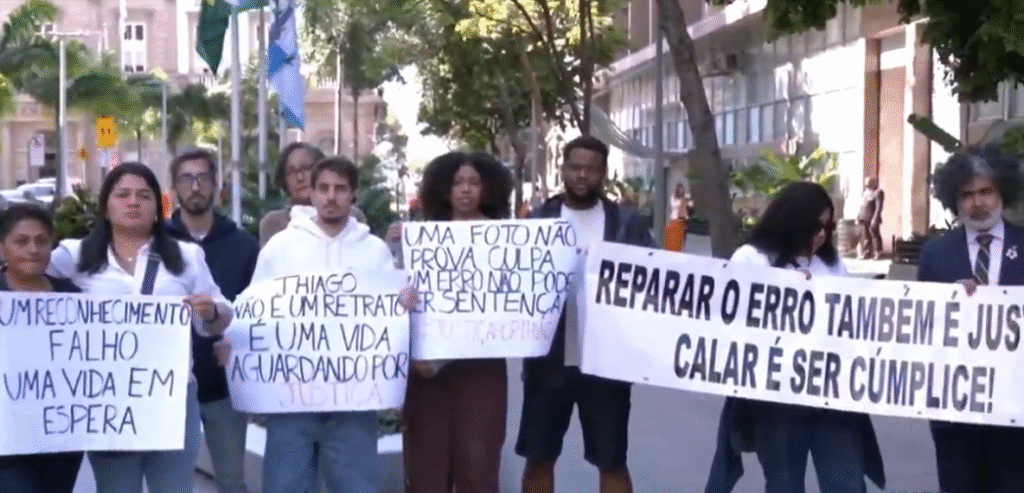
In 2025, the physical education teacher Thiago Feijão, 32, faces Brazilian justice for the second time, accused of robbery and murder. The worst part of this history? There’s a good chance that he’s innocent.
Convicted in 2015 through a photo lineup, he presents evidence and testimonies in support of his innocence. The case is marked by contradictions and racial bias, which generated national repercussions and reignited debates about discrimination in the judicial system and the narrative of racial democracy in Brazil.
A Black man, Thiago was accused based on a photograph identified by only one witness, who at another moment had described him as a white man. He was sentenced to 28 years in prison for robbery followed by homicide and armed criminal association.
According to the prosecution, Thiago allegedly took part in two robberies, including a felony murder, on May 29 and 30, 2015, along with three other men.
However, he presented witnesses and evidence proving it was impossible for him to have been at the crime scenes.
May 29, 2015: Thiago was working at a warehouse managed by his family. The ice supplier, Édson Santos, confirmed having spoken with him minutes before closing his shop, making it impossible for him to reach the crime scene in time.
May 30, 2015: Feijão said he was picking up his daughter and getting ready to watch a UFC championship at home. His wife, Sharon, presented phone records, cell tower location data, and a statement from his daughter’s school principal as proof.
Thiago’s identification was based solely on a photograph. Although the initial witness had described the suspects as three Black men and one white man, Thiago, being Black, was still charged as the “white suspect.”
Subscribe to The Superhero Brief!
Free access to the CEO's newsletter.
The views expressed in this newsletter are those of the CEO and do not necessarily reflect the views of the organization.
He was imprisoned for two months until he obtained habeas corpus. With a new arrest warrant issued in 2024, Feijão decided to go into hiding, a situation he remains in to this day.
The case returned to national attention in 2025, when two new witnesses securely identified another man as responsible for the crimes for which Thiago had been convicted.
In an interview with Yuvoice, Thiago’s lawyer, Rodolfo Xavier, stated:
“For me, the moment that stood out was during the hearing in the early evidence-gathering procedure, when it became clear that the photo attributed to Thiago Feijão was in fact of another person.”
The physical resemblance between the two men had led the initial witness to make a mistake.
“It was Ruan, already deceased. The ones who recognized Ruan in the photograph were his widow and also his former sister-in-law. Both testified in court and confirmed the recognition,” he added.
The criminal appeal presented by the defense was rejected, leading the lawyers to file a habeas corpus with the Superior Court of Justice (STJ) in an attempt to overturn the decision.
The request was denied on the grounds that legal criteria had not been met and that the appeal overlapped with the trial of the main case, still pending.
The case proceeds slowly, and Thiago’s defense team now awaits approval of the request for annulment of the photo lineup and, secondarily, acquittal for lack of evidence.
Family holds protest in Rio de Janeiro, Brazil, and calls for justice in the trial of Thiago Feijão – Photo credit: SBT
The myth of racial democracy
Thiago Feijão’s case sparks outrage and opens discussions on how structural racism operates intrinsically within Brazil’s judicial system.
A misidentification can cost years of freedom and inflict enormous suffering on families, highlighting the unequal weight of justice for Black and white people.
Since its early history, Brazil has often been portrayed as a naturally egalitarian country due to miscegenation. This discourse, cemented as common sense, denies the racism revealed in research and daily life for Black Brazilians, also affecting their self-identification.
Sociologist Gilberto Freyre, in ‘The Masters and the Slaves’ (‘Casa-Grande & Senzala’, 1933), reinforced the idea that miscegenation favored national development and would create a “cordial” nation, ignoring that relations between masters and the enslaved often involved coercion, abuse, and violence.
From this perspective emerged the narrative that Brazil was a country without racial division, where everyone was equal, even before the law. This belief became widely disseminated and deeply ingrained, serving as a way to deny data that demonstrate unequal treatment based on skin color.
João Miguel Goes, 18, shared with Yuvoice his experience as a young Black man in Rio de Janeiro:
“[…] Because if it really were about safety, safety for your own life, you’d have to stay at home, you’d have to deprive yourself of living. So, to keep on living, you live in fear, in tension. At any moment something could happen to you, they could accuse you of something you didn’t do, but since you’re the one with dark skin, curly hair… then the blame falls on you.”
According to a 2023 study by the ‘Rede de Observatórios da Segurança’, 90% of people killed by police that year were Black. This shows that police violence is not distributed equitably, but disproportionately targets the Black population.
Figures like this make clear the need to reject false ideas such as the myth of Brazilian racial democracy. In practice, stories like Thiago Feijão’s show that this idea is an illusion.
It is not about individual mistakes but about a structural pattern in which Black people are more readily positioned as suspects.
The scales of Justice are not balanced for all, and structural racism continues to shape experiences, opportunities, and identities in Brazil.



Comments
Be the first to share your thoughts!
We value diverse perspectives and respectful debate.