Backing New Beginnings: Refugee Entrepreneurs Find Support Across Britain

“When the land is full of snow and you don’t know what is underneath — ­business is like that,” says Akbar Majidov, an immigrant to Britain who runs a catering business with his wife Sanobar. You have to take risks, Akbar told The Sentinel: “you just need to walk on the snow. Sometimes there’s a hole there, but sometimes it’s OK.”

Akbar and Sanobar from Uzbekistan in central Asia are operating in London street markets and at private events, selling home-made food originating from their Persian-speaking Tajik culture. 

Akbar has had to tread virgin territory to forge a life for himself since he came to Britain in 2003, a life which has included working in construction and for restaurant group The Breakfast Club. Sanobar joined him permanently in London in 2019.

The husband-and-wife team has received guidance from non-profit organisation TERN, The Entrepreneurial Refugee Network, which is helping refugees to launch their own businesses. TERN helped 725 refugee entrepreneurs in the 2024-2025 financial year. It is seeing such demand for its mentoring and training courses that it is running a waiting list.

Kateryna Reshetnyk, a Ukrainian refugee from the eastern city of Kharkiv, now works with her husband in the Scottish town of Girvan, running PIXSEL UK, which produces hybrid glass protectors for car and motorcycle screens. Kateryna hadn’t operated a business before she was forced to flee the war in Ukraine. She told The Sentinel how she has also benefited from training through TERN.

“I had an accountancy course, an accountant from TERN helped me to create a business plan and I had a course for eBay. TERN and eBay helped refugees like me who want to sell on eBay.”

Immigrants to Britain have been facing a hostile environment in the past few years, both from governments and from right-wing populist party Reform UK, which is leading in opinion polls. However, there is also a groundswell of support for Britain’s multiculturalism. At least 50,000 people joined a march against the far right in London at the end of March. Nowhere is this multiculturalism more apparent than in the variety of international foods available to diners in London, the best city in the world for food, according to Tripadvisor.

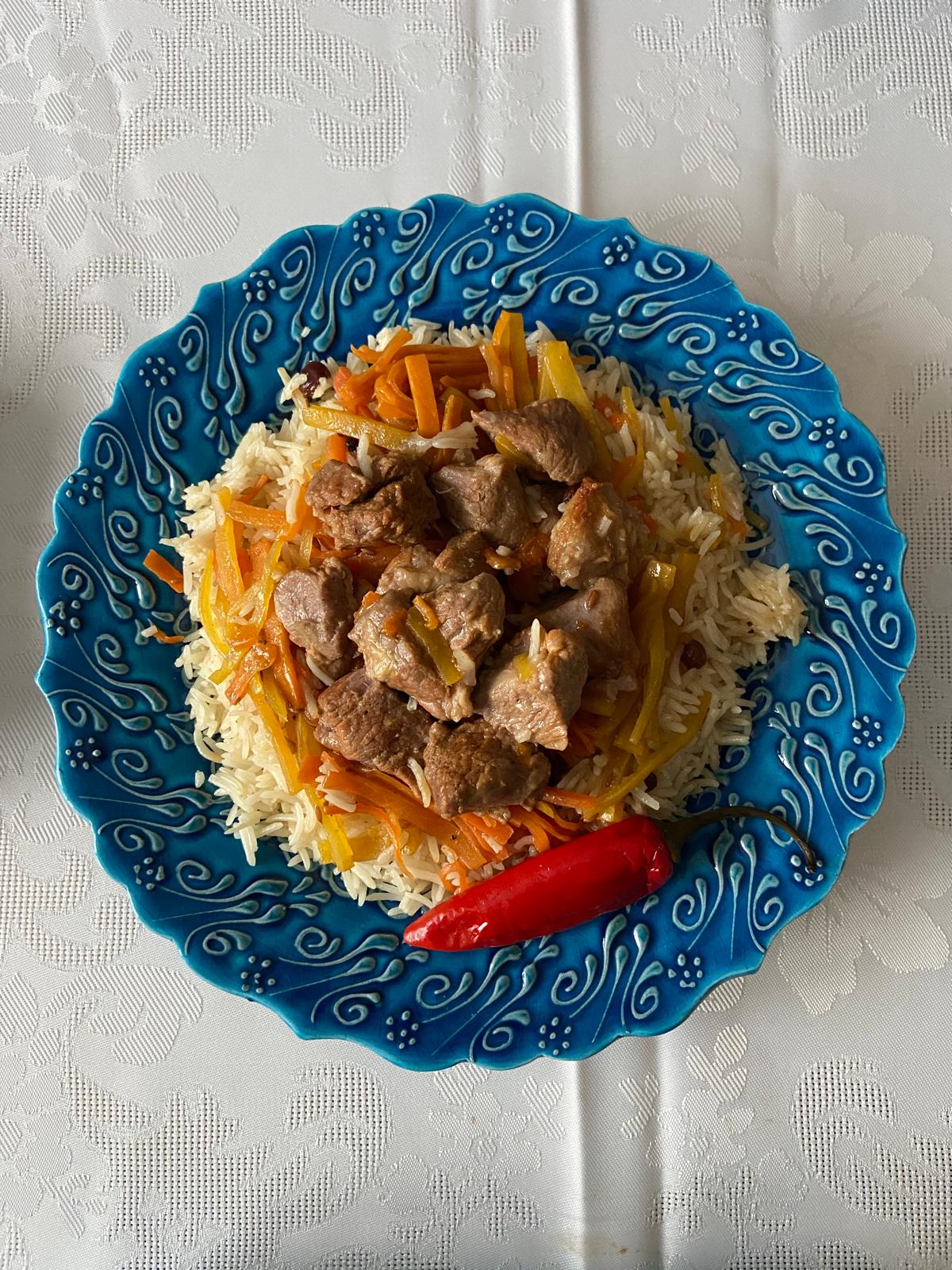
The signature dish of the Majidovs’ business, Samarkand Palav, is oshi palav, inscribed in 2016 on UNESCO’s Representative List of the Intangible Cultural Heritage of Humanity. Palav typically features rice, meat and carrots, as well as spices such as cumin. What makes the dish so tasty is that the ingredients are cooked together, with the rice absorbing the flavour of the meat and vegetables, says Akbar.

Another distinctive element of palav is that it is cooked and served in layers, with first rice, then meat, then vegetables, says Sanobar: “this very beautiful layer gives a touch of Bukhara and Samarkand.”

Sanobar says it is important for immigrants to integrate into Britain when they arrive. However, it is also important for them not to forget their own culture. For Sanobar, the contrast between central Asian and British culture can sometimes be great:

“In Uzbekistan, we keep a friendly, centuries-old culture. People live for today, and they don’t worry about money for the future. In the markets, in the bazaar, people share their food, they share everything. I think it’s good if they bring this nice culture with them and they share.”

Kateryna also stressed the importance for refugees of making the most of what they have.

“Thank you to people who trust us and who allow us to create a business here, and who provide advice for refugees. I understand now that everything changes very fast in our lives. You need to live for today and for this moment, not wait. I have been waiting for good things for four years, but we decided to create our business here, to live our full lives.”

England’s toddlers looking for a home

Fertility in England and Wales is at record low levels of 1.41 births per woman. It’s a trend replicated across Europe, including in countries traditionally seen as family-friendly like Spain and Italy. Meanwhile, the average age of parents has risen. People are waiting longer to have children and are sometimes finding it harder to have them. So finding adoptive parents for young children in need of a family should be getting easier, right? Wrong, according to Dame Carol Homden, chief executive of children’s charity Coram, a major voluntary adoption agency in England.

“Adoption matches and placements are down, but that is not because of a fall in the number of children,” Homden told The Sentinel in an interview, adding that in Britain:

“What is of profound concern is that we have more than 3,000 children waiting and we only have half the number of adopters.”

There are several reasons for a lack of potential adopters, according to Homden, starting with an ageing population.

“We have a demographic time bomb. We have a change in the demographics of the UK, a change in our population which means that the population is older. There are many people post-retirement playing a key role in the lives of their grandchildren. But for the parent age group, or what we normally think of as the parent age group, there are fewer of them.”

Brexit, inflation and war shocks are also taking their toll.

“It is ordinary people who do this extraordinary thing of adopting children, and the cost of living crisis has been a great concern,” Homden said.

“It’s increasingly difficult for young people to leave home and to have the housing that they need to form a family, combined with the cost of childcare, as a great many more women are in the workforce.”

Homden said that parents were “a squeezed middle that’s facing very high childcare costs and increasing burdens for their elderly relatives.”

In addition, scientific advances in IVF have reduced demand for adoption from would-be parents who have had difficulties in bearing their own children, Homden said.

Adoption also faces a barrage of negative publicity, with tales of adoptions which fall apart, Homden added:

“Good news is never news. There is a negative discourse that is drowning out the voice of the many, many children who say they love their adopters, and of the vast majority of adopters who say that it can be tough, but that they would do it again.”

Homden said it may be time to consider different ways of looking after children.

“We are going to need to adapt our ways of thinking about how people can help, even if they are not able to help us full time.”

With divorce high in Britain, one group of people who could be a natural fit for adoption are “second time arounders, where one of the partners has teenagers,” according to Homden.

There is no upper age limit on adoption in Britain, though Homden said Coram took into account the physical toll of looking after young children. “There is a sense check. Health conditions are considered quite carefully.”

There are also no restrictions on adoption by same-sex parents or single parents in Britain.  Joint adoption by same-sex partners is permitted in only 36 countries worldwide, according to the United Nations Population Fund.

“Coram has been welcoming people of all backgrounds for a very long time,” Homden said.”

Established as The Foundling Hospital in London by Thomas Coram in 1739 as a home for babies whose mothers were unable to care for them, Coram operates adoption services in London and the southeast of England.

Homden said that the vast majority of children who are adopted are under the age of five, with most between two and four.

Former primary school teacher Anne, a single woman of Black Caribbean descent, adopted her two daughters, birth siblings Emily and Rachel, through Coram in 2021 and 2022. Her network of family and friends were supportive of her decision, she said in comments provided to The Sentinel by Coram.

I knew it was going to be really tough to adopt as a single parent. But I had faith that this was the right thing for me to do, she said.

“I remember just always having a heart for those children who kind of didn’t fit into the mainstream in different ways. Being around children who were maybe looked-after, or they were known to social care, it really made me think this was something I wanted to do.” 

“Adopting children who are birth siblings I think is really important for their life story and having that connection. I am getting used to taking care of someone else’s needs, we are having new experiences and getting to know each other.” 

Same-sex parents Ben and Adam adopted siblings Lydia and Spencer, and later another child, Jamie, through Coram, according to comments provided to The Sentinel. Ben is a former mental health nurse and a qualified social worker, with experience of working with vulnerable children.

Lydia and Spencer, aged two and one at that time, were the first children Ben and Adam were put in touch with.  “I remember the night before the confirmation on whether we would be their adoptive parents,” Ben said. “The waiting then was the hardest part of everything, we couldn’t sleep because of excitement and nerves. But it was a wonderful process and exciting. 

Ben added that: adoption is a very different form of parenting to biological parenting and I think it’s quite hard to understand that before you do it, so we try to explain the realities to anyone considering it. Adopting our children is absolutely, one hundred per cent the best thing we ever did, no doubt about that.”

Editorial note: Names have been changed to protect the identities of the families.

Iranians in Britain who oppose regime and war

The U.S. and Israeli airstrikes on Iran have ignited passions around the globe, including among Iranians living outside the country. Clashes broke out in London on March 6, six days after Iranian Supreme Leader Ali Khamenei was killed, between supporters of Reza Pahlavi, the son of Iran’s last shah, and supporters of Iran’s current regime.

But three Iranians living in Britain told The Sentinel that these polarised views did not reflect their opinions, nor those of people living under the bombardment in Iran.

For political activist Aghileh Djafari Marbini, who is opposed to the current regime, it was not possible to rejoice at the death of Khamenei: “I’m not sad, but I’m not happy either.”

“The places that are being bombed are places I know.  I haven’t been to Iran for the past 10 years, but you know the smells, you know the places,“ she said, adding that the destruction of Tehran meant it was hard “knowing that my two kids will never go back to the place I left behind.”

Djafari Marbini, who spent most of her childhood in Iran, has been able only intermittently to hear news of her family there, given restricted Internet access.

“We do hear from people. One person hears from them and we hear from them that they’re OK,” though she added that the daily news of the war was “gut-wrenching”.

Djafari Marbini said the use of external force was not the right way to bring about change in Iran.

“I am very anti-this regime, I have never voted for anyone under this regime. What goes on in Iran is not the business of outsiders. We Iranian people have the right to determine our future. I don’t want my country to go from one dictatorship to another. This is not what people want.”

Djafari Marbini said it was important to remember the diversity of views, both inside and outside Iran. An analysis of the slogans used in the January protests in Iran, for example, showed that only 17% indicated support for Pahlavi.

“It’s a country of 90 million people and a variety of opinion, it’s like any other place. Lots of people are very upset about Khamenei having died.”

Djafari Marbini does not favour the return of the monarchy, unlike some of her friends and family, a cause of disagreement between them.

“I can’t see how this fracture can be fixed, I have lost friends, I had a row with a cousin in Canada.”

Her sister Hosnieh Djafari Marbini, a doctor, said the attacks brought back her childhood memories of the Iran-Iraq war of the 1980s:

“I really dreaded the dark because I was so afraid of the bombing, I couldn’t stop shaking when the bombings took place.”

Khamenei has been replaced by his son Mojtaba, whom Suzanne Maloney, vice president of the Brookings Institution’s Foreign Policy Program, described as hardline in a report on leadership transition in Iran published only four days before Khamenei’s assassination.

“Repression increases every time there is war, it hardens views, it breeds fear and anxiety,” said Hosnieh Djafari Marbini. “Now Iran has got an even more hardline regime than it had before. I cannot see how any of this is going to bring so-called freedom or liberty.”

“It is going to make all our lives much harder, it’s causing so much suffering.”

British Prime Minister Keir Starmer has faced criticism both at home and abroad for his unwillingness to enter the war, with U.S. President Donald Trump calling him “not Winston Churchill”.

However, British-Iranian journalist Arash, who declined to give his full name due to the sensitivity of the issue, said Britain should keep out of the war.

“We don’t want the UK to get involved, it will be really bad for the UK,” he said, pointing to the pressure on oil prices. “We need to try to mediate in order to find a diplomatic solution.”

Economist Timothy Ash also highlighted the broader economic impact of the conflict in a Substack post on March 10, pointing out that it went beyond oil prices, given Iran’s current closure of the Strait of Hormuz, a major route for the world’s shipping. Ash said that if this route were not opened soon, “the impacts to the global economy of the on-going war will still be very significant and could well still be globally systemic.”

Britain’s growth strategy needs training boost, expert says

Britain will struggle to boost economic growth without investment in training and skills but this sector of the economy is getting little help from the government, business expert Nigel Driffield told The Sentinel.

   Britain’s left-of-centre Labour government, elected with a strong majority in July 2024, is trying to lift people out of poverty and provide better public services without sharp rises in the tax burden. It is looking to faster growth to close that gap, but that strategy has failed to bear fruit so far. Gross domestic product grew at only 0.1 percent in the third quarter of 2025, down from growth of 0.3 percent in the previous quarter.

    Concerns about the cost of living, coupled with worries about immigration, have given the right-wing populist Reform UK party a strong lead in opinion polls.

   Manufacturing in Europe has been lagging the United States and China, fueling a rise in populism, as The Sentinel has previously reported. Productivity is particularly slow in Britain, according to Driffield, professor of international business at Warwick Business School. 

    “We have a major productivity problem in this country, much more than an employment problem. We have a lack of investment in capital, and lack of investment in skills.”

     Britain issued its closely-watched annual budget statement in late November, delivered by finance minister Rachel Reeves. The government has provided an extra 1.5 billion pounds to help employers train young people. However, such money is often diverted for use for higher-skilled workers, Driffield said.

    “Businesses send people on an MBA, that doesn’t necessarily address the lower skills problem.”

    For university students from poorer families, the government said it would reintroduce small student grants. However, its plans to charge each university a levy of £925 per student for most international students are a counter-productive measure, according to Driffield.

     “Can you imagine a situation where the government says, ‘we are going to put an export tax on Jaguar cars’? Name another sector where it would do that.”

    Driffield said the latest budget was mainly about lifting people out of poverty. The government finally removed an unpopular cap on child benefit for families with more than two children, introduced by the previous Conservative government.

   The minimum wage was also raised in the budget by 4.1 percent to £12.71 per hour. However, campaigners argue that the minimum wage is still not enough to live on.

    “A very high proportion of people on benefits are also in full-time work, because they are on very low earnings,” said Driffield. “We are effectively subsidising low-wage employers. That’s why I advocate for investment in skills. If people working full-time on the minimum wage are still eligible to claim benefits, that tells you there’s something wrong.”

     Income tax rates did not rise in the budget, in line with a promise by Labour in its manifesto. But the government announced a further freeze to the income thresholds above which people have to pay higher tax rates, effectively meaning higher taxes for many in the future.

      The extra three-year freeze will cost the typical worker £220 a year, according to a post-budget report from the think tank Resolution Foundation, which focuses on living standards. Most workers would be worse off than if Reeves had raised income tax by 1p instead, the Resolution Foundation added. 

    The High Pay Centre, a think tank for fairer pay, was also critical of the tax strategy.

    “Given the scale of inequality in the UK, the government would have been better served by increasing taxes on a banking sector turning in its most profitable results in decades, or via a wealth tax on the very wealthiest in our society,” High Pay Centre spokesperson Paddy Goffey said.

    At the same time, in addition to the latest minimum wage increases, businesses are still smarting from the government’s decision in the previous budget to require employers to make national insurance – social security – contributions for lower-paid workers.

     “It wouldn’t surprise me if we start to see some impact on employment, given the weakening labour market situation,” said John Forth, professor of human resource management at City St George’s, University of London.

   Driffield said the extra wage costs would be hard for employers in some sectors to bear, for instance in the hospitality industry. 

    However, higher employment costs for more skilled workers, such as lab technicians, could encourage more investment in training by employers, Driffield added.

    Britain is behind other countries such as France in productivity and growth, due to low levels of public and private investment, according to the British government’s own figures. Britain’s GDP-per-hour-worked has grown by 0.6 percent since 2010, compared with around 1.0 percent in France, according to a report from Britain’s prime minister’s office in 2025.

      “One of the big differences between the UK and France is that the French labour market is great if you are an insider,” said Driffield. 

“Business will invest in you, but getting in is quite hard. If you are a North African migrant living in one of those banlieues (outer suburbs of Paris), you are frozen out. In Britain, you have a labour market that is very good at getting people into jobs, but not very good in training.”

Young refugees in Britain find joy in theatre

On a warm evening earlier this year, actors from Britain’s acclaimed National Youth Theatre joined forces with young refugees to present a new play, “The Flip Side”, in a small theatre on a busy North London road. The play showed both the weekend partying and the miserable weekday existence of young students and low-paid workers trying to get by in Britain today.

The performance was a rare chance to give voice to young refugees in Britain, who are at risk of becoming increasingly marginalised as political parties of left and right speak out against immigration. As The Flip Side was being performed, protests took place outside a hotel accommodating immigrants in Epping, east of London. Several similar protests took place in subsequent weeks, and the ruling Labour government is tightening immigration rules.

Overcoming this hostile climate, the refugee actors – members of arts charity Compass Collective –  find joy in performing.

The Flip Side actor Shanzay Dilshad, 24, originally from Pakistan, had never acted before joining Compass in 2022.

“That was the first time where I felt like this is something I definitely want to do. I want to share the stage, I want to be on the stage,” Dilshad told Yuvoice in an interview.

Dilshad said she has performed her own poetry on stage and had even overcome stage phobia to do so, and that Compass gave her “a feeling of home”.

Compass Collective was formed in 2018, becoming a registered charity in 2021. “Our ultimate vision is that young people seeking sanctuary in the UK are welcomed, and that they are able to access provision and meaningful progression, in order to live fulfilling lives”, the Compass executive director Dorothy Hoskins told Yuvoice. Compass trustees include Harry Potter actor Toby Jones.

In addition to drama, music, film and writing programmes, which Hoskins said help build confidence and communication skills, Compass also provides online English classes for young refugees and asylum seekers aged from 14-26. It also has a professional development programme from which Dilshad, co-chair of Compass’s Youth Board, has benefited. Future Compass plans include a project at prestigious London drama school Guildhall.

When young refugees were facing protests outside their hotels on one particularly febrile day this summer, Compass offered online access to games and a safe space.

Dilshad said The Flip Side showed young people’s struggle. “People have that kind of stereotype about young people, their weekend life that they get to live instead of their actual life. Like ‘I’ve been doing this waitress job, but I hate it’.”

Frank Mukisa Nsubuga, fellow The Flip Side actor and co-Youth Board chair of Compass, first got involved with the group in 2019. Mukisa Nsubuga, 27, originally from Uganda, enjoyed online sessions with Compass during the pandemic:

“It used to help me a lot. It was like my therapy,” he told Yuvoice, adding that, coming into a Compass session, “you know that there are people who care”.

Through Compass, Mukisa Nsubuga discovered a love of improvisation. The Flip Side, written by Shireen Mula, built up much of its script from the daily lived experience of its actors. Mukisa Nsubuga’s life story showed that he was burning the candle at both ends, studying and working, with little time to sleep.

“You are kind of having a conversation about your life,” he said. “I didn’t know I have a long day…for the first time I realised I really have no time.” Mukisa Nsubuga said he would like to change the frantic way he lives, “but right now, I can’t”.

Explaining the strength of European populism

Why does right-wing populism appear so strong in Europe?

In a recent sign of its success, a populist party led by billionaire businessman Andrej Babis won parliamentary elections in the Czech Republic in October. Other European Union (EU) countries Hungary and Italy also have populist leaders.

In France, the government of centrist president Emmanuel Macron narrowly survived a no-confidence vote. The government has been flip-flopping after Prime Minister Sébastien Lecornu resigned after 26 days, only to return four days later. Macron faces a challenge in the polls from the far-right National Rally, led by Marine Le Pen.

The populist Reform UK is also doing strongly in opinion polls, while Germany’s right-wing AfD party has won state elections in the past year.

The rise of European populism is hard to counteract, because of the continent’s economic performance. Europe is lagging in both technology and  manufacturing, says Ronen Palan, professor of international politics at City St George’s, University of London.

“The fundamental problem that Europe faces is that the fourth industrial revolution skipped it,” Palan told Yuvoice in an interview.

“You have the American companies,  the Magnificent Seven – Meta, Apple etc. There is nothing in Europe remotely like that. Manufacturing excellence is now in China – China is far advanced. Europe is squeezed in between. Without a solution to that problem, we are talking about economic stagnation – Europe becomes a tourist attraction.”

The first industrial revolution started in Britain in the eighteenth century with inventions such as the steam engine.  The second industrial revolution of the late nineteenth century got a boost from the expansion of electricity, while computers led the third industrial wave of the late twentieth century.

The Magnificent Seven U.S. tech companies have stormed ahead in the U.S. stock market in recent years, helped by their role in the development of artificial intelligence.

Populist parties are offering little practical to address these economic concerns, but are playing on people’s sense of the precariousness of their lives, according to Palan.

Laggardness in Europe is also nothing new, he adds.

“Similar events took place in the 1970s. The European car industry was buffeted by the Japanese, the Americans were pulling ahead, the Americans and the Japanese were competing with one another. The answer was the common market and the single market, the creation of European champions, European competitors – we are in the same situation now.”

It has become harder for Europe to pull together as one force since one of its biggest economies, Britain, left the European Union following the Brexit vote, although Britain and Europe continue to collaborate on geopolitical issues, Palan says.

“Brexit created an institutional gap. The fact that Britain is out weakened Europe and weakens Britain,” he said, though he added that: “it doesn’t mean that if Britain were part of Europe, they would find a solution.”

The mood is not all going one way. A pro-European Union party won elections in September in the eastern European country of Moldova. Italian Prime Minister Giorgia Meloni faced a general strike and major protests in September and October following her refusal to recognise the state of Palestine, in contrast to other EU countries such as France and Spain. Left-wing as well as right-wing parties are also popular in France.

However, Palan points out that the rhetoric of both left-wing and right-wing parties is often similar, as right-wing parties such as France’s National Rally and Reform UK also promote strong intervention by the state. British think tank Chatham House said in an October report, that the National Rally’s economic policies were “closer in tone to French Socialist icon Jean Jaurès than to the Iron Lady (former Conservative British Prime Minister Margaret Thatcher)”.

These right-wing populist groups are taking their lead from U.S. President Donald Trump, whose language comes straight from the Marxist playbook, according to Palan.

“The Deep State is a Marxist concept, the idea that there is a small cabal of people – the bourgeoisie – controlling the state, and that Trump represents the working class against the entrenched state,” said Palan, adding that Reform UK leader Nigel Farage “is also adopting Marxist language – it’s very confusing.”

Francesco Rigoli, a political psychologist at City St George’s, University of London, says Europe’s biggest economies, Britain, France and Germany, could all have populist parties in government in a few years.

“The level of polarisation remains extreme,” he told Yuvoice. “There’s a feeling that the traditional parties have disappointed, that they have not fulfilled expectations. There’s a feeling that Europe is in crisis.”

Racial Equality Lags at Work

Only half of minority employees in Britain feel that companies are making progress on racial equality, according to a report last month by UK-based recruitment firm Green Park.

The report comes as firms battle a global backlash against DEI (diversity, equity and inclusion) policies triggered by the re-election of U.S. President Donald Trump. The views of non-white employees in the Green Park report contrast with those of company leaders and white employees, who are more positive about progress in addressing racial inequalities.

There has been change at the top. Ten years ago, the majority of FTSE-100 companies, Britain’s largest publicly listed firms, was led by all-white boards. This year, only five FTSE-100 companies have all-white boards, the report said. The Green Park survey of more than 700 people showed that 84.4 percent of corporate leaders believe business is making progress in addressing racial inequalities. Among white employees, however, that figure dropped to 69.3%, while for minority employees it fell further, to 51.2%.

“Corporate leaders are in sore need of a wake-up call – their own perception of progress is at odds with the perception of those who work for them,” Black British broadcaster and chair of Green Park Sir Trevor Phillips said in the report.

“The gap in sentiment between leaders and their ethnic minority employees can be seen from space. Not all employees see their bosses’ behaviours in the same way.”

Panellists at a Green Park virtual conference earlier this month warned about resistance to DEI policies. Green Park is a co-founder of Race Equality Matters, a British organisation of companies seeking to achieve racial equality in the workplace.

“The U.S. is the ground zero for the DEI backlash,” Tamara Box, chair of the women advisory committee at Britain’s Chartered Management Institute told the conference, attended by Yuvoice. Box pointed to an increasing wave of “pure self-interest and this sense of me-first”.

Box said Britain had always had a more positive approach to diversity policies than the United States, but added: “don’t kid ourselves that (this wave) isn’t coming here harder and faster”.

A majority of people in Britain view diversity policies positively, but that proportion has dropped to 52 percent, from 62 percent in 2023, according to a separate report released jointly last month by research group More in Common, Oxford University and University College London Policy Lab.

The right-wing Reform UK party, which is currently leading the ruling Labour party by 12 points in opinion polls, has said it will scrap diversity policies if it gains power.

Box told the conference that concerns about DEI policies needed to be taken seriously.

“In almost every organisation there will be a white straight ‘he’ who feels that all the things we talk about…leave him out. You can’t ignore a voice you don’t want to hear. There are people who feel left out of our efforts at inclusion, and by definition that means we are failing at inclusion.”

However, fellow panellist Mark Lomas, head of culture for the commercial insurance market Lloyd’s of London, said that businesses have a way to go, as they are not reflecting the ethnic make-up of the British population, nor of British universities.

“As managers, we have to be really clear that this idea of meritocracy doesn’t exist, anywhere.”