
Backing New Beginnings: Refugee Entrepreneurs Find Support Across Britain

“When the land is full of snow and you don’t know what is underneath — ­business is like that,” says Akbar Majidov, an immigrant to Britain who runs a catering business with his wife Sanobar. You have to take risks, Akbar told The Sentinel: “you just need to walk on the snow. Sometimes there’s a hole there, but sometimes it’s OK.”

Akbar and Sanobar from Uzbekistan in central Asia are operating in London street markets and at private events, selling home-made food originating from their Persian-speaking Tajik culture. 

Akbar has had to tread virgin territory to forge a life for himself since he came to Britain in 2003, a life which has included working in construction and for restaurant group The Breakfast Club. Sanobar joined him permanently in London in 2019.

The husband-and-wife team has received guidance from non-profit organisation TERN, The Entrepreneurial Refugee Network, which is helping refugees to launch their own businesses. TERN helped 725 refugee entrepreneurs in the 2024-2025 financial year. It is seeing such demand for its mentoring and training courses that it is running a waiting list.

Kateryna Reshetnyk, a Ukrainian refugee from the eastern city of Kharkiv, now works with her husband in the Scottish town of Girvan, running PIXSEL UK, which produces hybrid glass protectors for car and motorcycle screens. Kateryna hadn’t operated a business before she was forced to flee the war in Ukraine. She told The Sentinel how she has also benefited from training through TERN.

“I had an accountancy course, an accountant from TERN helped me to create a business plan and I had a course for eBay. TERN and eBay helped refugees like me who want to sell on eBay.”

Immigrants to Britain have been facing a hostile environment in the past few years, both from governments and from right-wing populist party Reform UK, which is leading in opinion polls. However, there is also a groundswell of support for Britain’s multiculturalism. At least 50,000 people joined a march against the far right in London at the end of March. Nowhere is this multiculturalism more apparent than in the variety of international foods available to diners in London, the best city in the world for food, according to Tripadvisor.

The signature dish of the Majidovs’ business, Samarkand Palav, is oshi palav, inscribed in 2016 on UNESCO’s Representative List of the Intangible Cultural Heritage of Humanity. Palav typically features rice, meat and carrots, as well as spices such as cumin. What makes the dish so tasty is that the ingredients are cooked together, with the rice absorbing the flavour of the meat and vegetables, says Akbar.

Another distinctive element of palav is that it is cooked and served in layers, with first rice, then meat, then vegetables, says Sanobar: “this very beautiful layer gives a touch of Bukhara and Samarkand.”

Sanobar says it is important for immigrants to integrate into Britain when they arrive. However, it is also important for them not to forget their own culture. For Sanobar, the contrast between central Asian and British culture can sometimes be great:

“In Uzbekistan, we keep a friendly, centuries-old culture. People live for today, and they don’t worry about money for the future. In the markets, in the bazaar, people share their food, they share everything. I think it’s good if they bring this nice culture with them and they share.”

Kateryna also stressed the importance for refugees of making the most of what they have.

“Thank you to people who trust us and who allow us to create a business here, and who provide advice for refugees. I understand now that everything changes very fast in our lives. You need to live for today and for this moment, not wait. I have been waiting for good things for four years, but we decided to create our business here, to live our full lives.”

England’s toddlers looking for a home

Fertility in England and Wales is at record low levels of 1.41 births per woman. It’s a trend replicated across Europe, including in countries traditionally seen as family-friendly like Spain and Italy. Meanwhile, the average age of parents has risen. People are waiting longer to have children and are sometimes finding it harder to have them. So finding adoptive parents for young children in need of a family should be getting easier, right? Wrong, according to Dame Carol Homden, chief executive of children’s charity Coram, a major voluntary adoption agency in England.

“Adoption matches and placements are down, but that is not because of a fall in the number of children,” Homden told The Sentinel in an interview, adding that in Britain:

“What is of profound concern is that we have more than 3,000 children waiting and we only have half the number of adopters.”

There are several reasons for a lack of potential adopters, according to Homden, starting with an ageing population.

“We have a demographic time bomb. We have a change in the demographics of the UK, a change in our population which means that the population is older. There are many people post-retirement playing a key role in the lives of their grandchildren. But for the parent age group, or what we normally think of as the parent age group, there are fewer of them.”

Brexit, inflation and war shocks are also taking their toll.

“It is ordinary people who do this extraordinary thing of adopting children, and the cost of living crisis has been a great concern,” Homden said.

“It’s increasingly difficult for young people to leave home and to have the housing that they need to form a family, combined with the cost of childcare, as a great many more women are in the workforce.”

Homden said that parents were “a squeezed middle that’s facing very high childcare costs and increasing burdens for their elderly relatives.”

In addition, scientific advances in IVF have reduced demand for adoption from would-be parents who have had difficulties in bearing their own children, Homden said.

Adoption also faces a barrage of negative publicity, with tales of adoptions which fall apart, Homden added:

“Good news is never news. There is a negative discourse that is drowning out the voice of the many, many children who say they love their adopters, and of the vast majority of adopters who say that it can be tough, but that they would do it again.”

Homden said it may be time to consider different ways of looking after children.

“We are going to need to adapt our ways of thinking about how people can help, even if they are not able to help us full time.”

With divorce high in Britain, one group of people who could be a natural fit for adoption are “second time arounders, where one of the partners has teenagers,” according to Homden.

There is no upper age limit on adoption in Britain, though Homden said Coram took into account the physical toll of looking after young children. “There is a sense check. Health conditions are considered quite carefully.”

There are also no restrictions on adoption by same-sex parents or single parents in Britain.  Joint adoption by same-sex partners is permitted in only 36 countries worldwide, according to the United Nations Population Fund.

“Coram has been welcoming people of all backgrounds for a very long time,” Homden said.”

Established as The Foundling Hospital in London by Thomas Coram in 1739 as a home for babies whose mothers were unable to care for them, Coram operates adoption services in London and the southeast of England.

Homden said that the vast majority of children who are adopted are under the age of five, with most between two and four.

Former primary school teacher Anne, a single woman of Black Caribbean descent, adopted her two daughters, birth siblings Emily and Rachel, through Coram in 2021 and 2022. Her network of family and friends were supportive of her decision, she said in comments provided to The Sentinel by Coram.

I knew it was going to be really tough to adopt as a single parent. But I had faith that this was the right thing for me to do, she said.

“I remember just always having a heart for those children who kind of didn’t fit into the mainstream in different ways. Being around children who were maybe looked-after, or they were known to social care, it really made me think this was something I wanted to do.” 

“Adopting children who are birth siblings I think is really important for their life story and having that connection. I am getting used to taking care of someone else’s needs, we are having new experiences and getting to know each other.” 

Same-sex parents Ben and Adam adopted siblings Lydia and Spencer, and later another child, Jamie, through Coram, according to comments provided to The Sentinel. Ben is a former mental health nurse and a qualified social worker, with experience of working with vulnerable children.

Lydia and Spencer, aged two and one at that time, were the first children Ben and Adam were put in touch with.  “I remember the night before the confirmation on whether we would be their adoptive parents,” Ben said. “The waiting then was the hardest part of everything, we couldn’t sleep because of excitement and nerves. But it was a wonderful process and exciting. 

Ben added that: adoption is a very different form of parenting to biological parenting and I think it’s quite hard to understand that before you do it, so we try to explain the realities to anyone considering it. Adopting our children is absolutely, one hundred per cent the best thing we ever did, no doubt about that.”

Editorial note: Names have been changed to protect the identities of the families.

Iranians in Britain who oppose regime and war

The U.S. and Israeli airstrikes on Iran have ignited passions around the globe, including among Iranians living outside the country. Clashes broke out in London on March 6, six days after Iranian Supreme Leader Ali Khamenei was killed, between supporters of Reza Pahlavi, the son of Iran’s last shah, and supporters of Iran’s current regime.

But three Iranians living in Britain told The Sentinel that these polarised views did not reflect their opinions, nor those of people living under the bombardment in Iran.

For political activist Aghileh Djafari Marbini, who is opposed to the current regime, it was not possible to rejoice at the death of Khamenei: “I’m not sad, but I’m not happy either.”

“The places that are being bombed are places I know.  I haven’t been to Iran for the past 10 years, but you know the smells, you know the places,“ she said, adding that the destruction of Tehran meant it was hard “knowing that my two kids will never go back to the place I left behind.”

Djafari Marbini, who spent most of her childhood in Iran, has been able only intermittently to hear news of her family there, given restricted Internet access.

“We do hear from people. One person hears from them and we hear from them that they’re OK,” though she added that the daily news of the war was “gut-wrenching”.

Djafari Marbini said the use of external force was not the right way to bring about change in Iran.

“I am very anti-this regime, I have never voted for anyone under this regime. What goes on in Iran is not the business of outsiders. We Iranian people have the right to determine our future. I don’t want my country to go from one dictatorship to another. This is not what people want.”

Djafari Marbini said it was important to remember the diversity of views, both inside and outside Iran. An analysis of the slogans used in the January protests in Iran, for example, showed that only 17% indicated support for Pahlavi.

“It’s a country of 90 million people and a variety of opinion, it’s like any other place. Lots of people are very upset about Khamenei having died.”

Djafari Marbini does not favour the return of the monarchy, unlike some of her friends and family, a cause of disagreement between them.

“I can’t see how this fracture can be fixed, I have lost friends, I had a row with a cousin in Canada.”

Her sister Hosnieh Djafari Marbini, a doctor, said the attacks brought back her childhood memories of the Iran-Iraq war of the 1980s:

“I really dreaded the dark because I was so afraid of the bombing, I couldn’t stop shaking when the bombings took place.”

Khamenei has been replaced by his son Mojtaba, whom Suzanne Maloney, vice president of the Brookings Institution’s Foreign Policy Program, described as hardline in a report on leadership transition in Iran published only four days before Khamenei’s assassination.

“Repression increases every time there is war, it hardens views, it breeds fear and anxiety,” said Hosnieh Djafari Marbini. “Now Iran has got an even more hardline regime than it had before. I cannot see how any of this is going to bring so-called freedom or liberty.”

“It is going to make all our lives much harder, it’s causing so much suffering.”

British Prime Minister Keir Starmer has faced criticism both at home and abroad for his unwillingness to enter the war, with U.S. President Donald Trump calling him “not Winston Churchill”.

However, British-Iranian journalist Arash, who declined to give his full name due to the sensitivity of the issue, said Britain should keep out of the war.

“We don’t want the UK to get involved, it will be really bad for the UK,” he said, pointing to the pressure on oil prices. “We need to try to mediate in order to find a diplomatic solution.”

Economist Timothy Ash also highlighted the broader economic impact of the conflict in a Substack post on March 10, pointing out that it went beyond oil prices, given Iran’s current closure of the Strait of Hormuz, a major route for the world’s shipping. Ash said that if this route were not opened soon, “the impacts to the global economy of the on-going war will still be very significant and could well still be globally systemic.”

Co-working app takes on café life with one-hour slots

Are you fed up with working from home? But also fed up with spotty wi-fi and glaring staff when you rock up to a café to work? Struggling to find an acceptable alternative workspace to the bedroom has been a headache for many laptop workers over the past few years. However, two start-up founders who met on Brighton’s storied beach in southeast England are hoping to change that.

Cameron Foskett and Connor Tagg are seeking angel, early-stage investors for their app, Werksy, which launched a year ago and is designed to make co-working far more flexible.

Co-working has become increasingly attractive to both big companies and small start-ups in the past few years, as The Sentinel reported earlier this year. The United Kingdom and Ireland are in the forefront of that co-working boom. In co-working, freelancers or employees of different firms share office space, and often lounge and leisure facilities.

Since the COVID-19 pandemic, it has become more popular for people to use booking platforms to book co-working spaces for as short a time as a day, or even half a day. However, Werksy is going one step further by offering co-working space for as little time as one hour.

This short-term space is in direct competition to café life, and as Foskett told The Sentinel, there are some basic barriers to cross.

“Some people don’t even know about co-working, the number of times I’ve had to explain what co-working is, as a concept.”

However, as Tagg points out: “The problem with working from a café is that after about an hour you’re sat there with a cold cup of coffee that you’re trying to nurse and you’re feeling a bit awkward and the barista is making eyes at you.”

Some London café owners are discouraging laptop workers from using their space, because of the downer that a silent laptop worker can have on the café atmosphere.

Café frequenters argue that their working space is free, but Foskett says that this does not take into account that co-working spaces offer free coffee. No more making your one flat white last 60 minutes. Wi-fi in co-working space is also more reliable, Foskett adds.

Foskett, with a background in sales, and Tagg, with a background in product design, had a Eureka moment in a chance meeting on Brighton beach in 2020, when Foskett heard about Tagg’s idea to make popping into a workspace as easy as tapping in and out of a Brighton bus ride. Werksy already has more than 3,000 users. The founders have been financing the venture themselves, helped by income from their existing careers. More investment could enable them eventually to expand beyond Britain, they told The Sentinel. 

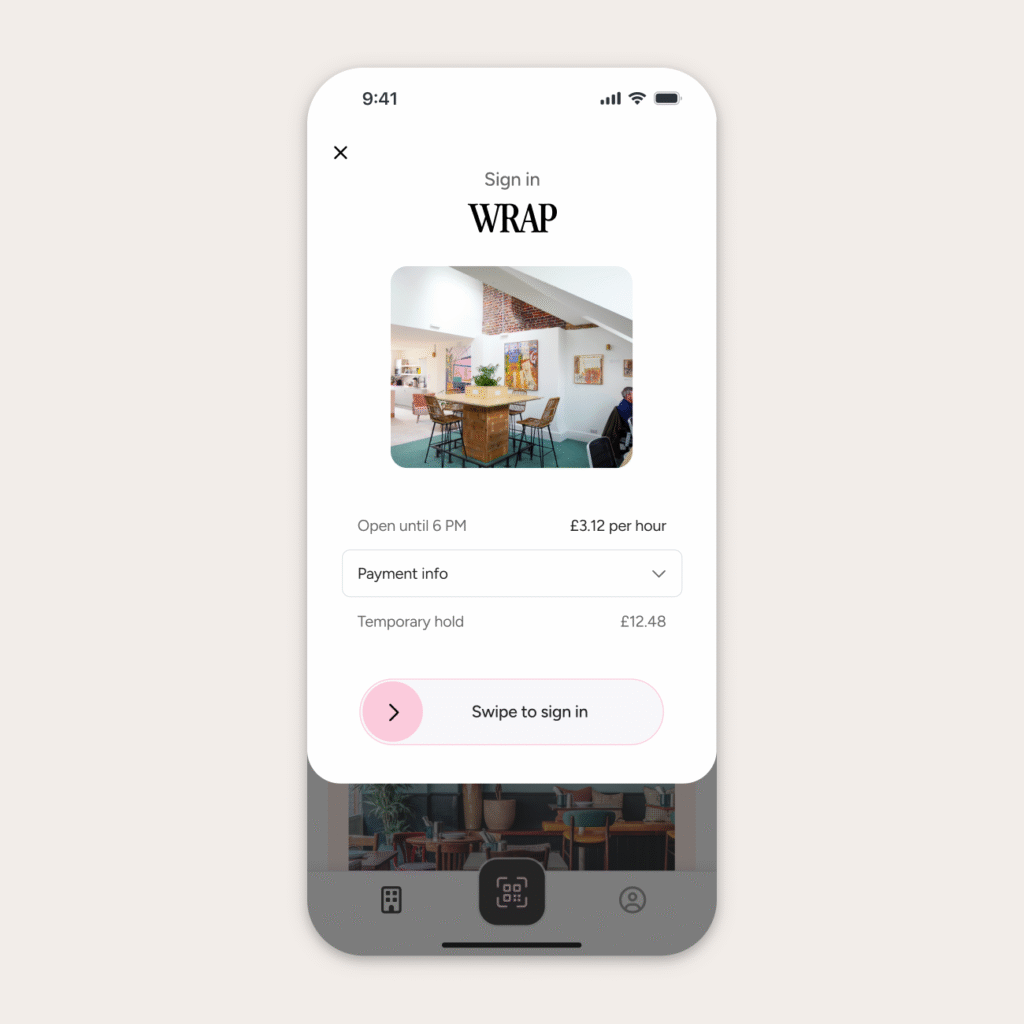
Screenshot from flexible workspace app showing image of co-working lounge, with payment and sign-in details.
Screenshot from the Werksy app, via https://werksy.notion.site/press

Once Werksy users are logged onto the app, entry to co-working space is via QR code.  Scanning in and out means there is no requirement for anyone to check whether app users have overstayed their time, unlike with conventional booking platforms, Foskett says.

Entry gives you access to co-working lounges, rather than to dedicated desk space.

However, lounge quality has improved in recent years, according to Nathan Carpenter, head of central sales at flexible workspace operator NewFlex, which offers Werksy users space in its co-working lounges.

“All of the lounges are fully kitted out with USB ports and plug sockets, you get coffee and you get refreshments and it’s a nice place to work. It makes a big difference for remote workers, who will have spent most of their time in a Costa or Starbucks trying to get signal, if you have a place which is really dedicated for you to work.”

Werksy user Aimen Chouchane, head of marketing for AI-powered video surveillance firm IntelexVision, says Werksy enables him to find reliable places to work in between meetings when he spends a day in London. He prefers this option to coffee shops, where “wifi can be unpredictable. Finding a perfect one can be hard, sometimes they’re too noisy.”

The nature of Chouchane’s work also means that security is important, that no one is looking over his shoulder.

Fashion designer Noemie Jouas, who also acts as an ambassador for Werksy, helping to promote the app, says the flexibility is ideal for workers with a varied schedule:

“The kind of work that I do is really, really different every single week. I might have photo shoots somewhere, or sometimes I have fabric shopping. My job takes me everywhere, Werksy saves a lot of time travelling in London.”

Prices can be a little more expensive than the cost of one coffee. The usual range for an hour in a Werksy space is between two and seven pounds, Foskett says, compared with £2.50 for a flat white in a London Starbucks. But users say the more appealing workspaces and the offer of free refreshments make up for that.

However, Fleura Bardhi, professor of marketing at City St George’s, University of London, told The Sentinel that short-term working risks removing the sense of community that co-working spaces have tried hard to foster:

“Booking for a day is a new development. Because it’s so flexible, it’s ‘why not?’ Then it comes with a damage to the community. A lot of people join so they are part of the community. If you have outsiders in and out for an hour and a day, it’s different.”

Foskett disputes that, pointing out that some Werksy users regularly use the same co-working space, and that a conventional co-working community that requires a monthly payment of several hundred pounds excludes many.

“We’ve got a lot of entrepreneurs, freelancers and people that just either don’t have the money, or don’t have the need to be restricted to one office.”

Public shows strong support for existing transgender access to Hampstead ponds

In a victory for those fighting for transgender rights, a large majority of respondents to a consultation want to keep existing arrangements for access to single-sex ponds on Britain’s beloved Hampstead Heath.

Eighty-six percent of respondents to the consultation carried out by City of London Corporation, the municipal body which operates the Kenwood Ladies’ Pond, Highgate Men’s Pond and Hampstead Mixed Pond, felt that the ponds should remain trans inclusive spaces, allowing trans men and women to use the pond of their choice. The two-month consultation opened in September and its results were published on January 29. It received more than 38,000 responses.

Transgender access has been a hot topic following a Supreme Court ruling in Britain, brought by campaigning group For Women Scotland versus The Scottish Ministers.

The court ruled in April 2025 that the terms “woman” and “sex” in the Equality Act 2010 refer only to a biological woman and to biological sex at birth, a ruling which has led to confusion about transgender access, for instance to single-sex toilets.

A photo of a trans rights rally on a sunny day in London, with protestors marching with signs and flags. Big Ben is visible in the background.
Protesters rally for trans rights following a Supreme Court ruling that only biological women are recognised under Britain’s Equality Act, in London, Britain, April 19, 2025. REUTERS/Chris J Ratcliffe TPX IMAGES OF THE DAY

The ponds are popular with swimmers from Hampstead, an area known for both wealth and non-conformity, and beyond. Eighty-four percent of respondents to the survey had swum at the ponds, and 74 percent lived in London, City of London Corporation said in a press statement.

City of London Corporation also received feedback from pond users through a series of independently-run focus groups. These also showed that retaining current trans-inclusive arrangements received broadest support, the Corporation said in the statement to the press.

City of London Corporation has stated that the consultation findings will be presented to Corporation committees, which will consider them alongside legal duties, equality impact assessments, safeguarding responsibilities and operational considerations.

In addition, it reaffirmed that current admissions rules will remain in place until a final decision is reached regarding future access.

“The volume and tone of responses we received demonstrate very clearly just how much the ponds are valued as calm, safe, welcoming community spaces for all to enjoy,” City of London Corporation Policy Chairman Chris Hayward said in the statement.

“While we’ve been clear that the consultation was not a referendum, carefully reviewing the findings from it will form an important part of our wider decision-making process, which we will communicate clearly to the public in the months ahead. It’s important that we take the time to ensure future access arrangements are fair, lawful, evidence-based and, crucially, respectful to those who use the swimming ponds.”

“We are delighted with the consultation results,” Steph Richards, Chief Executive of TransLucent, which campaigns for transgender rights, told The Sentinel.

“London is a very inclusive city. If anywhere is going to take this view, it’s going to be London. It’s a global city and we are all the richer for it.”

One respondent to the consultation, who declined to be named due to the sensitivity of the issue, told The Sentinel that the results were “really heartening.”

However, consultation respondent Venice Allan told The Sentinel that she was “furious…that the Corporation of the City of London is continuing to welcome men (to the Kenwood Ladies’ Pond) who claim to be women or non-binary..”

“As the Supreme Court ruled last April, women are female and no internal feeling or gender recognition certificate can change that fact.”

Campaigning group Sex Matters, which opposes the current ponds access policy, separately lost a legal bid on January 29 for permission to initiate a judicial review into the existing arrangements.

“The fight for women’s safety, privacy and dignity in single-sex spaces will continue,” Sex Matters CEO Maya Forstater said in a press statement. 

“Just because this particular claim was ruled out on procedural grounds does not give any service provider the green light to allow trans-identifying males into female facilities.”

Apartment service charges go through the roof

Tenants and residents of apartments in England are facing escalating service charges, paid to landlords to maintain their properties and carry out necessary repairs, sources tell The Sentinel.

The unexpected service charge hikes are affecting tenants renting lower-cost social housing as well as those who own their own leasehold properties, and even those living in retirement apartments.

Suzanne Muna, secretary of the Social Housing Action Campaign (SHAC), says it is easier for landlords to extract extra cash from service charges than from rents, which can attract more scrutiny.

Service charges have been rising for a number of years. Britain has been struggling to tame inflation since the Brexit vote, the COVID-19 pandemic and the war in Ukraine, and costs of building materials and labour have risen. Insurance and safety costs have also risen after a deadly fire at Grenfell Tower in west London in 2017. However, service charges are often rising far more quickly than inflation, Muna says.

“It’s not just insurance for which people are being charged hundreds of percentage points in increase every year, it’s all sorts of things — cleaning for example, going up hundreds of percentage points. Well, why?”

Fiona, for example, lives in a one-bedroom shared housing apartment — seen as an affordable way to get on the housing property ladder — in the New Capital Quay development in Greenwich, southeast London. She says her service charge has unexpectedly risen this year, to more than 3,500 pounds. Fiona did not give her last name because of the sensitivity of the issue.

“The services provided are sub-par. One of the lifts in our block has been out of service for two weeks…and weekly cleaning hasn’t been carried out for weeks, despite us paying for this service,” Fiona says.

Fiona pays her service charge to Hyde Housing Association. However, a Hyde spokesperson told The Sentinel that Hyde mainly collected the service charges on behalf of the development’s managing agent, Galliard Homes.

“We’re working with our customers at New Capital Quay to ensure that the managing agent delivers good services that represent value for money,” the spokesperson said, adding that “costs associated with essential lift maintenance and necessary repairs to the building have also led to some increased costs.” 

A Galliard Homes spokesperson said the increased service charges at New Capital Quay were mainly related to an increase in reserve fund contributions “to fund known capital expenditure projects over the next 20 years, as well as to provide for any unanticipated major works.” 

Many apartment owners in England own their properties on a leasehold basis. This means they do not fully own their homes but own it on a long lease, agreed with a freeholder. Freeholders collect a service charge to maintain the apartment buildings, or may appoint a managing agent to manage the property on their behalf. 

Mithuna Maran, who owns a three-bedroomed leasehold apartment in the Waterside development in Watford, north of London, says her service charge has nearly doubled this year, to more than 3,500 pounds. This is despite gaps in the maintenance of the building.

“Essential services are being neglected, serious issues remain unresolved, and large companies are repeatedly failing in their obligations without accountability,” she says.

“If no one challenges this behaviour, they will continue increasing charges without justification — effectively taking money from residents in broad daylight.”

Waterside developers Bellway Homes said it could not comment on service or maintenance charges, as these were managed by PBM Management.

“We can confirm that we remain in dialogue with leaseholder representatives regarding service charges for the development,” Bellway added. 

PBM Management told The Sentinel that the service charge had risen at Waterside “primarily due to new statutory requirements under the Building Safety Act.” 

Freeholders say that inflation has been a major factor in rising service charges, and that errors in the charges are often a result of administrative mistakes, rather than a deliberate attempt to overcharge leaseholders, according to a report published in June 2025 by the housing committee of the London Assembly. 

However, Muna says bad practice is widespread.

“It might be something like — it says that our windows are being cleaned regularly, but they still look really dirty — and then you’ve got the really black and white stuff, like — they are charging us for lift maintenance, but we don’t have a lift in our building.”

SHAC is proposing a system to make it easier for tenants and residents to dispute service charges and is campaigning to get the topic debated in Parliament. 

Muna says the issue of escalating service charges “is not individualised, it’s systemic. It’s happening everywhere, it’s on an industrial scale.” 

Co-working forges ahead in post-pandemic world

At lunchtime on an ordinary autumn Tuesday, co-working space Shoreditch Exchange is buzzing with young office workers. In the heart of one of London’s trendiest quarters, people are playing table tennis, enjoying free coffee from the workplace’s own barista and taking part in the day’s special activity – soap-making.

The COVID pandemic upended the way that we work. Working from home, or cafés, was once the preserve of freelance writers and designers – now hybrid working has become the norm for many office staff.

Co-working, in which freelancers or employees of different firms share office space, and often leisure facilities, existed before the pandemic.  But as big firms increasingly demand their employees back in the office five days a week, where does co-working fit in?

“The world of co-working has completely changed,” David Kaiser, chief executive of Oneder, which operates Shoreditch Exchange, told The Sentinel in an interview.

It’s no longer just about freelancers sharing space, but also about big companies who want to scale the size of their office space up and down more easily, Kaiser said. Companies are renting whole floors in co-working spaces, where lease lengths tend to be shorter than for traditional offices, though this gap is narrowing.

Mandeep Soor, CEO and co-founder of AI start-up Bendi, is enthusiastic about Shoreditch Exchange. “In the year we’ve been here, we’ve grown as a start-up and then shrunk again — and the team has been super flexible,” she said. “We’ve also made a bunch of friends here with other founders at the same stage as us, sharing everything from tips around funding to testing the early versions of our product.”

However, the model remains of co-working spaces providing facilities such as free tea and coffee and social activities such as yoga or running clubs. 

At one point, co-working seemed like it might have been a bubble. Lockdowns and work from home mandates during the COVID-19 pandemic dented the appeal of these short-term office tenancies. Co-working giant WeWork, for example, filed for Chapter 11 bankruptcy protection for its U.S. and Canadian businesses in November 2023. However, it came out of bankruptcy last year.

The global flexible office market is projected to triple from $45.24 billion in 2025 to $136.46 billion by 2032, according to Fortune Business Insights. And Britain is in the forefront of this trend. Co-working was available in 4,315 locations in the UK and Ireland in the third quarter of 2025, making the region “one of the most extensively networked markets in the world”, according to a report from co-working listing service Coworking Cafe.

It’s unusual for people to come into a co-working space every day, Kaiser said, reflecting continued demand from staff for flexible working. Around 1.1 million employees say they left a job in the last year due to a lack of flexible working, according to a report from UK human resources professional body CIPD. This is particularly the case for younger employees, the report said.

However, half of organisations which offer hybrid working have put incentives in place to encourage employees to be at their workplace more often, the CIPD report said.

“Every company has a different approach to mandated office work but the majority of companies want people in the office, for productivity, for the culture, to avoid loneliness,” Kaiser said.

“To get people back to an office, you have to entice them. You need to create these environments that are vibrant and fun and offer experiences they can’t get anywhere else. You also need office wifi, good coffee, good connectivity – you have to get the basics right.”

Doron Meyassed, CEO of holiday home platform Plum Guide, said that his staff were excited to be at Shoreditch Exchange “because of the atmosphere, the welcoming team and the variety of events”.

Fleura Bardhi, professor of marketing at City St George’s, University of London, said demand for co-working reflected “how  much consumption is embedded in work”.

“Your lifestyle is blended with work. For young generations, it’s very important to be in workplaces that fit their consumer identity,” she told The Sentinel, adding that some co-working spaces allow pets and storage, “it’s an extension of their living spaces”.

However, Kaiser said it was not just young people who use co-working space: “We have a variety of ages in our buildings, a variety of sectors, from tech to law firms to financial services.”

Two-year-old Oneder already operates four co-working spaces in London, with two more to open in 2026.

Bardhi said traditional offices should take lessons from co-working on how to attract employees, “it made work meaningful, so that’s why people stayed.” But Bardhi also said there was a risk in making your office more fun: “If everything is work, your hobby is work, there are no boundaries.” 

Bardhi said that for some people, it gets to the point where they say “I’m burnt out of having fun. I don’t want to see anybody, I don’t want to play any more.”

But for Kaiser, fun is part of the appeal, as co-working offers a space “people want to come to, not have to go to”.

Young refugees in Britain find joy in theatre

On a warm evening earlier this year, actors from Britain’s acclaimed National Youth Theatre joined forces with young refugees to present a new play, “The Flip Side”, in a small theatre on a busy North London road. The play showed both the weekend partying and the miserable weekday existence of young students and low-paid workers trying to get by in Britain today.

The performance was a rare chance to give voice to young refugees in Britain, who are at risk of becoming increasingly marginalised as political parties of left and right speak out against immigration. As The Flip Side was being performed, protests took place outside a hotel accommodating immigrants in Epping, east of London. Several similar protests took place in subsequent weeks, and the ruling Labour government is tightening immigration rules.

Overcoming this hostile climate, the refugee actors – members of arts charity Compass Collective –  find joy in performing.

The Flip Side actor Shanzay Dilshad, 24, originally from Pakistan, had never acted before joining Compass in 2022.

“That was the first time where I felt like this is something I definitely want to do. I want to share the stage, I want to be on the stage,” Dilshad told Yuvoice in an interview.

Dilshad said she has performed her own poetry on stage and had even overcome stage phobia to do so, and that Compass gave her “a feeling of home”.

Compass Collective was formed in 2018, becoming a registered charity in 2021. “Our ultimate vision is that young people seeking sanctuary in the UK are welcomed, and that they are able to access provision and meaningful progression, in order to live fulfilling lives”, the Compass executive director Dorothy Hoskins told Yuvoice. Compass trustees include Harry Potter actor Toby Jones.

In addition to drama, music, film and writing programmes, which Hoskins said help build confidence and communication skills, Compass also provides online English classes for young refugees and asylum seekers aged from 14-26. It also has a professional development programme from which Dilshad, co-chair of Compass’s Youth Board, has benefited. Future Compass plans include a project at prestigious London drama school Guildhall.

When young refugees were facing protests outside their hotels on one particularly febrile day this summer, Compass offered online access to games and a safe space.

Dilshad said The Flip Side showed young people’s struggle. “People have that kind of stereotype about young people, their weekend life that they get to live instead of their actual life. Like ‘I’ve been doing this waitress job, but I hate it’.”

Frank Mukisa Nsubuga, fellow The Flip Side actor and co-Youth Board chair of Compass, first got involved with the group in 2019. Mukisa Nsubuga, 27, originally from Uganda, enjoyed online sessions with Compass during the pandemic:

“It used to help me a lot. It was like my therapy,” he told Yuvoice, adding that, coming into a Compass session, “you know that there are people who care”.

Through Compass, Mukisa Nsubuga discovered a love of improvisation. The Flip Side, written by Shireen Mula, built up much of its script from the daily lived experience of its actors. Mukisa Nsubuga’s life story showed that he was burning the candle at both ends, studying and working, with little time to sleep.

“You are kind of having a conversation about your life,” he said. “I didn’t know I have a long day…for the first time I realised I really have no time.” Mukisa Nsubuga said he would like to change the frantic way he lives, “but right now, I can’t”.