The case of Thiago Feijão: injustice and the myth of Brazilian racial democracy

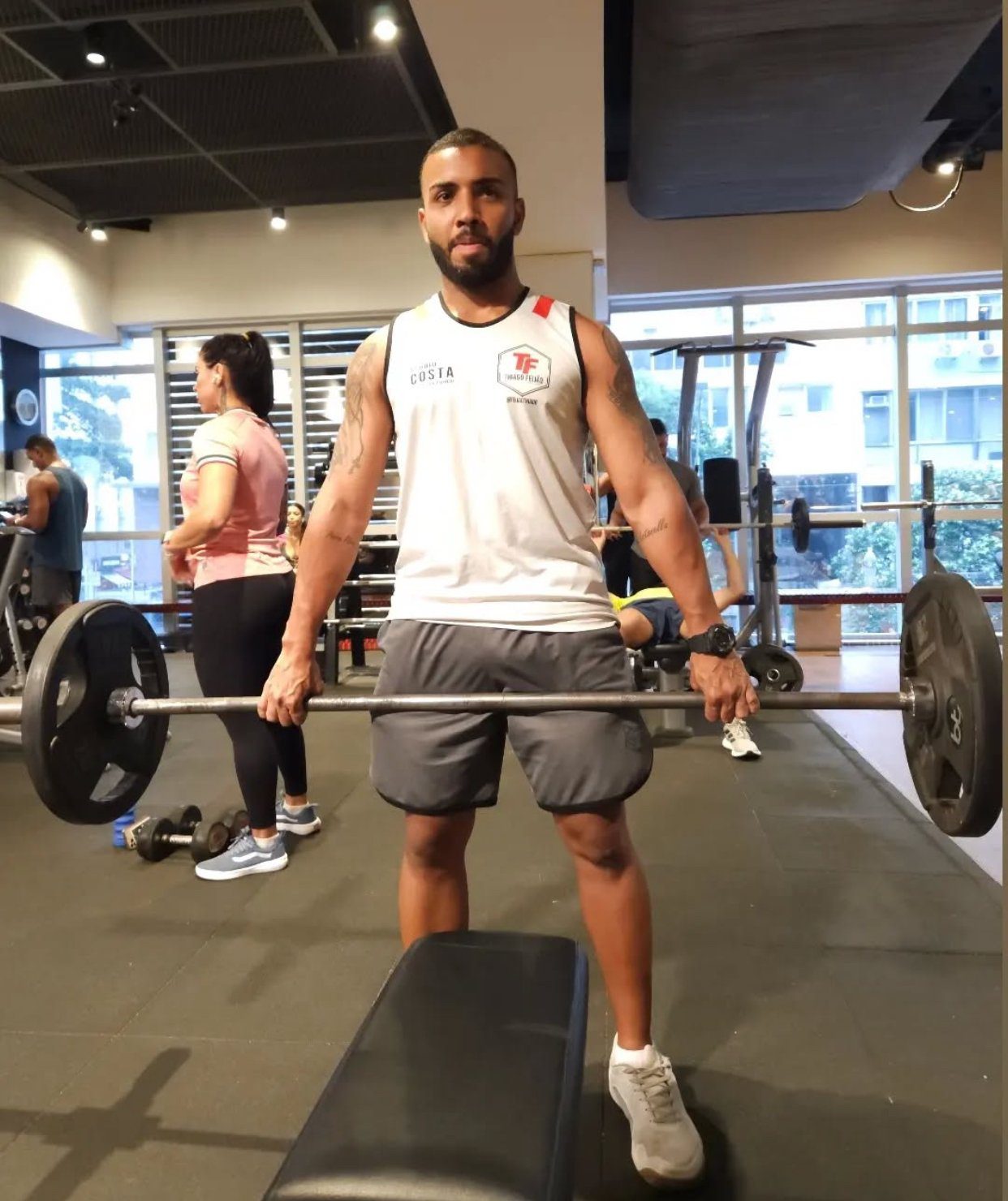
In 2025, the physical education teacher Thiago Feijão, 32, faces Brazilian justice for the second time, accused of robbery and murder. The worst part of this history? There’s a good chance that he’s innocent.

Convicted in 2015 through a photo lineup, he presents evidence and testimonies in support of his innocence. The case is marked by contradictions and racial bias, which generated national repercussions and reignited debates about discrimination in the judicial system and the narrative of racial democracy in Brazil.


A Black man, Thiago was accused based on a photograph identified by only one witness, who at another moment had described him as a white man. He was sentenced to 28 years in prison for robbery followed by homicide and armed criminal association.


According to the prosecution, Thiago allegedly took part in two robberies, including a felony murder, on May 29 and 30, 2015, along with three other men.


However, he presented witnesses and evidence proving it was impossible for him to have been at the crime scenes.

  • May 29, 2015: Thiago was working at a warehouse managed by his family. The ice supplier, Édson Santos, confirmed having spoken with him minutes before closing his shop, making it impossible for him to reach the crime scene in time.
  • May 30, 2015: Feijão said he was picking up his daughter and getting ready to watch a UFC championship at home. His wife, Sharon, presented phone records, cell tower location data, and a statement from his daughter’s school principal as proof.

Thiago’s identification was based solely on a photograph. Although the initial witness had described the suspects as three Black men and one white man, Thiago, being Black, was still charged as the “white suspect.”


He was imprisoned for two months until he obtained habeas corpus. With a new arrest warrant issued in 2024, Feijão decided to go into hiding, a situation he remains in to this day. 

The case returned to national attention in 2025, when two new witnesses securely identified another man as responsible for the crimes for which Thiago had been convicted.

In an interview with Yuvoice, Thiago’s lawyer, Rodolfo Xavier, stated:


“For me, the moment that stood out was during the hearing in the early evidence-gathering procedure, when it became clear that the photo attributed to Thiago Feijão was in fact of another person.”

The physical resemblance between the two men had led the initial witness to make a mistake.


“It was Ruan, already deceased. The ones who recognized Ruan in the photograph were his widow and also his former sister-in-law. Both testified in court and confirmed the recognition,” he added.

The criminal appeal presented by the defense was rejected, leading the lawyers to file a habeas corpus with the Superior Court of Justice (STJ) in an attempt to overturn the decision.


The request was denied on the grounds that legal criteria had not been met and that the appeal overlapped with the trial of the main case, still pending.

The case proceeds slowly, and Thiago’s defense team now awaits approval of the request for annulment of the photo lineup and, secondarily, acquittal for lack of evidence.

Family holds protest in Rio de Janeiro, Brazil, and calls for justice in the trial of Thiago Feijão – Photo credit: SBT

The myth of racial democracy

Thiago Feijão’s case sparks outrage and opens discussions on how structural racism operates intrinsically within Brazil’s judicial system. 

A misidentification can cost years of freedom and inflict enormous suffering on families, highlighting the unequal weight of justice for Black and white people.

Since its early history, Brazil has often been portrayed as a naturally egalitarian country due to miscegenation.
This discourse, cemented as common sense, denies the racism revealed in research and daily life for Black Brazilians, also affecting their self-identification.

Sociologist Gilberto Freyre, in ‘The Masters and the Slaves’ (‘Casa-Grande & Senzala’, 1933), reinforced the idea that miscegenation favored national development and would create a “cordial” nation, ignoring that relations between masters and the enslaved often involved coercion, abuse, and violence.

From this perspective emerged the narrative that Brazil was a country without racial division, where everyone was equal, even before the law. This belief became widely disseminated and deeply ingrained, serving as a way to deny data that demonstrate unequal treatment based on skin color.

João Miguel Goes, 18, shared with Yuvoice his experience as a young Black man in Rio de Janeiro:


“[…] Because if it really were about safety, safety for your own life, you’d have to stay at home, you’d have to deprive yourself of living. So, to keep on living, you live in fear, in tension. At any moment something could happen to you, they could accuse you of something you didn’t do, but since you’re the one with dark skin, curly hair… then the blame falls on you.”

According to a 2023 study by the ‘Rede de Observatórios da Segurança’, 90% of people killed by police that year were Black. This shows that police violence is not distributed equitably, but disproportionately targets the Black population.


Figures like this make clear the need to reject false ideas such as the myth of Brazilian racial democracy. In practice, stories like Thiago Feijão’s show that this idea is an illusion. 

It is not about individual mistakes but about a structural pattern in which Black people are more readily positioned as suspects. 

The scales of Justice are not balanced for all, and structural racism continues to shape experiences, opportunities, and identities in Brazil.

The New Nomad Generation: In Search of Freedom and Adventure on the Road

For many, the concept of home is no longer limited to a fixed address. Today, a new wave of travelers, the nomads, are trading the security of conventional life for the road, the sea, and the unexpected. They are proof that it’s possible to build a meaningful life on the move, with technology serving as their anchor and the pursuit of freedom as their true destination.

The philosophy of life on the road is nothing new. In Jack Kerouac’s 1957 novel “On the Road”, the American author celebrates the itinerant life as the ultimate search for freedom. 

He argued that adventure and spontaneity were more valuable than comfort and security, writing: “Better to sleep in an uncomfortable bed free, than sleep in a comfortable bed unfree.” 

Today, this same philosophy echoes in a more connected world. If, in the past, a nomadic life was synonymous with uncertainty, technology has transformed the journey by making it much more viable and practical.

Brazilian Nomads

The stories of new nomads are unique, but technology is a common thread that connects them.

One example is Aline Sena, a 54-year-old Brazilian communicator and digital influencer. In 2017, she traded a 400-square-meter house for a sailboat of just 27 feet (about 8 meters), where she began to live with her then-husband.

Aline, who already worked with video production, adapted her profession to the new setting.

Her main source of income became a YouTube documentary project, #SAL, about people who live on the sea. It became one of the largest channels in that niche.

The change brought challenges, such as the lack of space and a new notion of comfort. For Aline, living on the boat meant adapting to elements that were previously controllable.

“I had to give up physical comfort as I knew it. If it starts to rain in an apartment, I just close the window, but on the boat water can get in in many ways,” she explains. The instability of the sea can even make it difficult to work on the computer.

Despite the difficulties, the rewards outweigh the sacrifices. The simplicity and freedom of the nomadic lifestyle brought a new meaning to her relationships.

For Aline, the biggest change was the connection with nature. “Living on a boat for four years changed my perception, my way of being in the world. Looking at that immensity on the horizon, seeing the movement of the water… we are nature and often forget that.”

Today, Aline continues to live a nomadic life, but she has adapted her career to the new times: she works with remote digital consulting, helping people and companies develop online projects and communication strategies.

@nomadeali, as she is known on social media, combines her experience in content production with the knowledge acquired while living around the world, showing that it’s possible to unite freedom, technology, and profession anywhere.

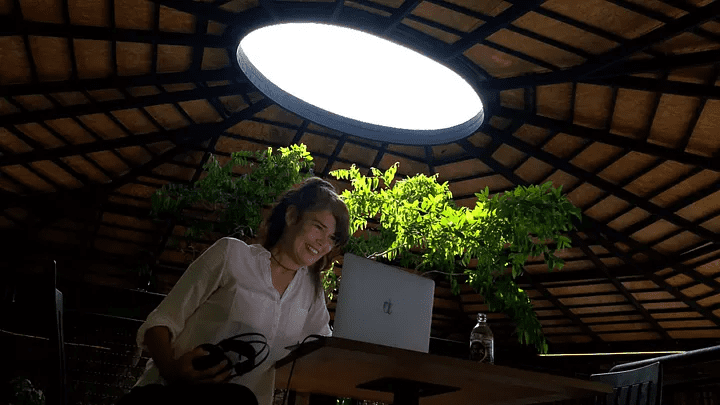
Aline working remotely. (Courtesy of Instagram @nomade_ali)

Another inspiring story is that of Larissa Silva, a young woman from the state of Goiás, Brazil. 

After moving to Ilhabela (an island on the coast of São Paulo, another Brazilian state) for a job that didn’t work out, she found herself lost but with a strong desire to travel.

Larissa found a solution through the Worldpackers app, which connects travelers to volunteer opportunities in hostels in exchange for accommodation and food.

Larissa began to do volunteer work, supplementing her income with small jobs at kiosks and selling polaroid photos on the beach, which allowed her to continue her journey. For her, the big lesson is the “freedom to choose.”

This freedom is not just geographical, but also the ability to adapt her routine and be more authentic, without being stuck in an office or fixed location.

“The fact that I can stay in places longer, not just for a week’s vacation, brings other perceptions. I learned to appreciate a beautiful sunny day, but also a rainy day, a cold day, because I’m not in a hurry. I can see the beauty in everything because I’m on my own time.”

Nomear o documento com com o nome da historia

Larissa in Rio de Janeiro. (Courtesy of Instagram @nerdistraida)

Technology and Connection on the Road

Modern nomadic life is driven by technology. With laptops and smartphones, travelers can work remotely, plan itineraries, and keep in touch with family and friends. 

The internet also allows them to connect with each other, creating supportive communities and sharing tips and stories.

These communities flourish on social networks like Facebook and Instagram. There are hundreds of YouTube channels about nomadic life, covering everything from trailer trips to backpacking and volunteering.

 These seemingly simple contents create a strong sense of belonging and support. One example is the Worldpackers Community on Facebook, created so that travelers and hosts can exchange information, tips, and experiences about volunteer projects.

The group’s description is clear about its purpose: “We are here to give support and help in this rich exchange between you.” For many travelers, the group becomes a starting point or a safe harbor during their journey. It’s a space where they can seek advice, share challenges, and celebrate victories, finding a support network that understands the lifestyle they have chosen.

In addition to social media, apps like the aforementioned Worldpackers, Couchsurfing (which connects travelers to locals willing to offer a place to sleep for free), and Airbnb (for short-term rentals) make it easier to find affordable accommodation and connect with local people.

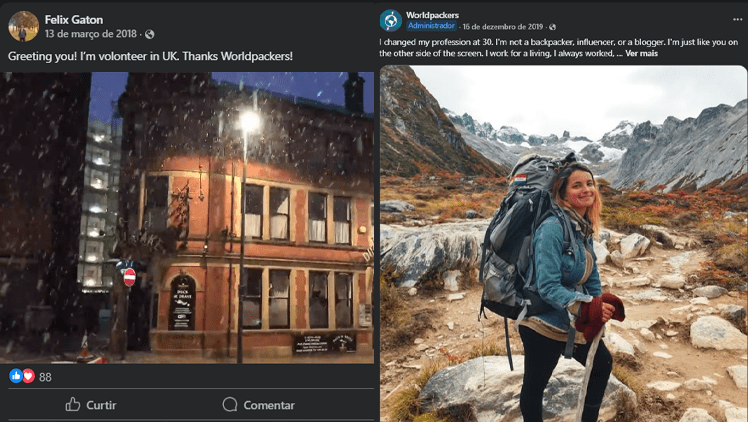
Reports in the Worldpackers group. (Screenshot/Facebook)

Simplicity and Notes on Detachment

Nomadism requires a re-evaluation of what is truly important. For many travelers, the search is for a simpler life aligned with their values. Therefore, the stories of nomads are also stories of detachment, where material possessions lose value in favor of experiences and freedom.

Aline Sena, for example, tells of the difficulty she had in selling her car: “It took me a long time to sell my car when I was on the boat. I didn’t need it anymore, but I had a hard time imagining myself without a car, because my worth was tied to that object. Then I realized there was no problem selling it, since I could take a bus or rent a car when I needed to.”

The ownership of the car, a symbol of status and stability for many, was a mental obstacle to true freedom.

The story of Jesse Koz, who sold everything he had to travel, also reinforces this idea.

He summarized his decision in his book: “Deep down, despite the material achievements, I wasn’t happy. […] In two weeks, I had detached myself from everything I had acquired in seven years. All I had left was Shurastey, the Beetle, and a few changes of clothes. It was more than enough.”

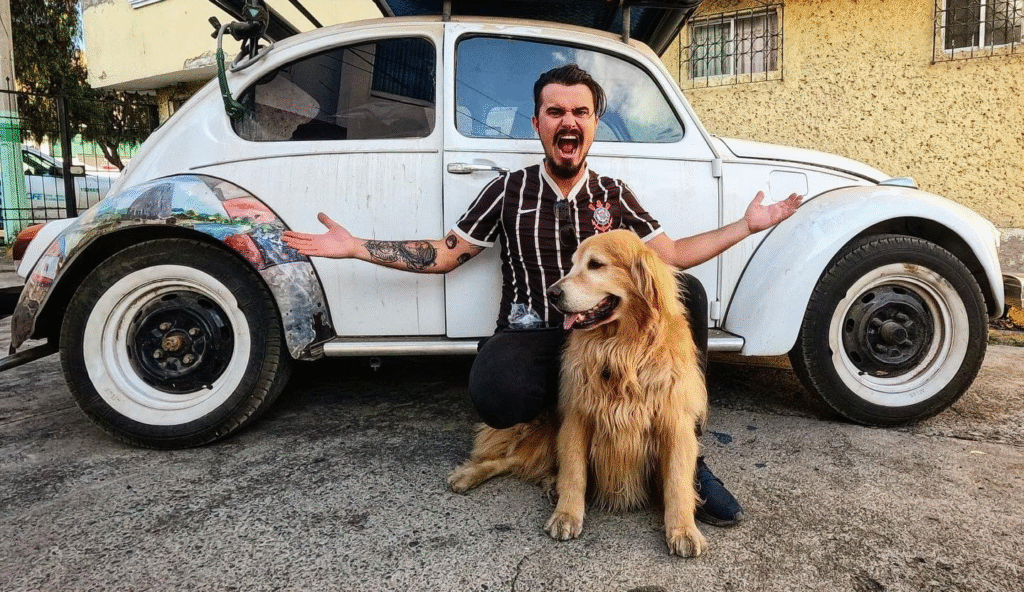
Jesse traveled the Americas alongside his Volkswagen Beetle, Dodongo, and his dog, Shurastey, becoming a symbol of freedom and simplicity for thousands of people who followed his journey through his Instagram and YouTube channel.

Unfortunately, his journey was cut short in 2022 when he and the dog died in a car accident in the United States. Still, his story continues to inspire travelers.

Jesse Koz and Shurastey (from Instagram @jessekoz)

The Parallel with the Global Housing Price Bubble

The rise of the digital nomadic lifestyle coincides with a global phenomenon: the accelerated inflation of property and rental prices. For the new generation, buying their own home or paying exorbitant rents can seem like a distant and financially unsustainable dream. In this scenario, nomadism emerges as an attractive alternative.

 Instead of allocating most of their income to a fixed address, people use that money to travel, often to places with a lower cost of living. In Brazil, this reality is clearly manifested.

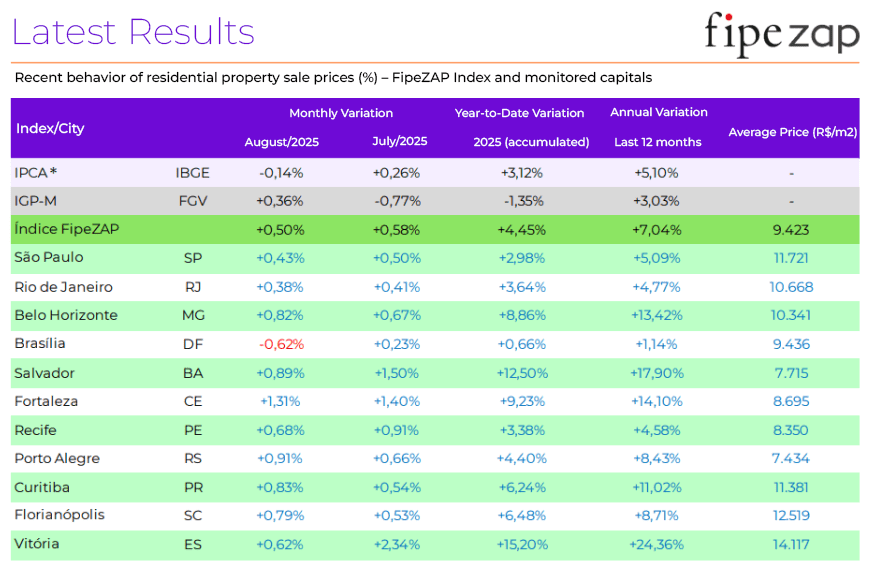
 Data from the FipeZAP Index show that the appreciation of residential properties has exceeded official inflation in the last 12 months: the index accumulated a high of 7.04%, while inflation was 5.10%. 

This trend is especially visible in the country’s largest cities, including capitals that concentrate important economic and cultural activities. 

The average price per square meter in Brazilian cities with a high cost of living, such as Florianópolis (12,519 reais per square meter), São Paulo (11,721 reais per square meter), and Curitiba (11,381 reais per square meter), highlights the challenge of maintaining a fixed residence.

For the new nomadic generation, security is no longer tied to having a fixed address, but rather to the flexibility and adaptability that life on the road offers.

The phenomenon, therefore, is both a quest for personal freedom and a reaction to the economic pressures of a real estate market that no longer meets their needs.

Source: FipeZAP Index, IBGE and FGV/IBRE

And for whom is nomadism?

The nomadic life is an incredible adventure, but it requires certain sacrifices and is certainly not for everyone. Giving up the stability and comfort of conventional life requires a good dose of planning and willingness.

For Larissa, what really matters is the will: “It’s not about being a certain age or having a certain thing. Of course, some characteristics make it easier, like not having children and being able to work remotely. But, in the end, it’s about how much your desire aligns with your willingness to let go.”

Aline Sena adds that this life is easier for those who have autonomy and don’t feel tied to one place by social or professional bonds. “If the person doesn’t have so much need for ties and commitments to just one place, it’s easier. If your life is full of strings, it’s difficult to reconcile.”

She also reinforces that the possibility of working online greatly facilitates the journey, as it eliminates the daily worry about subsistence.

Despite the demands, the nomadic community is incredibly diverse. It includes solo travelers, couples, entire families, recent graduates, professionals seeking new opportunities, and retirees.

The important thing, according to them, is to be prepared for changes and challenges and, above all, to forge your own path, without basing it only on the experience of others.

For those thinking of becoming a nomad, Larissa has one last piece of advice: “Planning is essential. I did some things without planning, and they were much harder. Routine is important; having a plan for things is too. I ran away from routine for a long time, but today I see that it’s important. The difference is that I can change my routine at any time.”

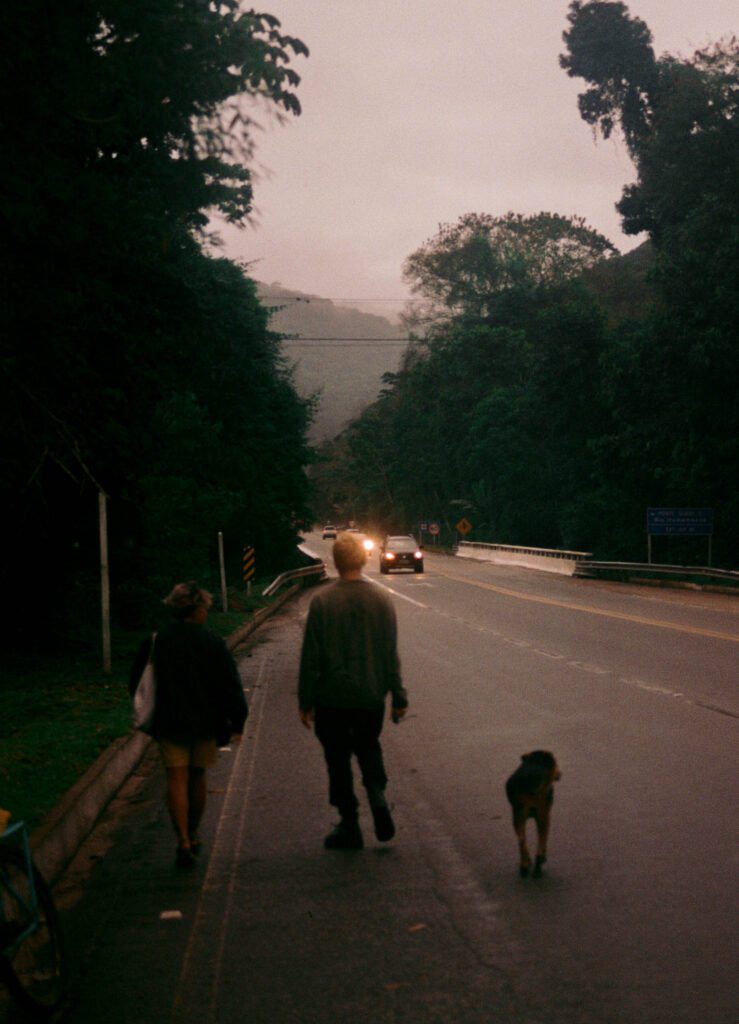
Two travelers and a dog on the side of the road in Ubatuba, 2021. (Photo: Eduardo Álvares)

UNESCO honors Rio de Janeiro as World Book Capital

Rio de Janeiro, Brazil, was designated UNESCO’s World Book Capital for 2025. It is the first Portuguese-speaking city to receive this prestigious title.

This choice is not only symbolic. Besides recognizing the cultural potential of Brazil, it also seeks to reposition the reading as a space of leisure, community, and dialogue. 

As the World Book Capital, Rio de Janeiro will host numerous events. Including book fairs and literary festivals, to foster cultural exchange and encourage access to knowledge.

The Brazilian city is therefore focusing on ways to encourage reading beyond book sales. One example of this is the ‘Rio’s 2025 Book Biennial’, featuring soirées, lectures and immersive activities.

Why was Rio de Janeiro chosen?

  • Commitment to reading: the city demonstrated a strong commitment to promoting literacy and making books accessible to all citizens. 
  • Rich literary heritage: Rio boasts famous writers like Machado de Assis and Clarice Lispector, contributing to its literary significance. 
  • Cultural hub: the city has a vibrant cultural scene, including renowned libraries like the Portuguese Royal Reading Room and the National Library Foundation. 

On September 16, the event Esquenta Jabuti took place in celebration of the title of World Book Capital. 

Writer and event moderator Henrique Rodrigues shared with Yuvoice his thoughts on the importance of this recognition, reaffirming how this title, granted by UNESCO, is significant for the city because it highlights the broader culture of Rio de Janeiro. 

At the same time, it is also relevant as a possibility for the creation of more effective public policies.

“It is necessary to have more everyday yeah activities, those small-scale initiatives that, over time, make a real difference in shaping readers.”

Rodrigues argues that sporadic events are mainly aimed at selling books and stimulating the market, but that once the buzz fades, the incentive for reading is lost.

“It’s as if books and reading were only talked about when there’s an event, when it should be the other way around. […] The event needs to be the culmination of something that happens all the time. That’s why I believe this title for the city can open the door to more regular programming that truly makes a difference in Rio’s schools and communities,” he stated.

The World Book Capital program

The initiative by UNESCO aims to recognize cities that champion reading and books. 

Each year since 2001, from April 23rd (World Book Day), the chosen city undertakes a year-long program of activities to encourage literacy and cultural exchange. 

Cities like Strasbourg (France, 2024), Accra (Ghana, 2023) and Guadalajara (México, 2022) have also held this title.

Does literature still foster social connection in the digital age?

It turns out that, in Brazil, more than half the population does not read frequently. According to the survey ‘Portraits of Reading’ (2024), around 53% of the people in the country haven’t read any kind of book – digital or printed – of any genre in the three months prior to the survey.

The numbers are alarming, since the total number of non-readers has surpassed the number of readers. Facing this scenario, a question remains: what has been done to stimulate the habit of reading?

Despite the statistics, young people and adults found time to read in their busy routines. Even if surrounded by countless stimuli from social media, literature fulfills its role not only of study or entertainment, but also of socialization in the lives of individuals. 

The urban scene, marked by people with smartphones in hand, might suggest that books are being left aside. But would that be the absolute truth or just a collective impression? 

This perception is not entirely confirmed: in-person and digital initiatives show that reading still takes a relevant place in the life of a portion of the population.

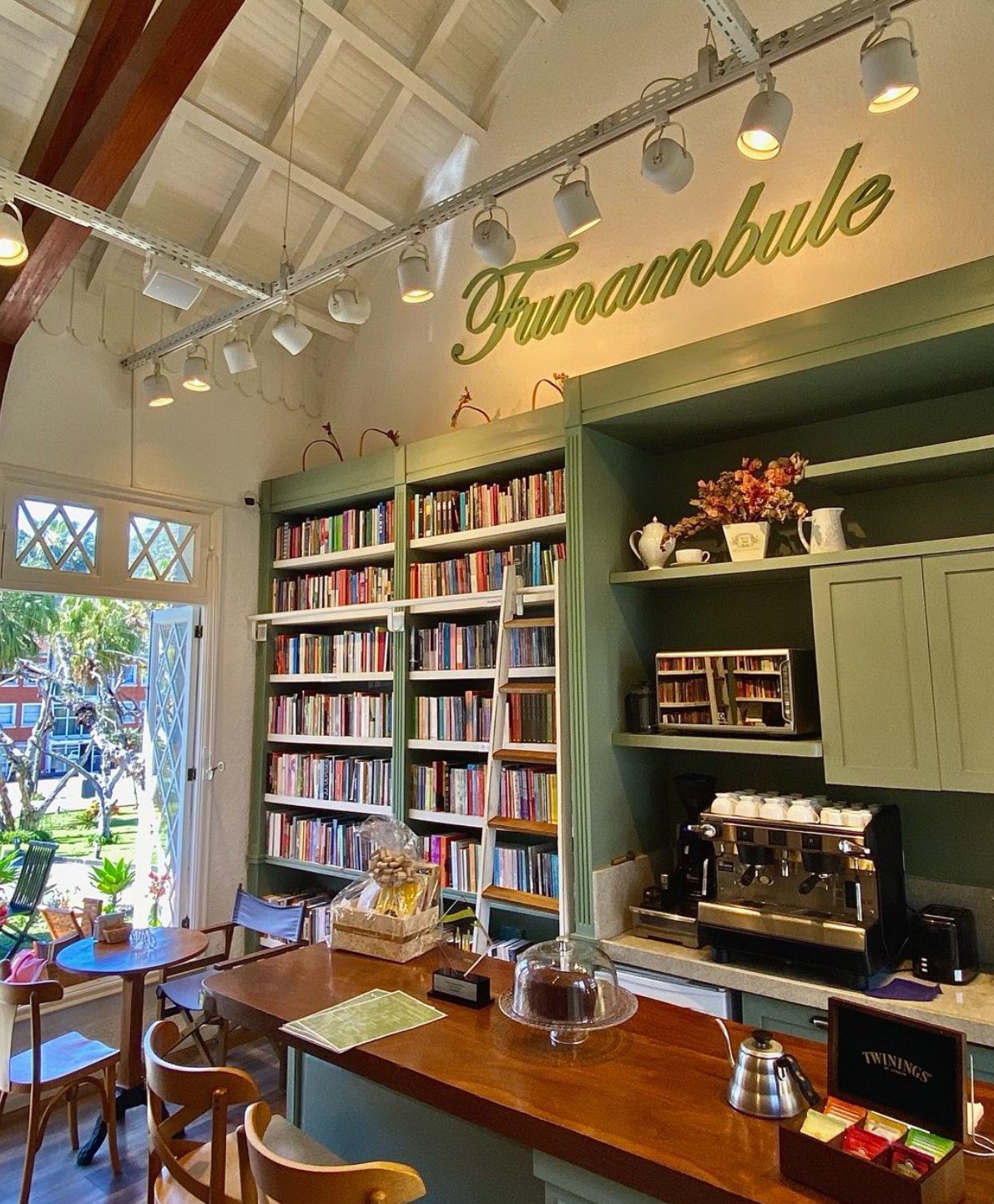
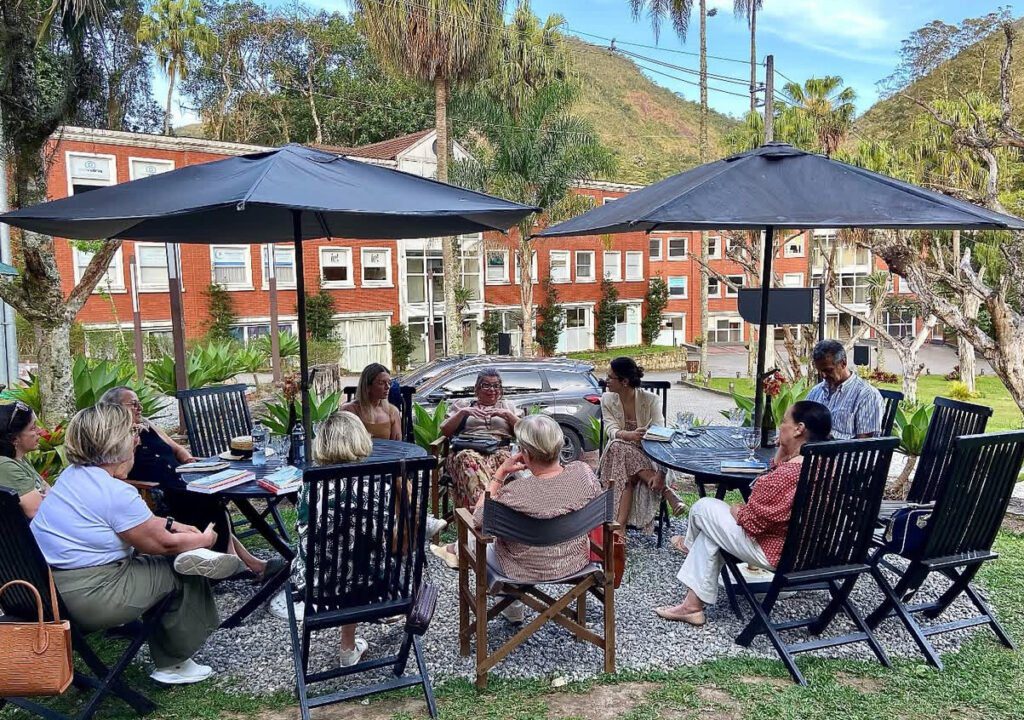
Group of readers at the Funambule Library – Photo by @livraria_funambule via Instagram.

In the Highland Region of Rio de Janeiro, a small library became a space and symbol of literary interaction.

Between shelves, cakes and coffee, the ‘Funambule Petrópolis’ established itself as a meeting spot to avid readers of the city. Through monthly meetings, diversified groups of children and adults come together to discuss their chosen reading. 

In an exclusive interview with Yuvoice, Hebert Rodrigo, Funambule’s founder, shared his vision of the importance of spaces that encourage this habit.

“Many people who come here to the bookstore have just moved, and they’ve found here, among the books and reading groups, an excuse to meet new people and build new relationships. […] It’s inspiring to see how members connect beyond literature, creating bonds.”

Reading continues to play its timeless role of opening the door to visit new worlds. It combines entertainment with reflection on the reality of our daily lives, awakening creativity, hope, and curiosity.

And in practice, its effects go beyond the individual sphere. Socialization through literature is not merely a byproduct.

In the point of view of Hebert, those places open space to people to explore things they haven’t done before, encouraging them to take risks. 

It is a third space of freedom where they can express themselves without commitment, spontaneously. Something you don’t normally find in the other two pillars of life, which are family and work.

When discussing books in groups, people not only share their interpretations, but also practice empathy, listening, and building ties of belonging.

To Hebert, reading made with the objective of sharing carries a different meaning than individual reading.

“You think more about your reading, develop your ideas further before sharing. It’s an enriching experience”.

This creates a space that encourages not only reading, but also critical thinking, discussion, and respectful exchange.

Reading and the Internet 

Nowadays, more environments that encourage the habit of reading are needed. In this sense, the internet is not the enemy.

Social media also plays a fundamental role in this process. Platforms like TikTok, Twitch, Reddit, and YouTube have become virtual meeting places where readers, especially younger ones, share ideas, create connections, and participate in live streams to collectively comment on works.

One example is the digital book club created by Brazilian influencer Maria Clara Quirino [@readingwithma] on Instagram, WhatsApp, and Meet. 

The group brings together more than 400 participants in monthly virtual meetings, with collective readings conducted via video calls and subsequent discussions, which seek to comment and discuss the main ideas read.

It is clear that literature in Brazil still lacks the incentive to strengthen its cultural power. Despite this, reading still finds ways to reestablish itself in a predominantly digital age. 

Therefore, in-person or digital projects are fundamental tools to expand access to books and reverse the worrying situation revealed by the research.

Mate Gelado Vendors: A Living Heritage of Rio’s Beaches

Amidst the white sands of beaches of the famous city of Rio de Janeiro (Brazil), the soothing sound of the waves is broken by sellers advertising the product that became part of the city’s cultural Carioca heritage in 2012, or rather, it is the vendors themselves who represent this wealth. Carioca is the term for people born in the city of Rio de Janeiro, and they love enjoying cold mate at beach, an old habit completely dependent on traditional sellers, truly beach long walkers. 

A cold drink is  perfect at beach , since in Rio de Janeiro  the climate is predominantly hot, with temperatures that almost always approach 30°C, but in the summer, they easily exceed 40°C. The beach is frequented by residents and tourists as it is an inexpensive , since it´s completely free. 

The landscape is filled with a constant stream of vendors selling a variety of products, from swimwear and sunscreen to food and drinks. Among them, one stands out so much that its vendors have been recognized by the municipality as Cultural Heritage of the city of Rio de Janeiro.

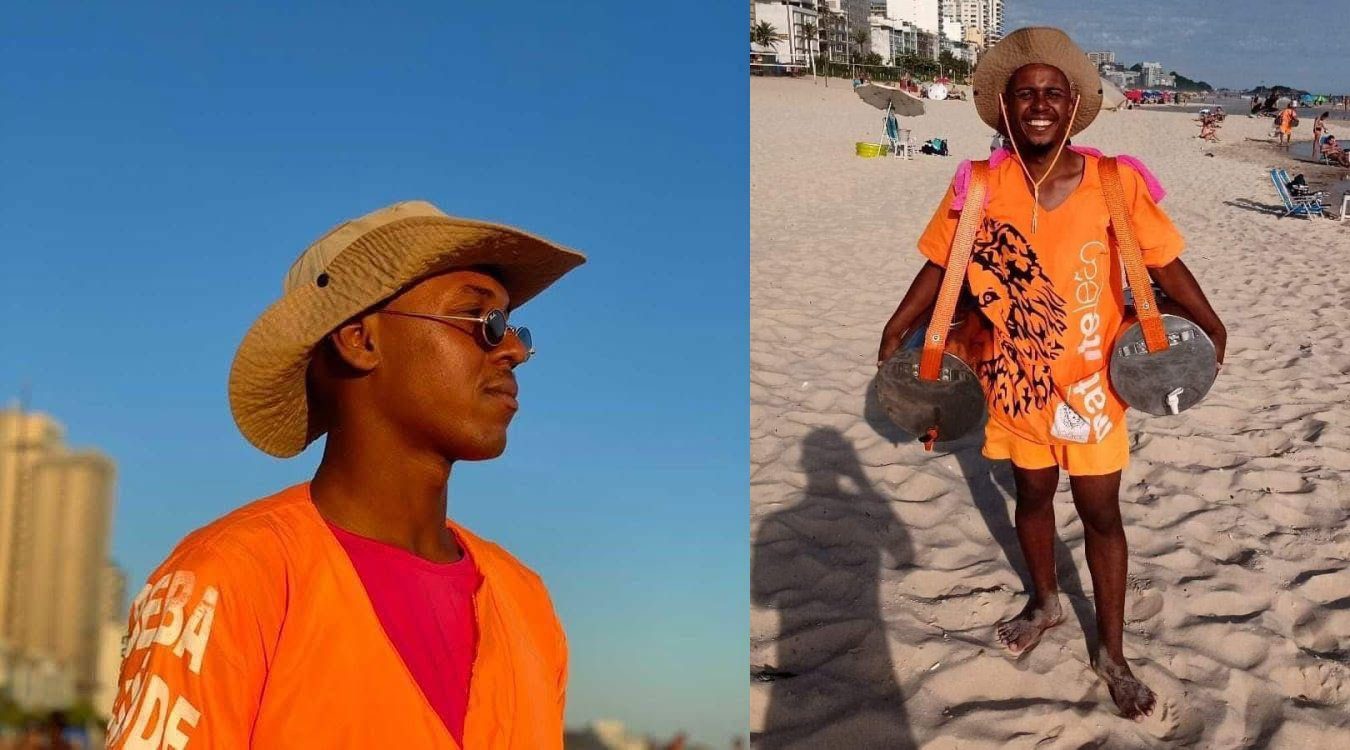
Wearing bright orange clothing, men and women walk for miles along the seafront of Brazil’s most famous city.

As they walk, they use their voices to announce their presence. On their shoulders, straps support shiny steel barrels. Inside the containers are liters of a refreshing drink that beachgoers have decided to associate with their stroll: mate.

Yerba mate

Originating far away from the well-known scenery of Copacabana and other beaches, an American plant gives rise to the drink. The indigenous people who inhabited what is now Brazil before the arrival of the Portuguese colonizers already drank tea made from the leaves of the “yerba mate” plant.

After industrial processing, the chopped leaves are packaged in a pumpkin-colored box, which cariocas easily associate with a certain brand. Just put the leaves in hot water, and in minutes, you get a dark and delicious infusion. After adding sugar (or not!), just drink it, preferably very cold.

The mateiros

The famous beaches of the Marvelous City drive an important economic engine. Families depend on the capital that is raised there. Beach vendors licensed by the municipalities sell food, drinks, coconut water, and rent beach chairs and tents. Beachgoers, in turn, benefit from these services.

The day has not yet dawned, and fans cool giant pots of mate, which have been resting since the herb was boiled at 11 p.m. the night before. It is three in the morning in distant Anchieta, 40 km from Leblon beach.

Gabriel Lourenço , a 28-year-old bachelor, is getting ready for his seventh day of work in a seven-day week. It is a sunny Sunday, and he expects to earn as much in two days over the weekend as he needs to work for twenty days in a month as an operational assistant in a factory.

All to contribute to the household budget and pay for what he calls a luxury: “eating at the mall once a month.” Gabriel defines himself as a “homebody.” The son of a single mother, has two brothers, as his sister has passed away. Part of the money he earns from selling mate on the beach will be given  to his mother.

While many beachgoers are still asleep, a car with his coworkers heads toward the beach under the scorching sun of Rio de Janeiro. Each of them carries the “mother mixture” which, after being diluted with ice water, will fill the barrels. There will be several trips back and forth on the sand, carrying two barrels, weighing a total of approximately 40 kg, from 10 a.m. to 5 p.m.

It has been like this for three years, says the former bricklayer’s assistant, who has also worked at McDonald’s. “I like selling,” he adds, feeling better rewarded financially with informal work than with a “formal job.”

“I used to wear the classic pumpkin-colored uniform, but today I work for ‘Bigode’s mate,’ who wears different clothes,” explains Gabriel.

Customers call him by raising their arms or through a WhatsApp group that brings them together and informs them which vendors are nearby.

From a tap attached to a barrel, like the ones we have in our gardens at home, a dark, cold, sugar-free liquid pours out. Or as Gabriel says: “It will be sweetened with lemon,” he says, if that makes any sense.

Mixing it with fruit juices is a hit: lemon, passion fruit, and, more recently, alcoholic beverages. It is mate, heritage, and tradition being reinvented right there on the beach, in the sand. We can´t imagine the next creation for this 2026 summer. 

Young Voices Rising: Education as a Weapon Against Climate Change

In Rio de Janeiro, public school students are leading the fight against the climate crisis.

Between 2020 and 2024, the initiative EVA Brasil brought environmental education into public and rural classrooms across the state-and its impact is already reaching local policymakers.

Less than a year after EVA’s pioneering work concluded, Brazil has become a focal point in discussions on sustainability in schools. In 2025, climate change, biodiversity protection, and disaster prevention were added to Brazil’s basic education curriculum, marking a major step in environmental education.

The initiative aims to involve all schools in the country in projects centered on environmental justice, encouraging young people to participate and learn from one another throughout this journey.

With a new school year underway, EVA’s legacy offers lessons on how youth-led education projects can shape policy. 

In 2024, EVA’s work reached the City Council of Petrópolis (Rio de Janeiro, Brazil). Through the project, students collectively created thematic committees and drafted proposals for the city’s Climate Adaptation Plan. These proposals were formally submitted, documented, and filed with local authorities.

The initiative involved community outreach and debates in participating schools, in partnership with the wider community. The process included mapping environmental risks and identifying preventive measures against disasters.

The impact of the program goes beyond classrooms, focusing on students’ intellectual development. The team promotes teacher training and introduces activities on climate adaptation and sustainability, strengthening both the school environment and the community at large.

This movement highlights the urgency of applying socio-environmental education into civic formation, so that society, from its very foundation, understands the consequences of its actions on the planet.

The project’s experience shows how socio-environmental education can prepare new generations to face an increasingly evident climate crisis in Brazil. It is crucial to remember that young people will be among the groups most affected by decisions made today, reinforcing the need for initiatives that give them voice and a space to act.

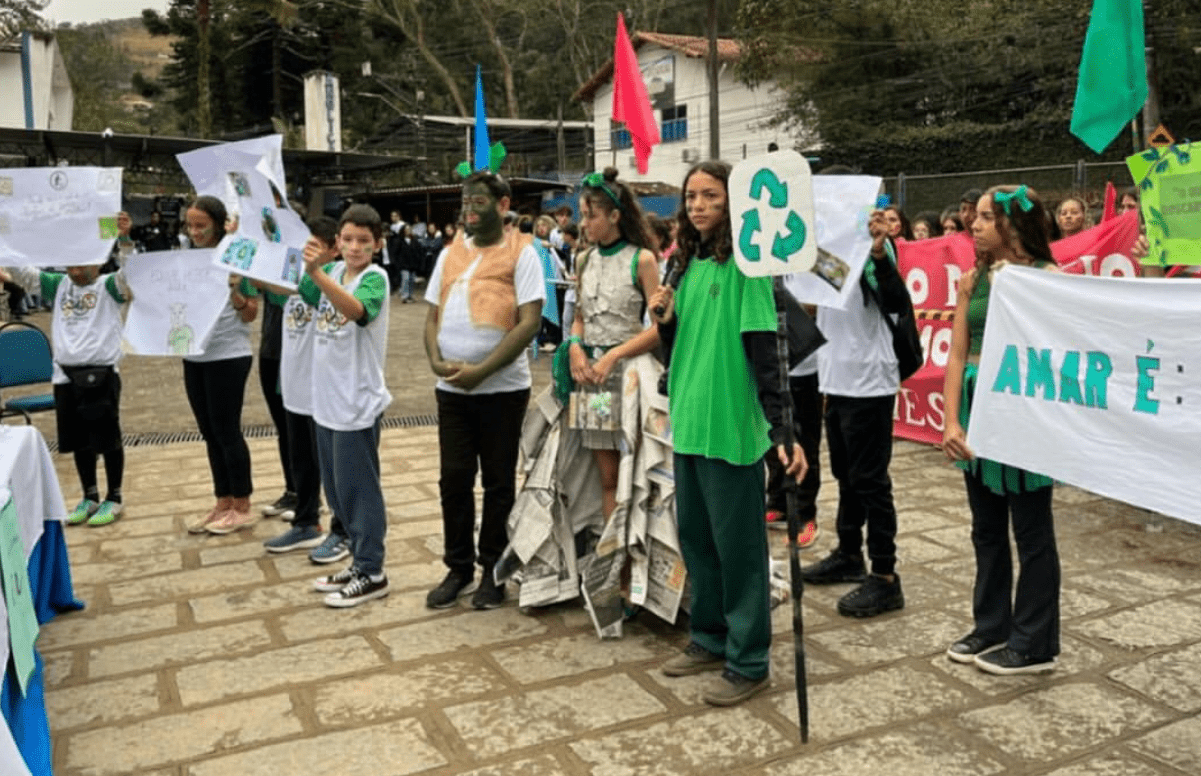
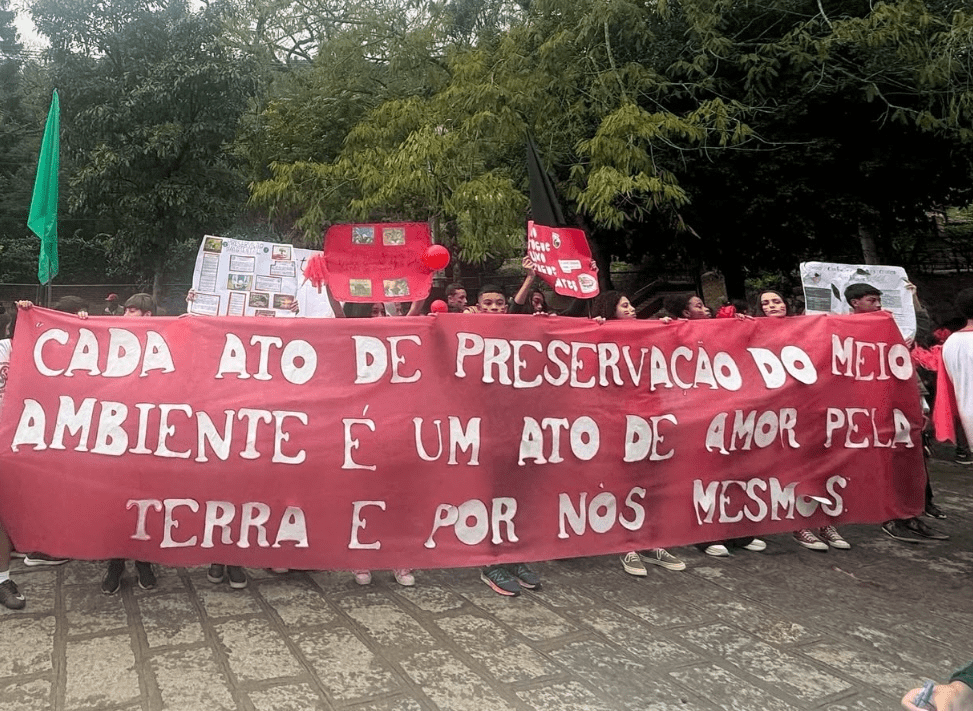
Young students hold a sign that reads, in portuguese: “Each act of environmental preservation is an act of love for the earth and for ourselves.” Photo by @parolesocioambiental, via Instagram.

Impact

In an interview with Yuvoice, Denise Fonseca, Eva director, emphasized the importance of youth engagement.

“Young people, especially teenagers, are by nature restless and eager for change. This is part of this stage of life, when they assert their existence, reclaim their identity, and present the new self they are building from their own experiences. Their worldview gradually differs from that of their elders. Not just to question, but to propose paths forward. Formal education directly impacts the youth community: it brings newness into the family sphere and opens space for transformation”.

The role of young people is crucial, she says. “They have this ability to spread ideas. Change begins within their own social circles”.

When informed and encouraged, young people cease to be mere spectators and become more participatory, able to understand climate shifts, question unsustainable models, and contribute to solutions for a greener future.

A survey conducted by EVA members showed that more than 60% of families reported adopting more careful environmental practices, such as waste separation, water quality monitoring, water and energy consumption control, and awareness around fire prevention.

The project, however, did not receive government support during its four years of operation and relied on donations to stay afloat, which made it harder to improve and sustain its activities. 

Despite these challenges, the Eva team continued fighting for broader recognition throughout its duration, and the project officially concluded its field work at the end of 2024, having laid the groundwork to potentially expand its impact to other schools facing similar vulnerabilities.

Initiatives like this gain even more relevance in today’s global and national landscape. While EVA’s impact is seen at the family and community level, Rio de Janeiro’s environmental progress is also reflected on a broader scale.

The state has stood out. According to MapBiomas research, between 1984 and 2023, it was the only state in the country to record growth in forested areas. This progress is directly linked to Atlantic Forest restoration efforts – a biome that covers the state of Rio de Janeiro – and to the work of NGOs and local organizations.

Consistent environmental policies have also proven effective in restoring native forests and soils.

Still, these gains are not enough to neutralize the impacts of other environmental dilemmas. Brazil continues to face severe challenges such as deforestation and ecosystem degradation, issues that demand urgent action.

It is clear, therefore, that young people must be brought together and encouraged to understand the full scale of the climate and environmental crises affecting the world. 

Only through an educated and empowered generation can Brazil hope to confront its climate future.

Chelsea FC: from oblivion to paradise!

When the referee blew the final whistle, it became reality. Chelsea FC, once again, defied the odds to become the first club ever to conquer the brand-new FIFA Club World Cup, hosted in the United States. A unique edition with the 32 best teams on the planet, it proved a success both on the pitch and financially for FIFA, ahead of next year’s major event.

For Chelsea FC, defeating clear favourites Paris Saint-Germain with relative ease – a first-half brace from Cole Palmer (22’, 30’) and another strike from João Pedro (43’) – was a statement to the world: they are back.

Cole Palmer and his already trademark ‘cold’ celebration. He scored twice in the final. (Chelsea FC website)

Previous difficulties

“There is a light at the end of every tunnel” – a famous quote that fits the club’s last three years’ story perfectly. After the UK government forced the club’s sale, ownership moved from Roman Abramovich to a consortium called BlueCo, led by American businessman Todd Boehly.

In the meantime, the club’s appeal faded and results collapsed. Graham Potter, Bruno Saltor, Frank Lampard and Mauricio Pochettino all took turns in the dugout, but none had it easy. External circumstances didn’t help either.

Chelsea finished 12th in the 2022-23 Premier League season, then “recovered” to 6th the following year. With no European competition in between and lacklustre results on the pitch, it felt like a downward spiral until Enzo Maresca was announced as head coach in May 2024.

Italian mister in charge

That proved a turning point and, perhaps, one of the savviest decisions in the club’s recent history. The former Leicester City coach restored a winning mentality and a bold, attractive style of play. As a result, Chelsea clinched a top-four spot (while becoming the youngest Premier League side ever at 24 years and 36 days) and lifted the Conference League trophy after a 4-1 win over Real Betis in the final.

Enzo Maresca collected several trophies as a player and now is doing it as a coach. (NBC Sports)

With that emotional boost, they headed to the United States for the inaugural Club World Cup. 

A 3-1 defeat to Flamengo in the second group stage game, a weather-delayed four-hour encounter against Benfica, back-to-back wins over Brazilian sides thanks to mid-tournament signing João Pedro, and a sensational performance in the final against the Champions League holders – it was a wild month. They won silverware, gained experience and proved they could be serial winners again.

“I’m very happy especially for them [players] because they deserve this moment. At the end of the day you can give a detailed plan to your players, but they need to execute it and they did that so well,” Maresca told the club’s official channel after the final.

A special mention goes to Willie Isa, added to the backroom staff as player support and development officer. The former Wigan Warriors centre played a vital role in the squad’s mentality shift. This Chelsea side isn’t just tactically well-drilled, they run tirelessly and press smartly like lions. Much of that hunger should be credited to Isa.

Willie Isa's winning mentality proved key for the Chelsea turnaround. (LoveRugbyLeague.com)
Willie Isa’s winning mentality proved key for the Chelsea turnaround. (LoveRugbyLeague.com)

Fan insight

The success is a signal of hope for the future and shows how the club has managed to return to the good old ways. Nathalia Tavares, a communicator and avid football fan, travelled to the United States and witnessed the tournament first-hand.

“It was great to see Chelsea acting like they knew they could win it, which eventually happened. Not only will Chelsea wear that badge for 4 years, but they come into this season with a lot of confidence in where they are heading, so much different than it has been for the past 5 years or so” she explained.

Maybe the initial loss against Flamengo ended up being a blessing in disguise, as the team avoided the big favourite Paris SG until the final match — rather than facing them in a knockout phase. “I guess there was a big expectation of Chelsea topping the group which would mean a harder path, but it didn’t happen, so the title became more tangible” Tavares stated.

“It’s very clear how the mentality has shifted ever since the Fulham away game,” explains Gabriel Fraga, a lifelong Chelsea fan from Rio de Janeiro, Brazil. In that match, Chelsea kept their Champions League hopes alive after a quick late turnaround — thanks to goals from Tyrique George and Pedro Neto.

Since his arrival last year, Pedro Neto keeps proving decisive when it matters most.

Another detail Fraga pointed out was how smart and prepared the new coach is. “Maresca’s system has evolved,” he added. And yes, as seen in the games against Flamengo and in the final, the Italian coach is not afraid to shake things up depending on the opponent.

New season ahead

Only three weeks after lifting the trophy in the USA, the Blues returned for a short preseason, and they did it in style. They beat Bayer Leverkusen 2-0 and AC Milan 4-1, both matches played at the tempo of world champions. Fans at Stamford Bridge also got a first look at the club’s new signings.

Estêvão Willian, the Brazilian prodigy, made his long-awaited debut and immediately impressed. A goal and a penalty-won assist across two games, plus flashes of pure quality play, had the crowd cheering loudly. At just 18, he’s already pushing for a starting spot and, if he keeps this up, it won’t take long.

“We punished him for scoring against us,” joked Maresca. As a reminder, Estêvão scored one of the tournament’s best goals for Palmeiras in the Club World Cup (ironically against Chelsea).

João Pedro (23), Jorrel Hato (19), Jamie Bynoe-Gittens (21), Liam Delap (22), Darío Essugo (20) and Aarón Anselmino (20) also made their home debuts. All are under 23, a clear sign of the club’s long-term vision.

No more blue days

After losing the Carabao Cup final to Liverpool in February 2024, former player and pundit Gary Neville branded Chelsea “a blue billion-pound bottlejob.” 

The joke spread quickly across media and social platforms, but Todd Boehly’s plan stayed on course. Backed by sporting directors Paul Winstanley and Laurence Stewart, less than two years later the project is paying off. 

As the trophies keep filling the Stamford Bridge cabinet, the standards get higher. Tavares acknowledges this clearly: “My expectations for the season are the best possible. Returning to the UCL is huge already, but I feel like Chelsea can push in the PL and do better in the national cups — although I don’t think they should be a priority as they’ve been in the past years”.

Back in business, Chelsea kicked off their Premier League campaign with seven points out of nine. After a goalless home draw against Crystal Palace, they responded with back-to-back wins — a 5-1 thrashing of West Ham and a solid 2-0 victory over Fulham. They may not be title favorites, but they’ve already shown their credentials.

Before the transfer window closed, Chelsea secured the signing of Alejandro Garnacho from Manchester United. The 21-year-old winger finally landed at Stamford Bridge and will be available for Maresca right after the international break. Fellow Argentine attacker Facundo Buonanotte also joined on a season-long loan from Brighton.

Alejandro Garnacho will wear #49 and is expected to make an instant impact. (CFC Pics on Twitter)

Chelsea are back where they belong and this feels like just the beginning of a new era of success at Stamford Bridge.

Girl Talk Club: The Feminist Community Giving Voice to the Displaced

Amid emotional collapse and the overwhelming sense of invisibility that runs through so many women’s lives, a simple idea reignited Bruna de Ornelas’s purpose: to create a space where women could truly meet, both themselves and each other.

That’s how the Girl Talk Club was born: an alternative community weaving together care, learning, and belonging in the heart of São Paulo, Brazil.

Through in-person gatherings, conversation circles, creative clubs, and emotionally safe English workshops, the project has become a refuge for creative, intense women who don’t fit into the traditional corporate mold.

Bruna, who holds a degree in International Business and teaches English to adults, went through a deep depressive episode after facing homophobic abuse in the condo where she lived with her wife and young daughter.

Without institutional support and carrying a history of harassment, she decided to build, from scratch, a new way of inhabiting the world and helping other women do the same.

“I could only go back to teaching if I truly believed I was capable of delivering my best work. But I couldn’t return to teaching in the same way. I needed a life project. A legacy. A love letter to myself and to my students,” she wrote in a letter published on Girl Talk’s social media.

Since then, the club has brought women together for free events, expanding the conversation around identity, voice, and autonomy in a city where many feel alone, even when surrounded by people.

The community also became a space for collective English learning, using collaborative formats that break away from traditional rigidity and center listening, vulnerability, and exchange.

Among Girl Talk’s initiatives are:

  • Open picnics for women, with conversations about career, creativity, and emotional support;
  • Writing and artistic expression workshops, inspired by artists like Geloy Concepcion;
  • Secret subscription-based clubs for more complex activities in smaller groups (reading, cinema, art, letter-writing, and business);
  • Thematic workshops and circles with guests discussing self-esteem, communication, and life transitions;
  • Online and in-person events on topics like “creative vulnerability,” “girl-owned business,” and “nonconforming professional identity.”

Today, Bruna leads the project alongside other women and is already preparing to expand into new educational formats while keeping the essence intact: no one needs to perform perfection to learn or to belong.

Girl Talk defines itself as a “space of subversive care,” created by women who are tired of bending to external expectations. 

In contrast to toxic positivity and performative success, the club embraces the risk of deep listening and the courage to reappear.

English Classes for Adults

As an English teacher beyond the Girl Talk Club, Bruna describes her approach as decolonial and gender-conscious. To her, teaching a language is more than grammar and conversation, it’s about repositioning women in the world.

“We go after this knowledge and then feel ashamed to use it. Because those born with access look at us sideways. And that applies to everything: English, art, education. What I offer is more than a class, it’s a reclamation of belonging. The average student believes they don’t deserve to learn English. That’s not procrastination. It’s historic. It’s structural. It’s healing work,” she says.

Bruna explains that her teaching questions who gets access to knowledge and how that access is perceived by society.

“It’s not well seen when we learn later in life. The system values those born inside of it. But we belong at the table too. We just need to craft new utensils.”

Currently, Bruna offers both individual and group classes, shared mostly through communities and organic networks. Her focus is to keep the space intimate, safe, and collaborative without resorting to the performance of self-promotion.

Ana, Miguel and Life on Hard Mode

Ana met her husband in an infamous Brazilian chatroom, exactly the kind of meet-cute that defines the best love tales of the 21st century.

She was bored. His nickname was DJ_German. The conversation lasted just a few minutes. She was about to log off when he dropped his phone number. No drama, no pushiness.

“I thought… there’s no way I’m calling a stranger! But the next day, I had nothing better to do and thought… why not?” she recalls. So, on a random Sunday in the early 2000s, she called.

They talked for two hours. By Wednesday, they were meeting up at a mall in Curitiba, Paraná, Brazil. “It was love at first sight,” she says, and it doesn’t sound like an exaggeration. Twenty-one years have gone by. They got married. Had a child. They’ve been together ever since.

Their son’s name is Miguel. It’s for him, and for herself, that Ana, with the courage of someone who has broken down in public before, is now trying to find her place in the world again.

***

Her connection to gaming began long before motherhood. Even before her husband, Leandro. Ana used to play with her sister, her parents, and the whole family together.

“The whole family was addicted. Games brought us together in the living room. When it got late, my sister and I would go to bed, and my parents would stay up all night playing,” she remembers.

Back in the ’90s, her dad – an illustrator – was in charge of drawing maps for Phantasy Star (Sega, 1987), level by level, forest by forest, maze by maze. That memory is still vivid in her mind.

During the interview, Ana gets emotional and tears up just trying to remember the name of a long-lost Master System 3 cartridge.

“I missed it so much! I spent years trying to remember the name of that game. I looked everywhere and never found it. The memory is still so alive. The next day, my parents would tell us everything they had unlocked or achieved.”

Now approaching 40, Ana admits she still loves games but hardly plays. “My dream is to have a decent computer so I can play again,” she confesses.

Her favorite genre? “Silly games,” she says. “I like to relax, you know? Nothing stressful. My Steam profile makes it very clear.” The bio of her steam profile reads: “Yes, I play children’s games!”

Maybe it’s her way of resisting a world that demands too much.

She still treasures her second Game Boy (the first was stolen). She also owned an Atari and a Nintendo 64, alongside the Master System 3. She remembers clearly which titles she had for each console: “I couldn’t afford many games, so I lost count of how many times I replayed the ones I had.”

“Back in the 64 days, I loved Super Mario and Legend of Zelda. On Master System, I played Prince of Persia, Sonic, Super Monaco. Atari was easy… River Raid, Enduro, Pac-Man.”

Leandro’s Super Nintendo is still safely stored away. Every now and then, they still play a match or two. When asked if the vintage console could be sold for a high price, Ana is firm, “Whether it’s worth money or not, we’re not selling it.” The sentimental value means more.

Super Miguel World

The only game Leandro has ever liked and still does is Super Mario World. That’s where the idea came from: Miguel’s first birthday party would be themed after the world’s most famous plumber.

Not a coincidence at all: the boy fell in love with games even before he could speak, around age 3, starting with educational titles. Slowly, without any pressure, games became shelter, language, connection. With the world. With his parents. With himself.

***

“When I stopped the treatment, I got pregnant. My little one was born in 2017,” she says.

When she got pregnant with Miguel, Ana was working at a major telecom company. But just imagining someone else witnessing her son’s first steps while she was away made everything lose its meaning. She asked to quit. And she did.

“I was doing really well there. My pregnancy went smoothly… but during my seven years at the company, I saw many colleagues have babies, go on maternity leave, and return to work. Everything as it’s ‘supposed to be’. When my turn came, I couldn’t get used to the idea of my long-awaited baby spending all day with ‘strangers’ who’d then give me a report at the end of the day: ‘Oh, today he took a step, discovered something new, learned a game … while I was out chasing professional success’,” she explains.

“To me, it just wasn’t a fair trade. So when I came back from maternity leave, I said I wanted to quit. Quit to take care of myself, of him, and to chase my dreams.”

Contrary to what society often preaches, the postpartum period was far from a fairytale. After Miguel was born, he cried nonstop for three months, refusing to be held, and showing no clear signs of what was wrong. His mother ended up submerged in a sea of postpartum depression, resistance to help, and overwhelming guilt.

“I wasn’t sleeping. No one knew why he cried so much… he wouldn’t let anyone hold him. As he got a bit older, he became very selective with food, had intense crying fits… he’d have a meltdown anytime we went somewhere with unfamiliar people. He took a long time to start walking, and he didn’t accept physical contact,” she recalls.

It was a shock. Pure exhaustion. A desperate attempt to understand. No answers. The official diagnosis came only when he was two, after a frustrating journey through doctors’ offices unwilling to confirm what she already knew deep down: “my son is autistic.”

The Autism Spectrum Disorder (ASD) diagnosis finally came from the most expensive child neurologist in town. With it, a strange sense of relief. Relief in being able to name the chaos. To look back and think: “it wasn’t just in my head. It wasn’t my fault. It wasn’t a failure”.

Even so, Ana still feels guilty for how she handled the early years of motherhood.

“For me, the postpartum period was the worst time of my life. I felt like the worst mother in the world and not just that, I felt like the worst person. That’s why I’m completely against romanticizing motherhood.”

“Picture me, deep in postpartum depression, wanting to disappear off the face of the Earth, going through all of that. I did one of the worst things I could’ve done just to get a little peace… I’d leave him watching cartoons on TV, because it kept him distracted. That’s how he started saying random English words before even learning to speak Portuguese,” Ana explains.

Today, Miguel is 8 years old. He’s a sweet, well-mannered, brilliant child. He talks about astronomy with the vocabulary of a scientist and loves logic games. Among his favorite titles, a pattern emerges: puzzles.

“He’s an absolute sweetheart, polite and super smart. He loves studying English and has a hyperfocus¹ on games and astronomy. He used to be obsessed with human anatomy and physiology too, but that’s faded a bit. His dream is to work at NASA,” says his doting mom.

Like almost every kid his age in 2025, Miguel is also obsessed with the ever-polarizing Roblox. “That’s where he says he has ‘friends’,” Ana points out.

“He also loves Minecraft. He plays on his super tablet. And whenever he gets access to a computer, he enjoys games like Human Fall Flat, Portal… total little nerd. He dreams of having a Nintendo Switch.”

Of course, not everything has to be educational. Miguel also adores games with darker themes: Poppy Playtime, Garten of Banban, Five Nights at Freddy’s, and Bendy and the Ink Machine.

That fascination might just be in his genes. “I’m also drawn to darker themes, and some of my favorite games are Little Nightmares, Rain World, Cult of the Lamb, Limbo, Inside… I love them, love them, love them!” Ana confesses.

They’re dark yet safe worlds, almost like playable metaphors for the restlessness she struggles to say out loud.

Miguel doesn’t have regular access to video games, but that doesn’t stop him from playing. He watches YouTube videos. Lots of them. He knows where to find hidden items, the bugs, the shortcuts, the alternate endings. He watches so much that, when he finally gets a chance to play, it’s like he’s already beaten the game three times.

“He kills it, just from watching other people play so much. It’s fun to watch,” she says, laughing. It’s like he’s been training all along, just waiting for someone to hit Start.

When Ana mentions her son’s love for logic games, there’s a quiet pride in her voice. The same kind of awe she feels remembering the maps her father used to draw during the Phantasy Star days.

Only now, it’s Miguel who draws the maps. And the world – even if digital – finally starts to make sense. For him, games aren’t just entertainment, they’re a language. They’re a safe ground.

“We can see there’s a very positive side to it, too. He learns a lot, his English is great, he has quick thinking and strong logical reasoning.”

***

In the family’s daily life, games have become a shared language. A point of contact. An improvised form of therapy. Miguel plays, and his mother observes. She sees so much of her son in her husband, who also received an “unofficial diagnosis” of autism after being observed by a psychologist who simply said, “I have no doubts.”

“I had my suspicions, because he was very different from everyone else. When the psychologist said it, we just accepted it, it was so clear. But since we don’t have the ‘paperwork,’ he doesn’t present himself as autistic. Especially because, after so many years adapting and trying to be ‘normal,’ it doesn’t really impact his life or come across to others.”

Ana also started looking at herself differently and began to wonder a while ago. A preliminary test showed a “very high likelihood of being on the spectrum.” She wants to investigate further, but money is tight at the moment.

“After that test, I started to question a lot of things, but the cheapest evaluation costs around R$ 1,500. My father has high abilities², and I’m pretty much a copy of him,” she shares.

In fact, “there is an undeniable genetic component in autism,” explains pediatric neurologist José Salomão Schwartzman in an interview with the renowned Brazilian Dr. Drauzio Varella.

Scientific research has increasingly focused on genetic predisposition, and evidence suggests that genetic factors may explain up to 90% of autism spectrum development.

Reset

Ana speaks with passion. And at length. She describes herself as “chatty, all over the place, chaos.” But the moment the conversation shifts to voice (when she has to get on a call instead of typing), her body freezes. Anxiety kicks in. Panic. The fear of crying. The fear of shutting down.

The fear of being seen as “too fragile” for the job market as she searches for a way back into the corporate world after nearly 10 years away. When, in reality, she’s just tired of trying to fit into expectations that never once tried to fit her.

“I keep thinking: how am I supposed to get a job like this? I feel like some kind of wild animal. I go for an interview, a call… I’ll probably start crying halfway through. They’ll just say, ‘please leave’.”

“I don’t even know what weighs more, the gap in my résumé, which I’ve tried to fill every possible way just to be seen, my age, or the outdated experience. There’s no certificate that can cover that hole,” she confides. The hole of having stepped away. Of choosing to care. Of doing what so many romanticize in captions but reject in real life.

With a degree in Marketing and a postgraduate diploma in Business Management, Ana dreams of working in areas related to diversity, inclusion, ESG, and purpose-driven projects. She loves to create, to think about branding and identity, to build presentations, to make things meaningful and colorful.

“I’ve done a bit of everything in this life. I’ve run my own business, had a tattoo studio, sold Swiss chocolate, and worked as a tattoo artist. I had a family-owned semi-jewelry business, where I handled all the marketing. I worked for over 10 years at a multinational as a marketing analyst and project analyst,” she lists, showing the richness of her experience.

She even has her own version of hyperfocus: a dream of working at O Boticário (one of Brazil’s largest beauty conglomerates). “I really admire how they focus on people. It makes your eyes light up, you know? Makes you want to be a part of it.”

Deep down, Ana just wants to be seen. To be heard. “I even told a girl who works there, ‘If I could just talk to someone, just get an interview, I think they’d hire me.’ Because, honestly, if people knew how much love I pour into my work, the passion I have for what I do, the way I go all in… you know?”

Despite her résumé, experience, and drive, still hasn’t been called, not even for an interview.

“I don’t think my résumé is bad, or weak, even with the career gap, which I think I explained really well. But, still, I can’t land an interview. I just don’t know what’s wrong with my résumé,” she admits, “I feel pretty lost.”

***

Today, Ana barely plays video games, but laughs as she admits there’s “a dormant gamer inside me, just waiting for the right moment to wake up.”

“Since I’m not a big fan of mobile games, I don’t spend too much time playing. And the few that run on the computer I have right now are more for distraction, so it ends up being a positive thing,” she explains.

For now, she plays what she can. It helps her unwind. Distracts. Relaxes. Disconnects. But she knows that, with the right adventure, she wouldn’t sleep just to beat the game. “If I had the right hardware, I know I’d push past all limits.”

Sometimes, that’s what care looks like too: care for herself, for her time, for whatever energy is left after taking care of the whole world.

The story of Ana, Leandro and Miguel is a starting point, but it also opens space for us to reflect on the role of video games in contemporary childhood, especially when it comes to neurodivergent kids.

Autism at play

Ana doesn’t play much these days. Miguel plays a lot. But between them, there’s a kind of invisible thread, made of pixels, building blocks, and mental maps. If you pay close attention, you’ll notice: even without a controller in her hands, she’s still playing.

For children on the autism spectrum, like Miguel, the structured and rule-based environment of video games can be particularly beneficial. Games offer a safe space for social interaction, where expectations are explicit and communication can be more direct, reducing social anxiety.

The reward system reinforces positive behavior, and the visual and interactive nature of games can be a powerful channel for learning, adapting to different cognitive styles.

Yes, video games offer a field of possibility for autistic individuals. This isn’t naive optimism, it’s a growing consensus among professionals in health, education, and technology. Games bring joy, expand knowledge, contribute to emotional well-being, and create alternative paths for socialization, especially for children and teens who often experience isolation in the physical world.

Many end up learning English without realizing it. They practice reading, logic, motor skills, and problem-solving. Some games even function as natural blockers for intrusive thoughts. Others help develop cognitive and even physical skills, like the so-called exergames.

Immersion has its value too. Hyperfocus – a common trait among people on the spectrum – finds fertile ground in games, where the overstimulation of real life gives way to predictable rules, clear objectives, and immediate rewards. Some kids literally grow up between stages and quests.

That said, the very element that enchants can also disconnect. Excessive use raises concerns and, in some cases, leads to further isolation. It’s important to set boundaries and ensure screen time doesn’t replace essential experiences, like physical play, in-person connection, or body movement.

Miguel, for instance, sometimes goes overboard. He falls asleep thinking about games. Wakes up talking about them. Ana and Leandro, always attentive, notice when it’s time to gently pull the thread back into the real world.

“We’re very aware of this and try to involve him in other activities. The downside is that when he exceeds his limit and spends too much time on screens, he starts to live inside the game. He dreams he’s in the games, and all his conversations revolve around that. That’s when the alarm goes off for us,” Ana says.

The key lies in balance and, most importantly, in guidance. With the right support, games can be therapeutic tools, educational resources, and even starting points for real friendships.

Ana’s experience, seeing games as a bridge of connection with her autistic son, is far from unique. When played with purpose, ethics, and care, they are more than entertainment, they are opportunity, inclusion, and future.

Ana still dreams of a “decent computer,” of getting a job at O Boticário, and of reentering the professional world. Miguel dreams of working for NASA and getting a Switch. Somewhere in between – between drawings, maps, and difficult levels – they keep playing in their own way.

The console may still be missing. The job. The opening. But it doesn’t matter. Ana and Miguel already know how to play as a team.

European transfer buzz and Club World Cup breakout stars

European football season ended with a statement, as Paris Saint-Germain thrashed Inter Milan 5–0. Some would argue a new powerhouse has arrived — ready to dominate the game for years to come.

With the summer transfer window open until September 1, every team is looking to upgrade. Deals are already in motion, and many clubs aren’t wasting time. Let’s take a look at what’s going on:

Premier League 

The richest league in the world is no stranger to big spending, and this window has already delivered moves that could change the game.

Fresh off their title win, Liverpool didn’t hesitate. The Reds snapped up right-back Jeremie Frimpong, left-back Milos Kerkez, and creative midfielder Florian Wirtz — the latter arriving for a British record fee. All three are under 25 and expected to start right away. It is a huge boost for new manager Arne Slot, especially after losing club icon Trent Alexander-Arnold in late May.

“Attack wins you games, defense wins you titles” —a line Mikel Arteta has adopted at the start of this window. After finishing runners-up for a third straight season, the Arsenal boss is going all-in. So far, the Gunners have brought in goalkeeper Kepa Arrizabalaga and midfield anchor Martín Zubimendi. Now, all signs point to Cristian Mosquera joining next, after the young centre-back turned down a contract renewal from Valencia.

Meanwhile, the transfer rumor mill is making sound with links to Viktor Gyökeres, Noni Madueke, and Eberechi Eze. The Swedish striker and the two electric wingers could add a whole new dimension to Arsenal’s attack —potentially making this one of their biggest transfer windows ever.

Manchester City, the most dominant English club in recent years, ended this season without silverware. After losing the FA Cup final to Crystal Palace, Pep Guardiola’s side traveled to the United States for the Club World Cup, where fans got their first look at new signings: midfielder Tijjani Reijnders, left-back Rayan Aït-Nouri and the magic midfielder Rayan Cherki. All three slotted in seamlessly —so expect the Cityzens to be serious contenders for the Premier League title once again.

Rayan Cherki grabbed an assist during his cameo against Al Hilal. (via Cherki X account)

Meanwhile, Chelsea is on an upward trajectory. They became the youngest side in Premier League history, with an average age of just 24 years and 36 days. That didn’t stop them from qualifying for the Champions League — their first time back since the new ownership took over — and winning the UEFA Conference League in style with a 4–1 win over Real Betis.

So far, the Blues have signed striker Liam Delap (22), centre-back Mamadou Sarr (19) from Strasbourg and just unveiled Brazilian forward João Pedro (23) earlier today. English winger Jamie Bynoe-Gittens (20) is expected to be next, after reaching an agreement with Borussia Dortmund. Ghanaian playmaker Mohammed Kudus (24) is heavily linked with a move to West London. Chelsea has clearly embraced the youth movement, and it is beginning to pay off.

Elsewhere in Europe

Clubs across the continent are also making big moves, and big statements.

Real Madrid wasted no time in landing long-term target Trent Alexander-Arnold, the most dangerous full-back in world football- on a free transfer. They also brought in Spanish centre-back Dean Huijsen from Bournemouth. But the biggest addition might be on the touchline: Xabi Alonso has taken over as manager, promising a more expansive style than his predecessor, Carlo Ancelotti. Pressure is way bigger in the Spanish capital but anything close to the historic double with Bayer Leverkusen — including an unbeaten Bundesliga title — would be a huge success.

Barcelona also moved quickly, bringing in goalkeeper Joan García (24) from city rivals Espanyol with hopes of locking down the position for the next decade. Veteran Wojciech Szczęsny (35) returned from retirement last season and played a key role in Barca’s run to the Champions League semi finals. A smart long-term plan in motion at Camp Nou.

Joan García was crucial in helping Espanyol avoid relegation (via FC Barcelona site)

Atlético Madrid have no time to regret a disappointing campaign. They’ve added three international players in left-back Matteo Ruggeri, attacking midfielder Álex Baena, and midfield anchor Johnny Cardoso, all 23 or younger —in an effort to inject new life into the squad.

The third giant of Spanish first tier football is also busy. After a disastrous season, Atlético de Madrid wasted no time and secured the services of left-back Matteo Ruggeri (23), advanced midfielder Álex Baena (23) and anchor Johnny Cardoso (23). All three international players, expected to revitalise the squad.

Club World Cup Sensations

Amid the success of the tournament currently being played in the USA, Al Hilal stunned the world by defeating Manchester City against all odds. The Saudi side is the latest to shake up the global football scene. Several players have also stolen the spotlight, potentially earning themselves moves to top European clubs once the competition ends.

It’s safe to say this has been the tournament of Colombian midfielders. Both Richard Ríos (Palmeiras) and Nelson Deossa (Monterrey) have been vital to their teams, electrifying fans every time they touch the ball with their athleticism, technique and reading of the game. Both are also powerful ball-carriers with long-range striking ability. Deossa even scored one of the goals of the tournament in a stunning strike against Urawa Reds.

Both at 25, they’ve drawn serious interest. Ríos —who also was impressive in Copa América last summer— has been on the radar of Inter Milan, Porto and Manchester United. Don’t be surprised if Deossa receives the same level of attention.

Nelson Deossa and Richard Rios have been both magnificent. Colombian stars. (Own edit)

Jhon Arias is the third Colombian lighting up the tournament. The dynamic winger is in the form of his life and was key in Fluminense’s 2–0 win over Inter. A constant threat on either flank, defenders have struggled to contain him. His brilliant free kick against Korean side Ulsan HD was one of the highlights of the group stages round.

Igor Jesus (24) made headlines with his winner against Paris Saint-Germain. Despite Botafogo getting knocked out in the last round, his performances stood out the most. With a unique hold-up style and strong link-up play, he drew comparisons to Didier Drogba. A major comparison that highlights how good the striker is, and rumours say he’s on the verge of joining Nottingham Forest.

And then there’s Wesley França, a flying full-back. At just 21, the Flamengo star has pace, flair, and intelligence. Brighton and Serie A clubs have taken notice. He may be playing his final games in Brazil before taking the next step —and likely becoming a regular for the national team.

Keep an eye on these five rising stars, with European moves on the horizon.

Brazil may have finally found a solution to their number 9 struggles. (via Brasil Edition)

Transfers never sleep, and the summer window has just started. Don’t blink, the next big move might be happening right now.

Idaho Falls celebrates Juneteenth holiday through Musical Festivities

Idaho Falls celebrated the national holiday Juneteenth with a host of commemorative events designed to recognize one of the most important milestones in American history. June 19th remains a significant date, marking the day in 1865 when slavery was officially abolished in Galveston, Texas. Across the country, enslaved people were granted their freedom and claimed their right to emancipation. That legacy is honored today by many Americans, including Idahoans who seek to share history and narrative through one of the most meaningful channels of communication: music.

On June 14th, Idaho Falls held its second annual Juneteenth CommUNITY Heritage Music Festival, followed by Juneteenth: Night at The Colonial on June 19th. Both events celebrated rich cultural history and the ongoing fight for equality through a wide variety of music genres.

The music festival, a free public event at the Riverwalk Bandstand, featured live music by the Eastern Idaho Jazz Society. Families and individuals browsed community booths in partnership with the Idaho Falls Farmers Market. Opening remarks were delivered by Idaho Falls Mayor Rebecca Casper, who read the city’s official Juneteenth Proclamation. The event ran from 9:00 AM to 1:00 PM MDT and saw strong turnout from local residents. 

Chloe Doucette, a member of the organizing committee, reflected on the success of the event, “It was wonderful. We had lots of presence from booths representing different organizations within the East Idaho community that help share stories of our culture and showcase diverse perspectives.”

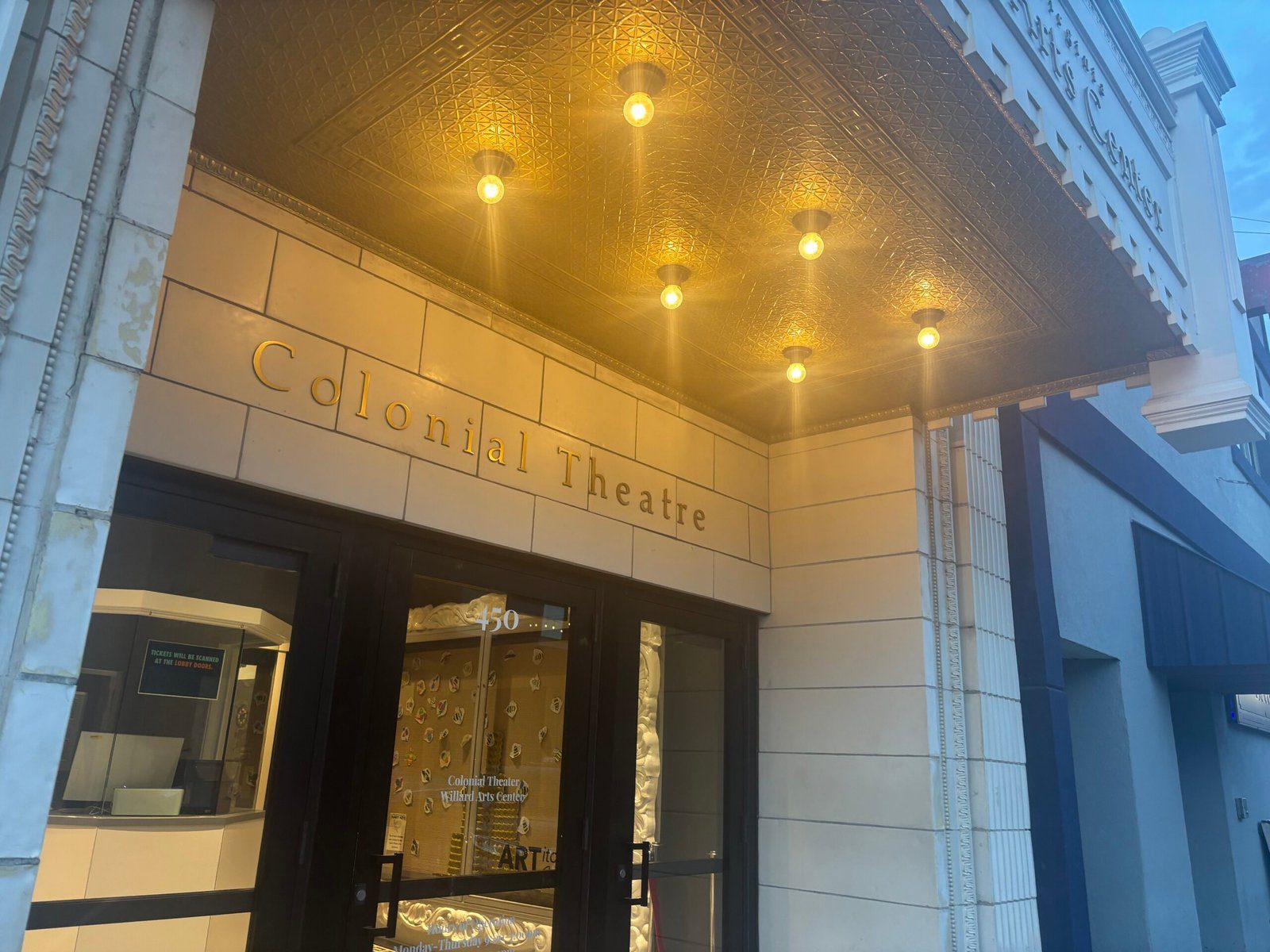
On June 19th, the Colonial House in downtown Idaho Falls hosted a memorable evening of musical performances and historical storytelling in honor of Juneteenth. The event began at 7:00 PM with opening remarks from one of the main performers and coordinators, Mosy Moran, who told the audience, “Tonight is an expression of freedom. It’s an expression of everything that America is meant to be—an expression of where we have been and where we can go.”

Performer and Coordinator Mosy Moran giving a statement at the Colonial House Juneteenth event.

The audience was then taken on an aural journey through decades of music, spanning symphonic, ragtime, jazz, blues, Motown soul, and modern hip hop. Musical performances included renditions of “What a Wonderful World” by Louis Armstrong, “Mustang Sally” by Wilson Pickett, and “I Feel Good” by James Brown, all performed by the Eastern Idaho Jazz Society. The Idaho Falls Symphony offered a violin and piano duet featuring ragtime classics such as “Graceful Ghost Rag,” “Saint James Infirmary,” and “Summertime.” Each piece was introduced with a short explanation of its historical significance and cultural impact.

The Eastern Idaho Jazz society playing at the Colonial House.

Midway through the event, a local group of young students known as the Freedom Readers presented a brief history of Juneteenth. They read firsthand accounts from African American citizens who had lived through enslavement, along with passages about the Emancipation Proclamation, the American Civil War, and the landmark day of June 19th, 1865. The students also highlighted the activism of Opal Lee, the “Grandmother of Juneteenth,” who campaigned tirelessly to make the holiday a national observance.

Young students known as the, “Freedom Readers” speak of the history of Juneteenth.

The evening concluded with a performance by the local band Mosy and The Heartthrobs, who played classics like “I Believe to My Soul” by Ray Charles and a stirring mashup of “A Change is Gonna Come” by Sam Cooke and “Alright”by Kendrick Lamar. Lead singer Mosy Moran spoke between sets about his passion for music and its unifying power: “Music unites everybody. It’s an expression. People relate to that expression. The more music you have in your life, the more you can understand somebody.” As Juneteenth continues to be celebrated nationwide, events like those in Idaho Falls at the Heritage Music Festival and the Colonial House demonstrate the power of retelling history and sharing rich music.