
Co-working app takes on café life with one-hour slots

Are you fed up with working from home? But also fed up with spotty wi-fi and glaring staff when you rock up to a café to work? Struggling to find an acceptable alternative workspace to the bedroom has been a headache for many laptop workers over the past few years. However, two start-up founders who met on Brighton’s storied beach in southeast England are hoping to change that.

Cameron Foskett and Connor Tagg are seeking angel, early-stage investors for their app, Werksy, which launched a year ago and is designed to make co-working far more flexible.

Co-working has become increasingly attractive to both big companies and small start-ups in the past few years, as The Sentinel reported earlier this year. The United Kingdom and Ireland are in the forefront of that co-working boom. In co-working, freelancers or employees of different firms share office space, and often lounge and leisure facilities.

Since the COVID-19 pandemic, it has become more popular for people to use booking platforms to book co-working spaces for as short a time as a day, or even half a day. However, Werksy is going one step further by offering co-working space for as little time as one hour.

This short-term space is in direct competition to café life, and as Foskett told The Sentinel, there are some basic barriers to cross.

“Some people don’t even know about co-working, the number of times I’ve had to explain what co-working is, as a concept.”

However, as Tagg points out: “The problem with working from a café is that after about an hour you’re sat there with a cold cup of coffee that you’re trying to nurse and you’re feeling a bit awkward and the barista is making eyes at you.”

Some London café owners are discouraging laptop workers from using their space, because of the downer that a silent laptop worker can have on the café atmosphere.

Café frequenters argue that their working space is free, but Foskett says that this does not take into account that co-working spaces offer free coffee. No more making your one flat white last 60 minutes. Wi-fi in co-working space is also more reliable, Foskett adds.

Foskett, with a background in sales, and Tagg, with a background in product design, had a Eureka moment in a chance meeting on Brighton beach in 2020, when Foskett heard about Tagg’s idea to make popping into a workspace as easy as tapping in and out of a Brighton bus ride. Werksy already has more than 3,000 users. The founders have been financing the venture themselves, helped by income from their existing careers. More investment could enable them eventually to expand beyond Britain, they told The Sentinel. 
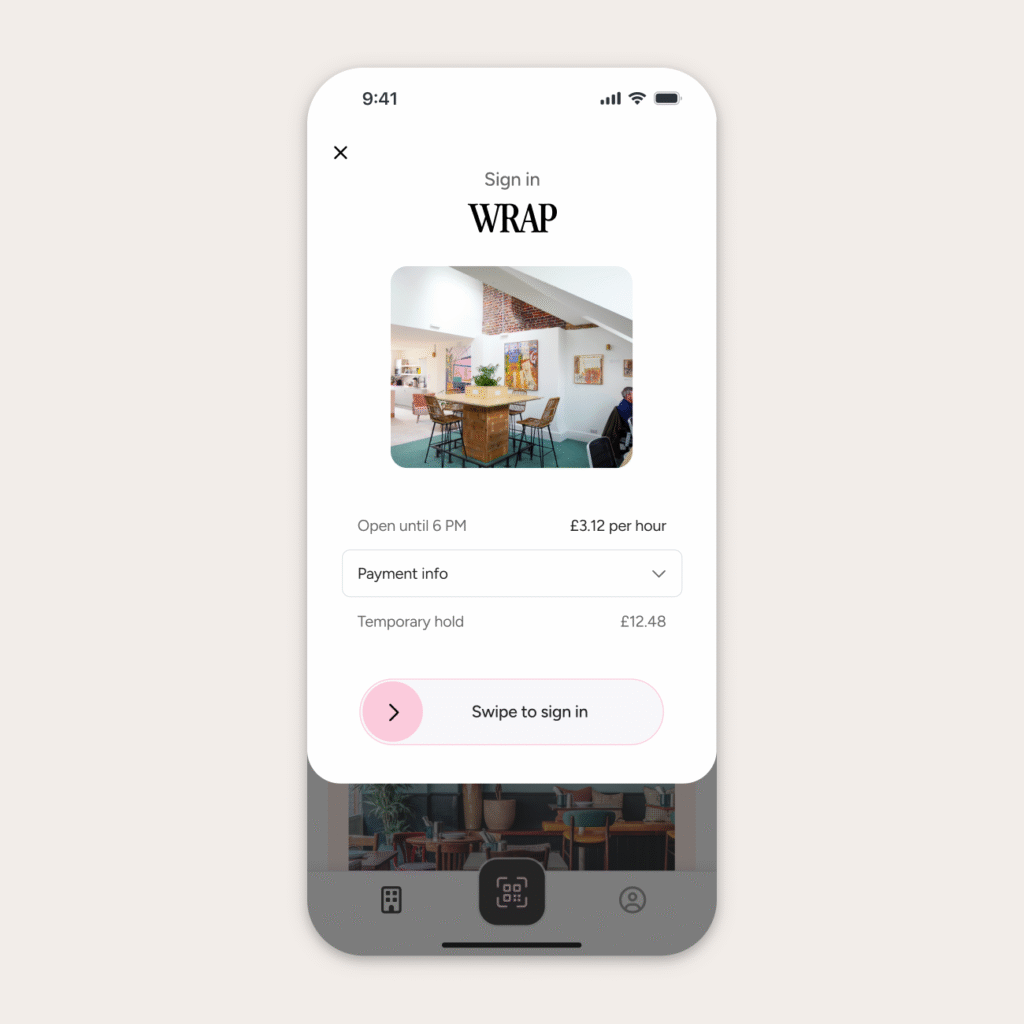
Screenshot from flexible workspace app showing image of co-working lounge, with payment and sign-in details.
Screenshot from the Werksy app, via https://werksy.notion.site/press

Once Werksy users are logged onto the app, entry to co-working space is via QR code.  Scanning in and out means there is no requirement for anyone to check whether app users have overstayed their time, unlike with conventional booking platforms, Foskett says.

Entry gives you access to co-working lounges, rather than to dedicated desk space.

However, lounge quality has improved in recent years, according to Nathan Carpenter, head of central sales at flexible workspace operator NewFlex, which offers Werksy users space in its co-working lounges.

“All of the lounges are fully kitted out with USB ports and plug sockets, you get coffee and you get refreshments and it’s a nice place to work. It makes a big difference for remote workers, who will have spent most of their time in a Costa or Starbucks trying to get signal, if you have a place which is really dedicated for you to work.”

Werksy user Aimen Chouchane, head of marketing for AI-powered video surveillance firm IntelexVision, says Werksy enables him to find reliable places to work in between meetings when he spends a day in London. He prefers this option to coffee shops, where “wifi can be unpredictable. Finding a perfect one can be hard, sometimes they’re too noisy.”

The nature of Chouchane’s work also means that security is important, that no one is looking over his shoulder.

Fashion designer Noemie Jouas, who also acts as an ambassador for Werksy, helping to promote the app, says the flexibility is ideal for workers with a varied schedule:

“The kind of work that I do is really, really different every single week. I might have photo shoots somewhere, or sometimes I have fabric shopping. My job takes me everywhere, Werksy saves a lot of time travelling in London.”

Prices can be a little more expensive than the cost of one coffee. The usual range for an hour in a Werksy space is between two and seven pounds, Foskett says, compared with £2.50 for a flat white in a London Starbucks. But users say the more appealing workspaces and the offer of free refreshments make up for that.

However, Fleura Bardhi, professor of marketing at City St George’s, University of London, told The Sentinel that short-term working risks removing the sense of community that co-working spaces have tried hard to foster:

“Booking for a day is a new development. Because it’s so flexible, it’s ‘why not?’ Then it comes with a damage to the community. A lot of people join so they are part of the community. If you have outsiders in and out for an hour and a day, it’s different.”

Foskett disputes that, pointing out that some Werksy users regularly use the same co-working space, and that a conventional co-working community that requires a monthly payment of several hundred pounds excludes many.

“We’ve got a lot of entrepreneurs, freelancers and people that just either don’t have the money, or don’t have the need to be restricted to one office.”


International aid organisations see tough year ahead

“We’re running on fumes,” says Sarah Shaw, associate director of advocacy for MSI Reproductive Choices, which provides contraception and abortion services in 36 countries. “This year has been a really bad year, next year is going to be a really bad year,” she told The Sentinel in an interview late last year about the impact of aid cuts.

U.S. President Donald Trump’s decision in 2025 to shut down the U.S. Agency for International Development (USAID) has hit development programmes around the world. At least 23 million children stand to lose access to education, and as many as 95 million people to lose access to basic healthcare, potentially leading to more than three million preventable deaths a year as a result, according to an Oxfam report in November.

The impact of cuts by the world’s largest aid donor has not just been at the front line of providing aid, but has also affected logistics and the delivery of supplies, according to Shaw.

“Trump dismantled USAID, which is the delivery arm for the world’s development programme. He just stopped 50 years of programming, and the fall-out from that has massively impacted our service delivery.”

For example, some U.S.-funded contraceptives intended for poor nations and worth nearly $4 million have been stuck in a Belgian warehouse since the U.S. aid freeze. They could become unusable by mid-2026, Reuters reported in October.

MSI has diversified its funding sources in recent years, following past cuts in U.S. aid. However, the global impact on the ground of the latest cuts has meant the organisation has needed to help fill gaps elsewhere:

“The closure of USAID and the speed at which it happened has caused so much chaos at country level, it’s blasted a massive hole in health budgets,” Shaw says.

“Governments are exhausted and they’re broke. We’re having to step in in a lot of countries and actually move the contraceptives around for the Ministry of Health to get them to the right place.”

In addition, European governments have been slower than in the past to fill funding gaps, embattled as they are by the economic impact of the COVID-19 pandemic and defence spending needs due to the war in Ukraine.

“The broader trend across Europe is, funding falling massively short of fast‑growing needs,” says Nihad Sarmini, global head of business development and partnerships at Action For Humanity, which delivers life-saving support in over 14 countries.

“There are women in Syria who may have to travel 100 kilometres for a maternity clinic, which may not be there next month when they need it again. Children in Yemen are succumbing to medieval diseases like cholera and diphtheria, entirely preventable and treatable, because governments are withdrawing funding and leaving humanitarians to plug gaps elsewhere.

Non-governmental organisations (NGOs) such as Action for Humanity and MSI are also braced for a planned cut in UK aid spending to 0.3 percent of gross national income (GNI) in 2027 from the current 0.5 percent. This latest cut in UK aid follows a cut in 2021 in response to the pandemic.

UK international development organisation network Bond said in an October briefing note that it was hearing that the UK government was considering ending its aid partnerships with several countries in Africa, including Malawi, Mozambique, Rwanda, Sierra Leone and Zimbabwe.

MSI’s programmes include a major health project in West and Central Africa which is funded by Britain’s Foreign, Commonwealth and Development Office.

Aid cuts are short-sighted, as every dollar invested in sexual reproductive health saves $130 in other development costs, according to Shaw.

“An investment in contraception is way wider than just a health investment. It breaks generational cycles of poverty, it enables women and girls to leverage opportunities by staying in education, by becoming economically independent,” she says.

Sarmini also stresses the far-reaching nature of slashed funding:

“Cuts to one organisation quickly ripple through the system, and communities pay the price.”

Britain’s growth strategy needs training boost, expert says

Britain will struggle to boost economic growth without investment in training and skills but this sector of the economy is getting little help from the government, business expert Nigel Driffield told The Sentinel.

   Britain’s left-of-centre Labour government, elected with a strong majority in July 2024, is trying to lift people out of poverty and provide better public services without sharp rises in the tax burden. It is looking to faster growth to close that gap, but that strategy has failed to bear fruit so far. Gross domestic product grew at only 0.1 percent in the third quarter of 2025, down from growth of 0.3 percent in the previous quarter.

    Concerns about the cost of living, coupled with worries about immigration, have given the right-wing populist Reform UK party a strong lead in opinion polls.

   Manufacturing in Europe has been lagging the United States and China, fueling a rise in populism, as The Sentinel has previously reported. Productivity is particularly slow in Britain, according to Driffield, professor of international business at Warwick Business School. 

    “We have a major productivity problem in this country, much more than an employment problem. We have a lack of investment in capital, and lack of investment in skills.”

     Britain issued its closely-watched annual budget statement in late November, delivered by finance minister Rachel Reeves. The government has provided an extra 1.5 billion pounds to help employers train young people. However, such money is often diverted for use for higher-skilled workers, Driffield said.

    “Businesses send people on an MBA, that doesn’t necessarily address the lower skills problem.”

    For university students from poorer families, the government said it would reintroduce small student grants. However, its plans to charge each university a levy of £925 per student for most international students are a counter-productive measure, according to Driffield.

     “Can you imagine a situation where the government says, ‘we are going to put an export tax on Jaguar cars’? Name another sector where it would do that.”

    Driffield said the latest budget was mainly about lifting people out of poverty. The government finally removed an unpopular cap on child benefit for families with more than two children, introduced by the previous Conservative government.

   The minimum wage was also raised in the budget by 4.1 percent to £12.71 per hour. However, campaigners argue that the minimum wage is still not enough to live on.

    “A very high proportion of people on benefits are also in full-time work, because they are on very low earnings,” said Driffield. “We are effectively subsidising low-wage employers. That’s why I advocate for investment in skills. If people working full-time on the minimum wage are still eligible to claim benefits, that tells you there’s something wrong.”

     Income tax rates did not rise in the budget, in line with a promise by Labour in its manifesto. But the government announced a further freeze to the income thresholds above which people have to pay higher tax rates, effectively meaning higher taxes for many in the future.

      The extra three-year freeze will cost the typical worker £220 a year, according to a post-budget report from the think tank Resolution Foundation, which focuses on living standards. Most workers would be worse off than if Reeves had raised income tax by 1p instead, the Resolution Foundation added. 

    The High Pay Centre, a think tank for fairer pay, was also critical of the tax strategy.

    “Given the scale of inequality in the UK, the government would have been better served by increasing taxes on a banking sector turning in its most profitable results in decades, or via a wealth tax on the very wealthiest in our society,” High Pay Centre spokesperson Paddy Goffey said.

    At the same time, in addition to the latest minimum wage increases, businesses are still smarting from the government’s decision in the previous budget to require employers to make national insurance – social security – contributions for lower-paid workers.

     “It wouldn’t surprise me if we start to see some impact on employment, given the weakening labour market situation,” said John Forth, professor of human resource management at City St George’s, University of London.

   Driffield said the extra wage costs would be hard for employers in some sectors to bear, for instance in the hospitality industry. 

    However, higher employment costs for more skilled workers, such as lab technicians, could encourage more investment in training by employers, Driffield added.

    Britain is behind other countries such as France in productivity and growth, due to low levels of public and private investment, according to the British government’s own figures. Britain’s GDP-per-hour-worked has grown by 0.6 percent since 2010, compared with around 1.0 percent in France, according to a report from Britain’s prime minister’s office in 2025.

      “One of the big differences between the UK and France is that the French labour market is great if you are an insider,” said Driffield. 

“Business will invest in you, but getting in is quite hard. If you are a North African migrant living in one of those banlieues (outer suburbs of Paris), you are frozen out. In Britain, you have a labour market that is very good at getting people into jobs, but not very good in training.”

Apartment service charges go through the roof

Tenants and residents of apartments in England are facing escalating service charges, paid to landlords to maintain their properties and carry out necessary repairs, sources tell The Sentinel.

The unexpected service charge hikes are affecting tenants renting lower-cost social housing as well as those who own their own leasehold properties, and even those living in retirement apartments.

Suzanne Muna, secretary of the Social Housing Action Campaign (SHAC), says it is easier for landlords to extract extra cash from service charges than from rents, which can attract more scrutiny.

Service charges have been rising for a number of years. Britain has been struggling to tame inflation since the Brexit vote, the COVID-19 pandemic and the war in Ukraine, and costs of building materials and labour have risen. Insurance and safety costs have also risen after a deadly fire at Grenfell Tower in west London in 2017. However, service charges are often rising far more quickly than inflation, Muna says.

“It’s not just insurance for which people are being charged hundreds of percentage points in increase every year, it’s all sorts of things — cleaning for example, going up hundreds of percentage points. Well, why?”

Fiona, for example, lives in a one-bedroom shared housing apartment — seen as an affordable way to get on the housing property ladder — in the New Capital Quay development in Greenwich, southeast London. She says her service charge has unexpectedly risen this year, to more than 3,500 pounds. Fiona did not give her last name because of the sensitivity of the issue.

“The services provided are sub-par. One of the lifts in our block has been out of service for two weeks…and weekly cleaning hasn’t been carried out for weeks, despite us paying for this service,” Fiona says.

Fiona pays her service charge to Hyde Housing Association. However, a Hyde spokesperson told The Sentinel that Hyde mainly collected the service charges on behalf of the development’s managing agent, Galliard Homes.

“We’re working with our customers at New Capital Quay to ensure that the managing agent delivers good services that represent value for money,” the spokesperson said, adding that “costs associated with essential lift maintenance and necessary repairs to the building have also led to some increased costs.” 

A Galliard Homes spokesperson said the increased service charges at New Capital Quay were mainly related to an increase in reserve fund contributions “to fund known capital expenditure projects over the next 20 years, as well as to provide for any unanticipated major works.” 

Many apartment owners in England own their properties on a leasehold basis. This means they do not fully own their homes but own it on a long lease, agreed with a freeholder. Freeholders collect a service charge to maintain the apartment buildings, or may appoint a managing agent to manage the property on their behalf. 

Mithuna Maran, who owns a three-bedroomed leasehold apartment in the Waterside development in Watford, north of London, says her service charge has nearly doubled this year, to more than 3,500 pounds. This is despite gaps in the maintenance of the building.

“Essential services are being neglected, serious issues remain unresolved, and large companies are repeatedly failing in their obligations without accountability,” she says.

“If no one challenges this behaviour, they will continue increasing charges without justification — effectively taking money from residents in broad daylight.”

Waterside developers Bellway Homes said it could not comment on service or maintenance charges, as these were managed by PBM Management.

“We can confirm that we remain in dialogue with leaseholder representatives regarding service charges for the development,” Bellway added. 

PBM Management told The Sentinel that the service charge had risen at Waterside “primarily due to new statutory requirements under the Building Safety Act.” 

Freeholders say that inflation has been a major factor in rising service charges, and that errors in the charges are often a result of administrative mistakes, rather than a deliberate attempt to overcharge leaseholders, according to a report published in June 2025 by the housing committee of the London Assembly. 

However, Muna says bad practice is widespread.

“It might be something like — it says that our windows are being cleaned regularly, but they still look really dirty — and then you’ve got the really black and white stuff, like — they are charging us for lift maintenance, but we don’t have a lift in our building.”

SHAC is proposing a system to make it easier for tenants and residents to dispute service charges and is campaigning to get the topic debated in Parliament. 

Muna says the issue of escalating service charges “is not individualised, it’s systemic. It’s happening everywhere, it’s on an industrial scale.” 

Young refugees in Britain find joy in theatre

On a warm evening earlier this year, actors from Britain’s acclaimed National Youth Theatre joined forces with young refugees to present a new play, “The Flip Side”, in a small theatre on a busy North London road. The play showed both the weekend partying and the miserable weekday existence of young students and low-paid workers trying to get by in Britain today.

The performance was a rare chance to give voice to young refugees in Britain, who are at risk of becoming increasingly marginalised as political parties of left and right speak out against immigration. As The Flip Side was being performed, protests took place outside a hotel accommodating immigrants in Epping, east of London. Several similar protests took place in subsequent weeks, and the ruling Labour government is tightening immigration rules.

Overcoming this hostile climate, the refugee actors – members of arts charity Compass Collective –  find joy in performing.

The Flip Side actor Shanzay Dilshad, 24, originally from Pakistan, had never acted before joining Compass in 2022.

“That was the first time where I felt like this is something I definitely want to do. I want to share the stage, I want to be on the stage,” Dilshad told Yuvoice in an interview.

Dilshad said she has performed her own poetry on stage and had even overcome stage phobia to do so, and that Compass gave her “a feeling of home”.

Compass Collective was formed in 2018, becoming a registered charity in 2021. “Our ultimate vision is that young people seeking sanctuary in the UK are welcomed, and that they are able to access provision and meaningful progression, in order to live fulfilling lives”, the Compass executive director Dorothy Hoskins told Yuvoice. Compass trustees include Harry Potter actor Toby Jones.

In addition to drama, music, film and writing programmes, which Hoskins said help build confidence and communication skills, Compass also provides online English classes for young refugees and asylum seekers aged from 14-26. It also has a professional development programme from which Dilshad, co-chair of Compass’s Youth Board, has benefited. Future Compass plans include a project at prestigious London drama school Guildhall.

When young refugees were facing protests outside their hotels on one particularly febrile day this summer, Compass offered online access to games and a safe space.

Dilshad said The Flip Side showed young people’s struggle. “People have that kind of stereotype about young people, their weekend life that they get to live instead of their actual life. Like ‘I’ve been doing this waitress job, but I hate it’.”

Frank Mukisa Nsubuga, fellow The Flip Side actor and co-Youth Board chair of Compass, first got involved with the group in 2019. Mukisa Nsubuga, 27, originally from Uganda, enjoyed online sessions with Compass during the pandemic:

“It used to help me a lot. It was like my therapy,” he told Yuvoice, adding that, coming into a Compass session, “you know that there are people who care”.

Through Compass, Mukisa Nsubuga discovered a love of improvisation. The Flip Side, written by Shireen Mula, built up much of its script from the daily lived experience of its actors. Mukisa Nsubuga’s life story showed that he was burning the candle at both ends, studying and working, with little time to sleep.

“You are kind of having a conversation about your life,” he said. “I didn’t know I have a long day…for the first time I realised I really have no time.” Mukisa Nsubuga said he would like to change the frantic way he lives, “but right now, I can’t”.