
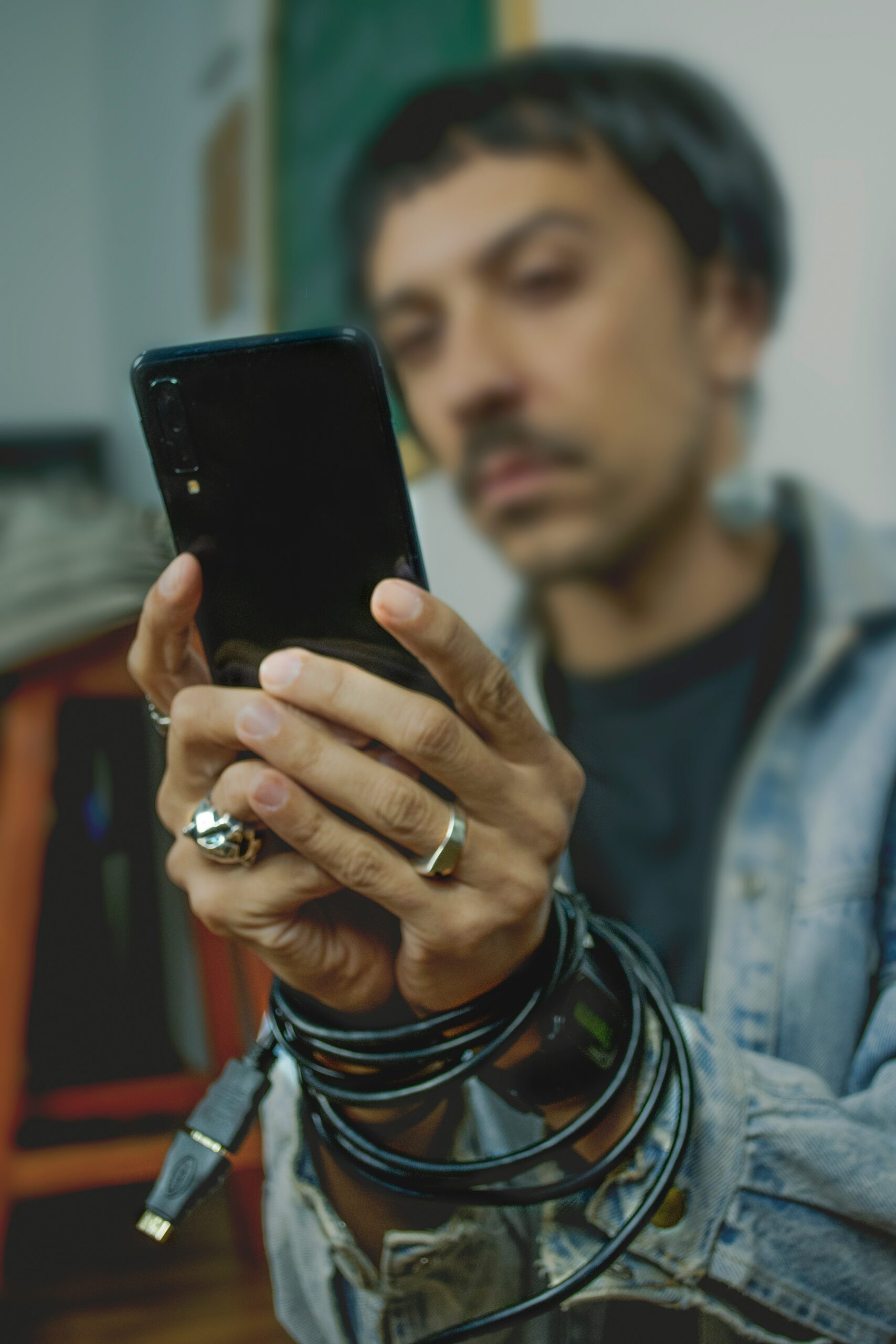
Doomscrolling At Its Finest

Some day I will die. But I will not die with a phone in my hand. 

That is my motto for 2026. I refuse to lose myself to the six-inch iPhone 15 that is sitting in my back pocket like glue. 

Toward the end of last year, I kept spending hours and hours scrolling through my social media. It seemed that no matter how hard I tried, I just kept opening up YouTube and Instagram every few minutes. I was quite literally stuck in a neverending loop that did not seem to break. So with the start of the New Year, I decided to take it upon myself to stop the doomscrolling once and for all. 

Paying attention 

While this is not a resolution per se, I chose this action because I want to live a better life without being tied to my phone. Despite using the incredibly tiny computer in my pocket, I physically felt myself trekking backwards instead of moving forward. I was so attached to my phone that at one point, I swear I became dependent on checking the invisible notifications that never came. Luckily, before the end of the year, I got the answer that I was desperately craving.

Deep in a rabbit hole of scrolling through Youtube one night, I came across a four-minute video of a creator detailing how they plan to not lose their brain in 2026. Just by paying attention for those four minutes, I actually regained the courage to put my phone down and delete what I no longer needed. 

You don’t own me

Now that we are already approaching the slow yet heavy beginning of this new year, I truly believe that I am taking the right amount of steps to regain my own, very personal sense of worth. I will no longer be controlled by a screen and altered by what is happening to my friends, family, and others on the other side of social media. I am so much more than someone who can get addicted to scrolling. Just by taking part in this needed lifestyle change, I can already notice that my attention span is slowly returning to me. My creativity as a writer still comes and goes as the constant struggle with writer’s block will truly never end, but I am continuing the pursuit. That is what matters. 

Escargot

In order to break the brain rot, I am also making sure to get back into reading. Even if I end up reading five pages a day, that doesn’t matter to me. I don’t care if I am considered a “slow reader.” I am reading despite my pace matching that of a snail. 

I know that I am staying true to my word because, for me, I can find more inspiration and draw countless amounts of creativity from a good physical book in my hands than from a device made from a battery and glass. That is worth more than anything else. Nothing can limit my infinite love of reading. 

Two weathered books stacked on top of each other. The top book is open in the middle.
(Image courtesy of svecaleksanddr249 on Pixabay)

Even in a world that is becoming illiterate, I will remain educated and constant. 

With reading (no matter the amount) I truly feel free and ready to take on any form of writing assignment there might be. Whether it’s reviewing a friend’s essay, proofreading stanzas of poetry from previous schoolwork, or even composing fan fiction, a phone can never replace a person’s creativity. 

Surrounded

If I had the choice, I would rather die surrounded by my book collection and the dust bunnies they create. I want to be tied to the books that made me, not the infinite digital footprint filled with a pile of fandoms, character edits, and a questionable and maybe concerning amount of screen time. 

I want my coffin to be filled with nothing but Brontë, works from the Romantic era, and the spice-filled book, “Dune,” that controlled my life when I was 14. I stand by these books that made me into the person and writer I am, not the cringey teen “young adult” books that are now being filled with unrealistic agendas and AI prompts. (Although the Fourth Wing franchise is fantastic). I was raised on “To Kill a Mockingbird,” “The Tell-Tale Heart,” and later in my teenage years, the “Interview with the Vampire” trilogy. As a matter of fact, I just purchased two editions of William Blake’s poetry and the uncensored version of “The Picture of Dorian Gray. Going forward, I will remain an old soul classic lover who owns more banned books than I know what to do with. 

***

Thank you to all of my real life friends who seem to be fighting the same tug of war between brainrot and anti-brainrot that I am. 

It’s nice to know that there are others who want their mind back. 

Uber and Bolt Face Mounting Safety Concerns in South Africa

Ride-hailing services Uber and Bolt, once hailed as safer and more affordable alternatives to traditional taxis, are under mounting scrutiny in South Africa. Riders and drivers are increasingly reporting incidents of violence, hijackings, kidnappings, and assaults linked to the platforms have raised urgent questions about safety gaps, weak verification systems, and sluggish emergency response mechanisms.

The recent shooting, arson and execution-style murder of 27-year-old Siyanda Mthokozisi Mvelase in Soweto, is of the many cases that have drawn public attention and the reemergence of the on-going violence between e-hailing drivers and taxi owners in South Africa. In Johannesburg, drivers have been lured to remote locations by fake ride requests, only to be ambushed and hijacked. Riders, meanwhile, have reported kidnappings in which they were driven off-route and held until relatives or friends paid a ransom. Police confirm that such incidents, once sporadic, have become worryingly frequent. Whilst no verified stats on the number of e-hailing related hijacking, it is worth noting that between January and March 2025, SAPS recorded 4,533 car hijackings nationally, down from 5,338 in the same period in 2024. Gauteng saw 2,488 hijackings which is about 55% of all hijackings in the country.

Despite these threats, Uber and Bolt continue to market themselves as safe and convenient. Both companies have rolled out safety features, such as in-app emergency buttons, ride-sharing with trusted contacts, and driver identity verification. However,  drivers and riders beg to differ, arguing that these measures have done little to close dangerous loopholes. Verification of drivers remains inconsistent, background checks are often cursory, and when users trigger the in-app emergency function, response times from security teams or law enforcement can be slow.

Drivers say they are increasingly vulnerable. “Drivers are screened but passengers are never screened… That’s how drivers get hijacked and beaten and some even get killed.” – said a Gauteng based Bolt driver, who has been working in the industry for the past two years. Many drivers operate late at night to maximize earnings, which exposes them to higher risk areas. Others complain that fare structures do not account for danger zones, forcing them into hotspots without adequate compensation or protection. In Cape Town, several drivers have begun refusing trips into informal settlements or poorly lit areas, a move that has left many commuters stranded.

The South African Police Service (SAPS) has acknowledged the surge in ride-hailing related crimes but insists that platforms must also take responsibility. “Law enforcement can only do so much. Companies have the data and technology to predict risks and alert us in real time. That isn’t happening.” Furthermore, Brigadier Athlenda Mathe, SAPS national spokesperson, said: “We have noted with concern the rising number of violent incidents targeting e-hailing drivers and passengers. SAPS is intensifying operations in known hotspots and working closely with stakeholders to ensure that perpetrators are apprehended and communities can feel safe using these services.

Globally, Uber and Bolt have faced similar controversies. In London, Uber temporarily lost its license in 2019 due to safety failings, while Bolt has faced regulatory scrutiny in several European cities over passenger protection but in South Africa, where crime levels are already among the highest in the world, the risks are magnified. Both companies insist they are investing in safety. Uber South Africa says it has expanded partnerships with private security firms to ensure faster emergency responses, while Bolt has introduced a “driver selfie verification” system aimed at reducing account takeovers by criminals. Yet riders and drivers argue that these measures are piecemeal, leaving them exposed to daily threats.

Civil society organizations are now calling for tighter regulation of the industry. The South African National Taxi Council (Santaco), which has long clashed with ride-hailing platforms, argues that Uber and Bolt must be subjected to stricter licensing and safety compliance. Others have suggested creating a central registry of vetted drivers accessible to both police and users.

For now, however, fear persists on both sides of the ride-hailing equation. As one Durban-based driver put it: “We want to work, but every trip feels like a gamble with our lives.

Until systemic gaps in safety are addressed, Uber and Bolt’s promise of safe, reliable transport in South Africa will remain under a dark cloud of mistrust.

Grandma goes to uni

“You’re lovely. You remind me of my grandma.” It wasn’t quite the sort of welcome I was hoping for at my first social event as a mature student two years ago. Remind me of my mother – I’ll accept it. Grandma – seems a step too far. However, doing the maths, it does figure. As a (very) mature student of over 60, I could indeed at a pinch have been grandma to the mostly 22-year olds on my humanities master’s at a top British university.

Being a mature student at such an elevated age was a strange and daunting experience. Technology has zoomed at quite a pace since I did my undergraduate degree. I wrote my undergrad dissertation on a typewriter – I was proud that it was an electric one, oh so advanced. Goodness only knows how I did referencing – if I even did any. I’m too scared to look back at that dissertation, which is gathering dust in my attic. Did I put any quotations in my essays I wonder? I would have had to copy those quotes down in longhand from books or journals in the library which I often couldn’t even withdraw. My fave hangout in those days was a library section called “dead periodicals”, and I was usually the only person there. No wonder the younger generation look at me today like someone just out of the Ark. I lived it, but even I find it hard to believe it.

Of course we’ve all had to get to grips with technology in our jobs, and as a news agency journalist I was used to reading fast, thinking fast and typing fast, all helpful attributes for academic study. But I have to admit now, though didn’t want to admit then, that I wasn’t too familiar even with basic programmes like Word, as we used a proprietorial editing system at work. I didn’t even know how to highlight PDFs, for example. Those 22-year-olds were streets ahead of me.

On the master’s, we were reading theoretical papers by people who often hadn’t even published when I was first at uni. Or if they had published, my university was not avant-garde enough to have us reading them. And as for the language they were written in…it took me the two years of the course, which I did part-time, to understand that there is a whole jargon of literary and cultural theory being used on the assumption that you’ve already read a bunch of theorists and understand their language. Michel Foucault, RIP, was one of the main culprits – genealogy, discourse, anyone?

 It’s hard to say quite why I chose to do a master’s when I did. The costs are high to study in Britain these days, even for domestic students. I’m trying not to think about how many luxury holidays I could have had for the price of the fees. However, after years of French evening classes I felt I wanted to delve more into the study of literature and history, and more broadly than into French studies alone. I felt the need to write essays which would require me to read books I would never normally read. I wanted to get feedback – though after the return of nine assignments with criticism of anything from my (arguably?) incorrect use of the comma to complaints that my sentences were too short, I may have got less keen on that. I did find the course constantly demanding and stimulating, however, and it’s whetted my appetite for more – I’m starting evening classes at another uni soon.

However, I wonder whether universities are doing enough to attract mature and part-time students. In Britain, fees may not be as high as for private U.S. universities, but they are high compared with elsewhere in Europe, and of course they are even higher for international students, often a mainstay of British master’s programmes. Academics tell me that the high fees, particularly for students from the European Union post-Brexit, along with the geopolitical climate and an increase in visa restrictions in the UK are deterring international students. Meanwhile, young domestic student numbers are also expected to fall due to demographic changes.

So maybe mature students could be filling that gap. Richard Hebblethwaite, head last year of the award-winning mature, part-time and carer student network at University College London, told Yuvoice he found starting a master’s in his 50s intimidating. But he soon settled in, and says that particularly as the British population gets older, universities should be making a commitment to lifelong learning. Mature students have a lot to offer, Hebblethwaite says:

“They’re a little bit more experienced in terms of life and perspectives. Many of them are not backwards in coming forward with ideas and opinions, they work well with other students in terms of project teams, and often they can initiate conversations and discussions within lectures or seminars.”

Lots of my friends and former colleagues, many much younger than me, say they would like to take a master’s degree when they retire, or before. But they are shocked to hear the cost.

So for anyone out there who would like to attract more part-time and mature students to their universities, here are my ideas, mostly based on good practice I’ve discovered around the place:

–          Provide catch-up classes ahead of the start of the year for those who’ve been away from studying for a long time.

–          For a master’s which would be full-time over one year, offer a part-time programme over three years, rather than two. It’s particularly hard to do a master’s dissertation, which usually counts for at least one-third of the course, when you are working part-time. Studying part-time while working is hard work but makes it more affordable. More time to complete would be a bonus.

–          Put modules all on one day and make it clear which day that is, so people know when they need to take time off from work for the course.

–          Spread compulsory modules evenly over the course, so part-time students in particular aren’t faced with too many modules bunched up together.

–          Masters’ degrees are expensive, so consider offering stand-alone modules, rather than the whole degree. Some universities are doing this already.

–          Offer extra-curricular short courses, ideally with some essay-writing and feedback built in. Again, this is already on offer, but not very much.

I’m sure there are all sorts of logistical reasons why these ideas aren’t feasible for many universities, but if even some of them were put into practice more regularly, I think you would soon see more than one “grandma”, or even grandpa, in a student seminar near you.

Tick, Talk

I saw your fingers twitch,
While your phone was in your pocket.
You talked about the news, and that
Artist in Phoenix you keep seeing
Everywhere, now that you are on TikTok;

The clock keeping ticking, as I wait for
You to arrive; I have not seen you much–
I know you cry a lot
When you text me, instead of calling;
We used to talk for hours,
Back at the cabin up in Maine,
The one with red clover out front,
Seafoam shutters– I remember
Watching you, watching the world–

Where did you go?