As a freelance writer, there’s always been a part of me that constantly worries about a new form of technology rendering my job obsolete.
The big one is artificial intelligence. It’s something that’s been talked about for years, but it’s become all-encompassing in 2025. Everywhere you look, companies are pivoting towards AI, whether it’s Microsoft’s Copilot, Meta AI or ChatGPT. These companies have all sought to reassure workers that AI is only being used to streamline certain menial tasks, not to replace them.But with so many layoffs happening around the world, it’s easy to see why people are worried.
I’ve been vaguely aware of generative AI tools like ChatGPT, which are designed to produce texts and images, among other outputs. While there is still that part of me that worries, I’ve always had the belief that I’ll find work because my own writing is better than an AI.
Having tried out generative AI myself, I now have a new worry: that it might not matter.
Note here that generative AI (original and creative) is bolder than traditional AI (analytical and predictive).
My experience judging generative AI
Despite my ethical objections to generative AI, I figured that I should at least try it out to see what exactly I was dealing with. As part of a recent article about how students are using AI to study, I decided to experiment with a tool to see what it was capable of.
My request was simple: Explain the pros and cons of using AI to study and present it in a table format. It did that, but it didn’t do it very well.
There were countless spelling mistakes, the table of pros and cons wasn’t completely symmetrical, and it randomly cut off at the end, halfway through the final point.
Generative AI isn’t very good, but does that even matter?
At first, I was relieved. While generative AI could potentially become a useful tool down the road, it would never be capable of producing high-quality writing that would put people like me out of a job. But then I remembered finding a major internet article written by AI.
It was about the best order to watch the Star Wars movies and TV shows. It was full of glaring mistakes, getting basic information about the timeline wrong and littered with obvious spelling mistakes. Maybe it would have seemed better to someone completely unfamiliar with the series, but even though I don’t consider myself an expert in Star Wars, I’m 100% certain that I could have written a better article.
This wasn’t found on some random no-name website; it was a highly-respected TV and video game site that has produced quality content in the past. Seeing such a poorly written, obviously AI-generated piece there was galling.
Fast forward a few years later, and generative AI is everywhere. So many ostensibly respectable outlets publishing obviously AI content, and sites like Facebook and YouTube drowning in a sea of low-effort slop.
Even if generative AI improves in the future, I doubt it’ll ever be a better writer than I am.
All right, I hope it won’t be better than me. Than I.
This thought hasn’t changed, but I’m increasingly worried that it might not even matter anymore. As more of the internet descends into AI, I might find myself out of a job.
What comes next?
As companies around the world go all in on AI, it can feel hopeless to push back. Yet I remain confident that there is, and always will be, a place for genuine human writing on the internet. You can see it on sites like Patreon: people are ready to financially support writers producing original, thought-provoking pieces. The future might look scary, but I’m convinced that there is still demand forflawed-but-human articles and that over time this demand will spell the end of generative AI as a replacement for real people.
We will continue to matter, even as “an unperfect actor on the stage.” And if Shakespeare can be unperfect, so can we still succeed.
I don’t think for a second that I’m a generationally talented storyteller, far from it. There are far better writers out there than me. Than I. But I like my work. I am proud of it. And even as technology moves ever forward, I continue to believe that I’ll find a home for my work.
That’s my story and I’m sticking to it.
Image courtesy of NomeVisualizzato via Morguefile)
It had been two years, and I’m utterly positive now: I can’t leave.
The last thing I remembered was drifting off after doing some late-night reading. And the next thing I knew, I woke up in a forest with wings attached to my back. I. Had. Wings.
Why did I have wings? I truly didn’t know. But after flying around, it seemed to be around the turn of the century. The modern world I grew up in was long gone, and I had no idea how to get back home. I spent three weeks spiraling in anxiety and fear, flying aimlessly around the woods looking for any sort of sign of where I was. The only clues I had were the lack of modern cars and the unpaved landscape—I was definitely not in any metropolitan city.
One twist of luck I discovered was my new magic affinity. My now shrunken size allowed me to fly anywhere really quickly, and the humans weren’t able to see me. I flitted around gardens and kitchens without being caught. I needed to eat somehow, and I hadn’t the faintest idea of what job I would’ve been able to get. Plus, it was still quite cold outside, so the warmth inside was hard to resist.
As I flew around the houses one night, I was peeking through the windows for any sort of entertainment on their old-school TVs when I noticed a horse and a rabbit in the middle of the room. Something deep inside told me to go in, so I slipped through and hid in a dark corner.
“What is real?” the little bunny asked the horse.
“Real isn’t how you are made. It’s a thing that happens to you,” the horse replied sagely.
Yup. I had landed myself somehow in The Velveteen Rabbit.
I had somehow become the Fairy in my favorite childhood story. When I was younger, I used to own several stuffed bunnies in the hopes of creating a real one myself. I had memorized the story by heart—but I never once wanted to be part of the story! I couldn’t accept being sent back a whole century just to make stuffed animals real.
Once the reality started sinking in, I made a beeline for the forest hollow I had now called my home. Now that I was able to use magic, outdoor living was more manageable for me. It was a far cry from the comfort I grew up in, but it was a lot easier.
(Image courtesy of Alessandro Matonti via Unsplash)
“Okay, okay, okay. I am a fairy. I am to make toys turn into real things?? The horse explains to the rabbit at the beginning of the…” I trailed off, running my memory at high speed, not trusting my recollection, and trying to find other sources of truth. Alas, it was to no avail. “I’m at the beginning of the story. The rabbit doesn’t turn real…for another half a year…”
If I were to make the rabbit real…then would I be able to go home?
A new determination filled within me. I now had a shot.
For the next few months, I began pushing the boy and bunny together: hiding the china dog, whispering in the boy’s ear that he longed for the bunny, and nudging the nanny on where to find it every time it was left behind.
Then, my time to shine had come.
I distracted the gardener and untied the bag holding the old toys to burn. That night, the velveteen rabbit rolled out. I had practiced and rehearsed for this very moment.
“You were real to the boy because he loved you,” I delivered in my most cheery voice. “Now, you shall be real to everyone.”
I scooped the rabbit up in my arms, dropped it off in the forest, and gave one final kiss. Then, I fluttered back into the shadows and watched as the rabbit explored its new life.
(Image courtesy of Laura Lumimaa via Pexels)
But I didn’t return as I had hoped.
I still had wings on my back, I could still use magic, and I was still in the story. With a light heart, I flew back to my hollow. I surprised myself when I thought about how…meaningful it felt to transform a boy’s love into a tangible wish.
So, when I saw myself still in those now-familiar woods, watching the velveteen rabbit of my childhood hopping around, I wasn’t too disappointed.
After all, there were plenty of toys to watch over.
Writer’s Note: Charles Perrault’s stories contain mature themes, specifically: violence against women and girls, sexual violence, xenophobia, cannibalism, and negative depictions of poverty.
If you wish to read his fables, discretion is advised. Many of the themes were glorified during Perrault’s lifetime, but are outdated now and are controversial in a modern context. I do not take inspiration from these controversial themes.
Hud and Grampy
From the time that I learned how to read, I gravitated towards literature and the arts. At first, it was pictures and touch-and-feel books. Later, I read chapters and The Rainbow Magic series. Post Transitional-1st when my fine motor skills began to improve, forming letters and writing sentences became easier. After school, my maternal grandparents’ house was the place where my creativity truly shined. I spent several hours there every afternoon during the week when my parents were working. Stacks of computer paper, pencils, and a stapler were tools that I regularly used. Before I learned the basics of navigating a computer, I assembled my short stories by hand.
My creative process started with the details, building the story arc without even realizing it. Next, I added the visual elements, imagery that featured characters from my own imagination. Not only did I recognize that language was important, but I knew that readability was fundamental. One side of my story was in English, and the other was in Spanish that I inaccurately gleaned from Google Translate. My grandparents fostered my interests, allowing me to have mock-storytime sessions in their living room. It didn’t matter how much it made sense, it only mattered that I tried. They resisted providing negative feedback, only giving me constructive criticism when necessary. Once I learned how to draft the pages on a computer, my grandfather simply reminded me to not use too much computer paper and printer ink — with my literary collection.
Grandmother Hud loved to read, and I enjoyed asking her questions about the dusty books on the bookshelf (including outdated encyclopedias.) I loved our frequent trips to the library during the summer when I had more time with my grandparents. My favorite genre to check out was fiction, especially the American Girls collection series by Valerie Tripp & Connie Rose Porter.
Outside of the library, my grandparents’ shelf mesmerized me with all of the colors, artwork, genres, and variety of authors. However, some items on the shelves were untouchable, fragile; very personal to my grandfather. Sometimes, I tried to quickly glance at a blue book with a yellow typeface: Perrault’s Fairy Tales, with thirty-four full-page illustrations by Gustave Doré.
For the longest period of my life, I believed that my storytelling came from my grandfather, Grampy. He was a storyteller in his own right, usually repeating tales that he had picked up during his lifetime. He adored sharing how people in the past used to tell tales by word-of-mouth before it was typical to write stories down. His words enticed me, and he knew exactly how to draw readers in.
I was a naturally curious child who wondered about our family history, about the origin of things. Where did the name Perrault come from? Who was the first person to have the namesake? Soon, this would be revealed to me.
When I was seven or eight, Grampy noticed how I attempted to flip through his prized possession when I thought he wasn’t looking. He grabbed it off of the shelf, while telling me the significance of it. Grampy described as if it was a trivia show, “See this book? Did you know that you’re related to Charles Perrault, the author of this? My dad was a Perrault.” I stared at him with amazement, thinking of how lucky I was to be related to someone like that.
(Image courtesy of Joshua Manjgo via Unsplash.)
He continued, “This book has been passed down in our family for generations. It was given to me when I was your age, and it’s my turn to pass it down to you.” It felt like a magical fairytale, unfathomable to my undeveloped mind. Grampy embellished some of it and fabricated the history of the supposed family heirloom, which in reality was published in 1969. I think he wanted me to have an even greater purpose for writing, because he believed in me when I often stood out to others.
After this a-ha moment, I reflected on what it meant for my future. In my early childhood, I constantly switched my potential career goals, going from a veterinarian, a pop star, a ballerina, a nail technician, and an author. I believe that the creative industry is the best field, based on my skills, interests, and literal heritage.
Charles Perrault was a well-known author who began his career (as an advisor and architect) through serving on the Acadèmie Française, and later, helping Louis XIV design part of the Palace of Versailles. In the 1690s, he continued writing, and released his book, “Tales and Stories of the Past With Morals.”
A version of Charles Perrault’s fairytales:
(Image courtesy of Francis Power & Charles Perrault via Wikipedia Commons)
Transcription of “Hush-a-by baby”
Hush-a-by baby On the tree top, When the wind blows the cradle will rock; When the bough breaks the cradle will fall, Down tumbles baby, Cradle and all.
This may serve as a warning to the proud and ambitious, who climb so high that they generally fall at last.
He is best known for: “The Tales of Mother Goose,” the modern version of “Cinderella,” “Sleeping Beauty,” “Puss in Boots,” “Little Red Riding Hood,” “Bluebeard,” “Little Tom Thumb.”
A version of Charles Perrault’s fairytales
(Image courtesy of Julian Bastinos and Charles Perrault via Google Books.)
How could I be related to Charles and not find out until now? I pondered on all of life’s possibilities. Everything suddenly made sense: how my brain was wired, how language, reading, and writing came easy to me; why I felt a deep desire to create literature. Writing is in my blood. In my veins, it’s in my DNA. My creativity originates from a man I never met. We are generations apart, yet we share the same passion and admiration.
(Image courtesy of Warren Umoh via Unsplash.)
I told myself that day that when I grew up, I wanted to become an author like Charles Perrault. I would work towards becoming famous, a household name. Whenever I feel like my chance of getting into the industry is dwindling away, I remind myself of what keeps me going. What makes me believe in myself. That answer is always the revelation that I had on what began as an ordinary afternoon.
My life changed that day, and it was all I could think about for the rest of the week. Last year in 2025, I started the painstaking genealogical process of figuring out exactly how we are related. Charles is my tenth great-granduncle. Not only do I trace my love for writing back to him, but the commonalities and family history are connected through physical traits, such as how Grampy strongly resembled Charles Perrault.
(Image courtesy of Academie Francaise via Wikimedia Commons.)(Image courtesy of the author.)
When I look at myself in the mirror, I don’t notice any major similarities between Charles, and Grampy, and me. The only physical trait that we share is that one side of my nose appears higher and slightly elongated from the right side profile, possibly resembling his nasal bridge.
Genetics can be tricky, especially when my maternal and paternal genetics frequently clash. I do not resemble Charles, but we are relatives.
Even though I was a child when I had my first eureka moment, it sits with me, and courses through my body. Time has passed and Hud and Grampy are no longer living, but we will always be intertwined. I will permanently be related to Charles Perrault and my grandparents, no matter what. It’s a constant bond that will never fade away.
About nine years ago, I was convinced that my life was over.
I’d graduated from university about a year before that, securing a respectable degree in journalism with good grades. Despite that, I’d left without any real idea of what I wanted to do with my life. Seeing friends with high-profile jobs and their own houses and cars took a toll on me as I struggled to find my place in the world, a calling. Watching others move forward as I felt stagnant caused me to fall into a deep depression, feeling that I had little left to live for. It began insidiously, first pressing on my mind throughout the day – small taps of worthlessness. It only grew as the time from when I had graduated stretched further and further into the past.
I can remember distinctly when I realized that something was wrong with me; it was a cold February day, shortly after my birthday. After a particularly bad dream where I was back at university, I awoke with a near-unbearable sense of despair so severe that I struggled to get out of bed. Nothing would shake the feeling.
Around the same time, my mum and brother had recently completed a beginner’s therapist course with a professional psychologist. The sessions appeared to have helped both of them. Realizing I needed outside help and seeing this as my chance, I sat down with my mum and spoke with her about my depression, my loss of joy for life. She provided me with the contact information for this psychologist so I could begin therapy immediately.
The sessions were slow at first. Despite being open to the support, I didn’t notice any progress in the first few sessions. After the third or fourth session, however, something changed. My therapist said that I already knew it to be true, despite my brain’s refusal to acknowledge it: this belief that my life was over wasn’t correct. I was only 23. Of course my life wasn’t over! I had just needed someone, a stranger, to examine my life and my thoughts and confirm that yes, I still had so much to live for. Such a simple statement, and yet it changed so much in an instant. It was like someone had shone a light in the darker corners of my mind, chasing the shadows that lingered.
You often hear about something clicking inside a person’s head, or a lightbulb lighting up. A ‘eureka’ moment, if you will. I’d never experienced anything like it until that moment. The feeling of despair began to dissipate as a result of that conversation. I was almost euphoric as I told my therapist of this breakthrough at my next session. Once I’d realised that my life was far from over, I worked with my therapist to look for ways to get my life back on track, determining how I envisioned my own success. I continued for a few more sessions, and by the end, I began to see the light at the end of the tunnel. A few months later, I went back to university, earned a master’s degree, and began my career as a writer. While my depression has never completely vanished – especially given the unprecedented nature of the last few years – I’ve become much better at identifying negative spirals and dismissing them.
Therapy saved my life
Writing about this a decade later feels weird. This belief I had held obviously wasn’t true, and it still isn’t today. I’m 32, I’ve worked as a freelance copywriter for five years now, and I recently started working with an international agency. There are still speed bumps here and there – the COVID-19 lockdown was rough, and I still have struggles with OCD and insomnia – but ultimately, I’m quite happy with my life. It’s strange to think back to a time when I was convinced that there was nothing left to look forward to.
Despite all this, I can’t help but wonder whether I would’ve experienced this eureka moment if I hadn’t gone to therapy. If I’d never seen that therapist, would I still be stuck in the depths of despair? Would I even still be here? I’d like to think that eventually, with the help of my friends and family, I would’ve been able to move past it, but I can’t know for sure. All I can be sure of is that I’m glad I got the help I needed.
It could help others like me
I’ve wondered about others who have suffered from similar thoughts. Are they able to see a therapist? Do they find the support they need? I was extremely lucky; I had money saved up to pay for visits, and my therapist provided me with a discount because he knew my parents. Even so, it was still expensive – upwards of £100 a session.
The price of therapy near me has only worsened as the cost of living crisis continues, and the NHS’s backlog means if you’re not willing to go private, you could wait years to see a therapist. There are so many people out there with the same problems that I had, but without any way to get past them. How many people are still waiting for their eureka moment? How long will it take them to chase away their shadows?
I can only hope that, as mental health awareness becomes more prevalent, the UK government will take steps to make therapy more accessible to the general public. It may not work for everyone, but it helped me understand my own brain, giving me the confidence to make connections, and kickstart my writing career.
I just hope that other people in similar situations, with or without therapy, find a light to guide them forward.
Growing up, I always thought I would get an apartment near the city. Something bigger but cozy, and not a pain to clean. It would ideally be on the cheaper side, so I could leave it every so often to go traveling, embark on big adventures, and create amazing memories.
That opportunity came soon after I finished college when I got to move to Japan as part of a cultural exchange program and live on my own for the very first time. I was excited to start my new life somewhere so far away — in a land that created the media that shaped my childhood to adulthood, abundant with delicious food, and home to so many cultural sites. I had been studying Japanese in college, so I was extra excited to interact with people and really surround myself within a new environment.
A three-year arc
Living abroad allowed me to immerse myself in the language and culture. My Japanese proficiency improved the more I applied my studies, and my confidence grew as I continued to interact and make Japanese friends. I think what really helped me become more comfortable in a foreign country were the friends I made who were also immigrants with whom I could talk and reminisce.
There were some things I missed about being in the U.S., and some more things that irked me while living in a foreign country, but all in all, I loved my life in Japan. Three years was plenty of time for me to get a feel for living on my own, become my own person, and amass a load of amazing travel experiences to think fondly of. So, when my visa expired, I decided it was time to close that chapter of my life and return to where I left my American story.
So, do I really need to be responsible?
As soon as I moved back home, I immediately moved out to live with my friend. I missed my family, don’t get me wrong, but my learned independence was too hard to give up, and I wanted to continue that lifestyle.
After having worked consistently for about eight years by then, I wanted to take my time finding a job again. At first, I wanted a break for a few months. But who knew it would take ten months to find another stable job?
Not only that, but I had to get new legal documents: my driver’s license had expired, my physical address had changed, my bank accounts had to be updated, and my passport and Global Entry also needed to be renewed.
(Image Courtesy of Nico Indii via Unsplash)
And let’s not forget: getting a phone plus a new number, a car now that I can’t rely on trains or my trusty bike anymore, another laptop now that my faithful one of six years was on its last legs, and a slew of furniture to go into my new abode. Mostly everything had to be used, of course, because I was quickly racking up credit card debt to enjoy my new solo living.
Health insurance, dental insurance, an optometrist, and new medications didn’t exactly make reintegrating back into American life any easier, either.
On top of everything else, I had to figure out my tax situation now that I was back on American soil. While living in Japan, I was also part of the mandatory pension program, so working out how to get my money transferred over, how much the fees were to take care of it in Japan, and how much taxes were going to be in California made me seriously contemplate leaving the $2,000-ish amount with the Japanese government.
My social life
Setting my life back up was an overwhelming challenge. There were so many things that needed to be accomplished in order for me to enjoy myself again. But once I was back on my own two feet, I was excited to go back out and meet up with familiar faces. I had made a couple of trips back home throughout the years, but it was never enough time to do everything I had wanted to do before I had to get back on that 12-hour flight.
It was great to be able to talk face-to-face, in real time, and to physically hold my friends and family. Re-visiting my old haunts and finding new restaurants was also an exciting adventure as I re-familiarized myself with the area.
The sad thing was that some of the friends that I thought I had close relationships with ended up fizzling out. I did my best to keep in touch with the friends I made abroad, but much of our conversations were hard to maintain due to the different countries, let alone the time zone differences. So, when I realized that some of my friends had either moved on or moved away, it felt like I missed out on the opportunity to keep our relationship intact. Not to mention finding my favorite places either closed down or changed beyond familiarity — I’ll never be able to enjoy fro-yo on my way back home from a jog ever again.
(Image Courtesy of engin akyurt via Unsplash)
But on the brighter side
Life happens. Even if I did stay in my hometown, friends would’ve moved away, I would’ve changed careers, and that corner restaurant I went to every month would’ve closed its doors eventually. The “fear of missing out” makes one try to take life on and tackle new challenges. But it can also be applied to not wanting to change, too.
What if I leave, and I end up missing these life events? I was just here last month, how is it gone already? Why should I move to somewhere I don’t know anybody?
I’ve dealt with some hard life events while in the States and living abroad in Japan. However, I don’t regret starting that new journey because it consisted of multiple smaller trips and adventures that I feel truly helped establish my character and outlook. Re-integrating myself back into my old life was challenging, but it wasn’t impossible. The experiences I gained helped me cultivate new relationships, which then led to even more exciting adventures.
Rolling with the punches is a life skill I try to maintain, and I wholeheartedly encourage anybody to try taking that leap of faith. Because more often than not, you can go back to that starting point and try again.
The biblical gardens were a fairyland. In Jean’s imagination, no one had planted the flowers, engraved the stones, or bought the benches: they had all appeared out of thin air. An angel had flown down from heaven, touched the land with a long, shining finger, and Eden had sprouted, flourished.
Mother often took Jean there to paint. “I could live without the overt Christianity,” she always said, “But something about this place calms me down.”
Jean played along the paths, in the creek, puzzled over the Bible verses, scattered throughout the garden – etched on rocks, displayed on wooden signs – as natural and essential to this place as the colony of ants that lived beside Mother’s favorite bench. Mother spent most of her time sitting there, overlooking the waterfall, often painting it, but sometimes staring at the signs with a sad, sour look on her face.
From a young age, Jean knew the real reason they came here was Grandma.
“I would have scattered her ashes here if the old bitch hadn’t insisted on being buried,” Mother told Jean again and again. “It would have been cheaper and nicer, but nope, because it would be easier on me… fuck it.”
Then she would sketch a flower, butterfly, or sometimes children playing in the garden. But none of the pictures, no matter how beautiful they were, made anyone who saw them happy. Even the butterflies, still and scrawled, came away looking sad.
To this day, one of these sketches hangs in Jean’s hallway, and she stops to look at it sometimes, just to remember the burden her mother had to carry.
In the picture, three children run down the trail, past Maudlin’s empty bench. The face of the first, a tall girl with curly brown hair that streams behind her as she runs onto the bridge crossing the creek, cannot be seen. The second is a little boy, mid-trip, his hands falling down in front of him to catch himself, his profile also not visible.
Maudlin is the third – drawn to impart the liminal: a grown-woman’s countenance plastered on a little girl’s body – turning around to stare at the voyeur looking in. Her mouth hangs open like a trap door, her eyes wide and globular, like two green planets; her arms hang limply at her sides, flopping, as if they have no bones.
…
The path through the garden is aided by several bridges, which allow the walker to zig-zag back and forth over the creek. The second, a dainty wooden arch that crosses the stream nearest the waterfall, sits deep in the garden, while the first, broader and well-worn, stands at the entrance. The thudding of Jean’s feet against the wood, drowning out the noise of Highway 49 behind her, seemed to herald her arrival, making her journey into another world complete.
A big sign that hung over the first bridge said: “Taste and See the Goodness of the Lord.” Mother always made a face whenever they walked past it, but Jean liked the idea of a god-garden. And she understood what the sign meant, too: when you experienced art, you couldn’t help but learn about the Maker.
Jean invited Jules to come with them, but only once, because not only did Mother find him annoying – “That kid talks so much about reptiles it makes me want to kill myself” – but also because Jean rightly recognized that he would be incapable of respecting the sanctity of the place.
You didn’t run in these gardens, she tried to explain, you were meant to walk slowly. Nor did you shout – you spoke in low, dulcet tones.
“It’s like church,” she warned him, “solemn.”
“You don’t go to church.”
“My grandma took me, when I was really little, like 3 or 4.”
“You can’t remember that. That’s too little to remember.”
A hazy world, blurred at the edges, like a dream:
Thick lights, streaming through the stained glass, illuminated the face of the baby, whose mother held up for all to see. She looked sad. Were all mothers sad?
Little boys, at the front of the church, dressed in white, singing like angels, or doves; the tone of each voice building on another, climbing higher and higher, further and further upward, till the whole church swam in music, till the sound, crystalizing at the tippy top of the high-ceiling, threatened to burst through the roof and obliterate the chapel in a violent, vibrating melody.
The big wooden cross loomed at the front with a man dying, sweating beads of blood – ever after. When Jean thought of her grandmother, she thought also of the statue of that man, because a moment after spotting him she turned her eyes to the ground and was shocked and frightened to find her grandmother on her knees, opening and closing her mouth without words, crying. Jean had never seen her cry before and would never witness her doing so again.
She almost reached out her little hand, like one might reach for a blooming cactus, before she remembered the touch would hurt. And her eyes again rested on the wooden cross. Jean wondered why on earth that poor man was up there, half-naked and sweating blood. And why all these people stared at him.
She asked Grandma, after service, who he was.
“That’s God,” Grandma said solemnly.
And for some reason it made sense to Jean that God was mutilated, that he bled.
“I hate church,” Jules said. “It’s boring.”
“You’ll like it here though,” Jean reassured him. “There’s a creek. And lots of lizards.”
“Well, alright,” Jules said, “I’ll come if I have nothing better to do.”
Jean frowned at his lack of enthusiasm.
…
Jules insisted on racing from the car to the garden, which confirmed that Jean’s decision to invite him had been a grave mistake. Still, it did feel wonderful to run, with her hair streaming out behind her and her feet thudding bombastically on the wooden bridge like the music of an off-beat drum. She didn’t race past the world; it bolted by her, elegantly topsy-turvy, with the speed and swiftness of light and wind.
Then her feet landed on the soft, spongy grass with relief. She wanted to sink down into it and grow burrowing roots for the cool, dark earth to hold.
Jean collapsed on the bench closest to the entry way as Jules finally came sprinting across the bridge, huffing and puffing.
“I beat you!” Jean gasped, triumphantly.
“Only ‘cause I let you win,” Jules wheezed. He took out his inhaler and brought it to his mouth, inhaling long puffs.
Jean saw Mother far away, still lingering in the parking lot, fading into the background like a tree or moss-covered rock. And the garden before her grew larger than itself—expanding into tangible imagination, a thought bubble solidified into a new, wild continent.
“I know what to play,” Jules said, excitedly. “We’ll be explorers, making maps and stuff.”
Jean considered this. “But why are there only two of us?”
“I don’t know, maybe everyone else died… and now we are running out of food.” Jules, in thoughtful contemplation, bit his lip. “You can’t be a girl, though,” he continued. “They wouldn’t have brought girls.”
“That’s not true. Lewis and Clark brought an Indian woman with them.”
“I can’t even say her name,” Jules said, “so she doesn’t really count.”
Jean frowned, wondering aloud: “It was an ‘S’ something…”
She suddenly felt it was important to remember, because this woman had existed – hadn’t she? – as much as Lewis or Clark, and she was actually more real than either of them, because she had been born from the land she traversed: sprouted up straight from the soil, rather than merely being someone who walked on top of it. Like the difference between herself and Jules – he stomped over and through places, but they never belonged to him or changed him in any way. But Jean became a part of the world she walked in, weaving a flower into her hair, scattering earth into the cuts on her fingers, welcoming water into her stinging eyes. Of course Jules wanted all the characters in the story to be stompers: unaware of the shrubbery they marred and the big boot tracks they left.
“Sacagawea!” she said triumphantly, remembering.
“Yeah, whatever. Don’t you want to play?”
“Why don’t you be the explorer, and I’ll be the Indian woman,” Jean said. “And I’ll help you learn to survive.”
In an uncharacteristic moment of self-assertion, she continued, ignoring Jules furrowed brow, and said, “We can pretend the creek’s the ocean, and you got shipwrecked here. And you don’t have any food. And if you want to survive you better become friends with me!”
Jean ran away then, ignoring Jules’ calling after her, because she didn’t want to argue, and maybe what she really wanted was to play alone – along the path, over the bridge, many waters gurgling underfoot, drowning out his voice. Up the winding trail (which ran parallel to the one Jules stood on but was separated by the creek), up the wooden steps and out of his sight – till she stood below the big wooden crucifix, with the image of the God-man, dying. She walked past him quickly because it made her sad to look at him, and continued to ascend the steps till she came to a stone table engraved with twelve men. The one in the center held out an ornate cup to the others, and the inscription sprawled beneath them, covering its length in fancy letters:
“This is my blood of the covenant, poured out for you.”
(Image courtesy of SK Stannik via Pexels)
The table and engraved goblet suggested to her a deep, disturbing magic. Witch doctors drinking the blood of their victims, magic spells and voodoo dolls, vampires lurking in the shadows. She connected it in her mind with that horrible scene in Narnia, where Aslan lay strapped to the stone table, murdered by the ghouls and goblins. It didn’t seem, for some reason, like Jules would be able to find her here. And so, in the brush a few steps beyond the table, in the shade of a large oak tree, she made her wigwam.
A tributary of the creek wound through this area, no more than a trickle this time of year, almost hidden completely by blackberry bushes. The big, shining berries dotted the branches, weighing them down. Carefully, she ventured into the thicket of thorny tendrils that tore at her clothes. Jean grabbed at the stems between the thorns and unstuck the fabric best she could. She plucked the berries nearest to her, one by one, from the bush, careful not to crush those which were juicy and overripe. But her delicate grip still pulverized many – resulting in a drain of dark, sticky blood flowing down her fingers.
Jean ate some and transported the rest to the stone table where she mashed them up with a stick. But upon poking her finger cautiously in the resulting juices and realizing the concoction was too thin and watery for her purposes, she knelt down by the nearly dried up stream and gathered some mud from the edges. Then, she mixed the mud with the mushed-up berries, creating a black paste.
One mark on the forehead. One on each cheek. One mark on the chin. Because the berries and the mud, cool and granular, now covered her skin, seeping into her pores, clogging them, she felt she knew the earth more intimately, like Sacagawea must have known it.
Jean heard Jules splashing in the creek, pounding on the ground with his feet in big, heavy beats, whooping and screaming loudly as he pretended to sail a ship on the seven seas. Everything he did affronted this place; his life force a chaotic reverberation that echoed throughout quiet earth and sky, silencing nature—scattering lizards, forcing birds to take flight.
She marked her hands with paste, then her forearms, in swirls of stars and moons, till black-red galaxies covered her body. If she were here alone, she would make a gallon of the stuff and lather herself, head to toe in it. She wondered if doing so would camouflage her and allow her to disappear against the backdrop of the ground, granting her invisibility. Or would the earth, seeing her skin turned to mud, recognize her as its own and swallow her whole?
The real world (where Mother lived, drawing somewhere, and Jules tramped) intruded on Jean’s solitude, limiting the scope of what she could become. It hung in the corner of her mind, frowning, reminding her always that she could not cover her whole body in mud and that she was not really an Indian. But her desire for this not to be true became so intense that, when Jules began to call her, Jean did not answer.
She was a Native American woman, cautious of this strange, noisy, pale man. She must not let herself be seen, but instead, observe the stranger, see if he was her friend or foe.
“Jean, where’d you go?” Jules called. His footsteps – thud, thud, thud – resounding from below, came closer. She must hide. Furtively, Jean slipped behind the stone table, behind the large wooden cross that overshadowed it, which marked the boundary of the garden. All that lay before her was a hedge of thick blackberry bushes. For a moment she felt trapped, until she realized: why shouldn’t these be her home? Wouldn’t the thorns, with white tips like teeth, protect her?
Only, they would hurt her, too. She cautiously grabbed one of the branches between the thorns, and then, with less care, grabbed another, accepting the painful pricks. She could hear Jules coming up the trail toward the stone table, closer and closer, so she abandoned all caution, covered her face with her arms, and waded head first into the blackberries.
Thorns scratched and tore at her arms, legs, and hands, creating so many cuts that she didn’t know where to focus on the pain. But Jean kept going until she knew the shrub had become her shroud. She crouched there, in the middle of the bush, the thorns hovering all around her like hungry fangs, savoring her, so if she moved even a centimeter they gnawed. She watched as a big scratch on her bicep produced a thin trail of blood, quickly filling the fleshy, thorn-carved trench it originated from and overflowing, trickling down her forearm. Still, she remained motionless.
And Jules’ feet – thud, thud, thud. “Jean?”
He stood before the stone table, only feet away, but he could not see her. The ability to watch him, undetected, filled Jean with an exhilarating sense of power. She knew more than him – could see more; he was at her mercy.
He looked this way and that, calling her, a slight panic crouching in the corner of his eye. “Jean, where’d ya go? You’re always disappearing,” he howled. Frustrated, he kicked the stone table. “Ow! Ow! Owww!”
Jean, counting on his preoccupying pain, snuck out of the bushes as silently as she could and routed him from behind. She felt like a snake in the garden, quiet, crafty, shrewd.
His eyes rose from his foot; seeing her there; a millisecond’s pause to take in her form – the berry juice paint, the scratches, the trickling blood; then, a delayed scream, high-pitched, and a hop backwards, so he almost fell onto the stone table.
His eyes opened wider still. Jean pantomimed an imaginary bow and arrow, strung taunt and ready to fly at his face. “Jeeeeez Jean, how’d you…?”
“Shhhh,” she whispered, like a narrator speaking to her reader in an aside, “we’re still playing.”
Editor’s Note: This piece is an example of the Japanese “rensaku” poetic form, a collection of haiku poems that connect with one another to create an overarching narrative.
Lifetime Haikus
A shimmer, shadow Wrapped in swaddle, to blossom In a mud puddle.
One learns to love the Days lost to scraped knees, teary Eyes, hugs that mend all.
Then the legs grow, the Arms reach out, fingers spread, The heart finds color.
You love her, lost the Fears you had handing her bruised Daisies, wrapped with bows.
She found you, held the Bouquet close, and you closer, Even after dawn.
Her hand is on your Chest, warm, serene, securely Yours– you breathe her in.
Your daughter is born, Her eyes still closed, she is safe Against your bare chest.
Everything is hard, Harder than you ever thought It would be to love.
A part of you shrinks as She grows, no mud to muddle, You love her. You lose.
She scrapes her knees as Yours feel heavier, all Steps forward for her.
You lost her mother, You lose yourself, but see her Still, as your heart breathes.
Your lass lingers less At home, begins her own way. “It’s alright, sweetie.”
She left today. You’re So happy to see her eyes Closed again; you hug.
Everything mending, She shimmers, the car drives east, Casting more shadows.
You lose you, again… Sit there, reading her letters, As your hair thins, grays.
She visits, her wife And son– the image of you– Hug you, eyes open,
As hers crinkle closed, Like her mother’s; you miss them Both, brutally now.
On your knees, at the Cemetery, your eyes mist, In the fog. You loved.
The photographs blur, Just a bit, and your daughter’s Voice sounds less like home.
“It’s alright–,” colors Paint your heart in antique grays, Blue, bruised arms that grasp,
That cling on, fingers Spread wide, on your chest, as you Still remember them.
You thank the world, Watch the rain, the mud puddles, Hold the daisies, bruise them.
The darkness grows, as Your crinkled eyes close, nothing To lose. You were loved.
The Iranian New Year arrives with spring, or perhaps it is more accurate to say that spring finds its meaning through the Iranian New Year.
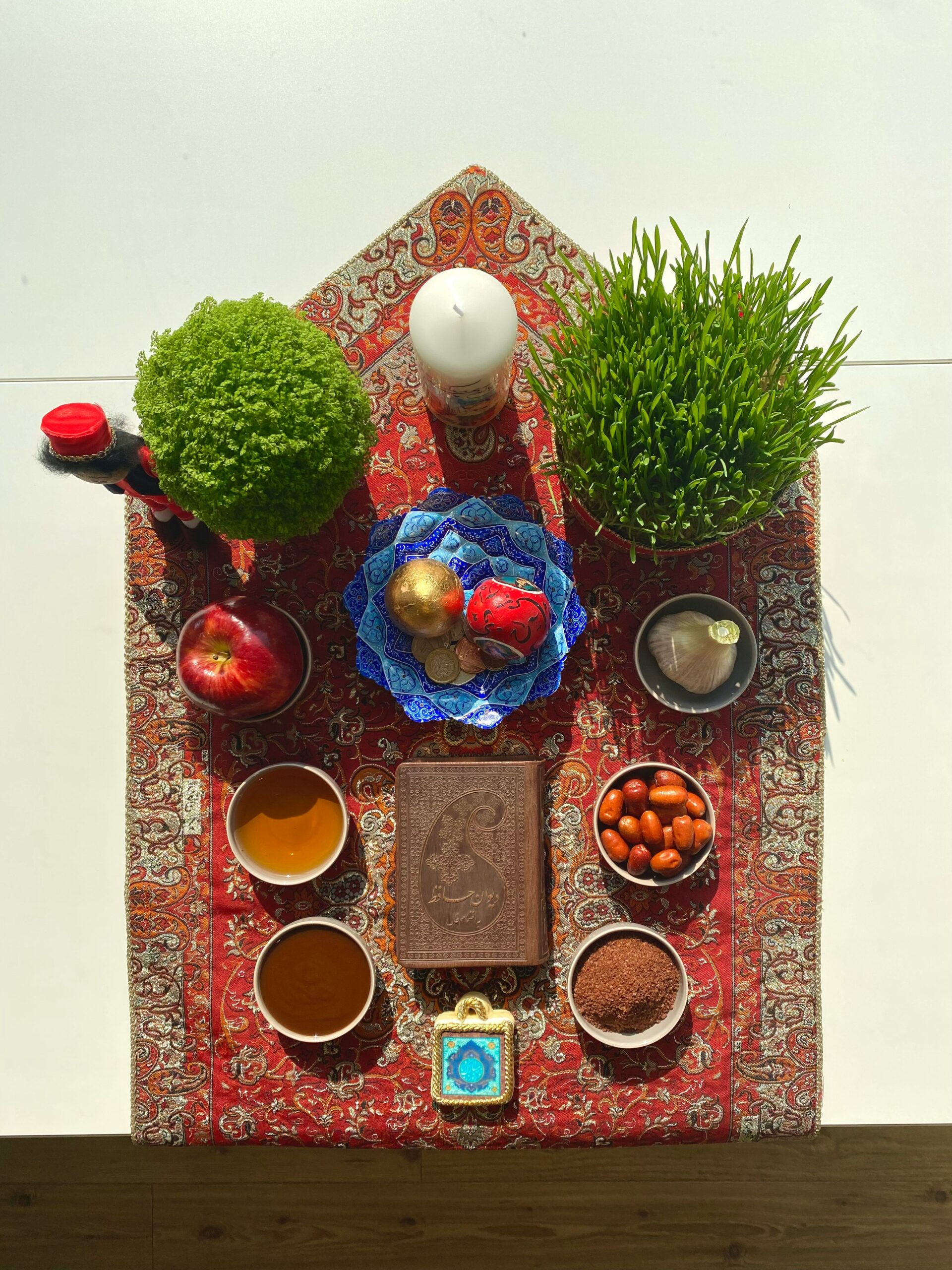
One of our most beautiful traditions is setting the Haft-Sin table — seven symbols starting with “S” that represent life, hope, rebirth, and continuity. But this year, for Iranians across the world, there is one more “S”: Soghoot (Collapse.)
Collapse; a word that begins with the same letter in Persian, yet carries with it a weight of pain, anger, and at the same time, hope.
For years, Iranians have chanted: “This is the year of blood; the regime will fall.” But each time, before any fall could happen, it was these innocent people who fell to the ground; it was these dreams that shattered; it was these lives that were extinguished.
And yet, each time — like a phoenix — they rose from the ashes, with wounded bodies and exhausted souls, but still standing.
Who could have believed that after the massacre of January 2026, after so many lives were cut short, one could even think of spring? The grief was so overwhelming that even uttering the word “freedom” had become difficult; a word whose cost proved far greater than we had ever imagined, and the brutality that stood against it was beyond any nightmare.
But only twenty days ago, at 9:33 in the morning local time on the 28th of February 2026, news shook the world: an attack on the “House of the Leader.”
A place that for years symbolized power and repression suddenly became an epicenter of collapse. No one believed that a dictator who called himself the “Leader of the Muslims of the world” — and who had been hiding underground after the 12-day war in the summer of 2025, leading him to be unofficially crowned with the derogatory alias of Mooshali (mouse in Farsi) — could have been killed in such an attack.
It took a full day for the news to be confirmed. And once again, during the dawn call to prayer.
For Iranians, the call to prayer at dawn is not just the beginning of a day; it is a chilling reminder of the hours when executions took place, before sunrise. How many nights did we stay awake until dawn, in anxiety and helplessness, wishing that maybe this time… maybe this young person, this athlete, this activist, this unnamed human being… would survive.
And now, the announcement of the dictator’s death at that very moment, at the dawn call to prayer felt, for many, like cooling water poured over burning hearts.
The morning after was a different morning. A morning that — even if it marked the beginning of another war — carried the scent of liberation.
Twenty days have passed since that day. An intense war is underway, with multiple countries involved in the Persian Gulf region and the engagement of two major armies. Yet despite all this, the number of casualties still cannot be compared to the massacre that took place in just a few hours.
Today, the world is less shocked by the war than by the “continued resistance of the regime.” But how could they understand, when for years they chose to look away?
Over the last 47 years, many countries that claim to uphold human rights not only remained silent, but through their actions, granted legitimacy to this monstrous regime.
And they still fail to understand that a government that massacres its own people has no hesitation in setting the world on fire and destroying the ancient land of Iran.
To this day, not a single country has officially closed its embassy in Tehran, nor expelled the ambassadors of this regime.
But the people of Iran see all of this clearly, and without forgetting.
When the “right side of history” is more visible than ever, yet political interests outweigh human values, surely this should serve as a warning sign for the citizens of those very countries.
Meanwhile, the power structure in Iran remains in the hands of the terrorist authority, the Islamic Revolutionary Guard Corps, which has controlled the country for years. And just today, before the New Year, they offered a “gift” to Iranians; they executed three protesters of the uprising in January, again at prayer time. That is why Iranians fear the survival of this inhuman regime more than missiles.
And now, a new leader, the son of that same dictator, has been chosen, carrying the same veneration of violence, and one even more rigid than before. A leader whose voice the people have not even heard, and whose very existence, whether alive or dead, is uncertain, yet his alias, Mooshtaba (from the lineage of a mouse, as his father’s alias was Mooshali, and a distorted form of his real name Mojtaba), speaks volumes about how local people view this continuity.
But what has not changed is the voice of the Iranians.
Iranians who still chant: “Death to Khamenei.” While during the lifetime of the first leader of this regime, no one publicly chanted “Death to Khomeini,” and his funeral was held with the utmost pomp and circumstance.
And now, 36 years after his death, the body of the dictator, who was killed on a cold winter day, remains unburied.
This is the fate of a dictatorship that denied families the right to mourn. that buried bodies at night, without names; that broke gravestones so that memories would be erased.
And yet, the names and memories of those loved ones were not erased; they were etched into the hearts of the people.
And today, that same dictator remains without a name, without a grave.
As if the soil of Iran, stained with the blood of its children, refuses to accept his cursed body.
During these years of resistance, Iranians have always said: even if only one of us remains, it will be enough to dance on your grave. And now, there is no grave to dance upon.
And may this be a stark lesson for dictators: how one can fall from the height of power to utter humiliation in less than half a century, despite all the massacres and crimes.
Last year was a year filled with pain. A pain that neither fades nor is forgotten. A massacre whose full dimensions are still unknown, yet one that is forever seared into the collective memory of Iranians.
And yet hope was never extinguished.
This year, among the Haft-Sin, there stands one more “S”:
Soghoot (Collapse)
A collapse we waited for, for years. A collapse we paid for with our lives. And a collapse that perhaps — marks a new beginning for life, freedom, and a spring that, this time, belongs to the people.