It took a full day for the news to be confirmed.
And once again, during the dawn call to prayer.
For Iranians, the call to prayer at dawn is not just the beginning of a day;
it is a chilling reminder of the hours when executions took place, before sunrise.
How many nights did we stay awake until dawn, in anxiety and helplessness, wishing
that maybe this time…
maybe this young person, this athlete, this activist, this unnamed human being… would survive.
And now, the announcement of the dictator’s death at that very moment, at the dawn call to prayer
felt, for many, like cooling water poured over burning hearts.
The morning after was a different morning.
A morning that — even if it marked the beginning of another war — carried the scent of liberation.
Twenty days have passed since that day.
An intense war is underway, with multiple countries involved in the Persian Gulf region and the engagement of two major armies.
Yet despite all this, the number of casualties still cannot be compared to the massacre that took place in just a few hours.
Today, the world is less shocked by the war than by the “continued resistance of the regime.”
But how could they understand, when for years they chose to look away?
Over the last 47 years, many countries that claim to uphold human rights
not only remained silent,
but through their actions, granted legitimacy to this monstrous regime.
And they still fail to understand that a government that massacres its own people has no hesitation in setting the world on fire and destroying the ancient land of Iran.
To this day, not a single country has officially closed its embassy in Tehran,
nor expelled the ambassadors of this regime.
But the people of Iran see all of this clearly, and without forgetting.
When the “right side of history” is more visible than ever,
yet political interests outweigh human values,
surely this should serve as a warning sign for the citizens of those very countries.
Meanwhile, the power structure in Iran remains in the hands of the terrorist authority, the Islamic Revolutionary Guard Corps, which has controlled the country for years. And just today, before the New Year, they offered a “gift” to Iranians; they executed three protesters of the uprising in January, again at prayer time. That is why Iranians fear the survival of this inhuman regime more than missiles.
And now, a new leader, the son of that same dictator, has been chosen, carrying the same veneration of violence, and one even more rigid than before.
A leader whose voice the people have not even heard, and whose very existence, whether alive or dead, is uncertain,
yet his alias, Mooshtaba (from the lineage of a mouse, as his father’s alias was Mooshali, and a distorted form of his real name Mojtaba), speaks volumes about how local people view this continuity.
But what has not changed is the voice of the Iranians.
Iranians who still chant: “Death to Khamenei.”
While during the lifetime of the first leader of this regime, no one publicly chanted “Death to Khomeini,”
and his funeral was held with the utmost pomp and circumstance.
And now, 36 years after his death,
the body of the dictator, who was killed on a cold winter day, remains unburied.
This is the fate of a dictatorship that denied families the right to mourn.
that buried bodies at night, without names;
that broke gravestones so that memories would be erased.
And yet, the names and memories of those loved ones were not erased;
they were etched into the hearts of the people.
And today, that same dictator remains without a name, without a grave.
As if the soil of Iran, stained with the blood of its children,
refuses to accept his cursed body.
During these years of resistance, Iranians have always said: even if only one of us remains, it will be enough to dance on your grave.
And now, there is no grave to dance upon.
And may this be a stark lesson for dictators: how one can fall from the height of power to utter humiliation in less than half a century, despite all the massacres and crimes.
Last year was a year filled with pain.
A pain that neither fades nor is forgotten.
A massacre whose full dimensions are still unknown, yet one that is forever seared into the collective memory of Iranians.
And yet
hope was never extinguished.
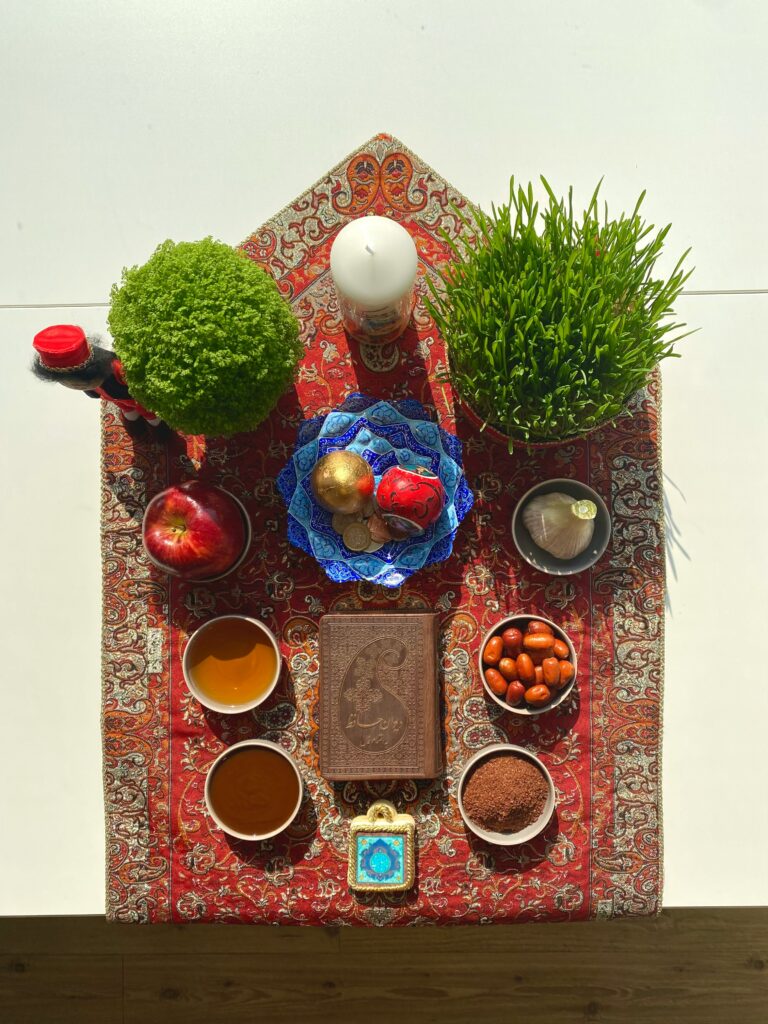
This year, among the Haft-Sin,
there stands one more “S”:
Soghoot (Collapse)
A collapse we waited for, for years.
A collapse we paid for with our lives.
And a collapse that perhaps — marks a new beginning for life, freedom, and a spring that, this time, belongs to the people.



Comments
Be the first to share your thoughts!
We value diverse perspectives and respectful debate.