
Mother Goose and Uncle Charles Perrault

Writer’s Note: Charles Perrault’s stories contain mature themes, specifically: violence against women and girls, sexual violence, xenophobia, cannibalism, and negative depictions of poverty. 

If you wish to read his fables, discretion is advised. Many of the themes were glorified during Perrault’s lifetime, but are outdated now and are controversial in a modern context.
I do not take inspiration from these controversial themes.

Hud and Grampy

From the time that I learned how to read, I gravitated towards literature and the arts. At first, it was pictures and touch-and-feel books. Later, I read chapters and The Rainbow Magic series. Post Transitional-1st when my fine motor skills began to improve, forming letters and writing sentences became easier. After school, my maternal grandparents’ house was the place where my creativity truly shined. I spent several hours there every afternoon during the week when my parents were working. Stacks of computer paper, pencils, and a stapler were tools that I regularly used. Before I learned the basics of navigating a computer, I assembled my short stories by hand.

My creative process started with the details, building the story arc without even realizing it. Next, I added the visual elements, imagery that featured characters from my own imagination. Not only did I recognize that language was important, but I knew that readability was fundamental. One side of my story was in English, and the other was in Spanish that I inaccurately gleaned from Google Translate. My grandparents fostered my interests, allowing me to have mock-storytime sessions in their living room. It didn’t matter how much it made sense, it only mattered that I tried. They resisted providing negative feedback, only giving me constructive criticism when necessary. Once I learned how to draft the pages on a computer, my grandfather simply reminded me to not use too much computer paper and printer ink — with my literary collection. 

Grandmother Hud loved to read, and I enjoyed asking her questions about the dusty books on the bookshelf (including outdated encyclopedias.)  I loved our frequent trips to the library during the summer when I had more time with my grandparents. My favorite genre to check out was fiction, especially the American Girls collection series by Valerie Tripp & Connie Rose Porter. 

Outside of the library, my grandparents’ shelf mesmerized me with all of the colors, artwork, genres, and variety of authors. However, some items on the shelves were untouchable, fragile; very personal to my grandfather. Sometimes, I tried to quickly glance at a blue book with a yellow typeface: Perrault’s Fairy Tales, with thirty-four full-page illustrations by Gustave Doré

For the longest period of my life, I believed that my storytelling came from my grandfather, Grampy. He was a storyteller in his own right, usually repeating tales that he had picked up during his lifetime. He adored sharing how people in the past used to tell tales by word-of-mouth before it was typical to write stories down. His words enticed me, and he knew exactly how to draw readers in.

I was a naturally curious child who wondered about our family history, about the origin of things. Where did the name Perrault come from? Who was the first person to have the namesake? Soon, this would be revealed to me. 

When I was seven or eight, Grampy noticed how I attempted to flip through his prized possession when I thought he wasn’t looking. He grabbed it off of the shelf, while telling me the significance of it. Grampy described as if it was a trivia show,  “See this book? Did you know that you’re related to Charles Perrault, the author of this? My dad was a Perrault.” I stared at him with amazement, thinking of how lucky I was to be related to someone like that.  

An adult creating a family tree from painted fingerprints and the outline of tree branches.
(Image courtesy of Joshua Manjgo via Unsplash.)

He continued, “This book has been passed down in our family for generations. It was given to me when I was your age, and it’s my turn to pass it down to you.” It felt like a magical fairytale, unfathomable to my undeveloped mind. Grampy embellished some of it and fabricated the history of the supposed family heirloom, which in reality was published in 1969. I think he wanted me to have an even greater purpose for writing, because he believed in me when I often stood out to others.

After this a-ha moment, I reflected on what it meant for my future. In my early childhood, I constantly switched my potential career goals, going from a veterinarian, a pop star, a ballerina, a nail technician, and an author. I believe that the creative industry is the best field, based on my skills, interests, and literal heritage. 

Charles Perrault was a well-known author who began his career (as an advisor and architect) through serving on the Acadèmie Française, and later, helping Louis XIV design part of the Palace of Versailles.  In the 1690s, he continued writing, and released his book, “Tales and Stories of the Past With Morals.” 

A version of Charles Perrault’s fairytales:

A 1760 French-to-English translation of a nursery rhyme, “Rock-a-by Baby” from Perrault’s written work, Contes de ma mère I’Oye: Mother Goose Tales. Above the lyrics is an image of a mother rocking her baby in a bassinet.
(Image courtesy of Francis Power & Charles Perrault via Wikipedia Commons)

Transcription of “Hush-a-by baby”

Hush-a-by baby On the tree top,
When the wind blows  the cradle will rock;
When the bough breaks the cradle will fall,
Down tumbles baby, Cradle and all.

This may serve as a warning to the proud and ambitious, who climb so high that they generally fall at last. 

He is best known for: “The Tales of Mother Goose,” the modern version of “Cinderella,” “Sleeping Beauty,” “Puss in Boots,” “Little Red Riding Hood,” “Bluebeard,” “Little Tom Thumb.” 

A version of Charles Perrault’s fairytales

An 1883 version of La Cenicienta ó La Chinela de Cristal, or Cinderella and the Glass Slipper. The illustration shows a young woman sitting on a bench with her arms on her lap.
(Image courtesy of Julian Bastinos and Charles Perrault via Google Books.)

How could I be related to Charles and not find out until now? I pondered on all of life’s possibilities. Everything suddenly made sense: how my brain was wired, how language, reading, and writing came easy to me; why I felt a deep desire to create literature. Writing is in my blood. In my veins, it’s in my DNA. My creativity originates from a man I never met. We are generations apart, yet we share the same passion and admiration.

DNA double helix strands on a black background.
(Image courtesy of Warren Umoh via Unsplash.)

I told myself that day that when I grew up, I wanted to become an author like Charles Perrault. I would work towards becoming famous, a household name. Whenever I feel like my chance of getting into the industry is dwindling away, I remind myself of what keeps me going. What makes me believe in myself. That answer is always the revelation that I had on what began as an ordinary afternoon. 

My life changed that day, and it was all I could think about for the rest of the week. Last year in 2025, I started the painstaking genealogical process of figuring out exactly how we are related. Charles is my tenth great-granduncle. Not only do I trace my love for writing back to him, but the commonalities and family history are connected through physical traits, such as how Grampy strongly resembled Charles Perrault.

A 1697 photo of Charles Perrault  in his late 60s, taken by Gérard Edelinck. His right hand is on top of a book.
(Image courtesy of Academie Francaise via Wikimedia Commons.)
A 56-year-old Grampy holding his infant granddaughter.
(Image courtesy of the author.)

When I look at myself in the mirror, I don’t notice any major similarities between Charles, and Grampy,  and me. The only physical trait that we share is that one side of my nose appears higher and slightly elongated from the right side profile, possibly resembling his nasal bridge. 

Genetics can be tricky, especially when my maternal and paternal genetics frequently clash. I do not resemble Charles, but we are relatives. 

Even though I was a child when I had my first eureka moment, it sits with me, and courses through my body. Time has passed and Hud and Grampy are no longer living, but we will always be intertwined. I will permanently be related to Charles Perrault and my grandparents, no matter what. It’s a constant bond that will never fade away.

Former President and Brazilian Generals Arrested for Attempted Coup for the First Time in Brazilian History

The former President of Brazil, Jair Messias Bolsonaro, has been definitively sentenced to 27 years in prison by the Supreme Federal Court on the afternoon of this Wednesday (25), in Brasília, the Federal Capital ( where the military resided). There, the former parliamentarian and retired captain of the Brazilian Army will initially be held in a Federal Police superintendent’s office., There are no further appeals available for the defendants in this case.

Former President Jair Bolsonaro had already been preventively arrested by the Brazilian Federal Police at sunrise last Saturday, November 22, at his residence in a luxury condominium in the capital of Brazil, Brasília. The former president attempted to tamper with the electronic ankle bracelet that monitored him, using a welding iron, which led to his preventive arrest and the subsequent suspension of the house arrest he had been serving since August 2025, due to the alleged escape risk. Until then, the convicted could appeal the conviction in the process, but the deadline ended this Tuesday.

In addition to the former president, Generals Augusto Heleno and Paulo Sérgio Nogueira, participants in the former Bolsonaro government, will also begin serving their definitive sentences (21 and 19 years, respectively) in a military barracks. Admiral Almir Garnier will be held in a military radio station of the Brazilian Navy. General Braga Neto, who ran for vice president in the 2022 elections, had already been in preventive custody for 11 months in a barracks in Rio de Janeiro, where he will remain. Former Minister of Justice Anderson Torres, who is not military, will go to the Papuda prison in Brasília.

The definitive arrest order was issued by Minister Alexandre de Moraes, the rapporteur of the judicial process that had already sentenced former President Jair Bolsonaro and others involved in an attempted coup at the end of 2022. At that time, Bolsonaro and the other convicted did not accept the electoral results of that year, which indicated the victory of the current president Luiz Inácio Lula da Silva and the unelection of thenPresident Jair Bolsonaro. It was the first time in Brazilian political history that a sitting president was unable to be re-elected to continue government. 

It is also the first time in Brazilian history that military personnel have been convicted for attempted coups. Brazilian historians point to up to nine coups since the end of the Brazilian monarchy. It should be noted that, whilst there is controversy among scholars regarding the counting of coups against the Republic, no fewer than nine coups have been cited.. In the 136 years since the abolishment of the monarchy, seven coups were successful, each with varying degrees of military participation.

In recent interviews with The Washington Post, three researchers paid attention to the unprecedented nature of the punishment of Brazilian military personnel. According to historian Lilia Schwarcz from the University of São Paulo, “Brazil carries two pacts of silence: the silence about slavery and the violence it produced, and the silence about the military. That’s why this case is so symbolic.” Carlos Fico, a professor at the Federal University of Rio de Janeiro, emphasized the aforementioned numerical issue concerning historical coups and, despite the high number, the absence of punishment: “For decades, I have studied more than 12 coups and coup attempts, and all resulted in impunity or amnesty. This time will be different…” Finally, political scientist Matias Spektor from FGV (Getúlio Vargas Foundation) points out the seriousness of the leniency against public officials who have the right to use weapons: “The country has never imprisoned anyone who had access to state weaponry. This is revolutionary.”

The Magic of Writing Christmas Greeting Cards

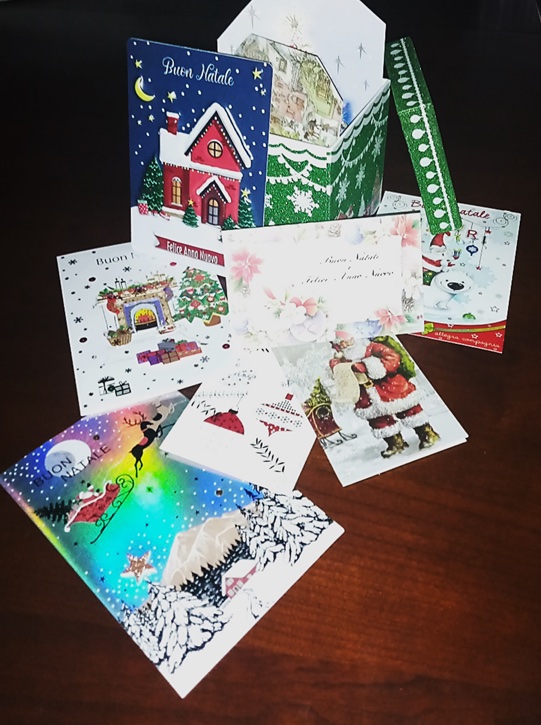
The world moves on, times change, and technology continues to invade our lives. Yet every year, as Christmas approaches, I open the “box of memories” where I keep not only the letters I exchanged with my teenage friends when social media didn’t exist but also the old postcards and greeting cards that were used to exchange holiday wishes into the 90s (and some into the early years of the new millennium).

As I look at them with nostalgia, I wonder if technology has made us lose our taste for anticipation and surprise. There was something magical about opening an envelope sent by relatives and distant friends, each sharing a bit of themselves and their lives. Those with little imagination limited themselves to a brief update on the health, work, or studies of their children and cousins. Others, like my mother and grandmother, devoted themselves to writing long messages expressing the joy of reconnecting with those they couldn’t see all year because of distance or family obligations.

The practice of Christmas cards dates back to the Victorian era, and the first illustrated postcard was commissioned in 1843 by Henry Cole, the director of The Victoria and Albert Museum in London. In the years that followed, there was a real boom, and postcards were printed by the thousands.

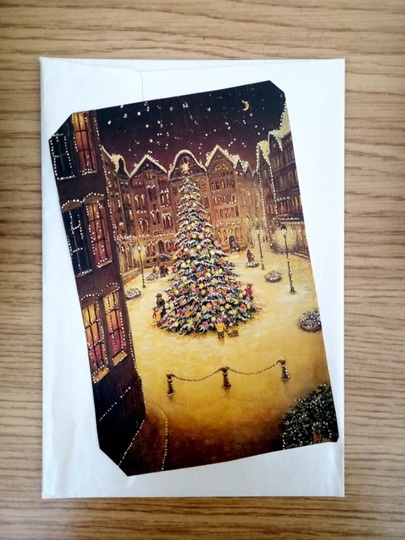
In the 1920s, Christmas stamps became popular both in Italy and English-speaking countries for sealing letters. The money from their purchase was donated to the Red Cross and other charities. When I was a child, my mother used to buy postcards from the Only Painters Artists Mutilated Charity Association of the City of Verona, the charity supporting disabled artists in the city of Verona, which still exists today. They sold paintings and artwork created by artists who used their mouths and feet to create their works. Many illustrations were incredibly beautiful and evocative, such as those by painter Jolanta Borek Unikowska (1990s).

 A Christmas card featuring a Christmas tree ornately decorated in a town square.
(Image courtesy of Viviana De Cecco)

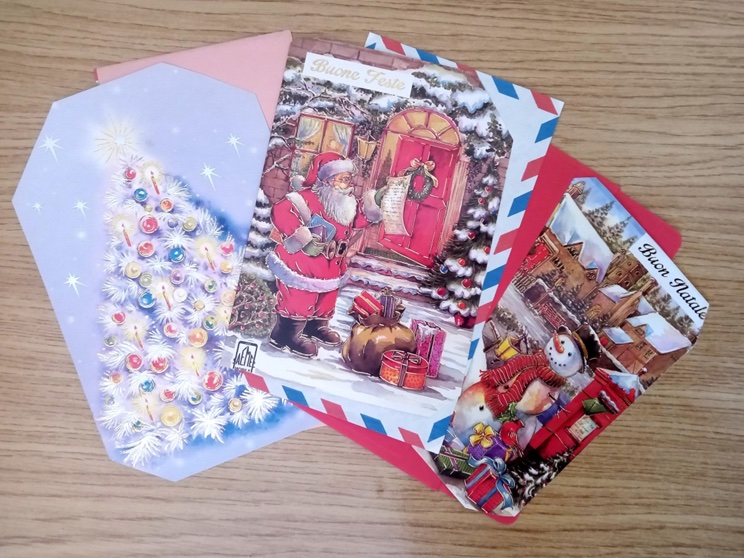
Old postcards have always held an extraordinary power for me. They transport me to a time that no longer exists. My favorites were those depicting snowy landscapes with tall trees illuminated in remote villages, and reindeer pulling sleighs through the snow. I especially treasure the postcards from the SAEMEC publishing house that specializes in this type of card, which have now become rare and collectible items and thus often sold on the internet.

A series of Christmas cards in various traditional styles.
(Image courtesy of Viviana De Cecco)

Here, on the island of Sardinia, snow is a rarity. In the past hundred years, in the town where I was born, we may have seen it four times at most. When I was a child, it wasn’t common to go on a skiing vacation, though few could afford a vacation in the mountains. So those postcards opened the doors of my imagination and, like in a fairy tale, I felt drawn to unknown worlds where fantastic beings like elves and snowmen with human features smiled at me from the paper. Sometimes the subjects were religious, while at other times they were limited to Santa Claus traveling on his sleigh with sacks bursting with gifts.

Each postcard was personalized, and since my mother had taught me to draw, I often added small pencil illustrations colored in with crayons or markers. I loved to spend hours hunched over the pages, letting my creativity run wild, thinking about what to write, and carefully choosing the most appropriate words for the recipient.

Christmas festivities began when the cards were mailed in early December, with the fear that the mail might be late. They were usually folded in half with the standard phrases for everyone inside but the rest of the page was left blank so that the sender could add his or her own special message.

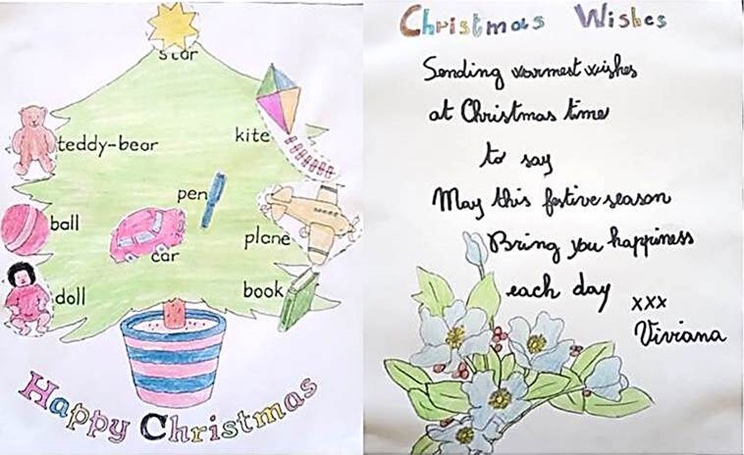
Also, at school, just before the holidays, teachers encouraged children to make rhymes, collages, or drawings to decorate the little cards they would give to their parents on Christmas Eve. I still have the card my English teacher had us make, which combined teaching and fun to stimulate each student’s creativity.

Two Christmas cards side by side, featuring adolescent decoration. 
(Image courtesy of Viviana De Cecco)

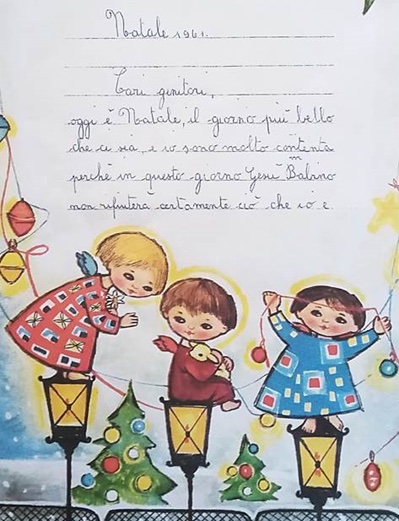
In 1961, my mother, six years old at the time, also wrote Christmas cards to her parents. Her old postcards show that, at that time, it was customary to include prayers for the health of the whole family. Gifts did not matter much compared to the health and happiness of loved ones.

A Christmas card, featuring children with writing in Italian. 
(Image courtesy of Viviana De Cecco)

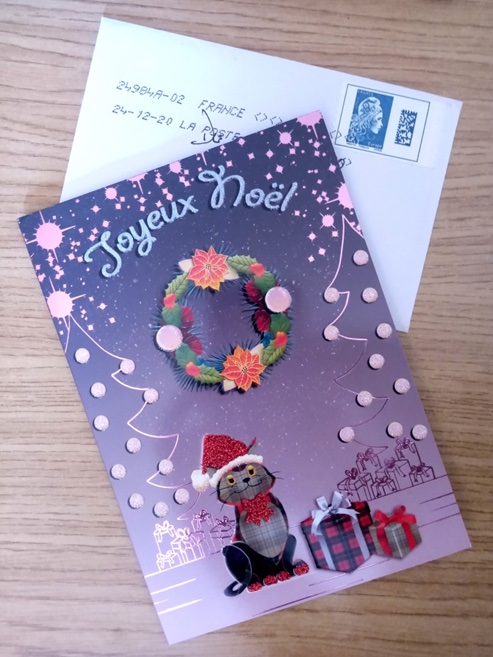
In the 1970s, my paternal uncles emigrated to France, and since we could only see them in the summer, my father began sending them Christmas cards. It became a tradition that repeated itself every year on time, and today that tradition continues with my cousin, now an adult like me. The message on the cards that he buys is, of course, in French, but he likes to try his hand at Italian sometimes, though he isn’t fluent. It’s his way of celebrating his father’s and uncle’s heritage.

A French Christmas card, featuring a wreath and a black cat. 
(Image courtesy of Viviana De Cecco)

In today’s world, perhaps the immediacy of instant messaging has broken that spell of anticipation that had us waiting at the windows for the postman. Or, on the contrary, perhaps it has brought us closer to those who, for various reasons, cannot be with us for the holidays. Perhaps the answer is somewhere in between.

With the advent of the internet, we have grown used to being bombarded with thousands of images scrolling across our phone screens. Sometimes, I confess, I look at them too quickly to admire them one by one. Often, I’m in such a hurry that I don’t even take the time to quietly observe the details. A part of me feels guilty because I know how much care, passion, and love an artist puts into creating their work.

When I hold my old postcards in my hand, it’s instinctive for me to stop and take in what’s in front of me, to enjoy a moment just for me, where I can let go of memories and feelings.

Maybe technology has made us neglect that a little bit. We are so distracted by animated digital visuals, that we don’t have the time to focus on the sensations that the words evoke in us. It seems like a kind of consumerism where we move from one thing to another without fully enjoying it.

I can say that technology has its positive sides, such as enabling us to share anything almost anywhere. I recently joined two Facebook groups, one in Italian and one in English, where some nostalgic people post photos of old hand-illustrated Christmas postcards. It’s getting harder and harder to find them in stores, and few people still use the postal service to send greetings, but it’s nice to know that there are other people in the world who share my interests.

Memories are a valuable resource for all of us because, after all, we know that even history is made up of a thousand life stories of unknown people. And just as the letters and postcards of those who have gone before us are preserved in the Postal Museum in London, I, too, keep the memory of the words of those who have loved me alive in my little box of memories. 

Your Body, Your Choice

Men questioning women today is the norm. Why? Because less freedom means less opportunities to make the ‘wrong choice,’ I guess. The freedom we have today presses their buttons because they are losing power. There is no question there. In light of the Roe vs Wade verdict (when the Supreme Court of the United States overturned the right to abortion, upheld for decades), there is an obvious and cowardly attempt to wrest this power back. 

How are they doing it? 

By going backwards into the past. 

Not only are old rules being brought back and new rules being written to restrict women, but the archaic argument of a “perfect summer body” is making its way to the forefront again. This ridiculous physical expectation is yet another way to control women. 

Men put women under a microscope when they walk down the street. If it’s not a dress that is too short, it’s your cleavage that is too revealing. If you’re not too skinny, then you’re too fat. If you’re not an “easy woman”, then you’re a prude. So, there is no way to please them. Stop trying and meet your own expectations and your expectations only.

An example from the past

Take the 1920s, for instance, an era engulfed by the Great Depression. Jobs were scarce and the economy was failing, and yet men found time to implement body ideals for women. After the First World War, the population dropped significantly. 

Imagine what it was like being a woman at that time. 

Eating three meals a day would be the last thing on your mind. Let alone having the time to think what a healthy fulfilling diet was supposed to look like. So, being thin with no curves whatsoever was the norm. 

But do we really have to imagine it? 

The reality

Today, the National Eating Disorders Association in the United States attests to these harsh realities reporting an alarming surge of up to 80% in calls around anorexia and numerous binge-eating disorders, which they liken to another pandemic.

Young women today make themselves endure a strict routine to satisfy the standards seen in popular media or the “male gaze” — wake up early but get enough sleep, go to the gym, eat healthy, socialise, and so on. It’s easier said than done. Every time a woman walks by you, she’s probably wondering what you’re thinking. Do you think she’s too short? Has too much belly fat? Isn’t pretty enough? 

Like all women today, I know what it’s like to walk down the street and hear random guys catcalling following me around. Even when they’re mere strangers, their expectations subconsciously influence my every decision. A constant fear when being alone is all-consuming. It’s no party for girls to be alone at night. 

How did I teach myself to stay safe? I learned to dress in baggy clothing, walk fast, and talk to someone on the phone. It’s funny that guys don’t have a care in the world. They can fight back. They have no fear of what saying “No” could mean. And as much as we make ourselves believe that we can fight back, the greater likelihood of sexual harassment for women, compared to men, is appalling. 

The NSVRC (a nonprofit offering information and tools to prevent and respond to sexual violence) turns these victims into a statistic on paper rather than just a another woman in the crowd: 81% of women and the drastically lower 43% of men face sexual harrassment in their lifetime.

Through the Ages

History paved the way for objectification of the female body, but let’s not forget the progressive steps taken during the 1940s. It was a decade of celebration and cultural rebirth after the Second World War accelerated freedom for women. The perception of the ideal female physique shifted from a slender, childlike figure to a fuller, more rounded shape, during a time when women were proud to show off their curves. This ideal meant you were comfortable, wealthy, and relaxed, or at least, seemed relaxed. Men still wanted their wives to wear a knee-length skirt and a top showing some but not too much cleavage. Women were taught to strive for an elegant and classy appearance, not to be called sluts “asking for it” if too much skin is showing. 

Consider the play written by Tennessee Williams in 1947, “A Streetcar Named Desire.” Blanche was exiled from society simply for being too flirtatious and for “sleeping around” despite her unmarried status. Her exemplar sister — although praised for meeting social expectations — became miserable in a home that was the site of domestic abuse. The expectations stayed the same, restricting women to the household under their oh-so protective and loving husbands. The female body was merely a spectacle for the male viewer to approve of. 

These male-made creations of the female identity make you wonder. One sister dimmed down her identity to a patriarchal norm that made her miserable; the other walked away from these restrictions; a free yet scapegoated woman. 

Sounds familiar? It does to me. But which is the better option for women today? Either way we are bound to fall into a depressive spell from not being enough, not meeting the pattern and not ticking every box to become “the perfect woman”. As hard as it may be, find the courage to reject the pressure to fit into a mould. Be your own independent self. 

From my own perspective

Walking into school every morning, I still remember female teachers sending girls back home, asking them to change if their skirt was too short, if they wore makeup, or if their uniform was too tight. When asked for an explanation, we all simply got the typical “it’s too distracting for boys” repetitive broken record excuse. We are letting men decide what we can or cannot wear, just as banning abortions was a male-dominated decision in the end. What right does a man have to tell me, or any other woman, what we can or cannot do with our body and health? 

At the end of the day, everyone has to realise that criminalising abortion does not put a stop to it, but rather it forces desperate women to find unsafe, unregulated places to terminate an unwanted pregnancy instead. Men can and will run away from such responsibilities. It is hypocritical to not give women an escape route from unwanted pregnancies, still today. 

Another glimpse of history

The 1950s and 1960s were a period of rebellion, where the Beatles took their rightful place with a new kind of music and reflected social liberation. Women embraced their sexuality as a form of newfound empowerment. The ‘60s also brought the Baby Boom generation and more attentiveness to the submissive housewife, but the Second Wave of Feminism was in full swing. 

When it came to the female image, Western Culture represented it through polar opposites. 

For one, there was Marilyn Monroe. Her body type would easily be considered “plus size” today yet she was, and still is, an icon. She took up space and kept it. Her hips were wide. She didn’t have a toned abdomen. She had larger boobs. She had the hourglass silhouette that women strive to achieve. Her modelling and acting career will forever paint Monroe as a blonde girl with bloodshot lipstick and a white dress on the red carpet. 

At the other extreme, Twiggy. Her real name is Lesley Hornby, a British model, who was quickly reduced to a nickname to sum up her identity just based on the way she looked, or to be more exact, the way she was encouraged to look. Being thin came back into fashion, and men weren’t bothered that these expectations were unhealthy. The concept of “attractiveness” is quite funny when you think about it. People have different likes and dislikes, so you will inevitably be deemed attractive by some and ugly by others. The only opinion that matters is yours. So, screw them and their obsession with controlling the female body. 

The pressure of social media

The 1990s and the 2000s are easier to recall. We live in a society influenced by the late ‘90s and its revered “‘thin body” image. It’s not as extreme as it used to be in the early 2000s, but social media has made it ten times harder for women to see themselves as beautiful when looking in the mirror. Having an Instagram page and feeling obligated to post bikini pictures or at least somewhat revealing photos online equals being watched and judged by girls who are just as insecure as you. 

Promise! 

At least before the internet, escaping a patriarchal reality was somewhat achievable: stay inside and don’t be tempted to watch models on TV or in magazines. Now, experiencing a pandemic — so basically locking yourself indoors — was a girl’s worst nightmare. 

The motivation to do anything active whatsoever was crushed. To cope with the isolation, many found comfort in binge-eating and watching Netflix in their bedrooms before going crazy. 

They also found new physical goals to obsess over, can’t forget those. Women become controlled by the idea that not having a thigh gap is shameful. The “hip dips” are another phenomenon. Something that has to do with a human’s bone structure and genes is turned into a flaw, so unacceptable to show in public. But the blame should not be placed on women. In reality, we are embracing female independence but still live under a mantle of male control. 

A person holding a fist up in the air, the sun rising behind them.
(Image courtesy of Miguel Bruna via Unsplash)

Don’t let the past control you

Look at the time frame of past and present expectations. Women have been bombarded with ideas of what the perfect body should look like and, ironically enough, all those absurd standards stem from a man’s archaic view. Don’t be either too thin or too fat. Or too feminine or too masculine either. Be independent, though we won’t let you be too independent. 

Screw all of it! Don’t give a damn! 

Just as women protested and won their independence in the past, women will have to protest once again. It is ridiculous that women are forced to take a step back in time in a so-called free land after the Roe vs Wade verdict. The female body and how it should look is entirely up to the woman herself. Don’t be fooled. A lioness attacks its prey in packs, increasing the chances of killing it. A lion is too proud to ask for help and so often fails.

Like gaining the right to vote, being allowed to have an education and finding equality in pay, women will unite again to stop the Roe vs Wade ruling. Protests are happening every day, showcasing the drive women today have to fight back. As such, a fourth wave of feminism is necessary and undoubtedly happening.

Finding Beauty and Ourselves in the “Devil’s Footprints”

Those who don’t know Italy well should know that there is no country or village – however small – that doesn’t feature a church, monument, scenic landscape or other remarkable  attraction that deserves to be visited.

I would like to tell you the story of how I discovered the extraordinary Ciampate del Diavolo, or “Devil’s Footprints,” palaeontological site, an area with fossils of great scientific value. 

It is tucked away in a little village, Tora e Piccilli, in the southern Italian area of the Roccamonfina extinct volcano. It preserves the oldest known footprints of Homo Heidelbergensis, one of the earliest extinct species of human beings who lived around 350,000 years ago.

A real life fairytale

How do I get out of a postcard? The more one proceeds towards the intriguing destination, the more it seems to be tucked inside a postcard of hills surrounded by dense and verdant vegetation. The first time I went there, I thought, “It’s a real postcard!” 

I found myself right inside a very ancient legend; everything around me was magical and fabulous. When I got there, I even exclaimed, “It’s a fairytale!”

That place, hidden in the wood, was a secluded corner from the world whose treasure chest was truly priceless – full of precious prehistoric footprints. The footprints, imprinted in the rock, took me back in time to my primordial memories – those that we all certainly have imprinted in our DNA.

The road taking me to the site was winding and wild. The trees in the dense forest all around me seemed like they were speaking to me, heralding the wonderful spectacle that was about to appear before my eyes. The nature that surrounded this magical place was a triumph of harmony; the potent
aroma of the dense vegetation, the bright colors of the large and centuries-old oaks and chestnut trees, the sweet song of the nightingale sounding like music to my ears, and the whistling  of the wind making me fly with my thoughts.

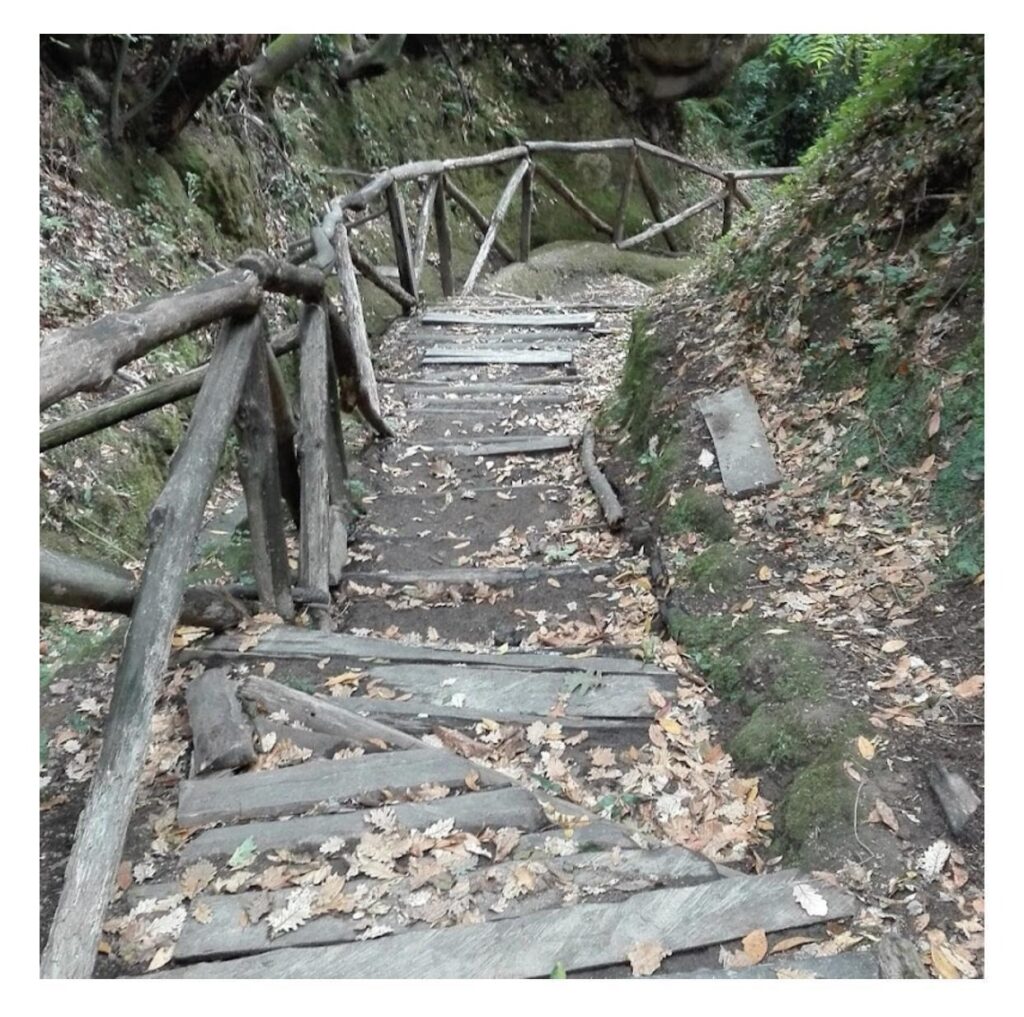
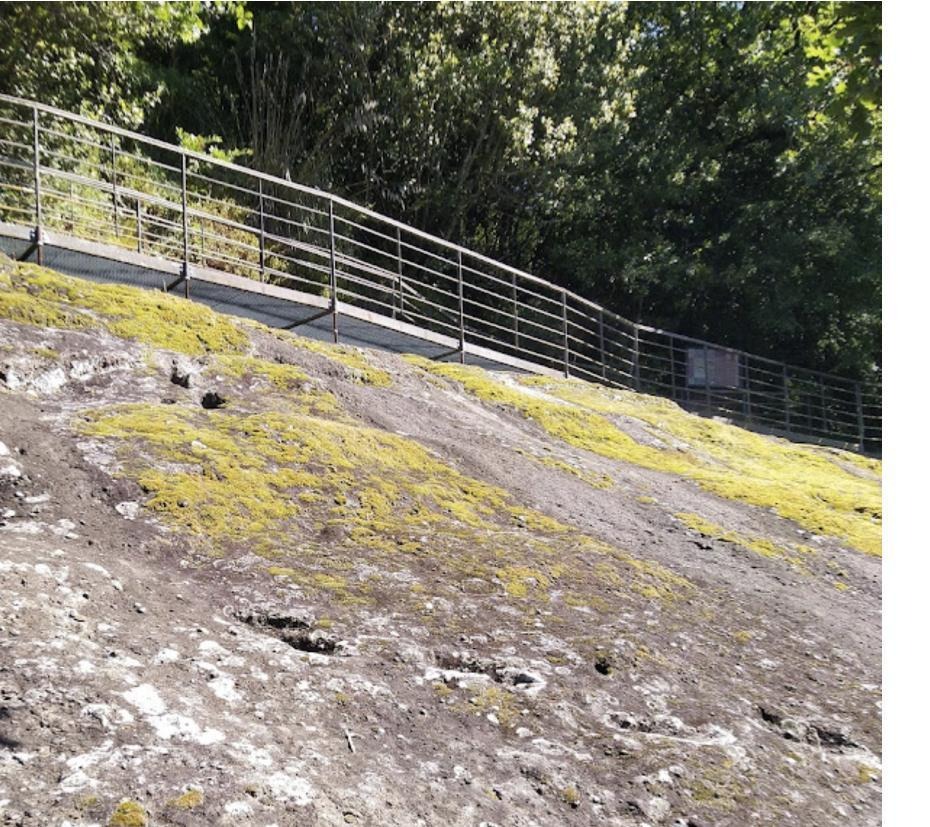
An old bridge near the site.
(Image courtesy of Cinzia Antonelli)

A step back  into history

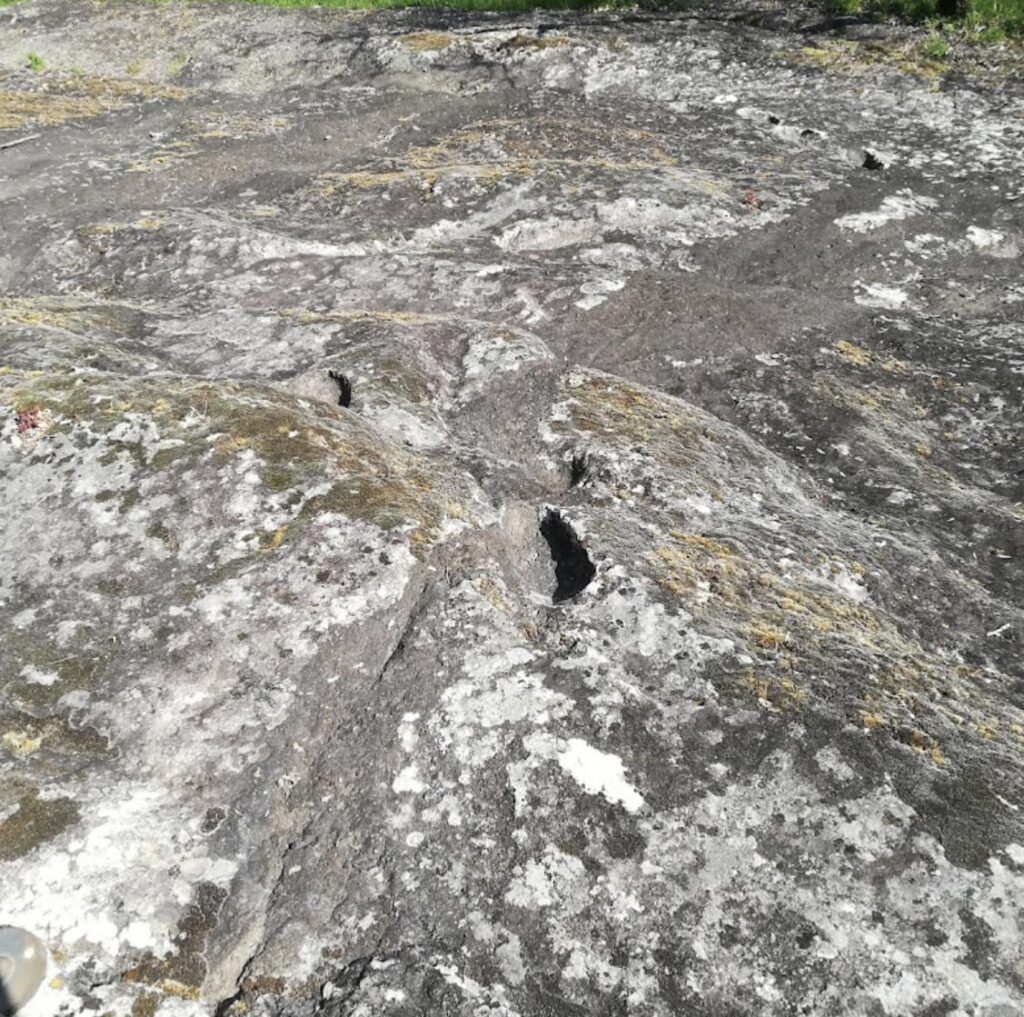
To get there, I travelled down a long path, an old mule track that was used by the locals in the past to reach a mill where they grinded their cereals. Suddenly, as if by magic, a huge boulder appeared before my eyes where I could admire the fossil footprints of my ancestors.

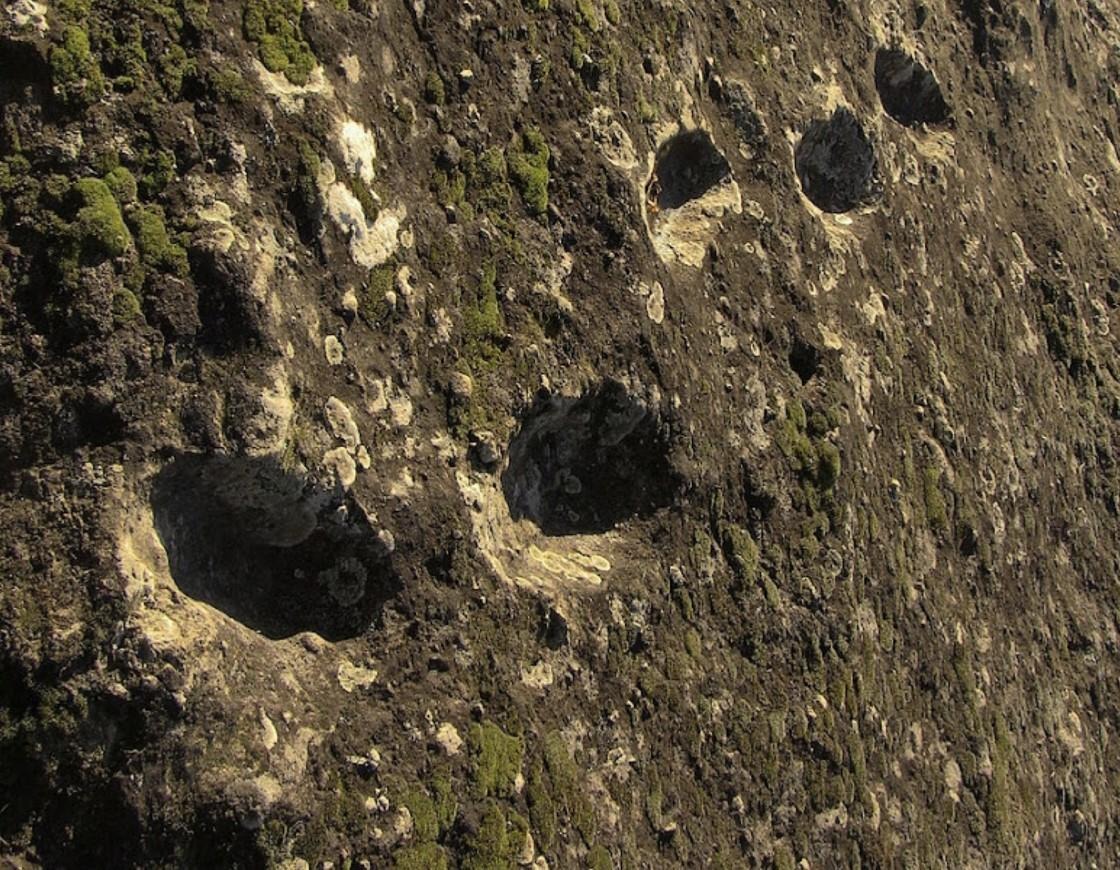
These treasured remnants of the past are preserved on the surface of the rock called “tuff,” a light porous rock formation made of volcanic ash. In the eruptive phase of the Roccamonfina volcano and certainly in that area, hominids and animals walked, leaving their tracks behind them. 

(Image courtesy of Cinzia Antonelli)

As an old folk tale has it, a series of torrential rains caused landslides in the early nineteenth century. The local generations that came before me interpreted the uncovered marks as the Devil’s footprints. In their opinion, only the Devil was able to walk along incandescent volcanic materials without burning himself, so the legend of the “Ciampate del Diavolo” was born.

Visiting that evocative, atmospheric and stunning place was without a doubt a real time travel experience for me, so I would strongly recommend a visit. I think that the best way to find ourselves is through researching our origins.

A site with many stories

A bittersweet story, which touched me in particular, is the one I heard when I first visited the site. It starts in the middle of the German occupation, during World War II. 

It was the year 1943. The locals put their lives at risk with the sole goal of saving Jewish people in the vicinity of the village and preventing them from being betrayed to the Germans. They steadfastly refused to trade the refugees’ safety for mere privileges. 

During this time, Tora’s inhabitants, with its families and Jewish people all fighting to survive, made “Devil’s Footprints” their shelter. They transformed that harsh environment into their temporary home. 

(Image courtesy of Cinzia Antonelli)

Today, 77 years later, us Italians honor those who bravely sacrificed themselves with no regrets in the name of humanity. It seems like the resemblance of Tora, the village’s name, to the Hebrew word “Torah,” the Sacred Law, was written in the stars. I consider it a very significant and touching coincidence.

See the footprints for yourself

Visiting the “Ciampate del Diavolo” is easy. The locals, proud of their ancient footpath, have created an inviting nature park around it. It is kept locked, except to official tour guides from the Orme Cultural Association, who accompany visitors. They are the true guardian angels of the site. With their rare friendliness and compelling stories, they enable  the beauty in the “Ciampate del Diavolo” to come out of the rocks. Entrance to this unique site is solely through the Orme Association, whose inspiring staff members will guide you during your visit. You’ll be able to enjoy the park, inhale the nature that surrounds you, and learn a little more about the locals and yourself.