It had been two years, and I’m utterly positive now: I can’t leave.
The last thing I remembered was drifting off after doing some late-night reading. And the next thing I knew, I woke up in a forest with wings attached to my back. I. Had. Wings.
Why did I have wings? I truly didn’t know. But after flying around, it seemed to be around the turn of the century. The modern world I grew up in was long gone, and I had no idea how to get back home. I spent three weeks spiraling in anxiety and fear, flying aimlessly around the woods looking for any sort of sign of where I was. The only clues I had were the lack of modern cars and the unpaved landscape—I was definitely not in any metropolitan city.
One twist of luck I discovered was my new magic affinity. My now shrunken size allowed me to fly anywhere really quickly, and the humans weren’t able to see me. I flitted around gardens and kitchens without being caught. I needed to eat somehow, and I hadn’t the faintest idea of what job I would’ve been able to get. Plus, it was still quite cold outside, so the warmth inside was hard to resist.
As I flew around the houses one night, I was peeking through the windows for any sort of entertainment on their old-school TVs when I noticed a horse and a rabbit in the middle of the room. Something deep inside told me to go in, so I slipped through and hid in a dark corner.
“What is real?” the little bunny asked the horse.
“Real isn’t how you are made. It’s a thing that happens to you,” the horse replied sagely.
Yup. I had landed myself somehow in The Velveteen Rabbit.
I had somehow become the Fairy in my favorite childhood story. When I was younger, I used to own several stuffed bunnies in the hopes of creating a real one myself. I had memorized the story by heart—but I never once wanted to be part of the story! I couldn’t accept being sent back a whole century just to make stuffed animals real.
Once the reality started sinking in, I made a beeline for the forest hollow I had now called my home. Now that I was able to use magic, outdoor living was more manageable for me. It was a far cry from the comfort I grew up in, but it was a lot easier.
(Image courtesy of Alessandro Matonti via Unsplash)
“Okay, okay, okay. I am a fairy. I am to make toys turn into real things?? The horse explains to the rabbit at the beginning of the…” I trailed off, running my memory at high speed, not trusting my recollection, and trying to find other sources of truth. Alas, it was to no avail. “I’m at the beginning of the story. The rabbit doesn’t turn real…for another half a year…”
If I were to make the rabbit real…then would I be able to go home?
A new determination filled within me. I now had a shot.
For the next few months, I began pushing the boy and bunny together: hiding the china dog, whispering in the boy’s ear that he longed for the bunny, and nudging the nanny on where to find it every time it was left behind.
Then, my time to shine had come.
I distracted the gardener and untied the bag holding the old toys to burn. That night, the velveteen rabbit rolled out. I had practiced and rehearsed for this very moment.
“You were real to the boy because he loved you,” I delivered in my most cheery voice. “Now, you shall be real to everyone.”
I scooped the rabbit up in my arms, dropped it off in the forest, and gave one final kiss. Then, I fluttered back into the shadows and watched as the rabbit explored its new life.
(Image courtesy of Laura Lumimaa via Pexels)
But I didn’t return as I had hoped.
I still had wings on my back, I could still use magic, and I was still in the story. With a light heart, I flew back to my hollow. I surprised myself when I thought about how…meaningful it felt to transform a boy’s love into a tangible wish.
So, when I saw myself still in those now-familiar woods, watching the velveteen rabbit of my childhood hopping around, I wasn’t too disappointed.
After all, there were plenty of toys to watch over.
Message: “Aunt nell, Nanti hettie. Dooey daiture and quinque, parker, Bona lavs, ducky. “ Polari translation: Listen, I am not straight. In 2025, I give you my best wishes, my dear.
In high school gym class, I often overheard conversations about sexual encounters, stories, ‘advice,’ and asking questions. I remember in ninth or tenth grade, a friend asked me questions about sexual experiences due to my being in a relationship. I felt uncomfortable, as this wasn’t something I wanted to discuss out in the open. I also didn’t want to discuss what started occurring in my life at 17 (that I hadn’t yet fully processed). Sex was an uncomfortable topic. Romance was different.
Finding the right words or labels
I had always felt romantic attraction towards others. My first crush was on a boy in my kindergarten class, and I realized in sixth grade that I was attracted to girls. Throughout my life, I thought of romantic attraction, not sexual attraction, as a vital component of a relationship.
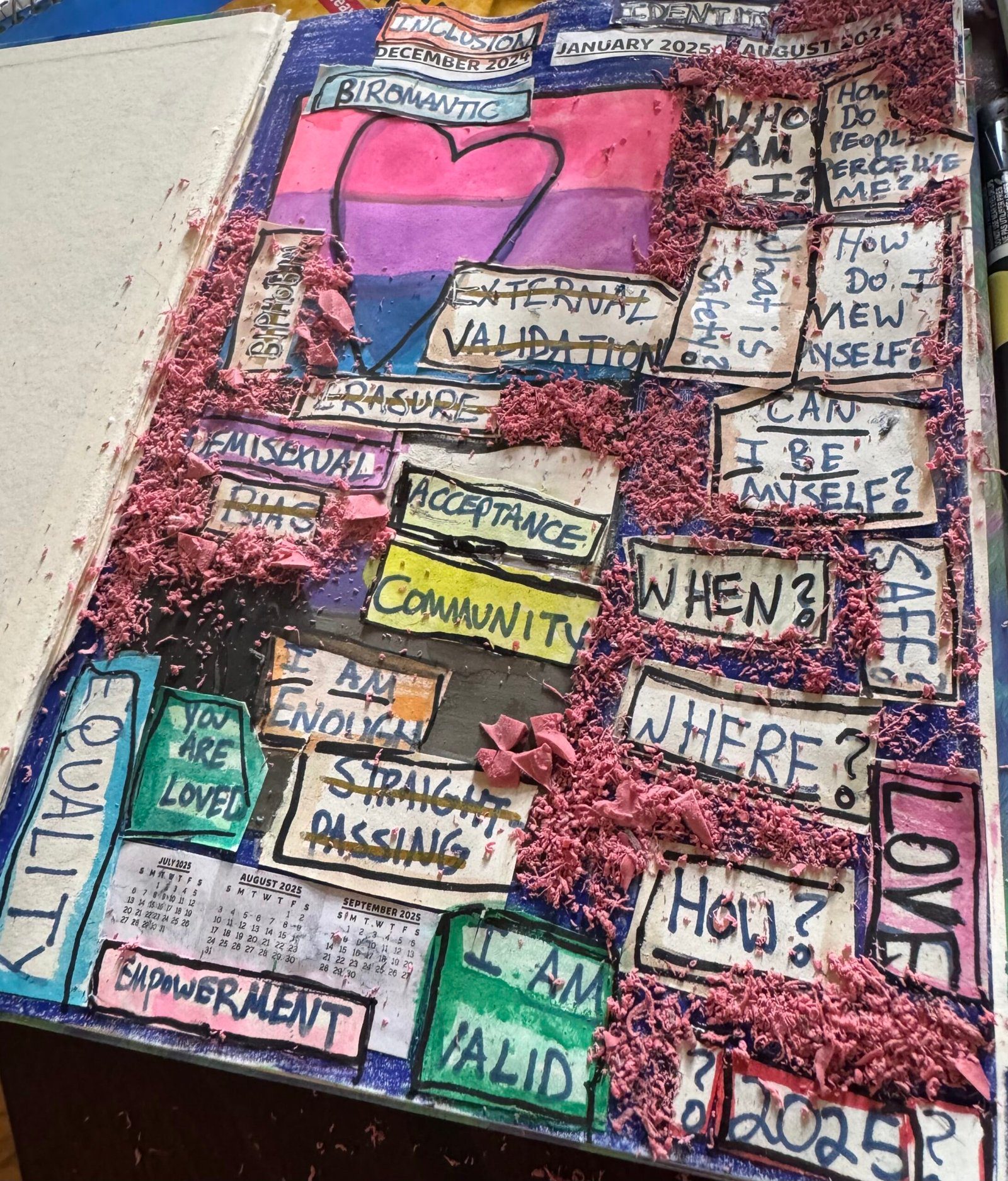
In seventh grade, I discovered the label bisexual. That identity lasted eight years, since I didn’t know there were other options to define myself. Earlier this year, I reconsidered if the label I had worn for so long was accurate to who I am. After thinking it over, I faced that the most accurate way to identify myself was biromantic and demisexual.
Biromantic is described as “being romantically attracted to more than one gender, not exactly in the same degree, same time, or in the same way.”
Biromantic to me means that I am romantically attracted to others, just not in the sexual sense.
Demisexual can be defined as “experiencing little to no sexual attraction without a strong emotional or romantic connection, falling under the ace umbrella (Asexual).”
To me, this means that I’m only sexually attracted to someone after thoroughly getting to know and trusting them on a deep, romantic level. I’ve never viewed myself as someone who could have a one-night stand or a friends-with-benefits situation.
For the past five years, I’ve reconsidered if it’s safe for me to be authentic in terms of my sexuality. With the rise of anti-LGBT laws and bills, I’m afraid to be open about it in public. If I’m with my close friends and in a safe environment, I’m able to speak about it in detail. Without my community, I’d feel lost.
The feeling of community does not always take the form of a connection that exists in person, since there are online friendships I hold dear to me. For basically ten years now, I have been an active member of the fandom that surrounds two of my favorite YouTubers, Dan and Phil.
Many within the fandom (phandom) are also LGBTQIA+. In addition, Dan and Phil themselves are queer individuals, and foster community within their fan base. This has been a positive space for me since I was thirteen, and first discovered my attraction to women/feminine-presenting people.
A friend of mine who I first met in the phandom once exclaimed while hanging out, “I’m here, I’m queer, I’m gay, and I slay.” This is an example of inclusion within the phandom.
Although I’m afraid to share my identity in some social situations, I have a safety net. The same net simultaneously protects and isolates me. Two years ago, my fiance and I became engaged. Due to bias and biphobia, I’m often viewed as straight because of my fiance’s gender.
For example, a classmate in high school asked me if I was “still bi” after beginning my relationship with my now-fiance. I’m sometimes not considered part of the LGBT community as a result of this relationship. That’s isolating.
Erasure is a concept that I internalize, and I have a difficult relationship with it. It makes me feel uneasy knowing that others dictate my identity. Being part of the community is part of my identity. The intersectionality of all my identities live within me: I am a woman, biromantic, demisexual, neurodivergent, and disabled — all at the same time.
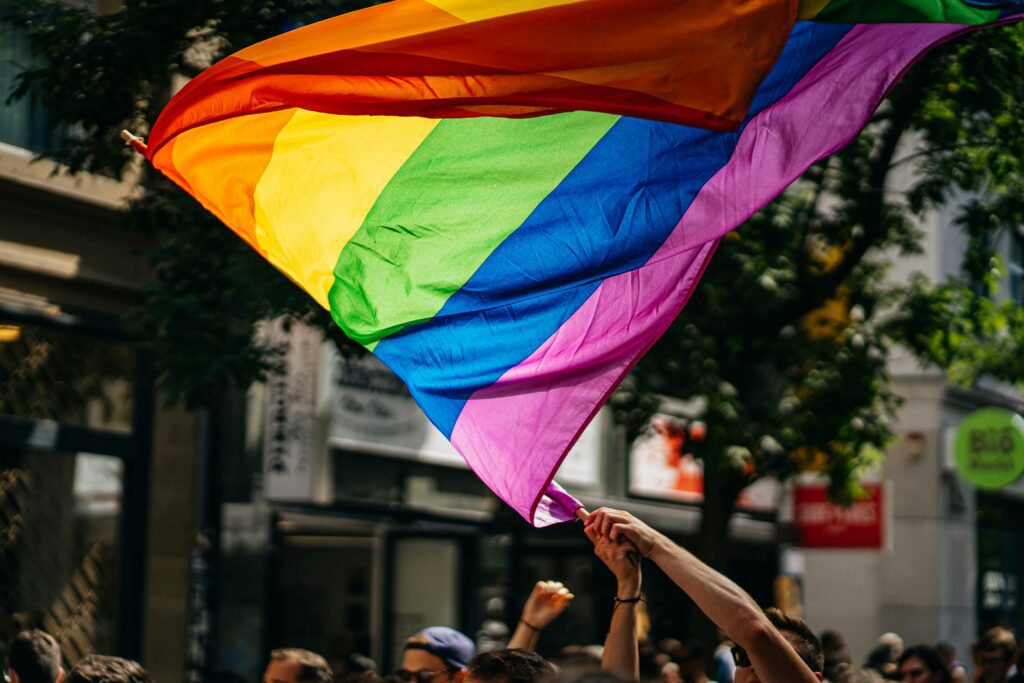
(Image courtesy of Steve Johnson on Unsplash)
The world we live in now
However, in this current climate, I’m privileged to have that safety net of being straight-passing. I am outwardly protected against hatred in some ways, but still discriminated against.
After a situation that happened to me a few years ago at a local restaurant, I’m scared to wear pride clothing. A nearby city didn’t have their first pride celebration until 2019. I know that not everyone in the area supports people like myself.
That protest during senior year
During my senior year of college last year, students found out about a restrictive policy that was passed by the board. This policy stated that transgender, trans, and nonbinary students were no longer eligible for admission; many of my former peers are trans and nonbinary.
At a campus event with a guest speaker, I felt unfairly silenced. We were told we couldn’t speak out, couldn’t interrupt the speaker, yet weren’t allowed to leave yet. Students who weren’t seniors protested the policy by wearing all black and accessorized with pride flag pins. But, I was a senior.
Part of me knew that the college administration was restricting students, but part of me didn’t know to what extent. I knew I needed to use my voice for good, since the restrictions were even stricter for students who were not closer to graduating. People in my life warned me about protesting, told me to not get myself in trouble. I didn’t care, because it was my senior year and knew just one extra voice could make a difference. I crossed that line almost daily, every time the administration made changes. I constantly worried that I would be called into the dean’s office, but thankfully I wasn’t.
I was surprised to find out how restricted I was as a student, but not shocked at the same time. I believe I was surprised that the administration thought so low of students, as many of us would not have even attempted to interrupt the speaker — without being told not to. I felt a sense of disconnection between how we as students viewed ourselves and our peers vs. how the Admin viewed us. The local police showed up to the Annual Founder’s Day event after the meeting, without our knowledge. I felt as if Admin viewed anyone who spoke out as a threat, when most people were not.
Some faculty were supportive of students, and I understand why some were not in the position to risk their jobs in order to support us.
In response to feeling shut out before, that same month I attended a protest on campus where students joined together, raising our voices to “Rescind the policy.” The administration approved the protest ahead of time. It was student-led, with fixed guidelines allowing us to shout approved phrases, hold signs, and only protest during the approved time slot. The protest coincided with the week that a board of directors meeting was occurring on campus. Once the meeting was over, we could no longer protest.
Following the protest, I joined a few others who were planning on speaking to a local reporter. I didn’t know if I would be punished for speaking out afterwards, but I took that risk. Loved ones warned me not to do it, saying I would get in trouble. However, after the way the campus climate had shifted quickly under the appointment of a new commander, getting in trouble was the least of my concern.
Despite graduating from college and leaving that environment, I face bias and discrimination still, but primarily due to other parts of my identity.
Anxiety comes upon me whenever I see red MAGA banners in nearby cities or when I come across articles online that mention politicians’ stances. Anxiety creeps in when I visit cities that are dominated by primarily anti-LGBT institutions.
I often don’t tell others about my sexuality upon meeting them since I cannot be sure of their intentions. I wonder if I can attend local pride events — if it’s worth the possibility of being targeted online by someone from my hometown who is passionate in their anti-LGBT sentiments. How accepting a particular state is a variable in determining where to relocate.
As well as this, I never know what will happen to my loved ones who are part of the community in 2025. I wish there were protections in place for every LGBTQIA+ individual. I wish I could foster that progress.
How I define progress and resistance
I may be ridiculed in public when I wear a pride shirt, but I know my experience isn’t the same as LGBTQIA+ people in other states or around the world. I may have been outed in seventh grade — and called a slur when I publicly came out as bisexual on instagram in ninth grade — yet, I cannot compare my experience to those who were queer activists in the 60s, 70s, and onward. I don’t know what it’s truly like to fear my life on the daily for who I am.
I can’t relate to the community members who spoke a code language for decades in order to share everyday encounters with their friends. There are no direct terms for biromantic and demisexual in this language. Thus, I most likely would have been referred to as bibi palone (bisexual woman). Polari represents the history of the community during one of many dangerous time periods for those in the LGBTQIA+ community.
Survive and thrive
The historical basis for pride was to stand up against injustice, fight for those who can’t do so themselves, and make a difference. Pride at its root is about being authentic, even when social barriers are in place.
I’m not suggesting that others outside of myself should necessarily tackle injustice, as individuals exist in different circumstances than myself. I myself am sometimes worried about wearing pride clothing or accessories. Further, fostering change is not a monolith. It can be carried out through different methods.
Prioritizing well-being and self-care may be the only form of autonomy for individuals. Sometimes, resistance consists of survival and, eventually, thriving. Being true to who I am makes a difference.
I’m very glad to be able to live with my fiance now. Right now, for me, being myself is resistance enough.
Image courtesy off Raphael Renter | @raphi_rawr on Unsplash
Day turned into night– Your warm embrace suddenly turned cold, And never saw the shadow of the sun
Until forever ended, You were my safe place, Calm in a noisy world, The harbor where my heart Rested;
You were home, Not four walls, a roof and doors, But arms that soothed, Eyes that saw everything, like window glass, never judged, A voice that sang love songs, Legs that never walked away.
But now, Now, the silence screams, louder than a music hall, Drowning out a thunderstorm; Our laughter– once song– Echoes in my ears; Even if I tried to forget, I couldn’t, I danced to the tune.
Every morning, I wake up to the ache, of remembering you’re no longer here. No longer the home that brings peace, joy, and hope. No longer the future so bright. Losing you feels like A wound that won’t heal. Maybe it will– tomorrow, or someday.
Now I’m left picking up pieces of a forever that promised to stay forever Just maybe, My love remains, quiet, and invisible,
But still burning softly, in those warm corners of my soul. It will remain till it fades away, forever.