The Timestamp That Changed the Way I Practice Journalism

On November 5th, 2021, Brazil was gripped by breaking news. 

A small aircraft had crashed in the countryside of Minas Gerais. On board was Marília Mendonça, one of the country’s most beloved singers — a young artist whose voice had become the soundtrack of heartbreak for millions. Within minutes, headlines multiplied, major outlets began reporting that she had survived, citing information from her press office. Relief spread quickly across social media and television broadcasts.

In the newsroom, I did what journalists are trained to do in moments of confusion: I went back to the primary source. The official note from the Fire Department included a precise timestamp for the crash. I read it once. I read it again. And something didn’t fit.

I compared it with the time the statement was released and considered the geography of the region. The reported time of the crash and the geography of the region made it nearly impossible for any official medical confirmation to have happened that quickly. There simply hadn’t been enough time.

The location was remote. Rescue operations would have required travel, on-site assessment, and official confirmation procedures.

It wasn’t a dramatic realization. It was quiet, mathematical. 

The timeline did not add up. There simply had not been enough time for anyone to responsibly confirm survival. There was no way the information circulating could already be confirmed. Based on logistics, distance, and the sequence of events, the optimistic reports circulating at that moment were, at best, premature.

I faced an uncomfortable dilemma. Like millions of Brazilians, I was not emotionally detached from the story. Marília’s music had been part of my daily life. I was also a fan. Her songs had played in my headphones, at parties, during long nights of writing. That day, I wasn’t just an editor. I was someone refreshing my phone like everyone else, hoping the earlier reports were true. I wanted the early reports to be true. But journalism is not guided by desire; it is guided by verification. Journalism has no space for hope.

And in that small gap between minutes, I understood something before anyone said it out loud. I didn’t feel triumphant. I felt cold. 

 If I was right, the country would move from relief to mourning.

Instead of repeating what other outlets were publishing, I chose to write a cautious article questioning the timeline and emphasizing the lack of confirmed information from emergency authorities. The piece did not speculate. It did not declare an outcome. It simply highlighted the inconsistencies between the official timestamps and the claims being disseminated. I knew I would be the only one swimming against the current, to push against this national hope. And still, uncomfortable as it was, I knew it was necessary.

Shortly afterward, the confirmation came: she had not survived.

The article became the most accessed in the history of our publication, surpassing 1.2 million unique views in less than three hours. It marked a significant growth moment for the site and consolidated our credibility in high-sensitivity coverage. In business terms, it was a turning point.

But my personal turning point had occurred earlier while examining that timestamp. That was the moment I understood, with unsettling clarity, what journalism really asks of you. It asks you to doubt relief. To slow down when the world accelerates. To risk being the cautious voice in a room eager for good news. And sometimes, it asks you to be right in ways you wish you weren’t.

Some believe professional maturity in journalism is about speed, sharp analysis, and competitive positioning. That afternoon clarified something more fundamental: responsibility often means resisting collective momentum. It also taught me that professional instinct and personal grief can coexist in the same body. I wrote through a lump in my throat. I updated headlines while processing my own sadness.

In breaking news environments, especially during emotionally charged events, the pressure to publish quickly can overshadow the discipline of verification. The easy choice would have been to replicate what larger outlets were reporting. The harder choice was to pause, analyze the data, and risk being temporarily out of sync with the national narrative.

Looking back, that was my Eureka moment. Not the confirmation itself, and not the record-breaking traffic, but the quiet realization that accuracy sometimes requires standing apart from the crowd — even when the crowd includes respected newsrooms.

That day permanently reshaped how I approach crisis coverage. Speed matters. Reach matters. But neither outweighs the ethical obligation to interrogate information, especially when hope is involved. Journalism is about being right for the right reasons — even when being right carries the weight of grief.

I have covered many stories since. None have carried that same quiet, irreversible click.

A timestamp. A calculation. A country holding its breath.

And the moment I knew.

Image of empty airplane seats in greyscale.
Image courtesy of Alejandro Anzola on Unsplash

This Fabric Does Not Suit Me

Editor’s Note: The Poetry Foundation defines an acrostic poem as, “A poem in which the first letter of each line spells out a word, name, or phrase when read vertically.” Usually, the central theme of the poem is revealed upon reading this hidden message.

This Fabric Does Not Suit Me

There’s a suit that I keep tucked away,
Hanging in my wardrobe, behind my newer clothes.
Every glance I take, I realise how much I have changed.

Fourteen years since I first laid eyes on it…
Allow me, now, to look in hindsight,
Back to a time when fashion weighed on chasing brainless trends.
Racks in retail shops were filled with fragile, gaudy tat,
Impressive shoes and shirts and hats,
Colorful and contemporary, yet lacking in their substance.

Once, I’ll admit, I sought these things that people viewed as “beautiful…”
Finding my thoughts swayed by spontaneous desire.

Originally, I spied this expensive suit displayed in River Island,
Underlined with crimson curves and shapes that ran red eddies.
Relishing the looks of envy, I swiftly made it mine.

Life felt sensuous when I wore this suit for a time, though…
Opinions of my character were shifting day-to-day.
Very strange choice, they’d say, for someone like me to wear something like that…
Everyone saw how much it was changing me.

Had I listened – understood that popularity was empty,
Allowed myself the chance to think if I actually liked that sumptuous skin…
Separation would have been made much easier.

For a child came from my marriage to this ill-fitting decision.
Red Timberland boots, bought on holiday one year.
And, however much I now look at that suit with scathing eyes,
Yearning to reverse that snap decision…
Everyone I know loves these Timberland boots, and so do I.
Destiny dresses in mysterious ways.

Overwhelm: That Need to Do Too Much

Overwhelm

I’ve been in a slump lately. I haven’t felt particularly down or anything. My social life is as buoyant as it can be. I have a steady job which I enjoy working. I’m lucky enough to have a roof over my head, and my sleep schedule, while shaky, is taking a turn for the better. I’m admittedly a chronic snacker, though the comfort mostly surmounts the shame.

What I really feel is overwhelm. Not burnout or anxiety. Rather, I feel now that, in looking forward to a potential creative career, I will be unable to complete all the many projects that I desire to work on. There’s not enough time. I feel that comes with malaise, especially if, like me, you haven’t settled into a proper routine yet.

It’s ironic that this article has taken me so long to write. The fear of abundant possibilities and wasting time are facets I’ve wanted to talk about for a while. They’re somewhat destructive spirals I have challenged repeatedly in post-university life. I don’t necessarily need to make any choices right now, but the pressure still bubbles, pushing me to commit to something. Often, this disables me from getting anything done, leading to other issues such as procrastination, burnout, low energy and so on.

To confront this overwhelm, I decided to reflect on all the various careers I thought I might inhabit as I was growing up. I hope this allows me to make some sense of the indecisions I now face.

Intercontinental Marble Run Designer

Really, it was rather simple to execute. My role would have involved designing interconnected networks of tunnels and rails all around the globe to transport marbles in and out of countries at a moment’s notice. Never mind the logistics or the actual demand for these contraptions – post-toddler me truly believed it was an occupation of studied importance. My parents never understood the vision.

Rockstar

This was around the time I was first getting into music, so I suppose this role should come with a caveat: Rockstar, who looks like Alice Cooper. I owned five of his albums. The makeup never seemed like much of a stretch to me.

World-Class Chef

Following the first time I tried cheesy pasta, which is literally just pasta… and cheese, I demanded that my Mum make it for me three nights in a row. All thoughts of eggy bread and chicken, and broccoli were flung from the window as I raced to learn how to prepare such a complicated dish. I thought I was set. Turns out, most competent restaurant dishes actually have three ingredients. Sometimes more.

Hole Digger and River Maker

One section of my childhood garden was basically woodland, dominated by a large willow tree as a centrepiece. I discovered the earth underfoot was soft enough to dig into for several feet, which spawned many a weary afternoon with the shovel. I would create trenches and position the hose to run water through them, ruminating on how I could one day terraform the planet while the rest of the garden flooded.

Secondary school came, distracting me with subjects I barely wanted to learn until I was finally able to specialise. Thus began my renaissance of career planning, the Game Designer era.

Coder for Video Games

The “do this and do that” doodah. The minute I jumped into computing lessons, I realised how boring coding could be. This passion faded.

Animator for Video Games

I grew up with Disney and DreamWorks and loved playing video games like Minecraft and Undertale. Sometimes I drew pixel art, sometimes I launched into full-blown Blender modelling. I discovered that animation could be just as boggling as the machine language itself, though pixel art and animated media/games have become the major loves in my adult life. I owe a lot to this period.

Composer for Video Games

Video game music fascinated me, and it still does (my playlist of game music once had over 2,000 downloaded tracks and took over five full days to play through the entire collection). By this point, I’d been transcribing lots of my favourite tracks onto a notation program called MuseScore, but I’d never actually made an original track of my own. Little did I know I ignited a spark and composed half of a video game soundtrack during my second year of university — one of the many things I have lying around, waiting to be finished.

I started to comprehend that each of my passions was creative in nature — marked by desire for visibility, recognition and legacy. With university fast approaching, I had to find a simple solution to fall into, one that I could jump into and start earning from immediately. I know!

YouTuber

The Gen Z-vetted choice! I made the decision overnight — I could avoid going onto further education, I could work from home, and I could become a millionaire in under a year. All my parents had to do was invest £2,000 into professional equipment to assist my dream in coming alive. Naturally, my ego was slammed (thanks Mum) in just one evening — I believe there was an almighty tantrum and one accusation of “you’ve ruined my life” involved, which I’m not exactly proud of. Thankfully, this was a short phase.

Stage Actor

It was bound to happen. I’d been acting all my life, so this just made sense. I took Drama and Theatre Studies at Royal Holloway, University of London. Got involved with student companies and improv societies… I started living for the thrill of performance families. Nothing beats the feeling of acting onstage for me. Sadly, the life of a struggling actor was not something I felt fully committed to, so I decided to specialise in something I could achieve from anywhere.

Screenwriter for Film and TV

Having written some, maybe four or five plays by this point, I knew I had an affinity for writing. My Mum is a copywriter and novelist, so this ran in the blood. I took a punt with my master’s and expanded my portfolio into more structured visual media— screenplays and televised drama.

Flashing forward, I now have two polished screenplays under my belt. I feel more confident with this form of output than ever. Still, I found myself drifting back to playwriting, procrastinating with music composition, designing pixel art, editing videos, acting in odd productions… All the things I thought I’d left behind! And with that, an idea started to blossom.

Game Designer

There it is again! Only this time, I could do everything at once. I had the knowledge to construct engaging narratives. I’d long been polishing my composing abilities. With a minimal approach, I could pump out sprites and game assets in an art style that suited me… and with the help of some enthusiastic Udemy courses, I was miraculously beginning to enjoy coding too! All the elements were in place… but I still couldn’t bring myself to commit fully to this resurgence. Don’t get me wrong, I am going to release a video game one day, but something else is becoming clear.

Kind of Like An Everything Writer

I write short stories every week. I write for The Sentinel. I freelance with chatbots, training AI models. I’m planning a fantasy novel. I run my plays and short films through scratch theatre nights. I submit to competitions and initiatives as often as I can. Every project that drives me, everything I’ve learned, revolves around words. I feel confident working with words. I know that something will present an opportunity if I keep working on and honing myself.   

It’s okay not to have everything figured out. It’s okay to experiment. This can be an intimidating place, especially when the competition for careers is so high, but it’s healthy to be curious and to explore different interests if you have space to do so. 

Repetition is exhausting – invest in yourself. You’re not “unfocused”, you’re versatile. You’re human. One day, the dreams and ambitions you once had may feel like a distant memory when newfound purpose takes your life in directions you might never have imagined.

All that being said, I did visit the “House of Marbles” glass-working museum in Devon recently, and I found it very difficult to leave.

My Ways to Feel

A glance,
A touch,
A greeting

To breathe in the same sights,
Experience the same sensations,
To be next to you
without saying a word –

It’s exactly where I want to be.

Expecting,
Wanting,
Dreaming

Constantly thinking
about what to do next,
Shaping our futures, together
or on my own;
Wanting to use the same blanket
so that no space remains –

It’s exactly what I want to do.

Two people sharing a blanket on a hill, enjoying the sunset over a forest and a lake.
(Image Courtesy of Brady Knoll via Pexels)

Guessing,
Surprising,
Delighting

Hoping you will like
what I planned –
Do you welcome
what you see?
Let’s go and get
what we don’t need –

It’s exactly what I want to hear.

Our routine,
Our rituals,
Our memories

Whether it’s planning them
or thinking about them,
Making ambitious plans,
Dreaming for us
And the days to follow –

It’s exactly what I want to create.

A shared look,
A shared thought,
A shared silence

Knowing what to get
before the words arrive,
How to act
when unsure,
Or to do what’s best –

It’s exactly what I want to protect.

Cherished,
Wanted,
Treasured

Accepting all flaws,
Bearing the pain
to spark that smile,
The twinkle in the eyes,
glistening from our shared emotions –

It’s exactly what I want to feel.

Missiles That Attack Your Heart Thousands of Kilometers Away

My first experience with war — yes, the first one — was when I was five years old. I remember it clearly.

I was born in the winter of 1982, about a year and a half after the Iran–Iraq War began. Until I turned five, my city, Tabriz, famous for its handmade carpets and the largest covered bazaar in the world, had remained relatively safe. Some infrastructure outside the city had been attacked, but I was too young to remember.

Then, in the winter of 1987, the city was bombed, and we were forced to leave.

My grandfather had a white Peykan, the iconic first Iranian-made car that evokes national nostalgia.  He drove my grandmother, my mother, my two-year-old brother, my aunt — who was in the last month of pregnancy — and me, out of the city. My father and my aunt’s husband stayed behind to protect the house and our belongings. Looking back, it seems both frightening and absurd: how could two men protect a home from missiles with their bare hands? 

I remember the cold winter day we left Tabriz for Miyaneh, a small city about two hours away, where relatives lived.

Maybe it was the wrong decision.

The day we arrived, Iraqi bombers attacked Miyaneh. A girls’ high school — Zeinabieh High School — was hit. Even today, nearly four decades later, a sign at the entrance to the city reads: “Welcome to the city of the martyrs of Zeinabieh High School.” It remains the most tragic event in the city’s history.

But the memory that stayed carved in my mind happened just before that. As we entered the city, my grandfather stopped at the bazaar to buy some nuts for the relatives we were about to stay with — we had left Tabriz so suddenly that we had brought nothing. At that moment, a jet fighter broke the sound barrier overhead. The explosion of sound shattered the windows of every shop around us.

The plane flew so low that, in my childish imagination, I thought I could reach up and catch it.

Years later, when I learned in physics class about supersonic speed and the breaking of the sound barrier, I already knew exactly what it meant. I had experienced it in the most real laboratory imaginable.

No child should ever have to learn physics through war.

A few days later, my cousin was born. 

Her birth filled the house with joy. As a child, it helped me forget the fear of that attack. We soon returned to Tabriz with the newborn baby, and only years later, did those memories come back to me.

*  *  *  

Years later, while studying in Italy, I once heard fighter jets flying over the city for a national day celebration. The sound instantly brought back that childhood fear. I could not continue studying.

For many years afterward, life in Iran felt like a different kind of battle. Especially as a girl, I was in a constant, invisible fight with the regime’s inhumane rules — a compulsory hijab among them. But despite repression, there was no real war again until the summer of 2025.

By then, I was already living in exile.

We knew this was the regime’s war, not the people’s. Unlike the war with Iraq, this conflict was not even with a neighboring country; it was with a state the Iranian regime refuses to recognize. The war lasted only twelve days, nothing compared with the eight-year war of my childhood.

This time, many regime officials were assassinated, and nuclear facilities were attacked. Civilians were also killed, and residential buildings were destroyed — tragically, as in every war. Yet many Iranians felt relief that those responsible for decades of repression were gone.

But the most terrifying experience — even for those of us in the diaspora — was the complete communications blackout. The internet, phone lines — everything cut.

We could not hear the voices of our loved ones to know if they were alive.

The internal enemy that has held Iranians hostage for forty-seven years feels more dangerous than missiles.

*  *  * 

And now I find myself living through the third war of my lifetime.

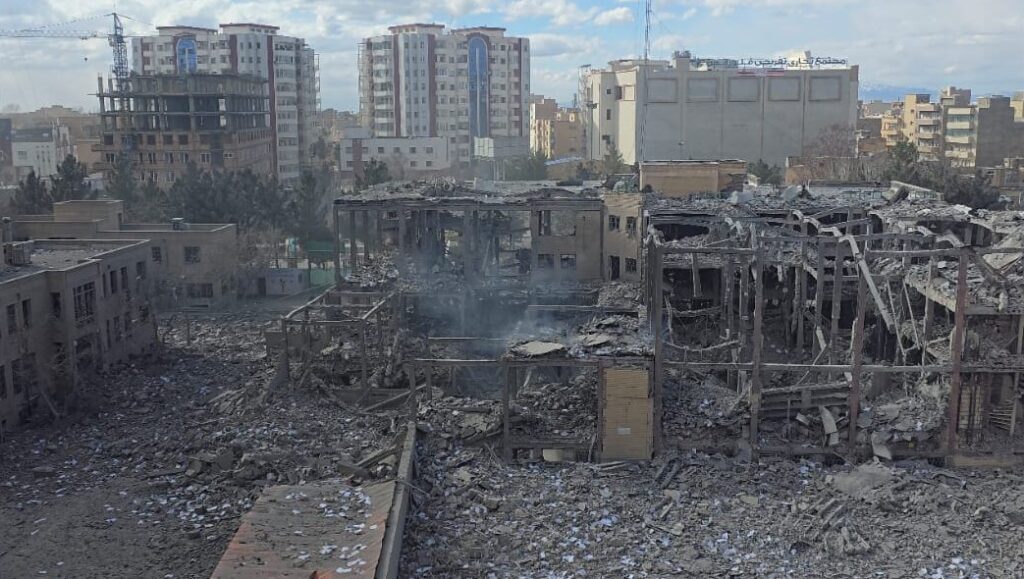
On the eleventh day of this war, a police building next to my family’s home was struck by a missile.

That day was the hardest day of my life in exile.

Destroyed police station in Tabriz, Iran. | (Photo by Anonymous)

Since the beginning of the war, I had spoken with my mother only once, for less than a minute. The communications channels were blocked again. That morning, I woke at 4:30 a.m. with a terrible headache. I took a painkiller and tried to go back to sleep, but could not.

I started the day as usual, pretending to live a normal life in exile while my country was at war.

Around noon, in the middle of an online meeting, my brother suddenly called.

“We are safe,” he said quickly. “Don’t worry. But the police station next to the house was hit hours ago.”

When he told me the exact time, I realized it had happened at 4:30 a.m.— the moment I woke up.

Thousands of kilometers away, yet somehow my mind was still there.

As a physicist, I should not believe in telepathic connections. But not everything in life can be explained by science.

When I finally heard my mother’s voice, it was a huge relief. She tried to reassure me.

“I had just cleaned the windows for the New Year,” she said lightly. “Now they’re all broken.”

I knew she was downplaying it to protect me. But when she ended the call with “I love you so much,” I heard the fear she did not say out loud.

For the past three days, we have had no connection again.

No internet. No phone.

Who could imagine that during war — when communication is vital— a regime would deliberately cut people off from the world?

I even feared my family might be in danger because we had spoken critically of the regime during that call. In Iran, that can be more dangerous than missiles.

I cannot stop thinking: if that missile had deviated by only a few meters, what would have happened to my family? And how could I have continued living?

That day I took two more painkillers. Even three days later, the pain has not fully subsided.

After sunset, I walked for hours, crying. I wanted desperately to hug someone, but exile is a lonely place. Instead, I hugged the trees along the path.

I imagined their branches wrapping around me.

When you hug a tree, you notice something: its skin is rough, not soft like human skin. Perhaps that is because it has survived many harsh winters. The bark grows thick to endure them.

It reminded me that my own skin must also grow stronger.

Trees teach us something else: after every long winter, spring eventually arrives.

But there is one difference between trees and people like me. Trees are rooted. In the past four years of exile, moving across four countries, I have not been able to take root anywhere.

My roots remain in my beloved Iran.

And I carry a small seed of hope in my heart, waiting for the day I can plant it in a free Iran.

Maggie Mascot

It wasn’t that she was the best; there were smarter workers. There were more articulate speakers, those with more connections, and those more “in.” There were certainly those who’d been at the company longer — but nobody gave more.

She could feel it, she knew it; people wanted her around. They desired her energy and forthrightness. She was wanted on the team and on their side in a proverbial playground scrap. They were always grateful for her input. She was forever cheerily met and greeted. Maggie (“Maggs”) was essential.

She was also the mascot, well, that’s how it could feel. That was the other side of it. She tried to keep her mind clear of such formulations of thought. She didn’t really like thinking about it. How petty it seemed, and, when she really stared at it, ugly.

The thankless tasks of spreadsheets, reports, social and messaging platform accounts; all organized when unasked for. Yet approaching her mid-thirties, Maggie was beginning to feel a discomfort at automatically going the extra mile.

“Still look 24 babes,” was a continual refrain coming her way. Maggie didn’t need telling this — she was quite aware. Like many a woman, superficial evaluation had lost a degree of thrill at the turn of 30. Hearing it from desired parties was always welcome, but the more important matters of status and being paid one’s worth held greater appeal.

She liked her little motor, resigned to the scruffy handbag on wheels it was. Loved a drive, her playlist blaring, charging down the road ahead, feeling unfiltered, unlimited, and… behind?  It was old. It didn’t reflect her. The age, the miles, and condition — this car spoke of settling. Maggie wasn’t ready, had no plans, and didn’t deserve to settle.

Maggie parked up some 20 minutes early. A timekeeping extraordinaire, well, certainly compared to many of the men in her office. She opened the tin of Cavendish & Harvey fruit drops found in her side glove compartment. There was a cherry flavored one left and a little celebratory “Yes” left her in a whisper. She didn’t fancy facing the panel with a Halloween purple or sickly yellow tongue for distraction.

Opening up her printed, bullet-pointed, and line-itemed interview documents, Maggie could hardly focus. It wasn’t so much butterflies, but… disinterest. Muttering the sentences in double time under her breath, she didn’t need this prep: she knew it. She’d known it for the better part of a fortnight. As an actor would say, she was “off-book.”

Her eyes gazed across the car park filled with cars and devoid of people. A brief pocket of dissociation. Her body numb, her mind temporarily blank. When she came to, she could feel a dull edge of disquiet and angst. Maggie had been here before.

The Deputy Regional Manager position opened up four years ago and she’d applied. All the colleagues who knew were rooting for her. She tried to remember if she’d parked in the same spot; it felt like the same spot. At the time, it came down to Maggie and one other, Bill Rutherford; a longtime stalwart of Kenson Logistics.

A near waddling turret of self-appreciation guided by a gift of the gab, Bill was a known voice and face able to make the panel laugh with easy familiarity. Maggie was the good girl, checking every box with a hard dose of earnestness and a light sprinkling of concern for others’ sensibilities. Bill Rutherford got the job. Maggie went back to Gillingham to tell expectant parties she’d fallen short.

Four years ago was rough. Retelling the same story to different people over and over, receiving the same messages of sympathy was… frankly aggravating. She reflected that her approach hadn’t necessarily belied the truth; that communicating her capacity wasn’t the best way to advertise it. Perhaps checking boxes wasn’t the way.

Maggie felt she’d lost a great opportunity to someone with less to offer than her, on merits that had little to do with the job description. She was privately downcast for the next month. The extra mile didn’t go far up against cronyism. The mascot remained firmly in her place.

***

Entering the conference room where the panel sat was fine, flat even. There was a surreal, familiar numbness to this. The panel hadn’t aged a day and even appeared to be dressed exactly the  same as they were four years ago, a disquieting exercise in time warp.

The same conference room fronted the same table in the same position and layout. All was déjà vu in every last inconsequential detail; the laminated printouts, the order of the glasses, and their unopened complimentary bottles of water. Maggie sat in what very much appeared the same style of chair. It had been four years of standstill; nothing had changed at all.

Her hearing left her within seconds of the interview starting. Was this the interview? Was it an alternative timeline? It felt like a dress rehearsal for the interview. Another “not quite” experience as she found here not all that long ago. Maggie Mascot went through the motions; she couldn’t hear herself talking or her responses to any of the questions.

It was as if she had some third-person perspective of the interview over her own right shoulder. The expressions, timely nods, and notetaking of the panel felt like reruns. Observer and participant, her mind drifted. There was just one out, one potential that sat in the farthest corner of her consciousness.

Laura had never caused Maggie trouble. There was never any unspoken friction. It was more like they operated on different frequencies and vibrations despite working in the same office. They were always friendly and warm, but they weren’t close.

Laura had girls in the office she would share with and chat to; Maggie wasn’t one of them. It was the same the other way round. Though curiously, they did manage to share some confidants vicariously. Ultimately, they were different people who garnered different responses and reactions to those around them.

Maggie was indispensable, reliable, trustworthy… Mascot. Laura was… prestigious, for want of better words. An Oxbridge graduate, Laura came from money. Not generational wealth, per se, but “dad did well” kind of money. Her holidays and social media accounting of them were like visual brochures. Laura seemed a closeted influencer.  

Elf-like, porcelain and glossy, Laura had eyes like planets. The men around the office always found a particularly playful or attentive energy when interacting with her, irrespective of how bad a day they were having. She also managed to maintain one of those waists that suggest no internal organs live there. Laura was a cut above, and not just of Maggie.

Through her confidants, Maggie gleaned only a little on Laura, as she wasn’t really one to ask. One of the few slivers she gathered was of a budding workplace romance. Legitimate, mature, adult, not bedhopping or drunken and lusty. Laura was around 10 or so weeks into seeing the junior accounts manager Jack.

They looked pretty picture perfect when lined up together in one’s mind’s eye. Maggie didn’t feel one way or another about it. Jack was nice enough and cute but she had no particular interest in him. The nascent couple hadn’t, however, run their relationship past HR.

When the interview was near conclusion, just as four years ago, Maggie was asked to say a few words about the other internal candidate. The questioning began. Would she have a problem working for this person as her superior should they get the role? Then, the customary and standard kind words.

Maggie came alive all of sudden. She went from dipping in and out of dissociation to being beamingly, near painfully, present. A few words… on Laura Talbot… and what she brought to the Gillingham office.

In a semi ad-lib, Maggie spoke warmly of Laura and her presence. She also, right at the last moment, managed to express how pleasant and refreshing it was to see a workplace romance flourishing in this HR-heavy day and age.

The panel somewhat froze, all four members rather stiffened. The air changed and the faces lost a softness to them. The only woman on the panel asked Maggie to continue with a simple, “Oh?”

And the rest is history. Sure, a “good girl” wouldn’t have done it. Absolutely, her face felt flush as she said the words. Was it out of character? Maybe a little. Was it what she wanted to do? Not so much. Was her drive back to Gillingham conducted in eerie quiet? You bet ya.

Yet, at the end of the following week, Kenson Logistics had a new Deputy Regional Manager, and Maggie was “Mascot” no more.

My Rescue Rescued Me

In a blanket

I’ll never forget waking up on that special Christmas morning, five years old and excited as any kid would be on Christmas, then walking into the living room to be greeted with the sight of a beautiful red Dachshund puppy wrapped in a blanket. She was the very first pet my family had and I was overjoyed. 

However, in 2013, my family unfortunately lost her due to unprecedented health issues that were out of control. Losing her was such a shock to me that I remember remaining numb for the rest of the summer. When we lost her, my parents and I almost considered not getting a second pet, despite looking in the newspaper and on local adoption websites. 

Inside a fur coat

A few weeks later, time came to move forward. After switching from a private school to a public middle school, the stars themselves seemed to align as another family member joined us. The day before when I was supposed to start my first day of eighth grade at a brand new school, my mother received a call from a beloved family friend. The couple could not take care of a brand new, six week old puppy, nor did they want to keep it, and offered that we take it in if interested.

After hanging up the phone, my mother, grandmother, and I all piled into the car just “to see” and “check out” if this puppy would be worth it. However, after an hour’s drive, the second our car turned into the driveway, the three of us were greeted with the sight of the family friend with the tiny puppy on a leash. Seeing this new puppy as a black and tan Dachshund-Chihuahua mix speck sitting at the end of the large driveway, my mother and I immediately died of happiness, and my grandmother knew that this dog would be coming home with us. 

On the ride back home, the three of us picked up on a couple of our new four-legged friend quirks that still stick to this day. For example, she loves to lay in my lap while in the car and is extremely well behaved in any vehicle. So much so that, as we will soon figure out, she actually gets mad if she cannot go on errands with us.

Now, as the years have passed, our new  “rescue” Heidi, certainly rescued me, and my family. The puppy that we said we’d check out has become a permanent part of our family who we often joke is a human in a fur coat. We love her unconditionally and she does the same in her own ways. 

Heidi brings joy and happiness everyday to me and my family that I know we would never trade her for anything. She is such a different dog than my first dog ever was and, while she’s pushing fifteen, Heidi still has so much energy and love to give. Everyday is an adventure with her. Heidi brings life into our house, even at such an old age, that my parents and I make fun of her by calling her an “old lady.” 

On a Parcheesi board

Whether she growls at unexpected noises, shows zero fear of fireworks, or passes out on the Parcheesi board in the middle of a game, she is one of the best last-minute chances we’ve ever taken. This dog has gotten my family through loss and hard times, and never failed to make us smile or laugh whenever we need it. 

We have given Heidi one of the best homes as a loving family, and it is incredibly important to us to treat all rescues with love and respect, regardless of where they came from. We usually won’t know their situation, unless we adopt and the center knows about the animal’s past, but by showing any kind of animal kind feelings and with time, anything is possible. 

For the rescuing

I’ve certainly learned that lesson with all of the pets I’ve had,  and Heidi has taught me the importance of adopting. Sure, it might be nice to get a pet from a store or a mill, but adopting or taking in rescues from friends or family is the absolute best way to expand your horizons on the subject of taking care of pets. 

Showing them a better home than what they came from should be one of the many necessities in life, otherwise they get put down without even having a chance. I am so glad we took the chance when it came to adopting Heidi. She claims that she’s happy we did. 

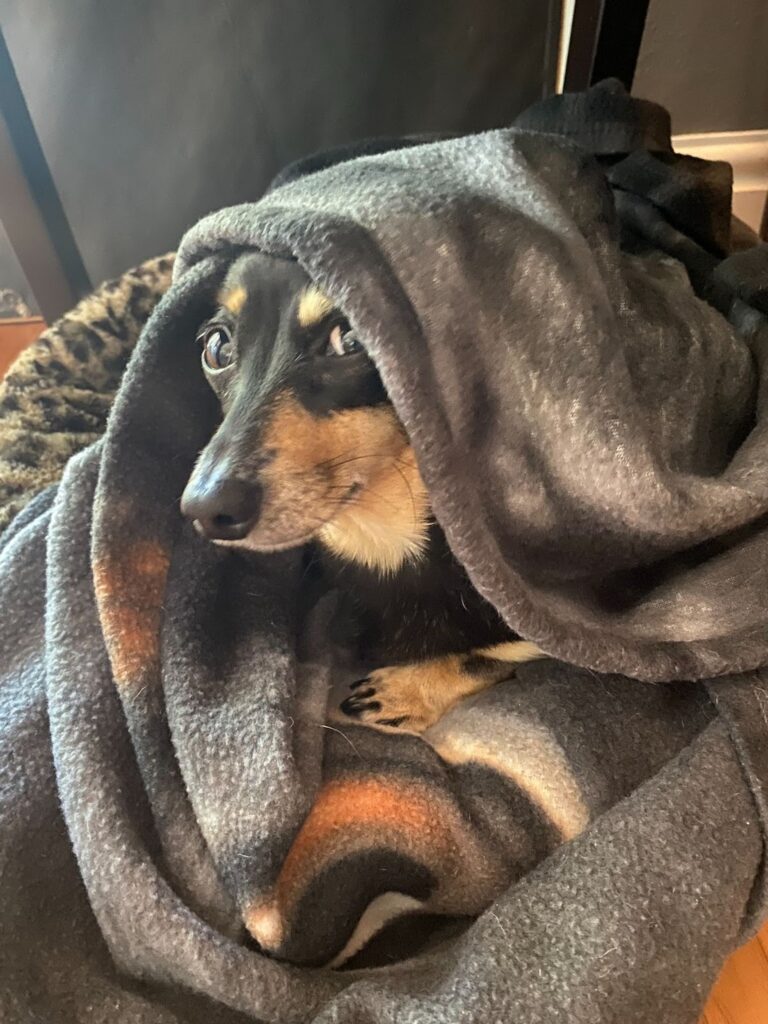
A current Heidi gives “side eye” while cozying up in a blanket.
(Image courtesy of writer)

The Other Side of the Counter

‘That’ customer in me

I feel the need to start by saying: we have all been the rude customer at some point — myself included. The last time I felt like a bad customer was when my wife and I moved into our current apartment. The leasing office had claimed that if we did not come in to pick up our keys on the official move-in date, it would affect the lease. A lease we had already signed. Not only that, we had already paid the first month’s rent. 

I explained to them that it didn’t matter to me if we picked up the keys a few days later, even though we already paid. They weren’t having it. In the end, this was not due to some overzealous property manager but a computer system designed by some far-off entity operating from the unreachable shadows. I never once considered that. I should have known better, given my years in customer service. This article is not meant to bully rude customers. It is simply my method of handling the rude, the kind, and the incompetent.

Feelings behind the counter

My career as a personal trainer, spanning nearly ten years, has been almost entirely focused on customer service. I’ve seen the other side. 

Most of the time, the person on the other side of the counter would be more than willing to give you everything you want. We can’t, though. 

We have bosses who have bosses breathing down our necks. There are systems in place that make it impossible for employees working in the trenches to be helpful in a real way. We are seen and treated by employers as a shield to criticism rather than empowered to solve problems.

The fact of the matter is, we are not paid enough to care whether or not you get a better deal. Our wages are never affected, for better or worse, on approving or denying customer requests. We only aim to keep our jobs long enough before we bounce to the next slightly better-paying position. This leads to negative experiences for the consumer.

Oftentimes, negative encounters result in the representative being told, “This isn’t very good customer service.” This is something I hear quite a bit in my current work. Which I assume is meant to make the “desk jockey” feel guilty. 

The idea that customer service is giving everything the customer wants is ludicrous. At the gym where I train clients, people often want free guest passes for their friends and family. Let me tell you something, I would love to have a pocket full of free guest passes to hand out. More people coming through the gym with a great experience eventually could lead to me having more clients. 

A sign reads “free entry” in red print with a pointing arrow.
(Image courtesy of Karim Manjra via Unsplash)

However, the company feels differently. No free guest passes for you! Employees in general are shackled by a strict set of regulations out of their control, and we follow them because rent is due on the first.

Myth or the truth

This is where my philosophy on true customer service comes into play. 

Customer service is not about giving everyone what they want. It was never meant to be that. And never will. Customer service is the employee treating you the same as everyone else, while giving you all the available information in a clear and concise manner. 

It doesn’t matter if we have a friendly rapport or if I perceive you to be the most miserable person I have ever met. I greet you by name if I know it. I answer the same question repeatedly without a hint of annoyance. I apologize when I am unable to fulfill a request. Such as moving gym equipment so you can do one single exercise in a specific spot that can be accomplished in several other places. 

Yes, this actually happened, and not out of feeling exposed to the male gaze by a certain exercise.

Wooden Scrabble tiles spell out “I am the truth”.
(Image courtesy of Brett Jordan via Unsplash)

There was an instance regarding the prone hamstring curl machine, which positions your butt in the air for all to gawk at. We did have a woman bring this concern to our attention, and we gladly shifted its position to be more modest.

Some requests are reasonable and will be executed. If yours was not, maybe consider that the employee is not the problem. 

Human side —no — gentle reminder

If a customer I have helped feels my service was less than adequate, I still greet them the same way the next time I see them. Customer service is the representative who never gives you a different side of themselves. 

But believe me, we will be talking about you behind your back. It’s just the way it is. 

So, next time you feel you’re being treated unfairly, please keep a couple of things in mind: the employee has no real power, and usually the manager doesn’t either. If we did, we’d give you what you want just to make you go away. 

Lastly, be kind to those who run the desk. We’re having a worse day than you. 

(The above excludes car dealerships, of course.)

Open Books

“Because it feels awkward.”

Oh? Has she still not gone yet?

“It’s not like I even know him anyway.”

It’s been weeks.

“No, I don’t want to. I don’t need to have a reason.”

If she doesn’t want to go, then forcing a meeting isn’t going to change her mind.

“I’m hanging up.”

I watched as the young customer made her way to my front desk, carrying a few volumes from that new series currently popular on social media. The promotional artwork around the display table sure was eye-catching.

“Find everything okay?” I asked cheerfully.

“Yeah, do you know when the next volume will be out?” she asked as she rummaged through her shoulder bag.

“The company said I should expect it in a few months. There’s been a delay in printing, it seems.”

“I heard the same thing. That gives me time to catch up, then.”

“I’ll let you know if I hear otherwise next time. Anything else?”

“No, no, that’s it.”

“That’ll be $64.92. Need a receipt today?”

“No, thank you.”

I bagged her books with trained speed as I watched another customer amble through the door, setting off the bell hanging in the corner. I bade her goodbye as she scrambled out into the breezy fall afternoon, and wondered if the series was worth reading. The premise of a romantic comedy about a zombie didn’t really appeal to me, but manga is a lot easier to read, so maybe it wouldn’t be too bad.

Will she go see him? Telling a young girl like her to do something out of adult obligation never works out.

A brass table lamp with a warm glow over books and other odds and ends at a small shop.
(Image courtesy of Nathalie Stimpfl via Unsplash)

My thoughts were soon filled with far-fetched imaginings as I pushed my cart of books to re-shelve. Awkward childhood, familial spat, the parents wanting something in return?

“Excuse me,” an elderly man perusing the autobiography section flagged me down. “Where do I find ‘The Tell’ by Amy Griffin?”

“Right here, sir,” I answered, showing him the shelf further down the aisle. I watched him pick up the book and start reading the jacket.

Huh, I wonder if it’s any good? I wonder how he got to know about it?

I spied Oprah’s Book Club symbol as I continued to re-shelve and made a mental note to look it up later.

“No, your family is condescending, doesn’t have any basic civil manners, and they all chew with their mouths open. I am not going to go just to have them make snide remarks about me and my ‘middle management’ job.”

I paused as I heard a whispered, and very heated, conversation from the end of the row.

“Listen here, Lisa, if I have to go, then I will tell them about our divorce myself the minute I walk through that door.”

If my eyes could have opened any wider, they would have. I looked around me to see if any other customers were in earshot, and then realized what section he was in.

Heh, Self-Help.

I spun on my heels to go the long way around, sneakily catching a glimpse at Lisa’s ex-husband, and started humming to myself. My phone chimed, alerting me to a calendar reminder to start ordering the spring reading list for the local high school. My store doesn’t get many students coming through for mandatory reading materials, but classics and Shakespearean titles will occasionally sell if the covers are visually appealing enough. The Used Books section also gains traction if I update the prices online early enough.

The profit margins aren’t too big, but my cozy shop has seen steady business and moderate success since I opened a few years ago. I can’t compete with warehouse prices, but I’ve tried to make my corner of the book world appealing.

Oh, Jeremy stopped by. Wonder if he’ll like any of these.

I gave a cheery greeting to one of my regulars as I dropped off my haul, made small talk, and started pushing my book cart back to the other side of the store. I glanced slowly back and watched as Jeremy made his way to the pile of tomes like a dragon eyeing a new treasure. He sure didn’t hide his love of used books.

I’m sure half his library is from here. Oh, wait, does he shop at other bookstores? What a cheater!

A golden dragon pendant with a silver chain lying on a book.
(Image courtesy of COPPERTIST WU via Pexels)

I chuckled inwardly before spotting Marge shuffling toward my desk. Pushing my half-emptied cart to the side, I briskly walked to the front and called out to her. I asked how her new grandchild was doing and learned he just got let out of the NICU and would be able to go home with Cathy and Erik soon. When I asked about all the cookbooks she had picked up, she said her best friend was flying in to visit for the weekend, and they were going to try out some recipes.

“If I don’t get through them all, I’m sure Erik would take them from me. Cathy sure does love his cooking.”

“Oh, I bet. A new mom doesn’t have the energy to be standing in the kitchen, right?”

“Quite so! Oh, that reminds me, maybe Betty and I should make some dishes to bring over to the hospital. It’s been a while since everyone has seen each other, probably not since the wedding. Oh, I should tell Betty. We’ll go shopping for some additional goodies when she lands.”

“Maybe for diapers? Can never have enough, I hear.”

“Oh, that’s too practical. No, it needs to be more fun.”

“A framed picture of diapers, then.”

“Now that’s the ticket, dear!”

I wave Marge off and internally hope Cathy is up for company this weekend. 

Well, if Betty can cook, I’m sure she’ll be welcomed with open arms.

Two women standing with their backs turned in the kitchen, cooking over the stove top.
(Image courtesy of Ivan Samkov via Pexels)

My attention snaps to the next customer, another regular who works across the street at the coffee shop. We chit-chat about how slow things have been this weekend, theorize how the weather must be making everybody stay in, and gossip about the new flower shop closing down in the next plaza because they were caught working as a front.

I watched him hold the door open as two teen girls giggled their way in and made a beeline to the romantic zombie table. Their squeals and hushed conversation were just barely audible from my post. I positioned my stool under me as I went through my purchase orders, inquiries, and updates on the computer. The bell brought my eyes up to another teen girl. She saw me first, but instantly looked away as her friends called her attention. I watched as she half-jogged her way over to them, turning the squeals from a duo to a trio, when Lisa’s ex-husband suddenly came into view, plopping a basket half-filled with self-help books and various manga in front of me.

What did Lisa do? What did you do?

More wild imaginings ran through my mind as I rang him up, my customer service routine on autopilot. “Find everything okay?” “Fine.” “Are any of these gifts?” “No.” “Would you like your receipt?” “No, thanks.” “Here’re your bags. Thanks for coming in.” “Bye.”

Hmm, what did you see in him, Lisa?

Out of the corner of my eyes, I watched the girls perform a rousing game of “Rock, Paper, Scissors” as I turned back to my computer.

It’s almost closing time.

I pushed the intercom button, alerted my customers that the shop would close in thirty minutes, and resumed my work.

Let’s finish this quickly.

I quickly clicked through my orders, jotted down the titles I would need to find later, and closed out my windows as a line started to form. The end-of-the-day rush doesn’t last long, but the quicker I can shoo people out, the sooner I can resume my librarian duties and pick up food on the way home.

The elderly man left holding a few books that Oprah had recommended.

Jeremy took about a third of the books that I returned.

A few customers walked out empty-handed.

The girls chittered excitedly about who got to read volume one first, how unfair it was, and that they called dibs on the next volume release. I interjected that it would only be a few more months, which prompted loud exclamations that the first girl needs to read “super-duper fast, or else!”

I walked Lenny, another regular, out, gossiping about the latest celebrity news until they turned a corner, and closed and locked the door. I groaned out loud at my checklist before placing my to-go order.

Twenty minutes to close up.

I zoomed through the now-empty aisles to grab any books that looked out of place, wrote down tasks to take care of in the morning, and shoved the list into my bag. Finishing the closing procedure quickly, I grabbed a book on my way out the door, and locked up the shop.

I need to finish this before Jenny comes in tomorrow. I can’t have her spoiling the ending for me, not again.

Making my way to my car, I gave one last look at my darkened windows before waving goodbye to the coffee shop worker across the street. He stopped bussing the table to smile and wave back.

See you tomorrow.

An open book on a table, next to a cup of coffee with a leaf latte art on top of a red saucer with a small creamer pitcher and spoon.
(Image courtesy of Khalis Rafif via Unsplash)


Peonies and Moon Trees

Today, in the stillness of winter, I realized how brilliant my twin brother is. I have always thought of him as highly intelligent. More than that, though, he is a force of good in my life, a being who encompasses constancy, sincere honesty, and all of those facets of society that I wish I beheld more often in other human beings.

Truthfully, I have been struggling with maintaining the same vibrancy I see within him these past months; I find myself looking for the broken pieces of our world upon which to cut my fingers. And there he is: always ready to mend my hands. I cherish him.

One afternoon, while we were walking through the brisk and battling winds of snowfields, we talked. We shared how we were feeling, how we viewed humanity’s tangible vicissitude, and my twin gently reminded me of the triumphs our world continues to nurture in defiance of the tragedies we are living through. However, what I found so powerful was that, unlike my prevailing bias in placing human beings at the center of all achievement, my brother discussed the success of plants, of things that grow simply because they must. 

He described the delicacy of peonies, how they flourished, what they symbolized, their perfect mutualism with the ants that could spoil a picnic and also cause sweet florescence. He spewed metaphors and similes as verdant as the plants whose names he recited, relaying how much we can learn from “those whose speech we rarely stop to listen to, let alone attempt to understand.” I found myself staring at the snow, imagining boughs and buds bursting forth with a vigor I could only hope to emulate.

My brother’s willingness to casually gift me the knowledge that would allow me to engage with nature in such intimate ways was akin to anything I have felt with someone I truly cared about, through reading poetry, tasting the best meal of my life, or landing a new job. It was euphoric, and all he did was describe to me how other living things continue onward despite global atrocities. I felt changed, and welcomed once more, by the living lyceum surrounding me, bestowing silent revelations. There were a few brief moments of envy when I desperately wished that I had arrived in this proverbial place of quietude on my own, but I was comforted by the fact that I have far more conversations, with both my twin and the plants whose languages I have yet to comprehend, to learn from and savor.

***

My brother’s generosity in welcoming me into the sanctity of nature felt healing, potentially from some hurt that had not yet been inflicted, and would now be wholly prevented. It felt rapturous, and so I asked him of other marvels that he leaned on in times of misery. He then spoke of “moon trees.”

For anyone who is unfamiliar, NASA launched Apollo 14 to orbit Earth’s moon in 1971. Aboard the vessel were astronauts, provisions and equipment, and tree seeds that Stu Roosa (the command module pilot of the mission) had stowed away. These seeds traveled through the void and the stars with the crew, and, upon returning to Earth, they germinated and were distributed across the world to national parks and historic locations. The saplings were strong, and, in some aspects, considered to be imbued with an abstruse vitality. They were fondly referred to as “moon trees,” and many continue to prosper today despite everything.

In 2023, more seeds were ferried to space upon the Orion spacecraft. These precious beginnings traveled thousands of miles for over a month before returning to Earth and being cultivated. This time, however, the moon trees were granted to schools, children’s camps, town halls, and community parks. In fact, organizations from across the globe were encouraged to write to NASA and illustrate why these precious trees would be beneficial to their communities, garnering over one-thousand submissions. Students, teachers, construction workers, hair stylists, and other changemakers wrote about the nearly ineffable hope that the moon trees represented and how they would remedy the increasing apathy of our celestial sphere by bringing everyone together.

My brother then described his own adventure locating a precious moon tree at the botanical garden where he once worked, and how he had made a point to map the location of the tree, a sturdy sycamore, so that everyone in the area could marvel at it. 

“It is magnificent,” he said as we walked, our warm breath misting in front of us. “And it is important for others to see that.”

I found myself getting emotional, recognizing the goodness within my twin, and understanding that he himself is, in more ways than one, a moon tree of sorts. He is someone who, like the powder-pink peonies, provides a sweetness that I crave in this bitter reality. He is a being, like the moon trees, who grants his own energy to lift others around him, all while harboring that same spirit that can only be born of stardust and moonlight.

I am proud of my brother for the numerous achievements that punctuate the years of his young life, but I, as his twin, feel fortunate beyond words that I, being half of something that also created him, could potentially be a moon tree to someone someday. I could become the peonies, in early spring, that don crowns of blushing heads, gilded in ants and glistening sugar.

I can choose to grow, whether it is in my ability to say that I was wrong, or to seek to understand when someone else fails to admit that they need help. I should prune my pride so that it does not become hubris, and I can nourish my everyday with humility and gratitude. Most importantly, I must decide to love without condition or expectation. For then, I may be pleasantly surprised when someone reaches out, bouquet in hand, to love me in return.

Yes, I believe that my twin brother has a brilliance that I rarely observe in other souls, but that is precisely why I am so grateful to discover it all over again, on our walks together, during these wintry days. He, along with Mother Nature, generously remind me that I may yet bloom in the snow and ash that surround me.

A white peony, looking as pale as the Moon, flowers in darkness.
(Image courtesy Photo by Anastasia Sineokaya via Pexels)