It had been two years, and I’m utterly positive now: I can’t leave.
The last thing I remembered was drifting off after doing some late-night reading. And the next thing I knew, I woke up in a forest with wings attached to my back. I. Had. Wings.
Why did I have wings? I truly didn’t know. But after flying around, it seemed to be around the turn of the century. The modern world I grew up in was long gone, and I had no idea how to get back home. I spent three weeks spiraling in anxiety and fear, flying aimlessly around the woods looking for any sort of sign of where I was. The only clues I had were the lack of modern cars and the unpaved landscape—I was definitely not in any metropolitan city.
One twist of luck I discovered was my new magic affinity. My now shrunken size allowed me to fly anywhere really quickly, and the humans weren’t able to see me. I flitted around gardens and kitchens without being caught. I needed to eat somehow, and I hadn’t the faintest idea of what job I would’ve been able to get. Plus, it was still quite cold outside, so the warmth inside was hard to resist.
As I flew around the houses one night, I was peeking through the windows for any sort of entertainment on their old-school TVs when I noticed a horse and a rabbit in the middle of the room. Something deep inside told me to go in, so I slipped through and hid in a dark corner.
“What is real?” the little bunny asked the horse.
“Real isn’t how you are made. It’s a thing that happens to you,” the horse replied sagely.
Yup. I had landed myself somehow in The Velveteen Rabbit.
I had somehow become the Fairy in my favorite childhood story. When I was younger, I used to own several stuffed bunnies in the hopes of creating a real one myself. I had memorized the story by heart—but I never once wanted to be part of the story! I couldn’t accept being sent back a whole century just to make stuffed animals real.
Once the reality started sinking in, I made a beeline for the forest hollow I had now called my home. Now that I was able to use magic, outdoor living was more manageable for me. It was a far cry from the comfort I grew up in, but it was a lot easier.
(Image courtesy of Alessandro Matonti via Unsplash)
“Okay, okay, okay. I am a fairy. I am to make toys turn into real things?? The horse explains to the rabbit at the beginning of the…” I trailed off, running my memory at high speed, not trusting my recollection, and trying to find other sources of truth. Alas, it was to no avail. “I’m at the beginning of the story. The rabbit doesn’t turn real…for another half a year…”
If I were to make the rabbit real…then would I be able to go home?
A new determination filled within me. I now had a shot.
For the next few months, I began pushing the boy and bunny together: hiding the china dog, whispering in the boy’s ear that he longed for the bunny, and nudging the nanny on where to find it every time it was left behind.
Then, my time to shine had come.
I distracted the gardener and untied the bag holding the old toys to burn. That night, the velveteen rabbit rolled out. I had practiced and rehearsed for this very moment.
“You were real to the boy because he loved you,” I delivered in my most cheery voice. “Now, you shall be real to everyone.”
I scooped the rabbit up in my arms, dropped it off in the forest, and gave one final kiss. Then, I fluttered back into the shadows and watched as the rabbit explored its new life.
(Image courtesy of Laura Lumimaa via Pexels)
But I didn’t return as I had hoped.
I still had wings on my back, I could still use magic, and I was still in the story. With a light heart, I flew back to my hollow. I surprised myself when I thought about how…meaningful it felt to transform a boy’s love into a tangible wish.
So, when I saw myself still in those now-familiar woods, watching the velveteen rabbit of my childhood hopping around, I wasn’t too disappointed.
After all, there were plenty of toys to watch over.
“No, I don’t want to. I don’t need to have a reason.”
If she doesn’t want to go, then forcing a meeting isn’t going to change her mind.
“I’m hanging up.”
I watched as the young customer made her way to my front desk, carrying a few volumes from that new series currently popular on social media. The promotional artwork around the display table sure was eye-catching.
“Find everything okay?” I asked cheerfully.
“Yeah, do you know when the next volume will be out?” she asked as she rummaged through her shoulder bag.
“The company said I should expect it in a few months. There’s been a delay in printing, it seems.”
“I heard the same thing. That gives me time to catch up, then.”
“I’ll let you know if I hear otherwise next time. Anything else?”
“No, no, that’s it.”
“That’ll be $64.92. Need a receipt today?”
“No, thank you.”
I bagged her books with trained speed as I watched another customer amble through the door, setting off the bell hanging in the corner. I bade her goodbye as she scrambled out into the breezy fall afternoon, and wondered if the series was worth reading. The premise of a romantic comedy about a zombie didn’t really appeal to me, but manga is a lot easier to read, so maybe it wouldn’t be too bad.
Will she go see him? Telling a young girl like her to do something out of adult obligation never works out.
(Image courtesy of Nathalie Stimpfl via Unsplash)
My thoughts were soon filled with far-fetched imaginings as I pushed my cart of books to re-shelve. Awkward childhood, familial spat, the parents wanting something in return?
“Excuse me,” an elderly man perusing the autobiography section flagged me down. “Where do I find ‘The Tell’ by Amy Griffin?”
“Right here, sir,” I answered, showing him the shelf further down the aisle. I watched him pick up the book and start reading the jacket.
Huh, I wonder if it’s any good? I wonder how he got to know about it?
I spied Oprah’s Book Club symbol as I continued to re-shelve and made a mental note to look it up later.
“No, your family is condescending, doesn’t have any basic civil manners, and they all chew with their mouths open. I am not going to go just to have them make snide remarks about me and my ‘middle management’ job.”
I paused as I heard a whispered, and very heated, conversation from the end of the row.
“Listen here, Lisa, if I have to go, then I will tell them about our divorce myself the minute I walk through that door.”
If my eyes could have opened any wider, they would have. I looked around me to see if any other customers were in earshot, and then realized what section he was in.
Heh, Self-Help.
I spun on my heels to go the long way around, sneakily catching a glimpse at Lisa’s ex-husband, and started humming to myself. My phone chimed, alerting me to a calendar reminder to start ordering the spring reading list for the local high school. My store doesn’t get many students coming through for mandatory reading materials, but classics and Shakespearean titles will occasionally sell if the covers are visually appealing enough. The Used Books section also gains traction if I update the prices online early enough.
The profit margins aren’t too big, but my cozy shop has seen steady business and moderate success since I opened a few years ago. I can’t compete with warehouse prices, but I’ve tried to make my corner of the book world appealing.
Oh, Jeremy stopped by. Wonder if he’ll like any of these.
I gave a cheery greeting to one of my regulars as I dropped off my haul, made small talk, and started pushing my book cart back to the other side of the store. I glanced slowly back and watched as Jeremy made his way to the pile of tomes like a dragon eyeing a new treasure. He sure didn’t hide his love of used books.
I’m sure half his library is from here. Oh, wait, does he shop at other bookstores? What a cheater!
(Image courtesy of COPPERTIST WU via Pexels)
I chuckled inwardly before spotting Marge shuffling toward my desk. Pushing my half-emptied cart to the side, I briskly walked to the front and called out to her. I asked how her new grandchild was doing and learned he just got let out of the NICU and would be able to go home with Cathy and Erik soon. When I asked about all the cookbooks she had picked up, she said her best friend was flying in to visit for the weekend, and they were going to try out some recipes.
“If I don’t get through them all, I’m sure Erik would take them from me. Cathy sure does love his cooking.”
“Oh, I bet. A new mom doesn’t have the energy to be standing in the kitchen, right?”
“Quite so! Oh, that reminds me, maybe Betty and I should make some dishes to bring over to the hospital. It’s been a while since everyone has seen each other, probably not since the wedding. Oh, I should tell Betty. We’ll go shopping for some additional goodies when she lands.”
“Maybe for diapers? Can never have enough, I hear.”
“Oh, that’s too practical. No, it needs to be more fun.”
“A framed picture of diapers, then.”
“Now that’s the ticket, dear!”
I wave Marge off and internally hope Cathy is up for company this weekend.
Well, if Betty can cook, I’m sure she’ll be welcomed with open arms.
(Image courtesy of Ivan Samkov via Pexels)
My attention snaps to the next customer, another regular who works across the street at the coffee shop. We chit-chat about how slow things have been this weekend, theorize how the weather must be making everybody stay in, and gossip about the new flower shop closing down in the next plaza because they were caught working as a front.
I watched him hold the door open as two teen girls giggled their way in and made a beeline to the romantic zombie table. Their squeals and hushed conversation were just barely audible from my post. I positioned my stool under me as I went through my purchase orders, inquiries, and updates on the computer. The bell brought my eyes up to another teen girl. She saw me first, but instantly looked away as her friends called her attention. I watched as she half-jogged her way over to them, turning the squeals from a duo to a trio, when Lisa’s ex-husband suddenly came into view, plopping a basket half-filled with self-help books and various manga in front of me.
What did Lisa do? What did you do?
More wild imaginings ran through my mind as I rang him up, my customer service routine on autopilot. “Find everything okay?” “Fine.” “Are any of these gifts?” “No.” “Would you like your receipt?” “No, thanks.” “Here’re your bags. Thanks for coming in.” “Bye.”
Hmm, what did you see in him, Lisa?
Out of the corner of my eyes, I watched the girls perform a rousing game of “Rock, Paper, Scissors” as I turned back to my computer.
It’s almost closing time.
I pushed the intercom button, alerted my customers that the shop would close in thirty minutes, and resumed my work.
Let’s finish this quickly.
I quickly clicked through my orders, jotted down the titles I would need to find later, and closed out my windows as a line started to form. The end-of-the-day rush doesn’t last long, but the quicker I can shoo people out, the sooner I can resume my librarian duties and pick up food on the way home.
The elderly man left holding a few books that Oprah had recommended.
Jeremy took about a third of the books that I returned.
A few customers walked out empty-handed.
The girls chittered excitedly about who got to read volume one first, how unfair it was, and that they called dibs on the next volume release. I interjected that it would only be a few more months, which prompted loud exclamations that the first girl needs to read “super-duper fast, or else!”
I walked Lenny, another regular, out, gossiping about the latest celebrity news until they turned a corner, and closed and locked the door. I groaned out loud at my checklist before placing my to-go order.
Twenty minutes to close up.
I zoomed through the now-empty aisles to grab any books that looked out of place, wrote down tasks to take care of in the morning, and shoved the list into my bag. Finishing the closing procedure quickly, I grabbed a book on my way out the door, and locked up the shop.
I need to finish this before Jenny comes in tomorrow. I can’t have her spoiling the ending for me, not again.
Making my way to my car, I gave one last look at my darkened windows before waving goodbye to the coffee shop worker across the street. He stopped bussing the table to smile and wave back.
Amongst humanities graduate students, especially literature students, there is a joke that grad school will kill one’s passion for reading. I always thought that I would be impervious to such a curse – that no matter what my Hispanic Literature programs threw at me, my love of reading would remain unscathed. I chose to study literature because, like most people who do the same, I loved reading from an early age. Further, I loved dissecting passages and plots, analyzing character motivations, and connecting works of fiction to larger societal themes. To a certain degree, I was right about my passion being steadfast in the face of the stresses of advanced academic training. There are numerous books from many different countries and eras that piqued my interest beyond them being required reading.
However, the greatest book in the world cannot fix the fatigue that a bloated reading schedule causes. I knew what I was getting into, of course, but knowing really doesn’t matter after having to read hundreds upon hundreds of pages of say, Garcilaso de la Vega or Gonzalo Fernández de Oviedo (real ones know!), as I had to do during my Colonial Latin American Literature survey course. For six years, I often felt as though I had one eye on a PDF and one eye on the clock, mentally calculating how long it took to read one page and estimating how quickly I could finish a book before moving on to the next one. However, In early 2021, I found myself free of the constraints of reading under pressure, as I had passed my preliminary exams for my doctoral degree the semester before.
Turning the page
With my attention now solely focused on crafting my dissertation and teaching Spanish language classes, I had won back something that had been missing during my time taking courses: an eensy, teensy bit of free time. Unfortunately for me, I had also been recently diagnosed with allergic asthma, so some of this free time was spent, once or twice a week, in my allergist’s office, on the receiving end of histamine shots that would (hopefully) reduce the severity of my allergies, while also not inducing anaphylaxis.
In that sterile and uninspiring room, far from the creaky, imposing library shelves I had been dwarfed by for so long, the pressure to read for the purposes of writing papers and bolstering class discussions melted away. Accompanied only by my ancient iPad, loaded with the Libby app, I would spend hours waiting in that office, interrupted intermittently by my doctor checking my airways and the injection site on my arm. At my fingertips was what seemed like an unending catalogue of books whose publications I had missed for the last six years. What’s more, I soon discovered something about me that I never expected: I loved reading horror fiction.
All my life I have hated horror movies. I have only seen one, The Strangers (2008), and even that was against my will. The Halloween of my fourteenth year saw me crowding into my friend’s basement with the rest of our social group, which consisted of teens who were not scaredy-cats like me. Due to a combination of peer pressure and shaky confidence, I agreed to watch the aforementioned horror flick while thinking, “Maybe it won’t be so bad.”
Boy, was I wrong.
Despite my rejection of slasher films, I wouldn’t consider myself an overly sensitive person, but my anxious personality is not well-suited to the anticipation and gore of the horror genre. There are some days I refuse to watch even an episode of The X-Files as twilight approaches. So to have been, suddenly, breathlessly waiting for books to come off hold that featured content aimed to terrify was very surprising to me, though I embraced it all the same.
My reading reawakening that began beneath the stale, fluorescent lights in a random medical building in north-central Indiana led to a years-long obsession of reading (when I wasn’t writing my dissertation, of course) anything horror- or thriller-adjacent that I could get my hands on. I devoured litfic that centered around body and/or psychological horror, crimes being committed, anything that boasted showcasing the darker sides of humanity.
I didn’t exclusively read horror and thrillers, but I found myself gravitating back toward such works, desperate for the illusion of control while living in a political landscape that was (and still is) trending anti-woman. In these fictional worlds, women could act on their impulses– something we’re very rarely allowed to do in reality. They may be committing crimes, sure, but aren’t we, as women, allowed a little rage when we’re losing our rights to medical care? Can’t we cheer for women doing exactly as they wish when there are those who wish to take away our rights to vote, to divorce, to be employed? Sadly, to everything there is a season, and it seems as though my time voyeuristically consuming women’s rights and wrongs through fiction has come to a possible end.
(Image courtesy of Engin Akyurt via Pexels)
Plot twist
After the birth of my daughter, my anxiety has gone into overdrive in an effort, evolutionarily and biologically, I suppose, to try to maintain my family unit within a small, protective bubble and keep the horrors of the world away. The terror that originally had no effect on me when reading horror is now wholly felt, as if I were back in the eighth grade, in my friend’s basement, watching Liv Tyler and Scott Speedman get stalked and terrorized by three weirdos in masks.
I noticed this change when I was finally able to read Monstrilio by Gerardo Sámano Córdova, a book about a woman mourning the loss of her child to such a degree that she turns a piece of his body into a sentient monster. I read, maybe, 10 percent of the book when panic began to overtake me. What if I lost my daughter? In our world, sadly devoid of magical realism, I wouldn’t be able to manifest such a creature. I would have nothing. Plenty of parents around the globe have obviously experienced loss, so I would not be special. But, such a fact does not eliminate the disquietude that this concept produces. I returned the book almost immediately. Then, very recently, a similar thing happened while I was reading the beginning pages of The Lamb by Lucy Rose.
I had read books describing cannibalism before and, while the idea personally disgusts me, I was able to push past this revulsion to see how these gruesome tales proceeded. Now, my response was so visceral, so palpably felt, that not even a can of Vernors ginger ale could remedy my nausea.
Both books had been hyped up on Bookstagram (a community with which, like BookTok, I have many issues but ultimately can’t quit) for months, as certain accounts received advanced reading copies and therefore raved about how good they were before library-using plebs like me could gain access to them. I was so excited to read them, but, this enthusiasm, and the state of my emotional moods, were in direct opposition.
The militant feminist in me (which, let’s be honest, is most of my personality) is begging me to push through. She, to be frank, doesn’t even think it’s appropriate to confess that motherhood has caused any change. I should be able to engage in the things I enjoy, instead of letting possible internalized patriarchal ideals – that dictate that mothers’ lives should revolve around their children; that they should spend every single second of every single hour of every single day thinking about their children and their needs; that they are not complete people now, but accessories to the new generation – win. Whatever individuality I can eke out, says this feminist, should be celebrated and pursued doggedly.
Cliffhanger?
Unfortunately, overriding my brain is easier said than done. I find that I miss the previous catharsis I relished while reading; I have no outlet for my frustrations. Also, a small part of me fears that, with this change in taste, I’m no longer cool. Is this how the process from eclectic individual to lame parent starts?
Maybe I’ll return to Monstrilio and The Lamb in the future, when I’m more practiced at divorcing reading and my anxieties. Maybe it’s finally time to give Marcel Proust’s In Search of Lost Time a try? Maybe I’ll exclusively read nonfiction until I’m 90. The specifics of my reading habits were different at 10, 17, 25, and will continue to vary at 32, 46, 54, and so on.
I find myself back at square one, in a place akin to where I was in 2021, wanting to read but not sure where that desire will take me. Still, I have progressed before and will again. And, I should emphasize, I’m ultimately grateful that my lifelong passion for reading remains in spite of the hiccups detailed here, and that I have passed that passion on to my daughter, who demands a reading of Frog and Toad Are Friends at least once a day.
For now, I suppose the horror books on my to-be-read list must wait patiently in their dark corners. But, as the current total of this list, according to my profile on The Storygraph, is 3,308 books, there’s plenty to read in the meantime.
Rio de Janeiro, Brazil, was designated UNESCO’s World Book Capital for 2025. It is the first Portuguese-speaking city to receive this prestigious title.
This choice is not only symbolic. Besides recognizing the cultural potential of Brazil, it also seeks to reposition the reading as a space of leisure, community, and dialogue.
As the World Book Capital, Rio de Janeiro will host numerous events. Including book fairs and literary festivals, to foster cultural exchange and encourage access to knowledge.
The Brazilian city is therefore focusing on ways to encourage reading beyond book sales. One example of this is the ‘Rio’s 2025 Book Biennial’, featuring soirées, lectures and immersive activities.
Why was Rio de Janeiro chosen?
Commitment to reading: the city demonstrated a strong commitment to promoting literacy and making books accessible to all citizens.
Rich literary heritage: Rio boasts famous writers like Machado de Assis and Clarice Lispector, contributing to its literary significance.
Cultural hub: the city has a vibrant cultural scene, including renowned libraries like the Portuguese Royal Reading Room and the National Library Foundation.
On September 16, the event Esquenta Jabuti took place in celebration of the title of World Book Capital.
Writer and event moderator Henrique Rodrigues shared with Yuvoice his thoughts on the importance of this recognition, reaffirming how this title, granted by UNESCO, is significant for the city because it highlights the broader culture of Rio de Janeiro.
At the same time, it is also relevant as a possibility for the creation of more effective public policies.
“It is necessary to have more everyday yeah activities, those small-scale initiatives that, over time, make a real difference in shaping readers.”
Rodrigues argues that sporadic events are mainly aimed at selling books and stimulating the market, but that once the buzz fades, the incentive for reading is lost.
“It’s as if books and reading were only talked about when there’s an event, when it should be the other way around. […] The event needs to be the culmination of something that happens all the time. That’s why I believe this title for the city can open the door to more regular programming that truly makes a difference in Rio’s schools and communities,” he stated.
The World Book Capital program
The initiative by UNESCO aims to recognize cities that champion reading and books.
Each year since 2001, from April 23rd (World Book Day), the chosen city undertakes a year-long program of activities to encourage literacy and cultural exchange.
Cities like Strasbourg (France, 2024), Accra (Ghana, 2023) and Guadalajara (México, 2022) have also held this title.
Does literature still foster social connection in the digital age?
It turns out that, in Brazil, more than half the population does not read frequently. According to the survey ‘Portraits of Reading’ (2024), around 53% of the people in the country haven’t read any kind of book – digital or printed – of any genre in the three months prior to the survey.
The numbers are alarming, since the total number of non-readers has surpassed the number of readers. Facing this scenario, a question remains: what has been done to stimulate the habit of reading?
Despite the statistics, young people and adults found time to read in their busy routines. Even if surrounded by countless stimuli from social media, literature fulfills its role not only of study or entertainment, but also of socialization in the lives of individuals.
The urban scene, marked by people with smartphones in hand, might suggest that books are being left aside. But would that be the absolute truth or just a collective impression?
This perception is not entirely confirmed: in-person and digital initiatives show that reading still takes a relevant place in the life of a portion of the population.
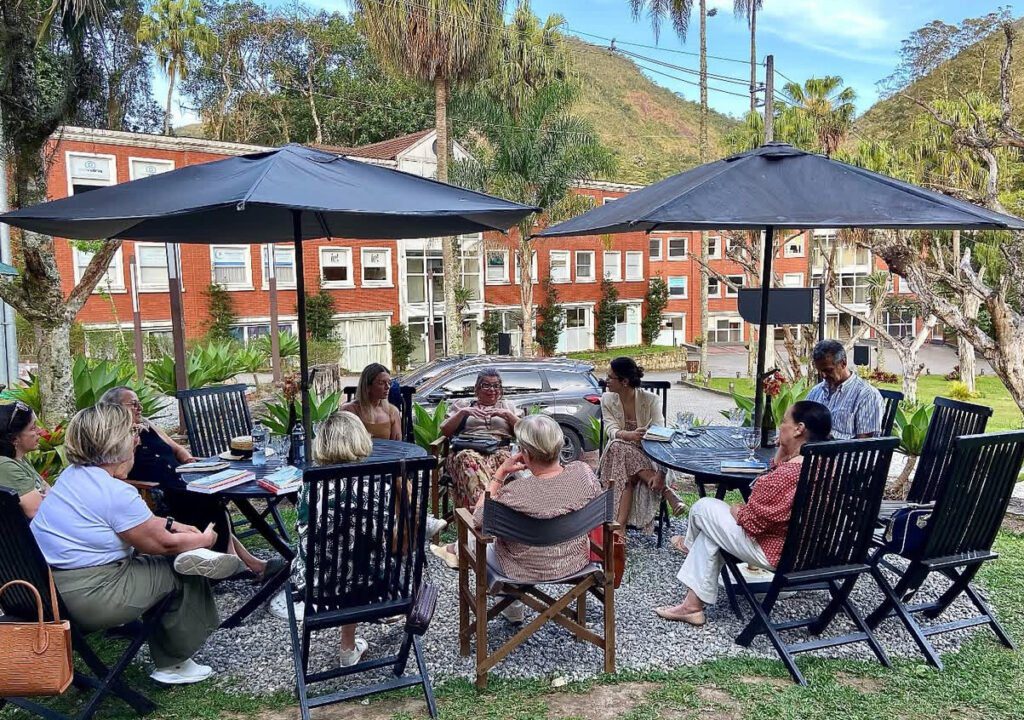
Group of readers at the Funambule Library – Photo by @livraria_funambule via Instagram.
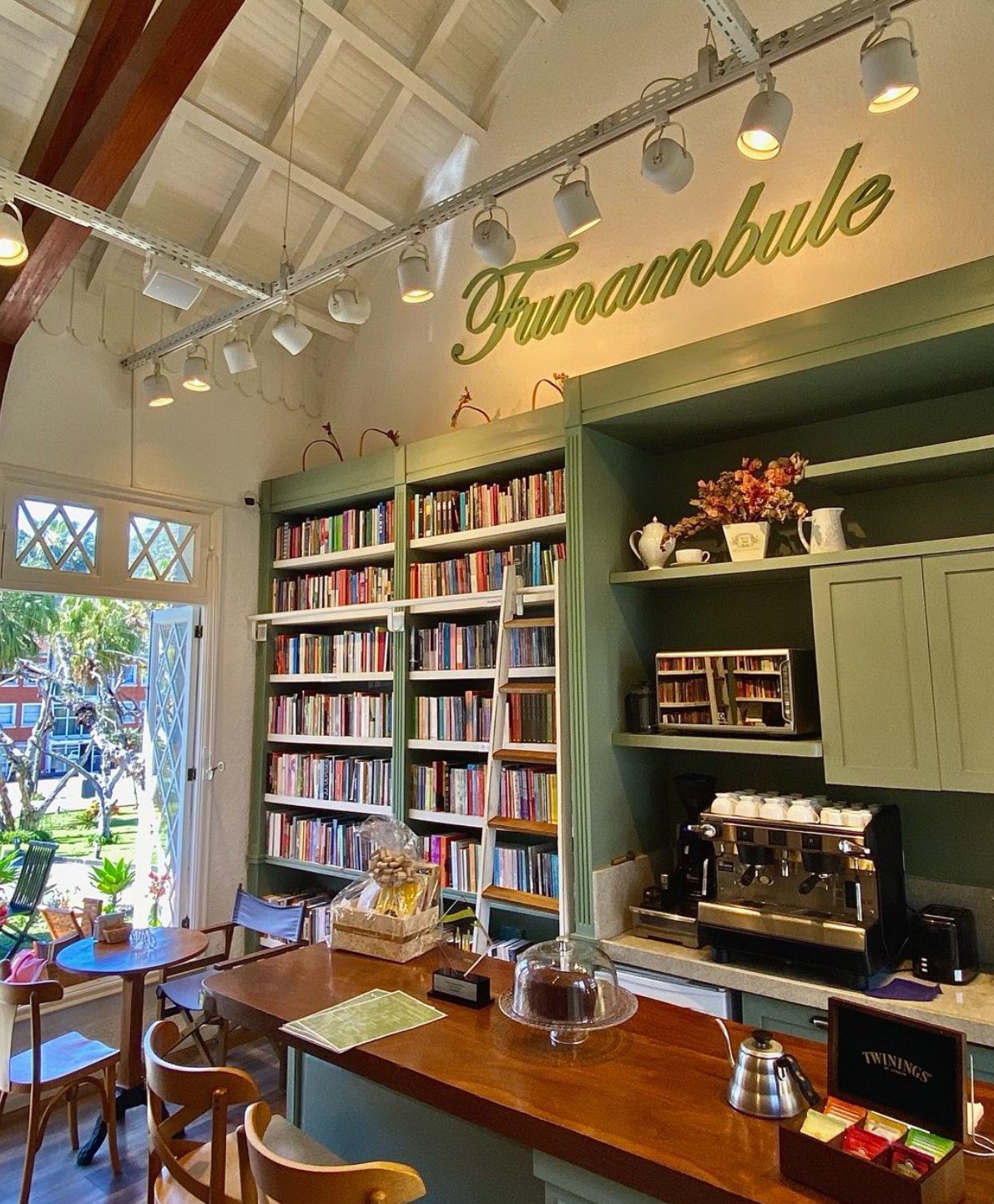
In the Highland Region of Rio de Janeiro, a small library became a space and symbol of literary interaction.
Between shelves, cakes and coffee, the ‘Funambule Petrópolis’ established itself as a meeting spot to avid readers of the city. Through monthly meetings, diversified groups of children and adults come together to discuss their chosen reading.
In an exclusive interview with Yuvoice, Hebert Rodrigo, Funambule’s founder, shared his vision of the importance of spaces that encourage this habit.
“Many people who come here to the bookstore have just moved, and they’ve found here, among the books and reading groups, an excuse to meet new people and build new relationships. […] It’s inspiring to see how members connect beyond literature, creating bonds.”
Reading continues to play its timeless role of opening the door to visit new worlds. It combines entertainment with reflection on the reality of our daily lives, awakening creativity, hope, and curiosity.
And in practice, its effects go beyond the individual sphere. Socialization through literature is not merely a byproduct.
In the point of view of Hebert, those places open space to people to explore things they haven’t done before, encouraging them to take risks.
It is a third space of freedom where they can express themselves without commitment, spontaneously. Something you don’t normally find in the other two pillars of life, which are family and work.
When discussing books in groups, people not only share their interpretations, but also practice empathy, listening, and building ties of belonging.
To Hebert, reading made with the objective of sharing carries a different meaning than individual reading.
“You think more about your reading, develop your ideas further before sharing. It’s an enriching experience”.
This creates a space that encourages not only reading, but also critical thinking, discussion, and respectful exchange.
Reading and the Internet
Nowadays, more environments that encourage the habit of reading are needed. In this sense, the internet is not the enemy.
Social media also plays a fundamental role in this process. Platforms like TikTok, Twitch, Reddit, and YouTube have become virtual meeting places where readers, especially younger ones, share ideas, create connections, and participate in live streams to collectively comment on works.
One example is the digital book club created by Brazilian influencer Maria Clara Quirino [@readingwithma] on Instagram, WhatsApp, and Meet.
The group brings together more than 400 participants in monthly virtual meetings, with collective readings conducted via video calls and subsequent discussions, which seek to comment and discuss the main ideas read.
It is clear that literature in Brazil still lacks the incentive to strengthen its cultural power. Despite this, reading still finds ways to reestablish itself in a predominantly digital age.
Therefore, in-person or digital projects are fundamental tools to expand access to books and reverse the worrying situation revealed by the research.