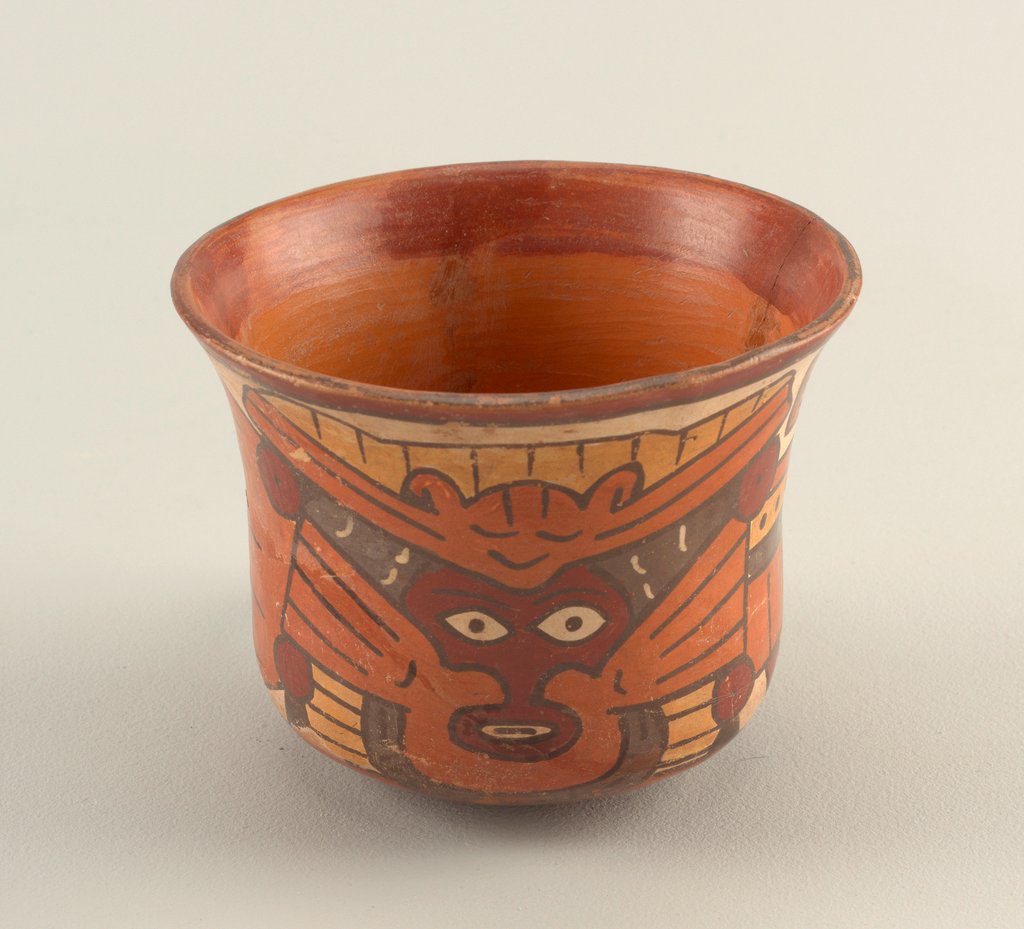
A 13.7-cm (5.3-inch) diameter slip-decorated earthenware beaker from Peru, hand-cast in the 5th to 7th century, now part of the Cooper Hewitt Collection, Smithsonian Design Museum.
(Image courtesy of Smithsonian)
Trigger Warning:Adult language, gory detail
When I was a kid and played little prince-turned-to-toad-type games, I always used to wonder: Hmmmm? What kind of peeper would I be?
Toadie
Would I be the Goliath frog of Cameroon? They say it’s the largest Conrauidae amphibian anywhere in the world. A beast of a frog. Giant. Massive. Monstrous. A right warty ruin. These so-called “slippery frogs” can grow to the size of a baby deer. And they’re born to run — just like Bruce Springsteen or a real deer. Drop, trot. Hop, hop. Takes four hands to hold type shit.
So if I had to be a bullfrog, then it better be that same, slick dreadnought. That’s the frog I’ve always wanted. Conraua goliath. Camarooni leviathanicus. Froggy monstrosititus. Amphibi juggernautti. Toadus maximus. All gross, no glory.
Batty
As an adult, I’ve played a similar game when wanting to fly: What kind of creature would I be in flight? No stupid bird for sure. All beak and big feathers. Weak! And far too pretty, to be sure. Soaring through the clouds. Bathed in light. Close to God and Daedalus too.
No way! I’d rather be a bat. A giant grotesque. A rodent with fleshy wings and nighttime flight. Eating insects and fruit. Sucking nectar from flowers. Drinking blood from a field full of cows.
But what sort of bat would I be?
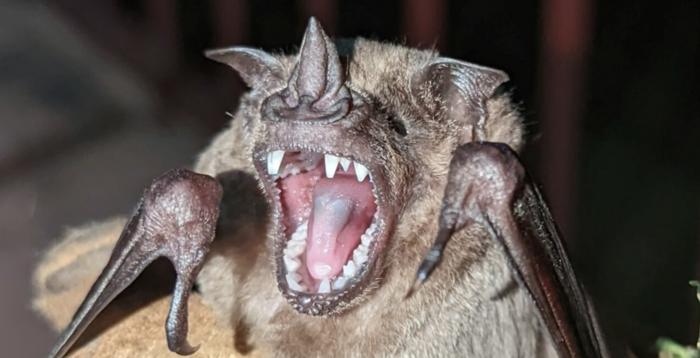
The Jamaican fruit bat Artibeus jamaicensis has a short jaw, like many fruit-eating bats.
(Image courtesy of Alexa Sadier via Eurekalert)
A few bat muthafuckaz
Would I be that gorgeous beast known as the flying fox? He of golden-crowned, golden-capped locks? The giant fruit bat Acerodon jubatus is the biggest one of all. A bat out of hell — like a small cat with wings, only with a rat face and groovy two-tone hair. They eat only fruit and the occasional insect taco too. Plus what a cool name… Jubatus? Chew bet I am!
Subscribe to The Superhero Brief!
Free access to the CEO's newsletter.
The views expressed in this newsletter are those of the CEO and do not necessarily reflect the views of the organization.
But forget about him. The coolest, most awesomely enviable of all bat names is Vampyrum spectrum, the so-called great spectral bat — also known as the American false vampire bat. These bats are remarkable. Loving. Social. Popular.
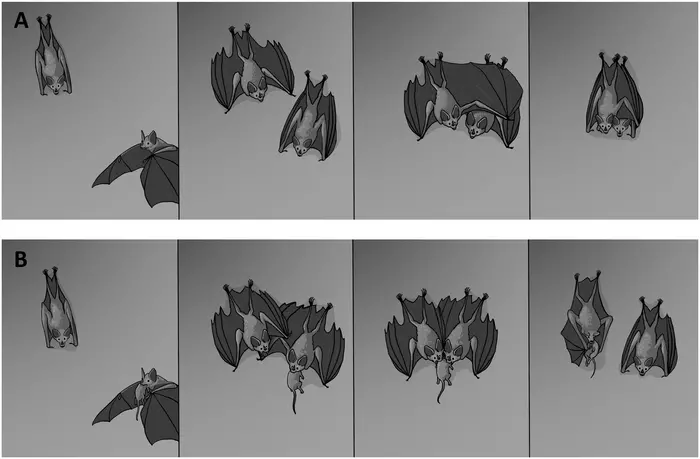
Last month, scientists at the Museum of Natural History in Berlin, Germany, reported hiding a camera in a tree and filming one group of this curious species. These bats sometimes sleep in balls for warmth on cold nights, with the outside bats wrapping their wings around the group. They also give each other bro-hugs, apparently. Most significantly, they participate in a takes-a-village form of “biparenting,” where hunting adults bring back food to share with random pups in the batty ball — often not even their own offspring. Gotta love ‘em.
Social behavior in Vampyrum spectrum bats. The top four panels show a classic bat “bro hug.” The bottom four panels depict an “Ooo… gimme, gimme” example of biparenting.
(Image courtesy of Paulo C. Ditzel (2025). CC-BY 4.0 via PLOS One)
Could I be part of that bat ball too — a screeching, gnashing commensal hunter and communal hugger? Maybe.
Or would I be the greatest hunting bat of all… the amazing incomprehensible Nyctalus lasiopterus, otherwise known as the greater noctule bat.
In-flight mealtime
This month, researchers studying lasiopterus from Aarhus University in Denmark and Doñana Biological Station in Spain showed that the bats are rare predators indeed. One of the few hunters in the entire animal kingdom capable of taking down a migrating songbird from a high-altitude avian flock at night. Bon appe-tit.
The greater noctule bat flies to an altitude of more than 1,200 meters (~4,000 feet). There, using sonar, it blindly trolls the mid-troposphere in search of a bounty. Ultrasonic screeches echolocate its path and pinpoint its prey: an unfortunate warbler, robin, or other songbird booty. The noctule bat picks them off. One by one. It can catch birds almost as big as itself.
While it takes them down, the bat doesn’t take them, uh, down. Audio recordings the scientists made of bats catching birds in mid-flight reveal their screeching continues, echolocating around, after the capture. And there are other sounds as well. Chewing sounds. Spitting sounds. Drooling. Yum. In one recording, a noctule bat devours its songbird dinner for 23 minutes, all while soaring high above Earth.
Ah, sweet mystery of life
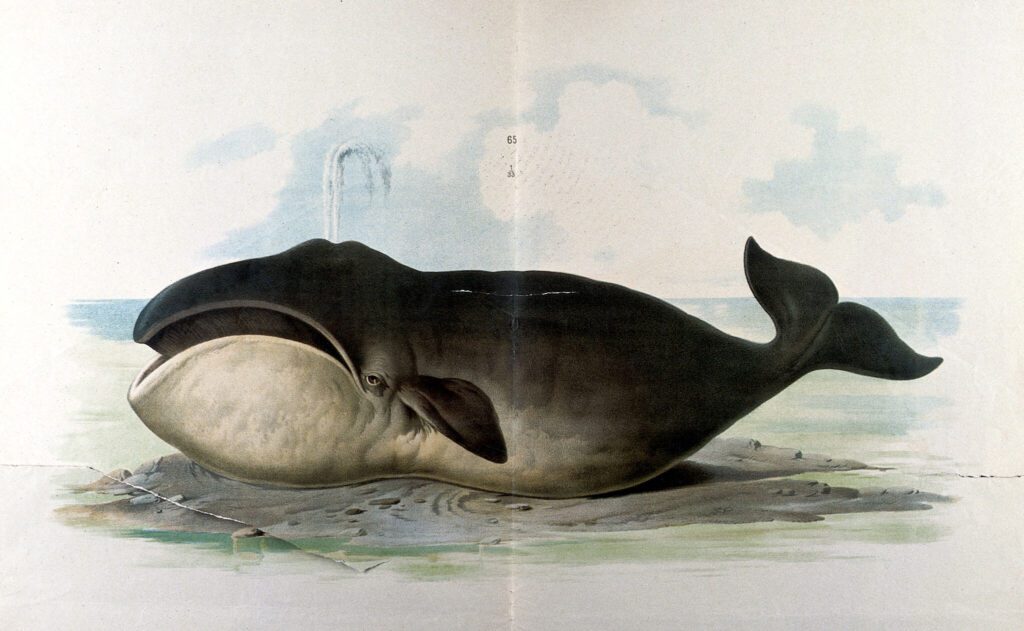
What mysteries these bats keep close. Some may even spill the secret to human longevity. They buck nature’s trend of live small, die young. Mice and rodents have lifespans measured in months — dogs and cats, years. Human life spans average out in decades, and larger mammals can live even longer still. The mighty 4-meter (13-foot) bowhead whale can easily live to be 200.
An 1860 chromolithograph by F. Gerasch of a bowhead whale resting on a sandbank.
(Image courtesy of F. Gerasch via Wellcome Trust)
But bats buck this trend and then some. For their size, they are the longest lived of all mammals, according to zoologist Emma Teeling of University College Dublin. “There are 19 species of mammal that live longer than humans, given their body size,” Teeling told me in a 2022 interview. “And 18 of these are bats.”
For the last 13 years, Teeling has led a group of researchers in a mobile lab to the north of France. As I have reported, they drive through the pastoral hills and picturesque towns of Brittany to arrive at an old Gothic church whose belfry serves as both flophouse and nursery to a population of around 5,000 bats. Then they get together with local townsfolk to capture, weigh, measure, and release every bat in this population, repeating the same procedure with the same bats the next year.
Teeling likens the secrets of a bat’s biology to a Ferrari with good brakes — a car that’s fast as hell but can stop on a dime without setting the tires on fire. Their bodies resist cancer. They tolerate viruses (thank you for that whole COVID-19 thing, by the way). And learning those lessons may someday help humans live longer.
Dracula as Fat Bubba Bat
But if truth be told, I want to be the weirdest bat of all, which in my opinion is the most famous bat in nature: our dear, dear, dreaded creature-of-the-night friend, Desmodus rotundus.
Vampire bats are biological wonders. They have spherically distensible bellies, shorter jaws, sharper teeth, and can drink twice their body weight in blood every night. Ever seen a fat, full vampire bat taking flight? Think about a bowling ball with wings. They’re not called rotundus for nothing!
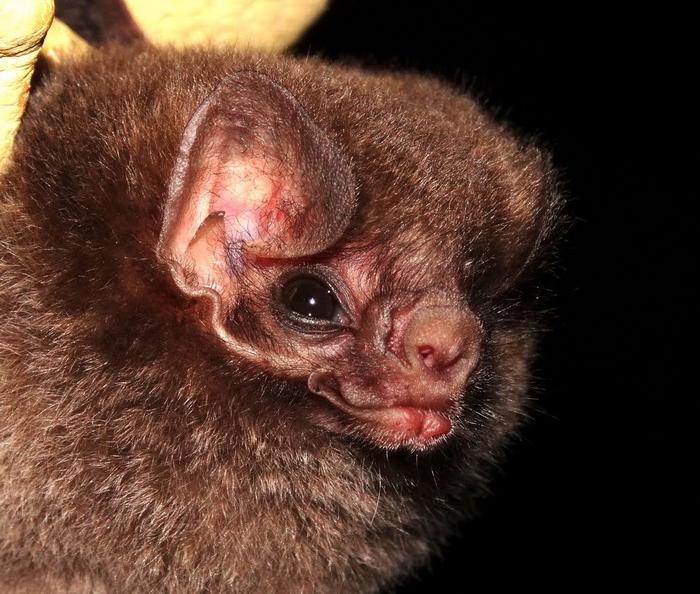
The hairy-legged vampire bat Diphylla ecaudata feeds primarily on the blood of birds. It is one of three living species of vampire bats. Fewer teeth and shorter jaws serve their specialized diet.
(Image courtesy of Sharlene Santana/University of Washington via Eurekalert)
They have special pits in their nose lined with infrared detectors — heat vision goggles, essentially. That physiology allows them to spot the pulsing, blood-pounding vein of a large mammal in the dark. They have no sweet and bitter taste receptors on their tongues, which means they’ve lost the taste for anything other than gimme-more blood. And they get it. They have razor sharp teeth, another evolution. Self-sharpening teeth, in fact. With no tooth enamel, their teeth wither into a keenly honed edge, always. Not just sharp — razor sharp.
All that allows them to spot, bite, and spout open a main line cut through the rough fur and thick hide of their traditional dinner — mountain lion or other large mammal — or sometimes even crocodiles, turtles, and rattlesnakes. Such brave bats!Their modern diet is often an all-you-can-eat bonanza of bitten ankles of domestic cows and sheep.
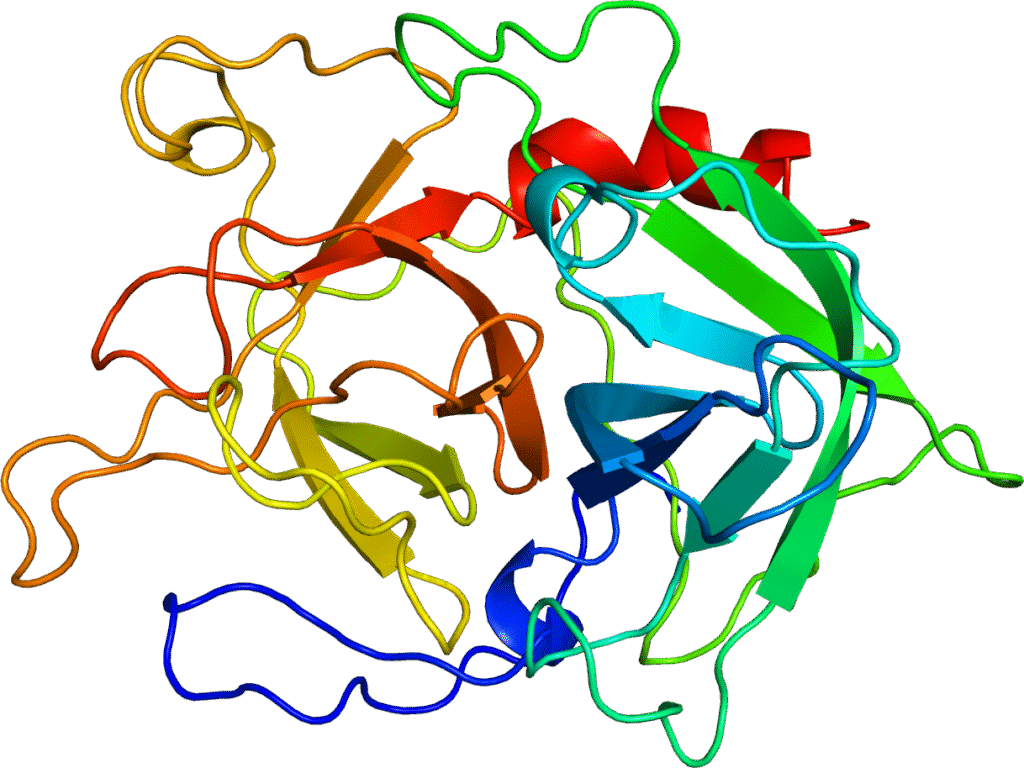
Vampire evolutionary adaptations do not stop at opening wounds, either. The bats have grooved tongues, like built in straws. Lick, lick. Gulp, gulp. They also produce chemicals that keep the flow of blood unstaunched via an anticoagulant present in their saliva — affectionately dubbed “Draculin.”
3D structure of desmoteplase, a compound derived from Draculin.
(Image courtesy of Protein Data Bank coordinates (PDB #1A5I) via Wikimedia Commons)
Large animals will kick these annoying vampire bats away when they bite. Those fangs… Oh mommy it hurts! But the more the bat licks the wound, the better it feels. The more the searing pain subsides. The cows stop fighting back. Bat licks are soothing. Nice. They have painkilling analgesic compounds on their tongues as well that soothe the wounds. Licks de-staunch and double salve. Let them do it, bitter bitten cows moo. It doesn’t hurt. Feels good.
Vampire bats are also social, though disgustingly so. Rather than wallow in their own post-sanguine puffery, a vampire bat will not hesitate to regurgitate a share of its bloodmeal with its brood mates. They literally vomit-share directly into the mouths of their loved ones. (Candy corn anyone?)
And finally… There’s one feature of the vampire bat that I love the most. They have freakishly large thumbs, which they use in conjunction with their strong thighs to launch themselves into the air. It ain’t pretty, waddling down the runway into a freakish thumb Cabriole caper. But it works. They launch themselves time after time into the nighttime sky and escape — to bite and suck and drink (to later vomit) and live another day.
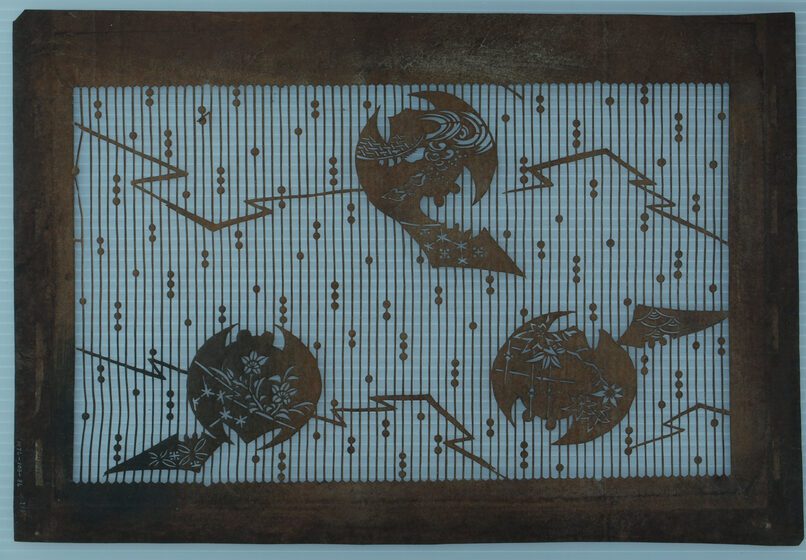
A Katagami of three bats dated mid 18th or early 19th century and now part of the Cooper Hewitt, Smithsonian Design Museum Collection. Waves, bamboo, maple leaves, and multiple blossoms give life to the lucky silhouettes on a medium of mulberry paper (kozo washi) treated with fermented persimmon juice (kakishibu), and utilizing silk threads (itoire). In Japan, bats symbolize good luck.
(Image courtesy of Helen Snyder via Smithsonian)
Jason Socrates Bardi is an award-winning health and science journalist and editorial director in Washington, DC. He has written three books about the history of math: The Calculus Wars (2005), The Fifth Postulate (2009), and his upcoming book The Great Math War (Basic Books, 2025). His articles have appeared in the San Francisco Chronicle, Good Morning America, U.S. News & World Report, and The Lancet. In addition to writing and editing, Bardi has published photographs of Nobel laureates in outlets around the world. He lives in Bethesda, Maryland.
Thank you to Daphne Kasriel and Yosef Baskin for their inspired edits on the piece.



Comments
Be the first to share your thoughts!
We value diverse perspectives and respectful debate.