Ever Be Forgot

Ever Be Forgot

The foreboding he felt was palpable. Bad juju, bad mana – no good vibes here. It was the sheer number of them. The closer he got to the designated site, the more cars there were. Road sides had started to look congested about 4-5 miles back.

By the time Eddie Whelan parked his car, there was no further to travel; it was park up or turn back. The winding, thinning country lanes up to the forest were stocked with cars everywhere he looked. This felt enormous. People had travelled a long ways to be here, from all over the country, and so very many.

Deep autumn right on the cusp of winter, when “the fall” has lost its charm. The first flashes of crispy pastel yellows and oranges dissolved into the sludge of dark mud under foot.

“Shit,” Eddie somewhat gasped as nearly an entire shoe was swallowed by mud. The visibility was dismal. There was clearly some form of glow emanating from the depths of the forest. Mainly, he was guided by a mid-distant hollering and the banter of the revelers way ahead of him.

A brief glance back and Eddie’s car was no longer visible in the gloom of later year night. Nevertheless, he kept moving forward, identifying the pines and conifers ahead with his phone torch. It felt eerie; it felt like it couldn’t be trusted. Time, place, setting – everything was off.

His years in the field had taught him he couldn’t really trust any novel environment – that caution, and an unblinking vigilance, were a necessity. But this was a flavor of feral he hadn’t sensed in a good while, maybe since youth. This was Guy Fawkes Night after all:

“Remember, remember the 5th of November.”

A holiday 400 years in antiquity, a staple of national identity.

“Gunpowder, treason, and plot…”

Counter terrorism before it was named, as King and Parliament saved.

“I see no reason, why gunpowder treason…”

Bring fireworks along, lighting bonfires must be done.

“Should ever be forgot.”

An evening of national pride, community, and fun.

Eddie wiped a drip of snot from the tip of his nose. The assaulting British cold emanated from the forest with every step. The winter to come was making its presence known – wrap up as you will, it’s going for your bones.

Wading deeper into the foreground of ominous pines, Eddie felt his entire back stiffen. This was a hell of a time to be out late… anywhere. He’d watched helplessly in recent months as his waistline and appetite for casual cigarette smoking grew. He thought to himself that maybe his job had never been harder.

Current affairs reporting in the 21st century was seldom uplifting. Journos knew the score, just as the general public did. Negativity, cynicism, and the inflammatory were catnip to news consumers. Yet, this was a bad year.

Britain’s social fabric was hemorrhaging. National identity had gone from being something revised, expanded and growing, decade for decade, to something febrile and dangerous. Forging ahead was rejected while screaming for something long gone was the order of the day. Exactly what it meant to be British had become a nationwide obsession. In many corners, it became a green light for vigilantism and worse.

Eddie could hear voices getting louder up ahead. The silhouettes of tree trunks getting steadily clearer. He couldn’t tell if it was his eyes adjusting to darkness or if he was moving towards light. A sharp crunch echoed nearby. Eddie made a snap glance behind. Nothing. Was he being followed?

Arguably the originators of conservatism, Britain had only in the most recent decades used the word “diversity.” The term Britain had always favored was “tolerance.” Yet it was clear in some parts of the country, this had long since faded. The picture was ugly. Violent white crime remained on a steady upward trajectory. Youth crime circled its perennial numbers. Hate crimes were suspiciously falling out of reporting, circulation, or consideration. Streets had become hairy.

Some areas of the country started setting curfews – the most economically deprived areas; typically those neighboring acute densities of immigrant communities. This, commentators called the British Establishment’s greatest failure since the three-day week. The defeat of it reeked. If you can’t make a better society, then survey, control, and cage it. The headlines were clickbait gold. Their message was societal decay.

IS THE BRITISH POLICE A SPENT FORCE?

SERVE AND PROTECT WHO?

OLD BILL OUT TO PASTURE!

The fuse was lit 6 months prior.
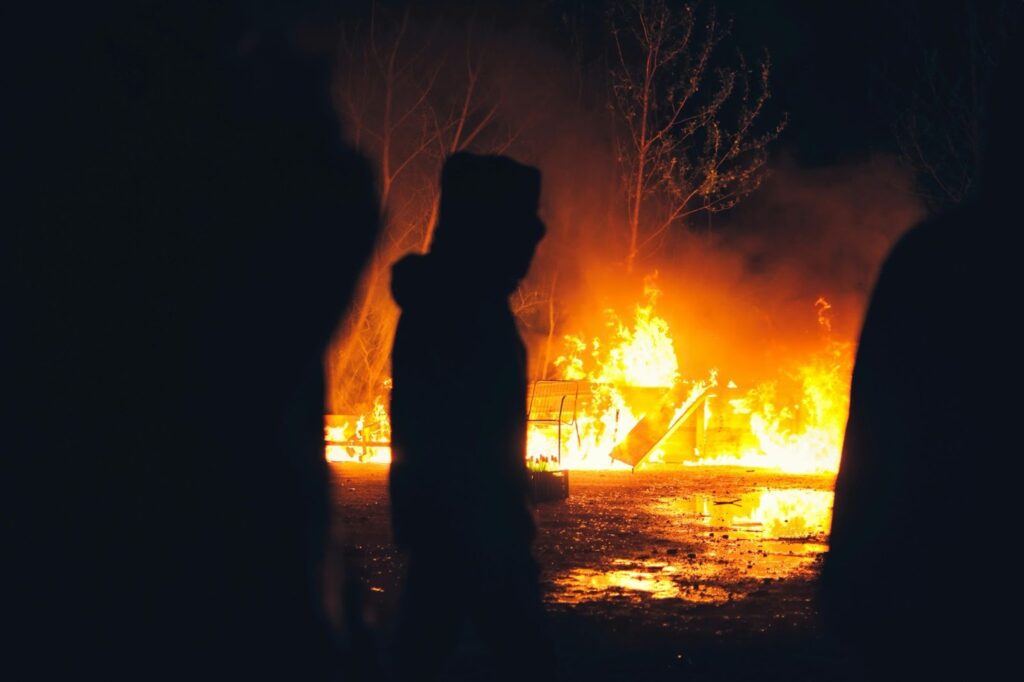
Three dark figures stand watching a public park ablaze as a bench and child’s slide go up in flames.
(Image courtesy of Marco Allasio via Pexels)

Shrill screaming filled the air. A firework ripped through the sky in a phosphorous tear. A pocket of silence followed before a loud pop of neon green splinters gilded the night sky. Eddie made a slow nervous turn to check behind him. Nothing again. As the airborne metal salts faded, the auburn glow of bonfire swelled ahead of him. At his furthest squint, Eddie could make out people marching towards the blaze. He followed.

The internet being a public space mirrors its real life counterpart: what is unacceptable in broad daylight may well find its private settings, corners, or… forums. Many who gather underground, away from the masses, are easily swayed and influenced by conspiracy and fear-mongering. The results can be disastrous.

Such a disaster imploded in an online forum exclusive to the British Isles. Some snarling, aggrieved, nefarious collection of men had taken it upon themselves to begin surveillance of places of worship and their attendees around their local communities. Blinded by bigotry and fear, they did not see the harassment or encroachment of civil liberties they were committing.

Eddie’s walking slowed when the bonfire was only partially blocked. He was no longer alone. The many, many cars parked up had indeed come to this site for what was an almighty bonfire. He couldn’t make out the entire scale of it because it was… it was as big as a house. And no small house.

Like a snowball rolling down a hill, the more this xenophobic tribe posted, the more the number of posts grew. The more the number of posts swelled, the more fictitious narratives and venomous storytelling were assigned to the innocent parties they preyed upon.

After an escalating 3-month campaign against one such individual, stalked and swatted by a forum frothing from the mouth, one of the very worst hate crimes in the country’s history was committed.

Women were left degraded and on life support. Children, grossly still, with skull fractures and broken bones lay in intensive care. A family and their home marred beyond recognition– all while the father was away and unable to protect. Horrifying, blind hate.

Eddie was no longer alone. A hard slap on the back announced the fact.

“Get in!” barked a scratchy voice leaving a full pudgy face, grinning wildly in giddy solidarity. The reveler marched ahead, unawares Eddie was far from one of his own. Eddie was struck by the heat emanating from the bonfire. This was as much a formidable force as a gathering point. The base of the behemoth bonfire was hardly visible from the dense crowd surrounding. Then, Eddie looked up and stopped walking closer.

The intelligence communities, in conjunction with the police, soon found the culprits. Those convicted individuals swore that they knew the truth. They claimed, feverishly, that they had attacked the family of an extremist, a terrorist in waiting, a threat to society. Yet, the intelligence communities found nothing of the sort.

Their “target,” upon interview and background checks of length and depth only intelligence teams could conduct, showed no prior or present links, trails, or anything nefarious to his name. The forum had created a monster that didn’t exist. Innocents lay in hospital beds thanks to imagined enemies – a disaster of both social and epistemic proportions.

Like the blast of a bomb, the harrowing damage rippled further than the site of impact. The perpetrators went in the dock, defiant and convinced of a system trying to suppress their “knowing the truth.” In fact, the sheer lack of evidence against the victim and his family only solidified the convicted individuals’ certainty that they were right to act as they had. Worse still, some corners of the internet and certain tribes of British society celebrated these criminals as martyrs.

When the government concluded its McAndrews Commission Report from the investigation – it was met with muted response. People believed what they believed – many felt that they were receiving the true overview of an evil attack of repugnant racism while others believed it was a government smoke screen avoiding uncomfortable realities.

The cacophonous chanting and pervasive roar surrounding Eddie was akin to a football cup final. A crowd in raucous anticipation of a great event. He had hoped his undercover following of the forums would turn out to be a damp squib. He tried not to let his own feelings cloud his expectations, but they must have done so. The enthusiasm of the posting was real, the projected attendance was not understated. The scale of this was intimidating, obscene.

This was a celebration, but one rotten and malignant in nature. Oh, the attendees were citizens, but this wasn’t citizenship. A calendar date to stand against nihilism had been hijacked to salute it. Eddie had craned his neck to look up at the towering effigy slowly catching flame. A giant “Guy Fawkes” wrapped in a huge banner. Printed across the banner: a published family photo of the victims.

Eddie slowly raised his phone, to take photos, to report, to do his job. The shriek of another firework and the heat of the fire felt miles away. His blood ran cold. He was numb – what had his country become.
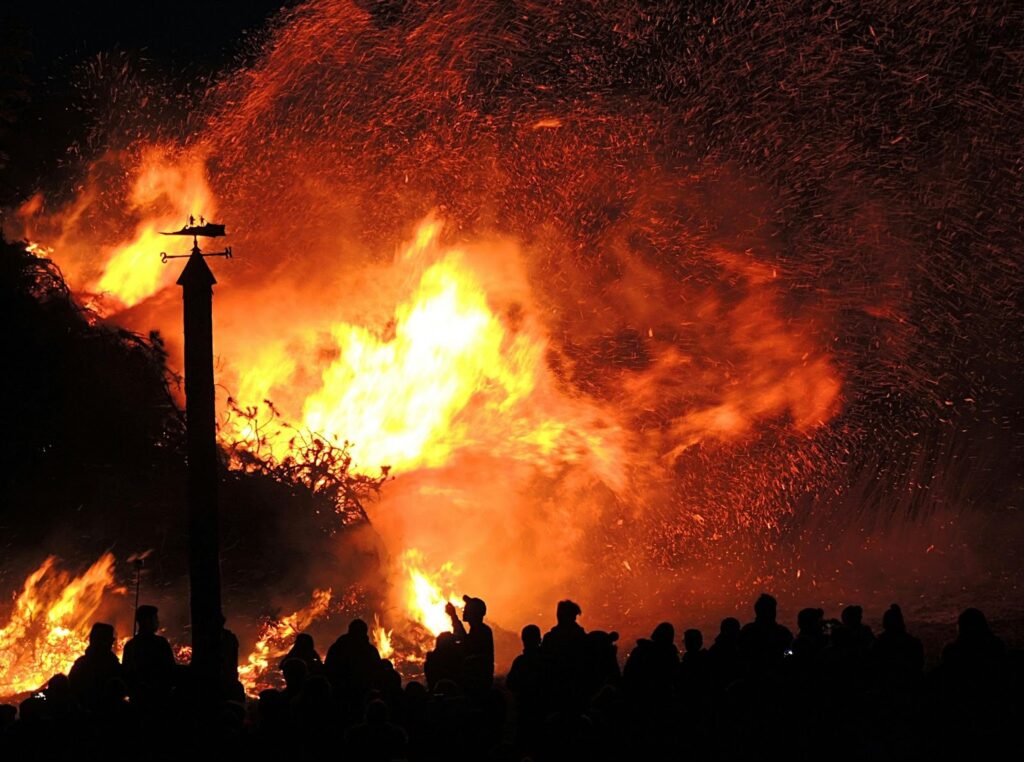
A huge crowd of people stand in the dark watching a gigantic blaze rage with sparks and flames everywhere. A small tower with a melting weathervane can be seen in contrast against the bright fire.
(Image courtesy of Pixabay via Pexels)

Epidemic Violence Against Women In Brazil

The end of last year was bleak in Brazilian police news. On the last weekend of November 2025, three crimes against women drew national attention.

In the first, a teacher and a psychologist were murdered inside the Federal Center for Technological Education Celso Suckow da Fonseca (Cefet/RJ) while at work. It was the end of a workweek. Allane de Souza Pedrotti Matos (a teacher) and Layse Costa Pinheiro (a psychologist) were in a room at Cefet-RJ when fellow teacher João Antonio Miranda Tello Ramos Gonçalves shot both women and then himself. 

All three died inside the school where they worked, during the school term and with many students present. So far, the motivation for the crime appears to be João’s inability to accept the fact that his supervisors were women. João suffered from mental disorders, had previously been on medical license for four months, and had been transferred to another department, but none of this was enough to prevent the fatal attack against the two women.

In the second incident, a so-called “Red Pill influencer” (a term used to describe men who believe in male superiority over women and who often promote misogynistic discourse, advocating violence against women), already known to police for violence against women, assaulted his girlfriend.

Tainara Souza Santos, 31 years old, was at a nightclub in São Paulo with another man. Her ex-boyfriend, Douglas Alves da Silva, 26, allegedly got into a fight with this man, motivated by jealousy. Douglas then reportedly waited for Tainara to leave the nightclub, ran her over, and dragged her body for more than one kilometer attached to the structure of his car. Tainara’s body only became detached from the vehicle when it went over a raised section of the road. The young woman had to have both legs amputated. Douglas was arrested by the police. Tainara died at hospital on Christmas Eve. 

These cases are just a few among many that happen every day in Brazil. Although legislation provides for the punishment of men who kill women simply because they are women, aggressors remain undeterred. Not even protective measures—such as court-ordered minimum distance from the victims or monitoring with electronic ankle bracelets—intimidate some attackers.

In Brazil, many women suffer violence every day simply because they are women. Since 2015, Brazil has recognized this type of murder as “femicide,” a heinous crime. The report Elas Vivem, by the Network of Security Observatories, estimates that every 15 hours a woman is murdered in Brazil. Sixty-eight percent of these murders occur inside the victim’s own home, and in 70 percent of cases the perpetrator is a current or former partner. Some statistics point to a 26 percent increase in reports of violent incidents against women in 2025 compared to the same period in 2024. In the first half of 2025 alone, 683 children were left without their mothers due to violence, according to data compiled by the Laboratory for the Study of Femicide (Lesfem) at the State University of Londrina. The laboratory projects 950 femicide victims by December 2025. In the second half of December, the Federal Government promoted a meeting between the Executive and Judiciary branches to outline a strategic pact with measures addressing violence against women.

The increase in violence rates recorded in the country has drawn the attention of scholars. In an interview in early December 2025 with Folha de São Paulo, demographer Jackeline Romio stated:

“We are experiencing an epidemic of gender-based violence—whether femicide, sexual violence, homicide (the violent death of women), or suicide, which has also been increasing. All these types of violence against women have already reached levels that must be monitored. In Brazil, we have surveillance data on cases resulting from violence. We can say that gender violence, in its various forms, has already reached, since 2010, levels that should be monitored as epidemics. They go beyond any expectations we previously had. Regarding femicide, it only increases and will continue to increase.”

One concrete measure, which does not repair the violence but strengthens a support network for victims, was recently evaluated by the Supreme Federal Court: granting financial assistance in the form of paid work leave to women who are victims of violence, similar to what already exists for Brazilian workers who face illness. Employers will be responsible for the costs of these leaves during the first 15 days away from work, and the INSS—the federal agency responsible for worker and retirement benefits—will assume payment after this initial period. In this way, victims can take care of their health while maintaining their income. It is worth noting that, in many cases, these women even require prolonged hospital stays due to the severity of the violence.

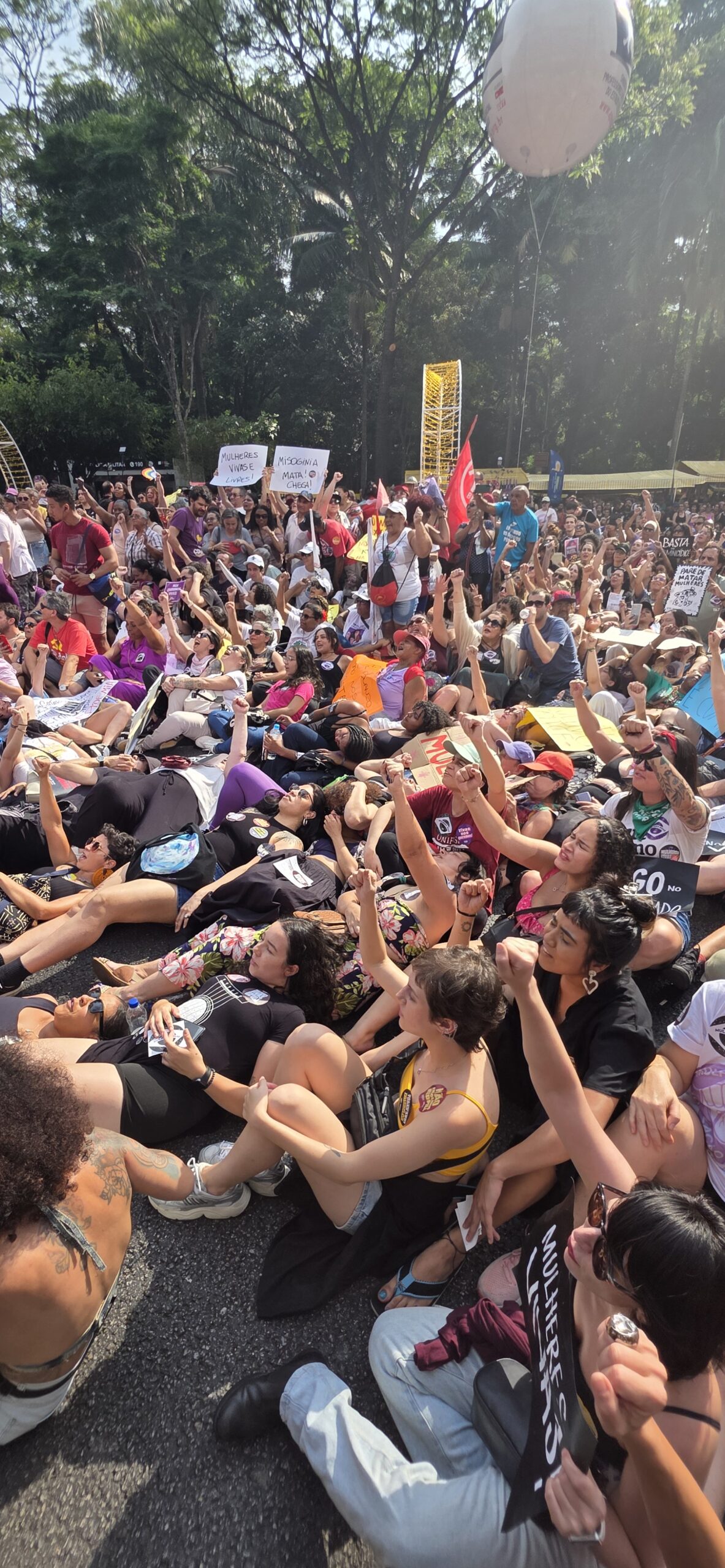
In several cities across the country, protests against this “epidemic” of violence took place in the first days of December.

Rachel Ripani is a Brazilian actress, director, and feminist activist. She participates in lectures, podcasts, and social media content production, emphasizing the importance of feminism. Rachel spoke with The Sentinel about the epidemic of violence against women in Brazil in late 2025:

The year 2025 is not even over yet, but statistics point to an increase in violence against women compared to 2024. What do you attribute this rise to?

Experts say that the fact that assaults are now being recorded—on cell phones in public spaces or on internal security cameras, such as in elevators—may give this perception. We are also seeing a slow education of police forces to recognize femicide and gender-based violence, which increases reporting. But I believe violence is objectively increasing due to hate speech and anti-women’s rights discourse that is fostered and monetized digitally. The manosphere, incels, and red pills spread hatred and lies against women without any punishment. On the contrary—violent words become violent actions. This is obvious to us. But for the Senate and Congress, it seems the saying applies: those who hit forget, but those who are hit do not.

In the last weekend of November 2025, we witnessed episodes of violence against women that seemed to surpass the usual level of cruelty. In your experience, do men feel freer to commit even more cruel acts? What is your opinion on impunity or the lack of effective punishment for such serious crimes?

Violence against women is, in practice, authorized. If 98 percent of rapists never spend a single day in prison, how can we curb violence? If the prevailing culture doubts women who report abuse, if neighbors “don’t get involved,” if children have no sex education in schools, how will they know that what they experience is abuse? Punishment alone is not the solution, although I do support severe penalties. We also need education and a change in mindset.

What kind of discourse do repeat offenders use to keep their partners close, even after previous episodes of violence?

It’s the so-called cycle of violence. At first, the man is a prince; he puts you completely on a pedestal. Slowly, very slowly, he distances you from people who would warn you about the control he begins to exert over you. Then comes gaslighting. If an abusive relationship began with a punch, no woman would stay. But that’s not how it works. It’s like a staircase—you go down one step at a time. And when you realize it, you’re at the bottom of the pit.

Beyond the law that already exists, what other measures would you point to as medium-term solutions to violence against women? Is Brazil a sexist country? How can we correct this historical acceptance or leniency toward partners who beat their own companions inside their homes? Remembering that 70 percent of violence cases in Brazil occur inside the home and are perpetrated by the partner.

The first is the criminalization of misogyny, a bill that is stalled in the Senate. We have several other legislative proposals that we want to present to leaders of the executive and judiciary branches, listed in our policy framework document available on our profile, @levantemulheresvivas.

How do you reconcile what you call conciliatory feminism with the urgency faced by women suffering violence today? Is this conciliation a long-term solution? Until then, what would be your proposal to prevent cruel deaths like the one in the horrific case of Tainara, who was dragged for more than a kilometer attached to her ex-boyfriend’s car? This case recalls the level of cruelty of former basketball player Igor Eduardo Pereira Cabral, who assaulted his girlfriend Juliana Soares in an elevator in July 2025 in Rio Grande do Norte, punching her 60 times in the face, all recorded by security cameras. Juliana had to undergo facial reconstruction surgery.

Obviously, in such cases, conciliation is impossible. Against crimes, I advocate severe punishment. Conciliation lies in feminism no longer being seen as a dirty word, no longer being perceived as a movement against men. This imaginary gender war does not exist. Women do not hate men. But men need to understand and position themselves as allies of women. That is conciliation. It comes from a space of dialogue and care, not from exclusionary dogmatic certainties.

We know behavioral change comes through education. What suggestions would you give so that, in a few years, more men consider the idea of hitting a woman absurd? After all, hitting any human being is absurd, since we are rational animals living in an organized society governed by law.

The Maria da Penha Law already provides for educational actions, as is the case in England, which adopted them after the series Adolescence. Educational initiatives in schools would be a great start. For adults, men should begin speaking up in their groups when a colleague posts a joke that demeans a woman or shares nude images without consent. When men consider rape as unacceptable as cannibalism, we will be closer to safety.

What explains a certain normalization of violence by people who do not live close to cases of aggression against women? How can these people be sensitized to become active agents in spreading ideas against violence?

It is very hard to grasp the magnitude of the gender disparity we live with. It is painful for women and can foster a sense of guilt in men—and guilt is paralyzing. That is why I believe that bringing men into the debate allows for positive, not imposing, action with our partners. Awareness can happen in a sensitive way, not sensationalist or imperative. As a woman, at a certain point in my life, I could no longer ignore the cumulative violence I had experienced, and that motivated me to begin my activism. Each person has their own path.

After Bondi Beach, Australia’s Gun Laws Confront New Realities and the Lessons of Port Arthur

Sydney’s Bondi Beach, usually a symbol of sun and surf, became a site of terror this week when two gunmen attacked a Hanukkah festival, killing 16 people and injuring dozens more. Soon after, the New South Wales Police confirmed that the weapons used were legally obtained firearms, properly licensed and owned under existing laws.

The attack, which appeared to explicitly target people in the Jewish community, has forced Australia to confront a prickly question left unresolved by the government’s response decades ago to a mass shooting in the Tasmanian city of Port Arthur: Can strict gun laws alone prevent such mass violence?


Modern laws born of tragedy


Australia’s current gun laws were created in the wake of the 1996 Port Arthur massacre, when a lone gunman killed 35 people. After this tragedy, federal and state leaders formalized the National Firearms Agreement, which banned most semi-automatic weapons. By contrast, handguns (pistols) were not outright banned. Licensed owners may possess handguns, registered to the owner only for approved reasons (chiefly target shooting) and subject to strict regulation. It introduced uniform licensing standards nationwide and implemented longer waiting periods. It also financed a national buyback program to take guns off the street that destroyed more than 650,000 firearms.


Over time, however, implementation of the law began to vary across jurisdictions. States and territories retained authority over licensing and possession of firearms, and this led to inconsistencies in enforcement. A 2025 report by the Australia Institute, an independent public policy think tank based in Canberra, highlights how license revocation rates in New South Wales have been nearly double those in Queensland. At the same time, the National Firearms Register, first agreed to by the National Cabinet in 2023, was rolled out in stages from mid-2024 and will not be fully operational until mid-2028. The register is intended to allow police national access to up-to-date firearm ownership and license status. At the time of the Bondi Beach attack, it was not yet fully implemented.


By 2025, Australia had more than four million registered firearms, a figure that critics say reflects rising firearm numbers despite strict laws. The same report published last year by the Australia Institute found that there were 25 percent more guns in Australia in 2025 than there were at the time of the Port Arthur tragedy. The same report found that 1 in 3 firearms in New South Wales were located not in rural or regional areas, but in major cities. Cecilia Milton, 74, who has worked in New South Wales in a non-profit organization that rehabilitates criminals, agreed while having a chat with The Sentinel. “Back in the day, we never saw firearms as much as I saw them in the last two decades. Homicide convicts often told us how easy it was for them to get hold of a firearm. Then came 3D printing.”

Immediate policy response


Within hours of the Bondi massacre, Prime Minister Anthony Albanese convened an emergency meeting of the National Cabinet. The leaders agreed to commit to “strong, decisive and focused action on gun law reform,” including renegotiating the National Firearms Agreement to ensure it would remain robust in a changed security environment.

The government flagged several key reforms now being developed by police ministers and attorneys-general:

  • Lowering caps on the number of firearms per individual, responding directly to the fact that police said the older alleged shooter held six legally registered guns.
  • Revisiting license renewals. Australian firearms licences are not indefinite and must be renewed periodically. In practice, the police send reminders as the expiry date nears, and failure to renew causes the licence to lapse.
  • Implementing citizenship requirements for firearm licenses, meaning non-citizens could face stricter conditions.
  • Promising a crackdown on 3D-printed firearms, high-capacity magazines, and certain types of ammunition and equipment.

States have also proposed specific legislative changes. In New South Wales, Premier Chris Minns called parliament back in session to tighten classifications of certain shotguns, restrict magazine capacities and empower police to revoke licenses without tribunal appeal.

In response to the hate


Voices from the Jewish community, whose members were directly targeted by the attack, have been central to the public conversation. At victims’ funerals and national vigils, leaders have condemned both the violence and what they describe as a slow governmental response to rising antisemitism in the country.

Things will always be different now for the Jewish community, said the co-chief executive officer of the Executive Council of Australian Jewry, Alex Ryvchin on National Television. “This stops life, this destroys worlds. Things will always be different for us,” he said. “Things can’t go back to normal. It’s fundamentally changed this country.”

In the aftermath of Sunday’s Bondi Beach attack, Andrew Klein, a celebrated Australian professional speaker and master of ceremonies wrote a post on Facebook, which has since been shared many times over. “We are many things today — but we are not shocked or surprised. Sadly, we all felt this was kind of inevitable,” Klein wrote. “Sunday was tragically the logical end point to what we have experienced in this country over the past 2 and bit years. We all felt this was on the cards; the writing was on the wall.”

“I published a widely circulated article on LinkedIn precisely one year ago today called ‘Make Australia Safe Again’ just after the torching of the Adass Israel Synagogue in Melbourne,” Klein added, “arguing that if our Government continued to remain inert, paralysed and impotent in tackling anti-semitism, then we all knew what would come next.”

The same sentiments have been shared by members of the Australian Muslim community. One Bondi Beach shooting witness recounted to a Sentinel reporter the terror of the shooting. Mehreen and her husband Junaid (whose names have been changed to conceal their identities) were just leaving Bondi Beach when they saw the tragedy unfold, and they described how they fled the scene but sheltered nearby at a motel to help in case anyone from the Jewish Community needed it. “The rise of extremism in Australia has amplified antisemitism, increased Islamophobia, and led to more instances of hate speech and hate crimes against members of both communities,” said Mehreen, an early education worker from Sydney.

They asked not to be identified for fear of being targeted themselves, something they never expected when they migrated to this country in 2014.


The Alannah & Madeline Foundation, an advocacy group for strong gun laws created by the families of victims of the Port Arthur Massacre, echoed the call for new limits on the number of firearms individuals can own, better tracking systems and more robust license renewal processes. “The community, rightly, expects our gun laws to place tight restrictions on gun ownership and use – and for there to be fewer, not more, guns in our community, especially in light of Sunday’s tragedy,” Sarah Davies, the organization’s CEO, said in a statement to the press.


Uncomfortable resistance to gun laws


Rishav Kale, a political studies teacher from Federal College, Victoria, breaks it down. “Australia’s constitutional framework complicates reform,” Kale said. Firearms regulation sits with the states, and federal influence is exercised mainly through consensus. Police can act on statutory thresholds, but intelligence agencies cannot revoke licenses, creating enforcement gaps. Even if information is shared between state and federal agencies, “there is no legal trigger compelling decisive action,” Kale said.

At Monday’s hastily convened National Cabinet meeting, Prime Minister Anthony Albanese and state and territory leaders unanimously agreed on the need for intense, focused action to strengthen gun laws, including renegotiating the National Firearms Agreement to keep regulations robust in response to evolving security concerns.

Yet the question remains: Will they succeed? There already has been publicly observable variation in state responses and some signals of caution or resistance from specific states. Any fractures that exist along state lines will undermine the effectiveness of new laws. Because firearm regulation lies with the states under the Australian Constitution, unanimous state support is required for a robust National Firearms Agreement.

Unlike Port Arthur, the Bondi massacre unfolded in a more complex political landscape, where terrorism, antisemitism, and border security dominate voter concerns. Intelligence briefs from agencies like the Australian Security Intelligence Organisation have highlighted the rising tide of extremism and ideological shifts that encompass not just antisemitic violence but also broader extremist trends targeting multiple minority groups. 

However, this also raises the question of whether even the strictest gun laws can fully prevent ideologically driven violence The lesson of Port Arthur is, perhaps: No — highlighting the need for comprehensive measures (intelligence, counter-radicalization, and community resilience efforts) alongside any legislative reforms. 

UPDATE: After this story appeared, Australian Prime Minister Anthony Albanese announced funding for a new gun buyback campaign to be managed by the country’s states and territories to target surplus, newly banned, and illegal firearms. It could become the country’s largest gun buyback campaign since Port Arthur. 

Eleven Killed in Sudan Mine Collapse as Gold Fuels War Economy

Eleven artisanal miners have died and seven more injured after the Kirsh al-Fil gold mine collapsed in eastern Sudan’s Red Sea State. The site had been previously shut by authorities due to safety concerns but was reopened unofficially as desperate miners sought gold in a region gripped by conflict and poverty.

The tragedy highlights Sudan’s growing war economy. Since civil war broke out in April 2023 between the Sudanese Armed Forces (SAF) and the Rapid Support Forces (RSF), gold has become both a lifeline and a weapon. In 2024, Sudan produced 73.8 tonnes of gold—85% from unregulated artisanal sites. Much of it flows into Chad, Egypt and South Sudan before reaching the United Arab Emirates (UAE), Sudan’s main trade partner.

Sudan has accused the UAE of aiding genocide, a case now before the International Court of Justice. While the UAE denies arming the RSF, gold shipments continue.

“Mineral supply without governance can create a shadow economy that finances conflict,” said Dr. Saleem H. Ali, a professor at the University of Delaware. “But with proper governance, these minerals can become tools for poverty alleviation and peace.”

In South Africa, Clement Moeletsi, also an illegal miner, says he knows this ordeal all too well. On July 24, 2024, he and fellow miners from Zimbabwe, Botswana, Lesotho, Mozambique, and South Africa entered abandoned shafts in search of gold. “The reality was brutal: chest ailments, starvation, and constant exposure to life-threatening hazards were the norm for us,” he said.

But, like many, he felt he had no choice. “We had to put bread on the table for our families.”

Environmental concerns are also mounting. Geoscientist Professor Paida Mhangara warned of long-term ecological damage and loss of cultural heritage: “Unregulated mining destroys vegetation, pollutes rivers and erases archaeological sites.”

As Sudan’s war enters a third year, the mine collapse is a stark reminder that in this conflict, gold costs more than money—it costs lives. 

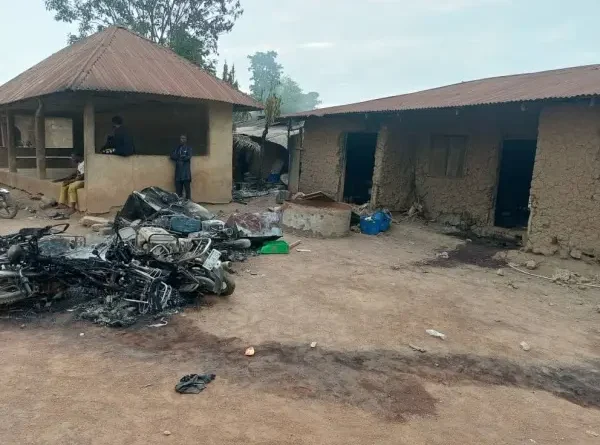
Land Dispute Leaves Six Dead, Including Pregnant Woman

A renewed outbreak of violence in a decades-old land dispute between two communities in Ebonyi State, South-East Nigeria, has resulted in the death of at least six individuals, including a pregnant woman and her unborn child, as confirmed by local authorities.

The involved communities are the Ndukwe Amasiri Community in Afikpo Local Government Area and Idima Autonomous Community in Edda LGA, specifically the people of Okporojo Idima. Over the years, related disputes have led to the destruction of lives and properties worth millions of naira.

On Saturday, 5th April, 2025, Okporojo community was attacked by assailants allegedly from the neighbouring Amasiri community. Among the deceased are a pregnant woman and her unborn child and one Abagha Chukwu, a native of Afikpo who resided in Okporojo until his ill-fated death.

Several pleas have been raised by members of both communities to the state governor Francis Nwifuru, urging him to step in and mediate an amicable resolution of the long-standing land dispute. Although the previous administration of Ebonyi State set up a committee to look into the feud, peace continues to elude the opposing communities.

Chima Ekumankama, who is the current Chairman of Edda Local Government Area, has confirmed the killing of four persons at Okporojo Idima, saying he visited the bereaved community and witnessed the harm done to it. He also praised the efforts of the Ebonyi State Government to ensure peace and normality by deploying security personnel into the disputed area.

The President General of Idima Edda Community also issued remarks to journalists confirming the attack. Comrade Nkama Okoro Agha expressed strong disapproval of the onslaught, recalling a previous incident on 6th February 2023 resulting in the death of innocents and the kidnap of three farmers whose whereabouts are unknown to date.

This 2023 attack was also exacted on Okorojo by suspected Amasiri natives. The President General added his voice to other appeals to the state governor for a more lasting resolution of the land dispute.

Another community leader weighed in on the unfortunate events. Hon. Imo Samuel Oduko, who sits as Chair of the Okporojo Development Union, maintained that the land in conflict belonged to the Okporojo people of Idima Edda, who hired Amasiri farm hands that settled in the area and began fighting their lessors over their rightful estate.

The Chairman of Afikpo LGA, Timothy Nwachi, stressed the unpleasantness of the resumption of hostilities between the two communities and confirmed the presence of security officials to quell the unrest in the area. He also urged the Amasiri people to remain calm while awaiting the government’s decision regarding the conflict.

Another voice spoke out on behalf of the Amasiri people. Maduabuchi Idam, a civil rights lawyer and Amasiri local, petitioned the heads of several security agencies within Ebonyi State over brutality and aggression against his community.

His petition is titled “Re-Emergence of Military Invasion, Brutality, and Aggression Reign Freely Against My Community, Amasiri” and contains complaints regarding the military intervention that followed the renewed clash between the neighbouring communities.

Idam asserted that Amasiri was a peaceful party which had since sought to quash the quarrels in spite of irritation from the Oso Edda community. According to him, on Friday, 11th April, 2025, the Ebonyi State Commissioner of Police set up a peace committee to that effect in Abakaliki, which several Amasiri stakeholders attended.

However, their neighbours refused to take part in the meeting and alternatively attacked some Amasiri natives. He also made mention of the insecurity currently faced by the people of Amasiri on the Okigwe-Afikpo highway, along which Oso Edda natives allegedly waylay and identify commuters identified with Amasiri.

All this goes on without the intervention of the Ebonyi State Government, whom he calls on to take action. He protested military action in his community, which he said involved the destruction of properties, arrests and sporadic shooting in Amasiri while ignoring the neighbouring Edda people.

He petitioned the Commandant of Nkwegu Military Cantonment in Abakaliki, which the military personnel were reportedly deployed from, and the Chief of Defence Staff, naming the Edda people as aggressors who intended to illegitimately lay claim to Amasiri ancestral land.

Calling on fellow Nigerians to join him in denouncing the actions of these security agencies, he insisted that the people of Amasiri have remained peaceful and attended meetings in hopes of resolving the decades-long conflict. He described the military activity in Amasiri as “unlawful, … unwarranted, illegal [and] unprovoked.”

Slave Boy

Came to my home with a hat and boots.
Slept in my house; I gave up my room.
Asked for my name; He called me marooned.
Wondered why I’m Black. He stared at my food.
Laughed with my Dad, then showed him his tools.
Gave Mama a mirror, Her smile did glow.
Harmless like a fly, his skin sure shone.
Seemed to be nice, Unknown to us he’s a crook.
His friends are in the bushes and they’re ready to shoot.
Killed my father in his sleep and spat on him too.
Pointed the barrel to my mama. He made me a slave boy.