
I Can’t Not Use It

How come it’s ”insufferable” but not “unsufferable”? Why is “irregardless” an accepted word? Is it “sneaked in or snuck”? Who actually says “tomato” instead of “tomato” (You know what I mean)?

The root of it all

I’m sure I’m not the only one who read a lot growing up. However, all that exposure to the written language, vocabulary, and different styles of writing didn’t exactly include a dictionary. Believe me, I’ve tried reading it before, and, surprisingly, it wasn’t exactly fruitful. You see, the written word is exactly that: written. If you come across a new word that seems difficult to pronounce, you don’t exactly get to hear what it sounds like unless you ask somebody to help you. And honestly, when you get in the flow of reading, do you really want to stop just to ask?

That all changed when I entered high school.

In my first year, I remember how fascinating it was to learn that much of the English language is borrowed from other countries and that many of the words we know now are based on a dead language — Latin. Latin roots, prefixes, and suffixes particularly drew my interest, and I’ve always chuckled to myself about how I was most interested in English because of Latin.

It was also then I realized that I wanted to pursue a career in English.

Not an English teacher

Now, mind you, I didn’t want to be a teacher; I just wanted to be surrounded by words and books, and I wanted the opportunity to learn more about language. That interest stayed with me all through high school, and I was determined to be an English major.. My favorite one-liner was, “I’m an English major, not a dictionary.” Throughout college, my interest in language continued to grow, and I studied Japanese while learning to teach English as a second oral language. There was also a hot moment when I learned the Korean alphabet (Hangul).

Ironically, I even became a teacher assistant in Japan.

With the help of  my students and the teachers outside the English department, I came to realize that the English language was just a mess.

A stack of older-looking books with an apple perched on top.
(Image courtesy of Ylanite Koppens on Pexels)

Which homophone is the correct word to use? What do these idioms mean? How come there’s a specific order for adjectives? Why is it that when you affix a word (like compile), it’s pronounced differently from the original word (like compilation)? Homonyms? Now they’re just plain rude.

Yet, I pursued the language. I studied linguistics. I bought books to better understand grammar.I researched the same words over and over just so I could confidently explain their meaning to somebody who was trying to understand English themselves. To be honest, though, I still don’t quite know how to use adverbs correctly. But Hangul did come in handy when I was trying to show students how to pronounce English words correctly.

A lifetime within three years

Of the hundreds of students I’ve taught over three years, I’d say about 92% didn’t want to learn, whether from me or in general. Maybe about 6% were interested passively, and the last 2% were genuinely interested in a second language. Learning English helped them open up new opportunities, leave their hometown, and understand something outside their routine lives.

There’s one student, a bright young man, who I think about fondly. He took to the lessons – and my dumb games – with actual interest. I was fortunate to have taught him from his first year through his third year. Then, summer vacation rolled around after graduation, and the new semester started. It wasn’t until then that I learned he went to Hawai’i with his family for vacation and was involved in a tragic accident.

A small part of me thought that I helped cultivate his interest in the language, that I contributed just a small part to his confidence in English, and that it was just enough for him and his family to travel abroad. I may have forgotten his name (a terrible flaw I am truly ashamed of), but I can still picture his face perfectly. I know it’s not something I should hold myself accountable for, that it’s unreasonable to blame anyone for what had happened. Instead, I choose to be grateful that I had the chance to be a positive influence in his life.
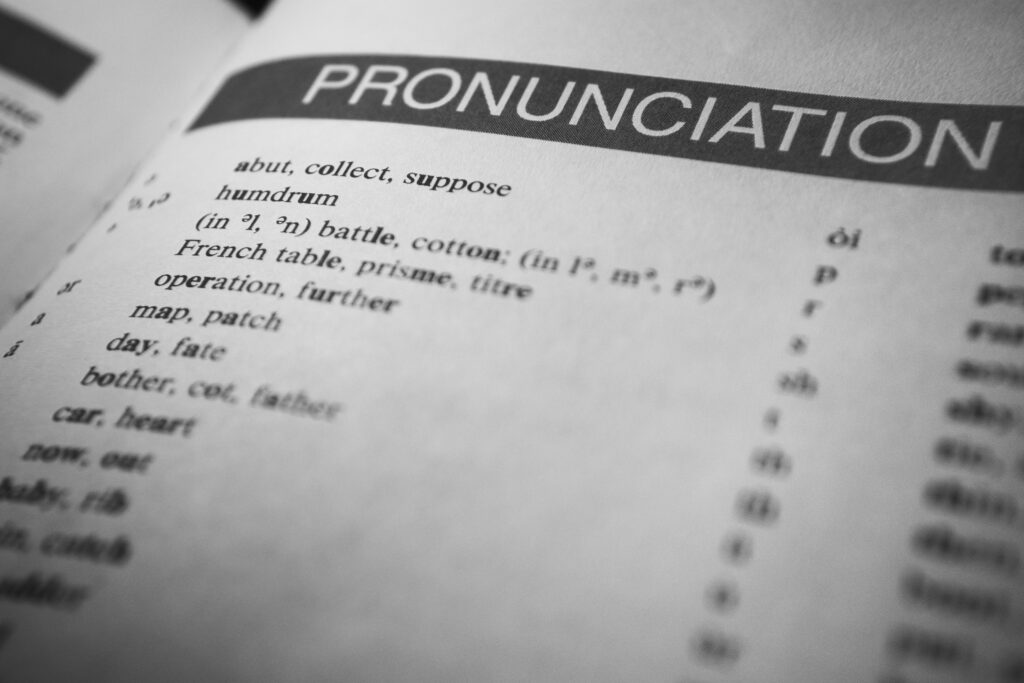
A page from a textbook showing the phonetic notations of a group of words.
(Image courtesy of Nothing Ahead on Pexels)

Me, my professor, and English

Truthfully, English is my second language, but it’s become my primary language. Studying it has broadened my horizons, deepened my appreciation and understanding of it, and allowed me to connect with people who also truly wanted to learn. I’d like to thank my grammar professor in college, who helped spark that motivation in me to better understand English. She fled North Korea, taught herself English, and is now teaching native English speakers how to better understand and dissect the innate understanding we have of the language – such as why we know to say “jump into the pool” and not “jump onto the pool.”

I still love to learn, and I’m best working behind the scenes rather than in front of students, teaching. That spark I felt nearly two decades ago still remains to this day.

And for the record, I personally say ‘toe-mae-toe.’

Because English!

The English language can be a fickle bastard. It does what it wants and is heavily unregulated. But that’s part of what makes it so interesting. 

During my time as an English major, I took a course studying the different aspects of the English language down to minute details such as morphemes, which is a piece of language that cannot be further broken down. I was even tasked with writing phonetically every week in general discussions. When it came to pronunciation and word origins and uses over time, my professor had a go-to answer to explain why we say things a certain way. His explanation was “Because English!”. It was my time during this course that inspired me to write about how we are actively shifting language today. Words like literally, iconic, and legend have become catch all’s for when we don’t really have much to say. 

So, allow me to take you on what might be the most iconic and legendary breakdown of modern slang you’ve ever read… literally.

Literally is literally an adverb for opinions now. Literally the funniest thing I’ve ever heard. Literally the best movie. Literally insane. Literally the best news I could get. Literally the worst billionaire ever (this last one might be true). I say literally to emphasize, and so does everyone now. I can’t remember the last time I heard someone use literally in a literal sense. The word has been successfully co-opted by society to not have one true meaning. Any meaningful meaning. And that’s okay in my literal opinion, because language in dialogue is supposed to be informal. Adverbs used in papers, books (not including dialogue), and emails can be seen as lazy, but in conversation and other informal areas of writing, they get a much-deserved pass. Imagine if we all spoke in APA and MLA format —  that’s not a world I would ever refer to as iconic.

A friend of mine just used iconic for a reel I sent over. And you know what, I don’t remember the reel. Which means it was literally not iconic. Everything is iconic nowadays. My friend had a hell of a round in a video game we were playing; it was iconic. I made it home a few minutes faster than my maps app said it would take; it was iconic. I wore an all-black suit and green steel-toed boots at my wedding; it was iconic (I literally believe this was iconic though). Like the word literally, we’ve adopted iconic into our everyday language when there are true icons out there. For instance, I don’t  watch basketball or golf and have zero interest in either sport, yet I know who Tiger Woods, Michael Jordan, and Larry Bird are. Those are icons. The first moon landing, the Olympics — these are iconic. Breaking the speed limit on my way home is not iconic, it’s stupid, and it’s stupid for me to think otherwise. Literally and iconic have taken their places in the lexicon to a point to where they’ve become, dare I say, legendary.

Legend, or ‘lejund’ as I like to spell it on occasion, has also been inflated in its use. My friends and I often call each other “LEGEND” when one of us makes a joke at the expense of another. I remember getting into working out and seeing literally everyone think they were being iconic by saying “you can’t spell legendary without leg day.” Absurd. It made me cringe when I first saw it on a t-shirt and it still makes me cringe. My ears shudder at the thought of the phrase. We even use legend as a word of praise. I solved the issue with the treadmill at work… legend. I drank twelve beers in one sitting at a friend’s house… legend. I thought to make a reservation ahead of time so we didn’t wait for a table… legend. There’s nothing legendary about any of that. I’m guilty of it, too.

A coworker brought in a box of artisan donuts, so I called them legend. They’re not a legend, they literally didn’t earn the iconic title of legend, but we say it anyway. Because English

Green & orange paper-mâché dragon that is literally an iconic legend — because literally
(Image courtesy of Chamomile via Morguefile)

Note: Paper-mâché or not, a dragon is literally an iconic legend — because literally. 

Lessons in Korean

:

Six letters, six minutes. C-L-O-S-E-D at 8:00pm. It’s now 8:06pm. 

I stare at the bold black letters in front of the weathered “J. Hara’s General Store” with a bit of torturous disbelief. My stomach grumbles and I feel my husband’s thinly veiled displeasure radiating off his person like a heat wave. I turn to him and state, “Well now what?” 

Grumble, grumble. “I don’t know, honey. I’m just as surprised as you are,” my husband says.

“I know right? It’s a Saturday evening. How can things close at 8 o’clock at night?!”

“Big Island really does things differently from O’ahu.”

I nod in agreement. “Well,” I suggest, “I guess we can try to drive back further into town. Do you want to grab Taco Bell?” 

My husband, Jess, ponders my inquiry for a few moments while kicking a rock on the pavement below. I begin to shiver from the evening air while I likewise scan our surroundings. 

Currently we’re standing in front of a locally owned market and general store boasting its historical status with old, wooden siding and some sepia tone photos on its outer cork advertisement board. To our left is a gravel parking lot, and to our right is a closed cafe and a small gas station. Other than a few lampposts dotted here or there, the cool, white moonlight shining down is the only illumination we have. 

J. Hara’s General Store is the closest to our weekend getaway…a mere 40-minute drive away. Neither my husband nor I really want to keep driving, but we’re too hungry to go back to our campsite without something to eat. We have spent the whole day hiking the Volcanoes National Park and, in our excitement, we have neglected to eat anything beyond trail mix for the better half of the day. So, we hop back into our rental Jeep long past the sunset on Pele’s playground and decide to drive North until we find somewhere to eat.  

And now here we are. But we’re six minutes too late.

Perhaps noticing my sudden goosebumps or feeling the cool breeze himself, Jess recommends we head back to our vehicle to try and look up something else on Yelp. Up until a few miles down the road, we have had no phone service, thus the time discrepancy with the restaurant. Agreeing, we begin to walk to the Jeep, chatting about our day all the while, when the young couple at a gas pump catches my eye.

Other than the not-so-amenable employee closing up, my husband and I, and the couple, the parking lot is empty. Typically, I mind my own business, yet I can’t help but notice that the man has been fiddling with the gas pump for the entire time Jess and I have been there. It clearly has an “OUT OF ORDER” bag over its handle, so I can’t understand why he would be trying to use it. 

They look young, and seem stylish; the man sporting a boy band singer haircut and monochrome black ensemble and the woman, with her profile poking out of the top of the red Mustang convertible, is pretty enough to be an actress. He continues to call out to his female companion, with increasing frustration when suddenly it clicks.

He’s speaking Korean!

(Image courtesy of Kang So-eun via Pixabay)

Many years before I wound up at this gas station in Kurtistown, Hawai’i, I spent many nights in Monterey, California at a little place called the Defense Language Institute (DLI), the United States military’s premier language learning academy. For sixteen arduous months, I spent upwards of seven hours a day, five days a week learning my assigned language of Korean to become a linguist in the US Navy. 

Frankly, the experience was very difficult for me. Although my aptitude was great, and I had not much trouble with the actual Korean learning process, many of the emotional, physical, and spiritual aspects and consequences of my Korean course were back-breaking. The rigorous military-school work balance, homesickness, youth, poor self-esteem, and even just the blunt, and seemingly callus treatment from our native Korean instructors often wore me down. 

I can see now how these experiences shaped me and helped me become a much stronger version of myself today, but at the time, I was often melancholy and filled with angst. 

I channeled my feelings into despising the Korean language for being required to learn it. I didn’t want it to come to me easily; I wanted to fail and start something new in the Navy, but my fear at what the military would do to me were I to quit at such an advanced stage forced me to continue to perform well academically. 

Essentially, I had shown my potential in a difficult course with a low retention rate. Were I to fail, my superiors might know I was doing so purposefully and reassign me a terrible job in the Navy. Like painting ships for twelve hours a day. Needless to say, when I finally graduated from DLI, I was excited to move on and my first duty station was…well, you guessed it, Seoul, South Korea.

Many aspects of living in Korea were very enjoyable, like the cuisine, shopping for cheap skin care and beauty, all activities I enjoyed, though I was not a huge fan of the culture itself. Being a foreigner, even one who spoke Korean fluently, didn’t exactly help me feel at home. The homogeneity of the society only succeeded in making me feel like a fish out of water, no matter how hard I tried to swim. 

My time there, luckily, was short, lasting only about four months before I was reassigned to Hawai’i. I’ve more or less been here ever since, though I left the military about a year ago. Nevertheless, my relationship with the Korean language and Korean culture has always been one of contention for me, with me rarely speaking Korean to this day. 

Do I speak Korean or not?

So it is, on this June evening in the middle of seemingly nowhere on a verdant, tropical rock in the middle of the sea, that a young Korean gentleman and lady are in need of help, and, if you believe in it, divine intervention sends a Korean linguist their way.

As my husband and I approach the door of our rental car, I feel a mixture of anxiety and apprehension enter my gut. Should I help them? No, they’ll figure it out. But they’ve been stuck there for a while already. But what if I try to help and I mess up? Will they understand me? No, I should just let it go. 

Then, I think, “What if they were me?” 

I feel myself walking toward the pair as if my feet had a mind of their own. Even if I am shy and my past experiences make me wary, I am going to help these people if it is the last thing I ever do. 

After all, especially having come up the way, I know there is nowhere else to get gas but another ten miles north or so into Hilo proper. What if they can’t make it back that far? No, we will Korean our way through this together. 

“Hwaiting!” (Pronounced more like high ting, the marker is similar to “Let’s go” or “Do your best.”)

I approach the man meekly, but then energetically surge into Korean, like we’d known each other our entire lives, though much more politely, I hope. He is definitely surprised, but I can see the relief on his face.  I explain, “Ee-go-noon an-twey-yo” (It doesn’t work), and that he has to use a different one, that these other pumps have 89 or 93 octane, depending on what the Mustang needs. 

His girlfriend/wife even steps out of the car to say thank you, as they are clearly getting very flustered, having never been to the US and are not completely versed in English, signage, and the like. Before we part ways, we even bow to one another as is customary in Korean culture, though rare  in Western ones. In spite of my initial fear, I am able to help people in need. This holds a special meaning for me.

As we walk back to our Jeep, Jess says, “Nicely done, babe! I’ve never actually heard you speak Korean before. You seem really good.”

I reflect for a moment on his words. At DLI, our teachers enforced humility. Even the top student was not good enough. In Korea, I never felt good enough either, being a boulder in a world of pebbles. In my heart, I often struggle with worthiness, too.

But tonight, I look at my husband proudly and smirk, “You’re right. I’m actually kind of a pro.” Lesson learned. 

(Image Courtesy of Viktor Forgacs via Unsplash)

A Hāfu in Japan

Two passports. Two last names. Two identities. From a very early age, my life has been characterized by how I am half-American and half-Japanese. In elementary school, my mom tried to teach me Japanese by putting me in a “Japanese as a Second Language School (JASL)” on Sundays. Being a child, of course, I was very averse to going to more school on the weekend.

In middle school, we moved to Tokyo, Japan, for two years for my mom’s work. I ended up going to the ‘American School in Japan (ASIJ)’ to take 6th and 7th grade. 

Blame it on anime!

However, I only decided I wanted to actively interact with and learn the language years later, in the middle of high school, all spurred on by watching just a few minutes of anime, something I ironically had never done before, despite all my exposure to Japanese culture up to that point. 

Suddenly, all my past experiences became missed opportunities. Suddenly, I wished I had been more open to the JASL lessons taught to me at Princeton University. Suddenly, I wished I had soaked up more of the Japanese that was all around me in Tokyo and ASIJ, which had both American and Japanese students alike. 

From sophomore year onward, I finally began to expose myself to Japan and Japanese-oriented programs. I put myself in a Japanese summer camp, a JASL summer school at Harvard, and as I went on to college, I got into a joint-degree program that would offer me two years in both an American university and a Japanese (Ritsumeikan University) college. Unlike my earlier experience of living in Japan for a couple of years, this time, I actually had a thirst for learning Japanese, and that experience and desire was what made all the difference in feeling that I was truly experiencing Japan.

Being in different phases of my life (11-13 years old vs. 20-22 years old) and the context that defined them was the main difference of living in Japan as a half (ハーフ Hāfu) individual. In middle school I was indifferent to both Japanese itself and learning the language, whereas in college, I actively wanted to learn Japanese and ended up going to a school that would better immerse me in its culture and people. 

While before I was made to go there because of my mom’s work, this time, I went of my own volition, meaning that I was more open to absorbing what Japan had to offer me. While I previously attended an American school that was filled with a majority of international students, Ritsumeikan was a Japanese university first and foremost, meaning that most of the school had students who didn’t even know English (I was in the international department, which had the only classes that were taught in English and were full of foreign students). 

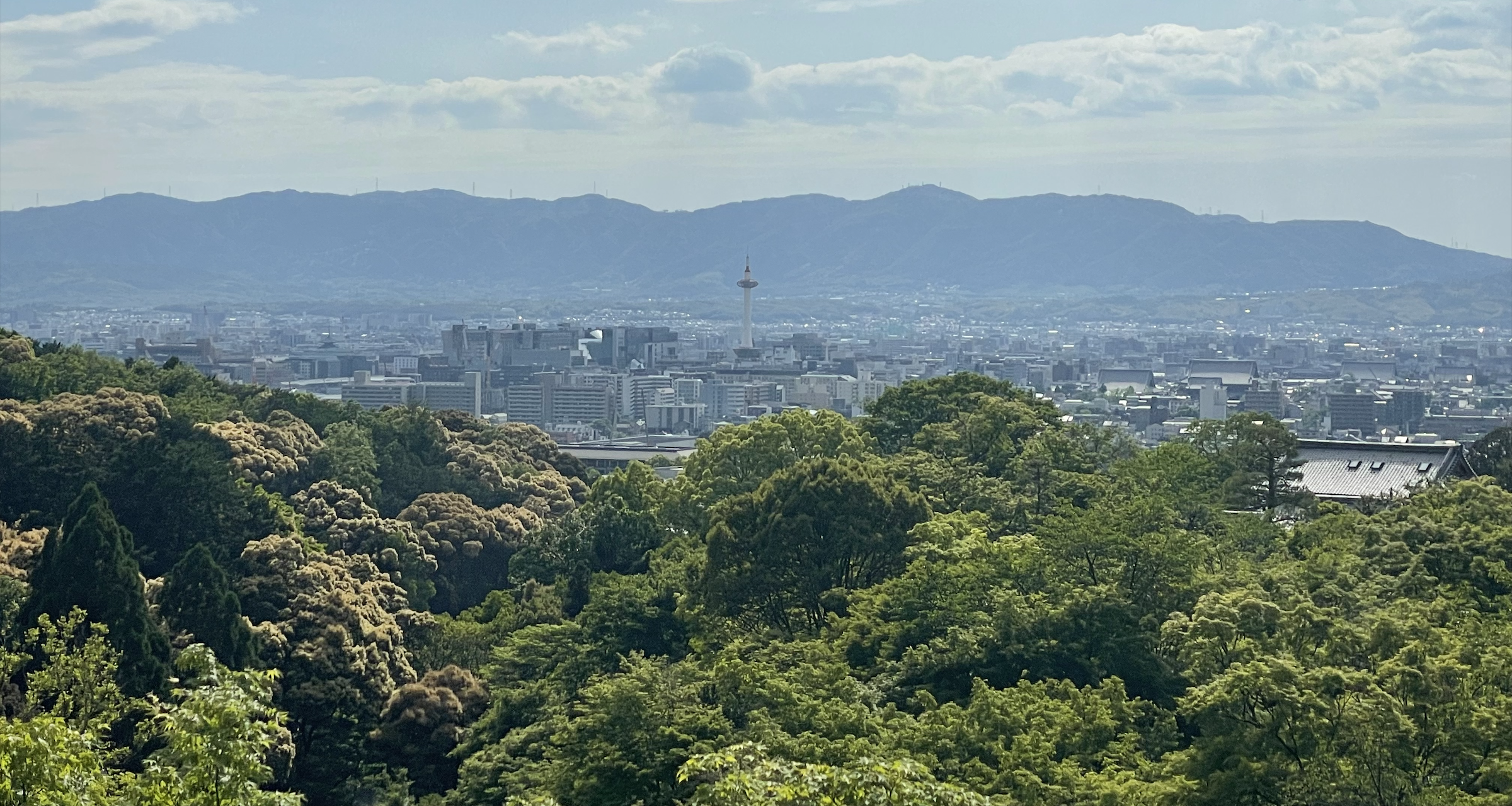
The places in Japan I went to differed too. Tokyo is a modern city with many international influences and people, and was where I went to ASIJ. Kyoto, where I went to Ritsumeikan University, is far more traditional. Living in Kyoto gave me a whole new perspective on what it meant to live in Japan. Although I had technically lived in Japan before as a “half person”, this experience was like night and day. I don’t even remember it too well; it gave me a much more valuable experience of what it was like living in a different country. 

Tokyo versus Kyoto

To start with, the city of Kyoto was so different from Tokyo, where I had lived before. It is not as big as the Capital and is far more spread out, which feels a lot less like an actual city since there are an abundance of rural areas (the dorm I lived in was in one such area). To get to the most popular part of the actual city meant taking an almost hour-long bus ride. Even the buildings were not “allowed”to be too tall due to the designation of Scenic Areas dating back to 1930. However, this was not to Kyoto’s detriment. In fact, it actually made Kyoto feel more quaint and intimate, along with showing that even in a place filled with suburbia, you could still get pretty much anywhere easily with a very punctual and connected bus system. When I was living in America, in rural New Jersey, it was and did not feel nearly this connected. 

There are many other differences though that made living there challenging. Tokyo can be likened to New York in many ways, with its tall buildings and seemingly never-ending expanse thanks to its many prefectures and wards. As the country’s capital, it makes sense that it is the city that comes to mind when thinking of Japan and it’s hardly surprising that  many international visitors end up making it their home. Kyoto, on the other hand, has far fewer foreigners, which does have its downsides. 

While this homogeneity allows you to experience a more traditional Japanese way of life, it also means that many people are not as exposed to foreigners, and living in Kyoto as one was not always easy. Some Japanese people are not as familiar with international ideas and diverse lifestyles, being more traditional and conservative.  This outlook meant that living as a half-person in Kyoto was challenging for me, as it isn’t always the best setting for nurturing your sense of identity as a Japanese person.

Our pet peeves

Many of my experiences as a foreign student in Japan resonate with the experiences of others in similar situations. We’re irritated by some mostly small microaggressions and situations that may last for only a few seconds, but as they add up, it becomes obvious that they are indicative of a much bigger problem. 

For example, a woman once stared at me the entire time she was on the bus I was traveling on, even after she got off it! Another time, I was told to quiet down by the bus driver, even though there was a large group of Japanese students sitting right across from me, being far noisier. People occasionally asked to take a picture with me.

Although I am sure none of these people harbored ill will, I still think it shows how foreigners are seen by some as more of a sideshow, far outside the Japanese in-group, and not to be treated as equals.

Seeing as how I don’t remember any of this stuff happening my first time around living in Japan in Tokyo, I think it was mainly a Kyoto experience, a setting where I never saw more than a few pairs of foreigners on any modes of transport at any given time. 

My language and looks cramp my acceptance 

But there are other reasons why I don’t seamlessly blend in. Because I only decided to start learning Japanese in high school instead of when I was much younger, it means that I am still not fully fluent in the language. 

I don’t look fully Japanese either, and have been told by some that they didn’t even realize I was anything but Caucasian. Seeing as how I lived in America for all my life, I told myself that Americans couldn’t tell I was part-Japanese because they hadn’t been exposed to what Japanese people look like. However, many people in Japan couldn’t see past the foreign side of me either. 

When I order food or anything really from a restaurant or shop, the person behind the counter immediately starts talking to me in English, even if I initiate or respond in Japanese. A lot of people who have only known me for a few seconds are surprised that I know more than a few Japanese words like mountain (yama) or river (kawa), and even more shocked that I know how to write such words in kanji.

However, I am not fluent in Japanese, and I admit to an occasional feeling of dread when others are proven right, and I am no longer able to understand everything they say. Sometimes, I just want to tell them that simply because I don’t understand everything in Japanese doesn’t mean I don’t understand the word for ‘here’ (ここ koko) or even the word for ‘Japan’ itself (日本 nihon). 

Many Japanese people assume that I don’t know any Japanese because of how I look, and when I show that I do, it’s mind-blowing. Even worse, when I say I don’t, it’s to be expected. 

Even after I returned from Japan, I still maintain my identity as a Japanese person, but my time in Kyoto was eye-opening for me. It really taught me a lot about what it was like to live in a more traditional part of Japan. I was surprised at how different the two cities of Tokyo and Kyoto are. If I had to choose between the two, I think I would ultimately opt for Tokyo. Kyoto is somewhere I recommend as a place to visit for a few days, but I think that Tokyo is a city that is better to live in, at least for foreigners. If I were to settle  in Kyoto, I don’t think I would feel completely comfortable with my Japanese identity as a hāfu, and would continue to feel like a foreigner in what is technically my own country.