Humanity explores the human condition and what it means to be alive in today’s world. Sometimes, this can be practical, lived politics as they impact our lives and how we seek to change the world around us, or a distillation of those experiences we have yet to fully unearth, in the gaps and fringes of ourselves.
Three-year-old Denise Pipitone was abducted from Mazara del Vallo, Italy on September 1, 2004, and has never been found. At the time, I was a prosecutor in Marsala, Sicily.
I was on holiday and could only follow the case on television. I did not know at the time that this very sad case would transform my life, forcing me to never give up, and to have much more courage, inventiveness, and patience than I ever thought possible.
The story of Denise’s disappearance also helped me rarely to accept any compromise, never to go down paths that would have led me to betray myself, and to seek my own happiness and that of my family members beyond all ties and conventions.
Because any hypocrisy and any surrender to my dreams as a child would have made my battle impossible: the battle for the truth, always, and at any cost,. But especially for finding the tangled path to Denise.
Image courtesy of David Werbrouck via Unsplash
Tragically, so many children go missing every day all over the world. Sometimes it is their families who are responsible for these crimes. Sometimes it is someone with mental illness or a serial killer that must be found. Sometimes it is chance and misfortune that takes them away.
Denise’s case is a symbol; my commitment and that of all those who are looking for her and will always continue to look for her want it to also be a warning so that such crimes are not repeated, and so that all missing persons are searched for until a trace is found.
Just as the Good Shepherd searched for his lost sheep, we must not give up and must continue to put in place every useful initiative to reach the goal.
The only suspect in the kidnapping to date, Jessica Pulizzi — Denise’s half sister — has been definitively acquitted by the Italian courts.
On the other hand, serious procedural errors were also committed during the investigation. Jessica was heard several times in summary information without a lawyer, before being entered in the register of suspects. It was already clear that she was suspected of having taken the child. That trial went cold.
In 2024 — thanks to the work of private investigator Giuseppe Asaro and criminologists Antonella Delfino Pesce and Katia Sartori — Denise’s father, Tony Pipitone, filed an application with the Marsala Public Prosecutor’s Office to reopen the investigation into his daughter’s abduction.
Tony, together with some friends, founded a nonprofit association last year, The Missing Children in the Heart L’associazione I bimbi scomparsi nel cuore — to help all families who are looking and longing.
I, too, am a member of this association, which for one thing is supporting a constitutional petition for the establishment of a parliamentary commission of enquiry into the case of Denise Pipitone’s kidnapping. The petition has already garnered more than 3,000 signatures.
Our association and the one founded by Piera Maggio, the little girl’s mother, are constantly sharing posters of Denise, with age progressions and useful information and contacts, all over the world. We are very confident that we will all manage together to break through the fog and find the thread that will lead us to Denise.
You readers, too, can help us by sharing this story. For more information or if you have any leads about Denise’s disappearance or on other missing children, please get in touch with our association.
I was a first-year medical student when a stage 3 cancer patient gave me insight into the patient perspective. She described the heartless demeanor of the oncologist who first informed her she had cancer.
As she started crying, his response was: “I’m sorry, have I upset you?”
Clueless. Many people have the preconceived notion that the key to being a good physician is book smarts and experience, overshadowing the value of nurturing a trusting doctor-patient relationship. However, over the past decades, there have been countless studies indicating that the emotional connection is a key aspect of caring for a patient. Fostering this connection not only cultivates trust, it also leads more patients to staying with their treatment.
Now, modern medical schools have emphasized the importance of empathy and understanding, but is that enough?
Some feelings can be taught
Before medical school, I thought empathy and compassion were innate skills that could not be taught. However, years as a medical student proved otherwise; most if not all of my peers are trained to nurture empathy and humanity. That seems to indicate that the cancer patient’s Sorry oncologist started out with a sense of empathy and humanity, which unfortunately diminished throughout his career. This realization left a deep question: why do physicians experience a waning sense of empathy over the course of their working lives?
(Image courtesy of Jon Tyson via Unsplash)
While my first instinct was to blame this doctor, at some point I realized that as a physician, one is generally more exposed to death. Over the years, he might have eventually become so accustomed to death that he lost his sense of empathy — patience with the patient.
This tendency may have been exacerbated by high patient volume, which can lead to physicians viewing patients as just another case while disregarding the essential humanity.
Avoiding burnout, physicians take a holistic approach to patient care, to hear and understand the patient’s journey. Listening to the big picture enables us to be empathetic to the little things. Like the language they use.
Taking this approach would change the doctor-patient interaction from statements like “This is your diagnosis” or “Take this treatment” to a more heartfelt and compassionate conversation that ensures all patients receive the treatment they deserve, and expressed in a way they can absorb.
(Image courtesy of jppi via Morguefile)
Cultivating empathy
Physicians often focus intensely on gathering the most critical information to diagnose a patient’s condition, meticulously assembling the pieces of a complex puzzle. However, in their quest for accuracy, many become so engrossed in the details of the symptoms that they overlook other essential elements, such as the psychological aspects of patient care.
I’ve witnessed doctors firing off questions, barely allowing the patient a moment to breathe. “Are your parents alive?” quickly followed by “Did they have a similar condition?” without pausing to consider the emotional impact of their words. I, too, have been guilty of this efficiency. However, the patient’s expression brought me back to reality, and I have sincerely tried to prevent this pattern from recurring.
As I have sought ways to foster my feelings of empathy with patients, I frequently remembered my own primary care physician, who manages to keep the embers of his humanity burning brighter each year. He told me that the secret behind his everlasting kindness and empathy was continuous training. Although that may seem straightforward, too simple, it is truly an integral part of life and an axiom I have gone back to time and again. As Leonardo da Vinci said, “simplicity is the ultimate sophistication.”
I also try to remember a favorite expression of my mother’s, who had always told me to “Put yourself in others’ shoes.” This life philosophy makes it easier for me to connect emotionally to my patients by incorporating the patient’s unique perspective.
Staying sensitized
To preserve maximum empathy, I have committed to the following principles:
The Continuous Practice of Mindfulness and Reflection: Medicine is a lifelong journey, and reflecting on one’s actions allows the physician to improve with each patient interaction.
Empathy Through Understanding: I strive to place myself in others’ shoes, recognizing that each patient is on a unique journey. By doing so, I no longer see them merely as numbers or cases, but as individuals with their own stories.
Maintaining a Healthy Work-Life Balance: This balance is vital in preventing burnout, a significant desensitization factor. By taking care of myself, I can better care for others.
I hope these rules will help me maintain my sense of compassion while pursuing a deeper understanding of the potential impact of a condition on my patient’s life.
I pray that my three principles offset being overwhelmed by too many patients and desensitizing myself as a coping mechanism to their personal suffering.
In my 20 plus years of existence, I have learned two important lessons: (1) if you want to succeed, you have to play the game. (2) I am not good at playing the game.
My life started out in the usual way, for a boy from a lower-middle class family in a Pakistani village. I grew up going to the village school and dreaming of joining the army. I never gave too much thought about the purpose of school or an education — I, like many of my classmates, never planned to study past the fifth or sixth grade.
But fate stepped in when I was accepted to the school run by my father’s employer. This company school was an entirely different world: there were large classrooms and playgrounds — and the language of study was English. For me, that was a major hurdle since I had only been taught in Urdu.
I was a good student, though. I worked hard, mastered English, and kept progressing in my studies. It wasn’t until I entered fifth grade that I started to question what I was being taught. In Pakistan, students in the fifth and sixth grades already have a firm understanding of politics and the country’s political parties. My loyalty lay with former Prime Minister Imran Khan, who was gaining ground against Pakistan’s two-party system.
He mostly talked about changing the corrupt system and motivating youngsters to join his struggle. I was very much fascinated by his battle and political moves. This fascination strengthened the rebellious feeling that was taking root inside me.
I started to adopt a policy of applying the knowledge learned from theories and books. When I began this implementation of the knowledge I had learned from books in my practical life, I started to question my teachers for being very different in how they teach and what they do. I was criticized and disciplined. Often that meant I missed classes.
These punishments didn’t demoralize me; instead they made me stand firmer in my beliefs and committed to raising my voice against the education system in Pakistan. I started to ask teachers questions when their words contradicted their acts.
By this time, I was in eighth grade — a pivotal moment in the Pakistani system — as schooling changes from general education to specialized tracks.
I was not interested in my choices: computer science or biology. I wanted to study the arts but that was not allowed, in part because private schools in Pakistan compete for students. Children’s scores in popular and challenging subjects, like the sciences, are a critical part of attracting parents and new pupils.
(Image courtesy of Roman Mager via Unsplash)
I opted for biology, even though I was not interested in it, and passed my eighth grade exams with flying colors. I was poised for success! Except I didn’t agree with the way the school system divided ninth graders according to their exam scores. Basically, the system divides children into two groups: the “average” group — kids who can pass the national exam but are unlikely to get top scores without a lot of tutoring and support — and the “strong” group: the chosen ones the school believes can achieve national ranking scores with enough attention and guidance.
I protested this division. Even at that age, I understood it was fundamentally unfair to give one group of children more resources when all the kids would benefit from more education. Why should a child’s future be sacrificed so a school can pour its resources into a chosen few?
I refused to follow the rules for exam preparations: I firmly believed — and still believe — scores should be given based on the value of your response, not the formatting or tricks you use to present your answers. As the exam date grew closer, the school coordinator even called my father to plead with him to convince me to follow their rules and get a good score. The message was, in short, the answers don’t matter: exam graders want to see how you format your responses, not the value of your words.
I was shocked to hear that, and instead of acting upon my coordinator’s advice, I continued my rebellious policy of just writing the answers without proper presentation. I used to say I never studied for marks; I studied to learn and use the knowledge I have learned daily. That was the point of being educated. My teachers, however, believed you can only succeed by being a part of this system. Admissions to prestigious universities and jobs in Pakistan are always given to those who have good grades.
In short, I could not get good grades in 9th and 10th classes and was strictly criticized for not following my teacher’s instructions and for not bribing the exam monitor. So, I could not secure admission to top colleges like my other classmates, who also acted upon their teacher’s advice and compensated the exam monitor.
Once I finished 10th grade, however, I realized I could still shift from the biological sciences to engineering or computer sciences for 11th and 12th grade, known as college or higher secondary education in Pakistan. So, with no additional preparation, I jumped to engineering. But, unfortunately, my experience there was the same: if I didn’t play the game, I couldn’t get the grades I needed to succeed.
(Image courtesy of Nathan Dumlao via Unsplash)
I still dreamed of joining the army, so after I graduated, I went to an academy in Lahore to prepare for the military exam. There, retired army personnel coached us on how to behave in interviews and tests. There was a Catch-22, however: I needed to prepare for the exams, but the military would not accept anyone who prepared because the point of the exams was to assess a potential soldier’s natural abilities and talents. My instructors told me directly to lie to the interviewer and say, when asked, that I had not received any coaching.
But I thought, why should I start my new career by lying? In short, due to my decision to tell the truth, I was shut out of the military and my lifelong dream was crushed.
Instead, I was admitted to the food science and technology department at university and decided to get my bachelor’s degree in this field so I could continue my education. I did not like the field and did not fully understand which jobs I could get with this specialty. With little guidance and my usual critical eye toward the education system, I struggled to do well and ended up graduating with average grades.
Now, I am sitting in my bedroom writing this story, thinking about my mistakes. I don’t want a master’s degree in my field and, after almost 24 years of life, I finally understand my true calling was not engineering, the military, or biology. My passion is literature and the social sciences: international relations, regional studies, and other similar subjects best fit me. I realized this after every opportunity has gone, and now there are limited chances that I can find a master’s program in any of those fields with my current degree.
Today, I realize that if I had followed the flow and kept all these rebellious thoughts to myself until the day when I would have had some power to change the typical education process in Pakistan, it would have been a much better way to make amendments and improvements in the society and system.
Instead, however, I just kept resisting, and my resistance as a child and young adult was useless. It deprived me of every opportunity, like attending an excellent, reputable college and studying the subject of my interest and choice. I could not analyze my interests and chose only the fields that were not my cup of tea.
So, in the end, Pakistani schools taught me an important lesson: resistance at the wrong time and age is useless. If you have to change the system, just be a part of the system until the day you reach the stage when your decisions or resistance will matter. We resist at the wrong time, and this ill-timed resistance has wasted many of the talented voices that were intentionally interested in bringing a positive change in the system. Instead, it is too late when we finally realize we have resisted at the wrong moments.
It is my hope that, by reading this, other young people will learn from my mistakes and understand that there is a time for every expression of resistance and every voice to be raised. If you want to change the system, work hard to obtain a position where your words may have some power to bring about the change you desire.
Voting is a fundamental democratic right, allowing citizens to have a say in how their country is governed. But what if it’s mandatory?
In Australia, as I discovered when I moved there, the voting process is compulsory, aiming to ensure that every eligible voter has the opportunity to cast their ballot and the opportunity to enjoy hot dogs at the polling booth. Normally called a sausage sizzle in Aussie slang, it becomes democracy sausage come election time.
Within the great Aussie democratic system, I realized, lies the phenomenon of “donkey voting,” a term that might be unfamiliar to many, especially to first-time voters and outsiders like me.
First of all, let me explain the hee-haw. Numbered voting is required in preferential voting, where voters rank candidates in order of preference or priority. A donkey vote occurs when a voter marks their ballot paper in numerical order from top to bottom without considering the candidates’ policies or merits.
For example, if the candidates are listed as A, B, C, D, and E, a donkey voter would spitefully mark them 1, 2, 3, 4, and 5 respectively. It is also a donkey vote if it goes the other way around. This type of voting shows up in preferential voting systems, like the one used in Australia,.
It doesn’t count as a sincere vote though, and is more of an act of protest. Voting like this also shows that you have not used any intellectual horsepower to think through your ballot choices. This stubborn act is called donkey voting for a few reasons.
Number crunching
Now here is why this type of mischief might happen at the polls Down Under for you numbers people:
1. Lack of interest or knowledge: Some voters might not have enough information about the candidates or might be indifferent to the outcome of the election. As a result, they simply mark the ballot in the order the names appear. Make voting compulsory and people will find a way to half-ass it. Hence it’s dissed as a donkey vote.
2. Protest vote: A donkey vote can be a form of silent, but black and white protest against the political system or the available candidates. It’s a way for voters to show their dissatisfaction with the checklist or the choices without spoiling their ballot. The vote counts, and this one hurts.
3. In a country where 26 million people reside, having 111,015 people vote sequentially may not seem high enough for concern. Just read this article for more numbers:
Grazing on democracy’s green grass
As someone who has never voted before, as I am not from much of a democracy, the concept of donkey voting is both intriguing and concerning. I am from an absolute monarchy where brain drain is common and people want to go somewhere more developed where they have freedom. The grass is always greener, somewhere, but do we really have to share it with jackasses?
I think personally, not voting properly is subverting democracy, turning it assways. There is more to it than that though sometimes.
While donkey voting is not illegal in Australia, it raises ethical questions about the integrity of the voting process. Critics argue that it undermines the principle of informed voting, where each vote should reflect a considered choice.
I had always assumed that every vote cast in an election was a deliberate and thoughtful choice. The idea that some people might vote in numerical order instead of preference raises questions about the true representation of the electorate’s will. Who is in the electorate though, I wonder?
If I was a voter, I would feel a sense of responsibility to ensure that my vote counts in a meaningful way. This means taking the time to research the candidates and their policies, understanding the issues at stake, and making informed voting choices. Donkey voting, in contrast, seems to invalidate this important civic duty. Or could you use it as a form of effective protest? Not as a student during student union elections, I don’t think.
I remember hearing about it between 2012-2016 in my formative university years as a first time ever voter of any kind. Students do not need to vote during their student union elections although it is a wasted opportunity if one does not learn the basics of the democratic process then. Oh come on now, don’t be such a neigh-sayer and tell me you scoff at the idea. Why I chose to even engage leads me to think that better voter engagement, at the personal or relational level, can improve voter confidence.
Furthermore, the prevalence of donkey votes underscores the need for better voter engagement. First-time voters, in particular, could benefit from resources that explain the voting process, the significance of preferential voting, and how to make an informed choice.
Additionally, efforts to increase voter engagement, such as candidate forums and accessible information about political platforms, could help reduce the incidence of donkey voting where mandatory voting means you can’t vote with your feet and protest by not voting at all.
Passive-aggressive, maybe just aggressive?
I sometimes think that voting this way in protest is probably valid when no one wants to give you a voice in the first place. In case no one represents you, why not express your disagreement and mock the process in a passive-aggressive way?
In compulsory voting, you need to vote or pay a fine. If you do not want to vote but also want to avoid paying a fine, you can just cast your ballot but not indicate a clear preference in protest.
In the case of the indigenous Australian population, that might turn out to be a full-on silent treatment.
No wonder, since 60 percent of Australians have recently voted to not give Indigenous Australians their voice. Imagine not letting your host speak at all during a party you crashed;. where is the propriety in that? Reconciliation may indeed be dead, as the 2023 Australian Indigenous Voice referendum showed, and only time will tell if donkey or linear voting will increase along with informal votes. Compulsory voting has its flaws after all. Who can convince
people to vote democratically in a system they wouldn’t design as the rules of the representational game don’t let them play and win? Not given a voice? Then they won’t give their voice.
Can the great Australian experiment be saved from going further south? That’s an article for another day so I don’t have to half-ass it. Or maybe ask the original custodians of the land.
It all started in Wichita, the largest city in Kansas, bustling with the aircraft of Cessna, Learjet, and Boeing. Founded in 1861 as a free state, Wichita was Native American land named after the Wichita and Kanza tribes. This land had a rich, deep cultural heritage predating colonization. Filled with dewy, mystic plains and sunflowers that dance in the wind, Wichita is my birthplace.
(Photo courtesy of Andrew Cruz via Unsplash)
A few Wiccan friends
Such a safe and liberal place to grow up, nestled in a place in America called the Bible Belt and Tornado Alley, Wichita had some challenges, too. For those who grew up there and were different in the 1990s and 2000s—life was lived in the tradition of “The nail that sticks out gets hammered down.” It was a very heavily Christian town, and most other belief systems were suspect and not embraced. But I would notice a new kid sitting alone during lunch and instantly befriended them, so they weren’t alone. Renegade.
I had a few Wiccan friends who were social pariahs. Excommunicated from the popular crowd, they still were my friends. We would walk home from school together and meet their cats. The agnostics, the atheists, the grunge and emo people, the cosplayers; all my friends. Couple them with the Roman Catholics and devout Christians, and you have a full index book of my school associations. No one was left out. I was a friend to the friendless and a bully to the bullies. I still have friends who remind me of times I stuck up for them. Renegade.
In the spring and early summer, our memories are imprinted with drills. We had to go to the school basement, a musty and dank gym locker room with rusted shower heads and cement walls. We could hear the blaring sirens for miles. Sometimes, we would just line ourselves along the classroom hallways with our heads bent towards the lockers and our hands clasped over the back of our heads. The screaming sound of the sirens would put chills down my spine and create an immediate visceral reaction. Friends’ homes were often destroyed on the outskirts of Wichita due to the tornadoes. But this was home, and we were all used to it.
(Photo courtesy of Ralph W. lambrecht via Pexels)
Emerging from innocence and charm
My friends and I, and many others in Wichita, were part of a desegregation bussing system. Buses went near and far to take us to Park City in grades K-12. Later to be known as the home of the BTK Killer, it still had its innocence and charm then. I sometimes saw horses, cows, chickens, even llamas on the way to my elementary school, Chisholm Trail—after Jesse Chisholm, a Cherokee merchant. Black Beaver, a Lenape trail guide and cattle rancher, and his friend Chisholm used this trail for cattle driving and trading.
(Photo courtesy of Phill Brown via Unsplash)
Chisholm Trail was a school breaking barriers. We had a female African-American Principal, Mrs. Saundra Kaye Lyons, and other people of color as our guidance counselors and instructors. We were on the cutting edge of school programs for Wichita and quite diverse.
But in middle school, there was a “magnet school” near my house. The magnet program is another system to attract a diverse student body, a continuation of the desegregation bussing from elementary school. This is where I started to come into myself and learn who I really was.
The facts of Iife crew!
I had a core friend group with three other girls, the “Facts of Life” crew. I was Tootie, Stephanie was Joe, Leticia was Natalie, and Julia was Blair. When we were together, no one could mess with us. Stephanie was Filipino, sporty, and played soccer. Lucita was black and Panamanian, my best friend from violin class. Julia was a ginger girl who loved animals, spunky, and the first to fight if someone insulted us. When I met Lucita, I was impressed by her basketweave pattern of tightly cornrowed braids. They were immaculate like a work of art. My sister was a hair braider so I found a way to inch into a conversation. Before our conversation, when I complimented her, I had never seen her speak a word to anyone. We became inseparable. I remember one of our teachers comedically telling us to “cut the umbilical cord!” as we laughed feverishly about a picture in our textbook.
I started to have complex feelings I didn’t understand for our other friend, Jennifer. I kept them in my diary and didn’t tell a soul until a couple of years later. I confessed my true feelings for Jennifer to my bestie, Lucita. She suggested that I write her a letter. I wrote it and put it in her locker, not sure what to expect. Maybe I thought she would be a renegade like me, we’d walk down the hallways holding hands, daring anyone to say anything. Maybe I thought we would stay the same with our flirty yet platonic relationship, but just with an understanding. I did not expect to break up our friends group.
(Photo courtesy of Marcos Paulo Prado via Unsplash)
And that’s exactly what I was doing, far too much to ask really in small-minded, bible-belted Kansas in the 8th grade. Jennifer was Roman Catholic. She couldn’t publicly associate with me anymore, and I accepted the death of our friendship.
My secret-laden diary goes AWOL
But fast forward a few months. I left my purse in a class — absent-minded teenager — where I kept my diary. The school jock decided to retrieve my diary and pass it to everyone. A fluffy, zebra-printed, fur-covered little time capsule. I somehow missed it that Friday. On Monday, a girl walked up to me with her jaw open and demanded, “Are you gay?!” I said no……? “Well, your diary is all over school now,” and she walked away as if I was the one who insulted her. I turned the corner, heart beating fast, and wondering about my next move. Then there was a group of people. “Are you gay?!” There wasn’t much I could do to fight it. “Yes, I’m gay.”
But I wasn’t free. People did not leave me alone after my confession. Mobs of people approached me at recess, lunch, and every class. Prodding at me like a science experiment gone wrong. Even some teachers were looking at me like I had the plague. Ultimately, when I retrieved the diary, it was on a teacher’s desk, as if it had been brought in for Show and Tell. Without a word, I grabbed my journal and walked back out. I accepted my new fate as an outsider, like those I had befriended. Thankfully, they were a non-judgmental group of friends. Plenty of the religious ones could no longer associate with me, however.
My grannie challenge
Being adopted by my grandmother, I had a wisdom most kids my age didn’t yet have. I knew I needed to tell her before anyone else could. I was a little woman in my own right. We were born and raised in the Baptist church so talking was going to be a huge undertaking. Grannie was the superintendent of Sunday School and an Evangelist. I was the junior secretary there. Her husband had the keys to the church, and we were the first to arrive every Sunday to unlock it. Not going to be easy.
(Photo courtesy of William Krause via Unsplash)
I was nervous about this confession, but it was too late. I couldn’t put the milk back into the carton, and I didn’t have time to cry over the spill. I eventually confessed to my sisters and Grannie before the gossip. They told me they loved me no matter what. My middle sister told me she was just glad I wasn’t pregnant. My oldest sister said that she already knew. With Grannie, I became emotional. I didn’t want to be a failure in her eyes. She assured me being a lesbian didn’t preclude me from success. She told me to get myself together, and we would talk about it later. One day, I think she just couldn’t hold it anymore and exploded “I’d rather you had been pregnant than gay!” But she eventually came around and even introduced me to an older married lesbian mentor from her workplace. I am to this day grateful for my family’s acceptance, which many LGBT people never received.
Graduation howling
The last week of school, academic awards were presented in the auditorium before the entire student body. I had joined the cross-country team as a favor to one teacher. I competed in one race and didn’t even finish, but received an award. The entire student body burst into laughter at my name.
Maybe mild, it felt like outlandish howling. Hey, how would you expect Kansas teenagers to react in 2002?
It stained me. It also built character. Officially out, still working on being proud.
Manifesting what I really wanted
The next semester was high school. There were other lesbians in my school, but I still never quite fitted in anywhere. I graduated a year early and wanted to put school as far behind me as possible.
I went on to attend college to pursue a degree in Psychology. I married my wife, whom I met online in 2002, and we have been married for ten years. She is an Iraqi war Veteran turned teacher and quite amazing. We live in beautiful and accepting Oahu, Hawaii, and happy with our three chihuahua-yorkies. We are currently trying to conceive. Renegade.
(Photo courtesy of Taylor Hunt via Pexels)
I’m sure Kansas has grown by leaps and bounds since I left years ago, but this was an important snapshot of a time when things were not so easy for the LGBTQIA+ community. It may seem long ago that we were so openly discriminated against, but it was actually very recent and still sometimes happens today. I have also seen many improvements in schools regarding anti-bullying and support for the fostering of strong personalities within very different individuals. Live and let live, and always be yourself. There is a huge payout in the end, and you will manifest yourself exactly where you would have wanted to be in your teenage dreams.
My experience voting in these two countries seems so similar. Electronic voting machines and ballot boxes — covered enough to make it a perfect secret ballot, all set up on school premises. There are similarities in election propaganda, the campaigns, the rallies, and the voters have to be 18 years or older. Yet they are so different. India elects every five years, and the US every four.
Indian elections have a unique flavor, a sort of tanginess
Indian elections bring with them more movement than others; they are like carnivals: processions and massive campaign rallies with loud music and rhyming party slogans in Bollywood mashups. Overloaded vehicles of all kinds — bicycles, autorickshaws, cars, and bikes zoom in now and then through the streets — all calling loudly for votes. Life-size campaign banners used to influence voters are what bring in election fervor. Everything is a campaign board — the electric poles, tree trunks, public vehicles, walls, and roads decorated with posters and banners are everywhere. The door-to-door campaigns extend a personal touch. Talking to the candidates made me feel special, stirring in me, the 18-year-old first-time voter, a sense of responsibility— a feeling of “I should vote” and “I am old enough to make decisions.”
It was election day, and I was finally at the polling booth at a school, ready to cast my vote. 7:00 am to 6:00 pm is generally the polling window in India. I thought it would be a simple process, but my confidence shattered once I saw the voting machine in front of me. Where? Who? I had done my homework, but the long list of symbols with just the candidate’s names beside it made me nervous. After a few seconds of blank, I gathered myself up and voted (thankfully for the right candidate). Voting in the largest democracy with some seven recognized national parties, around 57 recognized state parties, and numerous other notable registered unrecognized parties — the ballot pages sometimes get long and puzzling.
(Photo courtesy of Tripti Mund)
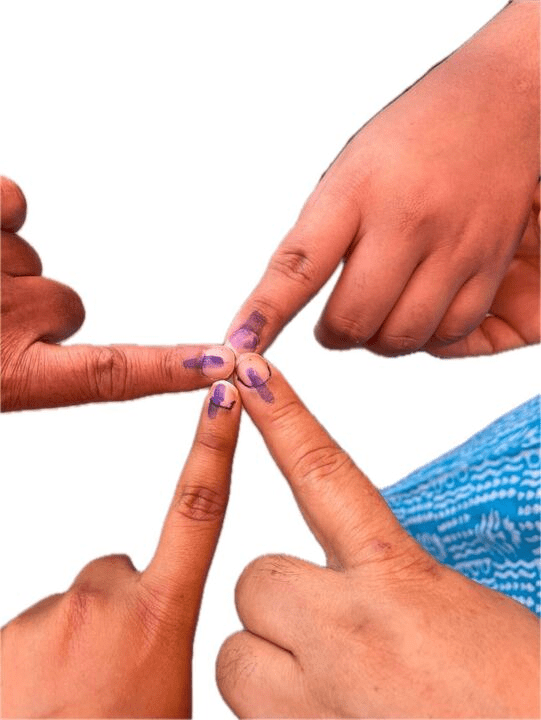
Post-voting indelible ink is used to prevent duplication and fraud in voting. That little drop on the left index finger is a statement of pride, of doing the democratic duty. It is not mandatory to vote in India, but I take pride in the fact that I voted in all the elections that took place when I was there.
The year I moved to the US, presidential debates had already begun. For me, it was, with other things, an acculturation of the election process. I felt the US elections were so calm, which made me miss the volume of Indian elections.
In the race for 543 seats, the Netajis (male politicians) and the Netrijis (female politicians) campaign standing in an open-top vehicle. Always with a namaskar (folded hands for greeting) and their head almost buried in marigold garlands. Close to elections, dresses in ethnic undertones stand out. Men dressed in kurtas and women in sarees. Heated-up speeches in open grounds from over-decorated stages, almost as tall as a house — visibility to the public is key. Screaming voices, high pitch with long pauses, and stress on every word, I could not find that in the US.
Lunchbreak voting!
Here, candidates’ speeches and rallies are mostly town halls or debates between just two parties, the Democrats and the Republicans, which are interesting and decent, like TED talks.
It was election Tuesday, and my US-citizen husband left home a little early. I thought it would take not more than an hour or two for him to be back home. At almost noon, I called him to find he was in the office. Working? This never happens in India! Election day is a holiday to vote or not. Yes, this is how it is in the US: manage time and your civic duties between work.
(Photo Courtesy of Element5 Digital via Pexels)
The Tuesday after the first Monday in November is designated US election day. This was a culture shock for me. I came from a land where election dates are released two to three months before elections, from a democracy that never votes on one fixed day. Voting dates vary from state to state, even district to district.
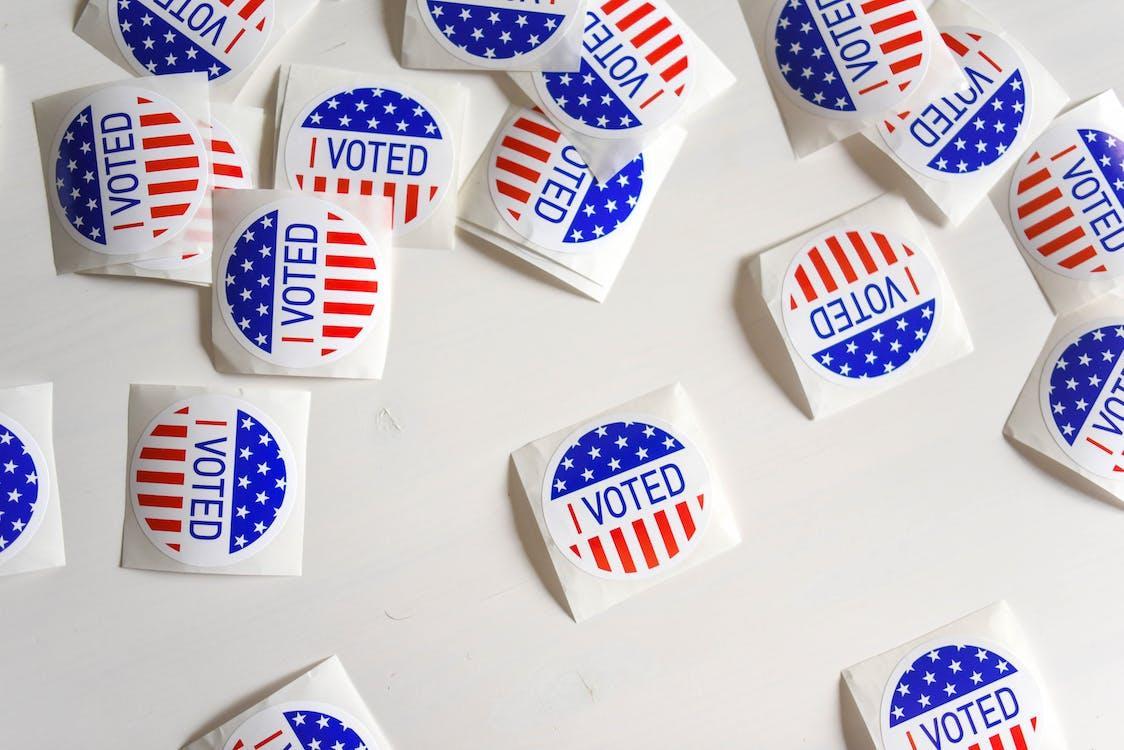
No voter ID card, just your driving license for proof of identity. No indelible ink, just an “I Voted” sticker. Once, we took our first-grader to see the voting process, and it is so different from India.
Protests close to the elections are very common in both countries. While in the US, they start after office hours and end before 9:00 or 10:00 pm, India crawls to a standstill, with protests impacting daily life from dawn to dusk. I called them holiday perks.
Flowers, scented flyers, crowds, and traffic jams surround elections. In my teens, I collected the scented flyers and carefully placed them between the pages of my books. They made my bag smell good. When a party wins you can see Holi and Diwali in the streets. What an extravaganza!
As a citizen of the USA now, I always vote. Here, Tuesday night’s 9:00 pm election debates bring the election fun — both primary and presidential, followed by the television analysis. The debates stir the election mood. I find the primary debates more interesting: candidates of the same party trying to claim their candidature on national television, wow, so much energy! Indian parties hold their primary debates behind closed doors. We just get to know the contesting candidate. The post-debate analysis is animated. At my home, too, we hold parties where we hotly debate election topics.2024 is all elections and elections, and both democracies are out again, fastening their belts. India for its Lok Sabha polls and the USA for its presidential elections. While my family dinner table hosts discussions on Indian bhashans (speeches) and American debates…
On the rooftop terrace, we talked about traveling; things like finding stylish and affordable accommodation through online searches, riding bicycles around small towns usually missed by annoying crowds of tourists, and avoiding expensive metropolises with barren cultural lives.
We gossiped about other people but revealed nothing about ourselves. Each trip is an escape from one’s identity.
We complained about real estate speculation in our cities despite the economic recession, which is actually a long and sophisticated process of cross-border money laundering by people fleeing their homelands. We discussed immigration and shifts of citizenship during regime handovers, pandemic outbreaks, and wars far away or impending.
Having witnessed the same cruelty of history respectively, are we sharing the same fate after all?
“Did you hear about the big movement in Hong Kong in 2019?”
“Yes, I did.”
Two hundred meters away, a train clanked by, drowning out our words. The hostel’s fish flags fluttered in the whispering wind. A bird leaped from a broken beam of an abandoned house, flying away from the commotion. In forty minutes, the sun would set where the train had gone. Tomorrow, we would depart with the same train to where the sun was setting.
It was the moment closest to a taboo topic, an unnamed incident from several years ago, in our conversation during each of our journeys from the silenced past to an uncertain destiny.
Sifting through multitudes of strangers, Longing for a familiar face, a smiling acceptance, An existence away from home, Calls for a course correction, isn’t it?
For weeks, I have plied on the roads less traveled, Meeting people, then distancing them, Walking the spectrum of small talk, appearances, Yet, I find the connection missing.
This city is a labyrinth of souls, Driven by capitalism, flocking to pots of gold. Drains the life away, seeping you deeper, Into an endless race built on casual ambiguity.
No one knows what brought them here, Chasing greens in a city of dreams, Like a traveler pursuing a mirage, No end in sight, but the chase goes on.
In this city of dreams, I long for a smiling face, A caring pat on the shoulders bogged down by expectations, A melodious voice, a koyal perched on a twig, And a greeting in my own language.
A begaana in a buzzing, bustling city, yearning for home, Smiling through teary eyes, wishing to meet his family again, Crossing the contours of language, when he couldn’t find his own.
Koyal: (Hindi)cuckoo, known for her melodious voice; begaana: (Urdu) unknown, foreign, alien.
How can we truly heal a patient’s physical state without addressing how they feel?
It is inevitable that all physicians, no matter the stage of their training, will unconsciously forget the emotional aspect of treating a patient.
Emotional understanding is a fundamental aspect when it comes to providing optimal healthcare. Yet, it is often forgotten, especially during busy times within a hospital. Emotional understanding not only allows for a patient to feel welcomed and at ease but also helps the physician genuinely grasp more than what words can simply express. More often than not, the art of sympathy and empathy, which was taught during medical school, is unfortunately lost within the busy hospital schedule.
It was during my first couple of clinical rotations that I had truly realized that the sacred art of emotional understanding is something that could easily be forgotten.
Such a phenomenon is bound to occur, especially as a physician starts to become caught up in the increasing workload of a hospital. I noticed that as the day grew older, the physicians I shadowed had slowly lost emotional touch with their patients.
By the end of the day, consultations became limited to statements such as “you may have this condition,” “I need to order an X-ray,” and “take this medication.” While the course of treatment offered by the physician may not have changed much, it was evident that patients were left dissatisfied, as an emotional connection had not been established.
Sometimes, all a patient truly wants is to be felt. Unfortunately, many of us forget the importance of forming an emotional bridge. Such a bridge is truly what allows for the first step of treatment to commence. I found myself constantly asking patients in the waiting room, “how are you?” and “how are you feeling?” and instantly noticed the atmosphere become enlightened. Patients would proceed into the doctor’s room feeling that even their emotional state was being considered.
During a memorable instance, I sat down and conversed with an elderly patient which slowly nurtured into a conversation around hobbies and shared interests. Although brief, the elderly patient thanked me with a smile and followed with “I wish there were more like you.” I was lost, pondering my thoughts. I started to question, is this not the norm?
The philosophy of “treat others as you wish to be treated” extends beyond just being friendly and respectful.
It entails the ability to ask oneself, “How would others feel if I did/said this?”
(Image courtesy via Greg Rosenke via Unsplash)
I have witnessed patients being asked to rate their pain from 1-10, but is their emotional state simply limited to being a number on a scale?
It had been evident through the eyes of patients that they were hoping for more than just treatment for their physical condition.
They wanted to be heard.
And most of all, they wanted to be felt.
As I stood in the waiting room one last time before my summer vacation, I finally noticed that abyss of emotions. A room full of patients yearning to be felt and emotionally understood. It was only then that I realized the actual value of establishing an emotional bridge with a patient. While some bridges are harder to cross, one must be established regardless, especially if a physician hopes to ensure the best provided care possible.
I took it upon myself to become more proactive, actively engaging myself with all patients when appropriate. I began to learn about the hobbies and interests of many. Through doing so, I saw that there was always a story to every person that shaped them. Learning about my patients was the first step towards their treatment. I began to approach every patient with genuine care. As I invested myself, and approached things with an open and receptive heart, I began to intuitively understand the emotional needs of the different patients I sat with. I realized that every patient needed to be approached with such a mindset in order to truly establish patient rapport.
The following are a few of my recommendations for establishing the lost art of emotional understanding between patients and physicians:
Promote workshops for healthcare workers which focus upon empathic listening. This skill allows for the establishment of genuine emotional connections by feeling the same way patients feel.
Undergo constructive conversations training and coaching sessions that focus on polishing up skills revolving around social awareness and emotional intelligence
Implement fixed reminders that help promote asking about the patient’s emotional state. Such an implementation would ensure that an emotional bridge is built with every consultation regardless of how caught up a physician could be with the workflow that increases as the day goes on.
In the end, it is true that a great physician must be able to accurately diagnose and recommend appropriate treatments. However, can a physician genuinely impact their patients’ lives without actually understanding how they feel?