
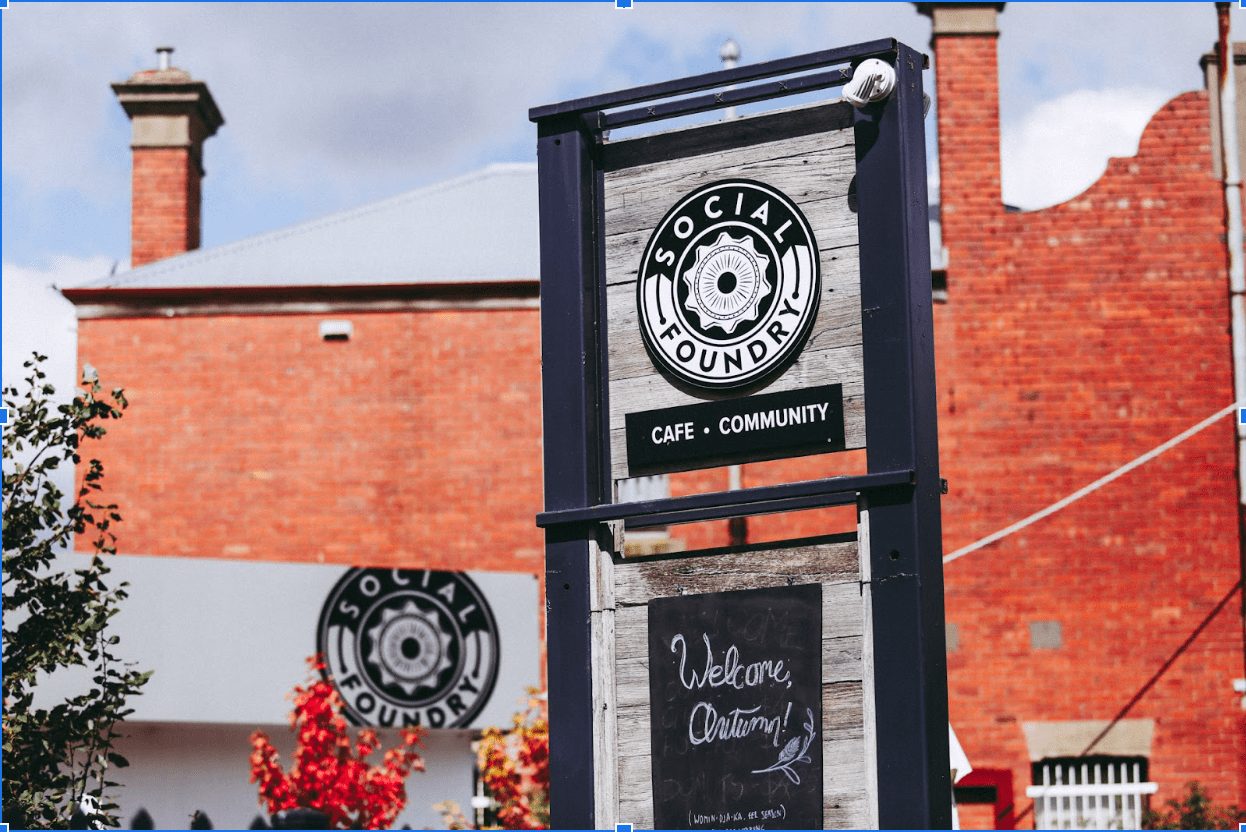
The Social Foundry: Teaching Life Skills to Youth With Community Support

In Brighter Tomorrow, we like to share stories of changemakers from all over the world. Here is one from the land down under. 

In the rural Australian town of Kyneton in the State of Victoria, the Social Foundry offers “standout food, coffee & service, while also delivering hands-on training for local youth facing barriers to employment.” I had the pleasure of interviewing one of their staff members, Sue-Lee, who works as the community life coordinator. She shared a couple of success stories that the Social Foundry helped create:

Ashley (a pseudonym) came to the not-for-profit after she finished high school and sought a job. She wasn’t sure what she wanted to do. Young school-leavers like her in the countryside have few opportunities to find work so she found help through an employment agency. One thing led to another and she ended up on the doorstep of the Social Foundry. 

Ashley, as Sue-Lee said, “started off doing the first 10 weeks – it’s called the work skills program. So it’s a 10-week program once a week and we started her off in front-of-house doing customer service delivering drinks and food clearing tables and towards the end of her work, we got her to do a skills program with us. We started her off on the coffee machine. And she really enjoyed that and said in that shift that it’s the first time in her life that she’s found something that makes her happy. So we asked her if she wanted to continue the program with us and do another lot of 10 weeks.” 

Sue-Lee then said it was decided for Ashley to continue on the coffee machine and get trained as a barista. At the end of the ten-week training, Ashley found a job in a local Kyneton café. 

This concluded Ashley’s training and introduction to the world of work. As a result, the trainee’s mental and physical health improved. She said her parents have seen the change in her and her confidence has been built up after it was struck down by her declining mental health. About Ashley’s journey, Sue-Lee said, “That was one of our many good news stories from our program.”

(Image courtesy of The Social Foundry)

In a city like Melbourne, known for its coffee, hospitality is an easy entry into the workforce. It isn’t easy being in the hospitality sector as the market is saturated despite the ubiquity of cafés. Add a social enterprise model into a cafe and there is the additional challenge but Sue-Lee affirms that the reward of all the good news stories make it worthwhile. 

At this point of the interview, Sue-Lee also recounted the story of Jane (a pseudonym) who, in August 2023, trained at the Social Foundry in her year 12. She was from a local high school and could not finish her studies because of her issues with anxiety and lack of connection with the school program. Her school counselor referred her to the Foundry and from there, she began to change. Starting with a short shift of four weeks, she enjoyed life at work rather than at school. She then moved on to the full ten-week training course, like Ashley did. 

“[Jane] came to us last August and was in Year 12 at a local high school and couldn’t finish her year 12, just because she was feeling quite anxious and was not connecting with the school program. Her school counselor shared about our program and introduced her to us. And so we started her off with a short shift for four weeks. When she finished that she enjoyed it. So we asked if she wanted to follow up with the work skills program, which involves a full day shift once a week and she continued to do that.”

According to Sue-Lee, Jane loved the work skills program and became a trainee upon finishing it toward the end of 2023. While training, she also handed out her resume to get a job further down the line. She worked short shifts again at the Social Foundry as she prepared to enter the labor market because she felt working a full day was a bit much for her. After finishing the program with us, she got a job at a local café just around the corner after being employed briefly in a local supermarket where she stopped getting shifts. It was a victory for Jane after a period of feeling low. 

(Image courtesy of Padraig Treanor via Unsplash)

Sue-Lee’s testimony about these two trainees shows that the Social Foundry’s approach is a winner for empowering local youth to engage with their community and the workforce. They say it takes a village to raise a child, and sometimes we forget that only a community can bring the young back from their detachment from society and work. 

Social Foundry, like many not-for-profit organizations, tries not to rely on grants and instead aims to work toward a self-funding model through its café, and event space. Try visiting it if you plan on a trip to rural Australia. The mountains and landscape there are breathtaking and are easily accessible by train. Kyneton, an hour’s ride from Melbourne, is known for its great literary culture and is home to some of the best cafés in the world, staffed by expert baristas.

Congratulations to the Social Foundry of Kyneton, Victoria for its impactful community work in Australia. The project was honored with the Yuvoice Brighter Tomorrow award on August 4, 2024, for its efforts in connecting youth to their community and helping them to overcome barriers to employment. On behalf of our Brighter Tomorrow team, thank you for taking the time to be interviewed. 

Not Playing the Game: The Bitter Cost of My Youthful Resistance

In my 20 plus years of existence, I have learned two important lessons: (1) if you want to succeed, you have to play the game. (2) I am not good at playing the game.

My life started out in the usual way, for a boy from a lower-middle class family in a Pakistani village. I grew up going to the village school and dreaming of joining the army. I never gave too much thought about the purpose of school or an education — I, like many of my classmates, never planned to study past the fifth or sixth grade. 

But fate stepped in when I was accepted to the school run by my father’s employer. This company school was an entirely different world: there were large classrooms and playgrounds — and the language of study was English. For me, that was a major hurdle since I had only been taught in Urdu. 

I was a good student, though. I worked hard, mastered English, and kept progressing in my studies. It wasn’t until I entered fifth grade that I started to question what I was being taught. In Pakistan, students in the fifth and sixth grades already have a firm understanding of politics and the country’s political parties. My loyalty lay with former Prime Minister Imran Khan, who was gaining ground against Pakistan’s two-party system.  

He mostly talked about changing the corrupt system and motivating youngsters to join his struggle. I was very much fascinated by his battle and political moves. This fascination strengthened the rebellious feeling that was taking root inside me.

I started to adopt a policy of applying the knowledge learned from theories and books. When I began this implementation of the knowledge I had learned from books in my practical life, I started to question my teachers for being very different in how they teach and what they do. I was criticized and disciplined. Often that meant I missed classes. 

These punishments didn’t demoralize me; instead they made me stand firmer in my beliefs and committed to raising my voice against the education system in Pakistan. I started to ask teachers questions when their words contradicted their acts.

By this time, I was in eighth grade — a pivotal moment in the Pakistani system — as schooling changes from general education to specialized tracks. 

I was not interested in my choices: computer science or biology. I wanted to study the arts but that was not allowed, in part because private schools in Pakistan compete for students. Children’s scores in popular and challenging subjects, like the sciences, are a critical part of attracting parents and new pupils. 

(Image courtesy of Roman Mager via Unsplash) 

I opted for biology, even though I was not interested in it, and passed my eighth grade exams with flying colors. I was poised for success! Except I didn’t agree with the way the school system divided ninth graders according to their exam scores. Basically, the system divides children into two groups: the “average” group — kids who can pass the national exam but are unlikely to get top scores without a lot of tutoring and support — and the “strong” group: the chosen ones the school believes can achieve national ranking scores with enough attention and guidance. 

I protested this division. Even at that age, I understood it was fundamentally unfair to give one group of children more resources when all the kids would benefit from more education. Why should a child’s future be sacrificed so a school can pour its resources into a chosen few?

I refused to follow the rules for exam preparations: I firmly believed — and still believe — scores should be given based on the value of your response, not the formatting or tricks you use to present your answers. As the exam date grew closer, the school coordinator even called my father to plead with him to convince me to follow their rules and get a good score. The message was, in short, the answers don’t matter: exam graders want to see how you format your responses, not the value of your words. 

I was shocked to hear that, and instead of acting upon my coordinator’s advice, I continued my rebellious policy of just writing the answers without proper presentation. I used to say I never studied for marks; I studied to learn and use the knowledge I have learned daily. That was the point of being educated. My teachers, however, believed you can only succeed by being a part of this system. Admissions to prestigious universities and jobs in Pakistan are always given to those who have good grades.

In short, I could not get good grades in 9th and 10th classes and was strictly criticized for not following my teacher’s instructions and for not bribing the exam monitor. So, I could not secure admission to top colleges like my other classmates, who also acted upon their teacher’s advice and compensated the exam monitor.

Once I finished 10th grade, however,  I realized I could still shift from the biological sciences to engineering or computer sciences for 11th and 12th grade, known as college or higher secondary education in Pakistan. So, with no additional preparation, I jumped to engineering. But, unfortunately, my experience there was the same: if I didn’t play the game, I couldn’t get the grades I needed to succeed. 

(Image courtesy of Nathan Dumlao via Unsplash)

I still dreamed of joining the army, so after I graduated, I went to an academy in Lahore to prepare for the military exam. There, retired army personnel coached us on how to behave in interviews and tests. There was a Catch-22, however:  I needed to prepare for the exams, but the military would not accept anyone who prepared because the point of the exams was to assess a potential soldier’s natural abilities and talents. My instructors told me directly to lie to the interviewer and say, when asked, that I had not received any coaching.

But I thought, why should I start my new career by lying? In short, due to my decision to tell the truth, I was shut out of the military and my lifelong dream was crushed. 

Instead, I was admitted to the food science and technology department at university and decided to get my bachelor’s degree in this field so I could continue my education. I did not like the field and did not fully understand which jobs I could get with this specialty. With little guidance and my usual critical eye toward the education system, I struggled to do well and ended up graduating with average grades.

Now, I am sitting in my bedroom writing this story, thinking about my mistakes. I don’t want a master’s degree in my field and, after almost 24 years of life, I finally understand my true calling was not engineering, the military, or biology. My passion is literature and the social sciences: international relations, regional studies, and other similar subjects best fit me. I realized this after every opportunity has gone, and now there are limited chances that I can find a master’s program in any of those fields with my current degree. 

Today, I realize that if I had followed the flow and kept all these rebellious thoughts to myself until the day when I would have had some power to change the typical education process in Pakistan, it would have been a much better way to make amendments and improvements in the society and system.

Instead, however, I just kept resisting, and my resistance as a child and young adult was useless. It deprived me of every opportunity, like attending an excellent, reputable college and studying the subject of my interest and choice. I could not analyze my interests and chose only the fields that were not my cup of tea.

So, in the end, Pakistani schools taught me an important lesson: resistance at the wrong time and age is useless. If you have to change the system, just be a part of the system until the day you reach the stage when your decisions or resistance will matter. We resist at the wrong time, and this ill-timed resistance has wasted many of the talented voices that were intentionally interested in bringing a positive change in the system. Instead, it is too late when we finally realize we have resisted at the wrong moments.

It is my hope that, by reading this, other young people will learn from my mistakes and understand that there is a time for every expression of resistance and every voice to be raised. If you want to change the system, work hard to obtain a position where your words may have some power to bring about the change you desire.