
Peonies and Moon Trees

Today, in the stillness of winter, I realized how brilliant my twin brother is. I have always thought of him as highly intelligent. More than that, though, he is a force of good in my life, a being who encompasses constancy, sincere honesty, and all of those facets of society that I wish I beheld more often in other human beings.

Truthfully, I have been struggling with maintaining the same vibrancy I see within him these past months; I find myself looking for the broken pieces of our world upon which to cut my fingers. And there he is: always ready to mend my hands. I cherish him.

One afternoon, while we were walking through the brisk and battling winds of snowfields, we talked. We shared how we were feeling, how we viewed humanity’s tangible vicissitude, and my twin gently reminded me of the triumphs our world continues to nurture in defiance of the tragedies we are living through. However, what I found so powerful was that, unlike my prevailing bias in placing human beings at the center of all achievement, my brother discussed the success of plants, of things that grow simply because they must. 

He described the delicacy of peonies, how they flourished, what they symbolized, their perfect mutualism with the ants that could spoil a picnic and also cause sweet florescence. He spewed metaphors and similes as verdant as the plants whose names he recited, relaying how much we can learn from “those whose speech we rarely stop to listen to, let alone attempt to understand.” I found myself staring at the snow, imagining boughs and buds bursting forth with a vigor I could only hope to emulate.

My brother’s willingness to casually gift me the knowledge that would allow me to engage with nature in such intimate ways was akin to anything I have felt with someone I truly cared about, through reading poetry, tasting the best meal of my life, or landing a new job. It was euphoric, and all he did was describe to me how other living things continue onward despite global atrocities. I felt changed, and welcomed once more, by the living lyceum surrounding me, bestowing silent revelations. There were a few brief moments of envy when I desperately wished that I had arrived in this proverbial place of quietude on my own, but I was comforted by the fact that I have far more conversations, with both my twin and the plants whose languages I have yet to comprehend, to learn from and savor.

***

My brother’s generosity in welcoming me into the sanctity of nature felt healing, potentially from some hurt that had not yet been inflicted, and would now be wholly prevented. It felt rapturous, and so I asked him of other marvels that he leaned on in times of misery. He then spoke of “moon trees.”

For anyone who is unfamiliar, NASA launched Apollo 14 to orbit Earth’s moon in 1971. Aboard the vessel were astronauts, provisions and equipment, and tree seeds that Stu Roosa (the command module pilot of the mission) had stowed away. These seeds traveled through the void and the stars with the crew, and, upon returning to Earth, they germinated and were distributed across the world to national parks and historic locations. The saplings were strong, and, in some aspects, considered to be imbued with an abstruse vitality. They were fondly referred to as “moon trees,” and many continue to prosper today despite everything.

In 2023, more seeds were ferried to space upon the Orion spacecraft. These precious beginnings traveled thousands of miles for over a month before returning to Earth and being cultivated. This time, however, the moon trees were granted to schools, children’s camps, town halls, and community parks. In fact, organizations from across the globe were encouraged to write to NASA and illustrate why these precious trees would be beneficial to their communities, garnering over one-thousand submissions. Students, teachers, construction workers, hair stylists, and other changemakers wrote about the nearly ineffable hope that the moon trees represented and how they would remedy the increasing apathy of our celestial sphere by bringing everyone together.

My brother then described his own adventure locating a precious moon tree at the botanical garden where he once worked, and how he had made a point to map the location of the tree, a sturdy sycamore, so that everyone in the area could marvel at it. 

“It is magnificent,” he said as we walked, our warm breath misting in front of us. “And it is important for others to see that.”

I found myself getting emotional, recognizing the goodness within my twin, and understanding that he himself is, in more ways than one, a moon tree of sorts. He is someone who, like the powder-pink peonies, provides a sweetness that I crave in this bitter reality. He is a being, like the moon trees, who grants his own energy to lift others around him, all while harboring that same spirit that can only be born of stardust and moonlight.

I am proud of my brother for the numerous achievements that punctuate the years of his young life, but I, as his twin, feel fortunate beyond words that I, being half of something that also created him, could potentially be a moon tree to someone someday. I could become the peonies, in early spring, that don crowns of blushing heads, gilded in ants and glistening sugar.

I can choose to grow, whether it is in my ability to say that I was wrong, or to seek to understand when someone else fails to admit that they need help. I should prune my pride so that it does not become hubris, and I can nourish my everyday with humility and gratitude. Most importantly, I must decide to love without condition or expectation. For then, I may be pleasantly surprised when someone reaches out, bouquet in hand, to love me in return.

Yes, I believe that my twin brother has a brilliance that I rarely observe in other souls, but that is precisely why I am so grateful to discover it all over again, on our walks together, during these wintry days. He, along with Mother Nature, generously remind me that I may yet bloom in the snow and ash that surround me.

A white peony, looking as pale as the Moon, flowers in darkness.
(Image courtesy Photo by Anastasia Sineokaya via Pexels)


Mr. Sweeney’s Sandbox

And, just like that, he was gone.

It was New Year’s Eve, and Jace was spending the holiday at the hospital again, for the third year in a row. He had become a nurse to “help others heal,” but, at 37, realized that he was the one hurting. No significant other, no kids, and not even a dog (although only the last being really piqued his interest); he had been going through the motions at work since the pandemic because that was all he could do. Medicine had changed. He had changed. He was still hopeful, and honest, and worked hard, especially on those holiday nights when so many were home with their loved ones. He had a family that cherished him– a doting mother he spoke with daily, a brother who still sent heartfelt greeting cards for every holiday, just as he had when they were still in college, and his best friend, Khalil, who always graciously told him, “Come to the house for New Year’s,” before he inevitably turned down the invitation because he “had to work.”

It wasn’t that Jace was avoiding his family, but, rather, that he felt for those who didn’t have any. That was something he had witnessed in 2020 to disastrous degrees. Families had been separated because of COVID, among other maladies, both physically and metaphorically. When he was the on-call nurse seated at the front desk of the waiting room, he remembered watching multiple people, dozing, until their heads snapped up, a look of tremendous pain etching them in gray, just as the doctor emerged to inform them that, tragically, their loved ones had succumbed to the virus.

He recalled watching a mother with twin babies who did not even have the strength to cry after losing her husband, simply because she needed to process what she was going to do next, how she was going to care for two one-month-olds on her own. Another man, older, with a worn tweed flat cap resting on his lap had used it to conceal his face while he softly sobbed at the news of his wife’s passing.

These traumatic tableaus played in Jace’s head often, but they were not the ones that weighed most heavily upon him. It was those individuals who flickered out of existence, with no one but him to remember them, that made him keep coming back during the holiday season. 

Even though he was fully vaccinated, Jace had had COVID twice, but that came with the territory. He thanked his lucky stars that he had survived what so many others hadn’t, but he would risk it again, if he could be there to listen or even just to make sure another person didn’t burn out like a toppled candle left to pool on the table. Jace would support them as best he could, even if that meant saying “You’re alright. It’s going to be alright,” when he could see the monitors’ oscillations declining.

Jace knew that lying to his patients in those final moments was wrong, but so was having them suffer silently in isolation. If he could ease their worries, fray their pain at the edges, for just a few moments, then he would.

Tonight, things had been relatively tranquil, even with the holiday. Jace was seated in the front lobby taking his fifteen. He made a point to at least observe the celebrations happening around him, and he would call his mom, brother, and Khalil to make sure they were enjoying themselves. His mom asked him to make a wish for the New Year and waited for him to blow a kiss into the sky (a family tradition), while his brother asked if he received his holiday card. He had; it was filled with paper confetti that he was still vacuuming up days later. His brother laughed heartily at the success of his harmless prank and reminded Jace to eat something before the end of his shift the next morning. Khalil screamed, “Happy New Year, Jacey-Boy!” into the receiver as she playfully swore off alcohol and chocolate for the umpteenth year in vain. Talking made him feel a bit better, and, every once in a while, the double doors of the hospital would slide open, and he would spy revelers celebrating the fleeting moments of the year. A woman in a sequined dress, with bright red legs from the cold, walked past with a kazoo, and the low quack actually made Jace grin. Then the chime of his alarm sounded.

He took the elevator up, waved to a fellow night nurse, and grabbed his charting cart before quietly swiveling it down the hall, hoping not to rouse anyone. So far, his patients were soundly asleep and stable. He made sure to whisper, “Happy New Year,” while he updated their vital readings and checked their fluids. Jace had to wake one little girl to give her some scheduled medication, and he had remembered to bring a packet of foil star stickers as a gift. The child was thrilled, and Jace promised not to notice if one or two stickers made their way onto the railings of the bed.

When he entered a Mr. Sweeney’s room on his rounds, he noticed the man’s chart was devoid of emergency contacts. He had checked himself into the hospital after testing positive. He also seemed to be asleep. His hair was gray and sparse on top of his head, and his eyebrows were a bit too wooly. He had stubble on his face to match them, which made a slight scratching sound against the nasal cannula wrapped around his face, and a modest belly that rose and fell alongside his chest. Jace whispered good wishes once more and was slightly startled when one of Mr. Sweeney’s eyes opened, focusing on him after a few moments. “What’d you say, sir?” 

“Oh, I’m sorry to wake you. I was saying ‘Happy New Year, Mr. Sweeney,’ but obviously was too lou–” “That’s kind of ya, sir,” Mr. Sweeney interrupted him. “Please, call me Todd.” “Well, Todd, Happy New Year to you,” Jace responded, feeling the echo of a lump in his throat. “Thank you very much. What’s a young person like you doin’ here of all places? You should be out celebrating, especially since–” he lifted one arm, with substantial effort, and made a circle in the air, “we’re not exactly the best partygoers.” Todd laughed, again with effort. 

“I really don’t mind. I like being he–” “I’m going to stop you right there and ask you a question, sir. Do you believe in God?” Jace bristled a bit, hoping, desperately, that this conversation would not turn into a tirade. He thought carefully for a few moments and answered as truthfully as he could, “I do believe in a higher power, but I have seen enough to make me question a lot of things.”

He braced himself for a verbal onslaught, but, instead, Todd smiled at him. “I can tell you’ve been a nurse for a while.” “Yes, eleven years now.” “And you’re still here? Interestin’,” Todd said, almost to himself. He coughed for a spell before continuing. “Sir, I can understand questioning everything in your line of work. I don’t much like bein’ here myself, so it’s nice to know there are people like you around. However, I’m goin’ to remind you to live your own life, too.”

Todd paused for a bit, looking out the window at the streetlights. He turned back to Jace slowly, smiling warmly. “It’s really none of my business, but I don’t care much for boundaries after they stuck tubes in me.” “Are you uncomfort–” “Never mind that. I’m fine, or at least tryin’ to be. What I want to say is that, whether it’s God or someone else entirely, you’ve got to remember that we’re all in the sandbox.” “I’m sorry?” Jace said gingerly. “The sandbox. Ya see, this world we live in is basically just a big sandbox for God. He sits down, in his corduroys, grabs his shovel, his plastic pail, and a bit of water, and he starts buildin’. Trees, trucks, pups, pythons, you, and me– he builds it all. He plays, has his fun, and then he, like anybody else, has to go home.”

Jace lingered on his words, thinking not of the giant bearded figure with a booming voice that he had seen in church, but of a little boy playing in sand while his parents watched from a nearby bench. His hands were dirty, and he smiled, looking over at them while they waved back.

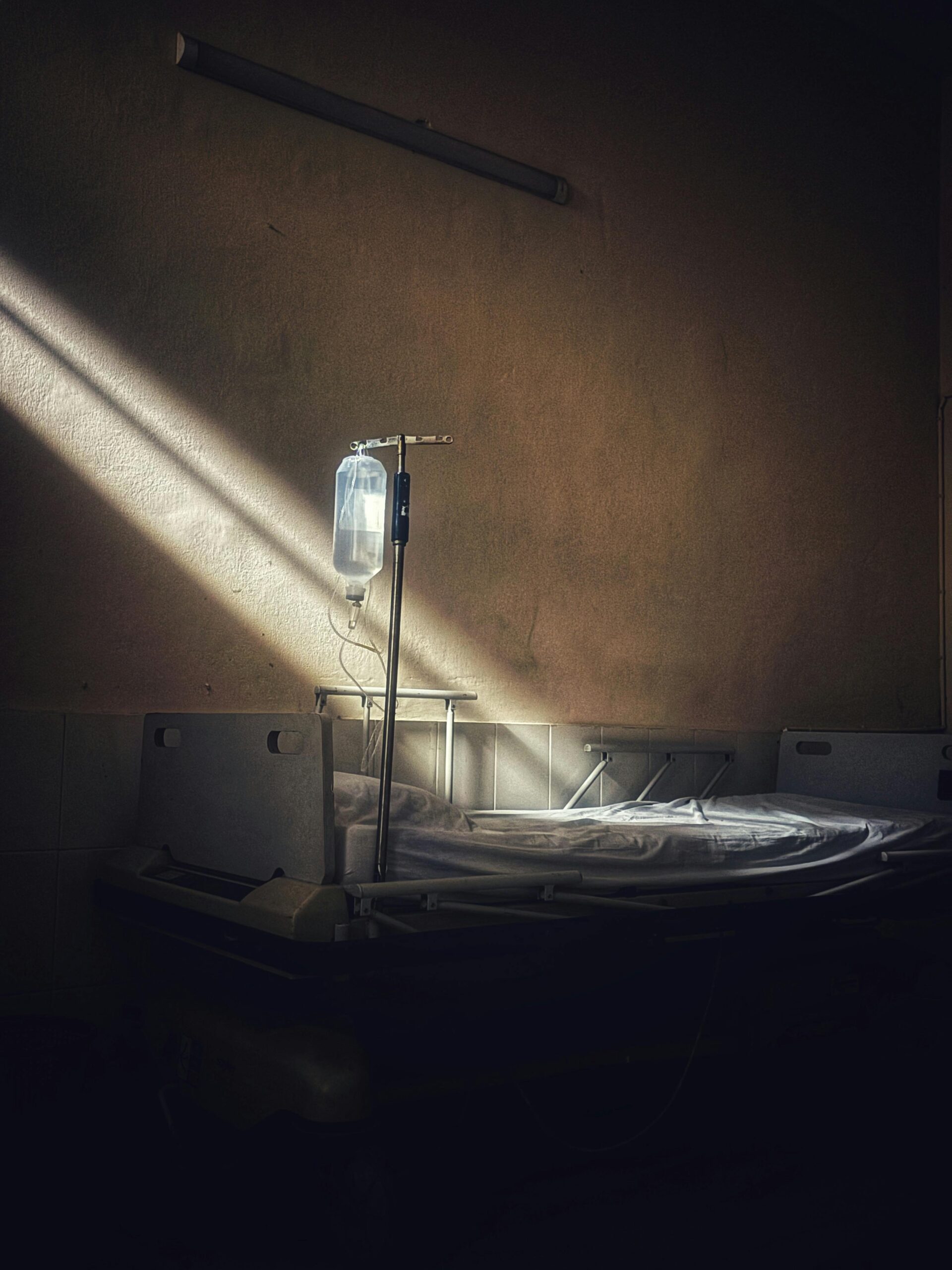
“Sir, I know what you’re doin’ here is really special, but maybe it’s time to put the pail away for a while, hm?” His gaze softened as he looked at the nurse, awaiting a response. Jace smiled back, nodding a few times in understanding. “Good night, Todd, and Happy New Year, again. Thank you for the conversation, and, if you need any–” “I’ll certainly call if I need somethin’. Thank you, sir, and Happy New Year. It’s been a pleasure.” Todd lifted his hand slowly and waved, his IV hose swaying like tall grass. He closed his eyes again, and Jace scooted the cart out of the room, partially closing the door.

Jace took the T back to the hospital at 8:00 pm on New Year’s Day, readying himself for another night. He hadn’t slept much as he continued visualizing the scene that Todd had gifted him. Except, the man on the bench was wearing a tweed flat cap, and the woman had her hand on a double-stroller while two little boys played together in the sand, one in white corduroys, the other in blue. 

After calling his mom, he grabbed his charting cart and ambled down the hall once more. Jace visited the little girl, spying star stickers adorning her bed. Some glittered in an arch above where her head was positioned on her pillow. When he reached Todd’s room, he walked in quietly, not planning to wake him this time. His head was turned towards the streetlights again, and his eyes were half-closed. Jace immediately noticed Todd’s chest and soft belly were still and rushed over to his bedside. “Mr. Sweeney? Todd!?” He reached out to touch him, noticing that his skin was the same shade of gray that those individuals, overcome with grief and worry, always had in the waiting room. He was cold.

Jace called his fellow nurses and the on-duty doctor, who reported to the room as swiftly as possible, vials of medication and resuscitation equipment in tow. However, Todd had been gone for a while. Jace stared at him, as he continued gazing out of the window, while people in blue scrubs and white coats swarmed around him. Jace still hoped that Todd would turn towards him with the same gentle smile he had the previous night, and he imagined him, laying in a sandbox, eyes towards the sky, sand falling between his fingers as he clenched his fists.

Amid the flurry of activity, he went over to Todd, closed the man’s eyes as best he could, grabbed the rubbish pail near the bed, and emptied it before leaving the room.