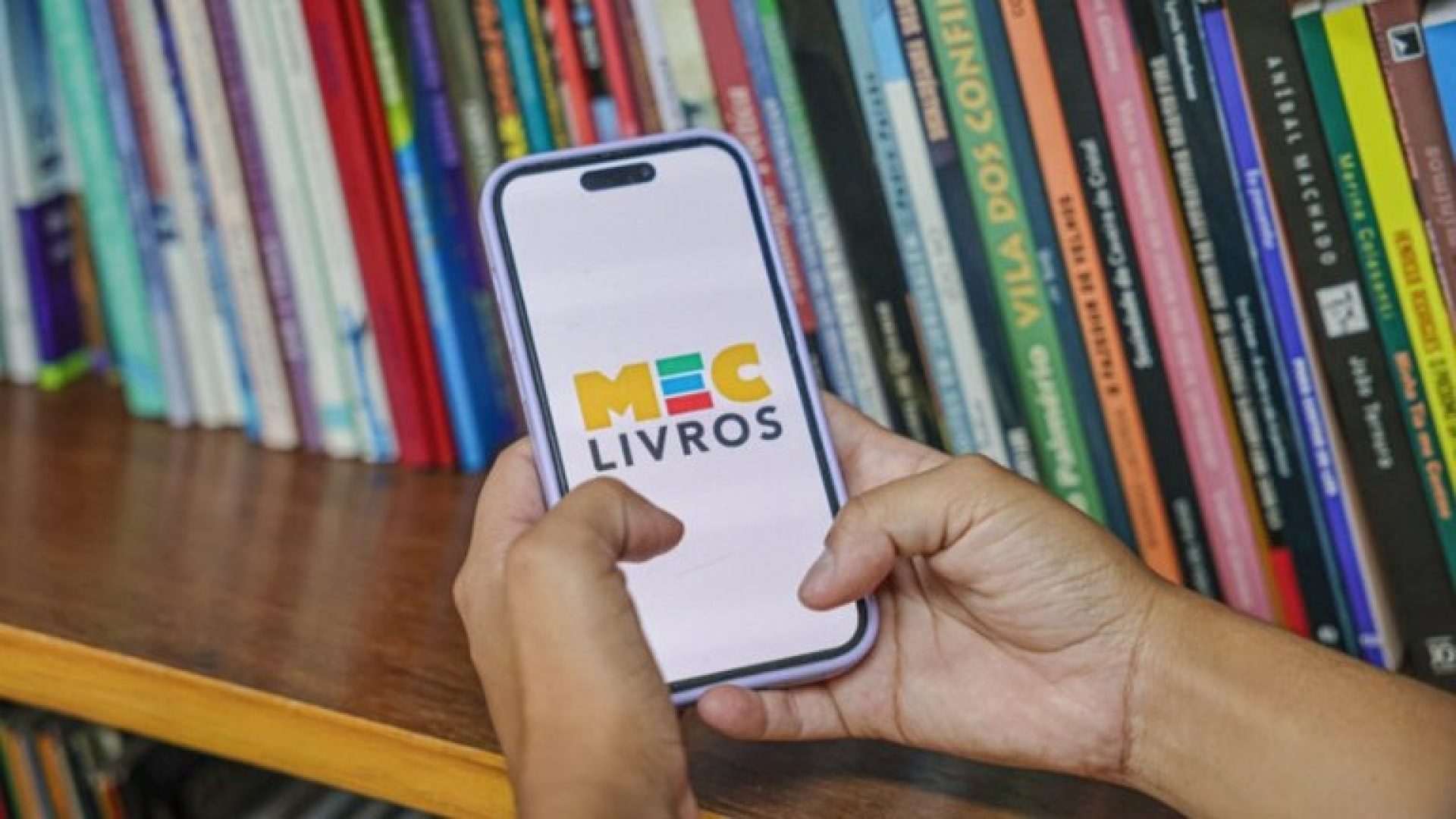
On April 5, 2026, Brazil’s federal Ministry of Education (MEC) launched a free digital library featuring a wide range of books. The initiative aims to democratize access to reading for all citizens.
What is MEC Livros?
It is a public, free digital platform offering about 8,000 books, both national and international. The library includes classics, bestsellers, new releases, and various literary genres, aimed at students, teachers, and general readers.
For university student João Pedro Oliveira, MEC Livros revives a culture that has been fading by bringing readers closer to the traditional library experience.
“It’s a wonderful proposal… What’s most interesting, in my view, is that it imitates a library. I think that’s a culture that has been largely lost nowadays.”
The student also highlights the variety of the catalog as a strong point, noting that it can attract different reader profiles.
In a country where access to books is still shaped by economic inequalities, public initiatives to encourage reading become essential for forming new readers.
Additionally, the country has been experiencing a decline in the number of readers in recent years, highlighting an increasing distance between the population and reading habits. This context is directly linked to structural factors such as social inequality and the high cost of books, which limit access, especially for low-income communities.
This difficulty is also reflected in the daily lives of young readers. João Pedro reports that limited access directly hindered his development as a reader, particularly in engaging with Brazilian authors.
“The biggest impact is my lack of reading Brazilian literature. I’ve always tried not to download pirated books, so among everything I’ve read, only a small portion is national literature.”
In contrast to this scenario, Rio de Janeiro’s recognition as UNESCO’s World Book Capital in 2025 — an annual title granted by the organization to cities that promote reading and access to books — reinforces the importance of projects that encourage reading and expand access to literature.
The city was chosen for its commitment to promoting literature and improving accessibility for all citizens, intensifying discussions about how factors like high book prices and limited access influence low reading rates in the country.
The digital format also stands out as a key advantage of the platform. By gathering thousands of works in an environment accessible via mobile phones, MEC Livros expands opportunities for engaging with reading in everyday life.
“It’s on our phones, something we use very frequently. That makes a huge impact,” João Pedro says.
According to the student, the impact of reading goes beyond the immediate habit:
“It’s something quiet and long-term… The more you read, the more you realize how far your mind can go.”
In this way, platforms like MEC Livros emerge as a way to bring the population closer to the literary world through the democratization of knowledge and digital inclusion on a national scale.
Sagene, maybe midnight. Maybe just before. It’s late. I had my usual spot at the local park, up on the rise where a couple of benches sit, with a view to the whole place. It’s January and it is cold — really cold — but I don’t mind it.
In Norway, they know how to bundle up. Frankly, living two entirely separate existences — from the bright, warmer months to the dark, colder ones — is a necessity. Norwegian winter isn’t a joke, it’s real. You get endless false summits of the snow finally melting, only for it to fall again and again and again.
I was triple-layered all over, beanie on my head and a flask of piping hot coffee in hand as I sat out to smoke. I was escaping, in truth. There was always a part of me in that relationship that just needed…air. I just had to, wanted to. Then of course, I’d feel mildly guilty that I’d pulled such an escape hatch and left my girlfriend back in the flat.
I took my seat on the bench, my increasingly customary spot. I looked up to see the Big Dipper faintly flickering in the sky above. This was my little refuge. Yet that led to a significant question… why exactly did I even need a refuge?
***
I was in Norway, following the girl I loved. She and I had been together some six years when back home came calling for her and, on open invite, I followed.
We both left London feeling we’d found the person we would gladly spend the rest of our lives with. It was magical. Leaving the only country I’d ever known in the name of romance was exhilarating. (It’s also one of the coolest ways to sign off from a job).
We spent six months living at her folks’ place. Amazing people, brilliant hosts, with a pristine haven of a home. I sat, got fed, and mildly fat when, legally, I couldn’t do anything else. It was around the six month mark when my girlfriend got a job interview in Oslo. We moved to the capital and got a little apartment with a balcony in a beautiful, leafy corner.
It’s rare that reality lands like an anvil, giving that shuddering sweep of blood running cold. Those sideswipes happen, but they aren’t often. Usually, typically, reality unfolds, slowly, carefully, over time. As it has been said in writings more important than this one, “God gives us as much truth as we can handle”.
In retrospect, I was running on myths: Myths and half truths — all well meant, I should caveat. It would dawn on me in the weeks ahead that I’d be taking advice about living in Norway from someone who hadn’t actually done that since school age.
Myth Number 1 – Norway is not that expensive.
We were Londoners. We’d spent the best part of our formative 20’s in the Big Smoke. It’s a major capital, and, like most, it comes at a premium. Even so, my girlfriend was fairly confident that the cost of living would be about the same.
I believe we were about two food shops in when she’d turn to me and said,
“Norway’s bloody expensive, isn’t it?”
Myth Number 2 – Everyone Speaks English There. You’ll Be Fine
Now this is a slippery one. Mostly because it is true. The vast majority of Osloaites (or, in Norwegian, Osloenser) I met or made friends with had a comfortable and easy grasp of English. Yet how this related to job markets was less than inspiring. The inference that speaking Norwegian wasn’t a necessity for employment turned out not to be true. My preceding months of Duolingo were far from enough to get by…
Myth Number 3 – Work Part Time, Do Your Writing
The only doubt I had in moving was that I’d be making major changes in my life I wasn’t ready for. I was confident in the relationship, in my partner, and in the move to a part of the world that gave her family a support network. We spoke before moving and she gracefully, beautifully, gave me the green light: do it, go for it, live your dream. Work some 25-30 hours a week and spend the rest of your time doing what you love.
However, with the above two items being so, this was simply impossible.
All this unfolded over the opening weeks and into months of living in Norway. Reality can never live up to fantasy; that’s why we’re generally dissuaded from it. My partner got a job that was really well paying, and she was good for it. Honestly, she had an incredible mind, a remarkably intelligent person.
She went on a coding course while we were living at her folks’. She got head-hunted by one of the biggest publishers in the country, for a well-paid and profoundly contemporary job. The flipside of the coin was: it swallowed her whole.
She was consumed by it. She stressed about it approaching work. She stressed about it during work, and she stressed about it after work. It became the only topic of conversation when she was back. Weekends were increasingly matters of recuperation, when she was regularly beleaguered with migraines.
I couldn’t help but feel gut-punched at the irony. She was so deserving of this job. This was an immensely capable and smart individual. London’s job market had been indifferent, when not cruel, to her. Finally, she got a chunk of employment that actually measured up to her value. Yet this was the first time a valuable and well paying role had come her way in our time together. I was so happy for her getting the post, but once again, reality clashed with fantasy and visions. I’d never considered that a job which actually made the most of that brilliant brain would leave her depleted and despondent.
I don’t know when exactly the turn happened —when I started to feel the pressure cooker — but I remember a firm sense that… I’d lost my place in the relationship. I began to feel invisible and powerless. My freelancing engagements were hardly enough to line pockets, and Norway is expensive. Her mind was elsewhere, with no conversation but work. I felt like a passenger. As for my love… that was the burn, I still loved her, but love is a raw and beautiful force with many different faces.
She felt like home. I cared for her deeply. I felt an overwhelming sense of responsibility and care for her happiness. I was a best friend, a father figure, a flatmate, and definitely a source of comfort. But… lover, romantic partner? Something got lost on the flight from Heathrow to Oslo. Something altered as the reality of living in Norway unfolded. She was deeply committed to me, and I’d drawn a line in the sand by moving over, but something was gone.
Seven years in, was this normal? How does one tell? Who does one ask? What makes you know?
***
Image courtesy of Human Bahluli on Unsplash
Sagene, gone ten pm, maybe midnight. It’s cold out–or is it? It could be spring, summer. I spent so much time finding my little spot up at the park it’s something of a blur. I do remember kissing my girlfriend before heading to the park, clear as day. I remember her face; I remember coming away from the kiss with it… just not feeling right.
The spot was quiet, just the occasional dog walker passing through. Sitting on the bench, I felt full– something in me not sitting right. Maybe it was the kiss, the relationship.. It was this dark, uncomfortable presence in my psyche that refused to be ignored. My mind swam as memories plumed.
Cabin trips in the spring and summer. Seven beautiful Christmases worthy of oil paintings. A family taking me in as one of their own. Hard times in London. Good times in London. The uncomfortable ups and downs of being a twenty-something. The wonderful ups and downs of being twenty-something lovers. Friends back home. Embarrassments. Arguments. Uproarious laughter. Binge-watching series. Holidays and trips together. Tender holding of one another. Comforting each other through losses. The opening joy of starting up in Oslo together. Her cute face…
I stood up from the bench, my cup ready to spill. I stepped forward just a matter of steps, looking out to the horizon, just a few trees and high-rises filling a spread of skyline. To no one, to anyone, the words left my lips with a throat as tight as vice:
“This isn’t the one…”
And I cried and I cried and I cried. I bawled like an infant, alone in relative darkness. I’d moved everything I had and left everything behind for this. I was all in. I’d rolled the dice and I got snake eyes.
***
What followed was a year of trying. I tried the good-cop way and we kept the groove of the relationship. I tried the bad-cop way and disturbed the groove of the relationship, but not for the better. Sometime in June the following year, I broke the relationship off. Despite the well of tears that followed for us both in the weeks and months ahead, it would increasingly dawn on us that it was the right decision.
I don’t know if my eureka moment was realizing the relationship had to end, or the conviction that came about myself having made the leap. By the time I had to leave Norway, I’d entirely placed my happiness and self-worth in someone else.
I’d taken the archaic maxim ‘happy wife, happy life’ to an extremis that just abandoned me. There were parasitic elements that I couldn’t reconcile or take pride in: your country, you got the good job, you take the reins now.
I’d stopped treating love with love. Some ghastly dependency arrived with an utter sense of resentment; that the success of the move for her hadn’t instantly equated to a glowing happiness. Moving countries for your love is certainly a man’s choice, and I’d turned out a scared boy.
Returning to the UK brought a determination. I couldn’t look to or depend on externals; I needed to look at me. I wanted responsibility and change, with a full understanding that they are harbingers of stress and challenge. I wanted to be the architect and accountable party for my own happiness and never lose sight of that.
I desired reality, even if it meant the frightening prospect of staring it down the barrel. I wanted to be someone who could take that. I set out to do the work of becoming the guy I was meant to be, not someone I thought I was… running on myths out of someone else’s mouth and covert contracts about others.
***
Creative destruction is a term for economics but I feel it can be more broadly applied. Sometimes the antiseptic stings; we have to make decisions that are painful at the time for better results down the line. That’s certainly turned out to be true. I’m very much becoming who I was meant to be with a steeper degree of self-worth, insight and responsibility than I’d ever had in my life. I’m also pursuing what I love more diligently and consistently than I’ve ever done.
As for the villainous matter of being the breaker in the break-up…
When I left my partner, she had a beautiful, full furnished apartment and a well-paying job in the capital of her country. She was just a train ride away from family and had a blooming social life in the city. This hasn’t changed.
There’s a saying that “sometimes, in order to find love, we must hurt the ones we love”.
We’re both for the better for it, with a deeper understanding of love and ourselves that staying together could never have fulfilled. She’s free now and so am I, living the lives we want to.
Fertility in England and Wales is at record low levels of 1.41 births per woman. It’s a trend replicated across Europe, including in countries traditionally seen as family-friendly like Spain and Italy. Meanwhile, the average age of parents has risen. People are waiting longer to have children and are sometimes finding it harder to have them. So finding adoptive parents for young children in need of a family should be getting easier, right? Wrong, according to Dame Carol Homden, chief executive of children’s charity Coram, a major voluntary adoption agency in England.
“Adoption matches and placements are down, but that is not because of a fall in the number of children,” Homden told The Sentinel in an interview, adding that in Britain:
“What is of profound concern is that we have more than 3,000 children waiting and we only have half the number of adopters.”
There are several reasons for a lack of potential adopters, according to Homden, starting with an ageing population.
“We have a demographic time bomb. We have a change in the demographics of the UK, a change in our population which means that the population is older. There are many people post-retirement playing a key role in the lives of their grandchildren. But for the parent age group, or what we normally think of as the parent age group, there are fewer of them.”
Brexit, inflation and war shocks are also taking their toll.
“It is ordinary people who do this extraordinary thing of adopting children, and the cost of living crisis has been a great concern,” Homden said.
“It’s increasingly difficult for young people to leave home and to have the housing that they need to form a family, combined with the cost of childcare, as a great many more women are in the workforce.”
Homden said that parents were “a squeezed middle that’s facing very high childcare costs and increasing burdens for their elderly relatives.”
In addition, scientific advances in IVF have reduced demand for adoption from would-be parents who have had difficulties in bearing their own children, Homden said.
Adoption also faces a barrage of negative publicity, with tales of adoptions which fall apart, Homden added:
“Good news is never news. There is a negative discourse that is drowning out the voice of the many, many children who say they love their adopters, and of the vast majority of adopters who say that it can be tough, but that they would do it again.”
Homden said it may be time to consider different ways of looking after children.
“We are going to need to adapt our ways of thinking about how people can help, even if they are not able to help us full time.”
With divorce high in Britain, one group of people who could be a natural fit for adoption are “second time arounders, where one of the partners has teenagers,” according to Homden.
There is no upper age limit on adoption in Britain, though Homden said Coram took into account the physical toll of looking after young children. “There is a sense check. Health conditions are considered quite carefully.”
There are also no restrictions on adoption by same-sex parents or single parents in Britain. Joint adoption by same-sex partners is permitted in only 36 countries worldwide, according to the United Nations Population Fund.
“Coram has been welcoming people of all backgrounds for a very long time,” Homden said.”
Established as The Foundling Hospital in London by Thomas Coram in 1739 as a home for babies whose mothers were unable to care for them, Coram operates adoption services in London and the southeast of England.
Homden said that the vast majority of children who are adopted are under the age of five, with most between two and four.
Former primary school teacher Anne, a single woman of Black Caribbean descent, adopted her two daughters, birth siblings Emily and Rachel, through Coram in 2021 and 2022. Her network of family and friends were supportive of her decision, she said in comments provided to The Sentinel by Coram.
“I knew it was going to be really tough to adopt as a single parent. But I had faith that this was the right thing for me to do,” she said.
“I remember just always having a heart for those children who kind of didn’t fit into the mainstream in different ways. Being around children who were maybe looked-after, or they were known to social care, it really made me think this was something I wanted to do.”
“Adopting children who are birth siblings I think is really important for their life story and having that connection. I am getting used to taking care of someone else’s needs, we are having new experiences and getting to know each other.”
Same-sex parents Ben and Adam adopted siblings Lydia and Spencer, and later another child, Jamie, through Coram, according to comments provided to The Sentinel. Ben is a former mental health nurse and a qualified social worker, with experience of working with vulnerable children.
Lydia and Spencer, aged two and one at that time, were the first children Ben and Adam were put in touch with. “I remember the night before the confirmation on whether we would be their adoptive parents,” Ben said. “The waiting then was the hardest part of everything, we couldn’t sleep because of excitement and nerves. But it was a wonderful process and exciting.”
Ben added that: “adoption is a very different form of parenting to biological parenting and I think it’s quite hard to understand that before you do it, so we try to explain the realities to anyone considering it. Adopting our children is absolutely, one hundred per cent the best thing we ever did, no doubt about that.”
Editorial note: Names have been changed to protect the identities of the families.
Slate eyes, drawn by compulsion, to a watch, ever ticking. Always somewhere to be, something to be… Flicking deft hands along a tailored suit to sharpen its edges, Scrubbed clear of lint and hidden creases, an inbuilt calculation. A briefcase, attached to the second wrist of a creature drawn in frown lines – The scars of corporate resolve, weighing stronger… As the bus is delayed even longer.
He settles his pride for a haggard bench, wiping the perch with a sleeve, With never a glance, never consideration of the slum that shelters him – Of grinding advertisements, stuttering wantonly, Advising the masses to do this, buy that, go there, The billboards of budget-seekers; Of cigarette butts and whippet canisters; Of youths, uncouth, ill-advised, impoverished and yearning for a guiding hand, Met only with indifference; Of stains and panes marked with cracks, once pristine; Of green seats and blue backs of fading plastic, Broadly moulded by the public’s weight; Of simple shelters, repeating endlessly, Metal checkpoints in fleeting motion, a flame to the moth of civilisation, So routine, they’re barely perceptible… He’s blind to many things when the delay becomes unacceptable.
It is when the day sequesters and musings catch their final trains, When streetlamps give birth to gnats and midges and mayflies in the rain, That his bench becomes a resting ground – The morning dirt reformed with grimy duvet covers and cardboard sheeting, Arranged with minimal prominence, as if by some grand design, For privacy is a rare and coveted luxury. And under these blankets slides a person, As broken ankles and stinking soles, the totems of wandering, find respite. A complex life, enshrined by cold, Convulsing to gain purchase amidst the fraying seams of restful immersion, Before the buses renew their mindless excursion.
Days tick along but traces remain of diminished and fleeting souls, Seeking solace and restoration. A considered sniff may reveal the cloying reek of negligence: Trash and refuse left alone to seep into cracks and gutters. Or, perhaps, a glance around could widen a man’s perspective: The rhythms, though vast in frequency, Vibrating with elasticity. Colliding, bouncing, warping, tumbling in and around each other, Crafting melodies where the mind may be accustomed to white noise. A gardener leaning on a glass panel, blithely counting cars; Two sisters gossiping; their voices are hushed, Spilling secrets and promises before a winding journey home; A pensioner raising his lighter to a blunt and popping chapped lips; A Chevy mounting the kerb, commandeered by four pubescent boys, Throwing crude gestures from the window like bullets in a drive-by shooting; An author stroking his partner’s hair, Trying to conquer his public anxiety and failing; A mannequin of a man narrating loudly over the phone. A collage of existence, interwoven with frustration, As eyes find others, equally confounded as to the bus’ location.
When it finally arrives, he pushes right to the head of the queue, Still in a bustle; it makes no difference. An uncaring flick of his card, a brisk stash of his briefcase, He’s seated, settled; his pride surmounting, Eyes recounting the seconds lost as his fellow passengers shuffle down the aisle – A bunched host of chaotic lives, uneasily connected… As he ponders all the paperwork he’s neglected.
I sat in my bedroom, recovering from the flu, not knowing what would happen later that day. It was March 12, 2020.
I had planned to return to school the next day. Two text messages received in the afternoon changed that plan. The first was from a classmate, sharing that our teacher said that we wouldn’t have school the next day or the following Monday. A bit confused, I guessed it was due to the flu going around. A few hours later, my boyfriend texted, informing me that he heard about school being canceled for the next two weeks. Later, he sent an update. School will be canceled for the rest of the school year due to the virus, COVID-19.
Anxiety kicked in, and I blamed myself for the school closing even though there had been no confirmed cases in my county. I was worried that others would hold me accountable, thinking that maybe they believed that I was the reason school was canceled. Based on my symptoms – a cold made worse by asthma – my tendency to internalize things led me to rumination. Would my peers suppose that my absence and being sick could be COVID? Would they think I caused our school to shut down?
(Image courtesy of Tai’s Captures via Unsplash.)
Unwelcome changes
I would soon have more things about which to worry.
A few days after the schools in our state closed, my grandmother’s assisted living facility stopped allowing any visitors per the state’s COVID guidelines. Two weeks later, the facility’s staff began allowing residents’ families to speak to them through the window. My mother, aunt, and I held up signs outside, showing our support to grandma Hud. In April, however, we lost Hud to an accident that occurred at the facility. My heart felt like it had been slowly ripped from my chest. Hud meant everything to me, a constant source of support in my life.
I was already mourning the loss of my grandfather, Grampy, when Hud passed away. Grampy had passed five months earlier from stage 4 brain cancer. Navigating this grief through a pandemic and as a high school student was agonizing, but I numbed myself to the pain. I was confined with my parents in our home, and the only way that I got through it was because of my friends, my boyfriend, and the Nintendo game Animal Crossing: New Horizons. It gave me something to focus on, as well as a sense of control. It distracted me and was calming. It was a temporary, and much needed, escape.
Depression, dissociation, and emotional survival
Around May, I was in a free cosmetology program. The instructor was a hair stylist who attempted to teach the class over Zoom, but it wasn’t the same as in-person schooling. My parents didn’t want to be used as models, so I resorted to practicing cutting hair on my Pug, Luna. She wasn’t a very good client. Focusing on the course became more challenging with all of the changes I faced.
(Image courtesy of jagadshd via Unsplash.)
A few months before the pandemic began, I had begun to have episodes in cosmetology classes where I would lose track of time and couldn’t focus. I didn’t think much of it at first. Maybe there was just too much of my mind, too many things to worry about. There were several times in class where I thought only a short time had passed, but it had actually been 20 minutes. I tried to snap out of it, but the dissociative spells consumed me. I wouldn’t measure out the right amount of heat protection spray to use with flat irons. I’d begin the task of flat ironing a mannequin’s hair and then dissociate in the middle of it. There were a few times where I ended up leaving the iron on the countertop and didn’t finish the task.
Each time, I’d feel like I was on a lazy river, slowly swaying back and forth, feeling the ripples of reality touch my feet. My mind was blank, occasionally punctuated by sadness and grief. I didn’t understand what was going on, and it worried me.
There was no internal script during these moments, which was rare for me. For as long as I can recall, my mind has raced with thoughts that I cannot contain. My brain is a hamster that is spinning rapidly on a wheel to nowhere. I was unaware that I was dissociating in front of others, and what the cause of it was. I would later learn that I was developing PTSD from abuse (inflicted by an ex-partner).
Being away from friends and others due to the pandemic worsened these experiences. Despite having my parents and dogs around, I longed for more social connection. The lack of social support led to more and more dissociative spells, and I withdrew myself from others even more as a result.
A difficult, but right, decision
Before COVID, I was already struggling to keep up with my classmates in terms of technique and efficiency. Because of how the virtual schooling and isolation impacted my ability to learn, I found it difficult to keep up with my peers. I hadn’t taken into consideration that my hand-eye coordination skills weren’t very strong, and the inability to practice in person with a teacher meant I fell behind even more. Several people in my class were able to perfect their techniques soon after it was demonstrated to them. A lot of them were being considered for internships for the following year, while I could barely get everything on my list accomplished in one class period. In a time when I should have been able to receive extra emotional support from my grandparents, I couldn’t.
The grief consumed me, and I moved into survival mode. The lack of socialization and support gave me more time to reflect on whether cosmetology was right for me. As time went on, I became less convinced that it was. Eventually, I decided to drop out of the free program.
It was a difficult decision, but I knew that it was the best outcome for me. That choice allowed me to spend more time with my boyfriend during our senior year, where hybrid learning meant that we attended school in person three out of five days a week. The additional social interaction supported my wellbeing and helped me feel better about the decision to drop the course. If I had chosen to remain in cosmetology, I would have had one or two days on the main campus and the rest at the technical center, and I wouldn’t have been able to interact with my friends or boyfriend as often.
Feeling a sense of support and familiarity was essential, particularly when socialization was rare, and learning was mostly independent. Thinking back to this time, I cannot see myself staying in a field that I didn’t truly enjoy. Although my choice to drop the course led to attending college — and student loan debt — the knowledge I gained and the networking connections I built more than made up for what I might have gained had I continued with cosmetology.
These events, like everything in our lives, are all interconnected, a web expanding outward in hundreds of directions. Our trajectory changes as we adapt to different circumstances, events. I learned it was okay to not know what I wanted to pursue or to switch even though I didn’t know what the outcome would be. I reminded myself that I had an abundance of time to find the right answer for me, and that’s led me to where I am today.
And from where I’m sitting, I’m pretty happy with those choices.
Grieving, I believe, Is so delicate, and fragmenting, Because it is The understanding that We are bound to love, All ways… Deeply, Profoundly, To wear a widow’s wedding band As its tourmaline dulls, To walk those rooms in which a widower Could not stop crying, pressing his palms Into the floor And loathing the linoleum Because it reminds him that His love and body Are real, Wracked with the sorrow That we only withstand because We are forced To continue Cherishing, Remembering.
Children send letters, On balloons, Into persimmon twilights, Watching the words They dare not say– But write instead– Drift towards the heavens That look so cold to them… To heal the hurt That crusts over Like marmalade on the jar’s rim; They love ruefully, Bungling with the buttons On their shirts Because a parent Used to dress them;
We feel grief because We are saying goodbye To the moments we live, The seconds, Third glances, Final embraces, The feelings, thoughts, Farewells we’ve yet to accept, That dawdle alongside us, With untied shoes, Long before Loss picks up her child In a minivan; And then, The heaving of a broken heart ebbs, Tarnishing, Like a silver teapot, Until Longing polishes it alone, When a dog loves unconditionally, Or a paramour plants praise like Crocuses in snow;
The orchestra swells in tragedy… The conductor weeps, too, Knowing the song must, inevitably, end, So she loves Until the final note’s echo Joins the balloons, Letters, And every airy and feeble hope That our hearts Would hold less.
“Human beings don’t like accepting that they are at fault; instead, they would rather blame others.” This statement just sounded to me like any other psychological way to prove theories until I found myself deep into this trap. I came to realize that “carrying your cross” is an actual thing and not just any other quote. Doubtless, there is a reason for this. But why is it so difficult to own a fault and apologize instead of sugarcoating the mistake with endless deflections.
If I did anything wrong — If
I get goosebumps when I recall the day I first encountered the phrase “anything wrong” used in place of a genuine apology. I was coming home from work after a long day in the office, just one of those days where you wished the time would move faster so at least you can go home and decompress. Of course, the evening setting sun was just the kind of therapy I needed as it hit me. Just as I was about to cross the street that led to my apartment, I got a phone call from a friend asking if we would meet up for a cup of coffee. I agreed quickly, as it had become a relaxing routine to go out for coffee together while discussing our lives and ways forward. Moreover, talking to someone would still help me relax.
That evening, though, was not like the usual. That casual comment hit me so hard that it left me both stunned and boiling with anger and disappointment. He had said, almost as an afterthought, “If I did anything wrong, then I’m sorry.”
This was supposedly him giving an apology to me for a sin he had committed against me. Immediately, it dawned on me that under that conditional remark lay an avoidance of true responsibility. I felt very disrespected and demeaned. This hit me hard. For years I had boasted how I always owned up to my mistakes and flaws, and now I was falling victim to my insecurity. But was I right to get annoyed or displeased?
Yet when confronted with my flaws, I too sometimes found myself peppering my language with qualifiers. I began to examine my past and noticed patterns where I would say, “If I did something wrong” rather than a plain, “I’m sorry.” These words, though soothing to my ego, are deep down loaded with ambiguity, disguising accountability behind a curtain of uncertainty. They allowed me to retreat from taking full responsibility, leaving the hurt unaddressed and the issue unresolved. If they existed at all.
However, the turning point came on one of the fine days when I was scrolling through Facebook, when a post came up that I felt was addressing me. Memories of past crises and unspoken apologies began flooding my mind as though they were fresh. I remembered an incident at work when I had unintentionally taken credit for a colleague’s idea. To make matters worse, instead of admitting my mistake totally, I offered a conditional apology during a meeting, saying, “If I did anything wrong, I apologize.”
Do not crucify me! At the time, I thought this was a very diplomatic way to ease tension while maintaining my aura, but the resentment in my colleagues’ eyes was a clear indication that I just added more salt to the wound. It was clear that my half-hearted words were nowhere close to owning my mistake. I began to see that true accountability meant embracing the full weight of my actions without diminishing them with uncertainty.
Who’s responsible?
Taking responsibility is not simply about saying a few words — it’s a commitment to self-reflection and growth. I soon realized that a genuine apology requires clarity. It demands that you acknowledge the specific harm you’ve caused and lay the blame squarely on your actions rather than sheltering behind “if” statements. There is no room for empty excuses if you truly care about the people you hurt. This realization came gradually, through multiple conversations, quiet evenings of self-sanitization, and the honesty of a few trusted friends who assisted me by pointing out where my apologies had fallen short.
I decided to set out on a journey—not just to mend broken relationships, but also to mend the parts of myself that had become accustomed to self-protection. I started by revisiting every incident where I had used phrases like “if I did anything wrong.” One memory was particularly touching. I had been in a heated argument with a sibling over a long-overlooked family issue. In the aftermath, I used that conditional apology, hoping that it would mend the rift. Instead, my sibling felt that I had not acknowledged the depth of the hurt I had caused. The realization hit me: the conditional “if” was a loophole, a word shield that allowed the severity of my actions to be insignificant in my own eyes. I learned that true remorse requires vulnerability and complete ownership of one’s mistake.
Taking responsibility also meant facing the consequences of my actions. In my relationships and in my professional life, I discovered that accountability was often the first step to rebuilding trust. For instance, I led a project in which certain decisions resulted in unexpected losses. Rather than clarifying my role and admitting my error, I tossed around a conditional apology that left my team questioning my commitment. The resulting project delays and bruised egos eventually forced me to confront a hard truth: a half-apology was like a bandage on a deep wound — it might cover the surface, but it did nothing to help the healing. I learned that effective communication and complete admission of missteps not only repair relationships but also foster an environment of trust and learning.
The journey to becoming someone who truly takes responsibility was far from simple. It required a daily commitment to honesty, even when that honesty is uncomfortable. I began to practice writing down my thoughts at the end of each day, reflecting on moments when I might have hurt others. Journaling became my silent confidant, a place where I could confront my mistakes without judgment.
Through this process, I started replacing the conditional if I did anything wrong with clear and definitive statements. I would write, “I realize that I made you feel terrible, and why, so I am deeply sorry for the injustice I caused.” Over time, this not only helped mend relationships but also allowed me to grow as an individual. I found that those I hurt respected my willingness to admit my faults, even if it left me feeling exposed.
Reflecting on these experiences now, I see that the phrase “if I did anything wrong” is a poor substitute for a meaningful apology. It is a disclaimer that shields one from full responsibility rather than offering heartfelt remorse. True accountability demands that we shed our defensive language and embrace the reality of our actions. By doing so, we not only mend what was broken but also pave the way for a more honest, reflective, and compassionate way of living.
Let’s be clear
Today, I strive to approach every relationship with clarity and integrity. I remind myself that owning up to mistakes is not a sign of weakness but rather a reaffirmation of my commitment to improving as a person. Every genuine apology is a chance to build bridges, to show that I value the feelings of those around me over my own need to always be right. In embracing my missteps, I found that I was also embracing my connection to myself. To forgive myself.
In a world where it’s all too easy to hide behind conditional statements, I’ve learned that the courage to say, “I am sorry that I did this thing” unburdens my soul and lays the foundation for a more empathetic future where accountability and sincerity are held sacred.
Because if I am not sure what it was that I did wrong, how will I avoid it next time? This journey is ongoing, a path of continuous learning that I hope will inspire others to examine their words, to take full responsibility for their actions.
Editor’s Note: This poem mournfully reflects upon relationships that have ceased to exist.
Days Gone
You’re plagued with nostalgia’s grotesque Scraps, an alchemizing insurgent. That banished inner voice Barks propaganda dressed in velvet. Dogma pollutes, preaching “You’ll be together again.”
Rusty scattered nails, hammered Without permission, in rotting Myrtle wood. Every now and then You hear so-and-so is up To this, and that. Doing well. Better than.
What should you expect?
Casting spells and chanting Fails to countermand the gravity That holds your feet fast. It’s easier to submit, but man evolved, Rebellious, to stand against. Dejection fills empty driveways. Simple truths are ignored As decried memories. Forget swallowing your dose – Reality is a brick-sized suppository.
One of the most incredible tools ever made, it has allowed individuals like myself to share ideas, connect, and make each other laugh across continents. More importantly, though, it has made my life easier, like helping me get my degree. Without the internet, I don’t see how I would have had the time to finish my degree in four years. My books and research materials were readily available through the internet as well. Juggling a full-time job while being a full-time student is hard enough, but I was able to attend classes online and on my own time.
Don’t fear, don’t trust
Keeping in mind how easily accessible the internet can be is what keeps me suspicious. I also do not trust the infamous algorithm to deliver trustworthy information. Not because I think everyone is outright lying on purpose, but because facts can be misinterpreted before being shared. This can continue until the truth is nowhere to be seen. Director Werner Herzog commented on this during his latest appearance on the podcast, Conan O’Brien Needs a Friend, that aired September 28th, 2025. He equated navigating the internet as a prehistoric man navigating their world by being suspicious of certain types of mushrooms and berries that could be poisonous. His point was we should not fear or hate the internet, but we shouldn’t take it at face value either. I am the prehistoric man who should be wary about what is on the internet.
I recently found myself communicating with a scammer through LinkedIn. Over a year out from graduation, I have yet to find a role that’ll allow me to officially end my time in the fitness industry. Being a trainer was always just a means to make money while I was in school. I’m a textbook example of an introvert, and being social all day can be draining. Plus, the people I have to be social with are the opposite of who I am politically, which adds another layer of exhaustion to the job.
Now that I have my English degree, the goal is to get a job in publishing or marketing while I continue to write poetry and work on my book. With countless applications sent since completing my education, it’s easy to lose track of them. I couldn’t tell you which companies I applied to last week, let alone six months ago. One day, I received an email about scheduling an interview. Being wary of potential job scams, I looked through my application history and found the company. Excited, I responded with my general availability.
Image courtesy of John on Unsplash
Red flags
The next day, I checked my email to find the supposed hiring manager replied at 6:17 a.m. telling me they were available now for the interview. That was the first red flag. I politely reminded them that I work during the hours of about 6 a.m. through 2 p.m. and have availability in the afternoons. That same evening, they responded saying to message them on Teams any time I could, and that the “text-based chat interview” would be conducted. That was the second red flag. A text-based interview sounded like absolute hogwash and would be a good way for someone to conceal their identity.
I combed the company’s website, which I admit I should have done first, and didn’t find the position posted. I then searched for the company on Instagram to see if they had posted on their social media account. What I found unfortunately did not surprise me. They had posted a notice saying to be aware of a job scam pretending to be them. They listed the email they would use to contact applicants, as well as the scammer’s fake email. The email I received was a cleverly crafted scam email address. The difference would go unnoticed by anyone at a first glance. I sent one last message because I couldn’t help myself: “Dayum. You almost got me. Caught you $cammin’.” They never replied.
Don’t succumb to poison
If I had let career desperation override my suspicion, I could have easily fallen deeper into the scam. I’m positive the next step would have been asking for money or personal information somehow, which never happens in an interview process. But people do fall victim to such scams. It is important to treat everything on the internet as false until proven otherwise. The algorithm is not your friend. Treat the next nugget of information you receive as a berry you cannot identify. Rub it on your skin, if there is no reaction, put it to your lips. If there are still no symptoms, chew and spit. Next, take a small bite. Only after this should you consume it.
I didn’t follow my own advice and became complacent. If I had looked a little deeper into the situation in the first place, I wouldn’t have gone as far as I did into the scam. Looking for a job has been taxing. Applications take time and I have become fed up with it. When this “opportunity” presented itself my initial thought was relief. Not only am I desperate for a job but also some interview practice. When I discovered I was speaking to a scammer I felt like an idiot.
This wasn’t the first time I have been targeted by a potential scam through LinkedIn, but it was by far the most convincing. Moving forward, I will have to treat every rare job opportunity as a scam. Being a detective is an unfortunate reality when it comes to the job market these days. I’ve become much pickier when it comes to where I apply. By that I mean I’m only applying to places I would actually want to work, and not just to get out of personal training. With fewer applications sent into the abyss, keeping track of them will be easier making the scammer’s job harder. Although I hope to find another scam one day – messing with them is good fun.