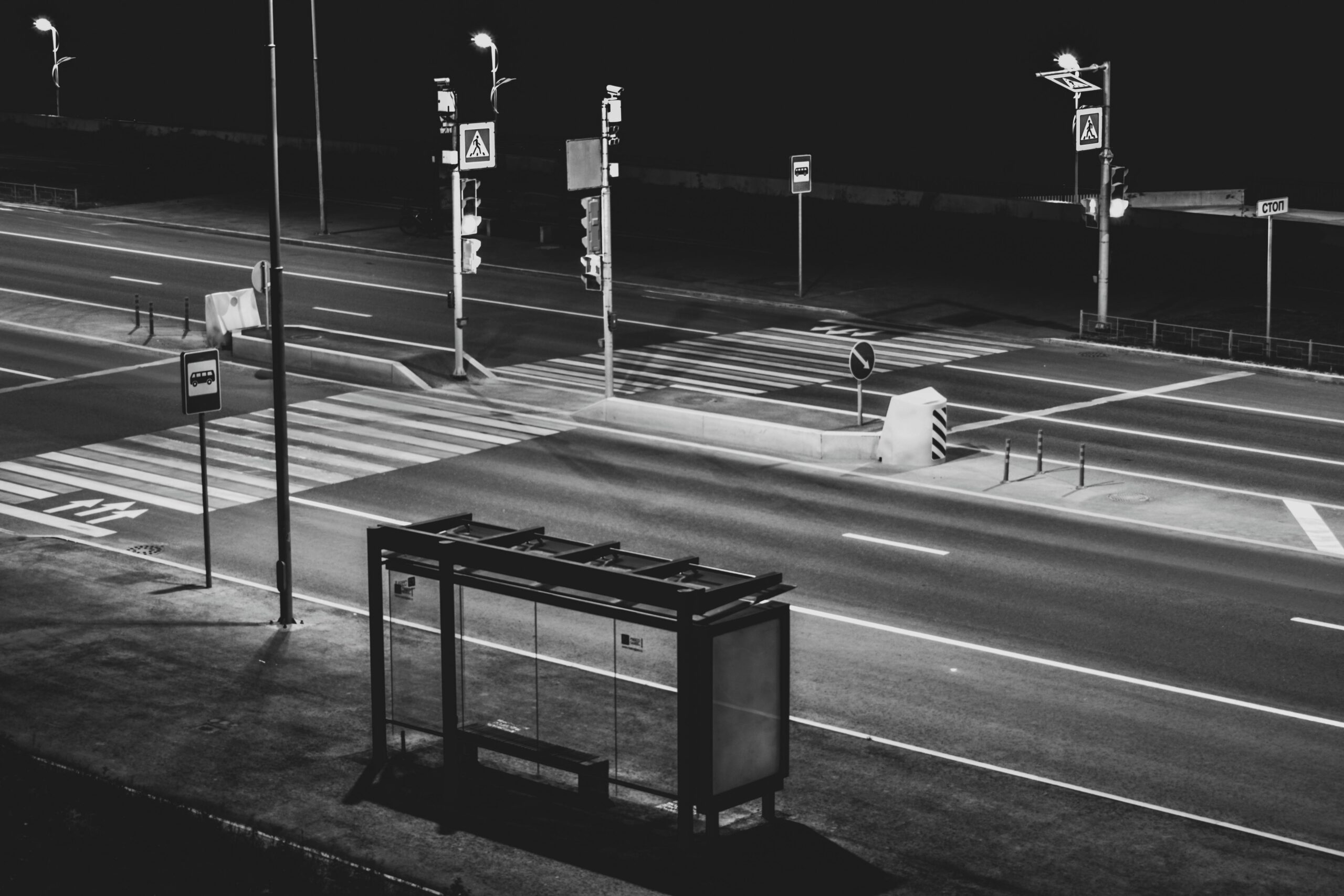
Slate eyes, drawn by compulsion, to a watch, ever ticking. Always somewhere to be, something to be… Flicking deft hands along a tailored suit to sharpen its edges, Scrubbed clear of lint and hidden creases, an inbuilt calculation. A briefcase, attached to the second wrist of a creature drawn in frown lines – The scars of corporate resolve, weighing stronger… As the bus is delayed even longer.
He settles his pride for a haggard bench, wiping the perch with a sleeve, With never a glance, never consideration of the slum that shelters him – Of grinding advertisements, stuttering wantonly, Advising the masses to do this, buy that, go there, The billboards of budget-seekers; Of cigarette butts and whippet canisters; Of youths, uncouth, ill-advised, impoverished and yearning for a guiding hand, Met only with indifference; Of stains and panes marked with cracks, once pristine; Of green seats and blue backs of fading plastic, Broadly moulded by the public’s weight; Of simple shelters, repeating endlessly, Metal checkpoints in fleeting motion, a flame to the moth of civilisation, So routine, they’re barely perceptible… He’s blind to many things when the delay becomes unacceptable.
It is when the day sequesters and musings catch their final trains, When streetlamps give birth to gnats and midges and mayflies in the rain, That his bench becomes a resting ground – The morning dirt reformed with grimy duvet covers and cardboard sheeting, Arranged with minimal prominence, as if by some grand design, For privacy is a rare and coveted luxury. And under these blankets slides a person, As broken ankles and stinking soles, the totems of wandering, find respite. A complex life, enshrined by cold, Convulsing to gain purchase amidst the fraying seams of restful immersion, Before the buses renew their mindless excursion.
Days tick along but traces remain of diminished and fleeting souls, Seeking solace and restoration. A considered sniff may reveal the cloying reek of negligence: Trash and refuse left alone to seep into cracks and gutters. Or, perhaps, a glance around could widen a man’s perspective: The rhythms, though vast in frequency, Vibrating with elasticity. Colliding, bouncing, warping, tumbling in and around each other, Crafting melodies where the mind may be accustomed to white noise. A gardener leaning on a glass panel, blithely counting cars; Two sisters gossiping; their voices are hushed, Spilling secrets and promises before a winding journey home; A pensioner raising his lighter to a blunt and popping chapped lips; A Chevy mounting the kerb, commandeered by four pubescent boys, Throwing crude gestures from the window like bullets in a drive-by shooting; An author stroking his partner’s hair, Trying to conquer his public anxiety and failing; A mannequin of a man narrating loudly over the phone. A collage of existence, interwoven with frustration, As eyes find others, equally confounded as to the bus’ location.
When it finally arrives, he pushes right to the head of the queue, Still in a bustle; it makes no difference. An uncaring flick of his card, a brisk stash of his briefcase, He’s seated, settled; his pride surmounting, Eyes recounting the seconds lost as his fellow passengers shuffle down the aisle – A bunched host of chaotic lives, uneasily connected… As he ponders all the paperwork he’s neglected.
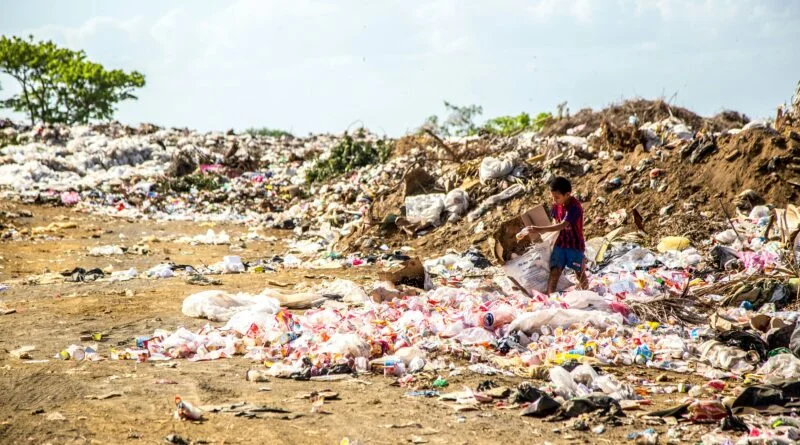
Once I came across a Faisalabad slum, Garbage, mosquitoes, and flies all sum. Residents welcomed, inviting me to come, I hesitated, reluctant to sit, Forgetting it’s my own garbage, thrown in a pit.
A dirty hand offered a handshake, While a clean hand took a break. The sun blazed down like a raging fire, Amplifying my thirst, igniting desire.
A dirty glass offered me cool water, Making my ego face a slaughter. I felt ashamed a bit, Dug in the same garbage pit. Realized under the same sky, We all share the same night.
I learned that day, behind a slum, It’s me standing like scum. Once I came across a Faisalabad slum.
(Image courtesy of Photo by Eirene Thoms via Unsplash)
When a foreigner sets foot in the land of Myanmar, one of the questions I’ve heard is “What is the yellow paste on the cheeks of young women?”
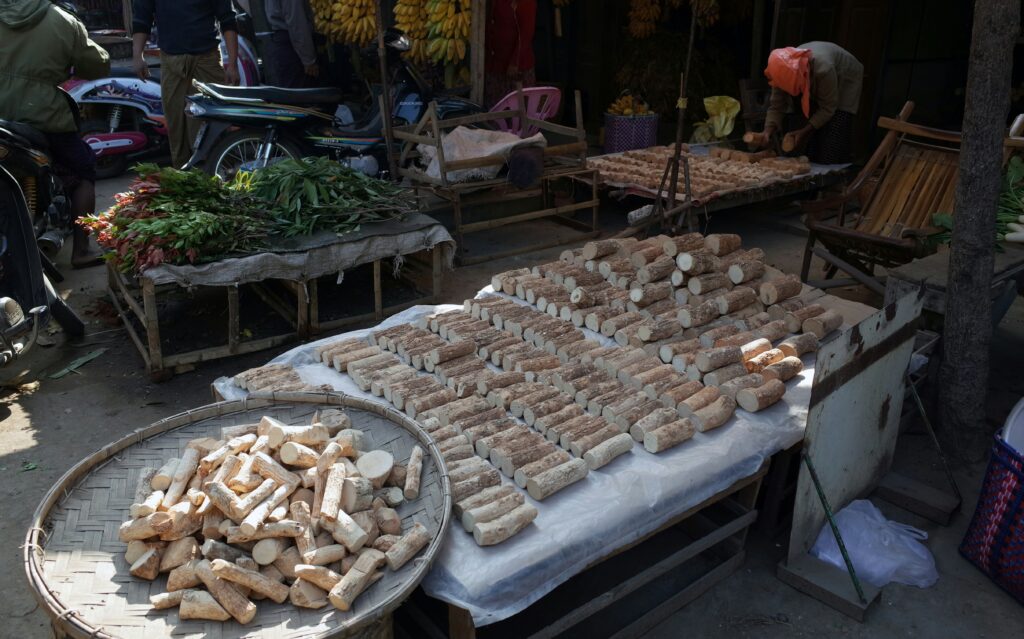
Well, it is “thanaka,” which can only be found in Myanmar.
To kindergarten with thanaka on my face
The first time I wore thanaka on my cheeks was when I went to kindergarten. It was actually one of my earliest memories. Back then, I didn’t care if I looked good or bad. I just let my mother do whatever she wanted with my appearance on my first day of school.
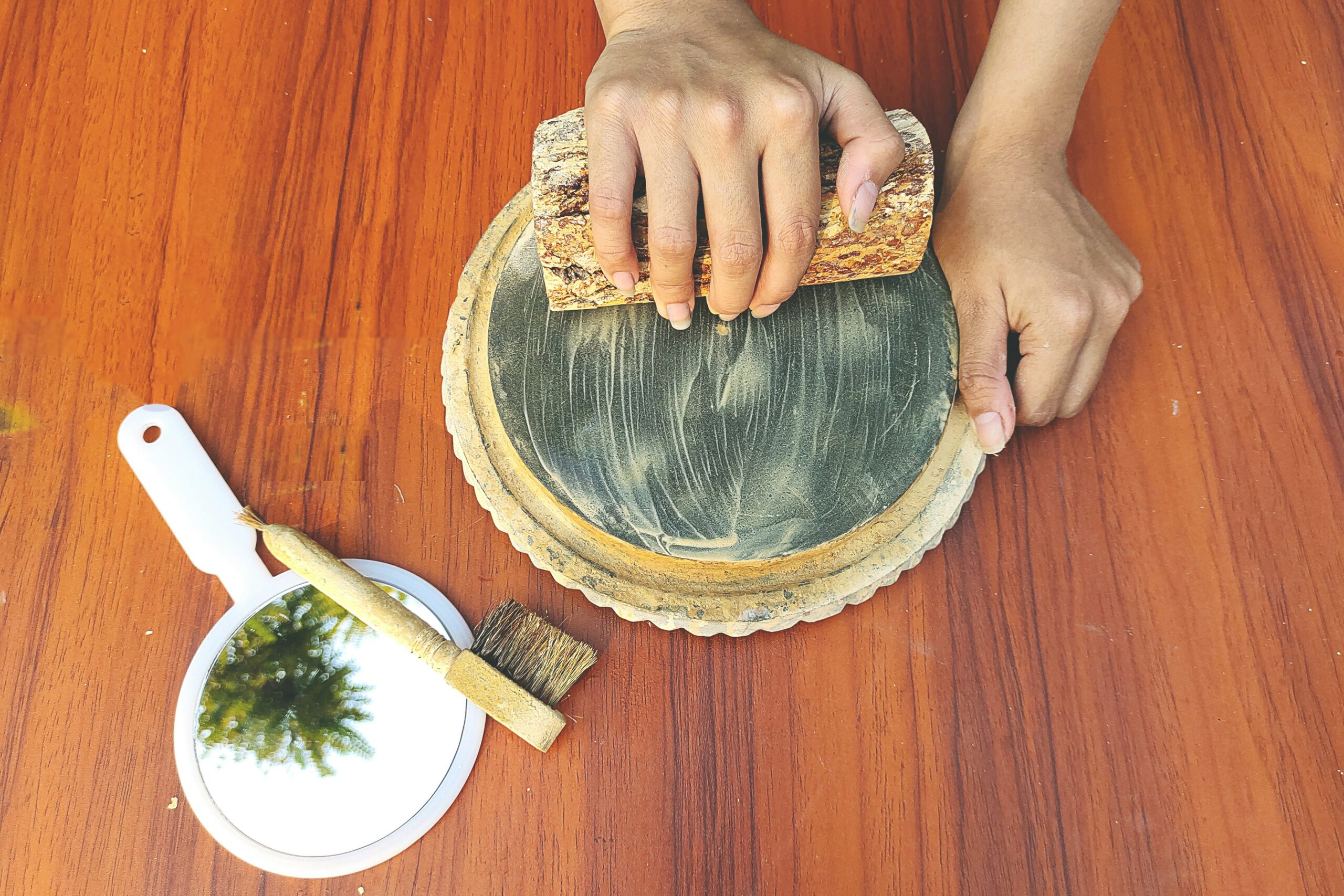
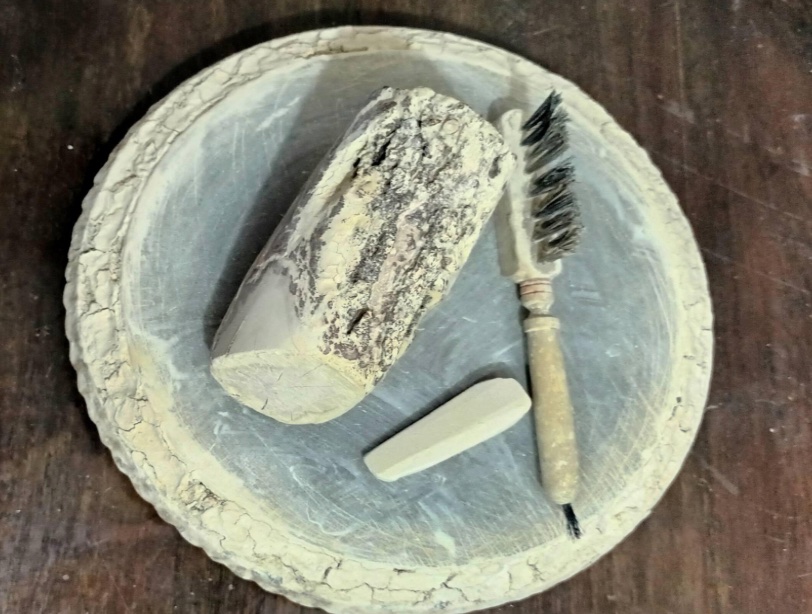
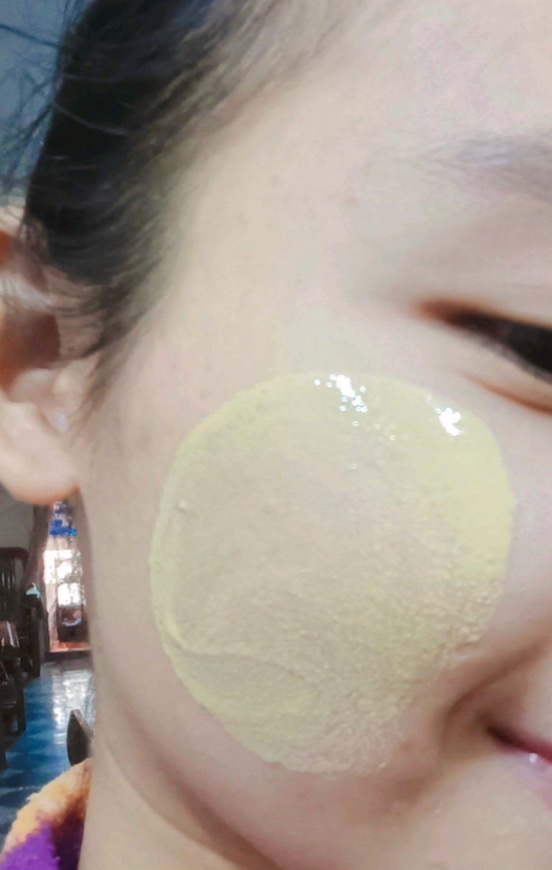
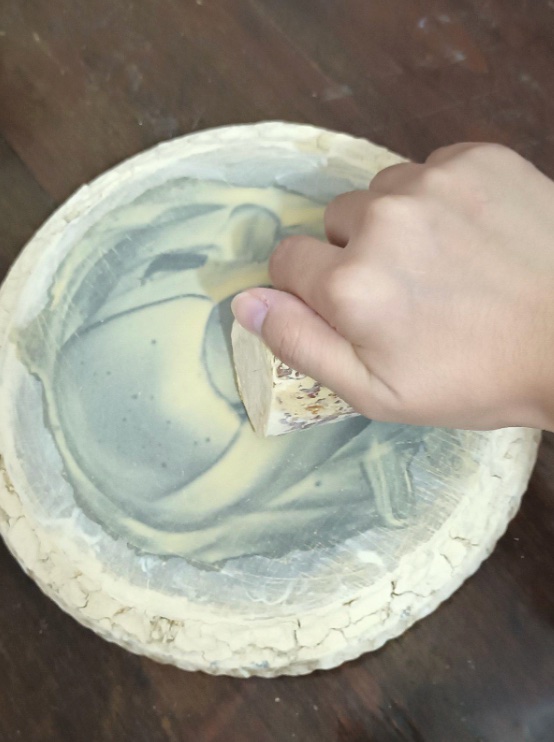
I can vaguely recall some facts, though. I remember how I sat still in front of a large mirror as my mom grinded a piece of tree bark that was bigger than the size of my small arm against a flat, heavy stone that had been wet with water. The magic took place after grinding for about two minutes; pure water was used, but after grinding, there was the yellow paste. Mom rubbed the yellow paste on the flat stone with her hand and put it on my cheeks, drawing oval forms to achieve an egg shape. That was it. There were no complaints from me, and I just happily went to school.
(Image courtesy of Johana Htwe)
Peer pressure raised its ugly head
As I reached puberty, I started caring about how I looked. This means that I applied thanaka by myself and never let my mom help me because I realized how silly I looked when my mom put the yellow paste on my face. It was as if she was using her five fingers to paint an ugly sketch, with my face as a sketch paper. The result was like those markings on a tiger’s face.
During high school, I wore thanaka every day, and so did my peers. I wore a simple shape made using thanaka by putting the yellow paste all over my face and using a brush to draw lines carefully. My friends wore particular shapes such as a rectangle or leaf. The reason I wore thanaka 365 days a year, even when I was sick, was simply because my mom would convince me I needed to.
A Burmese lady must not start her day with a bare face,” she would say. “Thanaka will keep your skin cool and brighten your face. Thanaka is good for your skin health.”
I do believe in these mantras. However, there was a period when I assumed thanaka was so cheap that it was used only by people who were considered poor. Personally, I consider the word “cheap” to mean not being able to blend in with classmates and teachers in this context.
(Image courtesy of Johana Htwe)
On my university campus, a bunch of gorgeous ladies were part of my surroundings. Their beauty was reinforced by international beauty brands. As for me, who grew up with little knowledge of cosmetics from other countries, I felt like I was the least beautiful girl in the university. I can still remember some comments from my friends.
“There is thanaka on your eyebrows,” they’d say in between their laughs.
“Your thanaka looks funny on you,” they’d sometimes say, assuming a serious tone. Still, it was as if they were suppressing their laughter.
“Your thanaka is soaked with sweat.”
“There are only some spots of thanaka on your face and it doesn’t look good.”
“Thanaka is so cheap.”
“I’m too lazy to do the grinding part.”
I didn’t defend myself back then. I thought maybe they were right.
So I changed my style. I began to use foundation, blushes, and lipsticks that were recommended by my friends. I couldn’t pronounce the brand names, but they were probably made in Korea and Thailand. I spent my monthly pocket money on them instead of enjoying my favorite pork stick in Tutt-pi restaurant.
I thought my appearance changed for the better with the help of these cosmetics. I told myself that even if I didn’t attract the attention of boys, if I looked good in the eyes of female classmates, I would at least not be judged. That was until one moment when I looked at myself in the mirror one afternoon.
Using international beauty products, though expensive and made of rare ingredients, didn’t turn out well for me in the long run. I looked good with makeup in the morning but not in the afternoon and evening; I usually got soaked with too much sweat. Myanmar has very hot weather and the heat is especially unbearable in the afternoons. As a result, my face would get oily at noon and my skin wouldn’t react well to chemical ingredients.
At the end of the day, pimples and acne appeared on my forehead, cheeks, and even around my neck. I covered them by wearing an even thicker foundation and more makeup. No matter how hard I tried, the result was that the more I wore, the more pimples and acne appeared on my face. In the end, I had no option but to stop using makeup.
Welcoming thanaka back into my life
Although I stopped using foundation and other makeup, I began to use thanaka again since I was not comfortable with a bare face. That was also due to my mom’s nagging about how thanaka could heal those pimples. She had no proof, of course. It was just the power of a mother that convinced me. If I were to become the president of a thanaka company, I would give the lead position of marketing department director to my mom! She was that good.
In this case, my mom was right. After using thanaka, the result was quite impressive.
(Image courtesy of Johana Htwe)
Thanaka kept my skin cool when the weather was too hot, so I didn’t feel the burning heat under my skin like I did with makeup. That might be because thanaka is made using water and the bark of a thanaka tree, which has to be nurtured for more than 30 years. The naturalness must have protected my skin from the extreme heat.
Also, whenever I sweat a lot, I would rinse thanaka off using water only. There was no need for a cleansing chemical liquid. This means there was no chemical reaction and thus, no more new acne. It took some time for the acne to disappear. As far as I remember, my remedy for acne is to forget about it, stay happy and healthy, never ever let myself be sleep deprived, and last but not least, to sleep wearing thanaka. It’s like wearing a Korean face mask.
Of course, even without acne, my face still has some oily pimples. I think it is just a hormonal matter and totally natural. To me, it is better to live naturally than to choose products containing synthetic chemicals to conceal whatever people think is ugly. After all, there are always side effects and most of the time, it is not worth spending heavily on chemical products.
Thanaka is a Myanmar tradition
Myanmar is a country with a hot and arid climate. That’s the reason why thanaka is still popular here. Thanaka protects the skin from the burning sunlight. To be frank, whenever I see a girl wearing thick makeup in very hot local weather, I just want to say, “Stop using makeup all the time. International brands are produced according to the standards of the host country. In the worst-case scenario, you could face an outbreak of acne because of chemical ingredients when you use those products in Myanmar. Besides, they might not protect you from sunlight, causing your skin to turn a sunburned shade due to damaging UV rays.”
In Western countries, sunburned, tanned skin is often considered beautiful. But in Myanmar, most young people, both girls and boys, want to have a fair and pale complexion. That is why most Burmese girls, many of my friends among them, are turning their attention to whitening creams when they reach adulthood. They think that the thanaka that they used to wear will no longer help them stand out.
(Image courtesy of Kentaro Komada via Unsplash)
There is also another reason why some Burmese women, especially young girls, are not interested in thanaka as much as before. It is the attitude that “only peasants wear thanaka.”
Even in my family, my sister always complains that only street vendors and working class people wear thanaka. The way she and my friends say that as if they are better than people from working society has always angered me. In fact, thanaka is Myanmar’s unique, traditional product that has existed for a long time, no matter who wears it or how much it costs. It is a shame that my sister and my friends, who were born and raised in Myanmar, somehow use thanaka to discriminate against people rather than seeing it as something to be proud of.
According to my mom, the makeup trend had already invaded Myanmar in her youth. These days, not only women, but also men and children wear thanaka.
On the streets of Myanmar, it is quite common to see children, regardless of their gender, wearing thanaka in various shapes, mostly with the yellow paste on the forehead, nose, and both cheeks whenever they go to school. Young men seldom wear thanaka, but I must say I always smile since I find a man cute and friendly when I see thanaka on his face. It is as if a man with thanaka is honest, kind, and generous, which I bet are the qualities of an ideal man for the majority of girls.
As for young women, they are quite careful when drawing shapes with thanaka on their faces, so as not to look funny. Being able to create beautiful thanaka shapes equally on both cheeks is a talent, and that talent can even make a village girl elegant, and full of pride and charm.
If one visits Burmese villages, it is even easier to see thanaka. For village people, thanaka is their sole daily beauty product. Besides, makeup is not the best choice for those who work under the sun from morning until night, looking after their crops, animals, and farms. Thanaka is the only natural product that can protect them from burning sunlight.
In my opinion, it is quite unacceptable to price what others consider precious according to their personal preference. My opinion is always diametrically opposed to that of girls who only think that a set of cosmetics can make them elegant and fit into the crowd, thus looking down on others who don’t do so.
I know that the beauty of a woman can be highlighted by using some makeup tools, but I also want to say that the sight of a village girl wearing thanaka while farming can be equally as eye-catching and convey the sense of true beauty.
In a nutshell, thanaka is for everyone and can be found anywhere in Myanmar. I want to say that I feel happy seeing a person wearing thanaka proudly without a care. I can sense innocence, a humble mind, and a particular connection with them.
As long as I live in Myanmar, I don’t think I will ever lose my love for thanaka. In the morning, I start my day after applying thanaka on my face, arms, and legs. Before I go to bed, I do the same.
Although I don’t want to admit it, I don’t have a talent for creating amazingly symmetrical thanaka shapes most of the time. Nevertheless, the shapes are not important. To me, the feeling of its cool texture and the many skin benefits that I get from thanaka are qualities that are too precious to convince me to replace it with international brands.
Like any other orphan, Tobias was curious about so many things. When he was younger, he wanted to know who his real parents were and why they had abandoned him. As he got older, he wanted to know what it was like to be outside the walls that surrounded the orphanage, or what it was like to attend a big school, or join a basketball team, or go to a mall, or own a mobile phone or fall in love.
Growing up in the orphanage together with thirty other children was not easy. Being the eldest at 16, he was put in charge of doing the household chores and served as an errand boy to the cook, whom he described as a very mean old lady with a poisonous tongue. He swore he could have died a hundred times already because of the many demeaning and hurtful words she hurled at him.
When he got the chance, he ran away, convinced he could survive the streets like his older roommates. “The unsheltered world is the real world,” they claimed. And so he followed suit. In his mind, he also wanted to prove to the nuns that he was old enough to look after himself. Besides, he was trying to find out the answers to the many questions in his head.
Convinced that the nuns would be relieved to have one less mouth to feed, and thus save the congregation a few hundred pesos, he took off when the guard was off duty. He went out the back door and climbed the barbed fence. Oh, how many cuts he suffered! He took two shirts, one pair of shorts, a bath soap, and a torn but clean blanket he found hanging on the clothesline near the backyard fence. He had less than a hundred pesos in coins, which he earned singing carols around the neighborhood the previous Christmas.
During his first day on the streets, he enjoyed his newfound freedom a lot — no curfews, no prayer time and, most of all, no house chores. How he hated running errands for the cook or cleaning the orphanage’s stained floors, which never looked clean no matter how hard he scrubbed.
He looked up and saw the immense sky above him, like a new universe has suddenly cracked open and welcomed him into its endless abode.
Roaming the city park, he joined the countless mendicants pleading and tugging at any person’s soft spot for any left-over food or coins. Come sundown, he found a suitable place to spread his blanket, a spot hidden from the public eye, uninhabited and most of all free from the stench of urine. On his first night he cried, feeling more abandoned than ever before. He managed to control his whimpering, clutching a cross pendant hanging from a black string around his neck.
The days that followed were characterized by hunger, heat, loneliness and destitution. His coins were gone. And people strolling in the park wanted to keep theirs. He suddenly longed to be sheltered. He wanted the feel of a clean shirt against his back. The stench of poverty appalled him, adding to the restless stabbing pain of a hungry stomach.
As days passed, watching other vagabonds do their rounds, he learned to wash himself in public toilets when the caretaker went on a break. He also sourced food from
families on picnics or couples on dates, and even ate leftovers from the trash. But the food — although clean — had a wasted quality, a hint of decay, unseen but grimly felt. Soon he grew weary; he wanted something freshly cooked. At night, he began dreaming of hot soups in a warm kitchen at the orphanage. He would wake up clawing the air, a growl of hunger echoing from his gut.
After several more days in the park, he made friends with other street urchins who talked about how pickpocketing could bring in more moolah than begging. One single wallet could yield several hundred pesos—equivalent to a week’s supply of decent food. A handbag could yield perhaps thousands of pesos since its contents could easily be sold to anyone for easy cash.
He wasn’t too keen on robbing people after all, so he walked away from the group, clutching his abdomen as if to silence the perennial rumblings. He was so hungry he wanted to sit down on the ground and maybe taste a few blades of grass when no one was looking. Even the water in the park’s pond looked inviting. “Anything, just grab anything worth ingesting,” his innards seemed to be saying.
It was high noon. The sun was shining overhead. He felt his head pulsating from the heat, making him feel hungrier than ever. A spell of dizziness made him rest under a tree. Its leaves made him think of boiled kamote tops the cook used to serve in soy sauce and lime. The brown trunk reminded him of grilled eggplants dipped in egg and fried to a deep delicious brown. His stomach gave another growl.
Looking around, he saw a middle-aged man sitting beside a young girl. The girl looked disheveled, her dress stained. Her face lit up when the man handed her a glass and told her to drink.
Tobias thought he could easily grab the glass from her to ease his hunger. But he stayed, watching her small frame almost quivering with delight. With great envy, he wondered what the glass contained: Was it fruit juice? Was it cola? Iced tea perhaps? His stomach gave another growl. This time, it came with a painful jab like a dagger driven into his belly.
Unconsciously, his hand reached to his cross pendant and clutched it. But his grip was without strength. He closed his eyes and began to rock himself to and fro, chanting a short prayer he learned from the nuns. Soon, he felt calm. The pain momentarily subsided.
Opening his eyes, he saw the man clutching the girl’s arm, bidding her to go with him.
“Let’s walk a little bit up to the street corner,” the man said.
“I have to go home,” the young girl pleaded.
“I’ll give you money later. Come on. It won’t take long,” he insisted.
Tobias knew something was amiss. She was being forced to do something against her will.
“Don’t be stubborn,” growled the man, as he tugged on the helpless girl.
Tobias sprang to his feet but his knees wobbled. His stomach gave another growl. It wasn’t the best time to meddle in other people’s business.
“Hey, don’t force her if she doesn’t want to go with you,” he finally managed.
“Don’t meddle, boy, or you might get hurt,” the man replied.
Tobias demanded the man release her. In a flash, two other men emerged out of nowhere. They took turns beating and clobbering him to a pulp. Tobias was not even able to return a punch.
The girl screamed, “Please stop! Leave him alone!” but was quickly silenced, her mouth tightly shut by the man’s hand.
Tobias was badly bruised, his face bleeding, his arms covered in cuts.
Suddenly, thinking of her own survival, the young girl bit her captor’s arm, making him loosen his grip. She ran off quickly, leaving her slippers behind. She ran and ran, away from the bad men, trying not to look back at the young boy who tried to help her.
Her captor screamed at his two companions.
The two men left Tobias and ran after the girl like bloodhounds.
Tobias lay on the ground, his eyes puffed and half-closed. His nose broken, his lip bleeding profusely, blood spilling into his mouth, staining his teeth red.
Dusk had fallen and the horizon was now colored purple, fading into orange and blue. Tobias was amused at the thought that even the sky was bleeding, sympathizing with his fate. He tried to sit but his whole body trembled with the effort. He winced at the pain.
“Help!” he gasped.
No one seemed to be around. He struggled to stand up but fell right back down.
He thought of the orphanage, the young children who ran around not caring about their future, the cook who always gave him errands and the soft-spoken nuns who taught him how to pray.
He lay on his back, facing the sky. He felt sad, wishing he hadn’t left the orphanage. He murmured a prayer. He felt sorry for all the bad things he did. He also said a prayer for the young girl and hoped she was able to escape her attackers.
(Image courtesy of Alexes Gerard via Unsplash)
Then he felt a strong grip on his shoulder, someone lifting him up. He heard a man’s whisper, “It’s going to be okay. I got you.”
Tobias woke up in a hospital room. A kind nurse making the rounds smiled at him and asked how he was feeling.
He tried to smile back, but gave a wince instead, realizing that the slightest movement caused a shot of pain. He was badly bruised all over. He fell asleep once more.
The second time he woke up, he saw a nun beside his bed. It was sister Consolacion from the orphanage.
“Tobias, we are so glad you are getting better. Get some more rest and soon we will be going home.”
Tobias felt guilty for leaving the orphanage and getting into trouble. He later learned that the girl he had tried to save called for help and the park’s security guard heard her. After calling the police and the child welfare department, they were able to contact the orphanage and confirm Tobias’ identity.
A local news reporter got hold of the story from the police station and went to see Tobias for an interview. Shortly, he was on TV, the face of a hero who got mauled for standing up to defend a young girl.
Soon, flowers and gifts began to arrive at the hospital — sent by people who saw the feature on TV and who wanted to express their thanks and admiration for him.
Tobias was pleasantly surprised. For the first time in his life, he had received not just one gift — from the congregation on the day of his birthday—but hundreds, filling up the entire room. There were shoes, shirts, towels, blankets, candy, chocolates, balloons, toys and other wonderful treats from well-wishers.
“What would you like to convey to your fans, Tobias?” asked a reporter in a live interview.
“I am thankful for everything they sent me, from the grandest gift to the simplest, hand-written card. I may be an orphan but I know I am loved. I am just a simple boy who tried to help another person. I guess God needed me to be there in that exact spot when the trouble happened. I guess no matter how difficult our situation may be, God put us there because that’s where we need to be.”
When Tobias got well enough to go back to the orphanage, he received a hero’s welcome. He hadn’t grasped how overjoyed he would be to be back among the other children, the nuns, and even the cook whom he used to loathe. The gifts he received at the hospital, he joyfully shared with others. There were shrieks of delight everywhere: smaller children enjoyed eating the chocolates and candies, and the older ones took turns playing video games.
That night, as he lay in bed, looking at the stained ceiling of the dormitory that he shared with 30 others, he said a prayer of thanks.