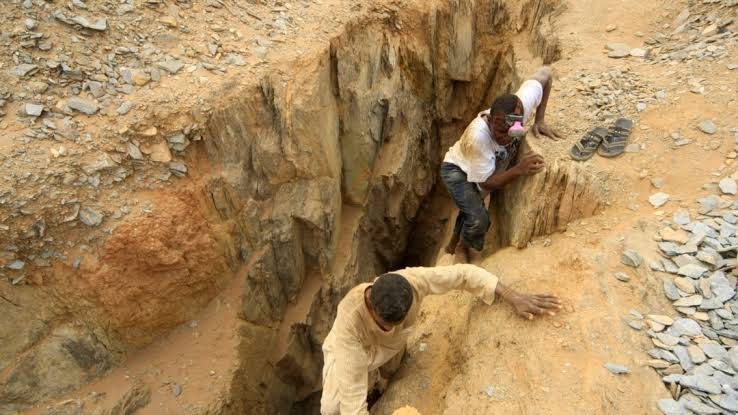
Eleven artisanal miners have died and seven more injured after the Kirsh al-Fil gold mine collapsed in eastern Sudan’s Red Sea State. The site had been previously shut by authorities due to safety concerns but was reopened unofficially as desperate miners sought gold in a region gripped by conflict and poverty.
The tragedy highlights Sudan’s growing war economy. Since civil war broke out in April 2023 between the Sudanese Armed Forces (SAF) and the Rapid Support Forces (RSF), gold has become both a lifeline and a weapon. In 2024, Sudan produced 73.8 tonnes of gold—85% from unregulated artisanal sites. Much of it flows into Chad, Egypt and South Sudan before reaching the United Arab Emirates (UAE), Sudan’s main trade partner.
Sudan has accused the UAE of aiding genocide, a case now before the International Court of Justice. While the UAE denies arming the RSF, gold shipments continue.
“Mineral supply without governance can create a shadow economy that finances conflict,” said Dr. Saleem H. Ali, a professor at the University of Delaware. “But with proper governance, these minerals can become tools for poverty alleviation and peace.”
In South Africa, Clement Moeletsi, also an illegal miner, says he knows this ordeal all too well. On July 24, 2024, he and fellow miners from Zimbabwe, Botswana, Lesotho, Mozambique, and South Africa entered abandoned shafts in search of gold. “The reality was brutal: chest ailments, starvation, and constant exposure to life-threatening hazards were the norm for us,” he said.
But, like many, he felt he had no choice. “We had to put bread on the table for our families.”
Environmental concerns are also mounting. Geoscientist Professor Paida Mhangara warned of long-term ecological damage and loss of cultural heritage: “Unregulated mining destroys vegetation, pollutes rivers and erases archaeological sites.”
As Sudan’s war enters a third year, the mine collapse is a stark reminder that in this conflict, gold costs more than money—it costs lives.
A Federal High Court in Abuja, the capital of Nigeria, has ruled in favor of a senator representing Kogi Central, Natasha Akpoti-Uduaghan, who was suspended by the Senate for six months over alleged misconduct.
Justice Binta Nyako, who led the court sitting on Friday, July 4th, 2025, delivered the judgment stating that the suspension of the senator was ‘excessive.’
The judge added that because lawmakers are expected to sit for 181 days in a legislative session, the six-month suspension would hinder the Senator’s ability to carry out her legislative mandate thereby denying her constituents the right to representation.
Reacting to the favorable judgment, the Senator told supporters, “I thank you for your support. I am glad we are victorious today. We shall resume in the Senate on Tuesday, by the grace of God.”
It can be recalled that Senator Natasha was suspended by the Senate Committee on Ethics after she brought forward a series of allegations against the Senate President, Godswill Akpabio
Senate President, Senator Godswill Akapbio (Photo by Vanguard)
The exchange between Senator Natasha and Senator Akpabio began after an argument about a reshufflement in sitting arrangement ensued between her and the Senate President.
The senator claimed that the new sitting arrangement put her in a dead zone where her legislative activities wouldn’t be captured by cameras. This she insisted, was an attempt by the Senate President to silence her.
The chairman of the Senate Committee on Ethics, Neda Imasuen rebuffed Senator Natasha’s claims stating that she wasn’t the only one whose position was changed and, “About four or five other senators were moved.”
Analyzing the issue, a Legislative Governance expert, Chibuzo Okereke explained, “She belongs to the minority caucus. They sit on the left side of the presiding officer by the tail of the maze…these things have significance because they are symbolism.”
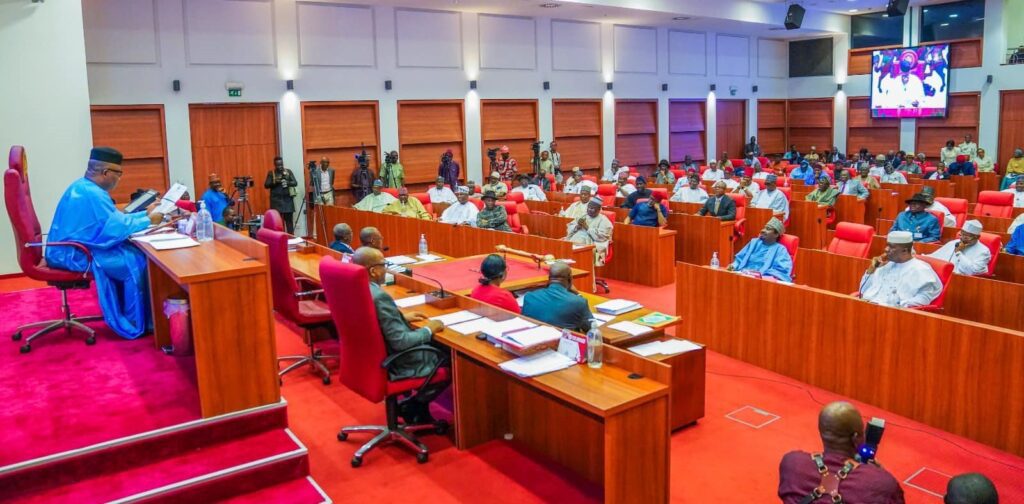
The Nigerian Senate (Photo by Nigerian Senate Via Facebook)
Following the reshuffling disagreement, Senator Natasha presented a petition against the Senate President to the Senate. She accused him of sexual harassment, abuse of office, and malicious obstruction of her legislative functions.
Responding to the claims during the Senate gathering, the Senate President said, “I have the highest regard for women…so at no time will I ever harass any woman.”
Although Senator Natasha’s petition was initially rejected by the Senate, it was later approved and a decision was made by the Committee on Ethics on March 25th, 2025, to suspend the Senator for six months. The body insisted that her actions brought dishonor to the Senate and its leader.
The suspension was accompanied by other strict conditions, such as stripping the Senator of her security detail, cutting off her salary, restricting her visit to the National Assembly, and prohibiting her from introducing herself as a Senator
A lawyer, Chinenye Uwanaka, condemned the situation, saying, “Looking at what has played out in the National Assembly, honestly speaking, it doesn’t look like a place that is welcoming for women.”
She continued, “We even have case law in Dume and Omo Agege…the Supreme Court held that those suspensions were not constitutional because it’s supposed to be a maximum of 14 days.”
As the court has reviewed the case and come to a consensus that this suspension was ‘overreaching,’ Senator Natasha has begun making preparations to resume her legislative duties.
Her resumption is, however, still dependent on the Senate’s examination and verification of the Certificate of True Copy (CTC) of the judgment. In a statement on 6th July 2025, the spokesperson for the Senate, Senator Yemi Adaramodu, said, “Pending the receipt and examination of the CTC, and acting on the advice of counsel, the Senate shall refrain from taking any steps that may prejudice its legal position.”
In a separate ruling, Senator Natasha was fined 5 million naira by the same judge after she posted a satirical apology to the Senate President on Facebook, disobeying the gag order that restrained all parties from commenting on the case.
I got the rarest of opportunities. Something of a fly on the wall in the most delicate of environments. As a kind of underling of a therapy team, an intern in a rehab is a unique kind of nothing; a cipher of experience, neither staff nor patient. Witness to anything with hardly any agency at all. “Inmate or Guard?”I was once asked by someone easing into their long-term stay. In truth, I wasn’t either. I’d find myself continually second-guessing the sense of service in my role.
One of the organic joys was watching communities form. Total strangers with their poison taken from them, being asked to come together. There is absolutely nothing more harmful to a recovery than isolation. The two pillars upholding any active addiction are isolation and shame. One tends to feed the other in a vicious cycle. Getting to witness people historically riddled with these but now seen and heard, finding a sense of togetherness. was a genuine privilege. Being a trusted presence, fostering a sense of safety where this could happen, was hugely validating.
Yet there was always push and pull. Wanting the best for people and to see their growth could be a difficult thing to regulate. Being the guardrails and not anything more could be a difficult post. So much could be on the line for those giving their stay at the rehab the most long-lasting value. People, who over time and conversations, would come to reveal all that was glowing and admirable in them. Witnessing exactly how communities would form and bond could also be uneasy. What was camaraderie and what was corrosive? What was the place of gallows humor and a visible sense of mischief in an environment designed to bring people to reality?
Nevertheless, reality would arrive to puncture any floating above it all or skirting round the edges.
Between process groups, therapy sessions and psycho-educational workshops, reality was coming after them day after day. In most cases I would witness, seldom would anybody leave without a sense that they had a problem of greater scale than they’d previously wanted to believe. Those staying had very real circumstances, phone calls could be worth the world, residents had families hanging in the balance.
Bruised and wounded
One of the several psychological interventions offered in the program was a “collateral letter”. The letter was to be read to a person staying at the rehab during a process group and it was to be written by their closest ones back home. Designed to be a confrontation with reality, not a lambasting or shaming. More a form of inventory of how much harm has been caused to those who mean the most.
One Monday, to a vibrant community of incredible lived stories and contagious characters, a collateral letter opened their week. It was thunderously powerful. The words written and read were searingly heartfelt. They were words laden with love, but a bruised and wounded one. The message was clear as day. The person the letter was written for was dearly loved, with children, a wife, a family to hold on to. This individual meant everything, but if they couldn’t leave alcohol behind, the mother of their children would have no choice but to protect the family and leave them behind.
The therapist sitting next to me was clearly moved. Breaths so deep I could’ve credited them to Tony Soprano. I was far from immune, sitting on a bubbling well of emotion that I needed to keep buttoned down for propriety. The person reading the letter was moved to tears and rightly so, she would lead the feedback as well. What she was reading mirrored her own circumstances, she’d spent the last couple of weeks clinging to phone calls on the present danger she could lose her own family. She would be seconded in the feedback. Another individual in the exact same present danger; grasp recovery or risk losing your closest. Soulful and robust, they underscored the gravity of matters to him: get a hold of yourself, get on with your recovery, words aren’t words alone, this is reality.
It was as if just for that 20-minute spell, somebody stopped the clocks. Time paused, reality was here and nothing else mattered. An individual was being handed truth in a form they’d never have again. A phosphorous, molten truth of priceless value. Where else could something with such honesty be handled with such care?
On that Monday, I felt an immense sense of service. To be sure, I was just a small cog in a much greater machine, but that Monday I walked out feeling a part of something profoundly valuable.
Monday and Friday
The main thing that the therapy team hammered into interns and Healthcare Assistants was boundaries and just how important they are. Maybe I didn’t get that down, maybe I had a degree of personal investment in outcomes I could have handled better. There is always a danger in emotional resonance with matters one can’t control. When I came back that Friday, there was a different feeling around the place. The air was thick and stilted, something was off. Just four days on, from one of their several random drug tests, someone in the community tested positive for cocaine.
The message from the therapy team was clear: when there’s using, there’s no growing. The healing back to square one, the value lost, the formidable message of Monday nowhere to be found. “The Community is Unwell”. I was gut-punched. The intervention couldn’t have been any more potent, the stakes any higher, yet mere days later we were staring down the barrel of families left in tatters. Addiction blindly bulldozing reality.
It would be the longest day I’d spend interning at that rehab. It didn’t belong to me. It really wasn’t my hurt but I couldn’t deny the sting of it. I was left with a painful doubt — what use did this work have to these people? What was my service?
In Nigeria, everything is about the hustle and bustle; everybody here is always working to outdo one another. Some people say it’s healthy competition and helps bring out the best in us. I wake up as a typical Nigerian man with a mindset of what I should do, how I can make my next buck, how I can continue hustling. Based on statistics, it is said that the average Nigerian has about two skills up their sleeves. We are known to strive for the best wherever we find ourselves.
I am a fashion designer, a data analyst, an administrative virtual assistant, and a shop owner, which sounds like a lot — it is! But it is the norm for me and for many others in my community. In a country where opportunities can be scarce and the cost of living continues to rise, multitasking isn’t just a skill — it’s a necessity. Every day feels like a race against time, with little room to pause or breathe.
Rest? That’s often seen as a luxury taken up by the lazy or unambitious.
A change in perspective
But lately, I’ve started to question this narrative. What if rest isn’t laziness? What if it’s not an obstacle to success but rather a catalyst for it? The idea struck me one evening after days of non-stop work. My body was exhausted, my mind foggy, and yet I pushed through, determined to check off every item on my endless to-do list. It hit me then: I wasn’t thriving; I was surviving. And there’s a big difference between the two.
Rest, I realized, is more than just sleep or taking breaks. It’s about reclaiming your energy, refocusing your priorities, and honoring your humanity. In a society that glorifies “hustle culture,” choosing to rest feels almost revolutionary. It challenges the notion that our worth is tied solely to productivity. For someone like me — juggling multiple roles and responsibilities — it felt especially radical to even consider stepping back.
So, I decided to experiment. Instead of waking up at 5:00 AM to dive straight into work, I allowed myself an extra hour to meditate and to plan my day intentionally. During some evenings, instead of working late into the night, I turned off my laptop and spent quality time with family or indulged in hobbies that brought me joy. At first, guilt crept in. “Am I falling behind?” I wondered. But over time, something incredible happened — I became more efficient, creative, and present in everything I did.
Taking moments to rest didn’t slow me down; it propelled me forward. As a fashion designer, I found fresh inspiration flowing effortlessly. As a data analyst, I approached problems with sharper focus. Even managing my shop felt less overwhelming because I wasn’t running on empty. Rest gave me clarity — the kind you can’t achieve when you’re constantly chasing the next task.
Pushback from society and the self
Of course, embracing rest hasn’t been easy. Society frowns upon stillness. Friends and colleagues often ask, “Why are you relaxing when you could be doing more?” But I’ve come to understand that rest isn’t idleness — it’s strategy. It’s about recharging so you can show up fully in all aspects of life.
(Image courtesy of Miguel Carraça via Unsplash)
In Nigeria, where resilience is celebrated and hard work is ingrained in our DNA, resting may seem counterintuitive. Yet, that is precisely why it matters. By prioritizing rest, we challenge outdated norms and redefine what success really means. Success isn’t just about how much we achieve; it’s also about how well we live while achieving it.
And since allowing myself to rest a little bit, I think I’m living more well than I was before.
Rest is not surrender. It’s resistance — a radical act of self-respect and empowerment. You don’t have to burn out to prove your worth. Sometimes, you need to give yourself permission to simply be.
I celebrated my 30th birthday at a meditation retreat in Rishikesh, India – in the foothills of the Himalayas. As I finished my last evening meal at the ashram, an iridescent birthday cake arrived for me on a motorcycle. In one of life’s more surreal moments, a disparate group of travellers, yogis and mystics sang ‘Happy Birthday’ while I blew out the candles.
For creative types, turning 30 seems to be some sort of ‘watershed moment’. Almost everyone I admire creatively has produced what history records as their ‘best’ work in their Twenties. As I approached my watershed, I was prepared to be ostracised from my own artistic circles because of it. Even though, in 2025, house prices, living costs and life expectancies mean that the Millennials are living in a decade-deficit to the milestones of our elders, turning 30 is still where it all ends.
…but I’d only seemed to hit my groove at around 25 and to be allowed just 5 years to nurture it felt like being short-changed.
My colleagues treated the Big-Three-Oh as a watershed too: to have a mortgage, a fiancée, another rung on the promotional ladder (and salary injection to prove it). Well, I had the mortgage and I had the fiancée but the ladder had revealed itself as a greased pole and the move from paper money to plastic meant that my bonus packet wouldn’t dry it off, no matter how much I threw at the problem.
Telling people at the office that I was going away for my 30th birthday was invariably met with the half-century-ingrained disdain for ‘the Hippie’. The idea that meditation was the answer to anything – this airy-fairy, cult-like pretence – was seen as a pointless pursuit in the face of “The Real World”. If I wanted to be the successful person I was firmly en-route to becoming, then I needed to avoid the poisoned temptation of the Hippie Trail. I might as well have been telling them they needed to “Turn-On, Tune-In and Drop-Out” – the classic Summer Of Love soundbite now used to ridicule the tie-dye, pie-in-the-sky delusions of the ‘Flower Power Generation’.
(Image courtesy RG Visuals of via Unsplash)
I know it would be naïve to proclaim the solution to world peace is free music, daisy chains and communal love, but I’ve always found it bizarre that the psychedelic movement’s core ideas of tolerance, acceptance and understanding are treated as hopeless rose-tinted relics rather than an aspirational blueprint for the future of humanity. As if carrying on with hating, stealing and killing is a more natural status quo. It seems incongruous with the values we’re taught as children – the values we’re supposed to embody as adults if we’re to be good world citizens.
What turns us against humankind’s capacity for kindness to humans?And why are those of us who want to preserve it treated as unrealistic dreamers unfit to participate in adult life? A crusade against these perils of growing-up was as good a reason as any to embark upon a quest for ‘Eastern Answers’. The extreme stress and anxiety I was experiencing at work every day was just a bonus.
I hoped that my entry into the Fourth Decade would open the doors to the Fifth Dimension…
What I did on my holiday
By the way, this isn’t one of those CULTURE-SHOCK pieces where the white, middle-class tourist reports on poverty’s romanticism from the laundered-linens of his 5-star suite. It’s not even an attempt to convey the mystical experiences I witnessed in India – to do so would be futile. If someone had told me that hallucination can be achieved through breathing alone and would cast-off years of hang-ups and self-doubt, without seeing it for myself, I wouldn’t believe it either…
I arrived at the ashram after a morning flight from Delhi. The drive from the airport through increasingly-clean air was a welcome relief that I’d left the madness of Delhi, Agra and Jaipur behind; their city smog replaced with mountain mist. I was about to go completely off-grid.
I was shown into a colourfully-painted office where my expectation to receive a marigold garland and a secret mantra was swiftly shot down when I was asked if I’d paid my balance via bank transfer and was given the Wi-Fi password. How about that for a culture shock? I suppose, for a walking, talking, juxtaposition like me – a corporate lawyer clinging to hippie ideals – it was fitting that these clashing opposites should extend to my search for spirituality.
Of the 19 students at the ashram (from 10 countries and 4 continents), all 19 were Millennials and all 19 worked in corporate settings: a group of generational misfits reaching their watershed moments together.
Were we all looking to ‘drop-out’?
I’d flirted with meditation for years with little success. I thought transcendence was about preventing thought and stopping the brain. My time in Rishikesh – and its daily schedule of yoga, meditation, spiritual teaching and reflection – taught me that it’s actually about tolerating thought and letting it wash over me. By giving myself something simple to return to when a thought enters my mind, I can allow it to leave just as quickly. It’s about accepting that negative influences are a part of modern life and understanding that while we can’t control the negativity of others,we can control how we process it. As my favourite teacher there explained: “we are the ocean, not the waves. Though the waves are part of the ocean, the ocean can never be part of the waves”.
I’ve learned to treat meditation not as some ‘higher consciousness’ but as a practical application which brings clarity of mind. Meditation done right doesn’t stop the brain: it slows it so I can live in the spaces between the thoughts. Like a ceiling fan spinning at full-tilt: you can’t distinguish the individual blades. The human mind is the same.
Any souvenirs?
Looking back, telling my colleagues my reasons for going to India and what I was hoping to bring home with me was probably my way of raising concerns for my wellbeing at work.
The funny thing is that my workplace required anyone going on holiday to check their emails three times a day and so I had to obtain special permission to leave my work phone at home. To me, this was an opportunity for my managers to engage with the concerns of its people and the destructive effects of its working practices on their mental health. Instead, approval was granted because taking my phone to India “posed a national security risk”. An opportunity missed, which I let wash over me like waves in the ocean…
…but India was my decider to quit the corporate sphere: it convinced me to ‘drop-out’. Maybe that means I’ve failed to incorporate meditation as a coping technique for the negativity of modern life. Or, maybe my newfound clarity will enable me to change things for those left behind, even if I’m now on the outside looking in. For anyone in a similar position, I’ll say this: you don’t need to drop-out to turn-on and tune-in, but it might help.
European football season ended with a statement, as Paris Saint-Germain thrashed Inter Milan 5–0. Some would argue a new powerhouse has arrived — ready to dominate the game for years to come.
With the summer transfer window open until September 1, every team is looking to upgrade. Deals are already in motion, and many clubs aren’t wasting time. Let’s take a look at what’s going on:
Premier League
The richest league in the world is no stranger to big spending, and this window has already delivered moves that could change the game.
Fresh off their title win, Liverpool didn’t hesitate. The Reds snapped up right-back Jeremie Frimpong, left-back Milos Kerkez, and creative midfielder Florian Wirtz — the latter arriving for a British record fee. All three are under 25 and expected to start right away. It is a huge boost for new manager Arne Slot, especially after losing club icon Trent Alexander-Arnold in late May.
“Attack wins you games, defense wins you titles” —a line Mikel Arteta has adopted at the start of this window. After finishing runners-up for a third straight season, the Arsenal boss is going all-in. So far, the Gunners have brought in goalkeeper Kepa Arrizabalaga and midfield anchor Martín Zubimendi. Now, all signs point to Cristian Mosquera joining next, after the young centre-back turned down a contract renewal from Valencia.
Meanwhile, the transfer rumor mill is making sound with links to Viktor Gyökeres, Noni Madueke, and Eberechi Eze. The Swedish striker and the two electric wingers could add a whole new dimension to Arsenal’s attack —potentially making this one of their biggest transfer windows ever.
Manchester City, the most dominant English club in recent years, ended this season without silverware. After losing the FA Cup final to Crystal Palace, Pep Guardiola’s side traveled to the United States for the Club World Cup, where fans got their first look at new signings: midfielder Tijjani Reijnders, left-back Rayan Aït-Nouri and the magic midfielder Rayan Cherki. All three slotted in seamlessly —so expect the Cityzens to be serious contenders for the Premier League title once again.
Rayan Cherki grabbed an assist during his cameo against Al Hilal. (via Cherki X account)
Meanwhile, Chelsea is on an upward trajectory. They became the youngest side in Premier League history, with an average age of just 24 years and 36 days. That didn’t stop them from qualifying for the Champions League — their first time back since the new ownership took over — and winning the UEFA Conference League in style with a 4–1 win over Real Betis.
So far, the Blues have signed striker Liam Delap (22), centre-back Mamadou Sarr (19) from Strasbourg and just unveiled Brazilian forward João Pedro (23) earlier today. English winger Jamie Bynoe-Gittens (20) is expected to be next, after reaching an agreement with Borussia Dortmund. Ghanaian playmaker Mohammed Kudus (24) is heavily linked with a move to West London. Chelsea has clearly embraced the youth movement, and it is beginning to pay off.
Elsewhere in Europe
Clubs across the continent are also making big moves, and big statements.
Real Madrid wasted no time in landing long-term target Trent Alexander-Arnold, the most dangerous full-back in world football- on a free transfer. They also brought in Spanish centre-back Dean Huijsen from Bournemouth. But the biggest addition might be on the touchline: Xabi Alonso has taken over as manager, promising a more expansive style than his predecessor, Carlo Ancelotti. Pressure is way bigger in the Spanish capital but anything close to the historic double with Bayer Leverkusen — including an unbeaten Bundesliga title — would be a huge success.
Barcelona also moved quickly, bringing in goalkeeper Joan García (24) from city rivals Espanyol with hopes of locking down the position for the next decade. Veteran Wojciech Szczęsny (35) returned from retirement last season and played a key role in Barca’s run to the Champions League semi finals. A smart long-term plan in motion at Camp Nou.
Joan García was crucial in helping Espanyol avoid relegation (via FC Barcelona site)
Atlético Madrid have no time to regret a disappointing campaign. They’ve added three international players in left-back Matteo Ruggeri, attacking midfielder Álex Baena, and midfield anchor Johnny Cardoso, all 23 or younger —in an effort to inject new life into the squad.
The third giant of Spanish first tier football is also busy. After a disastrous season, Atlético de Madrid wasted no time and secured the services of left-back Matteo Ruggeri (23), advanced midfielder Álex Baena (23) and anchor Johnny Cardoso (23). All three international players, expected to revitalise the squad.
Club World Cup Sensations
Amid the success of the tournament currently being played in the USA, Al Hilal stunned the world by defeating Manchester City against all odds. The Saudi side is the latest to shake up the global football scene. Several players have also stolen the spotlight, potentially earning themselves moves to top European clubs once the competition ends.
It’s safe to say this has been the tournament of Colombian midfielders. Both Richard Ríos (Palmeiras) and Nelson Deossa (Monterrey) have been vital to their teams, electrifying fans every time they touch the ball with their athleticism, technique and reading of the game. Both are also powerful ball-carriers with long-range striking ability. Deossa even scored one of the goals of the tournament in a stunning strike against Urawa Reds.
Both at 25, they’ve drawn serious interest. Ríos —who also was impressive in Copa América last summer— has been on the radar of Inter Milan, Porto and Manchester United. Don’t be surprised if Deossa receives the same level of attention.
Nelson Deossa and Richard Rios have been both magnificent. Colombian stars. (Own edit)
Jhon Arias is the third Colombian lighting up the tournament. The dynamic winger is in the form of his life and was key in Fluminense’s 2–0 win over Inter. A constant threat on either flank, defenders have struggled to contain him. His brilliant free kick against Korean side Ulsan HD was one of the highlights of the group stages round.
Igor Jesus (24) made headlines with his winner against Paris Saint-Germain. Despite Botafogo getting knocked out in the last round, his performances stood out the most. With a unique hold-up style and strong link-up play, he drew comparisons to Didier Drogba. A major comparison that highlights how good the striker is, and rumours say he’s on the verge of joining Nottingham Forest.
And then there’s Wesley França, a flying full-back. At just 21, the Flamengo star has pace, flair, and intelligence. Brighton and Serie A clubs have taken notice. He may be playing his final games in Brazil before taking the next step —and likely becoming a regular for the national team.
Keep an eye on these five rising stars, with European moves on the horizon.
Brazil may have finally found a solution to their number 9 struggles. (via Brasil Edition)
Transfers never sleep, and the summer window has just started. Don’t blink, the next big move might be happening right now.
A telltale trend in true crime stats dropped out of urban South Yorkshire County, England, this week, and it has rekindled my love for citizen science. Why? I’ll explain that in a moment.
For now, just know this: the trend emerged from a massive analysis of illegal behavior in that one British district over an entire decade. It showed that certain crimes — like burglary, robbery, bicycle theft, or vehicle offences — occur more frequently in the dark.
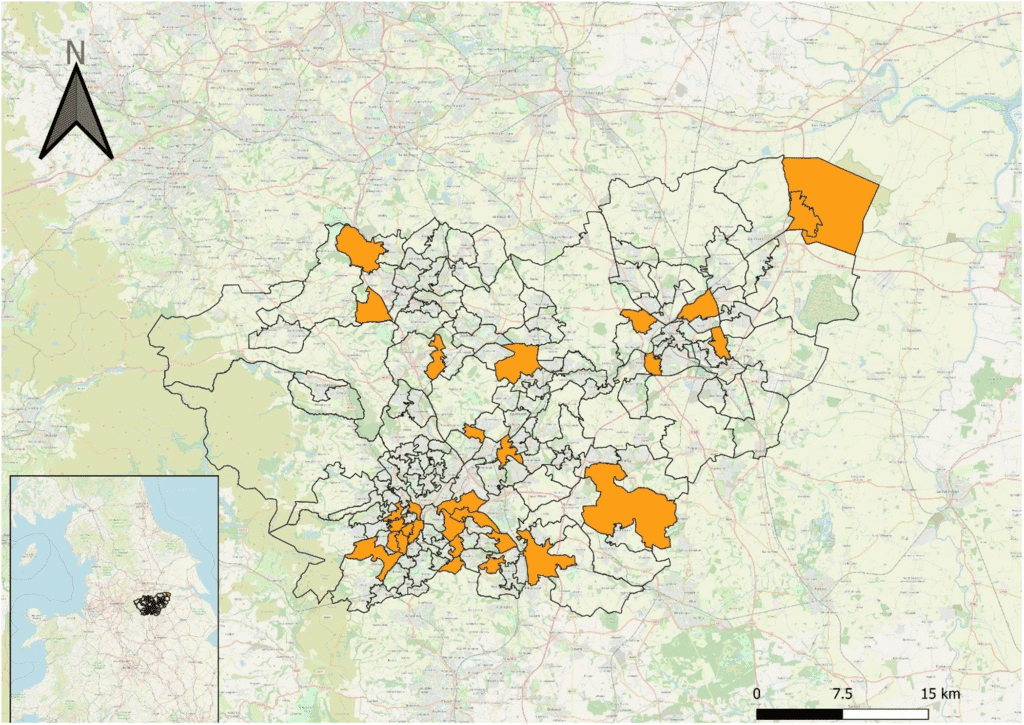
Conducted by a team of architects at the University of Sheffield and members of the South Yorkshire police department, the study examined all 990,446 crimes committed in the county from 2010–2020, mapping where they occurred and at what time of day. As they described in the journal PLOS One last week, the researchers found a correlation between light and crime, concluding that the risk of certain crimes grew after dark.
(Image courtesy of Uttley et al. via PLOS One. CC-BY 4.0)
Crime-after-dark hotspots in South Yorkshire, England, 2010–2020. A map of the county with high-crime districts highlighted in orange.
They also identified about two dozen specific hotspots across the county where crime rates are especially elevated in darker places — all of which suggests that urban lighting design could play a role in reducing crime.
Taking a step back for the moment, many other studies have shown, not surprisingly, that dark places instill fear in people. Everyone is afraid of the dark to some degree, whether we admit it or not. And research shows people feel safer after dark in brightly lit places like parking lots. But the relationship between darkness and crime is less clear.
More light, less crime?
Some studies show that if you install better street lighting, crime goes down. But confusingly, crime rates often go down in those places during the day as well. Other studies show no relationship between streetlights and crime rates at all. And some even show places with less lighting see lower crime. Criminals are afraid of the dark as well?
This new study is a breakthrough, however, because it shows a definitive connection between darkness and crime in urban areas, and it defines what specific types of crime, like bicycle theft, are more likely to take place in the dark. All that has rekindled my love for citizen science.
Mushrooms, monarchs, and manatees
What is citizen science? It’s everything, literally. Gazing through telescopes, ripping out invasive plants, taking pictures of mushrooms, geolocating trees, counting butterflies and birds, making soil pH measurements in your backyard, and monitoring your own biometrics for drug discovery. Here are a few specific examples (from a longer searchable list):
Citizen scientists are a unique set of people. All ages. All places. All walks of life. They are the telescope hobbyists, the do-gooders, the day trippers, the crowdfunders, the ethical hackers, the quantified selfers, the street-marching activists, the land and sea photographers, the storm chasers, the nerdiest of the nerds, and the just plain curious. Many come with nothing more than a smartphone, a pair of hiking boots, and some attitude.
Others invest small fortunes in their art — underwater camera rigs with mirrorless SLRs, floating flashes, wetsuits, fins, tanks, regulators, reef charters, and salty old boat captains thinking “We’re gonna need a bigger hobby.”
They are the unsung heroes of astronomy, climate change, ornithology, wildlife monitoring, land management, freshwater protection, coastal preservation, and rare and neglected disease research. They track coastal landslides, mushrooms, urban coyotes, zombie asteroids, Great White sharks, freshwater pollution, saltwater manatees, invasive weeds in South Australia, feral pigs in Canada, mountain goats in Montana, boreal toads in Colorado, black swans anywhere in the world, and monarch butterflies heading home to Jalisco, Mexico.
(Image courtesy of Harrison Qi via Unsplash)
My own first foray into citizen science came more than 25 years ago when I was in graduate school. One of my first pieces of journalism covered a local ecology project in Baltimore that enlisted classrooms in surrounding counties and trained children in these classrooms to take pH, temperature, and moisture readings in their own backyards. Years later, when my very own children were that same age, I got an idea for a citizen science investigation of my own.
I had visions of starting a massive project with my kids and their friends. We would walk along the Rock Creek, our local waterway. We would count pieces of litter dropped as people walked the paved outer path beside the parkway or the overgrown single-track dirt inner path on the banks of the creek. We would do this one day before one of the two big semi-annual volunteer cleanup days the county organizes. And we would map which parts of the park had the most trash and needed the most attention.
I had grand ambitions about what to do with this data. I thought it could steer resource allocation during volunteer clean-ups. The county could prioritize certain stretches of the park for maintenance throughout the year based on these analytics. Then when the small army of well-meaning local residents descended on the park with thick plastic bags and thin metal pickers once or twice a year, they would have a map. The organizers could use the data to stage the volunteers effectively where needed most. I imagined expanding from my little stretch of the Rock Creek to beautification efforts up and down the entire watershed.
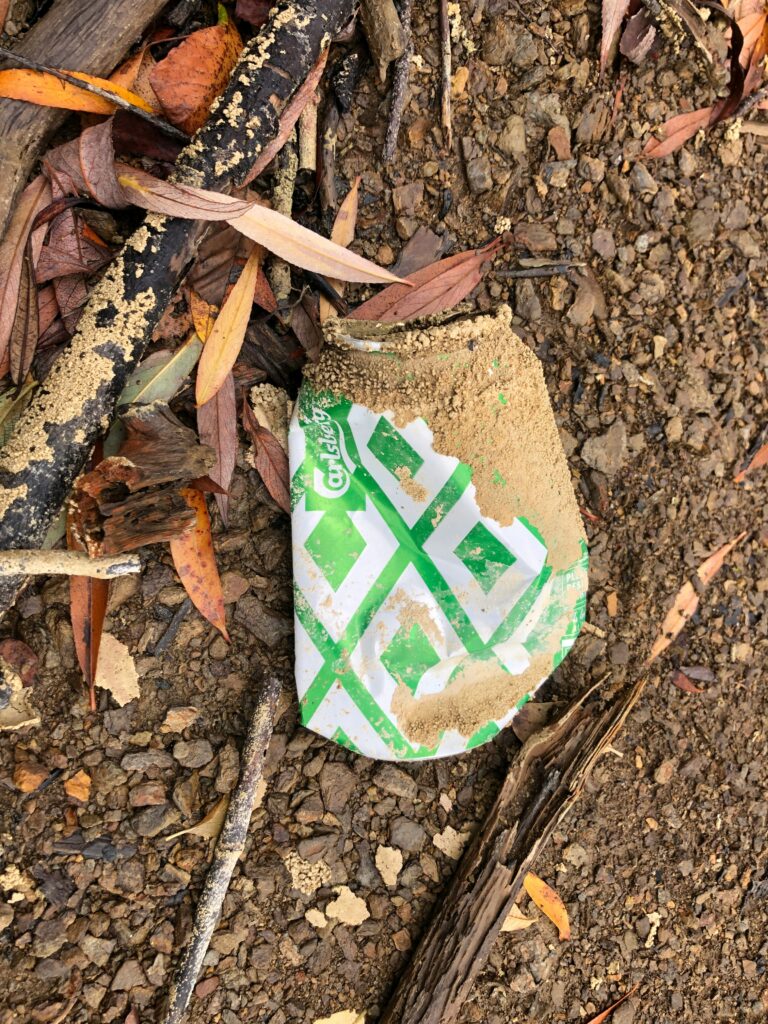
Of course, it didn’t work out that way. My kids were not as interested in my project as I was. Even so, I went out myself one afternoon, full of citizen-science spunk: I came, I saw, I tabulated tin cans.
But even though I had fun crawling through the brush collecting data, I dropped the ball and never contacted the county or the cleanup day organizers. One volunteer cleanup day came and went. And another. I soon forgot about the whole thing, even though what I discovered in my own data intrigued me.
Darkness scorns the witness tattle
My assumption at the start was that I would find more trash in the places that saw more foot traffic—the kids parks along the trail and the places where urban planners placed benches and trash cans for the dog walkers and tired sloggers. Those places, I reasoned, saw more people so they would see more trash. Not so!
I found far more litter in the more remote parts of the park — the rough, unmaintained lone-hiker spurs jutting off the main path into the deep woods. These places saw the least amount of traffic and the most amount of refuse. Why? My hypothesis at the time was altruism. The remarkable influence of a million small, selfless acts. I reasoned that far more litter was dropped in the highly trafficked spots, but that there were also more genuinely nice people in those places who care enough to pick up someone else’s garbage when they see it. Less so in more remote parts of the trail.
But reading about the South Yorkshire police study this week made me reconsider. There’s another mechanism as well, I think. Crime rates increase in dark places, the study teaches. And why not. Criminals love the darkness. It’s their friend. They may fear the dark, just as all humans do, but what they fear more is getting caught. So they work in the shadows. Darkness favors brazen theft and scorns the witness tattle.
So that’s my new hypothesis. Litterbugs love the dark as well — not the darkness of night but the darkness of solitude. They walk in remote sections of park with purpose, I suspect, passing into thick woods and behind dense brush where no one can see. There they drop their trash, thinking: If a wrapper falls in the woods and nobody’s there, does it make a sound?
Kenya’s Parliament moves to table a restrictive motion on protests in the country following the violent waves of protests in the country in the last two years.
Days after the latest demonstration in the country, the Parliament of the country is now said to be threatening the constitutional right of the people to protest by suggesting laws that will restrict them.
This law will force protest movements to register full names of individuals, addresses of individuals, routes planned, number of protesters, as well as slogans to be chanted during protests.
The proposed law comes after thousands of Kenyan youths marched in protest on 25 June 2025 in the country’s capital, Nairobi, to air out their grievances against the corrupt government, express their dissatisfaction surrounding the mysterious disappearances of fellow Kenyans, and illegal operations of the police force.
This June marked a year since the country witnessed a violent anti-tax bill protest that left 60 people killed and several injured.
According to a former Member of Parliament, George Koimburi, the controversial financial tax bill was passed by lawmakers in 2024, after the Members of Parliament were offered 2 million in Kenyan Shillings to vote in favour of the bill.
However, after the deadly protest that left the country shaken, the Kenyan president, William Ruto, refrained from signing the bill, stating, “I concede, and therefore I will not sign the 2024 finance bill.”
In honour of last year’s anti-tax protest and to mourn those who were lost during the demonstration, Kenyans came out in their numbers once again, insisting that they have yet to see any substantial changes one year after they marched to parliament demanding a better system.
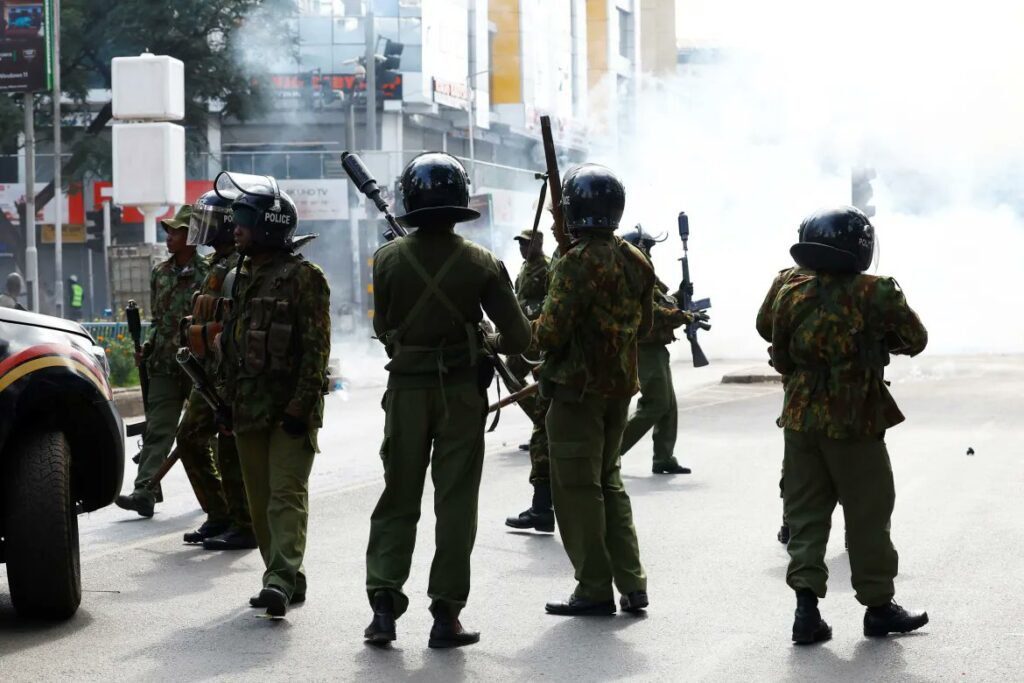
According to Amnesty International Kenya, the death toll in this year’s protest is marked at 16, while at least 107 persons are said to have suffered from injuries resulting from bullet hits. Al Jazeera notes that peaceful protesters were attacked by police using live rounds, tear gas, rubber bullets, and water cannons.
The Kenyan police at the protest scene (Photo by Al Jazeera, via X)Tear gas being deployed at protesters (Photo by Al Jazeera, via X)
Center of this year’s protest is the death of 31-year-old blogger, Albert Ojwang, who died in police custody. Protesters were seen on video holding up signs with the blogger’s name and chanting ‘Justice for Ojwang.’
Ojwang was found dead in his police cell after being arrested at his house because he allegedly posted false and malicious information about the Deputy Chief of the Police Force, Eliud Lagat.
An autopsy conducted on Ojwang revealed that he had suffered a head injury, neck compression, and soft tissue damage, all of which point to assault as the cause of death.
Ojwang’s case is only one out of many cases of police brutality in Kenya, and the citizens are now saying they have had enough.
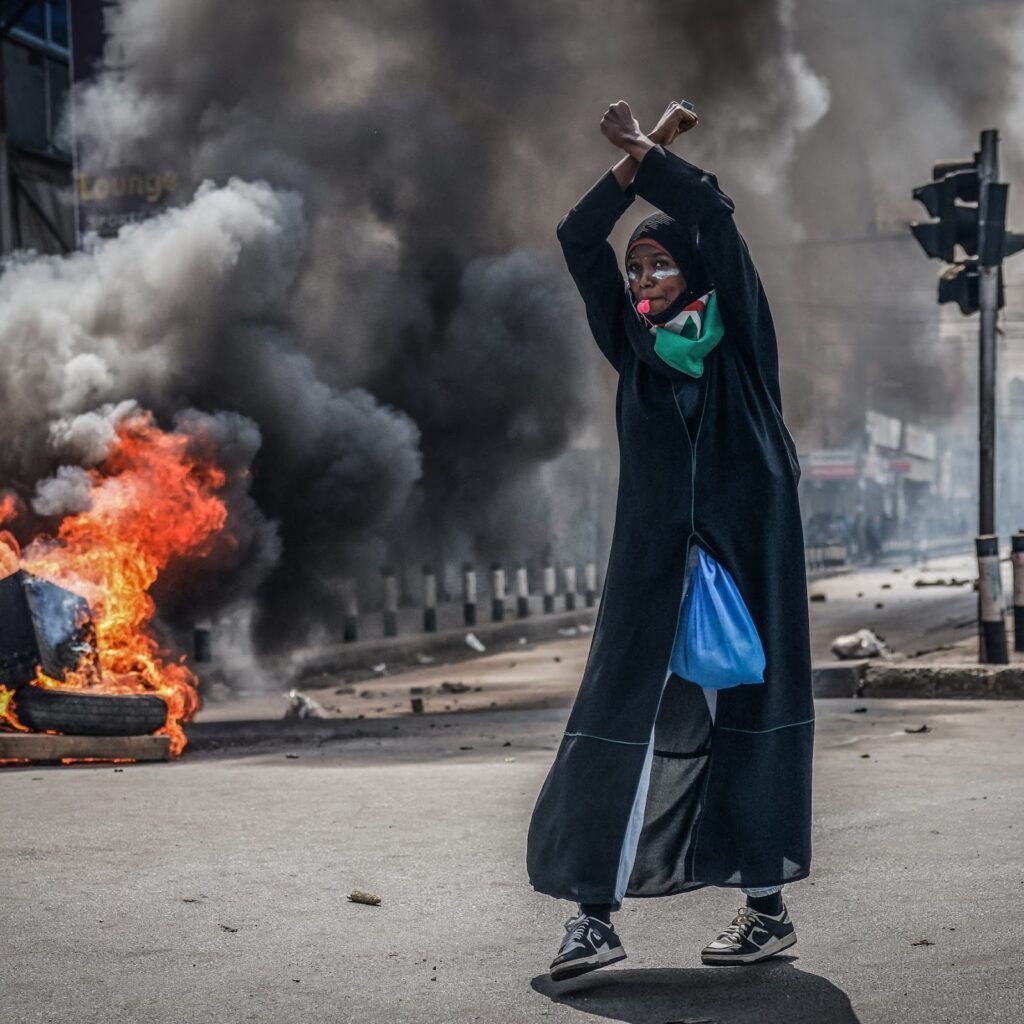
Female protester at the scene (Photo by Thuso Van Zyl, via X)
Kenya’s Independent Policing Oversight Authority (IPOA) has taken up the responsibility of investigating police activities during last year’s and this year’s protests. The body has successfully tracked down 6 men, including police officers, who are connected to the death of Albert Ojwang.
The coverage of this year’s protest was halted by the government after the Communications Authority of Kenya ordered all television and radio stations in the country to stop broadcasting live coverage of the march.
Several Kenyan broadcast stations that proceeded to offer live coverage of the protest despite the order from the CA were taken off air, however, after a court in Nairobi suspended the ban, broadcasting commenced in those stations.
Responding to this order, the Kenya Editors’ Guild stated in a press release that the “CA is actively undermining judicial authority and reopening the door to unconstitutional state censorship.”
Many youths, particularly those in African countries, have reacted to the protest in Kenya, stating that the courage of Kenyan youths is admirable. One X user posted, “All eyes on Kenya please, they are having a historic Gen-Z-led protest…”
The government’s present efforts to restrict protests in Kenya make many citizens believe the war is far from being over, and with the recent abduction of another blogger, Ndiangui Kinyagia, the youths continue to demand justice on social media using the hashtag #FreeDaguin.
A Kenyan activist, Abigail Arunga, who spoke with Yuvoice, expressed that this could spiral into another protest with the upcoming national holiday on July 7, Saba Saba, which was historically a protest day in Kenya.
Life and career in a funk? Find your rhythm or change it up
Self-improvement?
It was a dark and stormy night, but let me say something first.
I struggle with procrastination a lot, as you see. I can stay in a rut for ages, and there are times when I just want to give up when I find my life and work pointless. Some self-improvement gurus online say we should change our routine and do more self-care. Others say we should try something new or practice Ikigai, the Japanese art of finding one’s purpose in life. I cringe at how people talk about Ikigai outside of Japan. I lived there for six years, and no local I met ever talked about it. It’s all just hype, unless you read from Ken Mogi’s book exclusively. Anything else is just Western productivity bro hack-speak that totally misses the point. Ikigai is about finding satisfaction in the little things, rather than figuring out what you are good at and what the world needs. Those Venn diagram representations you see online are nothing more than poor attempts by management writers to turn us into more productive robots.
I read about staying motivated at work from the internet, like most of us do, I’m sure. The blogs I read all say similar things: we need to find purpose at work, change our attitude toward our job, or find something more meaningful. I am all for these things, but my squabble comes from noticing that people still leave meaningful jobs anyway. Take, for instance, the people who work in social impact or for the not-for-profit sector. Their jobs do not pay very well but they are considered meaningful in the sense they do good for other people and the reward for it is intrinsic. High feel-good factor over monetary value. No one does charity to become rich themselves. Now, I think these motivation problems are important because businesses cannot run efficiently without people who want to work there.
This insight came about during an outdoor dinner on a stormy night in a water village in my home country.
Dinner on stilts
The evening rain accompanied us steadily on the evening of January 29th, 2025 while driving towards a restaurant for dinner. My EduTech boss and I were in the car driving our CEO and COO from their hotel near the Brunei International Airport to Kota Batu, a historical area in our capital city of Bandar Seri Begawan. Kota Batu used to be the ancient capital of our country and is now home to museums and a section of the Water Village, a national tourist attraction and traditional residential area. Our colleague who recommended the restaurant to us that night wanted to share some traditional Bruneian hospitality to our seniors, by way of doing this.
When we exited the car, we boarded a wooden walkway to get to the diner, as it was in the area of the Bruneian Water Village, the site of the old capital. The Brunei River lapped against the wooden stilts beneath us, iridescent from the light of lanterns and fluorescent lamps that lit the restaurant verandah.
That CTO got rhythm
The smell of barbequed meat skewers, which we call satay in our local language of Malay hung around the air, whetting our appetites. We settled at our reserved table and got into a conversation about business and our plans for the company. One thing that stood out to me during the conversation was how our C-Suite (minus one) spoke about the CTO, who was absent. They credited him with the success of the business, as a master of a flow called “cadence”.
I had always known cadence in poetry and music — the rise and fall of the arc of a melody, the measured rhythm of words. But here, on this stilt house turned restaurant, against the backdrop of a lighting-filled sky with gentle evening rain, I learned something new about cadence in business. Or life.
Nearby, fishermen cast their nets into the river, guided by their flashlights and their fishing instincts. As they worked, my mind caught onto the idea of a kind of rhythm in business workflows. Just as village fishermen knew where to cast their nets and the time to cast them without the aid of sonar onboard a modern fishing vessel, modern business pros know how to optimize their routines when they work. Our CTO was on top of things, like knowing how to handle customer complaints or feedback, the marketing, or even just how to make a website work using his tech wizardry. All this, his peers said, came down to his cadence or workflow. They praised his time management skills, his ability to take naps when he wants, and his overall mastery of his daily schedule.
He was like the encyclopedic entry of cadence itself.
I caught on to this idea quickly through their introduction. This tale brought the joy of discovering a word anew, one that was in my vocabulary, unused, picked up somewhere in the course of my studies, but only usable for work through business jargon.
I thought of Mogi’s ikigai, which emphasized that life’s purpose and happiness go hand in hand. Mogi, a neuroscientist, said “Ikigai starts from very small things, like just having a cup of coffee.”
Embracing routine
Aligning purpose with habit is also found in this philosophy of ikigai, which is like a spectrum for embracing purpose in work, play, and life in general. Productivity or management writers like to express this concept in Venn diagrams, which get it wrong, as they are more the idea of aligning purpose with passion for the sake of a productive workflow. Ikigai, for Mogi, starts with gratitude rather than the expressed purpose of improving personal efficiency or effectiveness. Which also makes it distinct from cadence. Yet, how they are similar is that Ikigai-like cadence embraces routine.
There is a kind of rhythm or harmony in the flow of life and work, much like the way the fisherman is connected to working with nature. It gives the confidence to fish in the middle of the rain or even a light storm, because he knows his catch is always there.
As my company bosses and colleagues stepped outside into the damp night, the rain stopped. And then, suddenly, the sky above Bandar Seri Begawan erupted in light — bursts of gold and crimson, crackling fire against the murky river. The fireworks signaled the arrival of Chinese New Year in our Malay Capital, their shimmering reflections rippling across the water.
I stood there captivated as we posed for a group picture.
Rhythm. Movement. Repetition. Turning Point. Result. It wasn’t just poetry or business — it was life itself.
The North-Central region of Nigeria remains one of the most susceptible regions to herdsmen attacks, and the recent massacre in Benue state, which has drawn national attention, is being tagged as the deadliest attack yet on the state.
On the night of June 13, 2025, a village in Benue state, Yelewata, was attacked by unknown gunmen suspected to be herdsmen. During the attack, which lasted a couple of hours, several houses were burned down, killing hundreds of innocent victims, including children.
In a video circulating on social media, a victim of the attack, Fidelis Adidi, narrated how he lost his wife and four children after his house was set ablaze during the attack. Additionally, an anonymous military personnel who spoke with Vanguard confirmed, saying, “We lost two military personnel in that attack.”
According to the Chief of Defense Staff, General Christopher Musa, there was a clear modus operandi.If you see the way some of the burning were made, you know that they were targeted. It shows they have insiders.”
This attack, which has left many hospitalized and homeless, has attracted the attention of notable government personnel, including the president, Bola Ahmed Tinubu, who paid a visit to the state on June 18, 2025, to meet with stakeholders and offer condolences to affected victims.
President Bola Ahmed Tinubu pays a visit to the attack victims (Photo by Business Day)
Many view the incident as one of many land disputes between herders and farmers, which have persisted for years, particularly in the Guma, Logo, and Agatu Local Government areas. This land dispute began to arise when Fulani cattle rearers infiltrated the state and allowed their herds to feed on the farmland of farmers in Benue state.
This year alone, Guma, Logo, and Ugum local governments have experienced similar attacks in April and May, which have claimed about 100 lives. Acknowledging a pattern in these attacks, a royal head in Benue state, Tor Tiv, tagged the incident as a genocide attack aimed at overtaking the land.
Attacks of this nature continue to persist as a result of the grazing reserve law enacted in 1965, which permits animals to graze in grazing areas within the grazing reserve.
To protect the state from future attacks, the Benue State House of Assembly calls for the implementation of an anti-open grazing law. Daily Post notes, “The House of Assembly has urged Governor Hyacinth Alia to fully implement the Open Grazing Prohibition and Ranches Establishment Law, 2017.”
Being one of the most gruesome attacks recorded in the state, both the State and Federal governments have begun putting strategies in place to safeguard Benue and catch the culprits responsible.
Speaking via his X account, President Tinubu said, “To the good people of Benue…We will restore peace, rebuild, and bring the perpetrators to justice. You are not alone.”
According to the National Emergency Management Agency (NEMA), 6,527 people have been displaced from their homes, and about 3000 displaced persons are being camped in Nassarawa state following the attack.
Citizens around the country have continued to express their fears and concerns about the ordeal and this has prompted residents of Benue to address the need for self-defence, however, Governor Alia has turned down these demands, insisting that protection using community policing is a better approach.