Smothering with profound prejudice, Steadfast and solidified. A weighted blanket Suffocating open fields, Splitting, when trees uproot, But easily merged into Systemic circulation.
Currents deterred by reinforced foundations;
Armor immune to ashing;
Wind is as it appears–
A constant plague on the souls Who tread on me… Outlasting those who march On me tomorrow.
When the world grays And all that lived are dust and dry venom, My slab will lie vigilant.
When Lt-Gen Nhlanhla Mkhwanazi first laid bare accusations of political interference, hidden criminal syndicates, and sabotage within the South African Police Service (SAPS) in July 2025, it sent shockwaves through the country particularly in communities already living in fear. For ordinary citizens in townships and informal settlements where criminality and “vanishing police dockets” are part of daily conversations, that moment was less about surprise and more about relief because someone was finally naming the injustice that shaped their daily lives.
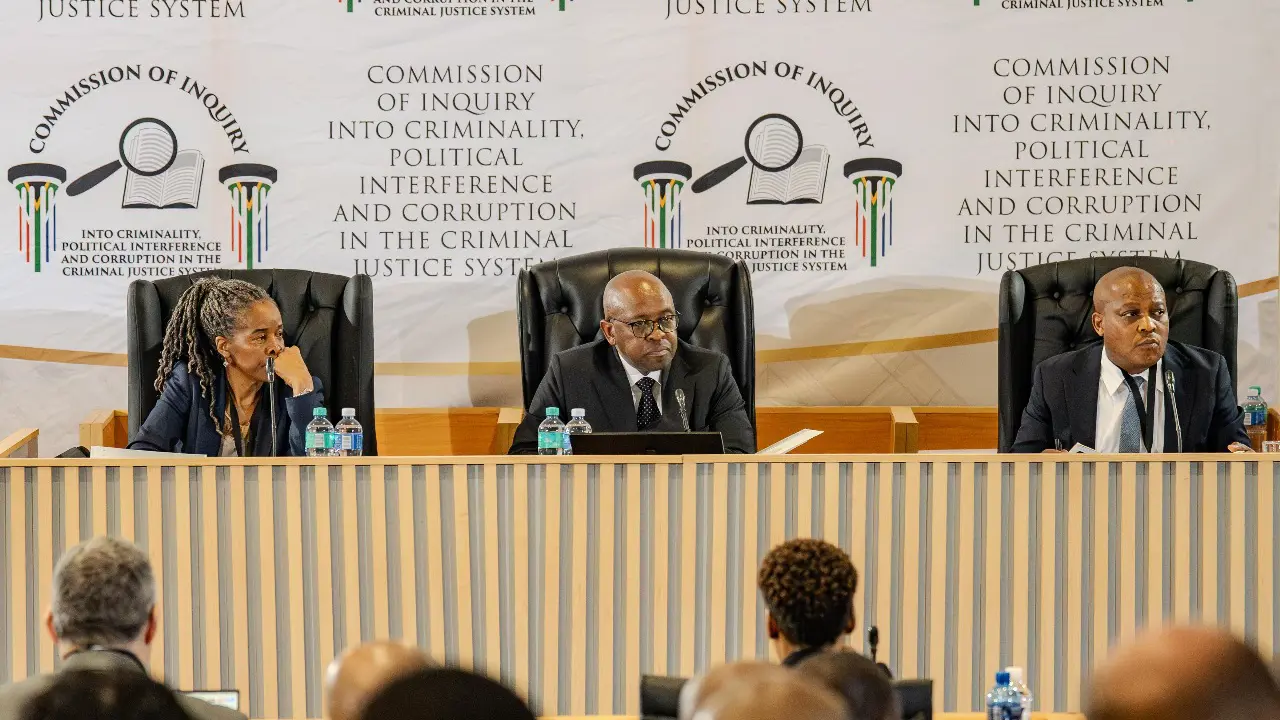
Now, as the Madlanga Commission of Inquiry has begun its public hearings on 17 September 2025 at the Brigitte Mabandla Justice College in Pretoria, the emotions of ordinary citizens mirrored the nation’s tension. The delays, resource problems, and political pushbacks are not just bureaucratic obstacles, they carry real costs in people’s lives. Nicole Myburgh, Ward Committee Member in Eldorado Park, commented “As a resident of Eldorado Park, I’ve witnessed firsthand the devastating impact of gun violence and drug cartels in our community. For years, we’ve lived under the shadow of gang warfare, a reality shared by many communities across the country.”
The first public witness to take the stand was Lieutenant-General Nhlanhla Mkhwanazi, his testimony immediately set the tone. Speaking under oath, Mkhwanazi painted a damning picture of political interference that, in his words, had “turned the South African Police Service into a playground for power brokers.” Mkhwanazi told the commission. “It is a capture of policing itself from the station level right up to the minister’s office. Political loyalties decide who gets promoted, which cases disappear, and who lives to tell the story.”
The second witness National Police Commissioner Fannie Masemola corroborated parts of his account, testifying that ministerial directives had “encroached upon operational independence” and undermined accountability. According to internal documents tabled before the commission, 121 case dockets, many tied to politically connected suspects, were re-routed or “lost” after the task team’s dissolution. Witnesses described how officers who resisted interference were threatened, transferred, or quietly sidelined.
Opposition parties quickly seized on the revelations. DA leader John Steenhuisen told reporters outside the hearings, “These testimonies confirm what South Africans have long suspected that state institutions have been weaponised for factional gain. This commission must go beyond exposure; it must end impunity.” It is worth noting that even though the commission of inquiry has been well received by citizens, if it delivers not only revelations but prosecutions, not just words but systemic reform, perhaps the state will again be seen as a protector, not a predator.
South Africa’s democracy was built on accountability, the idea that no one, however powerful, stands above the law. However, as the Madlanga Commission peels back layers of a major political crisis, that principle feels increasingly fragile. The sudden death of former Police Minister Nathi Mthethwa on 30 September 2025, barely two weeks after his name surfaced in testimony linking him to “protection networks” around illicit mining and logistics cartels, has further raised suspicion. Officially ruled as a suicide falling off a hotel in Paris, his passing nonetheless sparked an online storm of speculation and conspiracy theories leaving others in fear that the line between politics and organised crime may now be one of survival.
Parallel economies thrive in this environment. From the zama-zamas (unregulated small scale mining) of mainly Gauteng’s abandoned shafts to cross border tobacco and vehicle hi-jacking cartels, organized crime has become a shadow state which is exploiting gaps in governance and the rule of law while the most vulnerable in society suffer more into poverty. In a report, the Transnational Alliance to Combat Illicit Trade (TRACIT) estimated that illicit trade (tobacco, alcohol, counterfeiting, etc.) causes losses of about R100 billion annually, but that is not expressed as a percent of GDP.
In the end, the Madlanga Commission is not just about rooting out corruption, it is a mirror held up to a democracy testing its own endurance. South Africa’s political underworld did not emerge overnight but it grew in the blind spots of accountability, in the silence of those who looked away. Whether the commission’s findings lead to prosecutions or fade into another forgotten report will determine far more than political reputations, it will reveal whether this democracy still has the courage to save itself and whether citizens like Nicole will inherit a country worth living in.
Kenya’s Parliament moves to table a restrictive motion on protests in the country following the violent waves of protests in the country in the last two years.
Days after the latest demonstration in the country, the Parliament of the country is now said to be threatening the constitutional right of the people to protest by suggesting laws that will restrict them.
This law will force protest movements to register full names of individuals, addresses of individuals, routes planned, number of protesters, as well as slogans to be chanted during protests.
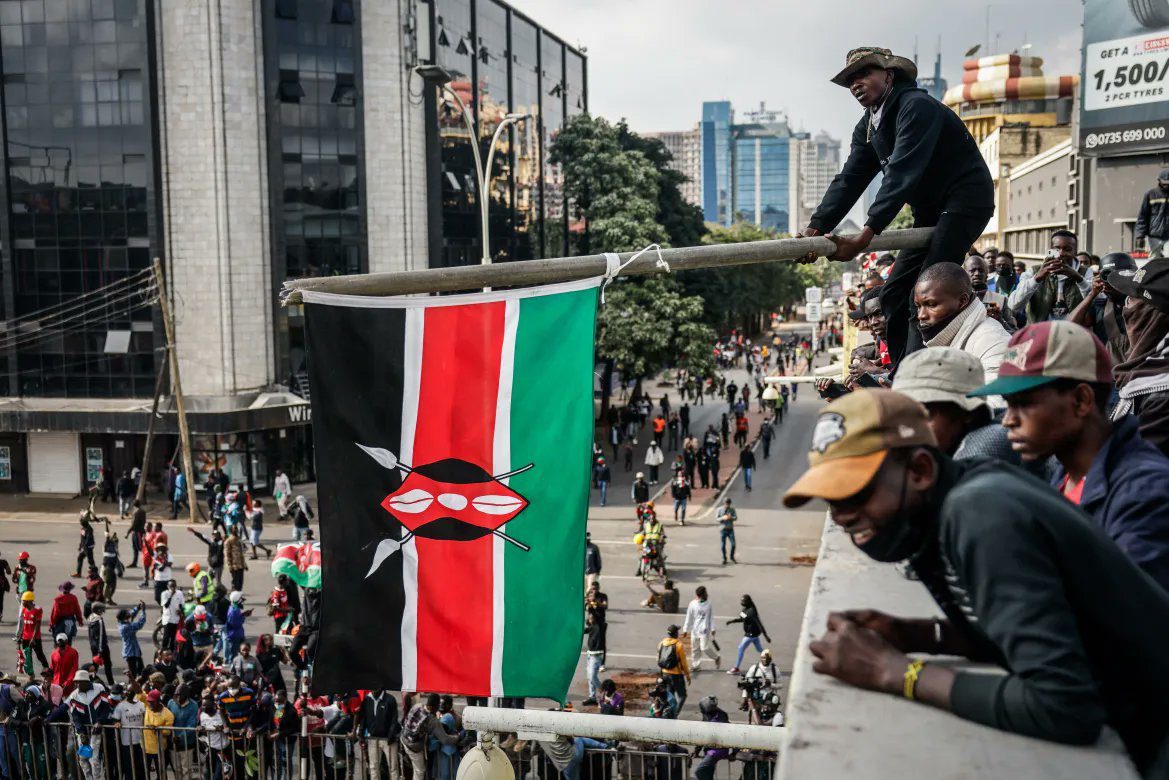
The proposed law comes after thousands of Kenyan youths marched in protest on 25 June 2025 in the country’s capital, Nairobi, to air out their grievances against the corrupt government, express their dissatisfaction surrounding the mysterious disappearances of fellow Kenyans, and illegal operations of the police force.
This June marked a year since the country witnessed a violent anti-tax bill protest that left 60 people killed and several injured.
According to a former Member of Parliament, George Koimburi, the controversial financial tax bill was passed by lawmakers in 2024, after the Members of Parliament were offered 2 million in Kenyan Shillings to vote in favour of the bill.
However, after the deadly protest that left the country shaken, the Kenyan president, William Ruto, refrained from signing the bill, stating, “I concede, and therefore I will not sign the 2024 finance bill.”
In honour of last year’s anti-tax protest and to mourn those who were lost during the demonstration, Kenyans came out in their numbers once again, insisting that they have yet to see any substantial changes one year after they marched to parliament demanding a better system.
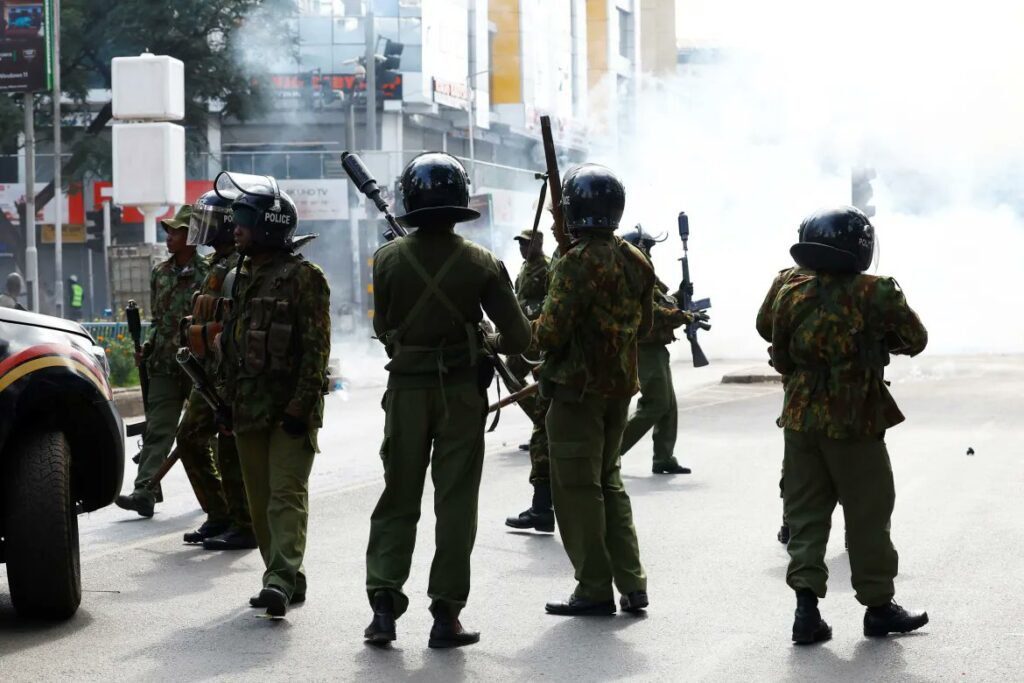
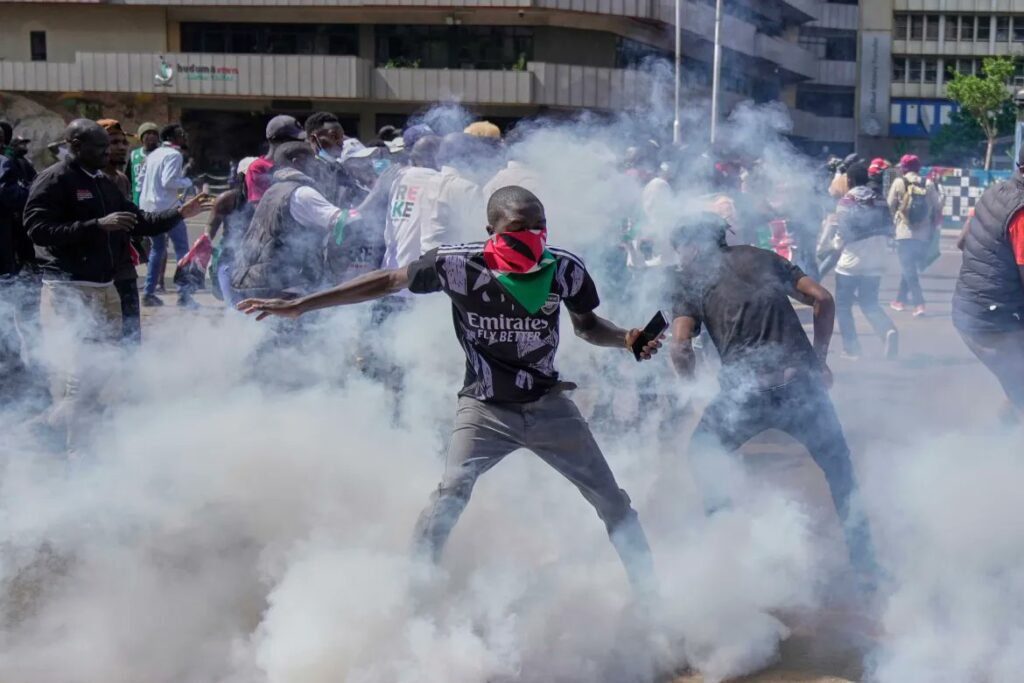
According to Amnesty International Kenya, the death toll in this year’s protest is marked at 16, while at least 107 persons are said to have suffered from injuries resulting from bullet hits. Al Jazeera notes that peaceful protesters were attacked by police using live rounds, tear gas, rubber bullets, and water cannons.
The Kenyan police at the protest scene (Photo by Al Jazeera, via X)Tear gas being deployed at protesters (Photo by Al Jazeera, via X)
Center of this year’s protest is the death of 31-year-old blogger, Albert Ojwang, who died in police custody. Protesters were seen on video holding up signs with the blogger’s name and chanting ‘Justice for Ojwang.’
Ojwang was found dead in his police cell after being arrested at his house because he allegedly posted false and malicious information about the Deputy Chief of the Police Force, Eliud Lagat.
An autopsy conducted on Ojwang revealed that he had suffered a head injury, neck compression, and soft tissue damage, all of which point to assault as the cause of death.
Ojwang’s case is only one out of many cases of police brutality in Kenya, and the citizens are now saying they have had enough.
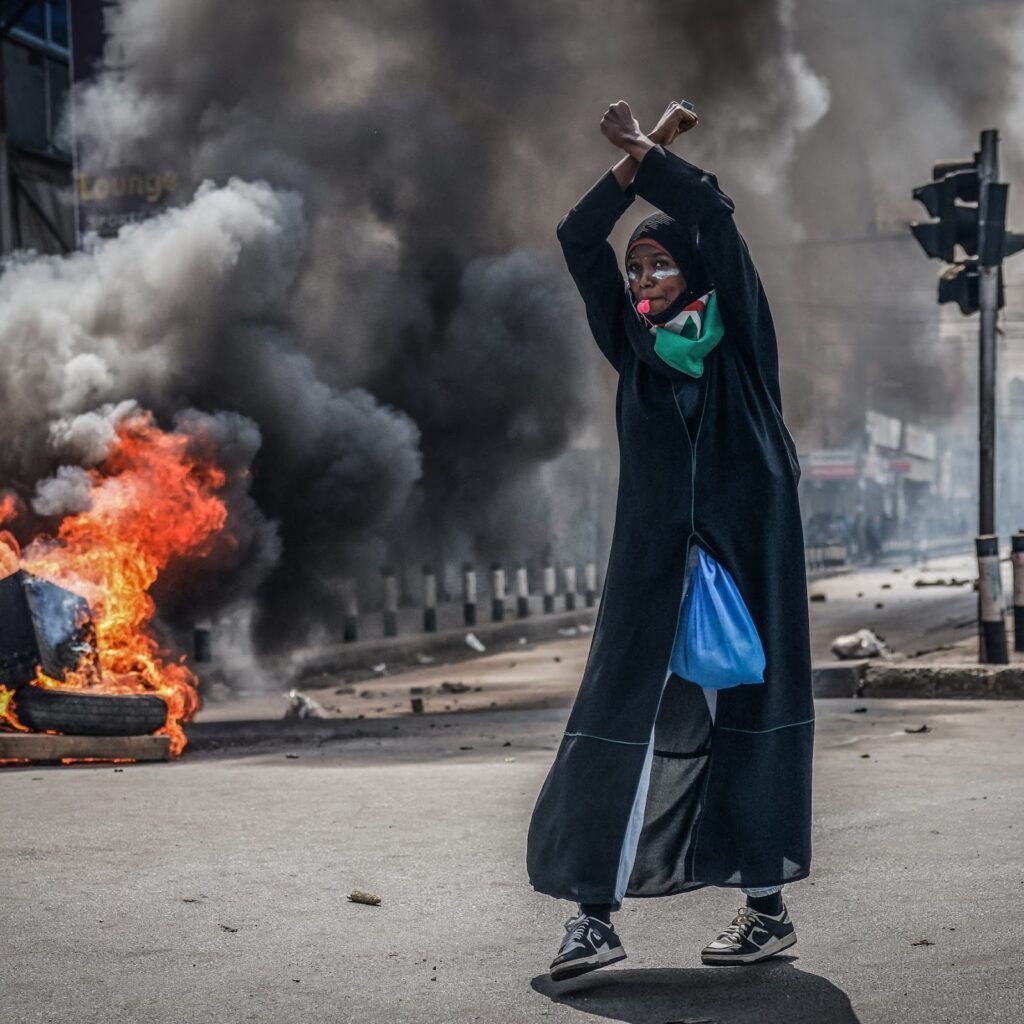
Female protester at the scene (Photo by Thuso Van Zyl, via X)
Kenya’s Independent Policing Oversight Authority (IPOA) has taken up the responsibility of investigating police activities during last year’s and this year’s protests. The body has successfully tracked down 6 men, including police officers, who are connected to the death of Albert Ojwang.
The coverage of this year’s protest was halted by the government after the Communications Authority of Kenya ordered all television and radio stations in the country to stop broadcasting live coverage of the march.
Several Kenyan broadcast stations that proceeded to offer live coverage of the protest despite the order from the CA were taken off air, however, after a court in Nairobi suspended the ban, broadcasting commenced in those stations.
Responding to this order, the Kenya Editors’ Guild stated in a press release that the “CA is actively undermining judicial authority and reopening the door to unconstitutional state censorship.”
Many youths, particularly those in African countries, have reacted to the protest in Kenya, stating that the courage of Kenyan youths is admirable. One X user posted, “All eyes on Kenya please, they are having a historic Gen-Z-led protest…”
The government’s present efforts to restrict protests in Kenya make many citizens believe the war is far from being over, and with the recent abduction of another blogger, Ndiangui Kinyagia, the youths continue to demand justice on social media using the hashtag #FreeDaguin.
A Kenyan activist, Abigail Arunga, who spoke with Yuvoice, expressed that this could spiral into another protest with the upcoming national holiday on July 7, Saba Saba, which was historically a protest day in Kenya.