
From Academia to a Gompa and Back: How Retreats Brought Me Full Circle

Enmeshed in a busy year working at my academic office at my university, I thought about attending a retreat. I wanted some relief from the tiresome routine.  As a postgraduate student, I was embroiled in a substantial project of completing a research dissertation. The subject I was working on was philosophy/theology and ecology, and I enjoyed it. This was the year before the arrival of Covid-19, and there was still a bustle around the corridors and offices of the School of Humanities. 

Added to my research paper,  my academic duties included reading and grading assignments, attending lectures, and giving an occasional lecture to students enrolled in the Genre Studies unit. These were fairly light duties for any casual academic. For me, the burden of resolving the complicated subject matter of my research was most challenging. Sitting long hours working on it, I sometimes found it hard to concentrate, and I would try to find a way to clear my mind, mostly by strolling in the university gardens. 

In the garden, there were trees, lawns, and walking tracks. Refreshment corners with coffee and snacks were also available in various locations on the campus — a campus good enough to refresh and recharge oneself. But I realized these moments were not refreshing enough. I needed more than these small havens on the campus, and a fuller break from the responsibilities of my work. Perhaps it was time for a course in contemplation.

I could usually recover by retreating into my quiet office space, writing, researching, and listening to classical music. This still works well for me, but the internet remains a constant distraction. When I was offered the opportunity to go on a retreat, I decided to go for it, so I booked a spot for the mid-term break.

Most retreat centers are located in bushland — remote woods away from town and the internet — areas of complete solitude. They are close to nature and use solar power and tank water. It could be rough to keep the tablets, pads, laptops, and phones always charged.

The silence here was so exciting
My first retreat was a combination of daily meditation “sits” in the gompa  (silent sessions in the meditation hall), sleeping in a caravan, and engaging in the crack-of-dawn writing bouts lit by battery-operated lamplight.

(Photo Courtesy of Maria Orlova via Pexels)

On my first flush of morning in the retreat, the bush was quiet. I knew that soon, the birds would begin to stir in the sky.  I was writing a paper to present at a conference on theology, while also working on completing my thesis. My computer, with its e-book library, was my essential equipment, and that early morning quiet time alone was inspiring. 

Well before daylight each morning, I would walk up to the kitchen to fill a thermos with coffee. On the way, I might encounter kangaroos pausing watchfully in their paths, waiting to discover my intentions. I would practice a kind of gentle meditative walking, hoping they would not be disturbed by my presence. Soon, they would bound off, either down the valley towards the dam or into the bush, and I would continue walking, but now, I had a deepened connection with my surroundings. In the retreat center in a mountain range in northern New South Wales north of Sydney, the early spring air was crisp and clear.

The air

What a joy to have access to such clean air in the tranquil bushland!

Each morning during the break, I would sit near a small pond at the edge of a stand of gum trees, where spring wildflowers were blooming. Sometimes, the teacher would come and sit with me, and we would discuss a Zen verse or the Heart Sutra.

(Photo Courtesy of Pat Whelen via Unsplash)

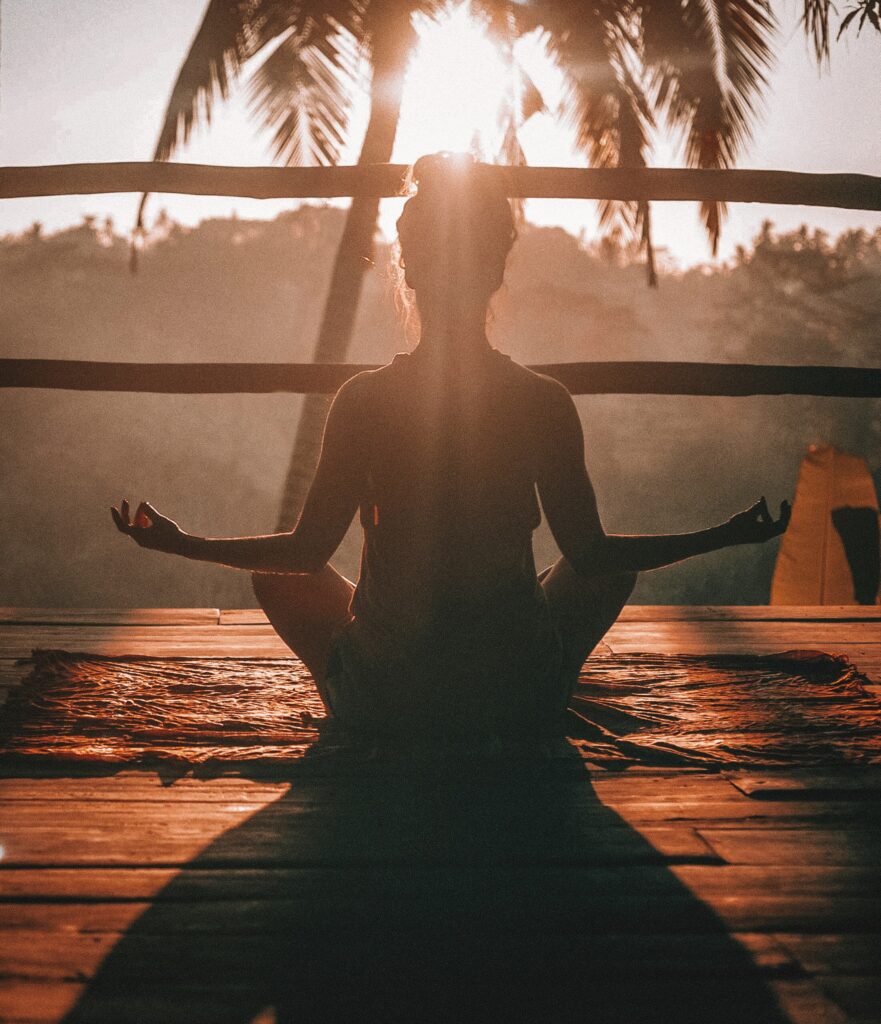
Then, we would return to meditate in the gompa. Here, a statue of Buddha sat before the window on an altar with smaller statues and photos around him and lovely flowers and incense offered to him. It was a serene space at the top of a hill, surrounded by native bushland and flat sandstone rocks from which a view extended across the valley to the south. Inside the gompa, it was silent, apart from the occasional rustle when other meditators adjusted their posture. A stillness descended over the space as participants focused on their breath, beginning to release thoughts of the outside world and various day-to-day activities. 
(Photo Courtesy of Jared Rice via Unsplash)

At night, after the last meditation, the constellations of the Southern Cross and the Pointers were brilliant among the bright star fields beyond Earth. 

One thing I learned was that no matter what might appear to be going on within my fellow attendees and myself or in the memories that arose during meditation, it would always be our own personal “stuff” that would come up, simply so we could become aware of it. It was only after several uncomfortable sessions with a busy mind that I found the best way to do that. It was to alternate a sitting meditation session with one in which I walked outside or stood among the wildflowers, attending to the birds while, as earlier in the day, emptying my mind of thoughts. 

(Photo Courtesy of Adana Durso via Pexels)

Silence would sometimes pervade my awareness of those airy heights, at least for a while.

When the last day arrived, we cleaned the gompa, the kitchen, and the caravans and left the Retreat Centre around lunchtime. The next day, I returned to the university, and my mind calmed as I settled back into my office. The world seemed brighter, and my random thoughts only came occasionally and more quietly. I knew I would be able to return to academic work, but now with a peaceful mind. 

Soon, the paper was finished and ready to be presented. It was time I made some real progress in writing my dissertation. 
Swimming Out and Changing Careers

Let me set a scene for you. I’m at gorgeous Coogee Beach in Sydney, on the Pacific — just had a really nice swim  — and the sun is about to set on my twenties. 

As I watched the sunset, I thought a lot about what I want my thirties to look like. And it hit me like the waves that struck me during my swim. I thought to myself, “I do not want to be in the office anymore.”

This is not to say the media agency I was at, or the people I worked with were bad. The work is achievable, and ideally, by my age, I would need a stable career. The people I was working with were all fantastic people, and the office and location beautiful. But the one question I kept asking myself was — is this something I want to do for the rest of my life? Simply put, NO! By the time I was at Coogee, I was burnt out at work. The very same day I made a vow to pursue things that give me happiness and peace; that energize me every day. Writing, photography, and teaching are some of those. I wanted to chase them all. 


Fast forward one month, and I handed in my resignation. 

After working for five years in the media industry, where I was involved in successful campaign implementations and met so many amazing people, I stepped away from the comforts and into the unknown. My passion drove me away from the comforts.

(Photo courtesy of the author)

I headed toward a destination more peaceful and fulfilling  — life as a writer, a photographer, or a teacher overseas was my dream. A lot of people in my work circle thought it was a ballsy thing to do and results will not come overnight. So in the meantime,  I’m looking for something temporary or part-time to cover my expenses …

I keep myself busy 

Volunteering for a community center, staying in the gym, learning a new language, and practicing in language exchanges are the ways I kept myself busy. All these activities helped me stay busy and sane through the long rut of finding a job two years ago. With volunteering, I may not get paid, but along with gaining experience and honing my skills, there was an inner joy I got by teaching the elderly English or about using phones. The gym gave me a sense of accomplishment — completing heavy lifts. And learning a new language shows a dedication to learning new things.

That dedication has extended to my pursued career


(Photo courtesy of the author)

Before I handed in my resignation, I started writing a blog about my journey from office worker to potential freelancer. I’ve also been refreshing my knowledge about freelance writing and immersing myself back into a master’s course in writing. Language exchanges have allowed me to learn and get better at a language whilst also helping those who are struggling with English. 

After I resigned, the first thing I did was go back to Coogee where it all started. I then went on the Coogee-to-Bronte walk and took photos from that even more scenic beach. Since then I’ve been on photography trips, heading to different beaches and some areas I have never been to before. There is a lot of testing out of lighting and shutter speeds to help me develop a style of photography that is truly mine; which is actually what this journey has been about — developing a me best suited to writing, teaching, or photography.

Still, I haven’t 100% said goodbye to the media 

You can never be sure in life, so I can’t be certain I’m done with the media industry forever. There have been publishers and people from other agencies that I’ve met that I would go as far as to say are my friends. One good thing about the media industry is that the people in it are quite laid back, so , it was easy to make connections there as I’m the same kind of person. Plus, I’ve always been told to never burn bridges. If this career change doesn’t work out, those connections I made through just being my outgoing self at many media parties will bode well if I  return to the media industry. Never say never.

Career changes are never easy. I can say with certainty that it is still scary stepping away from somewhere that gave me comfort and security to delve into the unknown. But when those doubts start to creep in…

I remind myself of the why


(Photo courtesy of the author)

At the end of “The Last Dance” documentary, Michael Jordan said it was maddening that not only did he retire at his peak, but he and the Bulls didn’t get the chance to go for seven NBA championships. There are so many could haves or what ifs to this day that bothered Jordan, and I wonder if I might feel the same if I didn’t at least try. And it isn’t just because I want the comfort in saying I tried my best, it’s because I want to chase things that’ll give me happiness. I want to break out of the 9 to 5 routine and be my own man. If I do end up back in the media industry, I want to at least proudly say I gave it my best. Working at a desk, I can sit back at peace, knowing that I tried. 

We all have different circumstances in life that make career changes less than  ideal. If an opportunity knocks where you can pursue your passion in life, can we take that leap forward? Life is short and can end in an instant — this year has shown me how to take those leaps instead of sitting by and waiting for those leaps to happen.

Starting an Online Business: My Steps to Achieving Success

Have you ever sighed deeply after a mistake or mishap and said to yourself, “If only I knew,” or “I wish someone could have told me…”?

Well, I did. As mindful as we can try to be, I don’t think anyone likes making mistakes. We all wish we could prevent mishaps and unpleasantness.

Predicting the future is impossible, but I eventually understood that I can learn from others’ mistakes and lessons. 

I got ahead on taxes and legal stuff

Starting an online business isn’t easy, but it’s worth it. I scaled my coaching business in less than two years, and it was no walk in the park. I did things right, and I did things wrong, but the lessons learned are invaluable.

Tax and legal bits — definitely the least exciting aspect of starting a business — are super important, and I wished someone had guided me through it all. Especially for a digital nomad, it can be hard to handle the gray areas of the lifestyle that come with it and to keep up with taxes while traveling. Where do I pay taxes? Where should I receive my income? Will my home country have a problem with this? These are some of the questions that filled my head.

Taxes are much more than just tracking your monthly expenses and income. It’s the things no one tells you about, like organizing your invoices, getting your forms, saving your receipts, and setting up a legal structure. 

(Photo Courtesy of Michael Walter via Unsplash)

Since my business took off so quickly, I needed more legal support, tax advice, and help to get my ducks in a row. I consulted with international tax lawyers because only they could shed light on my very particular situation—double nationality, double residency, etc. My instincts were right; I needed to start sorting my legal aspects early on.

Luckily, I’ve always been good at managing money. I always know how much cash I have and how much to spend today after saving for tomorrow. Being aware and on top of all your finances is a gratifying feeling.

Managing my time and energy has been the most important skill I could master

As a new entrepreneur, I was alone trying to do it all. And as my business started picking up, I soon found myself managing strategy, marketing, funnels, and all that good stuff. 


(Photo Courtesy of eduardo199o9 via Pexels)

I learned the hard way how to prioritize my time and energy at every level. As my business grew, it became more and more challenging to balance everything. Just because you master something at one level does not mean you’ve mastered it for eternity.

Business will evolve as we do; shift your priorities as you go. 

Investing in myself is a must-do

When a business starts, it is okay to rely on free advice and resources, thinking that’s enough. Luckily, I realized soon enough that nothing compares to tailored and proper groundwork. You are unique! And so is your business. So why conform to free generic stuff if what you’re trying to put together is something extraordinary?

(Photo Courtesy of Krakenimages via Unsplash)

I did use freebies on and off, but I certainly also invested in coaches, programs, new team members and different ways to support myself. Even outside of my coaching business, I looked for support where I needed it, whether that was mental health, business courses, or outdoor activities — if those things contribute to your time, energy, and momentum, they’re all worth it.

You will only be able to grow a business if you invest in yourself. Period. It’s not if; it’s just when. It will make your business journey much smoother, saving time and money in the long run.

I created a support system by my side

In 2022, I joined a misfit mastermind group. Without a supportive community, I was facing endless headaches and decision fatigue, and this well-suited community was the missing piece that would have made my business journey so much smoother from the start. Let’s just say…a lot of mistakes could have been avoided. 

(Photo Courtesy of Wade Austin Ellis via Unsplash)

Having support also means you have someone to discuss things with and bounce ideas off. Making decisions alone can be overwhelming, and all biz owners out there know how many choices you have to make as an entrepreneur. 

I learned that money is important, but it isn’t everything 

Money doesn’t change everything. I learned to keep in mind my health, the health of my business, and the passion that drives us both. These elements are ultimately more important than how much I bring in each month.

Money is just a byproduct of all your other things: marketing, working with clients, and building your biz.

Money means nothing unless you assign it a value. What does money mean to you? Honestly. 

Energy is the most important thing at every stage of business

Your audience can feel your energy, I promise you. And I am a real example of it.

The #1 reason clients hire me is my energy during workshops, interviews, posts, launches, and meetings. My energy draws people to me, and it’s everything when turning potential clients into real clients. 

(Photo Courtesy of Anna Tarazevich via Pexels)

But there’s a flip side: I gave so much energy away in 2021 that I had nothing left. I burned myself out. This happens to a lot of entrepreneurs. We love what we do so much, and we love to hustle. I need to constantly go, go, go

While it’s good to have drive and ambition, you cannot forget to take care of yourself. Aiming for balance, not burnout.

I learned how to make hard decisions

And making them fast and with confidence. 

When you’re starting an online business, decisive action is crucial; indecision, any prolonged deliberation and agonizing over small things will only stall progress.


(Image courtesy of the writer)

I didn’t fully realize how many hard decisions I had to make as a business owner until this year. I’ve learned that the best way to handle it is to plan and commit, then move forward. The last part is the hardest but most important — make a plan, then lean fully into it.

If you’re having trouble making decisions, get support from a coach or another business owner. Self-trust decision-making is a muscle — the more you practice it, the more natural it becomes.

Starting an online business isn’t just a career decision — it’s a personal one

Becoming an entrepreneur challenges you to grow as both a person and a business owner, so inevitably, you’ll start noticing how much you start discovering about yourself. This is because entrepreneurship is fundamentally different from employment, where everything is set in stone and more predictable, with little room for self-discovery. All of a sudden, you’re in charge of everything, and everything is new: setting up a legal entity, creating a website, brainstorming, and strategy; it’s all new, and it all triggers new emotions and ideas that are rarely felt under the regular employment mode. 

If you want to succeed in business, you must take your personal development seriously. The most important thing is mastering your mindset. You can only make it in this industry with a rock-solid mindset. Mindset is everything in business.

Every day challenges you in new ways, and you have to choose a growth mindset to believe you are capable of more. 

If you’re struggling with this, make sure you’re only managing what you can handle. Take a step back and evaluate how much you’ve taken on, discard what’s too much, and readjust. And make working on your mindset a daily focus. Last but not least, I stopped trying to make everything happen all at once. Being realistic and self-kind should also be a daily focus.

(Photo Courtesy of RDNE Stock project via Unsplash)

Accountability gets things done

Part of why starting an online business appealed to me is the freedom it creates. I don’t have to report to a boss or commute to the office. No one will care if I blow off work to go to the beach. 

(Photo Courtesy of Aditya Saxena via Unsplash)

On the other hand, working only 1-2 hours per day and spending most of my time at the beach isn’t realistic for my business or my bank account. Some people claim to work only 2-3 hours a day — not true. At least not in their first year of business. I learned I needed to look at my goals and craft a feasible plan. If I want to build a million-dollar empire, most likely, it will take more than a few hours of work to get that business off the ground in the beginning.

People also claim you need discipline. Overrated. Do you know what really worked well for me? Accountability. I feel responsible for something I created myself, which is truly precious. That is the true and most reliable engine. I have never worked 24/7, but I have learned to work smart, not hard. 

I know I will be okay

Everyone goes through hard times in their business, so just know you are not alone. 

If you want to quit or can’t handle it, remind yourself that you’ll be okay. I’ve been there, and I can promise it will all work out if you keep moving forward, as every mistake is a learning opportunity. 

(Photo Courtesy of Key Notiz via Pexels)

You have to have persistence, determination, and trust that the process will unfold how it’s meant to. If you believe it can happen, it will. I believed in my success before anyone else did. And I didn’t play small! While dreaming big, I learned to also be patient. 

Everything takes time. Everyone has their own journey. Everyone has their path.

My Virtual Interview in a Pakistani Ice Cream Parlor

I’ve been in the telecoms field for the last 20 years and writing for the last five. During my professional life, I have sat through multiple job interviews, all held in quiet office meeting rooms. Dressed professionally, having already researched the company, I maintained a good and attentive posture and was aware of my body language. I stayed focused on the interviewer and paid full attention to their questions and responses, striving to impress with my personality, tone, manners, and knowledge.

But this time, I had a very different experience. 

I live in Pakistan, and I had to give an interview for a remote content writing job in the USA. Due to the 11-hour time difference, the interview time was about 9.00 p.m. Pakistan Standard Time.

I was on my way to a mobile repair shop because that day my phone had suddenly stopped working. Luckily, I switched my Mobile SIM card to another mobile beforehand. I entered an ice cream parlor to grab a chair and a table for my interview and ordered a cup of pineapple-flavored ice cream while waiting for the call from the US interviewer. 

I observed that the parlor had a lot of people in it. I was surrounded by tables packed with people talking to each other, enjoying their favorite ice creams, fruit juice, and milkshake treats.

My interviewer was a lady. As she was on a video call, I noticed that she was a white woman, about 43 years of age, working as an editor in the organization. She was punctual and called me at exactly 9:00 p.m.

Luckily, I had headphones with me. I immediately attached them to my phone and then started my interview. We were still introducing ourselves to each other when a waiter arrived with my ice cream and put it down in front of me. In Pakistan, most people can’t speak and understand English except those who specifically study it, so the waiter looked at me with a puzzled expression and went away. 

Although I was trying my best to impress this woman with my writing expertise, I had to speak aloud and occasionally repeat my sentences due to a slow internet connection. As I continued to speak, I noticed that the people sitting around my table were staring at me. Some of them looked surprised, some were impressed, and some had mischievous smiles on their faces when they realized that I was talking to an attractive foreign woman.

The interviewer was detail-oriented and wanted me to explain my writing niche in depth. So I tried my best to make her believe that I was the best writer she could find on the planet, but it was not so easy. Meanwhile, my ice cream was melting before my eyes, and people around me were paying more attention to me than to their own ice cream. 

To be honest, at that moment, I decided to impress them even more by using complex and difficult English words, so I started using these words frequently to show off my command of English to those around me. In doing so, no doubt, I let my usual attention to tenses and other grammatical rules go out the window, something my interviewer would have definitely noticed.

My interview lasted around half an hour and was punctuated by some interesting and amusing moments. For instance, I was explaining the difference between Pakistani and US cultures when I told the interviewer that it’s really awkward in Pakistani society if a young man comes to a family home and tells a father directly that he’s the boyfriend of his daughter. 

Right then, when I looked around, the people in the vicinity were laughing at me. When I suggested that I could write an article on how to train children to protect themselves from sexual harassment, the folks around me stared.

I tried to convince the interviewer that I could write on multiple topics but that my niche is love and relationships. In doing so, I used romantic words like love, affair, and relationship numerous times. 

When I finished my interview, the person sitting next to my table came up to me and asked me with a smile, “Brother, were you speaking to your girlfriend?” 

I corrected him, explaining that she was my interviewer. 

But I don’t think he believed me. 

Contours of Language

Sifting through multitudes of strangers,
Longing for a familiar face, a smiling acceptance,
An existence away from home,
Calls for a course correction, isn’t it?

For weeks, I have plied on the roads less traveled,
Meeting people, then distancing them,
Walking the spectrum of small talk, appearances,
Yet, I find the connection missing.

This city is a labyrinth of souls,
Driven by capitalism, flocking to pots of gold.
Drains the life away, seeping you deeper,
Into an endless race built on casual ambiguity.

No one knows what brought them here,
Chasing greens in a city of dreams,
Like a traveler pursuing a mirage,
No end in sight, but the chase goes on.

In this city of dreams, I long for a smiling face,
A caring pat on the shoulders bogged down by expectations,
A melodious voice, a koyal perched on a twig,
And a greeting in my own language.

A begaana in a buzzing, bustling city, yearning for home,
Smiling through teary eyes, wishing to meet his family again,
Crossing the contours of language,
when he couldn’t find his own.

Koyal: (Hindi)cuckoo, known for her melodious voice; begaana: (Urdu) unknown, foreign, alien.

Why Fueling Work with My Intense Passions Is My Disruptive Secret

Society doesn’t like people like me, like you.

Do you ever find yourself caught in the worry that your diverse passions could lead to confusion in people around you? Your audience, even? Maybe, like myself, you’re concerned that this could even endanger the success of your business because you’re scattered all over the place. We are squiggly lines, and society likes straight, linear individuals. 

However, I dived into the heart of these concerns and explored why embracing my faceted nature is the key to unlocking unparalleled success, both in life and business.

A neon sign that reads “Fuel Your Passion” in semi-cursive script
(Image courtesy of Randalyn Hill via Unsplash)

I started thinking back and reflecting on all those instances where I’ve come across individuals I deeply admire. Have I ever been put off by their passionate discussions spanning a multitude of topics? Can I recall a time when their exploration of different interests left me bewildered? Honestly? Rarely. In fact, it’s often exhilarating to witness our favorite communications expert delve into the realms of “erotic power,” or witness a business coach passionately writing about the world of music. It’s in these moments that a genuine connection forms. We trust these multifaceted individuals, and we are itching to accompany them on their journey of diverse passions — we crave it — eagerly absorbing the wealth of knowledge they offer through their content and experiences. It is because they talk about different things that fascinate me! 

Why, then, should it be any different for you and me? As I was navigating my path as an entrepreneur, I started noticing that my clients were drawn to my transformative journey and the energy I radiate. They seek my authenticity and my liberation from struggles, which mirror their own. If we restrict ourselves due to apprehensions about our multifaceted nature, we unintentionally limit the very authenticity that attracts our clients.

I’m not alone in this journey, and neither are you. Understand that your energy, your natural inclinations, and your passions, are all your guiding lights. Trust in them. Just as your clients trust you to lead them toward transformation, trust yourself to lead your business with the same authenticity. At times, I noticed those who struggled to grasp my authenticity. It’s an indication that they might not be my true audience — and that’s perfectly okay.

It’s about crafting a holistic approach that blends your multifaceted essence with the digital landscape: all dimensions that your target audience absorbs information through. I can still share your specific insights, my offers, and the results my clients can achieve. The specificity that matters isn’t the niche I fit into but the genuine value I bring to the table. 

I’m embracing my restlessness. I have the unique ability to expedite progress and satisfaction. I move from one interest to another with remarkable speed. And this is my strength. Unlike others, I have the power to shift focus effortlessly when an endeavor no longer aligns with my energy. This agility is a boon, a testament to my dynamic nature. A nature I’m no longer resisting. I am loving it. And if you’re anything like me, rest assured, as long as you’re driven by passion rather than frustration, the right people will gravitate towards you.

We live in a world that often values specialization over diversity, so embracing my multifaceted self has seemed like a challenge. Yet, it’s precisely this authenticity that sets me apart. 

So, trust your journey. Embrace your versatility; embrace your passion. Let intuition guide you in creating anything that reflects your genuine self. As you do so, you’ll find that your audience – your tribe – is already out there, waiting to connect with the unfiltered, multifaceted you.

Reminiscing on My First Day of Teaching

There I was teaching live. Even though I majored in English as an undergraduate and as a master’s student, it was difficult for me to imagine myself in front of the classroom. I was notorious for doubting myself. Heck, I still doubt myself today, even if it’s been five years since I started teaching.

Upon earning my Masters in English in Spring 2018 from the University of Hawai’i at Mānoa, I secured a lecturing position there to teach one section of English 100 in the Fall-2018 semester. It was a long shot, becoming a fresh graduate and applying as an adjunct lecturer. Courses were going to be filled based on seniority, as a fresh graduate I was at the bottom of the list- tenured and assistant professors first, doctoral students with funding second, doctoral students without funding third, and graduates last. Luckily, I was able to secure a course to teach. 

I remember stressing out all summer, granted I was overthinking about the lectures I would take, but that was me. I wasn’t sure how I was going to deliver lessons? What should I talk about? How to plan group discussion and activities, the works??? I had signed up for a series of incoming lecturer training sessions. It was really helpful- developing our course syllabus, schedule and major assignments. 

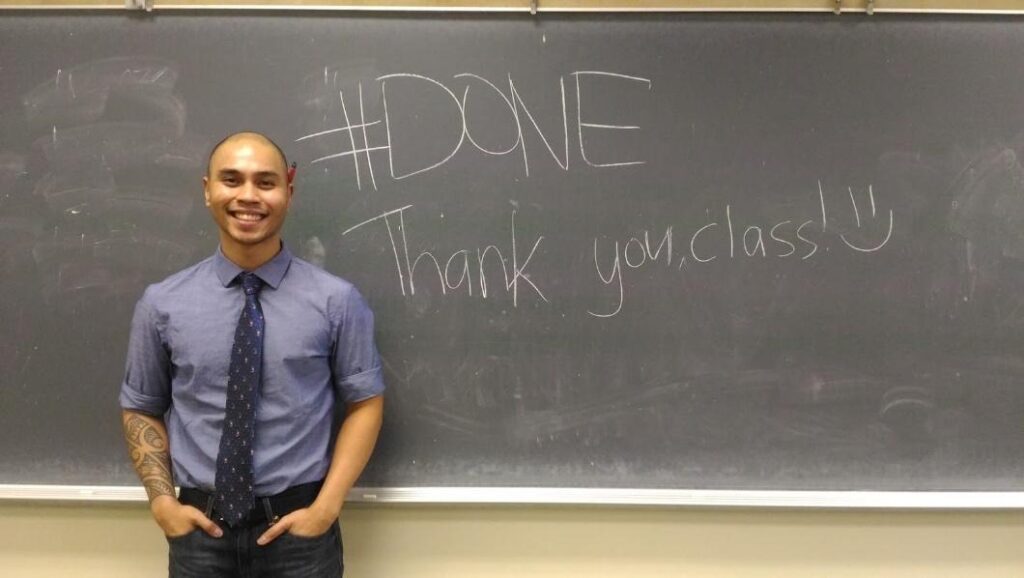
Author Jordan Luz stands in front of a chalkboard that reads, “#DONE Thank you, class :)”
(Image courtesy of Jordan Luz)

Alt text: Author Jordan Luz stands in front of a chalkboard that reads, “#DONE Thank you, class :)” (Image courtesy of Jordan Luz)

We also had the opportunity to give a demo lecture that involved a lesson plan, group activity and feedback from a volunteer audience; they were but the professors and graduate students from the department. Thanks to my masters’ syllabus teaching pedagogy and materials, it was all there. Also, my writing mentor training and working with fellow doctoral students helped immensely. I was placed in the classrooms and worked closely with the students helping them improve their writing, while also being given the opportunity to deliver sample lessons. This rigorous training led me to my first experience in teaching.

Whatever the training, the first classroom experience was nerve wracking. I knew English 100 by heart: free writing, the writing process, thesis statements, topic sentences, transitions, evaluating sources, everything was printed in my head. I had spent so much time engaging with them during graduate school. My major concern was I might mess these topics up and students may not make sense of what I was explaining. 

I thought about everything worse that could happen on my first day of teaching.

Lucky me, I had a great support system of fellow graduates, some of them also had prior teaching experience. We had a joyful nervousness; we were about to start teaching for the first time.

Array of questions ran across me, “I still look like an undergraduate student, can I teach?” 

“Can the students understand my lessons?”

“What if they don’t even listen to me?”

These were the common sentiments. I felt them more as the semester approached. I remember reaching out to Dr. Sarah Allen, my professor of Composition and Rhetoric. and coordinator of the fresh lecturer training series. I will always be grateful to her. Her words, “just do it. The students don’t know what you don’t know. You’ve been in the classroom. You know how it works. YOU can do this. Be yourself. Be honest with your students. I believe in you” still echoes in my ears.

August 20, 2018. The first day of the Fall semester. I wore a long-sleeve button up shirt with jeans and dress shoes, professional, but comfortable. My partner was in my office, helping me calm down. I even remember pacing in my little office in Kuykendall Hall. I also replayed Dr. Allen’s advice in my mind as I walked up to the fourth floor where my classroom was. 

Author Jordan Luz with his class
(Image courtesy of Jordan Luz)

I made my way to the classroom computer and pulled up the class roster and syllabus. Students slowly started to trickle in, I was nervous, an even mix of locals from Hawai’i and students from the mainland U.S.  

The class started, I was sweating profusely, but was able to find my groove once I started talking. I told my students how I was feeling and, to my surprise, they were 

nervous, college freshmen, after all. A new environment for us. It added to my ease. We would navigate this new environment together. 

The heaviness lifted off my chest once I got back to my office. Going through the syllabus and having the students introduce themselves wasn’t so bad after all. 

I shared my feelings with my partner, Dr. Allen and other first-time lecturers.  It turned out that all my nervousness was completely normal; the first day or the 30th day of teaching. I always reiterate Dr Allen’s words “You can be your own worst critic, but rather than focusing on what you did wrong, try to focus on what you did right, what worked, and build on that moving forward.” 

I’ve been teaching for five years now; I still get nervous before every class. It is perfectly ok to be nervous.

Healing Beyond Medicine

Patients, diagnoses, and treatments are my life.

As a medical intern, what else can I think of other than the whirlwind of patients? 

New challenges and lessons are what each day brings, but nothing could have prepared me for the encounter. An encounter that would leave a lasting imprint on my heart and impact my approach to patient care. 

It was a typical morning at the hospital when I received his case. He was diagnosed with dengue fever. After a thorough examination, I was asked to put in a urinary catheter as he was having burning sensations during urination. I discovered that he had smegma collected at the urethra, likely due to poor genital hygiene. This condition, though not uncommon, required a delicate approach to counseling the parents about the importance of that hygiene. 

As I walked into the consultation room to meet his parents, I felt a mix of emotions— empathy for the child’s discomfort and anxiety about how to broach the subject with his parents.

I took a deep breath, reminding myself of my duties as a doctor. My responsibility was not only to diagnose and treat but also educate and empower.

His parents’ love for him was evident, but as I probed further, I realized his parents were unaware of the essential steps of genital hygiene. They looked concerned and anxious as I gently explained the importance of cleanliness to prevent infections and discomfort. As I spoke, I tried to be sensitive and compassionate, ensuring I didn’t make them feel judged or inadequate as parents.

I drew parallels between routine hand hygiene and genital hygiene to make it relatable for them. Slowly, their apprehension began to fade. Their ignorance was now replaced by a genuine interest in learning how to take better care of him. I demonstrated the correct method and recommended age-appropriate techniques to teach him as he grew older. 

As I continued the conversation with his parents, I realized that connecting with the community was crucial. Any discussions about genitals were considered taboo, a resultant of a generational cycle of ignorance, and breaking it required not just medical knowledge but also cultural sensitivity. I understood that I needed to tailor my approach to suit their beliefs while ensuring his parents grasped the significance of proper hygiene.

Scrabble tiles that spell out “Shine your light.”
(Image courtesy via Brett Jordan via Unsplash)

His case instilled in me a sense of social responsibility. I immediately proposed a project for the tribal population, offering encouragement and support as they navigated this new chapter of a subject long considered taboo. Initially there was resistance but with time, they became more comfortable discussing their concerns and asking questions.

The success here encouraged me to host awareness programs addressing common health-related misconceptions and promote open conversations about hygiene and health. My aim was to empower parents and caregivers with knowledge to ensure a healthier future for him and children like him.

A physician’s room with an exam table under a window.
(Image courtesy of charlesdeluvio via Unsplash)

His incident taught me an invaluable lesson–that compassion, patience, and cultural awareness are as important as medical expertise. As a doctor, I learned the privilege of Healing Beyond Medicine was by building rapport and trust with patients and their families. Through these efforts, I hope to witness a transformation within the community. Parents should feel more confident seeking medical advice, and conversations around health must become normalized. Being a medical intern not only taught me medical skills but also the profound significance of doctor-patient counseling. Empathy, warmth, and understanding can bridge gaps and lead to lasting changes in patient lives. 

My journey with him and his parents taught me that true healing goes beyond prescriptions. It involves a genuine connection with the community we serve and a reminder that no issue is small and, if tackled properly, it can lead to a huge impact in the community.