
The Eternal Quest For a Good Night’s Sleep

I haven’t always had trouble sleeping. 

About a decade ago, whilst studying for my master’s degree, I lived in a cramped room in a student house in Sunderland. For a full year, I would spend hours intensely studying at my desk before taking about five steps across the room and getting into bed.

It wasn’t a particularly nice bed. It was quite small, and if it hadn’t been for a strategically placed pair of drawers stopping me from falling out I probably would have been on the floor more often than not. And yet despite this, I would always fall asleep within an hour.

Fast forward to 2025, and I’ve upgraded that small bed for a nice double in a reasonably-sized bedroom. I also no longer have the stress of multiple exams and essays hanging over me, so it stands to reason that I would have no trouble falling asleep.

But for multiple reasons, the last five or so years have proven to be challenging as I’ve grappled with insomnia. And despite reading countless self-help books and taking several steps towards creating a better sleeping environment, a good night’s sleep continues to elude me.

I’m quite lucky in that I can still function normally during the day – I get up at a reasonable time, I can still go out with friends and I’m still able to write for my day job – but my poor sleeping habits over the last few years have definitely taken their toll, and there will be some days where I’m too tired to do anything other than sit on my sofa and doomscroll.

It’s hard to pinpoint the main cause of my insomnia. While I’ve often had trouble falling asleep during my life, the issue has really exacerbated in the last five or so years since COVID-19 first reared its head. I don’t need to tell you that the last few years have been stressful for everyone, and there’s every reason to believe that this is the main factor. I also have obsessive-compulsive disorder (OCD), which can lead to intrusive thoughts keeping me awake at night.

Whatever the reason, insomnia has gone from an annoying, but manageable condition to something that was starting to have a real impact on my life. The time had finally come to do something about it.

Improving my sleep hygiene

Go onto any website or read any self-help book about insomnia and you’ll see the term ‘sleep hygiene.’

Essentially, sleep hygiene describes the healthy habits that can help you get a good night’s sleep. This can range from your sleeping environment to what you do during the day.

In the last year or so I’ve started taking these things more seriously, whether it’s creating a nicer sleeping environment (no screens in the bedroom) or thinking more about what I’m doing during the day (eating healthily, no social media in the evening).

There’s a long way to go before I’m getting into a consistent sleeping pattern, but the early signs are encouraging. Simple acts like leaving my phone downstairs or reading before bed are already starting to have an effect, and I’m finding it easier to fall asleep, although I still find myself waking up randomly during the night.

I’ve also found that taking time away from social media (and the internet in general) has had a big effect. With 24/7 news and constant scrolling on social media, it can be incredibly difficult to switch off, even when I can tell that it is having an adverse effect on my mental health. The trick is to put as many barriers between you and those things as possible, whether that’s deleting apps, setting a daily browsing limit, or leaving your phone somewhere else, gradually spending less time online has ultimately had a big impact on my mood and my sleep hygiene.

Still, there are some elements that I can’t control, namely the recent heatwaves in the UK making it impossible to cool down enough for sleep and my dog, who likes to take up most of the bed (and who am I to stop her?), but with a few simple steps I’ve managed to greatly improve my sleep hygiene, and I’m hopeful that as time goes on I’ll be able to say goodbye to my insomnia for good.
If This Year Went Too Fast, The Fault Is In The Planets

Every December, I am reminded once again that I come from a country where Christmas is not part of our cultural calendar. In Iran, we follow a solar calendar that begins in spring, not winter. Our New Year, Nowruz, arrives with blossoming flowers, warmer days, and the promise of renewal. It makes intuitive sense: the Earth wakes up, and so do we.

So even after all these years of living outside Iran, I still cannot quite get used to the idea of celebrating the start of a New Year in the coldest, darkest moment of winter. My body insists, “This cannot be the beginning!”

But ironically, when I lived in Iran, where I was not expected to care about Christmas, I was forced to care. Why?

Because the rest of the world shuts down.

Which means:

  • application deadlines have moved earlier 
  • research funders disappear for two weeks
  • collaborators vanish into holiday mode
  • offices send out-of-office replies

And as if that wasn’t enough, only two months later, another wave of deadlines arrived, right when Iranians were preparing for Nowruz.


So I lived in a double-deadline universe.

But then, as an astronomer, I realized something comforting:

This is all Earth’s fault.

And strangely…
Earth deserves some credit.

On Mercury: deadline panic, every 88 days

Imagine living on Mercury.
A full year is only 88 days long.

Which means:

four grant/tax cycles 

constant “end-of-year” reflections and resolutions

Honestly, Mercury sounds like a cosmic nightmare.

On Saturn: great view, terrible timing

Then there is Saturn; majestic, stunning, photogenic.
If I lived there, I would wake up every morning to an Instagram-worthy sky filled with golden rings.

But a Saturnian year is 29 Earth years. 

Which means:

waiting nearly three decades just to say, 

“Happy New Year! How have you been since… 1997?”

The rings might be beautiful,
but waiting 29 years for a holiday would test even the most patient among us.

On Earth: a perfectly imperfect compromise

And so, despite all my complaints that
the winter holidays that feel upside down,
the double sets of deadlines,
the confusion of trying to celebrate in one calendar while living in another,
I have to admit something.

Earth sits in exactly the right place

Close enough to the Sun to avoid freezing,
far enough to avoid burning,
tilted enough to give us seasons,
and spinning at just the right pace to make a year …

not too fast

not too slow

just right

So this Christmas…

Whether you feel the year has rushed past you or dragged on endlessly,
whether you celebrate Christmas or Nowruz or something entirely your own;

Just remember:

On a cosmic scale, Earth has given us the best possible calendar for both living and dreaming.

And enjoy the holidays, however and whenever they arrive for you.

And if you ever feel overwhelmed by deadlines, just be grateful you don’t live on Mercury.

Is it Me, or Are We All “Stacking Grinds”?

All time must now be quality time

Ah, the grind. The 40-plus hours a week of earning my keep whilst trying to keep soul and sanity intact. There’s not much I can add to the endless commentary on this reality. What interests me most on this topic is that contemporary living seems to be centered around the grind on top of the grind. Or should I say, the grinds on top of the grind. The stacked grind, if you will. It’s as though our increased reliance on machinery and automated processes has changed our expectations of ourselves — that we, too, should have a certain level of productivity at all times. Ever productive, ever optimal. 

Sustainable, optimal, valuable. Execution, success, failure. This language is the perfect fit for operating businesses, quarterly board meetings, and machines. It’s far from a healthy or perfect fit for people, though. Machines were only ever brought to society to bring results. Unfortunately, not only are we not machines, the results of our productivity are rarely as important to us as the process of being busy itself is. Aren’t we all about the process, the journey? The results and the destination aren’t ever that relevant. Maybe that’s how this obsession with the grind came to be; we wanted to chase that high of being productive at all costs, at all times. Is this grind stacking a result of industrial brainwashing? Are we collectively turning ourselves into mass machinery, becoming something we were never meant to be? 

Optimally

I’m trying to work out what optimal means for myself, and I’m looking around at my peers. What I’m observing is curious. Those in the deepest of grinds, chasing work, gym, social, vocational, and status goals seem the furthest from happiness. The people closest in my life, who have the best slice of happiness, are doing quite the opposite. 

These people are far from gym rats: padded, not iron board flat, and far from worried about how photogenic they are. Selfies and social accounts aren’t really these people’s deal; they are more concerned about school catchment areas than their waistlines. They don’t ask for much, money is responsibly watched over, not idolized with a giddy dream of more. Despite the lack of striving, thriving, “optimal;” they appear to have what all those chasing optimal don’t have — a noticeable degree of contentment and peace with themselves and their lives, which I admire.

The stacked grind is insane, and yet, it’s normal for many. 

I’m writing this as I attempt it on my own. I’ve got the 40-hour a week job, the 3–4 workouts a week, the clean diet, the regular social hangouts, and as the author of this piece — wouldn’t you know — my vocation, my calling, my “side hustle” is writing.

Grinding to a… burnout?

I’d be lying if I told you I don’t wake up some Saturday mornings and feel… flattened. I’m still a young man (relatively… my twenties have been and gone; toll the bell, please) and yeah, I’m tired. It would also be dishonest of me to tell you I’m not after “optimal.” And, frankly, it would be dishonest of me to tell you I know what optimal means for myself. When I look around and see my peers after the same thing — this elusive idea of optimal — they appear equally bewildered at the input-to-reward ratio of grind stacking. 

Ha, there I go again, talking in ratios. Machine, much?

With all of this stacking and pushing for optimization in our lives, am I the only one who  foresees the inevitable outcome — burnout?

This contemporary burnout culture worries me, and maybe because I’ve experienced it myself. An utter internal flatlining was my burnout. Unable and uninterested in relating to much and full of fear. Thanks to the travelling I was soon to do, I did get months off work to recoup. What really shook me was my genuine anxiety over returning to work when the time inevitably came. 

People more disciplined, educated, and capable than me have burned out. Lawyers, doctors, nurses — all professions admirable but a likely disaster in these hands — sidelined and flattened through overexertion. Burnout is not specific to geography. I’ve seen burnouts in Australia, New Zealand, the UK, the U.S., and Norway. We’ve never had more provincial safety or material comfort. In some sense, we’ve never had it so good. 

Maybe it’s because we’re expecting and wanting more than ever before. Previous times had people working longer, harder hours with less to aid them, and yet burnout was not in their lexicon. 

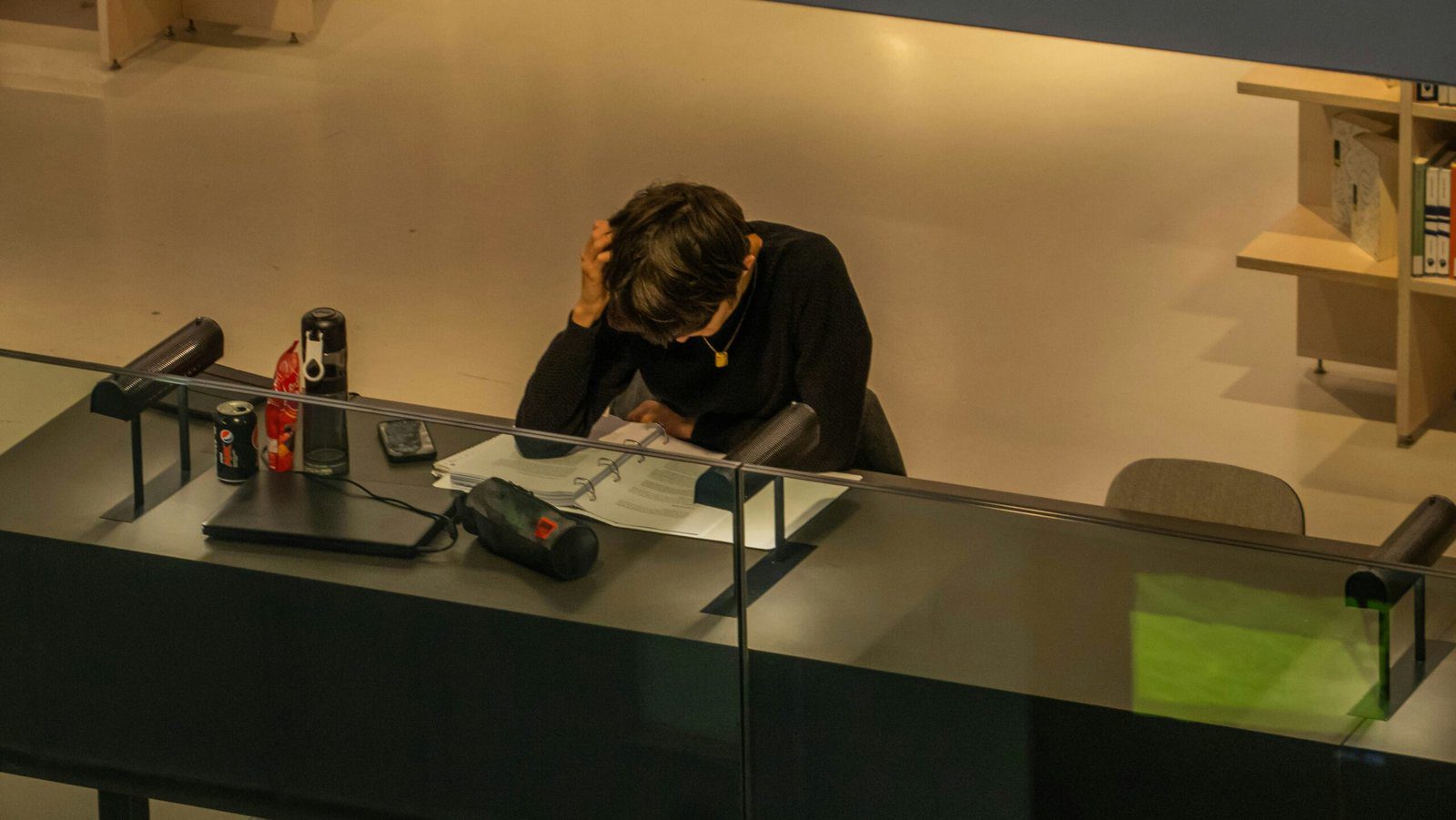
Image of a person holding their head in their hands in a cluttered space.
(Image courtesy Christian Erfurt on Unsplash)

Will the grind measure up?

When our elders look back, they don’t regret what they have done — they regret what they didn’t do. In this respect, we might consider more stacking. However, the free spirit in me very much wants to savor the juice of life. While I can, when I can, go for all of it, the good stuff. A very best attempt to squeeze out every last drop.

I’m observing the struggle of the grind and not its raving success. There are surely people who can and do hit the robot groove: up at 5, supplements, exercise, work, date night, and a chartered flight the following morning. For the select few who do not find their mortal limits screaming at them in this process, I applaud them.

Yet it is the tenor of our grind-into-burnout culture that unsettles me. A Buddhist proverb says, “Each of you is perfect the way you are, and yet, you can use a little improvement.” 

I feel our current culture emphasizes the last part of that phrase — with scant regard for the first.