
Recidivist Phantoms

It was some 18 months into the AI overhaul, and a pattern began to emerge.

It started with just instances, here or there. There was no great wave. There were just punctuated happenings, miles apart, entirely without relation. Though, over enough time, droplets made up an ocean.

Prison releases in any iteration of society had always been a complicated matter. The statistics were seldom positive on the side of rehabilitation. Worldwide, recidivism was a reality – between 18% and 55% of released prisoners could return within two years. Even in a day and age where western penal systems found themselves creaking with overpopulation, there was no immediate remedy for the complications of life after release.

Irrespective of their sentences, fundamental issues of housing and having any kind of reliable support or income stood in the way for a significant proportion of released individuals. That’s not to say many couldn’t go on to form a stable life, but this was, of course, entirely conditional. Public support was high for businesses hiring ex-offenders, but promising outcomes remained low. Those who could rejoin the workforce knew the barriers they were heading towards.

Barely 15% found themselves back at work within six weeks of release, while a little over 20% received employment after six months. These were the fortunate few, typically with support systems in place for them, and low-wage, low-security work their means of money. Ultimately, the broadest of barriers to life after prison were stigma, mental health complexities and homelessness. Yet, something began to change, to show up, bit by bit, across international probation reports.

***

Jobs were being vacuumed up at light speed as juries became a thing of the past. AI became the replacement for judges and every last piece of visual media’s origins and intentions were entirely unknowable. The most affluent of areas segued into universal basic utopia, while the most deprived areas became enclaves of isolated desperation. The world had become a fully automated riddle. Few roles remained for human beings, yet low-wage, low-security work, deemed befitting of released prisoners, was still available.

Probation officers were also among the remaining jobs, relying on some last human faces to reintegrate other human faces into society upon their release. Curiously, the ex-offenders who managed to gain interviews and employment started to display peculiar trends across their probation reports. Ad-hoc, instantaneous compiling of information meant AI noticed these patterns first. This notice was soon passed on to their human counterparts. Abby Nelson received hers via email the night before her 9:45 am appointment with a Mr. Derek Rogers.

Some months ago, Abby weathered the initial shock of being reposted to the role of a Probation Officer. She did though, with enough experience, acclimate and soon counted herself lucky. Firstly, she had a job. Secondly, she had a job that was solely based around people with acute needs; her role was necessary and desired, and it most certainly should have been carried out by a human being. Abby found herself as much an agony aunt as a useful resource to many of her clients. They were simply trying to get through, consistently trying and applying in hope that a stable job would materialize soon.

She often ruminated on the fact that poor literacy is one the most profound themes of prison populations, and, while it stands as an obstacle to employment prospects, this can also result in remarkably expressive, poetic, and connected speakers. Without the rigidity and constriction of schooled literacy, individuals often found themselves adept as perceptive talkers and listeners. They might not be able to recall the pedantic insides of a peer-reviewed academic textbook, but they could distinguish a lie from the tone of a voice. They knew the threat of manipulation from a pressed syllable. They also recognized a good soul from a bad one, all from the choice of words and their delivery. Abby relied on this fact, and respected it, as she approached any client conversation.

Derek was a success story. Abby had always found him polite and straightforward. His sentence had been four years for, in his own words, “getting up in business that was none of my business.” He didn’t reek of self-loathing or wanton mental health crises as so many releases did. Abby saw his story straight; Derek had fallen for an offer to make quick money in a moment of weakness, and he’d been caught in the act. He accepted his sentence and made no bones about his crime, following a quiet, drama-free sentence: he was released.

Derek’s life story was one of a self-made man, and his life after release continued that motif. Within two months he’d secured a single room flat and began to make a modicum of regular income as a plasterer and plumber. He also kept himself well clear of anything nefarious. With an ex-wife “somewhere out there” and “few friends worth talking to,” Derek was a fifty-something in the process of reintegration and, ultimately, doing incredibly well.

***

Abby and he had been seated for some ten or so minutes before she realized something was off. Derek always sat to face her and was somewhat chatty. He had the slightly grating, chauvinistic habit of calling her “Abby girl.” However, Abby weighed this endearment against every other name prison releases had called her in the past months and decided to recognize its warmth. Today, though, Derek wasn’t chatty. He gazed out and away from Abby and… he looked tired.

“Is everything okay, Derek?” Abby implored, genuinely hoping bad news was not afoot.

Derek shuffled a bit in his chair. He half-muttered under his breath, interrupting himself from responding more than once. He briefly glanced back at Abby and let out a little chuckle before setting himself. His eyes shifted to another corner of the room while he said,

“What is it? This… AI? This, this new world. Photographs, now videos. Vehicles with nobody driving. None of it real. You know, even when you walk down a street full of people – it feels empty. Nobody… talks anymore. Don’t even acknowledge your walking on the same street. It’s quiet but the cars. My last three jobs; I get sent the job on my email, I go to the door, I’m answered by the door bell… I didn’t even see the last three people whose homes I was in. There were no photos on the walls, either. It doesn’t matter where I take a job, it’s the same everywhere I go.”

Derek looked up and out, ruefully, mournfully.

“Is… is… this it? Dead streets. Nobody behind the counter. Talking to a computer. Everything’s a computer program. It feels cold. The whole thing, it’s… it’s… not like people live here anymore. It’s like everybody is scared. Too scared for a greeting. Too scared for even a ‘hello’.”

Derek looked pained. His voice softened. Abby’s throat felt dry.

“A child spat at me.”

His gaze set upon Abby once more. His face stopped moving; his eyes felt hollow. 

“Just a little thing. 5, maybe 7 years old… he – it, didn’t hit me. But… the mother… she moved her kid away from me. Didn’t confront or discipline him. Didn’t make an apology. She grabbed him and moved away… like I was the problem.”

Derek paused.

“That’s not about me. I have no sign on my head. People don’t know I’ve been to prison. They can’t read minds… this is people. People are just scared.”

Derek briefly brought himself back from his thoughts, back to Abby, back to the present. He began with an exhale,

“Abby girl, I may be talking crazy, but… and don’t misunderstand me when I say this… I don’t ever want to… do something stupid again. That’s not what I’m talking about. Don’t misunderstand me. But can you believe me when I say this; I had a dream the other night of being back inside. Do you hear that? This… out here… there’s no society. I can’t believe I’m saying this, but I think something in me wants to go back.”

Abby sat in silence, looking at the glassy wetness filling Derek’s eyes. This was as honest and intimate an exchange as she’d ever had with a released prisoner. Abby didn’t know where to begin.

The email memo she’d received the night before was as if prophecy:

En masse, successfully reintegrating prison releases were longing to be back in prison.

Ctrl+Alt+Layoff

“So, you’re a pro at this. You know what you need to do.”

My therapist was trying her best to cheer me up amidst a shitstorm — our country falling apart and my being laid off. It will be my third time —I have to submit for unemployment again. 

“Imagine if this was your first time around,” she continued. “That’d be even worse — trying to figure out what to do with all of this happening. So, you at least know what you need to do.”

Where’s the safety net?

Thing is, I wish I didn’t. 

I actually don’t remember what I need to do at all as I write this. My brain has blanked out those parts of my memory, likely in an attempt to preserve a shred of my ego.

I hate this. I’m a proponent of welfare systems and safety nets — have been for as long as I can remember. I’ll tell you wholeheartedly that people who end up unemployed deserve help, regardless of what happened. I still stand by that.

I’m also the person who was always commended for my diligence and work ethic growing up. The overachiever. I never did the bare minimum. To do that would be to fail, to be lazy. And now, here I am, completely through no fault of my own — according to my former employer.

The one needing unemployment benefits for the third fucking time in my life.

I’m trying to apply now as I write this, and lo and behold, the NYS Department of Labor unemployment website is down. That feels… ironic? Fitting? Like some sort of sign from the universe stating a message in big, celestial letters? I don’t know anymore.

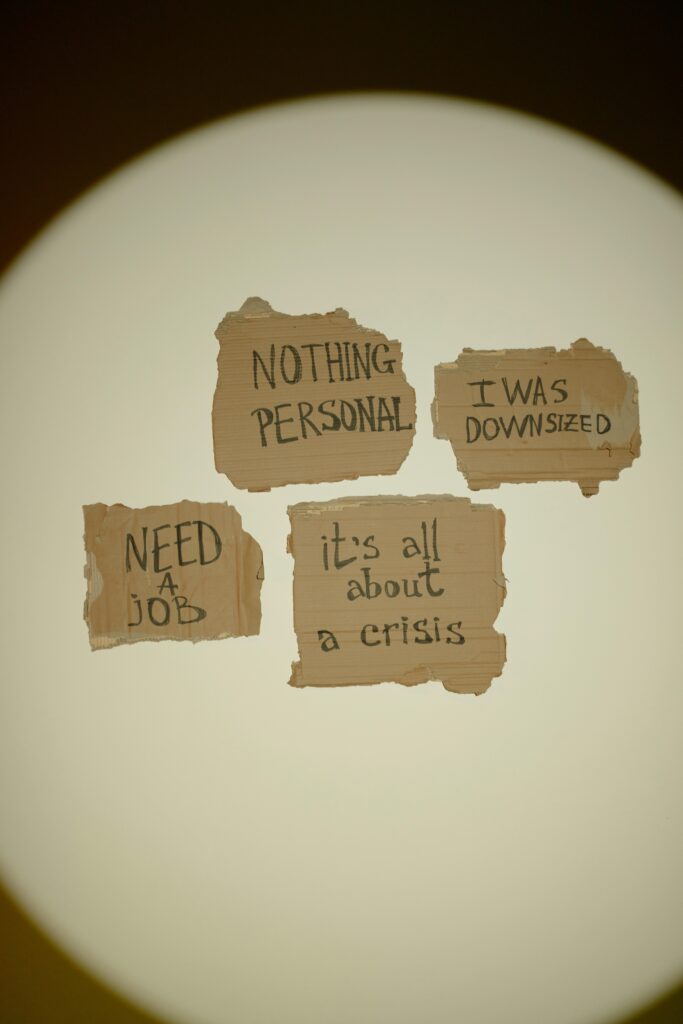
From the inside then to the outside now

(Image courtesy of Cottonbro Studio via pexels)

Here’s the thing: I interviewed people in my last three positions. And that’s how I know that all of these recruiters online saying you just need to tailor your every cover letter more or “use your network” are entirely out of touch with reality.

For one role,  literally over 700 people had applied. The founder of the company, because it was just the two of us at the time, asked me to do a first pass — and maybe a second and third. Out of those 700, maybe half fully met the qualifications. So, we had 350 individuals. 

We couldn’t interview them all, especially with just the two of us. We had to become pickier. So, who had more experience? Who had a more robust portfolio? Who had more education? On it went, until we could finally narrow it down to 15 or so individuals for an interview. 

We could hire only one person out of the 350, all of whom could definitely have done the job. We had to choose one

What do you do in that scenario?

Fast forward to another position, and my company was hiring for the person who would become my manager! It was very exciting, given that our marketing team was so small — just two of us — and we desperately needed the support. 

I can’t recall the exact number of individuals I helped interview. What I can say is that they had started interviewing for this position at least three months before I joined; it wasn’t until four or five months into my working there that they finally hired someone for the job. 

There were plenty of applicants, but some folks involved in the hiring process — who were much higher up the corporate ladder than my coworker and me — found something wrong with almost every single candidate. 

Some of the reasons: 

“He doesn’t seem to learn ‘actively’ enough.”

”She probably wouldn’t be able to push back against the SMEs (our experts) when needed.”

 And, of course, the classic, “Her attitude wasn’t great.” 

Eventually, they made a decision. It worked out that the person who was hired became one of the best managers I’ve ever had. Only for him to be laid off less than a year later.

At another job, we were hiring for an additional marketing team member — something we very much needed. I don’t know the total number of applicants. All I know is the three of us in the marketing team were provided about ten or so resumes and portfolios, give or take a few. The ones that had made it to this stage where we were interviewing them had already passed the initial interview process, so they clearly were qualified. 

So, how do you choose then? That answer depended on who you were talking to. 

Honestly

One applicant made a joke about Star Wars on their resume, and one of my coworkers thought that was too “cringe” to take him seriously and decided not to move forward with him.

Another applicant made the mistake of telling the truth. She confessed lacking knowledge in a specific area when another interviewer told her, “There are no wrong answers.” This coworker, after the meeting, explicitly stated that they had said the purpose was to “make the candidate feel more comfortable being honest,” so they could discern whether or not she had the right skills. Her honesty was her downfall. 

I know ethics can be subjective, but I was highly disturbed by this action.

So, no. It’s not about tailoring your resume or writing a perfect cover letter. And networking? It’ll help, but only to a degree. 

You need to have everything lined up — the experience, the tone, the timing.  And then you need a hiring team whose subjective views will accept you out of hundreds of equally qualified, if not more qualified, applicants.

I’ve seen both sides. Honestly, they’re both awful.  But at least on that side, I was getting paid.

Money, please

(Image courtesy of Nicola Barts via pexels)

It’s not like I’m doing nothing at all. I still have my dog-walking and pet-sitting side gig, and I’m doing a little freelance work here and there. I also hold a volunteer position, much as the title I have there gnaws at my imposter syndrome — Director? Me? What could I possibly contribute that would make it right for me to be the director of anything? I can’t even keep a fucking job.

My job tracker stares back at me as I type this. Sterile-white spreadsheet cells. No hope offered. Over 300 applications now — full-time, part-time, freelance, contract. And only two calls back. 

Well, technically, three. I had a recruiter reach out to me for a position with a major social media giant whose CEO met a revelation of needing more “masculinity” in the company and had just laid off thousands of highly qualified individuals. I turned down that conversation and job, thinking ‘You want male energy and called a Jessica; you’re a pig and called this Jessica; and if I took the job out of need despite all that, I’d still get canned due to the wrong energy field.’ Maybe only to also be labeled as an underperformer, with no evidence to back up that title.

I may feel like a fraud half of the time in my work, like I don’t deserve my title or my salary, but I know I’m not an underperformer. I am Jessica Day. If nothing else, I am a hard worker.

And yet, I’m left here with so many questions. So many frustrations. So many concerns.

How long will it take me to find a job? 

Will I ever find a job again?

Am I bad at everything I do? 

Am I always going to be laid off or furloughed? 

Is this going to happen again? And again? 

Can I trust any employer? 

Is it me? Is it them? What is it? 

Why has this happened? 

Why is our economy here yet again? 

When will people stop using “unprecedented” to describe this shitty moment in time? 

Will my generation ever know any semblance of calm? 

Will we ever be able to buy houses and have families and just have normal fears like what milk to buy instead of whether or not we can afford groceries?

I don’t know. 

I don’t know I don’t know. I don’t know. I don’t. Fucking. Know. 

I wish I knew.

Where do we go from here?

(Image courtesy of Ron Lach via pexels)

In the meantime, I’ve been tracking the layoffs happening in our country. I’ve currently tallied tens of thousands of individuals laid off since the beginning of January. I’m one of the many. 

It’s horrific to think of everyone who’s lost their position, their livelihood. They lost their stability, their sense of direction.

And no, they can’t all be underperformers. That’s highly improbable, as anyone with any understanding of statistics could tell you.

Spiraling would be the word I’d use here. For myself. For the economy. 

There’s no easy way out of this situation, and everyone has their own idea of what the best way out is. The fact is, there is no best way out. 

I have a friend who just finally found another job, and I’m so proud of and happy for her. She’s worked with globally known companies and at an upper-management level. It still took her over six months to finally land a job offer — and as a vice president no less, which is very exciting and so deserved. 

But I look at her, with her impressive resume and years of experience, and then I look at mine….

It took her over six months. 

How long will it take me? 

What if my partner loses his job, too? 

Will we be able to survive? 

Will we ever find jobs again? 

Will we be able to retire? 

Will we have Social Security?

See how the spiraling is easy to fall into? 

Once you fall in, you can’t pull yourself out.

But I’m a pro at this, as my therapist said. Not just applying for unemployment, though still feeling shame, but also surviving scary events in history.

I’ve lived through the ice storm of ‘98, Y2K, the dot-com bubble, the 9/11 attacks, the 2008 financial crisis, the H1N1 scare, COVID, and now… whatever we want to call this chaos we’re living through that is our entire world right now — right alongside the rest of my generation.

I’m a pro at surviving. 

I can do this. 

I’ve got this.

Right? 

right?

(Image courtesy of Luca via pexels)