Humanity explores the human condition and what it means to be alive in today’s world. Sometimes, this can be practical, lived politics as they impact our lives and how we seek to change the world around us, or a distillation of those experiences we have yet to fully unearth, in the gaps and fringes of ourselves.
I wasn’t always into punk rock. The first genres that I was into were classic rock and metal. The first album I picked for myself was Guns N’ Roses’s Appetite for Destruction. My first concert when I was in the sixth grade was a Kiss concert. It wasn’t until I was at a friend’s house playing NCAA Football 06 that I heard my first punk song. The NOFX song “Jeff Wears Birkenstocks”came on, and I was instantly hooked. NOFX still stands as one of my favorite punk bands. Over the years I started getting into other sub-genres of punk and becoming interested in the culture. It wouldn’t be until recently, within the past six years, that I would get my first pair of Doc Martens.
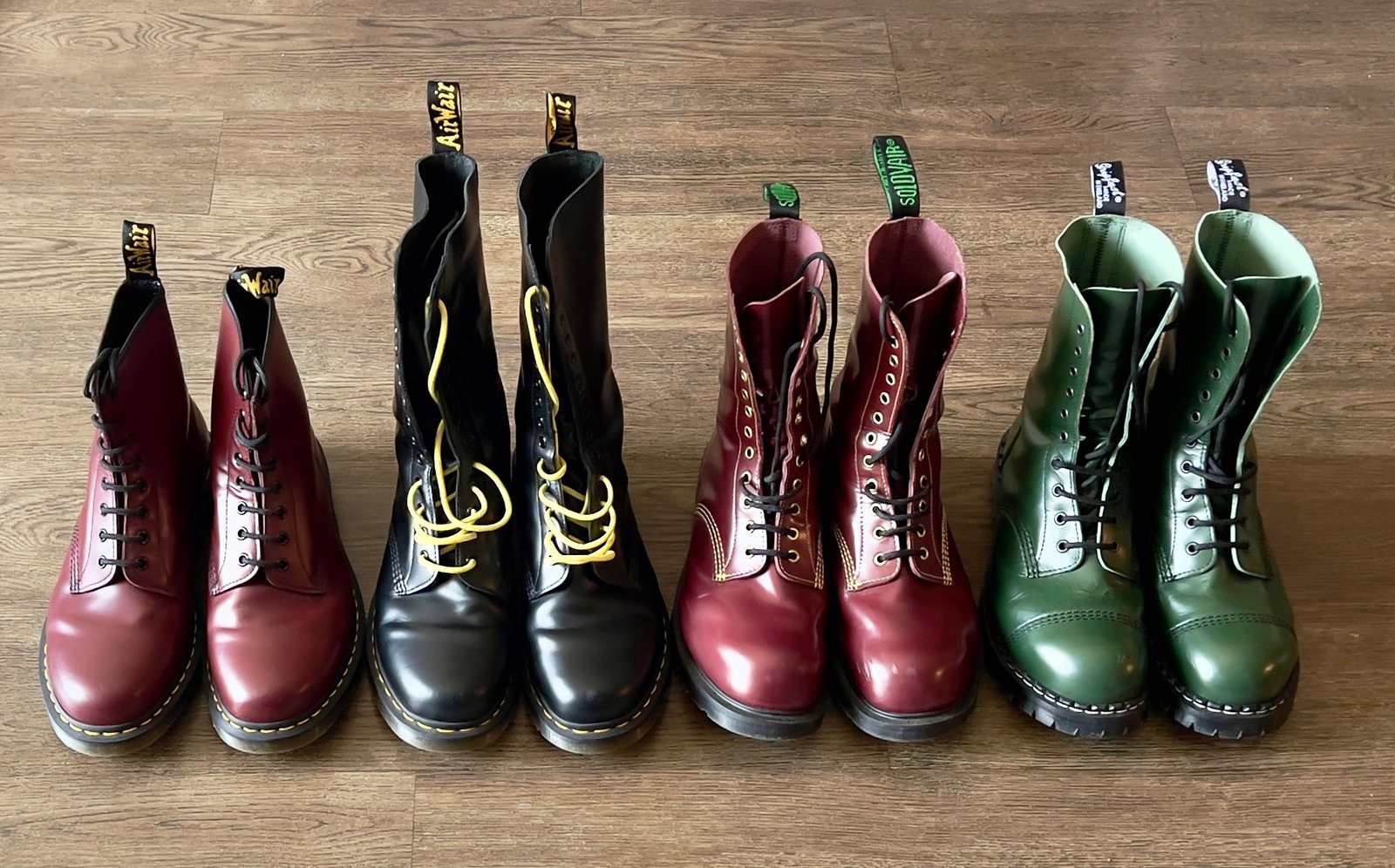
My boots
A pair of 1460 smooth leathers in cherry red were my first pair. I chose these because they are a smaller boot, and seemed like less of a commitment in case I wasn’t into them. My only regret was not getting a more substantial pair first. My second pair, 14 eyelet 1914 Doc Martens, a taller boot, made more of a statement. This is the pair that would introduce me to colored laces and their importance. Unlike my first pair, which came with black laces, the 1914s came with yellow. There was a small paragraph explaining why yellow had become the staple for Doc Martens. It was chosen as a symbol against racism. There had been issues of extremist hate groups infiltrating the punk scene, which led to distinctions in lace color. I’m glad I read it because I almost made a crucial error.
White and red
Both white and red have strong ties to hate groups. White represents white power and subsequent ideologies, and red is for neo-nazi gangs. Red can mean the individual has committed a violent act. But red may also be worn by anti-fascists. Given the negative associations I’ll never sport either color, even if the meanings dramatically change. Not only do these colors represent things I stand against, I must consider the way I look. I’m a paper-white male who shaves his head. I’ve even been in the unfortunate situation of being greeted by a Huntington Beach skinhead gang member at the beach. I remember the greeting being something to the effect of, “Hey, brother.” I wasn’t even wearing anything that could be misconstrued. Black board shorts. It was simply because of my physical appearance and where I was. I ignored him and haven’t been back since.
Blue and green
Blue began as a way to identify individuals who had killed police officers, but I was unable to find evidence supporting this claim. And SHARPS, the group known for wearing blue, wore them as a symbol against racial prejudice and police brutality. Even though I align with those sentiments, the possibility of me wearing blue laces is low; I don’t want to be associated with groups of which I’m not a member. It reminds me of a biker bar near where I grew up. It was best not to wear red or green; the Hell’s Angel’s (red) and Vagos (green) MCs were known to go there. Running the risk of wearing the opposite faction’s colors could get me into trouble. Green is considered neutral in the States but can also be associated with anti-fascist groups in St. Petersburg. I’d rather err on the side of caution and forgo green altogether.
Black and purple
Black is the standard color and has no affiliations. It’s the color that is on three out of four of my boots. It’s a neutral lace that is always okay to wear. Purple is another color I would never wear, but not because of any negative implications. Purple laces are associated with gay pride. Being cisgender and straight, I wouldn’t find it appropriate to don these laces even in a show of support.
Narrowly dodging ignorance
Many people never give a second thought to the color of their shoelaces, even if they change them out for a new pair. When it comes to a pair of Docs or similar pair of stompers, lace color is significant. I almost made a mistake before I knew what each color represented. I came very close to buying a pair of white laces only because I thought black and white would look cool. Thankfully, I read that paragraph when I bought my second pair. I feel embarrassed about how close I came to being that ignorant; I hadn’t realized how many subliminal messages might be intertwined with the color of bootlaces until then, and I’m truly glad I found out before making such an error.
I’m all too familiar with that clench in my stomach when I first enter a room, knowing it’s full of strangers and not a familiar face in sight. From childhood and well into adulthood, most of us worry about relationships or connections to alleviate loneliness, myself included. Making friends is part of our nature, forming packs or groups to make it easier to survive.
There are a myriad of reasons for me to make friends. Sometimes, though, there’s even more to let them go.
Can I? Should I?
Relationships serve a purpose, whether they are short-lived or long-term. Many times, though, the acquaintances I’ve made are just that: acquaintances. Often, I think to myself, “I really should reach out to that person and see how they’re doing. I should get around to seeing if they want to hang out with me.”
But do they even like me? Am I coming across as annoying?
I would send a text or message to ask how their life is, and I would get either one or two responses back — sometimes no responses at all, and that’s where it hurts. Our half-hearted exchanges show that we’re not in each other’s lives anymore, despite our once-lengthy conversations into the night. I sometimes feel like I’m the only one carrying the discussion. The group chat where memes and jokes were constantly thrown around has been quiet for years now. The childhood friend I’ve known literally my entire school life from kindergarten through all of college is no longer there. We’ve all moved on to pursue different careers or relationships, and we can’t go back. Our roads have diverged.
But that’s okay.
It has to be. And it will be — eventually.
Distance is hard, but also helpful
I’ve gone through my fair share of relationships. We swear to keep in touch, to not be a stranger, to reach out and keep each other in our thoughts. But it’s hard. Proximity keeps them in sight, making it easier to engage, to laugh, to share memories. To overlook irks, red flags, or disappointments. When they’re not right in front of me, how do I maintain that level of closeness? Is it yet possible for us to maintain the connection?
Or is it time to move on?
In other situations, our personalities just didn’t jive, or they felt like a negative influence in my life. I shouldn’t have to validate their happiness with my unhappiness, should I? It hurts when others think I’m being childish or insensitive, but I don’t want to have to justify their negative behavior to make them feel good about their life choices. Toxic relationships can be detrimental to our happiness, whether it’s family or friends — and it hurts more the closer we are to them. I want to stay by their side because they’ve known me the longest, so how can I accept that they don’t need to be in my life anymore?
I’ve found myself at the teetering point of a few relationships recently. They were great work friends, and we’ve spent a lot of time together laughing, eating, and enjoying life. So when it came time to quietly let them go, it was neither easy nor sudden. I had to come to terms that I couldn’t reach out to them quite as easily or look forward to seeing them in person again. We weren’t working together anymore by that point, and we lived in different parts of the area. We didn’t particularly share any recreational activities or hobbies, and our tastes in music and movies were vastly different. It was one of those situational relationships where it worked until the situation changed.
(Image courtesy of Duy Pham via Unsplash)
Relationships serve a purpose
Biologically, we look for others to be with because there’s safety in numbers. It helps alleviate the burden and stress, both physically and mentally. It makes it easier to tolerate loneliness because we have precious memories to think of fondly.
I have many lifelong relationships that I’m thankful for. Some I’ve found late in life, and some after much heartache — some even after we’ve diverged and forced our way back into each other’s way. I’m grateful for the friends I have now, and also to the ones I’ve had to let go. For the sake of my happiness and well-being, it’s healthy to reevaluate relationships once in a while to gauge just how much better my life is with them. But I also know I need to focus on learning to love myself; only then can healthy friendships grow because I know exactly what I should be looking for, what I need in a friend.
I like to believe my past relationships were mutual understandings. We needed each other at that moment, and we’ve served our purposes. Could I have put in more effort? Yes. Could they have as well? Also yes. Finger pointing and victim blaming is impractical because there’s always going to be another chance to be better, and I’m grateful for that opportunity — to be an even better friend to those I’ll meet in the future. As a millennial, I’ve often lamented that it’s hard making friends my age, but it’s not impossible. I know that now.
About 15 years ago, I lived in a little corner of West London that played out like the Wild West of the city. If you say West London to most people from the UK, they think Mayfair, Harrods, and the King’s Road. The stereotype is one of opulence: Chelsea tractors — SUVs common in the wealthier parts of the city — flawless complexions, and foreign nationals with bottomless pockets, all examples of how the other half live.
This was not my experience of West London.
Oh, I had a place in Kensington. But it was Kensington in title only: pre-gentrified and somewhat forgotten, buzzing, humming, and possessing a discernible edge. It’s what Londoners call ‘lively’ and what others may call ‘seedy.’ At first, I couldn’t have been happier. It was a studio, but the idea of self-sufficiency, of living on my own, as someone barely past 19 years old grabbed me. It harkened back to what father once glowingly advertised as the colloquially-known ‘bedsit living,’ you could simultaneously shave whilst cooking your eggs in the morning.
But things changed at night, the street transforming as the sun went down. It was as if the shift in light was a cue for subterranean, darker, malevolent energies and presences to emerge. Night would be the setting, but the underlying note to it all would be a single, recurring sound. It would be heard again and again and again.
“Amigo, Amigo.”
This was not a noun; it was a name. Amigo was the big dog, the kingpin, the Capone, the Heisenberg. Amigo was no amigo, as I’d come to learn from a slow but steady grasp on my surroundings. From 9 p.m. ‘til 4 a.m. near every night, “Amigo” would be heard. A man’s voice, a woman’s voice, a delicate whisper, a powerful shout, desperate, friendly, elated, deflated, and always, always with a rattling knock on a ground-floor window. To my great discomfort, it soon came to my attention that I lived at number 12, and Amigo lived at number 10.
Between faded orange street lights offering a dirty glow for illumination, the sound of sex in the air come summer, and Amigo’s clientele, I’d chain-smoke Chesterfields by my flat window, feeling I’d found myself in a Tennessee Williams play, reenvisioned for 2010s London. I was naive and dumb enough to get a kick out of being in and among a risky environment. Clear and present danger was conceptualized as ‘reality.’ Yet reality bites.
One night, a woman in search of both ‘white’ and a gentleman named ‘Frank’ held down our front door buzzer until it was ringing the walls of the entire building. I figured I’d do the responsible thing of answering and telling this individual how this wasn’t okay. I told this person they would not find ‘white’ or a gentleman named ‘Frank’ here, and they needed to stop holding down our buzzer. For my troubles, two kitchen knives the length of my forearm were drawn on me. Miraculously, they weren’t used beyond threat, and after a thoroughly surreal conversation, the woman realized she was looking for next door. In the aftermath, the police provided no help beyond a phone call. The letting agent who’d introduced me to my current flat offered only a list of other rentals nearby. I decided after that night that I’d forgo chatting to Amigo about his customers…
I wanted London, I wanted reality — here I was.
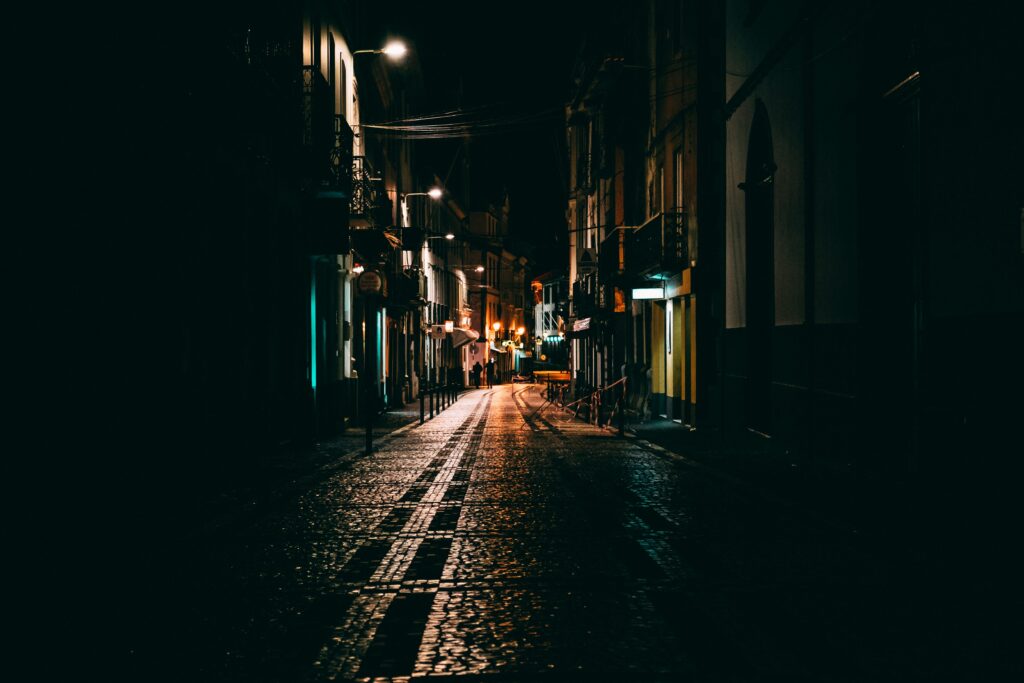
Image courtesy of Andre Benz on Unsplash
The ruler of the land
Amigo, in truth, ran the street. Come nighttime, it felt like many of us were chorus figures, and Amigo’s clientele were the main characters. You see, on the other side of the street was a bed and breakfast, perfect for tourists just a walk from a tube station. These tourists were practically fodder for the local milieu. Time after time, they would be taken by deception. I had the perfect view from my window.
So often, tourists would stand outside, taking their own break from the harsh pounding rhythm of London. Some had just arrived, the loud friction of suitcase wheels on concrete announcing their arrival. Cigarettes as their choice of anesthetic, they’d sit on the little outdoor promenade of the hotel and be approached. ‘Just a tenner’ or ‘20 pounds,’ Amigo’s clients said, stating they’d be back in 10–15 minutes. But Amigo’s clients would never return, much like the money. So who was Amigo?
I saw him once, long, long after it was clear this was a person of whom to be wary, if not afraid.
He was all smiles — a wide deep smile pronouncing easy contentment. A light red tint to the afro hair on a diminutive, gaunt physique. For the man who an entire area was centered on and around, I saw no crime lord. His presence was more a curiosity than anything intimidating. Through a smile, the only words I heard out of an accent I couldn’t place were from the football shirt I was wearing: “Chelsea, Chelsea.”
Months in, Amigo’s supply and demand had evidently managed to develop quite the following. Unfortunately for Amigo, people want to see you doing well — they don’t want to see you doing better than them. The nightly regulars were consistent, the ground-floor window covered in bed sheeting and cardboard still had a steady flow of knocks, but that didn’t mean everyone was happy.
An empire crumbles
The first sign of trouble was the sound of glass shattering.
Alert and wide-eyed from the flurry I’d hear lying in my bed that night, I pondered whether things would change. And yet, business went on much the same. A police presence began to develop on a consistent basis — but never at night, mind you. Soon, the notorious ground-floor window barely maintained through cardboard and bedsheets was boarded up. The night it all went down, however, I wasn’t present. My partner at the time, living in the flat on the floor above mine, would witness it all: a train of ‘little bad men’ — all clad in black tracksuits and balaclavas — made a run on Amigo’s, with bottles, bats, poles, and blades in hand. Not long into the fray, two police vans tore onto the street. What followed was a line of the balaclava-clad gentlemen being cuffed and placed in those vans.
I presumptuously concluded that Amigo’s days were numbered. Police presence, arrests, and the looming threat of escalating violence should have brought an end to it all. The enterprise was seeing its last days, and perhaps the street on which I lived would become a safer place.
It was a spring evening, and I was puffing away on a cigarette in front of my building. An unmarked police car materialized in front of me. Before it stopped moving, an officer opened the door and stepped out. Their tone was urgent and unblinking.
Did I live next door?
I said no.
Had I seen anyone go in next door?
No again.
They’d placed a court order on the building; no one but residents could enter the premises.
Shortly, politely, they returned to the car, which vanished in the same inexplicable manner it had arrived. Adrenaline pumping from the exchange, I walked to the grocery store, realizing Amigo’s days were truly numbered. Returning only minutes later, plastic bags in hand, who stood outside number 10… but Amigo.
The signature smile was intact and the words left his lips:
“Did you see the police?”
A thick flurry of anxiety struck me. How did he know?
Nervously, I answered yes.
An easy, relaxed body language matched the wide smile.
“They are very nice people. They give me a flat in Victoria.”
In 1995, my 6th grade social studies teacher at the private Catholic school in town fell ill early in the first semester of the school year. Enter Mr. H, now Father Gale. Gale Hammerschmidt came into my life as a substitute teacher in the midst of a crisis. He filled educational shoes no one could think to fill, while also inspiring positive disruption in my hometown and countless members of my community for the last two decades.
The teacher he replaced never returned to Luckey Junior High, where I would spend the rest of my middle school life. So, Mr. H became a prominent male role model. In addition to teaching social studies, he supported the school through other means: coaching almost every sport, acting as referee in debates during the daily religious classes, substituting for other teachers, and more.
By 1996, I was turning 13 years old and preparing for confirmation in the faith — a decision often made during the preteen and teenage years. After less than a year of his tutelage, I asked Mr. H to be my confirmation sponsor, and he agreed. Shortly after that, I landed the position of president at the local parish’s Catholic Youth Organization.
My religious story would halt there for some time — faith in a higher power replaced by almost any other option for belief.
A wedding to attend — and an old friend
Fast forward to July of 2015. I was to be the best man at my brother’s wedding in Tennessee, while working in Los Angeles as an intern. Two days before the wedding, I flew to Nashville, where I was picked up by my mother and driven to the party in Knoxville. My brother and my new sister did it well, admittedly, even if as best man I am required to say this.
By 2015, however, Mr. H made a significant transition from the middle school teacher who ended the last day of every school year with a viewing of “Footloose” to a full-fledged Catholic priest; he would be presiding over the wedding ceremony. I could not recall when last I had spoken to my former teacher and confirmation sponsor, but it had been a long time since my lapse in the Catholic faith began. Best man or not, I was not a practicing Catholic at that time. H is gonna H, however, and the day before the wedding, Mr. H, my brother Brad, and I were part of a 4-man, shotgun-start, golf scramble.
My lack of experience in golf was rivaled only by my lack of practice in Catholicism. Mr. H did not waste a breath on religion with me. We were playing golf, H was not in his collar, and pride was on the line. H brought a long game like a young Tiger, or at least played as if he did. The two others kept our four-man-scramble together, and I shot well in my short game over the first 9 holes. At the end, my father asked for help picking up supplies for tomorrow’s wedding reception.
TJ, a punk who had been hanging around for years, offered to help dad with the pick up. I stepped up as best man, however, handed TJ my clubs, and told him ‘to bring his short game’. TJ listened to my orders, our team won the scramble, and my dad and I completed our pick up successfully.
The rumors around Knoxville that night, throughout the bar neighborhoods, were of the Catholic priest from Kansas who had come to town for a wedding and set some kind of distance record at a local course just that afternoon. H is gonna H.
The next day, the wedding went off without a hitch, Father Gale (no longer H in this role) being as gracious as ever a person can be, and my brother and his new wife enjoying every opportunity to celebrate with family and friends that evening. I myself enjoyed everything Knoxville could provide. My confidence fluttered early in the night, however, after the standard celebratory dances. Before I could think of anything else, though, I was caught speechless, a feat only a positive disruptor can accomplish. There was Father Gale-turned-H, busting out a move on the reception dance floor — he was doing the worm.
There I was, my life relatively calm and stable to most any other time, surrounded by family and friends from across the country, best man to my little brother, and my 6th grade substitute teacher-turned-priest was performing the worm before an audience breathtaken as much or more so than myself. As a person who has been committed, I have never seen fuller commitment to the task at hand than Father Gale Hammerschmidt at task, even if only to show everyone else on the dance floor how it is to be done.
It comes full circle
Now, in my neighborhood near the campus of my alma mater, I can walk up to the parish where my confirmation sponsor is a priest. Even if I were not now actively practicing Catholicism again, I would take a heavy dose of comfort just knowing Mr. H is still out there showing others by example how full and joyous life should be.
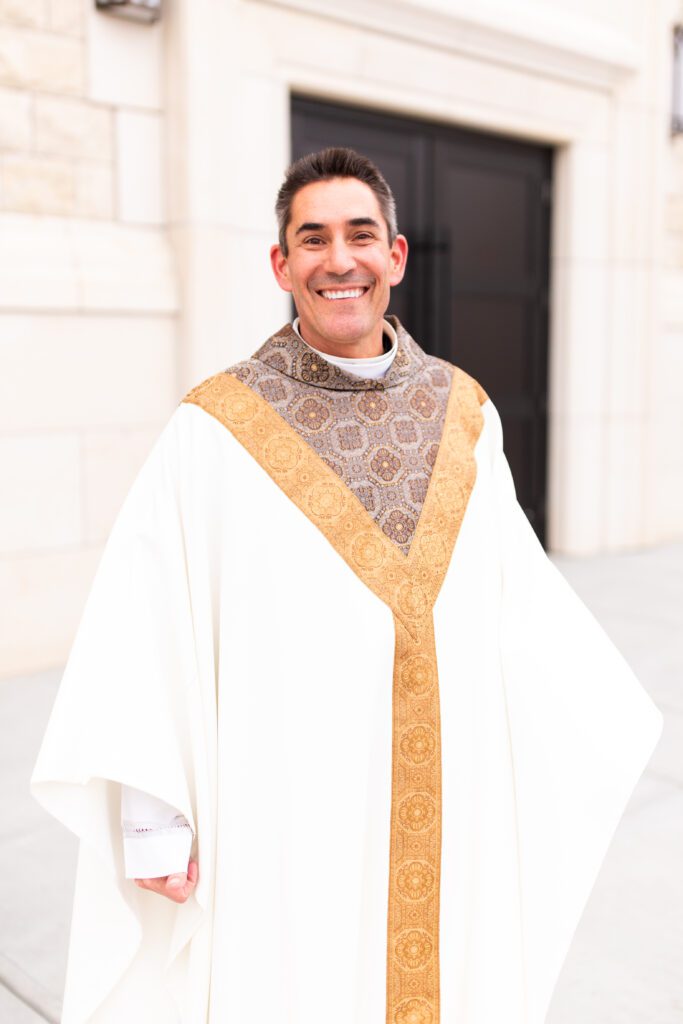
(Image courtesy of St. Isidore’s Catholic Student Center.)
Costumed kids, Pumpkin pie, Wind whips And trees sigh: My tears run (Generator Dies), and you Don’t ask me Not to cry, But say, “Hold Out your hand.”
I soar upwards, watching the world simultaneously minimize and enlarge before my eyes. Roads transform into unraveled threads, mountain ranges into gentle ridges, great lakes into dots of blue.
I know that the land below hasn’t really changed, only my perspective of it. But from several thousand feet high, that’s hard to believe. Lost in myself, I forget that the objective and subjective aren’t the same. In the landscape of my own consciousness, there are no true norths — no indisputable, solid landmarks that can guide me. And just as my perspective shifts, transformed by age, so have my memories.
To recall is not straightforward. We don’t pull a perfectly preserved file from the mind and replace it, unaltered. Instead, to remember is to erase, add shading, embellish. Sitting on this plane, I know my memory of Halloween night has been distorted beyond recognition — a road turned into a shoe string.
Every time I write about my life, I want to caution whoever reads it: what I’m about to tell you is both entirely true and a bold-faced lie.
That fateful Halloween of the cat
(Photo by Beth Teutschmann on Unsplash)
Last Saturday, I talked with my brother on the phone. We swapped memories, unsure of whose lay closer to the truth.
“Wasn’t it in the front yard?” I asked.
“No,” he said, “I’m pretty sure it was in the back. Mom wouldn’t have let you play in the front.”
“But, I thought I remembered Dad getting home,” I argued, “which is why we were out there. I was running out to greet him and show him my cat, and I fell.”
Halloween, 2000, in foggy Pacifica, which is situated on the northern California coast: we were a family of five. I wouldn’t use the adjective “normal” to describe us — because who is normal when you dig deep enough down? — but I will paint you a generic picture: white, suburban, middle-class.
My brother reminded me that he dressed up as Spiderman that year, complete with webshooters that catapulted Silly String. I can picture him at 8 years old, sprinting around the house, trying to climb the walls, spinning web after web. Dodging behind the couch to evade my mother, speeding past one of his little sisters, almost knocking her down. I have no idea what costume my two-or-so self wore, but I imagine it was nothing elaborate. The prior year, I had shrieked so determinedly when my mother attempted to dress me up in anything that, exasperated, she finally drew a circle on my t-shirt, wrote “I’m a pill,” and forced me into it.
Whether I understood Halloween as a concept at two and a half is debatable. However, the great pride I took in the cat I had “painted” at Clay Creation earlier in the week — red splotches blobbed over white ceramic — was not. We must have picked up our artistic triumphs that day. My mother stayed at home with us as our father worked, and she was always spoiling us with that kind of fun — painting, crafts, sewing.
“I know I shouldn’t have let you carry it,” she told me, “but you wanted to show Dad yourself.”
So, I had toddled out to him across the pavement, hands outstretched, clutching my seemingly blood-bespeckled cat (an omen of what was to come) as he got out of the car.
“Dadda, look,” I said proudly. And then I tripped, smashed the luckless cat into a million pieces, fell palm first, and gracefully landed on sharp ceramic.
My “memory” ends there — actually, it ends before the impalement, with the trip, the slow fall, and the shattering. I’m sure I screamed. Blood undoubtedly trickled across the pavement.
“I thought I remembered you saying later,” I told my brother, “that you were really worried you wouldn’t get to go trick-or-treating.”
“Probably. But Dad took us, and we had a really great time. I don’t remember thinking about you at all,” he laughed.
My poor mother, meanwhile, wrapped my hand in a towel and transported me, shrieking, to the emergency room.
Are parents real?
Parents aren’t really people for their children for a very long time; children usually don’t see their caregivers as individuals with wants and needs and vibrant inner lives of their own. I know I certainly didn’t for a long time. Someday, they may see the light, but only through a painful process of maturation that culminates in their own experience of parenthood.
It’s hard for me, even now as a grown woman, to conceptualize what my mother felt then — as impossible as it would be for someone who has never flown to imagine what the world looks like from several thousand feet high. My perspective of her is shifting, but she still hasn’t quite become a person yet, maybe because, in my mind, she was always more of an icon or a household god than a woman with emotions, fears, and a life of her own.
She was always right. She could fix everything. One word, one hug, and she could drive all the sadness away.
That night, after we had arrived at the emergency room and were ushered in to see a doctor, the sky had darkened to pitch black. Fog billowed on the sidewalk, reflecting the streetlights.
My mother remembers the emergency room being busy. Amid the shuffle, bustle, and crying kids, something truly eerie happened — the lights went out, the backup generator failed, and we were left swathed in darkness.
“They got the lights back on again pretty quickly,” my mother told me, “but on Halloween night, it was pretty creepy.”
Bleeding in the dark, I must have been frightened — but not overly so. My mother, after all, was with me. However, a fresh wave of fear must have hit me when I sat before the doctor, sharp metal instruments shining on his left and right, and listened to him say I needed … stitches.
“You were really little,” she always recalls, when telling the story, “and for small children, they strap them down to something called a papoose board. But I knew how much that would scare you. I told them that if I asked you to, you would hold out your hand and be completely still.”
The doctor objected. My mother insisted. I was not strapped down.
“Sofie,” she said to me. “I want you to hold out your hand for the doctor. Keep looking at me and stay still — even though it hurts.”
I did.
To this day, I have a scar on my right palm, extending from wrist to lifeline, drawing a half-moon. And for a long time, the story of my extreme filial obedience was a source of pride. It is clear to me now that all glory should go to my mother, who inspired such a high level of faith and respect in her child, and in a doctor. That is no common thing.
And I do like to think it was trust, not a fear of punishment, that led me to obey. The belief she would never ask me to do something painful unless it were for my ultimate well-being. When you find a deity both all powerful and all good, you follow them.
The crash that follows
Can you sense the inevitable crash to come — anticipate how adult complexities must eventually clash with childlike faith? As I got older, my mother fell off her pedestal. Adolescence and adulthood have brought me great pain as I realized, little by little, that she’s no god after all.
For the last ten years, my sister, the undescribed fifth member of my family, has been sick. She may never get better, nor will she die anytime soon — she’s stuck in a type of half-alive purgatory, a caterpillar cemented in its cocoon.
As we have readjusted to the reality of her illness, life has gone on over this painful backdrop, separate from and yet always intertwined with it. I have fiercely disagreed with my parents; reevaluated my childhood — broken the snow globe and poured the contents on the floor. I have dealt with my own mental illness, gone to therapy. Back to therapy again, as I try to accept that my sister is ill.
I’ve been so, so angry that my mother can’t fix it, can’t make my sister well, can’t wave a magic wand and fix the cracks in our family and the world.
If she were to read this, I’d say. “Any anger I have towards you, any feelings of disappointment … are because you were a damn good parent. You wrapped me in a beautiful illusion, and it’s a testament to the strength of that illusion that seeing you as you are, with limitations, has been so painful for me.”
The cycle of life continues
(Photo by Omar Lopez on Unsplash)
Throughout our lives, point of view shifts. Objective truths blur, fade, and come into focus again. Even now, the plane has begun its descent: once again, I can make out rivers, roads, houses.
As my fiancé and I talk about having children, I can feel my perspective morphing into a new shape, one that will only be fully visible when my own children have been raised, and I finally have lived as much life as my mother has.
I know that when I hold my baby girl in my arms, I’m going to hope and pray that we also have the kind of relationship where, if I ask her, she’ll hold out her hand, not counting the cost. What a terrifying privilege and responsibility — beautiful when stewarded, disastrous when mishandled.
It makes me want to weep knowing that, just like my mother, I will champion that responsibility both well and poorly in turn. Because, after all, no one is all powerful or all good — we are all just people, trying, and often failing, to do the best for those we love.
My parents tried much harder than most.
Back together
When we got home that Halloween night, it was to find that my father had meticulously collected every piece of my cat and glued it back together.
I still have it — splattered blood red, lined with deep fissures that tell the story of its shattering and repair. And if I could wave a magic wand, wish away the scars, and make the ceramic smooth again, I wouldn’t.
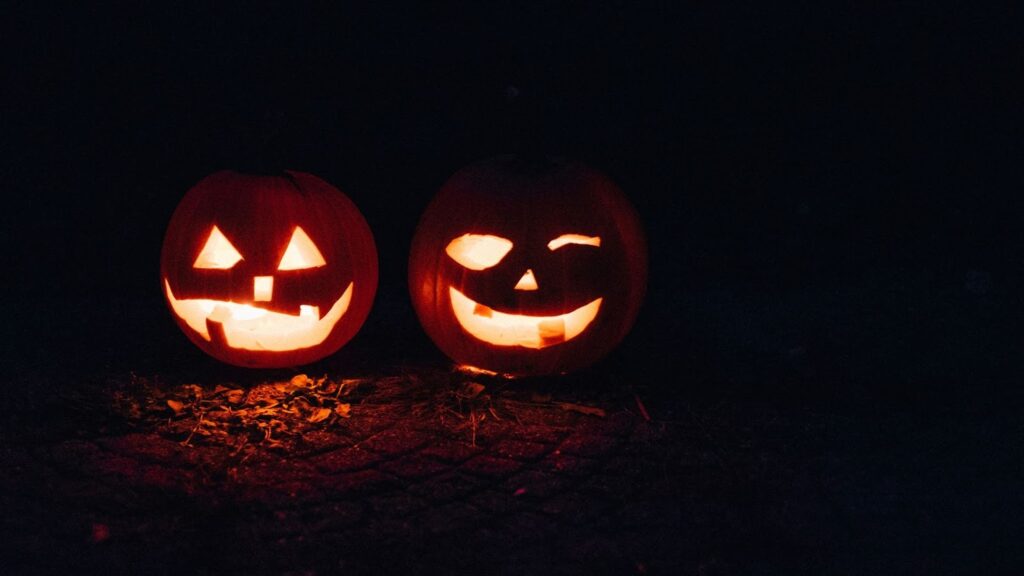
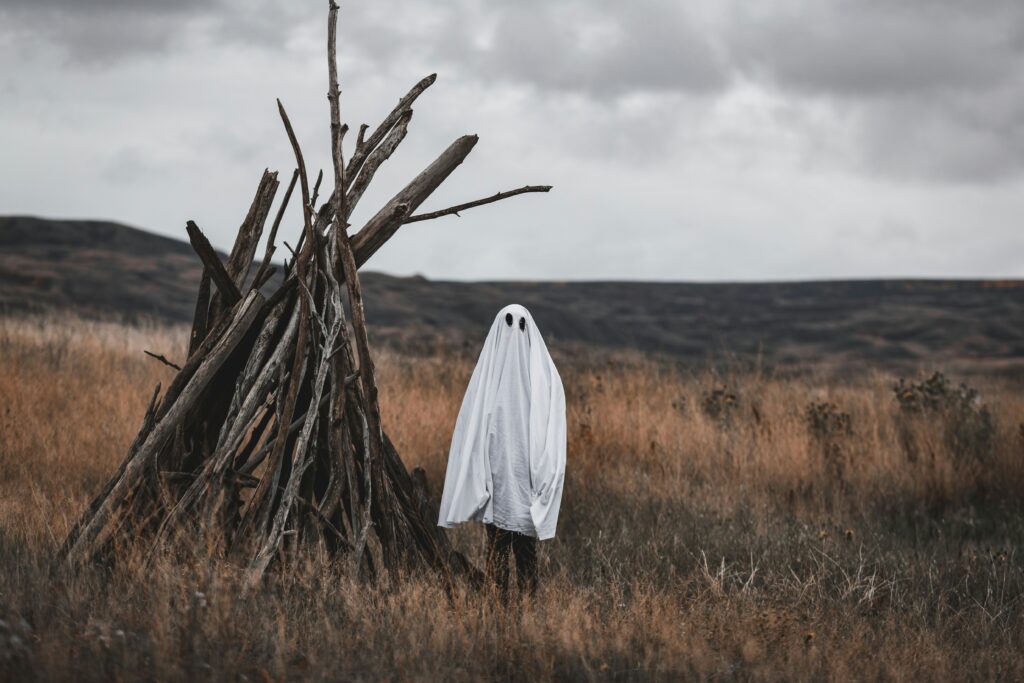
Halloween comes once a year for most. A night of masks, spooky movies, and pretend scares. But in Iran, under the rule of the mullahs, every day is Halloween.
The mullahs hide behind the mask of religion while practicing a reign of terror. They turn faith into fear and laws into lethal weapons. The world celebrates Halloween as a once-a-year fantasy. For Iranians, it is a daily horror.
I am Iranian. It was for me.
A death that sparked a movement
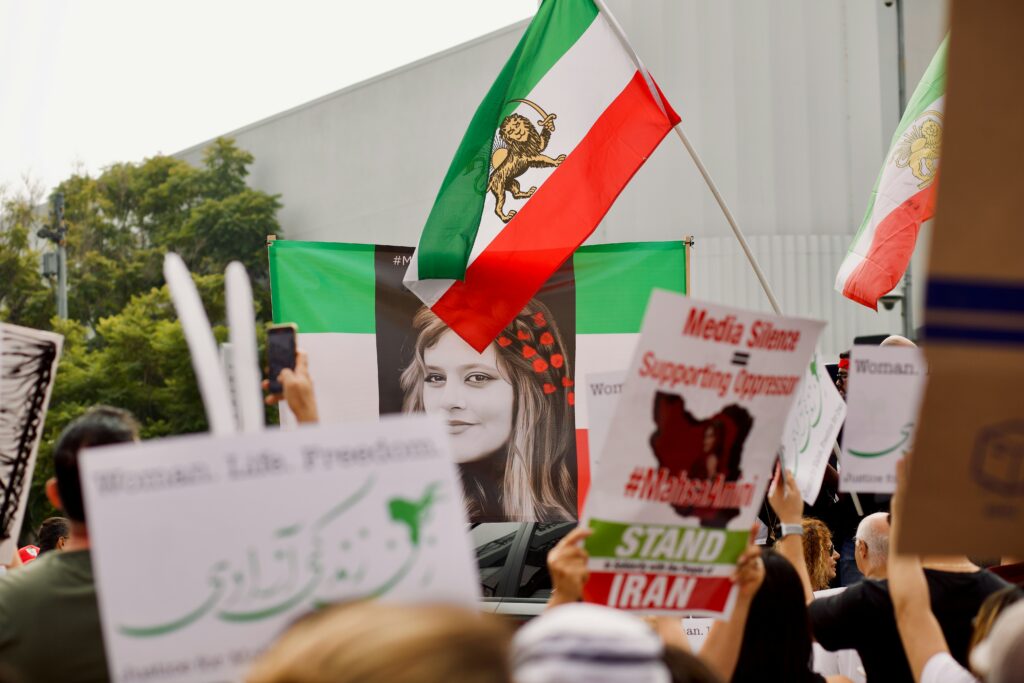
On September 16, 2022, Mahsa Amini, only 22 years old, died after being taken into custody by the frightening gasht-e ershad patrol — “Guidance” in Farsi, but we Persians call it the morality police.
She was arrested and taken to the notorious Vozara detention center because of her hair. Too much of it showed from beneath her hijab. Three days later, she was dead.
The regime insisted it was a heart attack, the people knew it was murder, something a UN report later confirmed. Protests swept across the country. People took to the streets with courage, but unlike in the West, they could not carry painted signs. In Iran, even holding a sign is enough to be detected, arrested, and imprisoned. The images of banners you may have seen come from protests abroad, where Iranians in exile have the freedom to speak in ways that are impossible inside the country. The government responded with full metal jackets.
More than 500 people were killed to prove that Mahsa’s death was not their fault. Proof this is the Islamic Republic within Iran.
(Image courtesy of Craig Melville via Unsplash)
Since then, executions have become the regime’s loudest weapon. More than 10 protesters have been executed since the uprising, their deaths meant as warnings. In just the first nine and a half months of 2025, more than 1172 people were executed, about three every single day. Imagine this in the 21st century: a state that takes lives on an industrial scale to prove its power. More proof.
The cruelty is not limited to the streets. On January 8, 2020, Ukraine International Airlines Flight PS752 was shot down by Iran’s Revolutionary Guards just minutes after takeoff from Tehran. All 176 people on board, men, women, children, even an unborn baby, were killed. Iran became the only country to shoot down its own civilian plane in its own airspace.
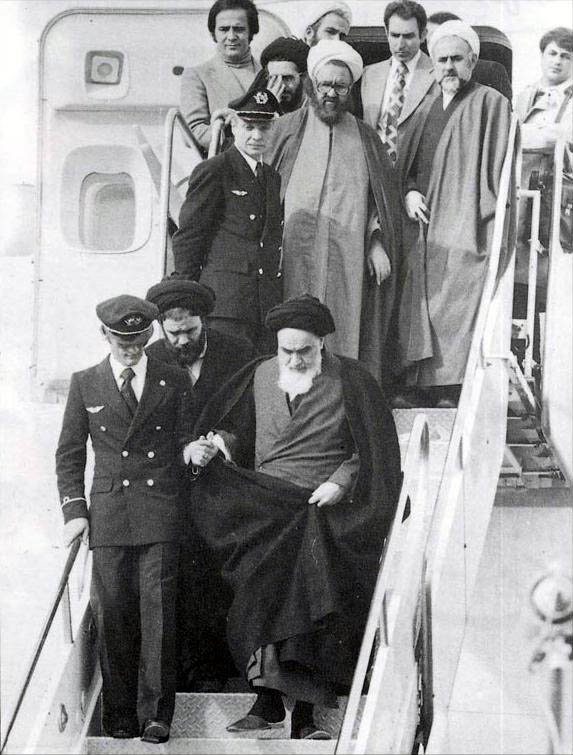
The horror stretches back to the beginning. After the 1979 Islamic Revolution (recall that the country became known as The People’s Islamic Republic of Iran), thousands were executed. Opposition to the regime was framed as opposition to God.
Graves of hundreds remain unknown.
In the 1980s, the Iran–Iraq war was prolonged. not to defend the nation but to silence dissent under the slogan of “wartime unity.” To this day, the true cost of human horror in that meaningless war is hidden.
A dried lake, a dried future
The regime’s brutality is not only against people, but even against nature. Lake Urmia, once the largest saltwater lake in the Middle East and the place of childhood summers for many, has dried. Neglect, mismanagement, and corruption drained this natural treasure and place of cultural heritage, leaving behind salt plains and despair.
Even the land bears scars and wears the mask of this misrule, bereft and humiliated.
A real-life Halloween
What kind of regime kills its women for the way they wear their hair, shoots down its own people in the sky, drains its lakes, and executes three people a day, all while demanding respect?
I know this horror personally. As an academic, my work and my voice put me at risk. The same regime that silences women on the street has no tolerance for those who speak up in universities or in public life. In solidarity with the ‘Woman, Life, Freedom’ movement, I resigned from my position in Iran in 2022. That act of conscience made me a target. Like so many others, I was forced into exile, not out of choice, but out of necessity, to protect both my life and my ability to continue my work.
Here in the West, I have witnessed Halloween in its sweetest form. Children knocking on doors in costumes, candy-filled buckets, laughter under streetlights. I have seen a tiny mermaid holding her father’s hand, a Glinda the Good Witch skipping along with friends, and even a toddler dressed as Sonic the Hedgehog racing up and down the sidewalk. This is what Halloween should be: play, imagination, and community.
Back in Iran, the most dangerous Halloween costume in the world is worn every day. This is the cloak of the mullahs, because behind it is not a happy face, but a machine of death.
The difference between once-a-year Halloween in the West and everyday life in Iran is simple: during Halloween, your fear is pretend. Your nights are filled with trick-or-treat candy and fun. Your daylight brings safety. In Iran, our nightmare does not end at dawn. It just continues to haunt.
Yet Iranians endure. Despite decades of brutality, they remain among the kindest, most resilient people. They hope that there will be light at the end of this darkness. One day, the mask will be torn away, so the nightmare will end.
This Halloween
Soon, I will stand at my door and see children on my street dressed as witches, superheroes, and fairy-tale characters; their laughter will no doubt echo into the night. Their joy in a world where fear is only pretend gives me hope. Hope that one day, children in Iran too will know only the sweet kind of fright, the kind that ends with candy at dusk and safety at dawn. And perhaps then, the mullahs and their reign of horror will be nothing more than a dark fairy tale told of the past.
As someone who loves horror films, they still find ways of haunting me. Even now, I occasionally wake up in the middle of the night from a nightmare that feels as real and chilling as Halloween night. In my eyes, these cyclical terrors reveal how expertly crafted the creatures and jump scares of fictional films are. Anytime a jump scare occurs, especially in the Conjuring films, which are personal favorite frights of mine, I have to turn my attention to a random corner of the screen or not look at all. That’s how much they get under my skin.
With its final film premiering this past September, The Conjuring film series has made its impact as a horror film staple for many horror buffs. The films are fictional retellings of notable, real life cases of paranormal investigators, Ed and Lorraine Warren. Whether or not you believe the events of these chilling ghost hunts are factual or fanciful, the films are a perfect example of what horror films should be: fun and entertaining to watch. Furthermore, the franchise contains jump scares that have lingered in the dark recesses of my mind for years, and they remain insidious reminders of the art of a great scare.
Prior to the franchise’s final film release, I have been rewatching the previous installments in anticipation of the new horrors that inevitably await me. However, of the four previous films, I cannot seem to get past The Conjuring 2 because of one specific performance that always manages to send shivers up my spine. The character of the “Crooked Man” is a standout ghoul of the second film, invading the household through a toy zoetrope (a spinning lantern) and his eponymous children’s song. I am so terrified of this menace that I have to hide my face behind my hands throughout the sequence – I still don’t entirely know what happens! What I do understand is that the talented actor who plays the “Crooked Man,” Javier Botet, is able to move his body in such a foreboding way that it makes the character unnerving and desperately uncomfortable to watch. Acting directly against Patrick Wilson (who plays one of the series’ protagonists, Ed Warren), Botet moves like a horrific animatronic, sending the audience spinning like the zoetrope he leaps out of in the dark.
Speaking of the dark, watching any horror film in the middle of the day seems like the best option for me despite the fact that any little noise after the credits roll will make me question everything that’s going on in my own home. And that is an extremely effective way to prove that these jump scares and other techniques awaken my fight-or-flight mode and rattle me when I’m home alone. A prime example of this manifests whenever my family and I make the mistake of watching a scary film at night. It is my job to take our beloved dog outside for the evening, so, every night without fail, I always glance into the dark garage just to double-check that nothing is lurking in the dark despite the tiny security light remaining on continuously. I still don’t understand why I do this; it has just become a habit at this point, probably as a result of the malignant shadows that my loved ones and I so enjoy watching on screen. Consequently, I have learned that family ties are often tethered to fear as well.
A while back, I decided to watch Hereditary, a petrifying film about how some family secrets continue plaguing future generations in truly horrific ways. I viewed it in the middle of the day, being home alone, and the sunshine brought me little comfort. The physical act of Toni Collete, who plays one of the film’s main characters, climbing the ceiling in her family’s home, her head banging continuously against the wall as her terrified son screams, “Mommy, I’m sorry,” will always haunt me because of her character’s unnerving silence and erratic, inhuman movements. The sight and sounds (or lack thereof) of that particular scene never fail to make my blood run cold. And other films continue to use visual and auditory storytelling to incite dread in their audiences masterfully.
I can’t even watch The Exorcist anymore because of Linda Blair’s incredibly nuanced performance as a child actress portraying a girl who is possessed. The words and actions that leave her mouth shook me to my core when I first watched the film. I was shocked beyond belief that not only was this level of brutalistic horror achieved in the early 1970s, but that my seemingly fearless mom and uncle had a hard time watching it as teenagers. While The Exorcist has produced some incredibly famous imagery, the mental image of Regan (the young girl possessed by a demon that Blair plays) profusely cursing and spitting at the priest and her family trying to save her/exorcise the demon is something I’ll never get over. The very sight of Regan’s appearance changing as she swiftly loses her humanity and the gruff sounds of the young girl’s voice as the demon possessing her fights for control are expertly done, and the film has rightfully achieved its goal of being one of the scariest films of all time.
More recently, horror continues to expand and include the terrors of the everyday. In Longlegs, a film about an FBI agent investigating the grisly murders of a supposed occultist serial killer, there is an emphasis on how the smallest acts can infuse horror that make one’s heart ache. Nicolas Cage plays the titular villain of the horror crime film and is an incredibly eerie character. His performance perfectly encompasses dread and an inhuman rage as he wails, “Mommy, Daddy, unmake me!” in his own car after being thrown out of a hardware store. Such a small act, as being asked to leave a store, sets Cage’s character into a spiral that utterly terrifies me and showcases how quickly someone can devolve to disastrous degrees. Understanding the additional context of the film, Longlegs’ personal yell is horrifying. Cage’s line delivery played on repeat in my mind for a few days afterwards, and it’s unlike anything I’ve ever seen and heard.
Horror films are such a delight to experience, whether at home or in the theater, because they often expose us to things, concepts, and characters we would not dare to dream up. And, if the jump scares give me goosebumps, then I know I’ll be in for a wild ride! Additionally, horror films are a great way for my family to connect with one another. Half of my family (including myself from time to time) will binge true crime podcasts, documentaries, and macabre tv shows across all of the streaming platforms, fueling our never-ending love of the genre. My family loves good scares, whether we get them from horror films or one of the countless documentaries we have watched with bated breath and many gasps. Effective jump scares and thrills from horror films make my skin crawl, get my heart pumping, and provide terrors that I believe most individuals can’t truly fathom in the modern world. Finally, the creativity sparked by horror films continues to stand alone as an irreplaceable form of gruesome (and sometimes gratifying) entertainment.
I grew up drinking rosehip tea with people I knew but couldn’t see. My grandparents, Giszela and Moric, laughed about the good times they had shared with cherished relatives and friends, beckoning them into our conversations, and so into my memories.
I knew about their slo-mo holidays in the Tatra Mountains between Slovakia and Poland, and that ice skating on frozen lakes was pure joy. I could tell anyone about the time my great grandfather, a headmaster at a Jewish school, chose his daughter, my grandmother, to accompany him to the mayor’s ball, an event far out of his comfort zone. But most of all, I felt the lack of prescience of these “invisibles.” My grandparents once grasped that it was time to quit everything that was familiar to them, fast. But they always regretted failing to persuade significant others to share their flight response to what they saw unfolding around them, just before the family’s halcyon days sunsetted and crashed in the wreckage of The War.
Cherries rule!
We were in London, but actually, in the alternate universe of my grandparents’ home, we were always somewhere else. Speaking something else. Hungarian, Czech, Slovak, German, Yiddish, Russian, and French words whizzed past our watchful faces. We listened as we tickled the legs of hapless visitors under the dining room table.
These lower limbs belonged to a thick-accented coterie of relatives and friends just passing the time together on slow afternoons. Most of them, my father too, sashayed between languages, the silver-lining skill of many a refugee. And these came from a region where borders had moved like chess pieces for centuries.
The walls of the forever corridor in my grandparents’ home were decorated with antique maps of the Holy Land and plenty of framed embroidery. These sewn pastoral motifs must have stolen acres of time from their creators, people I could see and those I couldn’t, I thought. My grandmother, for one, the educator’s daughter, who had dabbled in teaching movement, writing, and sewing to small children at her father’s school, but had let her brilliant mind lie fallow. She was known affectionately as Anutzi, mother in Hungarian.
(Image courtesy of Tycho Atsma via Unsplash)
But we felt at home breathing in the paprika-scented dishes, and nibbling on thinly-sliced radishes, always parked on the table. And, of course, we loved the cherries that were everyone’s favorite. We waited for the cherry liquor chocolates in shiny wrappers and the preserved sour cherries in painted jars often brought back by visitors to the Old Country, but especially for the fresh cherries, whose pairs made perfect earrings.
(Image courtesy of Nika Benedictova via Unsplash)
Once, when we bumped into each other on the avenue by his apartment building, my excited grandfather, his eyes twinkling, sang to me about his bounty of delicious purple cherries; the precious package dangling from his Zimmer frame walker.
Drawing back the Iron Curtain
Sometimes, visitors who had remained behind the mysterious Iron Curtain where these languages still bloomed, and who were only dipping their toes in “The Free World,” joined us for chamomile or rosehip tea. They talked about their bleak days under Soviet rule. More than once, these wishful defectors flirted with the idea of escaping to the West and abandoning their families, right in front of us.
But there were plenty of other émigrés who had resettled locally, decades earlier, or who had fled from communism more recently, like my relative Serena, whom we never saw without the plaster covering the number branded on her arm that she had kept hidden since The War. We could count on them to bring their own and very present invisibles along to tea. It didn’t matter that these lost loved ones were long dead, or if we were confused and a little frightened.
On rare rain-free days, these guests and their shadows met up at Mitteleuropa-style coffee shops with names like Louis. They had sprung up between the usual London retail chains, to serve our “resident aliens” anchoring in the familiar setting. Their windows dazzled with creamy patisserie delicacies that I have only ever seen since in Budapest.
We hurried out of the London cold and into their womb-like interiors for yet more tea at the tiny tables where our grandparents’ invisibles were ever-present.
Sidestepping trauma?
Never was the missed presence of these yearned-for people more apparent than at the end of a sentence. A long sigh, eyes locked sideways, held by a memory, lips contorted into bittersweet smiles. We heard of the quintet of my grandmother’s siblings whose lives were snuffed out before they hit middle age. If we ever dared ask, we received the standard it-was-The-War response and knew better than to interrupt the trancing storyteller.
A counsellor once shared with me that to overcome trauma, you should revisit it like a butterfly. Land on it, but only momentarily, and then return for a little longer, before flying off to happier recollections. But instant tears, heaving chests after a bout of sobbing, and constant retellings, all signify work still to be done.
(Image courtesy of Leon S via Unsplash)
As Giszela and Moric aged, they just couldn’t fly away. Instead, they were sucked deeper into their unsettling memories, condemned to relive the rupture from loved ones on constant repeat. Why, my grandmother lamented over and over to us, did she not deceive her dentist brother and tell him that he was guaranteed work in London, offering a white lie that could have saved him, instead of just sending him banknotes hidden in books?
Ah Sándor, if only I had told you that I’d found you work here.
Towards the end of their lives, the past and present began fusing in strange new narratives, powered by the will to regain control over time and history. My grandfather, a natural-born businessman since his apprenticeship in pre-war Frankfurt, asked my mother what he should “do” about the Dalai Lama!
My grandmother, delirious from illness, reassured me as I held her delicate hand, not to worry. Aputzi (my grandfather, father in Hungarian), would ensure that we were all buried very soon. This is a scary thing to hear when you’re a teenager, but not so strange when you remember that this rite of death was denied to many of our family’s extinguished personalities.
It was only in the 1980s, after my father died prematurely from a haunting sadness, my mother said, before we learned the truth. My grandparents followed soon after our father. That’s when we, his daughters, discovered what none of them had ever told us: Our grandparents were actually my father’s aunt and uncle.
They had left for Switzerland and then England in the dawn days of WWII, rushing my father away to safety, at the same time wrenching him from his younger parents, Eszter and Max, our real grandparents, whose lives would be brutally snuffed out in The War. But not before his beloved mother, knowing that they were doomed, wrote my father letters overflowing with love and pain.
Ah, the grind. The 40-plus hours a week of earning my keep whilst trying to keep soul and sanity intact. There’s not much I can add to the endless commentary on this reality. What interests me most on this topic is that contemporary living seems to be centered around the grind on top of the grind. Or should I say, the grinds on top of the grind. The stacked grind, if you will. It’s as though our increased reliance on machinery and automated processes has changed our expectations of ourselves — that we, too, should have a certain level of productivity at all times. Ever productive, ever optimal.
Sustainable, optimal, valuable. Execution, success, failure. This language is the perfect fit for operating businesses, quarterly board meetings, and machines. It’s far from a healthy or perfect fit for people, though. Machines were only ever brought to society to bring results. Unfortunately, not only are we not machines, the results of our productivity are rarely as important to us as the process of being busy itself is. Aren’t we all about the process, the journey? The results and the destination aren’t ever that relevant. Maybe that’s how this obsession with the grind came to be; we wanted to chase that high of being productive at all costs, at all times. Is this grind stacking a result of industrial brainwashing? Are we collectively turning ourselves into mass machinery, becoming something we were never meant to be?
Optimally
I’m trying to work out what optimal means for myself, and I’m looking around at my peers. What I’m observing is curious. Those in the deepest of grinds, chasing work, gym, social, vocational, and status goals seem the furthest from happiness. The people closest in my life, who have the best slice of happiness, are doing quite the opposite.
These people are far from gym rats: padded, not iron board flat, and far from worried about how photogenic they are. Selfies and social accounts aren’t really these people’s deal; they are more concerned about school catchment areas than their waistlines. They don’t ask for much, money is responsibly watched over, not idolized with a giddy dream of more. Despite the lack of striving, thriving, “optimal;” they appear to have what all those chasing optimal don’t have — a noticeable degree of contentment and peace with themselves and their lives, which I admire.
The stacked grind is insane, and yet, it’s normal for many.
I’m writing this as I attempt it on my own. I’ve got the 40-hour a week job, the 3–4 workouts a week, the clean diet, the regular social hangouts, and as the author of this piece — wouldn’t you know — my vocation, my calling, my “side hustle” is writing.
Grinding to a… burnout?
I’d be lying if I told you I don’t wake up some Saturday mornings and feel… flattened. I’m still a young man (relatively… my twenties have been and gone; toll the bell, please) and yeah, I’m tired. It would also be dishonest of me to tell you I’m not after “optimal.” And, frankly, it would be dishonest of me to tell you I know what optimal means for myself. When I look around and see my peers after the same thing — this elusive idea of optimal — they appear equally bewildered at the input-to-reward ratio of grind stacking.
Ha, there I go again, talking in ratios. Machine, much?
With all of this stacking and pushing for optimization in our lives, am I the only one who foresees the inevitable outcome — burnout?
This contemporary burnout culture worries me, and maybe because I’ve experienced it myself. An utter internal flatlining was my burnout. Unable and uninterested in relating to much and full of fear. Thanks to the travelling I was soon to do, I did get months off work to recoup. What really shook me was my genuine anxiety over returning to work when the time inevitably came.
People more disciplined, educated, and capable than me have burned out. Lawyers, doctors, nurses — all professions admirable but a likely disaster in these hands — sidelined and flattened through overexertion. Burnout is not specific to geography. I’ve seen burnouts in Australia, New Zealand, the UK, the U.S., and Norway. We’ve never had more provincial safety or material comfort. In some sense, we’ve never had it so good.
Maybe it’s because we’re expecting and wanting more than ever before. Previous times had people working longer, harder hours with less to aid them, and yet burnout was not in their lexicon.
(Image courtesy Christian Erfurt on Unsplash)
Will the grind measure up?
When our elders look back, they don’t regret what they have done — they regret what they didn’t do. In this respect, we might consider more stacking. However, the free spirit in me very much wants to savor the juice of life. While I can, when I can, go for all of it, the good stuff. A very best attempt to squeeze out every last drop.
I’m observing the struggle of the grind and not its raving success. There are surely people who can and do hit the robot groove: up at 5, supplements, exercise, work, date night, and a chartered flight the following morning. For the select few who do not find their mortal limits screaming at them in this process, I applaud them.
Yet it is the tenor of our grind-into-burnout culture that unsettles me. A Buddhist proverb says, “Each of you is perfect the way you are, and yet, you can use a little improvement.”
I feel our current culture emphasizes the last part of that phrase — with scant regard for the first.
We appear to have hit some event horizon about the state of young men and boys coming of age. This commentary has been running for a few years in the States and now appears to be hitting the UK as a greater cultural conversation. This topic is something of a biased one for me — my beginnings were calamitous at best. It’s taken the other side of 30 to build a genuine identity and a feeling that I’m not just another lost male in a sea of them.
As a millennial, I had a half-and-half childhood. Born in 1991, I had a near clear split between an analogue world of legacy media and phones on walls before the rise of all things wireless and the internet. Someone 10 years my junior has grown up in a profoundly screen-based childhood where most interaction and information are found online. Being online is very much their norm, and suggesting that young people stay clear of what’s “in” might not exactly win me any listeners.
The major concern about our youngest men is a listlessness that easily falls into isolation, gaming, porn, and gambling. Being directionless as a young man is far from easy or fun. We tend to be prone to cover this with a willful, jet-propelled narcissism or overcompensation to make up for a lack of self-image, worth, or direction. Finding one’s feet in a world quick to judge men on their competency when one is still developing is uncomfortable at best. However, I can’t deny that the incredible, godlike tool called the internet is the root cause of this current generational malady. Not for a second am I suggesting young people don’t use the internet, but their relationship with it may well be in need of adjustment.
There is consistent commentary that young men are in need of role models. This is a traditional approach to an entirely novel time. I’d argue that models for the analogue world may not work so well digitally. Role models are great, but counting on them to be present in a society of new-thing-next-thing, throwaway consumerism may be unwise. Young men don’t need father figures; they need to find out who they are. This is often a years-long process, but in my observation working with men younger than myself, there are some simple ways for starting this process.
Time to play the game?
I’m a ‘90s kid. I grew up on Streets of Rage 2, Sonic the Hedgehog, Goldeneye, and other gems. The ‘00s was something of a golden age for video games, and I was a teenager; I won’t deny this was close to bliss. I barely have time for video games now, but I know I don’t want them out of my life altogether. Video games can be a part of any young man’s life, as they have been mine, but there is a difference between my younger years and the lives of young men now. During my youth, video games meant inviting friends round and playing together in the same room. What young men have access to now are headsets and playing online with others who are often miles apart. It’s worth considering either deprioritizing or fighting the tide of an innately singular activity — game less to make time for other interests or commit and develop the interest externally. This would mean attending events, expos, competitions, and online communities to make an isolated interest more sociable.
Porn
There is not a single feted or worthwhile piece of self-help or dating literature for men that doesn’t tell them to give up pornography yesterday. There’s no net win in the usage of porn. If the material is from professionals, we’re possibly witnessing the outcomes of social outcasts, tearaways, and neglect and abuse victims. If the material is from amateurs, none of the above may be true, but you’re still a peeping tom by definition! I’ve read that consistent porn use over time is prone to emotionally numbing the user, the exact opposite of what a young person finding themselves needs. I’m of the firm belief that young men should claim and take responsibility for their own pleasure, not lean on virtual externals to uphold it in some sleazy crutch. I can confirm that it is 100% normal for a young man at the turn of his twenties to have a sky-high sex drive.
But can the same thing be said about someone taking a laptop to bed every night?
(Image courtesy of duncan karanja on Unsplash)
Address isolation
Coming from a dysfunctional home, isolation and its patterns were the norm. It’s jarring to me that my formative circumstances can hold matters relatable on a mass scale. We were a house of closed doors; we seldom connected or shared a space beyond mealtimes and family holidays. I’ve come to realize in the years since that that experience has impacted how I’ve gone about life. I’m always seeking a place for myself, and despite a clear need for it like anybody else, I can easily find social engagements draining. I have had to be quite proactive and push myself to stave off isolating patterns and habits I inherited and never asked for. My fear is that many young men could find themselves fighting the tide I did, which leads me to…
Apps aren’t the way forward
At the time of writing this, apps geared toward dating, hooking up, and socializing appear to be hitting a saturation point; people are increasingly losing interest in them. I’d argue not a moment too soon. Apps are highly functional, but maybe they’re too much so for what they are supposed to be contending. What should be a boon for technology, a remarkable attempt at providing opportunities for connection, is not so in reality. Apps are more akin to human meat markets, dissolving valuable connection into an impersonal validation frenzy. I don’t know anyone who hasn’t experienced app fatigue sooner or later, and I include myself in that. If you want to meet a woman or new people in general, put yourself out there. There are numerous online platforms that advertise in-person social events, so it’s easy to find something to do.
In my experience, they’re well worth it.
Where do we go from here?
(Image courtesy of Zeki Okur on Unsplash)
The primary theme I keep returning to seems to be this: get offline. This is not quite true. What the steps above outline is to not rely on the internet to fill one’s needs and to carefully use it to find opportunities in the real world. Be online to find social events, not socialize. Follow your interests to find your calling; don’t fix a job path to define your identity. Focus on building yourself to attract the right people; don’t desperately chase in the hope of finding someone. This is the advice I’d give my younger self.
Yes, men are judged on competency. Yes, it’s important that a man is competent, but perhaps not in the way we uphold it as a culture. What makes a competent, valuable man? Amor fati. Or, the acceptance of one’s self, life, and fate. Someone who can embrace all of life. He sees the good and the bad, success and suffering, and responsibilities and hardships as all having value and necessity. A competent, valuable man isn’t about his paycheck, lifestyle, or status; it’s about him going after what he wants in life and having a hell of a time getting there. Come rain or shine, upheaval or mastery, any day of the week.
The struggle is where growth happens, and that growth might be what gives life a sense of unfolding, progressive adventure. In my experience, it’s worth the fight.