During the interview, Ana gets emotional and tears up just trying to remember the name of a long-lost Master System 3 cartridge.
“I missed it so much! I spent years trying to remember the name of that game. I looked everywhere and never found it. The memory is still so alive. The next day, my parents would tell us everything they had unlocked or achieved.”
Now approaching 40, Ana admits she still loves games but hardly plays. “My dream is to have a decent computer so I can play again,” she confesses.
Her favorite genre? “Silly games,” she says. “I like to relax, you know? Nothing stressful. My Steam profile makes it very clear.” The bio of her steam profile reads: “Yes, I play children’s games!”
Maybe it’s her way of resisting a world that demands too much.
She still treasures her second Game Boy (the first was stolen). She also owned an Atari and a Nintendo 64, alongside the Master System 3. She remembers clearly which titles she had for each console: “I couldn’t afford many games, so I lost count of how many times I replayed the ones I had.”
“Back in the 64 days, I loved Super Mario and Legend of Zelda. On Master System, I played Prince of Persia, Sonic, Super Monaco. Atari was easy… River Raid, Enduro, Pac-Man.”
Leandro’s Super Nintendo is still safely stored away. Every now and then, they still play a match or two. When asked if the vintage console could be sold for a high price, Ana is firm, “Whether it’s worth money or not, we’re not selling it.” The sentimental value means more.
Super Miguel World
The only game Leandro has ever liked and still does is Super Mario World. That’s where the idea came from: Miguel’s first birthday party would be themed after the world’s most famous plumber.
Not a coincidence at all: the boy fell in love with games even before he could speak, around age 3, starting with educational titles. Slowly, without any pressure, games became shelter, language, connection. With the world. With his parents. With himself.
***
“When I stopped the treatment, I got pregnant. My little one was born in 2017,” she says.
When she got pregnant with Miguel, Ana was working at a major telecom company. But just imagining someone else witnessing her son’s first steps while she was away made everything lose its meaning. She asked to quit. And she did.
“I was doing really well there. My pregnancy went smoothly… but during my seven years at the company, I saw many colleagues have babies, go on maternity leave, and return to work. Everything as it’s ‘supposed to be’. When my turn came, I couldn’t get used to the idea of my long-awaited baby spending all day with ‘strangers’ who’d then give me a report at the end of the day: ‘Oh, today he took a step, discovered something new, learned a game … while I was out chasing professional success’,” she explains.
“To me, it just wasn’t a fair trade. So when I came back from maternity leave, I said I wanted to quit. Quit to take care of myself, of him, and to chase my dreams.”
Contrary to what society often preaches, the postpartum period was far from a fairytale. After Miguel was born, he cried nonstop for three months, refusing to be held, and showing no clear signs of what was wrong. His mother ended up submerged in a sea of postpartum depression, resistance to help, and overwhelming guilt.
“I wasn’t sleeping. No one knew why he cried so much… he wouldn’t let anyone hold him. As he got a bit older, he became very selective with food, had intense crying fits… he’d have a meltdown anytime we went somewhere with unfamiliar people. He took a long time to start walking, and he didn’t accept physical contact,” she recalls.
It was a shock. Pure exhaustion. A desperate attempt to understand. No answers. The official diagnosis came only when he was two, after a frustrating journey through doctors’ offices unwilling to confirm what she already knew deep down: “my son is autistic.”
The Autism Spectrum Disorder (ASD) diagnosis finally came from the most expensive child neurologist in town. With it, a strange sense of relief. Relief in being able to name the chaos. To look back and think: “it wasn’t just in my head. It wasn’t my fault. It wasn’t a failure”.
Even so, Ana still feels guilty for how she handled the early years of motherhood.
“For me, the postpartum period was the worst time of my life. I felt like the worst mother in the world and not just that, I felt like the worst person. That’s why I’m completely against romanticizing motherhood.”
“Picture me, deep in postpartum depression, wanting to disappear off the face of the Earth, going through all of that. I did one of the worst things I could’ve done just to get a little peace… I’d leave him watching cartoons on TV, because it kept him distracted. That’s how he started saying random English words before even learning to speak Portuguese,” Ana explains.
Today, Miguel is 8 years old. He’s a sweet, well-mannered, brilliant child. He talks about astronomy with the vocabulary of a scientist and loves logic games. Among his favorite titles, a pattern emerges: puzzles.
“He’s an absolute sweetheart, polite and super smart. He loves studying English and has a hyperfocus¹ on games and astronomy. He used to be obsessed with human anatomy and physiology too, but that’s faded a bit. His dream is to work at NASA,” says his doting mom.
Like almost every kid his age in 2025, Miguel is also obsessed with the ever-polarizing Roblox. “That’s where he says he has ‘friends’,” Ana points out.
“He also loves Minecraft. He plays on his super tablet. And whenever he gets access to a computer, he enjoys games like Human Fall Flat, Portal… total little nerd. He dreams of having a Nintendo Switch.”
Of course, not everything has to be educational. Miguel also adores games with darker themes: Poppy Playtime, Garten of Banban, Five Nights at Freddy’s, and Bendy and the Ink Machine.
That fascination might just be in his genes. “I’m also drawn to darker themes, and some of my favorite games are Little Nightmares, Rain World, Cult of the Lamb, Limbo, Inside… I love them, love them, love them!” Ana confesses.
They’re dark yet safe worlds, almost like playable metaphors for the restlessness she struggles to say out loud.
Miguel doesn’t have regular access to video games, but that doesn’t stop him from playing. He watches YouTube videos. Lots of them. He knows where to find hidden items, the bugs, the shortcuts, the alternate endings. He watches so much that, when he finally gets a chance to play, it’s like he’s already beaten the game three times.
“He kills it, just from watching other people play so much. It’s fun to watch,” she says, laughing. It’s like he’s been training all along, just waiting for someone to hit Start.
When Ana mentions her son’s love for logic games, there’s a quiet pride in her voice. The same kind of awe she feels remembering the maps her father used to draw during the Phantasy Star days.
Only now, it’s Miguel who draws the maps. And the world – even if digital – finally starts to make sense. For him, games aren’t just entertainment, they’re a language. They’re a safe ground.
“We can see there’s a very positive side to it, too. He learns a lot, his English is great, he has quick thinking and strong logical reasoning.”
***
In the family’s daily life, games have become a shared language. A point of contact. An improvised form of therapy. Miguel plays, and his mother observes. She sees so much of her son in her husband, who also received an “unofficial diagnosis” of autism after being observed by a psychologist who simply said, “I have no doubts.”
“I had my suspicions, because he was very different from everyone else. When the psychologist said it, we just accepted it, it was so clear. But since we don’t have the ‘paperwork,’ he doesn’t present himself as autistic. Especially because, after so many years adapting and trying to be ‘normal,’ it doesn’t really impact his life or come across to others.”
Ana also started looking at herself differently and began to wonder a while ago. A preliminary test showed a “very high likelihood of being on the spectrum.” She wants to investigate further, but money is tight at the moment.
“After that test, I started to question a lot of things, but the cheapest evaluation costs around R$ 1,500. My father has high abilities², and I’m pretty much a copy of him,” she shares.
In fact, “there is an undeniable genetic component in autism,” explains pediatric neurologist José Salomão Schwartzman in an interview with the renowned Brazilian Dr. Drauzio Varella.
Scientific research has increasingly focused on genetic predisposition, and evidence suggests that genetic factors may explain up to 90% of autism spectrum development.
Reset
Ana speaks with passion. And at length. She describes herself as “chatty, all over the place, chaos.” But the moment the conversation shifts to voice (when she has to get on a call instead of typing), her body freezes. Anxiety kicks in. Panic. The fear of crying. The fear of shutting down.
The fear of being seen as “too fragile” for the job market as she searches for a way back into the corporate world after nearly 10 years away. When, in reality, she’s just tired of trying to fit into expectations that never once tried to fit her.
“I keep thinking: how am I supposed to get a job like this? I feel like some kind of wild animal. I go for an interview, a call… I’ll probably start crying halfway through. They’ll just say, ‘please leave’.”
“I don’t even know what weighs more, the gap in my résumé, which I’ve tried to fill every possible way just to be seen, my age, or the outdated experience. There’s no certificate that can cover that hole,” she confides. The hole of having stepped away. Of choosing to care. Of doing what so many romanticize in captions but reject in real life.
With a degree in Marketing and a postgraduate diploma in Business Management, Ana dreams of working in areas related to diversity, inclusion, ESG, and purpose-driven projects. She loves to create, to think about branding and identity, to build presentations, to make things meaningful and colorful.
“I’ve done a bit of everything in this life. I’ve run my own business, had a tattoo studio, sold Swiss chocolate, and worked as a tattoo artist. I had a family-owned semi-jewelry business, where I handled all the marketing. I worked for over 10 years at a multinational as a marketing analyst and project analyst,” she lists, showing the richness of her experience.
She even has her own version of hyperfocus: a dream of working at O Boticário (one of Brazil’s largest beauty conglomerates). “I really admire how they focus on people. It makes your eyes light up, you know? Makes you want to be a part of it.”
Deep down, Ana just wants to be seen. To be heard. “I even told a girl who works there, ‘If I could just talk to someone, just get an interview, I think they’d hire me.’ Because, honestly, if people knew how much love I pour into my work, the passion I have for what I do, the way I go all in… you know?”
Despite her résumé, experience, and drive, still hasn’t been called, not even for an interview.
“I don’t think my résumé is bad, or weak, even with the career gap, which I think I explained really well. But, still, I can’t land an interview. I just don’t know what’s wrong with my résumé,” she admits, “I feel pretty lost.”
***
Today, Ana barely plays video games, but laughs as she admits there’s “a dormant gamer inside me, just waiting for the right moment to wake up.”
“Since I’m not a big fan of mobile games, I don’t spend too much time playing. And the few that run on the computer I have right now are more for distraction, so it ends up being a positive thing,” she explains.
For now, she plays what she can. It helps her unwind. Distracts. Relaxes. Disconnects. But she knows that, with the right adventure, she wouldn’t sleep just to beat the game. “If I had the right hardware, I know I’d push past all limits.”
Sometimes, that’s what care looks like too: care for herself, for her time, for whatever energy is left after taking care of the whole world.
The story of Ana, Leandro and Miguel is a starting point, but it also opens space for us to reflect on the role of video games in contemporary childhood, especially when it comes to neurodivergent kids.
Autism at play
Ana doesn’t play much these days. Miguel plays a lot. But between them, there’s a kind of invisible thread, made of pixels, building blocks, and mental maps. If you pay close attention, you’ll notice: even without a controller in her hands, she’s still playing.
For children on the autism spectrum, like Miguel, the structured and rule-based environment of video games can be particularly beneficial. Games offer a safe space for social interaction, where expectations are explicit and communication can be more direct, reducing social anxiety.
The reward system reinforces positive behavior, and the visual and interactive nature of games can be a powerful channel for learning, adapting to different cognitive styles.
Yes, video games offer a field of possibility for autistic individuals. This isn’t naive optimism, it’s a growing consensus among professionals in health, education, and technology. Games bring joy, expand knowledge, contribute to emotional well-being, and create alternative paths for socialization, especially for children and teens who often experience isolation in the physical world.
Many end up learning English without realizing it. They practice reading, logic, motor skills, and problem-solving. Some games even function as natural blockers for intrusive thoughts. Others help develop cognitive and even physical skills, like the so-called exergames.
Immersion has its value too. Hyperfocus – a common trait among people on the spectrum – finds fertile ground in games, where the overstimulation of real life gives way to predictable rules, clear objectives, and immediate rewards. Some kids literally grow up between stages and quests.
That said, the very element that enchants can also disconnect. Excessive use raises concerns and, in some cases, leads to further isolation. It’s important to set boundaries and ensure screen time doesn’t replace essential experiences, like physical play, in-person connection, or body movement.
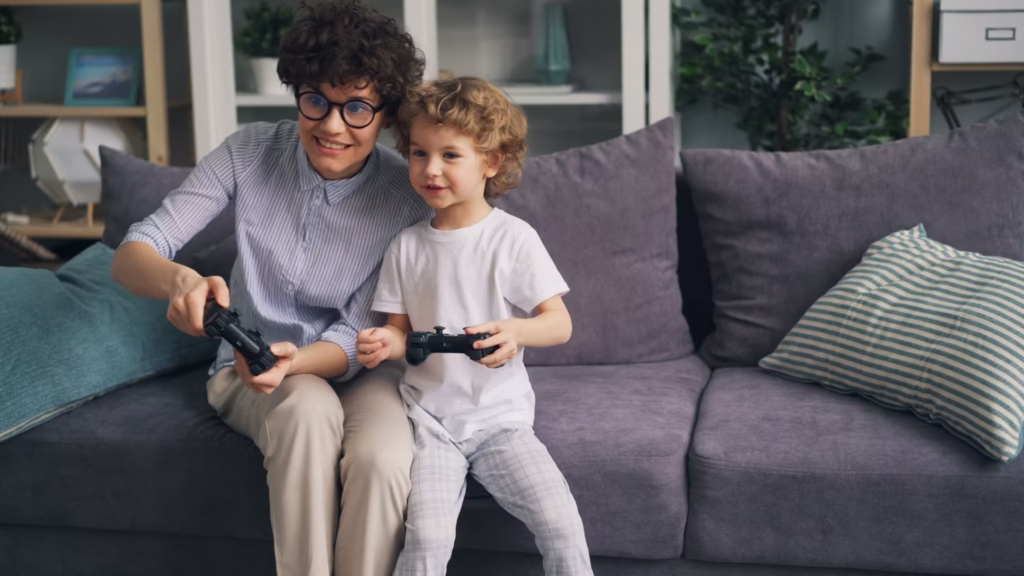
Miguel, for instance, sometimes goes overboard. He falls asleep thinking about games. Wakes up talking about them. Ana and Leandro, always attentive, notice when it’s time to gently pull the thread back into the real world.
“We’re very aware of this and try to involve him in other activities. The downside is that when he exceeds his limit and spends too much time on screens, he starts to live inside the game. He dreams he’s in the games, and all his conversations revolve around that. That’s when the alarm goes off for us,” Ana says.
The key lies in balance and, most importantly, in guidance. With the right support, games can be therapeutic tools, educational resources, and even starting points for real friendships.
Ana’s experience, seeing games as a bridge of connection with her autistic son, is far from unique. When played with purpose, ethics, and care, they are more than entertainment, they are opportunity, inclusion, and future.
Ana still dreams of a “decent computer,” of getting a job at O Boticário, and of reentering the professional world. Miguel dreams of working for NASA and getting a Switch. Somewhere in between – between drawings, maps, and difficult levels – they keep playing in their own way.
The console may still be missing. The job. The opening. But it doesn’t matter. Ana and Miguel already know how to play as a team.


Comments
Be the first to share your thoughts!
We value diverse perspectives and respectful debate.