

LIFESTYLE

I Can’t Not Use It

Trigger Warning: Death, Guilt

How come it’s ”insufferable” but not “unsufferable”? Why is “irregardless” an accepted word? Is it “sneaked in or snuck”? Who actually says “tomato” instead of “tomato” (You know what I mean)?

The root of it all

I’m sure I’m not the only one who read a lot growing up. However, all that exposure to the written language, vocabulary, and different styles of writing didn’t exactly include a dictionary. Believe me, I’ve tried reading it before, and, surprisingly, it wasn’t exactly fruitful. You see, the written word is exactly that: written. If you come across a new word that seems difficult to pronounce, you don’t exactly get to hear what it sounds like unless you ask somebody to help you. And honestly, when you get in the flow of reading, do you really want to stop just to ask?

That all changed when I entered high school.

In my first year, I remember how fascinating it was to learn that much of the English language is borrowed from other countries and that many of the words we know now are based on a dead language — Latin. Latin roots, prefixes, and suffixes particularly drew my interest, and I’ve always chuckled to myself about how I was most interested in English because of Latin.

It was also then I realized that I wanted to pursue a career in English.

Not an English teacher

Now, mind you, I didn’t want to be a teacher; I just wanted to be surrounded by words and books, and I wanted the opportunity to learn more about language. That interest stayed with me all through high school, and I was determined to be an English major.. My favorite one-liner was, “I’m an English major, not a dictionary.” Throughout college, my interest in language continued to grow, and I studied Japanese while learning to teach English as a second oral language. There was also a hot moment when I learned the Korean alphabet (Hangul).

Ironically, I even became a teacher assistant in Japan.

With the help of  my students and the teachers outside the English department, I came to realize that the English language was just a mess.

A stack of older-looking books with an apple perched on top.
(Image courtesy of Ylanite Koppens on Pexels)

Which homophone is the correct word to use? What do these idioms mean? How come there’s a specific order for adjectives? Why is it that when you affix a word (like compile), it’s pronounced differently from the original word (like compilation)? Homonyms? Now they’re just plain rude.

Yet, I pursued the language. I studied linguistics. I bought books to better understand grammar.I researched the same words over and over just so I could confidently explain their meaning to somebody who was trying to understand English themselves. To be honest, though, I still don’t quite know how to use adverbs correctly. But Hangul did come in handy when I was trying to show students how to pronounce English words correctly.

A lifetime within three years

Of the hundreds of students I’ve taught over three years, I’d say about 92% didn’t want to learn, whether from me or in general. Maybe about 6% were interested passively, and the last 2% were genuinely interested in a second language. Learning English helped them open up new opportunities, leave their hometown, and understand something outside their routine lives.

There’s one student, a bright young man, who I think about fondly. He took to the lessons – and my dumb games – with actual interest. I was fortunate to have taught him from his first year through his third year. Then, summer vacation rolled around after graduation, and the new semester started. It wasn’t until then that I learned he went to Hawai’i with his family for vacation and was involved in a tragic accident.

A small part of me thought that I helped cultivate his interest in the language, that I contributed just a small part to his confidence in English, and that it was just enough for him and his family to travel abroad. I may have forgotten his name (a terrible flaw I am truly ashamed of), but I can still picture his face perfectly. I know it’s not something I should hold myself accountable for, that it’s unreasonable to blame anyone for what had happened. Instead, I choose to be grateful that I had the chance to be a positive influence in his life.

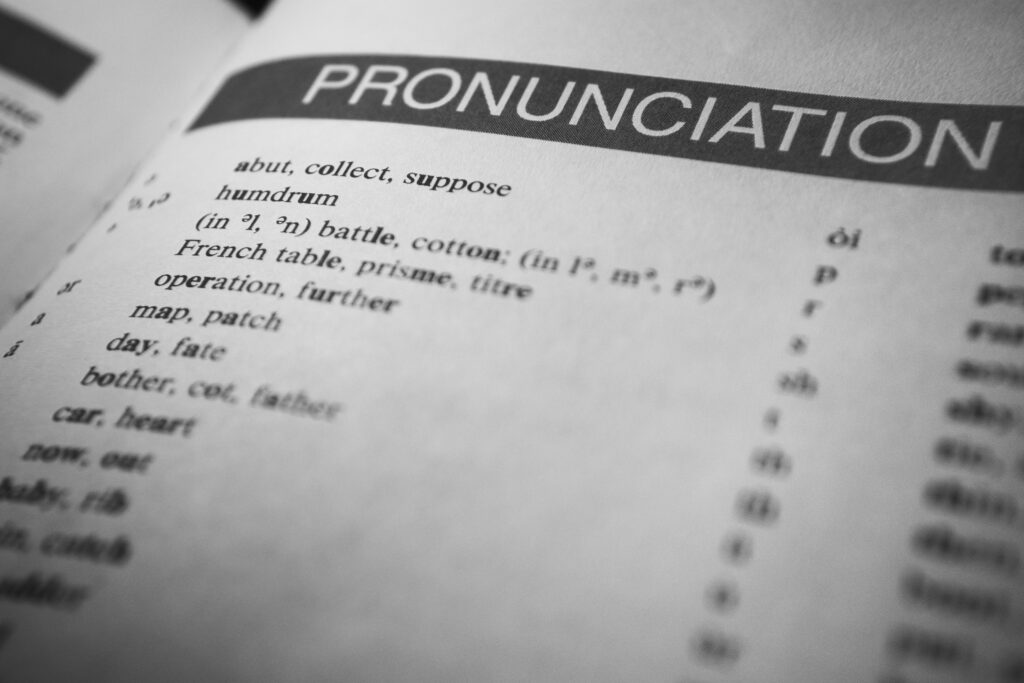
A page from a textbook showing the phonetic notations of a group of words.
(Image courtesy of Nothing Ahead on Pexels)

Me, my professor, and English

Truthfully, English is my second language, but it’s become my primary language. Studying it has broadened my horizons, deepened my appreciation and understanding of it, and allowed me to connect with people who also truly wanted to learn. I’d like to thank my grammar professor in college, who helped spark that motivation in me to better understand English. She fled North Korea, taught herself English, and is now teaching native English speakers how to better understand and dissect the innate understanding we have of the language – such as why we know to say “jump into the pool” and not “jump onto the pool.”

I still love to learn, and I’m best working behind the scenes rather than in front of students, teaching. That spark I felt nearly two decades ago still remains to this day.

And for the record, I personally say ‘toe-mae-toe.’

Editorial Acknowledgments

Thank you to Eric Mabry and Josh Stanford for their inspired edits on the piece.

READ MORE

Comments

Be the first to share your thoughts!

We value diverse perspectives and respectful debate.