

I Can’t Not Use It

How come it’s ”insufferable” but not “unsufferable”? Why is “irregardless” an accepted word? Is it “sneaked in or snuck”? Who actually says “tomato” instead of “tomato” (You know what I mean)?

The root of it all

I’m sure I’m not the only one who read a lot growing up. However, all that exposure to the written language, vocabulary, and different styles of writing didn’t exactly include a dictionary. Believe me, I’ve tried reading it before, and, surprisingly, it wasn’t exactly fruitful. You see, the written word is exactly that: written. If you come across a new word that seems difficult to pronounce, you don’t exactly get to hear what it sounds like unless you ask somebody to help you. And honestly, when you get in the flow of reading, do you really want to stop just to ask?

That all changed when I entered high school.

In my first year, I remember how fascinating it was to learn that much of the English language is borrowed from other countries and that many of the words we know now are based on a dead language — Latin. Latin roots, prefixes, and suffixes particularly drew my interest, and I’ve always chuckled to myself about how I was most interested in English because of Latin.

It was also then I realized that I wanted to pursue a career in English.

Not an English teacher

Now, mind you, I didn’t want to be a teacher; I just wanted to be surrounded by words and books, and I wanted the opportunity to learn more about language. That interest stayed with me all through high school, and I was determined to be an English major.. My favorite one-liner was, “I’m an English major, not a dictionary.” Throughout college, my interest in language continued to grow, and I studied Japanese while learning to teach English as a second oral language. There was also a hot moment when I learned the Korean alphabet (Hangul).

Ironically, I even became a teacher assistant in Japan.

With the help of  my students and the teachers outside the English department, I came to realize that the English language was just a mess.

A stack of older-looking books with an apple perched on top.
(Image courtesy of Ylanite Koppens on Pexels)

Which homophone is the correct word to use? What do these idioms mean? How come there’s a specific order for adjectives? Why is it that when you affix a word (like compile), it’s pronounced differently from the original word (like compilation)? Homonyms? Now they’re just plain rude.

Yet, I pursued the language. I studied linguistics. I bought books to better understand grammar.I researched the same words over and over just so I could confidently explain their meaning to somebody who was trying to understand English themselves. To be honest, though, I still don’t quite know how to use adverbs correctly. But Hangul did come in handy when I was trying to show students how to pronounce English words correctly.

A lifetime within three years

Of the hundreds of students I’ve taught over three years, I’d say about 92% didn’t want to learn, whether from me or in general. Maybe about 6% were interested passively, and the last 2% were genuinely interested in a second language. Learning English helped them open up new opportunities, leave their hometown, and understand something outside their routine lives.

There’s one student, a bright young man, who I think about fondly. He took to the lessons – and my dumb games – with actual interest. I was fortunate to have taught him from his first year through his third year. Then, summer vacation rolled around after graduation, and the new semester started. It wasn’t until then that I learned he went to Hawai’i with his family for vacation and was involved in a tragic accident.

A small part of me thought that I helped cultivate his interest in the language, that I contributed just a small part to his confidence in English, and that it was just enough for him and his family to travel abroad. I may have forgotten his name (a terrible flaw I am truly ashamed of), but I can still picture his face perfectly. I know it’s not something I should hold myself accountable for, that it’s unreasonable to blame anyone for what had happened. Instead, I choose to be grateful that I had the chance to be a positive influence in his life.
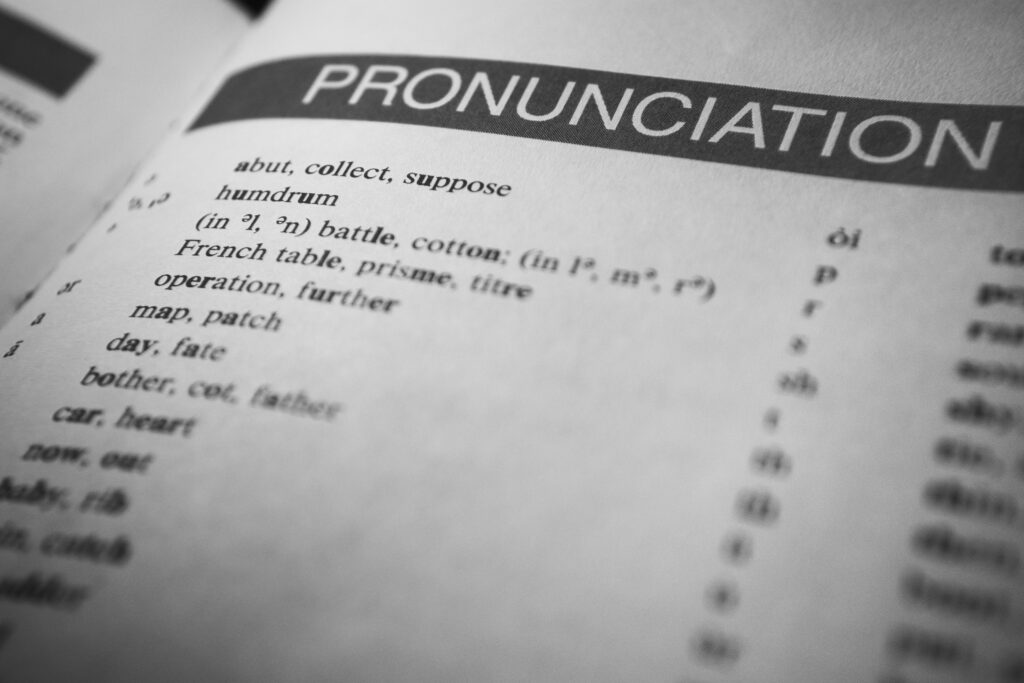
A page from a textbook showing the phonetic notations of a group of words.
(Image courtesy of Nothing Ahead on Pexels)

Me, my professor, and English

Truthfully, English is my second language, but it’s become my primary language. Studying it has broadened my horizons, deepened my appreciation and understanding of it, and allowed me to connect with people who also truly wanted to learn. I’d like to thank my grammar professor in college, who helped spark that motivation in me to better understand English. She fled North Korea, taught herself English, and is now teaching native English speakers how to better understand and dissect the innate understanding we have of the language – such as why we know to say “jump into the pool” and not “jump onto the pool.”

I still love to learn, and I’m best working behind the scenes rather than in front of students, teaching. That spark I felt nearly two decades ago still remains to this day.

And for the record, I personally say ‘toe-mae-toe.’

Britain’s growth strategy needs training boost, expert says

Britain will struggle to boost economic growth without investment in training and skills but this sector of the economy is getting little help from the government, business expert Nigel Driffield told The Sentinel.

   Britain’s left-of-centre Labour government, elected with a strong majority in July 2024, is trying to lift people out of poverty and provide better public services without sharp rises in the tax burden. It is looking to faster growth to close that gap, but that strategy has failed to bear fruit so far. Gross domestic product grew at only 0.1 percent in the third quarter of 2025, down from growth of 0.3 percent in the previous quarter.

    Concerns about the cost of living, coupled with worries about immigration, have given the right-wing populist Reform UK party a strong lead in opinion polls.

   Manufacturing in Europe has been lagging the United States and China, fueling a rise in populism, as The Sentinel has previously reported. Productivity is particularly slow in Britain, according to Driffield, professor of international business at Warwick Business School. 

    “We have a major productivity problem in this country, much more than an employment problem. We have a lack of investment in capital, and lack of investment in skills.”

     Britain issued its closely-watched annual budget statement in late November, delivered by finance minister Rachel Reeves. The government has provided an extra 1.5 billion pounds to help employers train young people. However, such money is often diverted for use for higher-skilled workers, Driffield said.

    “Businesses send people on an MBA, that doesn’t necessarily address the lower skills problem.”

    For university students from poorer families, the government said it would reintroduce small student grants. However, its plans to charge each university a levy of £925 per student for most international students are a counter-productive measure, according to Driffield.

     “Can you imagine a situation where the government says, ‘we are going to put an export tax on Jaguar cars’? Name another sector where it would do that.”

    Driffield said the latest budget was mainly about lifting people out of poverty. The government finally removed an unpopular cap on child benefit for families with more than two children, introduced by the previous Conservative government.

   The minimum wage was also raised in the budget by 4.1 percent to £12.71 per hour. However, campaigners argue that the minimum wage is still not enough to live on.

    “A very high proportion of people on benefits are also in full-time work, because they are on very low earnings,” said Driffield. “We are effectively subsidising low-wage employers. That’s why I advocate for investment in skills. If people working full-time on the minimum wage are still eligible to claim benefits, that tells you there’s something wrong.”

     Income tax rates did not rise in the budget, in line with a promise by Labour in its manifesto. But the government announced a further freeze to the income thresholds above which people have to pay higher tax rates, effectively meaning higher taxes for many in the future.

      The extra three-year freeze will cost the typical worker £220 a year, according to a post-budget report from the think tank Resolution Foundation, which focuses on living standards. Most workers would be worse off than if Reeves had raised income tax by 1p instead, the Resolution Foundation added. 

    The High Pay Centre, a think tank for fairer pay, was also critical of the tax strategy.

    “Given the scale of inequality in the UK, the government would have been better served by increasing taxes on a banking sector turning in its most profitable results in decades, or via a wealth tax on the very wealthiest in our society,” High Pay Centre spokesperson Paddy Goffey said.

    At the same time, in addition to the latest minimum wage increases, businesses are still smarting from the government’s decision in the previous budget to require employers to make national insurance – social security – contributions for lower-paid workers.

     “It wouldn’t surprise me if we start to see some impact on employment, given the weakening labour market situation,” said John Forth, professor of human resource management at City St George’s, University of London.

   Driffield said the extra wage costs would be hard for employers in some sectors to bear, for instance in the hospitality industry. 

    However, higher employment costs for more skilled workers, such as lab technicians, could encourage more investment in training by employers, Driffield added.

    Britain is behind other countries such as France in productivity and growth, due to low levels of public and private investment, according to the British government’s own figures. Britain’s GDP-per-hour-worked has grown by 0.6 percent since 2010, compared with around 1.0 percent in France, according to a report from Britain’s prime minister’s office in 2025.

      “One of the big differences between the UK and France is that the French labour market is great if you are an insider,” said Driffield. 

“Business will invest in you, but getting in is quite hard. If you are a North African migrant living in one of those banlieues (outer suburbs of Paris), you are frozen out. In Britain, you have a labour market that is very good at getting people into jobs, but not very good in training.”