A Hāfu in Japan

Two passports. Two last names. Two identities. From a very early age, my life has been characterized by how I am half-American and half-Japanese. In elementary school, my mom tried to teach me Japanese by putting me in a “Japanese as a Second Language School (JASL)” on Sundays. Being a child, of course, I was very averse to going to more school on the weekend.

In middle school, we moved to Tokyo, Japan, for two years for my mom’s work. I ended up going to the ‘American School in Japan (ASIJ)’ to take 6th and 7th grade. 

Blame it on anime!

However, I only decided I wanted to actively interact with and learn the language years later, in the middle of high school, all spurred on by watching just a few minutes of anime, something I ironically had never done before, despite all my exposure to Japanese culture up to that point. 

Suddenly, all my past experiences became missed opportunities. Suddenly, I wished I had been more open to the JASL lessons taught to me at Princeton University. Suddenly, I wished I had soaked up more of the Japanese that was all around me in Tokyo and ASIJ, which had both American and Japanese students alike. 

From sophomore year onward, I finally began to expose myself to Japan and Japanese-oriented programs. I put myself in a Japanese summer camp, a JASL summer school at Harvard, and as I went on to college, I got into a joint-degree program that would offer me two years in both an American university and a Japanese (Ritsumeikan University) college. Unlike my earlier experience of living in Japan for a couple of years, this time, I actually had a thirst for learning Japanese, and that experience and desire was what made all the difference in feeling that I was truly experiencing Japan.

Being in different phases of my life (11-13 years old vs. 20-22 years old) and the context that defined them was the main difference of living in Japan as a half (ハーフ Hāfu) individual. In middle school I was indifferent to both Japanese itself and learning the language, whereas in college, I actively wanted to learn Japanese and ended up going to a school that would better immerse me in its culture and people. 

While before I was made to go there because of my mom’s work, this time, I went of my own volition, meaning that I was more open to absorbing what Japan had to offer me. While I previously attended an American school that was filled with a majority of international students, Ritsumeikan was a Japanese university first and foremost, meaning that most of the school had students who didn’t even know English (I was in the international department, which had the only classes that were taught in English and were full of foreign students). 

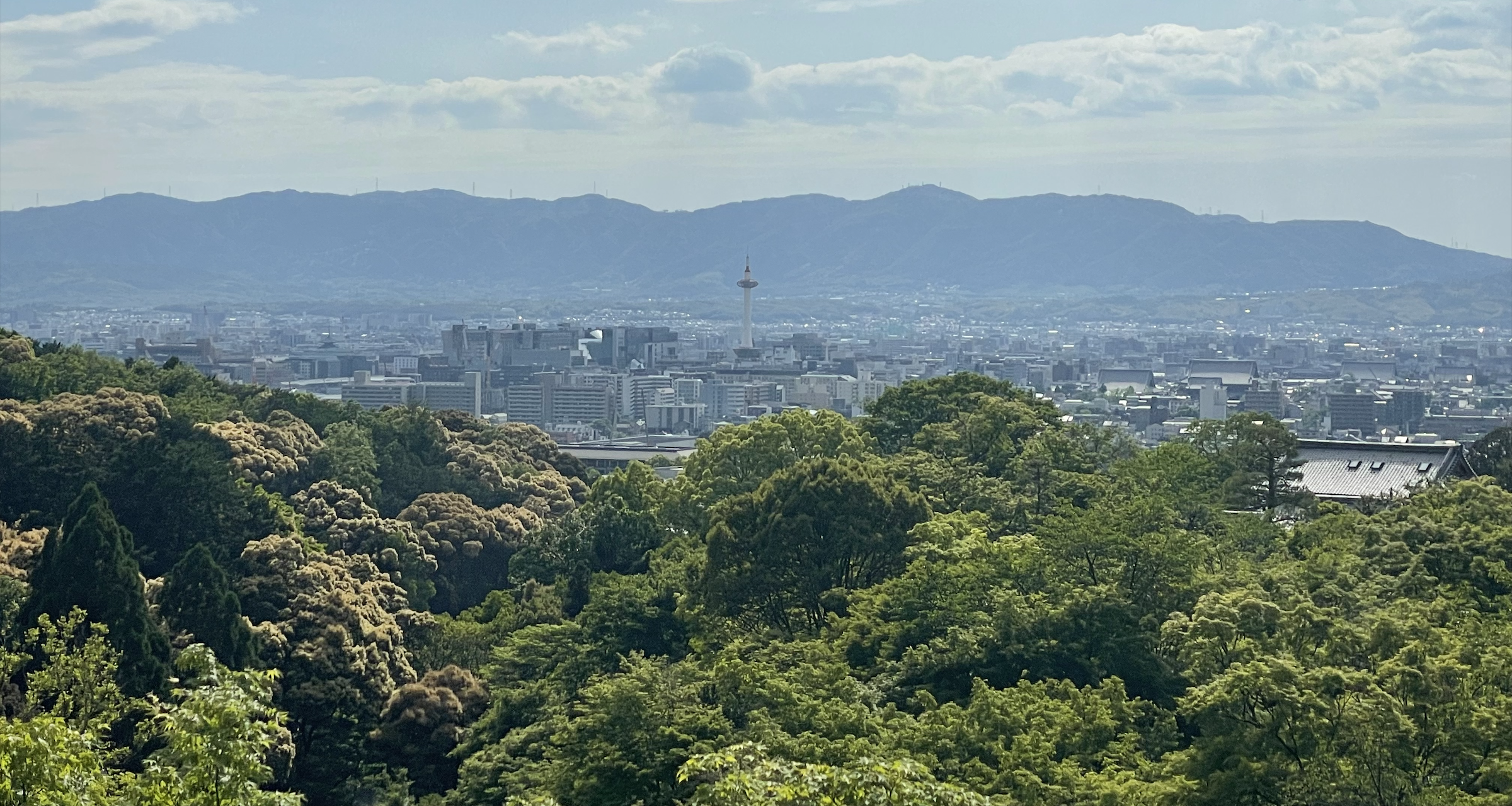
The places in Japan I went to differed too. Tokyo is a modern city with many international influences and people, and was where I went to ASIJ. Kyoto, where I went to Ritsumeikan University, is far more traditional. Living in Kyoto gave me a whole new perspective on what it meant to live in Japan. Although I had technically lived in Japan before as a “half person”, this experience was like night and day. I don’t even remember it too well; it gave me a much more valuable experience of what it was like living in a different country. 

Tokyo versus Kyoto

To start with, the city of Kyoto was so different from Tokyo, where I had lived before. It is not as big as the Capital and is far more spread out, which feels a lot less like an actual city since there are an abundance of rural areas (the dorm I lived in was in one such area). To get to the most popular part of the actual city meant taking an almost hour-long bus ride. Even the buildings were not “allowed”to be too tall due to the designation of Scenic Areas dating back to 1930. However, this was not to Kyoto’s detriment. In fact, it actually made Kyoto feel more quaint and intimate, along with showing that even in a place filled with suburbia, you could still get pretty much anywhere easily with a very punctual and connected bus system. When I was living in America, in rural New Jersey, it was and did not feel nearly this connected. 

There are many other differences though that made living there challenging. Tokyo can be likened to New York in many ways, with its tall buildings and seemingly never-ending expanse thanks to its many prefectures and wards. As the country’s capital, it makes sense that it is the city that comes to mind when thinking of Japan and it’s hardly surprising that  many international visitors end up making it their home. Kyoto, on the other hand, has far fewer foreigners, which does have its downsides. 

While this homogeneity allows you to experience a more traditional Japanese way of life, it also means that many people are not as exposed to foreigners, and living in Kyoto as one was not always easy. Some Japanese people are not as familiar with international ideas and diverse lifestyles, being more traditional and conservative.  This outlook meant that living as a half-person in Kyoto was challenging for me, as it isn’t always the best setting for nurturing your sense of identity as a Japanese person.

Our pet peeves

Many of my experiences as a foreign student in Japan resonate with the experiences of others in similar situations. We’re irritated by some mostly small microaggressions and situations that may last for only a few seconds, but as they add up, it becomes obvious that they are indicative of a much bigger problem. 

For example, a woman once stared at me the entire time she was on the bus I was traveling on, even after she got off it! Another time, I was told to quiet down by the bus driver, even though there was a large group of Japanese students sitting right across from me, being far noisier. People occasionally asked to take a picture with me.

Although I am sure none of these people harbored ill will, I still think it shows how foreigners are seen by some as more of a sideshow, far outside the Japanese in-group, and not to be treated as equals.

Seeing as how I don’t remember any of this stuff happening my first time around living in Japan in Tokyo, I think it was mainly a Kyoto experience, a setting where I never saw more than a few pairs of foreigners on any modes of transport at any given time. 

My language and looks cramp my acceptance 

But there are other reasons why I don’t seamlessly blend in. Because I only decided to start learning Japanese in high school instead of when I was much younger, it means that I am still not fully fluent in the language. 

I don’t look fully Japanese either, and have been told by some that they didn’t even realize I was anything but Caucasian. Seeing as how I lived in America for all my life, I told myself that Americans couldn’t tell I was part-Japanese because they hadn’t been exposed to what Japanese people look like. However, many people in Japan couldn’t see past the foreign side of me either. 

When I order food or anything really from a restaurant or shop, the person behind the counter immediately starts talking to me in English, even if I initiate or respond in Japanese. A lot of people who have only known me for a few seconds are surprised that I know more than a few Japanese words like mountain (yama) or river (kawa), and even more shocked that I know how to write such words in kanji.

However, I am not fluent in Japanese, and I admit to an occasional feeling of dread when others are proven right, and I am no longer able to understand everything they say. Sometimes, I just want to tell them that simply because I don’t understand everything in Japanese doesn’t mean I don’t understand the word for ‘here’ (ここ koko) or even the word for ‘Japan’ itself (日本 nihon). 

Many Japanese people assume that I don’t know any Japanese because of how I look, and when I show that I do, it’s mind-blowing. Even worse, when I say I don’t, it’s to be expected. 

Even after I returned from Japan, I still maintain my identity as a Japanese person, but my time in Kyoto was eye-opening for me. It really taught me a lot about what it was like to live in a more traditional part of Japan. I was surprised at how different the two cities of Tokyo and Kyoto are. If I had to choose between the two, I think I would ultimately opt for Tokyo. Kyoto is somewhere I recommend as a place to visit for a few days, but I think that Tokyo is a city that is better to live in, at least for foreigners. If I were to settle  in Kyoto, I don’t think I would feel completely comfortable with my Japanese identity as a hāfu, and would continue to feel like a foreigner in what is technically my own country. 
Movie characters and why I wish I was one

I wish that I was traumatized like people in movies are traumatized

I wish that other people could escape into my sad story to hide from their own

I wish that I was sardonic, I wish it made me funny

I wish that I was haunted not by entire years of life but by one single soundbite, a few flickering frames of film, something small enough to lock away and forget

I wish that the memories were in third person, distant, not seen through my eyes and made inescapable by perspective 

I wish that it was precise, I wish I could remember each word well enough to repeat inside my head until it turns into a prayer

I wish that I woke from nightmares and sat bolt-upright, panting in bed with glycerine sweat on my brow, disheveled but somehow sexy as well

I wish that the nadir of my downward spiral was me crying and punching my own reflection in a bathroom mirror

I wish that emotional music played over the rock-bottom scenes, two thirds of the way through the movie to kid the audience that it’s all going to end right now

I wish that even as I cut into myself and the corn-syrup blood spurts from little tubes hidden under silicone skin, as artificial tears roll down my cheeks over ersatz bruises, my face would be stony and still like a statue of a saint 

I wish that I would be rushed to hospital in a haze of red and blue lights and that my rescue would be medically accurate and miraculous

I wish that people around me would care

I wish that at my lowest point a manic pixie dream girl would take my hand and teach me to love life again, as if the issue isn’t what life has done to me but my attitude towards it

I wish that years of trauma could be negated by minutes of happiness

I wish that the parts of me that are trauma-formed were simply layers that obscure who I really am, that they could be shed like a snake sheds skin it no longer needs

I wish that they weren’t inseparable from me

I wish that those around me would be endlessly patient and understanding as I make my slow but steady progress, because they can see the good in me that is there for the benefit of the audience

I wish that I would have only a single setback in my recovery, and that my misery and fear would be resolved with a pep talk and a hug

I wish that I would take some minor but symbolic baby-step at the end of the movie that shows it’s all going to turn out okay

I wish that it would go the way the audience wants it to go

I wish that the ending of my movie would be happier than the start

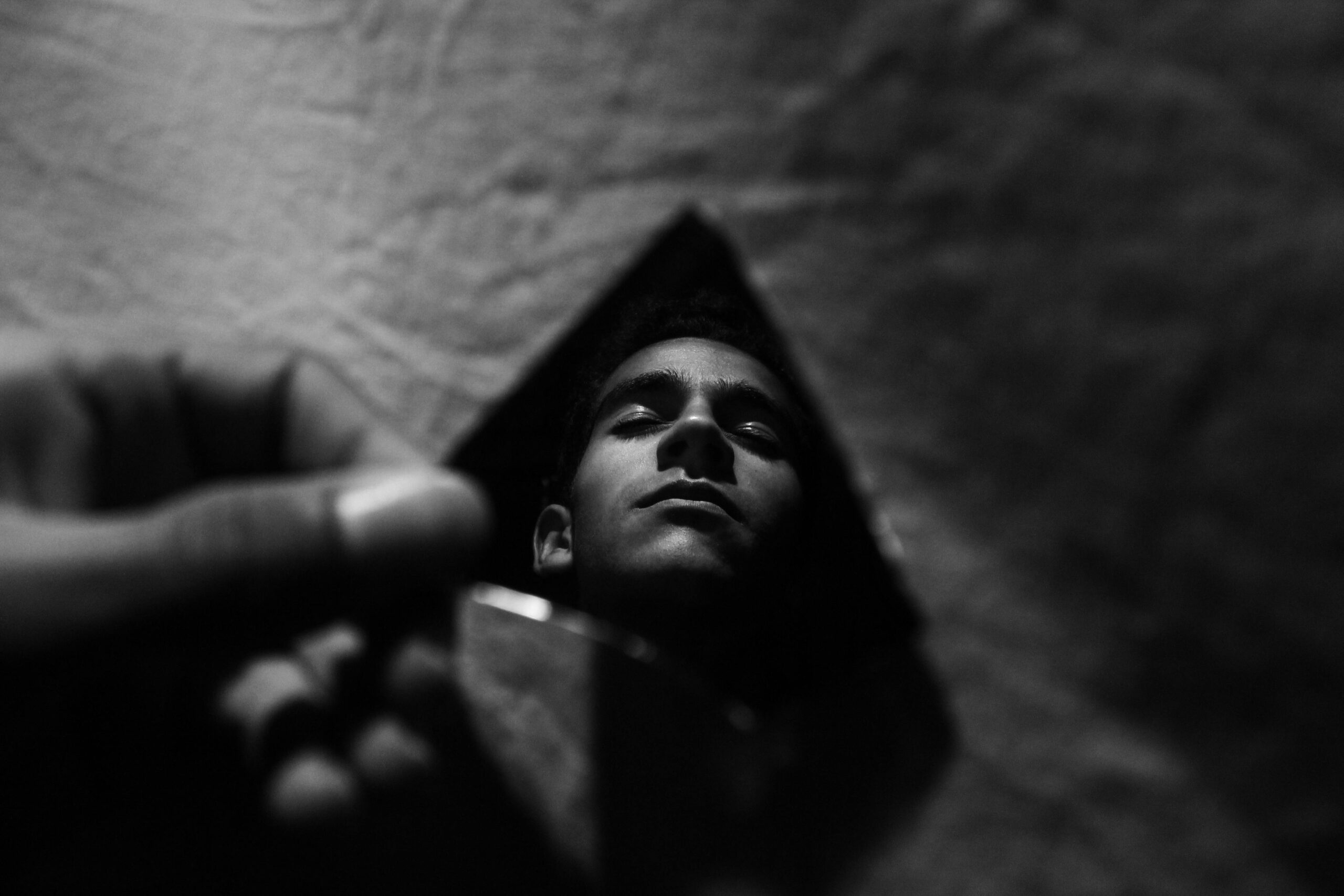
Image of a man holding a mirror shard in his hand. He stares at his reflection in the shard. In the distance, the sun shines down.
Image courtesy of Amine M’siouri on Pexels

A Journey from Nopreneur to an Entrepreneur

Life is full of ups and downs,’ we have all heard this.

For me, this saying is completely justified. I have always been an achiever, since my childhood, with distinctions all through my academics. As an electronic engineer by training and a founder by passion, I took the path from a Bachelors of Technology degree in Electronics to becoming an entrepreneur, but it was never easy for me. Although the beginning was hopeful, later, I had my share of hardships. 


Starting my career in 2013 at the giant consulting firm Tech Mahindra, I was placed via campus recruitment as an Associate Software Engineer. I resigned after two years of association in 2015 with anticipation of starting my own boutique. But fate saw to it that I didn’t get the chance to start my dream boutique at all. 

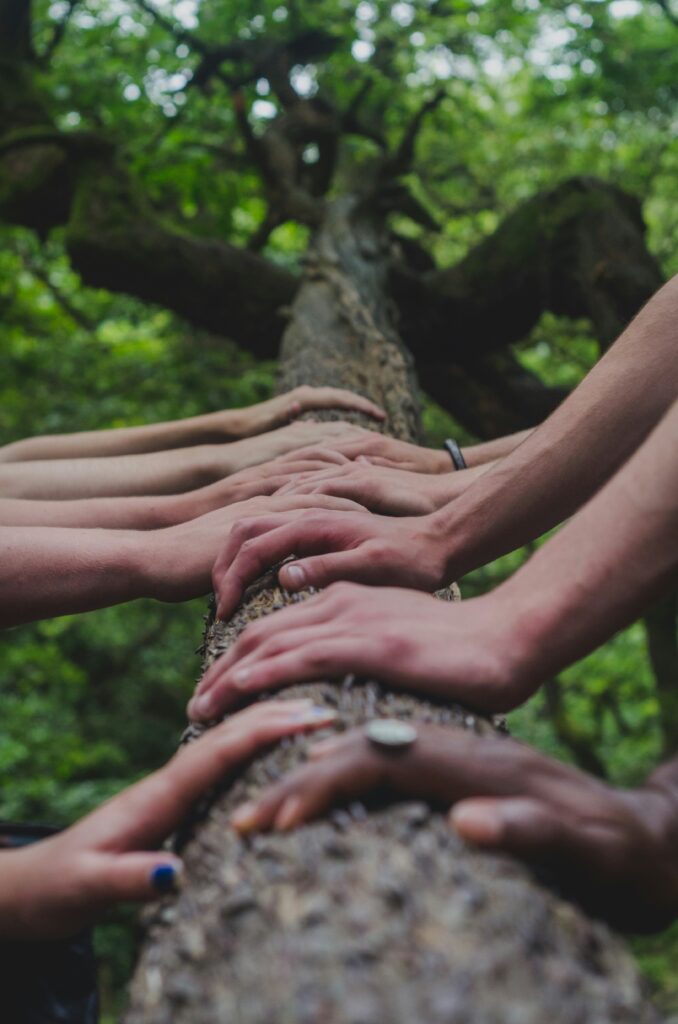
Hands of various people lined up along a log.
(Image courtesy of Shane Rounce via Unsplash)

Not disheartened, I pushed myself and started preparing for the Masters in Business Administration examinations, managing through it with the little savings I made from my short tenure at Tech Mahindra Ltd. To secure admission into a top-tier institute, I went through the ordeals of SNAP, XAT, CMAT, and CET. Based on my good CMAT and CET scores, I joined a Management Institute. 

I also got an interview call from Amdocs, a US-based company. My parents were reluctant to let me work abroad, probably because they feared for my safety in a foreign land. So I accepted a remote offer from Wcities Content Solutions—a travel and entertainment content publisher—as a Freelance Editor. 

This was in 2017. 

By 2019, I decided to leave the employment world. Determined to start something on my own, I started freelancing, all from zero.

What you are seeking is seeking you

I got my first break from Pete Hillier, a client from London via Truelancer, and there has been no looking back since then.  Content projects started pouring in rapidly from across the world. 

After working for several clients and projects for over a year, it was the Pepper Content website that spotted me and regarded me as one of the ‘Highest Paid Freelancers’. They introduced me to several brands, such as Upgrad, Springboard, Mercer|Mettl, American Technology Consulting, PayTm, and many more. Within a year of consistent performance, they regarded me as a ‘Pepper Certified Writer’.

A gold trophy against a white background.
(Image courtesy of Giorgio Trovato via Unsplash)

After three years of working with Pepper for over 300 top brands, I had the confidence to finally start my own agency. I have now been successfully running my own agency since December 2022. 

The trajectory from being an associate to an entrepreneur has been rewarding. Delightfully, it has earned me the honor of “Woman Entrepreneur of the Year 2022-23” by the Indian Achievers’ Forum, Delhi, India. As the cherry on top, I am now a part of the IndieFolio network, too.

A decade of tireless days, I am today representing Woman Entrepreneurship, nurturing a team of 20 talented professionals. Having groomed and guided innumerable aspirants over all these years is satisfying. All thanks to my mentors, my friends, and the people who have supported me and who have always been there to lift me up when I am down.

This is a small message from me to everyone out there, that if I can do it, so can you. 

Sea Comedies

Seas. Escapades. Journeys.

These are the things one lives for. These are the things that Melissa Jennings’s mother wanted her to strive for. When she did, she found herself in the middle of a rowboat abandoned by her crewmen for the crime of being a woman who wouldn’t “put out.” The churning waves lifted and dropped the small rowboat over and over again as the sun beamed down on her clothed form. Queasiness filled her stomach, and it was only because she hadn’t eaten in days that she was not emptying it into the ocean. Her whole body was sticky and grimy from the caked-on sweat, and she wondered how and why life decided to put her into a Shakespearean comedy.

The only good fortune in her life right now was that, prior to being tossed overboard, it had been her job to supervise the ship’s charts, and if she was remembering right, there should have been an island close to where her ex-friends dropped her off. 

Yet, as she gazed out at the ocean with blurry vision, she saw nothing but the same lifting and descending waves. Her urine wasn’t going to save her for long. She had to do something.

Melissa slowly moved the hand that was resting on her forehead. She swallowed dry spit down her throat and nearly had another coughing fit. Dying at sea didn’t seem so bad, she supposed. At least the nearest shark could tip the boat over and then she’d be useful to nature. Or maybe a whale would find her unmoving body and use it as a toy. There weren’t any piranhas in the ocean that she could see, though if there were, she wouldn’t be surprised since she couldn’t fully trust her eyesight at the moment. 

She rose from her laid-out position and cracked her neck. As temporary relief coursed through her neck and shoulders, her eyes spotted a dark spot in the distance. As her eyes cleared, the waves of heat dissipated. Relief filled her as she spotted her salvation. 

An island! 

Thankfully, her ex-friends didn’t deprive her of a paddle. Melissa grabbed it and pushed through the ache of her muscles, and a rush of adrenaline let her row her way towards the shore. Eventually, she reached a point where the waves began to push her, so she stopped rowing. Luckily, the island was only a few feet away. Then, all at once, her boat started to lift. 

Melissa groaned; she spat out the sand that clung to her lips, rose from her knees, and dusted herself off. She found new scratches on her arms and legs after her rough landing. The island began to spin, and she knew she needed to find food before her body became a permanent part of the landscape. Leaving the overturned lifeboat, she carefully journeyed into the forest in front of her.

A mental image of her map revealed that this island was called Radovid. Melissa had never visited, but according to her ex-friends, it was a popular destination for shipmen that wanted to disappear with their whores for a few days. The island sat in the middle of the great Pacific between two main islands, Nautilus and Euphrates. There were several other islands in between, but those were not nearly this big. Most of them had views where you could see the other side of the shore. 

             Radovid was nothing like she’d ever seen. This island was large and filled with lush trees. Melissa expected to see tall coconut, avocado, mango trees, papayas, or hibiscus shrubs. Instead, the only ones she could identify were lily trees. Literally, trees with white lilies for leaves. Melissa oriented herself to make sure she was actually alive. She smelled the shore, felt the crunchy grass beneath her feet, and the knots in her upset stomach were very real. Maybe lily trees were a new experiment that the earth hadn’t introduced to the populace yet.

            Unfortunately, these lilies did not smell like the ones that grew in her mother’s front yard. Oh no. These smelled musty. The scent assaulted her nose as she traveled further into the island. As if things weren’t bad enough, she hadn’t seen a single fruit or vegetable since she arrived. In fact, there weren’t any animals, either. A sea of lily trees surrounded her now, encasing her in a valley of brown, lime green, yellow and white. She huffed out a frustrated breath.

“Hello?!” Her voice echoed up, up, up, past the canopy of lilies.

Thank the heavens that she wasn’t allergic to them.

The more she roamed, the more Melissa’s nerves began to spike. There wasn’t a single person, animal, or other form of plant life. Every single tree was covered with those same white lilies. Thankfully, they blocked out the sun and provided some much-needed shade, but the sour stench of the flowers was making her lightheaded. Returning where she came from proved to be useless. Somehow, her sense of direction was skewed. She couldn’t remember where she left her boat. The waves of the ocean were the only faint traces of reality that Melissa had left, and she intended to keep them. She followed their sound further north.

Up ahead, a bunch of trees blocked her path. There was just enough space to squeeze through. As she did so, she pushed on the tree to her right. It moved effortlessly. The tree trunk bent as if it were a wet noodle. Wide-eyed, Melissa pushed herself through, watching as the tree returned to its original straight position.

Melissa turned around and saw what had to be the darkest place on the island. She found herself standing in a circular room of foliage. Around her was a thick wall of vines with teardrop leaves and lilies scattered throughout. Their sour stench stuck onto Melissa’s skin. She fought the urge to hurl the only two things in her stomach: air and anxiety. There was a chipped and cracked stone well sitting in the center of the room. Dirt occupied the ground as well as the ceiling, which was odd. 

The dirt crunched under Melissa’s feet as she approached the well. Its dark center came closer into view as she walked toward it, and a heaviness crept into her heart when she looked down into the pit. There was nothing, not a single flicker or anything. No water. No plants. Not even lilies! Blackness met her head-on.

          God, this heaviness within her chest was awful. Melissa grabbed her chest, and her breathing slowed. Suddenly, water swelled in her eyes. She turned to face the entrance…which was now closed shut. An examination of the room revealed that there were no exits whatsoever. “Hello?” she called. Nothing. The trees that she passed through were no longer there. Melissa only saw more green veined walls. Her voice heightened in pitch: “Hello? Hello!”

Snickering came from behind her. As she slowly turned, the snickers increased. They varied in pitch and tone. Each one was terribly horrifying. Her eyes hyper-focused on a lily directly across from her, on the wall.

The lily had black eyes, a tiny nose, and shark-like teeth that shimmered as it suddenly started laughing.

Every single lily stared right at her and commenced a chorus of maniacal laughter. Melissa screamed and turned around, finding herself face-to-face with a wall of laughing lilies. She retreated to the stone well and leaned against it. The lilies started vibrating as they laughed. Their eyes rolled to the back of their heads – petals? – until they disappeared, leaving nothing but their awful mouths.

Tears fell freely from Melissa’s eyes. She looked inside the well and lifted her knee to enter. A large face that matched the lilies with wide eyes and an amused smirk stopped her dead in her tracks. It opened its mouth, “Hello, Melissa.”

          Melissa screamed again, falling to the ground. She screeched so hard that her voice cracked. The well started vibrating as it laughed along with the lilies. The laughter started to merge together. The range of pitches and tones became one soul-shattering, deep tone that plummeted any hope that Melissa might have had.

The lilies stopped laughing. They simply stopped. Their smiling mouths shut and then dropped to the ground. Piles of mouths plopped to the floor. Melissa curled into a ball and stared at them with horror.

One twitched. Then another. Then another. In a burst, the laughter continued. The mouths bounced on the sides of the wall until they started heading closer and closer to her. Terror kept her frozen in place.

“Stop it,” she whimpered. “Please stop it.” No amount of sea and survival training could have prepared her for this. No amount of her mother’s protective training could have protected her from this. If there were stories about this damn island, then she certainly hadn’t heard any. If anyone ever survived this place, why hadn’t they made books or newspaper articles about it? It could’ve saved her life!

The mouths bounced and bounced, their sharp teeth coming closer and closer towards her.

“Stop it, now!”

The mouths stopped. Some of them froze in midair.

Melissa quickly wiped her eyes and face, her mouth agape as she examined the strange creatures. She quickly stood and started to catch her breath. She turned left and met the eyes of a woman with ashy hair, melted skin, exposed muscle, and rotting flesh on her mouth, fingers, and the corners of her eye. She leaned on the side of the well and gave Melissa a strange, almost welcoming smile.

Melissa was too shocked to run or to scream, not that it would make a difference in this hellish enclosed cave anyways. She stood completely still, staring at this woman, though the sight of her almost made Melissa sick all over again. 

The woman was clearly human at one point, that much Melissa could tell. How did she end up on this godforsaken island? How had she become this monster that stood before her? Melissa then thought that perhaps this monster had once been exactly like her, stranded here by greedy seamen who only saw her as an object to be had. Maybe this woman had also refused to be their commodity. Maybe Melissa was doomed to the same fate as this humanoid monster that continued to stare at her intently, still with that faint, discomforting smile on her rotting lips.

Then, the woman laughed. Her laugh roared through Melissa’s ears, immediately bursting her eardrums. The mouths started their horrible laughing and bouncing once more. One finally made contact with Melissa’s leg. Another one latched onto her arm. She let out a horrified, blood-curdling scream. Desperately, Melissa tried pulling the mouths off of her, terrified at the thought of dying at the hands of this foul creature. 

More and more, the mouths munched and munched until there was nothing else left of Melissa Jennings. With a satisfied smile and a full belly, the melting woman disappeared back into her well. Silence fell on the island, and the mouths returned to the lilies, who smiled once more.

Contours of Language

Sifting through multitudes of strangers,
Longing for a familiar face, a smiling acceptance,
An existence away from home,
Calls for a course correction, isn’t it?

For weeks, I have plied on the roads less traveled,
Meeting people, then distancing them,
Walking the spectrum of small talk, appearances,
Yet, I find the connection missing.

This city is a labyrinth of souls,
Driven by capitalism, flocking to pots of gold.
Drains the life away, seeping you deeper,
Into an endless race built on casual ambiguity.

No one knows what brought them here,
Chasing greens in a city of dreams,
Like a traveler pursuing a mirage,
No end in sight, but the chase goes on.

In this city of dreams, I long for a smiling face,
A caring pat on the shoulders bogged down by expectations,
A melodious voice, a koyal perched on a twig,
And a greeting in my own language.

A begaana in a buzzing, bustling city, yearning for home,
Smiling through teary eyes, wishing to meet his family again,
Crossing the contours of language,
when he couldn’t find his own.

Koyal: (Hindi)cuckoo, known for her melodious voice; begaana: (Urdu) unknown, foreign, alien.

The Magic of Writing Christmas Greeting Cards

The world moves on, times change, and technology continues to invade our lives. Yet every year, as Christmas approaches, I open the “box of memories” where I keep not only the letters I exchanged with my teenage friends when social media didn’t exist but also the old postcards and greeting cards that were used to exchange holiday wishes into the 90s (and some into the early years of the new millennium).

As I look at them with nostalgia, I wonder if technology has made us lose our taste for anticipation and surprise. There was something magical about opening an envelope sent by relatives and distant friends, each sharing a bit of themselves and their lives. Those with little imagination limited themselves to a brief update on the health, work, or studies of their children and cousins. Others, like my mother and grandmother, devoted themselves to writing long messages expressing the joy of reconnecting with those they couldn’t see all year because of distance or family obligations.

The practice of Christmas cards dates back to the Victorian era, and the first illustrated postcard was commissioned in 1843 by Henry Cole, the director of The Victoria and Albert Museum in London. In the years that followed, there was a real boom, and postcards were printed by the thousands.

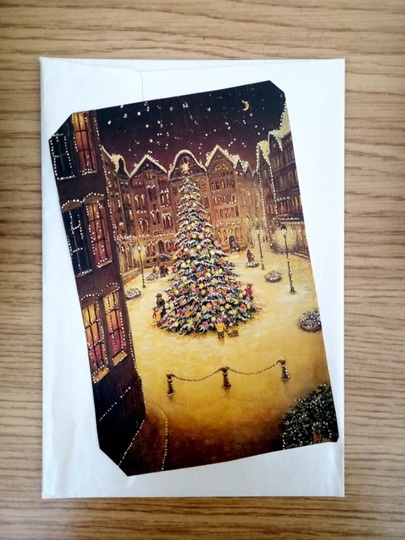
In the 1920s, Christmas stamps became popular both in Italy and English-speaking countries for sealing letters. The money from their purchase was donated to the Red Cross and other charities. When I was a child, my mother used to buy postcards from the Only Painters Artists Mutilated Charity Association of the City of Verona, the charity supporting disabled artists in the city of Verona, which still exists today. They sold paintings and artwork created by artists who used their mouths and feet to create their works. Many illustrations were incredibly beautiful and evocative, such as those by painter Jolanta Borek Unikowska (1990s).

 A Christmas card featuring a Christmas tree ornately decorated in a town square.
(Image courtesy of Viviana De Cecco)

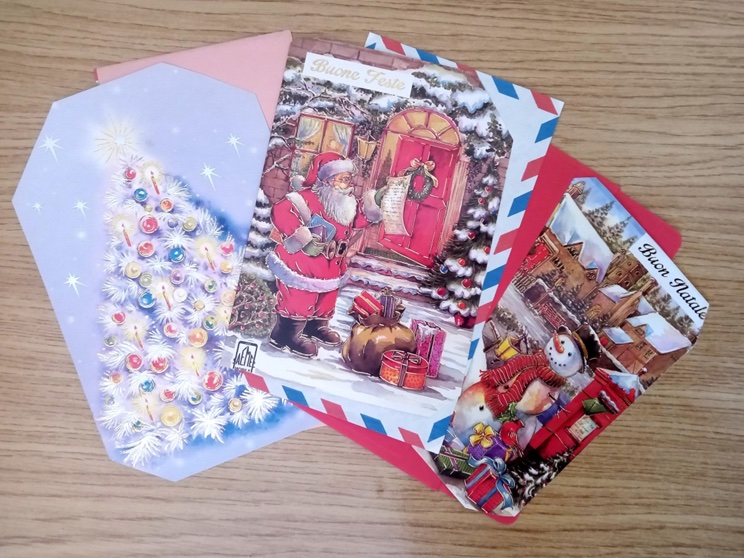
Old postcards have always held an extraordinary power for me. They transport me to a time that no longer exists. My favorites were those depicting snowy landscapes with tall trees illuminated in remote villages, and reindeer pulling sleighs through the snow. I especially treasure the postcards from the SAEMEC publishing house that specializes in this type of card, which have now become rare and collectible items and thus often sold on the internet.

A series of Christmas cards in various traditional styles.
(Image courtesy of Viviana De Cecco)

Here, on the island of Sardinia, snow is a rarity. In the past hundred years, in the town where I was born, we may have seen it four times at most. When I was a child, it wasn’t common to go on a skiing vacation, though few could afford a vacation in the mountains. So those postcards opened the doors of my imagination and, like in a fairy tale, I felt drawn to unknown worlds where fantastic beings like elves and snowmen with human features smiled at me from the paper. Sometimes the subjects were religious, while at other times they were limited to Santa Claus traveling on his sleigh with sacks bursting with gifts.

Each postcard was personalized, and since my mother had taught me to draw, I often added small pencil illustrations colored in with crayons or markers. I loved to spend hours hunched over the pages, letting my creativity run wild, thinking about what to write, and carefully choosing the most appropriate words for the recipient.

Christmas festivities began when the cards were mailed in early December, with the fear that the mail might be late. They were usually folded in half with the standard phrases for everyone inside but the rest of the page was left blank so that the sender could add his or her own special message.

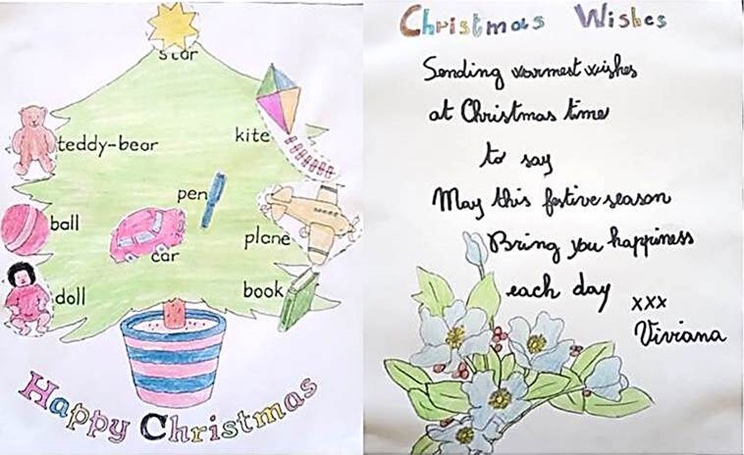
Also, at school, just before the holidays, teachers encouraged children to make rhymes, collages, or drawings to decorate the little cards they would give to their parents on Christmas Eve. I still have the card my English teacher had us make, which combined teaching and fun to stimulate each student’s creativity.

Two Christmas cards side by side, featuring adolescent decoration. 
(Image courtesy of Viviana De Cecco)

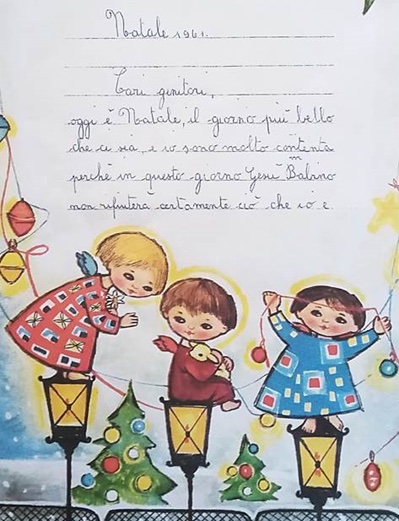
In 1961, my mother, six years old at the time, also wrote Christmas cards to her parents. Her old postcards show that, at that time, it was customary to include prayers for the health of the whole family. Gifts did not matter much compared to the health and happiness of loved ones.

A Christmas card, featuring children with writing in Italian. 
(Image courtesy of Viviana De Cecco)

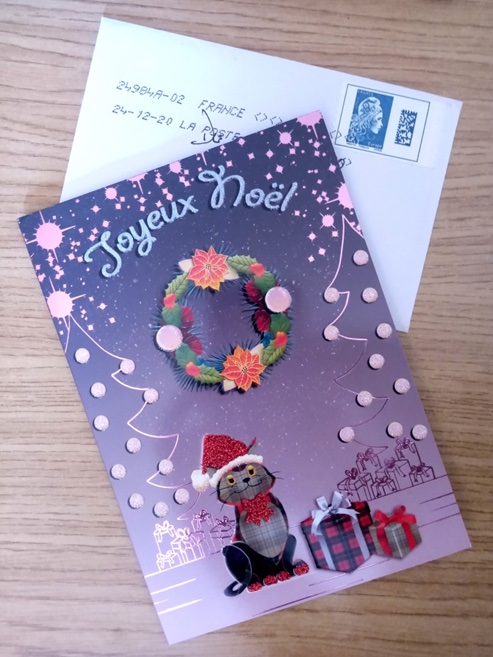
In the 1970s, my paternal uncles emigrated to France, and since we could only see them in the summer, my father began sending them Christmas cards. It became a tradition that repeated itself every year on time, and today that tradition continues with my cousin, now an adult like me. The message on the cards that he buys is, of course, in French, but he likes to try his hand at Italian sometimes, though he isn’t fluent. It’s his way of celebrating his father’s and uncle’s heritage.

A French Christmas card, featuring a wreath and a black cat. 
(Image courtesy of Viviana De Cecco)

In today’s world, perhaps the immediacy of instant messaging has broken that spell of anticipation that had us waiting at the windows for the postman. Or, on the contrary, perhaps it has brought us closer to those who, for various reasons, cannot be with us for the holidays. Perhaps the answer is somewhere in between.

With the advent of the internet, we have grown used to being bombarded with thousands of images scrolling across our phone screens. Sometimes, I confess, I look at them too quickly to admire them one by one. Often, I’m in such a hurry that I don’t even take the time to quietly observe the details. A part of me feels guilty because I know how much care, passion, and love an artist puts into creating their work.

When I hold my old postcards in my hand, it’s instinctive for me to stop and take in what’s in front of me, to enjoy a moment just for me, where I can let go of memories and feelings.

Maybe technology has made us neglect that a little bit. We are so distracted by animated digital visuals, that we don’t have the time to focus on the sensations that the words evoke in us. It seems like a kind of consumerism where we move from one thing to another without fully enjoying it.

I can say that technology has its positive sides, such as enabling us to share anything almost anywhere. I recently joined two Facebook groups, one in Italian and one in English, where some nostalgic people post photos of old hand-illustrated Christmas postcards. It’s getting harder and harder to find them in stores, and few people still use the postal service to send greetings, but it’s nice to know that there are other people in the world who share my interests.

Memories are a valuable resource for all of us because, after all, we know that even history is made up of a thousand life stories of unknown people. And just as the letters and postcards of those who have gone before us are preserved in the Postal Museum in London, I, too, keep the memory of the words of those who have loved me alive in my little box of memories. 

Tidal Waves

some days are tidal waves
knocking me breathless
i gasp for air that won’t fill my lungs
drowning in the waters of worry

other days
i drift gently as a feather
floating on winds of hope
i bask in the warmth of joy
soaking in calm

healing is not linear
progress flows and ebbs like tides
some days i slip beneath the surface
fighting to stay afloat

other days
i soar high above the darkness
seeing light ahead
i breathe easier knowing
the low tides always recede

i softly embrace my broken spirit
cradle myself with kindness
mend slowly with care
fill its cracks with gold

i honor the darkness
for without it
i would not recognize the light
pain bears gifts if i am open

today i will walk gently
bare feet grounded on earth
heart open to sky
receiving whatever comes
with arms stretched wide

Image of waves crashing against rocky cliffs.
Photo by Олег Мороз on Unsplash

One Woman’s Mission to Let Migrant Women Shine Front and Center

“…as a journalist, when I migrated, I started to face a lot of issues to find one opportunity. And I really wanted to tell these stories…I didn’t find places that wanted to publish [them],” Juliana da Penha admits. 

An experienced immigrant, da Penha personally understands the challenges faced by migrant women. Native to Brazil, she has also lived in Portugal, Italy, and Cape Verde before settling in her current home in Scotland. But it was not just the challenges of migration that confronted her. The stories told by the press about migrants, especially women, were also alarming. As da Penha built a life away from her homeland, she began to realize the media did not always portray migrants in an accurate light, often describing them according to untrue stereotypes.

A seasoned migrant with a passion for storytelling

Having worked with an employability project for migrant women, da Penha witnessed firsthand the discrimination talented migrant women with much to offer experienced due to immigration policies and racism. She determined that if no one else would, she would tell their stories. Thus, an idea began forming, one that would blossom into Migrant Women Press, officially launching in 2020. A trained journalist, da Penha used her skills to create an online space for the stories of migrant women to be shared and centered. 

Research has shown that the mainstream European media has frequently referenced migration as a “crisis,” framed migrants as either vulnerable or dangerous, rarely offered context for the circumstances of migration, and scarcely provided opportunities for migrants to speak for themselves. In the British media, journalists themselves play a pivotal role in framing public discussion on migration. To that end, Migrant Women Press serves as an influential force disrupting journalistic practices that perpetuate xenophobic, dehumanizing stereotypes. 

Letting migrant women glow front and center

Unlike most other news outlets, Migrant Women Press and its content are led and created exclusively by migrant women. Da Penha explains, “…in the UK, for example, we have 94% of the journalism workforce made up of white people, and then we are bringing diverse voices.” In a field dominated by white majority influence, Migrant Women Press offers a fresh perspective to media discourse about migrants. “We are humanizing the discussions about migration. We are not just speaking about numbers, about crisis, we are speaking about people.”

Overall, more than 20 different countries are represented through the publication’s international contributors, fostering a connected global community.

A hand, holding a ball point pen, writing on paper.
(Image courtesy of Unseen Studio via Unsplash)

Establishing a groundbreaking initiative like this, of course, comes with its challenges. For da Penha, the most difficult ones to overcome were the personal ones. “The barriers were internal barriers, mental barriers,” she reflects. Coping with insecurities regarding being out of the industry for many years and language competency was difficult. Rejecting this mindset and choosing to begin helped da Penha move forward with Migrant Women Press. “It doesn’t need to be perfect. It’s from my heart.”

Migrant Women Press is not a solitary effort. Da Penha works with a team of volunteer writers, editors, journalists, and media specialists from different backgrounds scattered across several countries. Together, they develop content and help shape the direction of Migrant Women Press, drawing on their diverse pool of knowledge and experience. 

As a volunteer-led, independent media organization, no two days are alike. “Things change all the time, working with media,” da Penha reports. Despite the dynamic nature of working in the press, regular editorial meetings keep Migrant Women Press running as her team plans its next steps, week-to-week.  

Moved by the migrant voices they amplify

For da Penha, the most rewarding part of doing this work is the migrant women she meets. She shares passionately about the experience of working with women, “doing amazing things, speaking with them, listening to their amazing projects, about their dreams, about their potentials, about how they wanted to contribute to making this work better.” Da Penha also emphasizes the importance of offering a space for the stories of migrant women to be told, so they are not lost. 

Migrant Women Press has profoundly contributed to diversifying narratives about migrant women by empowering women affected by immigration and displacement to tell their stories, thus challenging stereotypes perpetuated by mainstream media. It has  aided in introducing more perspectives to the public discourse. As da Penha notes, “I think it’s positive that we are not having one single side of the story.” She is currently a finalist for the Georgina Henry Women in Journalism Award

Despite all that Migrant Women Press has accomplished, da Penha has no plans to slow down. Looking towards the future of Migrant Women Press, she hopes to do more investigative work to further influence media discussions around migration, help migrant women develop their media skills, and continue to bring diverse voices to the press. “This is our vision,” she shares. 

To My Only Friend Who is Gone on a Voyage of Death

Many, at times, think we see a ray of hope to comfort our emotions and whittle down the volcanic cloud of our sadness. But unfortunately, our sense of love and compassion ends up overwhelming the strength to prevent tears. 

For to cry is not to mourn, but to weep is to truly mourn, as it is written that even our Lord wept. 

The beauty of death is that the life the deceased lived will become an amusing experience and sensation for us, to remind us that someday, we will end up as someone else’s amusing experience and sensation.

Do you know where the best cinema is? Found in the euphoria of memories of any event in the mind of a person who is nursing an ambition of good or bad memories of an event. The vividness of such memories is worth more than a setup of an Opera House or performance at a Pit-theater (just like the AwoVarsity Theatre).

Tonight, I am seated outside, on the veranda, hearing the stillest sounds of air, looking at the clouds being separated and fussed over.

Suddenly, the thoughts of my late friend, Hajj Ibn Abubakar struck me. The air around me grew a little cold, colder I should say even. My body let go of the goosebumps for a while as the air became a little wind that whispered a few words to me. They reminded me that no matter what, the goodwill of my late friend still connects with my inner bond whenever I remember him.

I searched my inner man to ask Hajj Ibn Abubakar some questions; then I remembered it was just the memories and his goodwill that spoke. Hajj is long gone to queue up again as one of the silent children from the constellation of stars.

Hajj, my very good friend, was quite older. Yet, he bonded with me; you’d never think he wasn’t my blood. But he became my blood through the nights and plights of the ‘streets’ so much he earned the name, ‘Emperor, the Cross leader of the Streets even to the Moon and Stars.”I called him ‘captain streets’ towards the end of our real life relationship.

It was at Ipetumodu that we met. I wore black all through, as you might say, from head to toe, with my black shirt having several fire symbols. He strolled into my “base” with three guys. Everyone greeted him with a little bowing while hailing him while I turned my back a little, pretending I was typing a message on my Nokia 6600. 

One of his boys, named Tunde, who later became a follower of one of the ideological groups on Awo Varsity campus but later became a member of a fascist reactionary fraternity, shouted, “Eh oh boy, Paale dey call you.”

I was shocked when I heard a thunderous slap on Tunde. Hajj said, “You sabi who this oga bi? You see people wey young like this amidst these big chests, yet na only am wear full regalia, oh boi I don’t want war here.” 

I still didn’t flinch. I turned to him and sang one of my father’s favorite songs, which says, “Kosi agbara to da bi ti Jesu” that is, no power like that of Jesus. 

They all laughed, and Hajj said, “I am Hajj, son of Abubakar. I’m a trained intelligence officer, and I speak Hausa/Fulani, Igbo, Yoruba, Classical Arabic, French, English, and a little Spanish.”

At that point, I smiled, and I said to him, “My name is Aanuoluwapo; I’m from Ibadan.” I said nothing else to him. 

I beckoned him to come over, and he followed me to my room, which I shared with Ransome, Damilola, Lateef, Gaffar, and Sola. He saw my church’s calendar. He saw my father’s picture on it and asked me why I didn’t say that I was this Baba’s son. I replied that he didn’t ask me initially. 

But Hajj said, “Deny a thousand times, but your eyes and face have given you away. More so, you speak like him.” At that point, I was confused. Hajj further said, “See I know this true man of God, it was when my favorite sister got to his church in the 90s that her womb was opened. And I have never missed his church programs on tv and radio since. And anytime I get the chance to watch him in Lagos or Ibadan.”

I was silent, too quiet. Shock or surprise? 

Hajj then said, one thing I believe is this that today is a remarkable day, “Aanu, I believe you will be kind to me just as your father’s God was kind to my sister through your father. It was such a heavy statement and trust. I tried to mumble some words, only for me to say, ‘may God bless abundantly.” Then he said amen. 

I explained to him not to reveal anything about my true identity; in his words, he said, “Not even on my deathbed except you give me the order.” I laughed, and he saluted me. 

And that was how the beginning of this bond of friendship was struck on the blade of fraternal love and brotherhood. An inside joke between Hajj and myself sometimes was, “Inseparable son of a Christian Minister and son of an Islamic Cleric.”

I remember how he used to call me a creature of the night. I was never scared of walking at night. In fact, he used to be angry that I preferred taking the cemetery road as a shortcut to get to his side. I used to tell him that someday, ours too will scare others. You’re the only friend I ever had, Hajj Abubakar. Indeed Abiku is true. I remember how you felt when I discussed reincarnation and powerful people with strong spirits. Now, you’re the one whom we discussed over 15 years ago. I know you are here, and you never left; but for this space suit called flesh, let it continue to rest.

Hajj, you came visiting through the telepathic lens of dreams a few days ago. I forgot to tell you how I’ve written a Yoruba drama that is dedicated to you, and I titled it OJU-DUDU. I hope and know that many generations will read your name in this forthcoming book (Oju-Dudu).

I remember you said I’ll be alive while you leave for the world beyond. All your words about how I’ll battle “peculiar” issues have happened. You reminded me to be so strong, even over my emotions. I hope I will face any circumstances. You said, “Aanu, your father is favored by God, but as your name implies, you’ve received God’s mercy.” 

Hajj, it is true. I’ve survived many instances that should have stopped my mortal suit of flesh. I wish you called me that day; it is because of you I still pick unknown numbers till date. You’re from the far end side. I’m from the long downside. You’re a core Muslim, and I? A Christian! Yet you encouraged me never to miss my fellowship days and time. You would call me Sheriff, and I, in turn, used to call you Brother Paul. It didn’t matter to us. We were just happy as brothers. None of my family knew you; none of your family knew me. We were too concerned with life and spirituality.

My friend. My only bosom friend. I miss all we used to do; you would have spoken to me about my plans for the year now. You used to tell me I’m not like every other person. You’d tell me just to wait till God gives me whatever I deserve in life. Hajj, rest well so we can play on the circumference of the air again someday. 

Reclamation

Emile scowled theatrically at the mirror. His imagination ran wild with unearned pride. That’s how I’ll look, he thought. That’s how I’ll look when I march up to receive that shiny, new badge. He could see it in his mind so clearly. The chrome-laminated card nestled snugly on his uniform, with the burnt bronze lettering spelling it all out: Emile Constance, Floor 738. He imagined the envious looks of his floormates. Floor 452 was by no means undesirable, for it was better than being on, say, Floor 451. It was certainly better than being on something like Floor 302, and infinitely better than the dredges of Floor 94. But part of being on the 400-600 series floors was constantly looking up to the more prestigious denizens of Floor 700 and higher. Sometimes, it felt like there was more shame in remaining on the 400-600 series than it would be to live the miscreant lives near the base of the skyscraper. Those in Emile’s position were expected to eventually replace the residents on Floor 700. But you could not be too mediocre. If you were too mediocre, you risked losing your position on the floor to someone lower who had shown great promise, or even worse. You would have to face the same walls for the rest of your life. One can only handle monotony for so long before he goes insane.

Emile dreaded the thought. He very much wanted to take that position on Floor 738. But the competition was incredibly fierce. At times, Emile doubted himself and his rather well-off position as the Chief Supervisor of the Labor Schedulers. It was he, after all, who approved all the schedules for the laborers on Floors 302-367. Of course, there were others like him, but he was certain that he was among the best when it came to supervising such things. He had hosted every biweekly meeting for the Labor Schedulers of Floor 452 for the past three years. Recently, he made a mandate that the meetings would be held weekly. Despite the gripes and complaints of those under his wing, he knew it was the right decision when he was personally congratulated by an emissary of the Ministry of Labor from Floor 776 via an official letter that came through his cubicle’s designated mail tube. His merit was noticed not only by his colleagues but also by the principals above. It was a great honor to Emile to be recognized in such a way.

Not to mention that he was fiercely loyal to the cause of The Reclaimers. He firmly believed that it was their mission to rebuild what was destroyed and rediscover what was lost. He trusted, as The Reclaimers told them, that every small effort of every floor was necessary to save humanity from extinction, and that they are in it together, all parts of the same body. With his spirit invigorated by existential optimism, he marched out into the sleek, tarnished silver halls of Floor 452. They were not nearly as shiny as the sterile, reflective halls of Floor 702, but they made an impression nonetheless. Emile had the privilege of visiting Floor 702 once. It amazed him to think that he would soon be even above that. 

His navy-gray uniform was impeccable. He noticed both the quality and lack thereof in the many other uniforms that passed by. Normally, he’d follow the sea of people right to his cubicle, but today was a special occasion. He, and a handful of others on Floor 452 would be entering the cafeteria to have an early breakfast and anticipate a new life.

Sitting at one of the many tables, he looked down at his tray and sighed. Part of him was already manifesting a nostalgic feeling for the tasteless nutrient loaf that he had eaten for the past five years. In a strange way, he would miss it. 

“They say that on 738, Principals get to eat things other than a nutrient loaf.”

Emile was only half listening. He replied something along the lines of an “uh-huh” as he continued to poke at his food, slowly lifting the fork and chewing on the rubbery brown solid.

“Eggs, Emile. Buttered toast. Bacon.” The last word came out of Votsky’s mouth with a spatter of saliva. A little bit of it fell onto Emile’s tray. Disgust crossed his face as he pulled his nutrient loaf farther away from the now-tainted side of the tray.

“You’re only in it for the food,” Emile replied sourly, the disgust remaining on his face.

“Well, aren’t you?” Votsky fired back instantly. “If not the food, then certainly you’re in it for the five-minute hot showers. Here, we only get two minutes, lukewarm. And on Floor 738, they have personal rooms that are 50 square feet instead of 32.” 

Votsky kept rambling on about 738. With contempt, Emile smirked quietly and watched Votsky’s mouth fly open and closed unceasingly. He doesn’t truly respect The Reclaimers and their mission. I’m not like him, he told himself confidently. If I had to stay on Floor 451 forever, I would do it because The Reclaimers know best. He was bold enough to continue this train of thought despite the nagging reminder of his own hypocrisy. After all, just 20 minutes ago, he was fantasizing about the shiny new badge while he practiced the airs of superiority in his bathroom mirror. He pushed the thought away, nodded at something Votsky said, and then finished the last bite of his loaf. That was a wrong move.

“Why are you nodding? Didn’t you hear what I said?” Votsky snapped. When Votsky was rambling, one always ran the risk of unconsciously agreeing to something they weren’t supposed to or answering a rhetorical question. Emile blinked a few times and remained silent. “I asked you what your job was before you came to 452.”

“Oh. I transported artifacts from the Basin,” He lied. It was one of the better occupations for the low-skilled laborers of the 200-300 series floors.

“Is that so?” Votsky replied, the tone walking the line between disbelief and surprise. “I heard that it is a very rewarding job. The Reclaimers care a lot about recovering the past. Still, I doubt that does much in the way of your Merit.”

What did Votsky know about Emile’s Merit? Emile flashed him a hateful look. “As if you would know anything about Merit,” he whispered with venom.

“Oh, I know plenty about Merit,” Votsky retaliated. “When I was on Floor 93, I was one of the Listeners. Did you know that I broke up revolt plans on that floor? The Principals were very happy with me. I even received an award for it. They said that if it weren’t for my Listening, they could’ve brought the whole tower down. But yeah, I guess that’s nothing compared to you picking up boxes full of dirt.” 

Votsky’s taunt almost got the better of Emile. Emile stood up aggressively, slamming his tray on the table. The fork rattled against the metal sheet. In the quiet cafeteria, it drew looks from the handful of other people hoping to get to floor 738. Exhaling deeply, Emile picked up his tray and walked towards the dispensary as if that was what he had planned the entire time and had made the racket only accidentally. The truth was that, for a brief moment, his hand was balled into a fist, ready to move just inches above the table and slam into Votsky’s jaw. He resisted the urge and thanked himself for it.

At that dispensary, he collected himself. He tossed the leftover crumbs. He was thankful that he had eaten most of the nutrient loaf before losing his appetite to anger. He walked back to the table and glared at Votsky.

“I would say good luck, but I genuinely hope you stay on this floor forever. Better yet, I hope you’re sent back down to 93,” Emile said quietly, seething. 

Before Votsky could utter a snarky reply, Emile made her way towards the door, joining a conglomeration waiting for the appearance of the Emissary. The excitement of the small crowd wasn’t like the kind you got from the lower floors, where large groups of laborers would clamor to see who was cut out for management. Emile had seen plenty of those in his teens, and the crowd in front of him was a polar opposite. These people spoke with a pseudo-intellectual air, as if they were critically analyzing who they thought was the best candidate for the position. In their hearts, they all wanted it for themselves but acted as if they truly knew who the Reclaimers would find worthy. This phony brothel unraveling before him was of no interest to Emile. He simply wanted to hear his name called out by the Principal.

A chrome elevator, rising up a concrete building.
(Image courtesy of Sara Kurfeß via Unsplash)

Emile was devastated. It was as if the Principal had sent daggers straight into his ears, stabbing violently into his brain matter and siphoning his will to live. “Votsky Noel,” the Principal repeated. The beady-eyed, snarky intellectual steadily walked across the cafeteria. It was as if he knew that he would be selected, so he simply sat at his original spot so that the walk to claim his burnt-bronze badge of honor would last unbearably long. Emile could not hide his devastation—he wore it on his face with such embarrassment that he felt his entire body turn hot as the blood flushed his cheeks. 

Votsky did not even grant him a condescending smile. He acted as if Emile had not existed at all, marching up to the Principal and taking his place beside him. And without another word, the Principal left with Votsky. There was no lecture for their inadequacy — no, Emile’s inadequacy. His shame was more humiliating than the scorn of a Principal. Was he even close? Did he even have a chance against the likes of Votsky? Was his story about being a Listener true?

He was a Listener, Emile thought. A Listener. No one talks about their role as a Listener — we only know of their existence through rumor. 

Emile’s disconcerted expression turned into a cruel smile. Votsky had made a fatal error, a severe misjudgement. Perhaps it was not the fact that Votsky was a Listener that was a compromising secret, but what he had discovered. Revolt plans on Floor 93? A truly compromising detail. It would embarrass The Reclaimers.

Later that day, when Emile had returned to his usual post, he stepped into one of his subordinate’s cubicles and tapped her on the shoulder.

“Yes, Mr. Constance?”

“Did you hear that one of our own has been selected to be a Principal today? Votsky Constance. If you see him, be sure to congratulate him.”

“Oh — of course,” she nodded. 

Emile put on a friendly facade. “He deserves it. Did you know that he was a Listener? Said to have stopped a rebellion on Floor 93. No doubt that he is loyal to the cause of the Reclaimers.”

A seemingly innocent comment transfers by word of mouth with ease. It was no more than two hours into the day that the message had spread throughout the floor like a virus. Many congratulated Votsky on his new position and even more congratulated him on having stopped a rebellion on Floor 93. Votsky, wide-eyed and aware of how compromising the detail was, vehemently denied any rebellion had ever taken place. But by that time, it was far too late. Emile had sown a dreadful seed. Thirty minutes later, two men covered head to toe in sleek, black metallic suits threw the door open. They approached Votsky in his cubicle; nightsticks idle in their hands. 

“Are you Votsky Noel?”

Votsky adjusted his glasses nervously, his hands shaking. “Y-yes—”

The confirmation was all it took for one of the guards to slam his nightstick into Votsky’s jaw. He slumped to the ground immediately, shouting in pain as he was then struck again, this time on the back. The guards holstered their nightsticks, hoisted Votsky up by his arms, and dragged him out into the hall.

The last person to have seen Votsky on Floor 452 was Emile. Votsky, his eyes glazed over and welling with tears, glanced curiously at the instrument of his downfall. Constance Emile was standing at the threshold, feigning concern. Votsky knew Emile was responsible. The door closed, leaving a deafening silence in the department of Labor Schedulers.

Principal Constance of Floor 738 was held in great esteem. Although he had only been on Floor 738 for a few months, he was entrusted with many important duties and had been ruthlessly effective in increasing the floor’s productivity. One day, he was required to go back down to Floor 452 and discipline his successor, who caused a severe dip in efficiency during his short tenure. After all, Emile was irreplaceable. As he descended the tower with an escort of a single guard, he looked down at his burnt-bronze-lettered badge and proudly adjusted it, ensuring it was evenly aligned and free of any blemish. The doors of the elevator opened with a subtle chiming sound, and Principal Constance was greeted by the pale, worn face of a familiar, beady-eyed man. He looked down at the floor with a submissive, defeated gaze, holding a mop and bucket in both hands as he waited for Emile to pass.