Resolutions, Schmesolutions

I have a lot of hobbies. I started cross stitching in middle school and knitting and crocheting in college. So, for most of my crafting life, I have been balancing learning these crafts and going to school. Now, in my early 30s, I must squeeze in whatever craft time I have with my work and taking care of my family. I love my life, but having my skills often stagnated is often emotionally taxing.

I’ve always had very high standards for certain things. No good baked or dish cooked has ever been perfect. After trying the fruits of my labor, I always have to make a note about an ingredient that needs adding or that the cooking time needs to be adjusted. This deep need to sharpen my skills is why I went to grad school. The idea of knowing everything about a subject was enticing. I so desperately wanted to deepen my language skills (in multiple languages) and develop my research skills. Imagine my disappointment when I realized that learning everything was impossible.

This desire, however, still exists in my crafting life. It is not enough to be good at my chosen crafts. I expect my products to be impeccable. I must be able to win the blue ribbons at state fairs (I have never entered a project into a contest, nor have I been to a state fair. But the expectation remains). Other crafts also call to me: sewing (quilting especially, but also hand quilting), embroidery, basket making, loom weaving, spinning, nålbinding, bobbin lacemaking, yarn dyeing (with both natural and artificial dyes) – the list goes on! There lives in me a desire to learn carpentry despite knowing that I absolutely do not have the coordination to be around power tools. This bucket list is not taking into account the instruments I do and want to play, the languages I want to learn, the movies I want to watch, the books I want to read. I thank whoever responsible that I was not born with the talent to draw or paint, because that would open another can of worms. 

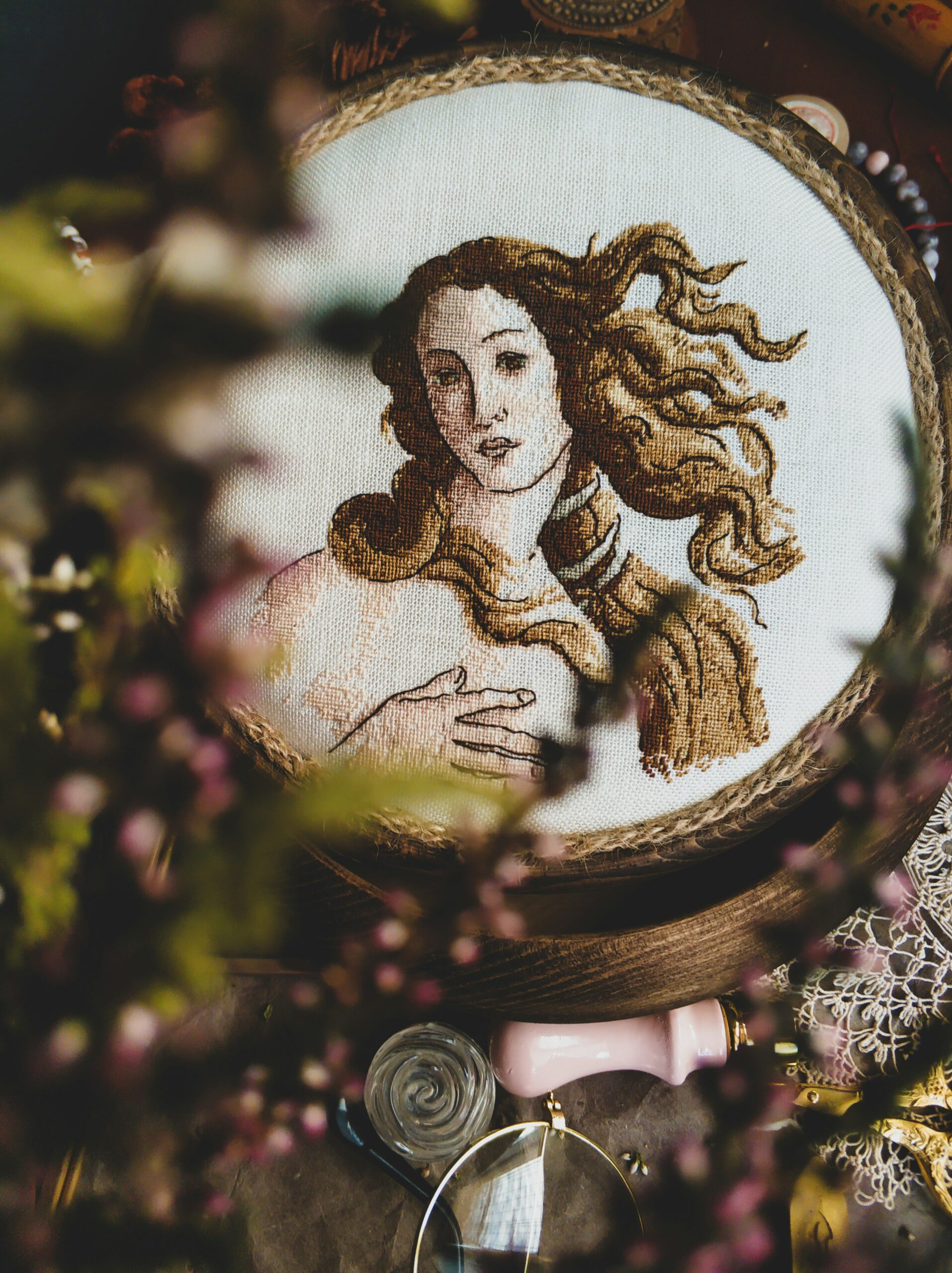
So, when the holiday season rolls around and we’re inundated with talk of New Year’s resolutions, it is not a surprise that I make an ambitious list of projects that I never finish. For example, I started a reproduction of Long Dog Samplers’s “Pandemic” cross-stitching pattern. Created while most of the world was in quarantine during the early days of the COVID-19 global emergency in 2020, this pattern was designed to keep stitchers entertained while staying indoors. The piece is mammoth. The finished project is about 20 inches wide by 24 inches high. 

I managed to score a copy when the company was giving it away for free in late 2020 and put it at the top of my project queue. Having acquired the necessary materials for Christmas, it was my resolution to start and finish the piece in 2021. Also on my list were: learn how to use my sewing machine, knit a sweater, and learn how to crochet doilies. 

In 2022, I resolved to finish it.

In 2023, I resolved to finish it.

In 2024, I finished the piece on Thanksgiving Day.
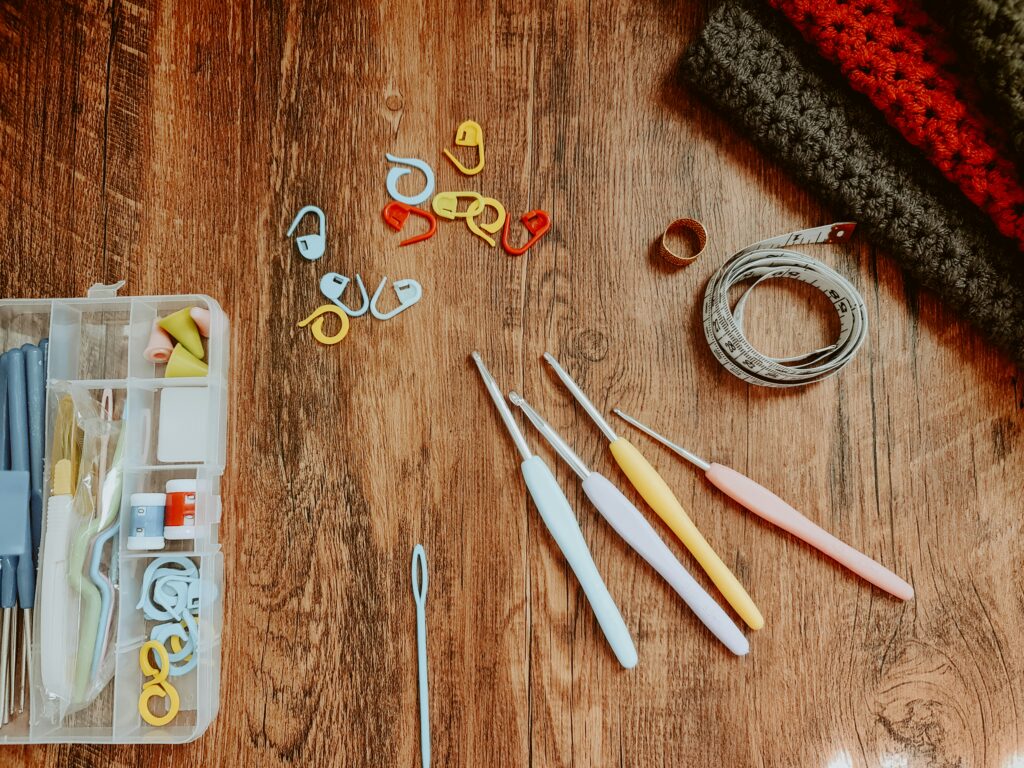
A tabletop covered with various notions associated with crocheting: stitch markers, a tape measure, crochet hooks, and a tapestry needle among them.
(Image courtesy of Edz Norton via Unsplash)

Of course, I wasn’t dedicating every single second of every single day to “Pandemic.” I was in grad school. I was spending time with my dogs and my husband. I was giving birth, at one point. I was, admittedly, working on other cross-stitching projects concurrently. I do not regret the time it took to complete this huge accomplishment. I am so proud of my work.

But, at the same time, I have yet to develop the skills necessary to knit a sweater. I only just learned how to crochet doilies this past year (unexpectedly, the patterns make a lot of sense to me, and I am very good at making them). Years have come and gone, resolutions made and unfulfilled, and I feel as if my skills have remained stagnant.

And usually this doesn’t bother me. Lately, my life is too busy to be distracted by my harsh self-critiques. I can bounce from project to project with enthusiasm and whimsy. That is, until I visit everyone’s worst enemy: social media.

First, before I break down the negative, I want to say how grateful I am for the resources social media provides that wouldn’t have been accessible in the past. I have countless sources of information at my fingertips. I can go on Ravelry and find tens of thousands of knitting and crochet projects within seconds. I can watch a YouTube video for a tricky method instead of having to resort to written instructions. Posts on Instagram give me color and pattern inspiration. And, not to be rude, I learn from the mistakes others make (if I had a nickel for every time I exclaimed, “With that color combination?” to myself while scrolling).

Platforms like Instagram, TikTok, and Reddit inundate us with narratives of perfection every day. Usually users purport physical perfection, aided by the use of filters. But there exist the feelings of imperfection one gets when looking at the life events that people choose (and choose is an important word here) to share. People rarely share the negative aspects of their lives. So, when crafters share flawless shots of their WIPs (works in progress) or FOs (finished objects), it’s just as likely one will be inspired as much as they could feel inadequate.

Sometimes, this feeling can be instructive. If someone’s stitches are neater than mine, I can take that in, find strategies to improve, and grow. But the pressure still exists, and it is not always constructive. For example, about once a year I attempt to learn how to knit Continental style (holding the yarn with the left hand) instead of English style (holding the yarn with the right hand). This is because so many Continental knitters boast about their speed and how their style is more efficient than that of English knitters (despite the fact that English knitters often have better tension, and therefore better-looking FOs). My mind just cannot grasp Continental, no matter how much I try. But then I think: when I finally achieve my dreams of being able to make garments without agonizing over how to do it, am I going to remember how speedy I was?

Then, there are the variables that I cannot control, namely the depressing obsession with scrolling social media instead of working on my projects, but also: other people’s family lives might not be as hectic or demanding; they might have more disposable income to buy better materials; they might have been taught by a family member and, because of this, don’t have to learn the Italian Cast On from blurry videos on YouTube. For some, their craft is their job. They have unlimited hours in the day to become better.

It’s important, to me and for me, that I keep these things in mind when I start to compare my abilities to others’. Comparison does not only steal joy, it can lead to depression if I don’t keep my comparisons in check. I spent much of my late adolescence depressed and I have no intention of going back to that. Frankly, I can’t afford to. I refuse to go back to laying in the dark, wasting away while the world spins on around me. 

So where does this leave me with my unfulfilled resolutions and my inability to feel accomplished? I think I’ll keep making resolutions at the start of every year, be they a handful of new projects, a goal to read x number of books, or what-have-you. Achieving the goals is a nice thought, but the journey is the important part. Even if I spend the whole of 2026 never finishing a project, I’ll still be working toward something. What’s worse: not finishing by some made-up due date or having never started at all?

But I really do need to stay off social media.  
The Magic of Writing Christmas Greeting Cards

The world moves on, times change, and technology continues to invade our lives. Yet every year, as Christmas approaches, I open the “box of memories” where I keep not only the letters I exchanged with my teenage friends when social media didn’t exist but also the old postcards and greeting cards that were used to exchange holiday wishes into the 90s (and some into the early years of the new millennium).

As I look at them with nostalgia, I wonder if technology has made us lose our taste for anticipation and surprise. There was something magical about opening an envelope sent by relatives and distant friends, each sharing a bit of themselves and their lives. Those with little imagination limited themselves to a brief update on the health, work, or studies of their children and cousins. Others, like my mother and grandmother, devoted themselves to writing long messages expressing the joy of reconnecting with those they couldn’t see all year because of distance or family obligations.

The practice of Christmas cards dates back to the Victorian era, and the first illustrated postcard was commissioned in 1843 by Henry Cole, the director of The Victoria and Albert Museum in London. In the years that followed, there was a real boom, and postcards were printed by the thousands.

In the 1920s, Christmas stamps became popular both in Italy and English-speaking countries for sealing letters. The money from their purchase was donated to the Red Cross and other charities. When I was a child, my mother used to buy postcards from the Only Painters Artists Mutilated Charity Association of the City of Verona, the charity supporting disabled artists in the city of Verona, which still exists today. They sold paintings and artwork created by artists who used their mouths and feet to create their works. Many illustrations were incredibly beautiful and evocative, such as those by painter Jolanta Borek Unikowska (1990s).

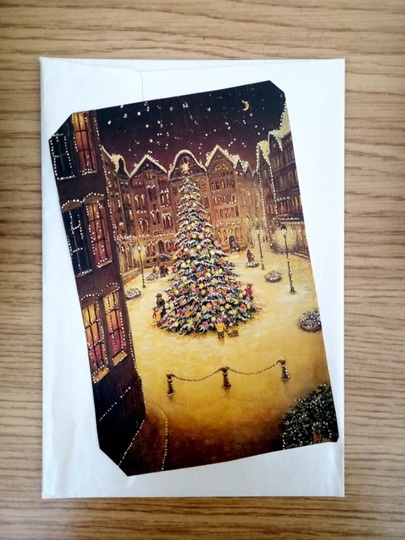
 A Christmas card featuring a Christmas tree ornately decorated in a town square.
(Image courtesy of Viviana De Cecco)

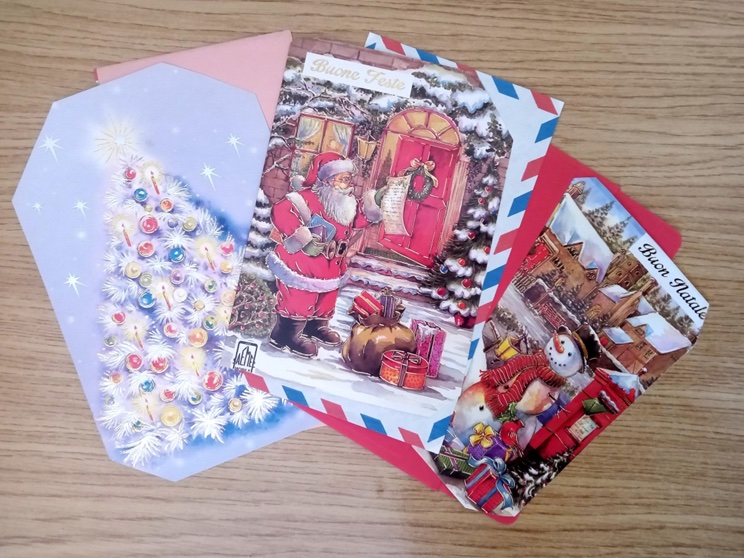
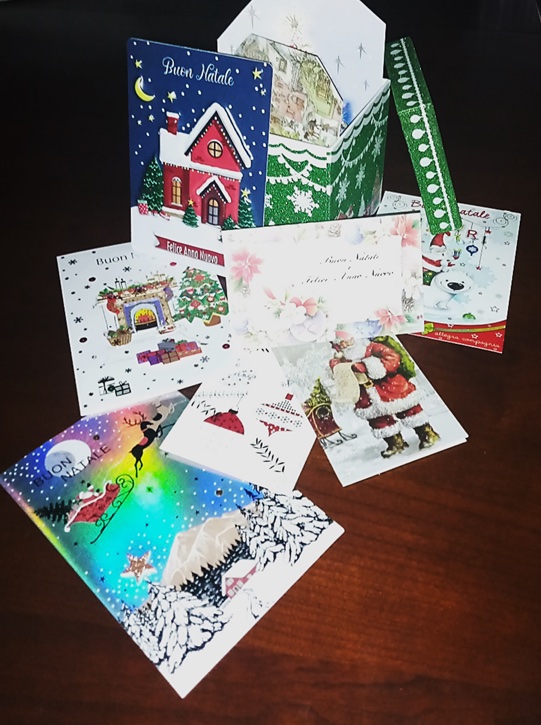
Old postcards have always held an extraordinary power for me. They transport me to a time that no longer exists. My favorites were those depicting snowy landscapes with tall trees illuminated in remote villages, and reindeer pulling sleighs through the snow. I especially treasure the postcards from the SAEMEC publishing house that specializes in this type of card, which have now become rare and collectible items and thus often sold on the internet.

A series of Christmas cards in various traditional styles.
(Image courtesy of Viviana De Cecco)

Here, on the island of Sardinia, snow is a rarity. In the past hundred years, in the town where I was born, we may have seen it four times at most. When I was a child, it wasn’t common to go on a skiing vacation, though few could afford a vacation in the mountains. So those postcards opened the doors of my imagination and, like in a fairy tale, I felt drawn to unknown worlds where fantastic beings like elves and snowmen with human features smiled at me from the paper. Sometimes the subjects were religious, while at other times they were limited to Santa Claus traveling on his sleigh with sacks bursting with gifts.

Each postcard was personalized, and since my mother had taught me to draw, I often added small pencil illustrations colored in with crayons or markers. I loved to spend hours hunched over the pages, letting my creativity run wild, thinking about what to write, and carefully choosing the most appropriate words for the recipient.

Christmas festivities began when the cards were mailed in early December, with the fear that the mail might be late. They were usually folded in half with the standard phrases for everyone inside but the rest of the page was left blank so that the sender could add his or her own special message.

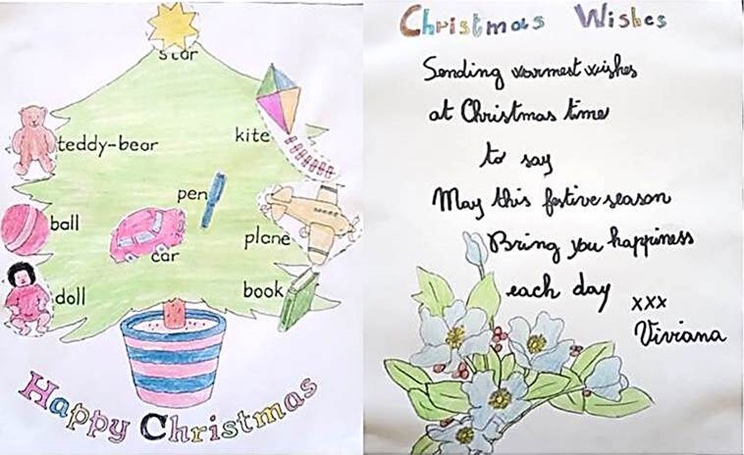
Also, at school, just before the holidays, teachers encouraged children to make rhymes, collages, or drawings to decorate the little cards they would give to their parents on Christmas Eve. I still have the card my English teacher had us make, which combined teaching and fun to stimulate each student’s creativity.

Two Christmas cards side by side, featuring adolescent decoration. 
(Image courtesy of Viviana De Cecco)

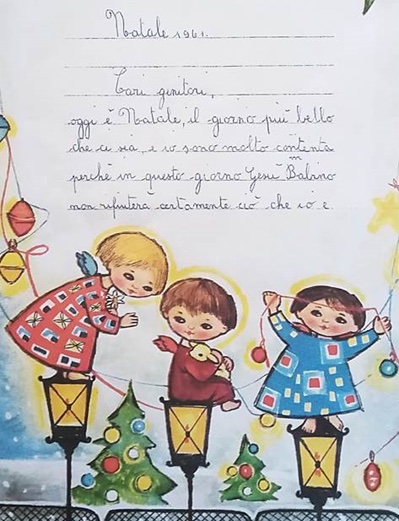
In 1961, my mother, six years old at the time, also wrote Christmas cards to her parents. Her old postcards show that, at that time, it was customary to include prayers for the health of the whole family. Gifts did not matter much compared to the health and happiness of loved ones.

A Christmas card, featuring children with writing in Italian. 
(Image courtesy of Viviana De Cecco)

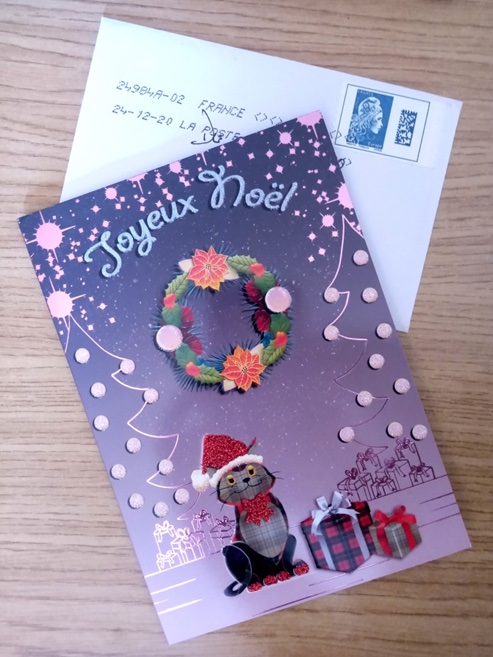
In the 1970s, my paternal uncles emigrated to France, and since we could only see them in the summer, my father began sending them Christmas cards. It became a tradition that repeated itself every year on time, and today that tradition continues with my cousin, now an adult like me. The message on the cards that he buys is, of course, in French, but he likes to try his hand at Italian sometimes, though he isn’t fluent. It’s his way of celebrating his father’s and uncle’s heritage.

A French Christmas card, featuring a wreath and a black cat. 
(Image courtesy of Viviana De Cecco)

In today’s world, perhaps the immediacy of instant messaging has broken that spell of anticipation that had us waiting at the windows for the postman. Or, on the contrary, perhaps it has brought us closer to those who, for various reasons, cannot be with us for the holidays. Perhaps the answer is somewhere in between.

With the advent of the internet, we have grown used to being bombarded with thousands of images scrolling across our phone screens. Sometimes, I confess, I look at them too quickly to admire them one by one. Often, I’m in such a hurry that I don’t even take the time to quietly observe the details. A part of me feels guilty because I know how much care, passion, and love an artist puts into creating their work.

When I hold my old postcards in my hand, it’s instinctive for me to stop and take in what’s in front of me, to enjoy a moment just for me, where I can let go of memories and feelings.

Maybe technology has made us neglect that a little bit. We are so distracted by animated digital visuals, that we don’t have the time to focus on the sensations that the words evoke in us. It seems like a kind of consumerism where we move from one thing to another without fully enjoying it.

I can say that technology has its positive sides, such as enabling us to share anything almost anywhere. I recently joined two Facebook groups, one in Italian and one in English, where some nostalgic people post photos of old hand-illustrated Christmas postcards. It’s getting harder and harder to find them in stores, and few people still use the postal service to send greetings, but it’s nice to know that there are other people in the world who share my interests.

Memories are a valuable resource for all of us because, after all, we know that even history is made up of a thousand life stories of unknown people. And just as the letters and postcards of those who have gone before us are preserved in the Postal Museum in London, I, too, keep the memory of the words of those who have loved me alive in my little box of memories.