Nobody wants a toxic relationship, but they just happen sometimes. Most people go through one at least once in their lives, and it has probably happened to you. Well, at least it has happened to me.
One reason for this could be because every single person has a different perception of how dating relationships are supposed to be. This can usually be seen in movies, song lyrics, or you can even get the wrong image from your friends’ love lives. It can mess up your conception of how couples are supposed to behave and how they are expected to be treated, and these expectations can often lead to a misunderstanding.
My first toxic relationship
I remember vividly how I got carried away by my own preconceptions during my first relationship, and the fact that I am part of the LGBTQ+ community made it even more complicated: the lack of representation in the media can subconsciously get into your head to follow the heteronormative rule. This mistaken idea undoubtedly added some weight to my already toxic enough relationship. But queer or not, we can recognize a duality when it comes to relationships: on one hand, we have the ideal and exceptionally healthy ones, which we all aspire to have, and on the other, the toxic-dysfunctional relationships, which are conventionally romanticized.
“Unconditional love” doesn’t exist even with all the damage and mental harm that your partner can bring. Many typical aspects of a toxic relationship are noticeable from the outside, but they are often hard to recognize if you’re the one in the relationship. When you’re in love, some red flags can go unnoticed. Sometimes you might even gloss over it, turn a blind eye in hope that you’re mistaken or it was a one-time thing.
This is romantically portrayed in the teenage book After: “He repeatedly breaks my heart, even when I don’t think there are any more pieces to break. And I love him.”
It is unbelievable, right? I think that if the author is trying to portray a toxic relationship to raise awareness, she did not succeed. When I read the book at the age of thirteen, I did not find myself reflecting upon how toxic Tessa and Hardin’s relationship was. I just wanted them to end up together and have a pleasant life.
I even aspired to have that “enemies to lovers” kind of relationship. Unfortunately, that quote stuck with me in my teen years: I remember telling myself during my first relationship that despite the fact that she was not returning my phone calls or answering any of my texts, I still loved and cared about her and I was a hundred percent sure she was going to change. Because at the end of the day that’s what they make you believe. Spoiler alert: she did not. And in this novel, Anna Todd is constantly normalizing and romanticizing toxic situations or behaviors between the two lovers.
Jealousy and more
One of the most common toxic behaviors is jealousy, which usually happens when insecurity takes over in the relationship. This can lead to obsession, and eventually to possession. As healthcare provider HealthScope states, “A toxic individual behaves the way they do essentially for one main reason: He or she must be in complete control and must have all the power in his or her relationship.”
Jealousy can indeed be reflected in controlling behaviors, like questioning the other person about where they are, or getting angry when they do not respond immediately to a text, and this can end up destroying trust. And once trust has fallen to pieces, there’s no going back.
In Fifty Shades of Gray E. L. James illustrates toxic personality traits in which not only psychological abuse is romanticized but physical ones too. The main character is obsessed with having absolute control over his partner’s personal life. The expression “he’s changing” is used frequently in the film and the books. The victim forgives his abusive partner repeatedly while he plays the victim by saying “those things won’t happen again.”
This is supposed to be a book about romance, and many teenagers will probably believe that this is normal behavior, a younger me included. Something similar happens with HBO’s Euphoria series, the only difference being that it is a queer show. The toxic relationship between the two main characters is sugar coated with pretty lights and a seductive soundtrack.
I found myself repeatedly romanticizing the show because of this. How dangerous is that? The reality is that their relationship is based on a lack of communication: Rue lies to Jules about her relapse with drugs, and Jules cheats on her… with a male friend. That caught me off guard. My queer heart was screaming “go back with Rue!” till the end of the show.
This actually shocked me because something similar happened to me: my blond, ex-girlfriend cheated on me, a curly brunette. Watching these episodes may lead young viewers to wonder why they still get back together, and many will try to follow their path because “that’s how it is portrayed in Euphoria.”
My ex and I went back and forth a million times and the series was a comfort to me at that time, and now that I think about it from a distance, I can see that I was just another victim. But it could also act as an awakening for those who are going through the same stuff, and if you’ve been in that kind of situation, you’ll find yourself relating to these characters and feeling sorry for them, as I did when it aired.
Toxic relationships are real and unfortunately it’s more common to see one of them than a healthy one. It’s important to know how to recognize the signs and listen to the people that surround you; those who are able to see the situation from the outside. Luckily, I had the support of my friends and my therapist to get out of that loop; it takes a lot of effort and great emotional maturity to get out of a relationship you’ve been in for years.
You know it hurts, but you know it will affect you in the long run more if you don’t get out on time. It’s also necessary not to get carried away by toxic relationships that are camouflaged as “romantic” in movies, shows, and books. They are often thought of as a waste of time, but they’re actually not if it’s possible to get out of them with a new perception of how relationships truly are, and with a new vision of oneself.
If I managed to get out of one, you can do it too.
One Saturday in August 2019, parents, grandparents, and children were shopping for school supplies at an El Paso Walmart when they came face to face with a gunman set on taking as many Brown lives as possible. While this was happening, I was at Walmart in El Paso, buying school supplies for my son. I just happened to be at a different Walmart in town on that fateful day.
I spent the rest of the day watching the news and video clips online. I cried a lot. I attended a vigil at a high school football stadium. I was shaking. I felt the kind of fear you have that’s not for yourself, but for your child, who is smaller and more helpless. My son was with his father that day and although I received a text that they were ok, it wasn’t enough. I needed to hold my baby, to hug him and kiss him. I needed that as a mom. It was the first time I ever realized that I needed that reassurance because I had never experienced a moment like this.
My son is my first child, and he was four years old at the time of the shooting. I was still very much new to parenting. I didn’t know it at the time, but I was experiencing parental anxiety triggered by the mass shooting. I had intense worry and emotion that my son was not safe. These fears were irrational, and although I knew he was safe, I felt otherwise.
After the Walmart shooting, I sought therapy, and it helped immensely. I was offered helpful ways to cope with my worries. Now, I make use of tools that I know will reduce my anxiety. My favorite calming activities include listening to my vinyl records, baking, reading fiction, exercising outdoors, and taking my son to community events. I usually have a good stretch of time before the next mass shooting.
Parental anxiety is a normal reaction to something as upsetting as a mass shooting. But considering that mass shootings occur so often in the U.S. they are now part of our culture, this is a reaction that can recur frequently. Now, when a mass shooting occurs, especially if it is one that involves children, a school, or a place I frequent with my son (like a store), I feel this intense worry again and the need to keep him safe. I recognize the fear and I work toward improving my mental health, identifying rational or irrational fears, and using coping mechanisms to reduce my parental anxiety. But sadly, mass shootings are the norm and the cycle of events for parents can look something like this:
(Image provided by author)
A Community Shaken
When a tragedy like a mass shooting happens to your own town, it changes you. It changes everybody. I should say that El Paso is not like other cities. To say we are close-knit is an understatement. The people here speak to their neighbors, confide in strangers, and support each other. This is not the kind of city where you can meet someone at the mall and then never see them again in your life. I have had pharmacy techs speak to me like they’re my sisters, panaderia workers regard me as a daughter, and grocery checkout people tell me about their day and genuinely ask me about mine. This city truly does have a “small town feel.”
On weekends we go to local festivals or Farmers’ Markets. In the mornings and evenings, we walk dogs in our neighborhoods and greet our neighbors. Our kids make lemonade stands and sell chocolates door-to-door. Carolers come to your door at Christmas. If your dog runs out the door, a neighbor will bring him in, so he is safe. We take care of each other, and we care for each other. This is what it means to be an El Pasoan.
This is the kind of community that quells your anxiety. When a heinous act like a mass shooting happens, it leaves an impact. For days after the shooting, there were reports of people, especially elderly people, being afraid to go in grocery stores. They waited outside and even asked workers to get items for them. Years later, I still cannot step foot in the Walmart where the shooting occurred.
Among the victims were friends of my coworkers. One was going to be a guest at my coworker’s upcoming wedding. Also killed was my husband’s former bus driver. A family was broken when two parents shielded their baby boy, saving his life but losing theirs. This was our community. People we knew, saw, and remembered.
The victims of Uvalde, mostly children, lost their lives in May, 2022. Every time a shooting happens, I hope that will be the last shooting. But in hoping and praying, every time a shooting happens, I will also act. First, I must take care of myself and my family. I cannot be a good mother to my son if I am suffering and not taking care of my own mental health. In doing so, I make sure my family feels healthy and secure. Then I take care of my community, doing everything I can to make positive change.
I vote, I march, I prepare.
This is what it means to be a mother in the era of mass shootings.
I’m sorry I haven’t talked to you in a bit. It’s just been hard.
I don’t know what to say to you, or even bring anything up with you. I think about you all the time, especially late at night. You’re on my mind, and I wanted to tell you… I hope you know none of what happened was either of our faults. The world, it’s just messed up. And we just got caught in the middle of it all.
Please don’t hate yourself. Please don’t hate me.
I’m sorry we went through everything we did. We didn’t deserve that. You didn’t deserve that. You were only 14. You didn’t deserve to go through what you did. Any of it.
But I promise you, so much has changed since then. We’ve gotten better. We’re trying to heal. We have somebody who loves us unconditionally, who treats us with love and care now. Somebody who respects us and our boundaries, and I promise you that we turn out okay. But I can’t promise you that we’ve healed completely. It’s not possible to have completely healed in the time since. There’s been too many incidents, too many stories. We haven’t healed as fast as we would’ve liked. I feel that it’s near impossible, but I do think it’s within reach. We’re getting help now, real help. But sometimes it doesn’t feel like enough. When I think of you, what happened to us, I get uneasy. You tried so hard to get help, and no one helped us. It makes me doubt if anybody is really going to help us now.
I’m sorry. I’m sorry we haven’t talked, it’s just. Like I said, you know? It’s hard to talk to you. Sometimes I try to pretend you don’t exist. As if you’re not part of me and who I am now. As if you aren’t the reason I am who I am. The reason I’m so scared of living. It’s hard to confront you when I don’t want to remember you. I’ve pushed you away for so long. Hidden you deep within me, praying you’d never see the sun. Screaming out “Merciful G-d help me please,” all while begging that you didn’t exist, that what we went through didn’t exist. But it did, and it hurts. It hurts so fucking bad, and I hate you for it. Why couldn’t you have been stronger? Why couldn’t you have stood up for yourself? Why didn’t you? Why? Why did it happen to us? Who let this happen to us? Why? Just why? Tell me, please. I want to know. I really need to know. It hurts and I hate it. I hate you. Every day, every night, every waking moment of my life, I fear you and I hate you. I hate the idea of existing when I know you still live within me, when their touch still lingers on my skin and there’s no turning back time, no taking it all back. I want it to disappear. I want the you of who I once was, to disappear.
I don’t want to live like this; I don’t want you to exist within me. I want to be happy. But instead I struggle waking up every morning and cry myself to sleep at night. I live every day feeling like I don’t deserve to be here, and I hate that. I hate it so much. I want to be healed of all that was you, all of what you went through, and who you are to me. I want that part of me to be gone. I want to never have hurt the way I hurt before. I want everything that has happened to me to never have happened to me.
So why did you let it happen to us? Why did it happen to us? How did it happen to us? Why us? Why? Why me? Why can’t we just let it go? Why can’t we heal? Why are we stuck in the past of who we once were when we‘ve come so far? Why can’t we be okay? Why can’t we just be okay? Please, please tell me.
I’m begging you. I want to know. I need to know.
Why did all of this happen? Why can’t I be okay? Why? Why did this happen to us? Who up and decided, yes. Her. Make her suffer. Make her wish she was never born. Make her feel like the worst mistake to have ever been made. Make her feel like her existence is horrendous and have her suffer every second that she’s alive. Make her hate herself. Consume her from the inside out until there’s nothing left within her. Make her feel like an empty shell of a human being that doesn’t deserve anything. Make her feel like the worst piece of shit alive.
I’m sorry. I’m blaming you for that one thing, as if there wasn’t more that contributed to our pain. But do you see? See what happens when I talk to you? All of this. All of this comes rushing out. All of these tears. All of this hurt. It doesn’t feel the best, but I think it’s long overdue. I don’t know how to talk to you without crying. I don’t know how to feel. I’m sorry if it takes a while for us to talk again. I just. I can’t handle who I am whenever we do. I just wish you knew what I know now. I know you desperately wanted it all to end. All the pain and anguish.
I know you; I am you, and I’ll admit there are times where I still feel that way. But it’s different now. Our life is different now. You’re loved in so many different ways, by so many different people. You matter, and I know it doesn’t feel that way, but you do. You really do. We’ve honestly come so far. I wish I could have told you all of this back then. We could’ve started our healing process sooner.
A pandemic caused by fungal spores is the exact premise of a popular gaming franchise called “The Last of Us”. Is there any justification for humans to fear a fungal-based diseased world?
We can start by defining the characteristics that plummet the fictional world into crisis. Without too many spoilers, the game uses Cordyceps fungus which has mutated. The resulting spores are able to infect humans by targeting their neural pathways, and also continue infecting new humans by transfer of body fluids. The driving goal of the world is to find a cure. Obviously, there are some shared characteristics to the world that we have lived through, which aids the game in creating an immersive scenario. Quick outbreaks lead to overwhelmed healthcare systems, which causes panic and worse, and the resulting disruption to daily life is felt on a global scale. The main difference is the level of violence a fungally-infected person is compelled to inflict on others.
So, can any fungus on earth create aggression? There’s no scientific evidence of such a fungus in the real world. Aside from being poisonous when ingested, there are some species of fungi that can “infect” a human which causes headaches and fever and fatigue. There’s even a species of Cordyceps fungi that is capable of infecting insects to alter their behavior to prioritize growth of the Cordyceps instead of the insect. But these insects and arthropods are small compared to humans. It’s virtually impossible that Cordyceps would be able to grow to an overwhelming concentration in humans. This is why the game stresses that the Cordyceps are a mutated species.
As a scientist, I wonder if we have already identified any genes within Cordyceps that would increase the strength or hasten the growth. So I looked and the answer was “no.” While Cordyceps is a well studied species, we have not discovered any specific gene that makes it a stronger parasite. So far, it seems like the reason Cordyceps is even able to manipulate behavior in its host is because of the fungal metabolites produced.
The problem is that ‘metabolites’ is a rather large umbrella term that can include complex neurotransmitters or simple sugars. This means it is possible that small molecules and neurotransmitters target the host’s nervous system, or that the immune system of the host is challenged leading to a significant change in behavior. Again, the size of an ant compared to a human means that a few Cordyceps cells are able to manifest as a significant disease. As humans, our immune system would likely recognize the invasive Cordyceps spores before they could replicate through the many many cycles needed to generate a substantial infection.
It seems rude to critique the practicality of infection without offering my own. I would have proposed using Chronic Wasting Disease (CWD) which is a serious transmissible spongiform encephalopathy that is killing deer, elk, and moose in the North American continent. I hope that you never witness such an infection, as it would mean a growing harm to nearby cervid populations, but deer and their genetic relatives experience weight loss, lethargy, and other symptoms that eventually lead to death. The slow development of symptoms is part of the reason for the widespread infections, as deer appearing healthy are able to engage in behaviors that lead to transmission before the other members of the herd realize they are at risk. Little by little, their bodies become infected with high amounts of misfolded proteins, more specifically known as prions, and these levels of prions are able to interfere with normal behaviors controlled by the nervous system. The deer pace, and droop their heads, and their brain becomes increasingly more inflamed. Along with the deer, wildlife management agencies are heartbroken to manage infections in these populations. There is not yet a cure, so the best course of action is to isolate suspected infected deer from the main herd and take action as necessary to spare the deer continued pain.
Currently, there is no reported threat to humans for CWD. Similarly, a zombie apocalypse as depicted in popular culture is not a scientifically feasible possibility in the real world. The idea of a zombie outbreak, characterized by the reanimation of the dead and their subsequent attack on the living, is purely fictional and has no basis in science.
(Image courtesy of Seth Wickham via Unsplash)
However, there are some real-world scenarios that have been used as inspiration for the zombie genre. For example, some diseases like rabies can cause aggressive and erratic behavior in infected individuals, which could resemble the portrayal of zombies in movies and TV shows. Additionally, pandemics and other widespread outbreaks of infectious diseases could cause widespread panic and social disruption, which could mimic some elements of a zombie apocalypse.
It’s important to note that these real-world scenarios are still far from the classic depiction of a zombie apocalypse and should not be taken as evidence that such an event is likely to occur. They are simply points of inspiration for creative works, and should not be a source of fear or concern for the general public.
While the topics of dystopian-era diseases are not kind to the heart, we are not powerless. The genre of survival games are parallel to the world in which we all live. Similarly to how Sci-Fi is a feedback loop for innovation that can inspire accessibility, I believe that survival games breed empathy and awareness to horrifying diseases in our world. With every mind that begins to love the universes in fictional games, there becomes a new innovator in the world of medical interventions. Now it is your turn to share what diseases you have heard of that relate in some small way. One thing that fictional or non-fictional worlds need to survive is global collaboration to keep the balance of life safe.
I was four years old then. Yet I still vividly remember feeling the ground shake beneath me, the windows shattering during every air strike hitting our area, leaving our house barren and unrepaired. I knew beyond doubt that we would be under the rubble any time soon, buried with the memories and dreams of a life that once was.
April 9, 2003 marks the day when many Iraqis’ lives changed forever. After a month of constant cruise missile attacks on the country’s capital, Baghdad, the American forces completely seized the land and began a full-fledged invasion.
My brother and I slept in our parents’ bed the night Baghdad fell so that we either lived or died together no matter what happened. As children, we were only told that the “Americans were invading.” We were not spared any further explanation – leaving our imagination to make up the political story that later dictated every aspect of our lives.
What was once a country that harbored family, friends, free education, quality healthcare, historical monuments, and most importantly, a sense of belonging for its citizens became one of the most dangerous places in the world—all in a matter of months. Stuck between a rock and a hard place, many families from neighboring countries, like Syria and Jordan, seek refuge and better lives. Even then, continuous political turmoil and unequal opportunities in the region forced many of these displaced Iraqis to move to Western countries for only the chance of a more secure future.
After miraculously surviving three years of terrorism, internal conflict, and a debilitating embargo, my parents decided to take us and finally seek refuge in Jordan–shortly after our elementary school was attacked. After that, my family and I moved to multiple countries, including Jordan and the UAE, before settling in Canada. But ever since then, I have not had the chance to revisit my homeland and childhood home.
Instead, I always wonder about other Iraqis’ refugee stories and where they are today.
One such story is Omnya’s, a colleague of mine in a student-led UNICEF society at our university. She, too, was born in Iraq and left for Syria when she was only two years old during the 2003 war. Syria’s beauty and nature became her home for about seven years until 2010, after which she and her family immigrated to Canada through her aunt’s help and the UN’s family sponsorship program.
With long-held dreams of attending university and advocating for minorities, Canada was the perfect place to make the achievement of Omnya’s goals possible. Surrounded by an academically oriented family, Omnya was heavily influenced to pursue such a learning path – especially since her father was a university professor in Syria. Currently, she is in her fourth year of the Global Rights program at the University of Western Ontario, a degree that wouldn’t have been as easily attainable if she hadn’t moved to Canada. Moreover, because of Canada’s strong political influence and vast advocacy opportunities, no action is too trivial to create a change, however small, toward the positive. The only thing that Omnya needed to fulfill her dreams of protecting vulnerable populations and advocating for her community was the initiative. She certainly had plenty of that.
While most Iraqis had high hopes of making this venture, their lack of opportunity to move abroad had them lose complete access to quality healthcare, safety, and education as they stayed back in what had now become their poverty-stricken homeland. Unlike this large majority, Omnya luckily had family in Canada who helped sponsor her travel and settlement there.
(Image courtesy of Jan Wever via Unsplash)
In contrast, many others only dream of being able to pursue a better life in the West. Recognizing this major obstacle in the lives of immigrants and refugees alike, Omnya aspires to make the immigration process easier than its currently daunting state. She plans to enact this change by increasing the availability of family sponsorship programs across the country. As an active member of the London Cross-Cultural Learner Center, Omnya and her team have made strides in helping immigrants with community integration and settlement, especially given the language barrier and cultural shock that a lot may struggle with at first. This was a difficulty that faced Omnya upon her move to Canada, often feeling inferior and disconnected from her classmates due to her limited English proficiency.
Through the challenges, she became the Project Development Director at RefuHope, a non-profit organization aiming to integrate new refugees. She was the current co-president at UNICEF Western, operating under UNICEF Canada. Omnya has made significant accomplishments in advocacy and support of refugee and immigrant integration. She plans to continue working to reach the ultimate goal of “living in a world where we don’t feel the need to protect one another.
Despite the devastating loss of her father, her biggest role model, to COVID-19 early in the pandemic, Omnya’s resilience to “keep going forward,” as she eloquently puts it, has never been stronger. From the early days of leaving her homeland and moving countries to learn to adapt to new environments and recover from hardship, which really tested her strength. Omnya is a notable example of perseverance. She learned to cope with her challenges by seizing every opportunity and giving back to immigrants whose shoes she was once in.
Such is only one of the success stories of the Iraqi underdog, who, despite the political turmoil and displacement, still made the most out of themselves and helped others. In short, it truly is inspiring to witness the many stories of immigrants and refugees rising from the ashes – an admirable feat, if there ever was one.
Came to my home with a hat and boots. Slept in my house; I gave up my room. Asked for my name; He called me marooned. Wondered why I’m Black. He stared at my food. Laughed with my Dad, then showed him his tools. Gave Mama a mirror, Her smile did glow. Harmless like a fly, his skin sure shone. Seemed to be nice, Unknown to us he’s a crook. His friends are in the bushes and they’re ready to shoot. Killed my father in his sleep and spat on him too. Pointed the barrel to my mama. He made me a slave boy.
My husband and I were not able to travel this past summer for a variety of reasons, including several weddings. Thus, we were very excited when close friends of ours said that they will be coming abroad to us for a vacation for ten days.
Me, being a planning freak, started what I do best: planning. My husband opened Google Maps and we checked places in close proximity with each other and worth seeing. One week before they got here, the list of places to see, where to eat and the prices were ready.
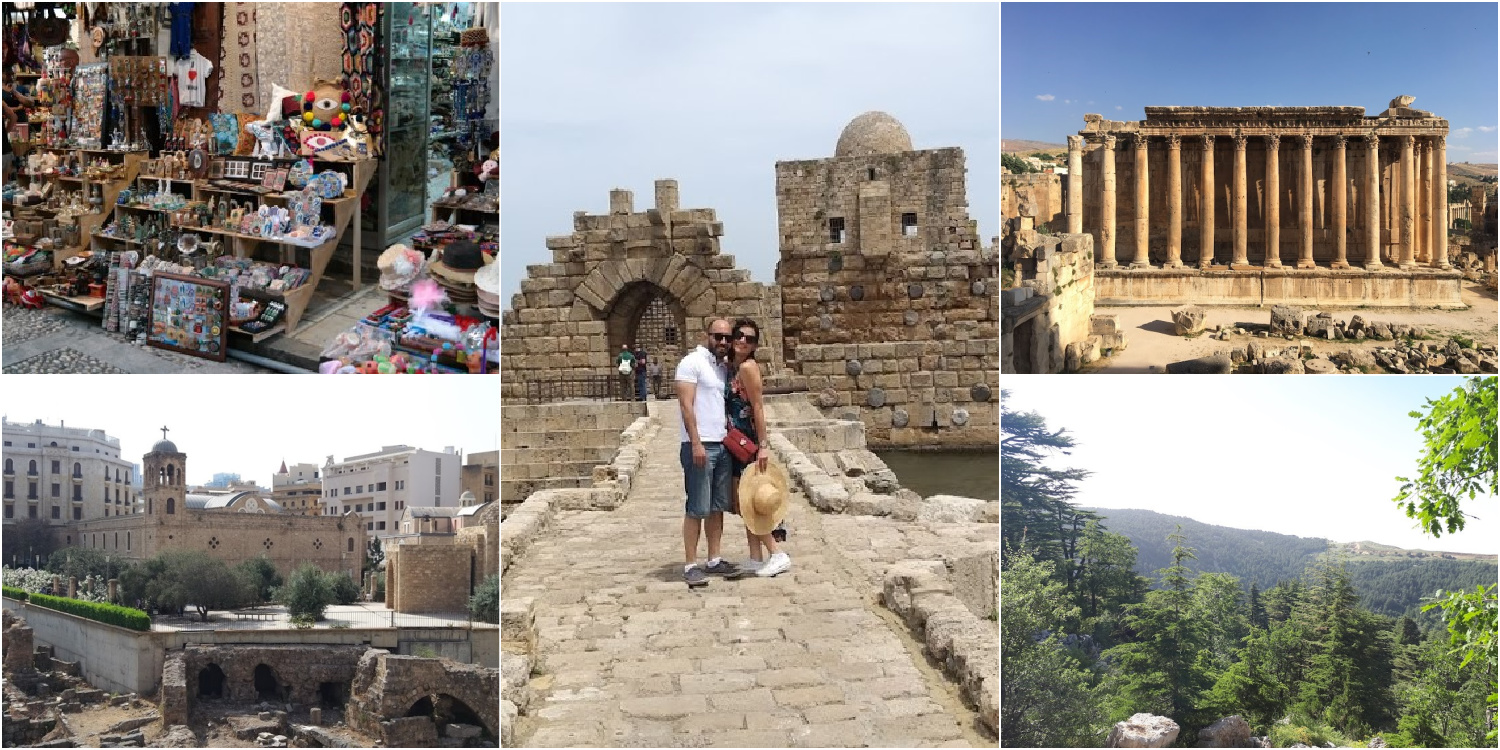
Ten days, eight trips around Lebanon.
And at last, on June 3, 2022 at 4 p.m., our vacation started.
Trip 1: Diving deep into caves and cities
June 4was a holiday, so our plan was to take it slow. We started our journey just outside of Beirut with Jeita Grotto, the Middle East’s longest cave. For US$12, we got a cable railway ride to the upper cave, which is a wonder. That was followed by a trip to the lower gate, another geological wonder, which is guarded by “The Guardian of Time.”
(Image courtesy of Stephanie Rahi Bassil)
In both caves, no pictures are allowed. Next stop, the shrine of Our Lady of Lebanon. We did not drive all the way up, but we took the US$7.50 round trip cable cars. What a view from all the way up! The view is a mixture of the Coast of Azure in France and the view from Christ the Redeemer in Brazil. I could spend the whole afternoon just enjoying that view.
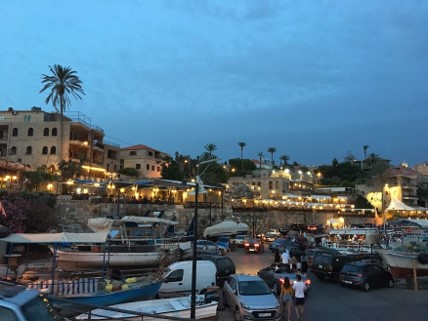
The coastal city of Jounieh really does have an amazing bay, but awful traffic jams. After that, the city of Jbeil, also known as Byblos.
We were not able to go into the ruins because we arrived late, but a walk around Jbeil in the fresh air was needed. We strolled around until we reached 1188, the place to be for a quiet relaxation drink or meal (for us it was a drink) away from all the hustle and touristic places in downtown Jbeil.
Trip 2: The beauty of walks, drives, and nature
Wednesday, June 5 was the start of our second road trip. Destinations: St. Maroun Monastery in Annaya, the Baloue Balaa nature reserve and waterfall, and Tannourine Cedars Forest Reserve.
(Image courtesy of Stephanie Rahi Bassil)
After our first breakfast, we drove all the way to the Saint Maroun Monastery in Annaya where St. Charbel Makhlouf lived. It is a great and well known sanctuary for Christian and Muslims in Lebanon. St. Charbel is known for healing the sick and for answering prayers. Our second breakfast was in Snack Mar Charbel right next to the monastery.
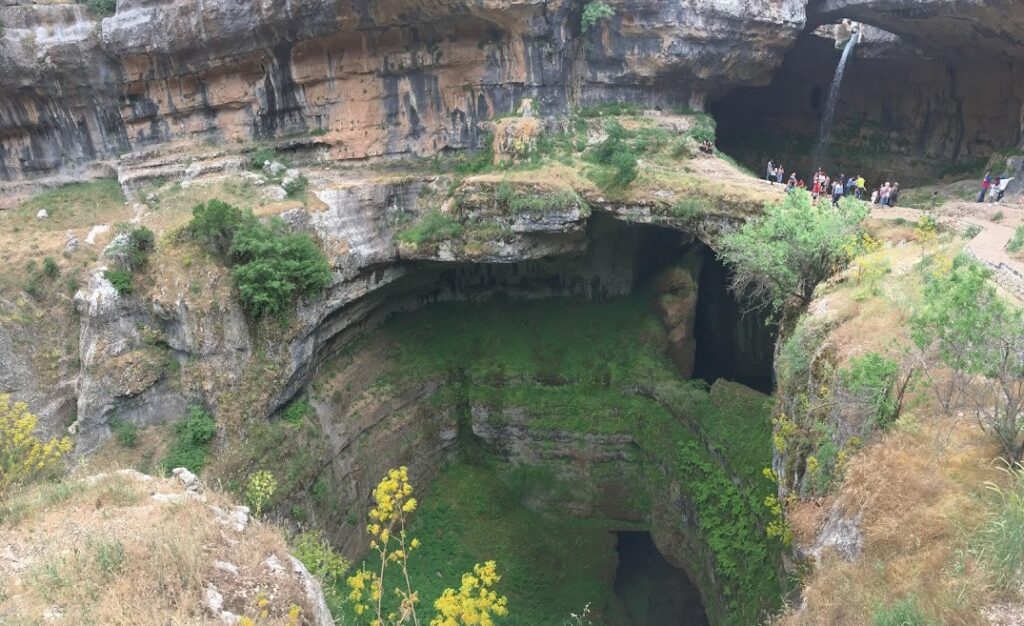
After fueling up again, we headed towards Baloue Balaa, considered one of the world’s most breathtaking waterfalls. It was really easy to find it on Google Maps. I must say, I went to Beloue Balaa last year and it was an adventure just trying to walk all the way.
(Image courtesy of Stephanie Rahi Bassil)
This year, the Tannourine municipality is working hard on getting this natural wonder safe for the public by building pathways and barriers all the way from the top to the bottom. The entrance fee to walk down is a mere US$2.50 per person. We had lunch on our way to Tannourine Cedars Reserve.
Bellies full, Cedars here we come. For a mere entrance charge of US$4.50, the Tannourine Cedars Reserve is worth seeing, with several clear walking paths that you can choose between depending on how willing you are to walk.
End your day with sweets at Hallab, Jbeil.
Trip 3: Seeing the sea
Our destination on June 6 was cities in the South: Sidon, Tyre, and Naqoura.
After the usual first breakfast, we arrived at Chamsine Bakery for our next breakfast. Nice sweets and delicious croissants.
(Image courtesy of Stephanie Rahi Bassil)
The Sidon Sea Castle was easy to reach through Google Maps, our favorite companion. It’s a shame what has been done to this beautiful castle. Would it be too much to ask for decent, knowledgeable guides inside the castle?
Next, we went all the way to Tyre’s Christian Neighborhood and Abou Ghassan, a small seafood restaurant at the entrance of the neighborhood with no more than four tables. The shrimp there was not to be missed. We walked the food off with a stroll throughout the neighborhood. Do not miss the Church of our Lady of the Sea and the old church just beneath the new one.
The neighborhood is a totally different story. You have the feeling that you are in a different country with the narrow streets, colorful buildings and the beach next to Dar Alma.
(Image courtesy of Stephanie Rahi Bassil)
We wanted to check the Naqoura beaches after all those Instagram stories. But what we missed is that if you are accompanied by foreigners, you will need a special permit from the secret service of Sidon. Since we did not have that, we went back to Cloud 49 at Tyre Beach and chilled.
Trip 4: Biking, bites, and bars
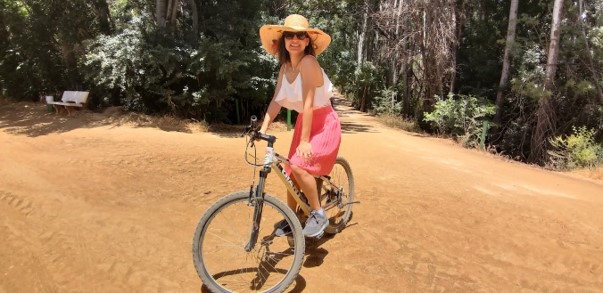
On June 7, we went to the village of Taanayel, the town of Anjar, and the Kefraya winery in that order. In Taanayel, which is not far from the city of Zahle, we biked for around an hour; In the hot summer weather, that was a bad idea!
(Image courtesy of Stephanie Rahi Bassil)
Our bike ride took us to this lake in the middle of the reserve. The lake had a beautiful relaxing view overlooking mountains from both the east and the west. The path to get there is so amazing, with huge trees on both sides of the lane and flora and fauna all around.
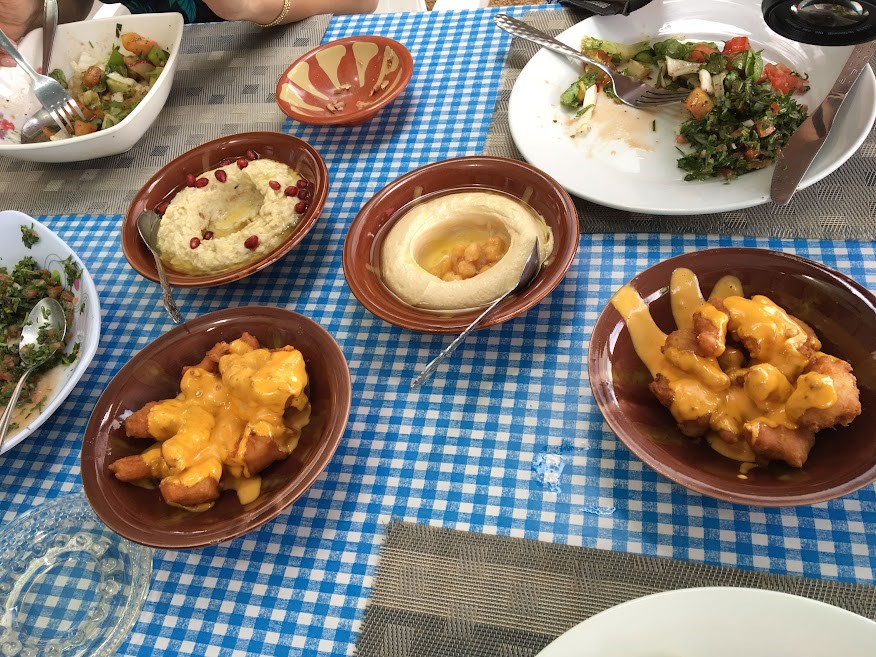
Past those trees, we could see some vineyards. You could practically smell wine coming out of them. After this sweaty but worthwhile bike ride, we couldn’t not try the “labne,” a fermented dairy product with the consistency of soft cheese that’s served with savory seasonings.
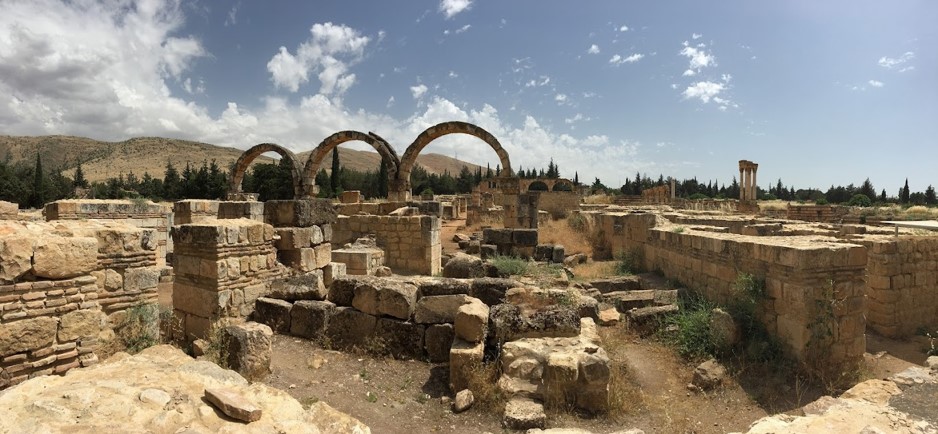
Next stop was Anjar with its beautiful ruins. We had lunch in Chamas (a must-try) and went to Kefraya to drink it all off. The wine tasting was totally free.
(Image courtesy of Stephanie Rahi Bassil)
During the weekend, we took it slow with family visits and a trip around the downtown area, along with church and mosque hopping. A rooftop bar worth checking out was C Lounge, which is on the rooftop of the Bayview Hotel. They had affordable drinks and lovely sunset scenery.
Trips 5-8: Wrapping it all up
We still had four more road trips to go on. We started our week with the Chouf area: Deir al-Qamar, Moussa Castle, Beiteddine Castle, and the Chouf Natural Reserve.
We walked around Deir al-Qamar. There, we checked the mosque, synagogue, and church, which was relaxing. The tourist shops were not that expensive for souvenirs.
Moussa Castle is a man-made wonder; it’s really interesting how one man dedicated his life to building such a castle. Unfortunately, Beiteddine was closed for unknown reasons, so we stuck to seeing it from the outside.
Lunch was not good that day, unfortunately. But a visit to Mir El Amin Palace uplifted our spirits. It’s a palace turned hotel with a courtyard of flowing fountains and a scenic mountain view that’s considered to be a model of early nineteenth century Lebanese architecture.
(Image courtesy of Stephanie Rahi Bassil)
Next up was Chouf Natural Reserve. The drive to the top was really something, with its beautiful, breathtaking scenery. I wouldn’t say the same about the pathways which require a bit of planning.
After that was Ksara in the city of Zahle, where we had our cave tour, wine tasting, and lunch. Ksara’s caves are exceptional! After that, we took the route from Zahle to Baalbek.
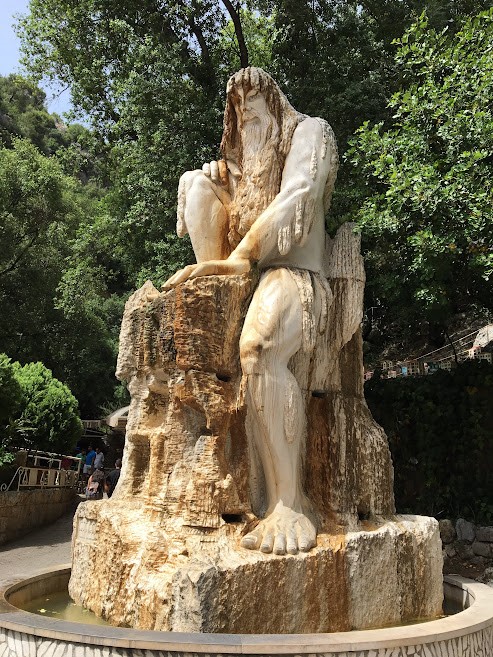
A drive from Baalbek to Faraya to check the statue of Saint Charbel was relaxing thanks to the mountain view.
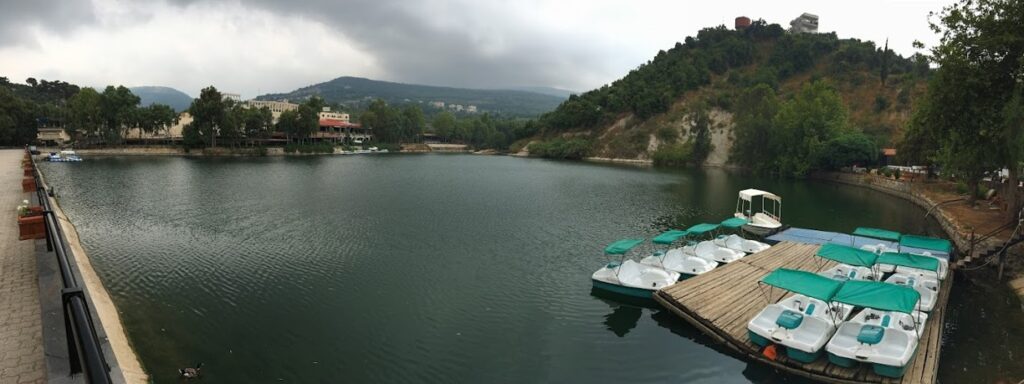
We could not forget the north: Bnachii Lake in Ehden, Cedars of God, and the town of Bekaa Kafra. Pedaling in the Bnachii Lake was so much fun; racing and goofing around was the best way to de-stress. The lake itself was not that big, but the view of the mountain in front of us with some snow still on the top was worth every goofy moment and every picture taken.
Lunch had to be in Ehden to try their “kebbeh.” Kebbehcroquettes are meat stuffed with more meat, pine nuts, bulgur wheat, and lard. They are to die for, but so fatty.
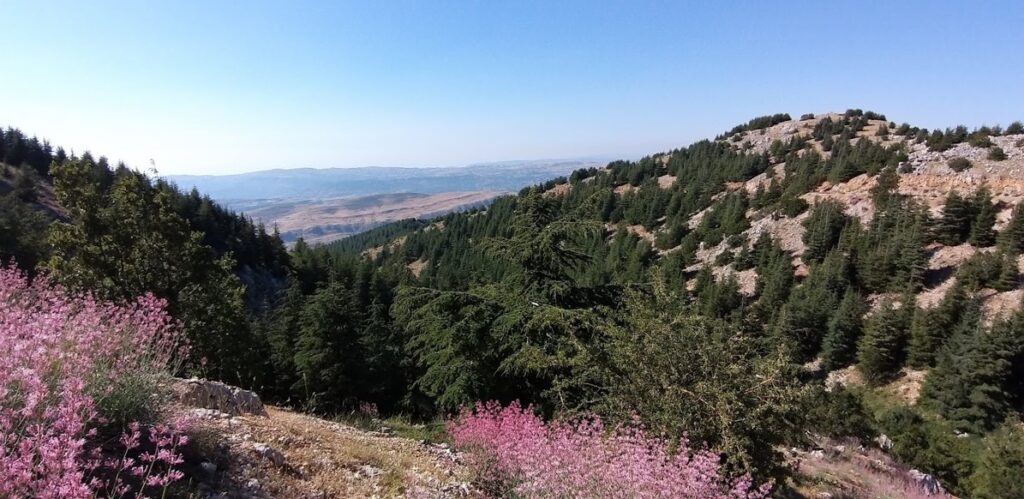
After that was Cedars of God where the cedars date back two thousand years. Cedars of God are at the bottom of Lebanon’s highest mountain top, Qurnat as Sawda.
Bekaa Kafra and the house of St. Charbel followed the cedars, which was then followed by a visit to Qannoubine Valley. You can drive all the way down to the valley and decide which monastery you would like to see and whether to get there by car or on foot.
(Image courtesy of Stephanie Rahi Bassil)
We still had one thing to see: Our Lady of Nourieh in the coastal town of Chekka, and the ancient Phoenician wall, Batroun. For our trip to Chekka, we took the seaside road from the town of Kaslik to Our Lady of Nourieh. It was a drive worth taking with all the sea views and the wonderful shores.
After the monastery there, lunchtime was at Abou Ghassan, a restaurant serving fresh, tasty fish just next to Rocca Marina. We ended it all in Batroun, walking around the whole town and visiting several churches and finally, a drink by the sea.
Eight trips to remember forever
Those ten days were our ultimate summer vacation in Lebanon. There are still many more places we need to see. Until next time, Lebanon.
From the rolling hills and countryside of North Carolina to city skyscrapers illuminated with neon signs and the ever-crowded streets of Tokyo, Japan, my first step out of the airplane felt like the entrance to another world. With the convenience of airplanes, traveling around the world is just a matter of money and dedication to adventure.
All it takes is one flight to experience the world and its diverse cultures and places. Japan was my choice of destination: the place I had wanted to visit since I was just a kid. I was first introduced to its culture through media like anime like the ever-popular “One Piece” and the old classics like “Yu Yu Hakusho.” I finally got the chance to visit in the summer of 2019.
Along with a group of eleven other university students, we had our Japanese teacher, Motohashi-sensei, for the trip to act as our guide and translator. The trip counted as a class so it required us to write journal entries for each city we went to, but the students were either there for the credits towards our college degree and/or the experience itself. We had a busy schedule to tour across Japan taking in Tokyo, Nagoya and Kyoto.
I met and spent most of my time with three other girls: Maddie, Madeline and Kaitlin. When our “sensei” wasn’t nearby, I acted as their translator because I could manage communicating Japanese better than that of most of the group. So I took the lead in ordering food at restaurants or translating when our teacher wasn’t nearby. Kaitlin was my roommate for the trip and she went for the experience and photographic scenery. Since she didn’t know any Japanese, I tagged along with her and got plenty of practice. My listening comprehension was always my strong point, so understanding it was easier for me. Our student team leader, Jonathan, was better at reading and writing this unique language.
Local stories
In the streets, through the streets, or even in a cab, sometimes the locals wanted to engage with us to hear about America or to share their own stories. For example, we were occasionally split into groups for taxi rides where I once ended up with Jonathan, two other girls and the taxi driver.
The driver enthusiastically shared his own journey across Japan via a leather-bound stamp book with hundreds of stamps from different shrines and temples. While I couldn’t understand all of what he said (as some names for shrines can be rather long and tricky to translate directly), I managed to have a conversation with him. Jonathan, on the other hand, looked just as lost as the two girls unless I translated for him. However, Jonathan did help a lot with directions as he knew how to write out the hotel address for the driver when we got separated from the other taxis.
“Which shrines would you suggest we visit?” I asked the driver in Japanese while I flipped through the pages carefully. The stamps were all distinctly unique depending on the shrine’s history or local mythology, so it was fun to guess the images within them.
“Are you guys planning to visit Nikko?” he asked. When I said no, he continued. “My favorite is Toshogu shrine. It’s the memorial shrine to Tokugawa Ieyasu, so it looks like it was made for a king! It’s a gorgeous shrine with many paintings and sculptures.” He went on to explain a lot more about it, though some of what he said got lost in translation. Still, the memory remains with me years later and Nikko has since become one place I hope to visit in the future.
Tokyo was, by far, the city with the most English used in its signs. It was obviously the most crowded; it was like a sea of people crossing chaotically across the four-way crossroads and illuminated by numerous bright neon signs or the giant TV screens on its skyscrapers.
It was a bit overwhelming at first, but there was a chaotic order to the madness that made it easy to just go with the flow of the crowd. It was pretty standard that the people parted nearly perfectly. People went forward on one side and those on the opposite side went the other way without inconveniencing others.
Our teacher helped everyone get their train passes, which actually offered a super convenient way to travel around the city. The train station system was laid out on maps in both English and Japanese thankfully, but nonetheless, still overwhelming. I can hardly drive without directions in America, much less understand the train system here in Japan, but the trains were certainly the best option for travel throughout Japan. I recommend that tourists get a Japan Rail Pass, which is a multi-use ticket that lasts seven to twenty one days depending on which version you buy. This was what let my group easily go between stations on the JR national train line.
Koto string instrument
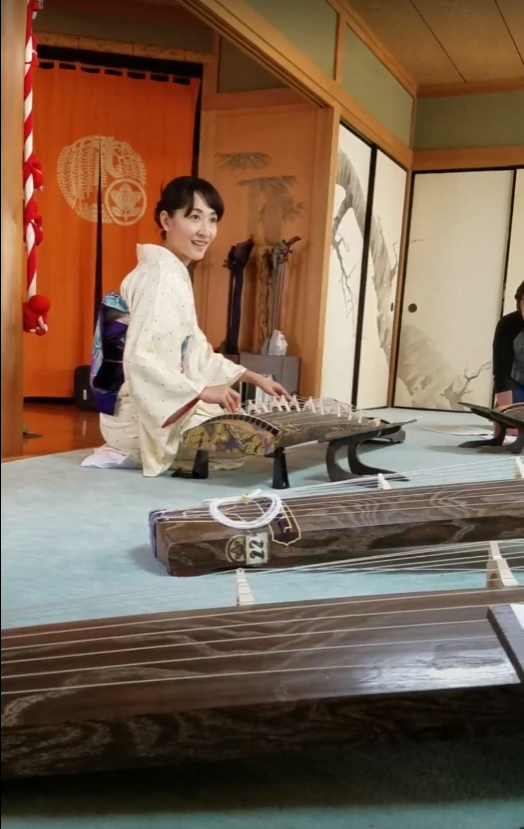
Motohashi-sensei brought us to his friend’s house. She lived in a very traditional-style house complete with “tatami” and sliding doors adorned with famous people’s artwork and numerous Japanese decor touches. She taught a “Koto”string instrument workshop to the community and invited us to come and learn from her. We had never played or been around one before, so it was entirely new for all of us students. Essentially, it was similar to a harp with a wooden body and thirteen strings running down the body of it.
The instructor showed us how each string was supported by a movable bridge that would change the pitch and note. She then gave us three small picks that would go on the fingers of our right hand to strum while we used the left hand to press down on strings. The graceful instructor in the photo taught us about the Koto instrument, the different kinds of Kotos and how they colored the sound played, and how to play “Sakura” and “Twinkle Twinkle Little Star,” both beginners’ songs she teaches at a university with Japanese students.
(This picture is a still from a video Julianna took. Here is the video if you would like to check it out.)
Tea ceremony
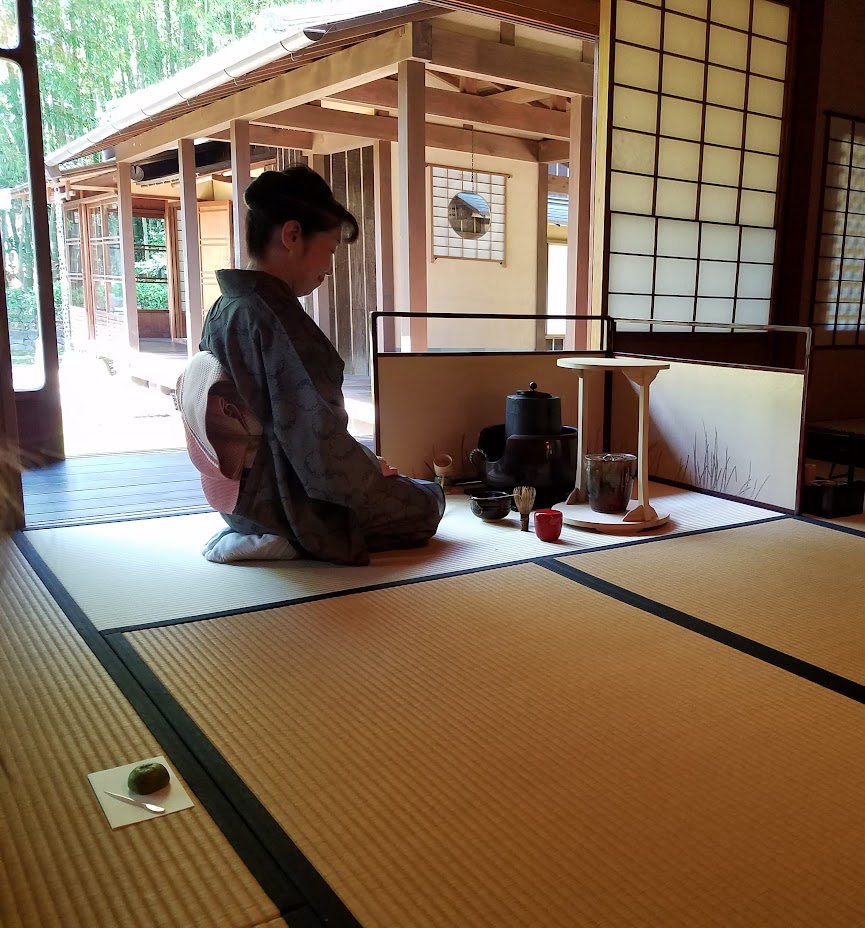
We also got to sit in on an authentic tea ceremony where an official translator came to interpret for us. Although there was no music, nothing more than the calm wind outside the open sliding door into the garden and the tinkling of windchimes, the silence in which she gracefully prepared tea for us was soothing and enrapturing.
Not only did she make us green tea from plants in her own garden, but she also brought a traditional red bean paste snack for each of us. It was sweet, but not quite as sweet as Americans are used to. The green tea had a light earthy bittersweetness with a nice grassy flavor balance that made it taste refreshing and healthy. This was unlike most regular green tea in America served in restaurants or in tea packs, which just tastes watery accompanied with a stronger bitter tang.
Some of the group, Kaitlin and Madeline included, didn’t like it, so they sneakily offered it to me because I enjoyed the new treat and wanted to be respectful of our host’s offering.
An encounter at the Asakusa Shrine Festival
We couldn’t have timed our visit to Tokyo better because we came perfectly in time to witness our first Japanese festival at the Asakusa Shrine. The area was jam-packed with people, everyone pressed together like sardines, while the excitement and anticipation were tangible. There was a whole parade of men dressed in traditional “Yukata” (a light cotton kimono), who carried several heavy golden altars to commemorate the shrine. It was so crowded that it was hard to take pictures, but I will always remember the loud whooping cheers of the men singing drunkenly, a traditional part of the festival, through the cheering crowd.
When we separated to do some shopping after the parade passed, I was approached by an older Japanese man when I was out looking for some souvenirs for my sister and mom. He was thin and short, but he spotted me through the crowd and shuffled over to me gently. He asked, in Japanese, “Excuse me, miss. Is that a college bag?”
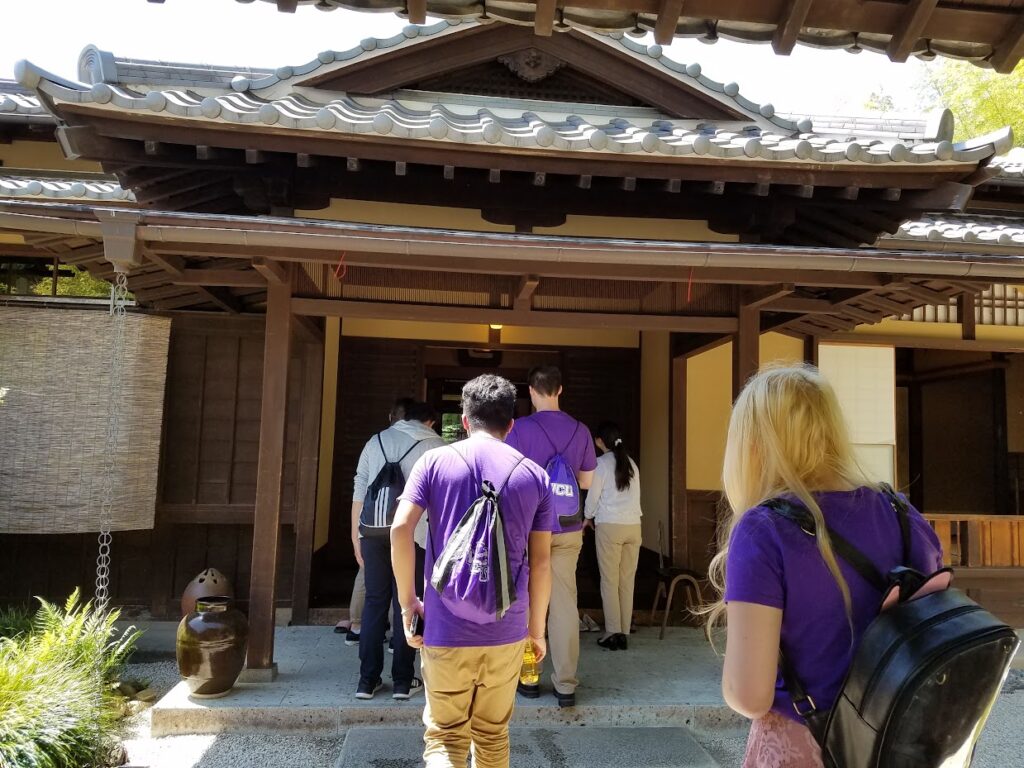
I had forgotten about the bold WCU white letters and university logo on my bag, and I was a bit nervous that my answer in Japanese wouldn’t be good enough, but I replied, “Yes, I came to Japan with students from my university in America.” (For reference, look at the picture! We all had matching shirts and some of us brought the school drawstring backpack.)
“Ah, I see,” he nodded to himself and pointed through the crowd to where a few students from my group were shopping. “Is that your group? You all have matching purple shirts.”
“Yeah, these are our school colors.”
“So why did your group come to Japan? Is it for a class or just for fun?”
“Uh,” I paused and had to mentally arrange my words. “It’s for a class, but we get to visit a lot of places in Japan and talk to Japanese students to learn.”
Despite my imperfect Japanese, he understood what I meant and seemed very giddy that I could comprehend and talk to him. “Good! I hope you learn a lot. Your Japanese is already pretty good, so maybe you can come back later and teach English. Welcome to Japan!”
I find that many people I approached and talked to in Japan were both very appreciative and relieved that I could speak Japanese since there are few English speakers in Japan who know more than just the basic curriculum taught in Japan’s schools. I also think this was one of the few times that someone approached me specifically. While I was initially nervous, the encounters always showed me how invested and curious people were in learning more about each other. Both sides know the courage it takes to approach a stranger, likely with a language gap, to explore the differences and share our own lives. That meeting could change a life, a perspective, an idea, so take a chance and reach out to the locals wherever you travel because everyone has their own story to tell.
Meeting Japanese students
Our time in Nagoya introduced us to some of the Japanese students at Chukyo University. It was very different culturally, seeing as rules in America are much less constraining and enforced, but Americans do tend to get in a lot more trouble because of that. Our visit to Chukyo University was our most interactive moment among students the same age as us who had taken the time to create a few mini games to practice their English with us and get to know us.
(Image courtesy of Julianna Wages)
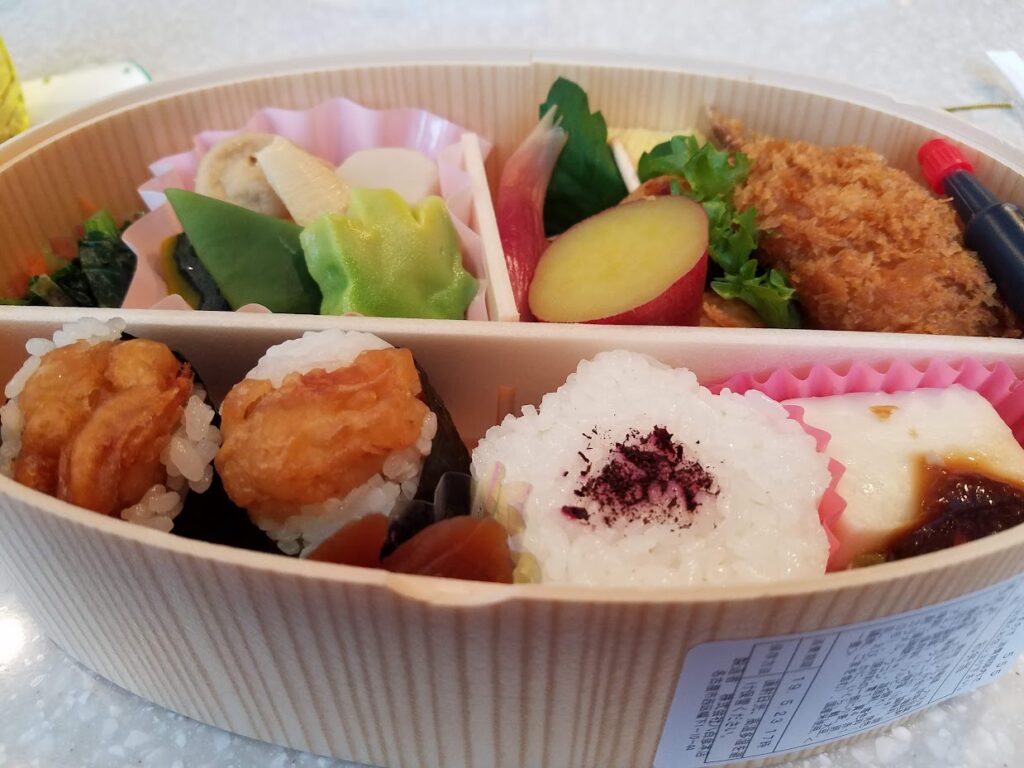
We took turns at each game and I went to a table of girls who had little fishing poles made of sticks and string with a magnet at the bottom to catch the fish on the desk. Each fish featured its name in Japanese and the girls would say the name of the fish that we had to catch. Luckily for me, I knew a few already and I could understand their descriptions for the ones I didn’t. They were very sweet and shy, but they opened up more when I managed to ask them a bit about their lives and dreams. The university also provided small bento box lunches for us to eat together with the students. It certainly let me develop my communication skills on the fly since I had to immediately translate what I wanted to say in my head to Japanese and speak it competently.
Kyoto adventures
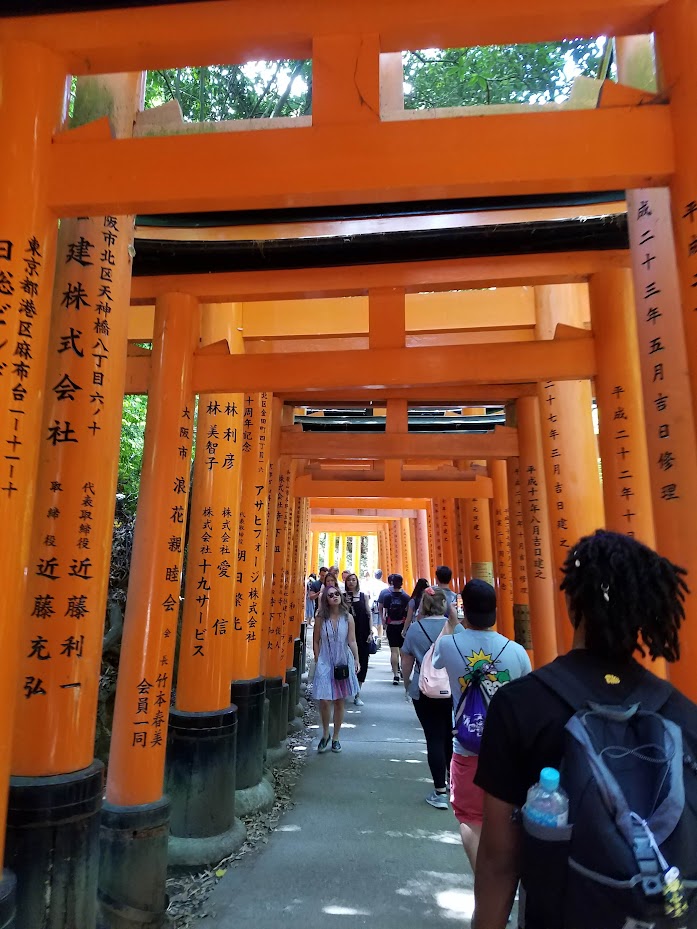
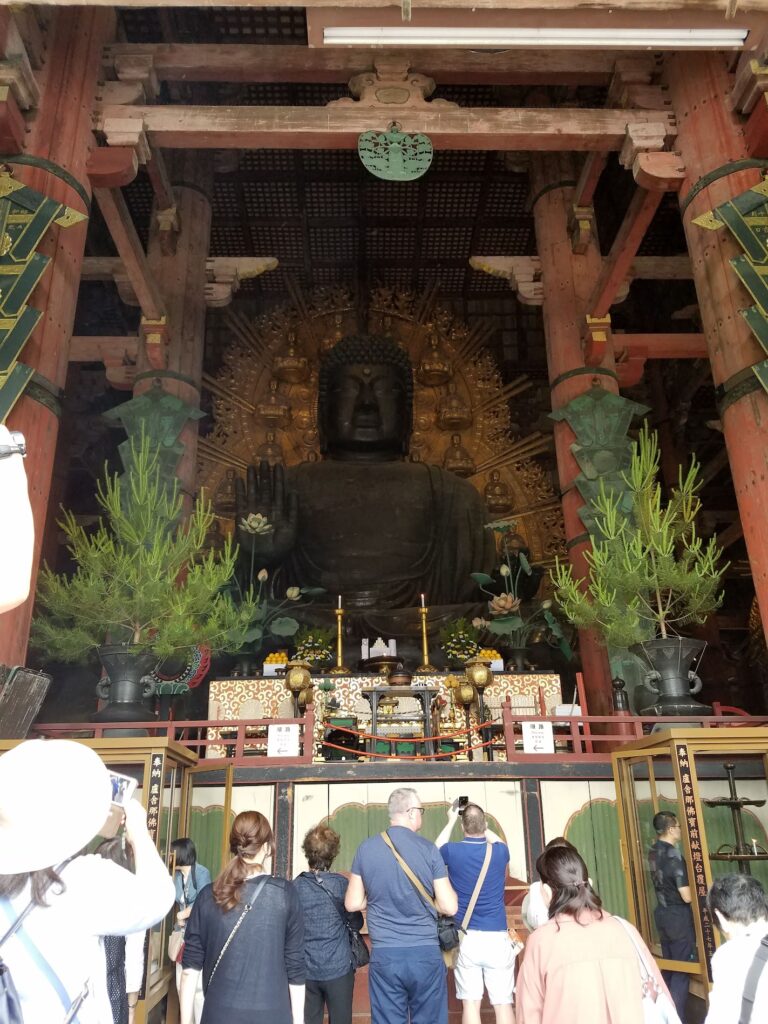
Before our return to Tokyo at the end of our three week tour, our last few days spent in Kyoto brought us to several of Japan’s castles, shrines, and temples. Kyoto is an amazing city and well known for how its over 1,600 Buddhist temples and more than 400 Shinto Shrines have been carefully preserved. Japanese architecture never ceases to amaze me. The Todaiji temple had the giant Buddah statue and the Fushimi Inari Shrine with the never-ending “torii” (convex) gates, for example. I got some souvenirs from both and enjoyed hiking up through the “torii” gates. Japan really keeps its shrines, temples, and castles in tip-top shape and I honestly looked forward to going to each one.
(Image courtesy of Julianna Wages)
We also traveled to Himeji Castle, which is an elegant white castle that towered high in the sky, stunning in its traditional historical architecture. Our teacher got us tickets to go inside, which enabled us to enter and climb up some very steep steps to reach the top with its breathtaking view. I spent some time just savoring it and the refreshing strong wind after the climb.
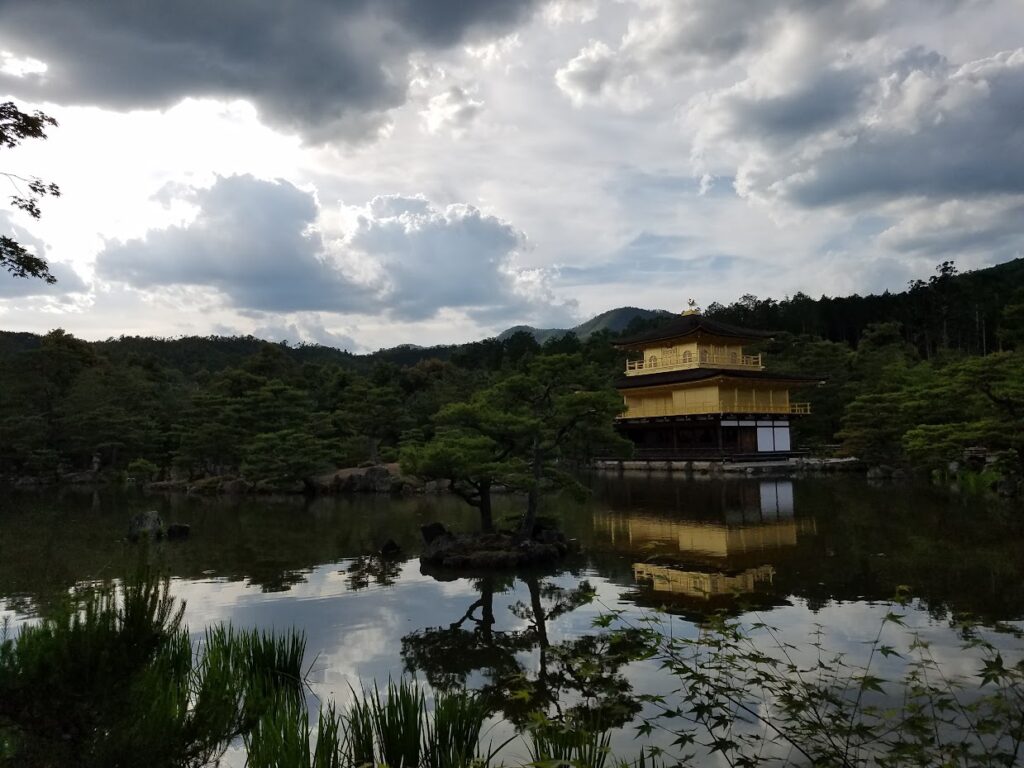
On our last day in Kyoto we also managed to go visit the “Kinkaku-ji” or the “Golden Temple.” It is one of Japan’s Zen Buddhist temples and is one of the most popular places in Kyoto because it’s a castle made out of real gold.
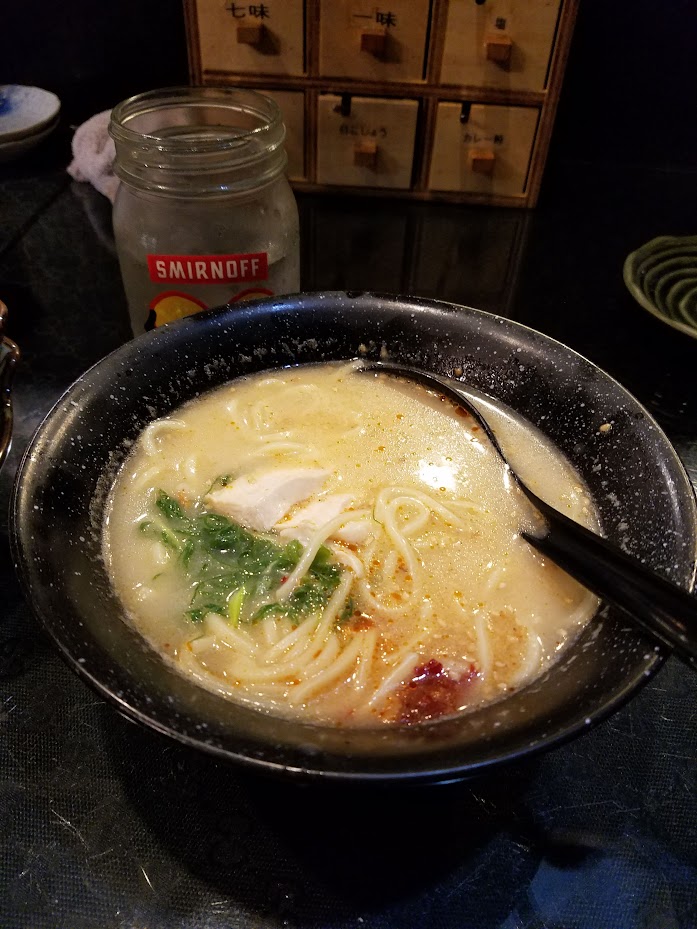
Not only does Kyoto offer amazing remnants of history at every turn, but Kaitlin and I discovered a small local “Izakaya” (Japanese bar) called “Kinnotori” that served a specialty mildly spicy ramen and fried chicken “Karaage” that we revisited for dinner every night we were in Kyoto! As foreigners are pretty rare in that area of Kyoto, the cooks there recognized us each time we returned, and even noticed how I had taken out a bit of the extra spicy chili oil during my first visit. They considerately brought it out on the side the next time just for me so I could moderate the spiciness.
Overall impressions
All in all, Japan is an amazing place to visit. Whether it’s with tours, a group, or alone, it’s worth the experience. Whispers of “Gaijin” and “Gaikokujin”, the words for “foreigner” in Japanese, followed my class as we stuck out among the homogenous-seeming local crowds. It felt more curious than anything, and we passed numerous kids staring at us with wide eyes and students wanting to approach us to practice their English. Foreigners in Japan were rarer in the Japanese countryside, so cities like Naruto had locals who were more distantly curious while those in the big cities we visited were more welcoming. Of course, not all warmed up to us but the vast majority were excited to see us. This was especially true whenever they learned that some of us could speak to them in their language. They were eager to show us their culture and were more than willing for us to experience it.
(Image courtesy of Julianna Wages)
As this was my first experience outside of the United States, thousands of miles from home and dropped into another culture with just our teacher and a couple of semesters’ worth of Japanese skills, I feel like this experience set the stage for my future travels and dreams. It challenged my Japanese skills and comprehension, giving me the motivation to turn my Japanese minor into an ISUD (Interdisciplinary Studies Undergraduate Degree, the equivalent of a major degree) in Japanese and thus further strengthen my Japanese so that I could one day visit Japan again on my own.
(Image courtesy of Julianna Wages)
After this experience in a foreign country and such a different culture, I found new appreciation for how different cultures have developed throughout the world. I also started to bring back what I learned in Spanish classes and got together with friends and coworkers to practice that language as well.
(Image courtesy of Julianna Wages)
I recently learned that my college is continuing their yearly class trip to Japan again now that Japan is opening back up for tourism, and I hope that everyone interested can now look to this story for inspiration and get their chance to visit. Take the chance to explore while you’re young and in college, whether it’s to Japan or any other country. Go ahead, travel and discover the world.
Sharing my glossary
English
Japanese
Japanese Romaji
Teacher
先生 (せんせい)
Sensei
Tatami (Japanese floor mat woven in layers of rice straw)
畳 (たたみ)
Tatami
Cherry Blossom
桜 (さくら)
Sakura
Yukata (a light cotton kimono)
浴衣 (ゆかた)
Yukata
Bento (single-portion take-out or home-packed meal in a boxed lunch)
弁当 (べんとう)
Bento
Torii Gate
鳥居 (とりい)
Torii
Golden Temple (Or more literally, “Temple of the Golden Pavilion”)
To be more alive, you have to be less shy, For, stigma and inhibition are like chains. They keep us indoors, away from our dreams! A wheelchair or a walker is no shocker! Live, dream, fly, grab what you must. Go and knock down your fears. Spread the joy and wipe tears. Go dear go, sky opens if you win your fears!
How often in your life have you closed your ears to the cliché “time flies” and prefer instead to throw yourself into the “having fun” part? Never does that expression feel more true than when you find yourself standing on the precipice of the end of your time at university.
“How can you possibly be at this point already? What have you been doing? What happens next?” When you graduate, thousands of questions flood your mind, threatening to overwhelm you and drown any joy you might feel at having reached this point.
I recently completed my studies in Classics at the University of Cambridge in the UK, and as my final days there approached, I had my fair share of these doubts and anxieties. However, I was determined not to allow them to outshine the joy that should accompany graduation. After all, it was a huge achievement!
Nevertheless, it’s undeniably hard to say goodbye, especially when the future feels a little hazy. I kept smiling by reminding myself of the concrete positives of everything that was happening: I was receiving my degree, I was celebrating with my friends, and I had so many wonderful memories to look back on.
During my time at Cambridge, I wrote as an advice columnist for a student paper. Here is one sort of question often submitted to the column: “How do I cope with the mixed feelings and confusion that come with leaving university?”
I had the idea of writing this guide to navigating this situation not only because I wanted to reflect upon my own experience, but also because I wanted to provide a helpful and comforting resource for others going through the same thing. So, here are my four tips for navigating your return to the real world, from one graduate to another.
Take a trip down memory lane
I believe one of the best ways to anchor yourself in this sea of uncertainty is to journey into your past.
I’m nostalgic by nature. In my final months, weeks, and days of university, I was constantly reminiscing about the slightest things, reminding my friends of meaningful moments and revisiting the ridiculous number of special spots in the city which had dominated the last four years of my life. It felt as though we were constantly attempting to squeeze in another goodbye: one last brunch in Murray Edwards Dome, one last trip up Castle Mound, one last glimpse of the punts as we crossed Clare Bridge.
(Image courtesy of Lucy Swanson)
I became hyper-aware of just how beautiful my walk home from the town center was. I couldn’t help but smile at the blue and white crockery and generous greenery in shop windows as I meandered across my beloved Bridge Street.
So why not pause for a second and look back? Scroll through your camera roll, head out to that one particular place, and laugh at the silly things you’ve said and done. Your memories are proof of all that has passed. They show that while the years may have flown by, you have filled them with fun. They are the perfect place to turn to for comfort when you’re panicking about where all that time has gone.
Remember reality
This may seem like an odd point to make, having just suggested that you spend some time wallowing in your past. However, it’s really important to find a sense of balance.
(Image courtesy of Rosina Griffiths)
For me, this meant leaving university-related Facebook groups and group chats that made it difficult for me to move on properly. This didn’t equate to cutting myself off from people, it just made it easier to turn the page to the future. Making the decision to remove myself from writers’ groups for student papers was a wrench, but it also drove me to send my words out into the wider world.
Your university community will always be there for you to come back to and the friends you made are a phone call or a visit away.
Remembering your journey is vital, no matter what the experience. But if you’re experiencing your last days at university, make sure you’re living them as they’re happening. Stay present and make the most of this time. You can immerse yourself fully in your memories in those first few days after you’ve left. After that, though, prepare to embrace the next chapter.
Make moving out fun
It can be quite hard to grasp the fact that you really are leaving. There’s nothing that can symbolize the truth of your departure better than the act of moving out.
You’re taking your fairy lights down from your apartment or dorm, your books are back in the library, and you’re packing up your clothes. This really is goodbye. Making moving out into a big deal is a good thing in that it helps you to come to terms with the reality of your situation, but it is a shame that it has to make you feel blue.
Why not take steps to turn it into a joyous occasion? I didn’t end up moving all my things out of Cambridge until several weeks after term had ended. Leaving still didn’t seem real to me. My mum and I decided that we might as well make the most of it, seeing as we had to make the trip down from North Yorkshire.
Once everything was all sorted, we had a lovely evening watching the world go by from the Cambridge Wine Merchants, before wandering along King’s Parade with a Jack’s Gelato.
(Image courtesy of Victoria Heath via Unsplash)
Moving out was undeniably sad, but marking it properly allowed me to acknowledge and validate my feelings; it felt like a true celebration of the last four years. So, schedule an afternoon, or even a whole day for packing up – anything that will help you avoid a panicked, angry, sweaty rush as you try to cram everything into the car while you get berated for your obscene amount of belongings.
Get organized and plan a treat for you and whoever is helping you. Seize this opportunity to spend some more time enjoying yourself in your university city. Bring your time living there to an end with a smile on your face.
Give yourself a break
A huge part of what can make leaving university so difficult is the expectation that you immediately know what you’re going to do next. This is often very far from the truth.
Remind yourself that getting through your finals and revision and handing in that dissertation is more than enough. The future can wait, and you’ll be glad that you focussed on those things when you did.
Give yourself some breathing space after leaving. You’ve just completed a degree; you’re probably in need of a rest!
I was fortunate enough to go on holiday almost as soon as I had completed my final year. It was exactly what I needed. I was able to embrace my brief freedom from work, to relax and enjoy the sights and experiences of the present moment. Taking that break allowed me to clear my mind, and I returned home ready for the next challenge.
When you feel up to facing the future then it is time to get that laptop open and begin searching for your next steps. Feeling refreshed, energized and confident will make that world of possibilities seem pleasantly exciting rather than pressurizing. The right thing for you will come along.
Good luck to everyone coping with the thought of leaving university, whatever stage of the process you’re in. Hold fast to your memories, be proud of all that you have achieved, and look forward to what your future might bring.