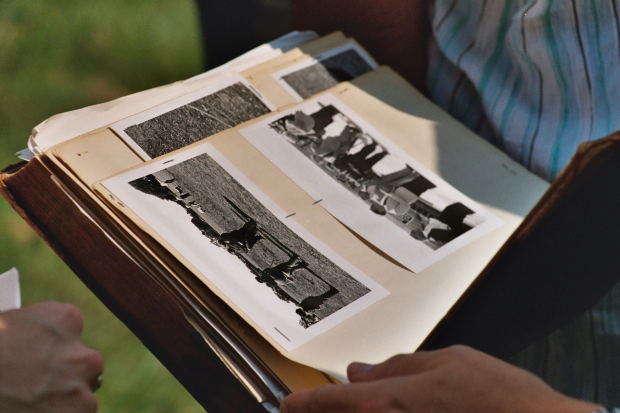
A ghost of a smile Graced my lips, Gazing at old faded photos of us I missed, Younger days have gone so fast. Truly good times never last.
Old happy times Memories are forever stored in my mind. Is this how getting old goes, Always going back to times, we lost, Favorite pastime now, I boast.
Old photographs lovingly stored, Like treasures I dearly behold, Bringing me back in time, Like the sound of a sweet chime.
Under the same sky, we reminisce, Good old times are the best, Under the same sky, we cry, Of people and things we lost, Under the same sky, we gaze, Never mind if this is a phase.
Every day is a new day to start anew, Let the blue sky guide us through, In God’s perfect time We shall meet again, my friend, Hoping that we can be the best again.
Big, oval-shaped metal ships appeared out of the sky. It’s hard for anyone to think that on that day, millions of lives disappeared. The aliens came in their large spacecrafts with protruding metal legs, and walked around our town in Aberdeen.
I was ten years old at the time, with Jay, who was eleven, and our mom. We were at the festival park downtown. Our dad wasn’t there, which was how things usually were. I remember that the perimeter of the park had a shaded, circular path for people who took their afternoon walks. There were two playgrounds. At the north-western side of the park, there were numerous wooden picnic tables, shaded by large trees.
After what felt like hours of Jay and I running around, our mom called us over to the picnic table to have lunch. As we ran over, I heard an eerie, high-pitched buzzing in my ear. I turned around to see where it was coming from. The sound became so loud and painful that I had to cover my ears, trying in vain to protect myself from it. I looked around the park and saw everyone doing the same. A homeless man who always frequented this park with his gang of dogs fell to his knees, his face scrunched up from the buzzing sound. I couldn’t understand what he was saying as I watched him curl into a ball, rolling from side to side with his mouth open.
Jay grabbed my hand and we ran to our mother as the sky turned dark. The beautiful baby blue color disappeared as the clouds quickly moved in, painting it gray. The wind intensified as we raced to our mother. I was terrified that my brother and I were going to get blown away. But thank God, we reached our mother in time and she took us into her arms. I don’t remember what I said because now all I can see when I close my eyes are the clouds opening and the alien spacecraft crashing from the sky.
We couldn’t run for cover. The impact of the spacecraft’s landing caused the ground to shake violently. Each time we tried to get up and walk, we ended up with itchy grass on our faces. The ground where the crafts landed on the cars, the public library, and the city hall were all shaking.
My mom held my brother and me close, whispering, “We are going to be alright.”
She tried her best to shield our eyes from the scene and focused on her, but it was futile. It was impossible not to see the complete destruction of my hometown. I thought again of the homeless man and his dogs. I still remember how hard I screamed when I saw him killed. A part of me, now, is grateful that the buzzing was so loud that I wasn’t able to hear the crushing of his bones or his horror-stricken cry. When the spacecraft’s feet lifted into the air, the man’s body was flattened, and he and the dog’s internal organs fell out of their bodies, mixing together on the ground.
My mom snatched my face and forced me to look her in the eye, “Mina, keep your eyes on mommy, okay? You too Jay! Kids, hold onto my hand tight and don’t let go!”
Jay and I nodded in silent horror.
My mom squeezed our hands, shaking them as she spoke. I didn’t have time to answer and neither did Jay. She got up and dragged us out of the park and towards the car before we could get a word out. I looked at my older brother to see his face turn white, as his eyes flooded with tears, snot running down his nose. I never saw Jay look horrified before then. He was the typical older brother, never afraid of anything. I was the one that would cry hysterically. But at that moment, the roles were reversed. I was the quiet one. I looked over at my mother again. She was clearly horrified, too, but somehow much calmer than either of us, because she wasn’t afraid for herself. Even in the middle of an alien invasion she couldn’t bring herself to be selfish. All she cared about was getting Jay and me out in one piece.
God why didn’t I listen to her then.
Suddenly, my fingers cease to type. Memories of my mother come flooding back. Her strength, her resolve. How she could be so calm amidst total chaos. Writing about her makes the pang of her absence even more apparent. The sick feeling in my stomach twists as I tell you this story.
My mother started sprinting for the car, dragging us by our arms. As we ran, I turned my head around to look at the mayhem. People scrambled to take cover and dodge the craft’s feet. A man carried a woman on his back towards the parking lot. He leaped over the carcasses of the homeless man and his dog but then slipped on the blood-slicked concrete and fell. My mom yanked my arm to turn me away. We were almost by our car when red lights appeared above us. I looked up and saw that each craft had wand-like appendages with red lights on them. I turned to ask Jay what they were, but his eyes were on our mom, unaware of what was about to happen.
“Mommy, I’m–“
Before I could finish what I was going to say. I heard what sounded like a crack of thunder.
Rain? Is it going to rain now?
Suddenly one of the wands shot out a blinding beam of light. The reflection lit up the whole park. A deep thumping sound came from the wand before another beam came out and struck a woman. She let out a horrified cry as her body turned red, and then her arms, stomach, and legs exploded. Chunks of her body scattered around us, her torso fell to the ground while the remains of her leg landed all around us. Something large and red flew past my head, and a moment later, her blood rained down on us. I turned to my left and saw her disfigured leg on the ground.
It was when the three of us took a big leap over something, that I felt a strange substance on my shoulder. I turned my head and saw a red, rust-smelling mass. I tried desperately to get it off me, but Jay’s grip on my hand tightened. I decided to ignore it. We continued running, while our mom pushed and dodged people to get out of our way. She knocked over a woman who was on her knees, screaming for her child to get up. I looked away, unable to bear the sight of it. We were inches away from the car when the sound of multiple lasers rang in the air.
My mom screamed as we finally reached the car and unlocked it.
“Keep your eyes on me!”
She threw Jay and me inside before she hurried behind the wheel. Outside the car window, more crafts swirled around the park, shooting lasers at anything alive and walking. My eyes turned back to the spot where the homeless man was. I saw the woman riding on the other man’s back. She was now on the ground, wailing and calling for him, but he kept running and left her behind. He nearly escaped when the laser beam hit him in the head, disintegrating it immediately. His lifeless body fell along with the other mutilated corpses around him. In a trance, I watched the bodies explode and the earth shake, and heard the buzzing, which overpowered the sound of my mom calling me.
She grabbed my face, “Mina! Mina!” she screamed, her fingernails digging into my skin.
“Mommy, my face hurts,” I whimpered. I tried to move my face away, but her grip was too strong.
Our mom’s voice trembled and cracked, “Mina! Listen to me! Do not look outside! Please honey. Look at your brother.” I looked at Jay, and he looked back at me, hyperventilating. With each pained cry he sucked in more air.
I begged her to let me go, “Mommy please…” I was terrified at the thought that, at any moment, we could all die.
“Jay, calm down honey, we’re going home. Mina baby…”
My vision was blurred with tears, and each time I tried to talk, my throat tightened. The car shook as my eyes trailed away from our mother and landed on the window. More limbs, belonging to both adults and children, were scattered all over the park. Their upper torso would be in one place, but their legs or arms would be far away. The last thing I remember was our mother turning around to start the car. But then, the body of a woman crashed onto the windshield, and suddenly the bright red light of another laser beam consumed my entire field of vision.
***
I stop the story and save the document. The images of the couple and homeless man replay in my head, and I realize I can no longer breathe. I get up from my desk to lay down on my bed. As my head falls on the pillow, I turn off the headset, put it down to my side, and just breathe. On my bookshelf are vintage books and picture frames that have moving holograms inside. One of them contains an image of my mom the last year before she died.
Our old selves stand in front of the camera with a big smile on each of our faces. Our mom was sitting in the middle while Jay and I flanked her on either side. The three of us posed and waited for the click, when suddenly Jay burst out into a giggle that made our mom laugh. Looking at this picture always causes this same bittersweet feeling: the memory of being with my brother and mom, the elation we experienced from just being with one another, and the sudden pain in my chest and throat when I realize we will never feel that way again. I stare at the hologram picture until my eyesight gets blurry again. I sniff and wipe my eyes as I turn over to face the other wall.
I want to write this story–my story. I don’t know why, maybe so I can heal some deep wounds. I take a deep breath and imagine the sound of her laughter on the day the photo was taken. For a second I question why I am even doing this. Forcing myself to remember her in vivid detail and write about how she was before I lost her. The pain of remembering her in this way is too much to bear at times. For a few minutes I entertained the thought of never opening up that document again, of keeping her memory safely tucked away, my only reminders of her the photographs of her smiling eyes. But then I think back to her final moments, how scared yet brave she was. I cannot let her become just a memory.
I take a deep breath, go to my computer, and open up the document once more.
This subtle jewel of a story, a confession almost, was dictated rather than written. Liba Chorny, 95 years old, shared this moving spiritual short piece.
Listen to the audio for the full experience.
__
When she was working on an art degree (studying in New York City), Liba brought up her interest in spirituality with her mother (born in Ukraine). At least she tried.
I told her about an experience I had, of mystical ideas. She said to me in Yiddish “Ken nisht herren” (Can’t hear it.) She didn’t want to hear about it, and I thought, “Wait a minute, I can’t talk to her about this.” She was not ready to listen.
And that’s when I stopped talking about Gurdjieff, the first person I spoke to her about. Then, I just learned to shut up and keep these things to myself.
It didn’t stop me from my interest in these subjects.
There were lots of side things that went on, oh, but my interest in mystical ideas — continued for the rest of my life.
But what can I tell you? You either have or that interest or that leaning or you don’t. I mean that’s been my attitude towards these ideas.
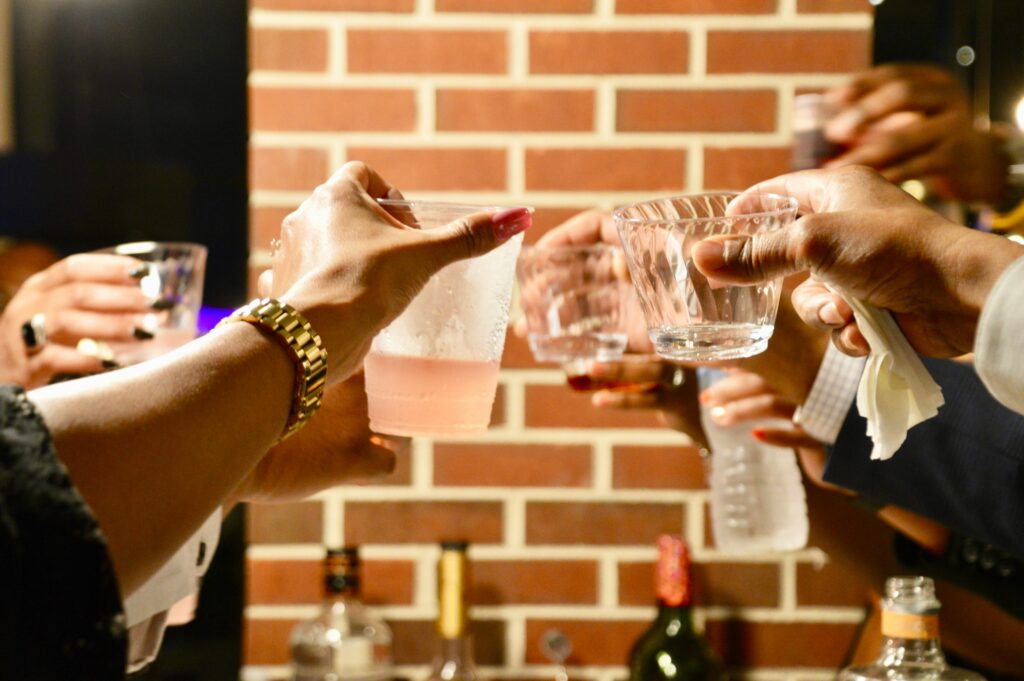
After-work drinks, generous customers, access to stock, brewery days, meetings in pubs, beer festivals, wine and spirit product tasting, line-cleaning sessions, and being surrounded by alcohol all day. Working in a pub not only facilitates regular drinking, it is actively encouraged. For some, this sounds like a dream.
Enthusiastic about drinking back in the early 2000s, I was drawn to working in the industry. But with an already developed alcohol problem stemming from my teens, I found that working in a pub fueled this at an extreme rate. Today, the sober-curious movement has introduced a wide array of alcohol-free alternatives in pubs for the customer.
But there is still very little being done by pub companies and breweries to safeguard their staff. In a 2021 study by BMC Public Health, 353 UK jobs were analyzed. The study found the most significant ratio of heavy drinkers were publicans and managers of licensed premises. Certainly, an industry that would benefit most from prevention programs.
Early exposure
I grew up in Yatton, a village halfway between Bristol and Weston-super-Mare in the south west of England. It was a fairly idyllic 1980s childhood with kickabouts in our cul-de-sac and cricket in the fields surrounding our streets. But I often had a pang of sadness in me. I was quiet as a child and never shared how I felt, which led to feelings of disconnect and loneliness.
I started experimenting with alcohol at 12 and instantly fell in love with how it made me feel. It was a kind of liberation. It released me from the feeling of being trapped within myself. My teenage years were then all about where the next party was and how we were getting our booze. I couldn’t get enough and quickly gained a hedonistic reputation.
But on each occasion, I got carried away and passed out, being told what I did or what was done to me the next day. By the time I was 15, I was depressed. But no one spoke about mental health in the nineties and I couldn’t understand what was happening to me. Alcohol allowed me to escape the depression. At least, initially.
But by 17, I was drinking alone and at crisis point. Struggling secretly, I planned my first suicide attempt. But I fought my way through and completed my A-Levels, never telling anyone what I was going through. I just knew that qualifications were my opportunity to escape.
The drinker’s double life
In 2000, age 18, I moved to London to attend the Metropolitan University’s communications and audio visual production course. I didn’t get into halls but found a house-share with six others in a large property in Stratford, East London. But after a few months of drinking and hangovers, I stopped attending university. Instead, I found a bar job, which I loved. I made friends, worked hard, partied hard, and felt like I belonged somewhere.
But it didn’t take long for this to get out of control. I found myself in the cycle of drinking every evening and passing out anywhere from a corner in a pub, on the tube, or on the street. Regularly, I woke up somewhere I had no idea where I was and had to take myself home for a quick shower and then back to work amid a mighty hangover fog.
I’d make it through the day, but after pouring beer all day. And, in an attempt to hide from my problems, I’d finish with “a few” pints after work again. Being surrounded by alcohol normalized daily drinking. I thought it’s what everyone did, especially at my age. The lifestyle came with its dangers, though. Over ten years, I was raped multiple times and found myself in countless situations where I didn’t know what I was doing or who I was doing it with. I felt utterly trapped in a cycle of self-hatred and attempts to alleviate the shame with more drink every day.
But throughout this period in my life, I was actually very high-functioning. Known as the “drinker’s double life,” functioning alcoholics often have steady careers, disposable incomes and positive relationships while they hide the seriousness of their alcoholism from those close to them.
Management and misuse
I ran my first pub when I was 25. Working for a large London brewery, I climbed from bar server to general manager through extensive management progression training. I learned about profit and loss, licensing and legislation, stock control, recruitment, training and disciplinaries, kitchen hygiene, and cellar work. But I never learned about responsible drinking, managing stress and mental health, or interventions or prevention programmes for staff who may develop drinking problems.
The pub was trading well and I was making good bonuses. So after paying rent and bills, I still had a significant disposable income to spend on more booze. Friends and family could always rely on me to be up for a drink and a good time. Often, they witnessed me having too much, perhaps passing out somewhere or falling over, but that was all in the spirit of the lifestyle. Life was all about enjoyment and I thought alcohol was the only way to achieve this. But, hidden to many, I was struggling with severe depression and drinking daily to deal with it.
I often woke up without remembering the end of the night. Sometimes on the floor. Sometimes in a bus terminal. Sometimes in a stranger’s house. The shame was too painful to acknowledge; I would do my best to push the feelings down and put on a smile. Alcohol made this easier. However, this progressively detached me from any emotions at all, and my true self sank away. Soon, all I knew was the shiny exhibited version – the side my customers saw. I had no idea who I was or what I liked.
(Image courtesy of Andra C Taylor Jr. via Unsplash)
Over time, the murky underbelly of my life grew bigger, infiltrating me like a poisonous gas. I was suffocating. Backed into the last remaining corner, it became too hard to hide from the shame and it became impossible to keep the smile on. Consequently, I became suicidal again as I was desperate to escape the exhausting cycle of pretence and remorse.
Attempting to get a grip on my drinking, I often told myself in the morning that I wouldn’t drink that day. But after spending hours pouring pints, I would have a few “in the till” from customers by the end of my shift or I would know which beer currently had a large stock surplus and I’d pour myself one. Propped up at the end of the bar and chatting with my staff and customers, who were all of a similar age and who I considered my friends, it felt completely normal to spend my evenings off this way.
Of course, as an alcoholic, I wasn’t able to stop at one or two and this led to several drinks before stumbling home. Friday nights were line-cleaning nights. After we closed and cleaned up, three pints from each lager and cider tap were poured into jugs for us to drink before the line-cleaning chemicals came through. It was quite a skill to stop it just in time. This was very often the start of drinking until dawn.
Monthly area meetings were always in one of our pubs, with drinks on a company credit card afterwards. Then, a few months into my role, I was given the additional title of Ale Champion, as the only manager in the area enthusiastic about cask ale. This role allowed me one day each month out of my pub to taste and learn about beer at beer festivals or at the brewery. I was literally being paid to drink. The next few years saw a few mental health crises and leaving jobs to escape my increasingly intolerable headspace, twice leaving the UK to escape. I kept running until I was 35. Eventually, though, I gave up pub work and finally gave up drinking. I’m now six years sober.
Working in pubs did not make me an alcoholic, and my experiences are extreme. It did, however, facilitate and enable my alcoholism.
Industry silence and call for change
In April 2023, I contacted 11 of the biggest UK pub companies to inquire whether there were any policies in place for safeguarding staff and whether they had any interventions for when it had gotten too far. Only two replied.
Nicholson’s sent me an alcohol responsibility policy, but this was for guests and the sale of alcohol, not for staff. Marstons told me their policies were internal and not for the general public. Their silence is staggering. Since 2001, when I started my first bar job, there has been no improvement.
I recently met with Dru from Club Soda, a small organization committed to helping people drink more mindfully and live better by promoting low and alcohol-free drinks, providing courses, and setting up alcohol-free events.
Dru told me he is “continually disappointed” by the big pub companies, who he says are difficult to engage with. He says many of them offer yoga days, vegan days, and promote well-being with their staff, but they go silent when the dangers of alcohol are mentioned.
Obviously, it’s not good business sense to tell the world that your core product is harmful, but shouting about the good work you’re doing to safeguard your staff could be excellent PR. The good news, though, is that there is some movement among smaller companies.
Club Soda works with The Drinks Trust, a charity dedicated to the drinks and hospitality workforce. They offer a service for businesses that can’t provide an employee assistance program due to the size of their company, and it is the smaller businesses that are most receptive to safeguarding their staff.
Alessandra from The Drinks Trust told me their free service for hospitality professionals was set up to benefit staff wellbeing. She added that their work with Club Soda has already helped thousands of people change their relationship with alcohol. Although with only 120 people per year signing up for Club Soda’s courses, there is still a long way to go.
The team at Bristol Beer Factory are also doing great things. I contacted Tom Clermont, head of sales for BBF. He reported that BBF invests more time and money into promoting Clear Head, their 0.5 percent alcohol IPA, than any other product. The beer was brewed with their primary charity partner, Talk Club, a Bristol-based mental fitness charity for men. Five percent of every bottle or pint sold goes directly to keeping Talk Club sustainable through regular cash donations to keep building a community of positivity and mental fitness.
Tom also told me BBF invests in their managers by enrolling them in mental health training. He also says BBF is on its way to achieving B-Corp status, a certification of proven excellence across staff happiness and policies, environmental impact, charitable giving, and community engagement.
Unfortunately, the wine industry is still a little sniffy about alcohol-free alternatives, instead adopting the mantra, “drink less, drink better.” A cynical mind could view this as an upselling technique. However, Liberty Wines, a wine wholesaler and importer based in London, has been working with Club Soda on an in-house workshop, Discover Mindful Drinking, to promote a mindful drinking culture within their company.
On a larger, global scale, Healthy Hospo supports drink brands to promote health and wellbeing, which, they claim, is tackling the problem at its source. I met with Jason Knüsel, co-owner and director of the non-profit organization. We discussed why so many are attracted to the job, such as the buzz you get from being around lots of people in a fast-paced environment and the passion for food and drink.
He told me that workers are still trained in many food and drink tastings but not about the dangers of excess, which he believes is due to the large-scale benefit of tax to governments worldwide. Healthy Hospo offers courses raising awareness, and educates staff about drinking habits and the science of neuroplasticity, the way the brain rewires itself through new routines.
But Jason tells me that hospitality is a mess. Since the pandemic, the industry has been losing a third of its workforce every year on an international level, citing mental health, cost of living, and life reevaluations in lockdown as a few of the causes. Industry sustainability is diminishing fast.
I don’t blame the pub industry for my alcoholism. This was well-developed on my own. But it’s been on reflection that perhaps pub companies need to take some responsibility for their employees. People who are attracted to working in pubs are often enthusiastic drinkers, making them susceptible to the progressive nature of regular heavy drinking. This is entwined in the culture.
Companies and organizations like Club Soda, The Drinks Trust, Healthy Hospo and Bristol Beer Factory are paving the way for culture change. Others need to follow.
The next steps are to implement company policies for prevention and processes for alcohol responsibility and awareness among staff. Interventions should also be planned for when an employee’s alcohol intake tips from social to dependent drinking. Hopefully one day, the big pub companies will follow the smaller organizations and breweries to take some responsibility as well.
I was accepted into the doctoral program and was offered a full scholarship. Most people would have immediately taken.
But I didn’t.
The pride I felt from being accepted into the program and not having to put myself into more debt for it was one of the most satisfying moments of my life. I had worked my ass off to get to that point; I received my Bachelor of Arts degree in three years and was accepted to the one and only Master of Arts program I had applied to. The master’s program was the most difficult experience of my life (and it lasted for two years, from 2018-2020). Long nights at the library, endless research and writing and proofreading, course readings and assignments, graduate assistant duties, student athlete mentor duties. My day was scheduled down to the last minute. But it was all worth it because I had gotten into the doctoral program. It was the goal, and I had achieved it, but I could not ignore the gnawing feeling in my gut.
The hidden cost of master’s programs
While I do not regret pursuing my master’s degree, the experience was miserable. I fell into old habits of barely eating, mostly because of stress and lack of time, but also because of financial instability and my mental health. I was in a constant state of anxiety and depression. My anxiety led me to believe that I did not have time to eat, sleep, or take care of myself, and my depression led me to think that I did not deserve to.
But my mental well-being did not get better. I was overwhelmed and exhausted, and not the best version of me. I felt sad, and then I felt bad for being sad. My mind would not stop racing about all the tasks I had on my “to-do” list and what would happen if I didn’t complete the tasks. But at the same time, my mind told me to stay in bed and rewatch New Girl for the 50th time. I barely slept, or ate, or saw my family and friends. And when I did spend time with my family and friends, I was absent mentally and emotionally because of my graduate school responsibilities. I would vent with my peers in the graduate program while consuming an unhealthy amount of alcohol. They offered validation and encouragement, but it was not hard to tell that we were all overworked and exhausted, too.
About a year into the program, I reached out to my university’s mental health center. I was informed that there were no openings for over a month. I was discouraged and attempted to look for help off of campus but realized I would not have time in my day to see a therapist. My days were packed with my graduate assistantship, mentor job, homework, research, and hours_long graduate classes. In between all of that, I needed to find time to eat, sleep, and maybe go to the gym, but only if there was time. How can I drive 20 minutes off campus, pay for parking at the medical facility, talk for an hour, and drive 20 minutes back?
I had been told that there is always time for mental health and that I need to take care of myself first, but I could not see how that was a possibility for me.
I told myself that I could make it through the year and that I was strong, smart, and capable. I faked it. And then, about halfway through my last semester in the program, the pandemic hit. Everything went virtual and all of my responsibilities became even more difficult and overwhelming than they were before. But, I made it through.
I completed and passed my thesis virtually. My family celebrated my graduation with a Zoom party my mom put together, and I had the opportunity to walk at graduation a year later. Everything I went through culminated in my acceptance into the doctoral program.
Image courtesy of Giorgio Trovato on Unsplash
Is this program worth my wellbeing?
There was a sense of pride when I received my acceptance into the doctoral program, but that gnawing feeling in my gut could not be ignored. If I were to accept, I would be committing myself to at least six more years of the misery I had been living. That gnawing feeling in my gut told me what I already knew: I could not survive six more years. I knew from the moment I opened that email that I would not accept it. However I told everyone that I was not sure what I would do. I did not know how to tell my family, friends, professors (especially the ones who fought for me to be in the program), and peers that I did not want to accept it.
“But it is such a wonderful opportunity!”
“It’s entirely paid for.”
“Won’t you regret it?”
I had not been honest about my mental well-being, so it was difficult to explain why I could not accept the offer. I felt as though I owed everyone an explanation, but it was an explanation I did not know how to give. My husband, then fiance, was the first person I told. He was there with me through it all (except for the six months he was deployed), and he saw my struggles first hand. He was a constant support throughout all of it, and I do not think I have thanked him enough for it.
The next person I told was my mom, who has been and continues to be, my greatest support in life. The last thing I wanted was for my mom to be disappointed in me. While I acknowledge my own hard work and perseverance, I recognize those traits; I got them from my mom. But I was ready to rest and my mom understood. She accepted my decision and confirmed that she was not disappointed with me.
So, I emailed my rejection to the program and let others spread the word for me.
It has been about three years since I decided not to pursue the doctorate, and I do not regret it. I made the right choice for myself, and am thankful I trusted my gut. Although I am struggling to find employment, I am relieved that I am not in a doctoral program. It is cliche, but trust your gut and stay true to yourself, and life will figure itself out.
“Are you sure you want to visit Grandma T? It might be difficult for you to see her this way,” my grandma, whom I call “Oma” asked me.
“Why?” I asked in return. I knew my great-grandma had recently moved from her home to a memory care facility, but I wasn’t aware to what extent her mind had been affected. I hadn’t seen her in a few months.
“She gets really upset sometimes,” she replied. “And she probably won’t remember who you are.”
Oma told me this with utmost apprehension in her voice. It wasn’t that she was trying to convince me not to come with her to visit her mother. Rather, she wanted to protect me from the potential pain of witnessing the inevitable change that our family had been dreading for years.
“No, I want to go see her,” I insisted. “This could be the last time. We don’t know.”
I felt like I should’ve visited her more before this, and I was worried that our time together on this earth would be cut too short, too soon.
A memory not so picture-perfect
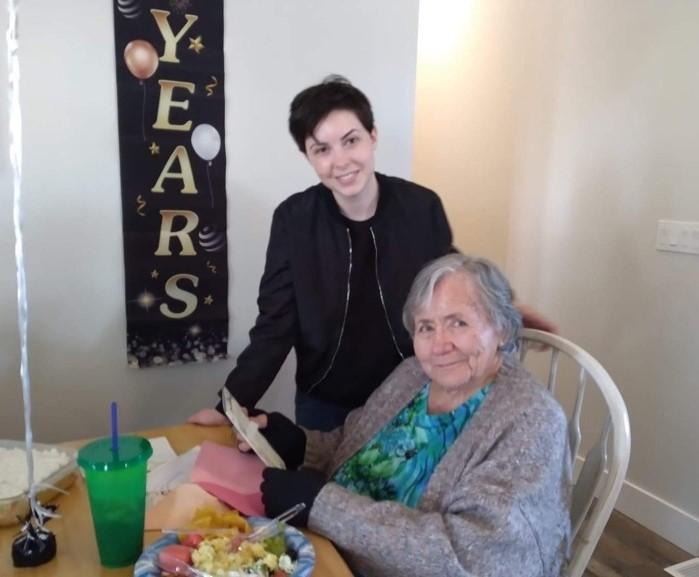
As soon as we walked into Grandma T’s room, I noticed the photos hanging on the walls. Decorating the space were frames filled with pictures of her kids, grandkids, great-grandkids, and everyone in between from various periods.
The room was quite small and unable to accommodate the elaborate decor of trinkets Grandma T is known for. However, the dozens of photos helped make it feel more homely. Grandma T also loves taking family photos at every moment, from the most important to the utterly mundane.
(Image courtesy of Brooklyn Riepma)
I heard a laugh—a laugh that sounds like mine but with a bit more resonance and wisdom.
“It’s good to see you girls,” Grandma T said. She sat in her brown leather recliner, looking up at us with happy eyes.
“Who do you have with you, Michelle?” Grandma T asked Oma.
“I’m not Michelle,” Oma replied. “Guess again.”
“Oh,” Grandma T said simply. “Adell.”
“No, that’s another daughter,” Oma corrected. “I’m Delila.”
“And you have your daughter with you. Good,” Grandma T said about me.
“I’m Brooklyn, your great-grandchild,” I told her. I didn’t mind the mistake or that she didn’t seem to recall my name. “Your oldest great-grandchild.”
“Oh, perfect,” Grandma T smiled. “It’s so good to see you. I always love it when you come to see me.”
I could tell she didn’t know exactly who I was anymore, but it was clear she knew I was someone she loved. That’s the most important thing to me.
This visit was short, and there wasn’t much talking. I told her some things about my life, like where I worked and that I had recently graduated from school, but it wasn’t as elaborate as our conversations in the past.
This made me feel sad because I knew our visits wouldn’t be the same anymore, but at least most of them were captured on film and SD cards. I’d always seen Grandma T carrying a camera in her purse for my entire life. Trying to figure out how many photos she took of her family would be like trying to count the stars in the sky.
For our next visit, I hoped to return to normalcy by bringing in some photos of my own–ones that she gave me.
(Image courtesy of Brooklyn Riepma)
A picture is worth a thousand words
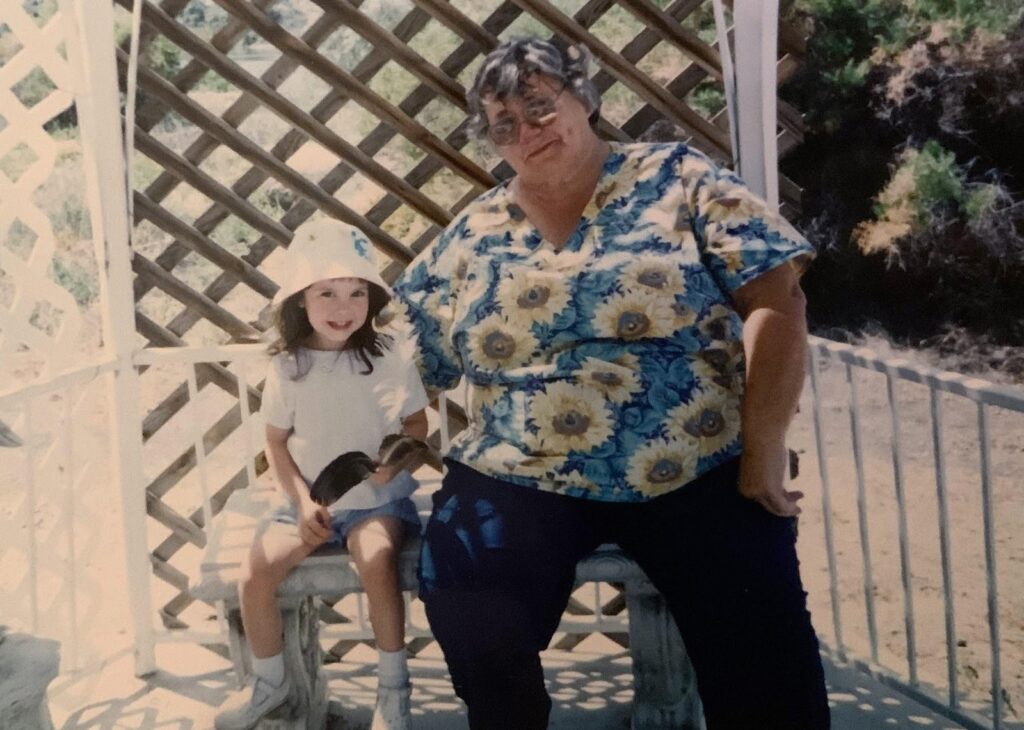
The next time Oma and I visited Grandma T, I brought some photos of us. Throughout my lifetime, Grandma T gifted me hundreds of printed photos that she took of my family and me. It didn’t take long to sift through them and find some fun ones to take with me.
“This was when you and I dyed Easter eggs,” I said as I held up a photo of her and me when I was little. “We did this every year for a long time.”
Grandma T muttered one of her famous catchphrases, “Oh, my stars,” as she stared at the photo with a smile.
“And here’s a more recent one from last year where we were celebrating your birthday,” I said as I showed her the next photo.
We spent the visit reminiscing. During a game of Scrabble, we laughed and made jokes about what was happening in the pictures. Before she had to move out of her home, she showed me the pictures. She used to tell me the stories, and now I tell them to her.
Nearly every time we visited each other as I grew up, she would bring me more pictures to add to the endless stack of ones she had already given me. A major focus point of each Grandma T visit was looking through each photo and discussing them.
The recent visits with her made me see that our relationship doesn’t have to change; just the role of the storyteller does.
Throughout my life, Grandma T gave me more photos than most people ever take in a lifetime. The photos themselves make wonderful memories and mean even more to me because she gave them to me. Not only do the pictures carry the energy of the moments captured within them, but they carry the energy she brings with her wherever she goes.
(Image courtesy of Brooklyn Riepma)
Take a picture so it’ll last longer
I used to fear getting older and losing my memory. I hated the thought of forgetting about my life and the people I love. I thought that once I lost that, I’d lose myself.
At a young age, that fear led me to follow in my great-grandma’s footsteps. I started taking pictures of all the beautiful moments I shared with my family and friends. I did this because I want a visual connection to my past if I ever forget it.
I’m not sure why Grandma T took so many pictures, but maybe she had the same idea.
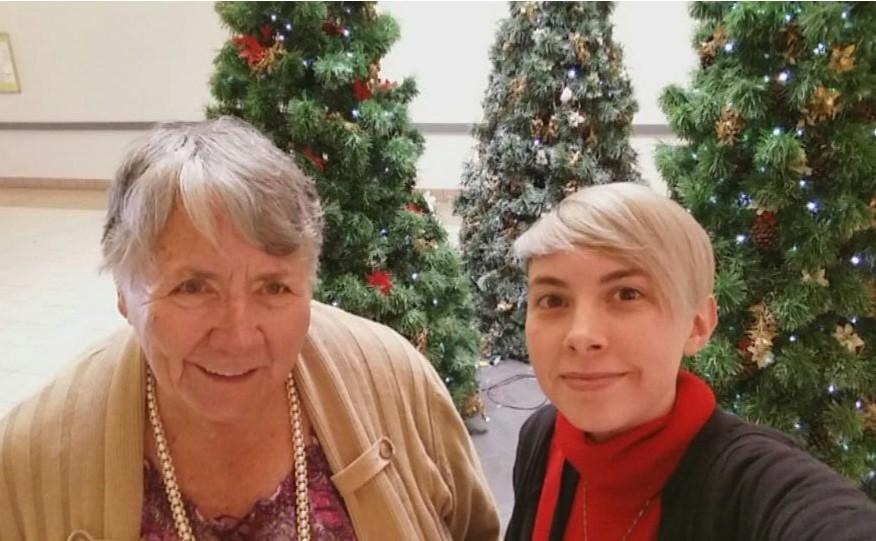
When I see her, she never seems quite certain who I am. She may not always know my name, my relation to her, my age, or where I work, but I see her face light up every time I bring the scrapbook for us to scope through.
The beauty of it is that she remembers how I make her feel. The details of who she believes me to be or not be don’t make a difference. The only part that matters is that we still get to experience life together and share some good laughs.
She showed me that love doesn’t require a physical memory to be alive; love is about connecting souls.
There I was teaching live. Even though I majored in English as an undergraduate and as a master’s student, it was difficult for me to imagine myself in front of the classroom. I was notorious for doubting myself. Heck, I still doubt myself today, even if it’s been five years since I started teaching.
Upon earning my Masters in English in Spring 2018 from the University of Hawai’i at Mānoa, I secured a lecturing position there to teach one section of English 100 in the Fall-2018 semester.It was a long shot, becoming a fresh graduate and applying as an adjunct lecturer. Courses were going to be filled based on seniority, as a fresh graduate I was at the bottom of the list- tenured and assistant professors first, doctoral students with funding second, doctoral students without funding third, and graduates last. Luckily, I was able to secure a course to teach.
I remember stressing out all summer, granted I was overthinking about the lectures I would take, but that was me. I wasn’t sure how I was going to deliver lessons? What should I talk about? How to plan group discussion and activities, the works??? I had signed up for a series of incoming lecturer training sessions. It was really helpful- developing our course syllabus, schedule and major assignments.
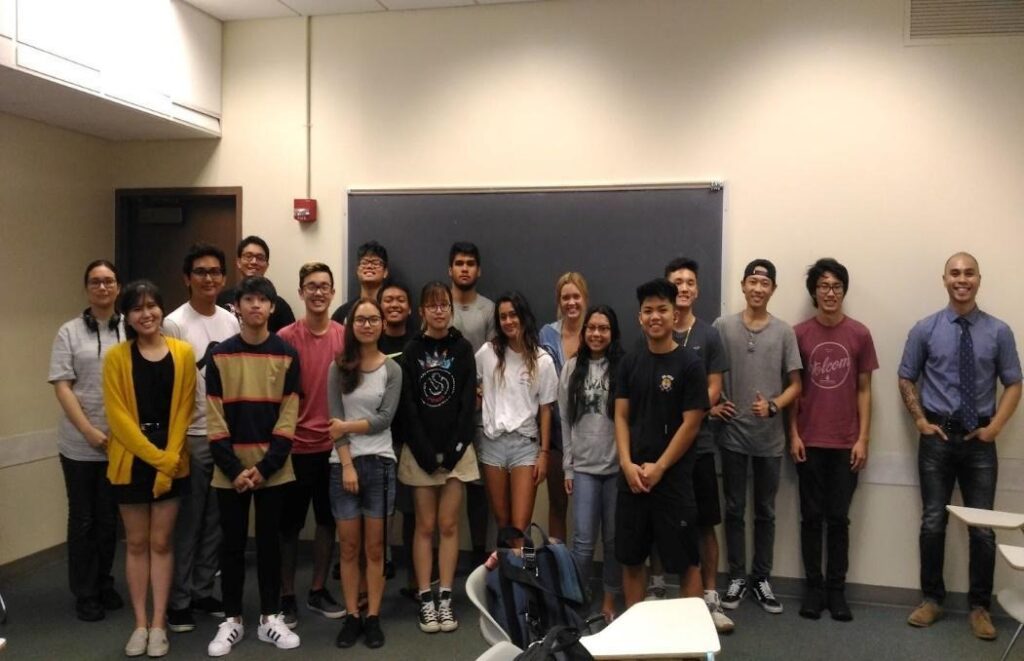
(Image courtesy of Jordan Luz)
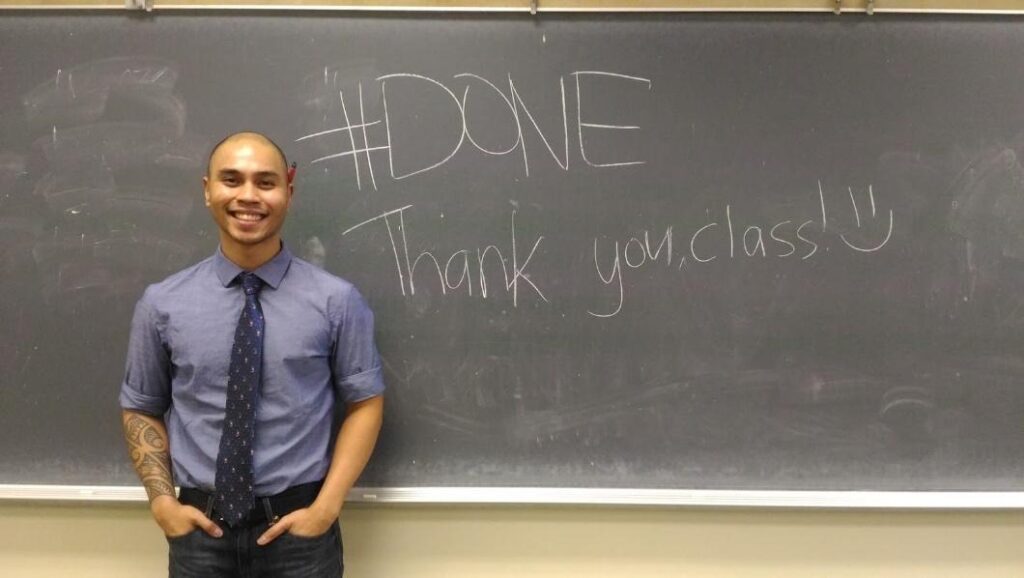
Alt text: Author Jordan Luz stands in front of a chalkboard that reads, “#DONE Thank you, class :)” (Image courtesy of Jordan Luz)
We also had the opportunity to give a demo lecture that involved a lesson plan, group activity and feedback from a volunteer audience; they were but the professors and graduate students from the department. Thanks to my masters’ syllabus teaching pedagogy and materials, it was all there. Also, my writing mentor training and working with fellow doctoral students helped immensely. I was placed in the classrooms and worked closely with the students helping them improve their writing, while also being given the opportunity to deliver sample lessons. This rigorous training led me to my first experience in teaching.
Whatever the training, the first classroom experience was nerve wracking. I knew English 100 by heart: free writing, the writing process, thesis statements, topic sentences, transitions, evaluating sources, everything was printed in my head. I had spent so much time engaging with them during graduate school. My major concern was I might mess these topics up and students may not make sense of what I was explaining.
I thought about everything worse that could happen on my first day of teaching.
Lucky me, I had a great support system of fellow graduates, some of them also had prior teaching experience. We had a joyful nervousness; we were about to start teaching for the first time.
Array of questions ran across me, “I still look like an undergraduate student, can I teach?”
“Can the students understand my lessons?”
“What if they don’t even listen to me?”
These were the common sentiments. I felt them more as the semester approached. I remember reaching out to Dr. Sarah Allen, my professor of Composition and Rhetoric. and coordinator of the fresh lecturer training series. I will always be grateful to her. Her words, “just do it. The students don’t know what you don’t know. You’ve been in the classroom. You know how it works. YOU can do this. Be yourself. Be honest with your students. I believe in you” still echoes in my ears.
August 20, 2018. The first day of the Fall semester. I wore a long-sleeve button up shirt with jeans and dress shoes, professional, but comfortable. My partner was in my office, helping me calm down. I even remember pacing in my little office in Kuykendall Hall. I also replayed Dr. Allen’s advice in my mind as I walked up to the fourth floor where my classroom was.
(Image courtesy of Jordan Luz)
I made my way to the classroom computer and pulled up the class roster and syllabus. Students slowly started to trickle in, I was nervous, an even mix of locals from Hawai’i and students from the mainland U.S.
The class started, I was sweating profusely, but was able to find my groove once I started talking. I told my students how I was feeling and, to my surprise, they were
nervous, college freshmen, after all. A new environment for us. It added to my ease. We would navigate this new environment together.
The heaviness lifted off my chest once I got back to my office. Going through the syllabus and having the students introduce themselves wasn’t so bad after all.
I shared my feelings with my partner, Dr. Allen and other first-time lecturers. It turned out that all my nervousness was completely normal; the first day or the 30th day of teaching. I always reiterate Dr Allen’s words “You can be your own worst critic, but rather than focusing on what you did wrong, try to focus on what you did right, what worked, and build on that moving forward.”
I’ve been teaching for five years now; I still get nervous before every class. It is perfectly ok to be nervous.
On the Italian island of Sardinia, where I was born and still live, there has always been a deep-rooted belief that, on the night of November 1 and 2, the fragile yet unsurpassable boundary between the living and the dead becomes more permeable. In the hope that loved ones who have died will find a way to return to this earthly realm for a few hours, and to nourish them from the dark journey they must take, many families set the table as if it were one of the happiest days of celebration.
This is what we have always called the Dinner of the Dead. The tradition of preparing a rich banquet for the deceased has been handed down for centuries.
In my family, the only one who prepared food for the dead was my great-aunt Alda, an older relative of my mother’s. The first time I attended the Dinner of the Dead, everything seemed shrouded in an air of fascinating yet eerie mystery. I was six years old and could not fully comprehend what it meant to lose a loved one. My grandparents were still alive then, and I was too little to remember my late great-grandparents.
Great-aunt Alda had always told me about her only son, who had died in the 1950s at five years old from a mysterious fever, for which no doctor had ever been able to find a cause, much less a cure. She had also lost her husband a few years earlier, and, as a widow, her life revolved around memories of happy times.
Her desire to feel them again was so strong that she looked forward to the Night of the Dead to remember them, secretly hoping to receive some sign of their presence. She would start cooking two days in advance.
I remember that on November 2, I would get up early and go to the cemetery with my parents and grandparents to place flowers on the graves of my great-grandparents. Then, after lighting candles and saying silent prayers for the departed, we would all go to my great-aunt Alda’s house for dinner. It was a ritual that none of us ever missed. Around seven o’clock, she would diligently pull out the best dishes she had, and set the table for the living and the dead. As soon as she let us into the house, she would show us the table. For this strange feast, she cooked fava beans, legumes, almonds, hazelnuts, dried figs, apples, pasta with cheese, and above all, the typical Sardinian sweets (pabassinas or papassini, pirichittus, cheese cakes and pardulas).
My favorite, however, was the “bones of the dead,” the most popular rustic, oven-baked biscuits. These are made with almonds, eggs, sugar, cinnamon, and lemon zest, then glazed with silver sprinkles. In Cagliari, the island’s capital, they are black because of a special ingredient called “sapa,” made from grape must and associated with mourning precisely because it makes the dough darker than usual. Curiously, the biscuits are not really shaped like bones but like a fish, because they symbolize the faith of the early Christians, who used it as a traditional sign to recognize each other during times of persecution by the Romans.
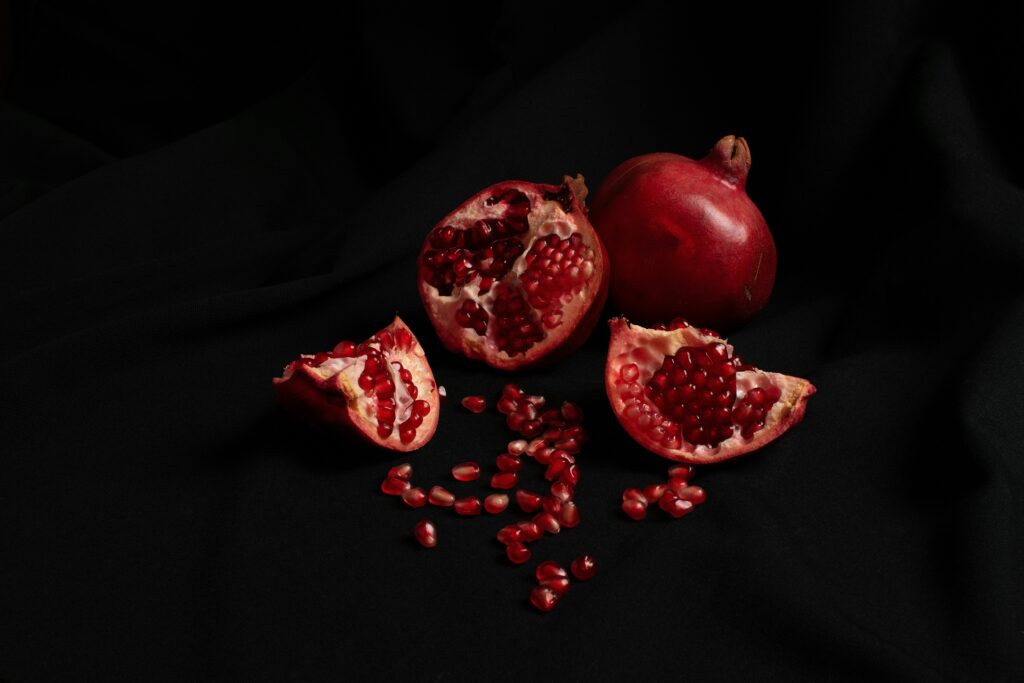
The pomegranate, a typical autumn fruit that grows in the Sardinian countryside, is also often associated with the dead, while its seeds are considered to bring new life.
(Image courtesy of Margarita Zueva via Unsplash)
In short, everyone is free to choose a little bit of what they want, even taking into account the tastes of the dearly departed, who may have had a special fondness for certain foods in life.
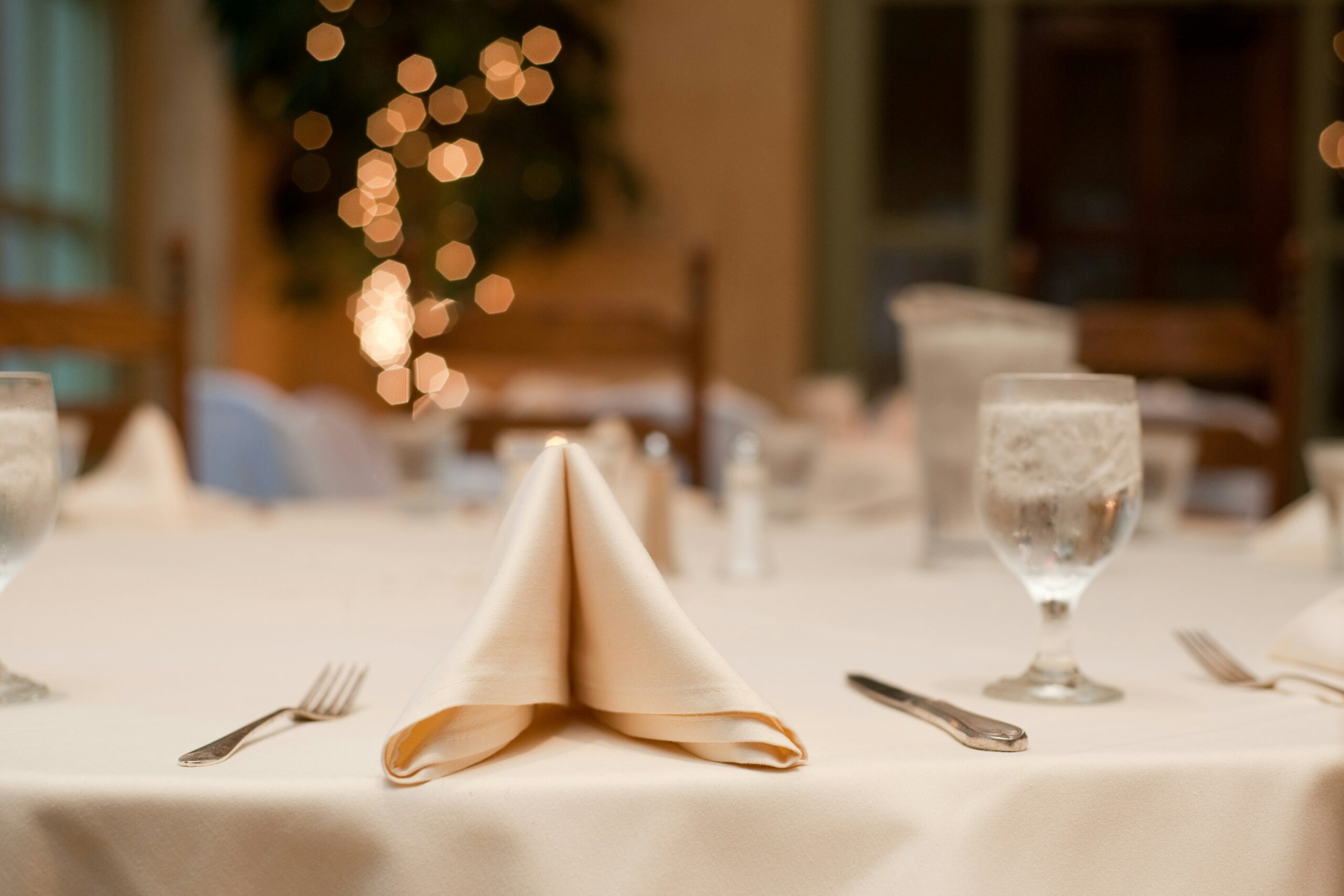
My great-aunt explained to me that the plates should always be white, the napkins perfectly folded, the glasses filled with red wine or water, and the chairs of the dead pushed away from the table to prevent the dead from making noise when they arrive. Great-aunt Alda, like other women from the inland villages of the island, used a white tablecloth, which could be made of filet (a traditional lace or crocheted lace with geometric patterns, like those on church altars), linen, or simple cotton, and with embroidery in the shape of roses and ears of corn.
It is customary to light a small candle at the center of the table to guide the lost souls in finding their way back to the house where they lived, and where they can finally embrace mothers, fathers, children, sisters or brothers one last time, or say a quick goodbye before crossing back over to the other side.
In the past, people like my great-aunt used a candle made of a cloth wick soaked in oil and embedded in a piece of cork that was left to float and burn in a bowl or pot of water. Each deceased person had their own flame that burned until midnight. Today, we are content to light ordinary white wax candles.
When everything was ready, my great aunt would make us sit around the table and, before we ate, she would recite a prayer in memory of the deceased. I remember my grandparents praying for their parents, my mother for her grandparents, and my grandfather for his brother who died in World War II.
As the Dinner of the Dead continued, we were surrounded by a strange and fascinating atmosphere. The candles shining in the darkness, the words whispered in memory of the dead, their names spoken aloud like a loud and clear call, gave this ritual the flavor of ancient magic. But this ritual has a dark side too…
After the meal, as no one dares to clear the table, this remains set until the next day, in case the dead come to satisfy their hunger. My great-aunt also told us no cutlery—or anything that could be used as a weapon—should remain on the table of the dead.
On the one hand, the deceased could hurt themselves; on the other hand, sometimes, a soul may have a score to settle with a mortal, so it is best not to leave possible instruments of revenge at hand. So, one must defend oneself against the attacks of those who might cross the dark threshold for a reason that has nothing to do with love.
Bedtime is no different. When the family goes to bed, the front door is left open, or at least ajar; this way the dead can enter without knocking. And to prevent tempting the dead to linger on in this life instead of returning to their dimension, sometimes dishes are placed on the windowsill to prevent the deceased from crossing the house’s threshold.
In times of famine or abject poverty, taking the keys off the doors or leaving the windows wide open also allowed those in need to sneak into homes and take food without being seen and without the humiliation of begging for a piece of bread.
In modern times, of course, no one has ever found an empty plate on the table or on the windowsill the next morning, and the living consume the rest of the food during lunch on November 2, the day on which the dead are officially commemorated.
Now that my grandparents and my great-aunt Alda have passed away, I know what it means to miss the presence of loved ones. Sometimes, as we sit at the table for a Sunday lunch or a birthday dinner, we turn to look at the sadly empty chairs, or the chairs pulled up to the table, where loved ones now reside in a place closed to us. Nothing is more painful than a meal eaten in solitude, or with nostalgia for the laughter that no longer fills the festive air.
There is so much within her, she deems unspeakable. A restlessness, long muted, vibrating undercurrents beneath her skin. You feel it too, don’t you? A razor-sharp blade sliding across your insides, like a silent threat waiting to cut open, tear membranes, and spill out all you hold within. All my unsaid tickles my anxiety, it does, like soft feathers pulsating at the edges underneath the surface. And this is how words denied air, weighty yet bubbling to the surface every chance they get.
She can hear them whispering, humming a soft song of longing in her ears. Notes seeking companions in relief and release. Wouldn’t we welcome such music at all?