UNBREAKING THE NEWS

South Africa’s Reckoning: Can Justice Still Save the Republic?

When Lt-Gen Nhlanhla Mkhwanazi first laid bare accusations of political interference, hidden criminal syndicates, and sabotage within the South African Police Service (SAPS) in July 2025, it sent shockwaves through the country particularly in communities already living in fear. For ordinary citizens in townships and informal settlements where criminality and “vanishing police dockets” are part of daily conversations, that moment was less about surprise and more about relief  because someone was finally naming the injustice that shaped their daily lives. 

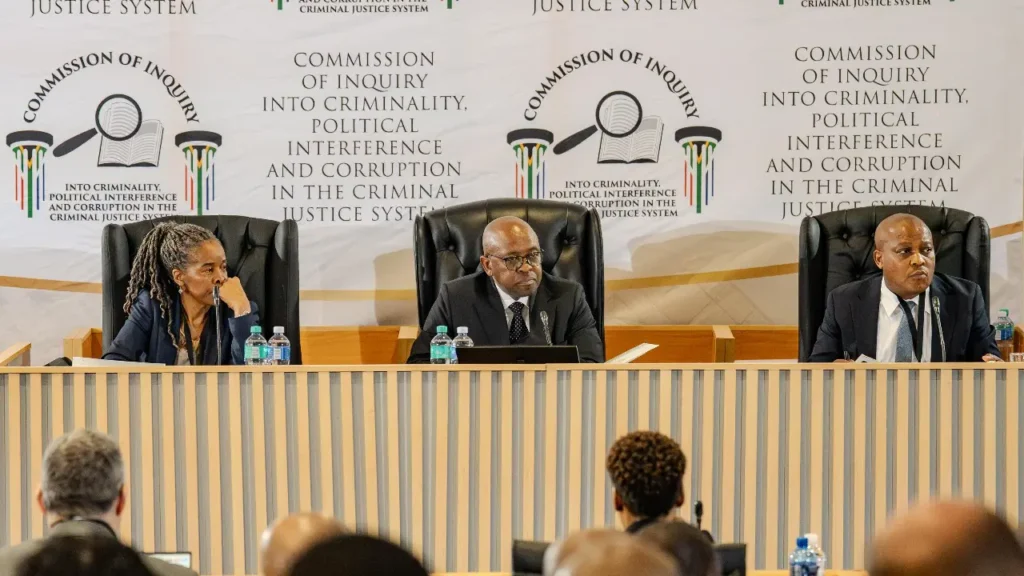
Now, as the Madlanga Commission of Inquiry has begun its public hearings on 17 September 2025 at the Brigitte Mabandla Justice College in Pretoria, the emotions of ordinary citizens mirrored the nation’s tension. The delays, resource problems, and political pushbacks are not just bureaucratic obstacles, they carry real costs in people’s lives. Nicole Myburgh, Ward Committee Member in Eldorado Park, commented “As a resident of Eldorado Park, I’ve witnessed firsthand the devastating impact of gun violence and drug cartels in our community. For years, we’ve lived under the shadow of gang warfare, a reality shared by many communities across the country.”

The first public witness to take the stand was Lieutenant-General Nhlanhla Mkhwanazi, his testimony immediately set the tone. Speaking under oath, Mkhwanazi painted a damning picture of political interference that, in his words, had “turned the South African Police Service into a playground for power brokers.” Mkhwanazi told the commission. “It is a capture of policing itself from the station level right up to the minister’s office. Political loyalties decide who gets promoted, which cases disappear, and who lives to tell the story.

The second witness National Police Commissioner Fannie Masemola corroborated parts of his account, testifying that ministerial directives had “encroached upon operational independence” and undermined accountability. According to internal documents tabled before the commission, 121 case dockets, many tied to politically connected suspects, were re-routed or “lost” after the task team’s dissolution. Witnesses described how officers who resisted interference were threatened, transferred, or quietly sidelined.

Opposition parties quickly seized on the revelations. DA leader John Steenhuisen told reporters outside the hearings, “These testimonies confirm what South Africans have long suspected that state institutions have been weaponised for factional gain. This commission must go beyond exposure; it must end impunity.” It is worth noting that even though the commission of inquiry has been well received by citizens, if it delivers not only revelations but prosecutions, not just words but systemic reform, perhaps the state will again be seen as a protector, not a predator.

South Africa’s democracy was built on accountability, the idea that no one, however powerful, stands above the law. However, as the Madlanga Commission peels back layers of a major political crisis, that principle feels increasingly fragile. The sudden death of former Police Minister Nathi Mthethwa on 30 September 2025, barely two weeks after his name surfaced in testimony linking him to “protection networks” around illicit mining and logistics cartels, has further raised suspicion. Officially ruled as a suicide falling off a hotel in Paris, his passing nonetheless sparked an online storm of speculation and conspiracy theories leaving others in fear that the line between politics and organised crime may now be one of survival.

Parallel economies thrive in this environment. From the zama-zamas (unregulated small scale mining) of mainly Gauteng’s abandoned shafts to cross border tobacco and vehicle hi-jacking cartels, organized crime has become a shadow state which is exploiting gaps in governance and the rule of law while the most vulnerable in society suffer more into poverty. In a report, the Transnational Alliance to Combat Illicit Trade (TRACIT) estimated that illicit trade (tobacco, alcohol, counterfeiting, etc.) causes losses of about R100 billion annually, but that is not expressed as a percent of GDP.

In the end, the Madlanga Commission is not just about rooting out corruption, it is a mirror held up to a democracy testing its own endurance. South Africa’s political underworld did not emerge overnight but it grew in the blind spots of accountability, in the silence of those who looked away. Whether the commission’s findings lead to prosecutions or fade into another forgotten report will determine far more than political reputations, it will reveal whether this democracy still has the courage to save itself and whether citizens like Nicole will inherit a country worth living in. 

READ MORE

Comments

Be the first to share your thoughts!

We value diverse perspectives and respectful debate.