
COP30 in the Brazilian Amazon: Expectations, Infrastructure, and Price Controversy

The city of Belém (the capital of Pará state in Brazil), in the heart of the planet’s largest tropical rainforest, is preparing to host the 30th United Nations Climate Change Conference (COP30) in November 2025.

The United Nation’s annual climate meeting plays the crucial role of reviewing climate mitigation and adaptation targets.

The gathering is expected to bring together leaders, negotiators, and activists from nearly 200 countries, placing Brazil, the Amazon, and its people at the center of international climate diplomacy.

However, alongside the anticipation for investment and visibility, tensions are rising due to the increase in accommodation prices during the event’s days.

The Amazon at the Center of the Debate

The choice of Belém as the host city is not random. Far from Brazil’s traditional economic hubs (São Paulo and Rio de Janeiro), the city carries symbolism: it brings the COP directly to the region most strategic for the planet’s climate balance.

Holding the meeting in Belém is a symbolic act and an opportunity to give due focus to the environmental issues experienced in the world’s most important natural reserve.

Professor Silvia Helena Ribeiro Cruz, director of the UFPA School of Tourism, emphasizes the location’s relevance.

“I ask, how can we discuss sustainability, climate change, and socio-environmental justice without being in the Amazon?”

For Brazil, COP30 is more than a large gathering: it’s a chance to transform global discussions into concrete actions, attracting investments in innovation, environmental policies, and sustainable development.

The expectation is that the event will leave lasting results for both the Amazon region and the country as a whole.

Construction Work and the Infrastructure Legacy

According to the Transparency Portal, the Federal Government has allocated more than R$ 4 billion (about US$ 750 million) to prepare Belém. The investment covers structural and logistical improvements that are intended to remain as a legacy for the city.

This funding aims not only to ensure the conference’s logistical success but also to leave a lasting legacy for the city and the region.

Among the projects nearing completion are the re-qualification of the Belém International Airport and the revitalization of Porto Futuro 2, a leisure and social complex on the capital’s waterfront.

Despite the progress, Professor Silvia Cruz warns of an inequality in the allocation of resources.

“The structural legacy will be mainly for the central urban areas, and little for the peripheral neighborhoods, where the socio-environmental problems, like lack of basic sanitation, are located.”
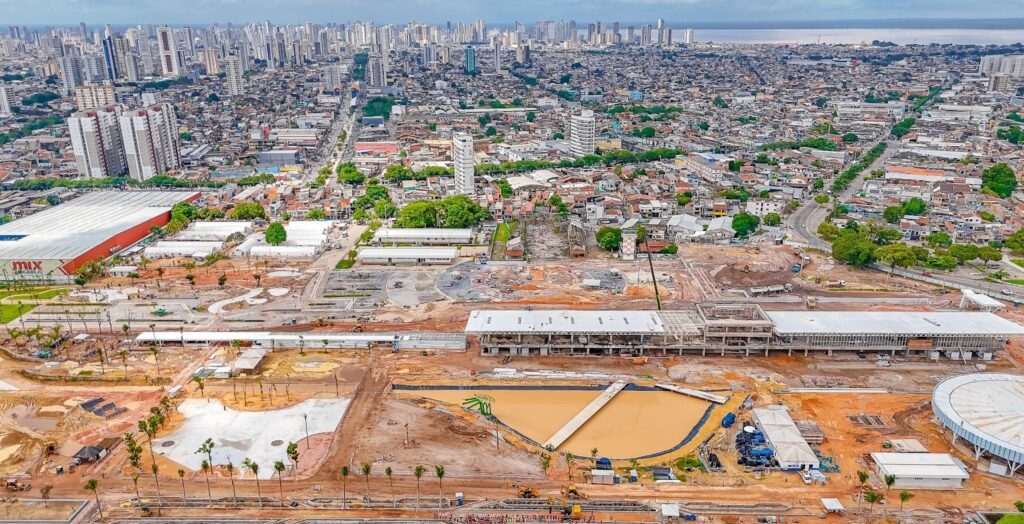
Belém (PA/Brazil), 02/14/2025 / Photo provided by Agencia Brasil, (Ricardo Stuckert/PR)

Hotel Sector, Prices, and the Government’s Response

The international visibility has also brought side effects.

Reports of inflated values for hotels and short-term rentals have multiplied, with extreme cases: a 118 m² apartment advertised for R$ 151,000 (about US$ 28,000) for the 11 days of COP30.

This practice generated a government reaction. On September 24, 2025, the Minister of the Civil House, Rui Costa, confirmed that the Union will take legal action against establishments that are abusing prices.

The justification is clear: to seek “reasonableness” and protect Brazil’s image. “It is not right, it is not fair that hotels are charging stratospheric prices,” declared Costa, highlighting the effort to “deconstruct this narrative, including internationally.”

The ultimate goal, according to him, is for the “great legacy” of the COP to be “the image of a welcoming, warm people, with wonderful cuisine.”
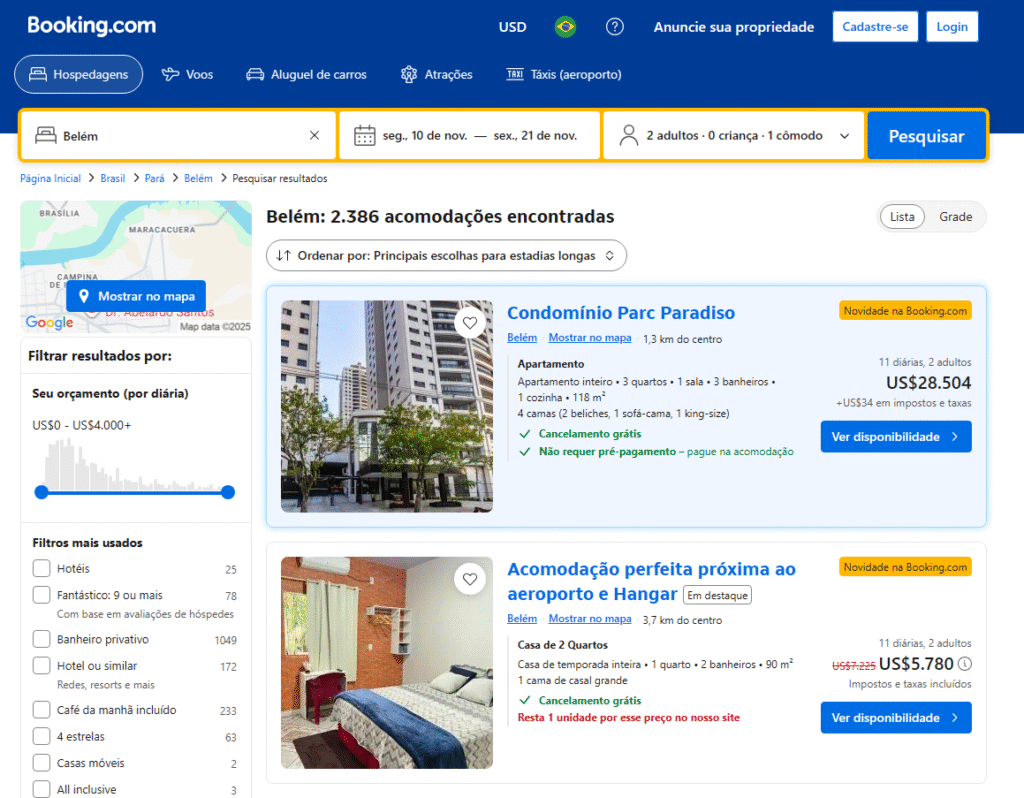
Accommodation available on Booking during COP30. Accessed 09/31/2025.

The Critique of the International “Alarm”

For Professor Silvia Cruz, the media’s excessive focus on Belém’s problems distorts reality.

“In every COP, there is a price increase. This is nothing new. I’ve never seen this level of scrutiny in other cities,” she argues.

She believes the disqualification of the city is unfair and may even be a political maneuver.

“In my perception, the alarm regarding Belém, with media outlets concerning themselves with the city’s inner workings, is a novelty. I never saw this done with other cities where a COP was held, even though all of them have structural problems.”

“This seems to me more like an orchestration to destabilize the event’s organization and remove it from the Amazon,” she adds.

Another point raised by Silvia is the presence of foreign capital.

“The hotel network in Belém is currently comprised of over 60% of hotels belonging to international groups. I haven’t yet seen anyone ask how the daily rates are priced, and these groups are European and American.”

Despite the city facing challenges such as the need for improvements in public transport and the major bottleneck in basic sanitation, Professor Silvia Cruz emphasizes that hosting large-scale events is not new for Belém.

“Belém hosts the Círio de Nossa Senhora de Nazaré every year, an event that attracts, on average, two million people to Belém,” the professor reminds.

She points out that “any major event, in any city, presents challenges,” and that Belém has the capacity to receive large volumes of visitors, overcoming adversity.
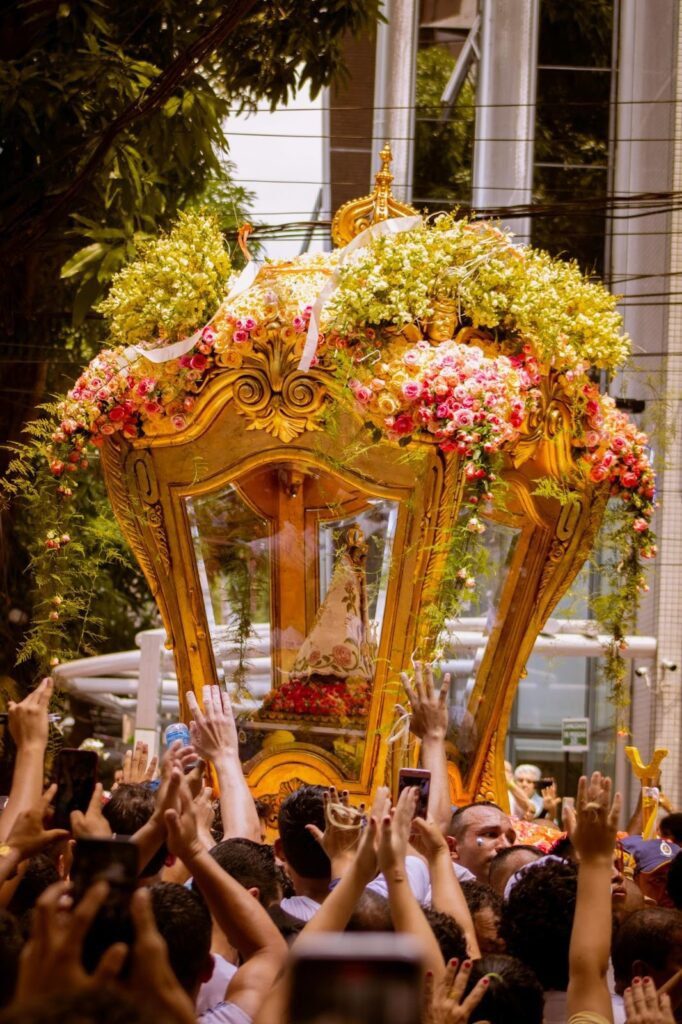
Círio de Nazaré, photo by Fernanda Lima, available on pexels

An Invitation to the World

Despite the challenges and controversies, the main goal of COP30 remains to fulfill the global environmental agenda and bring the world’s real demands to the forefront.

The event should also serve as a platform to promote regenerative actions and sustainable tourism in the region, setting the stage for new public policies that envision a development agenda valuing local populations.

The professor argues that the true legacy goes beyond infrastructure: “education actions through socio-cultural actions and environmental policies alongside local populations would be the great legacy.”

She bets on the cultural strength and the welcoming nature of the people of Pará as a differentiating factor.

“The human warmth of the people of Pará will be the differential, that warmth that not only works hard but also welcomes and always offers the best they have to visitors.”

She concludes with an invitation to the world: “We are capable of welcoming so well that even the difficulties will be overcome. My message is don’t be afraid. Come see a bit of the Amazon up close, come see how we live and survive.”
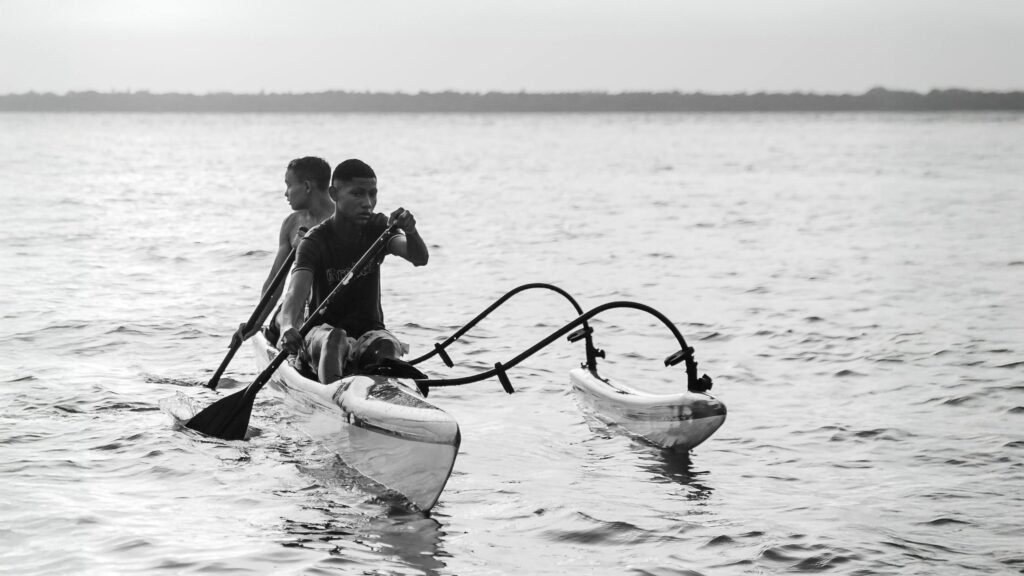
Canoeing on the Amazon River in Belém, Brazil / photo by Gabriela Ally, available on pexels

An Ode to Parkrun

New Year’s resolutions. Weight loss journeys. Fitness kicks. Meditation. Everyone has a reason for wanting to exercise, whether they’re driven by motives of result or satisfaction, but those just starting out may need a tactic to maintain motivation from week to week.

I was at one time one of those people, unable to muster the willpower to commit to any exercise routine. Many attempts were short-lived.

Then one day, after years of trying and failing to make any exercise stick, I was introduced to what would eventually become one of my greatest obsessions — parkrun.

Welcome to parkrun

Saturday no longer exists outside of parkrun. Saturday is parkrun day.

Parkrun is a collective network of five kilometer runs, taking place every Saturday at 9am in hundreds of locations across the UK and other countries around the world. Each event is free to attend, run by community-based volunteers, and the results for each attending runner are calculated and released via parkrun’s website and their app.

As of April 2025, 23 countries are actively hosting parkrun events, with over 2,000 individual parkrun locations and over nine million registered users. It’s a whopping community – one, and that played a massive part in immediately catching my interest.

A social outing that includes movement instead of a solitary jaunt at the gym? Sign me up.

Humble beginnings

It began with a social media post. Rather, it began with an onslaught of posts from a friend of mine and my dad’s — Caroline.

Caroline was a volunteer at her local course in Northampton, welcoming first timers and showing them the ropes. She also had a penchant for bombarding social media with constant encouragementcalls for new runners.

On a whim, my dad and I finally decided to  try our first parkrun at ourthe local park to see what all the fuss was about. Maybe Caroline was onto something.

It was New Year’s Eve in 2022, and winter that year was a cold one.

To give you a better understanding of my utter lack of experience with running, I stupidly decided to rock up wearing a pair of’ll share with you my outfit of choice for that day — jeans and a button-down shirt. I was, to say the least, ill-equipped to run. 

My dad, meanwhile, had tried on several occasions to get into the unrelated “Couch to 5K” program in his own time. Try as he might, the process never seemed to stick. 

I’m not sure what madness compelled ushim to finally answer Caroline’s frequent bids for running, but he did. 

Despite the frigid temperatures and our minimallack of running experience, we resolved to have fun at the very leastthat day. As it turned out, that’s exactly what parkrun catered to.

We were immediately struck by a sense of camaraderie — more than 200 people had dragged themselves out of bed on this festive day, each of them linked by the same, slightly insane purpose of running a 5k before 10am. Everyone was friendly and open to chatting about their parkrun journeys; some runners had even travelled from overseas just to be a part of a different parkrun group. 

Imagine travelling the world just to do a 5k with a group of people you’ve never met before…… That’s super inspiring.

The volunteers leadingrunning the event were supportive, assuring us that runners of all levels would be treated equally. We discovered later that one of the mandatory volunteer roles includes  “tail walkers,” whose job is to walk along with the back of the crowd to ensure no one finishes in last position. That was reassuring. Equally, runners were encouraged to bring dogs and young kids along, provided they stayed within reach of their respective adults. There was no concern from my dad or me on falling behind or looking out of place. The sentiment was very much, “We’ve all been beginners at some point.”

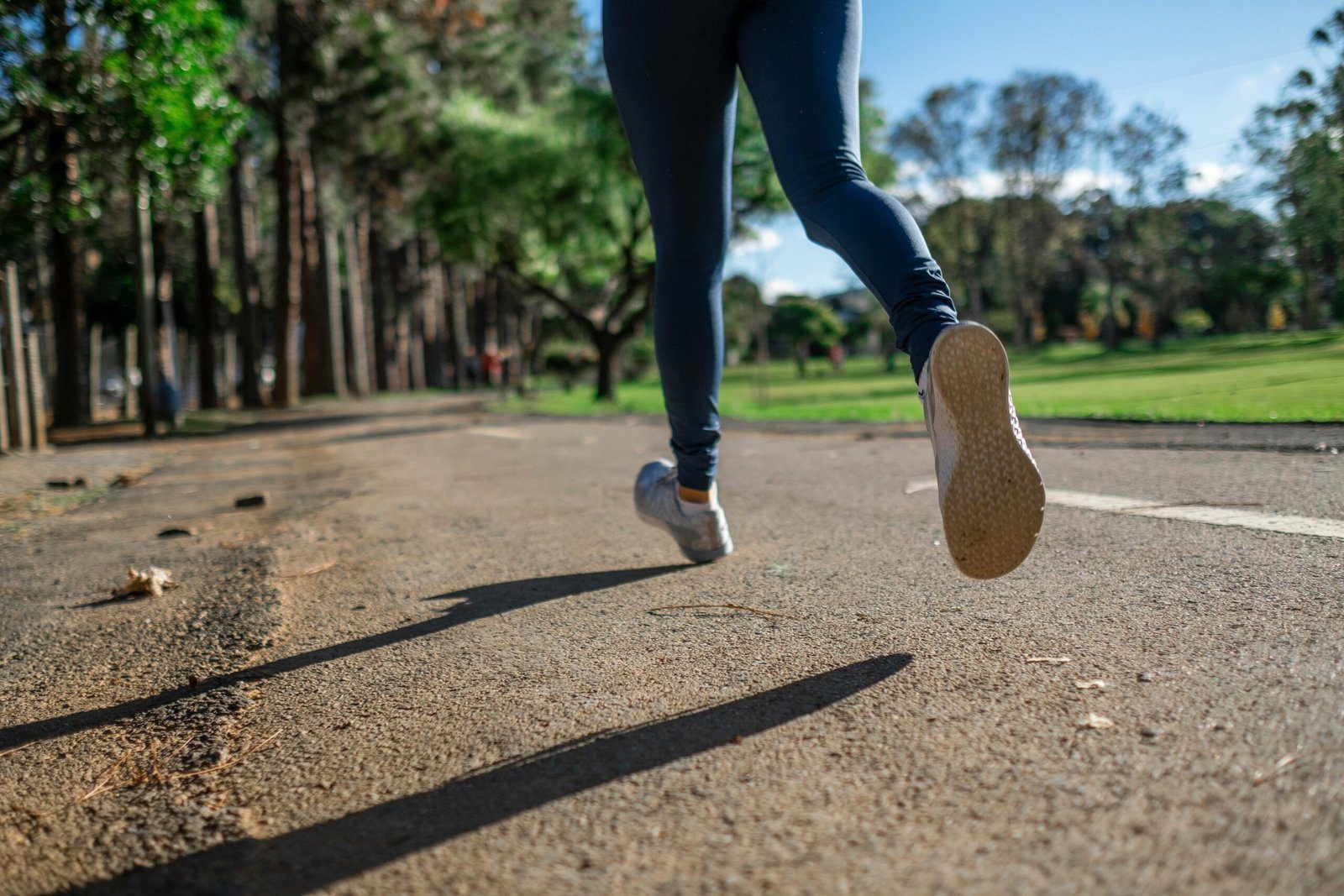
Image courtesy of Tara Glaser on Unsplash

Accountability buddies

Our first parkrun certainly wasn’t our fastest, with both of us clocking in around the 40-minute mark. We noted how gratifying it was to run alongside like-minded people — the rush of racing from a starting gate in a stampede. Everyone held each other accountable to achieve only the best that could be managed on that day.; 

Tthere was no competition with each other, or even past personal records. 

If we slowed to a walk, those overtaking would spur us along to keep us moving. The marshals around the course would cheer as we arrived at every checkpoint. Truly, witnessing the support network was incomparable.

Fitness tourism

Once I returned to university in 2023, I started clocking regular parkruns with my good friend John (who was something of a parkrun buff already). Through our frequent outings, I learned even more about the parkrun lifestyle. 

Courses are run on a variety of terrains — parks, forests, trails, promenades, beaches, hills, and wherever else permissions can be granted. The range of difficulties and experiences has given rise to a phenomenon called “parkrun tourism.”

Many runners set personal challenges — for example, completing a parkrun starting with every available letter of the alphabet, necessitating trips to countries such as Poland or the Netherlands to knock off tricky letters such as “Z.” UK-based parkrunners might try to complete at least one course in each of the major regions of the United Kingdom. John is one parkrun away from completing all the current 65 courses in the Greater London area, an achievement aptly named “LonDone”. 

I’m only at a measly 22.

(Image courtesy of Sherise Van Dyk on Unsplash)

Transformation

I’d always been interested in running throughout school and university, but something kept holding me back. Perhaps I felt too shy to demonstrate such a level of exertion in public, or maybe I had a stigma that I was more of a sprinter and could never build up my endurance.

Parkrun changed all of that. The community spirit is transformative — and one of the highlights of my week. Almost three years later, I’m 80 parkruns down and achieving sub-23-minute times regularly. I’ve started completing runs twice more in the week on Tuesdays and Thursdays. My fitness and happiness levels have improved tenfold; as a writer, it’s easy to sink into ideas without coming up for air, and running has become my tactic for modulating that burnout. I hope to continue exploring new parkruns and achieving milestones far into the future.

In searching for a new fitness regimeway to commit to consistent exercise, I initially saw parkrun as a starting point. 

Looking back now, starting was the easiest part for me.

Stopping is so much harder.