Business isn’t about numbers — it’s about your voice. We share real stories from entrepreneurs, professionals, job seekers, and career changers. From interviews to resignations, work wins to burnout — your journey matters, and we’re here to spotlight it. Work-life balance and everything in between — because behind every job title is a human story worth telling. Share yours with us.
Do you ever find yourself caught in the worry that your diverse passions could lead to confusion in people around you? Your audience, even? Maybe, like myself, you’re concerned that this could even endanger the success of your business because you’re scattered all over the place. We are squiggly lines, and society likes straight, linear individuals.
However, I dived into the heart of these concerns and explored why embracing my faceted nature is the key to unlocking unparalleled success, both in life and business.
(Image courtesy of Randalyn Hill via Unsplash)
I started thinking back and reflecting on all those instances where I’ve come across individuals I deeply admire. Have I ever been put off by their passionate discussions spanning a multitude of topics?Can I recall a time when their exploration of different interests left me bewildered? Honestly? Rarely. In fact, it’s often exhilarating to witness our favorite communications expert delve into the realms of “erotic power,” or witness a business coach passionately writing about the world of music. It’s in these moments that a genuine connection forms. We trust these multifaceted individuals, and we are itching to accompany them on their journey of diverse passions — we crave it — eagerly absorbing the wealth of knowledge they offer through their content and experiences. It is because they talk about different things that fascinate me!
Why, then, should it be any different for you and me? As I was navigating my path as an entrepreneur, I started noticing that my clients were drawn to my transformative journey and the energy I radiate. They seek my authenticity and my liberation from struggles, which mirror their own. If we restrict ourselves due to apprehensions about our multifaceted nature, we unintentionally limit the very authenticity that attracts our clients.
I’m not alone in this journey, and neither are you. Understand that your energy, your natural inclinations, and your passions, are all your guiding lights. Trust in them. Just as your clients trust you to lead them toward transformation, trust yourself to lead your business with the same authenticity. At times, I noticed those who struggled to grasp my authenticity. It’s an indication that they might not be my true audience — and that’s perfectly okay.
It’s about crafting a holistic approach that blends your multifaceted essence with the digital landscape: all dimensions that your target audience absorbs information through. I can still share your specific insights, my offers, and the results my clients can achieve. The specificity that matters isn’t the niche I fit into but the genuine value I bring to the table.
I’m embracing my restlessness. I have the unique ability to expedite progress and satisfaction. I move from one interest to another with remarkable speed. And this is my strength. Unlike others, I have the power to shift focus effortlessly when an endeavor no longer aligns with my energy. This agility is a boon, a testament to my dynamic nature. A nature I’m no longer resisting. I am loving it. And if you’re anything like me, rest assured, as long as you’re driven by passion rather than frustration, the right people will gravitate towards you.
We live in a world that often values specialization over diversity, so embracing my multifaceted self has seemed like a challenge. Yet, it’s precisely this authenticity that sets me apart.
So, trust your journey. Embrace your versatility; embrace your passion. Let intuition guide you in creating anything that reflects your genuine self. As you do so, you’ll find that your audience – your tribe – is already out there, waiting to connect with the unfiltered, multifaceted you.
After-work drinks, generous customers, access to stock, brewery days, meetings in pubs, beer festivals, wine and spirit product tasting, line-cleaning sessions, and being surrounded by alcohol all day. Working in a pub not only facilitates regular drinking, it is actively encouraged. For some, this sounds like a dream.
Enthusiastic about drinking back in the early 2000s, I was drawn to working in the industry. But with an already developed alcohol problem stemming from my teens, I found that working in a pub fueled this at an extreme rate. Today, the sober-curious movement has introduced a wide array of alcohol-free alternatives in pubs for the customer.
But there is still very little being done by pub companies and breweries to safeguard their staff. In a 2021 study by BMC Public Health, 353 UK jobs were analyzed. The study found the most significant ratio of heavy drinkers were publicans and managers of licensed premises. Certainly, an industry that would benefit most from prevention programs.
Early exposure
I grew up in Yatton, a village halfway between Bristol and Weston-super-Mare in the south west of England. It was a fairly idyllic 1980s childhood with kickabouts in our cul-de-sac and cricket in the fields surrounding our streets. But I often had a pang of sadness in me. I was quiet as a child and never shared how I felt, which led to feelings of disconnect and loneliness.
I started experimenting with alcohol at 12 and instantly fell in love with how it made me feel. It was a kind of liberation. It released me from the feeling of being trapped within myself. My teenage years were then all about where the next party was and how we were getting our booze. I couldn’t get enough and quickly gained a hedonistic reputation.
But on each occasion, I got carried away and passed out, being told what I did or what was done to me the next day. By the time I was 15, I was depressed. But no one spoke about mental health in the nineties and I couldn’t understand what was happening to me. Alcohol allowed me to escape the depression. At least, initially.
But by 17, I was drinking alone and at crisis point. Struggling secretly, I planned my first suicide attempt. But I fought my way through and completed my A-Levels, never telling anyone what I was going through. I just knew that qualifications were my opportunity to escape.
The drinker’s double life
In 2000, age 18, I moved to London to attend the Metropolitan University’s communications and audio visual production course. I didn’t get into halls but found a house-share with six others in a large property in Stratford, East London. But after a few months of drinking and hangovers, I stopped attending university. Instead, I found a bar job, which I loved. I made friends, worked hard, partied hard, and felt like I belonged somewhere.
But it didn’t take long for this to get out of control. I found myself in the cycle of drinking every evening and passing out anywhere from a corner in a pub, on the tube, or on the street. Regularly, I woke up somewhere I had no idea where I was and had to take myself home for a quick shower and then back to work amid a mighty hangover fog.
I’d make it through the day, but after pouring beer all day. And, in an attempt to hide from my problems, I’d finish with “a few” pints after work again. Being surrounded by alcohol normalized daily drinking. I thought it’s what everyone did, especially at my age. The lifestyle came with its dangers, though. Over ten years, I was raped multiple times and found myself in countless situations where I didn’t know what I was doing or who I was doing it with. I felt utterly trapped in a cycle of self-hatred and attempts to alleviate the shame with more drink every day.
But throughout this period in my life, I was actually very high-functioning. Known as the “drinker’s double life,” functioning alcoholics often have steady careers, disposable incomes and positive relationships while they hide the seriousness of their alcoholism from those close to them.
Management and misuse
I ran my first pub when I was 25. Working for a large London brewery, I climbed from bar server to general manager through extensive management progression training. I learned about profit and loss, licensing and legislation, stock control, recruitment, training and disciplinaries, kitchen hygiene, and cellar work. But I never learned about responsible drinking, managing stress and mental health, or interventions or prevention programmes for staff who may develop drinking problems.
The pub was trading well and I was making good bonuses. So after paying rent and bills, I still had a significant disposable income to spend on more booze. Friends and family could always rely on me to be up for a drink and a good time. Often, they witnessed me having too much, perhaps passing out somewhere or falling over, but that was all in the spirit of the lifestyle. Life was all about enjoyment and I thought alcohol was the only way to achieve this. But, hidden to many, I was struggling with severe depression and drinking daily to deal with it.
I often woke up without remembering the end of the night. Sometimes on the floor. Sometimes in a bus terminal. Sometimes in a stranger’s house. The shame was too painful to acknowledge; I would do my best to push the feelings down and put on a smile. Alcohol made this easier. However, this progressively detached me from any emotions at all, and my true self sank away. Soon, all I knew was the shiny exhibited version – the side my customers saw. I had no idea who I was or what I liked.
(Image courtesy of Andra C Taylor Jr. via Unsplash)
Over time, the murky underbelly of my life grew bigger, infiltrating me like a poisonous gas. I was suffocating. Backed into the last remaining corner, it became too hard to hide from the shame and it became impossible to keep the smile on. Consequently, I became suicidal again as I was desperate to escape the exhausting cycle of pretence and remorse.
Attempting to get a grip on my drinking, I often told myself in the morning that I wouldn’t drink that day. But after spending hours pouring pints, I would have a few “in the till” from customers by the end of my shift or I would know which beer currently had a large stock surplus and I’d pour myself one. Propped up at the end of the bar and chatting with my staff and customers, who were all of a similar age and who I considered my friends, it felt completely normal to spend my evenings off this way.
Of course, as an alcoholic, I wasn’t able to stop at one or two and this led to several drinks before stumbling home. Friday nights were line-cleaning nights. After we closed and cleaned up, three pints from each lager and cider tap were poured into jugs for us to drink before the line-cleaning chemicals came through. It was quite a skill to stop it just in time. This was very often the start of drinking until dawn.
Monthly area meetings were always in one of our pubs, with drinks on a company credit card afterwards. Then, a few months into my role, I was given the additional title of Ale Champion, as the only manager in the area enthusiastic about cask ale. This role allowed me one day each month out of my pub to taste and learn about beer at beer festivals or at the brewery. I was literally being paid to drink. The next few years saw a few mental health crises and leaving jobs to escape my increasingly intolerable headspace, twice leaving the UK to escape. I kept running until I was 35. Eventually, though, I gave up pub work and finally gave up drinking. I’m now six years sober.
Working in pubs did not make me an alcoholic, and my experiences are extreme. It did, however, facilitate and enable my alcoholism.
Industry silence and call for change
In April 2023, I contacted 11 of the biggest UK pub companies to inquire whether there were any policies in place for safeguarding staff and whether they had any interventions for when it had gotten too far. Only two replied.
Nicholson’s sent me an alcohol responsibility policy, but this was for guests and the sale of alcohol, not for staff. Marstons told me their policies were internal and not for the general public. Their silence is staggering. Since 2001, when I started my first bar job, there has been no improvement.
I recently met with Dru from Club Soda, a small organization committed to helping people drink more mindfully and live better by promoting low and alcohol-free drinks, providing courses, and setting up alcohol-free events.
Dru told me he is “continually disappointed” by the big pub companies, who he says are difficult to engage with. He says many of them offer yoga days, vegan days, and promote well-being with their staff, but they go silent when the dangers of alcohol are mentioned.
Obviously, it’s not good business sense to tell the world that your core product is harmful, but shouting about the good work you’re doing to safeguard your staff could be excellent PR. The good news, though, is that there is some movement among smaller companies.
Club Soda works with The Drinks Trust, a charity dedicated to the drinks and hospitality workforce. They offer a service for businesses that can’t provide an employee assistance program due to the size of their company, and it is the smaller businesses that are most receptive to safeguarding their staff.
Alessandra from The Drinks Trust told me their free service for hospitality professionals was set up to benefit staff wellbeing. She added that their work with Club Soda has already helped thousands of people change their relationship with alcohol. Although with only 120 people per year signing up for Club Soda’s courses, there is still a long way to go.
The team at Bristol Beer Factory are also doing great things. I contacted Tom Clermont, head of sales for BBF. He reported that BBF invests more time and money into promoting Clear Head, their 0.5 percent alcohol IPA, than any other product. The beer was brewed with their primary charity partner, Talk Club, a Bristol-based mental fitness charity for men. Five percent of every bottle or pint sold goes directly to keeping Talk Club sustainable through regular cash donations to keep building a community of positivity and mental fitness.
Tom also told me BBF invests in their managers by enrolling them in mental health training. He also says BBF is on its way to achieving B-Corp status, a certification of proven excellence across staff happiness and policies, environmental impact, charitable giving, and community engagement.
Unfortunately, the wine industry is still a little sniffy about alcohol-free alternatives, instead adopting the mantra, “drink less, drink better.” A cynical mind could view this as an upselling technique. However, Liberty Wines, a wine wholesaler and importer based in London, has been working with Club Soda on an in-house workshop, Discover Mindful Drinking, to promote a mindful drinking culture within their company.
On a larger, global scale, Healthy Hospo supports drink brands to promote health and wellbeing, which, they claim, is tackling the problem at its source. I met with Jason Knüsel, co-owner and director of the non-profit organization. We discussed why so many are attracted to the job, such as the buzz you get from being around lots of people in a fast-paced environment and the passion for food and drink.
He told me that workers are still trained in many food and drink tastings but not about the dangers of excess, which he believes is due to the large-scale benefit of tax to governments worldwide. Healthy Hospo offers courses raising awareness, and educates staff about drinking habits and the science of neuroplasticity, the way the brain rewires itself through new routines.
But Jason tells me that hospitality is a mess. Since the pandemic, the industry has been losing a third of its workforce every year on an international level, citing mental health, cost of living, and life reevaluations in lockdown as a few of the causes. Industry sustainability is diminishing fast.
I don’t blame the pub industry for my alcoholism. This was well-developed on my own. But it’s been on reflection that perhaps pub companies need to take some responsibility for their employees. People who are attracted to working in pubs are often enthusiastic drinkers, making them susceptible to the progressive nature of regular heavy drinking. This is entwined in the culture.
Companies and organizations like Club Soda, The Drinks Trust, Healthy Hospo and Bristol Beer Factory are paving the way for culture change. Others need to follow.
The next steps are to implement company policies for prevention and processes for alcohol responsibility and awareness among staff. Interventions should also be planned for when an employee’s alcohol intake tips from social to dependent drinking. Hopefully one day, the big pub companies will follow the smaller organizations and breweries to take some responsibility as well.
There I was teaching live. Even though I majored in English as an undergraduate and as a master’s student, it was difficult for me to imagine myself in front of the classroom. I was notorious for doubting myself. Heck, I still doubt myself today, even if it’s been five years since I started teaching.
Upon earning my Masters in English in Spring 2018 from the University of Hawai’i at Mānoa, I secured a lecturing position there to teach one section of English 100 in the Fall-2018 semester.It was a long shot, becoming a fresh graduate and applying as an adjunct lecturer. Courses were going to be filled based on seniority, as a fresh graduate I was at the bottom of the list- tenured and assistant professors first, doctoral students with funding second, doctoral students without funding third, and graduates last. Luckily, I was able to secure a course to teach.
I remember stressing out all summer, granted I was overthinking about the lectures I would take, but that was me. I wasn’t sure how I was going to deliver lessons? What should I talk about? How to plan group discussion and activities, the works??? I had signed up for a series of incoming lecturer training sessions. It was really helpful- developing our course syllabus, schedule and major assignments.
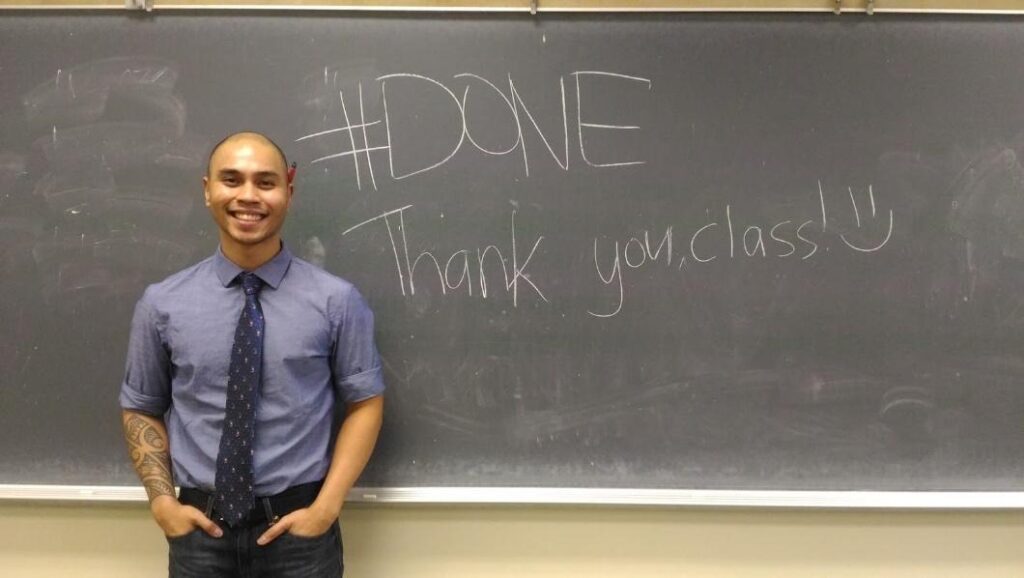
(Image courtesy of Jordan Luz)
Alt text: Author Jordan Luz stands in front of a chalkboard that reads, “#DONE Thank you, class :)” (Image courtesy of Jordan Luz)
We also had the opportunity to give a demo lecture that involved a lesson plan, group activity and feedback from a volunteer audience; they were but the professors and graduate students from the department. Thanks to my masters’ syllabus teaching pedagogy and materials, it was all there. Also, my writing mentor training and working with fellow doctoral students helped immensely. I was placed in the classrooms and worked closely with the students helping them improve their writing, while also being given the opportunity to deliver sample lessons. This rigorous training led me to my first experience in teaching.
Whatever the training, the first classroom experience was nerve wracking. I knew English 100 by heart: free writing, the writing process, thesis statements, topic sentences, transitions, evaluating sources, everything was printed in my head. I had spent so much time engaging with them during graduate school. My major concern was I might mess these topics up and students may not make sense of what I was explaining.
I thought about everything worse that could happen on my first day of teaching.
Lucky me, I had a great support system of fellow graduates, some of them also had prior teaching experience. We had a joyful nervousness; we were about to start teaching for the first time.
Array of questions ran across me, “I still look like an undergraduate student, can I teach?”
“Can the students understand my lessons?”
“What if they don’t even listen to me?”
These were the common sentiments. I felt them more as the semester approached. I remember reaching out to Dr. Sarah Allen, my professor of Composition and Rhetoric. and coordinator of the fresh lecturer training series. I will always be grateful to her. Her words, “just do it. The students don’t know what you don’t know. You’ve been in the classroom. You know how it works. YOU can do this. Be yourself. Be honest with your students. I believe in you” still echoes in my ears.
August 20, 2018. The first day of the Fall semester. I wore a long-sleeve button up shirt with jeans and dress shoes, professional, but comfortable. My partner was in my office, helping me calm down. I even remember pacing in my little office in Kuykendall Hall. I also replayed Dr. Allen’s advice in my mind as I walked up to the fourth floor where my classroom was.
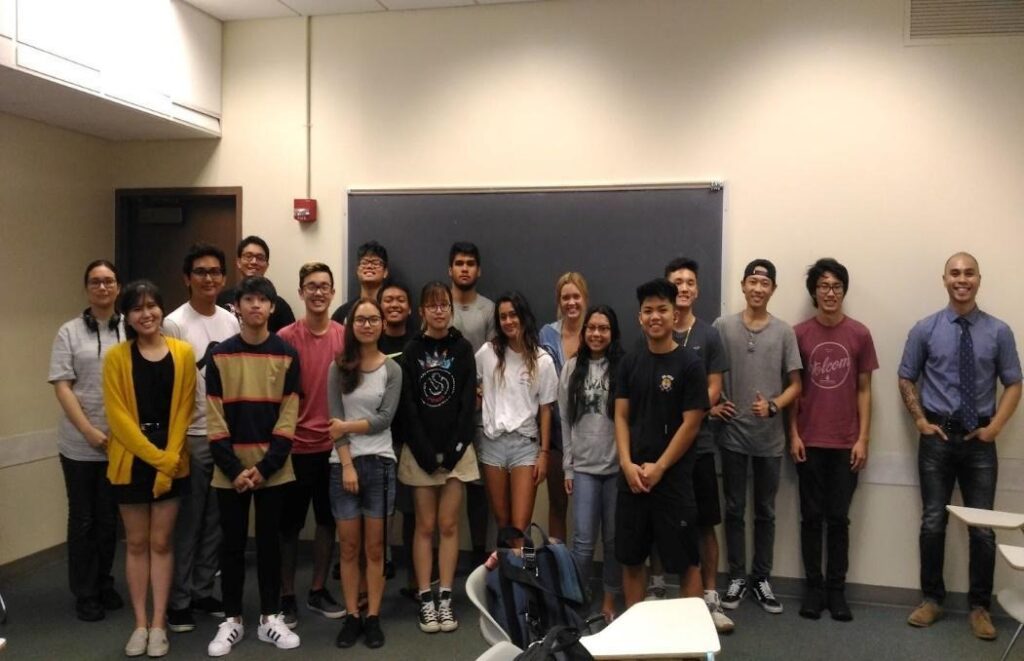
(Image courtesy of Jordan Luz)
I made my way to the classroom computer and pulled up the class roster and syllabus. Students slowly started to trickle in, I was nervous, an even mix of locals from Hawai’i and students from the mainland U.S.
The class started, I was sweating profusely, but was able to find my groove once I started talking. I told my students how I was feeling and, to my surprise, they were
nervous, college freshmen, after all. A new environment for us. It added to my ease. We would navigate this new environment together.
The heaviness lifted off my chest once I got back to my office. Going through the syllabus and having the students introduce themselves wasn’t so bad after all.
I shared my feelings with my partner, Dr. Allen and other first-time lecturers. It turned out that all my nervousness was completely normal; the first day or the 30th day of teaching. I always reiterate Dr Allen’s words “You can be your own worst critic, but rather than focusing on what you did wrong, try to focus on what you did right, what worked, and build on that moving forward.”
I’ve been teaching for five years now; I still get nervous before every class. It is perfectly ok to be nervous.
I wanted to go to college, but this mindset scared me.
I did end up getting a bachelor’s degree. In 2019, I graduated from Boise State University. I majored in media arts with a journalism emphasis, excited to be a journalist. After graduation, I applied to dozens of jobs in journalism. But I got slapped with rejections instead of landing a picture-perfect post-graduation position. Plus, journalism itself stressed me out. I realized I didn’t want to do it full-time. But journalism was a big part of my major and coursework, so I felt obliged to continue pursuing it.
I felt pressured to appease society and family by using my degree. Maybe one day, I’ll have a job in journalism. But I’m not actively pursuing one. Now I enjoy my job that doesn’t even require a degree. I’m no longer giving into the pressure.
The pressure to pursue
I believe a degree is absolutely worth it for those who want one. But at 18, we are told to either choose the right subject to study or be ready not to make much money. The journey from college to career is portrayed as a linear one. There’s a perception that one’s career path is determined solely by what their degree is in.
(Image courtesy via Javier Allegue Barros via Unsplash)
But from my experience, I’ve found that the value of a degree is a spectrum. Even though my job isn’t related to my degree, I still find plenty of worth in my studies. It may not be the worth people typically expect, but that’s nothing a change in perspective can’t solve.
Through introspection, I found happiness outside of the confines of my degree’s subject matter. Plus, it’s not the piece of paper that matters most. It’s what we learn while working toward it.
The hidden value of a degree
Attending classes, reading textbooks, and completing assignments are valuable. The diploma itself won’t display the years of our late nights and the best and worst memories. The degree is about more than what we studied.
Working toward that degree built lifelong skills. These include teamwork, critical thinking, communication, adaptability, problem-solving, and more—skills needed in the workforce. Using them means that the degree is being used, regardless of whether or not the name of the degree fits the job description.
So, even without a career related to the degree, those interdisciplinary skills are being implemented in that career or job search every day.
Finding joy in life is important, and a dreadful job won’t help that. I followed the path of passion, not the narrow one society expects everyone to go down. Getting a degree is an accomplishment in itself. It’s not a stepping stone to a potential accomplishment. As students, we learn life skills we can bring to every facet of our lives.
And more importantly, during the short lives we have here, we learn more about the world and ourselves.
As a medical intern, what else can I think of other than the whirlwind of patients?
New challenges and lessons are what each day brings, but nothing could have prepared me for the encounter. An encounter that would leave a lasting imprint on my heart and impact my approach to patient care.
It was a typical morning at the hospital when I received his case. He was diagnosed with dengue fever. After a thorough examination, I was asked to put in a urinary catheter as he was having burning sensations during urination. I discovered that he had smegma collected at the urethra, likely due to poor genital hygiene. This condition, though not uncommon, required a delicate approach to counseling the parents about the importance of that hygiene.
As I walked into the consultation room to meet his parents, I felt a mix of emotions— empathy for the child’s discomfort and anxiety about how to broach the subject with his parents.
I took a deep breath, reminding myself of my duties as a doctor. My responsibility was not only to diagnose and treat but also educate and empower.
His parents’ love for him was evident, but as I probed further, I realized his parents were unaware of the essential steps of genital hygiene. They looked concerned and anxious as I gently explained the importance of cleanliness to prevent infections and discomfort. As I spoke, I tried to be sensitive and compassionate, ensuring I didn’t make them feel judged or inadequate as parents.
I drew parallels between routine hand hygiene and genital hygiene to make it relatable for them. Slowly, their apprehension began to fade. Their ignorance was now replaced by a genuine interest in learning how to take better care of him. I demonstrated the correct method and recommended age-appropriate techniques to teach him as he grew older.
As I continued the conversation with his parents, I realized that connecting with the community was crucial. Any discussions about genitals were considered taboo, a resultant of a generational cycle of ignorance, and breaking it required not just medical knowledge but also cultural sensitivity. I understood that I needed to tailor my approach to suit their beliefs while ensuring his parents grasped the significance of proper hygiene.
(Image courtesy via Brett Jordan via Unsplash)
His case instilled in me a sense of social responsibility. I immediately proposed a project for the tribal population, offering encouragement and support as they navigated this new chapter of a subject long considered taboo. Initially there was resistance but with time, they became more comfortable discussing their concerns and asking questions.
The success here encouraged me to host awareness programs addressing common health-related misconceptions and promote open conversations about hygiene and health. My aim was to empower parents and caregivers with knowledge to ensure a healthier future for him and children like him.
(Image courtesy of charlesdeluvio via Unsplash)
His incident taught me an invaluable lesson–that compassion, patience, and cultural awareness are as important as medical expertise. As a doctor, I learned the privilege of Healing Beyond Medicine was by building rapport and trust with patients and their families. Through these efforts, I hope to witness a transformation within the community. Parents should feel more confident seeking medical advice, and conversations around health must become normalized. Being a medical intern not only taught me medical skills but also the profound significance of doctor-patient counseling. Empathy, warmth, and understanding can bridge gaps and lead to lasting changes in patient lives.
My journey with him and his parents taught me that true healing goes beyond prescriptions. It involves a genuine connection with the community we serve and a reminder that no issue is small and, if tackled properly, it can lead to a huge impact in the community.