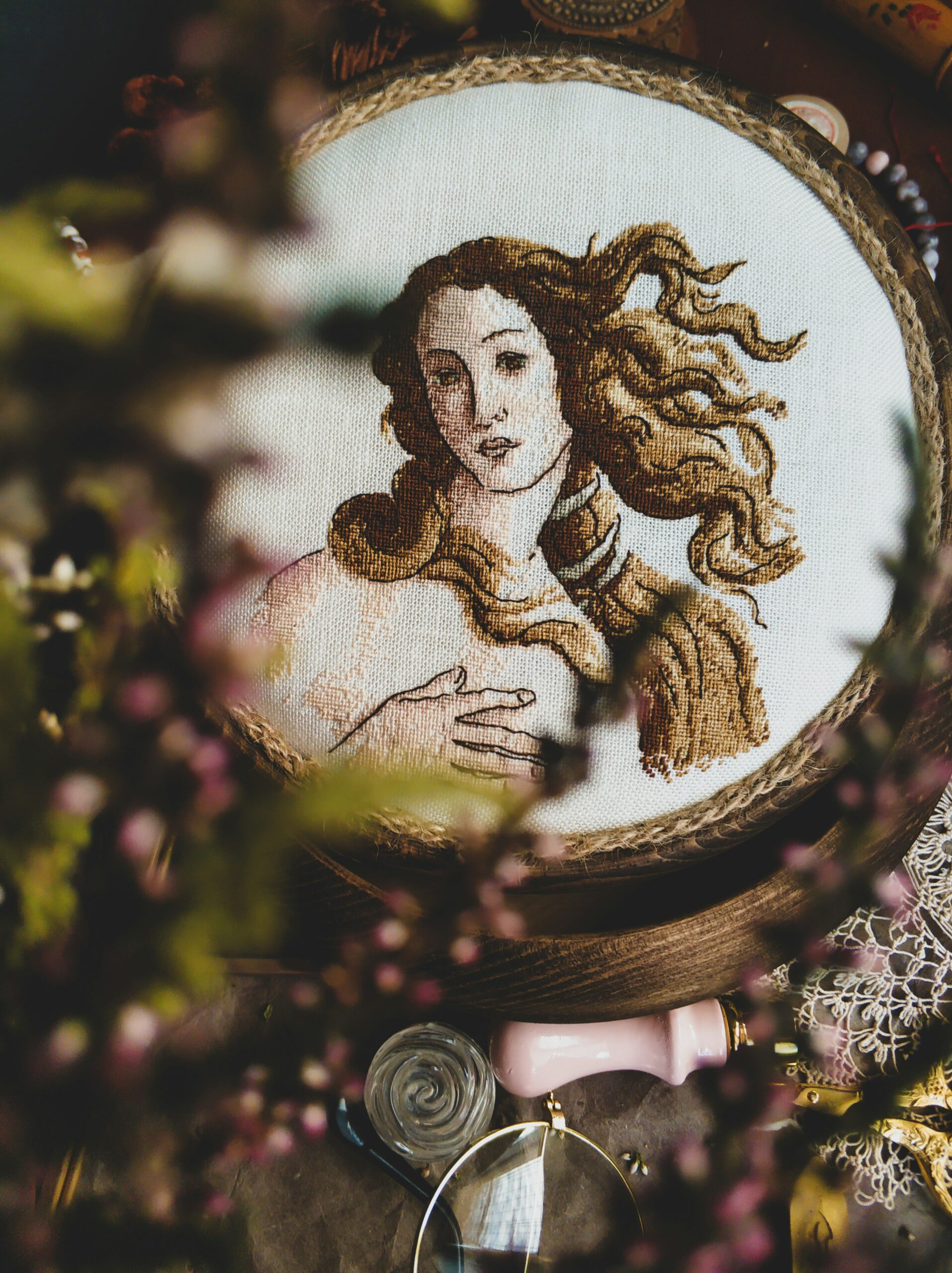
I have a lot of hobbies. I started cross stitching in middle school and knitting and crocheting in college. So, for most of my crafting life, I have been balancing learning these crafts and going to school. Now, in my early 30s, I must squeeze in whatever craft time I have with my work and taking care of my family. I love my life, but having my skills often stagnated is often emotionally taxing.
I’ve always had very high standards for certain things. No good baked or dish cooked has ever been perfect. After trying the fruits of my labor, I always have to make a note about an ingredient that needs adding or that the cooking time needs to be adjusted. This deep need to sharpen my skills is why I went to grad school. The idea of knowing everything about a subject was enticing. I so desperately wanted to deepen my language skills (in multiple languages) and develop my research skills. Imagine my disappointment when I realized that learning everything was impossible.
This desire, however, still exists in my crafting life. It is not enough to be good at my chosen crafts. I expect my products to be impeccable. I must be able to win the blue ribbons at state fairs (I have never entered a project into a contest, nor have I been to a state fair. But the expectation remains). Other crafts also call to me: sewing (quilting especially, but also hand quilting), embroidery, basket making, loom weaving, spinning, nålbinding, bobbin lacemaking, yarn dyeing (with both natural and artificial dyes) – the list goes on! There lives in me a desire to learn carpentry despite knowing that I absolutely do not have the coordination to be around power tools. This bucket list is not taking into account the instruments I do and want to play, the languages I want to learn, the movies I want to watch, the books I want to read. I thank whoever responsible that I was not born with the talent to draw or paint, because that would open another can of worms.
So, when the holiday season rolls around and we’re inundated with talk of New Year’s resolutions, it is not a surprise that I make an ambitious list of projects that I never finish. For example, I started a reproduction of Long Dog Samplers’s “Pandemic” cross-stitching pattern. Created while most of the world was in quarantine during the early days of the COVID-19 global emergency in 2020, this pattern was designed to keep stitchers entertained while staying indoors. The piece is mammoth. The finished project is about 20 inches wide by 24 inches high.
I managed to score a copy when the company was giving it away for free in late 2020 and put it at the top of my project queue. Having acquired the necessary materials for Christmas, it was my resolution to start and finish the piece in 2021. Also on my list were: learn how to use my sewing machine, knit a sweater, and learn how to crochet doilies.
In 2022, I resolved to finish it.
In 2023, I resolved to finish it.
In 2024, I finished the piece on Thanksgiving Day.
Of course, I wasn’t dedicating every single second of every single day to “Pandemic.” I was in grad school. I was spending time with my dogs and my husband. I was giving birth, at one point. I was, admittedly, working on other cross-stitching projects concurrently. I do not regret the time it took to complete this huge accomplishment. I am so proud of my work.
But, at the same time, I have yet to develop the skills necessary to knit a sweater. I only just learned how to crochet doilies this past year (unexpectedly, the patterns make a lot of sense to me, and I am very good at making them). Years have come and gone, resolutions made and unfulfilled, and I feel as if my skills have remained stagnant.
And usually this doesn’t bother me. Lately, my life is too busy to be distracted by my harsh self-critiques. I can bounce from project to project with enthusiasm and whimsy. That is, until I visit everyone’s worst enemy: social media.
First, before I break down the negative, I want to say how grateful I am for the resources social media provides that wouldn’t have been accessible in the past. I have countless sources of information at my fingertips. I can go on Ravelry and find tens of thousands of knitting and crochet projects within seconds. I can watch a YouTube video for a tricky method instead of having to resort to written instructions. Posts on Instagram give me color and pattern inspiration. And, not to be rude, I learn from the mistakes others make (if I had a nickel for every time I exclaimed, “With that color combination?” to myself while scrolling).
Platforms like Instagram, TikTok, and Reddit inundate us with narratives of perfection every day. Usually users purport physical perfection, aided by the use of filters. But there exist the feelings of imperfection one gets when looking at the life events that people choose (and choose is an important word here) to share. People rarely share the negative aspects of their lives. So, when crafters share flawless shots of their WIPs (works in progress) or FOs (finished objects), it’s just as likely one will be inspired as much as they could feel inadequate.
Sometimes, this feeling can be instructive. If someone’s stitches are neater than mine, I can take that in, find strategies to improve, and grow. But the pressure still exists, and it is not always constructive. For example, about once a year I attempt to learn how to knit Continental style (holding the yarn with the left hand) instead of English style (holding the yarn with the right hand). This is because so many Continental knitters boast about their speed and how their style is more efficient than that of English knitters (despite the fact that English knitters often have better tension, and therefore better-looking FOs). My mind just cannot grasp Continental, no matter how much I try. But then I think: when I finally achieve my dreams of being able to make garments without agonizing over how to do it, am I going to remember how speedy I was?
Then, there are the variables that I cannot control, namely the depressing obsession with scrolling social media instead of working on my projects, but also: other people’s family lives might not be as hectic or demanding; they might have more disposable income to buy better materials; they might have been taught by a family member and, because of this, don’t have to learn the Italian Cast On from blurry videos on YouTube. For some, their craft is their job. They have unlimited hours in the day to become better.
It’s important, to me and for me, that I keep these things in mind when I start to compare my abilities to others’. Comparison does not only steal joy, it can lead to depression if I don’t keep my comparisons in check. I spent much of my late adolescence depressed and I have no intention of going back to that. Frankly, I can’t afford to. I refuse to go back to laying in the dark, wasting away while the world spins on around me.
So where does this leave me with my unfulfilled resolutions and my inability to feel accomplished? I think I’ll keep making resolutions at the start of every year, be they a handful of new projects, a goal to read x number of books, or what-have-you. Achieving the goals is a nice thought, but the journey is the important part. Even if I spend the whole of 2026 never finishing a project, I’ll still be working toward something. What’s worse: not finishing by some made-up due date or having never started at all?
But I really do need to stay off social media.